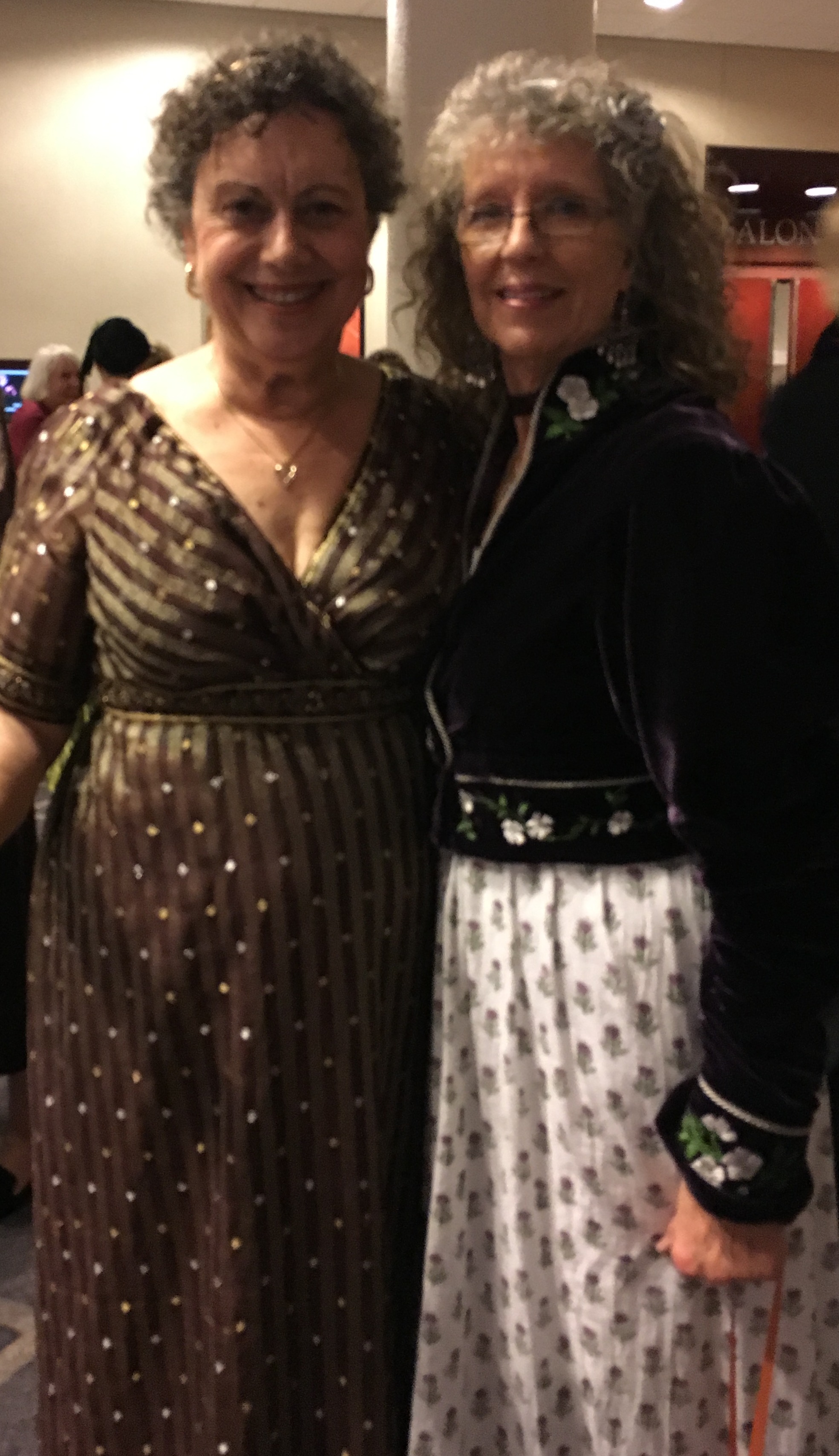
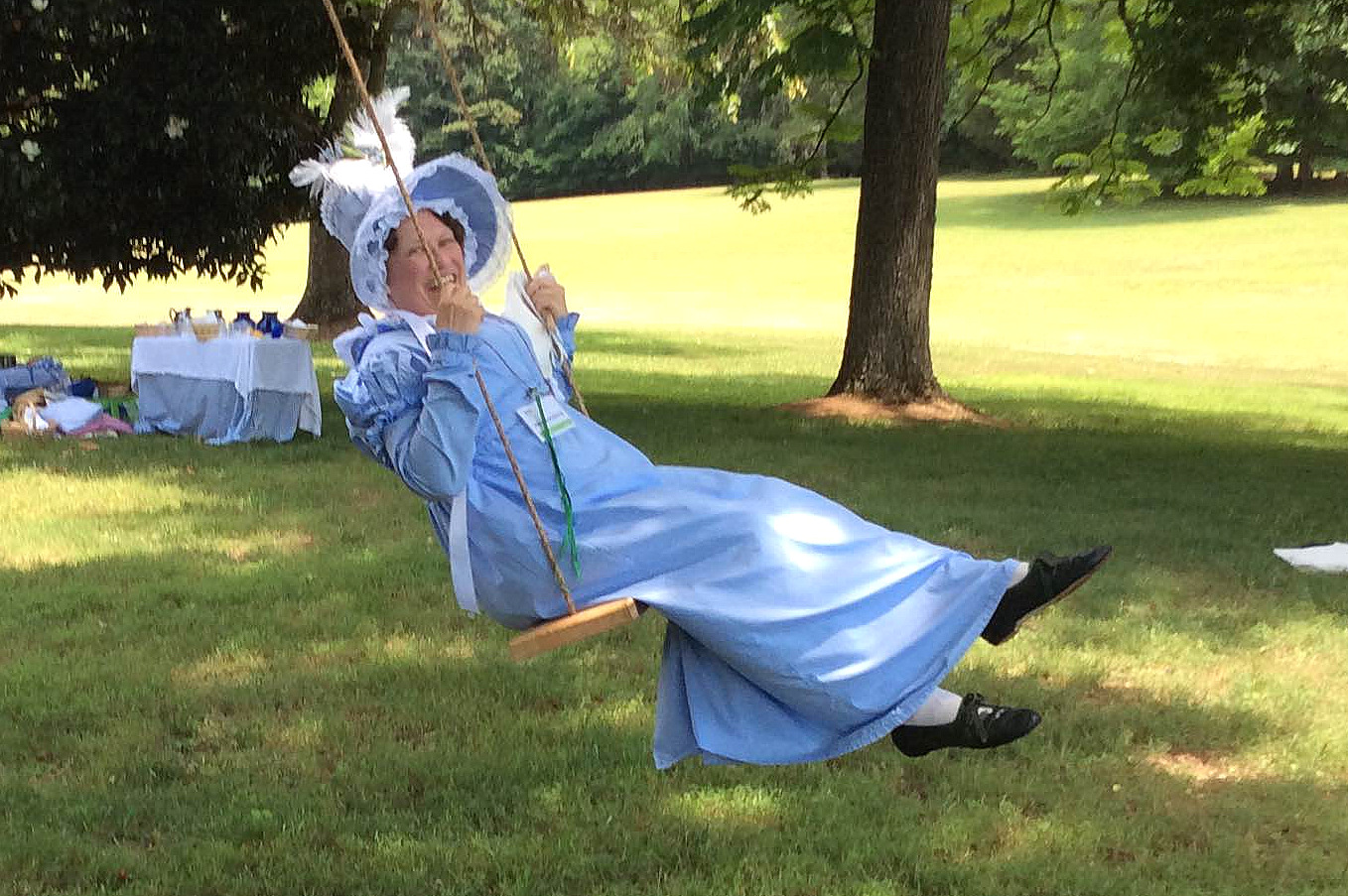
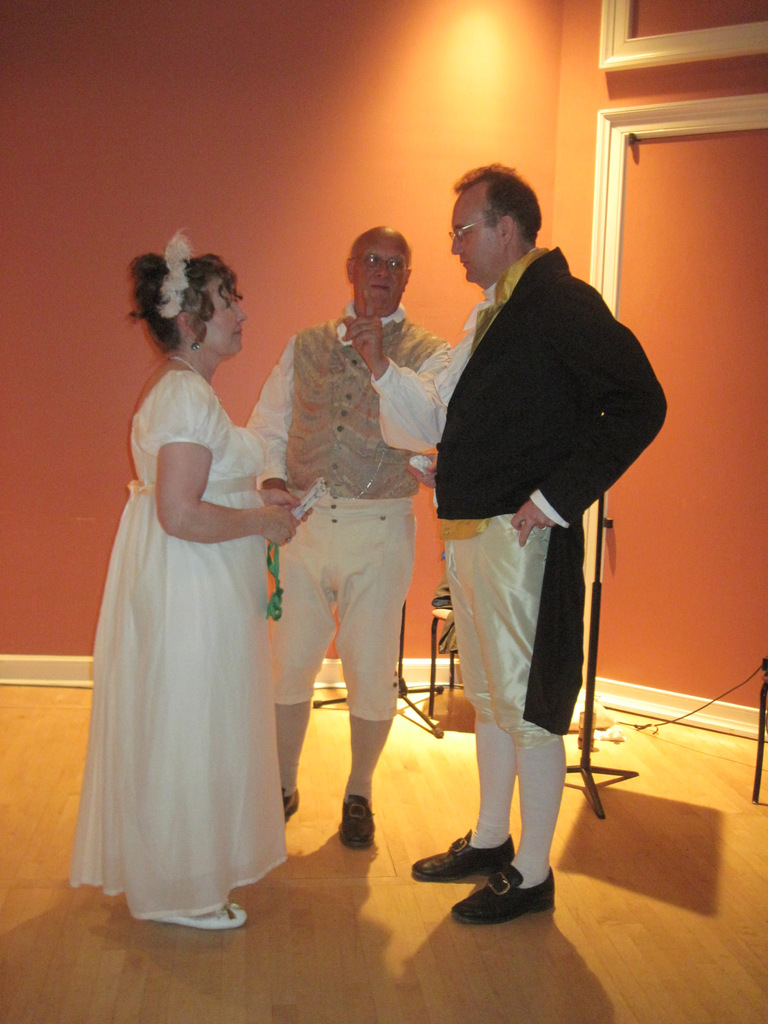
There has been a good deal to write about this year’s terrific JASNA AGM in Washington DC on Emma – but while it always takes me a good while to re-emerge into the 21st century after these events, little time has been accorded me to actually write anything about it. But I did want to give you a quick summary of the books and other “stuff” I bought this year – less than usual because I bought a DRESS and a SPENCER, which did my pocketbook some serious damage…(see the image below*).
But to the matter at hand, here are the books, etc. – most would make fine holiday gifts for your favorite Austen follower, or for your own stocking for that matter… except this first one which would not in any way fit:
Jane Austen. Mansfield Park: An Annotated Edition. Edited by Deidre Shauna Lynch. Harvard UP, 2016.
Very excited to have this, completing my collection of these beautiful Harvard editions. The book was released during the AGM and thankfully Jane Austen Books had copies. I have only skimmed through it, but it promises to live up to the other Harvard editions with an insightful introduction and notes by Lynch, and color illustrations throughout that give you the sense of time, place, and history that surround the adventures of Fanny Price. A must have and a perfect holiday gift for your Austen friends (and at $35, this is the best book deal out there, bar none…)
2. Alden O’Brien, et al.‘An Agreeable Tyrant’: Fashion after the Revolution. Exhibition Catalogue. Washington DC: DAR Museum, 2016.
The catalogue that goes along with the fabulous exhibition at the DAR Museum that many of us at the AGM were privileged to see. Ms. O’Brien spoke at the AGM to take us through the history behind and the creation of this fashion exhibit – complete with characters from Jane Austen’s Pride and Prejudice found in the “Pemberley Room” – it runs from October 7, 2016 – April 29, 2017 and is described on the website as: “…displaying men’s and women’s clothing from 1780 to 1825 in a dozen period rooms throughout the museum. It considers how Americans fashioned a new identity through costume; on the one hand, Americans sought to be free from Europe, yet they still relied heavily on European manufacturing and materials.”
The catalogue is quite lovely, showing full page color illustrations of fashions of the time as well as photographs of costumes in the DAR Museum collection. A must-have for every good Janeite with any fashion sense and perhaps in need of a new dress idea…it also contains various patterns in the back. You can purchase the book through the Museum’s website here. And my friend Kelly has written about the exhibit on her blog Two Teens in the Time of Austen.
Here are a few of my shots of the exhibit:
Mr Darcy
A Man’s Banyan
Pemberley Ladies
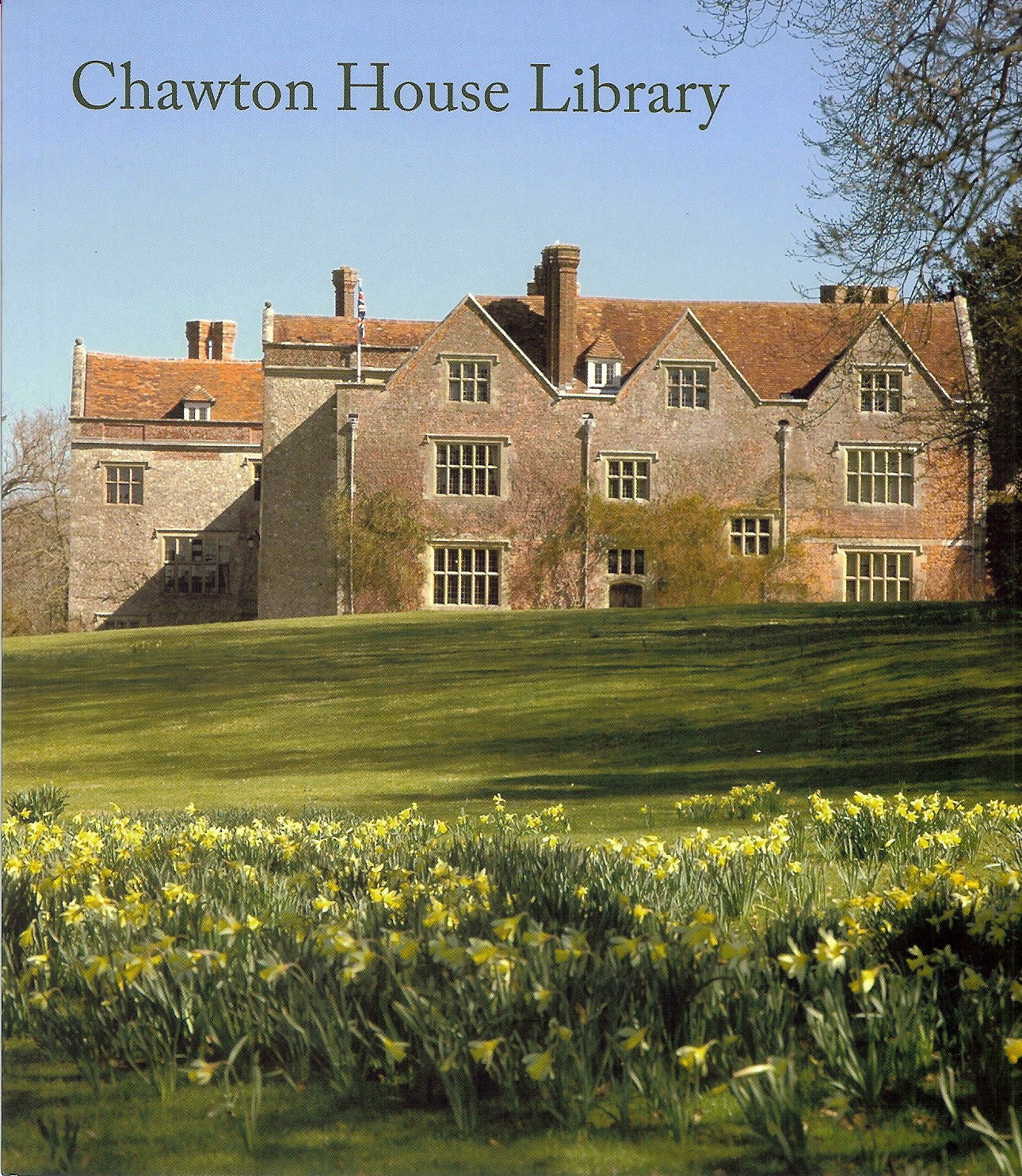
3. Chawton House Library – their new brochure and guide, text by Helen Cole, et al. CHL, 2016.
This is Lovely! It tells the history of the Chawton Great House, Jane Austen’s connection with it, the development of it as a learning centre for the study of early women’s writing from 1600 to 1830. There is much detail with fine illustrations of the house itself: the Library; the various rooms and staircases; exhibition and conference information; the furnishings, art and portraits; the gardens and grounds; and a bit of the history of women writers and their place in our literary heritage. For $12 you get to armchair-tour the house at leisure, and then you will add this to your next-trip-to-England itinerary, as well as a commitment to become a valued Friend of the Library (also a nice gift in a friend’s name).
[Note that the CHL online shop is currently experiencing the dreaded tech difficulties – if you would like a copy, please contact me and I will get one to you.]
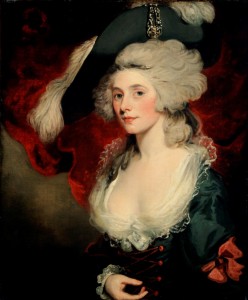
Portrait of Mary Robinson, by John Hoppner c1782 (at CHL)
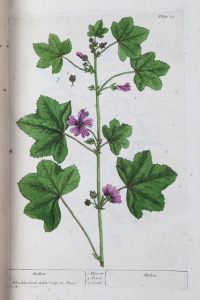
Also from the Chawton House Library – their table at the AGM was jam-packed with goodies – I bought their collection of 8 botanical cards from Elizabeth Blackwell’s A Curious Herbal (frameable!) – you can also “Adopt” this book as a way to support the Library!
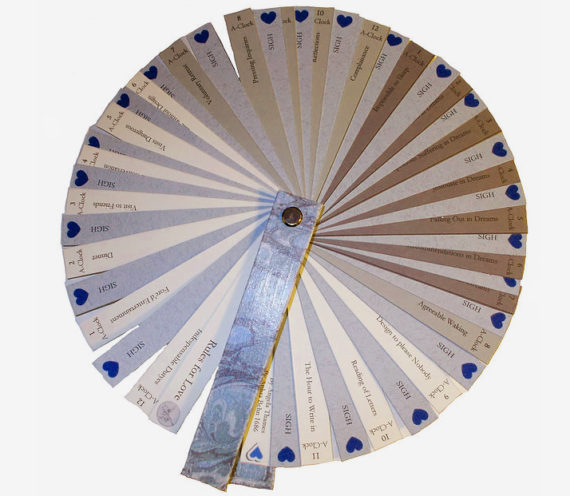
Also couldn’t resist this book-fan “The Rules for Love,” by book artist Angela Thames from Aphra Behn’s 1686 La Montre – (you can read about Ms. Thames as artist-in-residence at CHL here).
4. Susannah Fullerton, Amanda Jones, and Joanna Penglase, ed. Georgette Heyer: Complete to a Shade: A Celebration. JASA, 2016.
Exactly what the title tells us and another must-have – a collection of essays from various JASA folk who have long-been or are new to the joys of reading Georgette Heyer, based on their conference on Heyer in August 2016. Complete with lovely contemporary illustrations, this was just off the press in time for the AGM – $12 (I think) – you can contact JASA for information on how to purchase.
**************
Alas! I was very disappointed not to find a single book on London that I didn’t already have at either of the book stalls – but did find a few oldies worth perusing:
Lt. Col. W. P. Drury. A Regency Rascal. London: Collins, 1971.
The tale of Jack Peregrine, a regency rascal to say the least, who arranges a marriage of convenience for himself to help him through a financial crisis, and then finds himself the heir to an estate in Barbados – all based on the true story of Sam Lord and his Castle (most recently a hotel in Barbados*) – who cannot resist a story of such a man (Heyer couldn’t)! First published in 1937 by Hutchinson, it gives a glimpse of Regency-era life in both London and the Colonies. Will see if it lives up to the hype… [*The property was run as an exquisite hotel for many years but unfortunately it was destroyed by fire in 2010 – it is currently being reconstructed and will open in 2018 as a Wyndham Grand Resort. The 450-room resort will feature 3 restaurants, meeting facilities and a luxury spa] – sign me up!
Sam Lord’s Castle, Barbados, pre-fire
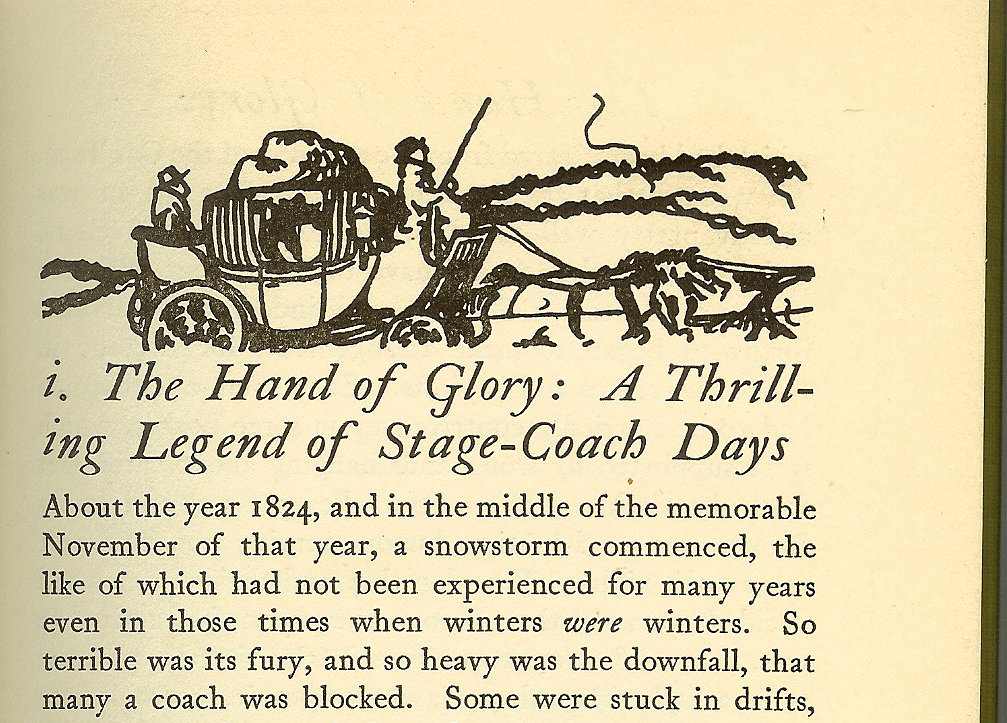
J. Fairfax Blakeborough, ed. Legends of Highwaymen and Others. New York: Frederick Stokes, 1924.
Just because I am a sucker for carriages and highwaymen tales!
(now, doesn’t that peak your interest just a little?)
Hazel Mews. Frail Vessels: Woman’s Role in Women’s Novels from Fanny Burney to George Eliot. U of London: Athlone Press, 1969.Why not? – adds to my collection on women writers – but it also had an inscription that I first thought read “Catherine Morland” and that cracked me up – heavy reading for Catherine! (it reads on close analysis “Catherine R. Harland”).
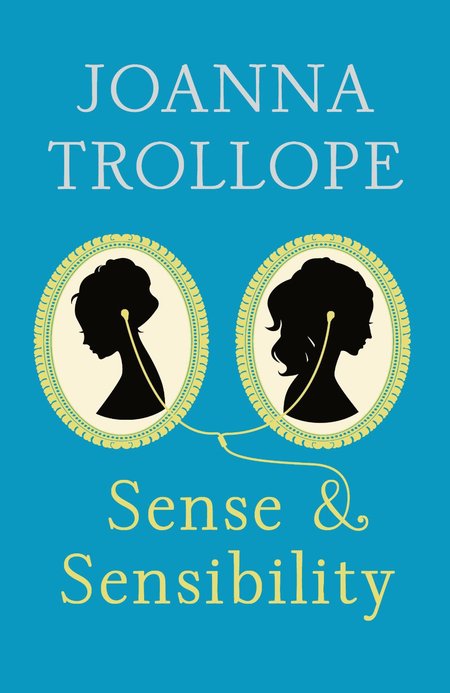
8. Joanna Trollope. Sense and Sensibility. New York: HarperCollins, 2013.
Only because I haven’t read this first of the Austen Project retellings and my Vermont Jane Austen book group has scheduled an S&S re-read this year and thought we would try this to compare…(though I know we will likely be gravely disappointed…)
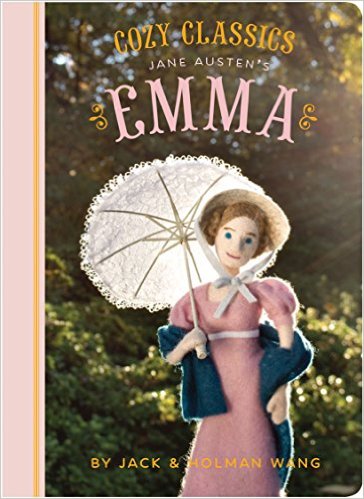
9. Jack and Holman Wang. Jane Austen’s Emma [Cozy Classics]. Chronicle Books, 2013.
This to add to my other board books, and a generous gift from the author. He attended my talk on “Illustrating Emma” and I could not have been more embarrassed to have not included this cover in my talk! (caveat: I did not include any of the covers of the many recent renditions due to lack of time – I have added them to the talk for those times where I can speak longer than the time-constrained AGM) – so with hearty apologies to Mr. Wang – this is of course a simply delightful addition to anyone’s Austen collection!
Erskine, Miss F. J. Lady Cycling: What to Wear and How to Ride. The British Library, 2014. Originally published by Walter Scott in 1897.
I have a friend who recently gave a talk on women and bicycles and my daughter is an avid cyclist – I bought this at The Folger Library shop (there seeing the simply amazing Will & Jane exhibit) as a gift but am now loth to give it away! Women and bicycles have an interesting joint history – here is a worthy account of the whole phenomenon here: http://www.annielondonderry.com/womenWheels.html
*******
So, as usual, I have my reading cut out for me – I would love to hear what YOU bought at the AGM this year…
*and here is my new costume – I am with my Good Buddy Marcia, who is wearing a Regency dress for the FIRST TIME!! (we bought our fabulous fashions at Matti’s Millinery & Costumes (visit their site here and have fun shopping!)
UPDATE #1: new images from the exhibition have been added!
Folger Exhibit Brochure
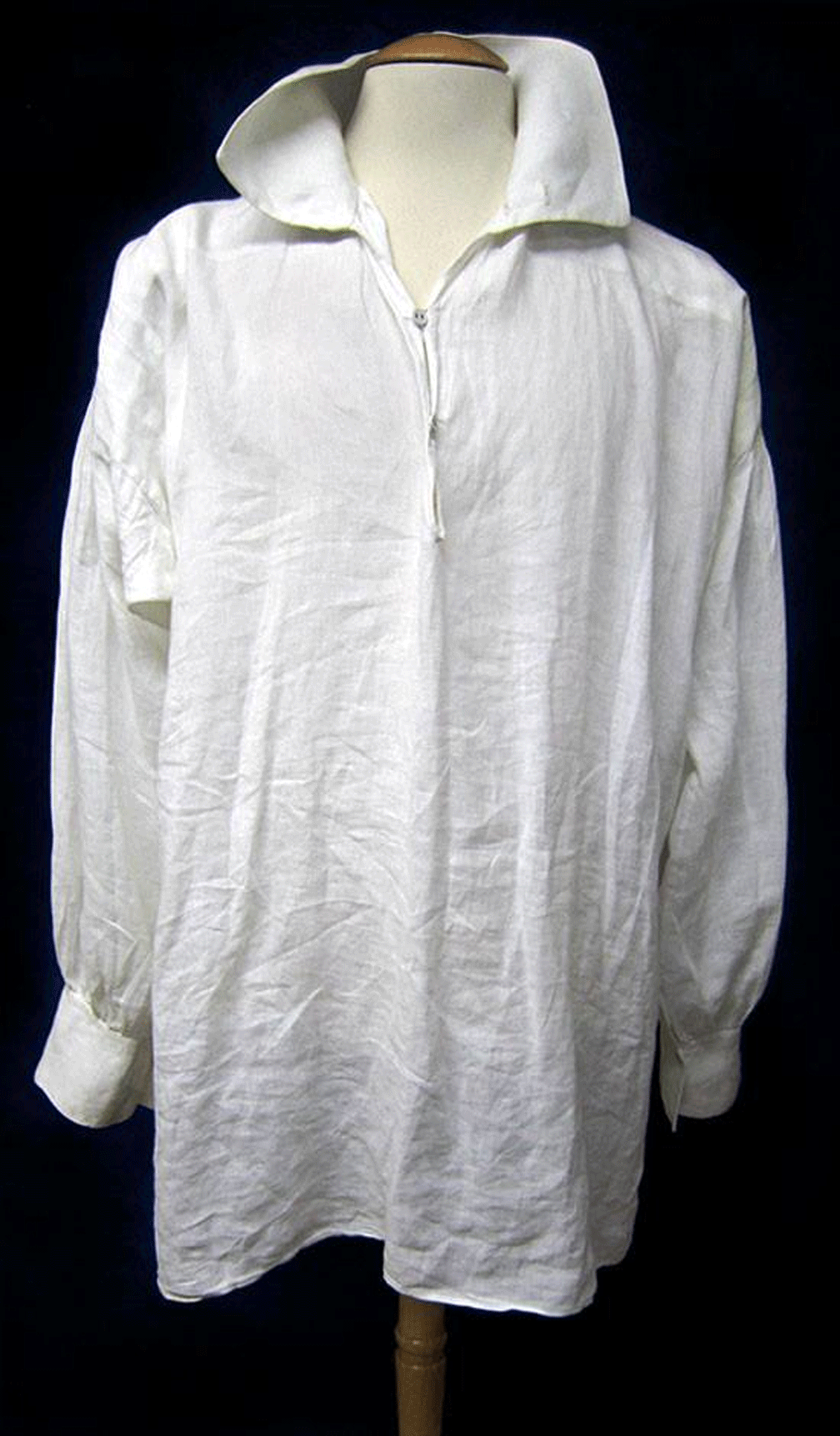
The Will & Jane: Shakespeare, Austen, and the Cult of Celebrity exhibit at the Folger Shakespeare Library is garnering a good deal of press (as it should!). Apparently there are record crowds wanting to get a glimpse of their two favorite Literary Heroes and how they have shown up in popular culture for the past 200 years – and “The Shirt” is no small part of this (a.k.a. Colin Firth as Mr. Darcy) – no, no, don’t get your hopes up, Mr. Firth is not part of the Exhibit (though he would be most welcome…), but rather the shirt worn for the endlessly-youtubed scene of Darcy emerging from a pool of standing water at Pemberley is on display in a locked glass case where it can be on view but protected from the expected mass hysteria of, well, the masses… Kissing a glass case is not quite the same as stroking a cotton shirt, albeit hanging rather listlessly from a plastic form… but it is still a must see if you can get there! Grown women have been known to faint away, despite the message from a young Jane to “run mad as often as you chuse; but do not faint…” I do hope the Folger is up to the task of a gallery full of shirt-mad persons… (and dare I add that though I am NOT one of the shirt-hysteric Janeites who think this scene is the best in all of the nearly 6 hour film, I do confess a strong interest in getting a glimpse of the actual shirt worn by Colin Firth…)
If you are able to attend the JASNA AGM this year, to be held in Washington DC, October 21-23 (but do allow extra days for all there is to see and do) – you will get a chance to go to the Folger and see what all the fuss is about – the two curators (Janine Barchas of the University of Texas at Austin, and Kristina Straub of Carnegie Mellon University) will be on hand to tell us all about it. If you are not at the AGM, the exhibit runs from August 6 – November 6, 2016 and admission is free. In the sad event you shall miss it entirely, there are also various articles to read – see the links below.
***************
18th-century Staffordshire porcelain of William Shakespeare (Folger) /
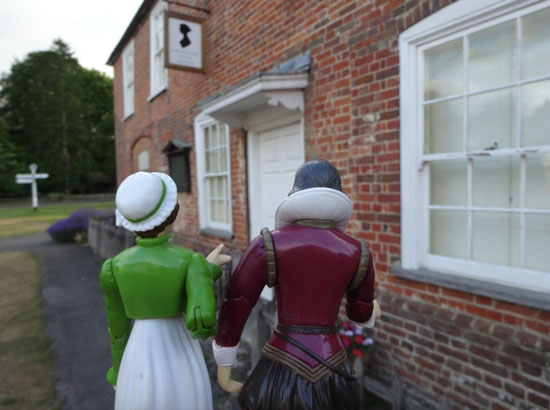
and 20th-century figurine of Jane Austen (Joan Doyle)
Today however, I welcome Janine Barchas, who most graciously answered a few of my questions about how the idea of this Will & Jane grouping came about… if you have any questions, please comment below and she will get back to you. As an incentive, and especially for those of you unable to make it to the Folger, Janine has provided us a copy of the 18-page exhibit brochure – another piece of Jane Austen celebrity “stuff” we all like to collect! (see below for details)
***************
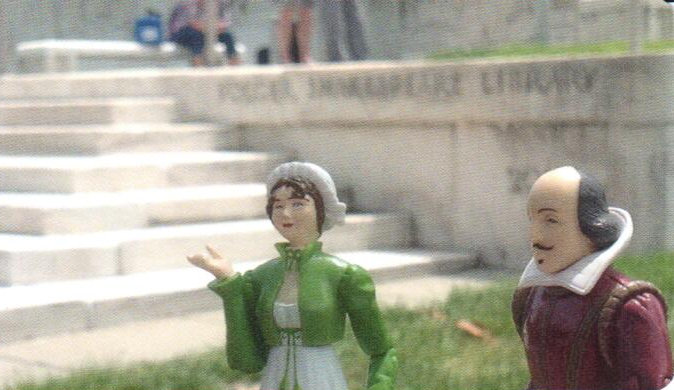
Will and Jane at Chawton Cottage
JAIV: Tell us how this exhibit came about?
JB: This was a case of classic academic one-upmanship. In 2012, Michael Witmore, the Director of the Folger Shakespeare Library, came to the University of Texas at Austin for a conference about the fate of books in a digital world. Over a meal, I joked that Jane Austen was “giving Shakespeare a run for his money” and asked what he was planning to do about it. As Mike and I continued to spar about the differences and similarities between the fan cultures around these two famous authors, an idea was born: “Will & Jane.”
Busts of William Shakespeare (Folger) and Jane Austen (Joan Doyle)
JAIV: How did you and Kristina Straub come to work on this exhibit together?
JB: Our partnership was the result of solid academic matchmaking! Mike Witmore was her former colleague at Carnegie Mellon University, so Kristina’s name came up right away in the context of her deep knowledge of Shakespeare’s reception in the 18th century. She and I had never met before our work on “Will & Jane” even though we are both 18th-century scholars and know many of the same people in what is a smallish field. This exhibition has been a full three years in the making, during which time we have grown very close. I look at our publications and label text and cannot tell you what sentence began as mine and which was first drafted by Kristina. Given that academics are known for their social awkwardnesses and a tendency to work best when alone, our partnership on “Will & Jane” has been an extraordinary intellectual experience – even outside of the unique content of the show.
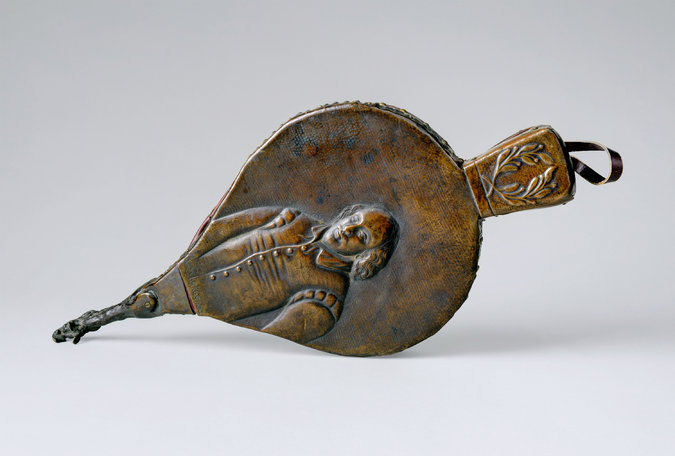
Shakespeare bellows – Folger
JAIV: You mostly talk and write about Jane Austen, but also the book itself as part of the material culture of the eighteenth and early nineteenth centuries. What was the biggest challenge in taking on this exhibit that largely deals with the artifacts of celebrity created and collected over the past 200 years?
Royal Worcester porcelain figurine of “Emma Woodhouse” (1998) from the collection of Joan Doyle / and a colored pottery tableau entitled “Othello Relates his Story (ca. 1880) from the collections of the Folger
JB: The dominance of non-book artifacts in this exhibition (ceramics, paintings, odd assortments of relics, tchotchkes, and souvenirs) may seem at odds with a serious library of rare books such as the Folger. However, although both Shakespeare and Austen are fundamentally admired for their great literary works, the history of their afterlives and the nature of their modern celebrity is not just about steady streams of new editions but about the material objects that ordinary fans crave and collect. This exhibition took us out of the usual library stacks of books and into art vaults and collections of so-called “realia.” Part of the challenge, then, of putting this exhibition together was for two academics who were used to talking about the language of plays and novels to learn how to think and talk about non-book and wordless objects and the stories they can tell. Mixing high and low culture in this exhibition (books with bobble-heads, so to speak) has been both a joy and a challenge. In practical terms, today’s objects that celebrate Jane Austen at her 200-year mark lack the historical patina of those Shakespeare “relics” and souvenirs that have been carefully preserved for two centuries. And yet we wanted these authors to stand together as potential equals. This meant that every juxtaposition of old and new objects, every comparison between the afterlives of Will and Jane, had to show similar impulses across centuries of fandom – in spite of any obvious differences between current market values of the materials shown.
JAIV: What most surprised you in your findings?
JB: We initially thought that in order to fill 20 large display cases, we might have to stretch the comparison a bit here and there. But we were amazed by the tight parallels between, for example, the public spectacles that celebrated Shakespeare around his 200 mark (e.g. a museum dedicated to the Bard and a Jubilee) and today’s BBC bonnet dramas that, in essence, do some of that same work to promote Jane Austen. Also, we were genuinely surprised by the manner in which Henry and Emily Folger resembled, in their dedication to all things Shakespeare, the collecting impulses of Alberta and Henry Burke, the couple who amassed the world’s most significant Jane Austen collection (now split between the Morgan Library and Goucher College). One thread across the exhibition is how these two American couples, collecting decades apart and focused on two very different writers, pursued their purchases in the same way.
JAIV: What do you hope visitors will take away from this exhibit?
Will and Jane at the Folger
JB: A sense of fun. We hope the combination of whimsy and scholarship is infectious and will help folks to see that even pop culture benefits from a larger historical framework.
JAIV: What has been the response so far?
A chalice made from the mulberry tree Shakespeare planted (Folger) /
a lock of Jane Austen’s hair (Jane Austen’s House Museum)
JB: A lively and lavishly illustrated review across two pages of the NYT weekend section on opening day surely helped to boost visitor numbers as well as raise our curatorial spirits. The public seems genuinely curious about a show that pairs these equally famous but very different authors. So far, we’ve had some record numbers in terms of daily visitors and received enthusiastic feedback from Folger docents. The docents are the well-informed volunteers who lead daily group tours and have their finger on the pulse of true public reaction. When they remain enthusiastic, you know a show is doing well.
JAIV: Who besides Shakespeare and Jane Austen has had such an impact on our celebrity-obsessed culture?
JB: Modern movie stars (and before them the starry thespians of the 18th-century stage) have glammed up both Will and Jane. Our exhibition features a number of film actors who have their feet in both Shakespeare and Austen camps and whose own celebrity is in a symbiotic relationship with these authors. From Laurence Olivier (photo stills and movie clips) to Emma Thompson (she loaned us the original typescript of her Sense and Sensibility screenplay), objects about and from movie stars adds a bit of Hollywood sparkle throughout the exhibition.
The Shirt – Colin Firth as Mr. Darcy (BBC)
JAIV: What is your next project???
JB: Hopefully another project with Kristina. It will indeed also be very hard to go back to a steady diet of “just books” after this. I suspect that odd bits of material culture will cling to all my research from now on. I see both Will and Jane differently now. They are each bigger than their written works alone.
This collector’s album for cigarette cards (London: Carreras Limited, ca. 1935) is one of many items in the exhibition showing Will and Jane being used to advertise non-book products
******************
Thank you Janine! – very much looking forward to seeing you and Kristina at the Folger in October!
If you would like to comment or ask Janine a question, please do so in the reply box below. Deadline will be Wednesday August 31, 2016 at 11:59pm – winner will be announced on Thursday Sept 1, 2016. Domestic only, sorry to say (our postal rates have soared).
Janine Barchas is Professor of English at the University of Texas at Austin. She is the author of Matters of Fact in Jane Austen: History, Location, and Celebrity (Johns Hopkins University Press, August 2012). Her first book, Graphic Design, Print Culture, and the Eighteenth-Century Novel (Cambridge UP, 2003), won the SHARP book prize for best work in the field of book history. You can visit (and spend hours browsing!) her online digital project What Jane Saw(www.whatjanesaw.org) which includes the gallery of the British Institution that Jane Austen visited on May 24, 1813 and the “Shakespeare Gallery of 1796.” Barchas, along with colleague Kristina Straub, is currently curating an exhibition at the Folger on Will & Jane: Shakespeare, Austen, and the Cult of Celebrity.
“Will & Jane: Shakespeare, Austen, and the Cult of Celebrity” runs August 6 through Nov. 6, 2016 at the Folger Shakespeare Library, 201 East Capitol Street S.E., Washington; 202-544-7077.
Gentle Readers: Today I welcome Tony Grant as he writes about his visit this week to the “EMMA 200” exhibit at Chawton House Library, he being my feet on the ground so to speak as I am woefully not able to be there myself. Hope those of you who are able to go will do so – and send me pictures and your thoughts when you do!
[Update: please read Tony Grant’s post about walking around Chawton at the “Jane Austen’s World” Blog]
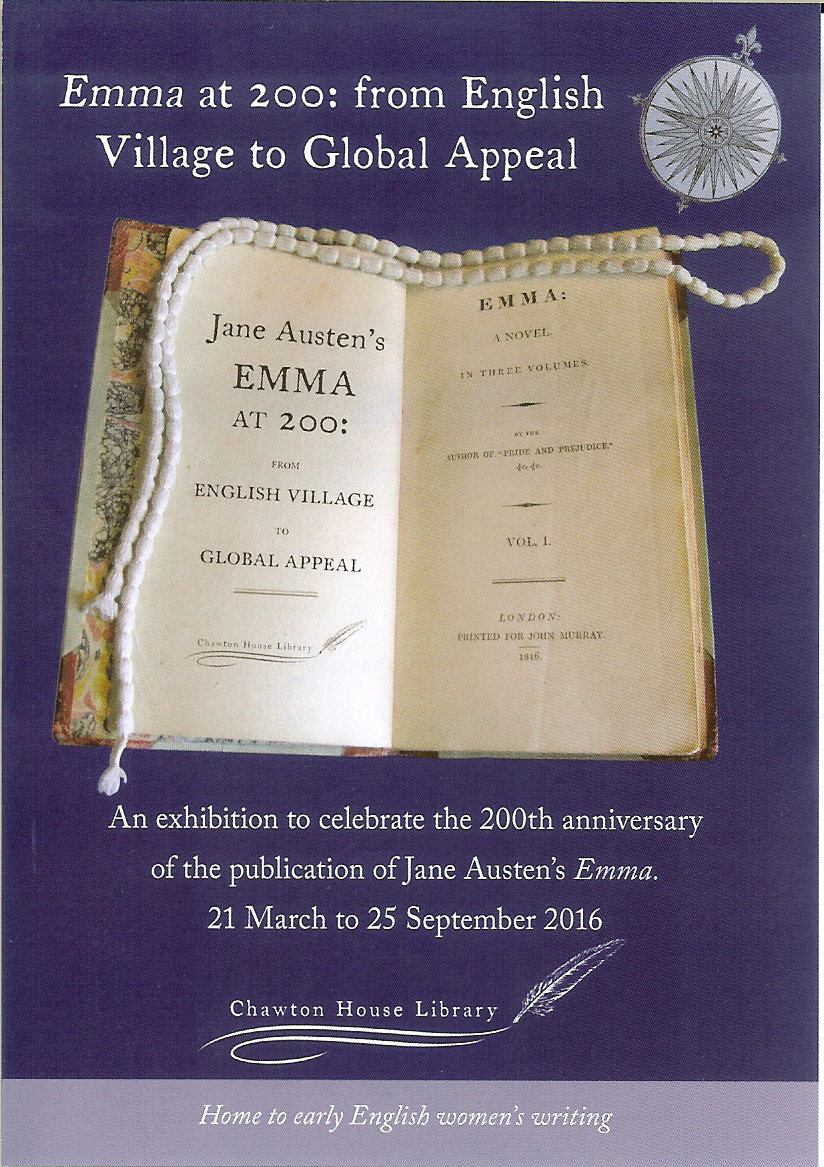
EMMA 200: English Village to Global Appeal
(Chawton House Library 21st March – 25th September 2016)
On Wednesday 20th April I drove from Wimbledon to Chawton in Hampshire over the Hogs Back with views stretching across Surrey into the distance. It was a bright sunny day and seeing the Surrey countryside green and pleasant and shining in the bright sunshine under blue skies was appropriate for my adventure. I was driving to Chawton House Library to visit the “Emma 200 exhibition.” Emma is Jane Austen’s Surrey novel and this year is the 200th anniversary of its publication and it is entirely set within that county.
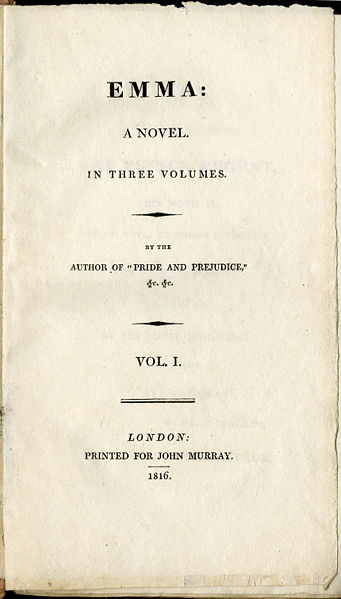
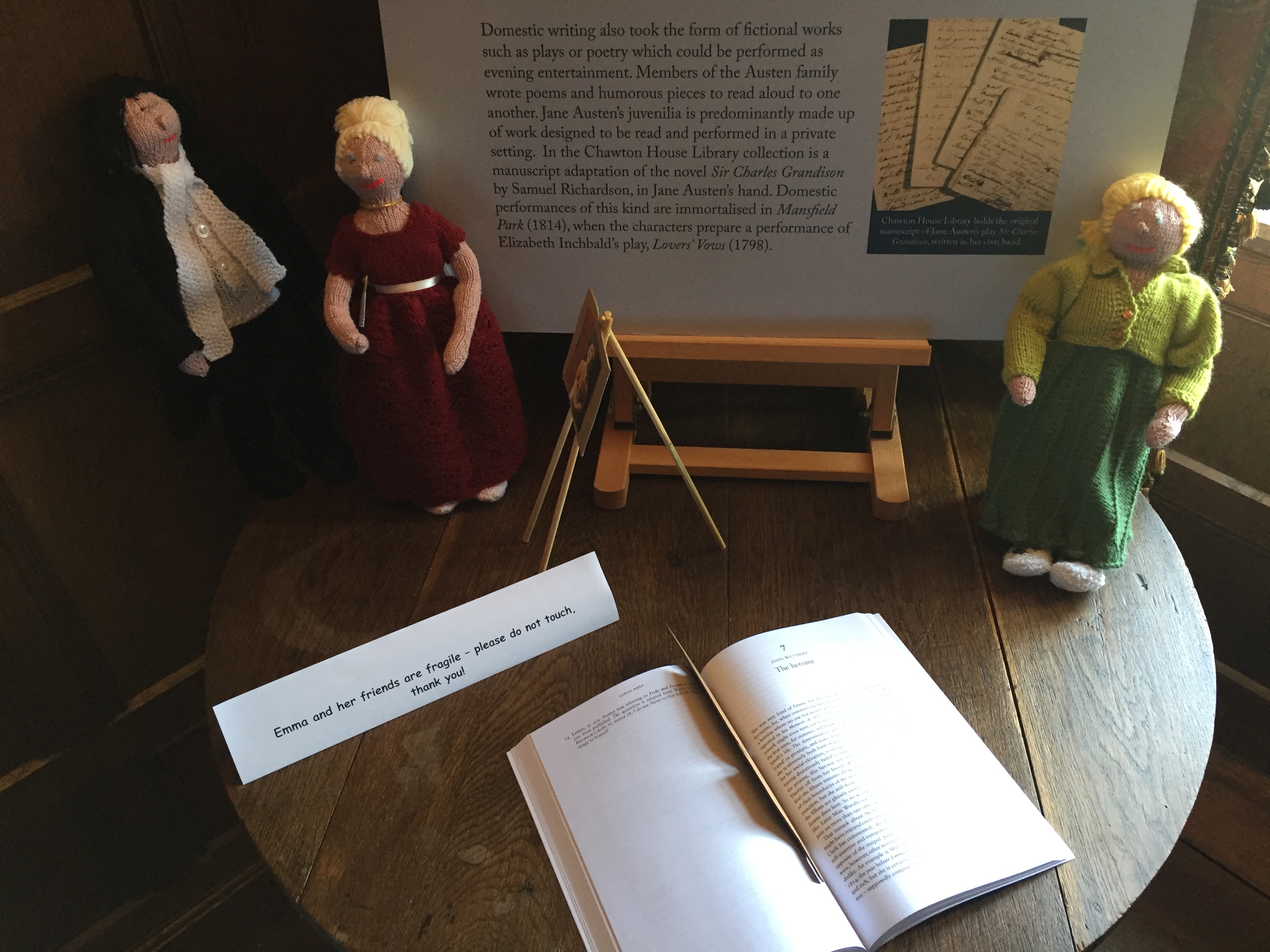
Emma was published by John Murray II of Albemarle Street on the 23rd December 1815, although its title page reads 1816. This exhibition has items from Chawton House’s own collection and from the Knight family collection, as well as other items on loan. The exhibition covers the reception of Emma through the nineteenth, twentieth and twenty first centuries; it also considers the country setting of the novel and the places that were possible influences. It covers the global appeal of Emma. It has a large section about John Murray II and nineteenth century publishing practices through letters and comments made by Jane herself and fellow authoresses also published by Murray. It highlights authors mentioned in the novel and nineteenth century ideas about female accomplishments such as music, embroidery and painting. It shows the connection with Shakespeare and has a section about the reception of the novel. In particular, there is a letter written by Charlotte Bronte to her own publisher, W.S. Williams, discussing her thoughts about Emma and Jane Austen as a writer.
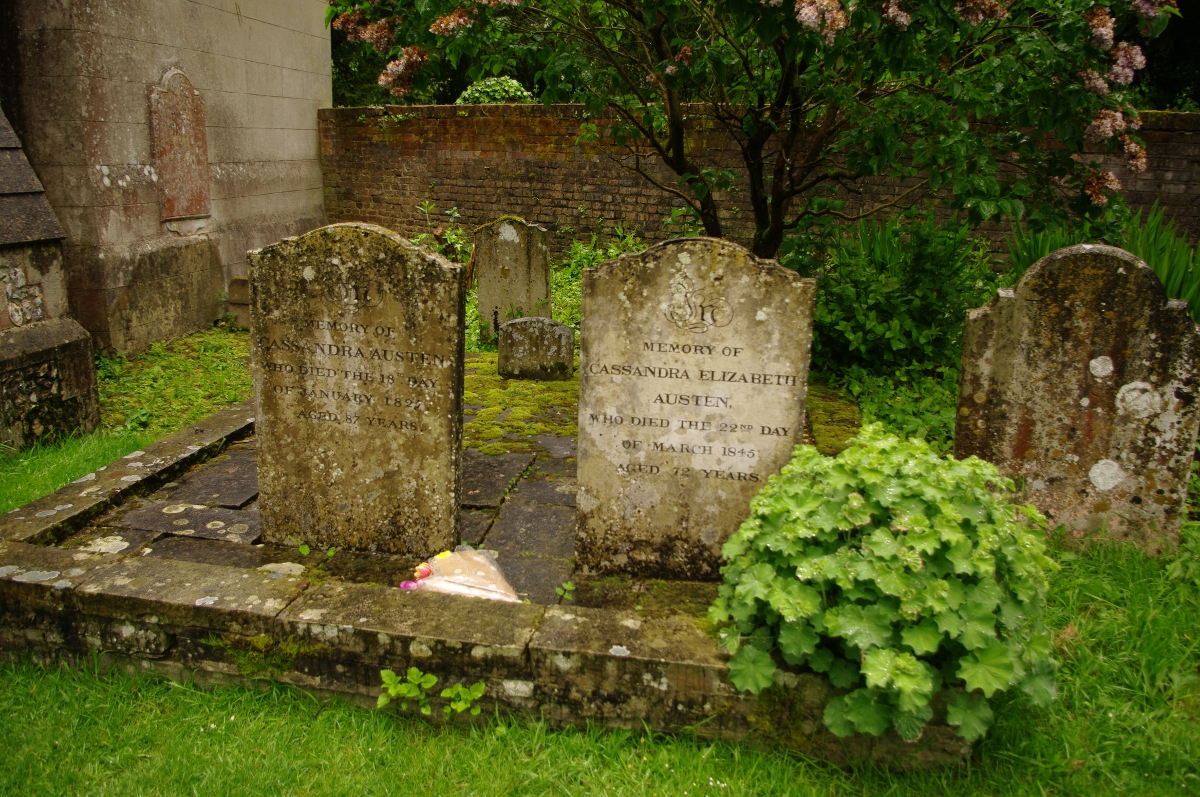
I arrived at the electronically operated gates early. The house opens at 1.30pm Monday to Friday. I was there promptly at 1.10pm. I decided to have a look around and inside of St Nicholas Church nearby, which is Chawton’s parish church and where Jane Austen and her family worshipped. The church we see today is not the church Jane knew. There was a fire sometime after Jane’s death and it had to be rebuilt, though some of the structure from the church that Jane knew remains. I read the memorials to the Austens and Knights within and then went round to the back of the church through an arbor of dark and gloomy ancient yew trees to see the side-by-side graves of Austen’s sister, Cassandra Elizabeth Austen, and mother, Cassandra Austen.
**************
Chawton House Library
It was such a nice day and I still had about ten minutes left so I sat on a stone bollard near the entrance gate and watched a gentleman sitting on a motor mower mowing the grass verges along the drive. As I sat there I noticed a smartly dressed lady leaving the front entrance of the great house with a dog on a lead. She approached the gate and opened it, placing a notice board on a stand giving the times and prices of entry. I asked jokingly if this meant I can go in. I pointed out it was still ten minutes to half past. She laughed and said by the time I walked up the driveway I should arrive at the door on time. “Just knock and they will let you in,” she told me. I knocked on the door with five minutes to and it was immediately opened by a smiling lady who ushered me in. The house is staffed by volunteers except in the kitchens where the official housekeeper keeps her domain but more about that nice lady later. I found everybody so enthusiastic and full of smiles and really, extremely welcoming. I paid my entrance fee and one lady took me into the great hall on the left of the entrance and showed me a map of the house with the route marked by numbered rooms. It is a self-guided tour so I was given the map to hold as I went round. There are volunteers in every room who you can talk to and ask information of.
**************
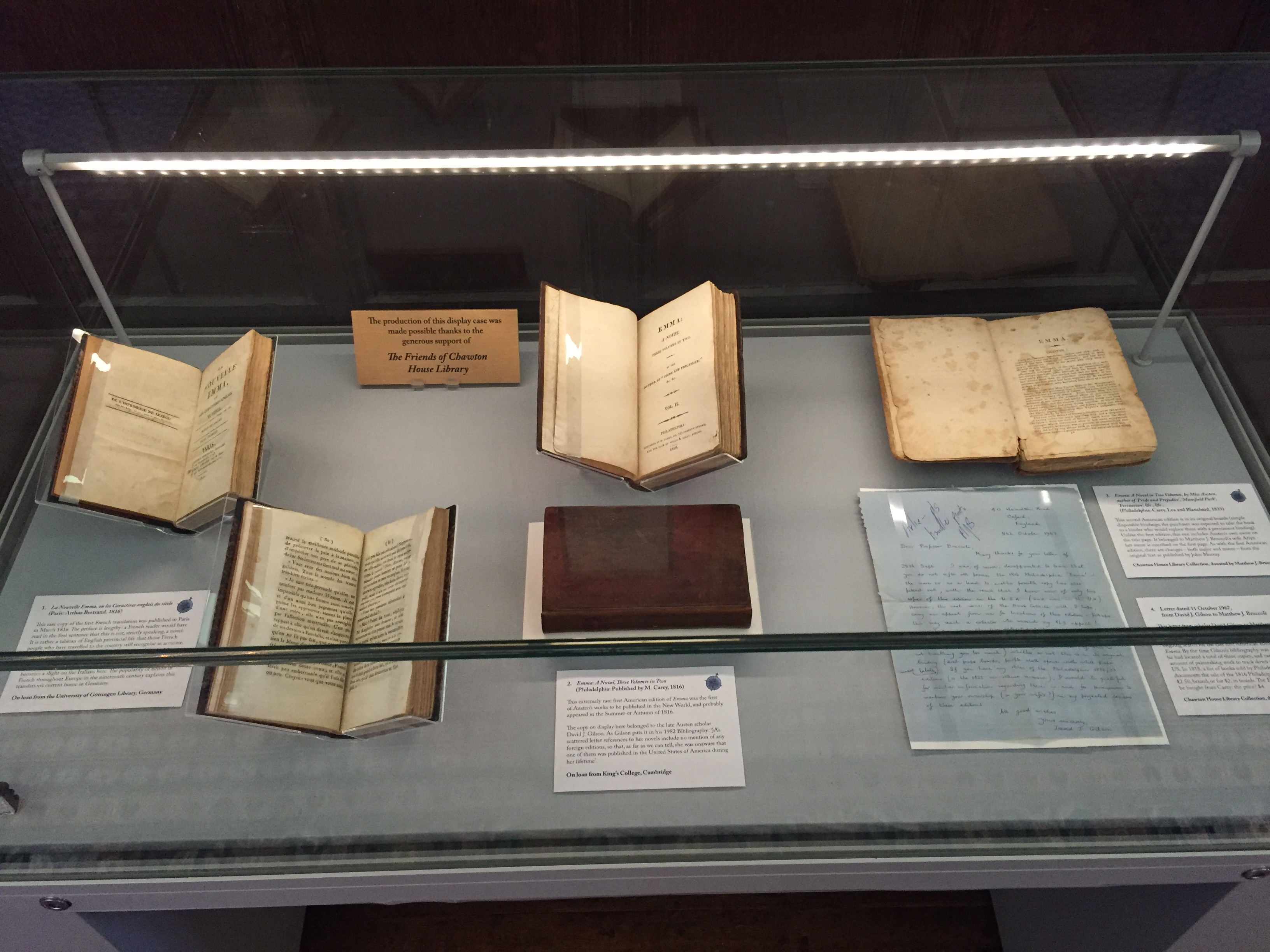
The exhibition began in the great hall. A glass case displays some first editions dated 1816. There was an edition in French as well as one published by Mathew Carey a publisher in Philadelphia. Somehow Carey had read Sir Walter Scott’s review of Emma and obviously liked it. He sold his version at a much cheaper price than John Murray’s London version. He produced a card backed version printed on cheap paper for $2. Murray’s London version, which was a much better quality, was twice the price. Very few American first editions have survived as a consequence of the poorer quality and the copy in this exhibition shows signs of much yellowing of the paper and black mold spots. It looks an inferior book to both the French and English versions. I felt honoured to able to lean over the glass case and read the opening few lines of the Murray edition.
“Emma Woodhouse, handsome, clever, and rich, with a comfortable home and happy disposition, seemed to unite some of the best blessings of existence:…”
There were no such things as copyright laws in those days and both the French and American versions, probably unknown to Jane Austen, brought her no income. Later in the nineteenth century Dickens went over to America and tried to do something about copyright laws in America but to no avail and to his great consternation. The fact that copies of Emma were being published abroad within the first year of its initial publication in England tells us something about publishing and the book trade at the time. Money could be made from books.
Emma 1st ed.
Dedication page
*****************
John Murray – NPG (Wikipedia)
John Murray II was the head of the foremost publishing company in Britain. He was a hard headed business man and if he could get an advantage, especially, it seems over the authors he published he would. I think Jane Austen had the measure of him. Her brother Henry who had dealt with publishers for Jane initially became ill and Jane took over negotiations with Murray herself. She was very direct and firm in her dealings. She said of Murray, “He is a Rogue, but a civil one.” In corresponding with Murray over the publication of Emma, for instance, on 3rd of November 1815, a month before the publication of Emma, she writes,
“…I am at the same time desirous of coming to some decision on the affair in question, I must request the favour of you to call on me here, on any day after the present that may suit you best, at any hour in the evening, or any in the morning except from eleven to one. – A short conversation may perhaps do more than much writing.”
It sounds as though Murray has been given his marching orders and she isn’t going to have any truck with being messed about. She is firm but polite with the “Rogue.” She knows the power of a face to face encounter. Some of her contemporaries were perhaps not quite so strong with Murray but learned a lesson.
Domestic Cookery, 1813 ed (Wikipedia)
One of the exhibits on display, putting Jane Austen’s publishing experiences with Murray in context, is a book called Domestic Cookery, published by Murray in 1806. It was very popular and made a lot of sales and presumably a lot of money for Murray. It was written by Maria Rundell. Rundell had been paid £150 by Murray. She regarded Murray as a friend but she was not aware at first that her book had become such a bestseller. When she found out she felt that Murray was not upholding the copyright agreement he had with her. Eventually Murray paid her £2100 but kept the right to continue publishing the book himself. Jane Austen’s comments about him being “a rogue but a civil one” come to mind. Murray was obviously a very astute business man and could make money from trouble.
Another exhibit displays copies of books written by the French authoress, Germaine de Stael. She wrote books about Rousseau, Revolutionary Politics and Marie Antoinette’s trial. She was virtually banned by Napoleon Bonaparte. He had her book, De L’Allemagne pulped. Murray saw a chance. He took her on. In 1813 he used three printers to publish the French original and English translations simultaneously. He relied on anti-French feelings to make Stael’s books best sellers.
Madame_de_Staël (Wikipedia)
Jane Austen had her critics who made both good and not so good comments about her work. She took notice of what people said about her books and noted down these various opinions. Sir Walter Scott, her illustrious contemporary, who was also published by John Murray, wrote of Emma,
“We bestow no mean compliment on the author of Emma, when we say that keeping close to common incidents, and to such characters that occupy the ordinary walks of life, she has produced sketches of such spirit and originality that we never miss the excitation which depends upon a narrative of uncommon events, arising from the consideration of minds, manners and sentiments greatly above our own.”
Sir Walter Scott (Wikipedia)
It appears that Murray regularly sent copies of newly published books to other writers he published for their comments. This can be seen as eliciting positive comments from people who wanted to keep in with Murray. Jane Austen mentions in her letters to Murray how thankful she is for the copy of Waterloo he sent her to read and actually asks him if he has any more she can have a look at. This suggests she knows how to play the publishing game. She is as astute as Murray himself it seems. In one way Scott’s positive comments could be read as keeping in with Murray. If Murray and his publishing house does well and sells lots of books it can only benefit himself after all, but there is more to Scott’s review. I think he has recognized what is original in her writing. She is a realist. Her style is about everyday common occurrences and everyday people and she makes them heroic. People reading Jane Austen can see themselves and people they know in her writing. It is said that reading a novel is good emotional and psychological therapy, and Austen hit a powerful vein.
Charlotte Bronte (Wikipedia)
The highlight of the whole exhibition for me, even more so than seeing and reading a first edition, is the actual letter Charlotte Bronte wrote to her publisher, W.S. Williams, on April 12, 1850, in which she writes a lengthy paragraph about her thoughts on Jane Austen and Emma. I found it easy to read Bronte’s small, thin, precise handwriting that flows clearly across the page.
“I have likewise read one of Miss Austen’s works—Emma—read it with interest and with just the degree of admiration which Miss Austen herself would have thought sensible and suitable. Anything like warmth or enthusiasm—anything energetic, poignant, heart-felt is utterly out of place in commending these works: all such demonstration the authoress would have met with a well-bred sneer, would have calmly scorned as outré and extravagant. She does her business of delineating the surface of the lives of genteel English people curiously well. There is a Chinese fidelity, a miniature delicacy in the painting. She ruffles her reader by nothing vehement, disturbs him by nothing profound. The passions are perfectly unknown to her; she rejects even a speaking acquaintance with that stormy sisterhood…”
Bronte continues:
“What sees keenly, speaks aptly, moves flexibly, it suits her to study; but what throbs fast and full, though hidden, what the blood rushes through, what is the unseen seat of life and the sentient target of death—this Miss Austen ignores. “
And she goes on. Charlotte Bronte is actually agreeing with Scott’s comments when he describes her writing as
“……close to common incidents, and to such characters that occupy the ordinary walks of life”
The difference is that Scott makes his view a positive while Bronte makes her view a negative. I agree with what she says. Austen writes about the ordinary. Bronte on the other hand and her sisters wrote about,
“what throbs fast and full, though hidden, what the blood rushes through, what is the unseen seat of life and the sentient target of death”
Charlotte Bronte is actually describing the differences between their two styles. I have read articles published on some blogs where the writer tries to pit Charlotte Bronte against Jane Austen. Who do you like the best? Who do you think is the better writer? And so on. These are a childish approach to comparing two great writers. Two geniuses. Their styles are different. Every one of us reads different types of books for different reasons at different times to fit, very often , our different moods. We can read a poem by Wordsworth one day and on other days a romantic comedy, a ghost story, a swashbuckling adventure, a horror story or maybe a present day thriller. We can enjoy each genre for what it is and what it brings to us. Austen and Bronte are not enemies, they are not one better than the other. They are different and we can enjoy both. I can imagine how Bronte could be critical. She had a harder life than Jane Austen. Her novels and those of her sisters, were full of passion and deep feelings and filled with great moral uncertainties testing the moral status quo to the limit. Their ideas made their lives worth living and helped them live their short lives with feeling. Jane Austen had a much easier existence. I can see how Charlotte Bronte might not understand Austen’s standpoint. She probably could not bear to live the way Austen’s characters are portrayed. However, we can love them both.
The exhibition demonstrates many of the influences Jane Austen might have used in her writing of Emma. There is the suggestion, for instance, that the fictional places Highbury and Hartfield in Emma are modelled on Chawton and the local town Alton. These are in Hampshire but the novel is set in Surrey. Others I know would not agree. Some say Leatherhead in Surrey, which is near Box Hill, a major location in the book. Others suggest Highbury is a generic English village, and I think this more likely.
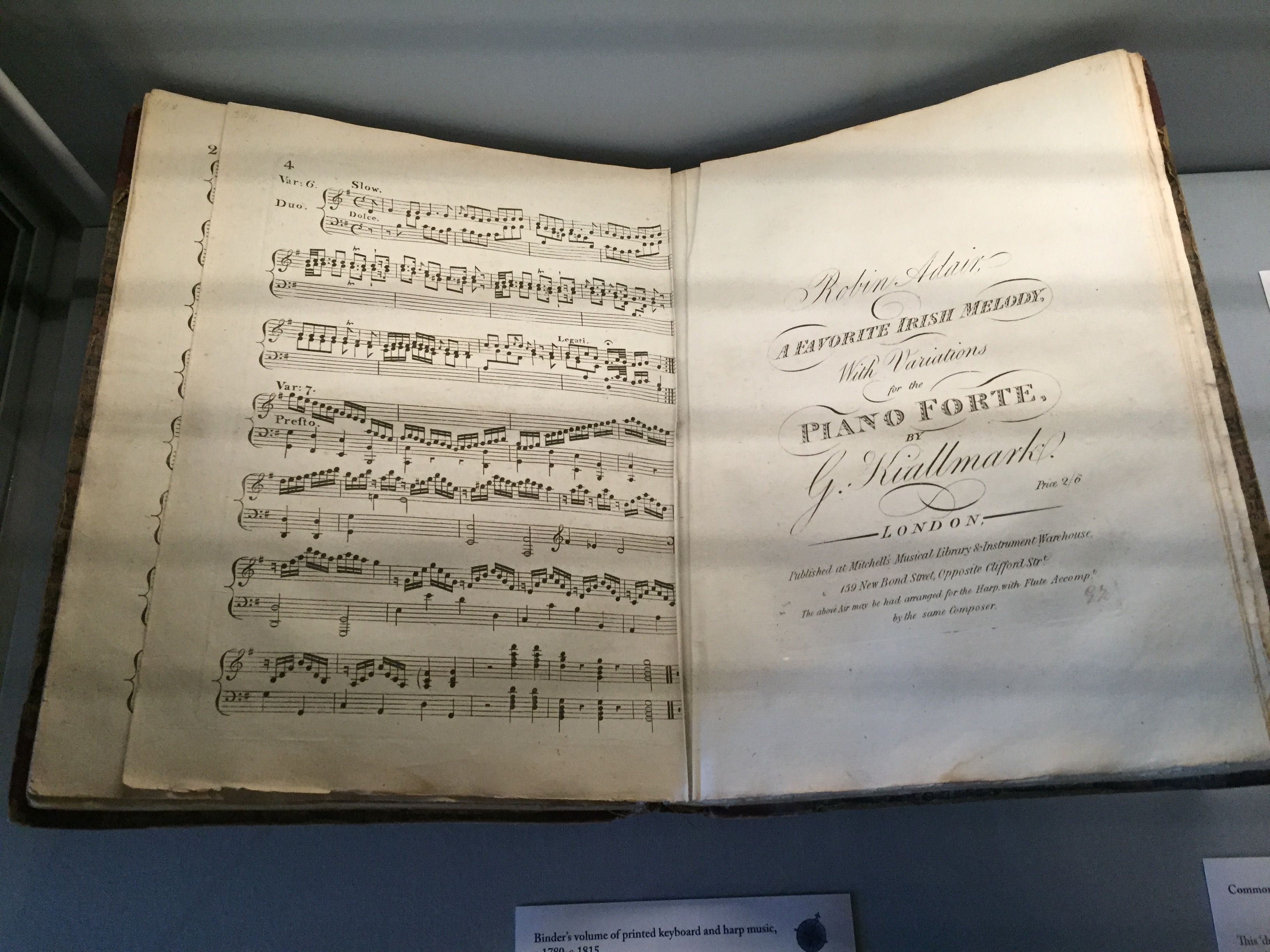
In Emma Jane Fairfax plays a tune called “Robin Adair” on the newly arrived pianoforte. There is on display a copy of “Binder’s volume of printed keyboard and harp music, 1780-1815,” annotated and autographed by Jane’s sister Cassandra. It includes the music to “Robin Adair.” [Ed. You can read this online here: https://archive.org/details/austen1677439-2001 ]
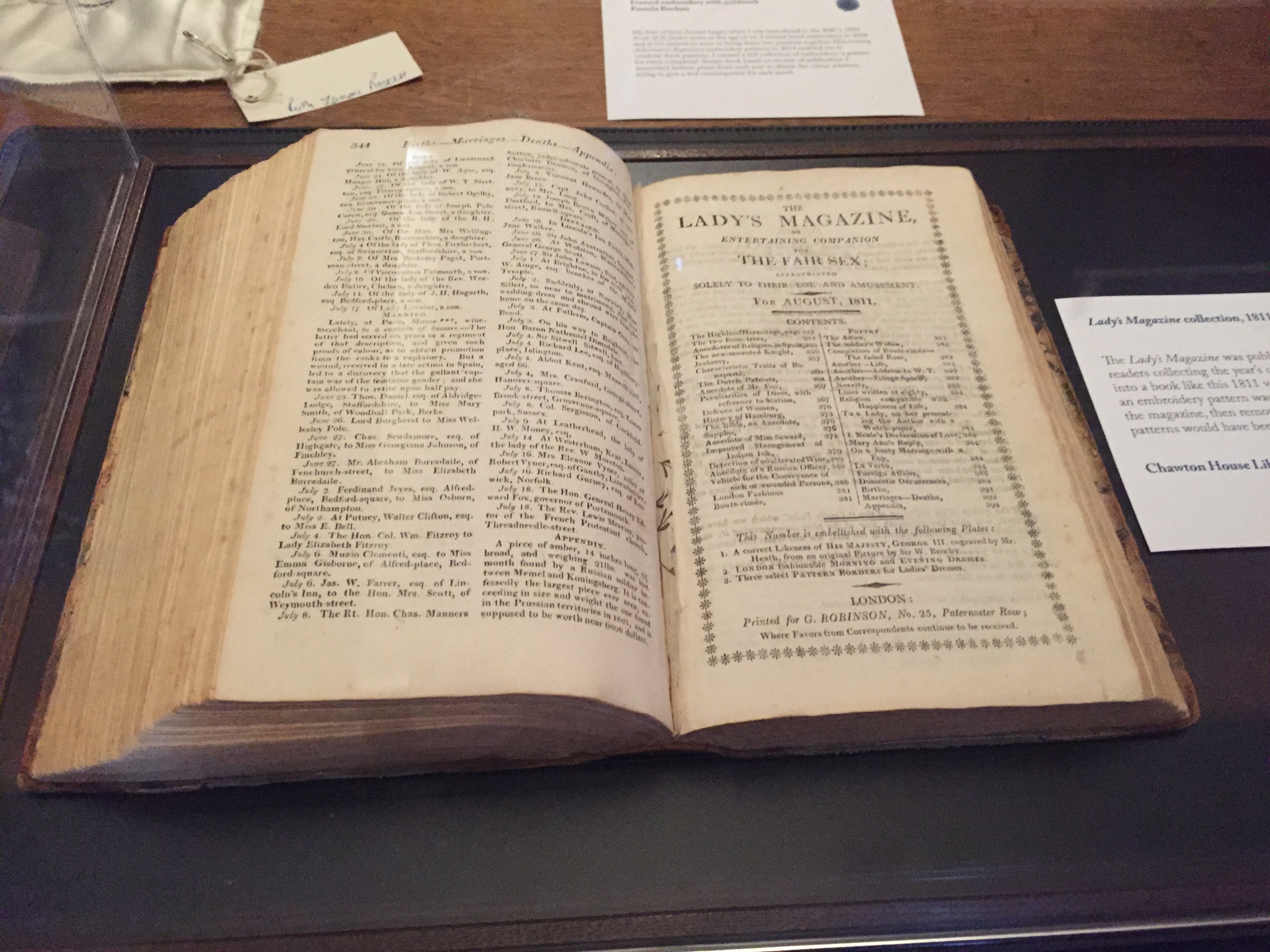
There is a bound set of The Ladies Magazine (1770-1832) which provides sewing patterns for young ladies. It is the sort of magazine that Jane Austen had access too. In Emma, sewing and painting are pastimes for young ladies.
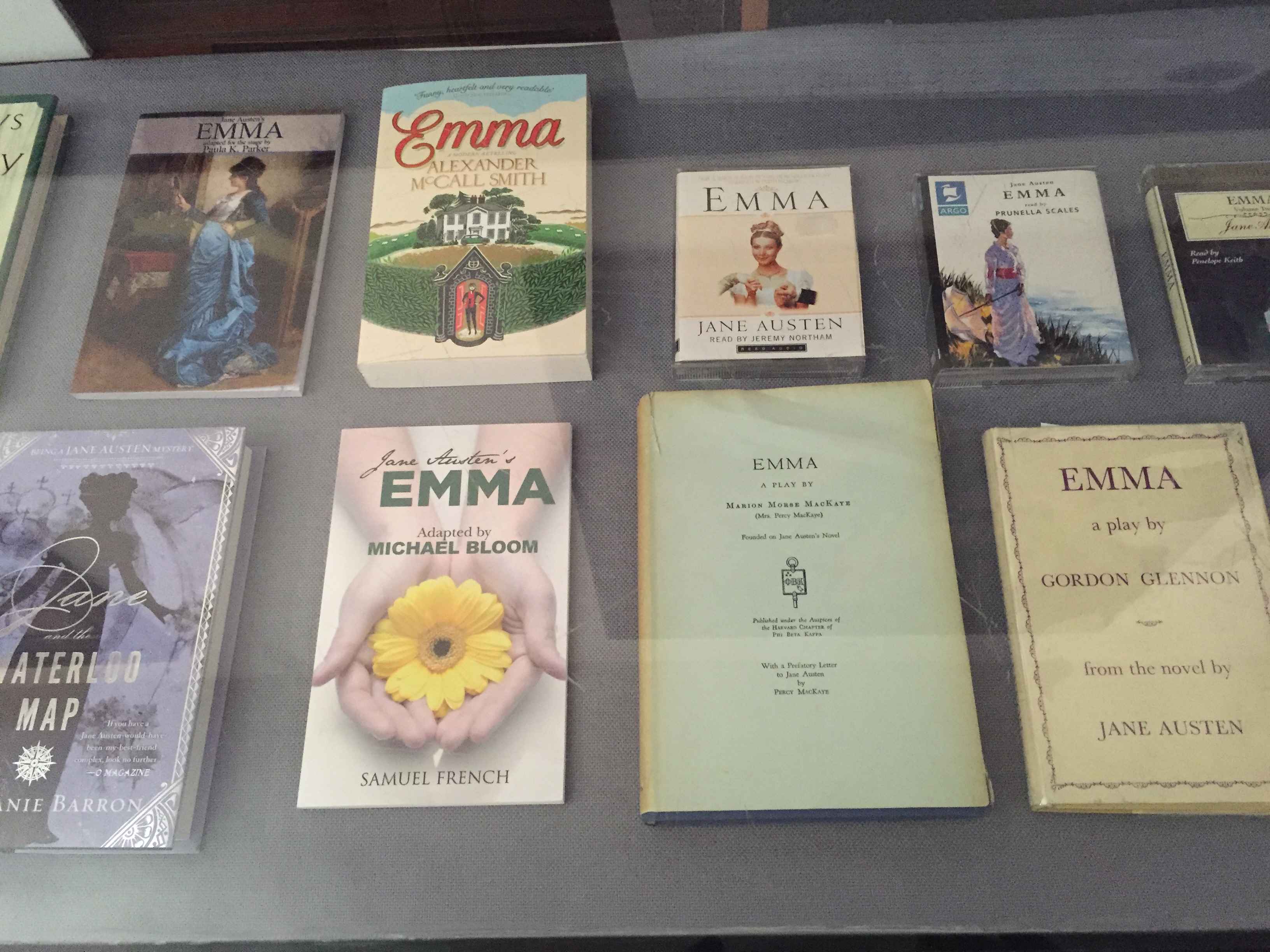
A final display cabinet shows the influences that Emma has had on culture over the centuries. There are various spin-off novels, including the latest modern version of Emma written by Alexander McCall Smith. There are play scripts written by various playwrights turning Emma into a stage version. These include plays by Gordon Glennan and Marion MacKaye. There are a number of radio adaptations. One read by Prunella Scales, another by Jeremy Northam. There are the film versions and the films influenced by Emma such as Clueless set in modern times. Spin-off novels are represented by a copy of the latest Stephanie Barron mystery The Waterloo Map. [Ed. Note that this latest Barron mystery has Jane visiting Carlton House where she meets with the Prince Regent’s Librarian – this all really took place on 13 November 1815; he “suggests” that she dedicate her newest book, Emma, to the Prince Regent – Barron has her also coming upon a dead body in the Library…]
****************
The exhibition is definitely worth seeing and just as much is the opportunity to walk around Chawton House where Jane Austen herself and her family lived and breathed. I also took the opportunity to take a walk in the gardens. I came across a snake lying across my path as I walked up to the walled gardens. I must tell you that in all my life I only recall seeing two other snakes in Britain in the wild. This was a grass snake and was totally harmless. The adder is the only poisonous snake in Britain and they are very shy creatures. I think I saw one once in the New Forest.
*************
“Portrait of a Lady” at CHL
The people who volunteer at Chawton are wonderful. They want to talk to you and tell you things. I had a very amusing moment with an elderly gentleman volunteer at the top of the great staircase. He was sitting on the landing. When I approached he showed me an information leaflet and we discussed its contents. One thing it mentioned was the original William Morris wallpaper. I looked around and couldn’t see any. “Well, then where’s the wallpaper?” I joked. He laughed and said “come with me.” We walked half way down the staircase and then turned and got on our hands and knees. There indeed, almost hidden behind the balustrade, was a patch of darkened William Morris print. He also kindly showed me the large 1714 map of London displayed on the folding panels of a screen.
We found Henrietta Street and other places associated with Jane Austen when she visited London. Then I went into the old kitchen which is used as a shop and cafe and met a lovely lady who told me she was the housekeeper. I had a delicious chocolate cake and a cup of coffee. All together I had a wonderful visit to the “Emma 200 exhibition.”
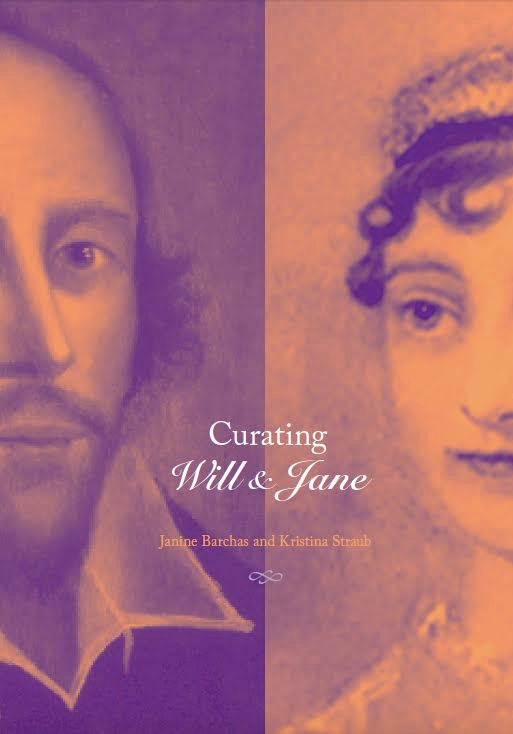
Eighteenth-Century Life has just published “Curating Will & Jane” by Janine Barchas and Kristina Straub. The article is an overview of their upcoming “Will & Jane: Shakespeare, Austen, and the Cult of Celebrity” exhibition at the Folger Shakespeare Library (opens 6 August and closes 6 Nov).
Because of public interest in the show, Duke University Press has just made the article freely available for a whole year while Cedric Reverand, enthusiastic editor of Eighteenth-Century Life, made possible an unprecedented thirty-seven illustrations, many in color. It takes about 10 seconds to download.
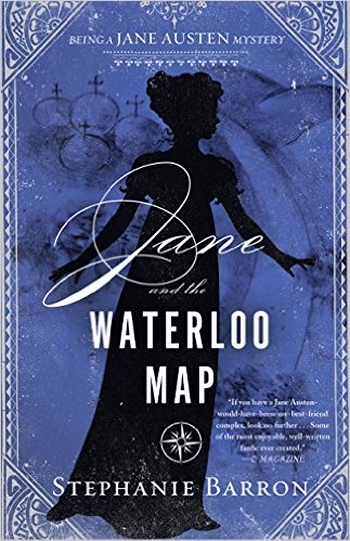
Amateur sleuth Jane Austen returns in Jane and the Waterloo Map,
the thirteenth novel in Stephanie Barron’s delightful Regency-era mystery series.
Gentle Readers: Today Jane Austen in Vermont is taking part in the ‘Jane Austen and the Waterloo Map’ blog tour that began on February 2, 2016 (see other tour stops below). Ms. Barron has done it again! – this time taking us into the Battle of Waterloo, but not before presenting our Jane with a body in the Carlton House Library! Read here an except from Chapter 8, followed by the details for the Giveaway – you can comment here or any of the other blog posts until February 29th.
***************************
About the book:
November, 1815. The Battle of Waterloo has come and gone, leaving the British economy in shreds; Henry Austen, high-flying banker, is about to declare bankruptcy—dragging several of his brothers down with him. The crisis destroys Henry’s health, and Jane flies to his London bedside, believing him to be dying. While she’s there, the chaplain to His Royal Highness the Prince Regent invites Jane to tour Carlton House, the Prince’s fabulous London home. The chaplain is a fan of Jane’s books, and during the tour he suggests she dedicate her next novel—Emma—to HRH, whom she despises. However, before she can speak to HRH, Jane stumbles upon a body—sprawled on the carpet in the Regent’s library. The dying man, Colonel MacFarland, was a cavalry hero and a friend of Wellington’s. He utters a single failing phrase: “Waterloo map” . . . and Jane is on the hunt for a treasure of incalculable value and a killer of considerable cunning.
And now….
AN EXCERPT FROM CHAPTER 8: In which Jane discusses the Battle of Waterloo with one of its survivors,
Lieutenant James Dunross of the Scots Greys.
“I did wonder whether the Colonel’s final words had any connexion to his valor on the field at Waterloo.” I looked at the Lieutenant rather than my hostess’s rigid form. “I have heard him described as a Hero. Would it trouble you to speak of him—or might I persuade you to recount his actions on that glorious day?”
There was the briefest pause.
“James?” Miss MacFarland queried in a lowered tone, her gaze fixed on the glowing coals.
“My dear,” he replied.
“Will it distress you?”
“Naturally. But as I expect to be hearing of Waterloo for the rest of my life, I had as well become accustomed.” The Lieutenant’s aspect was light, but his voice betrayed his distaste. “I should not use the word glory, however, to describe it. Carnage is more apt.”
“No,” Miss MacFarland protested. She turned impulsively to face us. “It shall always be a day of glory to me, because you and Ewan were spared! I cannot tell you how incomprehensible it is, Miss Austen, that my brother survived that battle—only to end in the fashionable desert of Carlton House. Incomprehensible!”
“The Colonel belonged to the Scots Greys, I believe?”
“He began military life in an hussar regiment, and saw years of active service in the Peninsula; but being better suited to heavy dragoon work, exchanged two years ago into the Greys. That is how we came to be acquainted with Lieutenant Dunross—James served in the regiment under my brother.”
Battle of Waterloo 1815 – William Sadler [Wikipedia]The gentleman forced himself heavily to his feet, and crossed with the aid of his cane to the draped window. He pulled aside the dark blue curtain and leaned into the casement, staring expressionlessly down at Keppel Street.“Are you at all familiar with the course of the battle?” Miss MacFarland asked.
“What little I learned from published accounts.”
“Then you will know that the cavalry was commanded by Lord Uxbridge.”
As who did not? Uxbridge had cut a dash among the Great for most of his life: He was an earl as well as a general; head of the Paget family; a darling of the ton; and Wellington’s reputed enemy. A few years since, Uxbridge ran off with the Duke’s sister-in-law, and embarrassed all their acquaintance. Divorce and outrage are nothing new to people of Fashion, however; and tho’ Uxbridge and Wellington might not sit down to whist together, once battle was joined with Napoleon, one was in command of the other’s cavalry. Some ten brigades, in fact.
“In the early afternoon of that wearing day, Wellington’s left was under serious attack from the French batteries,” Miss MacFarland said. I collected from her unvaried tone that she had told this story—or heard it told by her brother—many times. “General Picton was killed, and shells were exploding with horrific effect all along the British line. Our troops were giving way under the assault of d’Erlon’s columns. Uxbridge saw it as Wellington could not, being far down the right. The Earl threw Lord Edward Somerset and the Household Brigade into the thick of the fight, then galloped off to the Union Brigade. This is composed, as perhaps you may know, of three regiments: the English, or Royals; the Scots Greys; and the Irish, or Inniskillings.”
“Ah,” I managed. I had never thought to consider which regiments comprised the Union Brigade.
“Sir William Ponsonby was in command.”
Another man of Fashion. The Ponsonbys had spawned Lady Caroline Lamb, one of most outrageous ladies I have ever encountered.
“And above Ponsonby was Uxbridge,” I said encouragingly, having got it all straight. “So Somerset and Ponsonby and Uxbridge—who might normally have met peaceably in a ballroom—charged off together on horseback to slaughter the French.”
“Indeed. Or at least, their gun batteries.” Miss MacFarland glanced almost unwillingly at Lieutenant Dunross, but the silent figure by the parlour window gave no sign that he was attending to our conversation.
“The Greys were supposed to be held in reserve,” she continued. “But in fact they attacked the longest—well after the Royals and the Inniskillings had given up.”
“Of their own volition? –Without waiting for the command to charge?”
“No Scotsmen would be left in the rear while the English and Irish attack,” Miss MacFarland said proudly. “And indeed, the Union Brigade succeeded in their object so well that the French were turned.”
“For a little while, perhaps,” James Dunross tossed over his shoulder. “A half hour, even. But as is so often true in the smoke and confusion of battle, the hunters became the hunted.”
“I am sure that Ewan regarded that charge as having won the day,” Miss MacFarland argued.
“So he may have done! But he was wrong, Georgie. The battle was won by Blücher and his Prussians, not the Scots Greys.” He turned abruptly from the window and stumped back to us on his cane, his countenance alight with anger. “You must apprehend, Miss Austen, that most of our commanders and cavalrymen know nothing of military science. Excellent fellows, to be sure—Uxbridge was an hussar in his youth, and could not be called green—but we are gentlemen first and soldiers a distant second. What we know of cavalry manoeuvres was learnt on the hunting field. We are apt to get carried away by our own daring, as tho’ a confrontation with the French were a day’s hunting with the Quorn. Which is rather what happened at Waterloo.”
I stared at him frowningly. “You were distracted by a fox?”
“In our enthusiasm to have at Buonaparte, we charged too far,” Dunross explained, “and then could not get back again to the British lines. Most of us had never been in battle before. Ponsonby was unhorsed—he’d left his best charger in the rear because he could not bear to expose so expensive a mount to enemy fire. When the hack he rode into battle failed him, he was shot dead where he stood. The French cavalry counterattacked with Lancers. Do you know of them?”
I shook my head.
“Quite a new thing in military circles, but utterly terrifying. They carry something like a jousting stick and can stab anything on two or four legs to death. One of them stabbed me as I lay on the ground, unhorsed after that celebrated charge.”
“The hunters became the hunted, as you say?”
He smiled thinly. “Our cavalry were broken up, cut off, surrounded, and destroyed.”
I glanced at Miss MacFarland. Her expression was grim, as tho’ it were physical pain to hear Dunross speak.
“You will admit, James, that the Greys showed the most dramatic charge of all, in the midst of a sunken lane between hedges, where they sabered the French to pieces?” she cried. “You will admit that they seized one of Napoleon’s Eagles–the most dreadful shame a Frenchman may know?”
“Certainly,” he returned. “And then the French threw themselves down and pretended to surrender to us. Being honourless rogues, however, they stood up and fired on us as we approached to disarm them.”
She threw up her hands. “I wonder you regard even my brother as worthy of your respect, James,” she cried.
“I must,” he returned. “I owe him my life. Such as it is.”
******************
Grand Giveaway Contest!!
Win One of Three Fabulous Prizes
In celebration of the release of Jane and the Waterloo Map, Stephanie is offering a chance to win one of three prize packages filled with an amazing selection of Jane Austen-inspired gifts and books!
To enter the giveaway contest, simply leave a comment on any or all of the blog stops on Jane and the Waterloo Map Blog Tour starting February 02, 2016 through 11:59 pm PT, February 29, 2016. Winners will be drawn at random from all of the comments and announced on Stephanie’s website on March 3, 2016. Winners have until March 10, 2016 to claim their prize. Shipment is to US addresses. Good luck to all!
“Barron deftly imitates Austen’s voice, wit, and occasional melancholy while spinning a well-researched plot that will please historical mystery readers and Janeites everywhere. Jane Austen died two years after the events of Waterloo; one hopes that Barron conjures a few more adventures for her beloved protagonist before historical fact suspends her fiction.”
The Blog Tour: For more about Jane and the Waterloo Map, you can visit and comment on these other blogs throughout the month of February – there are reviews, interviews, guest blogs, and more excerpts, plus the fabulous giveaway opportunity. Join the fun!
Stephanie Barron was born in Binghamton, New York, the last of six girls. She attended Princeton and Stanford Universities, where she studied history, before going on to work as an intelligence analyst at the CIA. She wrote her first book in 1992 and left the Agency a year later. Since then, she has written fifteen books. She lives and works in Denver, Colorado. Learn more about Stephanie and her books at her website, visit her on Facebook and Goodreads.
All the FACTS:
Title: Jane and the Waterloo Map (Being a Jane Austen Mystery)
Ok, so I should start this post by saying that I LOVE the movies and am easily entertained – if I take confession further, I also loved Roy Rogers, thought I WAS Dale Evans, and dressed exclusively as Annie Oakley for about four years – so please keep that in mind when I tell you I LOVED this movie…
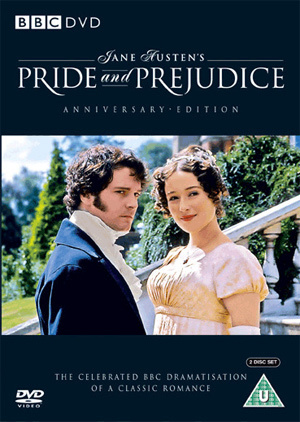
But then I also liked the 2005 Pride & Prejudice, one among few at the JASNA AGM in Milwaukee . While most everyone was disgusted with the pigs in the kitchen, the Bennets having a sex life, and a Darcy with chest hair exposed at early dawn, I just sat there for two+ hours with a smile on my face – they got it! I thought – the sense of the story, albeit compacted, but in the end Austen’s tale, her characters, her wit was all there (I do think you have to like Keira Knightley to like the movie…and I do concede the American ending was atrocious). No one can duplicate the 1995 Ehle-Firth – it is brilliant and 20 years on, still nearly a perfect adaptation – but I think Joe Wright got it right enough in 2005, much like Clueless gave us a perfectly rendered Emma set 200 years later. How well Austen translates to different worlds, different tellings.
So Pride & Prejudice & Zombies? – does Austen translate into a world of the undead? Blood and guts amidst Regency gowns and an etiquette-proscribed society? I didn’t think so – as much as my early years of “Million Dollar Movie” trained me well (can re-watch Roman Holiday, An Affair to Remember over and over and still cry every time), such things as Mummies and Zombies and Vampires and Blobs, and any and all Creatures of the Deep were never my cup of tea. I much prefer spies and westerns and civilized space invaders to anything emerging from a decaying earth. But I did buyP&P&Z – every self-respecting Jane Austen collector should have it on their shelf, a must-have really, but alas! there it sits unread – I couldn’t get past the first mention of “a zombie in possession of brains,” whether universally acknowledged or not. Indeed the frontispiece alone told it all:
“A few of the guests, who had the misfortune of being too near the windows, were seized and feasted on at once”
And that’s about all I needed to know – with 85% of the language from Jane, I felt creepily imaginative enough to fill in the other 15%… – so perhaps I am not a fair critic – I don’t know how much it follows the Grahame-Smith invention – but I went only to see a visual presentation of a P&P set in your everyday zombie-infested England – sort of a black plague on steroids… and what we really have here is the base story of P&P, a good solid dose of Austenian wit, a few drastic changes to the plot to make it fit into this rather gross world, and really just good plain fun.
But I must set the scene first: This was a spur of the moment decision to see this movie (a late matinee) – a quick email to my Jane Austen cohorts brought various no’s – other plans, hate zombies, etc., all good excuses, and there was no inducing my husband on this one – so I went alone, afraid the movie won’t be around here very long – and when I say alone, I mean ALONE – there was not another single soul in the theater! – a private screening (do they run a film if NO ONE shows up?) – I had no idea what to expect – I have purposely read no reviews, avoided all press on the movie, so I was there quite innocent of the oncoming mayhem – so I hunkered down and only briefly considered the gruesome truth that it was just me and the zombies, and me without a single weapon…
So here goes my checklist of a review, brief to avoid spoilers of any kind… and with my emphatic advice to just go see it…
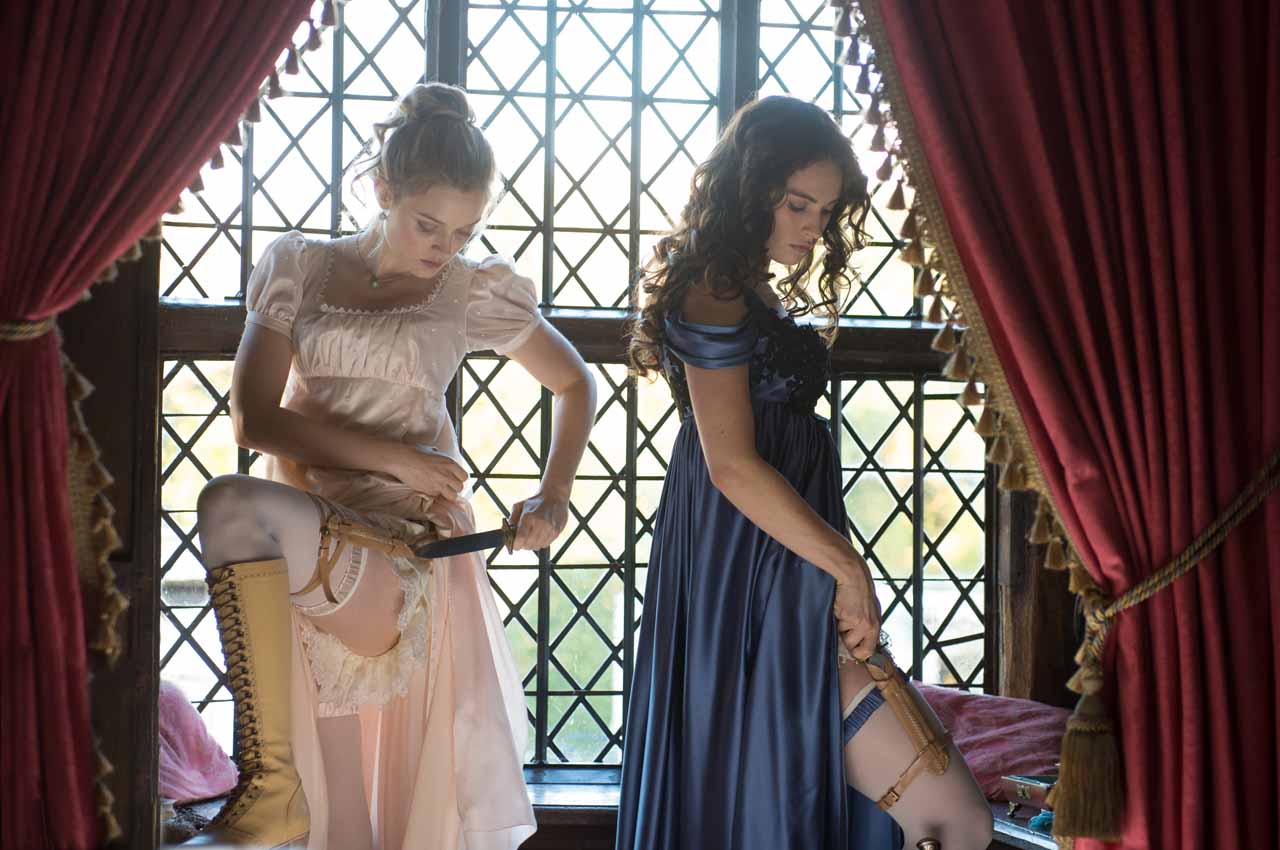
Bella Heathcote (Jane) and Lily James (Lizzie)
Elizabeth Bennet (Lily James): other than periodically confusing her with Natasha in the just-finished-the night-before War & Peace (some of the clothing strikingly similar – same time period so I guess it should), James makes a compelling Lizzie – those “fine eyes” are very present, she’s a terrific and fearless warrior, and I am sure that Andrew Davies must have had a hand here, or at least sat in a sub-director chair bellowing “more heaving bosoms please”… But this Lizzie is also Darcy’s equal in every way… and loved watching them find their way to each other… expertly slinging all manner of machetes along the way.
–
Mr. and Mrs. Bennet (Charles Dance and Sally Phillips): well cast, all the right lines there to clearly identify them as Austen’s parents, she ridiculous and he negligent (though Charles Dance, thankfully resurrected from Games of Thrones, and still hiding in his Library, did have the good sense to have his girls (and all FIVE are present and accounted for) trained as warriors). There is no embroidery or ribbons for these young ladies (though all are stunningly dressed!)- they spend their idle hours cleaning weapons – one feels safe in such a home as this.
The Bennet Sisters, warriors all (youtube)
Lady Catherine (Lena Headey, in Game of Thrones mode) – ha! – delightful – a black patch becomes her…
Lena Headey as Lady Catherine (winteriscomingblog)
Wickham (Jack Huston) – Huston was perhaps born for this role – Wickham’s evil side taken to new heights – I shall say only this so as not to give anything away – “pig brains.”
Jack Huston as Wickham (finalreel.co.uk)
Who knew that Charlotte Lucas snores?? – one can almost have sympathy for Mr. Collins… well maybe just a little…
6. Ok, Darcy’s turn…
Sam Riley as Darcy (screenrant)
Darcy, or “Fitz” as Wickham affectionately calls him (Sam Riley): I expect black leather great coats to become the latest fashion statement– too reminiscent of Nazi-Germany perhaps, but at least the costume here of the good guys. Riley shall be added to the Darcy roster, another name to check off in the endless “your favorite Darcy” polls – this Darcy, no idle aristocrat tending his own land, but fully armed with a small jar of dead-skin-detecting flies, is a Colonel in the Zombie-Annihilating Army, who like his black-clad not-so-distant cousin Batman, has the good sense to show up at exactly the right time, every time. (And obsessed Firth fans, have no fear – there is the barest glimpse of that essential piece of male wardrobe – the white shirt). Smitten with Elizabeth from the first look (after his initial requisite “she is tolerable” speech), his heartfelt but so hopelessly cringe-inducing proposal results in more than just Austen’s war of words – oh, most of the words are there, purists don’t worry, but if we line up all the available proposal scenes (such fun to do this – there are eleven I think, if you include Wishbone…) – this one shall surpass them all for pure energy and brilliant choreography… (and Davies was definitely here for this, coaching the proper removal of buttons…).
Here’s the rest of him:
All other characters terrific – Jane and Bingley, alas! Caroline given short-shift, Mr. Collins (Matt Smith) as good as any of his predecessors, a stone-like Anne De Bourgh…
Matt Smith as Mr. Collins (craveonline)
Fun things to look for: lots of Austen quotes from her various writings – it will keep the Austen-knowledgeables on their toes and give the Austen newbies a new found appreciation of her brilliance. They might even go on to read the real book, sans zombies. My favorite line: “…if adventures will not befall a young lady in her own village, she must seek them abroad” – and thus a zombie warrior is called to her destiny. [quiz: which novel?]
–
The Zombies? – and Austen? If one is tempted to shake their heads in disgust and moan “Austen must be rolling over in her grave” – perhaps not an apt phrase for this particular story line – please go see it before you profess to know how Jane might feel. All told, this latest adaptation has a deep respect for the original text. It is not a “camp” over-the-top retelling but rather it seems to take the realities of this invasion of England very seriously – just another human-induced war of Good vs. Evil, no different perhaps than depicting Napoleon and the French army conquering the shores of England, a valid fear in Austen’s day. There are laughs to be sure – who cannot when a demure-looking Elizabeth suddenly hoists up her Regency finery to expose her sword-clad leg, grabs her weapons, and deftly slices off the head of a trespassing undead; or Darcy, in his frustration over Lizzie’s refusal, engaging in sword-play with most of Lady Catherine’s lovingly sculptured boxwood topiaries. Mr. Collins at the dance? – he’s perfect; the black-patched Lady Catherine (fashion or function? asks Mrs. Bennet) as the Queen of Zombie Warriors? – Game of Thrones trained her well… So much of it all laugh-out loud (does one laugh-out loud if alone in a movie theater?)
screenrelish.com
But no, not “camp” at all – this all just seems to be almost real, a straight-on approach to a real threat to life as we know it, no one’s tongue in their cheek (well, maybe a little). One must just let go and get into the spirit of the thing, beginning with the introduction, a clever illustrated story-book depiction of the past 100 years of the zombie epidemic. And wonderful to know that all of Austen’s characters seamlessly fit into this world – I think she’d be far from a turn-over in her grave, appalled at yet another mash-up of her “light, bright and sparkling” tale – I think she’d be sitting up and shouting Brava! Bravo! to her Elizabeth and Darcy and everyone else involved. It is after all, not much removed from her very own Juvenilia.
And the zombies themselves? Rest assured, they are really not that bad (have you seen The Picture of Dorian Gray recently?) – a few gruesome faces with blood and snot and rot, but all thankfully quickly dispatched – heads removed, bodies kicked and stomped with boots (lovely boots) – and most of it done in a flash or just shy of camera-range – brilliantly done really – and I confess to only once or twice turning around in the empty theater to be sure I was indeed alone…
One piece of advice – stay for the credits…
[Stay tuned for another post with links to reviews, etc.]
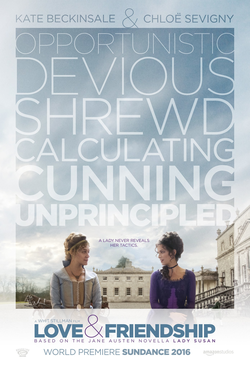
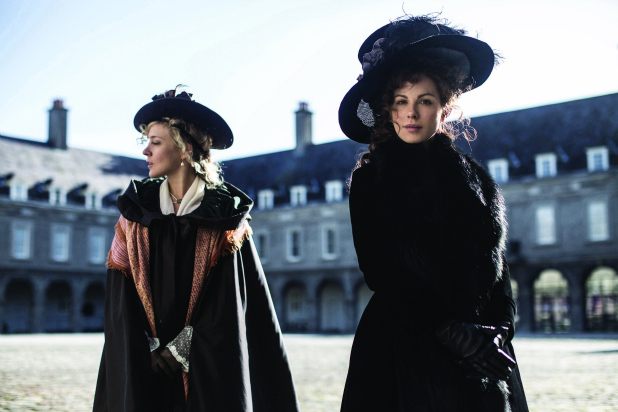
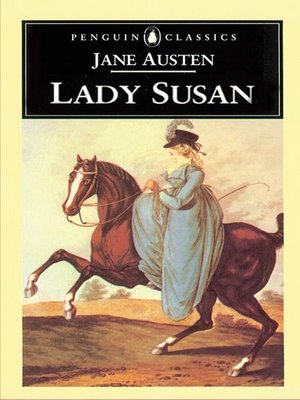
Just posting here all the reviews that have been piling in from Sundance – we have been waiting all year for this film – from the very first announcement that Whit Stillman was going to film Jane Austen’s Lady Susan, but bizarrely calling it “Love & Friendship.” Starring Kate Beckinsale and Chloë Sevigny.
Now if you know Austen’s Juvenilia, you know that “Love & Freindship” is one of her funnier over the top pieces (my favorite line: “run mad as often as you chose, but do not faint….”). It has nothing to do with Lady Susan of course – but whatever the reason for the title shift,* by all accounts it is a terrific film, with a Heroine just like other of Austen’s delicious “baddies” – Lady Susan the queen of them. At least there are no zombies to worry about…
*In the above cited interview, Stillman explains the title change:
She had no title on it. I’ve seen the manuscript. It’s in the Morgan Library. Her nephew, when he published it in 1871, put the title Lady Susan on it. Austen had sort of shifted as she went along from character names to imposing noun names for titles. Sense and Sensibility was supposed to be called Elinor and Marianne. So we took the title from a juvenile short story to give it that Austen sound.
* Our Regency Ball features Val Medve and the Burlington Country Dancers, music by “Impropriety” – Aaron Marcus (piano), Laura Markowitz (violin) and Ana Ruesink (viola) – instruction given, all skill levels welcome!
** We ask you to tell us in advance your favorite scene in the 1995 Pride & Prejudice – we will be showing and discussing these during the Tea.
We welcome today Margaret Harrington of JASNA-Vermont as she shares her thoughts on and several pictures from the 2015 Jane Austen Summer Program at the University of North Carolina, Chapel Hill that she attended in June.
**********
My Rave for the 3rd Annual JASP
“EMMA At 200”
The Jane Austen Summer Program 2015 University Of North Carolina, Chapel Hill
by Margaret Harrington, JASNA-Vermont
Hope G – JASNA-Vermont fashionista
I had an excellent experience at this year’s Jane Austen Summer Program because I gained new insights into the marvelous book, Emma, and had a good time doing it. The JASP co-directors, Dr. Inger Brody and Dr. James Thompson, planned everything so astutely that each lecture flowed naturally into the following event and led participants happily up the road to new discoveries about Jane Austen. In my opinion, Emma is Austen’s most deeply realized character and she lives and breathes in Austen’s most intricately structured rural society, so it was a consummate pleasure to attend this conference and to come away with a deeper understanding of the book.
Participants were greeted warmly by the graduate students and volunteers. Every day and evening of the conference we were engaged with knowledgeable lecturers and wonderful events, plus dance instruction for the ball.
Highlights were Game Night, the Box Hill Picnic at Ayr Mount, and of course the welcoming dinner, the Duchess of Richmond’s Regency Ball and a delightful production of Austen’s “Henry and Eliza” by the UNC players.
These pictures feature Hope Greenberg from JASNA-Vermont who wore different costumes of her own making for every occasion.
I certainly plan to return for next year’s JASP and Mansfield Park.
Hope turbaned…
Strawberries!
Hope off her swing
Box Hill anyone?
Presenting “Henry and Eliza”
Deciphering Emma‘s many puzzles
Off to the Duchess of Richmond’s Regency Ball…
Learning to not dance like a savage … (oops! wrong book…)
“…she had herself the highest value for Elegance…”
********************
Thank you Margaret for sharing your photos with us (but alas! none of you!) – it looks to have been a grand time!
For more information on the JASP “Emma at 200” you can see the full schedule here. But rather than feeling sad that you missed it all this year, you can already start planning to participate in next year’s JASP – read about it here:
The JASP website is worth a visit: it offers several teaching guides based on the various talks at JASP: on food, medicine, games, and class status in Emma, Austen’s use of free indirect discourse, an adaptation of “Henry and Eliza” – among others – good stuff here! http://janeaustensummer.org/teaching-guides/
And finally, JASP offers a replica of this beautiful Jane Austen bracelet as a fund-raiser for the Jane Austen Summer Program. Cost is $120.00 plus $5 shipping fees. You can order it here.
c2015 Jane Austen in Vermont, photos courtesy of Margaret Harringon
 There has been a good deal to write about this year’s terrific JASNA AGM in Washington DC on Emma – but while it always takes me a good while to re-emerge into the 21st century after these events, little time has been accorded me to actually write anything about it. But I did want to give you a quick summary of the books and other “stuff” I bought this year – less than usual because I bought a DRESS and a SPENCER, which did my pocketbook some serious damage…(see the image below*).
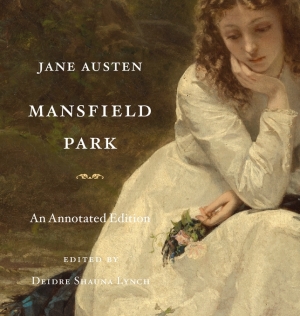 Jane Austen. Mansfield Park: An Annotated Edition. Edited by Deidre Shauna Lynch. Harvard UP, 2016.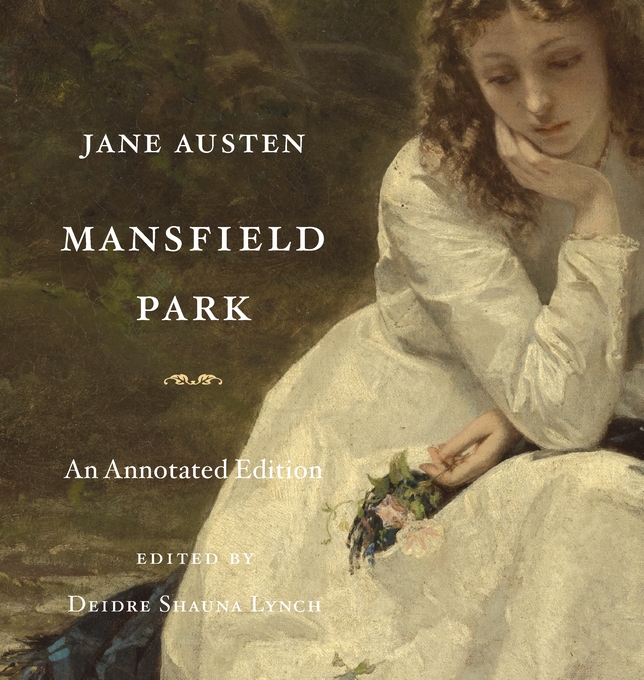
 privileged to see. Ms. O’Brien spoke at the AGM to take us through the history behind and the creation of this fashion exhibit – complete with characters from Jane Austen’s Pride and Prejudice found in the “Pemberley Room” – it runs from October 7, 2016 – April 29, 2017 and is described on the website as: “…displaying men’s and women’s clothing from 1780 to 1825 in a dozen period rooms throughout the museum. It considers how Americans fashioned a new identity through costume; on the one hand, Americans sought to be free from Europe, yet they still relied heavily on European manufacturing and materials.”


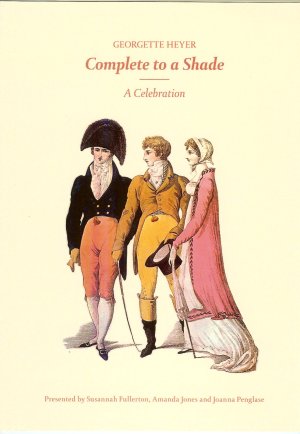 4. Susannah Fullerton, Amanda Jones, and Joanna Penglase, ed. Georgette Heyer: Complete to a Shade: A Celebration. JASA, 2016.
 him through a financial crisis, and then finds himself the heir to an estate in Barbados – all based on the true story of Sam Lord and his Castle (most recently a hotel in Barbados*) – who cannot resist a story of such a man (Heyer couldn’t)! First published in 1937 by Hutchinson, it gives a glimpse of Regency-era life in both London and the Colonies. Will see if it lives up to the hype… [*The property was run as an exquisite hotel for many years but unfortunately it was destroyed by fire in 2010 – it is currently being reconstructed and will open in 2018 as a Wyndham Grand Resort. The 450-room resort will feature 3 restaurants, meeting facilities and a luxury spa] – sign me up!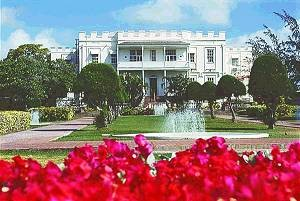
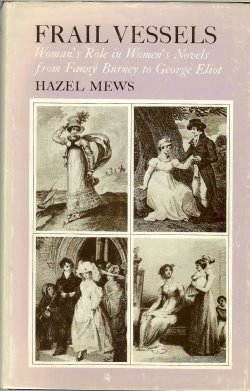 Why not? – adds to my collection on women writers – but it also had an inscription that I first thought read “Catherine Morland” and that cracked me up – heavy reading for Catherine! (it reads on close analysis “Catherine R. Harland”).
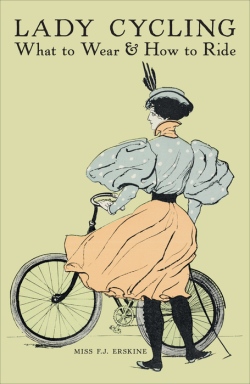 Erskine, Miss F. J. Lady Cycling: What to Wear and How to Ride. The British Library, 2014. Originally published by Walter Scott in 1897.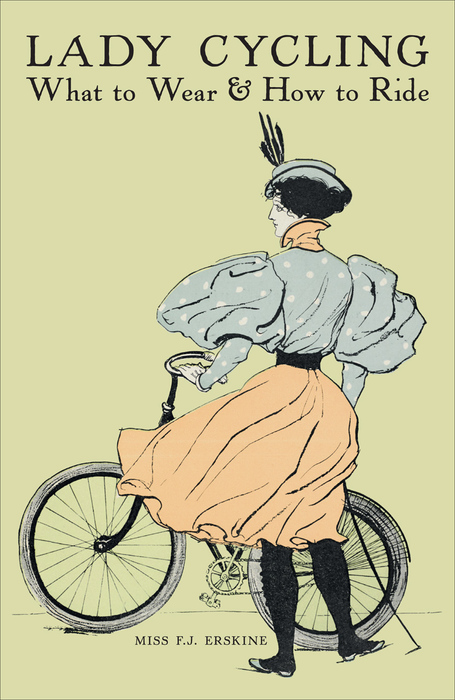

![will-jane-porcelain-figures2-jb[1]](https://janeausteninvermont.blog/wp-content/uploads/2016/08/will-jane-porcelain-figures2-jb1.png?w=663&h=556)

![will-jane-porcelain-figures-jb[2]](https://janeausteninvermont.blog/wp-content/uploads/2016/08/will-jane-porcelain-figures-jb2.png?w=663) Royal Worcester porcelain figurine of “Emma Woodhouse” (1998) from the collection of Joan Doyle / and a colored pottery tableau entitled “Othello Relates his Story (ca. 1880) from the collections of the Folger
Royal Worcester porcelain figurine of “Emma Woodhouse” (1998) from the collection of Joan Doyle / and a colored pottery tableau entitled “Othello Relates his Story (ca. 1880) from the collections of the Folger



























 Jane Austen in Vermont