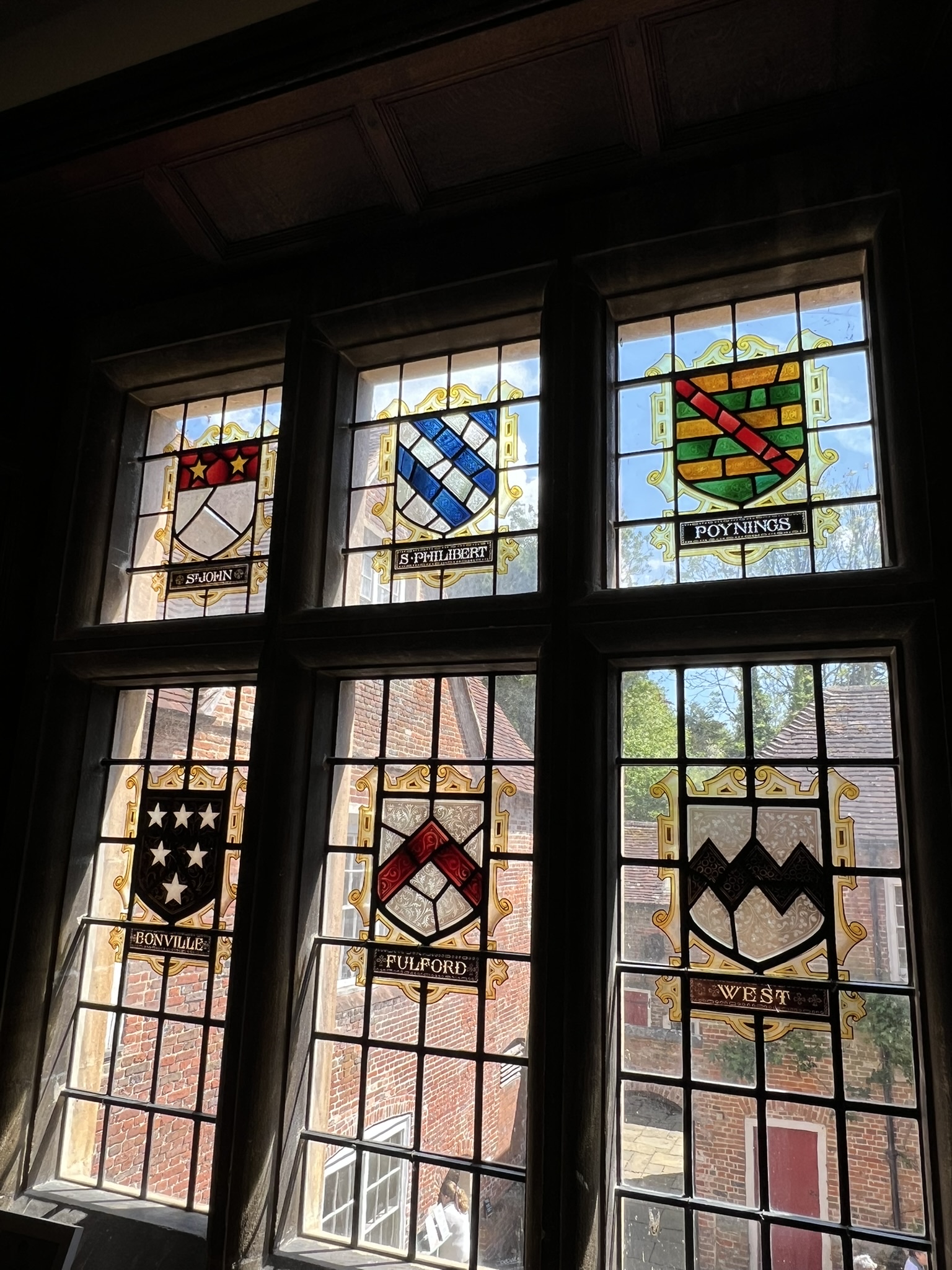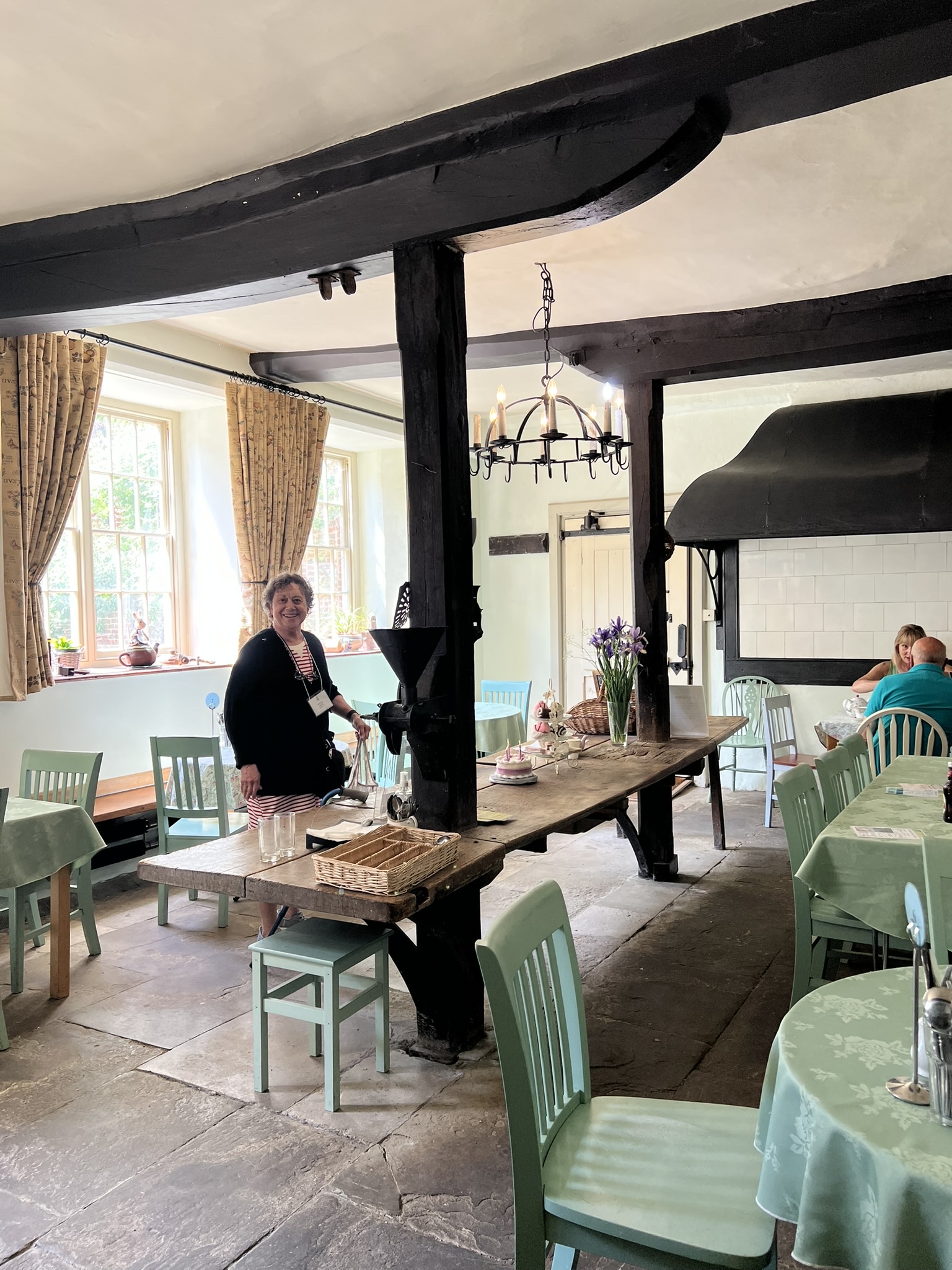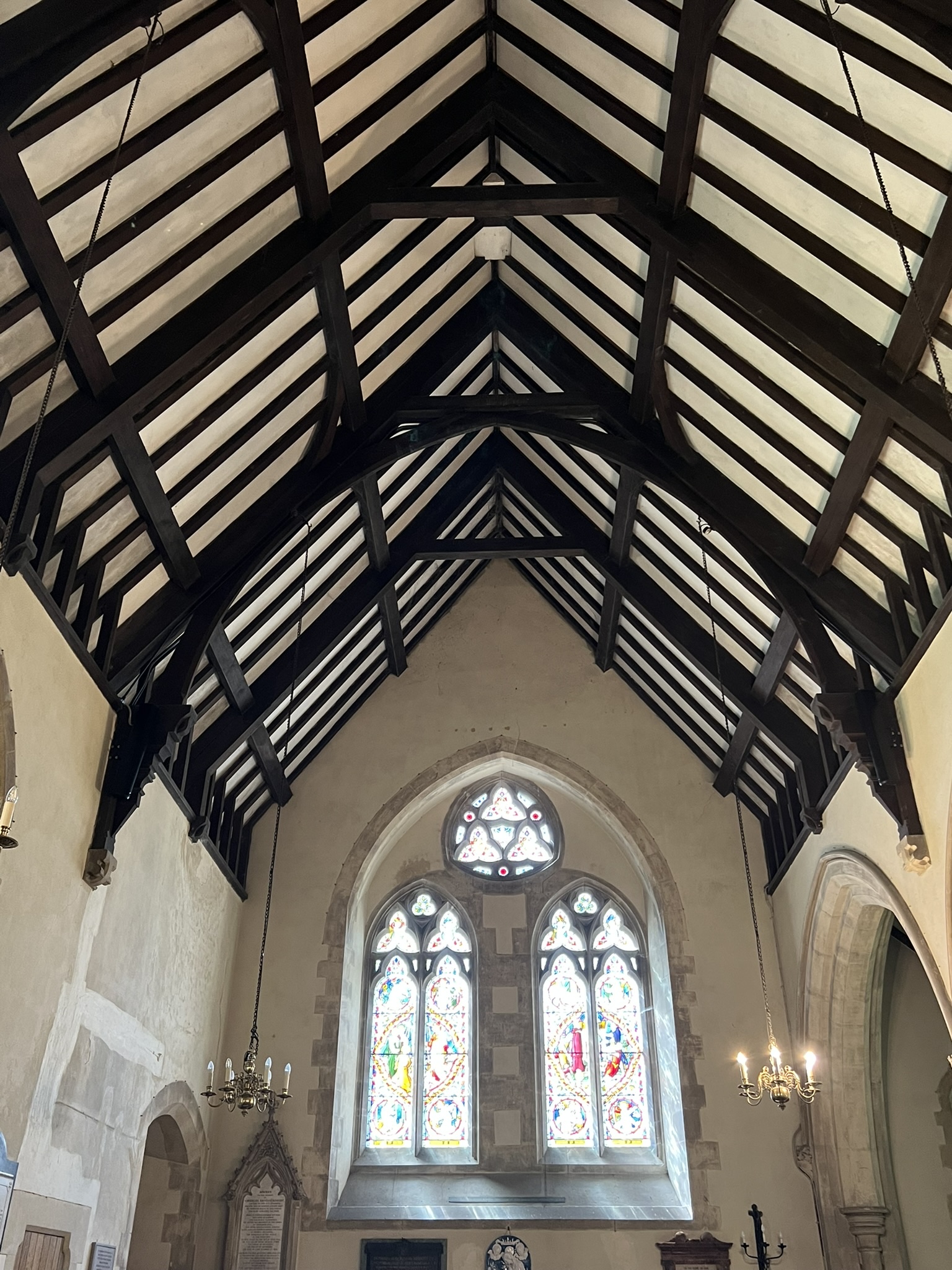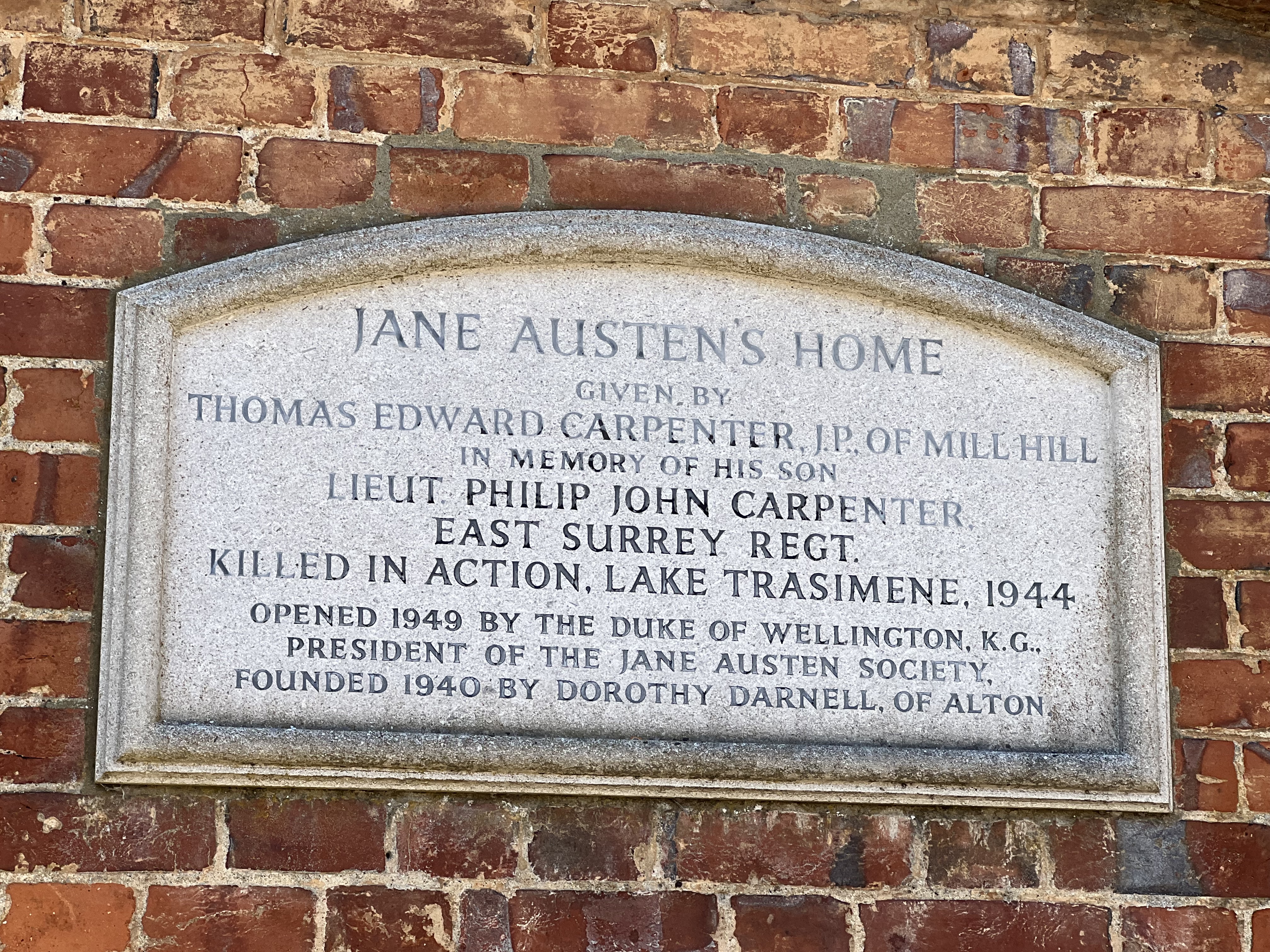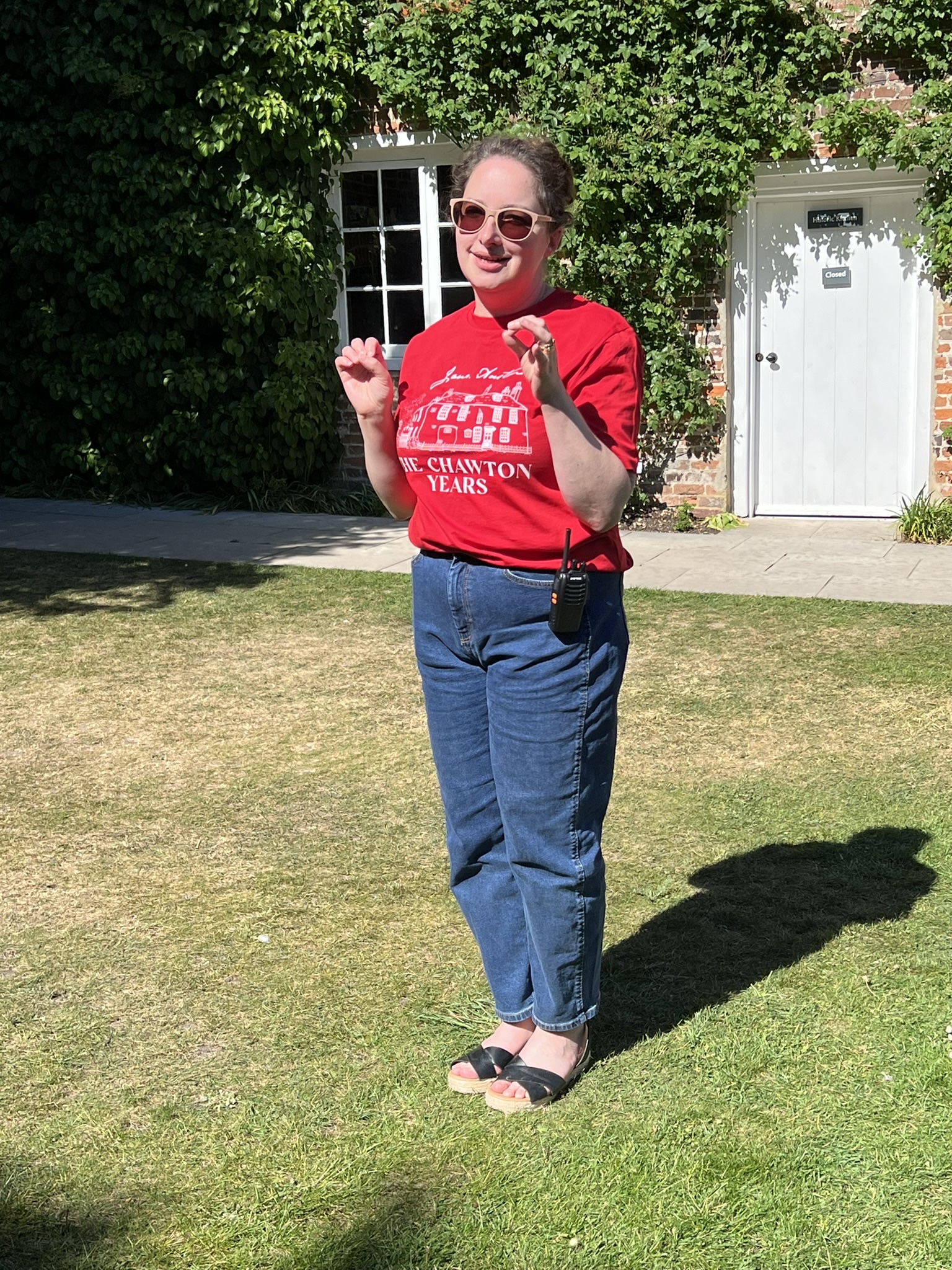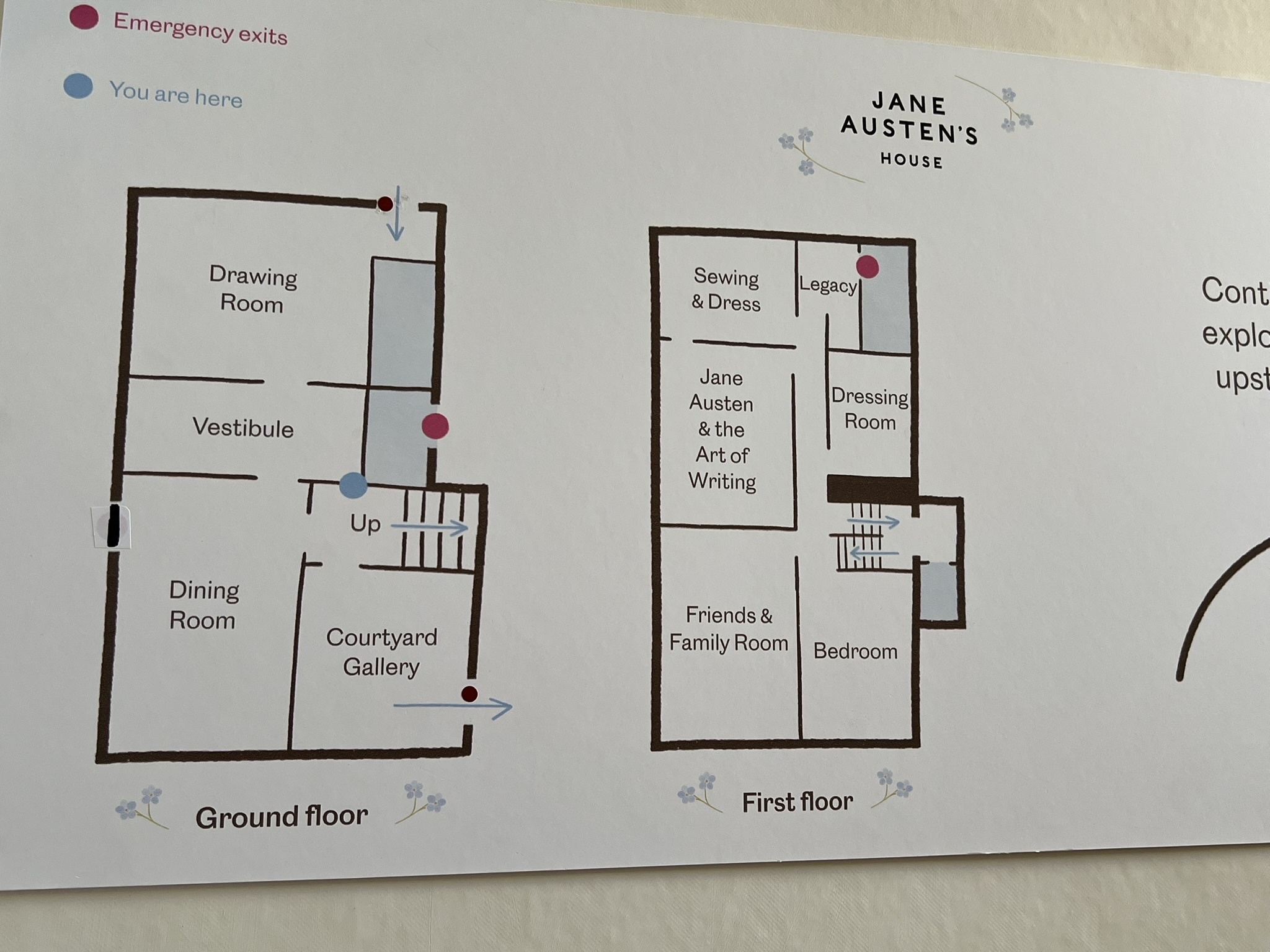
Austen Literary History & Criticism · Chawton House · Decorative Arts · Domestic Arts · Fashion & Costume · Georgian England · Georgian Period · Godmersham Park Library · Great Britain - History · Jane Austen · Jane Austen Circle · Jane Austen Merchandise · Jane Austen Popular Culture · Jane Austen Societies · Jane Austen's Letters · JASNA · Museum Exhibitions · NAFCH - North American Friends of Chawton House · Rare Books · Regency England · Social Life & Customs · Women Writers

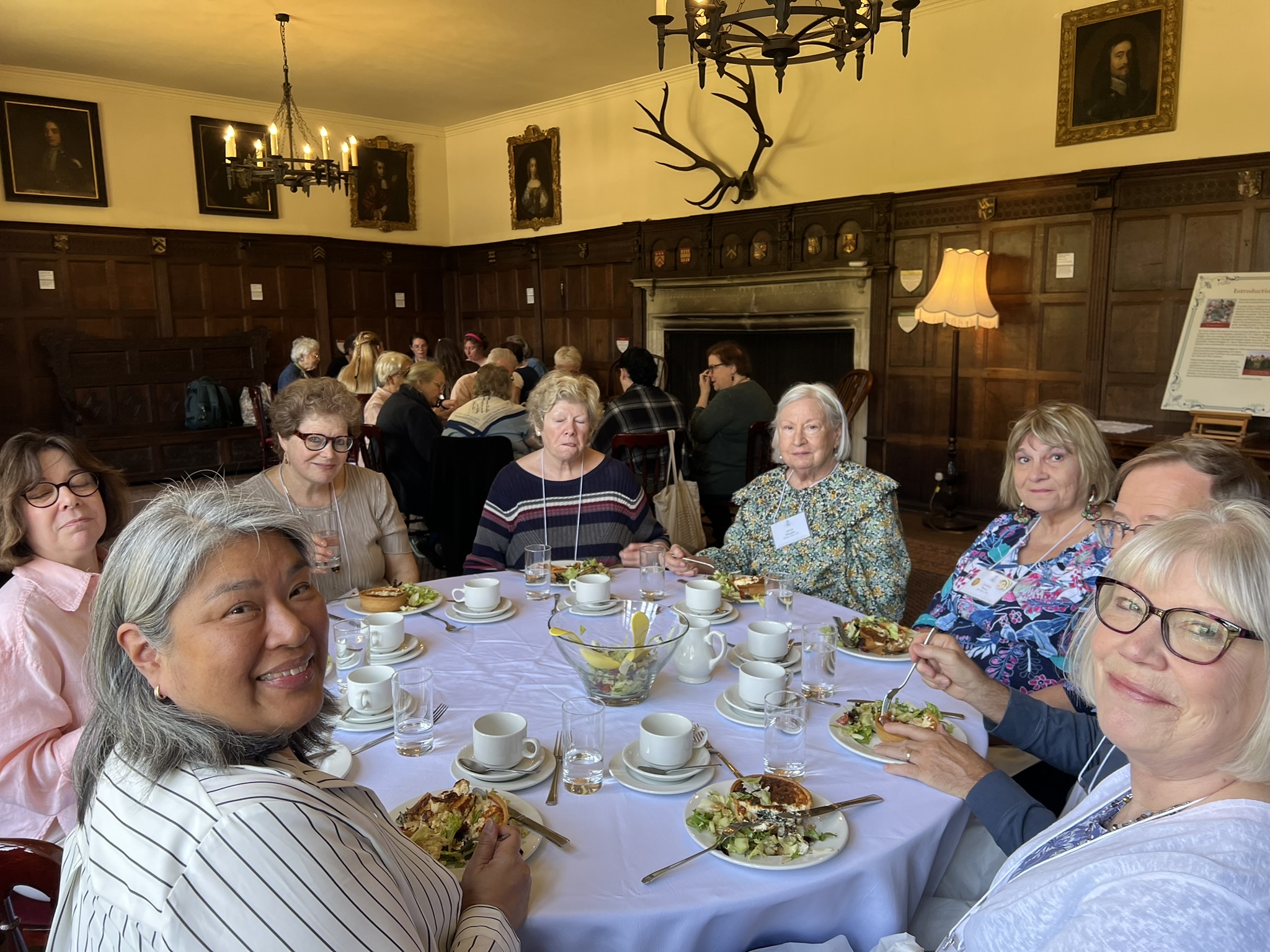
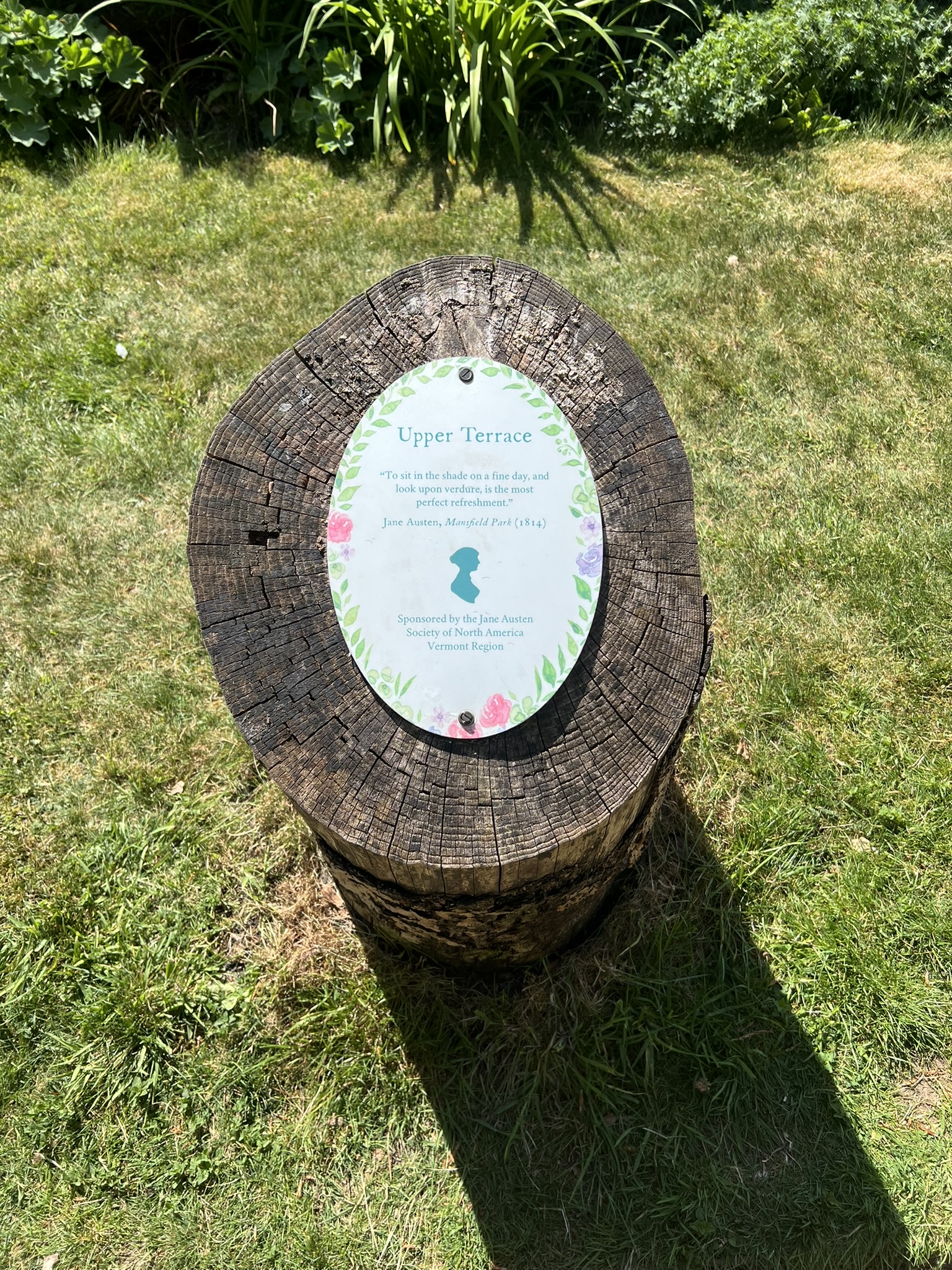
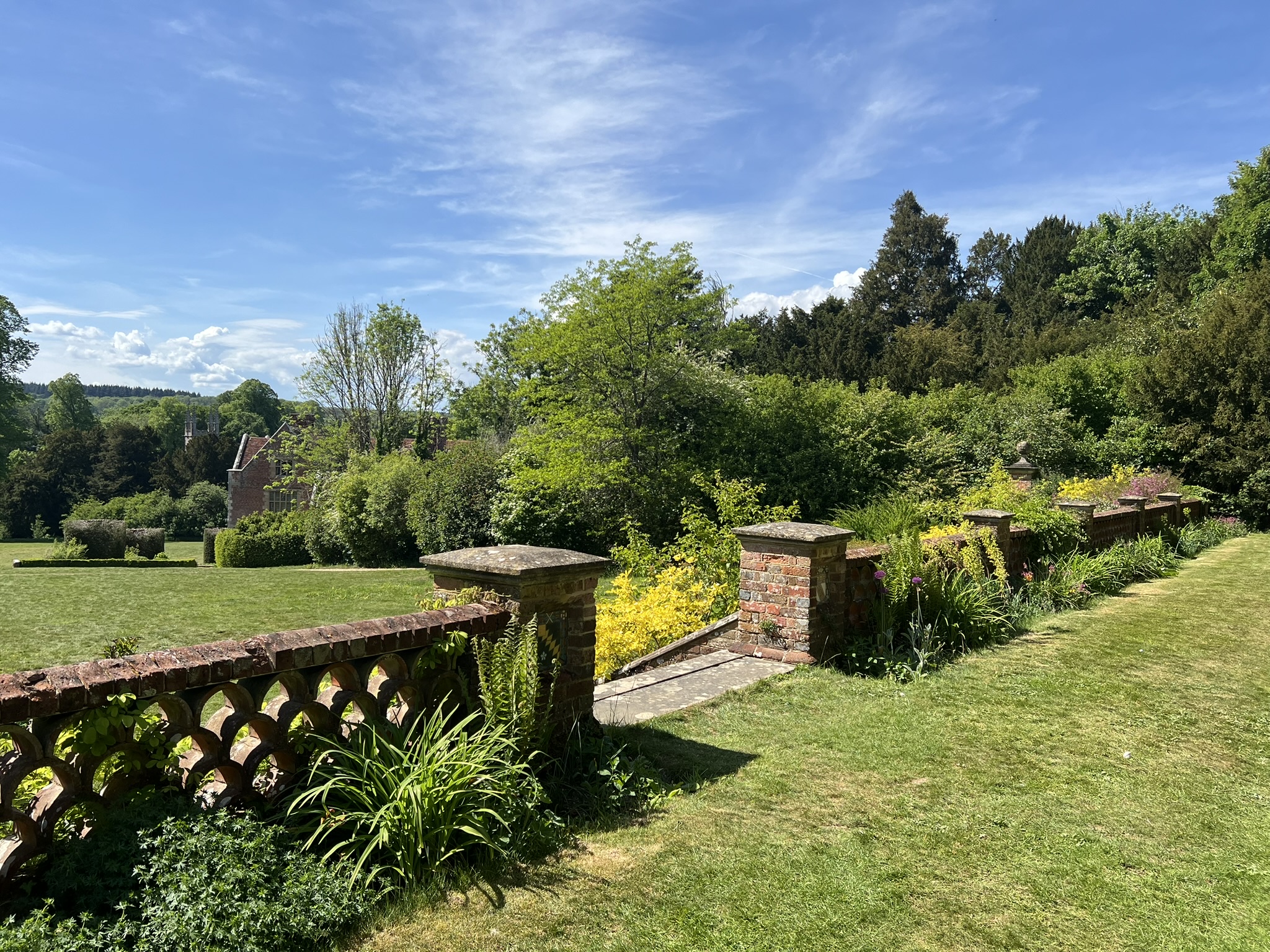
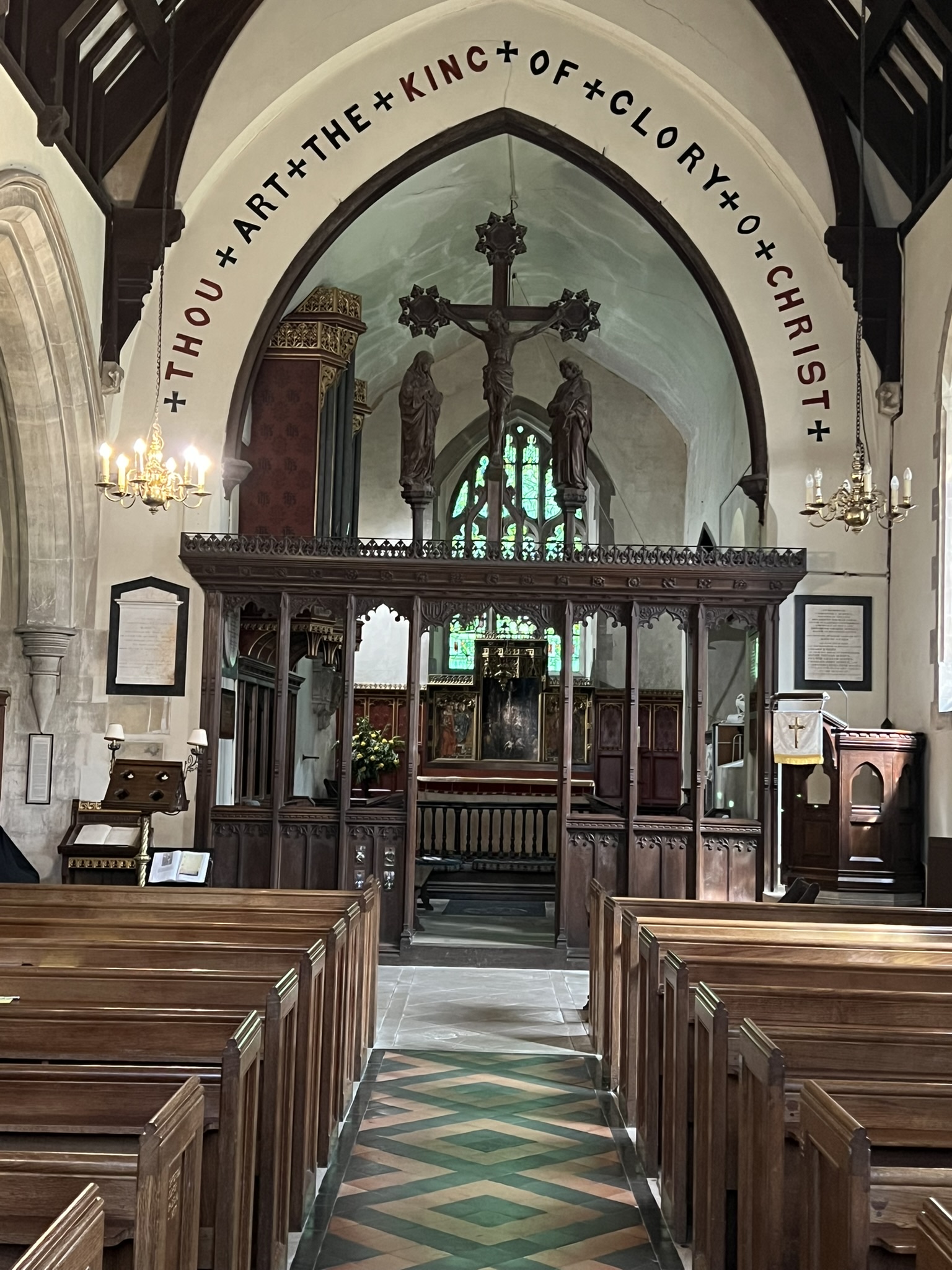
Adventures with Jane! Day VIII: The Delights of a Visit to Chawton

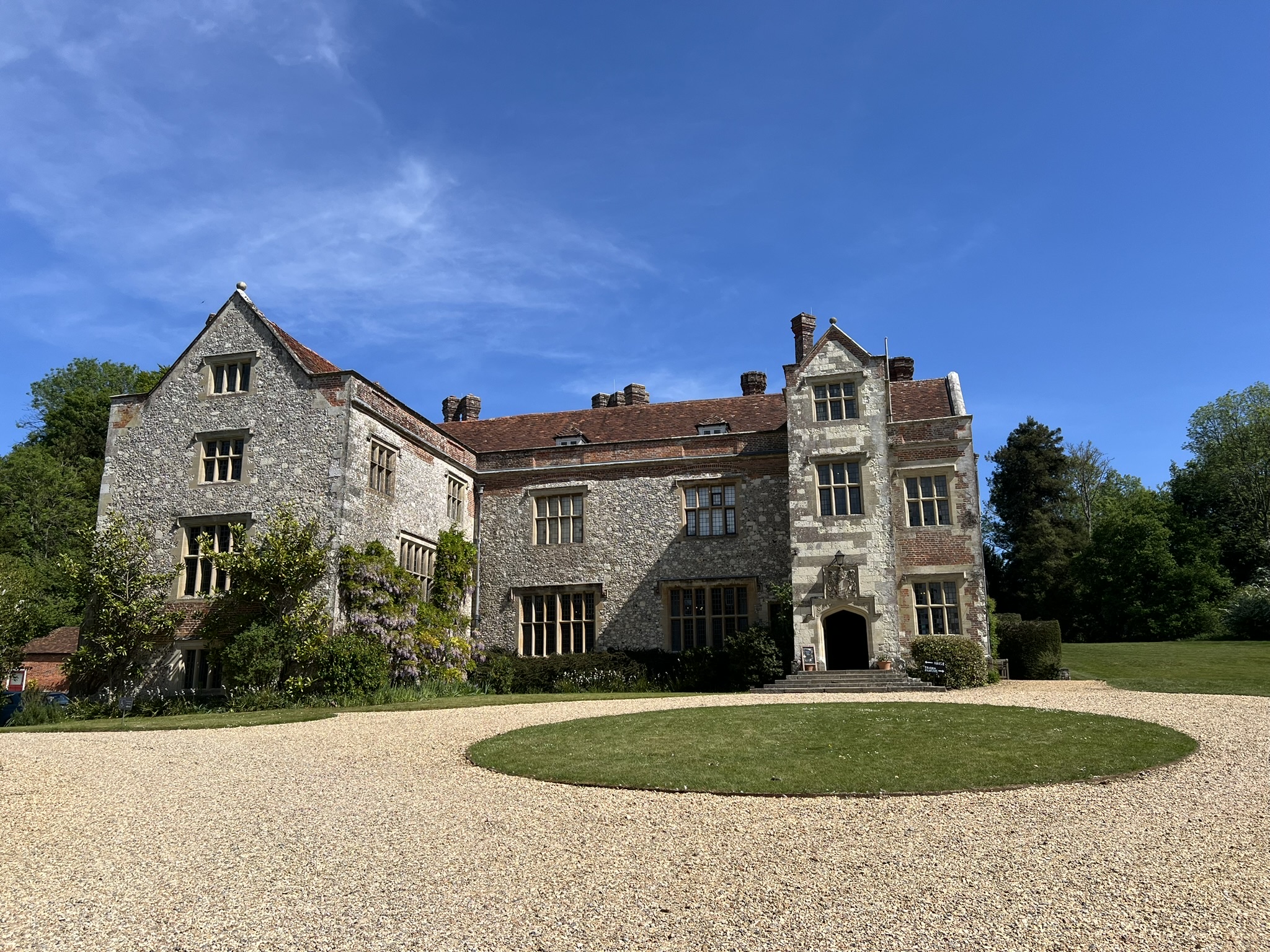
The Tea Room

************

– Janine Barchas, 2025

Jane Austen, 29 May 1811 from Chawton
to Cassandra at Godmersham Park

c2025JaneAustenInVermont
Austen Literary History & Criticism · Books · Jane Austen · Jane Austen Circle · Jane Austen's Letters · Literature · Publishing History

From the Archives: “Jane Austen’s ‘own darling Child'”

January 28, 1813: Pride and Prejudice is published! I retreated into the archives to repost this from 2013 which is in itself a repost from 2 years earlier [I am a big fan of recycling…] – it’s all about what Jane Austen had to say about her “own darling Child” – a Darling Child for many of us as well who reread this novel on an annual basis…
******************
Gentle Readers: This year we have just entered upon will be a long and interesting 365 days of celebrating the 1813 publication of Pride and Prejudice ! There are festivals, conferences, blog postings, reading challenges, and already many newspaper and journal articles on this timeless work by Jane Austen.  I would like to start off my own celebration of this beloved classic with repeating a post I wrote two years ago, where I had pulled together all the references that Austen makes to this, her “own darling Child,” in her letters.  It makes fascinating reading to “hear” her…
pp-christies-12-7-12
The publishing history of Pride and Prejudice, Jane Austen’s most popular book, then and now, is an interesting study in the book trade of early 19th century England.  First completed in 1797 (and called First Impressions) and rejected by the publisher her father took the manuscript to, Austen reworked her draft over time and submitted it to Thomas Egerton, the publishing house of her Sense & Sensibility, in 1812 (it was published on January 28, 1813).   She sold the copyright outright for £110, and did not incur other expenses in its publication, as she did in the three other works published in her lifetime [see links below for more information.]  How we would love to know her thoughts on this road to publication! – how we would love to have her letters written while in the process of the writing to give us some idea of her imagination at work – where WAS the model for Pemberley?  was Mr. Darcy someone REAL?  was Elizabeth Bennet her alter ego? was MR COLLINS drawn from life? – or to have the letters to her brother Henry and his to Egerton – but alas! we have very little, just a few comments scattered among the surviving letters.
Austen Literary History & Criticism · Books · Collecting Jane Austen · Jane Austen · Jane Austen Circle · Jane Austen's Letters · Publishing History · Social Life & Customs

Collecting Jane Austen: The Letters

Jane Austen to Cassandra, from Sloan St London, 25 April 1811 – British Library

Jane Austen’s Letters are an absolute must-have in your collection. There is nothing like reading these late at night, Jane Austen hovering over your shoulder. Considered rather mundane by the scholarly world when they first appeared – filled as they are with local gossip, fashion and food news, the periodic snide comment about friends and neighbors, and very little about her reading and writing – they have in succeeding years been picked over, and picked over again, to find the minutest insight into Austen and her world.

I find them a pure delight – seeing Austen as she was, mostly in missives to her sister, but also to her brothers, her friends, and publishers – it is like being inside her head at any given moment as she shares her thoughts, observations, and very caustic wit about the goings-on around her – a participant, but always the objective, sometimes judgmental, observer…

One-hundred and sixty letters remain from what has been surmised to have been thousands Austen likely wrote. Cassandra’s “great conflagration” before her own death in 1845 saw the destruction of who knows what else Austen had to say about her own life  – the gaps in dates give the reader such a sense of loss – what happened in those intervening days and years?? – and thus the fabric of novels is made. Of these 160 extant letters, most are scattered around various institutions or remain in private hands – location of each is noted in Le Faye’s exhaustive work.

This example of just her signature sold for over $16,000 in 2017!

So which of the published Letters to have??

Well, a true collector should have them all – you can find a good list in Gilson at G, a mere 8 pages (1982 ed.) with an additional three pages in the revised edition of 1997. While having them all would be a collector’s dream, you at least must have the 4th ed. by Le Faye if you are to understand anything at all about Jane Austen. But here is my list of the basic should-haves:

1. 1817: Henry Austen’s “Biographical Notice” postscript dated 20 December 1817 – Henry included a few extracts from her letters in this notice that appeared in the first edition of Northanger Abbey and Persuasion (London: John Murray, 1818).

2. 1870: James Edward Austen-Leigh, A Memoir of Jane Austen (London: Bentley, 1870) – includes extracts and some letters in their entirety.

Frontispiece to the Memoir – the prettified Jane

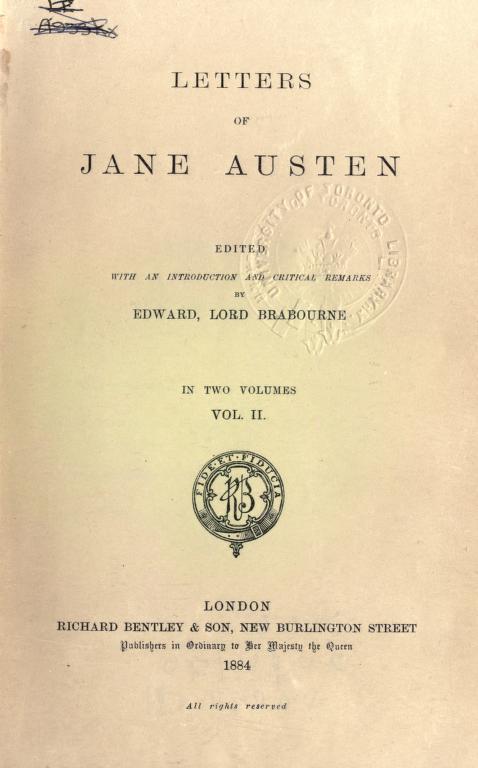
3. 1884: The Letters of Jane Austen, edited with an introduction and critical remarks by Edward, Lord Brabourne (London: Bentley, 1884). Edward Knatchbull-Hugessen, son of Austen’s niece Fanny Knight, published 96 of the letters left to him by his mother – mostly includes letters to Cassandra, but also to Fanny, Anna Lefroy, and the two letters written by Cassandra on Austen’s death.

You can read them all here: https://en.wikisource.org/wiki/Letters_of_Jane_Austen_(Brabourne)
or here: https://pemberley.com/janeinfo/brablets.html

For a fascinating history of an Austen family-owned and annotated copy of these Letters, you can read Edith Lank’s account of her copy here:

“Family and Scholarly Annotations in Lord Brabourne’s Letters: Adventures of an Amateur Academic,” by Edith Lank. Persuasions 30 (2008): 76-87 – citation only, full–text unavailable.

But Lank also made a list of all the annotations online in POL 29.1 (2008), which you can read here: http://www.jasna.org/persuasions/on-line/vol29no1/lank.html

4. 1906: Jane Austen’s Sailor Brothers, by John Henry Hubback and Edith Charlotte Hubback (London: John Lane, 1906) – this biography of Francis and Charles Austen includes for the first time Jane’s letters to her sailor brothers.

5. 1913: Jane Austen: Her Life and Letters, A Family Record, by William Austen-Leigh and Richard Arthur Austen-Leigh (London: Smith-Elder, 1913) – quoted from all the letters known at that time.

6. 1924: Five Letters from Jane Austen to her Niece Fanny Knight, printed in facsimile (Oxford: Clarendon, 1924) – the full text of the letters from Austen to her niece (they were incompletely printed in Brabourne’s collection.

7. 1925: The Letters of Jane Austen, selected with an introduction by R. Brimley Johnson (London: John Lane, 1925) – a selection of 44 letters from the Brabourne Letters, The Sailor Brothers, and the Austen-Leigh Life.

Chapman, Letters, 1932

8. 1932: Jane Austen’s Letters to Her Sister Cassandra, collected and edited by R. W. Chapman (Oxford: Clarendon, 1932) – the first definitive edition, printed from the actual manuscripts where possible with those letters not accessible taken from Brabourne. There was a 2nd ed. published in 1952 with the addition of 6 more letters but few other changes. Chapman also published a selection of the letters (about one-third) in 1955, and again in 1985 with an introduction by Marilyn Butler.

9. 1981: Five Letters from Jane Austen to Her Sister Cassandra, 1813, with an introduction by David Gilson (Brisbane: Lock’s Press, 1981) – a limited edition of 60 copies.

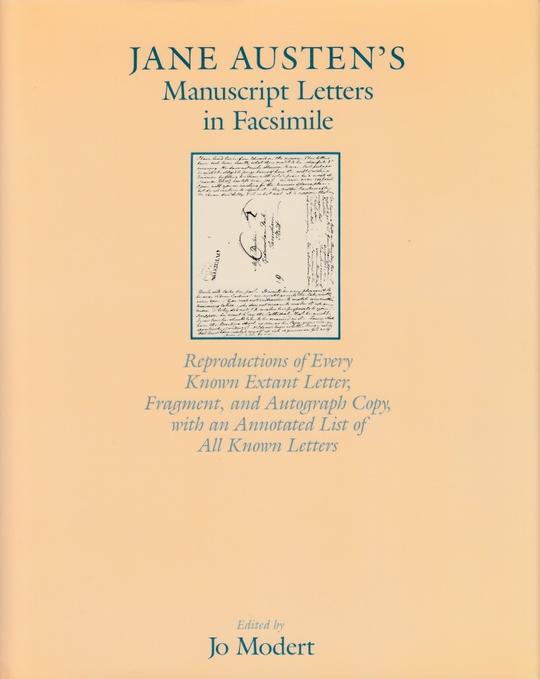
10. 1990: Jane Austen’s Manuscript Letters in Facsimile, edited by Jo Modert (Carbondale: Southern Illinois UP, 1990 – a reproduction of all letters that could be located – the introduction is invaluable and seeing each letter in its original state is fascinating.

11. 1990: My Dear Cassandra…a collection of Jane Austen’s Letters selected and introduced by Penelope Hughes-Hallett (London: Collins and Brown, 1990) – letters selected from the Brabourne Letters, not complete, but it does include many fabulous contemporary illustrations.

12. 1992: “Seven letters from Austen to Francis and Charles” published as a keepsake for those at the JASNA AGM (Alto Loma: Bookhaven Press, 1992) – a miniature booklet limited to 300 copies, these were given to attendees of the 1992 AGM in Santa Monica, CA – the theme was “The Letters, Focusing on Travel and the Sea.”

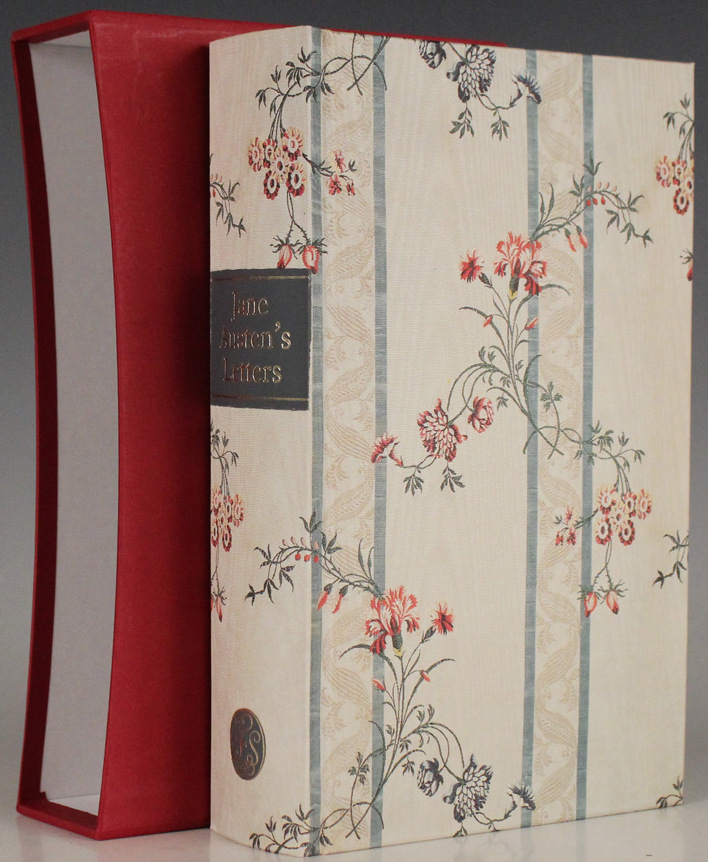
13. 1995: Jane Austen’s Letters, New Edition, collected and edited by Deirdre Le Faye (Oxford: Oxford UP, 1995) – a 3rd edition of the Chapman Letters but with Le Faye’s ceaseless and energetic scholarship into those not fully identified by Chapman as well as the addition of 12 more letters – Le Faye’s notes are mine of information on provenance, current location of each letter (if known), every detail on people and places and allusions are noted; includes biographical and topographical indexes. The lacking full subject indexes found in Chapman were added into the 4th edition (see below)…

There is also a fine publication of this 1995 edition by the Folio Society:

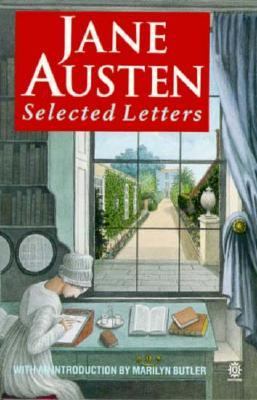
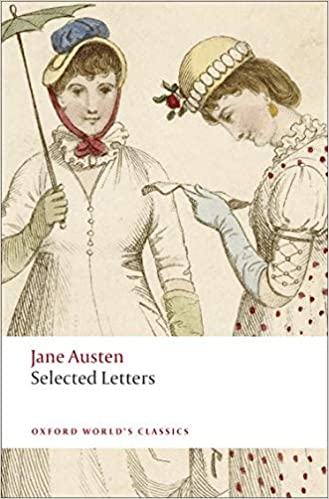
14. 2004: Selected Letters [of Jane Austen], selected with an introduction and notes by Vivien Jones (Oxford: Oxford UP, 2004) – based on the 3rd ed. of the letters by Deirdre Le Faye from 1995. You need these paperback editions so you have something to write-in and underline (!).

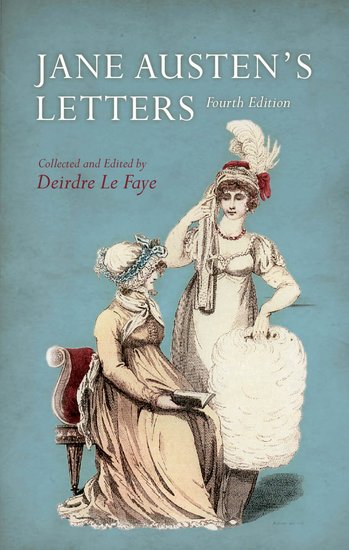
14. 2011: Jane Austen’s Letters, 4th ed., collected and edited by Deirdre Le Faye (Oxford: Oxford UP, 2011; paperback ed. 2014) – no new letters have been discovered since the 1995 ed, but much additional information has been added regarding Austen’s life and her endless references in the letters. Indexes and notes have been updated, as well as the addition of the all-important Subject Index.

There are other editions out there – I also have the small Oxford World Classics blue hardcover of Chapman Letters with the dust jacket, not often seen – if you should find this, buy it immediately…

[Please note: Our house is being renovated and all my books are packed up – so while some of these images are mine, I had to also mine the internet for others!]

Do you have a favorite edition of the Letters??

©2021 Jane Austen in Vermont
Austen Literary History & Criticism · Books · Collecting Jane Austen · Jane Austen · Jane Austen Illustrators · Jane Austen Merchandise · Jane Austen Popular Culture · Jane Austen Sequels · Jane Austen's Letters · Literature · Publishing History · Rare Books

Collecting Jane Austen: Book Collecting 101

Gentle Readers: In an effort to offer weekly posts on collecting Jane Austen, I shall start with the basics of book collecting – this a general summary of things to consider with a few examples specific to Jane Austen and Pride and Prejudice in particular. This will be followed by weekly posts on randomly chosen books in the various categories I list here that I think are essential to a Jane Austen collection.

Let’s start in the pages of Pride and Prejudice in the library at Netherfield where we find Elizabeth, Miss Bingley, Mr. Bingley, and Mr. Darcy:

   [Elizabeth] walked towards a table where a few books were lying. He [Bingley] immediately offered to fetch her others; all that his library afforded.

   “And I wish my collection were larger for your benefit and my own credit; but I am an idle fellow, and though I have not many, I have more than I ever look into.”

   Elizabeth assured him that she could suit herself perfectly with those in the room.

   “I am astonished,” said Miss Bingley, “that my father should have left so small a collection of books. What a delightful library you have at Pemberley, Mr. Darcy!”

   “It ought to be good,” he replied; “it has been the work of many generations.”

   “And then you have added so much to it yourself, you are always buying books.” [my emphasis]

   “I cannot comprehend the neglect of a family library in such days as these.”

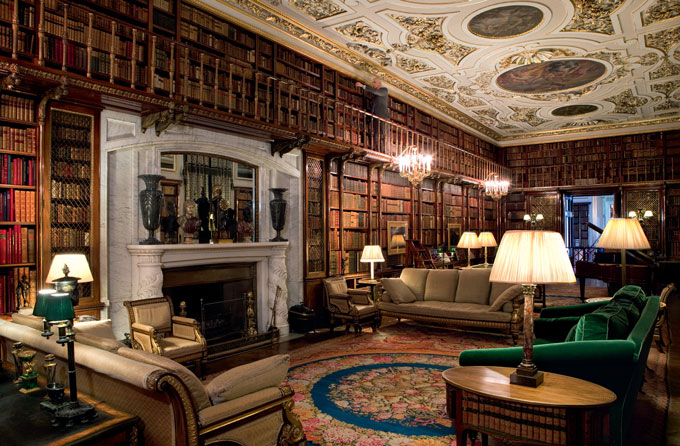
Chatsworth Library [British Magazine]

And so, here we have the permission of Mr. Darcy himself to buy as many books as we would like!

II. The Collecting of Books:

Terry Belanger, a veteran book collector and rare book librarian once famously said “you are a collector if you have more than one copy of a single title” –

So, I ask you, how many of you have more than one copy of any of Jane Austen’s novels? And how many of you already realize that to collect all copies of books by and about Jane Austen is surely an impossible task? Even focusing on one title, say Pride and Prejudice, we would find it an impossible undertaking!

So where to start?

1. The first rule of book collecting is Collect what you Love – so I can assume that any of you reading this all love Jane Austen, and so that will be our focus… and not only the books but also the myriad objects and ephemera.  You can collect anything – my son collects Sneakers, only Nike Jordans, which leads to books about sneakers, etc…!

An amusing tale about collecting one title: In a used bookshop in England a few years ago I hit the mother-load of A Child’s Garden of Verses – a title I collect –

 I brought five different editions to the register, manned by a young man obviously neither the owner nor all that well-versed in the vagaries of collecting – he hesitated for a moment, looked thoughtful, and finally blurted out “Do you know that all these books are the same?” [epilogue: I bought them all…]

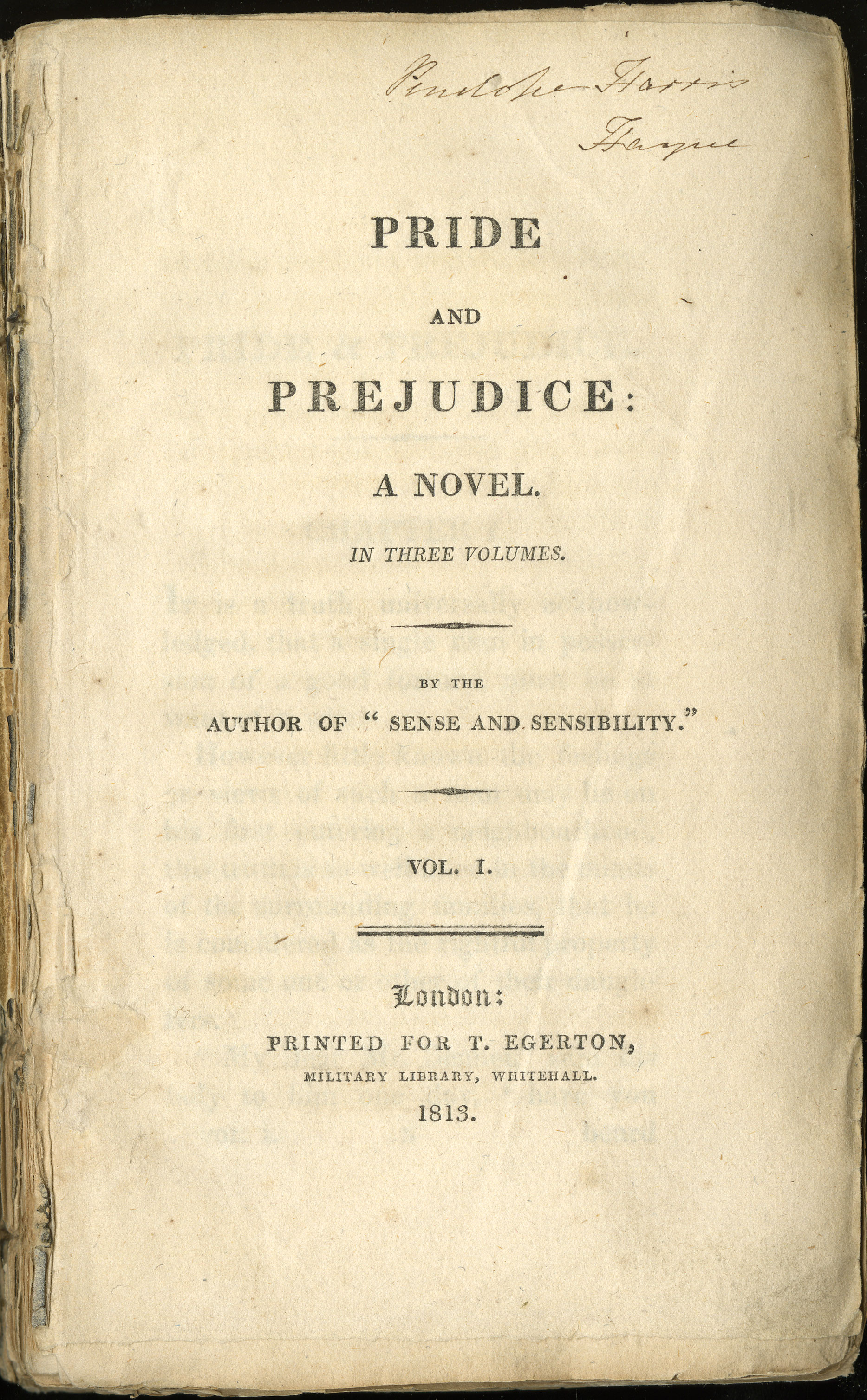
2.  Try to find the 1st edition (and by “first edition” I mean “first printing”), and how do we do that?

  1st edition Pride and Prejudice [National Library of Scotland]

For most of us, Jane Austen first editions are beyond our pocketbooks – but you will need to know the basics of book collecting to understand why some books are harder to find, and why, when you find them, they can often be expensive.

It is here you will need to decide if you want the first edition in pristine condition or if you only need a reading copy, or not even a first edition at all – this is a question to ask at every purchase.

The most difficult aspect of book collecting is how to identify a first edition – every publisher did it differently and often changed their indicators over time. There are many guides to help with this.

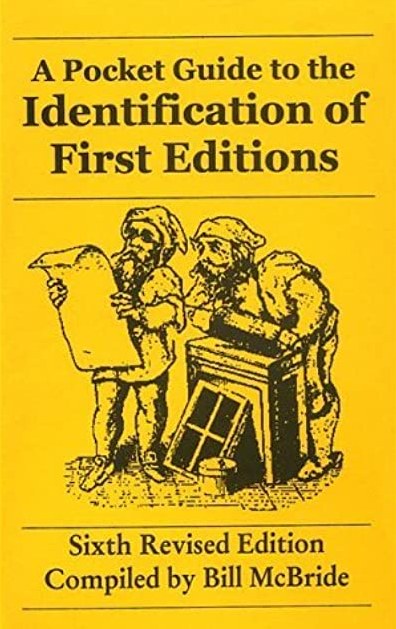
This Pocket Guide to the Identification of First Editions by Bill McBride is the best starting point for a general understanding of the practices of various publishers. You can also find this information online at Quill & Brush Books: https://www.qbbooks.com/first_ed_pub.php

Then you will need more specific detail on the author/subject you are collecting, and thankfully for us Jane Austen enthusiasts, David Gilson, and Keynes and Chapman before him, have largely done this work for us…

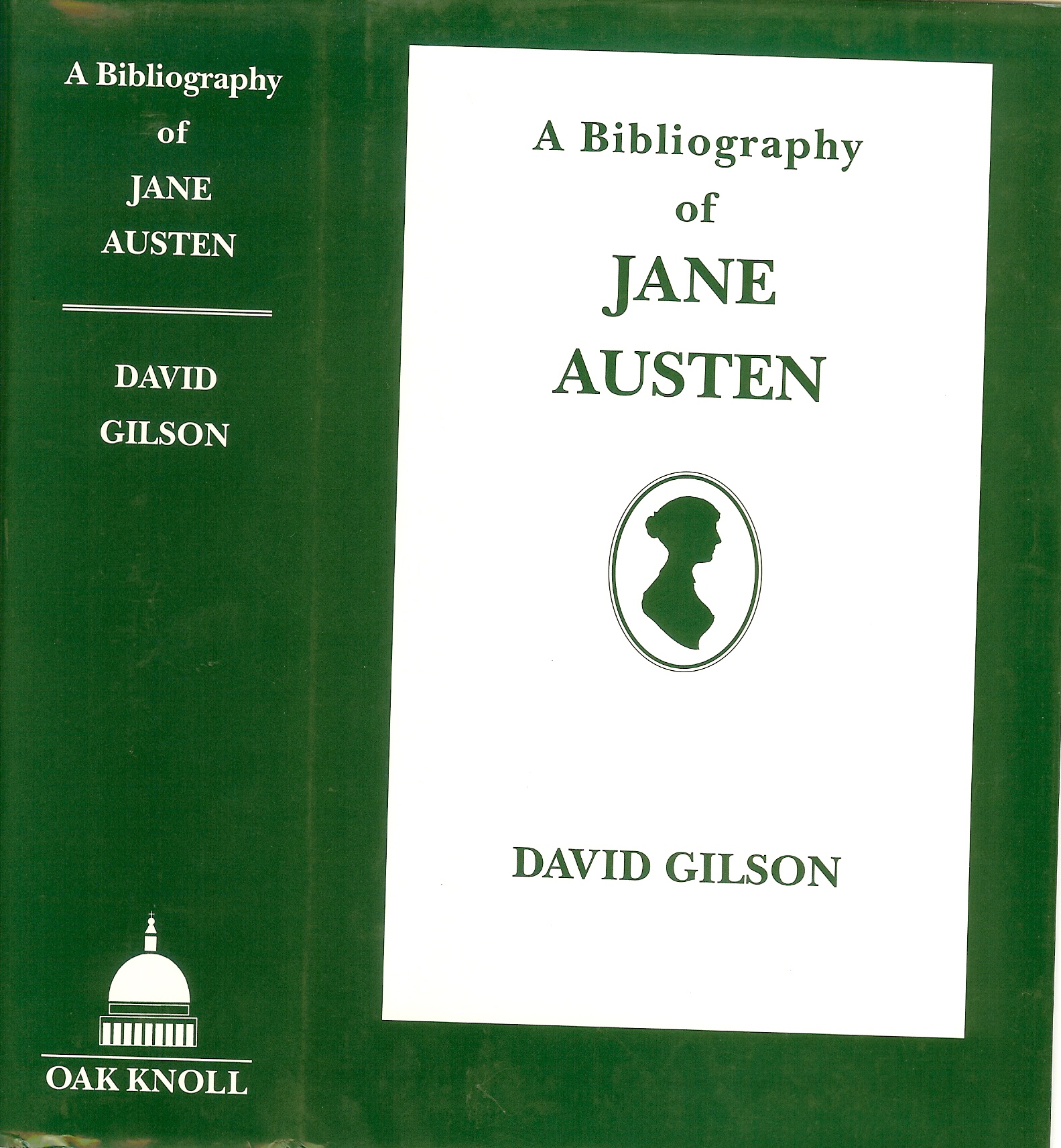
The David Gilson A Bibliography of Jane Austen will be your Bible to collecting Austen, a must-have book – I have already posted about this here: https://janeausteninvermont.blog/2021/02/26/collecting-jane-austen-gilsons-bibliography/

3. The Anatomy of a Book:

If you want to understand book terminology, you must have John Carter’s ABC for Book Collectors – the 8th edition by John Carter and Nicolas Barker.  Oak Knoll Press / British Library, 2004. 

It is now available online at ILAB: https://ilab.org/sites/default/files/2018-01/ABC-BOOK-FOR-COLLECTORS_0.PDF

Another easily accessible glossary is on Abebooks: https://www.abebooks.com/books/rarebooks/collecting-guide/understanding-rare-books/glossary.shtml

Most commonly used terms:

  • 1st edition
  • Issue
  • Points
  • Boards
  • Spine head, spine tail
  • Backstrip
  • Text block
  • Hinge
  • Joint
  • Endpapers
  • Half-title page
  • Title page
  • Copyright page
  • Frontispiece
  • Publisher’s cloth
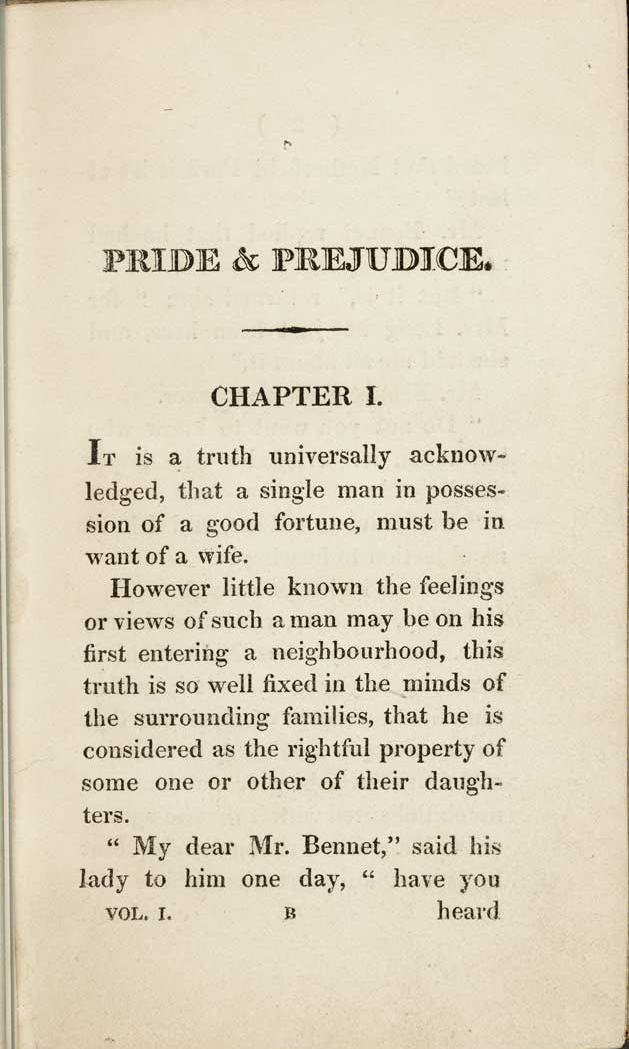
  • Catchword: “heard” at the bottom of the page is the catchword = the first word on the next page

-Vignette
-Foxing:

Example of foxing: Dent 1908 reprint, illus. HM Brock

4. Determining value: supply and demand – Desirability+Scarcity=Value

  • Is the book still in print?
  • How many copies were printed?
  • Is this the author’s first book? – Sense and Sensibility is the most valuable
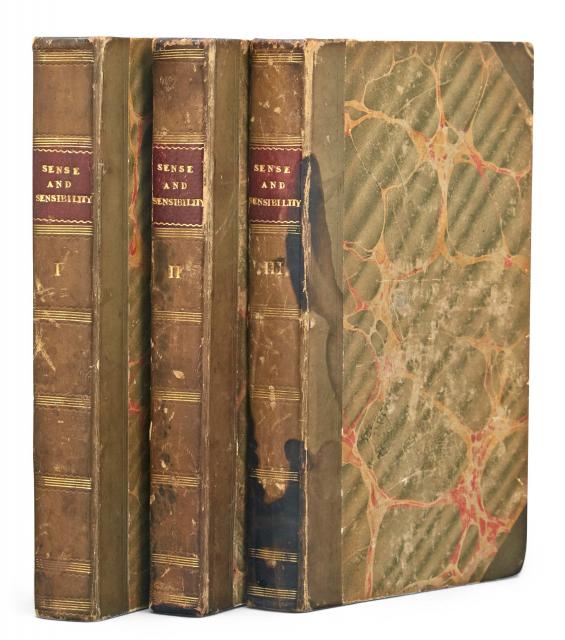
  • How did the book first appear? – binding, dust jacket? [value greatly reduced if lacking jacket: 75% – fiction, 20% – non-fiction]. Eg. S&S first published in boards is more valuable than the finest leather binding

S&S 1st ed in boards and leather bound]: estimated value:  $200,000 / $50,000.

  • Illustrations present? are they all there?
  • Condition, Condition, Condition! – most important factor! [see more below]
  • Where do you find values? There are many guides to consult:
  1. Allen and Patricia Ahearn. Collected Books: A Guide to Identification and Values. 4th ed. (2011); see also their author guides – one on JA from 2007
  2. American Book Prices Current: auction sales, so actual value
  3. Bookseller catalogues: what titles are selling for
  4. Author and subject bibliographies
  5. Internet: bookselling sites: be wary – prices all over the place

5. CONDITION is the most important issue: prices will vary depending upon condition – even if you have the 1st edition – if it is in deplorable condition that will affect the value.

Booksellers grade a book’s condition using the terms below, from “As New” down to “Poor”: for instance VG [for the book ] / VG [for the jacket] – anything less than a VG is really not collectible:

VERY FINE/NEW [VF / NEW]: As new, unread.

FINE: Close to new, showing slight signs of age but without any defects.

VERY GOOD [VG]: A used book that shows some sign of wear but still has no defects.

GOOD [G]: A book that shows normal wear and aging, still complete and with no major defects.

FAIR: A worn and used copy, probably with cover tears and other defects.

POOR: a mess really, but might have some redeeming qualities

READING COPY: any book less than VG

*************

An interesting tale to demonstrate this: The rare bookseller Stuart Bennett [no relation to our esteemed Bennet family!] writes in his book Trade Bookbinding in the British Isles 1660-1800.

Alas! pre-Austen, but we find her in a NOTE: [an aside – always check indexes for Jane Austen – you will be pleasantly surprised to see how often she turns up and in the most amazing places!]

Bennett writes in a footnote on the issue of publishing in boards vs. the wealthy having their favorite books bound in leather:

What is certain is that wrappered and boarded popular literature was not part of the visual landscape of country house libraries.  In my experience these books, when kept, found their way into cupboards underneath the display bookcases, or into passages or rooms used by servants. In my days at Christie’s I once spent hours in the pantry cupboards of a Scottish country house, searching through stacks of these wrappered and boarded books among which I found, virtually as new, Volume III of the first edition of Sense and Sensibility. When I found the other two volumes I remarked to the aristocratic owners that this was one of the most valuable books in the house, as exceptional survival in original condition, and doubtless so because one of their ancestors had bought Jane Austen’s first novel, read it, and hadn’t cared enough to send it to for rebinding, and never bought another. My ebullience was arrested by an icy stare from the Countess, who replied, “I am sure, Mr. Bennett, that our ancestors would never have felt that way about Jane Austen.” [3]

Stuart tells me: this S&S set the then-record auction price in 1977 or 1978 (he was the auctioneer!), and turned up about twenty or maybe 25 years later offered by a London bookseller for, as he recalls, $200,000.  Then it disappeared again. 

Question:  Should you buy a less collectible book because you cannot afford the higher price? – do you just want a reading copy or need to fill a gap in your collection? – you can decide this on a case-by-case basis – what becomes available and when and how much you can spend…

6. Where to find Books:

“Beauty in Search of Knowledge” – Thomas Rowlandson

Local bookstores: sadly less of them, but still the best resource of Jane Austen books – a bookseller who will know your likes, will buy with you in mind, someone to trust…
– Specific booksellers: those who specialize in Jane Austen and other women writers – shops, catalogues – you can find at book-fairs, being on their catalogue mailing list, and on the internet. For eg. Jane Austen Books https://www.janeaustenbooks.net/
Auctions / auction catalogues
– The Internet: major used bookselling sites: you need to be an informed consumer!

The Good, the Bad, and the Ugly of the Internet: I could write a very lengthy post just on this – so I will only emphasize the biggest positive – you have at your fingertips a Global marketplace – no longer dependent on a brick & mortar shop around the corner [sad as this is to me!]

Biggest negative: be in be-wary mode – who are you buying from? – how to decide which is the best copy with so many price and condition discrepancies? – my best advice? – choose a bookseller who knows what they are about: valid and complete descriptions and a price that seems reasonable in light of other copies on offer.

A word about EBAY: a Gigantic auction house always open! – an amazing resource but also the biggest potential for getting a bad deal – you need to be an informed consumer!

Best use of the internet: Want Lists – most book sites do this and auction houses offer “alerts” – you will be notified when an item becomes available…

7. Caring for your collection: lots of information here to consider…just not today.

II. What to Collect:

Now comes the hard part – with so much out there on Jane Austen, where do you even begin? The need to focus on one particular aspect [say just collecting copies of Pride and Prejudice], or by zeroing in on a certain illustrator you like [the Brock brothers], or only books with fine decorative bindings [so many] – this list covers the gamut of possibilities – you just need to choose what you are most interested in. You must however start with a core collection:

A.  A Jane Austen Core Collection

Oxford edition of The Novels of Jane Austen, ed. R. W. Chapman, 3rd ed.

1. The Works:  the Oxford edition, ed. by Chapman (1923); the Cambridge edition, general editor Janet Todd, with each volume edited by a a different scholar; a set of reading copies of each novel – ones you can markup, underline, and make notes

2.  The Letters – all editions [Brabourne, Chapman, Le Faye, Modert]

3.  R. W. Chapman’s books on Jane Austen

4.  Biography: the Memoir and everything since!

5.  A Chronology of Jane Austen, Deirdre Le Faye (Cambridge, 2006)

6.  The Bibliographies: Keynes, Chapman, Gilson, Barry Roth’s 3 volumes, and those continued annually in Persuasions; the Cambridge Bibliographies, etc…

7. Brian Southam. The Critical Heritage. Vol I. 1811-1870. Routledge, 1979; The Critical Heritage, Vol. II. 1870-1940. Routledge, 1987. – now available as digital reprints, 2009

8. Critical works: starting off point to further study – where to start?? The bibliographies; “Companions” – “Handbooks” – “Casebooks”

9. The World of Jane Austen: [endless material!]

  • The Arts: Music, Art, Architecture; Interior Design and Decorative Arts; Landscape
  • Georgian and Regency History: Political, Economic, Social, Religious
  • Social life and customs: Etiquette; Gender / Class issues; Dancing; Costume and Fashion
  • Domestic Arts: Cookery, Needlework, Women’s work, Family life, Home-life, Servants
  • Medical History
  • Military History: the Royal Navy, the Militia, The French Revolution, the American Revolution, Napoleonic Wars, War of 1812
  • Geographical History and Maps
  • Travel and Transportation: Carriages, Roads, Guidebooks, etc…
  • Literary Theory, History of the Novel, Narrative Theory, Language

B. Collecting a specific Jane Austen novel: as an example Pride & Prejudice

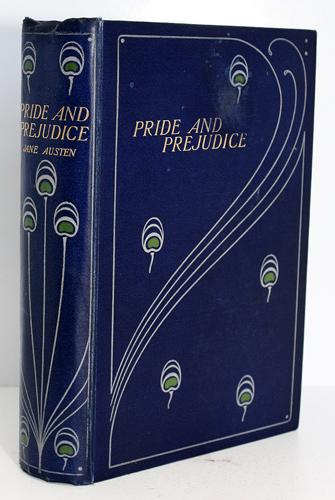
P&P, Gresham, 1900, illus. by Chris Hammond, Talwin Morris binding
  • 1st editions
  • American editions
  • Specific Publishers: Bentley, Macmillan, Dent, Oxford, Folio Society, LLC, Penguin, etc.
  • Translated editions
  • Illustrators: also single illustrations
  • Decorative bindings / cover art – to include paperbacks
  • Critical editions: with scholarly editing and introductions
  • Books where P&P shows up
  • Association copies: e.g. Sarah Harriet Burney’s copy
  • Books that influenced Austen: e.g. Frances Burney’s Cecilia
  • Adaptations: Editions for young readers; Dramatizations; Films, Audiobooks
  • Sequels! – endless potential!
  • History / Social Life and Customs of the times, specific to P&P – fill your bookshelves!
  • Ephemera and Physical Objects – P&P merchandise in popular culture, many to do with Colin Firth…(!)
Royal Mail, Jane Austen Stamps 1975, by Barbara Brown

*****************

Ok, now you know everything to know about Book Collecting – you can begin this lifelong fun-filled endeavor! Join me next week for the first of many [I hope] Jane Austen-related titles you must have on your shelves…all with Mr. Darcy’s approval. Any questions or suggestions, please comment.

©2021, Jane Austen in Vermont
Georgian England · Georgian Period · Jane Austen · Jane Austen Circle · Jane Austen's Letters · Regency England · Social Life & Customs

Jane Austen and Astley’s Amphitheatre ~ What She Saw…

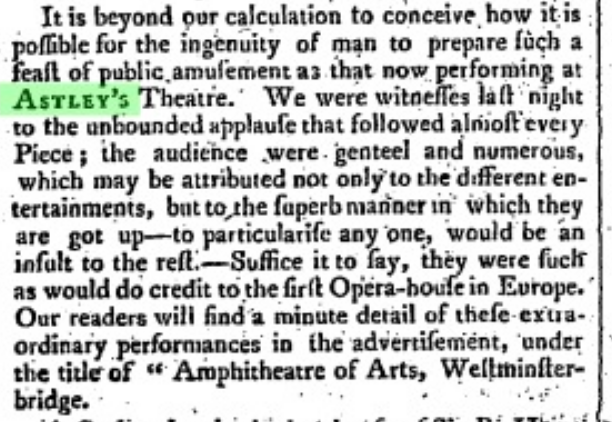
Dear Readers: Here is an update to the Astley’s Amphitheatre bit I mentioned in yesterday’s “Pemberley Post” – our esteemed co-regional coordinator for the Vermont region (Hope) was by complete coincidence doing some research in the 17th-18th Century Burney Collection Newspapers and found some relevant tidbits to add to our understanding of Astley’s and what Jane Austen might have exactly seen – Hope left a comment on the blog post, but I have put it in here as its own post in order to see some of the newspaper images to best advantage…

*****

Austen mentions Astley’s in a letter to Cassandra on 23 August 1796:

“Edward and Frank are both gone out to seek their fortunes; the latter is to return soon and help us seek ours. The former we shall never see again. We are to be at Astley’s to-night, which I am glad of.”

And in Emma: He [Robert Martin] delivered these papers to John, at his chambers, and was asked by him to join their party the same evening to Astley’s. They were going to take the two eldest boys to Astley’s… and in the next chapter: Harriet was most happy to give every particular of the evening at Astley’s, and the dinner the next day…

*****

From Hope:

What a coincidence. I was just looking in an online newspaper database from that period and had noticed some Astley’s news. So, I looked up the dates around Jane’s letter [August 23, 1796, Letter 3]. Astley’s changed their program every Monday (for Tuesday’s performance). If Jane had read the advertisements Tuesday morning for the performance that night she would have seen that the program included:

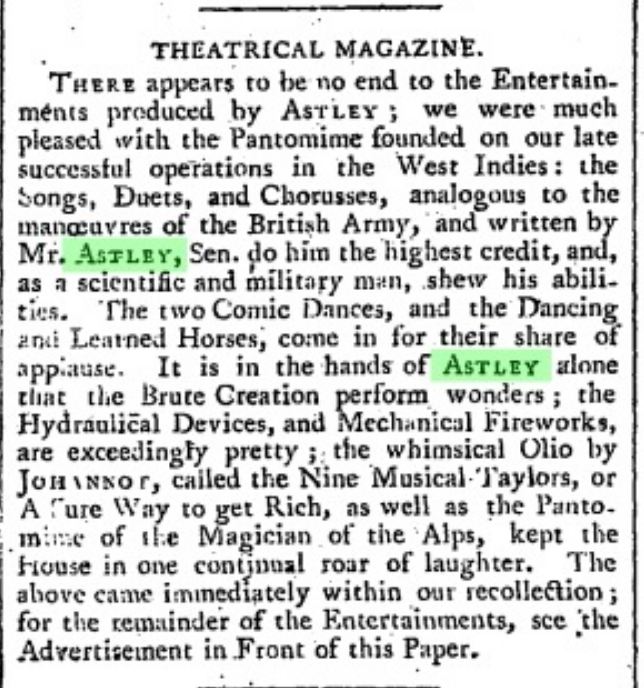
The West India Heroic Spectacle, Mechanical Fireworks, Hydraulic Devices, a new comic ballad by Mr. Johannot, called “The Nine Musical Taylors, or, A Sure way to get rich (arranged, compiled, written and composed by Mr. Astley, Sen.), Mr. Johannot also singing New Cries of London (also by Mr. Astley, Sen.), a Pantomimical Dance (composed by Mr. West) called “New Wheat; or, The Mill’s Agoing, a new dance called The Provincial Sailors, Chemical experiments with Signor Romaldo, Professor of Natural Philosophy, Equestrian activities as a Minuet by two horses, a Hornpipe by another, and a variety of military pantomimes, all concluding with a Grand Pantomime “The Magician of the Alps” with a “most beautiful  and magnificent Aerial Vertical Colonnade and Brilliant Transparent Celestial Temple, the whole of which are in motion.”

– Attendees were adjured to arrive between 5:30 and 6:30 and could, if they so desired, send their servants in at 5:00 to save their seats as long as they had spoken first with Mrs. Connell.

– Tickets cost 4s for Boxes, 2s if space available after 8:00; 2s. For Pit, 1s as available after 8:00; and 1s. for the Gallery, 6d after 8:00.
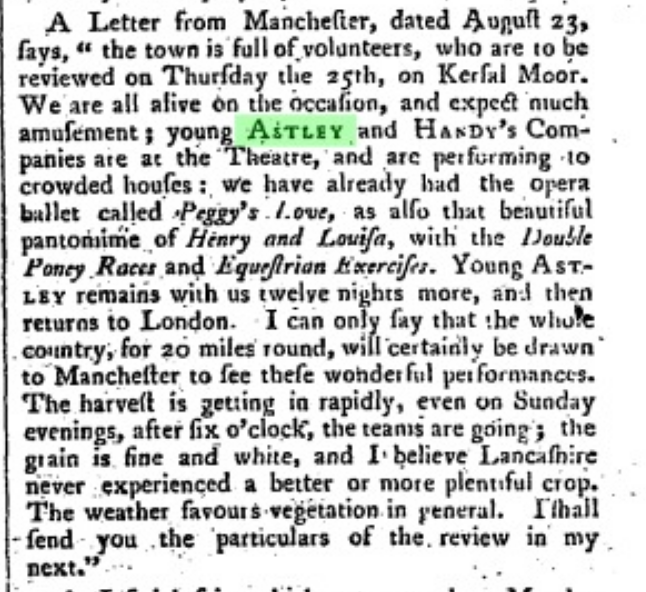
– Jane may have also compared her reaction to the show with some “reviews” touting the fine entertainment to be had at Astley’s, or even have learned that on the same day she went, the traveling version of the show, led by “Young Astley” was playing in Manchester to great acclaim, Manchester being filled with troops preparing for a review two days hence.

1) Morning Chronicle (London, England), Friday, August 19, 1796; Issue 8380. 17th-18th Century Burney Collection Newspapers.


****

A similar notice appeared in:

2) Morning Post and Fashionable World (London, England), Friday, August 19, 1796; Issue 7625. 17th-18th Century Burney Collection Newspapers.

***

3) Another can be found in Times (London, England), Friday, August 19, 1796; Issue 3666. 17th-18th Century Burney Collection Newspapers.

4) St. James’s Chronicle or the British Evening Post (London, England), August 20, 1796 – August 23, 1796; Issue 6033. 17th-18th Century Burney Collection Newspapers.


Note that this one announces some changes to the program, including the intriguing notice that: “Ballad Singer, Mr. JOHANNOT, who will sing the NEW CRIES of LONDON; written and composed by Mr. Astley, Sen.”

***

5) Those changes were also duly noted in:

Whitehall Evening Post (1770) (London, England), August 20, 1796 – August 23, 1796; Issue 7168. (2949 words). 17th-18th Century Burney Collection Newspapers.

In slightly abbreviated form in:

Times (London, England), Monday, August 22, 1796; Issue 3668. 17th-18th Century Burney Collection Newspapers.

6) On the morning that Austen mentions they will be going to Astley’s, they could have found the latest version with the above changes at:

– Daily Advertiser (London, England), Tuesday, August 23, 1796; Issue 21131. 17th-18th Century Burney Collection Newspapers.
– Oracle and Public Advertiser (London, England), Tuesday, August 23, 1796; Issue 19 407. 17th-18th Century Burney Collection Newspapers.
– Star (London, England), Tuesday, August 23, 1796; Issue 2504. (2372 words). 17th-18th Century Burney Collection Newspapers.

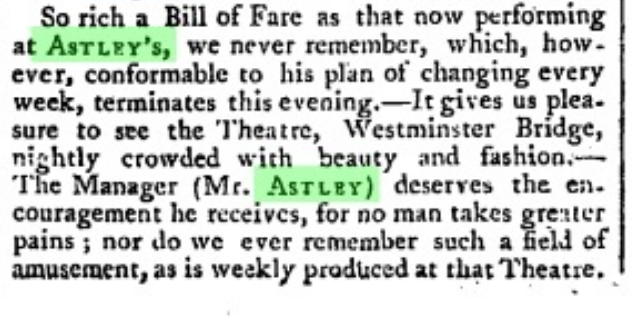
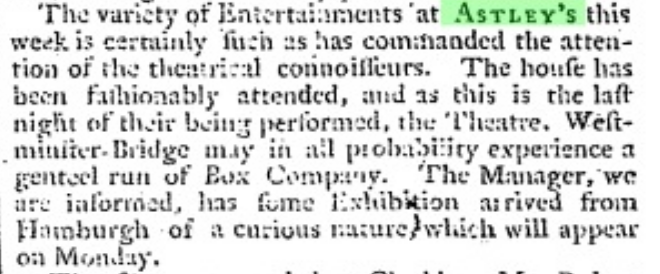
Throughout the year reviewers made sure to mention the fact that Astley changed the program every week, and to praise the results. Here are some examples.

7) True Briton (1793) (London, England), Saturday, August 20, 1796; Issue 1140. 17th-18th Century Burney Collection Newspapers.

***

8) Star (London, England), Tuesday, August 23, 1796; Issue 2504. 17th-18th Century Burney Collection Newspapers.

***

9) True Briton (1793) (London, England), Tuesday, August 23, 1796; Issue 1142. 17th-18th Century Burney Collection Newspapers.

***

10) And this one, referring to the end of that week’s program:

***

11) Meanwhile, from Manchester, we learn that:
Star (London, England), Saturday, August 27, 1796; Issue 2508. 17th-18th Century Burney Collection Newspapers.

The same “letter” also appears in:
Star (London, England), Saturday, August 27, 1796; Issue 2508. (1080 words). 17th-18th Century Burney Collection Newspapers.

**************

Thank you Hope for all this information – certainly proof that Astley’s was as great a source of entertainment as it was of journalistic interest!

17th-18th Century Burney Collection Newspapers is housed at the British Library and is available through Gale Cengage on a subscription basis – your library might have access.

c2019, Jane Austen in Vermont
Books · Fashion & Costume · Georgian Period · Illustrations · Jane Austen · Jane Austen's Letters · London · Museum Exhibitions · Pemberley Post · Rare Books

The Pemberley Post, No. 6 (Feb 4-10, 2019) ~ Jane Austen and More…!

This week finds me jumping from Jane Austen’s sister-in-law Fanny Austen, to crazy bibliophiles, Rossetti’s wombats, the Coloring craze, Princess Margaret, and on to London, muons (whatever they are…), and more of course – it’s a mad world of information out there…

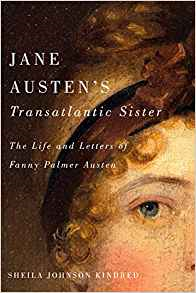
A new website and blog by Sheila Johnson Kindred, where she will explore Jane Austen’s naval world. Kindred is the author of Jane Austen’s Transatlantic Sister: The Life and Letters of Fanny Palmer Austen: https://www.sheilajohnsonkindred.com/

*

This made me laugh: always great stuff on The Londonist

https://londonist.com/london/outside-london/london-paris-comparison

*

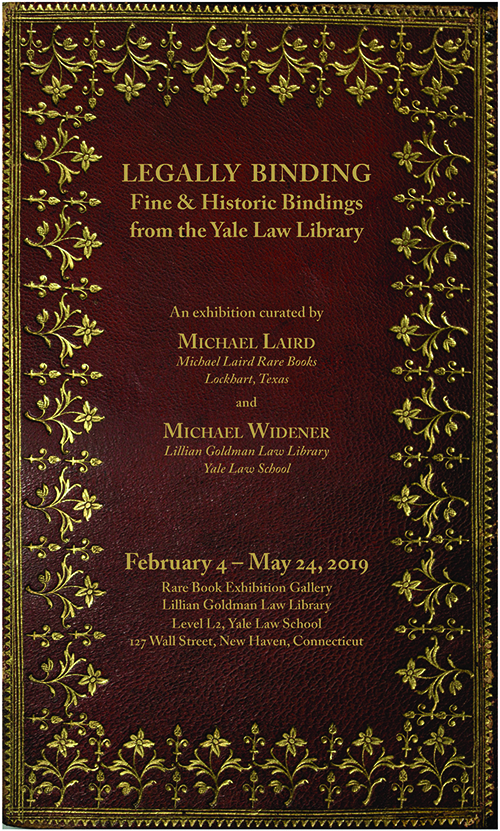
The Yale Law School Library has a new exhibit on its rare bindings: https://library.law.yale.edu/news/new-exhibit-legally-binding-fine-and-historic-bindings-yale-law-library

*

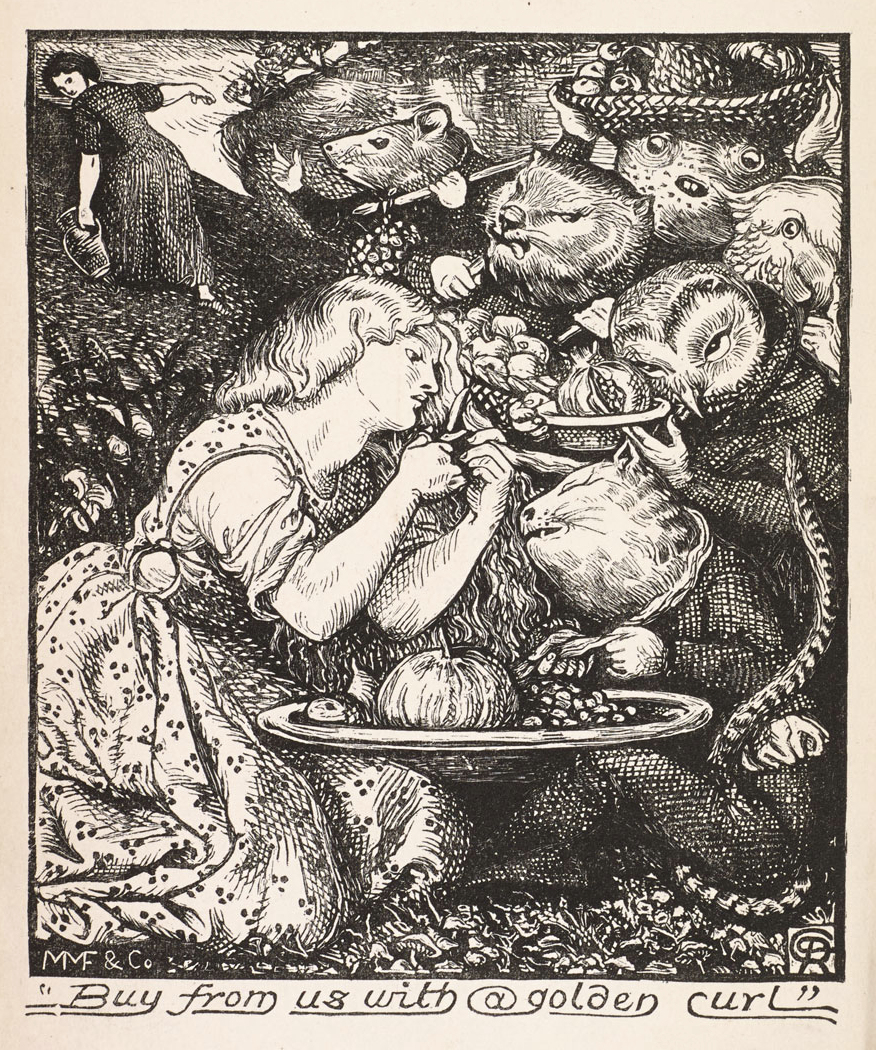
So, who doesn’t love a wombat?! https://publicdomainreview.org/2019/01/10/how-the-pre-raphaelites-became-obsessed-with-the-wombat/

Image: Dante Gabriel Rossetti’s frontispiece, complete with wombat, for his sister Christina’s long poem Goblin Market

*

A new blog on Early Modern Female Book Ownership (how nice we were allowed to have books…): https://earlymodernfemalebookownership.wordpress.com/

Frances Wolfreston

-which led me to this: https://franceswolfrestonhorbouks.com/, a blog by Sarah Lindenbaum, who is seeking to reconstruct the book collection of Frances Wolfreston (1607-1677), a gentrywoman from the English midlands with an expansive library; over 200 books have been identified thus far.

*
Have you gotten caught up in the coloring book craze? Here’s some history: it’s nothing new – https://publicdomainreview.org/2019/02/06/filling-in-the-blanks-a-prehistory-of-the-adult-coloring-craze/

Image: The page from the University of Oklahoma’s colored version of Leonhart Fuchs’ De historia stirpium commentarii insignes

This is an example of how finding one interesting link leads to more and you might never get up from your desk again…

-The Folger also is into the coloring craze: Color Our Collections (was available to download Feb 4-8, 2019): https://folgerpedia.folger.edu/Color_Our_Collections?utm_source=wordfly&utm_medium=email&utm_campaign=ShakespearePlus6Feb2019&utm_content=version_A&promo=

–…which leads you to the Folgers whole collection of British Book Illustrations from the 17th century:
https://britishbookillustrations.folger.edu/?_ga=2.137070000.1247254353.1549814122-1754199278.1548275325#explore

—…which leads you to this illustration from the color week in 2017: Louis Rhead, Romeo & Juliet, for Tales from Shakespeare by Charles and Mary Lamb—-and then back to #colorourcollections on twitter: https://twitter.com/search?q=%23colorourcollections&src=tyah

—–and on to facebook too: https://www.facebook.com/search/str/%23colorourcollections/keywords_search?epa=SEARCH_BOX

I’m exhausted and I haven’t even begun to color yet…

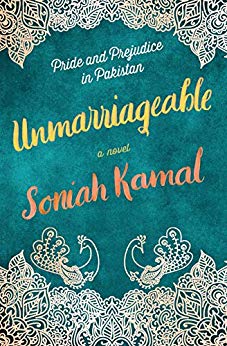
Back to Jane, for a minute: A nice review of the latest Pride and Prejudice redo, Unmarriageable, set this time in Pakistan: https://writergurlny.wordpress.com/2019/02/05/unmarriageable-a-novel-book-review/

*

The Museum of London has acquired an 1815 panorama of London painted by Pierre Prévost; Kelly McDonald on her Two Teens in the Time of Austen blog writes all about it: https://smithandgosling.wordpress.com/2019/02/07/jane-austens-london-1815/

*

A new exhibit at the V&A on Christian Dior: https://www.vam.ac.uk/exhibitions/dior-designer-of-dreams – and https://secretldn.com/inside-va-dior-exhibition/

The exhibit includes Princess Margaret’s 21st birthday dress – read more at this Smithsonian article:
https://www.smithsonianmag.com/smart-news/princess-margarets-iconic-21st-birthday-dress-goes-displaystains-and-all-180971404/

*


A new chamber in the Great Pyramid? If you know what a “muon” is, you might know that the use of muon technology has revealed an as yet undiscovered chamber in the Great Pyramid, where remaining treasures may lie: https://blog.oup.com/2019/02/power-mysterious-muon/

*

Here’s a bit of a head-scratcher: with thanks to Tony Grant:

https://www.atlasobscura.com/articles/transcribe-old-documents-unreadable-handwriting

The article shows a letter from Jane Austen to Cassandra that Ms. Watson has transcribed; but she states: “You can actually see how they have changed their manuscript – how Jane Austen changed Pride and Prejudice as she’s writing it… That blows my mind a bit. You see it, and you think – that’s so much better after she’s edited it than before.”

Well, I’m sorry but as far as I know there are no manuscripts of Pride and Prejudice, or any of the other 5 novels other than the cancelled chapters of Persuasionso this is very interesting if she has been transcribing a P&P manuscript??

      An 1800 letter from Jane Austen to her sister Cassandra

You can see and read all of Austen’s actual fiction manuscripts here: https://janeausten.ac.uk/index.html

*

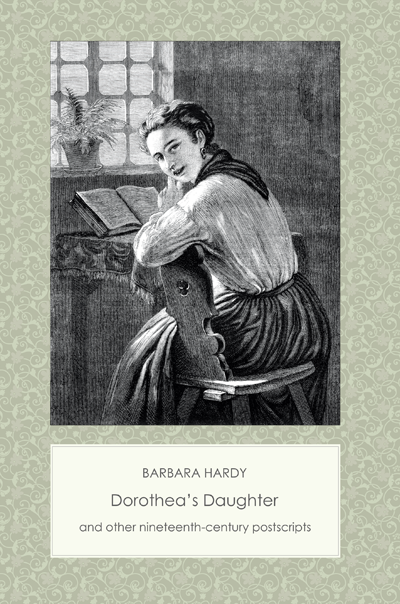
And finally, for your reading pleasure – I love finding something rather obscure: https://www.victoriansecrets.co.uk/book/dorotheas-daughter-and-other-nineteenth-century-postscripts/

“Dorothea’s Daughter is a stunning new collection of short stories based on novels by Jane Austen, Charlotte Brontë, Charles Dickens, George Eliot, and Thomas Hardy. They are postscripts, rather than sequels, entering into dialogues with the original narratives by developing suggestions in the text. The authors’ conclusions are respected, with no changes made to the plot; instead, Barbara Hardy draws out loose threads in the original fabric to weave new material, imagining moments in the characters’ future lives.”

The stories are:

  • Twilight in Mansfield Parsonage (Mansfield Park by Jane Austen)
  • Mrs Knightley’s Invitation (Emma by Jane Austen)
  • Adèle Varens (Jane Eyre by Charlotte Brontë)
  • Lucy Snowe and Paulina Bretton: the Conversation of Women (Villette by Charlotte Brontë)
  • Edith Dombey and Son (Dombey and Son by Charles Dickens)
  • Harriet Beadle’s Message (Little Dorrit by Charles Dickens)
  • Lucy Deane (The Mill on the Floss by George Eliot)
  • Dorothea’s Daughter (Middlemarch by George Eliot)
  • ’Liza-Lu Durbeyfield (Tess of the D’Urbervilles by Thomas Hardy)

Has anyone read this? It was first published in 2011. I’ve just ordered it and will let you know my thoughts…

Thanks for visiting… and Happy Reading…

ps: just a note as to why I leave in the full url of each link: if an imbedded link goes bad or far off into cyberspace, it is easier to find it if you have the details in the url – it doesn’t look as pretty, sorry to say, but more helpful in the end..

C2019 Jane Austen in Vermont
Jane Austen · Jane Austen Circle · Jane Austen's Letters · JASNA-Vermont events

JASNA-Vermont Next Meeting! June 3, 2018 with Professor Peter Sabor

You are Cordially Invited to JASNA-Vermont’s June Meeting 

Professor Peter Sabor

‘Reading with Austen’:
the Godmersham Park Library Goes Digital
 

Sunday, 3 June 2018, 1 -3 pm

Morgan Room, Aiken Hall,
83 Summit Street, Champlain College, Burlington VT

********

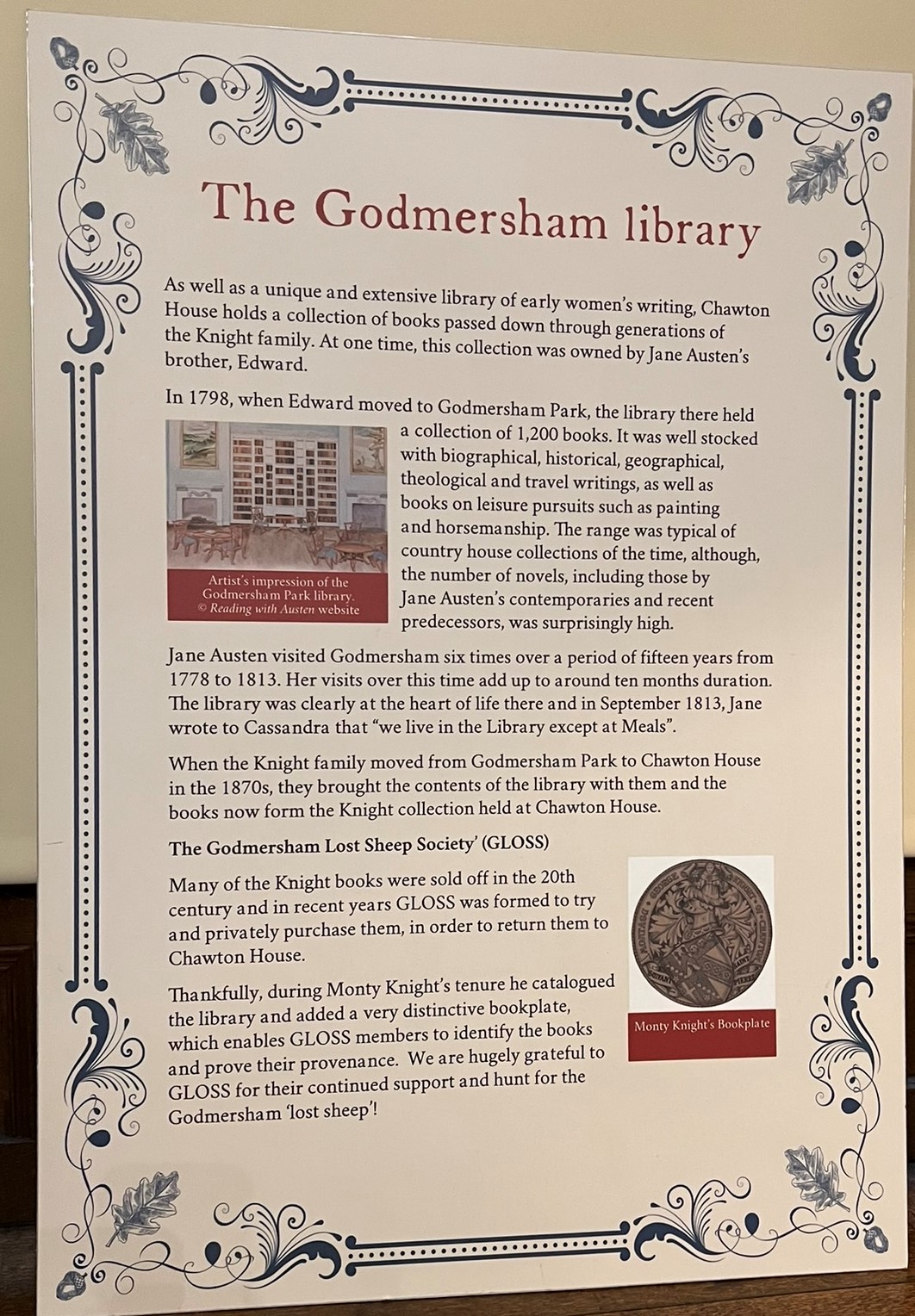
About a dozen letters sent by Austen from her brother Edward’s estate at Godmersham Park survive, recording her impressions of life at the great house and her time in its extensive Library. A research project spearheaded by Professor Peter Sabor of McGill University called Reading with Austen, will create a virtual version of what was in this Library, showing the books exactly as they were on the shelves. Edward’s handwritten 1818 catalogue of the library lists nearly 1,300 books, a third of which are extant today in the collection of Richard Knight and now on loan to the Library at Chawton House. A global search continues for the remaining titles. Come join us for a history of the Library, this digital project, how and where books are being found, and a sneak-peek into the website to be launched this July.


~ Free & open to the public ~
~ Light refreshments served
 ~ 

For more information:   JASNAVTregion [at] gmail [dot] com
Please visit the blog at: http://JaneAustenInVermont.blog

 *********************************** 

Peter Sabor, a Fellow of the Royal Society of Canada, is Professor of English and Canada Research Chair at McGill University, Montreal, where he is also Director of the Burney Centre. A Life Member of JASNA, he coordinated the 1998 JASNA conference in Quebec City, and has spoken at several JASNA conferences and Regional events. His publications on Jane Austen include an edition of her early writings, Juvenilia (2006), The Cambridge Companion to Emma (2015), and Manuscript Works (2013).

Hope you can join us!
~~

Godmersham Park image: by John Preston Neale, 1824 (Wikipedia)

c2018 Jane Austen in Vermont

Auctions · Austen Literary History & Criticism · Jane Austen · Jane Austen's Letters

Jane Austen’s Signature ~ Sells for 12,500 GBP = $16,111 !

Yikes!! ~ Just sold today (7-12-17) at Christies:

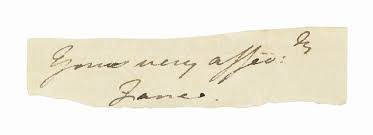
AUSTEN, Jane (1775-1817). Signature (‘Yours very affec[tionate]ly, Jane’), cut from a letter, n.d.

Price realised GBP 12,500 (Estimate GBP 1,000 – GBP 1,500)

AUSTEN, Jane (1775-1817). Signature (‘Yours very affec[tionate]ly, Jane’), cut from a letter, n.d.
22 x 91 mm. [With:] A later envelope, inscribed with provenance notes.

Provenance: Fanny Catherine Knight, Lady Knatchbull (1793-1882, niece of Jane Austen), given to – ‘H.P. Hope’, who, according to the endorsement on the accompanying envelope, dated 15 November 1858, ‘says “Lady K would have sent the entire letter, had it not contained family matters”’.

A tantalising fragment from one of the most elusive hands in English literature: Jane Austen’s signature, cut from one of her letters written to her favourite niece, Fanny Catherine Knight, apparently containing ‘family matters’. Any Austen autograph item is rare at auction: only four have sold in the last twenty years (ABPC/RBH).

2017 Jane Austen in Vermont
Auctions · Austen Literary History & Criticism · Jane Austen · Jane Austen Circle · Jane Austen's Letters

Austen on the Block! ~ July 10 at Forum Auctions, and July 11 at Sotheby’s

There are a number of terrific Austen items on the block today at Forum Auctions in London: it’s happening as we speak… scroll up and down from this link and you will see the hammer prices.

And tomorrow, there are three of Jane Austen’s letters up for sale at Sotheby’s, all to her niece Anna Lefroy: go to the links provided to see images.

  1. Lot 82: http://www.sothebys.com/en/auctions/ecatalogue/2017/english-literature-l17404/lot.82.html

Austen, Jane. AUTOGRAPH LETTER, WRITTEN IN THE THIRD PERSON, TO HER NIECE ANNA AUSTEN (LATER LEFROY)

a masterly comic jeu d’espirit, written as if to Rachel Hunter, the author of the verbose gothic novel Lady Maclairn, the Victim of Villainy, asking her to thank Mrs Hunter for the “spirited sketches … of those more interesting spots Tarefield Hall, the Mill & above all the Tomb of Howard’s wife – of the faithful representation of which Miss Jane Austen is undoubtedly a good Judge, having spent so many summers at Tarefield Abbey”, assuring her that she has wept copiously over these affecting scenes, expressing her earnest hope that Mrs Hunter “would have the kindness to publish at least 4 vols more about the Flint family”, and closing with local news that “the Car of Falkenstein [the Alton-London coach] which was the pride of that Town was overturned within the last 10 days”, 3 pages, 8vo (184 x 114mm, partial “Horn” watermark similar to Heawood 2752-2762), integral autograph address panel (“Miss Austen | Steventon”), remains of a black wax seal impression, [Chawton, ?29-31 October 1812], original folds, very slightly discoloured at edges, remains of hinges where once probably mounted in an album.

Jane Austen’s Letters, ed. Dierdre Le Faye (1995), no. 76 (edited from a copy).

2. Lot 83: http://www.sothebys.com/en/auctions/ecatalogue/2017/english-literature-l17404/lot.83.html

Austen, Jane. SUBSTANTIAL FRAGMENT OF AN AUTOGRAPH LETTER, TO HER NIECE ANNA LEFROY (NÉE AUSTEN)…

with lively family gossip in the weeks after Anna’s marriage, including the comings and goings of Jane’s brothers Charles and Henry, regretting that she will not be able to see her and her husband Benjamin again before she leaves London, assuring her that the Austen party had enjoyed their visit to Anna’s new home in Hendon (“…We talked of you for about a mile & a half with great satisfaction, & I have been just sending a very good account of you to Miss Beckford, with a description of your Dress for Susan & Maria…”), and with revealing comments about a trip to the theatre (“…Acting seldom satisfies me. I took two Pocket handkerchiefs, but had very little occasion for either…”), 2 pages, 8vo, [23, Hans Place, London, 29 November 1814], weak at folds, small tear (c.15mm) at top not affecting text [with:] a later envelope recording family provenance.

Jane Austen’s Letters, ed. Deirdre Le Faye (1995), no. 112.

  1. Lot 84: http://www.sothebys.com/en/auctions/ecatalogue/2017/english-literature-l17404/lot.84.html

Austen, Jane. FRAGMENT OF AN AUTOGRAPH LETTER, TO HER NIECE ANNA LEFROY (NÉE AUSTEN),

describing a visit to her younger nieces at her brother Charles’s family home (“…Cassy was excessively interested about your marrying, when she heard of it …. She asked a thousand questions, in her usual way – what he said to you? And you to him?…”), ten lines, [23 Hans Place, London, 29 November 1814], with, on the verso, fragments of pen practices (“Miss J Austen | Hans Place | Sloane Street” etc.) and a black wax seal impression [with:] Mary Isabel Lefroy, autograph letter signed, to Richard Austen-Leigh, presenting him with this fragment, also mentioning a forthcoming visit to Cambridge to inspect the Sanditon manuscript that had been given to King’s College, 2 pages, 4to, 27 October [1931], with envelope.

c2017 Jane Austen in Vermont