Laurel Ann at her Austenprose blog is currently posting a month-long group read through Pride & Prejudice – do visit and join in the discussion! – she is as always an insightful reader and discussion leader, and what better way to spend the first month of summer musing on P&P and the finer points of Austen’s magic!
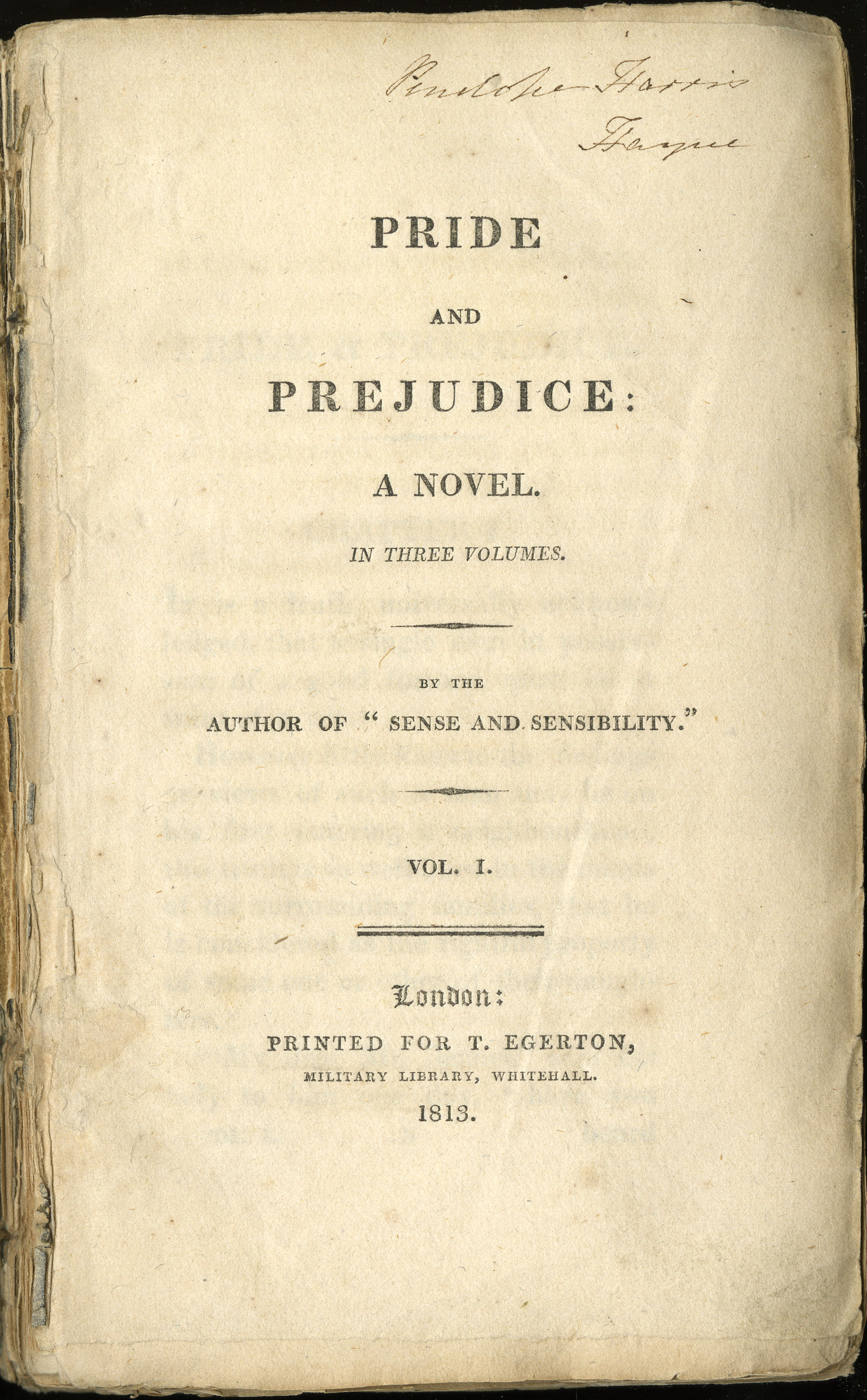
The publishing history of P&P, Austen’s most popular book, then and now, is an interesting study in the book trade of early 19th century England. First completed in 1797 [and called First Impressions] and rejected by the publisher her father took the manuscript to, Austen reworked P&P and submitted it to Thomas Egerton, the publishing house of her Sense & Sensibility, in 1812 [published January 28, 1813]. She sold the copyright outright for £110, and did not incur other expenses in its publication, as in the three other works published in her lifetime [see links below for more information.] How we would love to know her thoughts on this road to publication! – how we would love to have her letters written while in the process of the writing to give us some idea of her imagination at work [where WAS the model for Pemberley? was Mr. Darcy someone REAL? was Elizabeth Bennet her alter ego? was MR COLLINS drawn from life?], or to have the letters to her brother Henry and his to Egerton – but alas! we have nothing, just a few comments scattered among the surviving letters.
Austen does not give us much in her letters as to her writing practices or narrative theory [and thus such a disappointment when they were first published, criticized for their “mundaneness,” their focus on domestic nothings and neighborhood gossip!] – but if you dig for diamonds you will find them, and these scattered mentions are certainly diamonds – it is the feeling of having her right over your shoulder when you read that she is “disgusted” with the way her mother is reading her book aloud, or that she REALLY likes this earning money for her labors, or being miffed [but also full of pride!] with Henry for telling her Secret to one and all – we see Jane Austen here in her own words – the funny, ironic, brilliant Jane Austen – never enough, but this is as good as it is going to get.
So in this post I offer all the references she makes to Pride & Prejudice, her “own darling Child” – read them and enjoy!
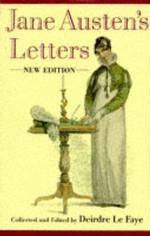
[NOTE: page references are to Deirdre Le Faye, ed., Jane Austen’s Letters, 3rd ed., Oxford, 1997; all abbreviations and spelling errors are retained]
Letter 17. January 8-9, 1799 to Cassandra, from Steventon
I do wonder at your wanting to read first impressions again, so seldom as you have gone through it, & that so long ago.[page 35]
[Le Faye notes that this is the first surviving mention of Austen’s literary work, this prototype of P&P having been finished in August 1797; Note, p. 366]
Letter 21. June 11, 1799, To Cassandra, from Bath
I would not let Martha read First Impressions again upon any account, & I am very glad that I did not leave it in your power. – She is very cunning, but I see through her design; – she means to publish it from Memory, & one more perusal must enable her to do it.[p.44]
Letter 77. November 29-30, 1812, to Martha Lloyd from Chawton
P.& P. is sold. – Egerton gives £110 for it. – I would rather have had £150, but we could not both be pleased, & I am not at all surprised that he should not chuse to hazard so much. – It’s being sold will I hope be a great saving of Trouble to Henry, & therefore must be welcome to me. – The Money is to be paid at the end of the twelvemonth. [p. 197]
Letter 79. January 29, 1813, to Cassandra from Chawton
I want to tell you that I have got my own darling Child from London; – on Wednesday I received one Copy, sent down by Falknor, with three lines from Henry to say that he had given another to Charles & sent a 3d by the Coach to Godmersham; just the two Sets which I was least eager for the disposal of. I wrote to him immediately to beg for my own two other Sets, unless he would take the trouble of forwarding them at once to Steventon & Portsmouth – not having any idea of his leaving Town before today; – by your account however he was gone before my Letter was written. The only evil is the delay, nothing more can be done till his return. Tell James & Mary so, with my Love. – For your sake I am as well pleased that it shd be so, as it might be unpleasant to you to be in the Neighborhood at the first burst of the business. – The Advertisement is in our paper to day [the Morning Chronicle of January 28, 1813]. – 18s – He shall ask £1-1- for my two next, & £1-8 – for my stupidest of all. I shall write to Frank, that he may not feel himself neglected. Miss Benn dined with us on the very day of the Books coming, & in the eveng we set fairly at it & read half the 1st vol. to her – prefacing that having intelligence from Henry that such a work wd soon appear we had desired him to send it whenever it came out – & I beleive it passed with her unsuspected. – She was amused, poor soul! that she cd not help you know, with two such people to lead the way [JA and her mother]; but she really does seem to admire Elizabeth. I must confess that I think her as delightful a creature as ever appeared in print, & how I shall be able to tolerate those who do not like her at least, I do not know. – There are a few Typical errors – & a “said he” or a “said she” would sometimes make the Dialogue more immediately clear – but “I do not write for such dull Elves” “As have not a great deal of Ingenuity themselves.” [from Scott’s Marmion] – The 2d vol. is shorter than I cd wish – but the difference is not so much in reality as in look, there being a a larger proportion of Narrative in that part. I have lopt & cropt so successfully however that I imagine it must be rather shorter than S. & S. altogether. – Now I will try to write of something else; – it shall be a complete change of subject – Ordination.[p. 201-2]
Letter 80. February 4, 1813, to Cassandra from Chawton
Your letter was truely welcome & I am much obliged to you all for your praise; it came at a right time, for I had had some fits of disgust. – our 2d evening’s reading to Miss Benn had not pleased me so well, but I beleive something must be attributed to my Mother’s too rapid way of getting on – & tho’ she perfectly understands the Characters herself, she cannot speak as they ought. – upon the whole however I am quite vain enough & well satisfied enough. – The work is rather too light & bright & sparkling; – it wants shade; – it wants to be stretched out here & there with a long Chapter – of sense if it could be had, if not of solemn specious nonsense – about something unconnected with the story; an Essay on Writing, a critique on Walter Scott, or a history of Buonaparte – or anything that would form a contrast & bring the reader with increased delight to the playfulness & Epigrammatism of the general stile. – I doubt your quite agreeing with me here – I know your starched Notions. – The caution observed at Steventon with regard to the possession of the book is an agreable surprise to me, & I heartily wish it may be the means of saving you from everything unpleasant; – but you must be prepared for the Neighbourhood being perhaps already informed of there being such a Work in the World, & in the Chawton World! Dummer will do that you know. – It was spoken of here one morng when Mrs. D. [Digweed] called with Miss Benn. – The greatest blunder in the Printing that I have met with is in Page 220 – Vol.3 where two speeches are made into one. – There might as well have been no suppers at Longbourn, but I suppose it was the remains of Mrs. Bennet’s old Meryton habits.[p. 203]
Mrs. George Austen
I had a letter from Henry yesterday, written on Sunday from Oxford; mine had been forwarded to him… he says that copies were sent to S. [Steventon] & P. [Portsmouth] at the same time as the others. [p. 204]
Letter 81. February 9, 1813, to Cassandra from Chawton
I am exceedingly pleased that you say what you do, after having gone thro the whole work – & Fanny’s praise is very gratifying; – my hopes were tolerably strong for her, but nothing like a certainty. Her liking Darcy & Elizabeth is enough. She might hate all the others, if she would. I have her opinion under her own hand this morning, but your transcript of it which I read first, was not & is not the less acceptable. – To me, it is of course all praise – but the more exact truth which she sends you is good enough. [p. 205]
Yes, I beleive I shall tell Anna – & if you see her, & donot dislike the commission, you may tell her for me. You know I meant to do it as handsomely as I could. But she will probably not return in time[p. 205, referring to telling her niece Anna that she is the author of S&S and P&P, note p. 414]
…- there is still work for one evening more.[p. 206, to finish reading P&P aloud, note p. 414]
Letter 85. May 24, 1813, to Cassandra from London
…Henry & I went to the Exhibition in Spring Gardens. It is not thought a good collection, but I was very well pleased – particularly [pray tell Fanny] with a small portrait of Mrs. Bingley, excessively like her. I was in hopes of seeing one of her Sister, but there was no Mrs. Darcy; – perhaps however, I may find her in the Great Exhibition which we shall go to, if we have time; – I have no chance of her in the collection of Sir Joshua Reynolds’s Paintings which now is shewing in Pall Mall & which we are also to visit. – Mrs. Bingley is exactly herself, size, shaped face, features and sweetness; there never was a greater likeness. She is dressed in a white gown, with green ornaments, which convinces me of what I have always supposed, that green was a favourite colour with her. I dare say Mrs. D. will be in Yellow. [p. 212]
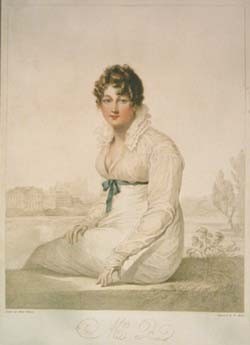
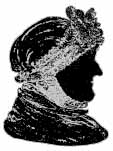
[Portrait of a Lady, by J.F.M. Huet-Villiers]
a.k.a. Mrs. Bingley
I am very much obliged to Fanny for her Letter; – it made me laugh heartily; but I cannot pretend to answer it. Even had I more time, I should not feel at all sure of the sort of Letter that Miss D. would write…[p. 213, referring to a letter from Fanny written to and expecting a response from Georgiana Darcy – Note p. 417]
We have been to both the Exhibition & Sir J. Reynolds’, – and I am disappointed, for there was nothing like Mrs. D. at either. – I can only imagine that Mr. D. prizes any Picture of her too much to like it should be exposed to the public eye. – I can imagine he wd have that sort [of, omitted] feeling – that mixture of Love, Pride & Delicacy. [p. 213]
Letter 86. July 3-6, 1813, to Francis Austen from Chawton
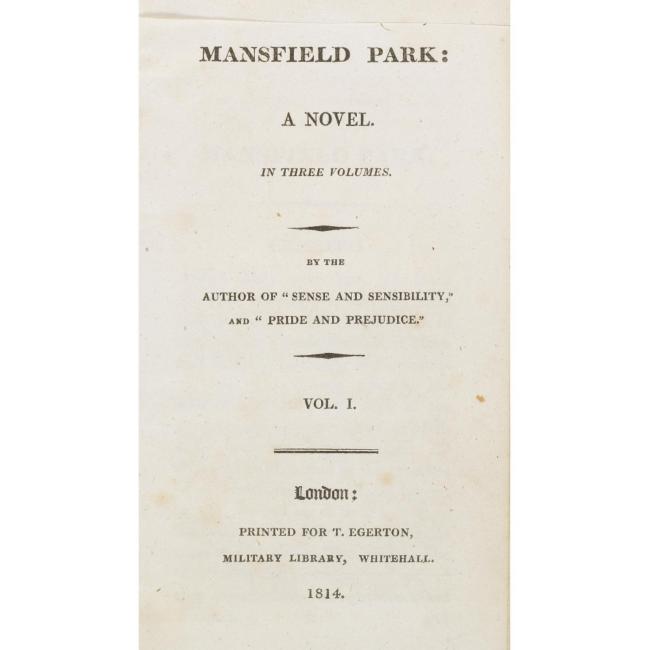
You will be glad to hear that every Copy of S.&S. is sold & that it has brought me £140 – besides the Copyright, if that shd ever be of any value. – I have now therefore written myself into £250. – which only makes me long for more. – I have something on hand – which I hope on the credit of P. & P. will sell well, tho’ not half so entertaining…[referring to Mansfield Park] [p. 217]
Letter 87. September 15-16, 1813, to Cassandra from London
Lady Robert [Kerr, nee Mary Gilbert] delighted with P. & P – and really was so I understand before she knew who wrote it – for, of course, she knows now. – He [Henry] told her with as much satisfaction as if it were my wish. He did not tell me this, but he told Fanny. And Mr. Hastings – I am quite delighted with what such a Man writes about it. – Henry sent him the Books after his return from Daylesford – but you will hear the Letter too. // Let me be rational & return to my two full stops. [p. 218]
I long to have you hear Mr. H’s [Warren Hastings] opinion of P&P. His admiring of Elizabeth so much is particularly welcome to me. [p. 221]
Letter 89. September 23-24, 1813, to Cassandra from Godmersham Park
Poor Dr. Isham is obliged to admire P.&P. – & to send me word that he is sure he shall not like Mde. Darblay’s new Novel half so well.– Mrs. C. [Cooke] invented it all of course.[referring to Frances Burney’s The Wanderer, published in 1814] [p. 227]
Letter 90. September 25, 1813, to Francis Austen from Godmerhsam Park
I thank you very warmly for your kind consent to my application & the kind hint that followed it. [asking Frank if she can use the names of his old ships in her her current work, MP] – but the truth is that the Secret has spread so far as to be scarcely the Shadow of a secret now – & that I beleive whenever the 3d appears I shall not even attempt to tell Lies about it. – I shall rather try to make all the Money than all the Mystery I can of it. – People shall pay for their knowledge if I can make them. – Henry heard P. & P. warmly praised in Scotland, by Lady Robt Kerr & another Lady; – and what does he do in the warmth of his Brotherly vanity & Love, but immediately tell them who wrote it! – A Thing once set going in that way – one knows how it spreads! – and he, dear Creature, has set is going so much more than once. I know it is done from affection & partiality – but at the same time, let me here again express to you & Mary my sense of the superior kindness which you have shewn on the occasion, in doing what I wished. – I am trying to harden myself. – After all, what a trifle it is in all its Bearings, to the really important points of one’s existence even in the World![p. 231]
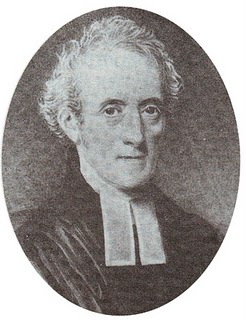
Henry Austen
There is to be a 2d Edition of S.&S. Egerton advises it.[p. 232, referring to her publisher]
Letter 104. August 10-18, 1814, to Anna Austen from Chawton
Now we have finished the 2d book – or rather the 5th – I do think you had better omit Lady Helena’s postscript; to those who are acquainted with P.&P it will seem an Imitation. [p. 268, referring to Anna’s manuscript sent to JA for advice]
Letter 128. November 26, 1815, to Cassandra from London
Mr. H is reading Mansfield Park for the first time & prefers it to P&P.[p. 301, referring to Mr. Haden, London surgeon, “who brought good Manners & clever conversation” ]
Letter 132(Draft). December 11, 1815, to James Stanier Clarke from London
My greatest anxiety at present is that this 4th work [Emma] shd not disgrace what was good in the others. But on this point I will do myself the justice to declare that whatever may be my wishes for its’ success, I am very strongly haunted by the idea that to those readers who have preferred P&P. it will appear inferior in Wit, & to those who preferred MP. very inferior in good sense… [p. 306]
Letter 134(A). December 27, 1815, from the Countess of Morley to JA at Chawton
I am most anxiously waiting for an introduction to Emma…. I am already become quite intimate in the Woodhouse family, & feel that they will not amuse & interest me less than the Bennetts [sic], Bertrams, Norriss & all their admirable predecessors – I can give them no higher praise-[p. 308]
************************************
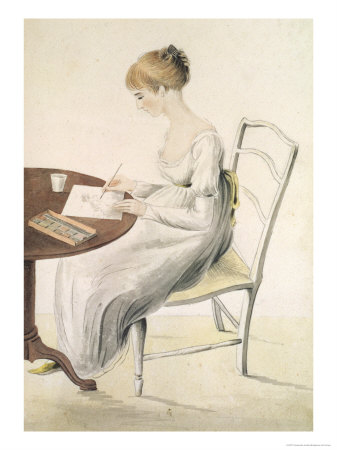
[a letter-writing Fanny Austen-Knight by Cassandra]
The set of Jane Austen’s novels published by Bentley in 1833 and up for auction at Bonham’s sale today [June 8, 2010] has come under the gavel and has sold for £3,360 [= @ $4827.] [the estimate was for £2000 – £3000 ]
Here are the details:
AUSTEN, Jane. Works, Bentley’s Standard Novel edition, 6 vol. in 5, 5 engraved frontispieces and additional titles, some light spotting to first and final few leaves, small corner tear to printed title “Pride and Prejudice”, without half-titles, ownership inscription of Eularia E. Burnaby (1856) on printed titles, bookplate of Henry Vincent, bookseller’s label of H.M. Gilbert, Southampton, uniform contemporary half calf, red and dark green morocco labels, extremities lightly rubbed [Gilson D1-D5], 8vo, R. Bentley, 1833
Sold for £3,360 inclusive of Buyer’s Premium
Footnote:
“No English reissue of JA’s novels is known after 1818 until in 1832 Richard Bentley decided to include them in his series of Standard Novels” (Gilson, p.211). See illustration on preceding page.
See the Bonham’s site here for details and other auction items in this ‘Printed Books, Maps and Manuscripts’ auction [Sale No. 17809]
See Laurel Ann’s post analyzing this set [along with her super sleuthing as to the provenance!] atAustenprose
Someone has gone home very happy today! [and hopefully this has gone to either a fine institution or a fine home with an Austen-loving owner…]
Another auction with one Jane Austen title: a first edition of Mansfield Park sold today at Sotheby’s for $21,250 ~
Sotheby’s Fine Books and Manuscripts, Sale N08602, 11 Dec 09, New York. Session 2
Lot 75 ~AUSTEN, JANE
10,000—15,000 USD Lot Sold. Hammer Price with Buyer’s Premium: 21,250 USD
Description:
Mansfield Park. London: Printed for T. Egerton, 1814 1st edition.
3 volumes, 12mo (6⅞ x 10 in.; 750 x 553 mm). Half-titles, paper watermarked 1812; (1): tear to lower right corner of C1, loss of lower right corner of G7; (2): top of title-page cropped, closed tears on H6–7 touching 2 lines of text, loss to lower right margin of O3, lacks terminal blank O4; (3) loss to right margin of B5, loss of right upper corners of I7–8 costing one letter on I8v, lacks advertisement leaf R4 at end. Contemporary half polished calf over marbled boards, ruled in gilt, smooth spines gilt, endpapers and edges plain; joints cracked or starting, head of spines of vols. 1–2 chipped, waist and foot of spine of vol. 3 chipped. Red morocco backed folding case.
There were also a number of Shakespeare titles sold, a Dickens, a George Eliot, as well as an early illustrated Frankenstein by Mary Shelley:
LOT 246SHELLEY, MARY WOLLSTONECRAFT
5,000—7,000 USD Lot Sold. Hammer Price with Buyer’s Premium: 7,500 USD
Frankenstein: or, The Modern Prometheus. Revised, Corrected, and Illustrated with a New Introduction by the Author. London: Henry Colburn and Richard Bentley, 1831
Bound with: Charles Brockden Brown. Edgar Huntly; or The Sleep Walker, London: Henry Colburn and Richard Bently, 1831
2 works in one volume, 8vo (6¼ x 4 in.; 159 x 102 mm). Engraved frontispiece and title-page vignette in Frankenstein by T. Von Holst; lacks final blank in vol. I, paper adhesion on II:B3r costing one word on A8v. Nineteenth-century full polished calf, central frame tooled in blind, gilt foliate border, the spine gilt in 5 compartments (2 reserved for red and green morocco lettering pieces), marbled endpapers and edges; minor rubbing at spine ends. Quarter brown morocco folding case.
First illustrated edition and third edition overall of Frankenstein, from “Bentley’s Standard Novels Series” (Vol. IX, first series), with Brown’s novel being Vol. X. In her introduction, Mary Shelley states that the alterations she has made to the novel are “principally those of style. I have changed no portion of the story, nor introduced any new ideas or circumstances. I have mended the language where it was so bald as to interfere with the interest of the narrative; and these changes occur almost exclusively in the beginning of the first volume [the 1818 first edition was issued in three volumes]. Throughout they are entirely confined to such parts as mere adjuncts to the story, leaving the core and substance of it untouched” (p. xii).
[All images from the Sotheby’s catalogue] – for the catalogue and complete sale results, see the Sotheby’s website.
Ok, I confess, I am NOT on Twitter, and I hope to stay that way [I figure that with Austenprose and Jane Austen’s World regularly twittering on Austen out there, that might be just about all that cyberspace can handle…] Since Facebook, which I am on, mostly as friends of my children’s friends, seems to now have been taken over by us BabyBoomers, Twitter has become the premier communication tool, at least until something else comes along, next week perhaps. My problem, as all my friends and cohorts will happily tell you, is that I have never been one to keep my sentences short, i.e. I babble endlessly on [often about Jane Austen] and though annoying, most of my friends seem to accept me as I am. Hence, the whole concept of Twitter leaves me, what can I say? –DUMBSTRUCK! Sort of like Haiku – I just don’t get it! Why say something in 20 words or less when you can go on and on so as not to risk being misunderstood?!
A number of years ago, a book called ShrinkLits, by Maurice Sagoff [Workman Publishing, 1980 rev. edition, originally c1970, and STILL in print] offered to the reading masses “seventy of the world’s towering classics cut down to size,” with cartoon-like illustrations by Roslyn Schwartz. Jane Austen does not appear [whatever was Sagoff thinking??!] – but he did reduce Bronte’s Jane Eyre to a few waxing poetic lines:
Jane Eyre Charlotte Bronte
My Love behaved
A bit erratic;
Our nuptial day
Brought truth dramatic:
He had a wife,
Mad, in an attic.
I fled! I roamed
O’er moor and ditch
When life had struck
Its lower pitch
An uncle died
And left me rich.
I sought my love
Again, to find
An awful fire
His home had mined,
Kippered his wife
And left him blind.
Reader, guess what?
I married him.
My cup is filled
Up to the brim
Now we are one,
We play, we swim.
The power we share
Defied all pain;
We soar above
Life’s tangled plain –
He Mr. Rochester,
Me Jane!
[ShrinkLits, pp 44-45]
Ok, so this is funny, as are the other sixty-nine…
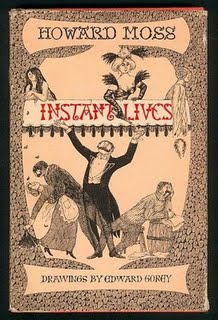
Instant Lives by Howard Moss, wonderfully illustrated by Edward Gorey, published in 1974 [Saturday Review Press], is another such book, in which Moss “spins out elegant, erudite, irreverent descants on the lives of the great composers-painters-authors-poets-performers,” [from the jacket] – all lives summarized in no more than two pages. Moss had the good sense to include Austen [the Brontes are all lumped together] – but I have always found this little write-up quite sad, though Gorey’s illustration of Cassandra toasting a marshmallow over the fireplace grate and Jane wandering about the room with the galleys of Sense & Sensibility alone makes the book worth having ~ here is an excerpt:
‘You’re so wordy, Jane,” said her sister. ‘No wonder you have trouble with men.’
Smugness aside, the derogation the remark conveyed was not lost, of course, on Jane.
‘My dear Cassandra,’ she said. ‘Why don’t you polish off these mephitic sweetmeats – it would only make your figure the more bizarre. I have a deadline to meet, you know.’ And with that, Jane swept out of the room, the galleys trailing behind her like a bridal train devised by a couturier impaled upon typography,
But , in Life, there would be no bridal train for Jane Austen.
[Instant Lives, p 4-5]
This seems a tad nasty, don’t you think? And certainly irrelevant to the value of those galleys… but Cassandra does seem to be encouraging less wordiness – the mother of Twitter perhaps…
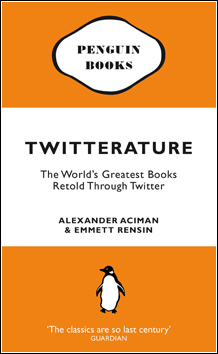
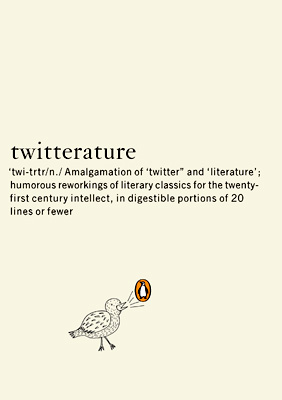
But I do bring this all up for a reason – there is a new book out called Twitterature [the title = Twitter + Literature] [Penguin, 2009] authored by two University of Chicago students, Alexander Aciman and Emmett Rensin, who obviously have way too much time on their hands – or perhaps not enough time to actually READ the classics they reduce to twenty tweets or fewer [though they do say that it helps to get the humor in the tweet if you have actually read the book, so hopefully they have done so]. They recently set up a Twitter page for the book, so you can follow their continuing adventure in literature reduction.
You can find it in one of two covers:
Penguin UK coverPenguin US cover
I’ve not yet seen the book but understand from reviews that Austen makes the grade – I am curious to know how the authors reduce Jane Austen in the tweeting universe – here is one example:
Elizabeth Bennet muses: It’s as if the less he seems to care about me, the more drawn to him I am. This seems the opposite of how it should be? Oh well.
And a few others to give you the idea:
Sherlock Holmes says: Continuing investigation. Made brilliant deductions on many snorts and very little evidence. Notice salt deposits on factory owner’s shoes?
On the Road has just the one: “For TWITTERATURE of On the Road by Jack Kerouac, please see On the Road by Jack Kerouac.” [Now I would say that for Pride & Prejudice, but I am “prejudiced” you might say…]
[comments from Guardian article]
So I will likely get this book, just for the fun of it and to add it to my collection of literature in short-takes, but I more likely agree with this reviewer from The Wall Street Journal who said:
“Do you hear that? It’s the sound of Shakespeare, rolling over in his grave.”
Ever wonder what happens to all those books and manuscripts that show up at auction and then disappear somewhere into the ether, briefly looked at wistfully in the catalogue and then only something you file away in your bibliographic memory chip?? I know I do this with all the Jane Austen materials [see the post my Bygone Books blog for the latest Austen titles on the block ]
The recent Bloomsbury Auction, The Paula Peyraud Collections: Samuel Johnson and Women Writers in Georgian Society [New York City, 6 May 2009] [click here for the catalogue and auction results] was of great interest to collectors and readers of 18th and early 19th century women writers. A recent article by Dr. Maureen E. Mulvihill (Princeton Research Forum, Princeton, NJ), titled “Literary Property Changing Hands: The Peyraud Auction (New York City, 6 May 2009)” [Eighteenth-Century Studies, vol 43, no. 1 (2009) pp. 151-63…..] sheds light on this world of auctions and book collecting, and tells us who bought many of the lots and where they are now to be found. As Dr. Mulvihill writes, “the sale was a dramatic validation of continuing interest and commercial investment in cultural property of the Georgian period, especially its women writers.” [p.152]
The sale consisted of 483 lots, mostly books, manuscripts and letters, but also many visual works of art somehow relating to the authors Ms. Peyraud collected. [The dominant figures in the collection were the women writers of the era: Frances Burney, Hester Thrale Piozzi, the Bluestockings, Maria Edgeworth, Jane Austen and the Brontes; but also several male writers: Samuel Johnson, Alexander Pope, Edmund Burke, David Garrick, Horace Walpole, and Lord Byron.]
The article also gives some history of Paula Peyraud [1947-2008] and the depth of her collection [the auction barely scratched the surface it seems…], and this alone is a compelling story of the habits of a woman collector.
My interest here is largely with the Jane Austen lots in the auction [see my post on this auction here], and unfortunately, although the results of the auction are available online [see below as well as my previous post], the five lots of Austen works seem to have been purchased by private collectors and are undisclosed. And the one Austen-related piece of art, a miniature of Elizabeth Bridges, Austen’s sister-in-law, remained unsold.
Pride and Prejudice-1813- 3 volumes Carysfort copy: [$20,000-30,000] – $26,000.
Sense and Sensibility-1811- 3 volumes: [$25,000-35,000] – $38,000. [or $46,360. with premium]
Austen aside, it is fascinating to see how many of the other lots are now in Library collections, and thus available for research purposes: The British Library, Dr. Johnson’s House, the University of Manchester, McGill University [10 lots of Frances Burney materials], the Houghton Library at Harvard [Johnson and Hester Thrale], the Morgan Library, New York Public Library, the University of Pennsylvania Rare Book Library, Princeton University [Maria Edgeworth], Vassar Library [Burney], and Yale University Beinecke Library [Yale acquired the “star of the show” for $140,300. – 8 volumes of Hester Thrale Piozzi’s heavily annotated copy of The Spectator.] Harvard purchased the most lots, and a Zoffany full-length portrait of Hester Thrale [lot 379] was the second highest sale at $58,560.
[from the Bloomsbury Auction Catalogue]
See the full article at this link at Bloomsbury Auctions: [prices in the article reflect hammer prices and premium]
Just added: Dr. Mulvihill’s February 2010 article “Captured by Jane” on the Morgan Library’s Jane Austen exhibition is in the online magazine of the Jane Austen Centre. If you did not get to see this wonderful exhibition last year, this is the next best thing to being there… you can view the article here.
[Addendum: since announcing the winner yesterday, I discover that “ivory spring” has a wonderful website and blog about quilting, so I append those links here for all to peruse [she is currently hosting a giveaway as well]- and she tells me that her next project will be an Austen-inspired sampler called “the daughters of Longbourn”! ]
The drawing for the copy of the Chawton House Library anthology Dancing with Mr. Darcy is complete and the copy goes to …… ” ivoryspring “ ! ~ if you could please send me an email with your address, Ms. Ashfeldt will post the book to you right away. Thank you all for your comments and great questions – and a special thank you to Lane Ashfeldt for her terrific and thoughtful comments [please check out her latest comment on my interview post where she discusses writing short historical fiction], AND for the offer of the book!
As for the title of the book being researched by Miss Campbell in the story “Snowmelt”, I append here Lane’s response: [and kudos to Alexa Adams for the correct answer!]
Hello Janeite Deb and readers, thanks for the replies and entries to the Dancing with Mr Darcy giveaway competition. Deb had asked you to name the book referred to in my story, “Snowmelt”.The book mentioned in ‘Snowmelt’ is Mary Shelley’s The Last Man, first published c. 1826 when it was credited as “by The Author of Frankenstein.”.(Like Austen who had preceded her by just a few years, Mary Shelley faced stigma if she were to let her name appear in print.) Her husband, Percy Bysshe Shelley, had recently died when she wrote it, and her grief over his sudden loss is a likely source of her inspiration: ‘The Last Man’ begins in 2073 and its theme is the wiping out of the human race by the year 2100.‘Snowmelt’ and Miss Campbell, with her worries over the end of the world and the end of the book, were already in progress when I came across ‘The Last Man’, so the book was a perfect match. I borrowed a line or two from it (credited, of course), so it feels like payback time to send a copy of Dancing with Mr Darcy to the winner, with my congratulations.
JASNA-Vermont will be giving away a copy of Dancing with Mr. Darcy, the short story anthology from Chawton House Library, published by Honno Press ~ please post a comment by Saturday November 14, 2009 to qualify. Author Lane Ashfeldt will send the book to the winner directly ~ see the following posts to comment:
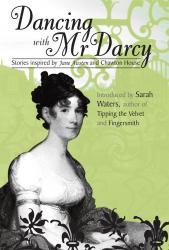
Dancing with Mr Darcy: Stories inspired by Jane Austen and Chawton House Library
Selected and introduced by Sarah Waters
Honno Modern Fiction, 2009
ISBN: 978-1-906784-08-9
UK £7.99 [paperback]
[I made mention of this book in another post in which Lane Ashfeldt, author of one of the short stories in this anthology [titled Snowmelt ] did an interview for this blog. Ms. Ashfeldt has graciously offered to send a copy of the book to anyone who comments on this or the previous post – please comment by Saturday, November 14, 2009 – I will announce the winner on November 15th – see below for full details.]
My reading over the years has not tended to short stories. But I do remember when my children were little, I spent my scattered reading allowance doing just that – it was the need to finish something, the escape perhaps for a few moments at least to another place that widened my world – a time to re-read the short novels of John Steinbeck, to discover Alice Munro, Flannery O’Connor, short detective works, etc… anything to keep the mind at work! But short stories never held much interest for me – I wanted a bigger canvas, a longer immersion – but it was perhaps really an understanding of my own inability to appreciate the short story in its best incarnation.
I picked up Dancing with Mr. Darcy at the Chawton House Library table at the JASNA AGM more as the need to add it to my Jane Austen collection with thoughts of at least reading Ms. Ashfeldt’s story… so it is with great delight that I found I could not put this book down! Sarah Waters, in her introduction, outlines the criteria for the competition: it must be well-written, be a self-contained short story that stands on its own, and must have a connection to Jane Austen, her life, her work, her Chawton home, or the Chawton House Library. The author of each of the twenty stories in this anthology appends a paragraph explaining how Jane Austen inspired their writing – these alone are worth the reading!
I read Snowmelt first – and this tribute to reading and libraries and books seems to have come from my very own thoughts, my concerns with the future of same. Miss Campbell, who fears the end of the world is at hand, is a librarian at a library that is closing its old building and reopening in a new space with far more computers than books – she visits Chawton House Library to research an early nineteenth century author*, and realizes that life it too short to not be doing what she truly loves and makes drastic changes to her life as a result.
She rang the bell, signed in, climbed the uneven wooden steps and knocked at the library door. A simple room. Books, wooden desks, lamps. A concentrated silence that she longed to bottle and unleash in her own library.
This is a lovely story – and as I said, it conveyed so many thoughts of my own – the future of libraries, the technological changes that are on the one hand absolutely amazing and on the other frightening – what will the future be for the book in this world of kindles and Google books and the like. I was right there along with Miss Campbell, with the aching longing to be working in a library that houses all the works of human accomplishment that one can touch!
[* the previous post asked the question of who the author might be that Miss Campbell is researching and the book she requests at the library…. If you can guess this, please post it in your comment…I will announce the name of the book and author at the end of the giveaway; see below for a few hints…]
The winner of the competition is the first story in the anthology: Jane Austen Over the Styx by Victoria Owens, where we find Austen in Hades, before the “court of the dead” expecting to address her “faults” in life [think her wicked tongue, her accepting-rejecting Bigg-Wither, etc], and instead facing the likes of Mrs. Bennet, Lady Catherine de Bourgh, Mrs. Ferrars, Mrs. Churchill, Lady Russell and Mrs. Norris! – her creations all – the crime? “her willful portrayal of female characters of advanced years, as a snob, a scold, or a harpy who selfishly or manipulatively interferes with the happiness of an innocent third party” [p. 11] – and invoking the words of the great Austen critic DW Harding himself with his theories of “regulated hatred”, Jane is brought to task – an inspired story and great fun! [and you must read it to find if Jane is deemed guilty or not, and how she indeed defends herself! – and of course, it is such a delight to see and hear Mrs. Norris again!]]
JASNA’s own Elsa Solender shared runner- up status with her Second Thoughts – which in Austen’s own voice, following her accepting the marriage proposal of Harris Bigg-Wither, tells of the agonizing decision to tell him the next morning “we should not suit” – it is beautifully conveyed and one feels that Ms. Solender captures exactly what happened that night.
Jayne, by Kirsty Mitchell, also a runner-up, tells of a young woman of a literary bent, struggling to survive at all costs, working as a soft-porn nude model, all the while quoting Shakespeare and knowing full well she must “if she have the misfortune of knowing anything, [should] conceal it as well as she can” [p. 39, quoting Northanger Abbey] – conveying the 21st-century version of the economic struggles of single females of a certain class…
The twenty stories offer the gamut – some use Austen’s characters in new situations, as Elinor Dashwood Ferrars as a detective [she does after all in Sense & Sensibility hear everyone else’s secrets!] [The Delaford Ladies’ Detective Agency by Elizabeth Hopkinson]; or in Somewhere by Kelly Brendel, where Mrs. Grant of Mansfield Park is given a voice of her own. There are re-tellings of a particular story in a contemporary setting, as in Second Fruits by Stephanie Tillotson, where, as in Persuasion, her characters “experience separation, maturation and second chance.” [p. 201] And likewise in Eight Years Later by Elaine Grotefeld, where a young man visiting Chawton House with his mother plans to reunite with his teenage crush from eight years before – he is, like Captain Wentworth, “half agony, half hope.” [p. 75]
There are several stories with teenage protagonists where Austen either inspires, as in The Watershed by Stephanie Shields, where a found used copy of Pride & Prejudice alleviates family and school stresses, and the young bookworm in Hilary Spiers’s Cleverclogs, who finds that her grandmother’s favorite book Sense & Sensibility is also hers. Or the story that mirrors Austen as in The Oxfam Dress, by Penelope Randall, where a 21st-century Lydia Bennet goes on a shopping spree. Bina, by Andrea Watsmore, tells of a teenage girl who finds that her true love was right there all along [an Emma of sorts]; and in The School Trip [Jacqui Hazell], a young woman finds on visiting Chawton that all ones needs to write is “a little space, a tiny desk and a creaky door.” [p. 212]
And there are a few stories that resonate but don’t fit a category: An older, lonely spinster in We Need to Talk About Mr. Collins by Mary Howell finds that perhaps she didn’t let romance into her life…; an amateur play group putting on a Pride & Prejudice theatrical during a bombing raid in Miss Austen Victorious [Esther Bellamy]; a bridesmaids’ weekend gone completely awry in The Jane Austen Hen Weekend by Claire Humphries; and one of my favorites, One Character in Search of her Love Story Role by Felicity Cowie, where a fictional character in the making pays a call on Jane Bennet and Jane Eyre for some insightful conversation about love and choices!
We seem of late to be surrounded in Austen sequels and prequels and spin-offs and re-tellings with zombies and vampires and sea monsters and all manner of creatures, and while I have often sounded off on these largely because I just want to read Austen “as she was wrote” I do also admit to liking some of them! – but these stories in Dancing with Mr. Darcy are so much more – they take the Jane Austen that we all love and admire and cannot get enough of, and create something new and lovely in her wake – be it a character, an idea, a storyline, or just a feeling – here is Austen as she inspires 21st century writers and it is a gift to all of us. I very much hope that Chawton House Library will offer such a competition every year – this is the true legacy of Jane Austen and such writing should be heartily encouraged.
[I should also add that along with Miss Campbell, I react strongly to the physical tactile nature of a book – and Dancing with Mr. Darcy does not disappoint – it is just physically lovely, very nicely put together, and just one more reason to add this to your Jane Austen collection!]
5 of 5 full inkwells – Highly recommended!
Book Giveaway: Please post a comment or a question to me or author Lane Ashfeldt by November 14, 2009 and you will be entered in a book giveaway contest. Please also try to guess the title of the book and its author that Ms. Ashfeldt’s character Miss Campbell has requested at the library [HINT: written in the early 19th century, the novel takes as its theme the wiping out of the entire human race by the year 2073.]
I will announce the winner on November 15, 2009. All are welcome to enter. Ms. Ashfeldt will send a copy of the book directly to the winner.
Thank you for all your comments…and many thanks to Ms. Ashfeldt for her offer of the book…!
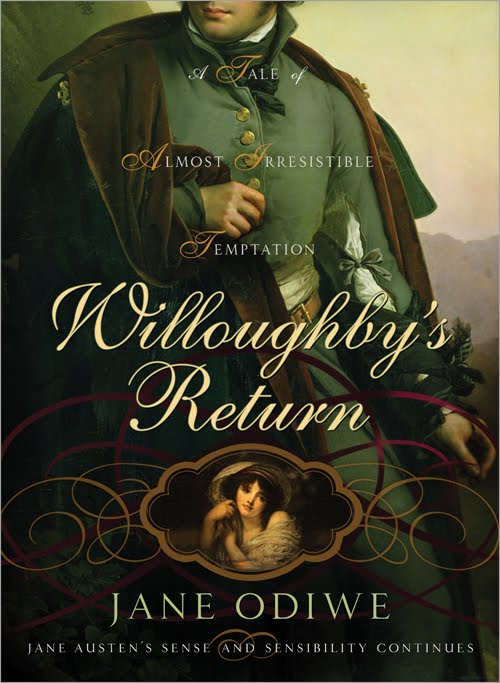
Jane Odiwe has just announced the publication of her latest novel: Willoughby’s Return.
“I’m writing to everyone about my new book Willoughby’s Return, which is about to be published on November 1st and I’m hoping you will help me spread the word by mentioning its release to anyone you think might be interested.
Here’s a bit of blurb from the publisher Sourcebooks:
A lost love returns, rekindling forgotten passions…
In Jane Austen’s Sense and Sensibility, when Marianne Dashwood marries Colonel Brandon, she puts her heartbreak over dashing scoundrel John Willoughby in the past. Three years later, Willoughby’s return throws Marianne into a tizzy of painful memories and exquisite feelings of uncertainty. Willoughby is as charming, as roguish, and as much in love with her as ever. And the timing couldn’t be worse, with Colonel Brandon away and Willoughby determined to win her back, will Marianne find the strength to save her marriage, or will the temptation of a previous love be too powerful to resist?”
Jane is also doing a blog tour, and to celebrate publication there will be giveaways, competitions to win books and paintings, plus interviews over the next couple of weeks.
One of my favorite websites is the book ‘repository’ A Celebration of Women Writers. Mary Mark Ockerbloom, our hostess who has been busy ‘rescuing’ books from Geocities (before that site closes down), has announced many additions to Celebrating Women’s website, but one in particular will interest Austen enthusiasts:
The Castle of Wolfenbach
by Eliza Parsons (1739-1811)
London : printed for William Lane, at the Minerva Press, and sold by
E. Harlow, 1793.
Writes Mary in her email introduction about the latest additions: “My personal favorite of the new titles, however, is Eliza Parsons’ “The Castle of Wolfenbach”. One of the seven “horrid novels” recommended with delightful anticipation by Isabella Thorpe in Jane Austen’s Northanger Abbey, The Castle of Wolfenbach is important as an early Gothic novel, predating both Ann Radcliffe’s The Mysteries of Udolpho and Monk Lewis’s The Monk.
A virtuous young woman in peril, a wicked uncle, a mysterious castle, a noble lover, what more could one ask?
Read and enjoy”
We’d love to post a ‘review’, should anyone be interested in reading then writing…
* * *
And last – Google’s book site has *finally* given us some (note the word!) volumes of Austen’s 1811 Sense and Sensibility!!
Only volumes I and II have been found – though Google books is notorious for making it difficult to find all volumes of a title (anyone listening to this complaint, Google?). I have not yet gone through the two volumes, for Google books is also notorious for skipping pages, missing pages, popping in pages twice, mis-scanning, etc etc. Though where can most of us see an Austen first edition, except through such a site! Now if only they will give us volume III as well as finish off Pride and Prejudice by supplying volume I for that trio.
… so says A.O. Scott of “Bright Star”, Jane Campion’s biopic love story of John Keats and Fanny Brawne. See his review in today’s New York Times [which has more references to Jane Austen than if it was about one of HER novels!]