Fashion & Costume · Great Britain - History · Jane Austen · Jane Austen Societies · JASNA · Movies · Regency England · Social Life & Customs

A Jane Austen Immersion ~ Learning about Persuasion on Lake George, New York.

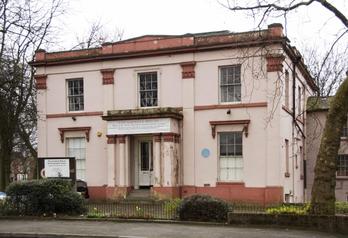
I am posting here several pictures from the JASNA-New York Capital Region’s Retreat from a few weeks ago – a fabulous time was had by all as we learned about, discussed, laughed over, and watched Jane Austen’s Persuasion. The overnight retreat was held at the Wiawaka Holiday House located on Lake George, New York, a perfect setting for a 24-hour immersion in the early 19th century. [See here for information on the weekend]

Wiawaka House c2013 Mary Huber

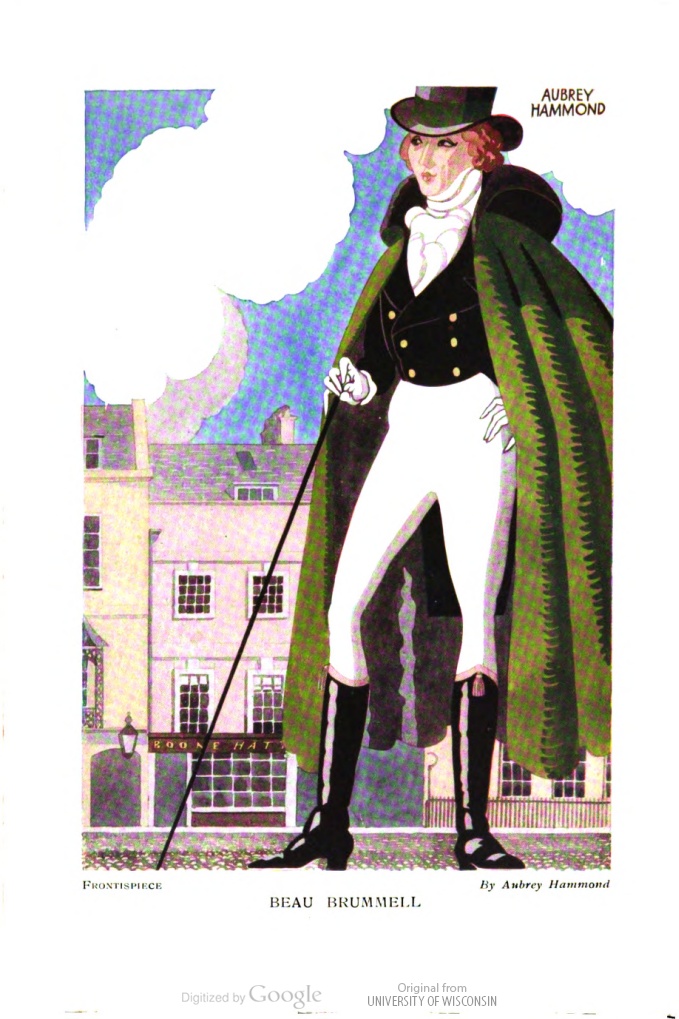
The event was facilitated by member Billie Franchini, who offered up great discussion questions, and kept us all on track and everything running very smoothly. We had the pleasure of listening to local author Marilyn Rothstein talk about the Regency Period, with tales of the Prince Regent, life in London for the upper classes, and Beau Brummell.

Hammond-BeauBrummell[Beau Brummell, by Aubrey Hammond, in Lewis Melville, Beau Brummell (NY: Doran, 1925) – at Hathi Trust]

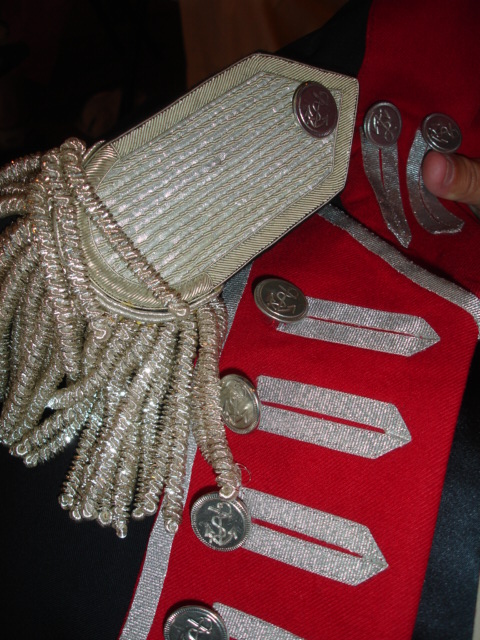
Lisa Brown, from the Syracuse and Rochester JASNA regions (and who has said she really just joined JASNA so she could talk about her first Love, The Royal Navy!), gave an enlightening talk on the uniforms of the Royal Navy from the period, as she passed around various examples of jackets made of superfine wool with epaulettes and buttons that we could handle and ooh! and aah! over [alas! – all empty with no Captain Wentworth in sight!]

the all-important epaulette c2013 D Barnum
Navy Uniforms 1795-1812 - Lisa Brown
Navy Uniforms 1795-1812 – Lisa Brown

***************

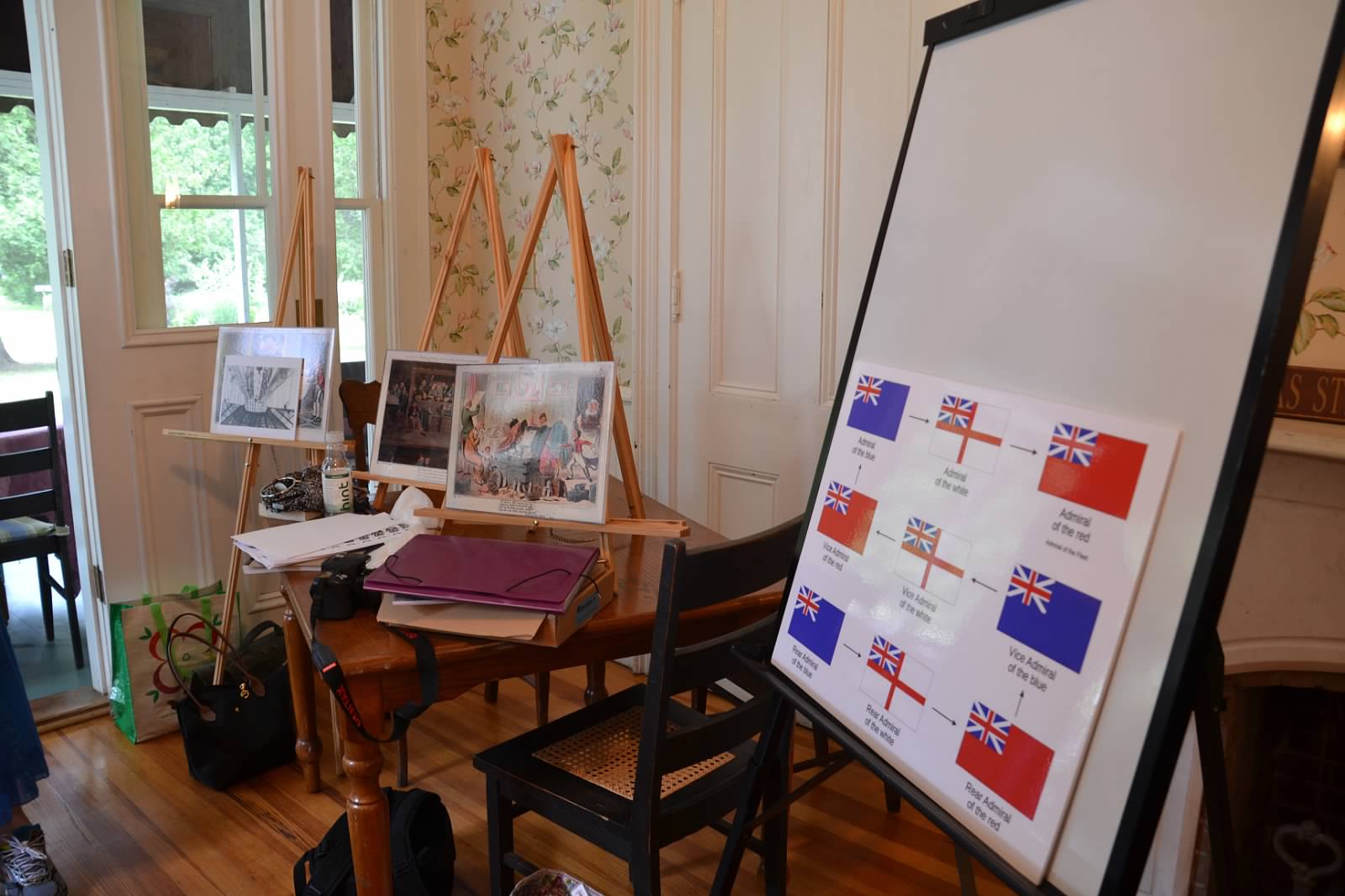
Lisa spoke the next day as well on “How Captain Wentworth Made His Fortune” – wherein we learned about the various ships of the period (and those that Wentworth commanded), the rating system, how one became an officer with hopes of success in battle and a future as an admiral, how one earned their prize money, how often a sailor was relegated to half-pay status [think Capt. Harville] and how very knowledgeable Jane Austen was about the Royal Navy because of her brothers’ involvement. Lisa is a veritable encyclopedia about the RN and she handled our peppering with questions admirably! [very excited to announce that Lisa will be speaking at our JASNA-Vermont June 2014 meeting!]

 c2013 Mary Huber
Lisa’s exhibits – c2013 Mary Huber
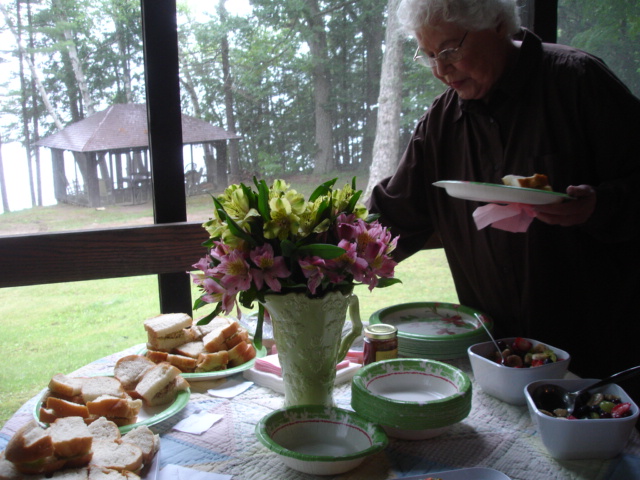
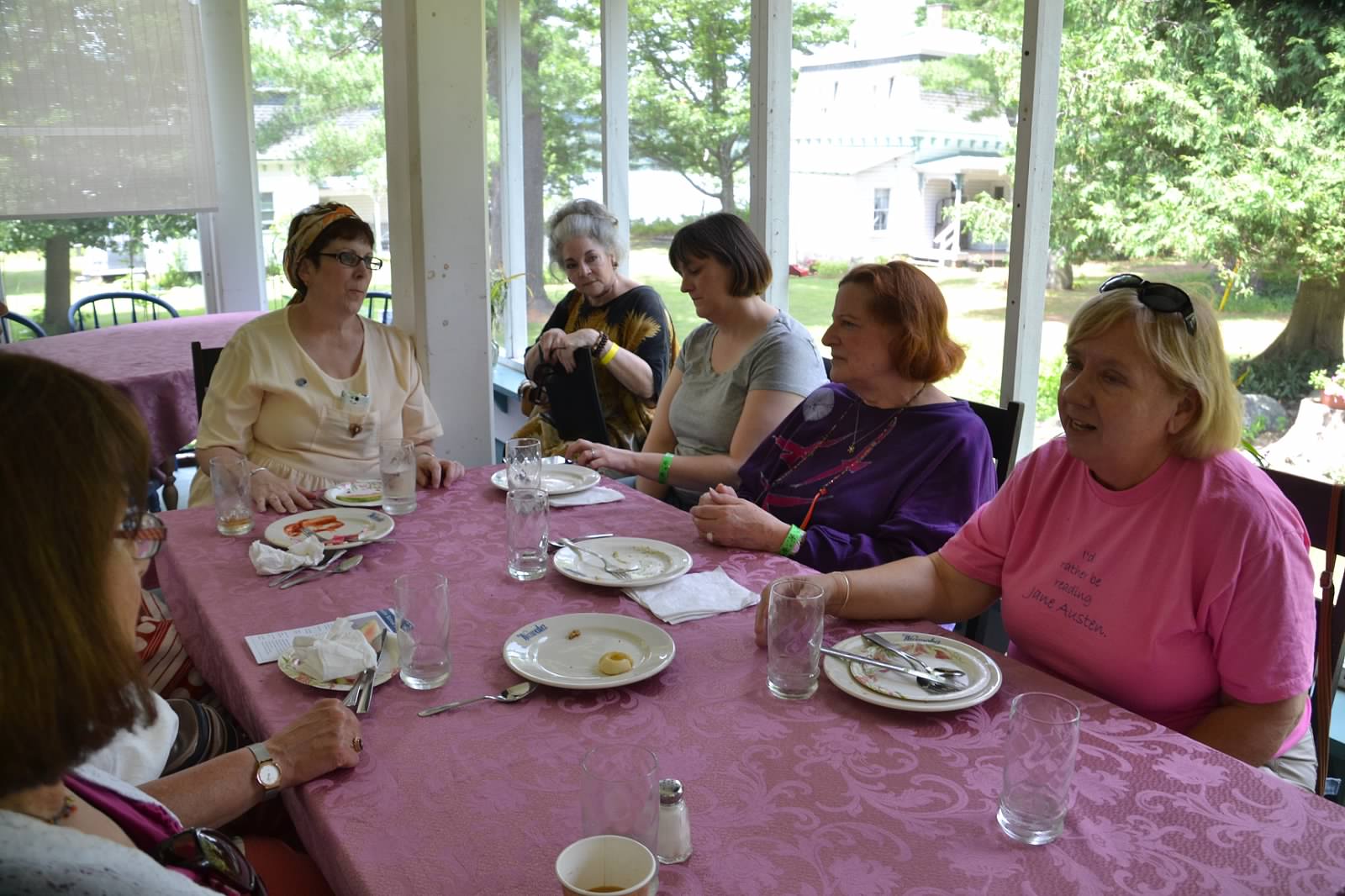
Tea on the Porch! c2013 D Barnum

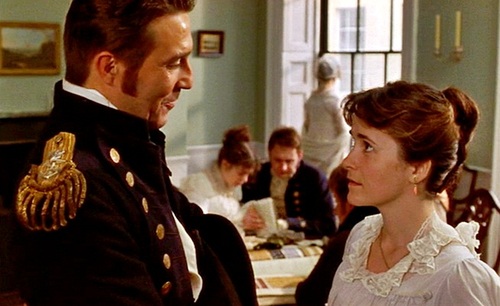
The weekend ended with a sumptuous Tea, prepared mostly by RC Pat Friesen, and a final discussion of the joys of viewing the movie adaptation of Persuasion – thankfully the one with Amanda Root and Ciaran Hinds! – which we had done the night before… one never tires of this nearly perfect adaptation, and one always sees things not seen before, moreso when viewing it with a group…

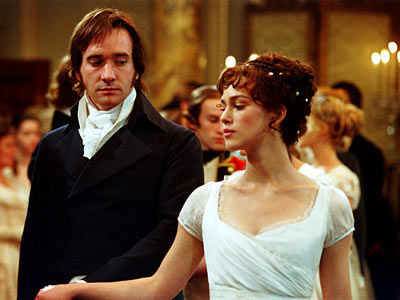
persuasionmovieimage

A lovely 24-hour immersion! – up for next year is Northanger Abbey, and a more perfect setting I cannot imagine. Thank you all in the Capital Region JASNA group for making us all feel so very welcome and offering up insightful Austen discussion!

***********************

Breakfast with Billie and Sara - c2013 Mary Huber
Breakfast with Billie and Sara – c2013 Mary Huber
Lunch! - c2013 Mary Huber
Lunch! – c2013 Mary Huber
c2013 Mary Huber
c2013 Mary Huber
c2013 Lisa Brown
c2013 Lisa Brown

JASNA-NYCR-flier

Further reading:

All photos reprinted courtesy of Mary Huber, Lisa Brown, and Deb Barnum; you can view more photos of the retreat here:

Auctions · Fashion & Costume · Jane Austen · Jane Austen Popular Culture · Movies

Austen on the Block! ~ Lounging around as Mr Darcy, or Maybe Maximus?

UPDATE:  Mr Darcy’s [a.k.a Laurence Olivier] jacket sold for $6,500. – estimate was $1500. – $2000.  Russell Crowe’s Gladiator tunic sold for $7500!

 There is a Hollywood auction taking place today in California – the Profiles in History auction house has a number of Hollywood artifacts being offered at their Hollywood Auction 56, the costumes for the Sound of Music movie for starters. But here is one item of interest to Jane Austen followers, a pure piece of Austen and movie memorabilia to grace anyone’s closet:

Darcyjacket

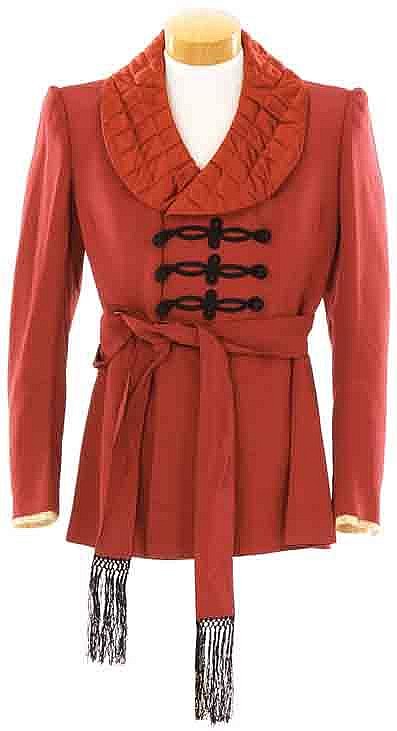
Lot 422: Laurence Olivier screen-worn “Mr. Darcy” jacket from Pride and Prejudice.

Estimated Price: $1,500 – $2,000   starting bid: $1,500

Description:

Laurence Olivier screen-worn “Mr. Darcy” jacket from Pride and Prejudice. (MGM, 1940).

A beautiful smoking jacket, screen-worn by Laurence Olivier as “Mr. Darcy” in the epic film adapted from the classic Jane Austen novel, Pride and Prejudice. Consisting of crimson, corded silk jacket with wide quilted satin lapels, black braid brocade loop and cloth-covered button front closure, integral sash with black fringed ends, crème-colored pleats peeking from sleeve cuffs and dark maroon satin lining throughout. MGM internal bias label on inside collar with “Larry Olivier” handwritten in black ink. This striking costume exhibits barely detectable age and wear. Fabric remains fresh with colors vibrant. Overall in vintage fine condition.

*******************

and view the various other pieces of Hollywood history that are available, 988 lots in total, from Marilyn Monroe to the Von Trapps – the catalogue itself a work of art and collectible for any movie nut. Here is the link to the flipbook – Mr. Darcy’s jacket is on page 141, right next to Gary Cooper’s costume from Sergeant York and opposite Judy Garland Wizard of Oz posters…

It all goes live this morning 11:00 am. PST!

olivier-darcy

p.s.: do you think Mr Darcy SMOKED??

p.s. 2: just so you don’t think that my other fantasies are not touched on in this auction, if you go to page 298-300, you will find the following:

Maximus tunicRussell Crowe-Gladiator

Lot 803: Russell Crowe’s Maximus tunic from Gladiator.

Estimated Price: $2,000 – $3,000

Description:

Russell Crowe’s Maximus tunic from Gladiator. (DreamWorks, 2000) This tunic was worn by Russell Crowe as “Maximus” in Gladiator. The sleeveless, knee-length tunic is constructed from studio-distressed, unbleached cotton homespun fabric and lined with a light weight muslin reinforcement lining. A bias tag with “Max” written in black ink is sewn under the muslin lining at the back of the neck.  “Max” wears this tunic when he is abducted from his destroyed home by Roman slave traders and taken to Zucchabar, a Roman city in North Africa. There, he is bought by the trader “Proximo” and forced to become a gladiator. Accompanied by a letter of authenticity from the costumer.

[Note: Bidding for this item begins on July 29, 2013, 11:00 am PST]

I might just have to buy this catalogue!

c2013 Jane Austen in Vermont
Jane Austen · Jane Austen Popular Culture · Literature · Movies · Query

A Jane Austen Siting ~ Pride & Prejudice in 16 words or less…

Scrolling through the “guide” on my television the other day, in dire need of pure entertainment, I came upon the 2005 Pride and Prejudice, though barely recognizable by its description – it read:

A convoluted courtship begins between a young woman and
the handsome friend of a wealthy bachelor.

And thus a major classic of the English language reduced to sixteen words, with nary a mention of Jane Austen, not to mention Elizabeth or Mr. Darcy! I was quite sure I had slipped off the guide into the Hallmark Channel!

If you had the assignment to do a write-up on any of Austen’s novels in 16 words or less, what would you write?? [I was asked this once in a radio interview and I had a complete brain-cramp and froze up, not my greatest life moment! – one should always be prepared for such a question, don’t you think?]

So Gentle Readers, please comment with your capsule of Austen! – think Twitter but even shorter…

Copyright @2012 Jane Austen in Vermont 
Austen Literary History & Criticism · Jane Austen · Jane Austen Popular Culture · JASNA · JASNA-Vermont events · Movies

Celebrating ‘Sense & Sensibility’ ~ “Marianne as Heroine”

JASNA-Vermont celebrated in style this past Sunday at our annual Jane Austen Birthday Tea.  As always, a delicious repast of afternoon tea goodies catered by Champlain College with additional tasty holiday cookies by various JASNA members, made for a lovely afternoon of food and Austen conversation.

This year in celebration of the Bicentenary of Sense & Sensibility,  we welcomed Rebecca McLaughlin, lecturer at the University of Vermont, as she shared her insights on “A Second Chance for Sense and Sensibility ~ Marianne as Heroine.”

Marianne Dashwood 1995 - Kate Winslet

As part of the course offered at UVM Austen: Page and Film**, McLaughlin presented an interesting and insightful look at Sense and Sensibility from the standpoint of Marianne as the Heroine [which then of course makes Colonel Brandon the true Romantic Hero!, with which I heartily concur!], backing up all her views with text examples, scholarly interpretation, and film clips from the various adaptations.  This year we had the advantage of sitting at eight tables of eight with all engaged in lively discussion and much laughter as McLaughlin, in true college style, prompted us with questions and a quiz! *

those who dressed for the occasion!

I think all there would agree that it was one of our best teas to date, the table arrangement being a great hit and Rebecca’s presentation one to remember – I do know that she has certainly prompted many to re-read their S&S with renewed vigor and plan into the night movie marathons of all six film adaptations! *** and perhaps even sign up for her next class,  sure proof that Jane Austen is alive and well in Vermont!

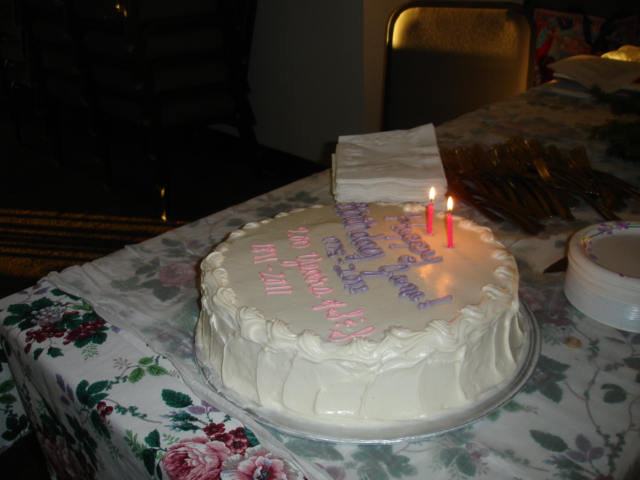
The CAKE!

A thank you to all who so generously helped with baking and at the event – I could not do it without you, and mostly to Janeite Marcia for her work as Hospitality Maven, Treasurer and Keeper of the Mailing List! – and a hearty THANK YOU to Champlain College for their generosity in providing the room for us, and their superb catering team.  And finally, many thanks to Rebecca McLaughlin for sharing her love of Austen with us and making all feel like we were back in that ole’ college classroom, wondering whether to become English majors or not!

Alas! only a few pictures – with thanks to Janeite Margaret for adding to my very few taken – I need to remember to TAKE PICTURES at these things, especially of the Tea Table….

JASNA Members Hope and Marcia

*******************************

* Sense and Sensibility Quiz:
        [scroll to the end for answers, but no cheating!]

1.   What was the original title of the story that would become Sense and Sensibility?

a.       Reason and Emotion
b.       First Impressions
c.       Second Attachments
d.       Elinor and Marianne

2.    How old is the story that we now know of as Sense and Sensibility?

a.      200 years
b.      195 years
c.      216 years
d.      225 years

3.    Originally, the story was written in letters; this style of novel is known as which of the following?

a.            realist novel
b.            epistolary novel
c.            sensation novel
d.            epic novel

4.   Although revised from its original form, how many complete letters may be found within Sense and Sensibility?

a.            none
b.            three
c.            six
d.            ten

 5.   Which of the following is the narration style Austen uses in Sense and Sensibility?

a.            first-person narration
b.            third-person omniscient narration
c.            stream-of-consciousness narration
d.            all of the above 

6.   Which of the following characters notices that Edward is wearing a ring with a lock of hair in it when he visits Barton?

a.            Mrs. Dashwood
b.            Mrs. Jennings
c.            Marianne
d.            Elinor

 7.   How much is Colonel Brandon’s estate, Delaford, worth (in pounds)?

a.            2000
b.            1000
c.            600
d.            5000

8.   Which of the following represents Marianne’s favorite maxim, or saying, within Sense and Sensibility?

a.            always think of oneself first
b.            you can only love once
c.            money is everything
d.            nature is man’s place of worship

[S&S Quiz, @2011 Rebecca McLaughlin and printed with permission]

************************ 

**The course at UVM:  Austen: Page and Film will be offered online in the Summer 2012 semester.  Course description:

Women’s & Gender Studies: Austen: Page and Film [WGST 095 OL1 : 3 Credit Hours  ]

After nearly two centuries in print, Jane Austen’s works continue to enthrall us, whether in their original form or in the numerous television and film adaptations created since 1938. This course examines the role Austen played during her own time as well as the role she continues to play within our contemporary cultural imagination by analyzing four of Austen’s novels (Sense and Sensibility, Pride and Prejudice, MansfieldPark, and Emma) and by viewing faithful adaptations, reinterpretations and modernizations of each novel. We begin by placing each novel within its social and historical context, by defining themes that may help explain Austen’s modern appeal, and by creating our own vision of the action and characters. We then turn to the adaptations and investigate the historical moment of production, analyze changes to script and character, and think about how prose fiction differs from film in an attempt to understand the screenwriter’s choices and our current love of anything Austen. Course requirements include lively participation via blogs, reading quizzes, and a final written assignment. 

Instructor:  Rebecca McLaughlin, Lecturer, UVM Dept of English.
May 21, 2012 to June 29, 2012.  Location: Online Course

More information available at the UVM website.

******************************

*** The Six film adaptations of Sense and Sensbibility:
                              [ visit the JASNA site for details ]

  • From Prada to Nada (2011)
  • Sense and Sensibility (2008):  Screenplay by Andrew Davies
  • Kandukondain Kandukondain (I Have Found It) (2000) – with English subtitles
  • Sense and Sensibility (1995): Screenplay by Emma Thompson
  • Sense and Sensibility (1980): BBC – Screenplay by Alexander Baron
  • Sense and Sensibility (1971): BBC – Screenplay by Denis Constanduros

*******************

Who is your favorite Colonel Brandon?

Colonel Brandon 1995 - Alan Rickman
Colonel Brandon 2008 - David Morrissey

Quiz answers:

  1. D
  2. C
  3. B
  4. C
  5. B
  6. C
  7. A
  8. B

**************************

Upcoming post: Publishing Sense and Sensibility

Copyright @2011 Deb Barnum, Jane Austen in Vermont
Jane Austen · Jane Austen Popular Culture · JASNA · Movies

Mr. Collins ~ Alive and Well! ~ in Charleston, South Carolina!

Update! – two items of interest regarding Mr. Collins:

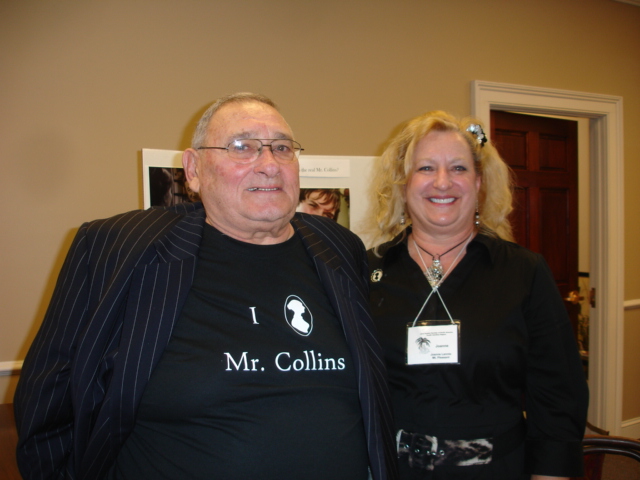
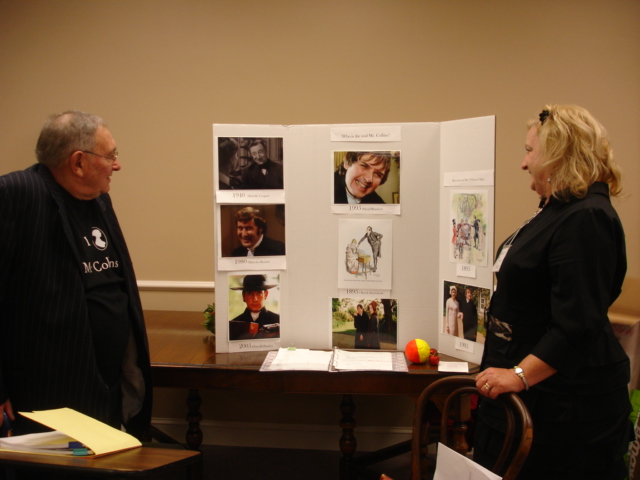
Here is the picture of Vince Lannie and his wife Joanne at his talk [my camera is  finally speaking to my computer!]

[Vince and Joanne Lannie – notice Vince’s shirt – a great find at the Fort Worth AGM! – and this might be the only such shirt in existence!]

– and two, I alert you to visit the Austen Authors site to read Diana Birchall’s latest, this time on Mr. Collins, as he writes to Lady Catherine after his proposal to Elizabeth, a proposal he still thinks is to be accepted…

“Mr. Collins and His Successful Love,” by Diana Birchall.
_____________________________________________________

Jane Austen in Vermont has been spending some time in South Carolina! – so what a treat to visit the South Carolina JASNA Region last week and hear Vince Lannie (husband of Regional Coordinator Joanne Lannie) give a rousing talk on of all people, Mr. Collins! In his “The Two Mr. Collins: ‘Underbred’ Social Misfit or Opportunistic Regency Clergyman?” Lannie presents a Mr. Collins who in his words “never stands a chance” – he is ridiculed in print by all the characters and Austen herself, and certainly in all the films.  

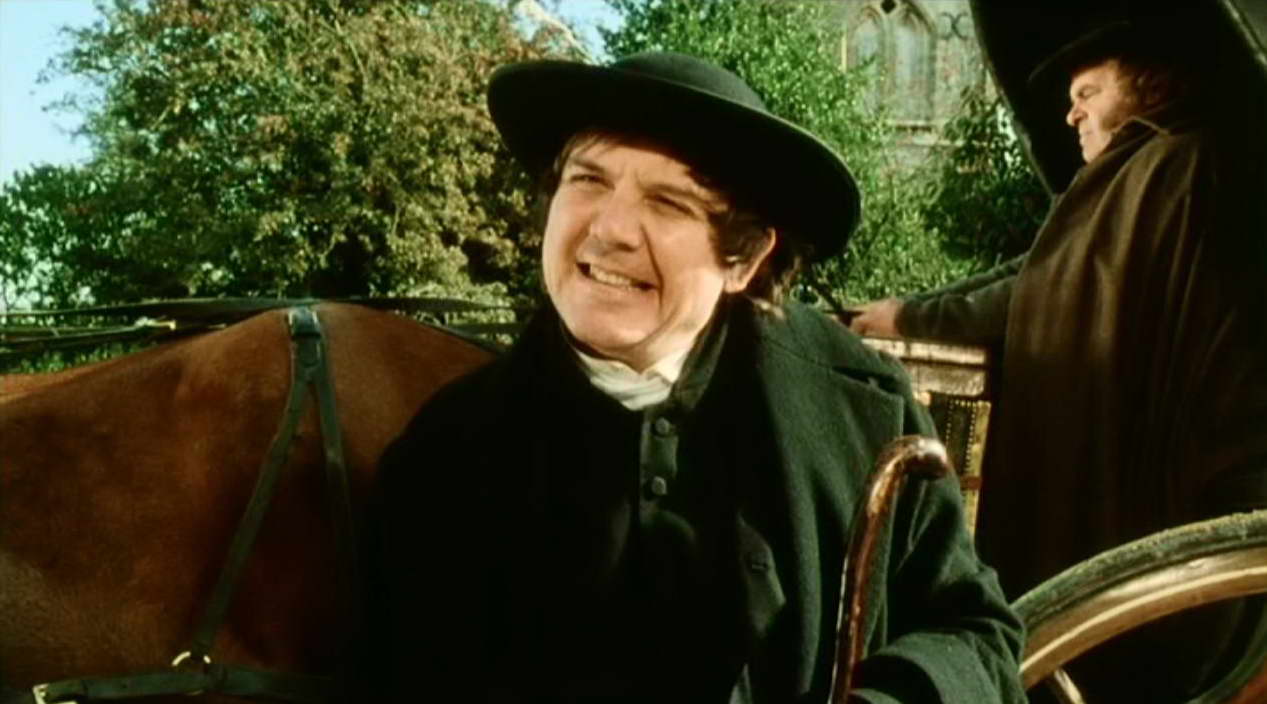
David Bamber - P&P 1995

Lannie begins his talk defining Austen’s take on “the Proper English Gentleman” – Mr. Bingley the perfect personification, Mr. Darcy a close second –  handsome, wealthy enough to not have to work, and approved by all [and I guess why Mr. Darcy is second-best – it takes a while to realize that he is after all the epitome of the English Gentleman, is he not?] – but Mr. Collins? – he is presented to us as outside the realm of the Gentleman before we even meet him!  His letter to Mr. Bennet suggests his best efforts to bridge the gap, to mend the family feud – but he is rendered ridiculous by his creator and in the reaction to him by her Bennet family characters. 

Ingres – Portrait-Dupaty c1805

 “The Proper English Gentleman” – Regency Period


The Proper English Gentleman - 21st century style

Collins is initially described in lowly terms – unattractive, deficient in intelligence and social status, one who only rises in this overly socially-conscious world due to the “fortunate chance” of Lady Catherine as patroness.  The facts of this chance act are never revealed in the text – why indeed does Lady Catherine choose to bestow her gifts on Collins?? Lannie calls Lady C a “Sugar Mamma”! – she and Collins forming a “Regency coalition,” a partnership that attempts to wield power and control over all the family and the neighborhood. 

Brock's Mr. Collins - Mollands

There is much analysis of Charlotte Lucas and her role as a “marital prostitute” as some have called her, with her very clear practical views on marriage where woman acquiesces vs. the hope for independent choice based on love. Elizabeth’s rejection is such a shock for Collins; it is so against the tradition of little choice in marriage for the woman, he is quite stupified. Lannie emphasizes that the “discordant dialogue” between Elizabeth and Charlotte on marriage and romantic love is one of the major themes of the novel. 

Malcolm Rennie - P&P 1980

In the end Lannie places Collins with other opportunistic men of the age who need to align themselves with patrons and helpmates who will raise them to the gentleman status that they are in reality far below. The irony perhaps is that while Mr. Collins is not Jane Austen’s version of the perfect Regency Gentleman, Mr. Collins certainly thinks he is!

Tom Hollander - P&P 2005

I offer only a quick skim of Mr. Lannie’s talk – I cannot give it all away, as all in the audience thought it was such a great defense of Mr. Collins that it is more than worthy of a breakout session slot for the Pride and Prejudice AGM meeting in Minneapolis in 2013!  Certainly Lannie’s fear that a roomful of Janeites might be compelled to throw tomatoes (Joanne supplied plastic ones to toss in the event!] or engage in “hissing” behaviors as he staunchly defended Mr. Collins against his fellow characters and his own creator did indeed not come to pass! – on the contrary, we all behaved exceedingly well as proper Jane Austen fans should, and heartily encouraged him to send it in to JASNA…! 

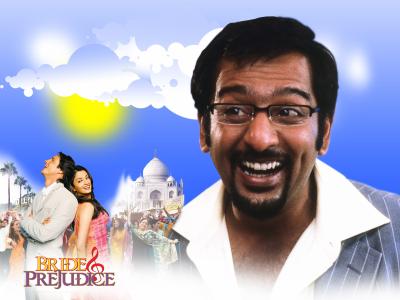
Nitin Ganatra - Bride & Prejudice

But I can ask, as we did get into some discussion about Mr. Collins [Should he perhaps have ended up with Mary and solved the entail dilemma for the Bennets? – Could he and Charlotte be truly happy together? Etc…] –

  •  What are your thoughts on Mr. Collins? 
  •  If you think on all the films you will agree that Mr. Collins is made to be quite ridiculous in all of them! – who is your favorite of the lot?
Guy Henry - Lost in Austen

So, all in all a delightful day meeting a whole new group of Janeite friends, in the lovely setting of the Charleston Library Society.  Up next from this visit: The Charleston Library Society’s copy of Emma.

[p.s. my pictures of the event will have to wait until my camera and my computer can agree to talk to each other… in the meantime enjoy the various above shots of the Proper English Gentleman and the various players of Mr. Collins!]

Melville Cooper - 1940 P&P

And there are others – is your favorite Lockwood West from the 1952 adaptation, or Julian Curry from 1967, or any of the other versions?

Lockwood West - 1952 P&P
Julian Curry - 1967 P&P

Let’s hear your thoughts on Mr. Collins!

Brock - P&P - RofP
Copyright @2011 Deb Barnum of Jane Austen in Vermont.
Jane Austen Circle · Literature · Movies · Women Writers

Elizabeth Gaskell Bicentenary Blog Tour: Your Gaskell Library


Welcome to the 14th stop on today’s celebration of Elizabeth Gaskell’s birthday – September 29, 1810!  Please join me in this blog tour honoring Gaskell as 15 bloggers, under the direction of Laurel Ann at Austenprose, each post something related to Gaskell – a look at her life and times, book reviews, movie reviews, a tour to her home in Manchester [see at the bottom of this post for the links to the various posts on the blog tour], and my post on “Your Gaskell Library” ~  where to find Gaskell in print, online, on your iPhone,  on your iPod, and on film – she is Everywhere!  By the end of the tour you will know more about Gaskell than you thought possible and be the better for it!!  There is also the opportunity to win a Naxos recording of North and South by just making a comment on any of the blogs.  Enjoy yourself as we all wish a hearty Happy Birthday to Mrs. Gaskell!
********************

I wanted to see the place where Margaret grew to what she is,
even at the worst time of all,
when I had no hope of ever calling her mine…

North and South
*************

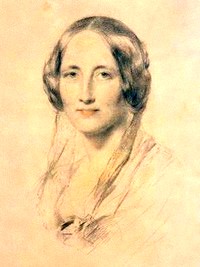
Elizabeth Cleghorn Gaskell (1810-1865) is best known to us as the author of the then-controversial biography of Charlotte Bronte, where she laid bare the oddities of the Bronte household, publicizing the behavior of the semi-mad father and the destructive life and affairs of the son. But Gaskell was a well-respected and popular author in her own day; we have been seeing a resurgence of that popularity with the broadcast of Wives & Daughters (1999), North & South (2004) [the film that rocketed Richard Armitage to fame, and rightly so!], and Cranford (2007, 2009). So I give a very brief review of her life and works [this was originally posted here], followed by a select bibliography. 

Born in Cheshire to William Stevenson, a Unitarian minister, Elizabeth was raised by her aunt, the sister of her mother who died shortly after her birth.  The town of Knutsford and the country life she experienced there became her setting in Cranford and her “Hollingford” in North & South.  She married William Gaskell of Manchester, also a Unitarian minister, in 1832, had four daughters and one son, who died in infancy.  The loss of her son had a devastating effect on her and to keep herself from sinking into an ever-deeper depression, she took pen in hand and started to write.  She published her first book Mary Barton in 1848 (using the pseudonym Cotton Mather Mills), though there is some speculation that she actually started to write Sylvia’s Lovers (1863) first but put it aside to write the more socially conscious Mary Barton.  Gaskell, according to Lucy Stebbins, was chiefly concerned with the ethical question of ”The Lie”, i.e. a belief that “deception was the greatest obstacle to the sympathetic understanding which was her panacea for individual and class quarrels.” (1)  This reconciliation between individuals of different classes and between the wider world of masters and workers was her hope for humanity and it was this zeal that often led her into false sentiment in her novels and stories.(2)  But because she saw both sides of the labor question and pitied both the oppressor and the oppressed, she was thus able to portray with often explicit candor the realities of her world.  But Stebbins also says that life was too kind to her as a woman to make her a great artist.  Her tales of vengeance and remorse were written more to satisfy public taste, after she started publishing in Dickens’ Household Words.  And David Cecil calls Gaskell “a typical Victorian woman….a wife and mother”….he emphasizes her femininity, which he says gives her the strengths of her detail and a “freshness of outlook” in her portrayals of the country gentry, while at the same time this femininity limits her imagination.  In comparing her to Jane Austen, Cecil writes: 

         It is true Mrs. Gaskell lived a narrow life, but Jane Austen, living a life just as narrow, was able to make works of major art out of it.  Jane Austen…was a woman of very abnormal penetration and intensity of genius. ….. [Gaskell] cannot, as Jane Austen did, make one little room an everywhere; pierce through the surface facts of a village tea-party to reveal the universal laws of human conduct that they illustrate.  If she [Gaskell] writes about a village tea-party, it is just a village tea-party…(3) 

   Cecil is critical of her melodrama, her “weakness for a happy ending”, her overlong works that lack imagination and passion.  But he does credit her four major works (Sylvia’s Lovers, Cranford, Wives & Daughters, and Cousin Phillis) as classic and worthy English domestic novels.  
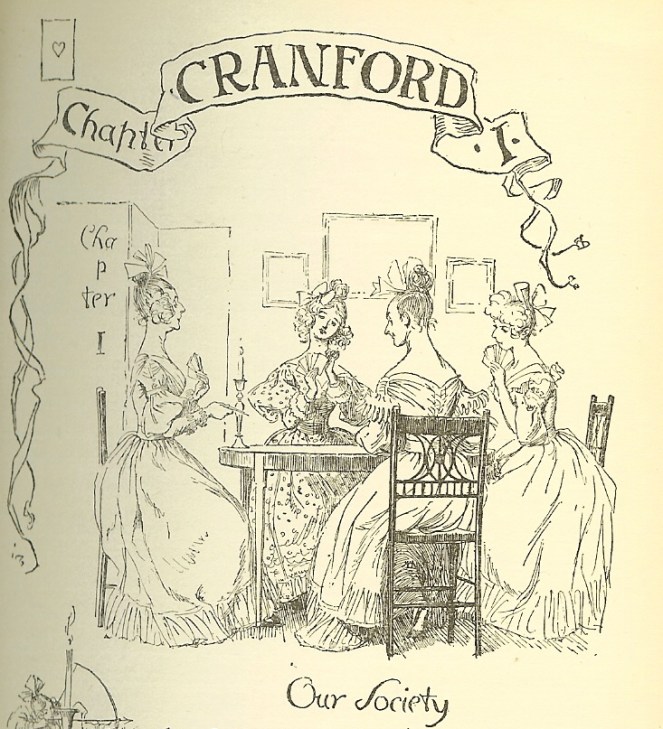
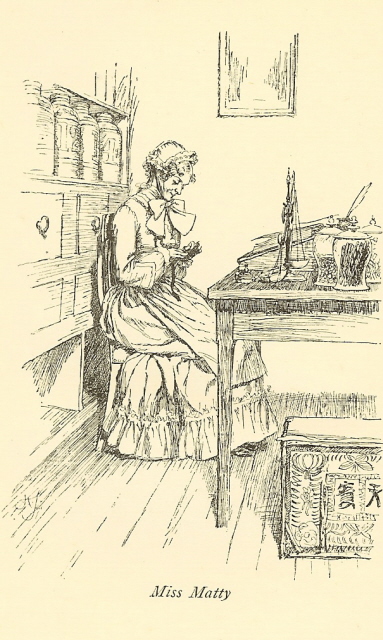
[Cranford, illustrated by Hugh Thomson.  London : Macmillan, 1891..
This copy is also available at the Illustrated Cranford site. ]

Anne Thackeray Ritchie, in her introduction to Cranford, published in 1891, also compares Gaskell to Austen, and finds the latter lacking: 

Cranford is farther removed from the world, and yet more attuned to its larger interests than Meryton or Kellynch or Hartfield….Drumble, the great noisy manufacturing town, is its metropolis, not Bath with its successions of card parties and Assembly Rooms.” …. and on love, “there is more real feeling in these few signs of what once was, than in all the Misses Bennett’s youthful romances put together…only Miss Austen’s very sweetest heroines (including her own irresistible dark-eyed self, in her big cap and faded kerchief) are worthy of this old place….”  and later, “it was because she had written Mary Barton that some deeper echoes reach us in Cranford than are to be found in any of Jane Austen’s books, delightful though they be. (4) 

Margaret Lane in her wonderful book of essays on biography, Purely for Pleasure [which also includes the essay “Jane Austen’s Sleight-of-hand”], has two essays on Mrs. Gaskell.  Lane calls her one of the greatest novelists of the time, and especially praises Wives & Daughters over Cranford for its stature, sympathies, mature grasp of character and its humour, and its effect of “creating the illusion of a return to a more rigid but also more stable and innocent world than ours” and we feel refreshed in spirit after a reading. (5) 

Wives & Daughters, Gaskell’s last work, and considered her finest, was published as a serial novel in Cornhill, the last unfinished part appearing in January 1866.  Gaskell had literally dropped dead in the middle of a spoken sentence at the age of 55, and the work remained unfinished, with only a long note from the Cornhill editor following the last serial installment.  Wives and Daughters tells the story of Molly Gibson and her new stepsister Cynthia, and their coming of age in the male-dominated mid-Victorian society of “Hollingford.” 

But it is Lane’s essay on “Mrs. Gaskell’s Task” in which she so highly praises Gaskell’s achievement in her biography of Charlotte Bronte.  While Gaskell obviously suppressed some facts (the letters to M. Heger) and exaggerated others (Mr. Bronte as a father and Branwell as a son), Lane says “her great biography remains a stirring and noble work, one of the first in our language…. and it is in essence ‘truer’ than anything about the Brontes which has been written since…”(6) 

Such contrary opinions!…certainly reminiscent of Austen’s admirers and critics!   Perhaps as Pam Morris says in her introduction to W&D, “Gaskell resists any simple categorization…her work ranges across the narrative forms of realism and fairytale, protest fiction and pastoralism, melodrama and the domestic novel.”(7) 

_______________________________________ 

Notes:
1.  Lucy Poate Stebbins. A Victorian Album: Some lady Novelists of the Period (Columbia, 1946) p. 96.
2.  Ibid.
3.  David Cecil.  Victorian Novelists: Essays in Revaluation (Chicago, 1962) p. 187.
4.  Anne Thackeray Ritchie.  Preface to Cranford (Macmillan, 1927) pp. vii, xix.
5.  Margaret Lane.  Purely for Pleasure (Hamish Hamilton, 1966)  p. 153.
6.  Ibid, p. 170.
7.  Pam Morris.  Introduction to Wives and Daughters (Penguin, 2001) p. vii. 
                                                            *****************

I append below a “Select Bibliography” of Gaskell’s works, biographies and critical works, as well as links to what can be found online, iPhone, audio, and film – and most everything Gaskell wrote IS available.  Many of her writings were originally published in the periodicals of the day, such as Howitt’s Journal, Sartain’s Union Magazine, Harper’s Monthly Magazine, Dickens’s Household Words and All the Year Round, and Cornhill Magazine; and many of these writings were later published in collections of tales. And, like Dickens, some of her novels were originally published in serial form [Cranford, North and South, Wives and Daughters].  I list below the novels as first published in book form, a list of short stories and essays with date of original appearance in print, and a list of current editions you can find in your local bookstore [I list only the Oxford, Penguin and Broadview editions – there are many others and reprints of all kinds – best to look for an edition with a good introduction and notes.]  There is a lot of information here, with links to even more information available on the web – there is no lack of writing on Mrs. Gaskell! – But what I really want to emphasize are her short stories, which often get lost in the hoopla about her major novels – there are many as you will see, with links appended – try some – you will not be disappointed!  

****************************
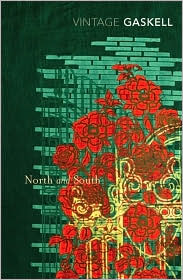
Bibliography: Selected list   [see links below for more complete bibliographies] 

Works:  Books, Short Story Collections 

  1. Mary Barton: A Tale of Manchester Life. 2 vols. London: Chapman & Hall, 1848; 1 volume, New York: Harper, 1848.
  2. Libbie Marsh’s Three Eras: A Lancashire Tale. London: Hamilton, Adams, 1850.
  3. The Moorland Cottage. London: Chapman & Hall, 1850; New York: Harper, 1851.
  4. Ruth: A Novel. 3 vols. London: Chapman & Hall, 1853; 1 volume, Boston: Ticknor, Reed & Fields, 1853.  
  5. Cranford. London: Chapman & Hall, 1853; New York: Harper, 1853.
  6. Hand and Heart; and Bessy’s Troubles at Home.  London:  Chapman and Hall, 1855.
  7. Lizzie Leigh and Other Tales. London: Chapman & Hall, 1855; Philadelphia: Hardy, 1869.
  8. North and South. 2 vols.  London: Chapman & Hall, 1855; 1 vol., New York: Harper, 1855.
  9. The Life of Charlotte Brontë; Author of “Jane Eyre,” “Shirley,” “Villette” etc.. 2 vols. London: Smith, Elder, 1857; New York: Appleton, 1857.
  10. My Lady Ludlow, A Novel. New York: Harper, 1858;  republished as Round the Sofa. 2 vols. London: Low, 1859.
  11. Right at Last, and Other Tales.  London: Low, 1860; New York: Harper, 1860.
  12. Lois the Witch and Other Tales. Leipzig: Tauchnitz 1861.
  13. Sylvia’s Lovers.  3 vols.  London: Smith, Elder, 1863; 1 vol. New York: Dutton, 1863.
  14. A Dark Night’s Work.  London: Smith, Elder, 1863; New York: Harper, 1863.
  15. Cousin Phillis: A Tale. New York: Harper, 1864; republished as Cousin Phillis and Other Tales.  London: Smith, Elder, 1865.
  16. The Grey Woman and Other Tales.  London: Smith, Elder, 1865; New York: Harper, 1882.
  17. Wives and Daughters: An Every-Day Story.  2 vols.  London: Smith, Elder, 1866; 1 vol., New York: Harper, 1866.


Works:  Short Stories and Essays [in order of publication] – most of these are available online at The Gaskell Web, Project Gutenberg, IPhone (Stanza – Munsey’s), etc. 

  1. On Visiting the Grave of my Stillborn Little Girl (1837)
  2. Sketches Among the Poor, No.1 (1837)
  3. Notes on Cheshire Customs (1839)
  4. Description of Clopton Hall (1840)
  5. Life In Manchester:  Libbie Marsh’s Three Eras (1847)
  6. The Sexton’s hero (1847)
  7. Emerson’s lectures (1847) [attributed]
  8. Christmas Storms and Sunshine (1848)
  9. Hand and Heart (1849)
  10. The Last Generation in England (1849)
  11. Martha Preston (1850) – re-written as “Half a Lifetime Ago”
  12. Lizzie Leigh  (1850)
  13. The Well of Pen-Morfa (1850)
  14. The Heart of John Middleton (1850)
  15. Mr. Harrison’s Confessions (1851)
  16. Disappearances (1851)
  17. Our Society in Cranford (1851)
  18. A Love Affair at Cranford (1852)
  19. Bessy’s Troubles at Home (1852)
  20. Memory at Cranford (1852)
  21. Visiting at Cranford (1852)
  22. The Shah’s English Gardener (1852)
  23. The Old Nurse’s Story (1852)
  24. Cumberland Sheep Shearers (1853)
  25. The Great Cranford Panic (1853)
  26. Stopped Payment at Cranford (1853)
  27. Friends in Need (1853)
  28. A Happy Return to Cranford (1853)
  29. Bran (1853)
  30. Morton Hall (1853)
  31. Traits and Stories of the Huguenots (1853)
  32. My French Master (1853)
  33. The Squire’s Story (1853)
  34. The Scholar’s Story (1853)
  35. Uncle Peter (1853)
  36. Modern Greek Songs (1854)
  37. Company Manners (1854)
  38. An Accursed race (1855)
  39. Half a lifetime Ago (1855) [see above “Martha Preston”]
  40. The Poor Clare (1856)
  41. The Siege of the Black Cottage (1857) – attributed
  42. Preface to Maria Susanna Cummins Mabel Vaughan (1857)
  43. The Doom of the Griffiths (1858)
  44. An Incident at Niagara Falls (1858)
  45. The Sin of a Father (1858) – re-titled Right at Last in collection
  46. The Manchester Marriage (1858)
  47. The Half-Brothers (1859) – in Round the Sofa collection
  48. Lois the Witch (1859)
  49. The Ghost in the Garden Room (1859) – re-titled “The Crooked Branch” in Right at Last collection
  50. Curious if True (1860)
  51. The Grey Woman (1861)
  52. Preface to C. Augusto Vecchi, Garibladi at Caprera (1862)
  53. Six Weeks at Heppenheim (1862)
  54. Shams (1863)
  55. An Italian Institution (1863)
  56. The Cage at Cranford (18863)
  57. Obituary of Robert Gould Shaw (1863)
  58. How the First Floor Went to Crowley Castle (1863)
  59. French Life (1864)
  60. Some Passages from the History of the Chomley Family (1864)
  61. Columns of Gossip from Paris (1865)
  62. A Parson’s Holiday (1865)
  63. Two Fragments of Ghost Stories [n.d]

Works ~ Collections: 

  • The Works of Mrs. Gaskell, Knutsford Edition, edited by A. W. Ward. 8 vols. London: Smith, Elder, 1906-1911.
  • The Novels and Tales of Mrs. Gaskell, edited by C. K. Shorter. 11 vols. Oxford: Oxford University Press, 1906-1919.
  • The Works of Elizabeth Gaskell, ed. Joanne Shattuck, et.al.  10 vols.  London:  Pickering and Chatto, 2005-2006.  Click here for more info on this set.

Currently in print ~ Individual Works and Collections: [only the Penguin, Oxford and Broadview Press editions are noted here – there are a number of available editions of Gaskell’s individual works – search on Abebooks, Amazon, or visit your local bookseller; and there are any number of older and out-of-print editions available at these same sources!]

  • Cousin Phillis and Other Stories.  Intro by Heather Glen. Oxford, 2010.
  • Cranford.  Intro by Patricia Ingham.  Penguin 2009; intro by Charlotte Mitchell.  Oxford, 2009;  Intro by Elizabeth Langland.  Broadview, 2010.
  • Gothic Tales. Intro by Laura Kranzler.  Penguin 2001.
  • Life of Charlotte Bronte.  Intro by Elizabeth Jay.  Penguin 1998; Intro by Angus Easson.  Oxford, 2009.
  • Mary Barton.  Intro by MacDonald Daly.  Penguin, 1997; Intro by Shirley Foster.  Oxford, 2009;  Intro by Jennifer Foster.  Broadview, 2000.
  • North and South.  Intro by Patricia Ingham.  Penguin, 1996; Intro by Sally Shuttleworth.  Oxford, 2008.
  • Ruth.  Intro by Angus Easson.  Penguin, 1998; Intro by Alan Shelston.  Oxford, 2009.
  • Sylvia’s lovers.  Intro by Shirley Foster.  Penguin, 1997;  Intro by Andrew Sanders.  Oxford, 2008.
  • Wives and Daughters.  Intro by Pam Morris.  Penguin, 1997


What’s Gaskell Worth Now?

Austen’s works show up at auction fairly regularly, but what about Gaskell – how does she compare to the high prices that Austen’s first editions command?  There is an upcoming Sotheby’s auction set for October 28 in London:  The Library of an English Bibliophile, Part I – all of Austen’s first editions are in the sale with high-end estimates; there are three Gaskell titles in the sale, so this gives a good idea of value:

  • Mary Barton.  London: Chapman and Hall, 1848.  First edition.  est. 4,000 – 6,000 GBP
  • Ruth.  London:  Chapman and hall, 1853.  First edition.  est. 2,000-3,000 GBP
  • North and South.  London:  Chapman and hall, 1855.  First edition.  est. 2,000-3,000 GBP.

 Letters / Diaries: 

  • Chapple, J.A.V. and Arthur Pollard, eds.  The Letters of Mrs. Gaskell. Manchester: Manchester UP, 1966.
  • Chapple, J. A.V.; assisted by by J. G. Sharpes. Elizabeth Gaskell: A Portrait in Letters.  Manchester: 1980.
  • Chapple, John and Alan Shelston, eds. Further Letters of Mrs. Gaskell. Manchester: Manchester UP, 2001.
  • Chapple J. A. V. and Anita Wilson, eds.  Private Voices: the Diaries of Elizabeth Gaskell and Sophia Holland.  Keele:  Keele UP, 1996.
  • Whitehill, Jane, ed.  The Letters of Mrs. Gaskell and Charles Eliot Norton, 1855-1865.  London: Oxford UP: 1932.

Bibliographies: 

  • Selig, R. L.  Elizabeth Gaskell; A Reference Guide.  Boston: G.K. Hall, 1977.
  • Jeffery Welch, Elizabeth Gaskell: An Annotated Bibliography, 1929-75. New York: Garland, 1977.
  • Weyant, Nancy S.  Elizabeth Gaskell: An Annotated Bibliography, 1976-1991. Metuchen, NJ: Scarecrow, 1994.
  • ______________.   Elizabeth Gaskell: An Annotated Guide to English Language Sources, 1992-2001.  Metuchen, NJ:  Scarecrow, 2004. 
    See also Weyant’s online Supplement, 2002-2010 [updated semi-annually]
  • See the Gaskell Web page for an online bibliography

Biographies: 

  • Chapple, John.  Elizabeth Gaskell: A Portrait in Letters.  Manchester:  Manchester UP, 1980.
  • ___________. Elizabeth Gaskell: The Early Years.  Manchester:  Manchester UP, 1997.
  • Easson, Angus.  Elizabeth Gaskell. London: Routledge & Kegan Paul, 1979.
  • Ffrench, Yvonne.  Mrs. Gaskell.  London:  Home & Van Thal, 1949.
  • Foster, Shirley.  Elizabeth Gaskell:  A Literary Life.  Houndsmills: Palgrave Macmillan, 2002.
  • Gerin, Winifred. Elizabeth Gaskell: A Biography. Oxford: Clarendon Press, 1976.
  • Handley, Graham.  An Elizabeth Gaskell Chronology.  Palgrave Macmillan, 2004.
  • Hopkins, Annette Brown. Elizabeth Gaskell: Her Life and Work. London: Lehmann, 1952.
  • Pollard, Arthur.  Mrs. Gaskell: Novelist and Biographer. Manchester: Manchester UP, 1966.
  • Uglow, Jenny.  Elizabeth Gaskell: A Habit of Stories. London: Faber and Faber, 1993.
  • Unsworth, Anna.  Elizabeth Gaskell: An Independent Woman.  London:  Minerva, 1996.

Studies: 

  • Barry, James Donald. “Elizabeth Cleghorn Gaskell,” in Victorian Fiction: A Second Guide to Research, edited by George H. Ford. New York: MLA, 1978.
  • Beer, P. Reader, I Married Him. . . . London: Macmillan, 1974.
  • Cecil, David.  Victorian Novelists: Essays in Revaluation.  Chicago, 1962.
  • Craik, W. A.  Elizabeth Gaskell and the English Provincial Novel. London: Methuen, 1975.
  • Easson, Angus, ed.  Elizabeth Gaskell: The Critical Heritage.  London, 1992.
  • Ganz, Margaret. Elizabeth Gaskell: The Artist in Conflict. New York: Twayne, 1969.
  • Lane, Margaret.  Purely for Pleasure.  London: Hamish Hamilton, 1966.  See chapters on “Mrs. Gaskell’s Task” and “Mrs. Gaskell:  Wives and Daughters’.
  • Lansbury, Coral. Elizabeth Gaskell: The Novel of Social Crisis.  London:  Paul Elek, 1975.
  • Lucas, John. “Mrs. Gaskell and Brotherhood,” in Tradition and Tolerance in Nineteenth Century Fiction, by D. Howard, J. Lucas, and J. Goode. London: Routledge & Kegan Paul, 1966.
  • Matus, Jill L. The Cambridge Companion to Elizabeth Gaskell.  Cambridge: Cambridge UP, 2007.
  • Morris, Pam.  “Introduction to Wives and Daughters”.  New York: Penguin, 2001.
  • Ritchie, Anne Thackeray.  “Preface to Cranford”.  New Edition.  London: Macmillan, 1907.
  • Rubenius, Aina.  The Woman Question in Mrs. Gaskell’s Life and Work.  Uppsala: Lundequist ; Cambridge: Harvard UP, 1950; reprinted by Russell and Russell in 1973.
  • Sharps, John Geoffrey Sharps. Mrs. Gaskell’s Observation and Invention: A Study of the Non-Biographic Works.  London: Linden, 1970.
  • Spencer, Jane.  Elizabeth Gaskell.  London: Macmillan, 1993.
  • Stebbins, Lucy Poate. A Victorian Album: Some Lady Novelists of the Period.  New York: Columbia UP, 1946.
  • Wright, Edgar. Mrs. Gaskell: The Basis for Reassessment.  London: Oxford UP, 1965.

Papers: 

Links:  


Ebooks:  

  1. Mary Barton
  2. North & South
  3. Cranford 
  4. Wives & Daughters  
  5. Life of Charlotte Bronte
  1. An Accursed Race
  2. Cousin Phillis
  3. Cranford
  4. Curious, if True Strange Tales
  5. A Dark Night’s Work
  6. Doom of the Griffiths
  7. The Grey Woman and other Tales
  8. Half a Life-Time Ago
  9. The Half-Brothers
  10. A House to Let
  11. Life of Charlotte Brontë — Volume 1
  12. Life of Charlotte Bronte — Volume 2
  13. Lizzie Leigh
  14. Mary Barton
  15. The Moorland Cottage
  16. My Lady Ludlow
  17. North and South
  18. The Poor Clare
  19. Round the Sofa
  20. Ruth
  21. Sylvia’s Lovers — Complete 
  22. Sylvia’s Lovers — Volume 1 
  23. Sylvia’s Lovers — Volume 2
  24. Sylvia’s Lovers — Volume 3
  25. Victorian Short Stories: Stories of Successful Marriages (as Contributor)
  26. Wives and Daughters  
  1. Cranford    
  2. Dark Night’s Work, A
  3. Doom of the Griffiths, The
  4. Half a Life-Time Ago
  5. Lizzie Leigh
  6. Mary Barton    
  7. My Lady Ludlow
  8. Poor Clare, The
  9. Wives And Daughters    
  10. An Accursed Race
  11. Half-Brothers, The    

Ebook editions at Amazon, Barnes & Noble and Borders: 

  • The [Kindle] Works of Elizabeth Gaskell – at Amazon, for $3.99 you can download most of her works to your Kindle; but if you search further, there are several free downloads of the individual novels, and other various collections; review the contents before selecting.
  • Barnes & Noble:  same as Amazon, some collections for $3.99, many free options.
  • Borders:  has various similar options 

iPhone Apps:   
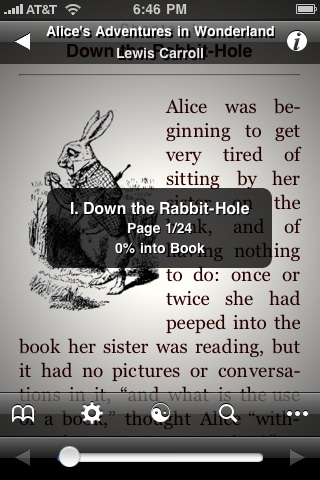
Whatever you use for books on your iPhone, there are plenty of free Gaskells available.  I use Stanza, which is a free app [there are many others – visit your iTunes store and search “books” under Apps and see what I mean!], and from there you can choose the following: Feedbooks has several; Project Gutenberg has the same as online noted above; but Munsey’s takes first prize for having the most – seems to have all the novels and stories as best I can make out – so if you are stranded at an airport or in stopped traffic, what better way to pass the time than a Gaskell short story?! 
 

Audiobooks:  

  1. Cousin Phillis (unabridged)
  2. Cranford (unabridged)
  3. North and South (abridged)
  4. North and South (unabridged)
  5. Wives and Daughters (unabridged)
  6. Wives and Daughters (abridged)
  • Silksounds:  has only My Lady Ludlow, read by Susannah York  [very good!]
  • CSA Word:  Best of Women’s Short Stories, vol. 1& 2.  Read by Harriet Walter [a.k.a. Fanny Dashwood] Includes Gaskell’s “Right at Last” and “The Half Brothers”; CSA Word also has an abridged version of Mary Barton [read by Maggie Ollerenshaw] and North and South [read by Jenny Agutter].
  • LibriVox:
  1. North & South
  2. Other Gaskell works in various states of completion 


Movies:
 [see the various blog posts listed below for movie reviews]

  1. Wives & Daughters (1999)
  2. North & South (2004) – with Richard Armitage and Daniela Denby-Ashe ~ sigh!
  3. North & South (1975)  – with Patrick Stewart and Rosalind Shanks
  4. Cranford (1972) 
  5. Cranford  / Return to Cranford (2007, 2009)
  6. Cousin Phillis (1982)
  7. The Gaskell Collection – DVDs  – includes 7 discs:  W&D, N&S, CRANFORD and all special features.

******************************* 

Well, there’s a fine list for winter reading, listening and viewing! And somewhere in the middle of all that, treat yourself to a re-watch of Armitage in North and South! [and then of course READ it again … here is a link to an older blog post about the book and movie

 ************************

This is a rather quick list of goodies – if any of you know of a particular edition of a book, or an ebook, or an audio edition you particularly like, or a movie that I do not mention, please let me know so I can add it to the list – thank you! 

Follow this link to to the next blog on the Elizabeth Gaskell Bicentenary Blog Tour by Tony Grant at London Calling:  Plymouth Grove – A Visit to Elizabeth Gaskell’s home in Manchester

***********************

The Gaskell Blog Tour:  Here is the complete tour through the 15 blog posts celebrating Gaskell’s Birthday today: and remember that one lucky commenter will win a copy of an unabridged edition of North and South by Naxos AudioBooks read by Clare Willie. That’s 18 hours of Margaret Hale and John Thornton sparring and sparking in Gaskell’s most acclaimed work.  Here is a list of participants. You can visit them in any order and all comments during the contest will count toward your chance to win. Good luck and Happy Birthday Mrs. Gaskell!

Biography

Novels/Biography

Novellas

Resources

Sometimes one likes foolish people for their folly, better than wise people for their wisdom.” Elizabeth Gaskell, Wives and Daughters

[Posted by Deb]
Fashion & Costume · Jane Austen · Movies · Social Life & Customs

Follow Friday ~ Fashion Exhibit at ‘Austenonly’

Well, this should be a “Follow Friday” but it’s already Saturday, so hopefully no one notices….

Please visit Austenonly for this ‘absolutely fabulous’ post:  Austen Attired: Marvellous Costume Exhibit at the Magnificent Peckover House where Julie shares pictures of the  costumes from various Austen TV and film adaptations currently on exhibit at the Peckover House in Wisbech.  For those of us unable to visit, we can be most grateful to Julie for this birdseye view of the many costumes, and to the National Trust for giving her permission to take the pictures.  A catalogue of the exhibition would be most welcome!

[wedding attire of Marianne and Colonel Brandon in S&S]

from the Austenonly website:  visit to see close-up details of these and many more fashions on display.

Jane Austen · Movies

Final Thoughts ~ Emma Part III

OK, I confess, I watched it again [remember our PBS here in Vermont showed the last episode LAST week right after Part II; this week our PBS re-ran Miss Austen Regrets] – but I did watch it again, just to be sure I hadn’t missed anything – they do take us on a rather quick ride from Box Hill to three marriages and Mr. Woodhouse’s fear of turkie robberies…

My major and final thought is “Thank you Jonny Lee Miller” – he redeemed this show in almost every way. And also with thanks to Sandy Welch who whacked the dialogue throughout to fit her own take on a 21st century Emma – but at least she left the proposal scene relatively intact, and despite THE KISS, it finished off quite nicely.

As mentioned above, this third part starts with Emma sitting with her father at Donwell Abbey – so nice to see the fine Donwell interior, and Emma’s unfaltering consideration of her father’s comfort. Mr. Knightley proud to bring Emma to his home, “the first time in eighteen months,” he tellingly points out. And there is a moment when he suggests to Emma that she looks almost the mistress of Donwell in her tender assistance to an “exhausted” Jane Fairfax. […more of those now obvious hints, but what is a screenwriter to do?].  Mr. Elton is seen dragging his darling wife to the Donwell strawberry picking on a donkey – seems a bit much for the local pastor but conveys all of their high-browed-ness in a few short minutes, Mrs. E. as per usual, “overly trimmed.”

We witness yet another spoiled-brat fit of Frank Churchill’s – the heat, the company, “sick of England,” all setting him off – but charmingly brought out of his bad humor by Emma, seen draping yet again all over the sofa. And then on to their scene at Box Hill – well done indeed! – [but really, would even the childish Emma and the anti-propriety Frank be so very bold in their display of affection at the picnic?! – I was embarrassed sitting in my own living room for this breach of 19th-century etiquette! – his head in her lap?! Yikes!- lavender water please…]

From here on, everything moves very quickly: Miss Bates of course is soundly insulted by Emma, and though a bit more morose than in other productions, the effects of this is well presented as all scatter to their separate corners of the hill, preferring solitude over such a gathering of mis-matched spirits. And here again, Mr. Knightley, all-seeing, performs his “badly done” absolutely perfectly – Emma seeing herself as others might see her for the first time, “anger against herself, mortification and deep concern,” the pivotal scene in the book, and here shown with Emma having what might be her first-ever sleepless night [lovely music here]… A visit the following day to Miss Bates, the farewell of Mr. Knightley with the attempted kiss to her hand [nicely done – an important scene…and glad this was not left out]; Mr. Woodhouse’s lament of “wanderlust” [I loved this!]; and then the news of Frank and Jane Fairfax, acquiring another “badly done indeed” from Emma, this scene also well done with Mr. Weston looking on, concern for Emma; a sort of bizarre set-piece with Frank and Jane kissing and dancing in the street; a few scenes with the perfectly cast John Knightleys worried about George’s bad humor; then the Harriet chat where Emma discovers to her horror that it is not Frank Churchill but MR. KNIGHTLEY that Harriet has been obsessing over, after which Emma really kicks her out of the house; and finally Emma’s wrenching monologue that it is “too late, too late” as she discovers her own heart after all….

All the above with the same wonderful decorations, gardens, fashions and food we have come to expect – and we are not disappointed – I am all forgiveness of nearly everything you see, because of all this loveliness – and also because they got the ending right, a very nice surprise, and with only a few caveats….

You all know [and I am almost sick of saying this myself] that Richard Armitage was born for this role of Mr. Knightley – so it took awhile for me to get over it [as well as Romola Garai’s eye-popping emotionals, but enough of that – she grows on you…] But Jonny Lee Miller pulled it off after all – nearly perfectly really – and this scene was given the time it needed [though why Emma had to be hiding behind a tree just added to her childishness – I thought she had perhaps grown up at this point?…] – my only real quibble with this whole proposal being so: in the book, Mr. Knightley, thinking that Emma is suffering the pangs of lost love over Frank Churchill, takes her arm [no contact in the movie and why not, I ask?]

 …till she found her arm drawn within his, and pressed against his heart and heard him thus saying, in a tone of great sensibility, speaking low, ‘Time my dearest Emma, time will heal the wound…’

And they continue to talk, until Knightley begins to say what in the movie is “his secret is out at least” in the book is “you will not ask me what is the point of envy” – Emma silences him and he says “I will obey you” and walks away [not so in the book – He is silenced “in deep mortification” – they walk to the house together and then take another turn when she wishes him to continue] – but here thankfully they keep most of the language. Either direct or in spirit:

          “As a friend!” repeated Mr. Knightley. “Emma, that I fear is a word — No, I have no wish — Stay, yes, why should I hesitate? I have gone too far already for concealment. Emma, I accept your offer, extraordinary as it may seem, I accept it, and refer myself to you as a friend. Tell me, then, have I no chance of ever succeeding?”
           He stopped in his earnestness to look the question, and the expression of his eyes overpowered her.
          “My dearest Emma,” said he, “for dearest you will always be, whatever the event of this hour’s conversation, my dearest, most beloved Emma — tell me at once. Say ‘No,’ if it is to be said.” She could really say nothing. “You are silent,” he cried, with great animation; “absolutely silent! at present I ask no more.”
           Emma was almost ready to sink under the agitation of this moment. The dread of being awakened from the happiest dream, was perhaps the most prominent feeling.
          “I cannot make speeches, Emma,” he soon resumed; and in a tone of such sincere, decided, intelligible tenderness as was tolerably convincing. “If I loved you less, I might be able to talk about it more. But you know what I am. You hear nothing but truth from me. I have blamed you, and lectured you, and you have borne it as no other woman in England would have borne it. Bear with the truths I would tell you now, dearest Emma, as well as you have borne with them. The manner, perhaps, may have as little to recommend them. God knows, I have been a very indifferent lover. But you understand me. Yes, you see, you understand my feelings — and will return them if you can. At present, I ask only to hear, once to hear your voice.”
[Emma, vol. III, ch.XIII]

Austen of course, gives her usual narrated proposal scene –

-What did she say? – Just what she ought, of course. A lady always does.-

We do get a little more here – a gentle, tender avowal of love and sealed with a kiss. Very nicely done, of course…and from here on in they only hold hands… And all ends with the news being broken to Mr. Woodhouse [Emma’s crying-jag scene, so much shown in the trailer, was blessedly short-lived and Mr. Knightley’s generosity of moving to Hartfield lovingly accepted]; Harriet and Robert Martin are united under the eye of Mr. Elton’s withering gaze; the turkies are thankfully “pilfered” and Emma and her Mr. Knightley ride off in a lovely carriage [holding hands] to their “ fortnight’s absence in a tour to the seaside”, ending thus gazing out to the sea, rather than with a wedding and the uninvited Mrs. Elton’s pronouncement on the “shabbiness” of the proceedings…

So the real test is will I buy the movie? – aah yes, I will, but then an Austen fan always does…

All the episodes of Emma will be available online through March 9, 2010 at the Masterpiece Classic website [lots of other great things there also!]

[Posted by Deb]

Jane Austen · Movies

More Random Thoughts ~ Emma Part II

Well, not sure what happened here Sunday night in the North Country, but my PBS-HD station played not only Episode II, but also Episode III! – This was not on the online schedule, but I went in to DVR the 9pm program and saw that the 10-11 slot also said “Masterpiece Classic” – I assumed it was a re-run, but the “info” button suggested the final episode – did anyone else have this delightful gift from PBS??  So that said, I am only going to share a few thoughts about the second show, those certainly being colored by the final chapter … especially by the filming of the pivotal scene at Box Hill.

 I agree with most everything that I said above:

The Good: the fabulous clothing, museum-like houses and their decorative accessories, the gardens, the ornate flower arrangements, the finely-done cinematography, the music, and most of the characters with noted caveats [see more below]…

The Bad, but not so bad really: the language is still off, so forgetting largely that this is set in the early 19th century, we have 21st century teenagers who like to dress up – sort of a Regency House Party rather than authentic Austen with people who couldn’t remember their lines… … but enjoyable anyway. I am, you may have noticed, not a purist in the sense of everything must be Austen or relegated to the trash bin – the spirit of Austen is here in so many ways, and coupled with great views, and a liveliness that cannot help but draw you in…

So the Good, the Bad, and thankfully nothing ugly… but some new scenes, new characters, and new suggested plot lines to be explored:

Characters:

Mrs. Elton and Mr. Elton – Christina Cole brings the right amount of snobbishness, status-obsession, and manipulative machinations as Austen created her – she is sufficiently overdone in manner and clothing [though she “dislikes being overtrimmed”, this said while verily dripping in ribbons and yellow feathers], and seems the perfect match for Mr. Elton, who appears more foppish than ever… what a pair! I am glad they found each other and spared others such a match.  And nice to see Mr. Elton actually preaching a sermon, the serious and obviously-needed-in-Highbury “let deceitful lips be dumb” … [I did however find Mrs. Elton’s ridiculous curls more appropriate for her rather than Harriet, whose hair continues to be all wrong for the character, despite liking this Harriet in every other sense…]

We see more of Frank Churchill [not quite right for the part and I am not sure why – should he have been more dashing and elegant? rather than so hyper-active and immature, one minute dancing around, the next sulking like a spoiled brat – is this maybe more true to what Austen wrote? [I need to re-read the book yet again on this one!]- I do wonder though why he felt the need to fling himself off his horse on each dismount – quite funny really!

Jane Fairfax is all wrong – she looks and acts like a waif about to fall into a swoon and drift away – she IS supposed to be more lovely than Emma, strikingly handsome, albeit a little pale, accomplished in all things; I could see Mr. Knightley more interested in Harriet Smith than this Jane…so this key part of the plot seems to fall flat…

Miss Bates just doesn’t get enough screen time to give us more of her comedic babbling… Tamsin Greig is currently the star in the London play, The Little Dog Laughed, where evidently she is stealing the show with her humor – more of that needed here perhaps?

Emma’s eyes continue to pop and bulge at every possible moment of surprise, awe, sadness, anger, concern, fear – but Romala Garai is growing on me – the further I move away from the Emma “as she was wrote,” I begin to find this almost child-like Emma endearing – but I do hope she grows up some in Episode III…or Knightley just might rightly decide to stay in London…  One plus, the male narrator who speaks in the first part seems to have been fired after all, and we do hear Emma’s thoughts as she begins to doubt her own long-held belief that she knows EVERYTHING – her reasoning that this lethargy and listlessness MUST be the love of Frank Churchill begins her much-needed introspection – she IS hopefully growing up… [her absolute hissy-fit when she walks home from Mrs. Elton’s, raging about her calling him “Knightley” is spot-on:

“Insufferable woman!” was her immediate exclamation. “Worse than I had supposed. Absolutely insufferable! Knightley! I could not have believed it. Knightley! never seen him in her life before, and call him Knightley! and discover that he is a gentleman! A little upstart, vulgar being, with her Mr. E., and her caro sposo, and her resources, and all her airs of pert pretension and under-bred finery. Actually to discover that Mr. Knightley is a gentleman! I doubt whether he will return the compliment, and discover her to be a lady. I could not have believed it!

[Emma, vol. II, ch 32]  – this is Emma in teenage mode – and funny – the first time I think she sees Knightley as someone other than her father’s daily visitor, someone who other people relate to, have thoughts about… and Emma does not like it. Well done in the movie!

Mr. Knightley also continues to improve for me – Miller’s furrowed brow, his vigilant observation of everything going on around him, his good sense and steady presence serves to act as a foil to this Emma who is in such need of his good guidance. And this is countered with Knightley’s apparent change in feelings toward Emma – a shift in his own world that unnerves him, he often looking quite grave – this of course not so clearly shown in the book [but there if you are looking for the clues!] – so though some of the “mystery” of Emma is lost in these glimpses into Mr. Knightley’s feelings – it does make it so clear that they must and will end up together…

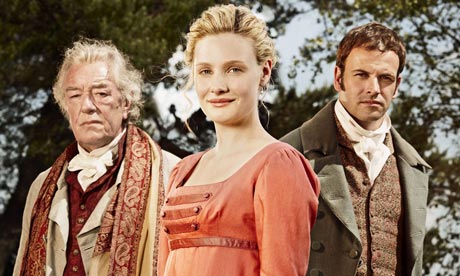
 Emma [Garai] & Mr. Knightley [Miller]

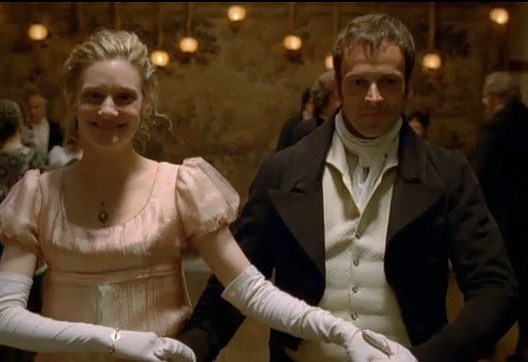
The Dance is fabulous! – the extravagant fashions [Emma’s dress is so lovely!] – the bouncing jaunty hand-clapping country dances are just great fun; the Harriet as wallflower / Mr. Elton snub, with Mr. Knightley to the rescue rightly sets Emma on the path to seeing him in a different light – and their dance together is, as in all the Austen adaptations, such a turning point in the story [recall the 1995 P&P Elizabeth and Darcy dance; the 2005 same scene where all disappears as Elizabeth and Darcy focus only on each other] – the dance in the 18th-19th century was the only way men and women could flirt, touch, and get to know each other – and here it seems is the first time that Knightley and Emma actually do connect in this way – the feelings of both undergoing some fundamental change. But major complaint here! – one of the most telling lines in the book is when Emma suggests Mr. Knightley dance with her:

Emma was extremely gratified. – They were interrupted by the bustle of Mr. Weston calling on every body to begin dancing again.
“Come Miss Woodhouse, Miss Otway, Miss Fairfax, what are you all doing? -Come Emma, set your companions the example. Every body is lazy! Every body is asleep!”
“I am ready,” said Emma, “whenever I am wanted.”
“Whom are you going to dance with?” asked Mr. Knightley.
She hesitated a moment, and then replied, “With you, if you will ask me.”
“Will you?” said he, offering his hand.
“Indeed I will. You have shown that you can dance, and you know we are not really so much brother and sister as to make it at all improper.”
“Brother and sister! no, indeed.”

[Emma, vol. III, ch, 38, p. 332] – a prime piece of dialogue and should have been included…

I am feeling like Mr. Woodhouse is not in the movie enough, so does not show this very generous and compassionate side of Emma [but just as I was thinking this – Part III starts with such a scene – so ok after all…I will say no more].  Also I did check about the John Knightleys – they indeed do have FIVE children: Henry, John, Bella, George, and Emma.

One other scene that is changed from the book is at the beginning of Part II – [vol. II, ch. 10, 244 ff] Mr. Knightley is called in from the street by Miss Bates to visit them – he is ready to do so until Miss Bates tells him Frank Churchill is there as well – he immediately changes his mind and raises his voice for all to hear his comments about Jane Fairfax – in the movie he comes in – a fine difference, but a telling point in this change of Knightley’s feelings toward Emma.

Laura Linney begins this second episode suggesting that Jane Austen’s works might be considered “too ordinary and narrow” for today’s world of super-human action stories the likes of Spiderman and the extremes of techno-thrillers and special effects – what can Austen give us in this non-magical world of Emma Woodhouse? She concludes that we are given a view into the world of people who are really just like you and me – the steady ones, the loving, the amusing, the annoying, the manipulating and greedy, all the believable characters that make up our daily lives – Emma is an “authentic human being” says Linney, who with an over-developed sense of her own importance has created quite the mess. We see her grow and become aware and realize that she does live in a very closed world and that perhaps her ideas are limited – I am enjoying seeing her come to these realizations, her blinders slowing slipping away, extravagant eye-popping or not! – and there are still those lovely costumes and decorating ideas to ponder…

The Masterpiece website for all things Emma; you can also watch the first two episodes online until March 9th here.

Stay tuned for Part III…

[photo from Costume Drama Reviews]

[Posted by Deb]

Jane Austen · Movies

Random Thoughts on the Masterpiece ‘Emma’

So, some VERY random thoughts – no time really to actually write anything, but figure this is better than nothing…[maybe…] – no pictures either… [ok, maybe one…]

First, I had the opportunity to watch this new Emma when it first came out – decided against viewing it on my computer screen, as I figured the best part of it would likely be the settings, so very glad I was patient [I am not known for my patience…] and I dutifully watched Part I last night.  It did not disappoint, either in the above-mentioned setting category, or in the expectation – long gleened from the various other reviews out there – that this was not an Emma of the early 19th century, but rather some 21st century rendition of how Austen might translate her own work to be understood by the watching masses… so here are my random thoughts:

The Past:  the whole movie starts with a rapid foray into the past to see how Emma’s mother dies [did we really need to see her in her coffin?]; how she and her sister are raised by the lovely Miss Taylor, and coddled and over-protected by their father; how little Frank Churchill is sadly sent off to live with his aunt; how John Knightley and Isabella are seen in a pre-marriage cavorting about in the garden while Emma and George [and we learn his name right at the beginning] look on; how Emma puts Miss Taylor and Mr. Weston together under an umbrella where love blooms; and FINALLY we get to the beginning of the book where the marriage has just taken place… none of this is in the book, only inferred, but its sets the story in time and place and we now know all… this is all necessary I suppose for those who have not read the book [to which I say, GO READ THE BOOK…]

The Fashions are to die for, and I like that Emma actually wears the same dress on different days, albeit with some ribbon-changing  – I especially liked the turquoise – just lovely… I liked all the clothing, even Mr. Martin had on a fine pair of pants and boots…Mr. Knightley of course looked fabulous…

The Houses, exterior and interior are absolutely superb – I have a gold damask Chippendale sofa in my living room and thus was especially pleased to see several of them scattered about.  I wanted to pause each frame and take notes.  I want to go on a tour of the actual houses – but now unfortunately I want redecorate my whole house, and this will not do [or so my husband informs me…]… Donwell Abbey was a treat to see – a tad forbidding – no wonder Mr. Knightley puts his coat on every day, opens the door, takes in a breath of fresh air, puts on his hat, and heads over to the Woodhouses.  And I liked the “Sed Semper Amico” over his inner door – seems to mean “but always for a friend” and was often on the entryways of country houses [and why does Google Translator not offer LATIN as a translation option?]

The Gardens – perfect specimens –  Mr. Ripton would be pleased – again, I want to freeze-frame them all, especially those at Hartfield – and thus need also to redo my gardens once they are uncovered of snow…

The Carriages, Horses: again, a visual feast – one thought is that Mr. Elton seems to be on his horse a lot… but rightly so, Mr. Knightley rarely uses his carriage…

The Town – it was nice to see the very real dirty streets – complete with horse pooh and working men – that said, it still seemed a bit manicured and one could almost imagine the camera men off to the side – but the pooh was a nice touch…

The Narrator: not sure why Miss Austen’s all-seeing narrator [who is obviously female] wasn’t hired for the job, but we seem to have a man’s voiceover that sounds suspiciously like Mr. Knightley, which sort of skews the content a bit [like who actually knows any of the upcoming “secrets”?]

The Language – well, this is the kicker really – now we know for sure we are in the 21st century with a group of people who just like to dress up funny – I thought for awhile that since it is so visually beautiful and as I do know the story after all, that I could just sit there for the two hours and watch – no sound…

The Music – well, I liked this – it added to the comic effect… can’t wait for the dancing part….

Production discrepancies:  there is snow all over Highbury on Christmas Eve, but all is green when Emma next visits Harriet only a few days later at Miss Goddards [I confess I need to check how much later she does this…] – there are likely more but I did not dwell on this…

Characters:

 Mr. Woodhouse – Michael Gambon a delight! – though he did indeed look a tad TOO hardy, it really just added to the humor of his being so obsessed with his body – I did, however, have a few fears that he might choke on all those scarves and shawls hanging about him…

Miss Bates – too early to tell anything about her, so I await Part II to decide.  She is certainly not as silly as the Paltrow version [though I liked Sophie Thompson in this very much – she gave her Miss Bates a poignancy that rang true to Austen’s text] –  the emphasis here seems to be more pathetic than comic.  And I was appalled at the scene where she leaves Hartfield pushing her mother in a wheelchair down the road – surely even the self-absorbed Emma would not have just waved goodbye and turned into her house! – this doesn’t bode well for Box Hill…
Miss Taylor / Mrs. Weston – I love Johdi May [she is brilliant in both Daniel Deronda and The Mayor of Casterbridge], but she seems wasted here, with just a few scenes of her knowing smirks and smiles – but she has several lovely outfits… [oh, and Mr. Weston seems a fine fellow…]
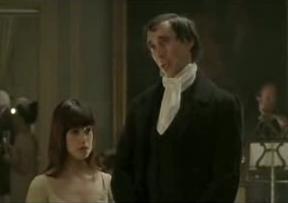
Frank Churchill – Rupert Evans is great so far – but not enough to judge by yet.  I do wonder why they had to put that scene in there of his meeting Emma on the road – it adds too soon to the watcher that he is not all that he seems, and unnecessary to the tale…

The John Knightleys – they seem to be well drawn in their small roles to convey the basics of their characters, so well-done on this score [I need to look again – do they have FIVE children??]

Robert Martin – he is physically perfect for the role – so this works too…

Harriet Smith – much better than in previous Emmas – Louise Dylan’s Harriet is not such a blank slate, just very sweet and indecisive and all obliging, with way too many curls.  The scene of her portrait painting is hysterical…

Mr. Elton – with his rather odd over attachment to his horse, Blake Ritson nails the simpering, over-zealous, pompous Mr. Elton perfectly – he just slithers onto the screen! – loved the coach scene – look forward to his return to Highbury with his £20,000 wife next week [and if anyone is getting their Austen confused at this point, it is likely because we have TWO Edmund Bertrams in this Emma – Ritson and Miller both have portrayed Austen’s least-likely (or is that least-liked) hero on the screen …]

Mr. Knightley – ok, the one you have been waiting for… I still cannot let go of my wish for Richard Armitage in this role – now lost forever in screen history as who knows when the next Emma will be made [perhaps he can play Mr. Woodhouse in a few years?] – but once I got into the swing of this 21st century Emma, I see that Jonny Lee Miller passes muster in this role – more like a big affectionate brother, always correcting, the great overseer, a pleasant sort of fellow, but not the Knightley [Knightley, she calls him Knightley!] on the page, who is much more austere and mature and distant.  But since they changed the story to the extent they have, Miller works for me – will see about next week, as I hear he gets better…

Emma – drum roll please: aahh! Emma – can anyone get this right?? Austen could not have imagined a world filled with moving pictures trying desperately to put her enigmatic Emma to a visual test…can’t be done I think…. So we have Romola Garai, like Miller, playing this role exactly as the writer [not Austen] and director wanted her to be – i.e. an early 19th century woman, dressed appropriately but acting like a 21st century teenager [and Emma is NOT a teenager] – the intention stated early on that this movie is to bring in another generation of watchers [and hopefully readers] – so Emma is annoying – she is playful to be sure, but rarely acts like the lady she is, always sort of draping herself over the furniture – I had difficulty with Garai in Daniel Deronda – she kept stooping forward and turning her head in the oddest way – and here, she seems to be suffering from a nervous “tic” of some sort, with these bizarre facial expressions that would have been unseemly in a time where one kept these personal feelings to themselves, certainly not baring them openly for all to see.  But again, if I step back from the page and just accept what is on the screen, she is endearing enough I suppose…. More thoughts on her after Part II airs…

So my final grade? – oh, I am afraid I am much too easy, despite my dislike of all this Austen stuff that isn’t Austen at all, I think I just know that a film of any Austen will not work to our satisfaction [recall the brouhaha after the 2005 P&P!] – so I will just sit back and enjoy this visual feast, hone my decorating and fashion skills, and go to bed early and re-read the real thing…

 what are some of YOUR random thoughts?

[Posted by Deb]

ps – oh dear, I completely forgot Jane Fairfax! a bit of a mouse really, that’s why – more after Part II… [lovely voice though…]

ps2 – completely forgot to comment on the cinematography, which, like all the settings was first rate and really makes the film.  The scene with Emma at the window looking back at her past imagining herself and her sister playing in the hallway, juxtaposed with the scene in the window of Mr. Knightley jaunting his way down the path to visit is a beautiful frame – though this does imply her future and thus gives away the plot – but since all the secrets have been mostly let out of the bag, I suppose we can just enjoy its loveliness?