Gentle Readers: Today I welcome Tony Grant as he writes about his visit this week to the “EMMA 200” exhibit at Chawton House Library, he being my feet on the ground so to speak as I am woefully not able to be there myself. Hope those of you who are able to go will do so – and send me pictures and your thoughts when you do!
[Update: please read Tony Grant’s post about walking around Chawton at the “Jane Austen’s World” Blog]
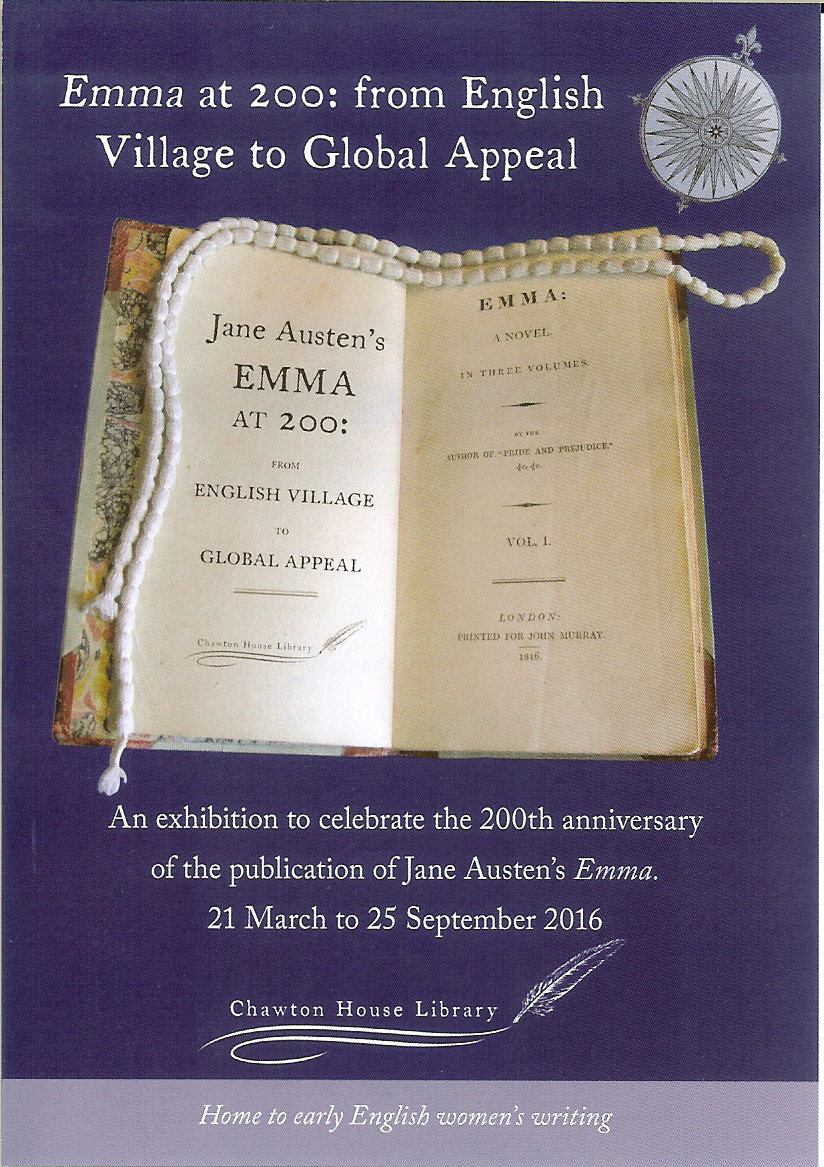
EMMA 200: English Village to Global Appeal
(Chawton House Library 21st March – 25th September 2016)
On Wednesday 20th April I drove from Wimbledon to Chawton in Hampshire over the Hogs Back with views stretching across Surrey into the distance. It was a bright sunny day and seeing the Surrey countryside green and pleasant and shining in the bright sunshine under blue skies was appropriate for my adventure. I was driving to Chawton House Library to visit the “Emma 200 exhibition.” Emma is Jane Austen’s Surrey novel and this year is the 200th anniversary of its publication and it is entirely set within that county.
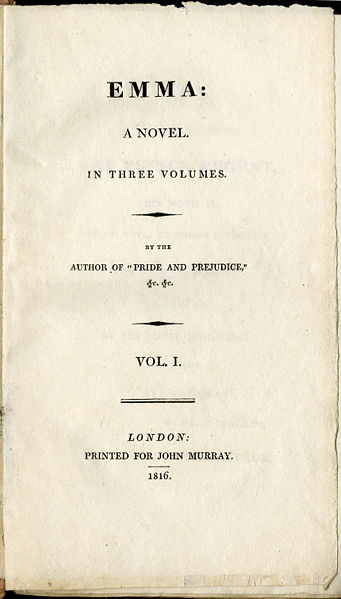
Emma was published by John Murray II of Albemarle Street on the 23rd December 1815, although its title page reads 1816. This exhibition has items from Chawton House’s own collection and from the Knight family collection, as well as other items on loan. The exhibition covers the reception of Emma through the nineteenth, twentieth and twenty first centuries; it also considers the country setting of the novel and the places that were possible influences. It covers the global appeal of Emma. It has a large section about John Murray II and nineteenth century publishing practices through letters and comments made by Jane herself and fellow authoresses also published by Murray. It highlights authors mentioned in the novel and nineteenth century ideas about female accomplishments such as music, embroidery and painting. It shows the connection with Shakespeare and has a section about the reception of the novel. In particular, there is a letter written by Charlotte Bronte to her own publisher, W.S. Williams, discussing her thoughts about Emma and Jane Austen as a writer.
I arrived at the electronically operated gates early. The house opens at 1.30pm Monday to Friday. I was there promptly at 1.10pm. I decided to have a look around and inside of St Nicholas Church nearby, which is Chawton’s parish church and where Jane Austen and her family worshipped. The church we see today is not the church Jane knew. There was a fire sometime after Jane’s death and it had to be rebuilt, though some of the structure from the church that Jane knew remains. I read the memorials to the Austens and Knights within and then went round to the back of the church through an arbor of dark and gloomy ancient yew trees to see the side-by-side graves of Austen’s sister, Cassandra Elizabeth Austen, and mother, Cassandra Austen.
**************
Chawton House Library
It was such a nice day and I still had about ten minutes left so I sat on a stone bollard near the entrance gate and watched a gentleman sitting on a motor mower mowing the grass verges along the drive. As I sat there I noticed a smartly dressed lady leaving the front entrance of the great house with a dog on a lead. She approached the gate and opened it, placing a notice board on a stand giving the times and prices of entry. I asked jokingly if this meant I can go in. I pointed out it was still ten minutes to half past. She laughed and said by the time I walked up the driveway I should arrive at the door on time. “Just knock and they will let you in,” she told me. I knocked on the door with five minutes to and it was immediately opened by a smiling lady who ushered me in. The house is staffed by volunteers except in the kitchens where the official housekeeper keeps her domain but more about that nice lady later. I found everybody so enthusiastic and full of smiles and really, extremely welcoming. I paid my entrance fee and one lady took me into the great hall on the left of the entrance and showed me a map of the house with the route marked by numbered rooms. It is a self-guided tour so I was given the map to hold as I went round. There are volunteers in every room who you can talk to and ask information of.
**************
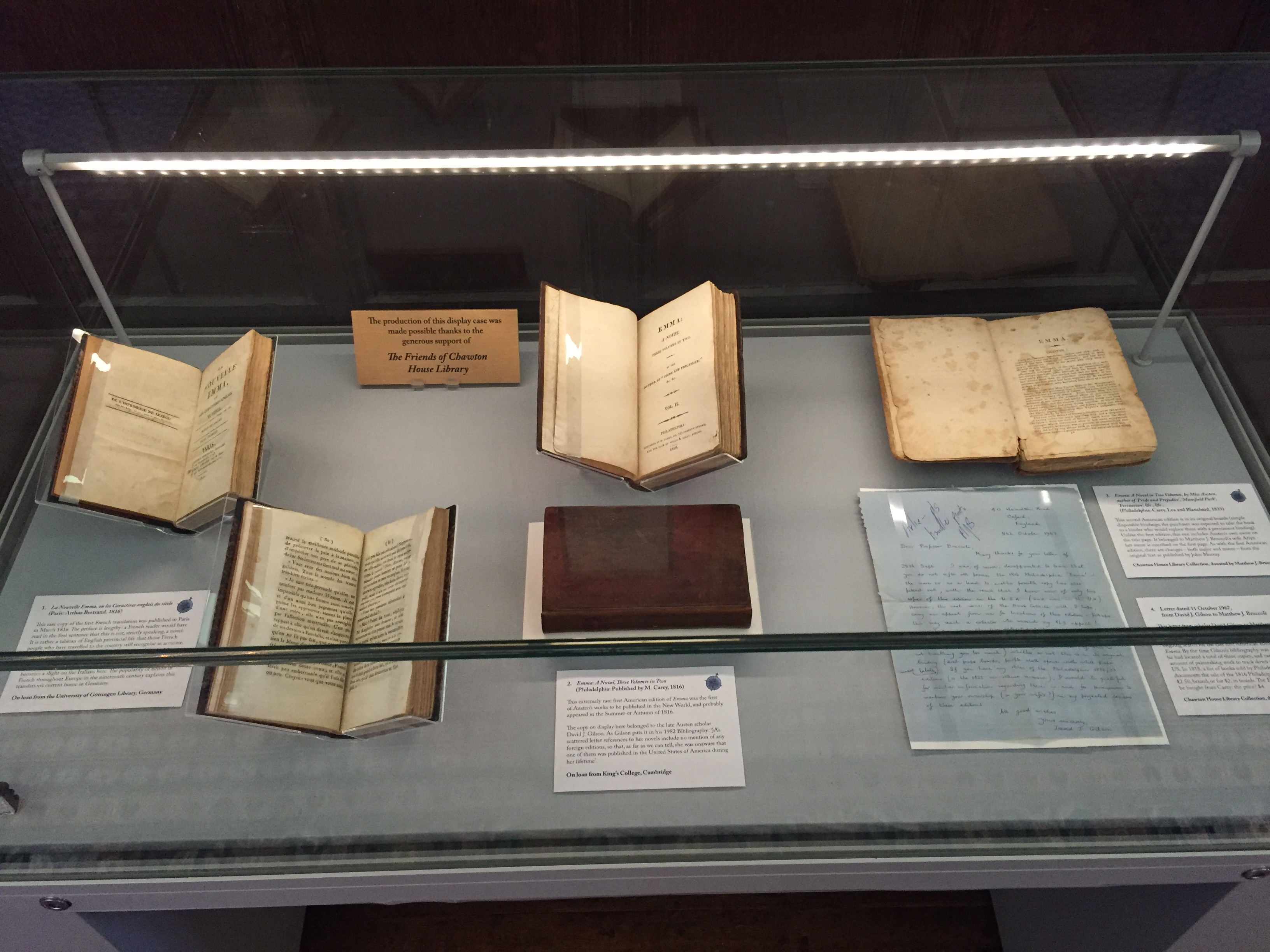
The exhibition began in the great hall. A glass case displays some first editions dated 1816. There was an edition in French as well as one published by Mathew Carey a publisher in Philadelphia. Somehow Carey had read Sir Walter Scott’s review of Emma and obviously liked it. He sold his version at a much cheaper price than John Murray’s London version. He produced a card backed version printed on cheap paper for $2. Murray’s London version, which was a much better quality, was twice the price. Very few American first editions have survived as a consequence of the poorer quality and the copy in this exhibition shows signs of much yellowing of the paper and black mold spots. It looks an inferior book to both the French and English versions. I felt honoured to able to lean over the glass case and read the opening few lines of the Murray edition.
“Emma Woodhouse, handsome, clever, and rich, with a comfortable home and happy disposition, seemed to unite some of the best blessings of existence:…”
There were no such things as copyright laws in those days and both the French and American versions, probably unknown to Jane Austen, brought her no income. Later in the nineteenth century Dickens went over to America and tried to do something about copyright laws in America but to no avail and to his great consternation. The fact that copies of Emma were being published abroad within the first year of its initial publication in England tells us something about publishing and the book trade at the time. Money could be made from books.
Emma 1st ed.
Dedication page
*****************
John Murray – NPG (Wikipedia)
John Murray II was the head of the foremost publishing company in Britain. He was a hard headed business man and if he could get an advantage, especially, it seems over the authors he published he would. I think Jane Austen had the measure of him. Her brother Henry who had dealt with publishers for Jane initially became ill and Jane took over negotiations with Murray herself. She was very direct and firm in her dealings. She said of Murray, “He is a Rogue, but a civil one.” In corresponding with Murray over the publication of Emma, for instance, on 3rd of November 1815, a month before the publication of Emma, she writes,
“…I am at the same time desirous of coming to some decision on the affair in question, I must request the favour of you to call on me here, on any day after the present that may suit you best, at any hour in the evening, or any in the morning except from eleven to one. – A short conversation may perhaps do more than much writing.”
It sounds as though Murray has been given his marching orders and she isn’t going to have any truck with being messed about. She is firm but polite with the “Rogue.” She knows the power of a face to face encounter. Some of her contemporaries were perhaps not quite so strong with Murray but learned a lesson.
Domestic Cookery, 1813 ed (Wikipedia)
One of the exhibits on display, putting Jane Austen’s publishing experiences with Murray in context, is a book called Domestic Cookery, published by Murray in 1806. It was very popular and made a lot of sales and presumably a lot of money for Murray. It was written by Maria Rundell. Rundell had been paid £150 by Murray. She regarded Murray as a friend but she was not aware at first that her book had become such a bestseller. When she found out she felt that Murray was not upholding the copyright agreement he had with her. Eventually Murray paid her £2100 but kept the right to continue publishing the book himself. Jane Austen’s comments about him being “a rogue but a civil one” come to mind. Murray was obviously a very astute business man and could make money from trouble.
Another exhibit displays copies of books written by the French authoress, Germaine de Stael. She wrote books about Rousseau, Revolutionary Politics and Marie Antoinette’s trial. She was virtually banned by Napoleon Bonaparte. He had her book, De L’Allemagne pulped. Murray saw a chance. He took her on. In 1813 he used three printers to publish the French original and English translations simultaneously. He relied on anti-French feelings to make Stael’s books best sellers.
Madame_de_Staël (Wikipedia)
Jane Austen had her critics who made both good and not so good comments about her work. She took notice of what people said about her books and noted down these various opinions. Sir Walter Scott, her illustrious contemporary, who was also published by John Murray, wrote of Emma,
“We bestow no mean compliment on the author of Emma, when we say that keeping close to common incidents, and to such characters that occupy the ordinary walks of life, she has produced sketches of such spirit and originality that we never miss the excitation which depends upon a narrative of uncommon events, arising from the consideration of minds, manners and sentiments greatly above our own.”
Sir Walter Scott (Wikipedia)
It appears that Murray regularly sent copies of newly published books to other writers he published for their comments. This can be seen as eliciting positive comments from people who wanted to keep in with Murray. Jane Austen mentions in her letters to Murray how thankful she is for the copy of Waterloo he sent her to read and actually asks him if he has any more she can have a look at. This suggests she knows how to play the publishing game. She is as astute as Murray himself it seems. In one way Scott’s positive comments could be read as keeping in with Murray. If Murray and his publishing house does well and sells lots of books it can only benefit himself after all, but there is more to Scott’s review. I think he has recognized what is original in her writing. She is a realist. Her style is about everyday common occurrences and everyday people and she makes them heroic. People reading Jane Austen can see themselves and people they know in her writing. It is said that reading a novel is good emotional and psychological therapy, and Austen hit a powerful vein.
Charlotte Bronte (Wikipedia)
The highlight of the whole exhibition for me, even more so than seeing and reading a first edition, is the actual letter Charlotte Bronte wrote to her publisher, W.S. Williams, on April 12, 1850, in which she writes a lengthy paragraph about her thoughts on Jane Austen and Emma. I found it easy to read Bronte’s small, thin, precise handwriting that flows clearly across the page.
“I have likewise read one of Miss Austen’s works—Emma—read it with interest and with just the degree of admiration which Miss Austen herself would have thought sensible and suitable. Anything like warmth or enthusiasm—anything energetic, poignant, heart-felt is utterly out of place in commending these works: all such demonstration the authoress would have met with a well-bred sneer, would have calmly scorned as outré and extravagant. She does her business of delineating the surface of the lives of genteel English people curiously well. There is a Chinese fidelity, a miniature delicacy in the painting. She ruffles her reader by nothing vehement, disturbs him by nothing profound. The passions are perfectly unknown to her; she rejects even a speaking acquaintance with that stormy sisterhood…”
Bronte continues:
“What sees keenly, speaks aptly, moves flexibly, it suits her to study; but what throbs fast and full, though hidden, what the blood rushes through, what is the unseen seat of life and the sentient target of death—this Miss Austen ignores. “
And she goes on. Charlotte Bronte is actually agreeing with Scott’s comments when he describes her writing as
“……close to common incidents, and to such characters that occupy the ordinary walks of life”
The difference is that Scott makes his view a positive while Bronte makes her view a negative. I agree with what she says. Austen writes about the ordinary. Bronte on the other hand and her sisters wrote about,
“what throbs fast and full, though hidden, what the blood rushes through, what is the unseen seat of life and the sentient target of death”
Charlotte Bronte is actually describing the differences between their two styles. I have read articles published on some blogs where the writer tries to pit Charlotte Bronte against Jane Austen. Who do you like the best? Who do you think is the better writer? And so on. These are a childish approach to comparing two great writers. Two geniuses. Their styles are different. Every one of us reads different types of books for different reasons at different times to fit, very often , our different moods. We can read a poem by Wordsworth one day and on other days a romantic comedy, a ghost story, a swashbuckling adventure, a horror story or maybe a present day thriller. We can enjoy each genre for what it is and what it brings to us. Austen and Bronte are not enemies, they are not one better than the other. They are different and we can enjoy both. I can imagine how Bronte could be critical. She had a harder life than Jane Austen. Her novels and those of her sisters, were full of passion and deep feelings and filled with great moral uncertainties testing the moral status quo to the limit. Their ideas made their lives worth living and helped them live their short lives with feeling. Jane Austen had a much easier existence. I can see how Charlotte Bronte might not understand Austen’s standpoint. She probably could not bear to live the way Austen’s characters are portrayed. However, we can love them both.
The exhibition demonstrates many of the influences Jane Austen might have used in her writing of Emma. There is the suggestion, for instance, that the fictional places Highbury and Hartfield in Emma are modelled on Chawton and the local town Alton. These are in Hampshire but the novel is set in Surrey. Others I know would not agree. Some say Leatherhead in Surrey, which is near Box Hill, a major location in the book. Others suggest Highbury is a generic English village, and I think this more likely.
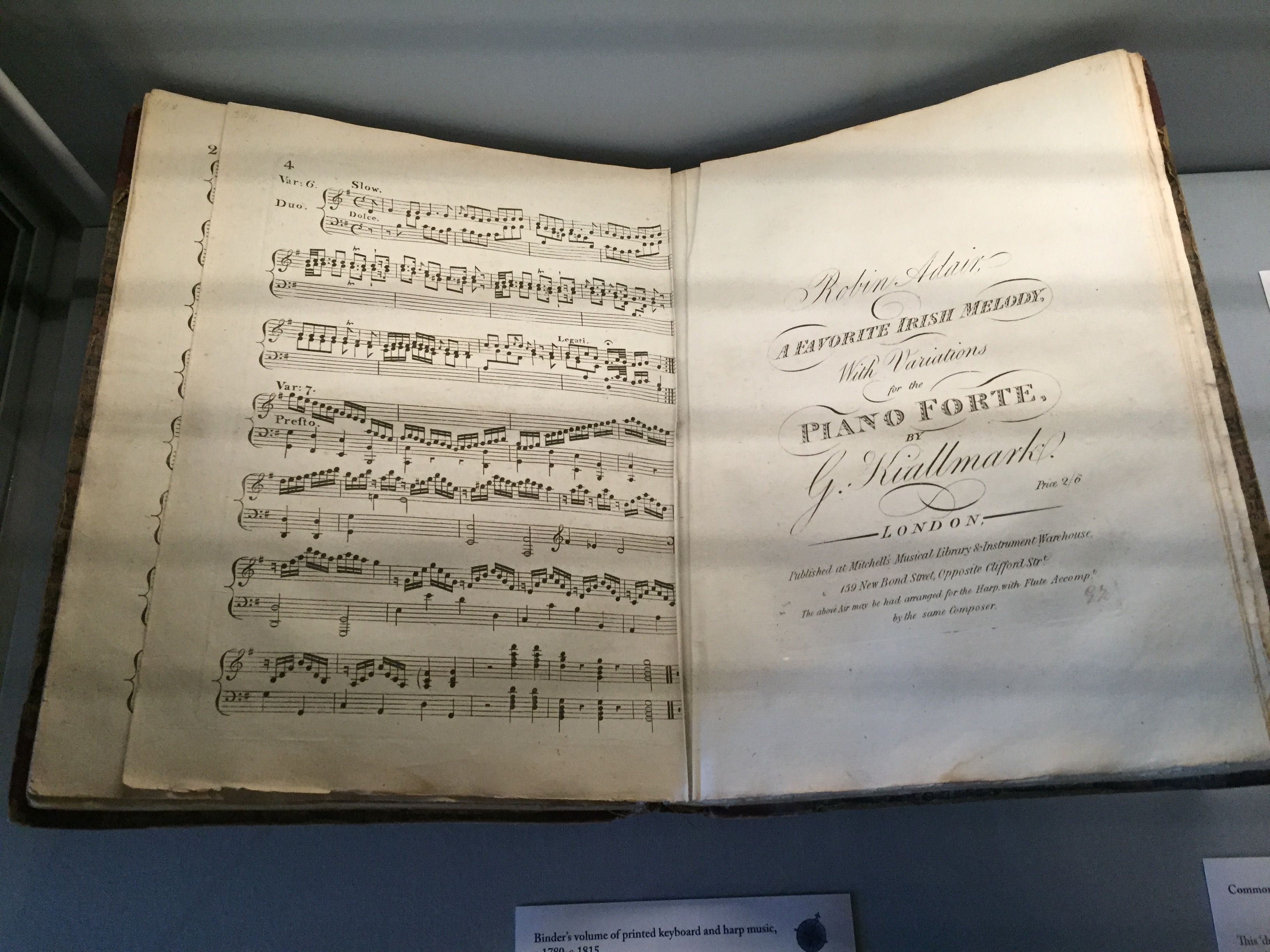
In Emma Jane Fairfax plays a tune called “Robin Adair” on the newly arrived pianoforte. There is on display a copy of “Binder’s volume of printed keyboard and harp music, 1780-1815,” annotated and autographed by Jane’s sister Cassandra. It includes the music to “Robin Adair.” [Ed. You can read this online here: https://archive.org/details/austen1677439-2001 ]
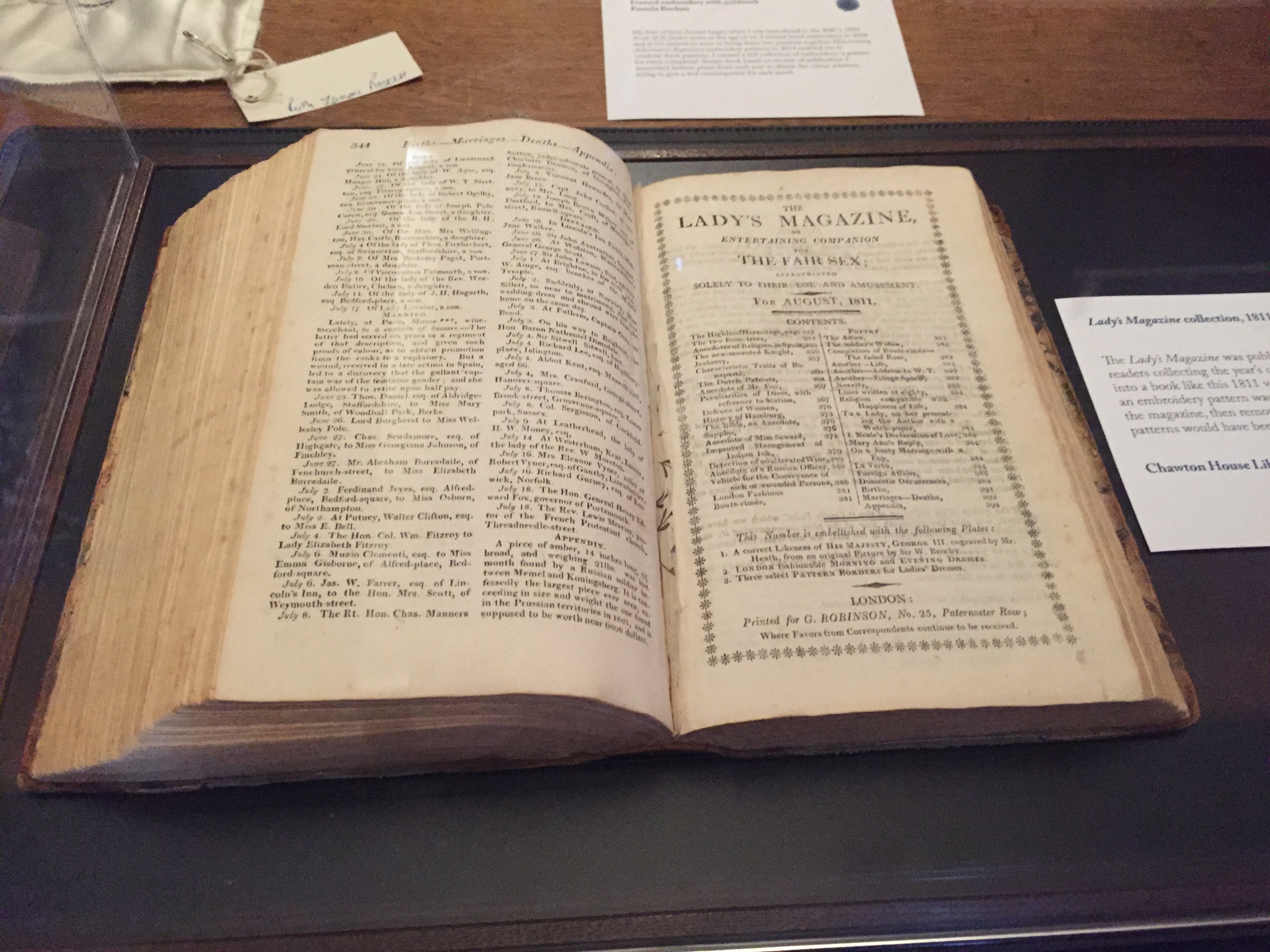
There is a bound set of The Ladies Magazine (1770-1832) which provides sewing patterns for young ladies. It is the sort of magazine that Jane Austen had access too. In Emma, sewing and painting are pastimes for young ladies.
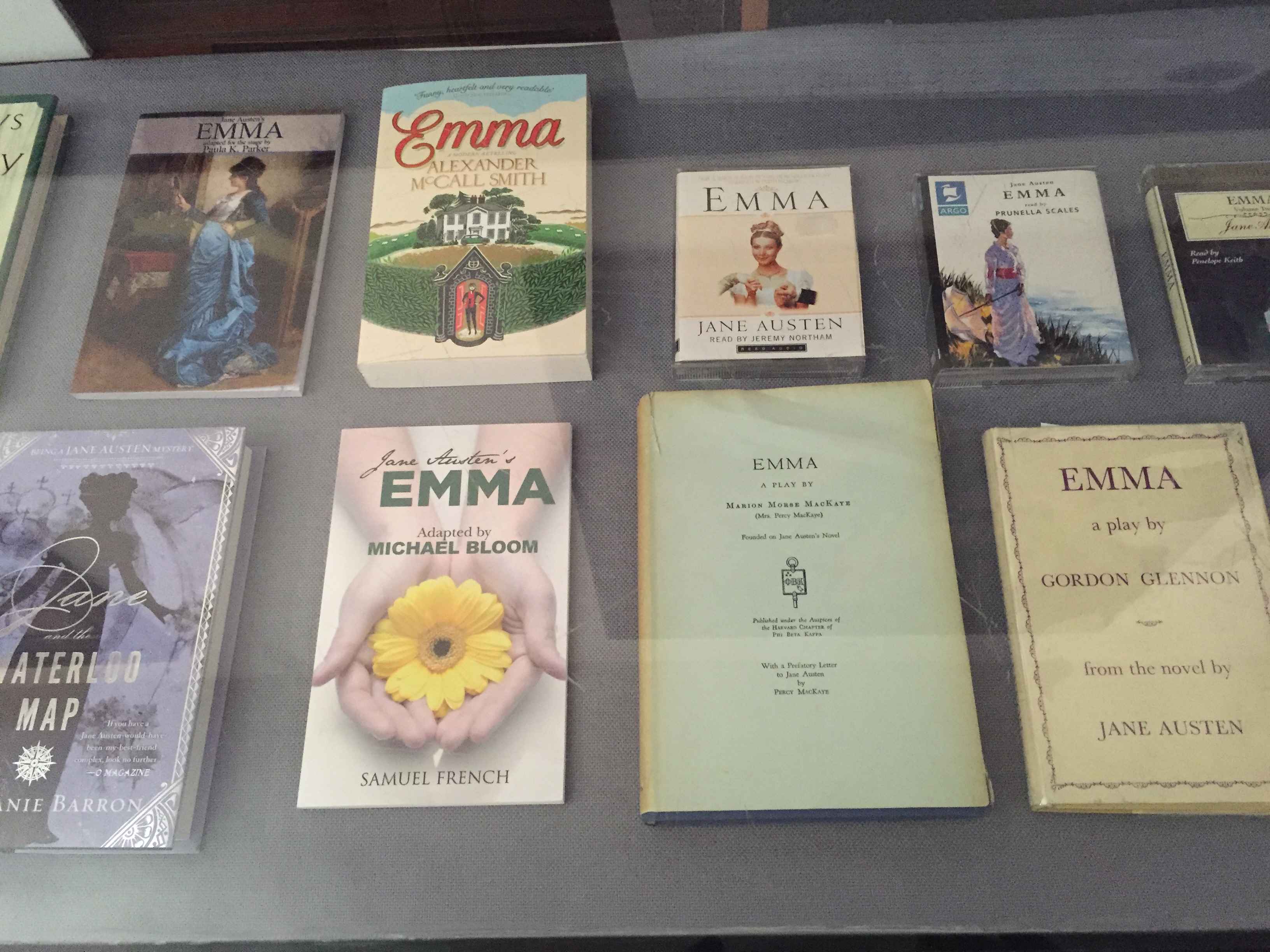
A final display cabinet shows the influences that Emma has had on culture over the centuries. There are various spin-off novels, including the latest modern version of Emma written by Alexander McCall Smith. There are play scripts written by various playwrights turning Emma into a stage version. These include plays by Gordon Glennan and Marion MacKaye. There are a number of radio adaptations. One read by Prunella Scales, another by Jeremy Northam. There are the film versions and the films influenced by Emma such as Clueless set in modern times. Spin-off novels are represented by a copy of the latest Stephanie Barron mystery The Waterloo Map. [Ed. Note that this latest Barron mystery has Jane visiting Carlton House where she meets with the Prince Regent’s Librarian – this all really took place on 13 November 1815; he “suggests” that she dedicate her newest book, Emma, to the Prince Regent – Barron has her also coming upon a dead body in the Library…]
****************
The exhibition is definitely worth seeing and just as much is the opportunity to walk around Chawton House where Jane Austen herself and her family lived and breathed. I also took the opportunity to take a walk in the gardens. I came across a snake lying across my path as I walked up to the walled gardens. I must tell you that in all my life I only recall seeing two other snakes in Britain in the wild. This was a grass snake and was totally harmless. The adder is the only poisonous snake in Britain and they are very shy creatures. I think I saw one once in the New Forest.
*************
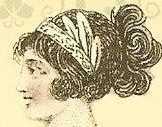
“Portrait of a Lady” at CHL
The people who volunteer at Chawton are wonderful. They want to talk to you and tell you things. I had a very amusing moment with an elderly gentleman volunteer at the top of the great staircase. He was sitting on the landing. When I approached he showed me an information leaflet and we discussed its contents. One thing it mentioned was the original William Morris wallpaper. I looked around and couldn’t see any. “Well, then where’s the wallpaper?” I joked. He laughed and said “come with me.” We walked half way down the staircase and then turned and got on our hands and knees. There indeed, almost hidden behind the balustrade, was a patch of darkened William Morris print. He also kindly showed me the large 1714 map of London displayed on the folding panels of a screen.
We found Henrietta Street and other places associated with Jane Austen when she visited London. Then I went into the old kitchen which is used as a shop and cafe and met a lovely lady who told me she was the housekeeper. I had a delicious chocolate cake and a cup of coffee. All together I had a wonderful visit to the “Emma 200 exhibition.”
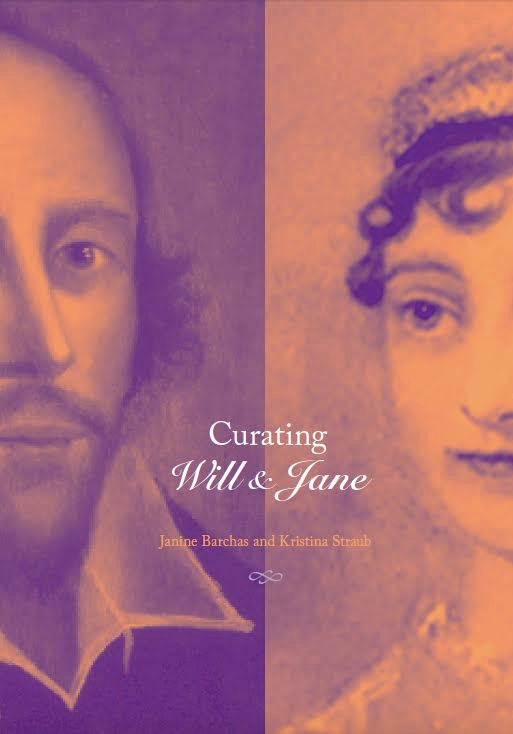
Eighteenth-Century Life has just published “Curating Will & Jane” by Janine Barchas and Kristina Straub. The article is an overview of their upcoming “Will & Jane: Shakespeare, Austen, and the Cult of Celebrity” exhibition at the Folger Shakespeare Library (opens 6 August and closes 6 Nov).
Because of public interest in the show, Duke University Press has just made the article freely available for a whole year while Cedric Reverand, enthusiastic editor of Eighteenth-Century Life, made possible an unprecedented thirty-seven illustrations, many in color. It takes about 10 seconds to download.
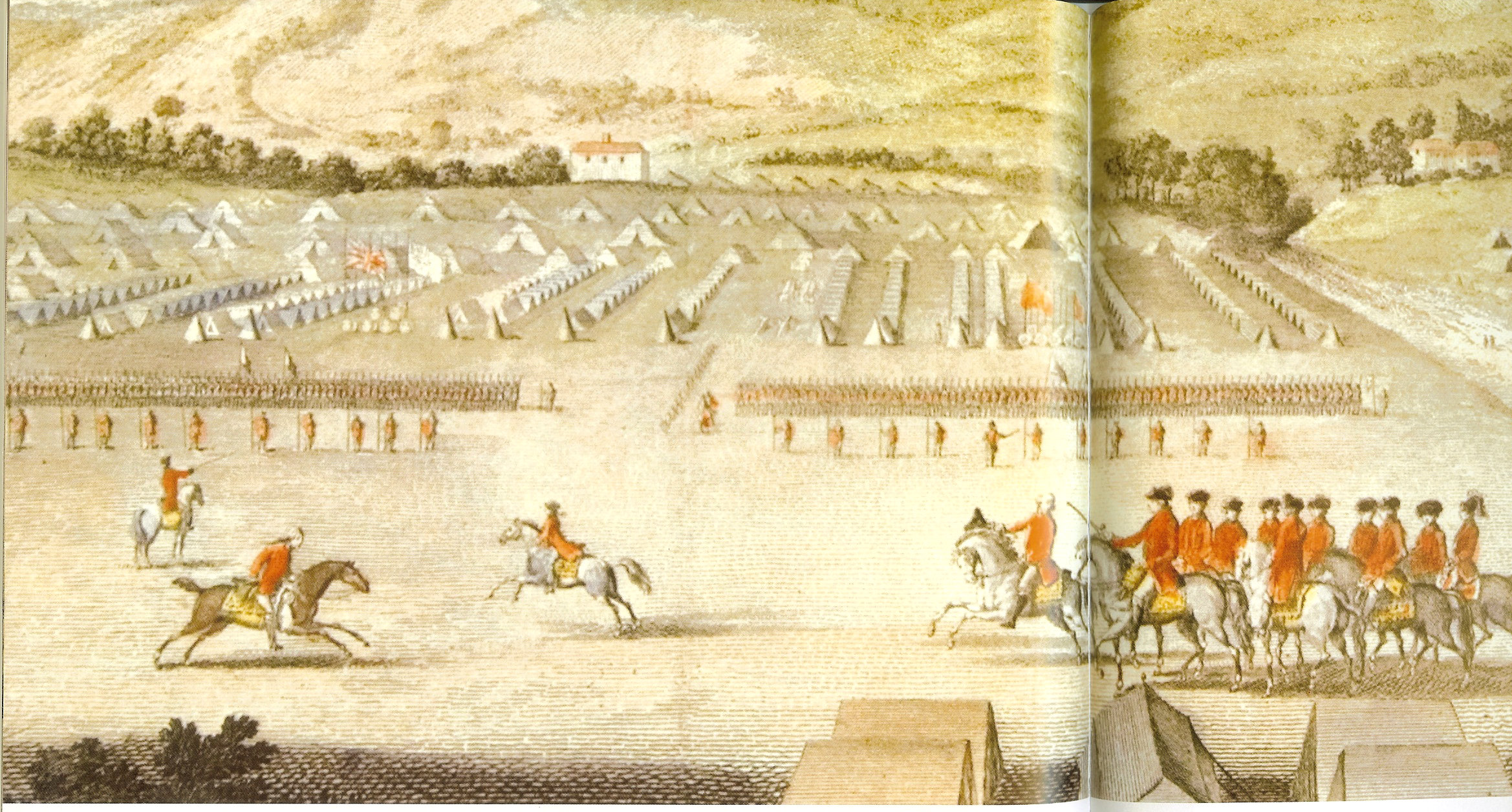
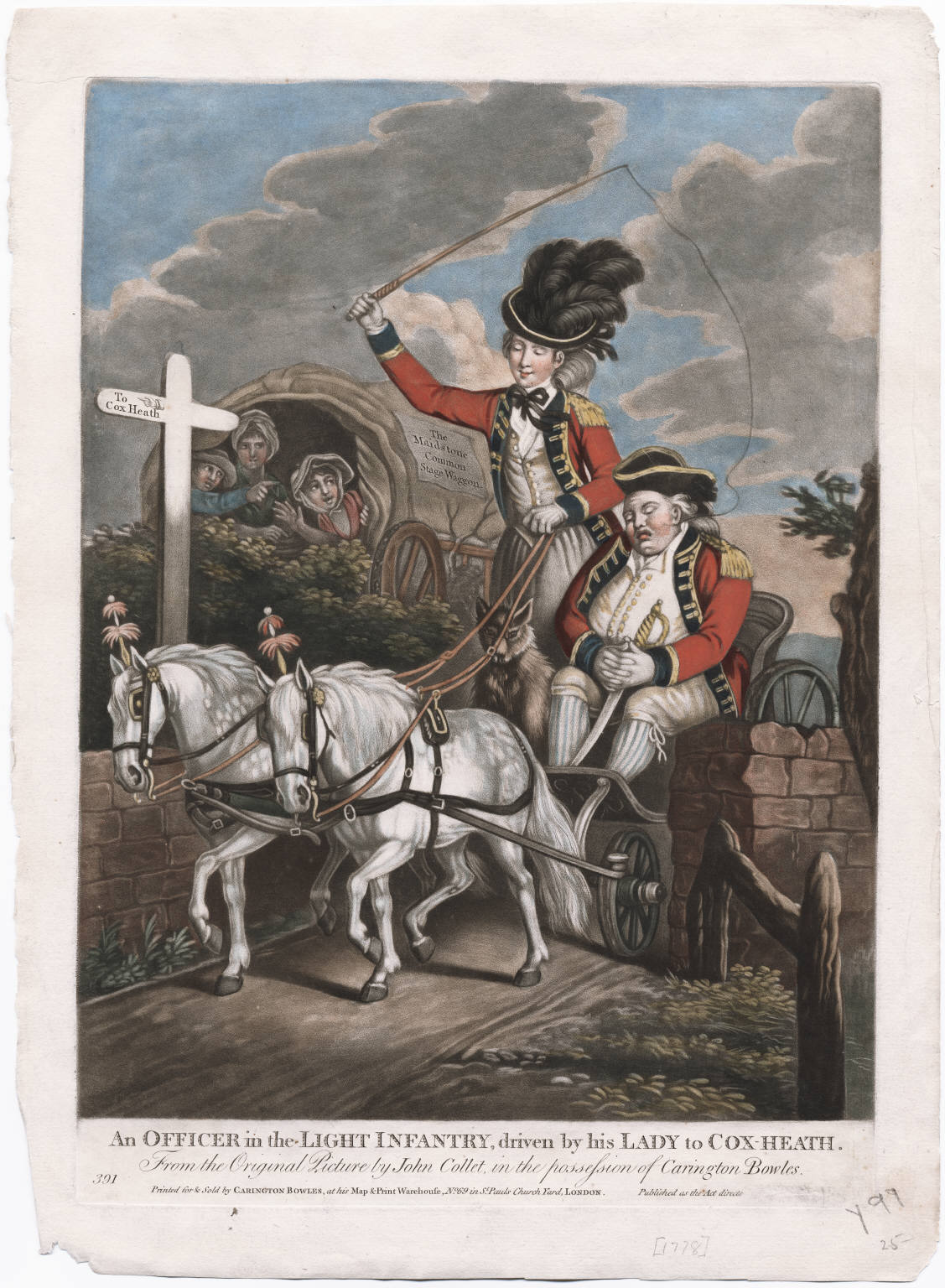
The Society of the Cincinnati, at its headquarters at Anderson House in Washington DC, currently has on exhibit “Homeland Defense: Protecting Britain during the American War” – you can view the online exhibit to see a collection of prints and cartoons that depict the various camps, soldiers, the visits of the fashionable, and other items that reflect Britain’s concern with possible invasion. We must believe that Jane Austen had some of this history in mind when she was writing Pride and Prejudice, with her soldiers, and the mad for red coats frenzy of the younger Bennet girls – and Mrs. Bennet for that matter!
“My dear Mr. Bennet, you must not expect such girls to have the sense of their father and mother. When they get to our age I dare say they will not think about officers any more than we do. I remember the time when I liked a red coat myself very well — and, indeed, so I do still at my heart; and if a smart young colonel, with five or six thousand a year, should want one of my girls, I shall not say nay to him; and I thought Colonel Forster looked very becoming the other night at Sir William’s in his regimentals.” (P&P, vol. I, ch. 7)
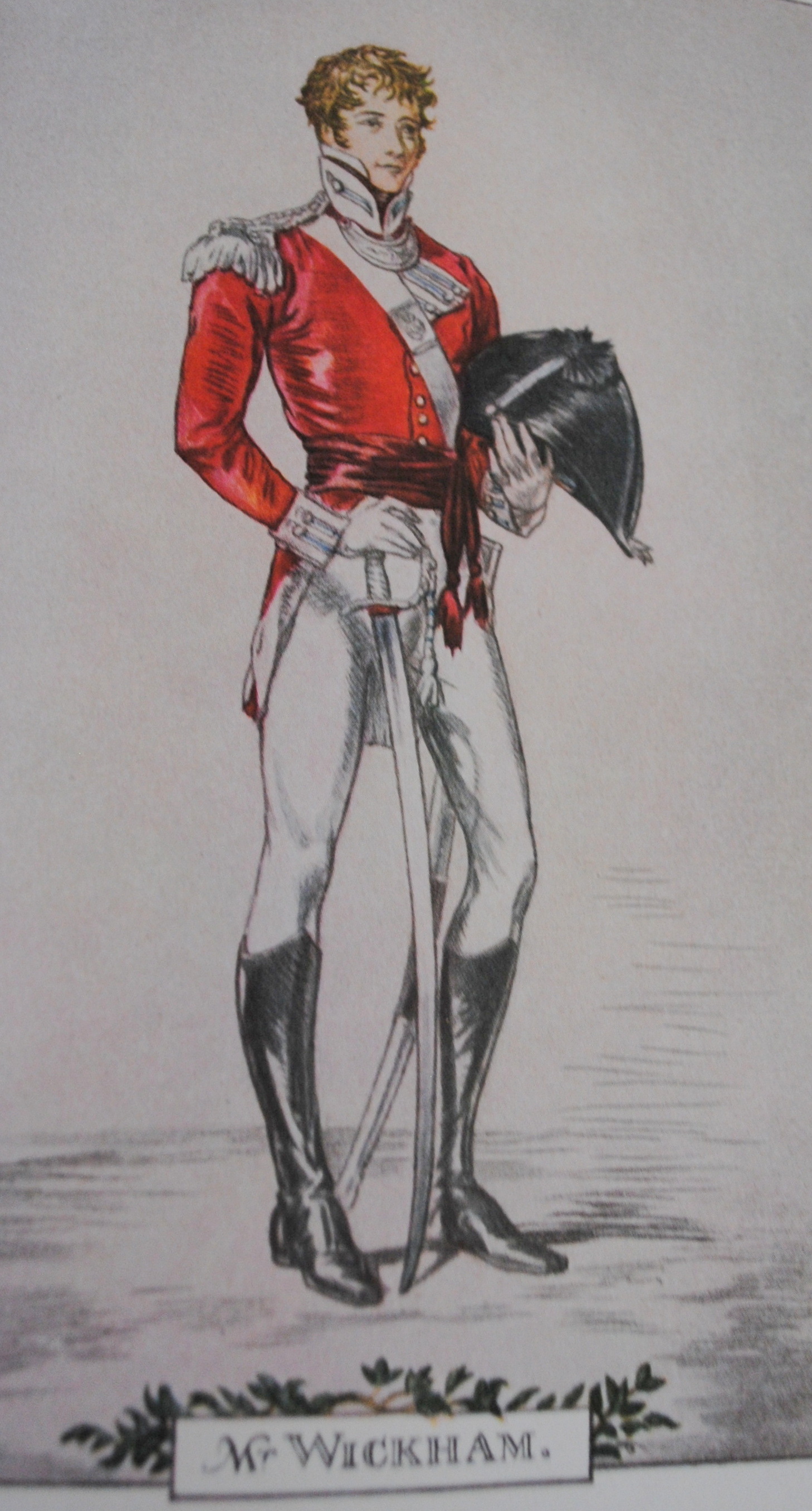
Mr Wickham, by Robert Ball, Pride and Prejudice (Doubleday, 1945)
Isaak Jenher. ‘Plan of the Camp at Cox-Heath 1779’ [in Kent] (London, 1779)
[image: Cincinnati Fourteen, Fall 2014, Journal of The Society of the Cincinnati, vol. 51, no. 1.]
By the beginning of 1778, British hopes of an easy victory over the American rebels had vanished. The British army had seized New York City and Philadelphia, but American resistance had proven far more tenacious than anyone in Britain had expected. The costs of prosecuting the war were mounting. Shipping losses were increasing. Parliamentary opposition to the war was growing. The defeat at Saratoga had destroyed British confidence that the colonies could be conquered. Even Lord North, the prime minister, had lost hope of total victory in what he called “this damned war.”
Then in February, France completed an alliance with the rebels. For the first time in a generation, Britain faced the threat of invasion. With most of the regular army in North America, the ministry recruited militia “for the internal defence of this Country.” The army established special camps in southeastern England to train the militia along with regular soldiers, to protect the coastline, and to provide for the defense of London. A distant and increasingly unpopular war suddenly reached the British homeland.
Contemporary novels and plays about military themes, new songs and poems celebrating British strength, and popular prints depicting the camps reflected public anxiety about the threat of invasion. They also reflected contemporary British opinion about the army at a moment when failure in America exposed it to satire and ridicule. The camps had a wide–ranging influence on popular culture. Fashionable ladies, for whom visiting the camps was a part of the social whirl, sported riding habits modeled on regimental uniforms. Cartoonists, meanwhile, took delight in poking fun at preparations for a foreign invasion that never came.
[quoted from the website]
John Collet. ‘An Officer in the Light Infantry, Driven by his Lady to Cox-Heath’ (London, 1778)
[image: Lewis Walpole Library]
The Wellcome Library announced on Monday its plan to release over 100,000 images from its collection of treasures – all in the Public Domain! [CC-BY = please give credit to the Wellcome Library when using any image]
One fine example:
A pretty barmaid drawing beer. Coloured lithograph, c. 1825. Published: Tregear London (123, Cheapside); Printed: Dean & Manday, lithographers [London]
Image credit: the Wellcome Library, London
A quick search brings up nothing “Jane Austen” – but as you imagine there are nearly 300 Rowlandson prints – here is one to bring to mind summer while more than half the country is in a deep-freeze:
L0017751 – Venus’s Bathing (Margate) – A woman diving off a bathing wagon in to the sea
Hand-coloured etching 1790 By: Thomas Rowlandson Image Credit: Wellcome Library, London
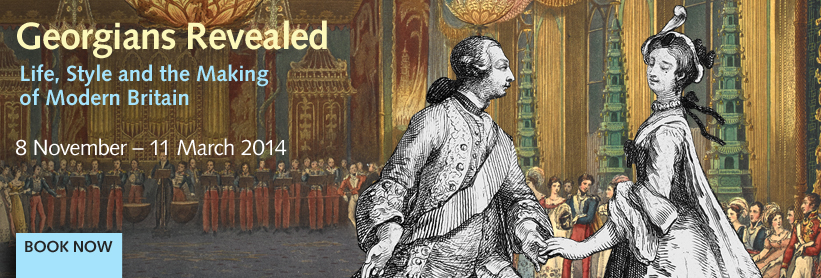
Opening today! ~ “Georgians Revealed: Life, Style and the Making of Modern Britain” – 8 November – 11 March 2014 at the British Library
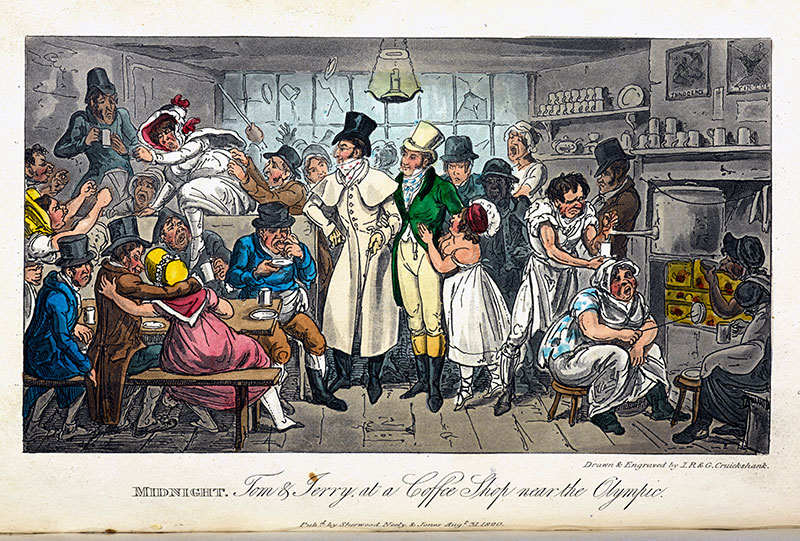
I.R. and G. Cruikshank. ‘Tom & Jerry at a Coffee Shop near the Olympic’ – Pierce Egan, Life in London (London, 1823).
Tasteful and polite, or riotous and pleasure-obsessed? Discover the Georgians as they really were, through the objects that tell the stories of their lives.
From beautifully furnished homes to raucous gambling dens, Georgians Revealed explores the revolution in everyday life that took place between 1714 and 1830. Cities and towns were transformed. Taking tea, reading magazines, gardening and shopping for leisure were commonplace, and conspicuous consumption became the pastime of the emerging middle classes.
Popular culture as we know it began, and with it the unstoppable rise of fashion and celebrity. Art galleries, museums and charities were founded. In this time of incredible innovation, ideas were endlessly debated in the new coffee houses and spread via the information highway that was mass print.
Drawing on the British Library’s uniquely rich and rare collections of illustrated books, newspapers, maps and advertisements, as well as loaned artworks and artifacts, “Georgians Revealed” brings to life the trials and triumphs of the ordinary people who transformed Britain forever.
And check out the online shop where all manner of Georgian -related treasures are for sale, as well as a catalogue of the exhibition, another must-have for your Jane Austen collection!
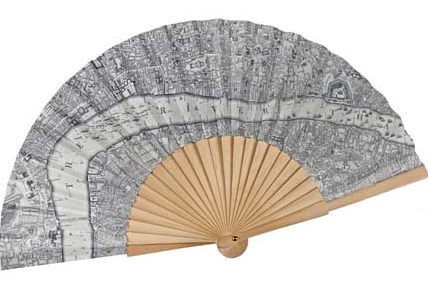
Rocque map of London fan, £8
A beautiful wooden fan, featuring a historic map created by John Rocque.
The fan has been created exclusively for the British Library. Wood/ canvas.
[Images and text from the British Library website]
If you are into your holiday shopping early, or compiling your own wish-list, here is a fine start: a must-have for your Jane Austen collection: the Folio Society’s latest edition of Pride and Prejudice, 2013.
“I had not known you a month before I felt that you were the last man in the world whom I could ever be prevailed on to marry.”
One of the world’s favourite books, Pride and Prejudice has long been regarded as a classic romance. In Elizabeth Bennet and Fitzwilliam Darcy, Jane Austen created the greatest pair of sparring lovers since Shakespeare’s Beatrice and Benedick. This sparkling comedy of manners features an inimitable cast of characters including the obsequious Mr Collins, the autocratic Lady Catherine de Bourgh, and Mrs Bennet, the most embarrassing mother in literature.
The award-winning Balbusso twins have contributed eight exquisite illustrations to this edition, as well as a striking cover design. The novel’s celebrated first line is blocked in gold on the slipcase. In a new introduction, the author Sebastian Faulks praises ‘a novel of almost boundless wit and charm that has withstood film and television adaptations and attempts to define it as a “fairy tale” or a “rom-com”.’
[Pride and Prejudice (Folio, 2013): image from the Balbusso website]
Details:
Introduced by Sebastian Faulks.
Illustrated by Anna and Elena Balbusso.
Bound in metallic cloth, blocked with a design by Anna and Elena Balbusso.
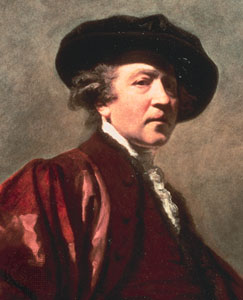
On 24 May 1813, Jane Austen visited an important and much-talked-about art exhibit at the British Institution in Pall Mall, London. The show was a retrospective of the works of Sir Joshua Reynolds (1723-1792), England’s celebrated portrait painter.
No visual record of this show is known to have survived, although it attracted hundreds of daily visitors during its much-publicized three-month run. However, many details of the exhibit can be reconstructed from the original 1813 “Catalogue of Pictures,” a one-shilling pamphlet purchased by visitors as a guide through the three large rooms where hung 141 paintings by Reynolds. Armed with surviving copies of this pamphlet, narrative accounts in nineteenth-century newspapers and books, and precise architectural measurements of the British Institution’s exhibit space, this website reconstructs the Reynolds show as Jane Austen (as well as any Jane Doe) saw it.
I. Why reconstruct this museum exhibit from 1813?
In truth, even if Jane Austen had not attended this public exhibit, it would still be well worth reconstructing. The British Institution’s show was a star-studded “first” of great magnitude for the art community and a turning point in the history of modern exhibit practices. The 1813 show amounted to the first commemorative exhibition devoted to a single artist ever staged by an institution. Although Reynolds, who had died a mere twenty-one years earlier, did not yet qualify as an Old Master, he was already hailed as the founder of the British School and celebrated as a model for contemporary artists to emulate. The preface to the exhibit catalogue, written by Richard Payne Knight, treats the work of Sir Joshua Reynolds as a national treasure in order “to call attention generally to British, in preference to Foreign Art” (Knight, 9). Knight allows that some of Reynolds’ paintings are better than others, likening the show to a pedagogical tool for artists and connoisseurs. He also insists upon the show’s modernity, hailing “the genuine excellence of modern” artists over the work of their forbearers (Knight, 9). In light of the coverage it received in the popular press and the London crowds that attended, the British Institution’s Reynolds exhibit presaged the modern museum blockbuster.
In the age before the photograph, portraits of the rich and famous were often reproduced by engravers as inexpensive prints. These black and white reproductions circulated Reynolds’ images of contemporary celebrities widely, providing pinups to the middling consumer. In this manner, Reynolds’ works functioned as the modern photographs of Annie Leibovitz do today, making it hard to say whether he recorded or created celebrity with his art. Wherever possible, the light-boxes in the e-exhibit therefore show an early engraving as well as the original canvas. Reynolds’ portraits of “abnormally interesting people” whom we now term celebrities offer concrete examples of just how someone like Austen, who did not personally circulate among the social elite, was nonetheless immersed in England’s vibrant celebrity culture (Roach, 1).
More questions are answered under the About WJS page:
Is there a connection between this exhibit and Jane Austen’s fiction?
Who, other than the Austens, attended this 1813 exhibit?
How did visitors in 1813 experience the British Institution?
Did the Catalogue function as a museum guide in 1813?
How historically accurate is this website?
Room for interpretation and improvement
Works Cited / Site Credits
It is a rainy weekend here in Vermont – what better way to spend a few hours but at such an exhibition as this!
Janine Barchas is Associate Professor of English at the University of Texas at Austin. She is the author of Matters of Fact in Jane Austen: History, Location, and Celebrity (Johns Hopkins University Press, August 2012). Her first book, Graphic Design, Print Culture, and the Eighteenth-Century Novel (Cambridge UP, 2003), won the SHARP book prize for best work in the field of book history. Her newest project is the website What Jane Saw (www.whatjanesaw.org).
“We have been both to the Exhibition & Sir J. Reynolds’, – and I am disappointed, for there was nothing like Mrs. D. [Darcy] at either. – I can only imagine that Mr. D. prizes any Picture of her too much to like it should be exposed to the public eye. – I can imagine he w’d have that sort [of omitted] feeling – that mixture of Love, Pride & Delicacy.- Setting aside this disappointment, I had great amusement among the Pictures…”
[Jane Austen, Letter 85, Monday 24 May 1813]
Those who have read Jane Austen’s letters are familiar with her comments on visiting London. It has been an ongoing project of mine to figure out where she went and what she did and how she uses the pieces of her London treks in her novels. One of the more interesting and frustrating is her reference to the art exhibit of Sir Joshua Reynolds – what did she see there, other than not finding a portrait of Mrs. Darcy? It has been revealed today that we will now have a chance to see exactly that, sort of following Jane herself around the galleries, as Professor Janine Barchas of the University of Texas at Austin launches What Jane Saw – a complete reconstruction of that exhibit. You will surely want to bookmark this new website and mark your calendars to view the happening on May 24, 2013!
From the website:
On 24 May 1813, Jane Austen visited an art exhibit at the British Institution in Pall Mall, London. The popular show was the first-ever retrospective of the works of Sir Joshua Reynolds (1723-1792), England’s celebrated portrait painter. On 24 May 2013, two centuries to the day that Austen viewed the 141 paintings in that exhibit, this site will open its doors as a public e-gallery, offering the modern visitor a precise historical reconstruction of that long-lost Regency blockbuster.
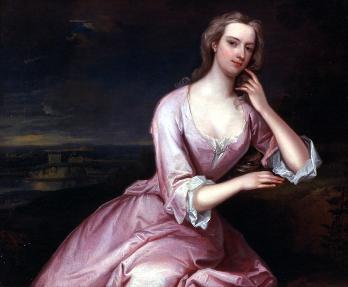
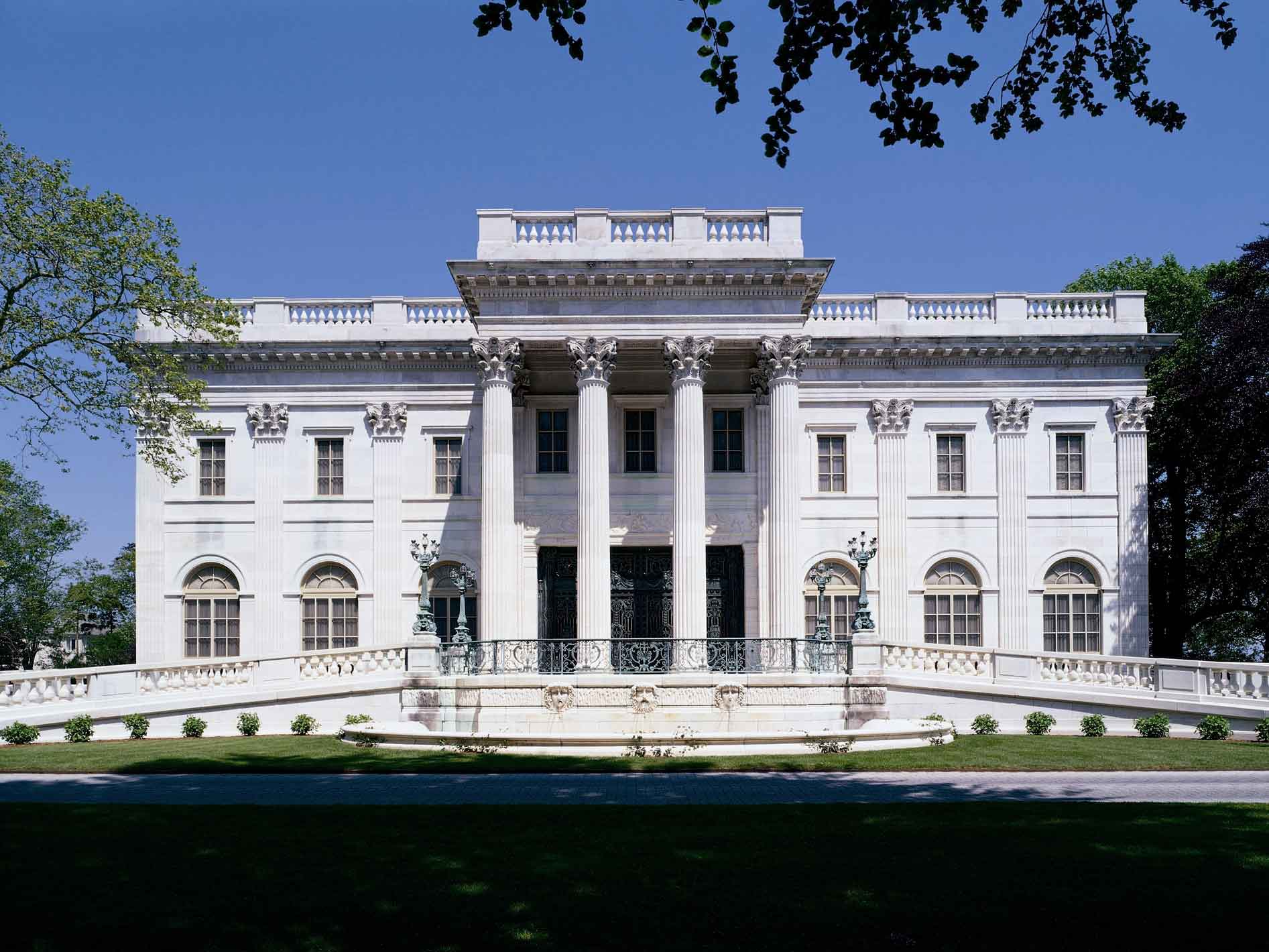
Enquiring Minds: Tony Grant of London Calling, and a regular contributor to Jane Austen’s World, had written a post for me on Marble Hill House in Twickenham– but alas! I have been so delayed in getting this on the blog that we agreed he should post it himself and I will link to it… so herewith the tale of Marble Hill House, home to Henrietta Howard, mistress of George II. This all started with a conversation over Joshua Reynolds’s house, which led to Richmond Hill, and then on to Henrietta Howard and Marble Hill House, and then Pope and Swift, Horace Walpole, John Gay and the Scriblerus Club, a bit on Wordsworth and Sir Walter Scott and on to Dickens and Virginia and Leonard Woolf, and of course Jane Austen gets her required mention – you get the idea – this is cram-packed with literary tourism and as always, Tony’s fine photographs…
****************
The Thames from Richmond Hill
The River Thames wends its tortuous way across England from Thames Head in Gloucestershire until it reaches the southernmost part of the North Sea. Its journey stretches for 215 miles. Finally the wide Thames Estuary which pours its contents into The North Sea is bordered on the north bank by the Essex coast and Southend on Sea and at its southern bank by the Kent coast, Sheerness and the entrance to the Medway.
Along its course The Thames passes though some beautiful English countryside before it enters the Greater London area passing by Sunbury and on to Hampton, then Hampton Court, Kingston upon Thames, Twickenham and Richmond. At last it reaches the centre of London with its iconic landmarks. The Thames, from London along its whole length, has a long history of Iron Age villages, Roman habitation, Saxon towns, and mediaeval settlements, Tudor Palaces and Georgian and Victorian Villas. London itself began as a Roman settlement for trade, built at the nearest bridging point to the coast where they had their port called Ritupiae (Richborough). They wanted to penetrate the hinterland north of the Thames. Indeed the names Thames which was Celtic in origin but had its Roman equivalent (Tamesas recorded in Latin as Tamesis) and London (Londinium) come to us from Roman times.
Over the centuries the Thames outside of London has provided a beautiful Arcadian retreat for the wealthy, the famous, the aristocracy and the monarchy away from the stench and diseases prevalent in many periods of London’s history. They built palaces and grand houses and villas with adjoining estates and landscaped parks to relax and take their leisure in. Marble Hill House is a Palladian Villa built between 1724 and 1729, very close to Richmond upon Thames but on the northern bank of the Thames near Twickenham. It was built for George II’s mistress, Henrietta Howard….
The Female Spectator, (Vol. 16, No. 2, Spring 2012), the newsletter of the Chawton House Library, showed up last week in my mailbox – this 12 page newsletter always offers something new and exciting to be discovered and shared!:
1. “Chawton Chronicles: A Letter from the CEO” – Stephen Lawrence talks about what has been accomplished at the Library since its inception in 2003, especially the academic initiatives and activities and the Visiting Fellowship Programme. And he writes of the upcomingSpring Gala of the JASNA-Greater Chicago Region where Sandy Lerner, Elizabeth Garvie, Lindsay Ashford, and Stephen will all be in attendance for the “Chawton Comes to Chicago” event [which took place on May 5 – visit the website for a photo gallery of the event – accessible to members only I’m sorry to say!]
3. “Talking Portraits at CHL” – by Sarah Parry – about the project to bring to life with actors in full costume the various portraits housed in the Library: the portraits of Mary Robinson, Elizabeth Hartley, and Catherine (Kitty) Clive were the portraits chosen for this first effort.
[Image of Catherine “Kitty” Clive from CHL at the BBC Collection]
4. “Curious Consumption: Cookery Books at CHL” – by Lindsey Phillips. An essay on her research into the exchange of culinary information and recipes between Britain and the West Indies; included is a recipe for “pepper pot” from Maria Eliza Ketelby Rundell’s American Domestic Cookery (ed. of 1823), which you can find here at Google Books.
5. “The Day the Descendants Came to Tea: Revelations and Connections from a Chawton House Fellowship” – by Katharine Kittredge, on the author’s study of Melesina Trench (1768 – 1827), an Irish writer, poet and diarist, and Kittredge’s connection with her relatives after her research was published in Aphra Behn Online. [her article in ABO can be found here.] And click here for Kittredge’s biography of Trench on the CHL website.
Melesina Trench – wikipedia
6. “The Language of Women’s Fiction, 1750-1830” – a conference report by Christina Davidson – one hopes the papers discussed will be published at some point…?
7. “‘Not in All Things Perfect’: The North Welsh Gentry in Fiction and History” – Mary Chadwick shares her research on a collection of English-language manuscript letters, poems, etc. written by members of a North Welsh gentry community and collected by one family, the Griffiths of Garn, and how this compares to the writing of the various novelists who set their tales in Wales (including Jane Austen in her Juvenilia!), in particular Elizabeth Hervey’s The History of Ned Evans (1796) [and recently re- published in the CHL / Pickering & Chatto series.
******************
And reasons to be at the CHL, and a continuing source of depression for those of us who cannot! :
Lectures:
June 7 [today!]: Dr Laura Engel on “Much Ado About Muffs: Actresses, Accessories, and Austen”
June 20. Professor Elizabeth Kowaleski Wallace on “‘Penance and Mortification for Ever’: Jane Austen and Catholicism.”
June 25. Evening Talk and Book Launch: Dr. Katie Halsey “‘A Pair of Fine Eyes’: Sight and Insight in Jane Austen’s Novels.”
When Mr. Darcy meditates on the pleasure bestowed by “a pair of fine eyes” in Pride and Prejudice, he does so because eyes are so very expressive. In this talk, Dr Katie Halsey explores the relationship between the physical eye and the eyes of the mind in Austen’s novels.
This talk is part ofAlton’s Jane Austen Regency Week, andthe launch of Katie Halsey’s new book: Jane Austen and her Readers, 1786 – 1945 [and soon to be added to my bedside table…]
Exhibition:
“Jane Austen’s Bookshop: An Exhibition” 18 June – 6 July, 2012
This exhibition explores how readers and writers in Winchester shared printed material (books, playbills, engravings &c). Men and women, young and old, gentry and middle classes, rich and poor, Protestant and Catholic – all participated. The Austen family purchased literature from the bookshop of John Burdon (today still a bookshop), while scholars at Winchester College published their works in their own city. The newly founded hospital produced annual reports, and local newspapers such as the Hampshire Chronicle promoted all kinds of publications in advertisements and reviews.
Come to Chawton House Library to learn more about book production and circulation. Find out what kind of material was published in Hampshire in the eighteenth century, and just what the Austen family might have read.
 Emma was published by John Murray II of Albemarle Street on the 23rd December 1815, although its title page reads 1816. This exhibition has items from Chawton House’s own collection and from the Knight family collection, as well as other items on loan. The exhibition covers the reception of Emma through the nineteenth, twentieth and twenty first centuries; it also considers the country setting of the novel and the places that were possible influences. It covers the global appeal of Emma. It has a large section about John Murray II and nineteenth century publishing practices through letters and comments made by Jane herself and fellow authoresses also published by Murray. It highlights authors mentioned in the novel and nineteenth century ideas about female accomplishments such as music, embroidery and painting. It shows the connection with Shakespeare and has a section about the reception of the novel. In particular, there is a letter written by Charlotte Bronte to her own publisher, W.S. Williams, discussing her thoughts about Emma and Jane Austen as a writer.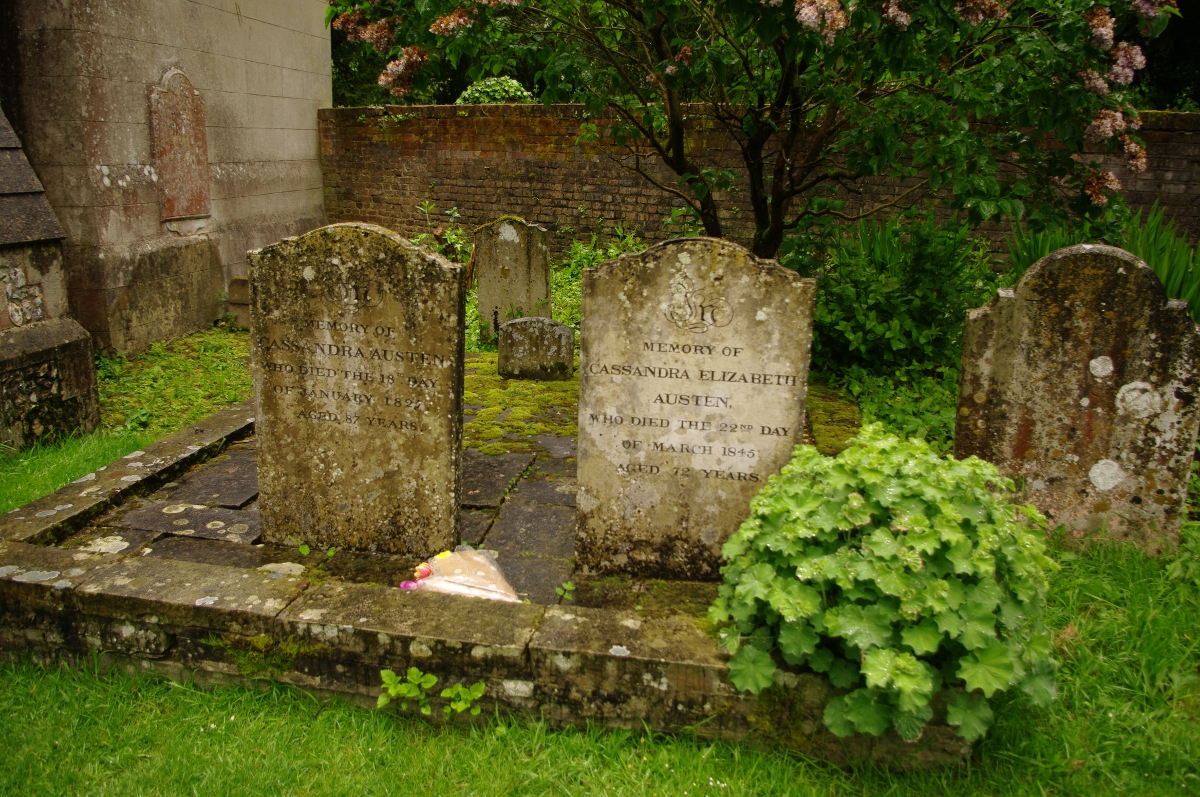




















 Jane Austen in Vermont