Books · Literature · News

A Bit of Armitage with your Heyer?

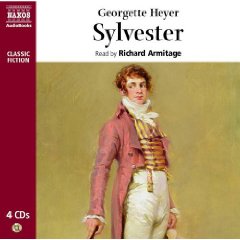
A recent find:  Richard Armitage reading Georgette Heyer’s Sylvester, to be released in the UK in July…

sylvester audiobook

The audiobook is due for release on 1st July.  Written in 1957, ‘Sylvester’ is one of the most popular of Heyer’s Regency romances. Witty and romantic, its heroine is Phoebe Marlow, who flees her home to avoid marrying Sylvester, the wealthy Duke of Salford. But the pair are fated to meet again…

The audiobook can be pre-ordered at Amazon UK, Amazon Germany and Amazon Canada. It’s listed at Amazon USA, though it’s not yet available for ordering there. It’ll also be available as an MP3 download from the Naxos website.

[from RichardArmitageOnline.com]

 If you cannot wait until July, you can listen to this 10-minute audio-clip from the opening of the book released by Naxos Audiobooks.  You can find the link to the audio here at Richard Armitage Online:  scroll down through the latest news to the item titled “Sylvester excerpt” and listen away! [oh that voice!] 


richard-armitage4


Jane Austen · News

Follow-up ~ A Talk on ‘Persuasion’

[see our follow-up to the talk below…]

Kellogg-Hubbard Library,  135 Main St, Montpelier, Vermont

Wednesday, May 6, 2009 7pm

Powers of “Persuasion” a Vermont Humanities Council First Wednesdays 2008-2009 Classic Book Program by Bennington College Professor April Bernard

In her final superb novel, Persuasion, Jane Austen combined social satire with profound feeling. Why does this “fairy tale for grown-ups” continue to compel readers? How does Austen hold our attention and sympathy? And finally, who are some contemporary writers who might have learned some of Austen’s lessons?

April Bernard is a poet, novelist, and essayist who teaches literature and writing at Bennington College. Her most recent book is a collection of poems, Swan Electric.

persuasion-cover-vintage

Follow-up to the gathering from Janeite Kelly:

Thanks to the Vermont Humanities Council and the Kellogg-Hubbard Library, this event drew a nice little crowd of readers interested in Persuasion and Austen. The Q&A session was amazingly robust!

Prof. Bernard brought up some useful and though-provoking points — including this comment on Austen novels: THEY’RE NOT JUST GIRLS’ BOOKS!! And that was undoubtedly bourne out, if not in her Bennington College classrooms, in the men comprising a portion of the audience for this evening’s lecture!

Some points brought up for discussion: The narcissism of Sir Walter Elliot; the brilliance of Samuel Johnson’s writing (admired by many Austens, including – of course! – Jane); how writers are also avid readers; and some tricks whereby Prof. Bernard teaches writing to her students.

She introduced some ‘nuggets’:

In Austen’s novels the YOUNG end up showing the ELDER generation how one should act and react in life; the ‘old’ versus ‘new’ order, if you will.

One point I had never thought about before, that the NAVY in the characters of Admiral and Mrs Croft – self-made, responsible, wealthier – in essence TAKE OVER from where the gentry, in the form of Sir Walter, have left off (’abondoned ship’, if I can be allowed to think of it that way!). Austen, of course, had her own Naval brothers – men who pulled themselves up through the ranks, and ended up with rank, a title, and some amount of wealth.

One audience member asked where the idea of ‘a fairy tale for adults’ (used in the advertising) fit into her idea of Persuasion. Prof Bernard responded: Second chances at happiness. Children, she said, know fear, hunger (the subjects of traditional fairy tales, yes?) — but children do NOT know disappointment. Anne knew just such a debilitating feeling, and Austen gave this ‘past her bloom’ woman a second chance. We should all live such ‘fairy tale’ lives!

Follow-up from Janeite Deb:

Kelly summarizes nicely some of the main points of Prof. Bernard’s talk on Persuasion – the younger generation proving the older generation wrong [in most of Austen’s writings,  but esp. in Persuasion] by criticizing the establishment; the “fairy-tale” quality of Anne and Wentworth’s second chance at happiness; the Crofts taking over Kellynch Hall as a symbol of Austen’s democratic view of men being able to rise in society by their own efforts.

Prof Bernard emphasized Austen as a “conservative” writer, i.e. as a follower of Johnson, Austen writes of a conventional reality, her code of conduct and moral compass clearly defined in her novels [with Mansfield Park being her most conservative work].  But Berhard views Persuasion as a departure from this for Austen, with this more “democratic” view of society’s changing possibilities, her criticism of the Peerage in the guise of Sir Walter and the rise of the Navy which makes Wentworth an eligible partner for Anne, a lateral social move so to speak.  Bernard also points out how for the first time, Austen has Anne speak in quite radical terms in her speech to Harville that Wentworth [thankfully!] overhears [though not radical for the times, this feminist-speak IS radical for Austen].

Austen’s writing technique is what interests Bernard –  her creative writing classes must be fabulous! – She believes that Austen in this her last completed work was experimenting with her writing, her use of direct vs. indirect discourse most pronounced here.  And Bernard makes a great point about Austen as a creator of the “surrogate writer” in her works, as in Emma, where Emma is writing her own “bad” novels with all her matchmaking stories; and in Persuasion when Anne becomes annoyed with Mr. Elliot for trying to write her own story or to tell her who she is. 

Bernard does make one point that I would like to put out there as a query and field your thoughts:  All of Austen’s books have the “happy ending” we like to see in our “fairy-tale” romances [and in Persuasion we are given her only equal and nearly perfect union in the marriage of Admiral and Mrs. Croft], but Bernard does say quite strongly that these pleasing endings do not all end in happy marriages:  Emma, she says, married her father in Mr. Knightley, and she will spend a lifetime being told what to do by him; and in Mansfield Park, Fanny and Edmund will not live happily ever after because Edmund clearly does not really love Fanny.  [this is perhaps why there are such a spate of sequels?!] – [and I should also add that I do not agree with this outcome for Emma and Fanny, but that is why I request your musings…and Kelly and I will post more on this later…]

So please share with us your thoughts on the “happily ever after” of Austen’s marriages? 
JASNA-Vermont events · News · Schedule of Events

JASNA ~ Massachusetts Region ~ May 3, 2009

You are invited to join the JASNA Massachusetts Region Chapter at their next meeting scheduled for Sunday, May 3, 2009:

“Learning to Love a Hyacinth: Emotional Growth in Northanger Abbey”

with Ingrid Graff*

 ********************************

Wheelock College, Brookline Campus

43 Hawes St

Brookline, MA

2:00 pm

$5. / person [Mass Chapter members free]

For more information contact:  JASNA – MA, Nancy Yee, Regional Coordinator,  617-965-5699

[* Ingrid Graff is a great friend of mine – I heartily recommend that you attend if at all possible!]

Books · Jane Austen · News · Rare Books · Regency England · Social Life & Customs

Hot off the Press!

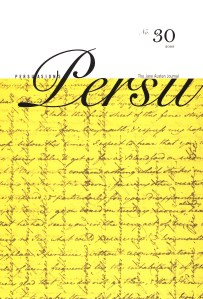
persuasions-cover30Yesterday, a FedEx box left on my stoop prior to lunch yielded up a BIG surprise: my contributor’s copies of JASNA’s annual journal PERSUASIONS, vol. 30 (2008). A brief email to Susan Allen Ford, the journal editor, to congratulate her on an ‘awesome’ volume, was answered by an email which said she hadn’t received her copies yet! Vermont’s good fortune (and mine) to be located next door to New Hampshire — from where the packages seem to have originated…
The first article I read was Edith Lank‘s telling of her annotated Brabourne edition of Austen letters. One curious thing: how could the books languish EIGHT years on her shelves, unopened?! A used book never passes my threshold without a thorough perusal! There is more on Miss Lank’s edition in Persuasions-Online.

Joan Klingel Ray offers up an interesting look at Victorian era perceptions of Austen, though I must comment that to Edward — a nephew who was in his late teens when his aunt died — Jane would surely have remained, over the 50 ensuing years, his “dear Aunt Jane”. Joan and I take differently, I think, to James-Edward Austen-Leigh’s Memoir of Jane Austen. Joan knows the descendents; but I’ve come to know Edward and Emma through their own words! So: a discussion to look forward to when Joan Klingel Ray visits Vermont in September (see our EVENTS page).

I would be telling a lie if I didn’t confess that the very first article I checked out was my own… Oh, the pictures look lovely! (They come via the collection of The British Museum.) I had been so worried after seeing the proofs. Susan Allen Ford has been very positive in her reaction (the anonymous reader, too) to this article, in which I examine an Emma Austen 1833 trip to Derbyshire in the steps of Elizabeth Bennet. The article was only improved by their wishes for a lengthier piece and some illustrations.

The Chicago AGM’s theme of Austen’s legacy brings up many fascinating ideas: Jocelyn Harris invokes Dr. Johnson; Deb will surely be interested in turning straightaway to Janine Barchas‘ article on Gaskell’s North & South (Deb highly recommends the new TV series, which she’s been watching) — but what will she think of the author’s assumption that it is a veiled recreation of P&P??? Sarah Parry‘s article on “The Pemberley Effect: Austen’s Legacy to the Historic House Industry” is surely next on my list.

A special ‘legacy’: the writing desk that once belonged to Austen, has been in the family, and now has been donated to The British Library. Freydis Welland‘s personal take on this piece of history opens the always pleasurable MISCELLANY section of Persuasions. Although I’ve not seen Lost in Austen, Laurie Kaplan‘s article which closes the journal has the oh-so-tempting title “‘Completely without Sense’: Lost in Austen“.

More comments than this — teasing tantalizers or tantalizing teasers, since the journal (according to the JASNA website) is schedule to mail out on May 1st — will have to wait. The one thing that keeps me from delving deep into my copy is an article I’m working on, and I must get back to work.

Austen Literary History & Criticism · Book reviews · Jane Austen · News

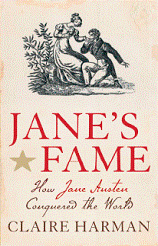
“Jane’s Fame” ~ the Reviews

book-cover-janes-fame

The reviews are in on Claire Harman’s Jane’s Fame: How Jane Austen Conquered the World [Canongate, 2009]


I list several of them for your perusal.  [I am fortunate indeed to have just been in the UK – I went into every Waterstone’s I came across until finally the date of release arrived and a very helpful shop-keeper found it sitting on a to-be-shelved cart!  – so I am almost finished and will post my thoughts shortly…]


The Telegraph, by Frances Wilson

The Independent, by Elspeth Barker

Times Online, by John Carey

The Guardian, by Kathryn Hughes

The Spectator Book Club, by Philip Hensher

The Literary Review, by Mark Bostridge

A preview of the book at Austenprose

My previous post at JAIV about the Jane’s Fame controversy

Austen Literary History & Criticism · Books · Jane Austen · News · Rare Books · Regency England

Austen on the Block ~ Bloomsbury Auctions

Bloomsbury Auctions-New York  announces the exhibition and auction of


The Paula Peyraud Collection, Samuel Johnson

and

 Women Writers in Georgian Society


Wednesday, 6 May, 2009 • 10:00 am


Bloomsbury Auctions, the world’s leading auction house for rare books and works on paper, announces The Paula Peyraud Collection, Samuel Johnson and Women Writers in Georgian Society with over 480 lots of books, manuscripts and paintings tells the fascinating story of English society in the middle and late Georgian periods. This extraordinary sale focuses on the artistic and literary women who came to the fore in the period 1750-1840.


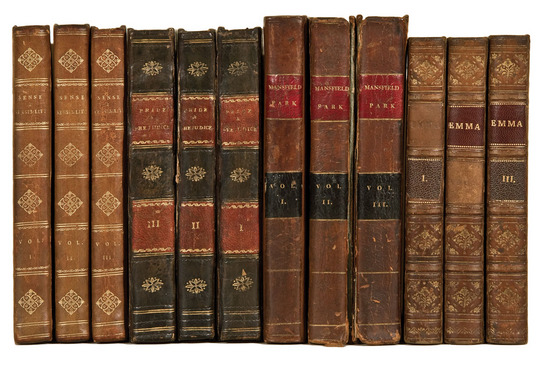
 A highlight in the sale are the following five titles from Jane Austen: 

bloomsbury-auction-austen

  • Emma-1816- 3 volumes: $8,000-12,000
  • Mansfield Park-1814- 3 volumes: $7,000-10,000
  • Northanger Abbey-1818- 4 volumes: $5,000-8,000
  • Pride and Prejudice-1813- 3 volumes Carysfort copy: $20,000-30,000
  • Sense and Sensibility-1811- 3 volumes: $25,000-35,000 


There are a total of 483 lots for sale, to comprise books, autograph letters, engravings and watercolors of the era:  Johnson and Boswell, and Walpole, etc., and many women writers are represented:  Frances Burney, Maria Edgewoth, Hannah More, Hester Thrale Piozzi, Charlotte Lennox, Charlotte Smith, Charlotte Bronte, Ann Radcliffe, Marguerite Blessington, to name a few.


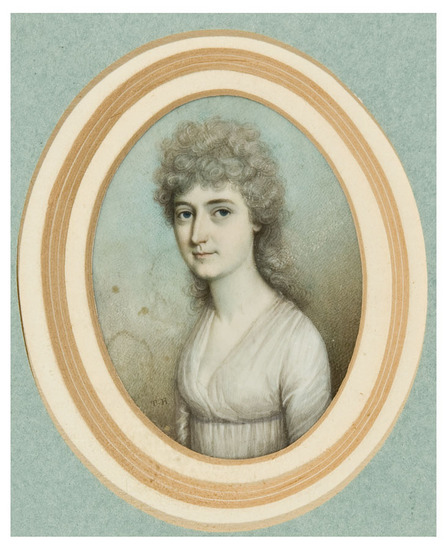
And see this watercolor of Elizabeth Bridges, Austen’s sister-in-law:

elizabeth-bridges-watercolor
Bloomsbury Auction - May 6, 2009 Lot No.127


127. [AUSTEN, Jane (1775-1817)] – Thomas Hazlehurst (1740 – 1821). Portrait miniature of Elizabeth Bridges Knight wearing a white dress with a blue ribbon tied under corsage. Watercolor on ivory, oval.
2 1/2 x 2 inches (6.5 x 5 cm).
Initialed “T.H.” (lower right).
A fine portrait miniature of Jane Austen’s sister in law, Elizabeth Bridges (1773-1808) who married Edward Austen, the brother of Jane Austen. Edward took the name of his second cousin Mr. Knight on inheriting in 1812 his estates in Kent at Godmersham Park. They had 11 children.
This lot sold with an uncolored print of Godmersham Park by Watts.
Literature: Country Life. 27 July 1987, ill. p.111.  Est. $2000 – 3000.

 *********************************************

Location:  Bloomsbury Auction Gallery, 6 West 48th Street New York 10019

Viewing hours:  

  • Friday May 1- By appointment
  • Saturday May 2- 10-5 p.m.
  • Monday May 4- 10-7 p.m.
  • Tuesday May 5- 10-5 p.m.

Bloomsbury Auctions is the world’s leading auction house for rare books and works on paper and is headquartered in London with salerooms in New York and Rome.


 For further information call Bloomsbury:  212-719-1000 or email at newyork@bloomsburyauctions.com


You can view the full catalogue at the Bloomsbury website.


Austen Literary History & Criticism · Jane Austen · News · Publishing History

If you can wait until November ~

This is a tad ahead of schedule, but Mark your Calendars! 

The Pierpont Morgan Library in New York City will be hosting a Jane Austen exhibit to begin in November 2009:

Jane Austen
November 2009 through March 2010

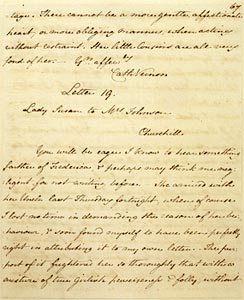
austen-lady-susan-ms-morgan-library

 Jane Austen, Lady Susan, autograph manuscript, written ca. 1793–94 and transcribed in fair copy soon after 1805. The Morgan Library & Museum, Purchased in 1947; MA 1226.


*********************************

This exhibition explores the life, work, and legacy of Jane Austen (1775–1817), regarded as one of the greatest novelists in the English language. During the past two decades, numerous successful motion picture and television adaptations of Austen’s novels have led to a resurgence of interest in Austen’s life and work. This show provides a close-up portrait of Austen, achieving tangible intimacy primarily through the presentation of her autograph manuscripts and personal letters which the Morgan has not exhibited in a generation.

The Morgan’s collection of Austen’s autograph manuscripts and letters is the largest of any institution in the world, and includes the darkly satiric Lady Susan, the only surviving manuscript of any of Austen’s novels. The exhibition will also include first and early illustrated editions of Jane Austen’s novels and letters, as well as contemporary drawings and prints depicting people, places, and events of significance in Austen’s life.

Responding to the revival of interest in Austen’s life and work, the exhibition provides a deeper insight into Austen’s essentially enigmatic character and personality, the craft of writing, and the historical context in which she lived and wrote. The exhibition will explore not only Austen’s personal reading, and the literary influences that inspired and informed her work, but also the response to Austen by later writers as diverse as Scott, Bronte, Nabokov, Twain, Chesterton, and Auden.

[From the Morgan Library website]

News

Happy Easter!!

happy-easter-postcard

[Raphael Tuck & Sons “Easter Post Cards”  Series, No. 700]

Happy Easter One & All!

An Austen Easter Basket: Today, a little potpourri from Janeite Kelly to join the beautiful illustration of Janeite Deb…

In the mail yesterday, when I expected nothing but junk mail, came the latest edition (Spring 2009) of JASNA News. My reviews of Carrie Bebris’ The Matters at Mansfield and Jane Odiwe’s Lydia Bennet’s Story are there (they should be posted at JASNA.org in some few months); as are reviews of Stephenie Meyer’s Twilight (continuing — or perhaps the correct word is beginning, since the first book in the series came out in 2005 — a Gothic connection to and from Austen’s works), Peter Graham’s Jane Austen & Charles Darwin: Naturalists and Novelists and Nora Nachumi’s Acting Like a Lady: British Women Novelists and the Eighteenth-Century Theater.

I can’t wait to sit with a cuppa and read the interview with Elizabeth Garvie (Elizabeth Bennet in the 1979 P&P); she is scheduled to appear at the October AGM in Philadelphia!

I loved Deirdre Le Faye’s forthright letter to the Editor about the bedrooms — and their possible distribution among guests — at Ibthorpe House. Just goes to show that we all use conjecture and educated guesses when reconstructing the past.

A lot of International “News” in this issue, but VERMONT gets its mention on the next to last page. I should clarify that the editor dropped what should be the full name of Suzanne Boden’s Hyde Park (Vermont) B&B: The Governor’s House in Hyde Park. Shortened to simple The Governor’s House, there may be readers who think we were actually entertained by the state’s sitting Governor! I will mention here (as I could not in the article) that there are two upcoming Pride & Prejudice weekends in 2009: August 14-16, and September 11-13. Those who come to the Friday ‘over dessert’ discussion of Georgiana Darcy are in for an interactive treat, as I am adding an audience participation component to the mix.

And this leads to the question posed in the News article: Why does sending out invitations to the Netherfield Ball depend upon Mrs Nicholls (Bingley’s housekeeper) making “white soup enough”?? As always with Austen, there are small details (that are easily overlooked) which obviously meant something to readers of her period. We did manage, that Sunday over brunch, to find a recipe for White Soup, so that is not the curious part; it is the ‘why’. Comments welcome!

An article on Lost in Austen brings up the possibility of a film (!) version, but why always the idea that something has to be adapted for an American audience?? Such absurd thoughts baffle me each and every time…

I leave readers with this little vignette found — well, I’ll reveal where it came from later:

“She smiled and blushed and hid her face. A porter and some other people were looking wonderingly on, so I thought it best to end the conversation. But there was an attractive power about this poor Irish girl that fascinated me strangely. I felt irresistibly drawn to her. The singular beauty of her eyes, a beauty of deep sadness, a wistful sorrowful imploring look, her swift rich humour, her sudden gravity and sadnesses, her brilliant laughter, a certainly intensity and power and richness of life and the extraordinary sweetness, softness and beauty of her voice in singing and talking gave her a power over me which I could not understand nor describe, but the power of a stronger over a weaker will and nature. She lingered about the carriage door. Her look grew more wistful, beautiful and imploring. My eyes were fixed and riveted on hers. A few minutes more and I know not what might have happened. A wild reckless feeling came over me. Shall I leave all and follow her? No — Yes — No. At that moment the train moved on. She was left behind. … Shall we meet again? Yes — No — Yes.”

So: A maudlin Victorian novel? A new knock-off of P&P? Or a real-life reaction to a pair of beautiful eyes, thereby making Darcy’s reaction to Elizabeth Bennet a bit less vague?? Answer revealed here Continue reading “Happy Easter!!”

Jane Austen · Literature · News

Previewing Persuasions

JASNA has posted a link to the table of contents for volume 30 (2008) of the Jane Austen Society of North America’s journal Persuasions. This annual is a peer-reviewed journal, featuring both articles based on papers presented at the October AGMs (Annual General Meeting; in 2008 it took placed in Chicago) and ‘miscellany’ — which includes my own article on the 1833 Austen-Smith journey to Derbyshire: they travelled pretty much in the shoes of Elizabeth Bennet! Watch the JASNA website, for I have been told the article might be posted on their “maps” page (a very interesting and quite useful resource, now augmented with related articles on places and travel pulled from the Persuasions archive).

Austen Literary History & Criticism · Jane Austen · News · Schedule of Events · Uncategorized

Bishop’s PRIDE

Two Saturdays ago (March 14th, to be exact) I ventured up to Bishop’s University (Lennoxville, Quebec) for a Pride & Prejudice Weekend – a symposium, thanks to English department professor Claire Grogan; a delicious ‘Jane Austen’s Cream Tea’ at Uplands; a Pride & Prejudice play, adapted by drama professor George Rideout; and an Austen-era Sunday Service in the university’s beautiful chapel. Sure the footlights have dimmed, the curtain has dropped, and the weekend’s events have faded into memory – but readers should know what they missed; and why they should keep an eye out for a production of this well-thought-out new play.

Saturday afternoon’s symposium featured three speakers; a full-hall (a good 70 people) had gathered to hear them.

Prof. Peter Sabor
McGill University, Montreal
“Portraying Jane Austen: How Anonymous became a Celebrity”. 
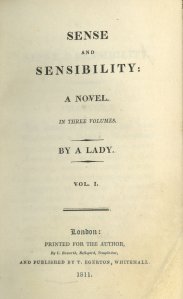
senseandsensibilitytitlepage

Illustrated by images, Dr. Sabor brought the audience along Austen’s circuitous route to celebrity – beginning with the original “BY A LADY” title page of Sense and Sensibility and showing near the end a publicity photo that made everyone chuckle: Jane Austen Hollywood-ized, complete with cell phone (the giant, 1980s version), conducting business while lounging on a poolside chaise.

In between these humble beginnings and the 20th-century hype lay a lot of Austen territory to be explored. Austen, of course, sold the copyright to Pride & Prejudice – her most popular novel – for ₤110. In 1813, the three volumes sold for 18 shilling (“about $2 Canadian today”).

Austen’s name has been located on a few subscription lists (Burney’s Camilla; the 1808 sermons of the Rev. Thomas Jefferson). Dr. Sabor explained that it was costly to purchase books by subscription. Such lists, however, can be invaluable to the researcher (I have located many Goslings and Smiths on subscription lists; it gives a thrill to realize they knew the author or valued the work enough to purchase a copy – or more than one – before the presses rolled).

The anonymous review (in reality Walter Scott) of Emma highlights Austen’s soon-acknowledged authorship a few years later: Although the title page of Northanger Abbey cited “By the author of ‘Pride and Prejudice,’ ‘Mansfield Park,’ &c,” the first volume included brother Henry’s biographical notice – thereby naming in print for the first time exactly who authored all six of these novels. [See also Henry’s updated version in the Bentley edition (1833) of S&S.] Beginning in 1818, we see reviews that mention Austen by name. (In an aside: Emma Smith, the future Mrs James-Edward Austen, was in 1817 already citing her as the author, specifically, of Mansfield Park; though Emma spelled the last name, as many did and often still do, Austin.)

A French translation of Austen’s last completed novel – published under the title La famille Elliot – becomes the first book in which Austen’s name appears as author on a title page. The year is 1821. [For information on the translator, see Ellen Moody.]

When discussion of the known and purported Austen portraits began, the audience was given a truly informative lesson on the pitfalls, as well as hopes and shattered dreams, of claimants to “authentic Janes”. Even the 1804 sketch: Is it a depiction of Jane by her sister Cassandra?? Anna Lefroy (half-sister to James-Edward Austen) inherited it, and to this day it resides within the family. (It was first presented by Chapman in his volume of Letters.)

The illustrations of Austen grow more wild as the publicity picks up – paper dolls, figures made for ‘action,’ plush and bobble-headed dolls, even an Austen Powers ‘superhero’. From recreations to fantasy depictions, Austen’s ‘anonymity’ has certainly turned a complete 360-degrees.

ADDENDUM: for an observation on the so-called ‘wedding ring portrait’ of Jane Austen (which Dr. Sabor called “bizarre”, see SEPARATED AT BIRTH?)

*

next: Prof. Robert Morrison (Queen’s), “Getting Around Pride & Prejudice: Gothicism, Fairy Tales & the Very World of All Us”

Waiting in the Wings: read insights into the character of Miss Bingley by actress Stephanie Izsak.