Austen Literary History & Criticism · Books · Collecting Jane Austen · Jane Austen · Literature · Publishing History · Rare Books

A Little Jane Austen with Your Daily Hygiene? ~ Janine Barchas on “Sense, Sensibility, and Soap”

For those of you interested in the publishing history of Jane Austen, Professor Janine Barchas has recently published another of her fabulous bibliographical articles on Austen covers, this time in the journal Book History.  It discusses the little-known fact of a Lever Brothers soap marketing campaign that offered various giveaways, including hardbound editions of classic literature, Jane Austen among them.  I append here the beginning of the article, one of the many [and interesting!] illustrations, and a link to the rest of it … with thanks to Janine for alerting me to it!

Source: Janine Barchas. “Sense, Sensibility, and Soap: An Unexpected Case Study in Digital Resources for Book History.” Book History 16 (2013): 185-214.

Unrecorded in even David Gilson’s A Bibliography of Jane Austen is the little-known fact that soap manufacturer Lever Brothers published editions of Sense and Sensibility and Pride and Prejudice during the 1890s as part of a unique marketing campaign for Sunlight soap. The first English company to combine massive product giveaways with large-scale advertising, Lever Brothers offered a range of prizes in “Sunlight Soap Monthly Competitions” to “young folks” (contestants could not be older than seventeen) who sent in the largest number of soap wrappers. The Sunlight advertising blitz, targeted to working- and lower-middle-class consumers, proved such a boon to sales that Lever Brothers ran the competition for a full seven years, annually escalating the giveaways. Prizes included cash, bicycles, silver key-chains, gold watches, and—for the largest number of winners—cloth-bound books. For this purpose, Lever Brothers published and distributed its own selection of fiction titles by “Popular Authors” and “Standard Authors,” including cloth-bound editions of Sense and Sensibility and Pride and Prejudice. By 1897, the year the competition closed, Lever Brothers had awarded well over a million volumes.

Continue Reading: Barchas-SSandSoap-BookHistory

S&S-LeverBros

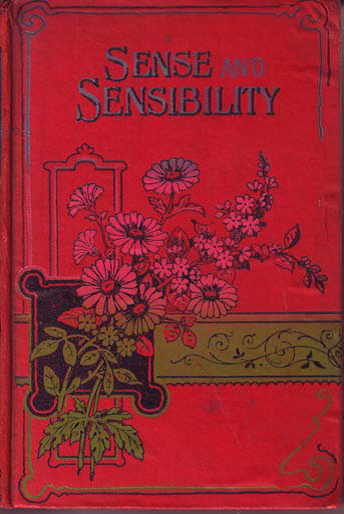
Jane Austen, Sense and Sensibility in red cloth (Port Sunlight: Lever Brothers, n.d.).

For those of you with Project Muse access, here is the direct link: http://muse.jhu.edu/journals/bh/summary/v016/16.barchas.html

c2013 Jane Austen in Vermont
Auctions · Austen Literary History & Criticism · Books · Jane Austen · Publishing History · Rare Books

More Austen on the Block! ~ A Jane Austen Portrait, First Editions, and More

UPDATE:  Prices realized [with buyer’s premium] are noted as made available

I wonder what is going on – I posted last week on several upcoming auctions with a number of Jane Austen offerings – and now I write about even more – there seems to an abundance, more than usual – why is this do you think??

***************

I will start with this, out of date order, but perhaps the most unique, interesting, (and expensive) to us:

Sothebys – 10 December 2013: English Literature, History, Children’s Books & Illustrations. London.

Lot 283:
Sothebys-JA Portrait-12-10-13

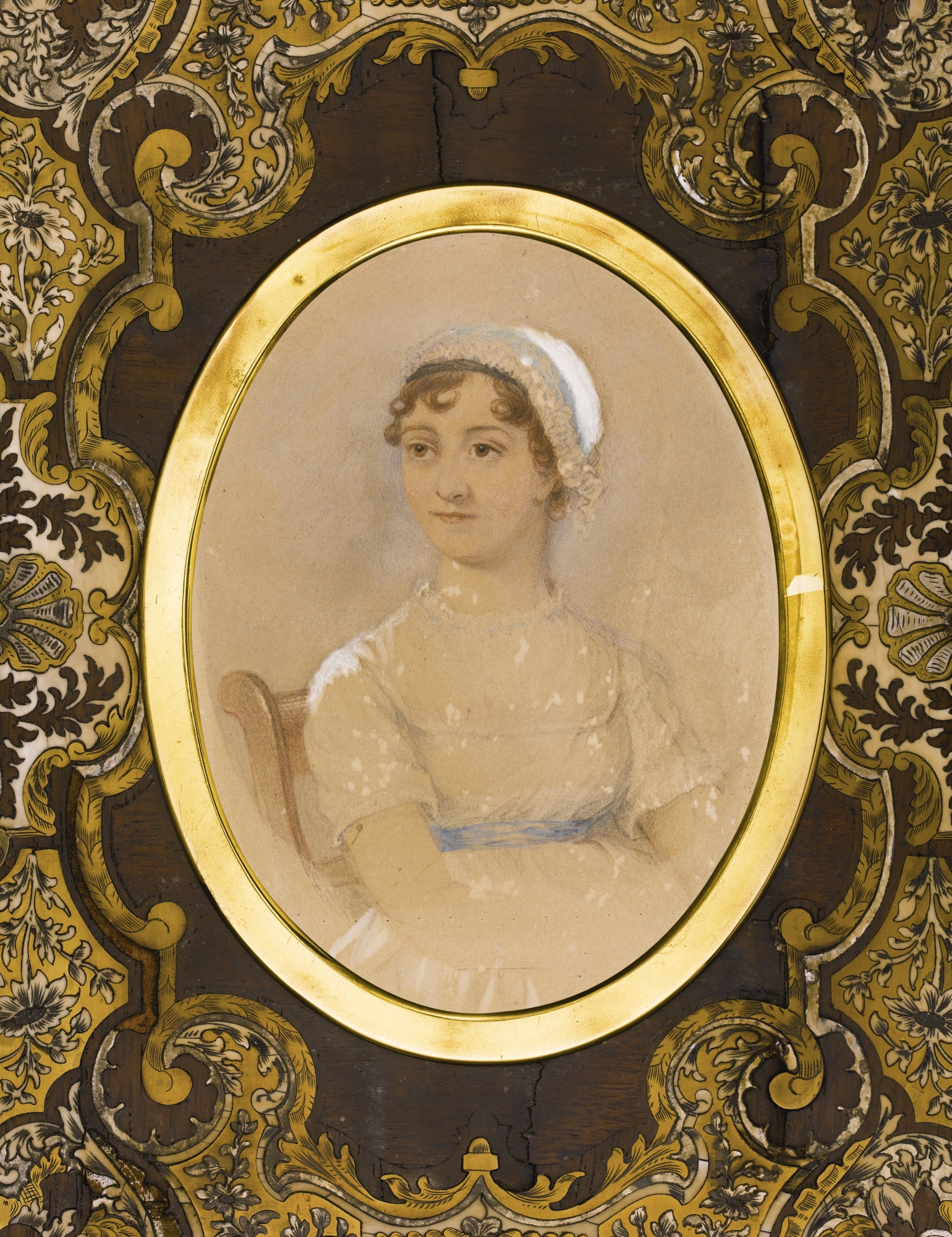
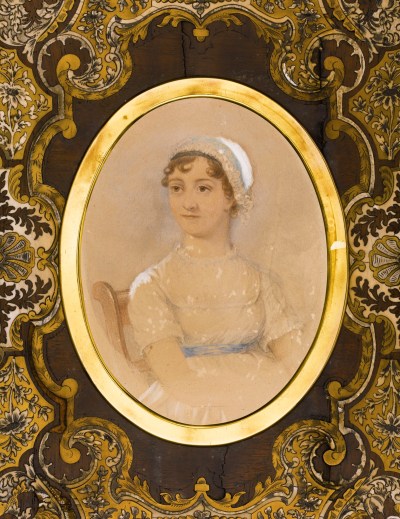
Austen, Jane – by James Andrews. PORTRAIT OF JANE AUSTEN.

watercolour over pencil heightened with gouache on card, depicting the author with brown curly hair and hazel eyes seated and facing towards the right, in a white frilled bonnet with light blue ribbon and a white dress with a dark blue ribbon under the bust, a small section at the bottom of the portrait apparently unfinished, oval, 143 x 100mm (overall sheet size 170 x 125mm), 1869, series of pin-holes at the top and bottom of the card, pencil markings probably by the engraver, mounted, framed, and glazed, frame size 327 x 247mm, the frame being a reused lid from a casket or box, French or German, probably eighteenth century, walnut inlaid with boulle-style marquetry of flowers and scrollwork in brass, silver, ivory, and mother of pearl, loss to surface of portrait probably due to insect damage, mostly affecting the dress, slight discolouration at edges seemingly where previously mounted in a rectangular frame.

The portrait of Jane Austen was commissioned by her nephew, James Edward Austen-Leigh, to illustrate his memoir of his aunt. This watercolor by painter James Andrews was the basis for the engraved version that is the best known and most reproduced image of Austen. It has been in the family ever since.

Estimate: £150,000 — 200,000 

[Note: For those of you in the New York area, this portrait will be on view from November 19 to 21 on the fourth floor of Sotheby’s, 1334 York Ave at 72nd St. Sotheby’s is open from 10 to 5. ]

There are other must-have items at this auction – see below [all are in chronological order]

***************

Swanns Galleries.  November 21, 2013. 19TH & 20TH CENTURY LITERATURE. Sale 2332.

Lot 4:

Swann-MP-11-21-13

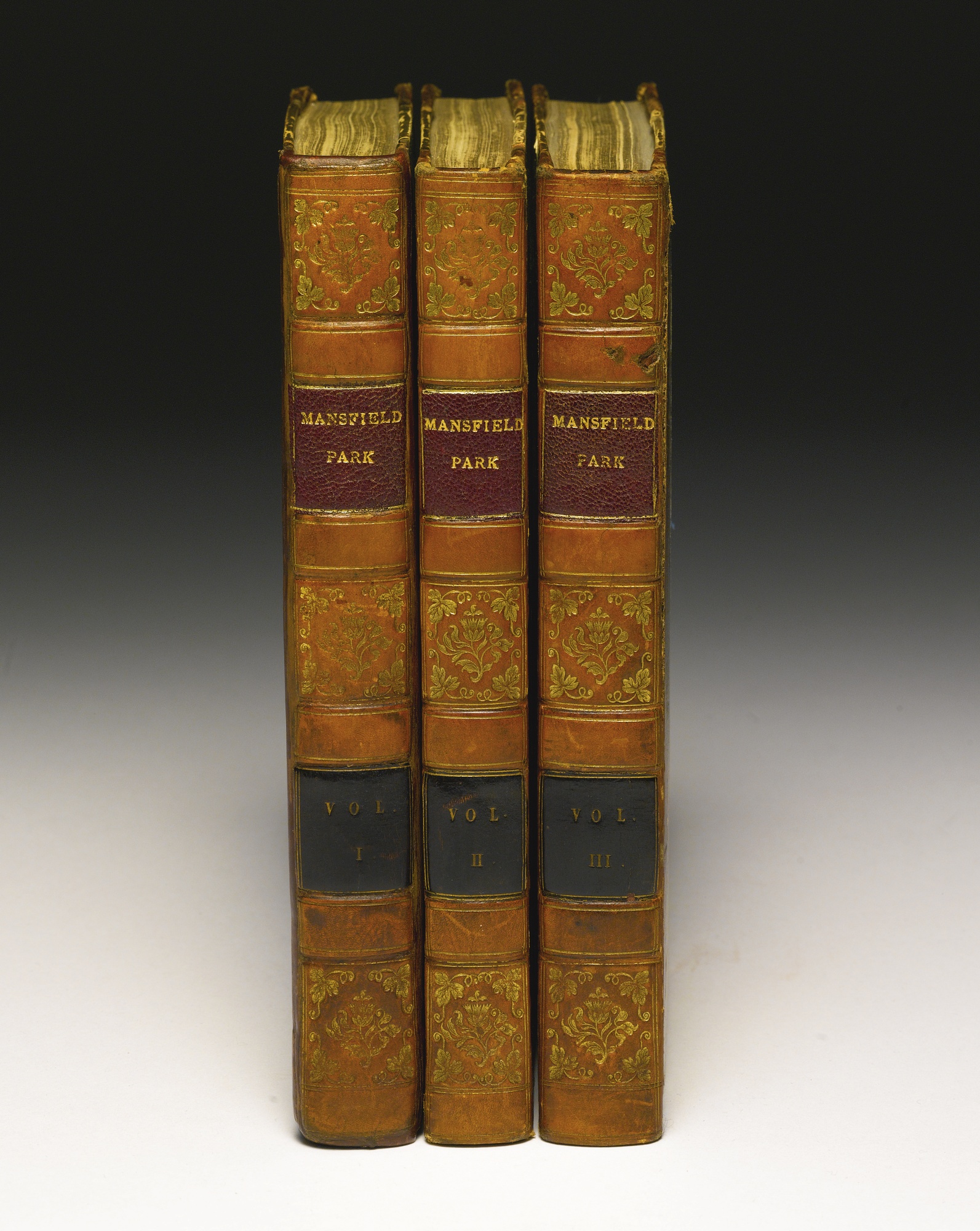
AUSTEN, JANE. Mansfield Park. 2 volumes. Philadelphia: Carey & Lea, 1832.

4 page publisher’s catalogue inserted at front of volume 1. 8vo, original publisher’s 1/4 cloth-backed drab boards, lettering labels on spines (absent but for trace remnants on each volume, and with small contemporary institutional labels either perished or remnant only below on each volume), cocked, few short splits at spine tips, generally mild staining and light wear to boards, corners rubbed with light exposure; hinges tender, pastedowns coming loose from boards in volume 1, scattered foxing throughout, at times heavily to volume 2, occasional small chips at deckle, old penciled numerals on front free endpapers, paper repairs on 2 leaves in volume 1 with no loss of text; housed in custom drop-back cloth case.

First american edition, extremely rare in the original binding. One of 1250 copies printed. Few copies of any of Austen’s first American editions have survived. “No appearance of the 1832 M[ansfield] P[ark] at auction has been traced” (Gilson, rev. ed., 1997). A survey of ABPC and AE records only one unsophisticated copy sold in the last 30 years. Gilson B4.

Estimate $4,000 – 6,000 – Price Realized $5,376

_______

Lot 5:

Swann-P&P2nd-11-21-13AUSTEN, JANE. Pride and Prejudice. Second Edition. London: Printed for T. Egerton, 1813.

3 volumes. Lacking half-titles. 12mo, contemporary 1/2 calf over marbled boards, spine gilt with leather lettering pieces (two perished, one with partial loss), covers and spines scuffed with some splitting along spine ends, fore-edges bumped in areas, joints strengthened; scattered light foxing, neat contemporary ownership inscriptions on title-page of each volume.

The less common second edition. According to Gilson, the publishing history is rather furtive (“The size of the edition is not known”). It does differ from the first edition in that it is entirely reset, resulting in occasional variations within the page. In addition, there are numerous small changes to spelling and punctuation and, occasionally, a change in wording (see Gilson A4 for list of alterations.); Chapman 4.

Estimate $3,000 – 4,000 – Price Realized $4,096
________

Swann-novels-11-21-13Lot 6:  

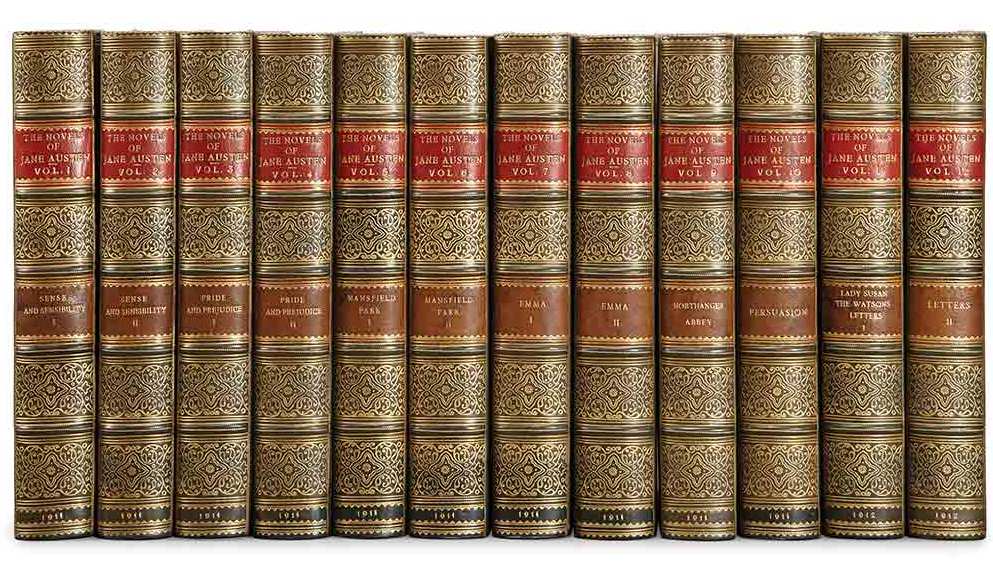
AUSTEN, JANE. The Novels. Edinburgh: John Grant, 1911-12.

12 volumes. Portrait frontispiece to volume 1. 8vo, later 1/4 olive calf, spine gilt in 5 compartments with gilt-lettered morocco lettering pieces in 1, top edges gilt. the Winchester Edition, a bright and clean set. One of the more desirable editions of Austen’s works.

Estimate $800 – 1,200 – Price Realized  $1,875

____________________

Also of interest: [to me anyway!]- as well as some wonderful offerings in children’s literature, lots of Dickens, alas! only one Hardy, but some lovely Hemingways and Twains…

Lot 238:  

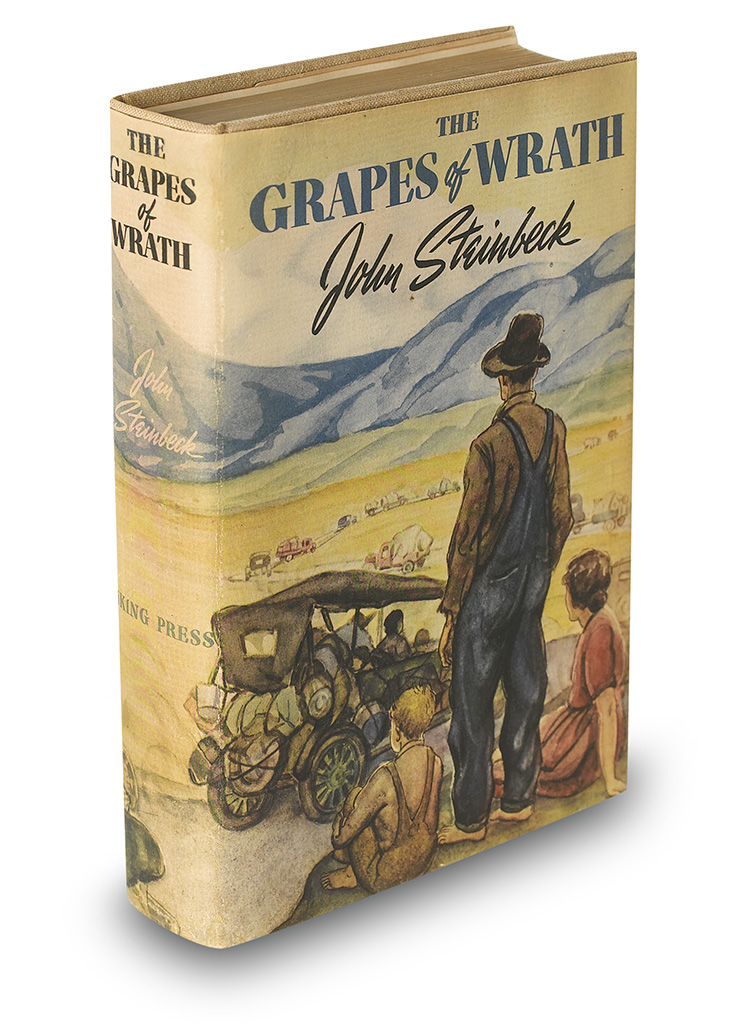
Swann-Steinbeck-11-21-13Steinbeck, John. ASSOCIATION COPY WITH ‘PIGASUS’ DRAWING.
The Grapes of Wrath
. New York: Viking, (1939)

8vo, publisher’s pictorial tan cloth, covers clean with virtually no rubbing or wear; outer pastedown edges with faint evidence of binder’s glue as usual, though with no offsetting to facing endpapers; first state dust jacket, mild rubbing to folds, small skillful restorations to spine panel tips and flap folds, bright and clean, a superb example with the original $2.75 price present.

First edition, an excellent association copy, inscribed on the front free endpaper “For Jules and Joyce and also Joan [underlined] with love John Steinbeck.” Below his signature Steinbeck added his “Pigasus” drawing. Jules Buck was a movie producer; he and Steinbeck made an early attempt toward a collaborative screenplay for what would become Elia Kazan’s “Viva Zapata,” though Steinbeck’s contribution was such that he received sole credit. Buck produced such post-war film classics as Robert Siodmak’s The Killers (based on the story by Ernest Hemingway), and Jules Dassin’s The Naked City. His wife Joyce Gates was an actress and their daughter Joan became the editor of French Vogue. Steinbeck generally reserved his flying pig doodle for close friends or significant occasions. In a letter (March, 1983) Elaine Steinbeck explained the significance of the image: “The Pigasus symbol came from my husband’s fertile, joyful, and often wild imagination … John would never have been so presumptuous as to use the winged horse as his symbol; the little pig said that man must try to attain the heavens though his equipment be meager. Man must aspire though he be earthbound” (The Martha Heasley Cox Center for Steinbeck Studies). An excellent inscribed copy with a fine association. Goldstone & Payne A12.a.

Estimate $18,000 – 25,000 – Price Realized $18,750
_________
Swann-Cruikshank-11-21-13Lot 71: 

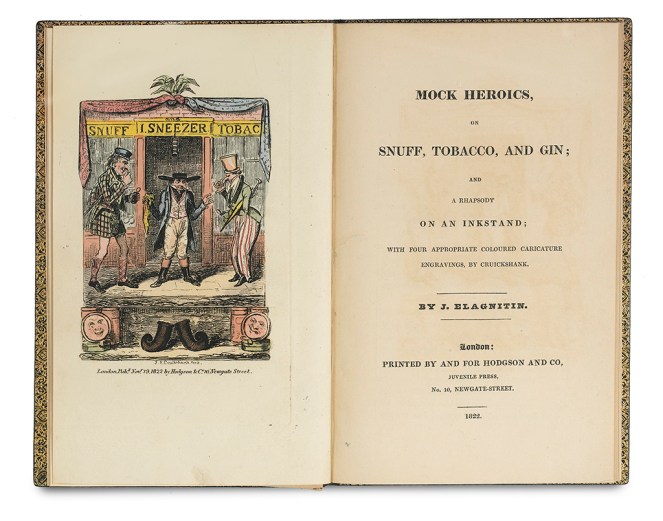
[Cruikshank, Isaac Robert]. UNRECORDED CRUIKSHANK (illus.). Mock Heroics, on Snuff, Tobacco, and Gin; And A Rhapsody on an Inkstand by J. Elagnitin. London: Hodgson and Co., 1822.

Frontispiece and 3 full page color engravings by I. R. Cruikshank. 8vo, contemporary full dark green crushed morocco, French fillet covers, spine decorated in gilt in compartments, all edges gilt, wide inner dentelles, by Riviere; tiny marginal repair on frontispiece, mild offsetting to title-page, else quite clean.

First edition of rare Cruikshank title with very bright, clean impressions of the plates. Shows London denizens taking snuff, on the pipe, at the debauch, and a more lonely pursuit. Not in Krumbhaar. 

Estimate $700 – 1,000 – Price Realized $469 

*****************

Doyle, New York. Monday, November 25, 2013 at 10am Rare Books, Autographs & Photographs – Sale 13BP04

Lot 522:
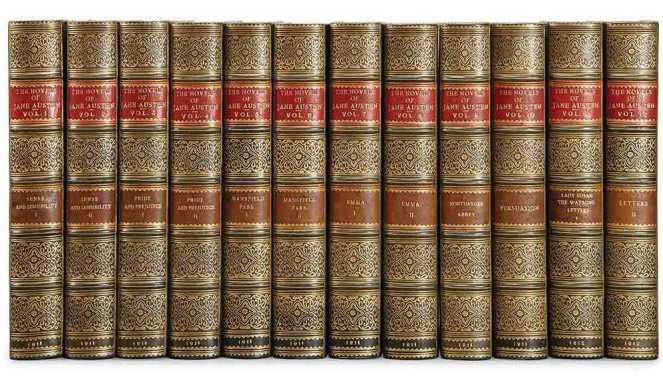
Doyle-JAset-11-25-13-2AUSTEN, JANE. The Novels. Edinburgh: John Grant, 1911-12.

The Winchester edition. Twelve volumes, full blue morocco gilt, the spines elaborately tooled and lettered in gilt with red morocco lettering labels, top edge gilt. 8 1/2 x 5 1/2 inches (22 x 14 cm). A fine and attractive set.

Estimate $1,000-1,500

[Note: This set is similar to the one noted above, just with a different binding – which do you like best?]
______

There is quite a collection of photographs and political collectibles at this auction, including this Tom Jones, Theodore Roosevelt’s copy:

Doyle-Fielding-11-25-13-2Lot 515:

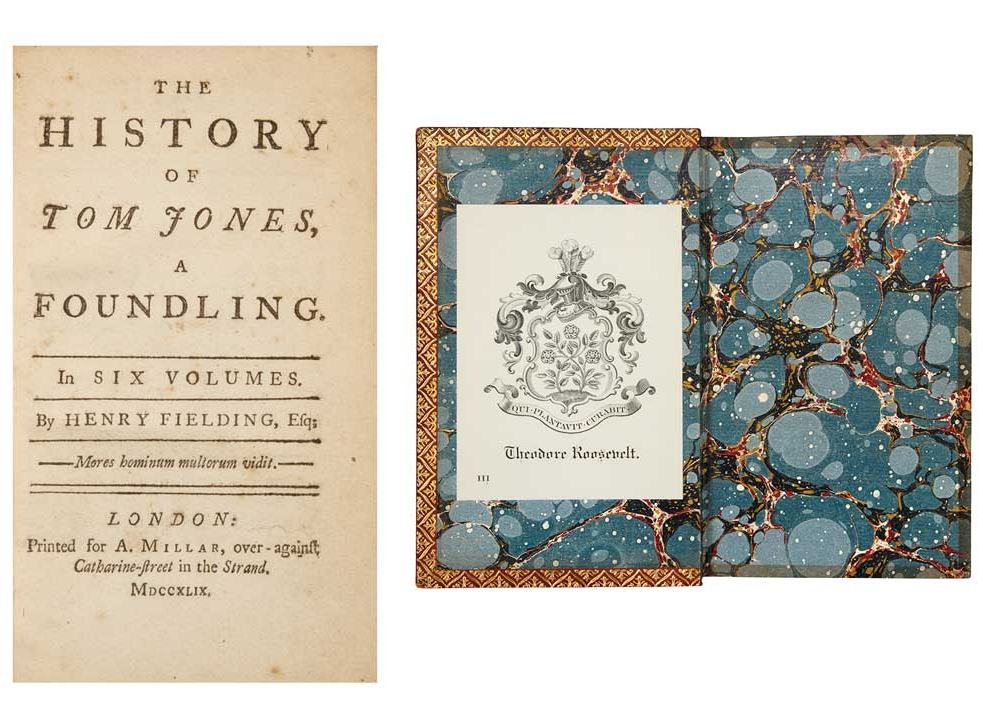
FIELDING, HENRY. The History of Tom Jones, a Foundling. London: printed for A. Millar, over-against Catharine-Street in the Strand, 1749. First edition, Theodore Roosevelt’s copy, with his “Qui plantavit curabit” bookplate to each pastedown. Six volumes, later full brown morocco gilt, all edges gilt. 6 1/4 x 3 3/4 inches (16 1/2 x 10 cm); with the errata leaf present in vol. I and with most called for cancels: Vol. I: B9, 10; Vol. II: N12; Vol. III: H8-10, M3; Vol. IV: B1, Vol. V: N8. [without the cancels at B4 and 5 in vol. II and Q11 in vol. III]. A 1910 inscription to front free endpaper on vol. I in an unknown hand, some foxing throughout, D10 in vol 2 with tear not affecting text, joints and extremities rubbed, losses to lettering labels, a sound set.
First edition of one of the earliest English works to be called a novel – with a very fine American provenance.

Estimate $2,000-3,000

********************

Sotheby’s auction December 5, 2013 New York:  Fine Books and Manuscripts, Including Americana

This is my birthday, so in case you are wondering what I might like, I will take any of these…

Lot 85:
Sothebys-S&S-12-5-13

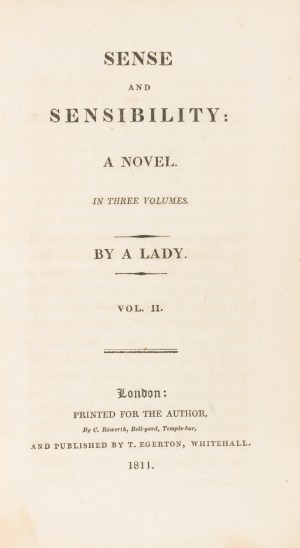
Austen, Jane. Sense and Sensibility. London: Printed for the Author and published by T. Egerton, 1811.

3 volumes, 12mo (6 3/4 x 4 in.; 172 x 104 mm). Half-titles  (with the correct length of rules as called for) in all volumes but lacking the terminal blanks in each, lower corner of B2 torn away in vol. 1, very occasional and mostly marginal faint staining throughout. Modern three quarter tan morocco and linen cloth by Sangorski and Sutcliffe, red morocco labels.

Estimate: $20,000 — 30,000. Did Not Sell

_______

Lot 86:

Pride and Prejudice: A Novel. London: T. Egerton, 1813

3 volumes, 12mo (6 3/4 x 4 1/16 in.; 171 x 105 mm). Lacks half-titles, some staining and browning throughout but less so  in vols. 2 and 3, closed tear in gutter of first text page in vol. 1 and last of vol. 3,  front endpapers lacking in last Sothebys-P&P-12-5-13volume. Contemporary half calf and marbled boards, spines with six gilt-ruled compartments and black morocco labels, a little rubbed overall, with minor wear at head of volume 1.

Estimate: $20,000 — 30,000

SOLD for $46,875.

______

Lot 87:

Sothebys-MP-12-5-13Austen, Jane. Mansfield Park. London: Printed for T. Egerton, 1814

3 volumes. 12mo (6 7/8 x 4 1/4 in.; 176 x 105 mm). Lacking half-titles but terminal blanks present, lower corner of Q3 in vol. 1 torn away, vol. 3 pg. 175 with clean tear repaired, few light stray spots to title pages, but text  unusually free from staining and browning. Near-contemporary half calf and marbled boards, spines gilt in 5 compartments, red and black morocco labels; sides rubbed, vol.1 rebacked preserving spine, upper joint of vol. 3 starting.

Estimate: $7,000 — 10,000 – SOLD for $13,750.
_______

Lot 88: 
Sothebys-E-12-5-13

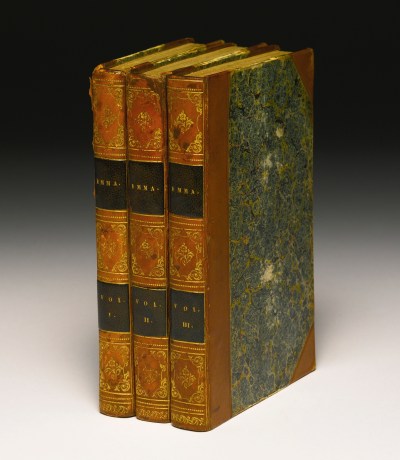
Austen, Jane. Emma: A Novel. London: Printed for John Murray, 1816.

3 volumes, 12mo (6 ¼ x 4 1/8 in.; 165 x 105 mm). Lacking half-titles; intermittent spotting and some staining, more so in vol. 2.  Near-contemporary half calf and marbled boards, spines gilt in 5 compartments with black morocco labels; some rubbing to sides and minor shelfwear along bottom edges, some skinning at top of spine ends.

Estimate: $7,000 — 9,000 – SOLD for $11,875.
_______

Sothebys-NA&P-12-5-13Lot 89:

Austen, Jane. Northanger Abbey: and Persuasion. London, John Murray, 1818.

4 volumes, 12mo (6 3/4 x 4 1/4 in.; 172 x 106 mm). Lacking half-titles; some very minor and mostly marginal spotting. Contemporary black half roan and marbled boards, spines ruled and gilt-titled; some rubbing to joints, slight wear at corners and along bottom edge, but a generally handsome set.

Estimate : $5,000 — 7,000 – SOLD for $8,125.

_______

Other items of interest at this auction:

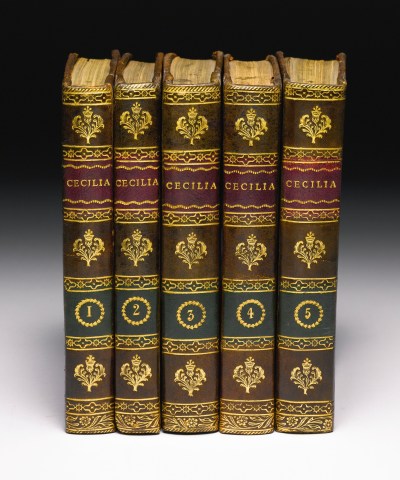
Lot 92: Love this binding!
Sothebys-Cecilia-12-5-13

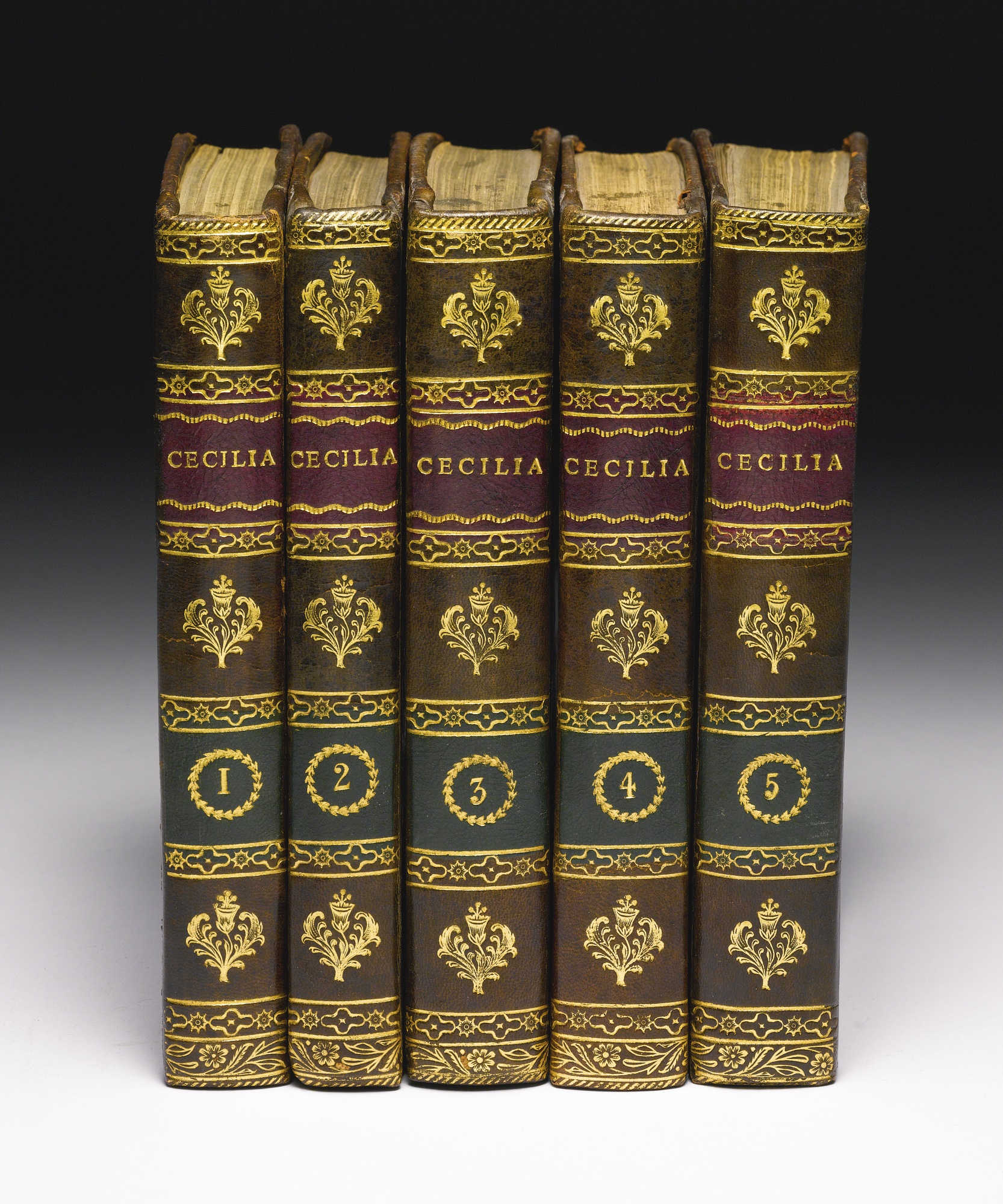
Burney, Frances. Cecilia, or Memoires of an Heiress. London: for T Payne and Son and T Cadell, 1782

5 volumes, 12mo (6 3/4 x 4 ins; 172 x 100 mm). Advertisement leaf present in first volume, vols. 2, 3, 5 lacking rear endpapers. Contemporary calf, rebacked to style with red morocco and green morocco labels.

Estimate: $2,000 — 4,000.
______

Lot 93:

Sothebys-Camilla-12-5-13Burney, Frances. Camilla: or a Picture of Youth.  London: for T. Payne, T. Cadell Jun and W. Davies, 1796

5 volumes, 12mo (174 x 102 mm). The occasional proud gathering and a few closed marginal tears to a handul leaves only. Contemporary speckled calf, single rule border to sides, spines with double-ruled compartments, green morocco labels; trace of rubbing to joints, upper joint of vol. 2 tender, but a lovely set.

Estimate: $3,000 — 5,000.
___________

Lot 96:

Sothebys-Byron-12-5-13Byron, George Gordon, Lord. Autograph verses for The Corsair. [1814].

Autograph fragment of two verses. 1 page (7 x 1 in.; 180 x 28 mm). Mounted in a portfolio with a portrait of the author; “And sad & lonely mid the holy calm /  Near Theseus’ fence y on solitary Palm.”

These two lines are the verses 1213 and 1214 of The Corsair, Canto III, published in 1814. In the edition of the Works of Lord Byron (Coleridge & Prothero, 1898-1905), the verses are: “And, dun and sombre ‘mid the holy calm, / Near Theseus’ fane yon solitary palm.”

Together with: autograph letter, signed (“Lord Byron” in third person). 1 page (8 5/3 x 6 7/8 in.; 219 x 175 mm), “13 Piccadilly Terrace, August 15th 1815”; to an unidentified correspondent: “Lord Byron presents his compliments to Mr. Juling [?] & would be glad to know if the letter of which he encloses the cover was not overcharged upon the [District?] stated on the address by the postman. The charge was thirteen pence half penny”. Formerly folded, soiling and foxing, tiny repair on the address. –Autograph address panel, cut from the address leaf of a letter addressed to his sister, August Leigh. 1 page (4 3/4 x 3 in.; 121 x 75 mm); wax seal; mounted in tinted roan folder.

Estimate: $4,000 — 6,000. 

***************

Sothebys – 10 December 2013: English Literature, History, Children’s Books & Illustrations. London

This auction includes the portrait noted above, but there a number of other offerings worth sharing: see the catalogue online where you will find a treasure-trove of children’s books and their illustrators  [Rackham, Tolkien, Potter, Robinson, Shepard, Pogany, Nielsen, Dulac, De Brunhoff, Carroll, Blyton, and more] , and also Johnson, Dickens, Pope, and Swift… and more…

Lot 284:

Sothbys-Bronte-12-10-13

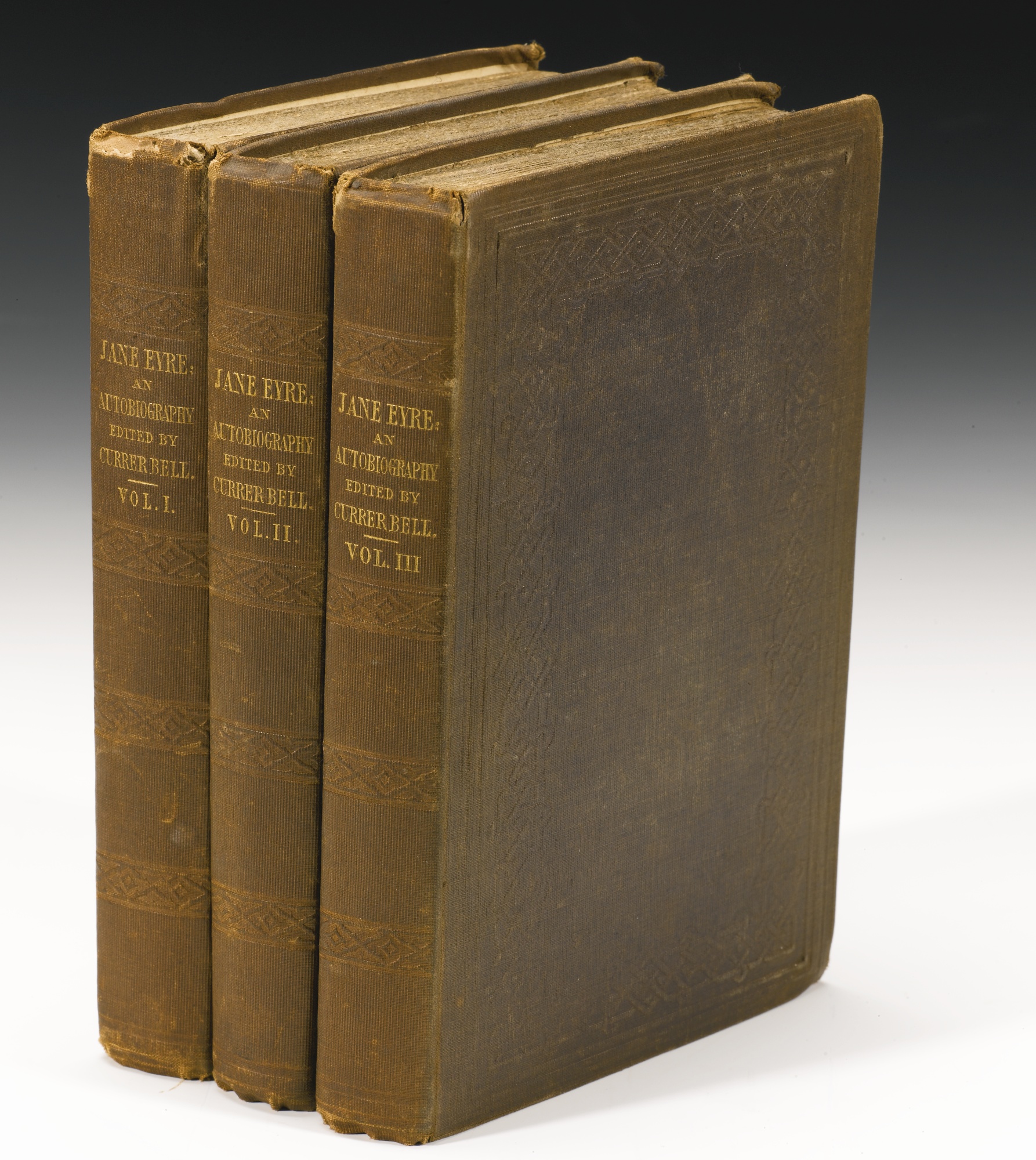
[Brontë, Charlotte]. JANE EYRE. AN AUTOBIOGRAPHY. EDITED BY CURRER BELL. SMITH, ELDER AND CO., 1847

8vo (198 x 124mm), 3 volumes, first edition of the author’s first published novel, half-titles, publisher’s 32pp. catalogue dated October 1847 at the end of volume 1, without the extra advertisement leaf present in some copies (no priority), original dark greyish reddish brown vertically-ribbed cloth, covers decorated in blind with triple line border enclosing decorative trellis-like border, pale yellow endpapers, tear to inner margin of T2 in volume 1 (not affecting text), small portion of lower outer margin of U3 in volume 2 torn away (also not affecting text), occasional foxing and browning to text leaves, lower hinges of volumes 1 and 3 starting, hinge of upper hinge of volume 2 slightly cracked, cloth at top of spine of volume 1 slightly chipped, further slight edge-wear to covers and some slight fading.

Estimate: £35,000 — 45,000 

____________

These are just fun!

Lot 219:
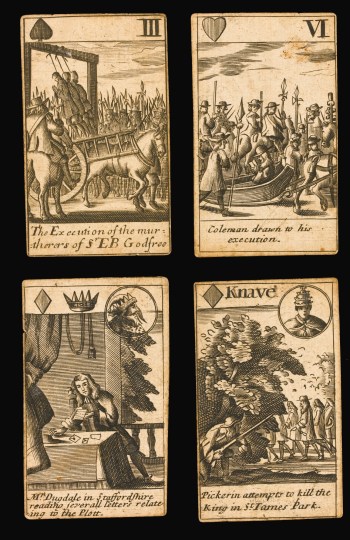
Sothebys-cards-12-10-13

Playing cards: Popish Plot cards. [LONDON: ROBERT WALTON, C. 1679 OR LATER]

52 cards, each 90 x 54mm., engraved with captions, grey patterned versos, 12 mounted in a frame, the rest in a folder attached to the back of the frame,  three cards somewhat worn (two of diamonds, ten of spades and ace of hearts), king of clubs torn with loss of club symbol.

Estimate: £2,500 — 3,000
_____

There are several other playing cards on offer as well – another example – because the images are fabulous!
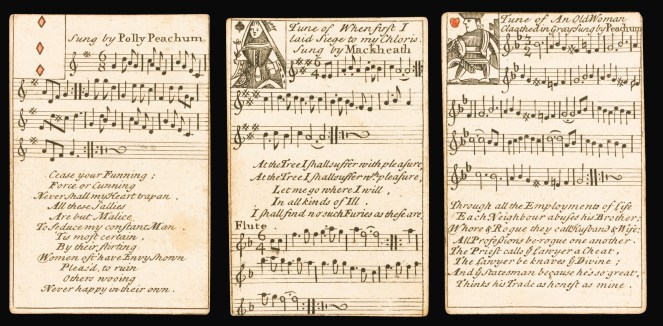
Sothebys-cards_opera-12-10-13Lot 236:

Playing cards: The Beggar’s Opera [LONDON: JOHN BOWLES, C. 1730]

52 cards, each 95 x 62mm., engraved with the hearts and diamonds coloured in red, plain versos, 13 mounted in a frame, the rest in a folder attached to the back of the frame, a few cards cut close, a few light stains

Estimate: £3,000 — 5,000

____

Lot 335:
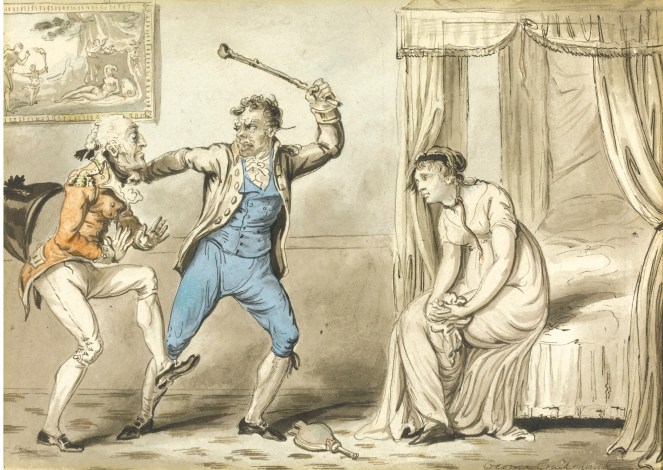
Sothebys-Cruikshank-12-10-13

Cruikshank, George. THE OUTRAGED HUSBAND.

165 by 228mm., ink and watercolour drawing, signed lower right, mounted, framed and glazed, some minor browning at extremities from former mount

Estimate: £1,500 — 2,000 

*********************

Some great items to add to your wish list! – go to the auction catalogues for even more treasures! Happy hunting [and wishing…]

C2013 Jane Austen in Vermont
Austen Literary History & Criticism · Books · Collecting Jane Austen · Jane Austen · Jane Austen Illustrators · Museum Exhibitions · Publishing History

The Folio Society’s Latest Pride and Prejudice

If you are into your holiday shopping early, or compiling your own wish-list, here is a fine start: a must-have for your Jane Austen collection:  the Folio Society’s latest edition of  Pride and Prejudice, 2013.

PP-cover-Folio2013

“I had not known you a month before I felt that you were the last man in the world whom I could ever be prevailed on to marry.” 

One of the world’s favourite books, Pride and Prejudice has long been regarded as a classic romance. In Elizabeth Bennet and Fitzwilliam Darcy, Jane Austen created the greatest pair of sparring lovers since Shakespeare’s Beatrice and Benedick. This sparkling comedy of manners features an inimitable cast of characters including the obsequious Mr Collins, the autocratic Lady Catherine de Bourgh, and Mrs Bennet, the most embarrassing mother in literature.

The award-winning Balbusso twins have contributed eight exquisite illustrations to this edition, as well as a striking cover design. The novel’s celebrated first line is blocked in gold on the slipcase. In a new introduction, the author Sebastian Faulks praises ‘a novel of almost boundless wit and charm that has withstood film and television adaptations and attempts to define it as a “fairy tale” or a “rom-com”.’

balbusso_05_pplarge

[Pride and Prejudice (Folio, 2013): image from the Balbusso website]

Details:

  • Introduced by Sebastian Faulks.
  • Illustrated by Anna and Elena Balbusso.
  • Bound in metallic cloth, blocked with a design by Anna and Elena Balbusso.
  • 352 pages.
  • Frontispiece and 7 colour illustrations.
  • Book size: 9½” x 6¼”
  • $62.50

[Text from the Folio Society Website]

********

Auctions · Austen Literary History & Criticism · Books · Collecting Jane Austen · Jane Austen · Literature · Publishing History · Rare Books

Austen on the Block! ~ Affordable Jane

The Leslie Hindman Auctioneers sale on April 10, 2013 in Chicago: Sale 239 – Fine Books and Manuscripts  [preview starts April 6] has three items of interest to collectors and readers of Jane Austen, and this time a pleasant surprise to see them in a more affordable range…

1.  Lot 319:

MP-2ded

* JANE AUSTEN.  Mansfield Park. London: J. Murray, 1816.

3 vols. 12mo, modern quarter morocco, renewed endpapers. Second edition. Lacks half-titles; 2-inch tear to title page vol. 2 restored; spines deteriorating and hinges cracked; otherwise the interior is in near fine condition with very little brownspotting.

Estimate $ 1,000-2,000.


2.  Lot 320:

Fragment

* JANE AUSTEN.  Fragment of a Novel, written January-March 1817. Now First Printed from the Manuscript [Sandition]. Oxford: Clarendon Press, 1925.

8vo, publisher’s cloth-backed blue boards, printed spine label, facsimile frontispiece. Limited edition facsimile, one of 250 copies on handmade paper. Boards lightly soiled with some loss to spine label; otherwise very good.

Estimate $ 100-200.


3. Lot 434A:

works-1882

JANE AUSTEN.  Works (COLLECTED WORKS). London: Richard Bentley and Son, 1882.

6 vols. 8vo, 3/4 maroon morocco over decorative boards, title in gilt to black leather spine labels, t.e.g. Light edgewear; otherwise fine.

Estimate $ 100-200.

__________

My note:  this last item does not offer a very comprehensive description, so I would suggest an inquiry to the auction house for more information.  This is likely the Steventon Edition that Bentley published in 1882, limited to 375 sets; size is 20.5 cm, or a small octavo (8vo), obviously rebound here; there are illustrations (those that appeared in Bentley’s original Standard Novels of 1833, and a few additional woodcuts and a facsimile of Austen’s letter to Anna Lefroy (29 Nov 1814)) – full information on the edition can be found in Gilson at D13; but again, please check with the auction house to verify that it is this edition (there was a reissue in 1886).  The interest in the Steventon Edition is that it was the last complete edition of Jane Austen’s works to be published by Bentley, her major publisher in England from 1833 to 1882, and holder of the copyrights until their various successive expiry dates.

[Images from the Leslie Hindman Auctioneers website.]

c2013 Jane Austen in Vermont
Austen Literary History & Criticism · Books · Collecting Jane Austen · Jane Austen · Jane Austen Popular Culture · Literature · Publishing History

Want List: A Miniature Pride and Prejudice from Plum Park Press

I posted several months ago about a miniature Emma, published by the bookbinder Tony Firman at his Plum Park Press. Since then I have received my very own Emma and am delighted with it:

Miniature Emma from Park Plum Press
Miniature ‘Emma’ from Park Plum Press

And now doubly delighted to hear from Tony that he is planning a similar miniature edition of Pride and Prejudice – perfect timing for this bicentenary year.  It will be another triple-decker, as was the original, in the same format and size as Emma with the same typeface. Each of the three volumes is to be published separately, in April, June, and August; the third volume will include a slipcase for the set.

Volume I and II will contain 240 pages, and 260 pages for Vol. III, all bound in a lovely soft faux leather, in a pretty butterscotch color. The endpapers will be decorated with colored illustrations from the 1907 Dent edition, four different pictures in each volume. The slipcase will be decorated with some of the same illustrations. It will be a limited edition of 15 copies. [no image is yet available]

C. E. Brock - Pride and Prejudice, Dent 1907 - Mollands
C. E. Brock – ‘Pride and Prejudice’ – Dent 1907 – Mollands

The first volume will be available near the end of April; price is $35. / volume, the complete set with slipcase, $105.  You can order either by volume as they become available or wait for the complete set in August, but with only 15 sets available, you best get your order in soon!  [There was a second edition of Emma, and there are copies still available.]

Other titles that Tony has published in this miniature format: [see his website for more information on each]

  • Priestley: Experiments and Observations of Different Kinds of Air
  • Curtis: The Botanical Magazine
  • Housman: A Shropshire Lad and Last Poems
  • Davenport: English Embroidered Bookbindings
  • Hubbard: William Morris
  • Crane: A Floral Fantasy
  • Huygens: Treatise on Light
  • Morris: A Dream of John Ball
  • Higgin: Handbook of Embroidery
  • Browning: The Last Ride
  • Blades: The Enemies of Books
  • Geikie: Geology
  • Einstein: Relativity
  • Austen: Emma
  • Wells: The Time Machine
  • Carroll: Alice’s Adventures in Wonderland
  • Lavoisier: Elements of Chemistry
  • Fitzwilliam: Jacobean Embroidery

firmanlogo
Tony Firman Bookbinding
205 Bayne Road, Haslet, TX 76052
www.TonyFirmanBookbinding.com

************************

Further reading: and if you have any questions, please comment below…

In the United States, a miniature book is usually considered to be one which is no more than three inches in height, width, or thickness. Some aficionados collect slightly larger books while others specialize in even smaller sizes. Outside of the United States, books up to four inches are often considered miniature.

 c2013 Jane Austen in Vermont
Auctions · Books · Jane Austen · Publishing History · Rare Books

Austen on the Block! ~ Jane Austen’s Emma Sells High

The first edition Emma that I wrote about here, the one with the interesting John Hawkshaw bookplate, sold yesterday (March 19, 2013) at Bonham’s London for £8,125 (inc. premium) or about $12,312. –  about in line with the original estimate at the November 2012 auction of £6,000 – 8,000  (€7,400 – 9,900;  US$ 9,500 – 13,000), and substanitally higher than the estimate for this auction: £4,000 – 5,000 (€4,600 – 5,800;  US$ 6,100 – 7,700).

Emma bonhams 3-2013

c2013 Jane Austen in Vermont
Austen Literary History & Criticism · Books · Jane Austen · Jane Austen Illustrators · Jane Austen Popular Culture · Publishing History

200 Years of Pride and Prejudice Covers

P&P cover - movie - barchasP&P penquin cover


Professor Janine Barchas has an article in this weekend’s New York Times on covers for Pride and Prejudice over the past 200  years:

The 200-Year Jane Austen Book Club

Let’s just be honest about our superficiality. Even when it comes to the high-­minded business of literature, people do judge books by their covers. Perhaps that’s why Amazon produces glossy mock “covers” for its disembodied e-books, to be inspected and decided upon alongside the traditional print offerings.

Book covers may be especially important when it comes to the classics. After all, many of us have a general sense of, if not a thorough familiarity with, the contents within. Perhaps more than anything else, these covers show what matters to prospective buyers. Two centuries of Jane Austen’s “Pride and Prejudice” are particularly revealing about the novel’s broad and sustained popular reach….

Continue reading…

– the article links to a slide-show of twelve covers here – this will be in the print edition on Sunday.

P&P peacock barchasP&P peacock barchas P&P cover - barchas 1

Austen Literary History & Criticism · Books · Jane Austen · Jane Austen Popular Culture · Publishing History

Our “First Impressions” of Jane Austen’s Pride and Prejudice

Letter 79.  January 29, 1813, Jane Austen to her sister Cassandra, from Chawton

I want to tell you that I have got my own darling Child from London; – on Wednesday I received one Copy, sent down by Falknor, with three lines from Henry to say that he had given another to Charles & sent a 3d by the Coach to Godmersham; just the two Sets which I was least eager for the disposal of.  I wrote to him immediately to beg for my own two other Sets, unless he would take the trouble of forwarding them at once to Steventon & Portsmouth – not having any idea of his leaving Town before today; – by your account however he was gone before my Letter was written.  The only evil is the delay, nothing more can be done till his return.  Tell James & Mary so, with my Love. – For your sake I am as well pleased that it shd be so, as it might be unpleasant to you to be in the Neighborhood at the first burst of the business. – The Advertisement is in our paper to day [the Morning Chronicle of January 28, 1813]. – 18s – He shall ask £1-1- for my two next, & £1-8 – for my stupidest of all. I shall write to Frank, that he may not feel himself neglected.  Miss Benn dined with us on the very day of the Books coming, & in the eveng we set fairly at it & read half the 1st vol. to her – prefacing that having intelligence from Henry that such a work wd soon appear we had desired him to send it whenever it came out – & I beleive it passed with her unsuspected. – She was amused, poor soul! that she cd not help you know, with two such people to lead the way [JA and her mother]; but she really does seem to admire Elizabeth.  I must confess that I think her as delightful a creature as ever appeared in print, & how I shall be able to tolerate those who do not like her at least, I do not know. – There are a few Typical errors – & a “said he” or a “said she” would sometimes make the Dialogue more immediately clear – but “I do not write for such dull Elves” “As have not a great deal of Ingenuity themselves.”  [from Scott’s Marmion] – The 2d vol. is shorter than I cd wish – but the difference is not so much in reality as in look, there being a a larger proportion of Narrative in that part.  I have lopt & cropt so successfully however that I imagine it must be rather shorter than S. & S. altogether. – Now I will try to write of something else; – it shall be a complete change of subject – Ordination. [p. 201-2]

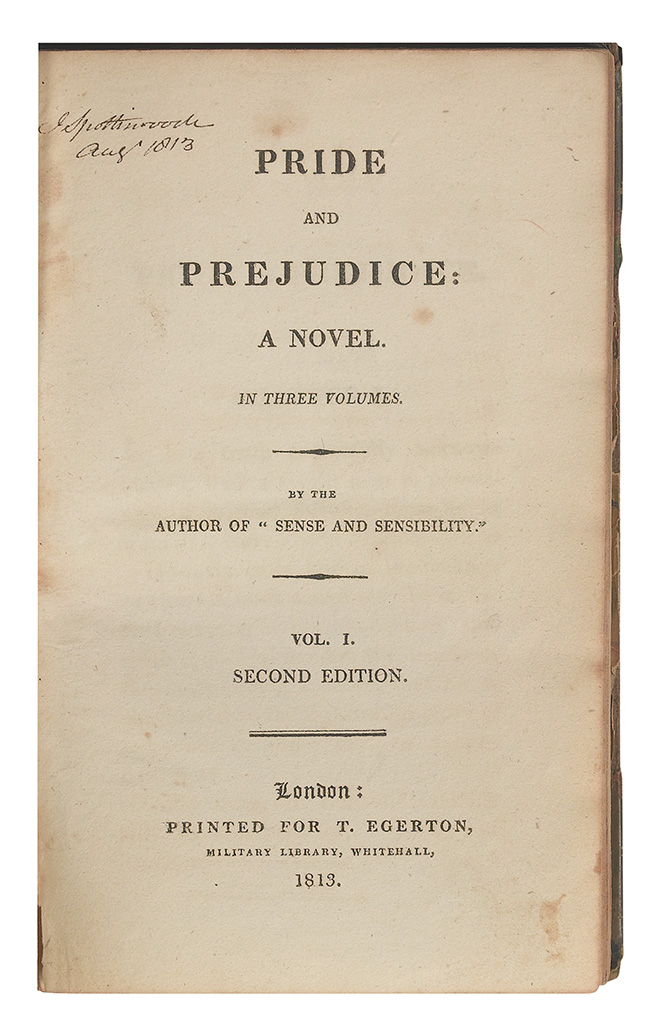
PrideAndPrejudiceTitlePageOn this day that celebrates the publication of Jane Austen’s Pride and Prejudice 200 years ago, I asked members of our JASNA-Vermont region to share a few words on what their “first impressions” were on reading Austen’s “light, bright and sparkling … own darling Child.” I will be posting throughout this year a number of thoughts on Pride and Prejudice, but today it seems more important to see what this book has done for so many of us across years and generations, how some of us moved from a force-fed dislike to just plain awe, how some of us recall that first reading as feeling the earth shift, how multiple readings have enlarged our life in immeasurable ways.

I love Jane Austen, and even I am nearly exhausted with all the hoopla about this 200th bicentenary! – numerous new books on Austen and a number specific to this work; journals and newspapers from all corners of the earth have published articles; blogs, twitter and facebook abound in it; there are special websites, conferences, festivals – I must assume that the non-Austen folk out there are quite sick of it! But the one thing I am most enjoying is the slow re-read of Pride and Prejudice in the quiet of my study – no movies, no scholarly interpretations, no internet babblings – I just want to go back to Jane Austen and closely look at every word, every sly comment, every character brought to life on the page, every laugh-out-loud moment – and try to remember the first time I read her, a teenager lost in the corner of a library discovering the beauties of the English language from such a pen as Miss Austen’s….

Here now are a number of  wonderful Pride and Prejudice memories from our JASNA-Vermont members – I have so enjoyed reading these, so hope you do too – and then please share yours with us in the comment section below…

************************

Believing Elizabeth: My First Reading of Pride and Prejudice 

I was in the middle of Spring final exams, my third year at the City College of New York when I read Pride &  Prejudice  for the first time. I turned to it for relief because my exams were felt endless and relentless and I was desperate to read something, anything which wasn’t school work. I had fallen in love with Jane Eyre at age 16 and I was aware of the name Jane Austen. The phrase ‘pride and prejudice,’ was like ‘war and book cover janeeyrepeace,’ an esteemed part of the language.

Around the corner from where I lived there was a warm, dark paneled public library called The Ottendorfer; it was either an old mansion or had been built to look and feel like an old mansion. So there I went, found Pride & Prejudice and was hooked from the first line.

In this first reading I saw the world completely as Elizabeth was seeing it. This meant that when Wickham told the story that outraged Elizabeth I heard it as she heard it, with outrage. Farther on in the novel I was as shocked as she was when I learned that Wickham was a liar and a scoundrel.  My exams were finally over, a year later I graduated and life happened. When I next picked up Pride & Prejudice – many years later – I understood with some sadness that I could never again read it with that unconscious merging naivete.

-Michele C.

****************

I didn’t read Pride and Prejudice until I was 40, more than a decade after finishing everything Georgette Heyer had written. I had been enchanted with the words and manners of Heyer’s characters, often thinking that I might have been quite content to live in their society. And with Heyer I could always count on laughing out loud. In desperation when there were no Heyers left, I even tried writing my own, but got only half way through the second chapter.

book cover - grand sophyCollecting books has always seemed the most natural thing for me and I bought a three-volume set of Austen along with a similar set of Bronte, thinking I couldn’t go wrong with something routinely labeled a classic. Trying a Bronte first, all six were immediately relegated to a distant corner of my brain if not a distant corner of my library.

I don’t remember what prompted me, years later, to finally reach for Pride and Prejudice, but I knew on page one that it was perfect. Heyer had been only an appetizer; this was Christmas dinner. As they say, life begins at 40!

Now, more than 20 years further along, I’ve discovered happily that I’ve forgotten enough of Georgette Heyer’s books to reread them with pleasure. But the real magic is that I don’t have to wait until I forget a plot to reread Jane Austen. I can start right over again and slip comfortably into a world I know well and always find a new delight. And I’m still laughing out loud.

-Susanne B.

***********

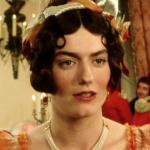
I believe I first read P&P in 1996. I had watched P&P 95 on video, as well as the movies for S&S and Emma. Alas, I can’t remember which came first. I love sweet Jane Bennet, especially when played by Rosamund Pike in 2005.  I wish I could be a 10th as good as sweet Jane Bennet.

Cheers!

Kirk C.

pike - bennet - tumblr

*****

Pride and Prejudice has provided ongoing lessons in my life.  I am seeking yet another lesson from this story.  I met someone recently, and my first impression of this person was very unsettling. I found myself quick to judge and assumed things about the person, due to behavior I observed. I am seeking ways to better understand this person, who may be an extended part of my life for a long time. Being open to possibilities of accepting his person will take time and understanding. The following exchanges from the book give me hope that my first impressions may not remain as they are, at present.

I look to Elizabeth Bennet, whose initial thoughts of Mr. Darcy, changed dramatically in the plot of Pride and Prejudice. Elizabeth is touring Pemberly with housekeeper, Mrs. Reynolds, along with her aunt and uncle, the Gardiners. Mrs. Reynolds says of Mr. Darcy, “I have never had a cross word from him in my life, and I have known him ever since he was four years old.” Elizabeth’s own thoughts of Mr. Darcy begin to shift:

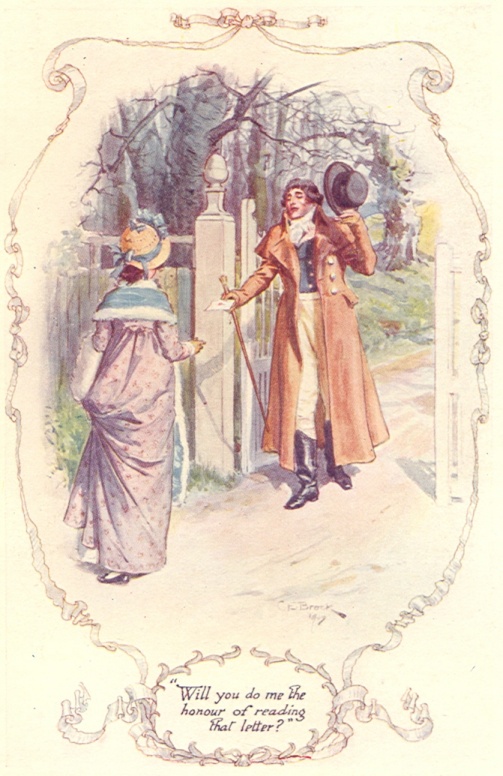
eliz reynolds 1995p&p

“This was praise, of all others most extraordinary, most opposite to her ideas. That he was not a good tempered man, had been her firmest opinion. Her keenest attention was awakened: she longed to hear more, and was grateful to her uncle for saying, “There are few people of whom so much can be said. You are lucky in having such a master.”

“Yes, sir, I know I am. If I was to go through the world, I could not meet with a better. But I have always observed, that they who are good-natured when children, are good-natured when they grow up: and he was always the sweetest-tempered, most generous-hearted, boy in the world.”

“Elizabeth almost stared at her. “Can this be Mr. Darcy!” thought she.

“His father was an excellent man,” said Mrs. Gardiner.

“Yes, ma’am, that he was indeed; and his son will be just like him- just as affable to the poor.”

“Elizabeth listened, wondered, doubted, and was impatient for more.”

A few pages later in the book, Mr. Darcy returned home a day early, and encountered Elizabeth, her aunt, and uncle, on the grounds at Pemberley. Darcy held his composure and spoke kindly with the party. Elizabeth was overwhelmed after the initial meeting.

“She blushed again and again over the perverseness of the meeting. And his behavior, so strikingly altered-what could it mean? That he should even speak to her was amazing!-but to speak with such civility, to enquire after her family? Never in her life had she seen his manners so little dignified, never had he spoken with such gentleness as on this unexpected meeting. What contrast did it offer to his last address in Rosings Park, when he put his letter into her hand! She knew not what to think, nor how to account for it.”

I’m hoping for greater understanding in this new relationship.

-Barb F.

******

carolinebingleyI first read P&P at a time when I could be said to have been “on the marriage mart”—I had just graduated from college and was deciding where to go from there. My mother was no Mrs. Bennet, but still the push to marry young (coming not so much from her as from the social standards of the time) was strong.

As I saw it, the two main approaches outlined in the book were 1) Elizabeth Bennet’s, in which a woman holds to her own views and doesn’t dismiss her feelings or trim her remarks and actions to fit the goal of catching (tricking actually) and marrying the most eligible man of her acquaintance whether she likes him or not, and would much rather be a despised spinster than to settle for a marriage void of love and respect; and 2) Caroline Bingley’s, in which a woman tracks, traps, and bags her prize using whatever means necessary, with no thought given to the probability that she’s also trapping herself in a lifetime of mutual loathing between herself and the man whose proposal she’s so desperate to win. Integrity versus flattery and deceit.

Two extremes, sure, but the contrast is a helpful reminder when navigating among the shoals on the way to finding a life partner—or indeed when working toward any kind of goal.

-Donna G.

*****

book cover - emmaI first ready P&P in 10th grade English class for a book report…my teacher had recommended it to me. I don’t remember much from that first reading, except that I did enjoy it. I’ll be giving away my age, but that was in the 1960’s. In 1992, we moved just outside London for about 2 years, and I stopped in the local bookshop for something to read. I prefer better literature, and they had a display of all of Jane Austen’s works. I remember thinking that I had enjoyed P&P, but I chose Emma, not knowing anything about it. I couldn’t put it down and read it so fast, I turned right around and read it a second time in 2 days, much slower the 2nd time. Then I chose Persuasion, and then the rest of the novels, and love some of the stories in the book of her juvenilia. I love her History of England! I couldn’t get enough of them and have since read all them at least 3 times and get something new from them every time.

I was able to visit Chawton, Lyme Regis, and Winchester Cathedral. I’ll always cherish my time in England. Living there certainly has given me new insight into the locations of Jane’s novels.

Now I keep the books in various places around the house so I can always pick one up to read again or peruse my favorite passages. In P&P, my favorite part is when Elizabeth is reading Mr. Darcy’s letter and the descriptions as she realizes she’s made a big mistake and is starting to change her mind. I find that an incredible piece of writing.

-Phyllis G.

*****

Pride & Prejudice was the first high school play I was in at a small Catholic academy for girls on the upper east side in NYC. There were 20 students each class, total 80 students in the high school. It was in my freshman year and it was the play before Christmas. The year was 1956 and I was 13 years old.

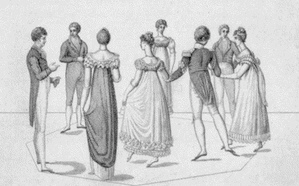
Although the stage was small, the production was opulent enough. I had a non-speaking role as a minuet dancer at an assembly. I wore a perruque, a beautiful blue ball gown, carried a reticule and sported a beauty spot. My partner was another girl in white stockings, silk breeches and waistcoat and dancing slippers. We wore lots of makeup which was professionally applied. It was a complete minuet lasting several minutes. I enjoyed rehearsals immensely and we dazzled the audience. We had only two performances.

dance

I never got the chance to watch the whole play but I did rehearse lines with the senior girl, Sheila C., all of 17 or 18 years old, who played Elizabeth Bennet. We travelled home on the same hour long subway ride to the Bronx. We were both academic scholarship students. I would give her the cue from the sides. When you rehearse from sides you get only the lead in line. So I would say, “….but he believes that it was left to him conditionally only.” Sheila-Elizabeth replied, “I have no doubt of Mr. Bingley’s sincerity, but you must excuse my not being convinced by assurances only. Mr. Bingley’s defense of his friend was a very able one, I dare say; but since he is unacquainted with several parts of the story, and has learnt the rest from that friend himself, I shall venture to still think of both gentlemen as I did before.”

Did we have an audience as we stood on the subway train dressed in our blue uniforms, white blouses, white gloves, blue, ground gripper shoes and blue hats? I don’t remember because I was so transfixed by what Elizabeth said and how Sheila’s skin changed color from pale to pink as she spoke the lines so forcefully. That following summer I would read P&P for the first time, but nothing can compare to the full dose of Elizabeth Bennet given to me by a senior girl whom I stood in awe of and who befriended me so kindly albeit with a good dose of arch humor.

(I’m enjoying rereading P&P and it’s fun to take part in this 200th celebration)

-Margaret H.

*****

book cover -P&P penguinI found Pride and Prejudice in a local bookstore when I was in high school.  It was my first reading of Austen, and I soon decided that this book was different.  From that reading, I have been in awe of Austen’s ability to create characters. What stood out for me as a teenager was the description of Elizabeth’s dawning self-awareness over many chapters.  At the mid-point of the novel, for example, she must grapple with Mr. Darcy’s letter:   “…she was in a fair way of soon knowing [the letter] by heart.  She studied every sentence; and her feelings towards its writer were at times widely different.  When she remembered the style of his address, she was still full of indignation; but when she considered how unjustly she had condemned and upbraided him, her anger was turned against herself…” Here, and throughout the novel, Austen never rushes to get to her point.  Many years later, I am still in awe!

-Lynne H.

*****

I once read a single passage of Pride and Prejudice and Zombies in a bookshop which lingers in memory and bookcover - P&P zombiessomehow makes me love Jane Austen’s original all the more. Don’t ask me if I remember it right; I don’t care. I didn’t buy the book. But what I recall is one blissful moment when Jane and Elizabeth launch themselves at Mr. Collins and tear out his throat.

Isn’t that secretly what we all long for?

-Stuart B.

*****

By the time I was 12 years old I had become an ardent fan of the works of Georgette Heyer. I don’t remember if I swooned over the romance or the costume descriptions and hilarious cant, but I do remember being intrigued with Heyer’s version of the Georgian and Regency world. I was happy, therefore, to find out that there was ‘another writer’ who wrote about this time period—and one that had actually lived in it. This Jane Austen person would surely make for a fun read. I found Pride and Prejudice. I now admit, to my secret shame, that I found it overlong, too wordy, with heavy-handed irony, and rather too slow a pace. I even tried a couple more Austen’s to no avail.

18120pelisse-carriage-walking-coat

Fortunately I gave her one more try, this time in a literature course in college. Thank goodness! I had grown up just enough in the intervening years to realize that P&P was not long at all, had just the right amount of irony, lots more subtle wit, and was paced to perfection. My only complaint at that, and subsequent, readings was that it was too short! I could have spent much more time among the residents of Longbourn (and Mansfield, and Highbury and…). And as I am sure so many have found, subsequent readings always bring something new.

-Hope G.

*****

pride_and_prejudice12

I first tried reading P&P when I was in the eighth grade.  I knew it was a “classic,” but I found it terribly dull.  I decided to try again when I was sixteen, and this time I saw all of the humor that I had missed in my first attempt.  That was it–I was hooked!  It’s still my overall favorite of JA’s books.

-Christie M.

*****

With varying degrees of intensity, all of Jane Austen’s novels are propelled by her almost unerring instinct for counter-balance in a scene. Rarely does Austen’s passionate story-telling NOT pair satire with fear, or irony with kindness, or absurdity with melancholy, or self-knowledge with self-deception. With a razor-sharpened pen and a delicately calibrated scale, Austen dissects and weighs the hearts of her characters as they do battle with the expectations of their closely-knit societies.

balancing scale can-stock-photo

In Austen’s earlier novels, the tone tends toward lightness. Her later works more heavily embrace the seriousness of the human condition. In the deftness of PRIDE & PREJUDICE we see Austen performing her most virtuosic balancing act: each barb is followed by a balm.

Because of this ameliorating rhythm, we may first worry, but we ultimately smile as we ponder her tale about the indignities faced by women who are NOT in possession of a good fortune, but who are VERY much in want of a husband.

-Nan Q.

*****

Loving Pride and Prejudice

I’m not going to lie and say I loved Pride and Prejudice the first time I read it. I was a senior in high school and just didn’t get what the fuss was about. What I did understand, however, was that my English teacher loved Jane Austen. Even after I went to college and became an English major, Ms. Henry remained my favorite English teacher and her love of Austen forever put those six novels on my radar. Like so very many of us, I am indebted to a teacher’s passion and enthusiasm.

It’s true that now that I love Pride and Prejudice best of Austen’s novels and of nearly all others entirely. It has become the standard against which I compare much of what I read. I happen to love its “bright and sparkling” quality and the packed action of “one country village.” There’s something about her work that makes my life better because I’ve read it.

My love for Jane Austen’s work has led me to join JASNA and to book a weekend at a bed and breakfast here in Vermont with the weekend focus of this great novel. I can’t wait to discuss Pride & Prejudice over afternoon tea and maybe play a little trivia. I get what the fuss is about, finally, and it never gets old.

Jane Austen weekend at Governor's House
Jane Austen weekend at Governor’s House

I love this line by Caroline Bingley: “To walk three miles, or four miles, or five miles, or whatever it is, above her ancles in dirt, and alone, quite alone! what could she mean by it? It seems to me to shew an abominable sort of conceited independence, a most country town indifference to decorum.”

Michelle S.

*****

carriage ride

Mr. Collins is certainly not my favorite character (!) ….but Elizabeth, of course, is. I was moved by her strength, wisdom and insight when I first encountered her in Freshman English…and then I became an even greater admirer more than 60 years later when I made her acquaintance once again…..this time via an audio recording as I made daily automobile trips around Vermont this past summer.

-Sallie S.

*****

When I was twelve, my mother gave me a beautiful edition of “Pride and Prejudice” with leather ends and sprigged wall paper covers; it isp&p pantheon - etsy charming.  I read it then with the intellect of a twelve year old and re-read each year unto my current 75th year with delight, awe and the greatest pleasure.  My husband, of fifty five years, held the Darcy conversation, sprightly, ironic, engaged and bountiful, to my Elizabeth, for fifty-five years. I have been enriched on both counts.  Each of my granddaughters has a beautiful copy to read when she is ready.   I spoke of Austen often during forty years of my teaching life. Bravo for Miss Austen.

-Sarah M.

*************

The following comments were made on the blog post on Susannah Fullerton’s new book Celebrating Pride and Prejudice, all telling of first reading Pride and Prejudice: I love all these stories! – please tell us yours!

artprintimages.com
artprintimages.com

ladysusanpdx: I first read Pride & Prejudice when I was 13, when my grandmother gave it to me. Seeing how struck I was by the story and especially Elizabeth Bennet, my father surprised me by letting me stay up very late to watch the 1940 movie version with Greer Garson and Lawrence Olivier. That was 50 years ago and it remains my favorite novel and an important part of my life.

Stefanie Henry: Although I teach Pride and Prejudice every year, I never grow tired of discovering some unknown nuance, and I always enjoy the faces of my students as they fall in love. The classes celebrate Austen by preparing and dressing for high tea. Hopefully, my love of Austen will continue to inspire students to read more and more.

Sharon Henson: I was an avid reader from the moment that letters formed words for me, but I didn’t have to read Austen in high school–or in college. I picked up Pride and Prejudice while living in London, England, where my husband was a Fulbright Scholar. From then on I was hooked, reading the rest of Austen’s books, and seeing all of the films based on her books. I’ve read books based on her characters, and various biographies on Austen and, still, over 40 years later, can’t get enough Austen.

Oloore: Actually my first experience with P&P ever was watching last 5 minutes of episode 4 in mini- series of 1995 when I was 13 or 14. Those 5 minutes intrigued me so much, that I watched all the remaining episodes and then went in search for the original. I remember reading it the same year during my summer vacation. I loved everything about the book, its plot and style, its heroes and heroines, and since that time P&P has become the best love story for me: witty, humorous, illustrative of different human characters, satisfying and with wonderful happy end. After P&P I read other works by Jane Austen, and some of them I liked, some of them I liked very much, but P&P was and still remains the best for me.

P&P 1995

Mary Preston:I can’t remember the very first time I read PRIDE AND PREJUDICE. It’s been a very long time. What I do know is that I appreciate it more with each reading.

Pinterest - JA International
Pinterest – JA International

Monica: I also can’t remember when I read P&P for the first time. I must have been in my early teens and it was an Italian translation. Maybe it didn’t make a great impression on me then. I reread it later and read also the other Austen novels and liked them very much. I have just reread P&P to celebrate this bicentenary and am really enjoying all the attention it is currently receiving. I will definitely read Celebrating Pride & Prejudice!

esolender: First time? Well, I was 15, I think, when my mother gave P&P to me for a second time — I had tried it once at 12, was too young, and left it unfinished. But this time, I read it through, loved it and then gulped down the additional five — all in one insatiable summer treat. Couldn’t get enough Jane so I read P&P a SECOND time that magical summer. But it was the THIRD reading —in college at age 17— that was truly a revelation: It was as if I were reading an entirely new and wonderful novel. That’s because I was two years older, brought more to the reading, and saw nuances and wit and wonder that I had missed the first time. It was also because Jan Ferrers Weeks (later Thaddeus) was my guide through the novel this time in freshman English at Barnard. I suspected —accurately, it turned out— that I could read it again and again with pleasure — and shall again this celebratory year.

Tanya:  Oh I would love to win a copy of this book – I just saw notice of it on Amazon yesterday and HAVE to have it. I adore Jane … all things Jane. Pride and Prejudice is well, tops! I design needlework inspired by Miss Austen’s novels. Never can get enough out of such few books!!I actually put a free pattern on the blog today to also mark the 200th Anniversary of this wonderful novel, P&P. If you do needlework, please do stop by and print a copy of it for your stitching basket: http://atthehoneysuckletree.blogspot.com/2013/01/literary-love-2013-souvenir-of-1813.html

Katherine:  I also can’t remember the first time I read P&P. I do remember the first time I read it critically (as literature, not strictly entertainment) – in a class on the English Novel in college. My professor considered Jane the greatest of English novelists, with which I heartily agree. I would love to have a copy of this book!

Ruth B.: My friend thinks that the first line of P and P is one of the best known of all  first lines. I agree with her and know that it is certainly MY favorite first line. I will be happily reading your book soon, I hope. It sounds fantastic.

gongjumonica: A question for Susannah. If you could change a scene in Pride and Prejudice, what would it be and why?

book cover - celebrating P&P- fullerton

Susannah Fullerton: It has been fascinating to read about the first reading of P & P for other people. We are all so lucky to have had our lives enriched by this book. Gongjumonica asked me if there was any scene I would change. The answer is NO, I do not want to change any scene at all. I adore it just as it is. Does anyone else think any scene should be changed? I do hope that whoever wins my book loves reading it.

Felicia: I remember the first time I read Pride and Prejudice, I just loved Elizabeth Bennet so much, I wanted to be her. It was not until the second reading that I truly appreciated Mr. Darcy. Maybe I was too prejudice?? :)

Tiffany:  I first read P&P in 8th grade… I remember desperately wanting to be a Bennet – crazy family and all. I agree with Felicia – Mr. Darcy didn’t catch on until I was a little older :).

A. Marie:  It was the summer I turned 16. I was at a low ebb, for various reasons: the usual too homely/too bright teenager angst, plus serious family dysfunction (frankly, the Bennets looked pretty good to me at that point). In addition, I’d just read Eugene O’Neill’s Long Day’s Journey into Night because someone thought I should, and I felt about the way anyone feels after reading that one. So I happened to pick up the battered old Everyman P&P that had belonged to my step-grandfather (bless you, Grandpa Bill, for throwing me a lifeline!). I was instantly hooked. I remember thinking before I finished the first chapter, “Jeez, I didn’t know it was OK to be funny in the early 19th century,” and I finished the book before bed that night–not just to find out whether Elizabeth and Darcy finally got together, but because I was completely drawn in and along by the language. And I still am, after too many readings to count.

Hugh Thomson - Elizabeth Bennet
Hugh Thomson – Elizabeth Bennet

Danielle C.: I fell in love with Austen when I was a young girl. I have found that as I got older and understood more about love and life I now fully appreciate what a great writer she was. Can’t wait to read this book.

Lúthien84: My mum introduced it to me when I was 12. She borrowed an abridged edition and having nothing else to do because school’s over and it was the holidays, I decided to read it. I’m joining the P&P 200th Anniversary blog hop party organised by Alyssa Goodnight so stop by on my blog to read my experience on Monday. I’ll also be giving away a copy of an Austenesque novel. Hope to see you there.

Kim W.: I came to Jane Austen late in life–I was in my early thirties when I started enjoying her movies–Emma was my first!!–and then my mid thirties when I started to read her books. Pride and Prejudice was the first book I read, which I got out of the library, and I was so surprised how easy it was to read! No memories of hard assignments by my 9th grade English teacher here!! I think that if I had met Jane earlier in life and understood her gentle sisterly advice, I could have avoided a lot of heartache. She is a truth teller even 200 years later!! Fingers crossed and Huzzah! for the publication of Ms. Fullerton’s book!

********

P&P - peacock cover

********

Thank you one and all for sharing your Pride and Prejudice stories! – would love to hear from others, so please comment below on:

  • 1. when you first read P&P and what it meant to you at the time / or how subsequent readings have influenced your life; or,
  • 2. your favorite passage from the book and why; or,
  • 3. thoughts on your favorite character in P&P and why.
  • Or, all three of the above!

Note: I will continue to post on Pride and Prejudice throughout 2013: next up will be “Places of Pride and Prejudice: St. Clements”, so stay tuned!

 c2013, Jane Austen in Vermont
Austen Literary History & Criticism · Books · Jane Austen · Jane Austen Circle · Jane Austen's Letters · Literature · Publishing History

Jane Austen’s ‘own darling Child’

Gentle Readers: This year we have just entered upon will be a long and interesting 365 days of celebrating the 1813 publication of Pride and Prejudice ! There are festivals, conferences, blog postings, reading challenges, and already many newspaper and journal articles on this timeless work by Jane Austen.  I would like to start off my own celebration of this beloved classic with repeating a post I wrote two years ago, where I had pulled together all the references that Austen makes to this, her “own darling Child,” in her letters.  It makes fascinating reading to “hear” her…
pp-christies-12-7-12
The publishing history of Pride and Prejudice, Jane Austen’s most popular book, then and now, is an interesting study in the book trade of early 19th century England.  First completed in 1797 (and called First Impressions) and rejected by the publisher her father took the manuscript to, Austen reworked her draft over time and submitted it to Thomas Egerton, the publishing house of her Sense & Sensibility, in 1812 (it was published on January 28, 1813).   She sold the copyright outright for £110, and did not incur other expenses in its publication, as she did in the three other works published in her lifetime [see links below for more information.]  How we would love to know her thoughts on this road to publication! – how we would love to have her letters written while in the process of the writing to give us some idea of her imagination at work – where WAS the model for Pemberley?  was Mr. Darcy someone REAL?  was Elizabeth Bennet her alter ego? was MR COLLINS drawn from life? – or to have the letters to her brother Henry and his to Egerton – but alas! we have very little, just a few comments scattered among the surviving letters.
Austen Literary History & Criticism · Books · Collecting Jane Austen · Jane Austen · Jane Austen Popular Culture · Publishing History

All I Want for Christmas? ~ Anything Jane Austen Please! ~ Day 1: A Miniature edition of Emma

I begin today a run through the next 12 days of the Christmas Season with some thoughts on gifts for your favorite Austen fan or gifts to add to your own “Want-List” – if you have been “nice” and not naughty all year [please do check Henry Tilney’s dispute over the meaning of the word in Vol. I, ch. 14 of Northanger Abbey], you might find some of these under your tree!

Day 1. A miniature edition of Emma, from Plum Park Press  [see update on a second printing below!]

Continue reading “All I Want for Christmas? ~ Anything Jane Austen Please! ~ Day 1: A Miniature edition of Emma