Auctions · Austen Literary History & Criticism · Books · Jane Austen · Jane Austen Circle · Literature · Rare Books

Austen on the Block! ~ An Austen-Filled Autumn at Upcoming Auctions

UPDATE: Prices realized noted in red as they become available

There are a number of Jane Austen materials coming up for auction in the next few weeks, some actually affordable! – and then some, not so much…  here are brief synopses – visit the auction house websites for more information.

This one is a bit different and an interesting addition to anyone’s Pride and Prejudice collection!

November 18, 2012. Heritage Auctions, Lot 54353. Pride and Prejudice 1939 Movie photographs:
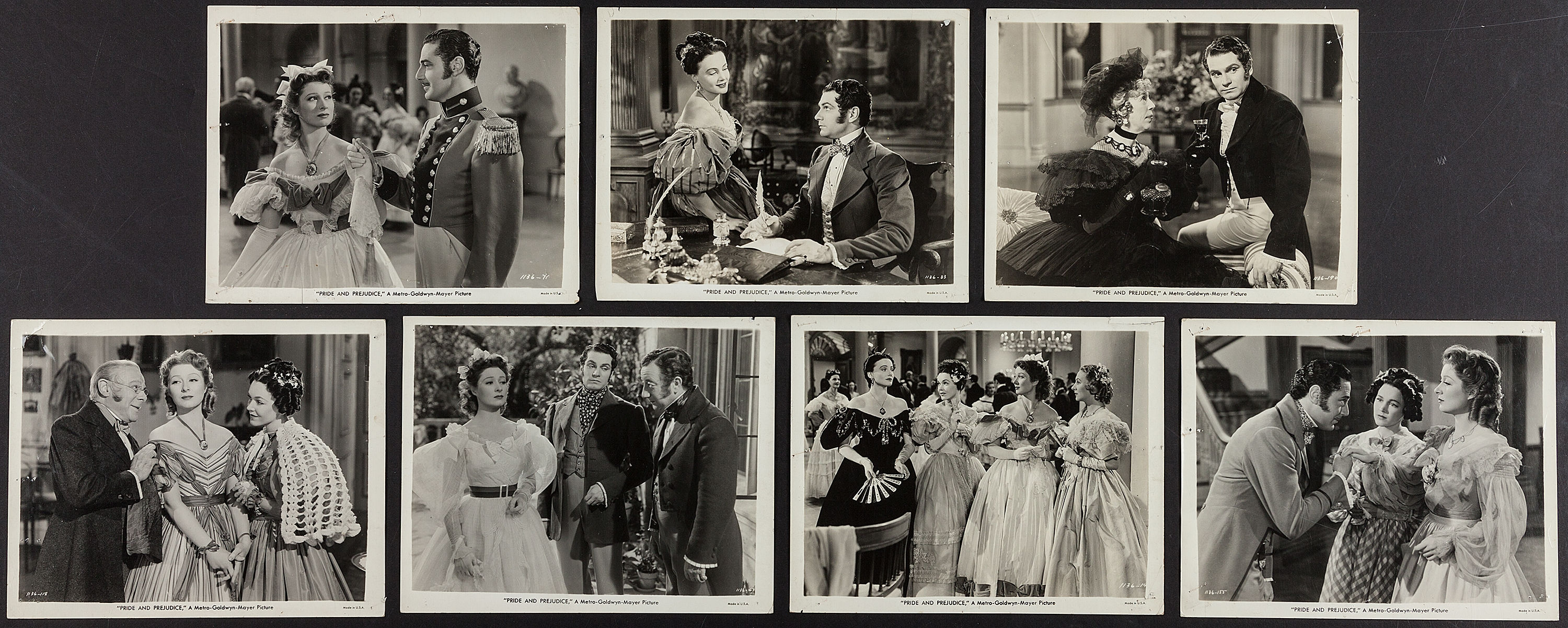
Pride and Prejudice (MGM, 1939). Photos (16) (8″ X 10″). Drama.

Vintage gelatin silver, single weight, glossy photos. Starring Greer Garson, Laurence Olivier, Mary Boland, Edna May Oliver, Maureen O’Sullivan, Ann Rutherford, Frieda Inescort, Edmund Gwenn, Karen Morley, Heather Angel, Marsha Hunt, Bruce Lester, Edward Ashley, Melville Cooper, Marten Lamont, E.E. Clive, May Beatty, Marjorie Wood, Gia Kent. Directed by Robert Z. Leonard.

There are 14 different photos with a duplicate each of 1136-190, and 1136-149; unrestored photos with bright color and a clean overall appearance. They may have general signs of use, such as slight edge wear, pinholes, surface creases and crinkles, and missing paper. All photos have a slight curl. Please see full-color, enlargeable image below for more details. Fine.

SOLD $179.25 (incl buyer’s premium)

 **********************

November 18, 2012.  Skinner, Inc. – Fine Books and Manuscripts, Boston. Sale 2621B

Lot 208:  Austen, Jane (1775-1817). Letters. London: Richard Bentley & Son, 1884. 

Octavo, in two volumes, first edition, edited by Edward Knatchbull-Hugessen, first Baron Brabourne (1829-1893), in publisher’s green cloth, ex libris Henry Cabot Lodge, with his bookplate; preliminaries in volume one a bit cockled, with some discoloration.

Jane Austen’s letters speak for themselves: “Dr. Gardiner was married yesterday to Mrs. Percy and her three daughters.” “I cannot help thinking that it is more natural to have flowers grow out of the head than fruit? What do you think on the subject?”

Estimate $300-500. SOLD $250. (incl buyer’s premium)

*****************

Lot 4 : AUSTEN, JANE. Northanger Abbey. Volume 1 (only, of 2). 12mo, original publisher’s drab boards backed in purple cloth (faded to brown), lacking paper spine label, edgewear; text block almost entirely loose from spine, few binding threads and signatures loose, several leaves in first third heavily creased, few other margins creased; else quite clean overall. Philadelphia: Carey & Lea, 1833

FIRST AMERICAN EDITION AND ONE OF 1250 COPIES. In need of some repair, but complete and in original cloth. All First American Editions of Austen are difficult to find. Later printings of this title did not occur until 1838, as a one-volume collected edition and, as a single volume in 1845. Gilson B5.

Estimate $500-750. SOLD: $600. [incl buyer’s premium]

**********************

This is the big one!

November 21, 2012. Christie’s. Valuable Manuscripts and Printed Books. London.  Sale 5690.
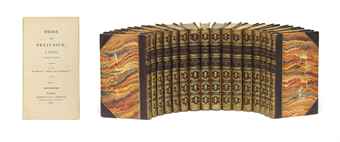
Lot 150:  AUSTEN, Jane (1775-1817). Sense and Sensibility … second edition. London: for the author by C. Roworth and published by T. Egerton, 1813. 3 volumes. (Lacks half-titles and final blanks, some browning and staining.) Gilson A2; Keynes 2.

Lot Description

AUSTEN, Jane (1775-1817). Sense and Sensibility … second edition. London: for the author by C. Roworth and published by T. Egerton, 1813. 3 volumes. (Lacks half-titles and final blanks, some browning and staining.) Gilson A2; Keynes 2.

Pride and Prejudice. London: T. Egerton, 1813. 3 volumes. (Lacks half-titles, lightly browned, a few leaves slightly torn along inner margin or with fragments torn from outer margin, margin of B10 in vol. I a little soiled, title of vol. III with slight stain at bottom margin, quires I and M in same vol. somewhat stained.) FIRST EDITION. Gilson A3; Keynes 3.

Mansfield Park. London: T. Egerton, 1814. 3 volumes. (Lacks half-titles, without blank O4 in vol. II or final advertisement leaf in vol. III, weak printing impression affecting 3 lines on Q10r.) FIRST EDITION. Gilson A6; Keynes 6.

Emma. London: John Murray, 1816. 3 volumes. (Lacks half-titles, E12 of vol. I misbound before E1, tear to bottom margin of E7 in vol. II, other marginal tears, L7-8 of vol. II remargined at bottom, title of vol. III with closed internal tear, some spotting, staining and light soiling.) FIRST EDITION. Gilson A8; Keynes 8.

Northanger Abbey and Persuasion. London: John Murray, 1818. 4 volumes. (Lacks half-titles and blanks P7-8 at end of vol. IV, some browning and spotting.) FIRST EDITION. Gilson A9; Keynes 9.

Together 6 works in 16 volumes, 12° (177 x 100mm). Uniformly bound in later 19th-century black half morocco over comb-marbled boards, marbled endpapers and edges (vol. I of Mansfield Park with scuffing at joints and upper corner of front cover).

Second edition of Sense and Sensibility, ALL OTHER TITLES IN FIRST EDITION. A rare opportunity to purchase the six most admired novels in the English language as a uniformly bound set. (16)

Estimate: £30,000 – £50,000 ($47,610 – $79,350) SOLD: £39,650 ( $63,004) (incl buyer’s premium)

**********************

November 27, 2012. Bonham’s. Printed Books and Maps. Oxford. 19851.
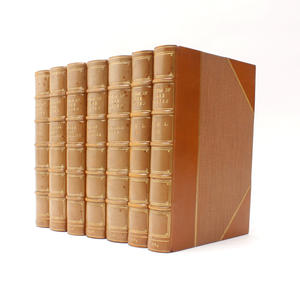
Lot 26:  AUSTEN (JANE) The Novels…Based on Collation of the Early Editions by R.W. Chapman. 5 vol., second edition, Oxford, Clarendon Press, 1926; together with The Letters of Jane Austen, 2 vol., frontispieces, uniform half calf by Hatchards, gilt panelled spines, faded, 8vo, Richard Bentley, 1884 (7)

Estimate: £300 – 500 ( US$ 480 – 810); (€380 – 630) – SOLD: £525  ($844.) (incl. buyer’s premium)

**************************

December 7, 2012. Christies. Fine Printed Books and Manuscripts Including Americana. New York. Sale 2607.

 Lot 140: [AUSTEN, Jane (1775-1817)]. Pride and Prejudice. London: Printed for T. Egerton, 1813.

Lot Description:

[AUSTEN, Jane (1775-1817)]. Pride and Prejudice. London: Printed for T. Egerton, 1813.

Three volumes, 8o (171 x 101 mm). Contemporary half calf and marbled boards, spines gilt-ruled, black morocco lettering pieces (a few stains and some rubbing); cloth folding case. Provenance: H. Bradley Martin (bookplate; his sale Sotheby’s New York, 30 April 1990, lot 2571).

FIRST EDITION. Originally titled First Impressions, Pride and Prejudice was written between October 1796 and August 1797 when Jane Austen was not yet twenty-one, the same age, in fact, as her fictional heroine Elizabeth Bennet. After an early rejection by the publisher Cadell who had not even read it, Austen’s novel was finally bought by Egerton in 1812 for £110. It was published in late January 1813 in a small edition of approximately 1500 copies and sold for 18 shillings in boards. In a letter to her sister Cassandra on 29 January 1813, Austen writes of receiving her copy of the newly publishing novel (her “own darling child”), and while acknowledging its few errors, she expresses her feelings toward its heroine as such: “I must confess that I think her as delightful a creature as ever appeared in print, & how I shall be able to tolerate those who do not like her at least, I do not know.” Gilson A3; Grolier English 69; Keynes 3; Sadleir 62b. (3)

Estimate: $30,000 – $50,000 –  SOLD:  $68,500  (incl buyer’s premium)

***********************
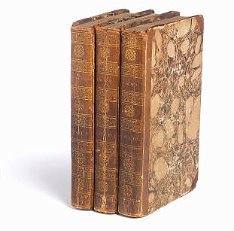
Lot 86: Presentation copy of Emma. Provenance: Anne Sharp (1776-1853) “Anne Sharp” in vol. 1 and “A. Sharp” in vol. 2 and 3.

Lot Description:

One of twelve presentation copies recorded in the publisher’s archives and presented to Jane Austen’s “excellent kind friend”: the only presentation copy given to a personal friend of the author.

In a letter to the publisher John Murray dated 11 December 1815, Austen noted that she would “subjoin a list of those persons, to whom I must trouble you to forward a Set each, when the Work is out; – all unbound, with From the Authoress, in the first page”. Most of these copies were for members of Austen’s family. David Gilson in his bibliography of Austen lists these presentation copies, based on information in John Murray’s records, as follows:

  • two to Hans Place, London (presumably for Jane Austen and Henry Austen)
  • Countess of Morley
  • Rev. J.S. Clarke (the Prince Regent’s librarian)
  • J. Leigh Perrot (the author’s uncle)
  • two for Mrs Austen
  • Captain Austen (presumed to be Charles Austen)
  • Rev. J. Austen
  • H.F. Austen (presumed to be Francis)
  • Miss Knight (the author’s favourite niece Fanny Knight)
  • Miss Sharpe [sic]

Anne Sharp (1776-1853) was Fanny-Catherine Knight’s governess at Godmersham in Kent from 1804 to 1806. She resigned due to ill-health and then held a number of subsequent positions as governess and lady’s companion. Deirdre Le Faye notes that by 1823 she was running her own boarding-school for girls in Liverpool (see Jane Austen’s Letters, third edition, 1995, p. 572). She retired in 1841 and died in 1853.

In 1809 Austen wrote to her sister Cassandra Austen that “Miss Sharpe… is born, poor thing! to struggle with Evil…” Four years later Jane wrote to Cassandra that “…I have more of such sweet flattery from Miss Sharp! – She is an excellent kind friend” (which may refer to Anne Sharp’s opinion of Pride and Prejudice). It is known that Anne Sharp thought Mansfield Park “excellent” but she preferred Pride and Prejudice and rated Emma “between the two” (see Jane Austen’s Letters, third edition, 1995, p. 573).

There is one known extant letter from Jane Austen to Anne Sharp, dated 22 May 1817. She is addressed as “my dearest Anne”. After Jane Austen’s death, Cassandra Austen wrote to Anne Sharp on 28 July 1817 sending a “lock of hair you wish for, and I add a pair of clasps which she sometimes wore and a small bodkin which she had had in constant use for more than twenty years”.

“In Miss Sharp she found a truly compatible spirit… Jane took to her at once, and formed a lasting relationship with her… [she occupied] a unique position as the necessary, intelligent friend” (Claire Tomalin, Jane Austen: A Life, 2000).

Anne Sharp is known to have visited Chawton on at least two occasions: in June 1815 and in August-September 1820. Deirdre Le Faye notes that James-Edward Austen-Leigh described her as “horridly affected but rather amusing” (see Jane Austen’s Letters, third edition, 1995, p.573)

Estimate: 150,000-200,000 GBP* UPDATE: UNSOLD

[*Now this confuses me: this copy of Anne Sharp’s Emma sold at Bonhams for a record £180,000 in 2008, and was subsequently sold to an undisclosed buyer for £325,000. in 2010 [see my post here and here on these sales] – I have got to hit the calculator to see what’s up with this…]

 ************************

Also in this sale:

Lot 87:  Austen, Jane. Northanger Abbey and Persuasion. John Murray, 1818.

Lot Description:

A set of Austen’s posthumously published novels in an attractive binding to a contemporary design. It appears that this set was the property of the Revd Fulwar-Craven Fowle (1764-1840). He was a pupil of Rev. George Austen at Steventon between 1778 and 1781. He is occasionally mentioned in Austen’s letters; it appears he participated in a game of vingt-un in 1801 and sent a brace of pheasants in 1815. Fulwar-Craven Fowle’s brother, Thomas (1765-1797) had been engaged to Cassandra Austen in 1792.

Deirdre Le Faye notes that he had “an impatient and rather irascible nature” and “did not bother to read anything of Emma except the first and last chapters, because he had heard it was not interesting” (see Jane Austen’s Letters, 1995, p. 525).

 Estimate: 4,000 – 6,000 GBP UPDATE: UNSOLD

**********************

And a few from Austen’s Circle I could not resist reporting on: these are all in the Swann Auction on November 20th – lots of other finds, so take a look:

Swann Sale 2295 Lot 40

BYRON, LORD GEORGE GORDON NOEL. Works. 13 volumes. Titles in red and black. Illustrated throughout with full page plate engravings. 4to, contemporary 1/4 brown crushed morocco, spines handsomely tooled and lettered in gilt in compartments, shelfwear to board extremities with some exposure, corners bumped; top edges gilt, others uncut. London, 1898-1904
Estimate $1,000-1,500   SOLD: $1200. (incl buyer’s premium)

limited edition, number 97 of 250 sets initialed by the publisher. This set includes a tipped-in ALS (8vo, one folded sheet. April 7, 1892) by the editor of this edition, Ernest Hartley Coleridge, the grandson of Samuel Taylor Coleridge, to a Mr. Tours[?], recounting a lecture he had recently given in Minneapolis.

********************


Swann  Sale 2295 Lot 204:
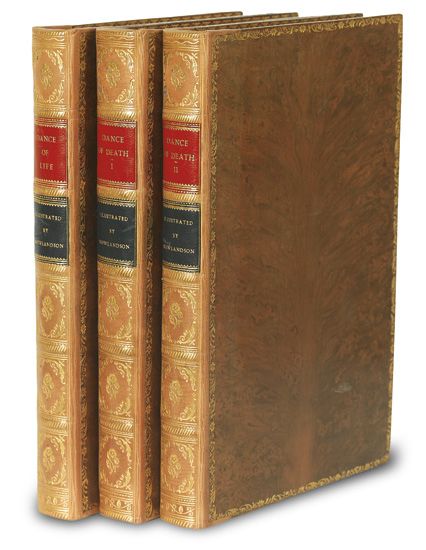
(ROWLANDSON, THOMAS.) The English Dance of Death. 2 volumes. * The Dance of Life. Together, 3 volumes. Engraved colored title-page and 37 hand-colored engraved plates in each volume of the Dance of Death, 25 hand-colored plates in the Dance of Life, by Rowlandson. Tall 8vo, later full tree calf gilt, spines tooled in gilt in 6 compartments with morocco lettering pieces in 2, rebacked; top edges gilt; occasional offsetting to text from plates and spotting to preliminaries; leather bookplates of Stephen M. Dryfoos mounted to front pastedown of 2 volumes; the whole slipcased together. London: R. Ackerman, 1815-16; 1817
Estimate $1,000-1,500 – SOLD: $3600. (incl buyer’s premium)

first editions in fine condition. “Indispensable to any Rowlandson collection, one of the essential pivots of any colour plate library, being one of the main works of Rowlandson”–(Tooley 410-411); Hardie 172; Abbey Life, 263-264; Prideaux 332; Grolier, Rowlandson 32.


Swann Sale 2295 Lot 205:
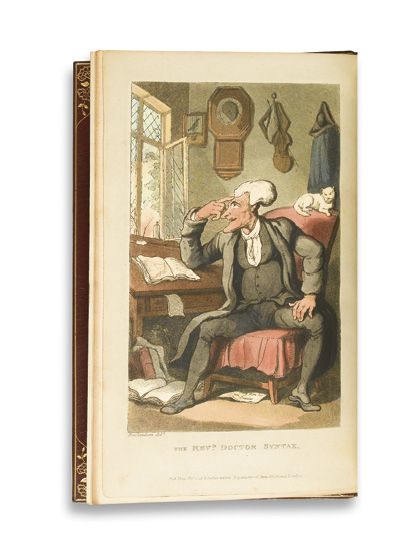
ROWLANDSON, THOMAS.) [Combe, William.] The Tour of Doctor Syntax, in Search of the Picturesque * In Search of Consolation * In Search of a Wife. Together, 3 volumes. Colored aquatint frontispiece in each volume, volumes 1 and 3 with additional aquatint title-page, and 75 colored plates by Rowlandson, colored vignette at end of vol. 3. Large 8vo, uniform full crimson crushed morocco blocked in gilt with corner floral ornaments, spines richly gilt in 4 compartments, titles in 2; turn-ins; by Root & Son, top edges gilt; bookplates of Edward B. Krumbhaar (vol. 1 only) and Christopher Heublein Perot (with his autograph). first edition in book form, second state, handsomely bound. London: R. Ackerman, 1812-20-(21)
Estimate $600-900 – SOLD: $960. (incl buyer’s premium)

 ***************************

And despite my love of Austen, I do periodically enter the 20th century [sometimes the 21st!] and I still harbor my great admiration and love of John Steinbeck, so this I share because it is so rare and lovely to behold:

Swann Sale 2295 Lot 234 John Steinbeck. Cup of Gold.

STEINBECK, JOHN. Cup of Gold. 8vo, original yellow cloth lettered in black; pictorial dust jacket, spine panel evenly faded with minor chipping to ends with slight loss of a few letters, light rubbing along folds, small rubber inkstamp on front flap; bookplate with name obscured in black pen on front pastedown. New York: Robert M. McBride & Co., 1929
Estimate $8,000-12,000 – SOLD: $14,400 (incl buyer’s premium)

scarce first edition, first issue of steinbeck’s first book with the McBride publisher imprint and “First Published, August 1929” on copyright page. Jacket flap corners evenly clipped as issued with “$2.50” printed price present. The publisher printed only 2476 copies, 939 of which were remaindered as unbound sheets and evidently sold to Covici-Friede who issued them with new preliminaries, preface, binding, and jacket in 1936. Variant copy (no priority) with the top edges unstained. Goldstone-Payne A1.a.

**********************

All images are from the respective auction houses with thanks.

Have fun browsing, and bidding if you wish!

 c2012 Jane Austen in Vermont
Auctions · Books · Jane Austen · Literature · Rare Books

Jane Austen on the Block! ~ The RING and the Books…

An exciting day in Austen-Land! The much-touted Ring is up for auction!, as well as first editions of five of Austen’s novels [wherever did the Sense and Sensibility end up?] – here are the details from Sotheby’s Sale No. L12404 English Literature, History, Children’s Books and Illustrations – London | 10 July 2012  – I will report later today the results… See the results in red below – to include buyer’s premium…..

Lot 59: Austen, Jane. GOLD AND GEM SET RING

ESTIMATE: 20,000 – 30,000 GBP Sold for £152,450  (about $236,298.)- also learned that the ring is actually natural turquoise not the odontalite as noted in the catalogue.  The bidding was quite fun to watch – all quite dramatic as the auctioneer baited the bidders in room, on the telephone and the internet  to keep the bidding going…  [update 2: “a battle between eight bidders … was eventually bought by an anonymous private collector over the phone, the auction house said” (from Reuters.com)]

set with a cabochon blue stone, natural turquoise, size K½ with sizing band, once belonging to Jane Austen, in a contemporary jeweller’s box (“T. West | Goldsmith | Ludgate Street | near St Paul’s”)

[with:] autograph note signed by Eleanor Austen, to her niece Caroline Austen, “My dear Caroline. The enclosed Ring once belonged to your Aunt Jane. It was given to me by your Aunt Cassandra as soon as she knew that I was engaged to your Uncle. I bequeath it to you. God bless you!”, 1 page, November 1863, with address panel on verso and remains of black wax seal impression, fold tears; also with three further notes by Mary Dorothy Austen-Leigh detailing the ring’s later provenance, 5 pages, 1935-1962

[more detailed provenance here: http://www.sothebys.com/en/auctions/ecatalogue/2012/english-literature-history-childrens-books-and-illustrations/lot.59.html – click on “catalogue notes”]
Lot 55: Austen, Jane. MANSFIELD PARK: A NOVEL. EGERTON, 1814

ESTIMATE: 3,000 – 5,000 GBP  Sold for £5250 (about $8,138.)

12mo (174 x 102mm.), first edition, 3 volumes, without half-titles, nineteenth-century half calf, marbled boards,  some spotting and browning, some gatherings proud,  recent expert repairs to binding and joints.

Lot 56: Austen Jane.  NORTHANGER ABBEY: AND PERSUASIAN…WITH A BIOGRAPHICAL NOTICE OF THE AUTHOR, JOHN MURRAY 1818

ESTIMATE: 2,500 – 3,500 GBP  Sold for £4000 (about $6200.)

12mo (175 x 102mm.), 4 volumes, first edition, watermarks, without half-titles, nineteenth-century half calf, marbled boards,, some slight staining to edges of some leaves, browning and spotting, recent expert repairs to joints and spines, some edge-wear. Northanger Abbey was completed in 1798 or 1799, and then substantially revised over time. Persuasion, a more gentle satire of manners, was written between 1815 and 1816. The novels were published posthumously in this tandem edition of 1,750 copies.

Lot 57:  Austen, Jane.  PRIDE AND PREJUDICE: A NOVEL. LONDON:G. SIDNEY FOR T. EGERTON, 1813.

ESTIMATE: 20,000 – 30,000 GBP  Sold for £22,500 (about $34,875.)

12mo (174 x 102mm.), 3 volumes, first edition, watermarks, without half-titles and advertisements, nineteenth-century half calf, marbled boards, B12 of volume 1 crudely opened and slightly creased, some gatherings proud, some spotting, staining and browning to text, volumes 1 and 3 re-backed, some recent expert repairs to binding and joints, some edge-wear.

Lot 58: Austen, Jane. EMMA: A NOVEL. C. ROWORTH FOR JOHN MURRAY, 1816.

ESTIMATE: 10,000 – 15,000 GBP  UNSOLD – bidding went to £7500

12mo (172 x 103mm.), first edition, without half-titles, nineteenth-century half calf, marbled boards, some creases at edges of some leaves, some spotting and browning, some gatherings proud, volume 1 re-backed, recent expert repairs to binding and joints, some edge-wear.

[All titles have the bookplate of Bridget Mary McEwen.]

Further Reading about The Ring:

The Guardian, 6 July 2012: http://www.guardian.co.uk/books/2012/jul/06/jane-austen-ring-for-auction

Diana B. at Austen Authors: http://austenauthors.net/jane-austens-ring

Julie W. at Austenonly: http://austenonly.com/2012/06/21/first-editions-and-jane-austens-ring-a-bumper-austen-sale-at-sothebys-on-july-10th/

[and please note at the end of this post wherein Deirdre Le Faye weighs in on the ring’s provenance – the date of the note from Eleanor Austen as noted in the printed catalogue is incorrect … and now corrected in the online version]

[Text and image from the Sotheby’s catalogue]

@2012 by Jane Austen in Vermont
Auctions · Books · Jane Austen · Publishing History · Rare Books · Uncategorized

Austen on the Block! ~ Results of Today’s Christie’s Auction

June 13, 2012: the results are in on today’s Christie’s auction I posted about last month – the sale of a first edition of Jane Austen’s Northanger Abbey and Persuasion:

Lot 169. AUSTEN, Jane (1775-1817). Northanger Abbey and Persuasion. With a Biographical Notice of the Author [by Henry Austen]. London: C. Rowarth [vols I-II], and T. Davison [vols III- IV] for John Murray, 1818 [but ca. 20 December 1817].

Hammer price: £5,625 ($8,696)
Estimate £5,000 – £8,000 ($7,730 – $12,368)

There were a number of other items of interest under the hammer today – you can review the results here at the Christie’s website.

There were three Humphry Repton titles  – this one took the highest prize:

Lot 118. REPTON, Humphry (1752-1818). Sketches and Hints on Landscape Gardening. London: W. Bulmer and Co., for J. & J. Boydell, [1795].

Hammer price: £17,500  ($27,055)
Estimate £8,000 – £12,000 ($12,368 – $18552)

[Images from the Christie’s website]

@2012 Jane Austen in Vermont
Auctions · Austen Literary History & Criticism · Books · Jane Austen · News · Rare Books

Austen On the Block! ~ Northanger Abbey and Persuasion 1st edition

Auction Alert! 

Christie’s Sale 5334: Valuable Printed Books and Manuscripts
13 June 2012, London, King Street

Lot 169: 

Austen, Jane.  Northanger Abbey and Persuasion. With a Biographical Notice of the Author [by Henry Austen].London: C. Rowarth [vols I-II], and T. Davison [vols III- IV] for John Murray, 1818 [but ca. 20 December 1817].

Estimate: £5,000 – £8,000  ($7,975 – $12,760) Price Realized: £5,625 ($8,696)

Description

4 volumes, 12° (172 x 103mm). (Some light spotting, without half-titles in vols. II-IV and final blanks P7-8 in vol. IV.) Near contemporary half calf over marbled boards by J. Seacome, Chester, with his yellow or pink ticket in each volume, flat gilt spines divided by greek key rolls between double fillets, and with red morocco lettering-pieces in two compartments (extremities lightly rubbed, spine heads slightly chipped, minor paper loss to one cover). Provenance: Jane Panton (early inscriptions on all titles, trimmed by binder) — Bernard Quaritch, bookseller (pencilled collation note at the end of vol. I).

FIRST EDITION OF BOTH NOVELS IN AN EARLY 19TH-CENTURY BINDING BY J. SEACOME OF CHESTER. According to the author’s sister, Cassandra, Northanger Abbey was written in the years 1798-1799, although it has been suggested ‘a first version may have been written as early as 1794’ (Gilson, p. 82). This gentle parody* of the gothic novel represents her style in its earliest public form. Sense and Sensibility and Pride and Prejudice, though earlier in origin, were far more drastically revised before publication. In 1803 she had sold the novel then entitled Susan, to Richard Crosby and Son, a London publisher, for £10. When it failed to appear after six years, she asked Mr Crosby for information, to be told that he was under no obligation to publish it, and that she could have it back for the amount he had paid her. The novelist waited until 1816 to accept the offer, but despite preparing the manuscript for publication once more, and changing the title from Susan to Catherine, still held it back. As a result, it only appeared posthumously with Persuasion in December 1817, the eventual title possibly supplied by Henry Austen. Persuasion, her last novel, was begun on 8 August 1815 and completed a year later. The two works were printed in varying specimens of Caslon Pica roman, and published by John Murray in an edition of 1750 copies. Gilson A9; Keynes 9 (collation corrected by 1931 errata); Sadleir 62e. (4)

___________________________________

  • Text and image from the Christie’s website
  • Click here for the full sale catalogue: there is a Dickens (David Copperfield) and also three works by Humphry Repton, who was read by Jane Austen:

Lot 119: REPTON, Humphry (1752-1818). Observations on the Theory and Practice of Landscape Gardening.London: T. Bensley for J. Taylor, 1803.

Estimate: £4,000 – £6,000 ($6,380 – $9,570)

Description:

FIRST EDITION OF REPTON’S ‘MOST IMPORTANT WORK’ (RIBA). Repton’s second treatise reflects the increasing refinement of his theories on landscape and architecture, and answers the criticisms of Uvedale Price and Payne Knight. ‘Perhaps [Repton’s] most significant and influential publication overall’ (Archer). It contains information from several ‘Red Books’ now lost. Abbey, Scenery, 390; Archer 279.1; RIBA 2734 (second edition); Tooley 399.

The other two Repton works are:

Lot 118: REPTON, Humphry (1752-1818). Sketches and Hints on Landscape Gardening.London: W. Bulmer and Co., for J. & J. Boydell, [1795]. Estimate  £8,000 – £12,000 ($12,760 – $19,140)

Lot 120: REPTON, Humphry (1752-1818) & John Adey REPTON (1775-1860). Fragments on the Theory and Practice of Landscape Gardening. Including some remarks on Grecian and Gothic Architecture.London: T. Bensley & Son for J. Taylor, 1816. Estimate: £6,000 – £9,000 ($9,570 – $14,355)

_____________________________

*Would you call Northanger Abbey “a gentle parody”?

Copyright @2012 Jane Austen in Vermont
Author Interviews · Book reviews · Books · Jane Austen · Jane Austen Popular Culture · London · Rare Books · Regency England

Part II ~ The Perfect Visit ~ Interview with Stuart Bennett, Wherein We Meet Jane Austen and Shakespeare ~ Plus, a Book Giveaway!

Today I again welcome Stuart Bennett, for Part II of our interview where we discuss his new book The Perfect Visit, a time-travel tale, a romance, and a pure escape into the Regency world of Jane Austen and the Elizabethan world of William Shakespeare! [Please go to this link for Part I of the interview.]

You can enter the book giveaway by commenting on either post before 11:59 pm 15 April 2012.  Winner will be announced on Monday April 16, 2012. [worldwide eligibility]

Talking about the Feminist Question: [because I always have to ask…] 

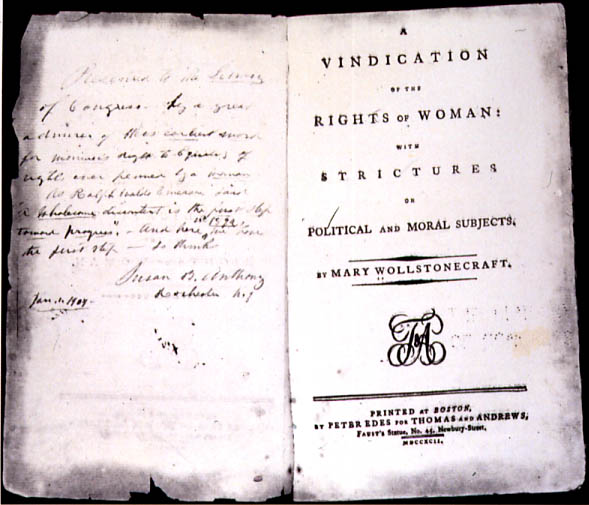
JAIV:  Vanessa is in all ways a 21st century woman, yet when she finds herself stranded in the early 19th century England she is “visiting” she must, I assume, “just fit in” – she even goes to the lengths of wanting marriage for protection alone – she cannot earn a living as she would have done here in the present – she is trapped and at times just so incredibly sad. You do have her debating women’s rights and voting and the realities for women publishing, and she does stand up for herself innumerable times – and you did create Meg, a lovely character, true to her time and herself – but I am perhaps taking Vanessa and her story too much to heart here? –  she feels very real to me [and I thought only Jane Austen’s characters are really real!] – and I felt that if I were there, I would be pushing Wollstonecraft’s Vindication on every passer-by, screaming for equality, hanging out with the bluestockings! – yet you have her taking such a back seat in these socio-political conversations of the day.  I just see that as a difficult issue for you as a writer – making her a very modern woman living in an earlier time and not scaring all the people around her! Did you feel this in creating her? – needing to make her an almost “invisible” being, with your own time travel rules at play to not change things, to lay-low so to speak, to not bring too much attention to oneself? …  And did you find her enforced silence painful as well? Or is this more my response as a female reader moved by her inability to speak out – more so than even for you who created her? [you might just answer ‘yes’ or ‘no’ and head on to the next question!]

[Image: wikipedia]

SB:  It is tempting just to say “yes” and move along.  But a question that shows such close and sympathetic reading deserves better than that.  Vanessa is young at the beginning of The Perfect Visit.  Resourceful and tough as she is, she still has to deal with the triple-whammy of being trapped in another time, imprisoned, and ill.  Without Meg (and other interventions which I hope readers will discover for themselves) Vanessa would surely have died. 

And so she does her best to lie low, to get by, to fit in.  And at times it all makes her feel like she is about to explode.  This is the Vanessa who came alive for me, and as a writer it brings me joy to know that she came alive for you too.  Thank you!
 

Talking about Books


JAIV:  All references to book titles, authors, prices, etc. are you say valid – in your words, you may have “tinkered a little with history, but I have done my best not to tinker with bibliography.” [p.341] – and this book abounds in Bibliography! I love to come away from such a story with pages of things, people and places, and books to research! – And I thank you for your “Historical postscript – the truth in Jane Austen’s life and her fiction, and the amalgamations of real people to create your heroine and hero and all the various booksellers… [though I did miss the Godwin reference I am ashamed to say! – so clear after reading your postscript…]  

So I would ask, can your story be enjoyed by the non-Austen aficionado? The non-bookseller? The person little acquainted with Shakespeare bibliography? – What can you tell us about your basic plot without all these fabulous extras that give the book such depth and meaning…? 


SB:
  I suspect most authors, like me, have readers they can count on for honest opinions.  Several of my readers, warned that the typescript was on its way, voiced advance worries about the time-travel, others about the bibliographical elements.  Virtually all reported that neither got in the way of what I wanted above all to be a romance: a romance for those who wish we could meet the authors we love, and for those who love (or wish they could love) someone as bookish as they are.  The rest of the novel could perhaps be seen as illustrating the old adage “be careful what you wish for. . . .” 

JAIV:   The value of Jane Austen’s books today either seems outrageous [to those who know that she received so little for her labors] or a fair accounting of what the market will bear… what are your thoughts on this, as a bookseller and an author?

 [Pride and Prejudice – 1st edition, 1813.  Sold for $35,000, Sotheby’s, June 17, 2011]

SB:  First, I don’t think Jane Austen fared too badly in the context of the commercial publishing world of her day.  It may have helped (here comes the gender discrimination again) that she had her father and brothers on her side in dealing with publishers, and she certainly had the last laugh when in 1816 (through her brother Henry) she bought back the manuscript and copyright of what became Northanger Abbey, for the same ten pounds a neglectful publisher had paid for it in 1803.  The net proceeds to JA’s heirs from the first edition of Northanger Abbey and Persuasion amounted to a hefty £453.14.11 – somewhere (by my rough reckoning) on the order of £35,000 in today’s money.

Second, I suppose if JA’s first editions are selling at today’s hefty prices (a nice Sense and Sensibility or Pride and Prejudice, the two most difficult first editions, might well appear on the market for the same £35,000 I just mentioned) then those prices must surely be judged a fair accounting. 

But I’m not sure those prices are sustainable.  When I was selling J.A. first editions in the early 1980s, auction prices were normally in the mid-hundreds of pounds, and my copies – almost never more than £1,000 – flew off the shelf.  When the modern movies came along prices went up, and up, and up – and now many high-end antiquarian booksellers have copies of the first editions that have lingered for years.

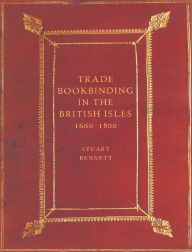
JAIV:   You have published the book Trade Bookbinding in the British Isles (2004), which surely comes into this story with the variety of publishers and booksellers and Vanessa’s publication of children’s books. What were the realities of publishing in the Regency period? And how different from today? …

 Oak Knoll Press, 2004

Indeed, you created your own press [the aptly named Longbourn Press!] to publish your book, as well as offer it as a kindle ebook.  Did you try to publish with a traditional publisher? And how is this form of publishing any different from what was available to Jane Austen as a first time novel-writer [sell her copyright outright or pay for printing and marketing costs herself, etc.]? 

SB:  I’ve given a couple of clues about Regency publishing in my previous answer.  “How different from today?”  Well, today’s publishing, with Kindle etc., seems to me to be reverting more to the Regency model than otherwise, with those able to pay for self-publication able to get their books printed and distributed more easily than in the last half-century or so.

Regency publishers were, of course, always on the lookout for potential blockbusters, especially if they could buy the copyrights outright (often for small sums, like the ten pounds originally paid for Northanger Abbey – then titled Susan).  Many women writers, often publishing anonymously, produced novels and other works, especially children’s books, at their leisure; others were desperate for money and sold manuscripts and copyrights for whatever they could get.  Those (men and women) able to pay the cost of their own publications could negotiate commissions with commercial publishers.  John Murray took only ten percent of the net proceeds of Jane Austen’s later novels, a deal which if available to J.K. Rowling might have made her a whole, whole lot richer than the Queen of England.  

The Perfect Visit had wonderful literary agents in London and New York who offered the manuscript to commercial publishers in the even-darker-than-usual publishing days of early 2009.  There were no takers; one London publisher described it as a nice “potential mid-list” novel, but not the blockbuster they were looking for.  But some wayward typescripts kept bringing notes and e-mails, and when a couple of enthusiastic ones came from perfect strangers as far away asAustralia, I decided to consider the Amazon route.  Another bonus, as a much-published friend observed: printing the book meant I had to stop revising.

JAIV:   Well, I for one am certainly glad you listened to those perfect strangers!  And yes, it is interesting to read about Austen’s publication history – very ironic that the only work for which she sold the copyright outright was Pride and Prejudice, always her most popular and enduring work.

One question I have about the story:  what might the ethical issues be about this bringing of old manuscripts and books into the present to sell? even if the resulting profit is for a good cause?

SB:  I think any reader’s guess is as good as mine.  Would it be unfair to the original author? If so, how?  Certainly if I could go back to Jane Austen’s time (not to mention Shakespeare’s) and buy new copies of her first editions to bring back to sell in 2012, I could also undercut the prices of my high-end bookselling colleagues.  Does caveat emptor apply in such circumstances? 

But of course the paramount ethical issue involves time-travel itself.  Surely time-traveller appearances would change the past, à la Ray Bradbury’s “Sound of Thunder,” and so skew subsequent history.  People who should have been born might not be, and vice versa.  

Someone once wrote an apocalyptic story where only the very rich could afford to travel back in time to escape the end of the world.  Against those kinds of fantasy possibilities, surely sneaking a few otherwise-vanished books and manuscripts out of their own times seems comparatively harmless.  Or not? 

JAIV:  Yes, it is an interesting question – one way to look at it is to believe you might be preserving a work that would have been destroyed in a fire or such, and otherwise lost to posterity…. [and I do have to remember, this is a fiction, after all!]

Here is a very specific question about a book you mention: You place your heroine in a library reading The Invisible Gentleman – I had to research this one I confess – written in 1833 by J. Dalton, author of Chartley the Fatalist, and The Robber, all published by Edward Bull of Holles St, London… you call it “a heavy-handed historical romance set in the twelfth century” [p. 312]… no wonder Vanessa tossed it aside! – So I ask, why this book for that scene?? –


SB:
  Because Vanessa wished she were invisible – and because I found it on an 1833 list of novels “just published” and couldn’t resist. 

JAIV: Oh good! glad I don’t have to add this to my TBR pile! 

Can you share anything about your writing process? – When, Where, and How [and maybe even Why?] – any advice for budding writers? 

SB:  I don’t think this is any kind of advice for budding writers, but here’s the truth behind my Perfect Visit process.  I’d written a couple of non-fiction books, lots of magazine articles on rare books and auctions, and during the 1980s attempted and abandoned a couple of novels.  I knew a little bit about sitting down and writing, and even writing with deadlines.  This helps.

 But the inspiration for The Perfect Visit and its (unpublished) sequels came as a surprise.  I have George R.R. Martin to thank – and if your readers aren’t sure who he is, the ubiquitous advertisements for the television version of his Game of Thrones gives the clue. 

[SPOILER ALERT re: Game of Thrones] At the beginning of 2006 I started reading Martin’s “Fire and Ice” series (Game of Thrones is Book One).  Initially I was hooked, but I started having doubts somewhere in Book Two.  By the middle of Book Three (I’ve repressed the books’ individual names) I felt like I was being had, that the author had realized he was onto a cash cow and decided to turn what might have been a trilogy into a five-parter (is there a name for that?)  

And Martin also killed off the one character I felt close to, whose name happened to be Ned.  Sometime towards the end of January 2006 – I remember the moment – I flung Martin’s Book Three across the room, stood up, and said “I’m going to write a book I’d want to read.”  The result was The Perfect Visit, central male character by name of Ned Marston. 

I should add, in case I appear delusional, that I am in no doubt Mr. Martin’s formula has a much broader appeal than mine. 

Are there any nuggets of gold here for budding writers?  I don’t know.  All I can say is that once I started, my characters took over large parts of my life.  They woke me up in the middle of the night with their dialogues; I started walking to work with bits of paper in my pockets so I could write down what they were doing and more of what they had to say.  And I would scribble, or clatter away on the computer most mornings, until I thought I’d done them some kind of justice.  Then I’d work at my business until the characters interrupted all over again.  The original typescript of The Perfect Visit went on, and on. . . . 

JAIV:  I love this story of your inspiration! [I have always thought a really good blog post would be to question people about the one book they most remember throwing across the room!]  I have not read the “Fire and Ice” books but do admit to being quite absorbed with the Game of Thrones on HBO, and like you, stunned at the outcome of Book I – indeed the only character I liked as well [being Sean Bean helps too!] 

You mention above other books revolving around The Perfect Visit. Can you tell us more about these? A sequel to this tale, or another time-travel book to another time? And if so where would you next most like to go? 

SB: Oh yes, there are a couple of sequels, one close to finished, and a kind of “part-prequel” set in 1823 in which Vanessa discovers the “truth” behind a lost episode in Jane Austen’s life.  There’s even, for better or worse, a half-written (maybe “half-baked” would be a better term) prequel about Ned Marston’s adventures in classical Greece. 

JAIV:  Can’t wait! 

And finally, in your answer to my question on London  – because it was so convoluted and actually contained four questions, so no guilt please for missing it! –  I asked what is your favorite London haunt, other than perhaps the British Library? 

SB:  I confess I love the London Library more than the British.  It’s climbing around in the stacks that does it, and all the books you find that way that you’d otherwise never known existed.

London Library - Geograph.uk

London Library label – wikipedia

But you asked my favorite London haunt, and I have to confess a hopelessly bourgeois affection for the Wolseley restaurant on Piccadilly.  I take myself there for breakfast whenever I can, all alone, reveling in perfectly-cooked bacon and eggs, and the best pastries in the universe.  People-watching there brings me as close as I can get to the way I think Vanessa must have felt at Molland’s Tea-Rooms in Bath.

The Wolseley, London

JAIV:  You make me want to go back to 1833! Just for a cup of tea!

Thank you Stuart for answering all my questions – you have been a gentleman and a scholar and I appreciate it!

Readers, please ask any question you might have for Stuart or leave a comment on either this post or the Part I post, and you will be entered into the random drawing for a copy of The Perfect Visit. Please do so by 11:59 pm, April 15, 2012. The winner will be announced on Monday April 16, 2012 – all are welcome to particpate, i.e. worldwide eligibility.

*******************

Stuart Bennett was an auctioneer at Christie’s inLondon before starting his own rare book business. He is the author of the Christie’s Collectors Guide How to Buy Photographs (1987), Trade Binding in the British Isles (2004) which the London Times Literary Supplement called “a bold and welcome step forward” in the history of bookbinding, and many publications on early photography, auctions and auctioneers, and rare books. He currently lives and works near Boston, Massachusetts.


  The Perfect Visit, by Stuart Bennett
Longbourn Press, 2011
ISBN: 9780615542706

For more information:

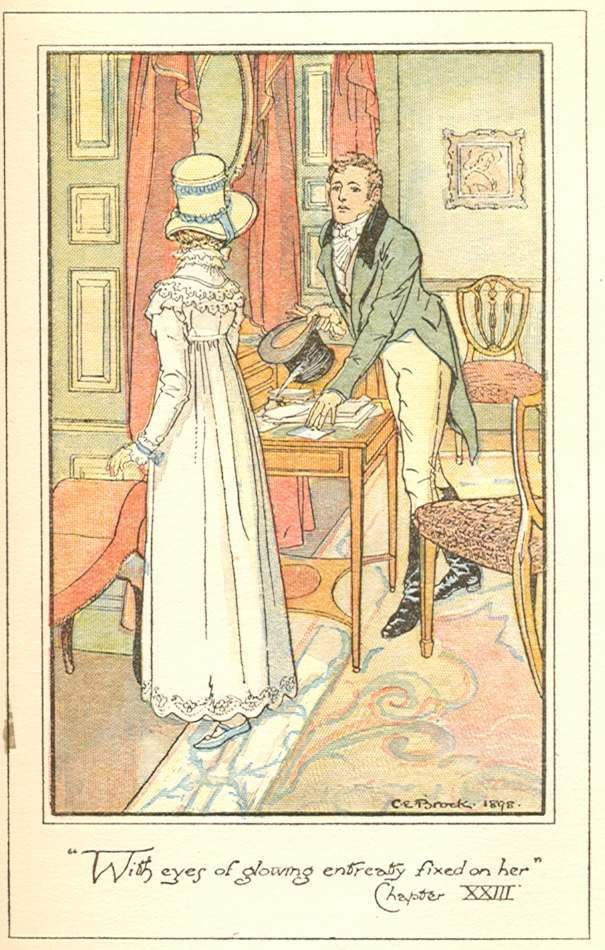
C. E. Brock. illustration for Persuasion, image from Molland’s

Copyright @2012 Jane Austen in Vermont
Author Interviews · Book reviews · Books · Jane Austen · Jane Austen Popular Culture · London · Rare Books · Regency England

Part I ~ The Perfect Visit ~ Interview with Stuart Bennett, Wherein We Meet Jane Austen and Shakespeare … and Enter to Win the Book Giveaway!

The Perfect Visit (Longbourn Press, 2011) is, no way to say it otherwise, a perfect treat – who of us would not want to spend a few days [or pull an all-nighter!] in the company of a time-travelling couple who are each in turn lovers of books, Jane Austen, Shakespeare, and just possibly each other? –

Today I welcome the author Stuart Bennett for a blog interview where we talk about how a rare bookseller became a writer of a first novel that brings to life both Jane Austen and Shakespeare, takes us on a whirlwind tour of their times, regales us with book history as we trek about the bookstalls of London and Bath, and all this in a mere 342 pages, a book sure to take a prime spot on your bookshelf.  So join us today for Part I of the interview, stay tuned for Part II this weekend, and enter the Book Giveaway by commenting or asking a question on either post before 11:59 pm 15 April 2012. Winner will be announced on Monday April 16, 2012 (worldwide eligibility).

************************

Welcome Stuart!  Thank you so much for joining us here at Jane Austen in Vermont. I have known of you for a good number of years as a rare bookseller and for a time president of the ABAA [Antiquarian Booksellers’ Association of America] – needless to say when I discovered you had recently published this book on Jane Austen [the title even comes from Emma: “It was a delightful visit; – perfect in being much too short.” [Vol. I, Ch. XIII]] – I saw my two worlds colliding in the most marvelous of cosmic alignments! I was so greedy to begin, I immediately downloaded it on my kindle, my hardcopy order far too slow to arrive, and was happily transported to the various times in your tale. So lets talk a bit about your background as a rare bookseller, your love of Jane Austen and Shakespeare [and how you dared to put both in the same tale!], the history of books, the time-travel bits, the woman-issue, and of course, just the sheer pleasure of a really nice romance…

*****************************

Talking about the story:

JAIV: To start, please explain the premise of your tale – a time-travel, book-loving love story that you say was first titled “A Bibliographical Romance” – so tell us about “The Project,” or at least a quick synopsis without giving too much away!

SB:  It starts as the tale of two bibliophiles planning to go back in time to rescue lost books and manuscripts. Vanessa decides on Regency England; Ned goes to Shakespeare’s. But they both have their own agendas as well.  Vanessa wants to rewrite history. And Ned wants to meet the Bard himself. 

Vanessa falls foul of the law, transported from Jane Austen’s genteel world to the dark underbelly of a Regency prison. 1607 London shows an equally black side to Ned when he antagonises one of Shakespeare’s rivals, escaping with his life only to find that an accident of time takes him only halfway home.

Talking about Jane Austen: 

“It was a delightful visit; – perfect, in being too short.” [Emma, vol. 1, ch. 13]

JAIV:  I know of your background as an antiquarian bookseller and former ABAA president – you have spent most of your life in books published before 1850.  So why Jane Austen for you? And why Shakespeare? Why not Frances Burney or Chaucer? Is it their times or their works, their continuing popularity today? 

SB:  Jane Austen and Shakespeare are central to my book because I love them.  A bookseller writing a “bibliographical romance” is committing a self-indulgent act – the more so with the presence of time-travel – and these two authors are part of it.  Frances Burney is intriguing, but I confess that had Jane Austen never written (could I have written any kind of  Perfect Visit without J.A.? – I doubt it) I might have been more tempted by Maria Edgeworth as a character.  Or maybe Hester Lynch Piozzi.  Chaucer and his world needs a true mediaevalist: I don’t have the knowledge of or empathy to go there.

JAIV:  You say in your postscript: “It is a presumption of a very high order to bring both Jane Austen and William Shakespeare into a single work of fiction, let alone a first novel … of the two, somehow Jane Austen intimidates me more, even though Shakespeare is perhaps the greater genius.” Explain your thoughts on the intimidating Miss Austen!

SB:  Wonderful question.  What is it that’s so intimidating?  I think it may be that, compared to Shakespeare, we really know quite a bit about Jane Austen’s life, notwithstanding the wholesale destruction of her letters by her sister and niece.  And what we know seems domesticated and uneventful. 

So how and why did she become, as I see her, the greatest novelist ever to write in English?  One could ask a similar question about Shakespeare and his plays: how did the grammar-school boy from provincial Stratford manage those.  And of course the fact that we know so little about Shakespeare’s life allows those in Shakespeare-denial (Oxfordians and similar snobs) scope for their own inventions. What we have of Jane Austen’s personal history is secure. 

As a novelist it’s a relief to have no sense of what Shakespeare was like as a man, let alone as a conversationalist.  I could invent quite freely.  The real Jane Austen, on the other hand, survives in family memoirs and letters, and I considered it my job to try to be true to her.  All I felt confident about at the time went into The Perfect Visit , but she haunts me still, and features much more largely in one of the two sequels/prequels to P.V. which are complete in first drafts but still have a long way to go.

JAIV:  How and when did you first discover Jane Austen? – as a reader or a collector or as a bookseller?  Or was your name [despite that extra “t”!] the impetus behind reading and writing about Jane Austen?! 

SB:  No to the last – I didn’t know there was a character in Jane Austen with my name mis-spelled until I was in my early twenties.  J.A. wasn’t quite the household name she’s become in the last thirty years, and I think I was lucky in being no younger than twenty-one, at university in England, when first introduced to the novels via Emma.  I couldn’t put it down.  

(I should add, however, that I take comfort in the fact that my spelling of “Bennett” is the same as the street in Bath.  Perhaps J.A. – or so I like to think – was recollecting the street as a good character name and simply forgot the last “t”.)

JAIV:  I don’t like to ask this question because who can ever work through such a dilemma, but I always do because the answers are so enlightening – but first I would ask if Persuasion is your favorite Austen novel? – it figures prominently in your story: Ned’s reading Persuasion; he and Vanessa are in Bath and literally take a Persuasion tour [which was great fun!]; and their romance has echoes of the Anne / Wentworth story.  ….

SB:  Your question – I’m sure this won’t surprise you – contains its own answer.  All the elements you describe in my book derive from my love of Persuasion. which seems to me to express most clearly Jane Austen’s own longings and losses, as the most autobiographical of all her novels.

JAIV:  A lovely answer! Persuasion is my own favorite, and it is wonderful how you weave Anne Elliot’s tale into your own. 

Is it every antiquarian bookseller‘s dream to actually visit the time of their literary hero[es]? To meet them as Vanessa meets Jane Austen and Ned William Shakespeare – is this your own vicarious dream? And has this time-travel story been in your head for the longest time?  I know you have written non-fiction works on book collecting, but have you written other yet-unpublished novels or fictional pieces?

 SB:  I think I may have answered the salient points of this great question in the course of dealing with other questions, but I would add this:  The most successful antiquarian booksellers I know don’t spend time dreaming about time-travel.  Instead they get to the auctions and flea-markets I didn’t know existed, woo wealthy collectors, and have healthier bottom lines. 

JAIV:  Yes! That bottom line does get in the way of day-dreaming and novel-writing, doesn’t it?! Jane Austen’s very own problem as well! 

 We find, along with your heroine, that we are soon to be in Jane Austen’s presence: 

“The first response to Vanessa’s knock was a rustle of papers, receding footsteps, and the creak of an interior door.” [p.5] 

– and we know we are in Jane Austen’s house in Chawton! … and we are there almost holding our breath as Vanessa first meets her, describes her – how difficult was she to create on your page, knowing readers all have their very own Jane Austen in their head?

Chawton Cottage

SB:  I did my very best to describe the physical J.A., and also Martha Lloyd, that emerge from contemporary accounts.  As to that first conversation, as well as later ones, the Jane Austen I hear is graceful, a little shy, with a ready wit and even sarcasm, but fundamentally kind.  Can any J.A. aficionado really demur to that?

JAIV:   Your heroine Vanessa Horwood is what Mr. Darcy would call an “accomplished woman” – even your Jane Austen character says “I have, it seems, in one young woman a literary critic, a musician, a financier, and an apothecary.”  [p. 7]. Is it fair to ask a male writer with a female protagonist, for a good part of the book at least – are you a little bit in love with your Vanessa?

SB:  All’s fair, and of course I am.  But I was also a little taken aback when many who know me best said that my Vanessa reminds them of me, and not always my most lovable side.

JAIV:  Aah – you have created your own better half it seems! 

 The description of clothing is very exact! – may I ask if you tend toward Henry Tilney in “understand[ing] your muslins, sir”?

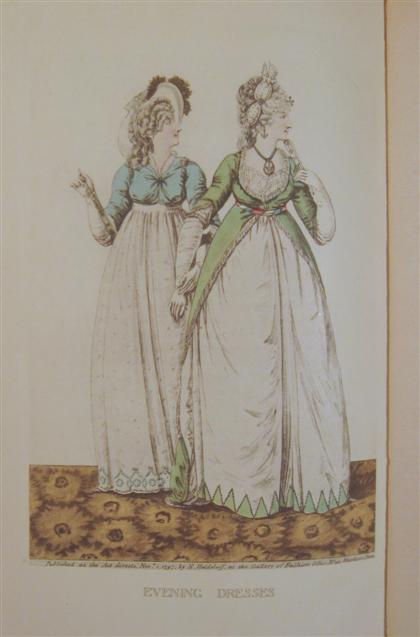
Morning Dress @1819, R. Ackermann [wikicommons]

SB:  I hope so.  But Ackermann’s Repository and other contemporary sources are a great help too, not to mention the modern books by the Cunningtons, e.g. Handbook of English Costume in the Nineteenth Century

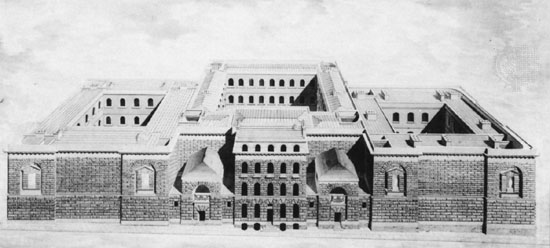
JAIV:    As you mention above, these times had heavy realities that Austen kept in the background for the more astute reader to find – but they are there – your heroine is jailed for forgery and will likely hang or will be transported – so this part of your story tells this darker side, the underbelly of Regency life, especially for women.  What was prison like and what resources did you use to make this seem so real? 

Newgate Prison - eb.com

SB:  I’ve read, and also bought and sold, so many accounts of English malefactors and their punishments in Regency and earlier times that I can’t really cite many of the sources that contributed to my sense of what a prison must have been like at that time.  Did I get it right?  Perhaps partly so, but I suspect the reality of most female penitentiaries was worse than I describe.  

Two essential sources for the Regency period are those to which Elizabeth Fry (who makes an appearance in The Perfect Visit) contributed: Notes on a Visit to some of the Prisons in Scotland and the North of England with Elizabeth Fry (this was published by Elizabeth Fry’s brother Joseph John Gurney) and Observations, on the Visiting, Superintendence and Government of Female Prisoners.


Elizabeth Fry, by Charles Robert Leslie - wp

 
Talking about Time-Travel:

 “Thus the whirligig of time brings in his revenges.” [Twelfth Night, Act V, Sc. 1] – [p. 113]

JAIV:  This is a time-travel book: and filled with “Rules of Time –Travel” – are these of your own creation for this story or from other sources? A few of the “rules” for example: 

  • -you cannot kill anyone
  • -cannot play modern music [in this case Vanessa playing Rachmaninoff if anyone is present]
  • -only organic clothing and material will pass through the time portal, so books, coins of the times, etc. will go, but no illuminated manuscripts
  • – the loss of the language of our 21st century life
  • -can only go the past, no travel into the future

SB:  As a child I watched, and was haunted by an episode of The Twilight Zone in which (as I recall from my single viewing close to fifty years ago) a criminal transports to the past, remains a criminal, and murders his own grandfather. 

Was it in the Wild West?  I’m not sure.  But what I remember is the image at episode’s end where the onscreen modern criminal dissolves saying something like “If I’ve just killed my grandfather, then how” [more dissolve] “can I” [almost gone] “exist?”  That was the origin of the first rule.  The others I developed as I sought consistency

JAIV:  Yikes! I remember that Twilight Zone episode! [also quite a faded memory!]. My other favorite was the 2-part Star Trek tale when Captain Kirk goes back in time and falls in love with Joan Collins – her character dies in “real life” and he must watch this and not step in to help so as not to completely alter the socio-political history of the future – I think I’ve seen that show 10 times! And it breaks my heart every time… 

So, I must assume you are a fan of time-travel literature? Your favorite? 

SB: As a kid I loved Robert A. Heinlein’s Door into Summer.  And Ray Bradbury wrote perhaps the greatest of all time-travel short stories, “A Sound of Thunder,” from which “the butterfly effect” has become a scientific term of art.  Alison Uttley’s Traveller in Time is a children’s book that transcends the genre (but then so do many of the best children’s books).  More recently I sobbed my way through The Time Traveler’s Wife (too bad about the movie though).

JAIV:  I haven’t watched the movie because I heard it was so dreadful – and yes, the book was sob-city-central! 

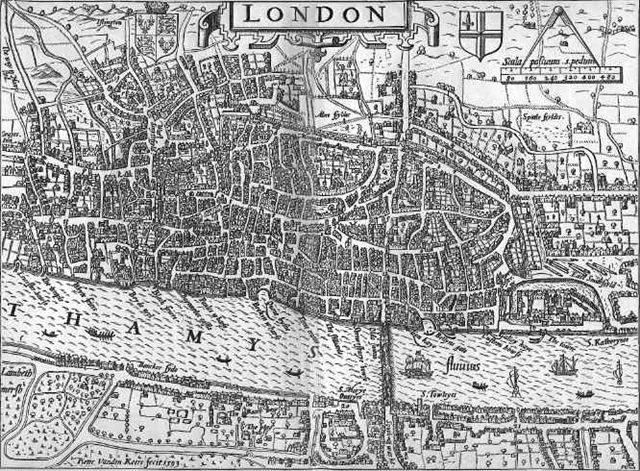
Shakespeare’s time reads like a gazetteer of London as Ned tours around looking for booksellers and all things Shakespeare, with detailed street names and historical sites and bookseller stalls – You must be familiar with London, so I must ask what is your favorite book on London? And London during the Elizabethan period?  The Regency period? And your favorite London haunt? [other than perhaps the British Library?!]

[Map of London 1593 – Internet Shakespeare Editions]

SB:  Oh dear, I didn’t want to sound like a gazetteer.  I lived more than ten years in London, and three in Bath, so much of what I wrote was from recollection.  Then I went back, retracing my characters’ steps with period maps and other clues to get the street names right, and to remove bridges and buildings that weren’t there at the times I was writing about.  I consulted all kinds of odd books, especially Regency ones, that I’d put aside during the course of my bookselling.  Pierce Egan’s Walks through Bath (1819) is a good example, and a useful one too.  For a modern book on London in Shakespeare’s time, the Oxford compendium Shakespeare’s England, first published in 1916, is still (I think) as good as it gets

JAIV:   On no! I meant that your book reading in parts like a gazetteer was a GOOD thing! I love the old London maps and had great fun following Ned around! 

The topic of carriages interests me very much, and the question of calculating distances and times is a difficult one: you say a coach traveling to London from Winchester in 1817 [50 miles] took 7 hours.  What sources did you use for those calculations?

SB:  Contemporary travel guides are not easy to come by, and sometimes even give conflicting information, but quite a few of the Regency and later guides to London have appendices of travel times.  I did the best I could with several of these.

JAIV:   I love the little bit about Fanny Dickens, Charles’s oldest sister, though you do say you muddled the dates a bit  – why Fanny and not other characters from the London or Bath of the time?

SB:  My brain accumulates trivia, and from somewhere or other I knew Fanny Dickens was a talented pianist.  That scene in Perfect Visit (I love it too – thank you) unexpectedly wrote itself one afternoon in the London Library where I was supposed to be doing other things.  I couldn’t let go of that scene, even when I found out I’d muddled the dates.  But with Fanny, Jane Austen, Elizabeth Fry, John Payne Collier, et al., already in the Regency parts of the novel, I felt that cluttering it up with even more celebrities would be too much of a good thing. 

JAIV:  Your Part III and IV are set in September 1833 [I will not ruin the plot and tell anyone the how and why!] – so without giving too much away, why this date? 

SB:  Touché!  September 1833 imposed itself on an early draft of the novel when I was trying to figure out a way to get Ned to the early 19th century.  My justification seemed compelling at the time, and then, quite suddenly, didn’t much matter at all.  But I’d gone to a lot of trouble getting the topography and costume of 1833 London as close to right as I could, so I kept Ned there.  I could invoke other reasons too, but I agree they would spoil the plot.

***************************** 

Thank you Stuart! – we will continue our conversation this weekend – Gentle Readers, please ask any question you might have for Stuart or leave a comment on either this post or the Part II post, and you will be entered into the random drawing for a copy of The Perfect Visit. Please do so by 11:59 pm, April 15, 2012.

Stuart Bennett was an auctioneer at Christie’s in London before starting his own rare book business. He is the author of the Christie’s Collectors Guide How to Buy Photographs (1987), Trade Binding in the British Isles (2004) which the London Times Literary Supplement called “a bold and welcome step forward” in the history of bookbinding, and many publications on early photography, auctions and auctioneers, and rare books. He currently lives and works near Boston, Massachusetts.

The Perfect Visit, by Stuart Bennett
Longbourn Press, 2011
ISBN: 9780615542706

For more information:

Copyright @2012 Jane Austen in Vermont
Books · Jane Austen · Jane Austen Popular Culture · Literature · Rare Books

A Jane Austen Sighting ~ in Northumberland!

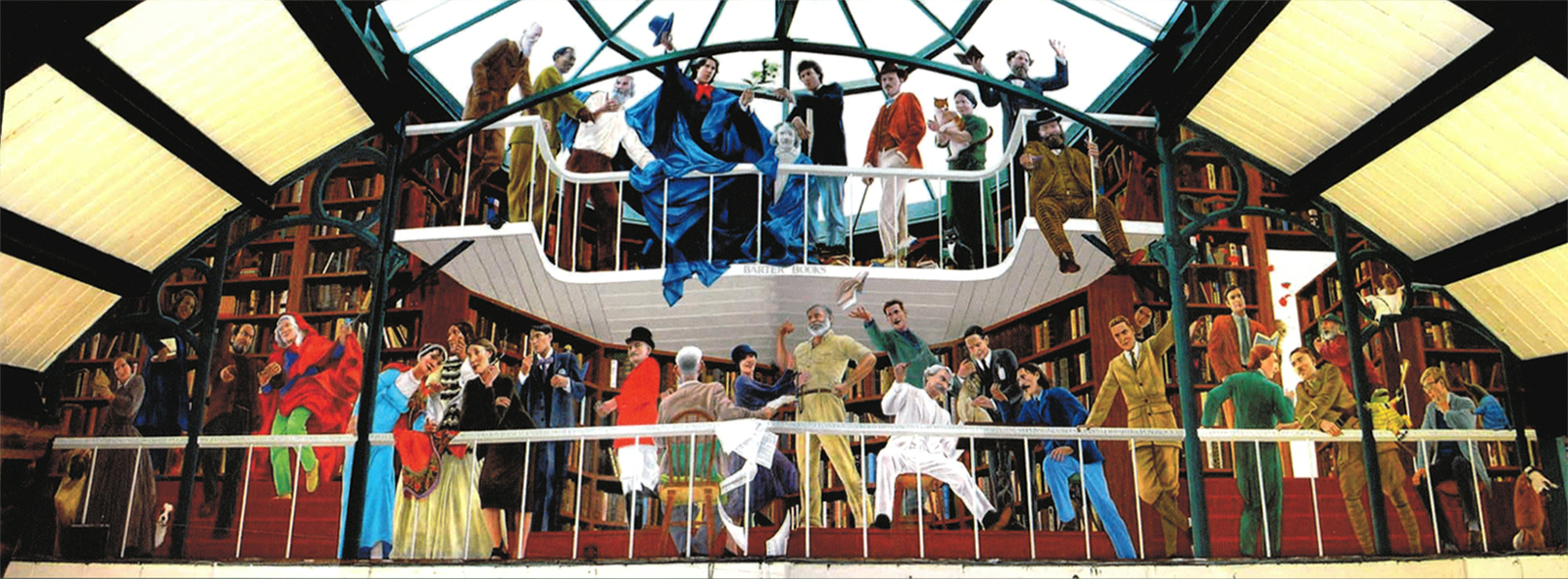
If you have seen the Friday Video on the Two Nerdy History Girls blog today, you will find this great short on the background to the “Keep Calm and Carry On” poster that is now seen and heard everywhere.  I didn’t realize that the poster was discovered in a box at this fabulous bookstore, Barter Books in Alnwick Station, Northumberland, and the rest as they say is history.

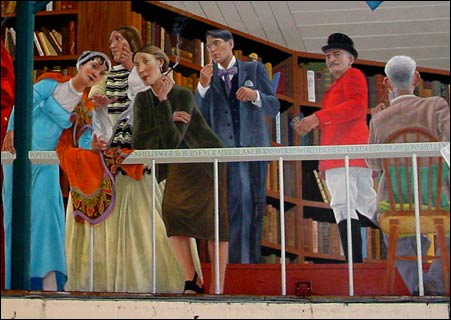
But in searching around the bookstore’s website (one of my addictions sorry to say), I discover a lurking Jane Austen in the “Writer’s Mural” in the shop:  visit the website yourself to explore the painting and enlarge the various images and find out why each author has been included, but here is the full painting, by Peter Dodd, the panel with Jane Austen, and a closeup of her image…

Famous Writers Gallery, by Peter Dodd
Jane Austen and Friends
Jane Austen closeup

Are any of your other favorite writers lurking about here? – if you were to compile such a wall mural, which authors would you put in it?

All Images courtesy of Barter Books – visit them soon!

Copyright @2012 Jane Austen in Vermont
Books · Collecting Jane Austen · Jane Austen · Jane Austen Popular Culture · Literature · Rare Books

On My Austen Bookshelf ~ The Perfect Visit

This book I shall get straightaway – available in paperback or for your kindle – and as this one looks like a keeper – books! bibliophiles! manuscripts! Shakespeare! Austen! – kindle will just not cut it…

Quoting full text from the Fine Books & Collections blog, by Rebecca Rego Barry:

If you enjoy novels with bookish characters and antiquarian themes, have I got a recommendation for you! Bookseller Stuart Bennett‘s debut novel, A Perfect Visit, is the story of a modern-day librarian and graduate student who get involved in a time travel project aimed at acquiring books and manuscripts to bring back to the future for profit and preservation. The American librarian, Ned Marston, travels to Shakespeare’s London to rescue lost quartos and ends up befriending the Bard, while the Canadian student, Vanessa Horwood, hopes to score a Jane Austen manuscript but gets sent to jail soon after meeting the dying author. If you can put aside your misgivings about a time travel plot (and you should, despite Dickens biographer Peter Ackroyd’s statement that “If a late-20th-century person were suddenly to find himself in a tavern or house of the period, he would literally be sick — sick with the smells, sick with the food, sick with the atmosphere around him” ), Ned and Vanessa’s experiences among famous authors and book collectors make for a perfectly delightful read.

In the postscript, Bennett, formerly with Christie’s rare books department and more recently past president of the ABAA, writes that the working title of this book was “A Bibliographical Romance” — less creative than the final title, taken from Austen’s Emma, but more descriptive. He goes on to say, “If I have tinkered a little with history, I have done my best not to tinker with bibliography…Every reference to books, authorship, texts, publisher’s imprints, and prices is, as far as I know, accurate.” It brings to mind the PBS slogan, “entertainment without the guilt.”

 Do you think Mr. Bennett was destined to write this book because of his name?? [despite the extra ‘t’…]
 
Further reading:
The Perfect Visit, by Stuart Bennett
  • ISBN-13: 9780615542706
  • Publisher: Longbourn Press
  • Publication date: 12/2/2011
  • $14.95 at your local bookseller [$10. 76 at B&N; $2.99 on your kindle…]
Copyright @2012 Jane Austen in Vermont
Auctions · Books · Jane Austen · Literature · Rare Books

Austen on the Block! ~ Affordable Jane and More…

Freeman’s Auctions [of Philadelphia] has two sets of Jane Austen’s novels up for auction this week: 

BOOKS, MANUSCRIPTS & EPHEMERA, Sale no. 1421.  2 Feb 2012. You can view the full catalogue here.

Lot 308: Jane Austen

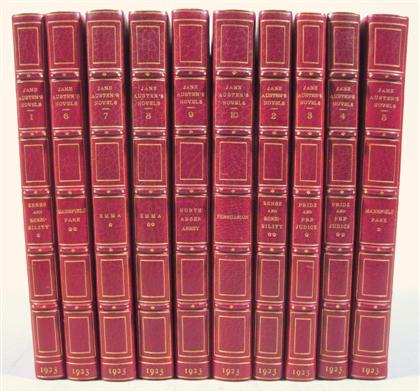
Novels - Lot 308

Austen, Jane. The Novels.Oxford, 1923. Large Paper edition, #1/950 (1000). 10 volumes. 8vo, contemp. 3/4 crushed burgundy levant morocco, gilt, geometric-gilt spine compartments, t.e.g., marbled bds., by Baynton; very occasionally slightly scuffed. Color and other plates. Edited by R.W. Chapman. Presumably purchased by the last owner from Mabel Zahn at Sessler’s Bookshop, Phila.  Estimate $800-1,200

Lot 319: Jane Austen

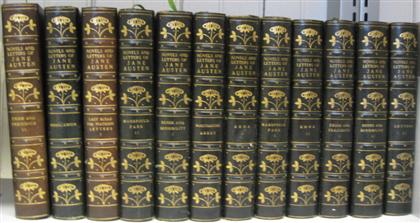
Novels & Letters - Lot 319

Austen, Jane. The Novels and Letters.New York: F.S. Holby, 1906. Stoneleigh Edition, #358/1250. 12 vols. 8vo, orig. 3/4 green morocco & marbled bds., t.e.g. gilt-lettered & floral spine; corners & edges occasionally slightly rubbed, a few spine heads scuffed or rubbed, 1 head band partly rubbed away, spines of 2 vols fading to brown. Color plates. Internally clean.  Estimate $800-1,200

Click here for the Austen details.

Other items of interest: a Shakespeare Head Bronte, 21 volumes of Thomas Hardy, and because we are all about Dickens all this year, there are several titles for sale, including this:  

Lot 259: Charles Dickens

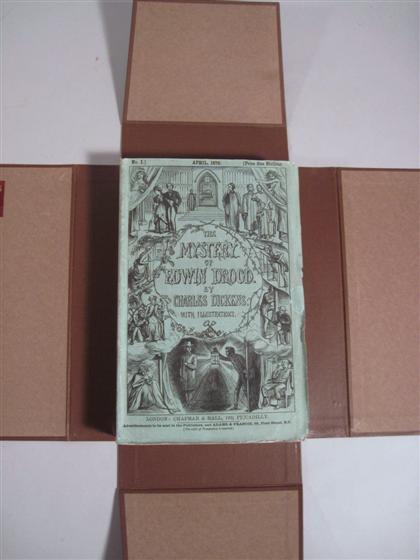
Dickens - Lot 259

Dickens, Charles. The Mystery of Edwin Drood. London: Chapman & Hall, 1870. 6 vols. (wrappers). First edition, 6 parts – all published 8vo, orig. printed blue green wrappers; minor wear. With 14 plates (incl. portrait). Scattered light foxing but internally generally clean and light. With all adverts. except the 4pp Wilcox & Gibbs concerning stitches adverts [ called for in part 6]. Includes the cork hats sheet in part 2. In custom gilt lettered brown cloth case & chemise.  Hatton & Cleaver pp373-(384). Purchased by the last owner from Mabel Zahn at Sessler’s Bookshop, Phila.  Estimate $300-500

And click here for offerings of  Thomas Rowlandson: here are the details on one, published by R. Ackermann between 1809-[1811]:  Jane Austen surely read these – she refers to Dr. Syntax in her letter of 2-3 March 1814 [Le Faye, Ltr. 97]. She writes to Cassandra from Henrietta St in London:   

“I have seen nobody in London yet with such a long chin as Dr. Syntax…”

 Lot 269: Thomas Rowlandson 

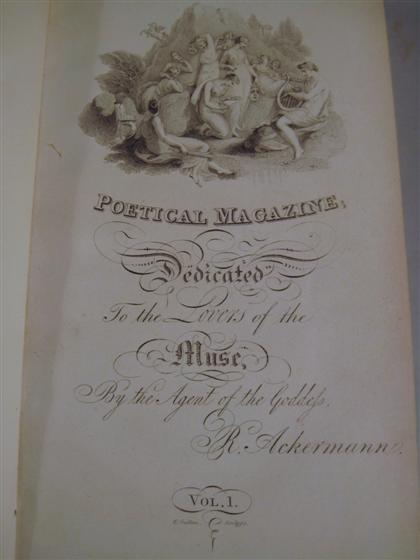
Poetical Magazine - Lot 269

(Rowlandson, Thomas, et al. illustrators) Poetical Magazine. London: R. Ackermann, 1809-[1811]. 4 vols. 8vo, early 20th-century full triple gilt lettered paneled, mottled tan polished calf, spines gilt, turn ins gilt, a.e.g., green morocco spine labels by Root; very occasional minor scuffing. With 4 engraved titles & 52 plates (50 hand colored aquatints & engravings – 30 by Rowlandson of Doctor Syntax.) Complete with a leaf of rhymed adverts. Internally clean & bright. Book plates of Dr. Stoughton R Vogel, & Robert Alexander Montgomery. Bright bdgs. Contains original issue of Combe’s & Rowlandson’s Tour of Dr. Syntax under the title of “The School Master’s Tour.” Tooley 421. Purchased by the last owner from Mabel Zahn at Sessler’s Bookshop, Phila.   Estimate $1,000-1,500

Rowlandson's Dr. Syntax - Lot 269

…with his very long chin!

*******************

Happy bidding!

[All images and text from the Freeman’s Auction website]

Copyright @2012 Jane Austen in Vermont
Auctions · Jane Austen · News · Rare Books

Austen on the Block! ~ The Watsons Sells!

Update: the manuscript sold for £990,000 to the Bodleian Libraries of Oxford University [with a little help from The National Heritage Memorial Fund] – thanks to Tony Grant for this information in his comment below – here is the latest news from the BBC website: http://www.bbc.co.uk/news/entertainment-arts-14152092 [though they could have spelled Bodleian correctly!]

******************

I am still on the road with little access – so thanks to Julie at Austenonly for the news that Jane Austen’s The Watson’s sold for over £850,000 this morning in London! – read Julie’s post here: http://austenonly.com/2011/07/14/the-watsons-sells-at-sothebys-in-london/ – stay tuned for the announcement of who bought it – apparently an institution – I would hazard a guess it is the Pierpont Morgan in New York City –  where the first pages of the manuscript are now housed – and though nothing against the Morgan, I guess I would prefer to see it at Chawton House Library, close to where it laid on a shelf somewhere in Chawton Cottage for a good number of years.

More later.  You can read my original post here:  https://janeausteninvermont.wordpress.com/2011/05/21/on-the-block-jane-austens-the-watsons/