Austen Literary History & Criticism · Author Interviews · Books · Jane Austen · Literature · Regency England · Social Life & Customs

Maggie Lane on Understanding Austen: Key Concepts in the Six Novels

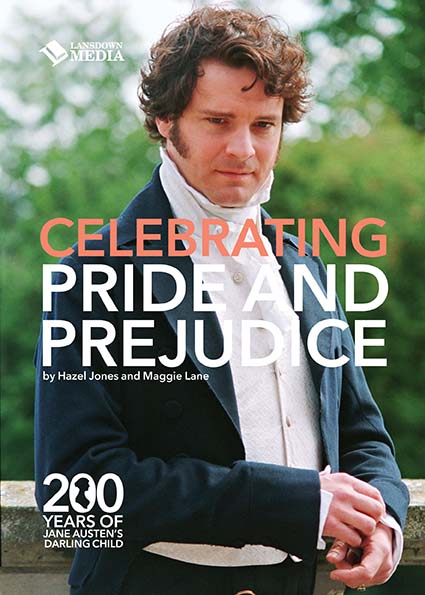
I had the pleasure to converse a bit with author Maggie Lane at the Brooklyn AGM last month – she signed a copy for me of her new book co-authored with Hazel Jones Celebrating Pride and Prejudice (Bath: Lansdown Media, 2012]
 

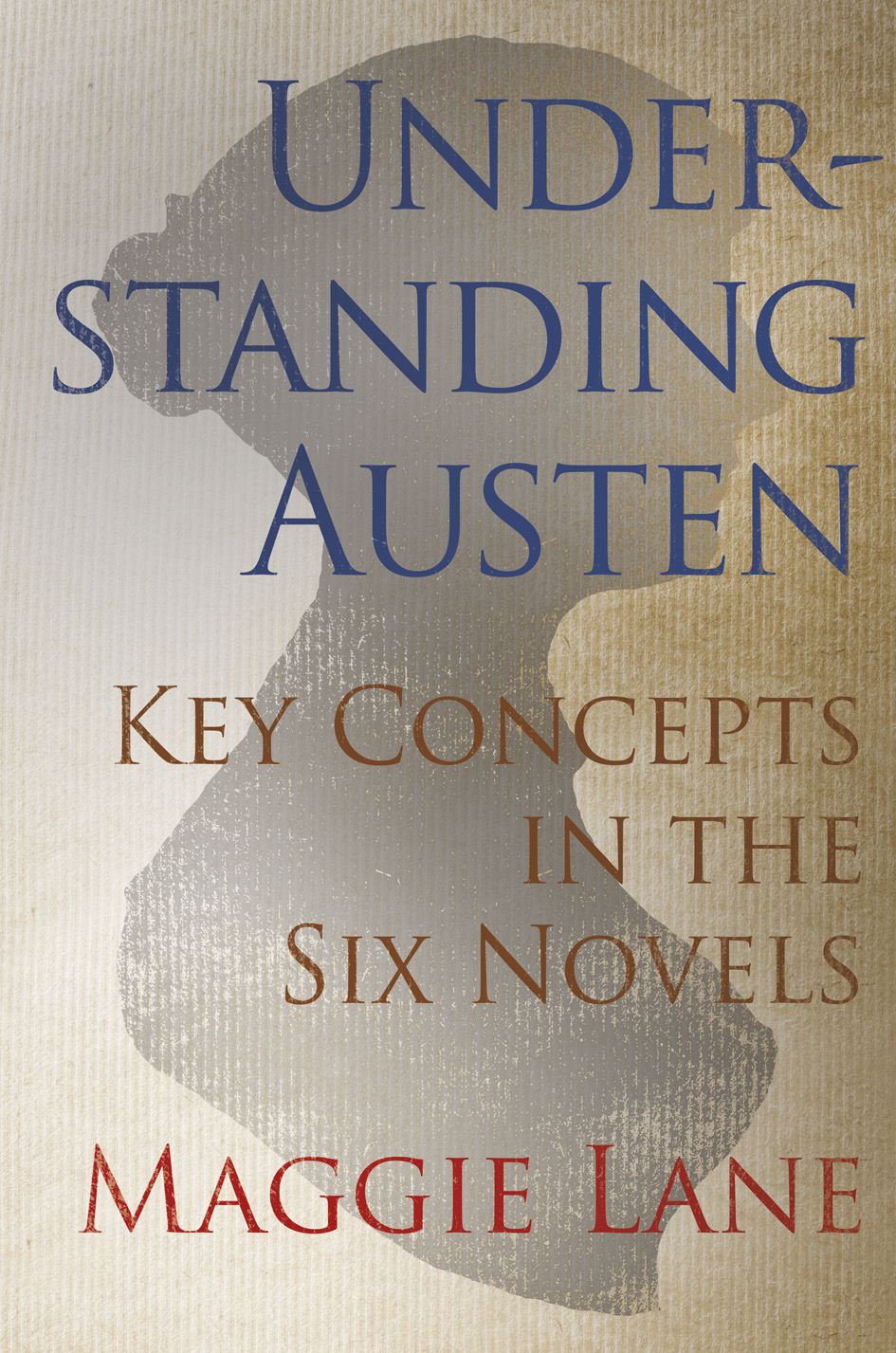
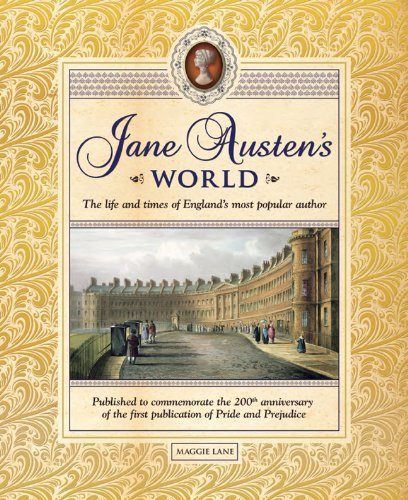
But Ms. Lane has been very busy! – I also purchased her just published Understanding Austen: Key Concepts in the Six Novels (London: Robert Hale, 2012) and in February 2013, her invaluable Jane Austen’s World: The Life and Times of England’s Most Popular Novelist (Carlton, 2013) will be published in a new revised edition with a new cover.
[You may pre-order here at Amazon.uk  ]

Those of us who subscribe to the Jane Austen’s Regency World magazine [and who does not! – if you have perchance let this fall through the cracks, it is a perfect holiday gift to request for yourself and / or give to your Austen friends: http://janeaustenmagazine.co.uk/subscribe/

… but those who do already subscribe will know that Maggie is the consultant editor, and author in each issue of the always interesting take on Austen “minutiae”, wherein she will take what the average reader will often gloss over and suggest the significance of the most obscure terms, themes or ideas, thereby making a reading all the more interesting and compelling.  Indeed in the latest Nov – Dec 2012 issue in her essay on “Shoelaces and Shawls”, Maggie addresses the clothing accessories in Emma’s Highbury, offering a discussion of shawls and shoes, and tippets and umbrellas, and the “elegance” of Mrs. Elton’s garish purple and gold; and she too makes reference to the importance of the already-famous Mr. Knightley’s gaiters

But today I want to share with you some of Maggie Lane’s own words on her book Understanding Austen.  She has most graciously written us a lovely essay on how the book came into being.  If you have any questions for Maggie or would like more information on the book, please comment below – she will be happy to answer you.

For some years now I have enjoyed being Consultant Editor of, and writer for, the Jane Austen and her Regency World magazine.  While other contributors explore the visual, social or political aspects of the world that Jane Austen inhabited, or discuss prominent personalities of the period, when writing my own articles I see my brief as keeping close to the novels themselves.  In each issue, I attempt to illuminate some theme or idea that plays a subtle yet vital part in Austen texts.  Thus it was that I hit on the idea of investigating some of the abstract nouns – elegance, openness and reserve, to take three examples – that feature so often in the six novels.

I soon realised that there was far more to say about these concepts than could be encompassed in the word-length of an article.  The idea for a new book was born!  The subject seems to me replete with interest.  There is the linguistic interest of how the meanings of certain words have shifted in the two centuries between Jane Austen’s time and our own.  Candour is a good example of that.  It now means frankness amounting sometimes even to rudeness, yet in Austen’s time it still carried the sense of generosity of spirit, of giving other people the benefit of the doubt, which Elizabeth Bennet so admires in her sister Jane.  And then there is the moral weight which Austen attaches to certain words.  Composure is almost always a quality to be recommended and tried for.  It preserves the individual from unpleasant notice and calms the nerves.  Yet when Willoughby displays composure in his London encounter with the deeply distressed Marianne, he is behaving as a heartless cad.  Anne Elliot’s “elegance of mind” is of a wholly different calibre from “the sameness and the elegance” of her eldest sister’s way of life.

The nuances which Jane Austen accords to all her favourite abstract terms make them an endlessly fascinating study.  By focussing on her vocabulary, noticing which words keep company with others, juxtaposing and comparing familiar sentences from across the novels, I gained new insights and new understanding which I hope my readers will share.

 *******************

Thank you Maggie!

I append here the Table of Contents to the work – an abundance of terms under discussion!

  1. Genius, Wit and Taste
  2. Elegance
  3. Openness and Reserve
  4. Exertion and Composure
  5. Liberality and Candour
  6. Gentility
  7. Delicacy
  8. Reason and Feeling
  9. Person and Countenance
  10. Air and Address
  11. Mind
  12. Temper
  13. Spirit
  14. Sensibility, Sense and Sentiment
  15. Firmness, Fortitude and Forbearance
  16. Propriety and Decorum
  17. A Nice Distinction

By way of example, let’s look at the Heroes of the novels and how they fare comparatively in the chapter on “Person and Countenance”:

Henry Tilney had a pleasing countenance, a very intelligent and lively eye, and if not quite handsome, was very near it; Bingley was good looking and gentlemanlike; he had a pleasant countenance and easy, unaffected manners; but alas! his friend Mr. Darcy is soon discovered to be proud, to be above his company and above being pleased; and not all his large estate in Derbyshire could then save him from having a most forbidding, disagreeable countenance.

Wickham had all the best part of beauty, a fine countenance, a good figure, and a very pleasing address.

Edward Ferrars does not at first appeal: at first sight, his address is certainly not striking, and his person can hardly be called handsome; Brandon: though his face was not handsome, his countenance was sensible, and his address was particularly gentlemanlike. And Willoughby? His person and air were equal to what her [Marianne] fancy had ever drawn for the hero of a favourite story. – which should send up red flags to the reader immediately!

Frank Churchillhis countenance had a great deal of the spirit and liveliness of his father’s – he looked quick and sensible.

And this description of Henry Crawford has always given me a chuckle: he was plain to be sure, but then he had so much countenance, and his teeth were so good. !

And Elizabeth Elliot is quick to observe [in the chapter on “Air and Address” which links quite nicely with “Person and Countenance”] this about Captain Wentworth: [she] had been long enough in Bath to understand the importance of a man of such an air and appearance as his…Captain Wentworth would move about well in her drawing room. Indeed!

And so it goes – are you not intrigued to find how Mr. Knightley is so described? I highly recommend this book – you will find you shall choose to re-read all the novels all over again, all the more appreciating the language and narrative meaning through Maggie’s insightful view – it is perhaps another holiday gift to add to your own ‘want-list’?

Do you have a favorite term or description in Austen that you would like to share? or a question about a term that might be confusing to you? – please comment below, along with any questions for Maggie.

About the author:

Maggie Lane is the author of numerous (and invaluable!) works on Jane Austen [see list below]–
She has also published articles in the Jane Austen Society Annual Reports,
the JASNA journal Persuasions, and has lectured on Austen
in the UK, the US, Canada, and Australia.

Having served for many years on the committee of the Jane Austen Society UK,
she is now Chair of its South West branch; she lives in Exeter.

Maggie Lane.
Understanding Austen: Key Concepts in the Six Novels.
London: Robert Hale, 2012.
ISBN: 978-0-7090-9078-6
£16.99 ($24.95)

Her works:

  • Jane Austen’s England (1986)
  • Jane Austen’s World (1996, 2005, new edition out in Feb 2013]
  • Jane Austen’s Family Through Five Generations (1984, 1992)
  • Literary Daughters (1989)
  • Jane Austen and Names (2002)
  • A Charming Place: Bath in the Life and Novels of Jane Austen (1988)
  • Jane Austen and Food (1995)
  • The Jane Austen Quiz and Puzzle Book (1982) [and various other quiz books on Dickens, Hardy, Bronte, Shakespeare, and more!]
  • Jane Austen in Lyme (2003)
  • Celebrating Pride and Prejudice: 200 Years of Jane Austen’s Darling Child
c2012, Jane Austen in Vermont
Austen Literary History & Criticism · Collecting Jane Austen · Jane Austen · Regency England · Social Life & Customs

Giveaway winner announced ~ A Dance with Jane Austen by Susannah Fullerton!

Giveaway winner for Susannah Fullerton’s A Dance with Jane Austen: How a Novelist and Her Characters went to the Ball is Diana Birchall! – she wrote this on November 3:

I love Susannah’s writing, and I have long been a great admirer of her awe-inspiring range of abilities.  That is why I cast her as “my Marianne”!  I must and shall own this book, but they ran out of them at the AGM, and I haven’t got mine yet.  I just won a fabulous biography of Keats on the Dovegreyreader blog, and my mother-in-law’s electricity got restored in NYC today, so let’s make it good luck comes in threes.  Please enter me to win Susannah’s book!

Congratulations Diana – luck comes in threes indeed! And the fact you cast Susannah in your play as “Marianne” makes this even sweeter – I promise a completely objective random drawing [you can thank my husband who picks a number from 1-whatever in order of posting – he doesn’t even know what I am asking for!]

Please email me privately with postal direction!

Thank you all for such wonderful responses, to Susannah for her lovely post and responses, and to Sue Forgue, my go-to person for all things Regency (and London!) for her dance information!  For those of you who will be attending the JASNA-Vermont Tea on December 2nd, this book will be one of the door prizes, with thanks again to the publisher Frances Lincoln for their generosity.

c2012 Jane Austen in Vermont
Austen Literary History & Criticism · Author Interviews · Books · Collecting Jane Austen · Fashion & Costume · Great Britain - History · Jane Austen · Regency England · Social Life & Customs

Guest post: Susannah Fullerton on her A Dance with Jane Austen and book giveaway!

The AGM in Brooklyn brought many pleasures, and one of the most pleasurable was meeting and talking with Susannah Fullerton.  I have long been an admirer – she is the President of the Jane Austen Society of Australia and a quick perusal of their website shows the extent of what she and her organization do, from annual meetings to conferences and the JASA publications Sensibilities and The JASA Chronicle.  Susannah also leads a number of literary tours for ASA Cultural Tours  [Australians Studying Abroad], and lectures on Austen around the world. And I must add that she was perfectly cast as the close-to-hysterical Marianne in the “Austen Assizes” script by Diana Birchall and Syrie James staged in Brooklyn!

Susannah has written many articles and a few books, one on which remains an all-time favorite, Jane Austen and Crime (Jones Books, 2004), wherein Ms. Fullerton gives us the real world that Jane Austen alludes to in all her works, the realities of such pieces in the narrative as Willoughby as serial seducer, Lydia’s “elopement,” and even the gypsies in Emma.  In her newest work, A Dance with Jane Austen: How a Novelist and her Characters went to the Ball (London: Frances Lincoln, 2012), Fullerton offers up the same detailed analysis of what Austen so off-handedly tells us, most of which we don’t quite “get” as 21st-century readers – the dressing for the dance, getting to the Ball, the various types of balls, proper etiquette, the music, the conversation, the Men! – all of it to enhance our understanding of Austen’s time and therefore her stories…

I have asked Susannah to join us today to tell us a little about her book, and her publisher has generously offered a copy for a giveaway – please see the information below on entering to win!

*************************

SF:  Some years ago I was having dinner with Joan Strasbaugh of Jones Books, the publishing firm which had brought out the American edition of my book Jane Austen and Crime, when Joan suggested that a book that really needed to be written was a book about Jane Austen and Dance. I was taken aback for a moment! Surely, with dances playing such a vital role in Jane Austen’s fiction, that subject had already been covered. But when I stopped to think, I realised it had not. Many Austen scholars have written about her dance scenes as part of other works, but there was no one book devoted entirely to that subject, a book that explored the social etiquette of the ballroom, the vital role dance played in courtship, the suppers served and the music played. Would I be interested, Joan asked, because if so, she could recommend the project to Frances Lincoln UK Ltd. And so I started writing.

image: Republic of Pemberley

What I wanted to do, I decided, was to follow Jane Austen’s characters to a ball. Had I been Jane or Elizabeth Bennet, what would the whole process of going to a dance have involved? How did a heroine get to a ball in the first place if her family had no carriage (the case for Emma Watson), how did she dress for the occasion, what rules governed her behaviour while there, and what differences did she find between assembly balls and private balls? When she stood up with a young man, what were the possibilities for flirtation and courtship, and how does Jane Austen show this happening with Elizabeth and Darcy, Jane and Bingley, Emma and Mr Knightley, Catherine and Henry, Marianne and Willoughby, when they are dancing with each other? Poor Fanny Price suffers the day after the Mansfield ball when she has no suitable confidante with whom to talk it all over, but for luckier young ladies often the ‘post-ball discussion’ was almost as much fun as the event itself.

Jane Austen loved to put on her satin slippers and go off to dance. In my book I wanted to provide information about the balls she attended, from the Basingstoke assemblies of her youth when she danced happily with neighbours and family friends, to the later balls where she chaperoned nieces and preferred to sit by the fire with a glass of wine rather than dance. She too enjoyed courtship in a ballroom when she danced with Tom Lefroy; she too knew the excitement of being asked by the right man, and the challenges of avoiding the wrong one.

As I wrote my book I discovered patterns in Jane Austen’s use of dances in her fiction. Several of the novels have one informal dance and one more formal one, and she uses each to progress her themes, characterisation and relationships. In some novels what happens is romantic, as is the case when Darcy and Elizabeth are partners and you can almost see the sparks between them, but in Mansfield Park everyone always seems to be dancing with the wrong person and balls in that novel illustrate selfishness, not romance. Jane Austen makes a great deal happen at a ball!

image: Brock illus Mansfield Park, Mollands

A Dance with Jane Austen is beautifully illustrated with contemporary pictures or illustrations from the novels. I include a brief chapter about dances in the film versions, but decided not to make this extensive because so often film-makers get it wrong and put in a dance, such as Mr Beveridge’s Maggot, which Jane Austen would not have danced. However, there are some lovely pictures from some of the movies that I chose to include.

For the past 17 years I have served as President of the Jane Austen Society of Australia. In that time I have lectured extensively about Jane Austen and her works, and have seen the joy that her books give to readers around the world. I hope that my book will increase the enjoyment of those readers by taking them into the ballrooms to discover that there is “nothing like dancing after all.”

***************

JAIV: One question I would ask Susannah is ‘What is your favorite dance scene in a Jane Austen novel and why?’

SF:  My favorite dance scene is the Crown Inn ball in Emma. This is the evening when Emma first starts to view Mr. Knightley as an attractive male, rather than as an old friend and family connection. She watches his “erect” figure move about the room, sees him rescue Harriet Smith from the embarrassment of being rejected as a dance partner, prods him into asking her to dance with him, and can hardly take her eyes off him all night! Jane Austen achieves so much in all her dance scenes – she gives a sense of a full community of living people, progresses courtships, reveals character and shows faults and foibles – but this scene is particularly rich. The moment when Emma reminds Mr. Knightley that they are “not really so much brother and sister as to make (dancing together) at all improper” and he replies “Brother and sister! No, indeed!” is one of the most erotic moments in all of Jane Austen’s fiction. It thrills me every time!

image: theloiterer.org

Oh I agree – I love this scene! Thank you so much Susannah for sharing your love of Jane Austen and dance with us!

**************************

Gentle Readers!  please ask any question you might have for Susannah Fullerton or post a comment here and you will be entered into the random drawing for a copy of A Dance with Jane Austen. Please do so by 11:59 pm, Sunday November 4th, 2012. Winner will be announced on Monday Nov. 5th – Worldwide eligibility!

For a review of the book, please visit:

About the author: 

Susannah Fullerton is President of JASA, and author of Jane Austen – Antipodean Views, Jane Austen and Crime and the forthcoming Celebrating Pride and Prejudice: 200 Years of Jane Austen’s Masterpiece (due out Jan. 2013) – note that the UK title of this work is Happily Ever After: Celebrating Jane Austen’s Pride and Prejudice.

A Dance with Jane Austen
Frances Lincoln, October 2012
ISBN-13: 978-0711232457

Upcoming book: (Feb. 2013)

US edition title and cover
UK edition title and cover
Austen Literary History & Criticism · Author Interviews · Books · Collecting Jane Austen · Great Britain - History · Jane Austen · Jane Austen Circle · Regency England

Guest Post: Janine Barchas ~ A Janecation in Yorkshire? ~ Jane Austen’s Real Wentworths

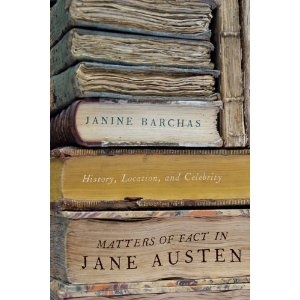
Gentle Readers:  I welcome today, Janine Barchas, associate professor of English at the University of Texas, Austin, where she teaches, perfectly situated you might say, Austen in Austin. She has published a number of scholarly articles on Jane Austen and the just released Matters of Fact in Jane Austen: History, Location and Celebrity (Johns Hopkins UP, 2012).  She has graciously offered to share a bit of one of the tales expounded on in her book, the Wentworth family of Yorkshire.  I think you will want to know more about her very interesting findings – I highly recommend the book! – and see below for a contest offering from the publisher that starts this coming Friday October 26 [see the blog here: http://jhupressblog.com/ ] – and please comment or ask Janine a question!

***********************

A Janecation in Yorkshire?  Jane Austen’s Real Wentworths

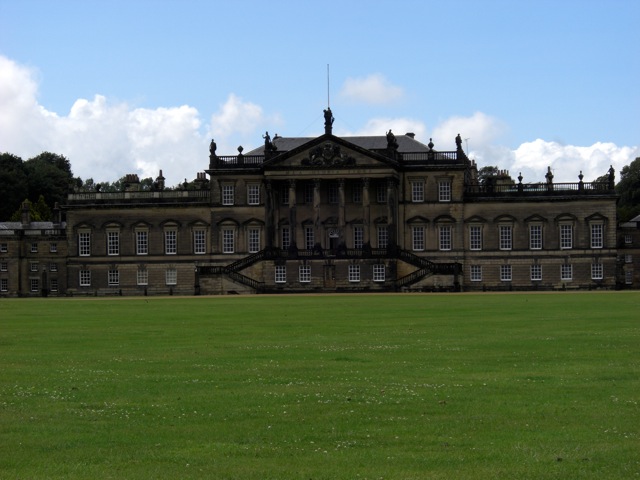
Although South Yorkshire may seem an unlikely destination for a Janeite pilgrim, the research for my book Matters of Fact in Jane Austen: history, location, and celebrity (Johns Hopkins UP, 2012) led me to two breathtaking country estates with histories that connect to Austen’s fictions: Wentworth Castle and Wentworth Woodhouse.

I was not tracing Austen’s physical steps, but following some of her leading names—particularly Wentworth, Woodhouse, Fitzwilliam, Darcy, Watson, and Vernon.  When Austen selected these surnames for her fictional protagonists, they hung on the real-world family trees of these two neighboring Yorkshire estates.  Not unlike the Kennedy family in our own era, the Wentworth clan consisted of high-profile politicians and celebrities—with newspapers assiduously tracking all sightings and London shops selling reproductions of family portraits as cheap paper pinups.  Jane Austen, too, seems to have been keenly aware of Wentworth celebrity.

Wentworth Woodhouse

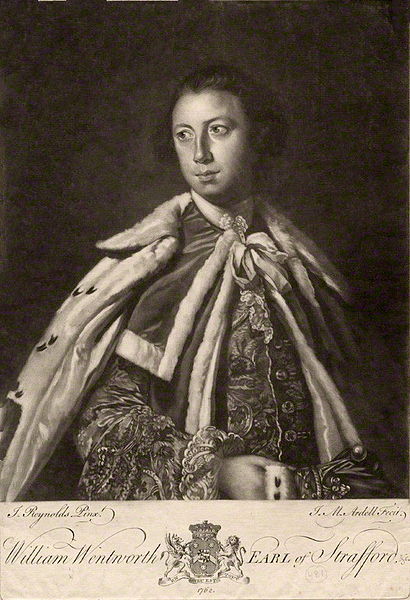
Even a short summary of the history of Wentworth Woodhouse can make an Austen fan sit up with the surprise of recognition.  After Robert Wentworth married a rich heiress named Emma Wodehouse, their Yorkshire family so prospered that in 1611 its senior line achieved a baronetcy, just as the owner’s sister married the heir of the wealthy D’Arcy family.  The eldest son of that same first baronet was the hapless Thomas Wentworth, first Earl of Strafford and martyr to the royalist cause.  With the Restoration, the estate was returned to Strafford’s eldest son, William Wentworth.  But when William died without issue in 1695, it transferred to the children of his sister, Anne Wentworth, wife to the head of the Watson family.  When in 1751, Charles Watson, heir to these princely estates, succeeded his father as the second Marquess of Rockingham, he became one of the wealthiest peers in England.  Charles Watson Wentworth, having added his mother’s maiden name to his own, was twice elected Prime Minister of England.  But he died unexpectedly and childless in 1782, just after his second election at age 52.  Thus, when Austen was a mere girl, the combined fortunes of the Woodhouses, Wentworths, and Watsons transferred to their next of kin, the Fitzwilliams.

Wentworth Castle
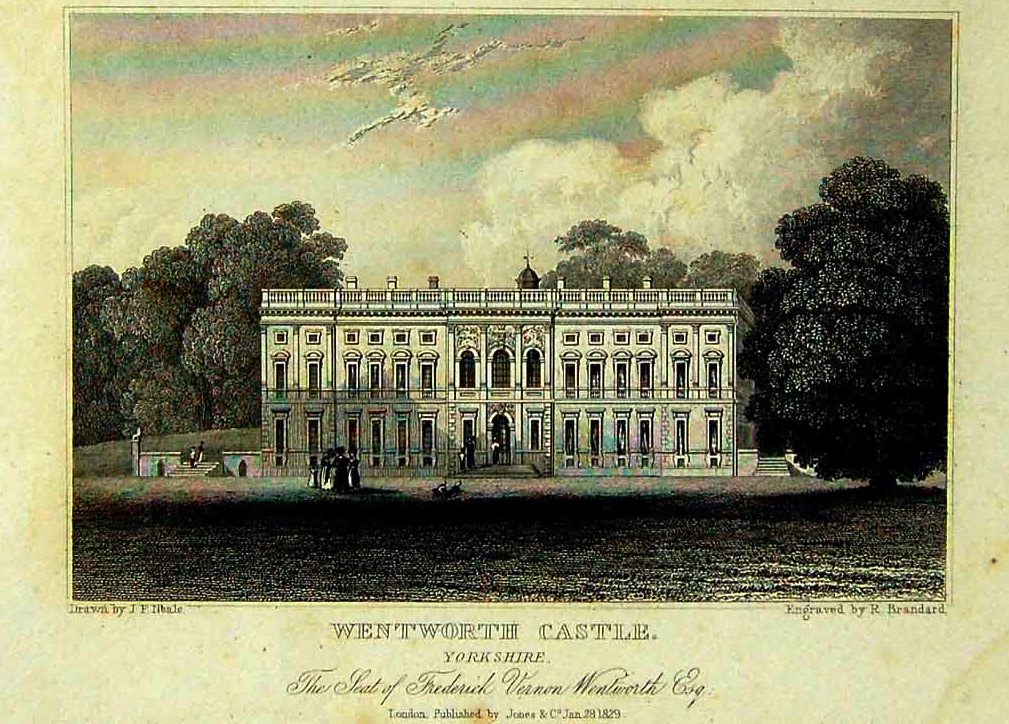
Wentworth Castle, 1829

By then, a family feud between Wentworth cousins (Tory and Whig) had resulted in Wentworth Castle.  Even the name of the rival estate deliberately taunted the mere “House” six miles away.  Major renovations to Wentworth Castle were duly answered with elaborate improvements to nearby Wentworth Woodhouse, shaping English garden design through one family’s political rivalry.  The competitive landscaping at these neighboring estates, the bulk of which took place between 1710 and 1790, was a prolonged endeavor that occurred on a grand scale and in the national spotlight.  It was in 1791, when Austen was in her teens, that the Wentworth Castle estate and titles were inherited by an obscure gentleman from Dorset named (I’m not making this up!) Frederick Wentworth, making him the third and last Earl of Strafford.  When Austen reached her late 20s, Wentworth Castle became the property of young Frederick Vernon after another heated Wentworth-family dispute. The historical circumstances surrounding this contested transfer of Wentworth wealth resemble those in Lady Susan, which features at least two characters named Frederic Vernon as well as a dispute over a family castle.

William Wentworth – 2nd Earl of Strafford

[Image from wikipedia]

After years of wily namedropping, and perhaps because her contemporary readers would have instantly connected the hero of Persuasion with this glamorous Wentworth family, Austen disclaims in her final novel.  She has the sycophantic Sir Walter Elliot sneeringly dismiss any link between Capt. Frederick Wentworth, the story’s self-made naval officer, and the highborn Wentworths from Yorkshire, who held titles such as the Earl of Strafford: “Mr. Wentworth was nobody, I remember, quite unconnected; nothing to do with the Strafford family.”  By placing the requisite disclaimer in the mouth of Sir Walter, Austen keeps her own tongue firmly in her cheek.  Sir Walter is notoriously unreliable—a narcissistic fop who lacks judgment.  Despite, or perhaps because of, Sir Walter’s dismissal, the name of Frederick Wentworth so flagrantly invites contemporary associations that the upending of those expectations (a landless sailor named after one of England’s most famous landowning families?) becomes part of the story’s piquancy and contemporary appeal.

Anne Wentworth, Countess of Strafford – by Joshua Reynolds c1745

[Image from wikipedia]

Today, both properties are being renovated and have opened their gardens to visitors.  Privately owned Wentworth Woodhouse has plans for a spa and hotel by 2015, while the Wentworth Castle Trust (the house is a teacher training college) has already restored the castle folly for which the property is known.  In both cases, the grounds and vistas are as stunning as eighteenth-century and regency guidebooks record.  While enjoying the picturesque herds of deer that, according to the locals, have roamed there since 1066, I could not help smiling at how the popularity of Austen’s fictional characters—especially Fitzwilliam Darcy and Frederick Wentworth—have succeeded in eclipsing their historical namesakes, casting a Janeite shadow over the once-glittering owners of these estates.

Wentworth Castle folly
Wentworth Castle Estate
Wentworth Woodhouse estate

If you’re an Austen enthusiast who has already been to Bath, Lyme Regis, and Chawton, then consider a visit to Wentworth Woodhouse and Wentworth Castle.  Meanwhile, I hope that my book takes you partway there.

The Fitzwilliam Arms in nearby Rotherham

***************************

For a few photos as well as more information about these and other glamorous places alluded to by Austen, see the JHU Press Blog post by Janine “Jane Austen on Location”: http://jhupressblog.com/2012/09/12/jane-austen-on-location/

Johns Hopkins UP is about to run a small contest that would give away copies of my book to the first few who answer correctly a historical question with an Austen twist.  Look for the question on the JHU Press Blog, starting on 26 October.

****************

About the author: Janine Barchas is the author of Graphic Design, Print Culture, and the Eighteenth-Century Novel (Cambridge UP, 2003), the editor of The Annotations in Lady Bradshaigh’s Copy of Clarissa (English Literary Studies, U of Victoria, 1998), and numerous scholarly works on Austen (search her name on the Jasna.org website here). Her research interests include eighteenth-century literature and culture, the British novel, book history, textual studies, Jane Austen, and early fiction by women. At the JASNA 2012 AGM, she spoke on “Austen Between the Covers: A Brief History of Book Cover Art”, and will be one of the plenary speakers at the JASNA 2013 AGM in Minneapolis, the AGM celebrating 200 years of Pride and Prejudice.

Further Reading:

Wentworth Castle:

Wentworth Woodhouse:

And note that The Country House Revealed is a six part BBC series first aired on BBC Two in May 2011 in which British architectural historian Dan Cruickshank visits six houses never before open to public view, and examines the lives of the families who lived there. Wentworth Woodhouse s featured in Episode 4.

All photographs by Janine Barchas.

Please leave any comments or questions for Janine below – and don’t forget to check out the JHU Press blog on October 26, and see if you can answer the Jane Austen question!

c2012 Jane Austen in Vermont
Austen Literary History & Criticism · Book reviews · Books · Collecting Jane Austen · Jane Austen · Jane Austen Societies · JASNA · Literature · Regency England

The JASNA 2012 AGM in Brooklyn ~ Part I: My Jane Austen Book Stash

I have not gone missing, though it may seem that indeed I have fallen off the planet – not quite so dramatic though it does almost feel like that – we have sold our house and amidst the joys of house packing, packing up my book business – all gone to storage as we do not have a place to call home – concerns about my son’s surgery, a September 23rd JASNA-Vermont event of grandiose proportions [three speakers, a fabulous afternoon!], and then off to the JASNA AGM in Brooklyn – a lovely respite into the late 18th century from which I am still fighting re-entry!  I was hoping to post about the AGM right away and fear I am slowly forgetting about all the fabulous events of Jane Austen Land in Brooklyn – but I shall start today with a booklist of new purchases – the Emporium filled with goodies as usual – and though the lack of a home and the memory of packing all those books forced me into more conservative behavior at the book stalls, I confess that book buying is my only true vice and I could not completely resist, so here are the latest additions to my Jane Austen library:!

Maggie Lane. Understanding Austen: Key Concepts in the Six Novels. London: Robert Hale, 2012.  ISBN: 978-0-7090-9078-6

Lane has written a number of Austen-related texts and this book will be a most welcome addition to my collection of her other works. Her essays in Jane Austen’s Regency World magazine are always insightful, often just focusing on a single term and how Austen employs it [for example in the Mar / April 2011 issue, she takes on Austen’s concept of “home”] – in this book, Lane delineates Austen’s 18th century language, clarifying for the reader the meanings of such words as “elegance” and “openness” to “candour” and “gentility” and “mind” and “spirit” – a lively entry into Austen’s world that adds to our understanding and appreciation of what she was really saying to her readers…

Devoney Looser. British Women Writers and the Writing of History, 1670-1820.  Baltimore: Johns Hopkins UP, 2000. ISBN: 0-8018-6448-8

Ashamed to say I do not have this in my collection – so happy to remedy that with this discussion of Lady Hutchinson, Lady Mary Wortley Montagu, Charlotte Lennox, Catharine Macaulay, Hester Lynch Piozzi, and Jane Austen and their historically-informed writings… perfect winter reading…

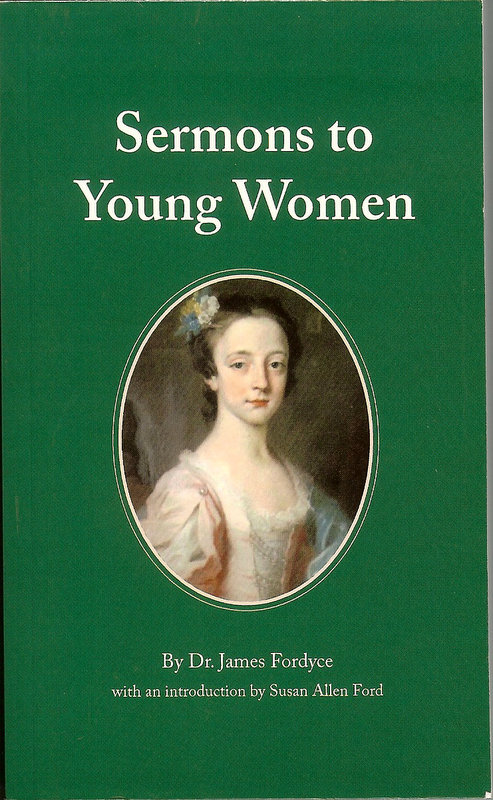
James Fordyce. Sermons to Young Women. Introduction by Susan Allen Ford. Chawton: Chawton House Press, 2012.
ISBN: 978-1-907254-07-9

One of the best-selling conduct books of Jane Austen’s day, Fordyce’s Sermons to Young Women we mostly know as the reading material of the odious Mr. Collins, the words of which Lydia Bennet patently ignored… This is a paperback facsimile of the 10th edition from the Chawton House Library collection, and necessary reading material if one is to understand the world that Jane Austen was writing in – we might laugh at some of the directives for female behavior now and think we indeed have “come a long way baby” – but read it we must to truly “get” Austen… purchase supports the Chawton House Library, and as Susan Allen Ford, JASNA’s intrepid Persuasions editor, has written the introduction, one should just add this to their shelves without further ado…

******************

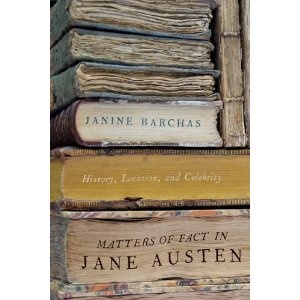
Janine Barchas. Matters of Fact in Jane Austen: History, Location, and Celebrity. Baltimore: Johns Hopkins UP, 2012.  ISBN: 978-1-4214-0640-4

“Janine Barchas makes the bold assertion that Jane Austen’s novels allude to actual high-profile politicians and contemporary celebrities as well as to famous historical figures and landed estates…the first scholar to conduct extensive research into the names and locations in Austen’s fiction by taking full advantage of the explosion of archival materials now available online.” [from the jacket]

I had the pleasure of introducing Professor Barchas at her AGM presentation on “Jane Austen Between the Covers: A Brief History of Book Cover Art.” She took us through the last 200 years of marketing Jane Austen through the physical aspect of the book, a long-term project she is working on to create a visual bibliography of Austen’s works.  Barchas has given a number of breakout sessions at the past AGMs, always incorporating the graphic and visual aspects of Austen’s world and tying them to her fiction.  I am most anxious to read her newest work, and can heartily recommend it…

Claudia L. Johnson. Jane Austen’s Cults and Cultures Chicago: U Chicago P, 2012.  ISBN: 978-0-226-40203-1

Also another must-have for your Austen collection… Johnson “shows us how Jane Austen became ‘Jane Austen,’ an exalted yet seemingly ordinary figure… [by passing] through the four critical phases of Austen’s reception: the Victorian era, the First and Second World Wars, and the establishment of the Austen House and Museum in 1949…” [from the jacket]

Elizabeth Aldrich. From the Ballroom to Hell: Grace and Folly in Nineteenth-Century Dance Evanston: Northwester UP, 1991.  ISBN: 0-8101-0913-1

This book went into a second printing in 2000, so very happy to pick it up. It offers up “a collection of over 100 little-known excerpts from dance, etiquette, beauty , and fashion manuals from roughly 1800-1890, to include step-by-step instructions for performing the various dances, as well as musical scores, costume patterns,  and the proper way to hold one’s posture, fork, gloves, and fan…”

Hazel Jones and Maggie Lane. Celebrating Pride and Prejudice: 200 Years of Jane Austen’s Darling Child.  Bath: Lansdown Media, 2012.  ISBN: 978-0-9573570-0-6

A compact, illustration-filled tribute to P&P, as Jones and Lane “investigate the reasons for its popularity and describe the extraordinary history, reception and afterlife of the phenomenon that is Pride and Prejudice.” [from the back cover].  I was fortunate enough to be purchasing this from publisher Tim Bullamore just as Maggie Lane was at the Jane Austen’s Regency World magazine table – so having it signed by both authors is an additional treat! – and Colin Firth graces the cover, so who could resist!

Sarah Emsley, ed. Jane Austen and the North Atlantic: Essays from the 2005 Jane Austen Society Conference in Halifax, Nova Scotia, Canada Jane Austen Society, 2006. ISBN: 0-9538174-7-4

I had wanted to go to this conference but was alas! unable to, so happy to pick up this collection of four essays – have meant to since 2006 when it was first published…

The Jane Austen Companion to Love. Naperville: Sourcebooks, 2009.  ISBN:  978-1-4022-4016-4

This was a lovely gift from Sourcebooks in our AGM bag of goodies…. Filled with quotes from the novels and illustrations by the two Brock brothers – a perfect bedside book…and gift for your favorite Austen-loving friend.

***********************

Several books highlighted at the AGM I already have, so shall give them a mention here as well:

Ava Farmer, a.k.a. Sandy Lerner. Second Impressions.  Chawton House Press, 2011. ISBN: 978-1-61364-750-9

Ms. Lerner was at the AGM as a plenary speaker – her talk “Money Now and Then: Has Anything Changed?” – was an interesting analysis of whether Jane Austen was knowledgeable about the issue of money in her novels – will write more about this in another post – but want to mention her book here – she will be coming to Vermont in December to speak at our annual birthday Tea! – and her book will be available for sale, all profits to support Chawton House Library. You can visit the book’s website here: http://www.secondimpressions.us/

Susannah Fullerton. A Dance with Jane Austen: How a Novelist and her Characters went to the Ball.  London: Frances Lincoln, 2012.  ISBN:  978-0-7112-3245-7

A delight to meet and chat with Susannah, the president of JASA, and author also of Jane Austen and Crime, one of my favorite books on Austen.  Here Susannah takes on the Regency ballroom, filled with beautiful contemporary illustrations, and everything you wanted to know about Dance!

Juliette Wells. Everybody’s Jane: Austen in the Popular Imagination New York: Continuum, 2011.  ISBN:  9781441145543

Nearly done with this one – and another must-have for your Austen library: “An investigation of Jane Austen’s popular significance today – why Austen matters to readers, how they make use of her novels, what they gain from visiting places associated with her, and why they create works of fiction and nonfiction inspired by her novels and life.” [from the back cover]

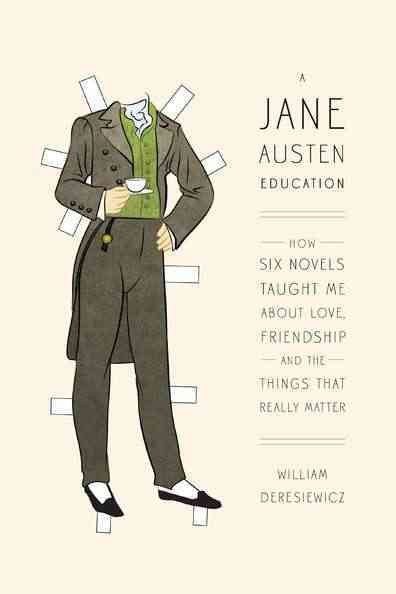
William Deresiewicz. A Jane Austen Education: How Six Novels Taught Me About Love, Friendship, and the Things That Really Matter.  New York: Penguin, 2011.

Deresiewicz spoke the evening of the Ball on “Becoming a Hero: Being a Man in Austen’s World” – his book is a delightful journey through the six novels and how his reading of them made him a better man…

*************************

Used Books? – my real downfall, but I only bought two items from the used bookseller Traveler’s Tales, where I usually drop a bit more blunt – I didn’t get to the booth until a few days after the Emporium opened and most items of interest were already gone… but I did find this:

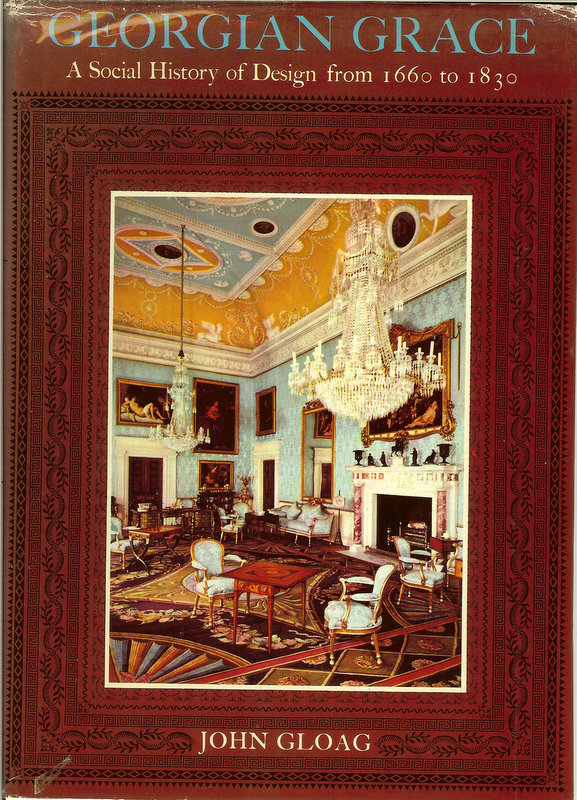
John Gloag. Georgian Grace: A Social History of Design from 1600 to 1830. London: Spring Books, 1967, c1956. – a must have for anyone interested in the architecture and decorative arts of the period – who can resist a book with chapters such as “‘A Dish of Tea’” and “Pray be seated” and “‘The toilet stands dispay’d’” and the like!

And this, a Rowlandson print – you must visit the Jane Austen’s World blog where Vic [my delightful roommate!] shares her purchase of FOUR of these Rowlandson prints!

Here is my one and only: “The Harvest Home” by Thomas Rowlandson (1821)

****************

…and last but not least, my favorite annual purchase at the AGMs is the Wisconsin Region’s “A Year with Jane Austen” Calender, this for 2013 a celebration of Pride and Prejudice: you can order your own copy here: http://www.jasna.org/merchandise/calendar-2013.html [I purchased a number to sell at our JASNA-Vermont Austen Boutique…]

******************

More to come about the AGM so stay tuned!

c2012 Jane Austen in Vermont
Book reviews · Collecting Jane Austen · Jane Austen · Jane Austen Popular Culture · Jane Austen Sequels · JASNA-Vermont events · Regency England

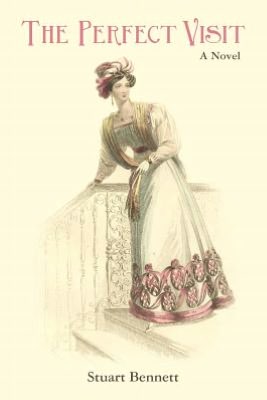
JASNA-Vermont’s “An Afternoon with Jane Austen” ~ The Perfect Visit by Stuart Bennett

Dear Readers:

Coming up this weekend [Sunday September 23, 2012] is JASNA-Vermont’s “An Afternoon with Jane Austen”: wherein we shall hear about ‘Channeling’, ‘Imagining’, and ‘Dressing’ Jane Austen’. Presentations by authors Elsa Solender (Jane Austen in Love: An Entertainment) and Stuart Bennett (The Perfect Visit) will take us back in time to meet our favorite author! These two sessions will be linked with a talk by our very own Hope Greenberg as she takes us through the stages of “Dressing Jane” in the proper Regency clothing of her day. 

Yesterday I posted a review of Elsa Solender’s Jane Austen in Love by Diana Birchall; today I am headlining Stuart Bennett’s The Perfect Visit – Stuart will be talking about his foray into historical fantasy/fiction, where he follows his long career in the world of antiquarian bookselling and scholarly publications on bookbinders and publishers in Jacobean, Augustan, and Regency England.  He will ask the audience to consider how much scholarship properly belongs in an historical novel, and what is the right balance between fact and fiction?  “Imagining Jane Austen” will focus on these topics, illustrated by short passages from The Perfect Visit.  Audience participation is invited.

I append here the various reviews of Stuart’s book that can be found on Amazon – links to my interview with Stuart are at the end of the post.

Hoping you can join us tomorrow to hear Stuart and Elsa each talk about their books!

************************

*The Perfect Visit starts a little slowly, but I soon became absorbed in the characters and the plot. Who thought time travel would be so complicated? This novel is well written with close attention to detail. The characters are life-like, with clear motivations. One doesn’t have to love Shakespeare and Austen to make this a good read, but it helps. Hope there is a sequel, or another book by this fine author.    (Esther Sisler)
***************

*Finished The Perfect Visit a few days ago. I found it a literate, well-written historical novel of time travel, romance, interesting content on book collecting (accurate for a welcome change), Shakespeare, Jane Austen, and a villain or two. I liked it and was sorry for it to end. But the author left Ned and Vanessa stranded in 1833 London so there can hopefully be a continuation of the story. Hope so… I have often dreamed of buying books in St. Pauls churchyard and Fleet Street in the 1570’s in London. Or visiting Lackington Allen and Co.’s Temple of the Muses in the early 1800s. Well researched; the historical accuracy gives the reader the feel of Shakespeare’s London or of Regency England. Stuart Bennett has been an auctioneer at Christie’s in London, and is the author of books on collecting photography and on English trade bookbindings. He is presently a dealer in rare books.  (Richard Cady)

***************

*Bennett writes with an encyclopedic knowledge of English culture allowing the reader to ‘time travel’ with the wild abandon of a breathtaking game of ‘pretend.’ His expertise on the subject of English culture is dwarfed by his love of the same terrain. Among the many delights of this read are the great descriptions of faces, architecture, wine, meat, landscape and-love! The various dialects from the respective eras are astonishingly distinctive from one another. If you would like to remember how to be seven years old again and also gain enormous insights into these two eras of English history please read and enjoy ‘The Perfect Visit.’  (Sally Christian)
***************

*Earlier reviews have praised Bennett’s mastery with words, his exceptional evocation of the Elizabethan and Regency periods, his meticulous detailing of the limits both of time travel itself and his invented machine, his fast-moving plot with its ingenious twists. I agree wholeheartedly and will add only that I came away from my reading of The Perfect Visit thinking, “I’m going to miss Vanessa and Ned.” So, for me that’s exceptional character-building, too. But let me speak, very quietly, to the book collector among prospective readers: You are going to be astonished by the absolutely impeccable bibliographic details so casually introduced. For a few of us, Ned’s 1607 bookshop purchases may rival all the derring-do for pure, pure excitement.  (Bee Thorpe)

*************

*I don’t think you have to like Jane Austin (sic), I don’t think you have to be enthralled with jolly old England. I think you will enjoy Stuart Bennett’s delightful time-travel novel if you like the way words can be bent into visions, the way descriptions can create feelings, the way unexpected plot twists can spank your imagination. Bennett is a master with words, and his novel is a perfect visit to a world of wonder, romance and friendship.  (Michael Lester)

***************

*I spent a pleasurable weekend reading Stuart Bennett’s graceful, happy and imaginative THE PERFECT VISIT. For those of us who have daydreamed of finding ourselves walking through Elizabethan London or being in the same room with Jane Austen, this is a delightful means to make real those daydreams, or as real as a well written novel can devise. He gives vivid life to names which have been obscure and dusty and walks us through the streets of London and Bath better than Google maps. Jane Austen and William Shakespeare, of course, are admired for their shaping of the English language. Stuart Bennett meets the challenge of making them the centrifugal forces of his novel with prose that they would enjoy, and, occasionally, recognize. Dear Reader, enjoy!   (Sarah Baldwin)

****************

*For anyone who has read each of Jane Austen’s novels a half dozen times or more, and is looking for something else to read before reading them all again, this is the book! The premise of time traveling turns out to be a marvelous platform on which to present an engaging tale, and to flesh out aspects of Jane Austen’s world which she had no need to describe in detail to her original readers. Stuart Bennett’s descriptions of art, music, popular literature, architecture, manners, the minutiae of apparel (especially feminine apparel), even of equestrian practices, paint a remarkably detailed picture of a particular time and place. As such it provides an valuable complement to Austen’s works.  The Perfect Visit is also a worthwhile work of fiction. As the story unwound towards it’s inevitable conclusion, I found myself drawn into the situation of it’s principal characters, a 21st century couple, trapped in the 19th, and living out a scenario which could easily be a plot out of an Austen novel.  (Alan Cate)

***************

*Historical novels provide a form of time travel allowing the reader to meet the characters, customs, costumes, cities and settings which have already created the foundations of our own time, and to imagine what it would be like now if things had turned out differently. Not only does “The Perfect Visit” encompass these traits with charm and depth, but also includes some thought-provoking aspects of the paradoxes of time travel. This is a captivating story, filled with rich historical details dovetailing with adventure and romance. We become embroiled in the world of rare early literary manuscripts and their authors, as the main characters, modern time travelers, learn to adapt to the customs of the past about which they know some things — but not everything. Tying it all together for this reviewer is a delightful musical thread masterfully weaving the present with the past and its future.  (M. Woolf)

***************

*A Perfect Visit, Stuart Bennett’s entertaining new novel about two present-day sleuths who separately travel through time to collect books and manuscripts from the English Regency and Stuart eras, pays homage to readers’ never-ending fascination with Jane Austen and William Shakespeare. Bennett’s thorough appreciation of both authors and their milieu is evident on every page as his characters, Vanessa and Ned, seek out their literary heroes and, of course, run into grave complications that imperil not only their ability to return to “reality” but also their chances of living together happily ever after. Bennett gives his readers a fast-paced narrative filled with unexpected twists–while also perfectly reproducing the tone and quality of the best Regency-period novels. I highly recommend A Perfect Visit to anyone experiencing Jane Austin (sic) withdrawal symptoms.  (Rockwell Stensrud)

***********************

 So reasons enough to pick up a copy of The Perfect Visit!

You can read more about Stuart Bennett here:

c2012, Jane Austen in Vermont
Fashion & Costume · Jane Austen · Jane Austen Popular Culture · Regency England · Social Life & Customs

A Jane Austen Weekend! ~ Guest Post by Tess Quinn

Dear Readers, 

As many of you as Jane Austen in Vermont blog readers know, The Governor’s House in Hyde Park, Vermont offers Jane Austen weekends throughout the year (you can visit their website to see upcoming  events). This past August Innkeeper Suzanne B. held another of her annual Character Weekends, wherein participants are to choose an Austen character from any of her works [alas! only one of each character allowed – who could take an entire weekend with not only one but perhaps FIVE of a fawning Mr. Collins! And one chatty Miss Bates is certainly enough ….] and play the role all weekend, through all the various activities of reading, chatting, needlework, writing, eating, dancing, horse adventures, and sport [the likes of archery and fencing!] – perhaps only giving up the role for a few hours of contented sleep!

This year a full-weekend I could not do, so I went for several hours on the Saturday and had the pleasure of chatting with the various characters, practicing a bit of archery, watching fencing matches, eating a sumptuous Regency-era meal, and dancing the night away with Val and Tom of the Burlington Country Dancers.  I came home well-satisfied indeed, and in Jane’s own words,  “[I] smiled & whispered to [myself] ‘This [was] a day well spent.'” 

One of the guests was Tess Quinn, who recently wrote a post on this blog about her experience at the Jane Austen Festival in Louisville – Tess has kindly offered to write another post about her weekend here in Vermont, along with many fine pictures! Thank you Tess for sharing this with us! [and it was great to see you again!]

**********************

A fair prospect

How often have Jane Austen readers wished they could experience Regency life as her protagonists do – at least the romanticized notion of it we derive from her books?  I can’t be the only one, or there would not be such a market for the myriad books published that deal with Austen fans, disillusioned with modern society, who suddenly find themselves transplanted in time and place to inhabit the body of an Elizabeth Bennet (e.g. Lost in Austen) or some other early 19th century character – for a day, a month or an eternity.  These books and films appeal because, for a little while, they take us away from mortgage payments and term papers and our children’s math homework; they sweep us off into a world our imaginations sketch as more genteel, more polite, less frenetic – more romantic.

Yes, literary time travel has huge appeal, no matter the book genre or historical era in question.  Readers well versed in Jane Austen’s society as depicted in her books must ‘experience’ the Regency in their imaginations; for as far as I know, a working time travel machine has not yet been perfected.  We cannot practically turn the clock back two hundred years… or can we?

I recently vacationed in Vermont where we came close to doing just that!  The Governor’s House at Hyde Park formed a distinguished setting for a gathering of ladies to come together and experience Jane Austen’s era for themselves—or rather, by adopting the personas of her characters for a few days.  The Governor’s House (formerly belonging to the gentleman who provided its name, and now a bed and breakfast inn) was built in the Victorian era but as a reproduction of a Colonial house.  As such, it reflects both periods in its ambience, yet gives one enough of the ‘feel’ of bygone days to transport one’s mindset to Regency England.

Governor’s House in Hyde Park, Vermont,
the setting for a Jane Austen Character Weekend,
and the whole of the experience was delightful.

We gathered first on Friday evening for introductions, each participant in turn describing something of her background until correctly identified.  Most of the books were represented.  Present were Elizabeth Bennet and her aunt Mrs Gardiner, along with Miss Charlotte Lucas.  Anne Elliot attended in the company of her sister, Mary Musgrove and her friend, Lady Russell; as well as a recently-arrived tenant of Kellynch Hall, Mrs Croft.  Eleanor Tilney appeared quite affable in the absence of her father the General.  And Emma Woodhouse came, being in company with both her former governess, Mrs Weston and her nemesis, Mrs Elton; as well as a most entertaining trio – Miss Jane Fairfax, Miss Bates and the elder Mrs Bates, the latter making her presence felt all the weekend though she uttered not a word.

Lady Russell – Miss Tilney – Mrs Weston

Introductions accomplished, we became friends over refreshments, followed by moving to the card tables for an evening of Whist.  I was grateful to find myself at one of the less competitive tables; we did not play deep, but we laughed deeply.

At the Whist table

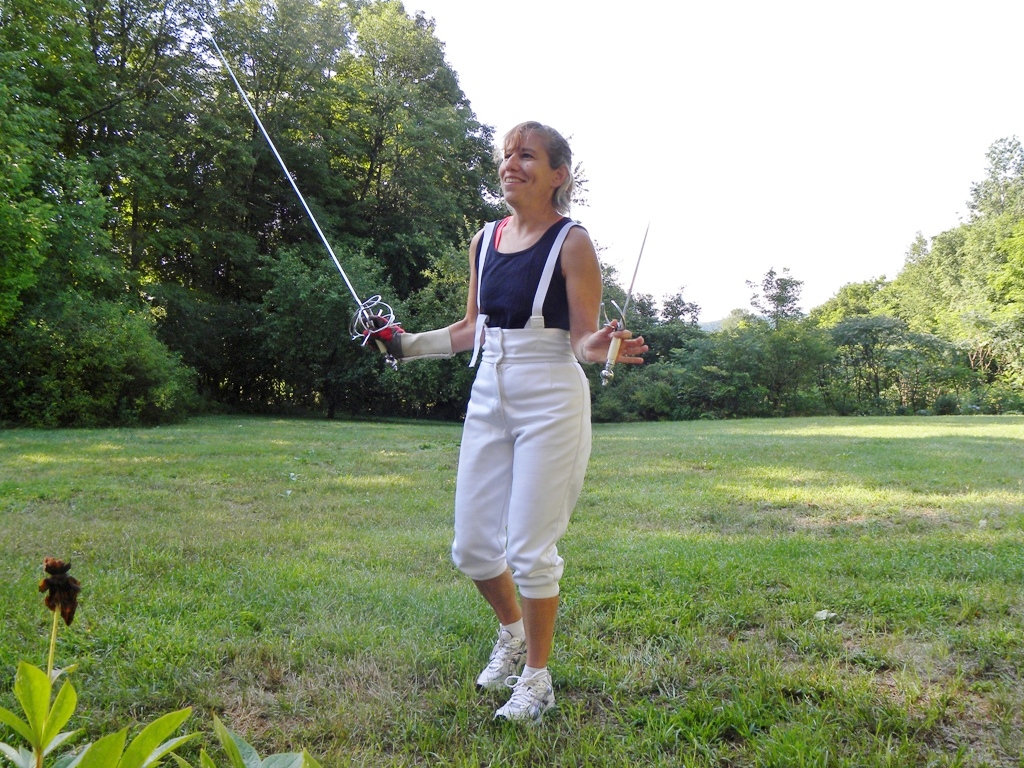
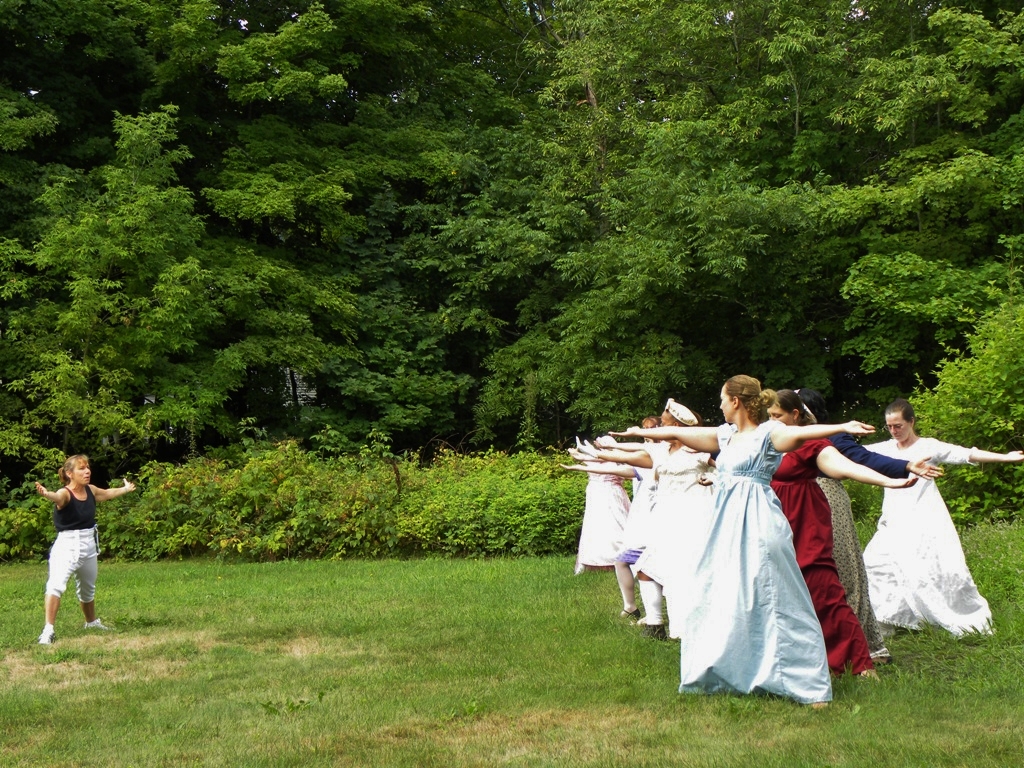
As most of us had travelled long that day, we retired after a few rounds, but gathered early on Saturday for breakfast in order to make the most of the day’s activities.  We began with a most excellent fencing master, Vivica Fox, who after providing us some historical information on the sport, led the group through the proper positions and stretching exercises.

Viveca Fox

Throughout the morning, then, Miss Fox gave private lessons to each of us who ventured so boldly.   The moves appear so graceful and natural when one observes accomplished fencers; but after many attempts to combine form, technique and strategy all at once in lunges, parries and ripostes, my best accomplishment was a greater appreciation for the skill and difficulty involved.  I was highly intrigued by my session, however, and would love to continue my training.

While several took advantage of the individualized fencing lessons, others of us moved to the back garden to take up bows for archery.

Archery lessons for Lady Russell and Emma Woodhouse

I am delighted (relieved) to report that a grand time was had by all, the target often was struck, and no dogs were dispatched.

Miss Fairfax, archer

The morning had begun with a fine hot sun which continued throughout our activities; fans and parasols were employed assiduously.  A number of our party, after archery, chose to retire to the shade of a large porch with their books or embroidery, rather than be kept in a continual state of inelegance.

Mary Musgrove driving Judge

But for some, a short journey to a horse farm brought the next adventure: learning to drive a gig!

The head groom very graciously allowed us to assist in harnessing Judge, an extraordinarily gentle animal (one could hardly call him a beast) – although of course, as ladies we would never perform this task for ourselves in the usual manner of things.  We then began by walking Judge around the paddock.  This was to become accustomed to working with him, especially for any of us who were no horsewomen.  Once each had achieved some comfort with the reins, a lovely small carriage was attached and off we went through a park land of varied prospects.  (I must confess that I saw little but the posterior of the horse in my turn, so concerned was I lest I steer poorly and hit a post which might have overturned us.)

Just as we bid adieu to our mount and made to leave, another group from our party arrived for a carriage ride.  We bade them a lovely tour and made our way back to the Governor’s House.  There we enjoyed a light fare set out by our hostess – since we had breakfasted so early – to tide us over until the dinner hour.

The last hours of our morning were passed again in satisfying retirement on the back porch; for as we all know, to sit in the shade on a fine day, and look upon verdure is the most perfect refreshment.  Some ventured to trundle a hoop, or play the Graces.  Most found contentment in a cool libation and the company of clever, well-informed people who had a great deal of conversation – the best company!

Finding shade
Charlotte Lucas
Reading Jane Austen
Lawn Ladies

**************************

Quite soon, it seemed, the time came to dress for dinner and we dispersed to don our fashions.

Mrs. Elton in full fashion!

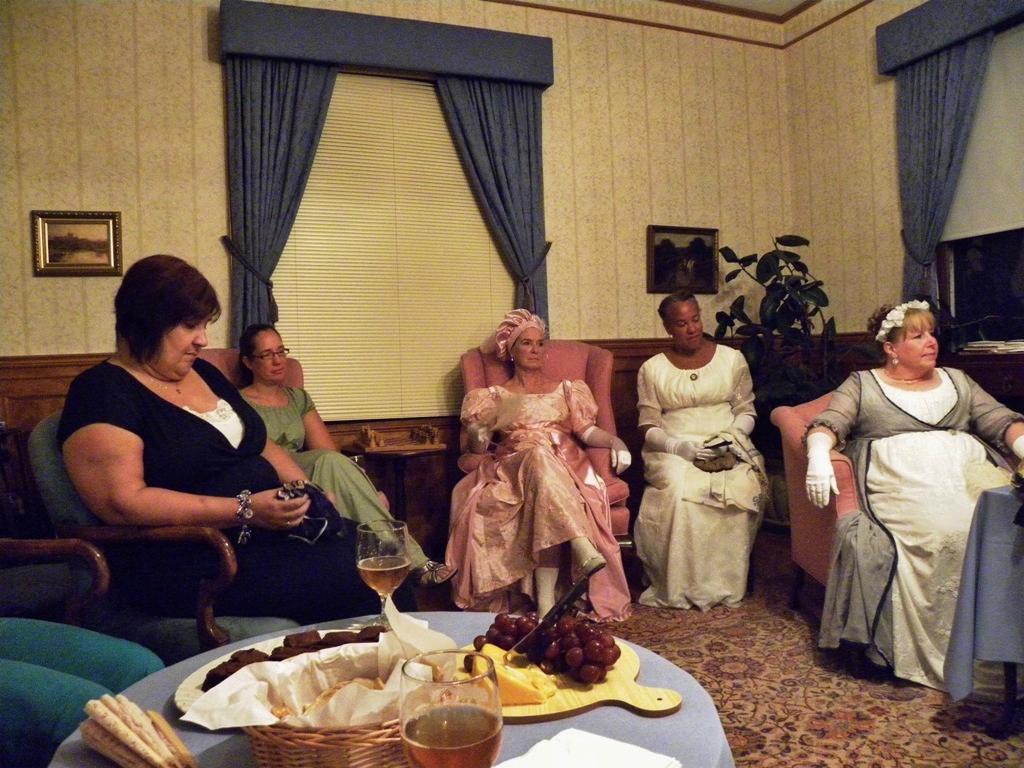
Jane Fairfax – Mrs Bates [there in spirit!] – Miss Bates

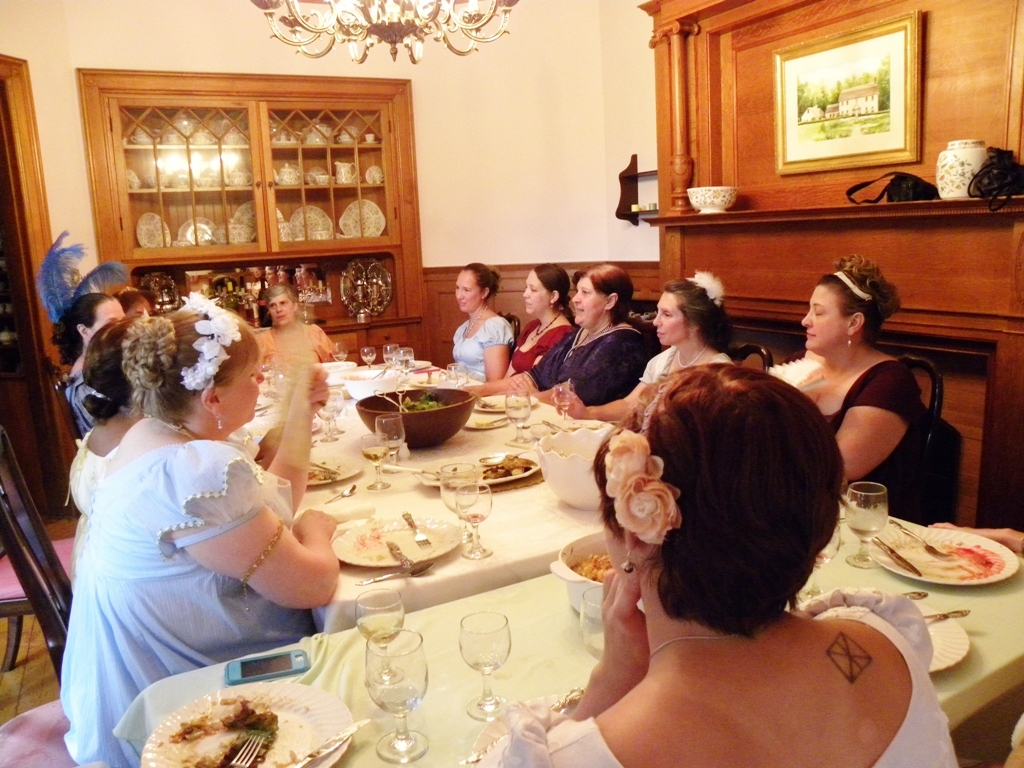
Our repast for the evening was a full course, enlivened by so much entertaining discourse and laughter that we all remained at the table right up until the arrival of visitors who had been invited to join us for the hour of tea!   Mr and Mrs Bennet with their daughter Lydia were presented, the latter immediately pronouncing that what the party required for success was… dancing!

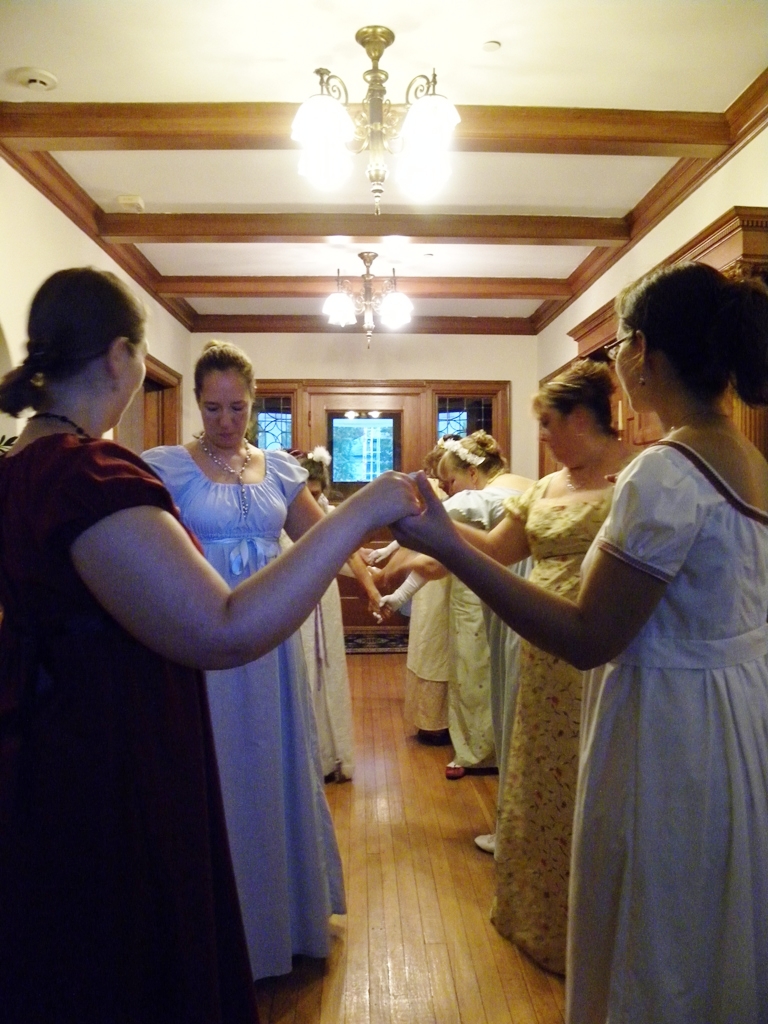
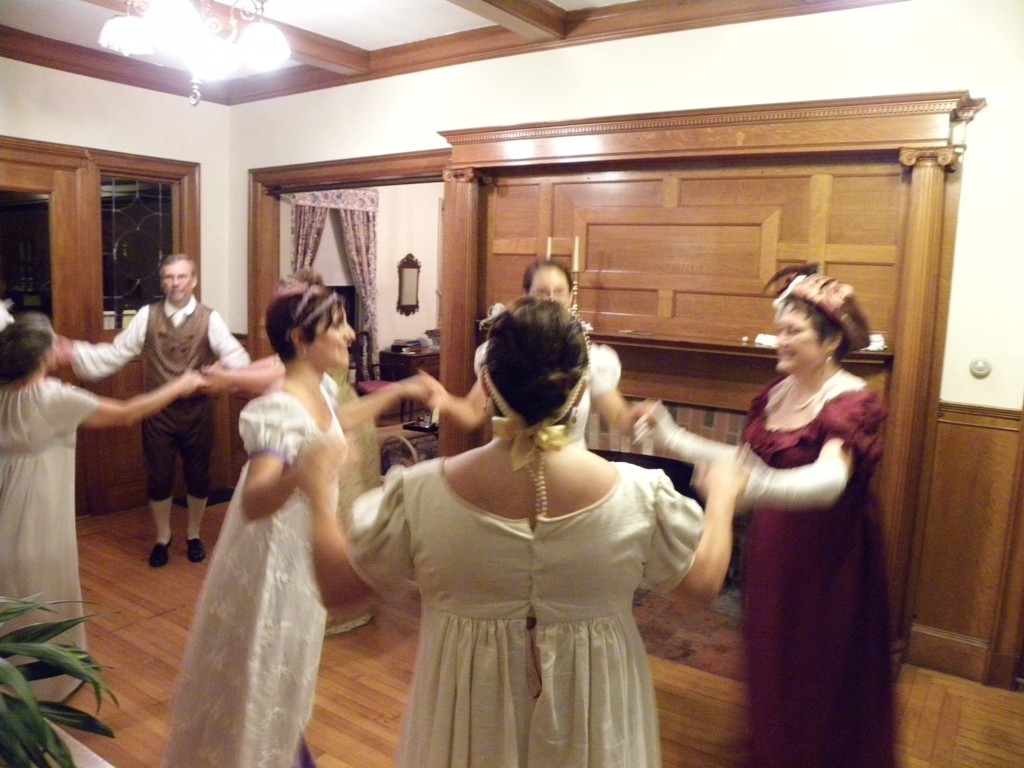
Of course, all were amenable to this particular proposal! Immediately, furniture was shifted and carpets rolled and removed, the music struck up and Mrs Bennet, an accomplished English Country Dance caller (sometimes peculiarly addressed as Val Medve), led us through an evening of dances with only a short ‘supper break’ to regain our breath.  Most invigorating, indeed!

When finally the night ended, few I think did not drift into sleep the moment they fell into their beds.

*****************

A Turn about the Estate

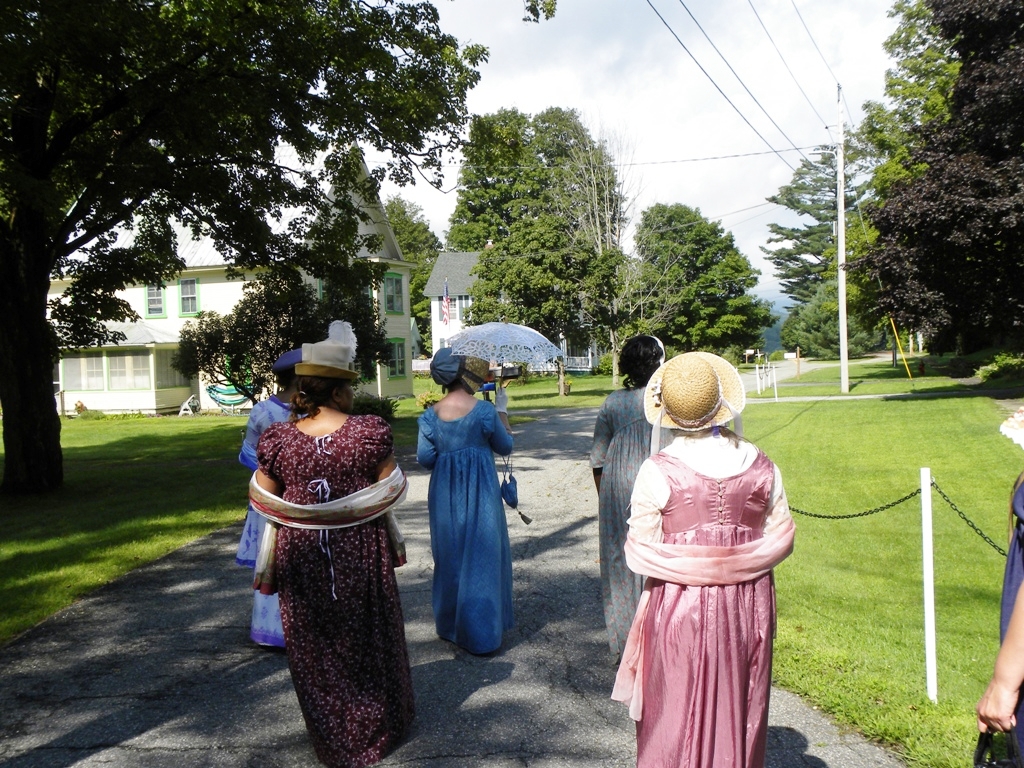
Sunday dawned as bright and promising as had the previous day.  Following our breakfast, some of the party went off to ride, others for a lengthy turn about the estate (such prospects to enjoy) and still others preferred the sedentary nature of their work in the elegant parlour.   But soon activity called once more.

Walking Ladies

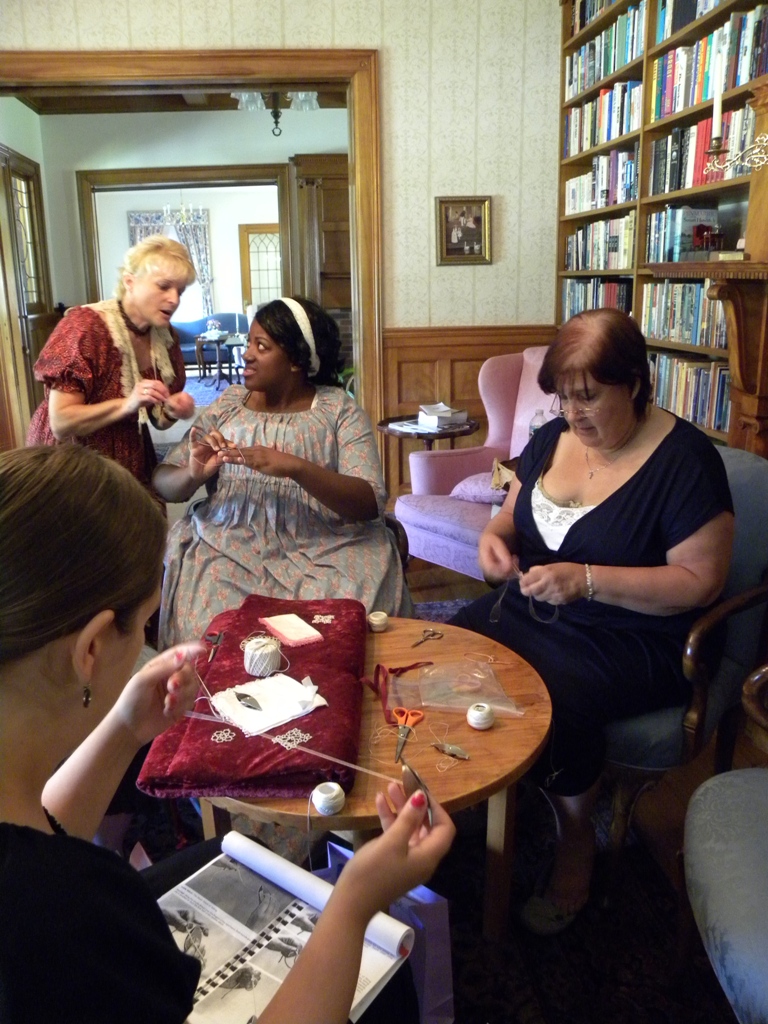
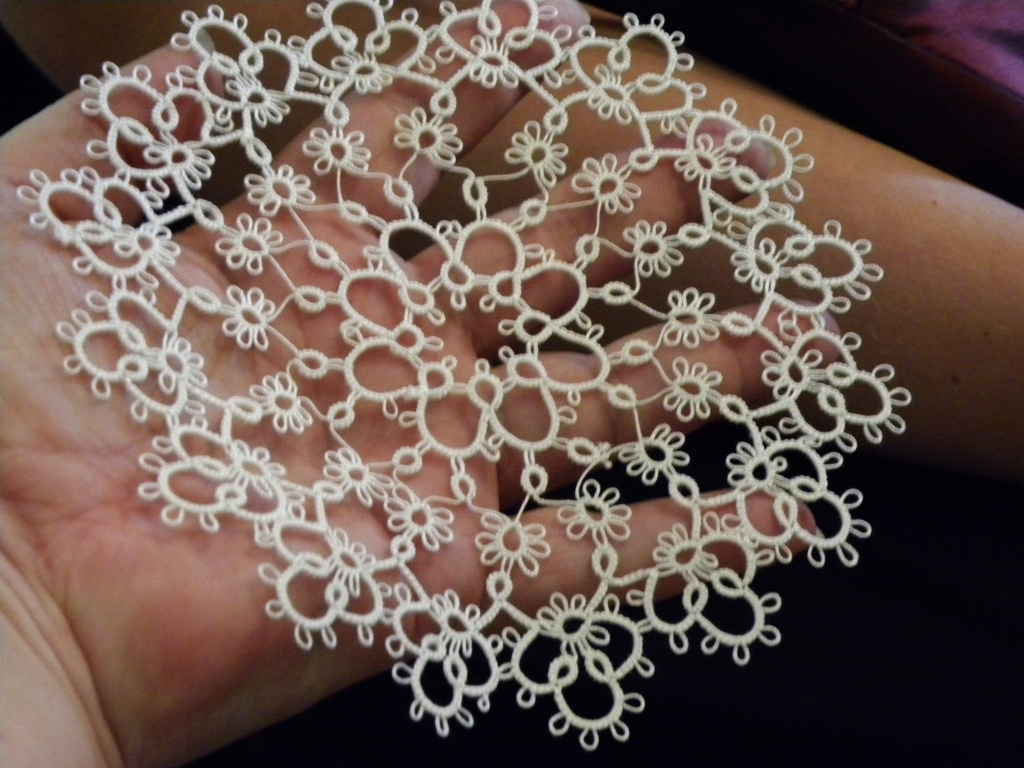
Since letters are the lifeblood of communication in the world we were visiting, we learned to cut our own quill pens and then practice our hand, writing letters on parchment.  No blotting here!  And following this, we employed our fingers in an alternative manner – in learning to tat with yet another master of the art.  I should like to boast of having made the sample you see below; but in truth I had not the talent.  My fingers did not fly through the string with anything like accomplishment.  This is indeed one art in which no excellence can be achieved without constant practice.

Instruction in tatting for Miss Lucas, Mrs Weston, and Emma
Tatting sample

Sunday noon found us gathering around the dining table for the last time together.  A lovely luncheon may have passed serenely but for the introduction of one final pastime, one perhaps not quite of the Regency period but relating to it.  It was a Quiz!  Questions to test our newly-experienced knowledge of Regency life.  Our hostess had gone to some effort to challenge us and had risen admirably to the occasion.  I would like to say we responded in kind; and so I will.  Our answers as a rule, when we discussed them collectively, were creative, humorous, clever and entertaining.  What matter if they were seldom correct?

This capstone event marked the end of our journey to Jane Austen’s time.  When we had laughed our fill, ladies slowly drifted off to supervise the packing of their trunks by their maids.  All ventured fare wells to friends old and new amid the exchange of addresses and promises to post pictures at facebook.  (Whatever can they have meant by such strange speech?)

I retired to my room as I would not leave until the following morning.  There my mind was most agreeably engaged in meditating on the very great pleasure which a gathering of fine characters from the pages of Miss Austen’s novels can bestow.

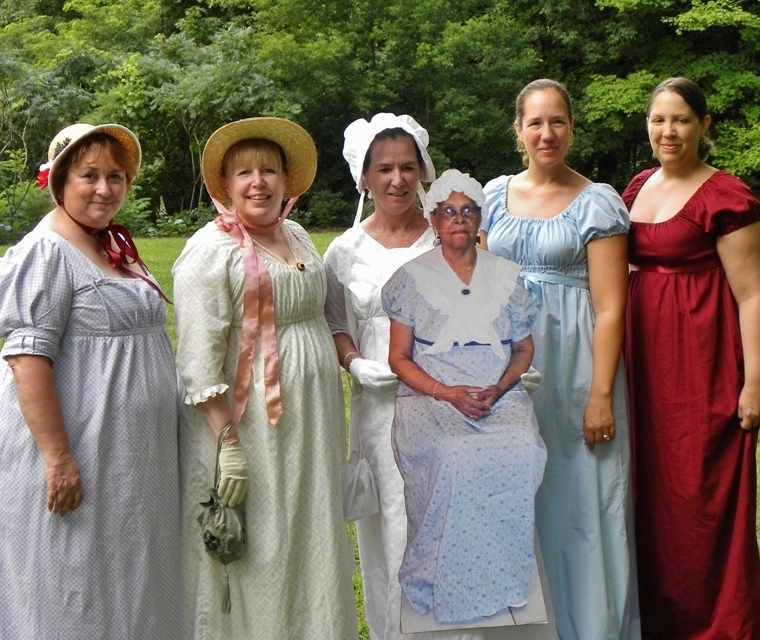
Emma Woodhouse – Lizzy Bennet
Lady Russell
Mary Musgrove – Charlotte Lucas – Mrs Elton
Miss Bates – Mrs Bates – Miss Fairfax
Miss Tilney – Mrs Croft – Miss Lucas
Sunday morning parlour

*****************

About the Author: Tess Quinn (a nom de plume) read Pride and Prejudice years ago at the age of thirteen, and has been hooked on Jane Austen – and Mr Darcy, unsurprisingly – ever since. She has read all the novels multiple times and doesn’t plan to stop any time soon. Some time ago she was introduced to Austen-based fan fiction and, unsatisfied with some of the depictions and approaches, took up her own pen to try to carry on beloved characters in a manner consistent with Miss Austen’s originals. In 2011, her first short story was published in an anthology called A Road to Pemberley. With that encouraging milestone she is hoping shortly to publish another anthology, all her own stories, tentatively titled Pride Revisited. She has two completed P&P based novels (awaiting final edits and a willing publisher); and is nearing completion on her own darling child, a retelling of P&P from Georgiana Darcy’s perspective.

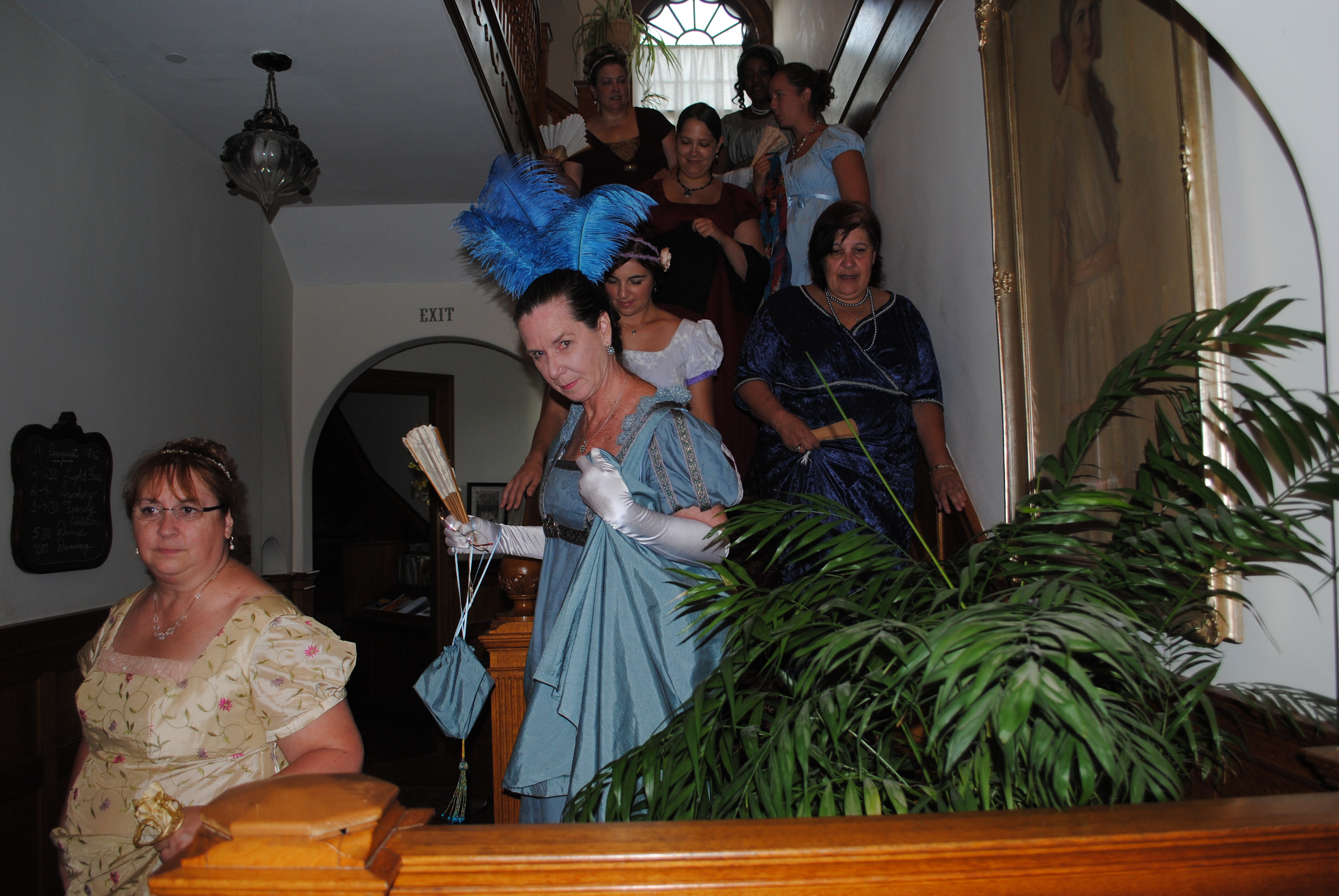
Descending into dinner

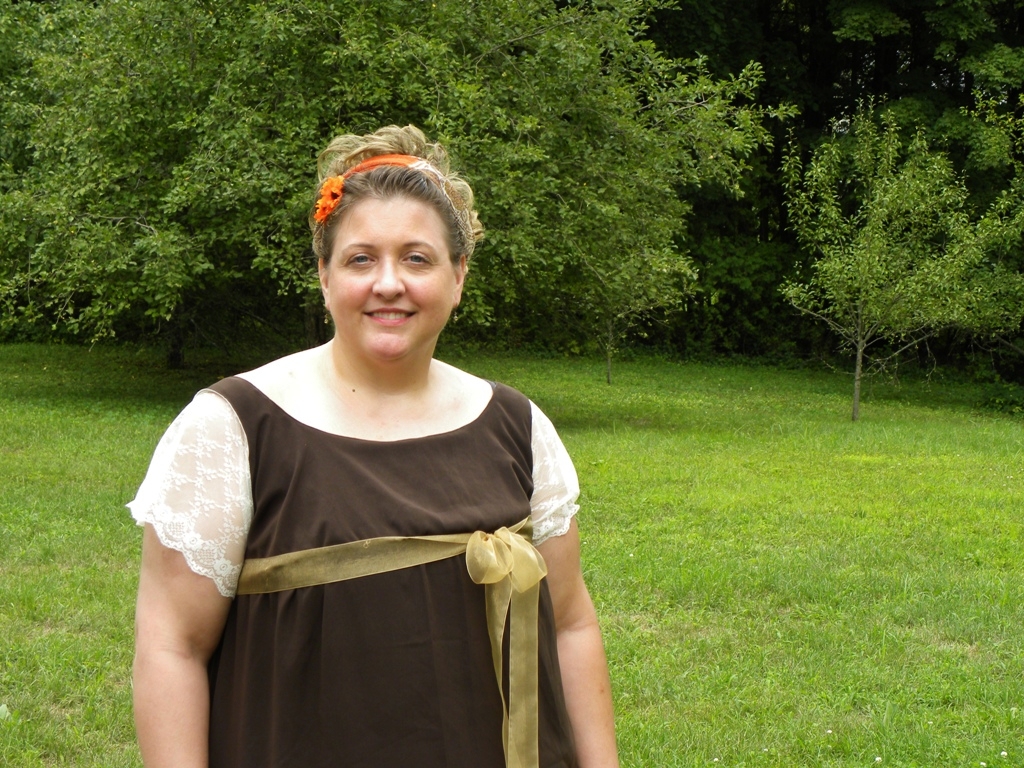
Tess, in her lovely evening dress, is on the left; do you agree that Mrs. Elton is looking rather miffed?? – perhaps we have caught her unawares displaying her displeasure at not being first into the dining room …

c2012 Jane Austen in Vermont
Books · Fashion & Costume · Jane Austen · Jane Austen Popular Culture · Jane Austen Sequels · JASNA · JASNA-Vermont events · Regency England

JASNA-Vermont ~ An Afternoon with Jane Austen! ~ September 23, 2012

You are Cordially Invited to JASNA-Vermont’s September Meeting 

~ An Afternoon with Jane Austen! ~ 

~ Former JASNA President Elsa Solender ~
“Channeling Jane Austen”
in Jane Austen in Love: An Entertainment
 

~ Rare bookseller Stuart Bennett ~
“Imagining Jane Austen”
in The Perfect Visit 
 

~ JASNA-VT’s Hope Greenberg ~
 “Dressing Jane Austen”
i
n the proper Regency fashion of her day 

*****

Sunday, 23 September 2012, 1 – 5 p.m. 

 Champlain College, Hauke Conference Center, 375 Maple St Burlington VT  

~Free & Open to the Public~  

Details? Visit our blog at: http://JaneAustenInVermont.wordpress.com
Email:  JASNAVermont [at] gmail ]dot] com

****************

We are pleased to welcome our two Distinguished Authors and one Regency Fashionista for a
full Afternoon with Jane Austen!
The event is co-sponsored by JASNA-Vermont and Bygone Books as part of the Burlington Book Festival.

There will be Door Prizes!
Books will be available for purchase and signing!
Light Refreshments will be served!
Regency dress encouraged!

****************

Join us for an afternoon of ‘Channeling’, ‘Imagining’, and ‘Dressing Jane Austen’. Presentations by authors Elsa Solender (Jane Austen in Love: An Entertainment) and Stuart Bennett* (The Perfect Visit) will take us back in time to meet our favorite author! These two sessions will be linked with a talk by our very own Hope Greenberg as she takes us through the stages of “Dressing Jane” in the proper Regency clothing of her day.

[*no relation to the esteemed Mr. Bennet…]

We will meet at the Hauke Conference Center of Champlain College on Sunday 23 September, 2012, from 1-5 pm; the visiting authors’ books will be available for purchase and signing; other books relating to Jane Austen and her times will also be offered for sale; and light refreshments will be served. Regency dress is encouraged!                    

1-2 pm:  Elsa Solender:  “Channeling Jane Austen”

Who was Jane Austen – really? Was she the chaste, unworldly spinster, mild and religious, who miraculously created six of the world’s most beloved love stories? Or a sharp-eyed ironist whose engaging plot and characters disguise the splinter of ice in her heart that transformed what she saw and heard into subversive criticism of her world that resonates to this day? In her novel, Jane Austen in Love: An Entertainment, Elsa Solender retells the novelist’s own life story, blending missing aspects of her “romantic career” with the sparse known facts. She will describe her search for a voice and style not unlike Austen’s to explore Jane’s inner life as the heroine of her own bright tale.

About the author:

Elsa A. Solender, a New Yorker, was president of the Jane Austen Society of North America from 1996-2000.  Educated at Barnard College and the University of Chicago, she has worked as a journalist, editor, and college teacher in Chicago, Baltimore and New York. She represented an international non-governmental women’s organization at the United Nations during a six-year residency in Geneva. She wrote and delivered to the United Nations Social Council the first-ever joint statement by the Women’s International Non-Governmental Organizations (WINGO) on the right of women and girls to participate in the development of their country. She has published articles and reviews in a variety of American magazines and newspapers and has won three awards for journalism. Her short story, “Second Thoughts,” was named one of three prizewinners in the 2009 Chawton House Library Short Story Competition, chosen from over 300 writers who submitted stories inspired by Jane Austen or the village of Chawton. The story was published in Dancing with Mr. Darcy, an anthology of the twenty top-rated stories of the contest, and is part of her new work Jane Austen in Love.

Ms. Solender’s story “A Special Calling” was a finalist in the Glimmer Train Short Short Story Competition, and of more than 1,000 stories submitted, was ranked among the top fifty and was granted Honorable Mention. She has served on the boards of a non-profit theater, a private library and various literary and alumnae associations.  Ms. Solender is married, has two married sons and seven grandchildren, and lives in Manhattan. 

More information:

*******************

 2:30 – 3:30 pm: Stuart Bennett: “Imagining Jane Austen”

Stuart Bennett’s foray into historical fantasy/fiction, The Perfect Visit, follows his long career in the world of antiquarian bookselling and scholarly publications on bookbinders and publishers in Jacobean, Augustan, and Regency England.  He will ask the audience to consider how much scholarship properly belongs in an historical novel, and what is the right balance between fact and fiction?  “Imagining Jane Austen” will focus on these topics, illustrated by short passages from The Perfect Visit.  Audience participation is invited.

About the Author:

Stuart Bennett was an auctioneer at Christie’s in London before starting his own rare book business. He is the author of the Christie’s Collectors Guide How to Buy Photographs (1987), Trade Binding in the British Isles (2004) which the London Times Literary Supplement called “a bold and welcome step forward” in the history of bookbinding, and many publications on early photography, auctions and auctioneers, and rare books. He currently lives and works near Boston, Massachusetts.

The Perfect Visit, Longbourn Press, 2011 

For more information:

***************** 

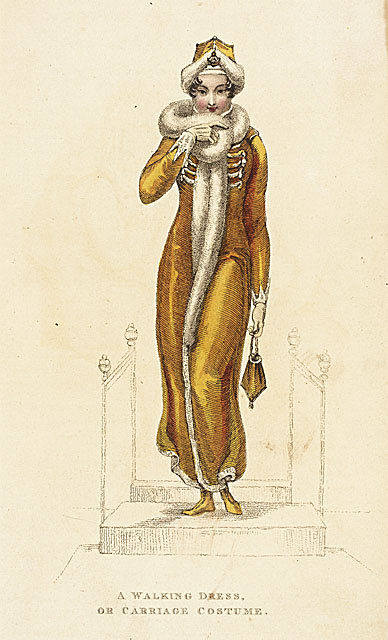
4:00- 5:00: Hope Greenberg: “Dressing Jane Austen”

Can one dance comfortably in a corset? Is it true that some ladies dampen their gowns to make them cling revealingly? Must one wear white all the time? Jane Austen’s novels and letters contain many fashion tidbits. Modern films offer their own take on the fashions of the period, but do they get it right? Through a collection of over 400 fashion images we will explore the revolutionary changes in fashion during Austen’s lifetime. Shifts, trains, petticoats, apron gowns, pelisses, spencers, narrow backs, high waists–we’ll see them all. Then together, we will try to solve a fashion mystery.

About the Speaker:

Hope Greenberg holds an MA in History from the University of Vermont where she is currently an Information Technology Specialist in the Center for Teaching and Learning, promoting and supporting the use of technology to further research and education. She is also an avid English Country Dancer. Her fascination with the creation and wearing of historic clothing as a way of gaining insight into the past predates all of these. Her absolute joy at the willingness of historic clothiers to share their insights is matched only by her gratitude to the museums and collectors that increasingly publish examples of extant clothing and fashion plates online so that we may continue to develop our understanding of clothing of all periods.

Hope you can join us for this Afternoon of All Things Austen!

c2012 Jane Austen in Vermont
Books · Great Britain - History · Jane Austen · Jane Austen Popular Culture · Regency England · Social Life & Customs

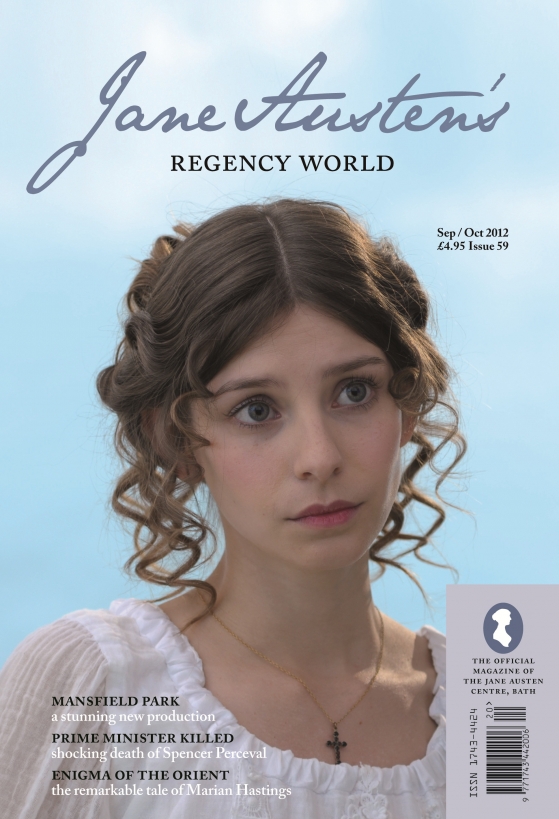
Hot off the Press! ~ Jane Austen’s Regency World Magazine No. 59

In the new issue of Jane Austen’s Regency World
(September/October 2012, No 59):

  • Mansfield Park on tour: a new stage adaptation tours the UK – we speak to the director Colin Blumenau
  • Prime Minister killed: marking the bicentenary of the assassination of Spencer Perceval
  • Enigma of the Orient: the remarkable tale of Marian Hastings, wife of the British ruler of India
  • Brooklyn preview what’s coming up at the JASNA  AGM in New York
  • Festival experience: regular visitors to the Bath Jane Austen Festival describe their time in the city

Plus … all the latest news from the world of Jane Austen, your letters, round-ups from the Jane Austen Society of the UK and the Jane Austen Society of North America, book reviews and quiz.

To subscribe visit here.

STOP PRESS… Watch out for our new book to mark the bicentenary of the first publication of Pride & Prejudice. Full details will be revealed next week!

[Text and image courtesy of JARW Magazine]

@2012 Jane Austen in Vermont
Author Interviews · Books · Jane Austen · Jane Austen Popular Culture · Jane Austen Sequels · Regency England

Guest post ~ Vera Nazarian on her Pride and Platypus: Mr. Darcy’s Dreadful Secret

Hello all! Today I have invited Vera Nazarian, now a Vermonter!, and author of a series of supernatural novels that expand upon Jane Austen, to write a little something about her latest book Pride and Platypus: Mr. Darcy’s Dreadful Secret – whatever would Jane think you might ask? – well for the next two days you can download Vera’s latest book onto your kindle for free [details below] – so give her a try, the least one Vermonter can do for another!  I look forward to having Vera speak to us at one of our future gatherings, so stay tuned!

*********************

Greetings, Gentle Vermont Janeites!

I am thrilled to be here, and to be able to say that I am now a proud Vermont resident. I would like to introduce myself as the Harridan—ahem—the author and illustrator of the Supernatural Jane Austen Series of books, which are witty and hilarious (and slightly insane) fantasy parodies of our beloved Austen classics.

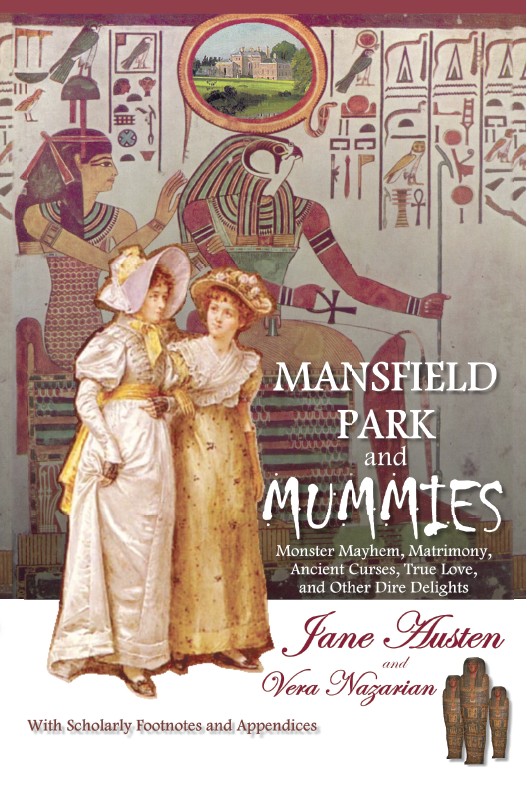
The books in the series so far are Mansfield Park and Mummies, Northanger Abbey and Angels and Dragons, and, my most recent release this June—the third book, Pride and Platypus: Mr. Darcy’s Dreadful Secret.

I look forward to getting to know you better and sharing all kinds of things (such as the true nature of the Brighton Duck—you do know about this infernal and mystical duck, right? No? Aha! Stay tuned!). But today I will be brief and just let you know that if you’ve never had a chance to read any of my books yet, and have no idea who I am, well, this is your lucky day. . . .

Because you can try one of my books for free!

Yes, absolutely free on Amazon Kindle all this weekend, and until midnight on August 12th, is none other than Pride and Platypus: Mr. Darcy’s Dreadful Secret!

You can download your free ebook here:  http://www.amazon.com/dp/B008D303J4/

And even if you do not own a Kindle, you can easily grab a free Kindle Reader App for your PC, Mac, smartphone, or other online device here, and then read the novel on pretty much anything short of an Etch-a-sketch!

Free Reading Apps:  http://www.amazon.com/gp/feature.html/ref=sv_kstore_1?ie=UTF8&docId=1000493771

Enjoy the free book with all my compliments! And be sure you are sufficiently equipped (and properly attired) to survive the effects of unbridled laughter!

You can visit the books’ website here: http://www.norilana.com/pap.htm

Book description:

When the moon is full over Regency England, all the gentlemen are subject to its curse. 

Mr. Darcy, however, harbors a Dreadful Secret…

Shape-shifting demons mingle with Australian wildlife, polite society, and high satire, in this elegant, hilarious, witty, insane, and unexpectedly romantic supernatural parody of Jane Austen’s classic novel.

The powerful, mysterious, handsome, and odious Mr. Darcy announces that Miss Elizabeth Bennet is not good enough to tempt him. The young lady determines to find out his one secret weakness—all the while surviving unwanted proposals, Regency balls, foolish sisters, seductive wolves, matchmaking mothers, malodorous skunks, general lunacy, and the demonic onslaught of the entire wild animal kingdom!

What awaits her is something unexpected. And only moon, matrimony, and true love can overcome pride and prejudice!

Gentle Reader—this Delightful Illustrated Edition includes Scholarly Footnotes and Appendices.

***************************

And now, here is a bit more word-of-mouth about the novel, including “authentic testimony” from the splendid mouth of Mr. Darcy himself:

REGENCY ERA PRAISE FOR…

Pride and Platypus: Mr. Darcy’s Dreadful Secret

“A sufficiently pleasing literary trifle. Only, might one be kind enough to explain why a certain gentleman constantly finds himself in wet shirtsleeves for no apparent reason?”  A Gentleman of Impeccable Attire

“I require an introduction to this Mr. Darcy, in all haste. Does the gentleman possess a male unattached sibling? Preferably, with a proper beastly Affliction, in place of what the gentleman himself suffers?”  A Lady of Elegance

“An outrage indeed! My own person and relations, to be thus referenced in this vile compendium of vulgarity! Why, this is not to be borne! Also, I recommend emu oil for polishing wooden surfaces.”  A Certain Lady of Rosings 

“I would have it known that, in my present condition, I am not altogether concerned with pollution.” A Shade of Pemberley

“There is entirely no excuse for the unseemly public behavior of some people’s gauche relations. I have returned this distasteful tome to the Lending Library, and shall henceforth endeavour to forget all of which I have inadvertently read in one sitting.” A Gentleman of Distinction

“I have been placed in numerous sequels, adored and worshiped by millions, scrutinized, analyzed, satirized, undressed, dressed again and soaked in various water reservoirs, and parodied in every manner possible, but never quite so audaciously as in this tome!”  —Mr. Fitzwilliam Darcy

“The gentleman with the satirical eye is being entirely too modest. Furthermore, for inexplicable reasons, he has also been seen in more wet shirtsleeves than all the Royal Navy on the high seas and the House of Lords after a London downpour, and I am yet to understand the mystery behind it.”  —Miss Elizabeth Bennet

“QUACK!” The Brighton Duck

***********************

Pride and Platypus: Mr. Darcy’s Dreadful Secret
by Jane Austen and Vera Nazarian
Trade Paperback (First Edition): Curiosities (an imprint of Norilana Books) June 15, 2012
Retail Price: $16.95 USD – £12.50 GBP
ISBN-13: 978-1-60762-078-5 ISBN-10: 1-60762-078-2
500 pages

*************************

About the Authors:

Jane Austen is an author of classic immortal prose.

Vera Nazarian is a shameless Harridan who has taken it upon herself
to mangle Jane Austen’s classic immortal prose.

She is also a two-time Nebula Award Finalist, an award-winning artist,
and the author of Mansfield Park and Mummies and Northanger Abbey and Angels and Dragons.

Images and text courtesy of Vera Nazarian with thanks!

c2012 Jane Austen in Vermont