You are Cordially Invited to JASNA-VT’s October Meeting
Featuring actor and scholar Laura Rocklyn
Who Dares to be an Authoress
Sunday, Oct 6, 1:00-3:00pm Charlotte Senior Center, 212 Ferry Rd, Charlotte, VT ******************
The year is 1815, and Jane Austen has just returned from a visit to the Prince Regent’s London residence. The honor of this invitation prompts her to reminisce about the events that led the daughter of a country clergyman to a position of such prominence.
Join us for a dramatic living history portrayal of this moment in Austen’s life.
Laura Rocklyn is an actress, writer, museum educator, and first-person historical interpreter who has performed with theaters across the country.
~ Free & open to the public ~ Light refreshments ~ For more information: Email: JASNAVTregion [at] gmail.com Facebook: Jane Austen in Vermont
Hope you can join us!
****************
Save the date: Join us for a Jane Austen Birthday Tea on Sunday, December 8 with entertainment by Donna Chaff. The program “Musical Jane” will feature music from the life, novels, and films of Jane Austen with selections chosen from the Austen Family Music Collection.
In doing some research a few months ago on Austen’s reading [a lifetime adventure…], I discovered a reference that might be something new in Austen scholarship – if this has appeared anywhere else that you have seen, please let me know. My source is Deirdre Le Faye, without whose research and knowledge we would not have the in-depth detail of Austen’s life and writings that we do.
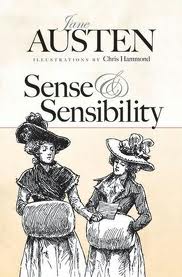
I am always surprised to see how often new things are discovered: books or letters showing up at auctions or a bookseller’s catalogue not seen before, such as these Chris Hammond illustrations for Sense and Sensibility that appeared out of someone’s attic – we can only hope for a new Jane Austen letter or two to be found! That would be worthy of a clarion trumpet call – this is small in comparison, but I do want to share as I do wonder if it has been noted before…
Looking at Jane Austen’s letter to Cassandra of Thursday 21 – Friday 22 May 1801 [Letter 37 in Le Faye 4th ed.] – she is writing from the Paragon in Bath to Kintbury, where Cassandra is staying [the letter is now at the Morgan Library]:
The Austens have moved to Bath; Jane and her mother are staying with the James Leigh Perrots at the Paragon and have begun a search for permanent lodgings. Mr. Austen and Cassandra are to follow and they arrive in Bath on June 1st. Jane writes the following:
“Mr. Bent seems bent upon being very detestable, for he values the books at only 70£. The whole World is in a conspiracy to enrich one part of our family at the expense of another. – Ten shillings for Dodsley’s Poems however please me to the quick, & I do not care how often I sell them for as much. When Mrs. Bramston has read them through I will sell them again. – I suppose you hear nothing of your Magnesia.”
Le Faye annotates this passage as follows (with pages cited):
Robert Dodsley (1703-64). A Collection of Poems in Six Volumes by Several Hands (1758) (391).
“your Magnesia”: Hydrated magnesium carbonate, a white powder used medicinally as an antacid and laxative; perhaps CEA had ordered some medicine containing magnesium which had not yet arrived, or else which had been left behind when the family left the rectory (391).
Mr. Bent: presumably an employee of Benjamin Stroud of Newbury, the auctioneer who conducted the clearance of Steventon Rectory. See. Vick, R. “The Sale of Steventon Parsonage” Collected Reports IV 295-8 (496).
Mrs. Bramston – family at Oakley Hall: Mr. Wither Bramston married Mary Chute [she liked MP]; her sister-in-law, ‘Mrs.’ Augusta Bramston found JA’s first 3 novels boring and nonsensical (499).
****************
My concern is with the “your Magnesia” reference in the letter and Le Faye’s annotation.
The paragraph is concerned with books, the books in George Austen’s library of 500 volumes and apparently some of Jane’s own books [her Dodsley perhaps?] that had been auctioned off early that May. So why is the reference to the capitalized “your Magnesia” not also referring to a possible book owned by Cassandra Austen and not to a magnesium medicine as Le Faye surmises?
In searching “Magnesia” I come up with the following sources:
1. An Account Of The Medicinal Virtues Of Magnesia Alba, More Particularly Of Calcined Magnesia; With Plain Directions For The Use Of Them. To Which Is Prefixed, A Concise Detail Of The Invention And Gradual Improvement Of These Medicines. By Thomas Henry, Apothecary, F. R. S.
London: Printed For J. Johnson, St. Paul’s Church-Yard, MDCCLXXV [1775].
OR, this, the earlier more detailed edition:
2. Experiments and observations on the following subjects: 1. On the preparation, calcination, and medicinal uses of magnesia alba. 2. On the solvent qualities of calcined magnesia. 3. On the variety in the solvent powers of quick-lime, when used in different quantities. 4. On varioius absorbents, as promoting or retrading putrefaction. 5. On the comparative antiseptic powers of vegetable infusions prepared with lime, &c. 6. On the sweetening properties of fixed air. By Thomas Henry, apothecary
London: Printed for Joseph Johnson, No. 72, St. Paul’s Church-yard, London, MDCCLXXIII [1773].
A bit on the author:
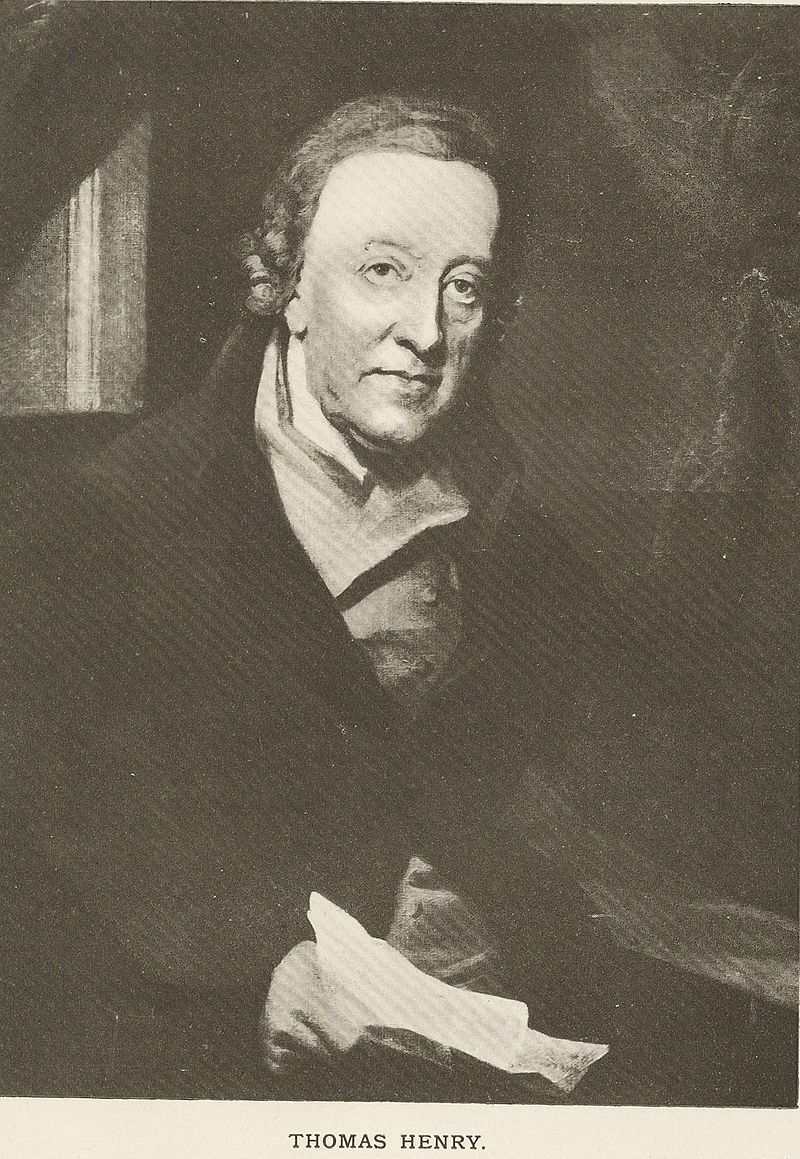
Thomas Henry (1734-1816) was a surgeon-apothecary and chemist. Born in Wales, he later moved to Manchester and was appointed visiting apothecary to the Manchester Infirmary in 1789. He co-founded the Manchester Literary and Philosophical Society in 1781 and became its president in 1807. He was also a Fellow of the Royal Society of London, and in 1786 he was elected to the American Philosophical Society.
In 1771, he invented a process for preparing magnesia alba and became known as “Magnesia” Henry. The first production of carbonated water is also attributed to him – he made it in 12-gallon barrels using an apparatus based on Joseph Priestley’s design.
It is also worth noting that Henry’s son, William Henry (1774-1836), was a chemist as well and is known for his study of gases, his formulation known as “Henry’s Law.” This gets us into physics, which I shall happily ignore much like Catherine Morland’s preference to avoid history – you can read all about it here: https://en.wikipedia.org/wiki/Henry%27s_law
[William was also quite handsome, tending toward Byron as you can see here…irrelevant I know but worth noting – it could make one almost want to take up chemistry…]
Talking about Magnesia might be, like politics in Northanger Abbey once again, “an easy step to silence,” but basically “magnesium oxide (MgO), or magnesia, is a white hygroscopic solid mineral that occurs naturally as periclase and is a source of magnesium” [wikipedia]. It has various uses, none of which I understand except as a fertilizer or its medical use that Le Faye suggests: Magnesium oxide is used for relief of heartburn and indigestion, as an antacid, magnesium supplement, and as a short-term laxative.
So, my belief is that Cassandra had one of these books by Thomas Henry, most likely the first one noted above on “Medicinal Uses,” and like so many of the other books in the Austen’s family possession, was sold off but not accounted for as an individual title, “your Magnesia” lost somewhere along the way. This could only be absolutely confirmed if such a title came up for auction with Cassandra Austen’s inscription…one can only hope…but in the meantime, we have another title to add to the wide-ranging reading list of the Austens.
*************
Notes:
Le Faye, Deirdre. Jane Austen’s Letters. 4th ed. Oxford UP, 2011 [pb ed. 2014].
Images:
Thomas Henry: from Wikipedia – Edward Mansfield Brockbank, Sketches of the Lives and Work of The Honorary Medical Staff of the Manchester Infirmary 1752 to 1830. (University Press, Manchester 1904): 72. Date and artist unknown.
William Henry: from Wikipedia – detail of an engraving by Henry Cousins after a portrait by James Lonsdale. British Museum.
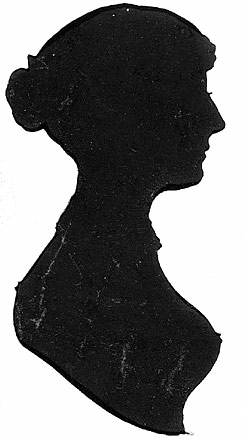
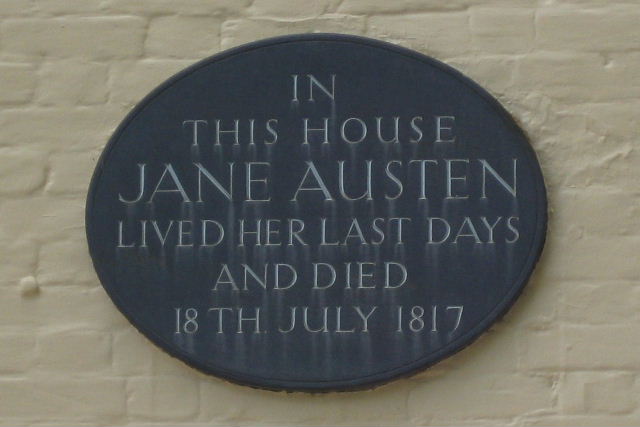
From the archives: July 18, 1817. Just a short commemoration on this sad day…
No one said it better than her sister Cassandra who wrote
I have lost a treasure, such a Sister, such a friend as never can have been surpassed,- She was the sun of my life, the gilder of every pleasure, the soother of every sorrow, I had not a thought concealed from her, & it is as if I had lost a part of myself…”
(Letters, ed. by Deidre Le Faye [3rd ed, 1997], From Cassandra to Fanny Knight, 20 July 1817, p. 343; full text of this letter is at the Republic of Pemberley)
There has been much written on Austen’s lingering illness and death; see the article by Sir Zachary Cope published in the British Medical Journal of July 18, 1964, in which he first proposes that Austen suffered from Addison’s disease. And see also Claire Tomalin’s biography Jane Austen: A life, “Appendix I, “A Note on Jane Austen’s Last Illness” where she suggests that Austen’s symptoms align more with a lymphoma such as Hodgkin’s disease.
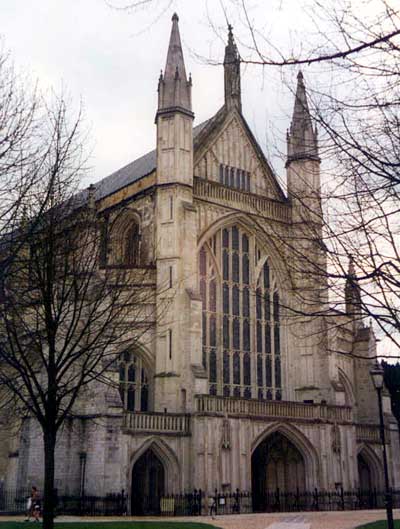
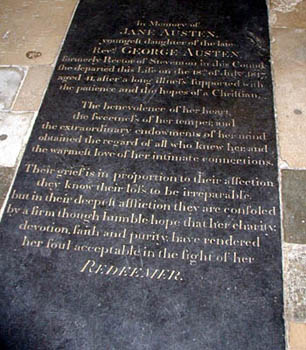
….where no mention is made of her writing life on her grave:
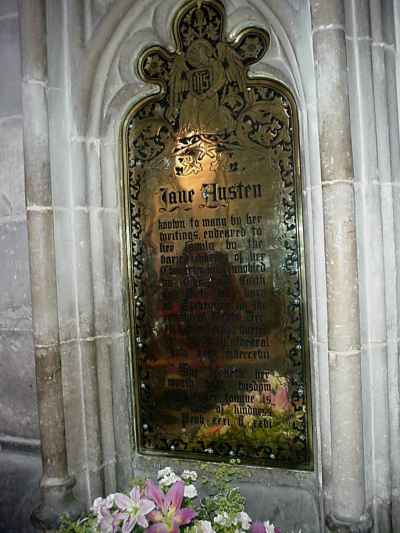
It was not until after 1870 that a brass memorial tablet was placed by her nephew James Edward Austen-Leigh on the north wall of the nave, near her grave:
It tells the visitor that:
Jane Austen
[in part] Known to many by her writings,
endeared to her family
by the varied charms of her characters
and ennobled by her Christian faith and piety
was born at Steventon in the County of Hants.
December 16 1775
and buried in the Cathedral
July 18 1817.
“She openeth her mouth with wisdom
and in her tongue is the law of kindness.”
The Obituaries:
David Gilson writes in his article “Obituaries” that there are eleven known published newspaper and periodical obituary notices of Jane Austen: here are a few of them:
Hampshire Chronicle and Courier (vol. 44, no. 2254, July 21, 1817, p.4): “Winchester, Saturday, July 19th: Died yesterday, in College-street, Miss Jane Austen, youngest daughter of the late Rev. George Austen formerly Rector of Steventon, in this county.”
Hampshire Telegraph and Sussex Chronicle (vol. 18, no. 928, p. 4)…”On Friday last died, Miss Austen, late of Chawton, in this County.”
Courier (July 22, 1817, no. 7744, p. 4), makes the first published admission of Jane Austen’s authorship of the four novels then published: “On the 18th inst. at Winchester, Miss Jane Austen, youngest daughter of the late Rev. George Austen, Rector of Steventon, in Hampshire, and the Authoress of Emma, Mansfield Park, Pride and Prejudice, and Sense and Sensibility. Her manners were most gentle; her affections ardent; her candor was not to be surpassed, and she lived and died as became a humble Christian.” [A manuscript copy of this notice in Cassandra Austen’s hand exists, as described by B.C. Southam]
The Hampshire Telegraph and Sussex Chronicle published a second notice in its next issue (July 28, 1817, p. 4) to include Austen’s writings.
There are seven other notices extant, stating the same as the above in varying degrees. The last notice to appear, in the New Monthly Magazine (vol. 8, no. 44, September 1, 1817, p. 173) wrongly gives her father’s name as “Jas” (for James), but describes her as “the ingenious authoress” of the four novels…
[from Gilson’s article “Obituaries,” The Jane Austen Companion. Macmillan, 1986. p. 320-1]
Links to other articles and sources:
There are many articles and blog posts being written today – I shall post links to all tomorrow – here are just a few:
Austenblog: Mags posts the full text of Cassandra’s letter.
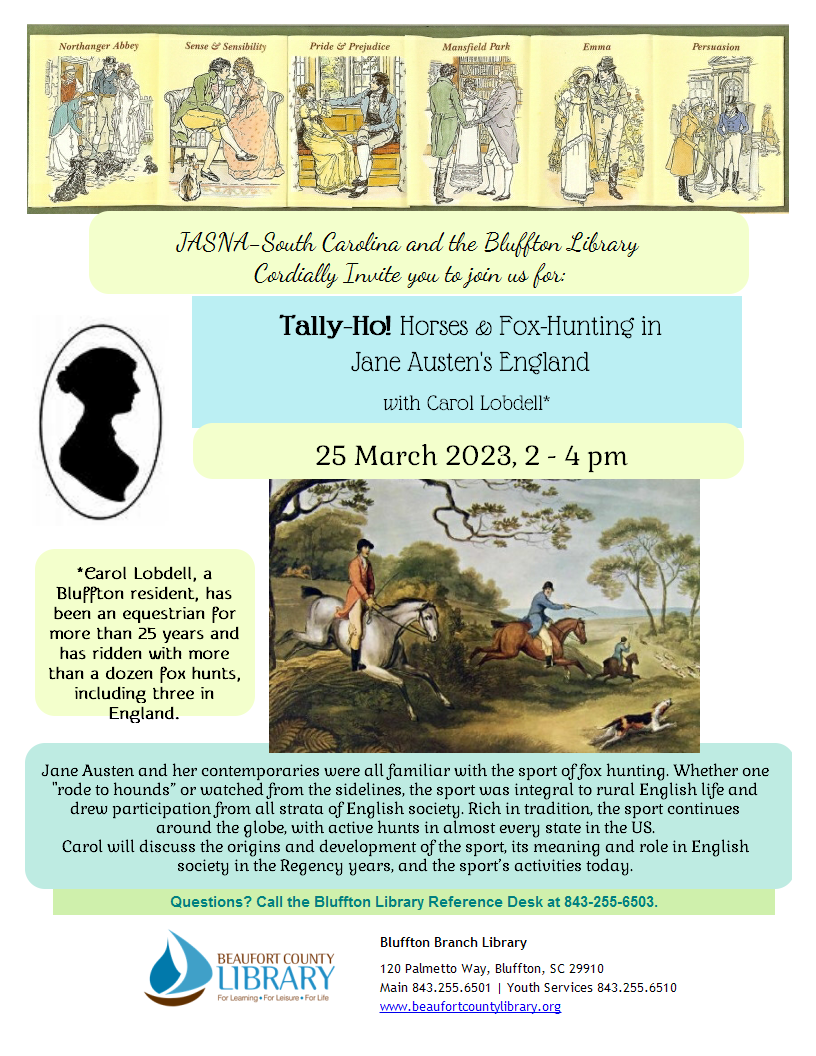
The South Carolina Region of the Jane Austen Society of North America and the Bluffton Library present:
March 25, 2023, 2 – 4 pm
Bluffton Library Free and open to the public / Light refreshments served
******************
******************
“Tally-Ho! Horses and Fox-Hunting in Jane Austen’s England”
Jane Austen and her contemporaries were all familiar with the sport of fox hunting, whether they “rode to hounds” themselves or watched the action from the sidelines. The sport was integral to rural English communities and social interactions, and drew participation from all strata of English society. Mounted fox hunting had practical origins — foxes preyed on poultry, sheep, and cattle, so farmers were happy to be rid of them — and evolved over time into a major social and sporting activity. Rich in tradition, the sport continues around the globe, with active hunts in almost every state in the US.
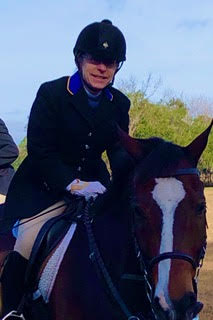
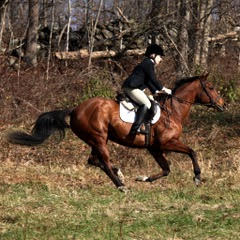
Carol Lobdell, a Bluffton resident, has been an equestrian for more than 25 years and is a fox hunter herself. She has ridden with more than a dozen different hunts, including three in England. She will discuss the origins and development of the sport, its meaning and role in English society in the Regency years, and the sport’s activities today.
Questions? Call the Bluffton Library 843-255-6503.
I pull this Christmas Eve message from the archives, first posted on December 24, 2010
Wishing you all a very Merry Christmas and Festive Holidays!!
***************
It is a rare date that Austen mentions in her works, but one of them is today, December 24: Christmas Eve, “(for it was a very great event that Mr. Woodhouse should dine out, on the 24th of December)” [Emma Vol. I, Ch. xiii]
While we usually associate Mr. Woodhouse with often curmudgeonly weather-obsessed behavior, here he is most eager to get all wrapped up and head over to Randalls:
Mr. Woodhouse had so completely made up his mind to the visit, that in spite of the increasing coldness, he seemed to have no idea of shrinking from it, and set forward at last most punctually with his eldest daughter in his own carriage, with less apparent consciousness of the weather than either of the others; too full of the wonder of his own going, and the pleasure it was to afford at Randalls to see that it was cold, and too well wrapt up to feel it. [E, Vol. I, Ch. xiii]
Fig. 2
So it is not dear fussy Mr. Woodhouse who is Scrooge this Christmas Eve, but Austen is adept at creating one, and long before Dickens ever did:
‘A man,” said he, ‘must have a very good opinion of himself when he asks people to leave their own fireside, and encounter such a day as this, for the sake of coming to see him. He must think himself a most agreeable fellow; I could not do such a thing. It is the greatest absurdity — Actually snowing at this moment! The folly of not allowing people to be comfortable at home, and the folly of people’s not staying comfortably at home when they can! If we were obliged to go out such an evening as this, by any call of duty or business, what a hardship we should deem it; — and here are we, probably with rather thinner clothing than usual, setting forward voluntarily, without excuse, in defiance of the voice of nature, which tells man, in every thing given to his view or his feelings, to stay at home himself, and keep all under shelter that he can; — here are we setting forward to spend five dull hours in another man’s house, with nothing to say or to hear that was not said and heard yesterday, and may not be said and heard again to-morrow. Going in dismal weather, to return probably in worse; — four horses and four servants taken out for nothing but to convey five idle, shivering creatures into colder rooms and worse company than they might have had at home.” [E, Vol. I, Ch. xiii]
Well, “Bah! Humbug!” to you too, John Knightley! – he is our Scrooge this Christmas Eve [indeed, I believe that Isabella has married her father!] and his ill humor continues throughout the evening – ending of course with his gloomy and overblown report of the worsening weather that sets off three full pages of discussion on the risks of setting out, on the possibility of being snowed-in, on the cold, on the danger to the horses and the servants – “‘What is to be done, my dear Emma? – what is to be done?’ was Mr. Woodhouse’s first exclamation…” and it all is finally “settled in a few brief sentences” by Mr. Knightley and Emma, certainly foreshadowing their success as a companionable couple.
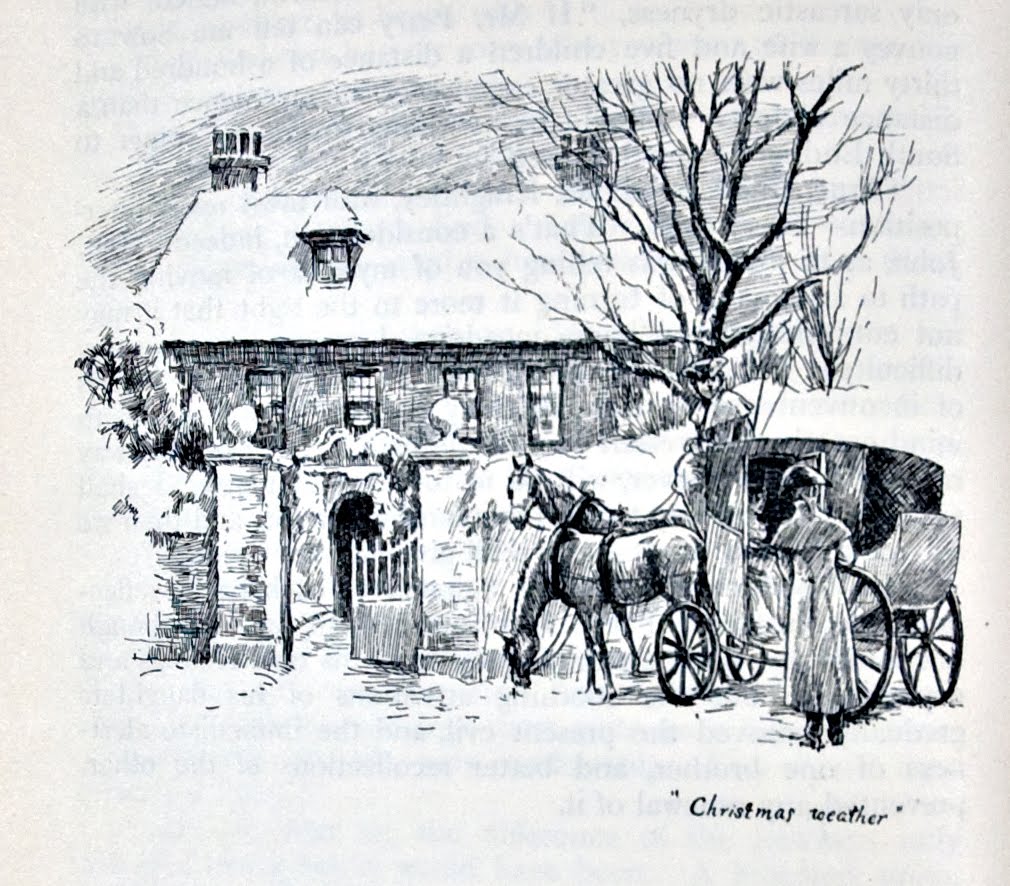
Fig. 3 ‘Christmas Weather’
And this leads to one of Austen’s most comic scenes – the proposal of Mr. Elton, Emma trapped in the carriage alone with him believing that “he had been drinking too much of Mr. Weston’s good wine, and felt sure that he would want to be talking nonsense…” – which of course he does…
Wishing you all a very Merry Christmas, with much snow on the ground (but not enough to trouble your carriage), some song and wine (but not enough to induce unwanted and overbearing offers of love and marriage), and the pleasure of good company (with hopefully no Scrooge-like visitors to whom you must either “comply” or be “quarrelsome” or like Emma, have your “heroism reach only to silence.” )
P.S. – And tonight pull your Emma off the shelf and read through these chapters in volume I [ch, 13-15] for a good chuckle! – this of course before your annual reading of A Christmas Carol.
Today’s post is about Brenda Cox and her just-published Fashionable Goodness: Christianity in Jane Austen’s England. You can follow the other blog posts on this tour here. [See at the end of this post for information on the giveaway.]
A few thoughts: I was honored when Brenda asked me to write a blurb for the cover, and I repeat that here with a few additional thoughts. I would first say that I have read a few works on Austen and religion, all of them enlightening in their own way. We do need to have some inkling of this religious world Austen grew up in, and the religion she practiced, to see that dimension in her writing. I am a born and raised Episcopalian [my parents were Anglican] and much of what Brenda writes in her book was very superficially known to me, at least those parts about the Church hierarchy, prayers and liturgy and hymns. What was enlightening was how Brenda wove all the details of the Church itself, and its spiritual foundations into a fuller understanding of what Jane Austen is actually saying in her novels, in the plots, the characters, and the settings – this book is a compelling read and you won’t look at the novels and the characters in the same way ever again. Just the tables, definitions, and references alone are worth the price of admission.
My blurb:
Fashionable Goodness is a meticulously researched, faultlessly organized, and engaging study of how religion, in all its forms, features in Jane Austen’s world, her life, and her writings.
Starting with Henry Tilney’s famous defense of “the English” in Northanger Abbey, Cox reveals the facts of Jane Austen’s faith, the realities and challenges of practicing religion in the Regency period, and with biographical sketches of the leading religious leaders and analysis of the various denominations of the time, she puts into context the explicit and subtle religious references in Austen’s novels. This Christian world permeates Austen’s writings and a fuller understanding of the Church and its clerical hierarchy and the emphasis on living a moral “good” life will open up a clearer view of Austen’s plots, characters, and underlying themes. You will look at Mr. Collins, the Crawfords and the Dashwoods, the Tilneys, the Wickhams and Willoughbys, all the “good” and the “not so good” people that populate the novels (and especially Fanny Price!) with new and surprising insights. Bravo to Brenda Cox for giving us this very accessible illuminating take on the “fashionable goodness” of Austen’s era.
*****************
An Excerpt from the first chapter, beginning as I say above with my favorite Hero, Henry Tilney:
C. E. Brock, Northanger Abbey, 1907
“Jane Austen’s England, A Foreign Country (Foreign to Modern Readers)”
“Remember the country and the age in which we live. Remember that we are English, that we are Christians.”—Henry Tilney, Northanger Abbey, ch. 24
How can we understand “the country and the age” in which Jane Austen lived? Her society is poles apart from our modern world, despite some points of similarity. As L. P. Hartley insightfully begins a novel set in 1900 [The Go-Between], “The past is a foreign country; they do things differently there.” The world of Austen’s novels is foreign to us, whether we live in the United States, modern England, or elsewhere. To enter this “foreign country,” the civilization that spawned Elizabeth Bennet, Mr. Darcy, and Emma Woodhouse, we need to learn its language and culture. While we may interpret Austen’s timeless novels according to our own experiences and values, we can enjoy them more deeply as we get to know Austen’s world.
Religious practices and values influenced many aspects of Austen’s culture. For example, in politics, the Church of England was (and is) the national church of England; the Pilgrims and Puritans fled to America to escape its authority. The sovereign was the head of the church, bishops and archbishops were members of the House of Lords, and Parliament made laws regulating worship, the clergy, and churches. From 1810 to 1820 (the Regency), the Prince Regent governed the country because of his father’s illness. Jane Austen disapproved of the Regent’s immoral lifestyle, but when he asked her to dedicate Emma to him, she respectfully complied, since it was her duty as a Christian to obey her country’s leader.
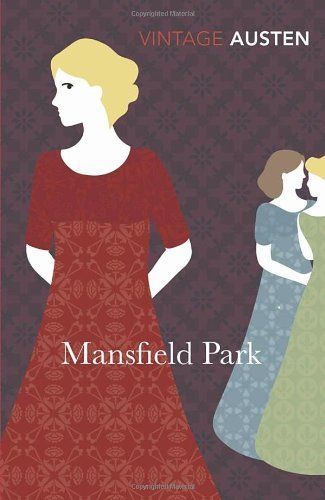
Religious values also guided family relationships. Honoring one’s parents was an important religious duty, given in the Ten Commandments in the Bible and elaborated in the Church of England catechism. In Mansfield Park, Edmund and Fanny are shocked by Mary’s disrespect for her uncle who raised her; Mary is showing poor moral values (ch. 7). Mr. Collins of Pride and Prejudice carries this to a ridiculous extreme when he delays reconciling with his cousins out of respect for his father’s memory, since his father was at odds with them (ch. 13). Disrespect toward a husband or wife was also considered immoral. In Sense and Sensibility, Willoughby shows his poor character by criticizing his wife, and Elinor rebukes him (ch. 44).
As Laura Mooneyham White points out in Jane Austen’s Anglicanism, the “foundational worldview” of modern Christians, including modern Anglicans, differs radically from the worldview of the Georgian-era Anglican Church. Because of this, we may miss some of the deeper dimensions of Austen’s novels….
A Worldly Bishop and a Godly Curate: Pillars of the Church, anonymous, 1810-1820. Satirical cartoons of the time showed serious issues in the church. Rich bishops were contrasted with destitute curates. This curate’s pocket holds “Sermons for Rent.” Sermons were often bought and sold. In Austen, the curate Charles Hayter of Persuasion cannot afford to marry, while Dr. Grant of Mansfield Park gets a high church position and dies of gluttony. Image courtesy of The Lewis Walpole Library, Yale University.
To understand the church’s pervasive influence in Austen’s world, we also need to recognize some the issues it was facing. Edmund Bertram and Mary Crawford argue about several: clergy without a calling, clergy who did not live in their parishes, and “fashionable goodness.” Was it enough to follow the fashions of the city and show up at church on Sundays, ignoring religion the rest of the week? Or, as new movements in the church stressed, should people seek a personal relationship with God that affected their hearts and behavior? Even for Mr. Darcy, being “given good principles” – knowing theoretical religious truths – was insufficient to make him a man Elizabeth could respect and marry…
Jane Austen’s religious beliefs, and the beliefs of her society, are often overlooked. She does not talk as openly about religion as today’s Christian writers do, or even as some of her contemporaries did. And yet, as Henry Tilney points out, being “Christian” was part of the English identity. Jane Austen’s personal identity was also Christian, as we shall see in the next chapter. In the rest of the book, we’ll explore the crucial part Christianity played in Austen’s stories and in her world. In Austen’s England, morality came directly from religion….
Author interview: I asked Brenda a few questions about why she wrote this book and how it has affected her reading of Austen:
DEB: You have said you titled the book Fashionable Goodness: Christianity in Jane Austen’s England, because during Austen’s time, it was fashionable to attend church and pretend to be “good,” but that the immorality of the Prince Regent and others seemed more fashionable, leading the influential William Wilberforce and others to try to reform “manners” [meaning behavior] – Edmund Bertram in Mansfield Park explains that “manners” meant behavior, how people acted based on their religious principles. So I would ask you: which of Austen’s novels focuses most on the church and this idea of “manners”?
BRENDA: Mansfield Park, hands down. Edmund and Mary Crawford discuss the importance of the clergy (those responsible for “all that is of the first importance to mankind”). Edmund and Henry Crawford discuss preaching and leading church services. Fanny, physically weak, displays great moral strength in refusing to marry an “unprincipled” (irreligious) man. Also, godly traditional values are contrasted with the immorality of the city. I appreciate Mansfield Park far more than I did before, now that I understand its religious background.
DEB: Your book is packed with information, from how the Church of England is organized, the challenges the church faced during Austen’s time, and the legacy it still holds for us. How did you decide to organize it?
BRENDA: My background is in engineering, and I tried to structure Fashionable Goodness logically. It starts, of course, with Jane Austen and her novels. We look at things like her personal faith, the lives of her clergymen, and worship during her time. Two chapters address how some of the church’s values played out in everyday life, particularly in the areas of marriage and divorce, and in scientific advances.
Part 2 then looks at challenges to Austen’s Church of England. Some of those, like the system of patronage and different levels of clergymen, are addressed in the novels. Others, like the Methodist movement and the place of different economic groups and races in the church, give background. I wove in fascinating stories of men and women leaders of the time.
As I saw how the church was making an impact on the country and the world, I added Part 3. It shows the impact of committed Christians of Austen’s era, ranging from the abolition of the slave trade to the Sunday school movement that educated millions of poor children and adults, breaking cycles of poverty and dependence.
DEB: What spiritual messages do you think Austen was trying to convey through her novels?
BRENDA: Austen always promoted moral behavior. But she didn’t do it by preaching and telling people what to do. Instead, she showed examples, both positive and negative. Readers of Pride and Prejudice, for instance, might learn to avoid judging and ridiculing other people. We might instead want to be more like Jane Bennet, assuming the best of others until the worst is clearly proven. (This was a religious virtue called candour in Austen’s time; posts on my blog explore this and other “faith words.”)
DEB: Which of her novels speaks most strongly to you personally?
BRENDA: Usually my favorite Austen novel, and the one that speaks to me most, is whichever one I have read most recently. Right now that is Sense and Sensibility, which I’ve read repeatedly in the months leading up to the JASNA AGM. It has made me more aware of emotions and their effect on us and other people. We can express our emotions selfishly, as Marianne did, not caring how we make others feel. Or we can recognize them in ourselves, as Elinor did, and choose ways to respond that do not hurt our loved ones. In this, Elinor was doing her Christian “duty,” to love her neighbour as herself. However, I also think Austen put Elinor in a worst-case scenario. Elinor’s promise to Lucy made it impossible for Elinor to tell her family what she felt. In other circumstances she might have shared her pain with her family in healthy ways.
*********************
About the Author: Brenda S. Cox has loved Jane Austen since she came across a copy of Emma as a young adult; she went out and bought a whole set of the novels as soon as she finished it! She has spent years researching the church in Austen’s England, visiting English churches and reading hundreds of books and articles, including many written by Austen’s contemporaries. She speaks at Jane Austen Society of North America meetings (including three AGMs) and writes for Persuasions On-Line[JASNA journal) and the websites Jane Austen’s World and Brenda’s own blog Faith, Science, Joy, and Jane Austen. You can find bonus material on the book here as well.
Brenda is offering a book giveaway [paperback or ebook] – Please comment below or ask Brenda a question [she will respond here] by Wednesday November 9 and you will be entered into the random drawing for a copy [there are some limitations to worldwide shipping] – I will announce the winner on November 10th. Here are some prompts for commenting, or please ask your own.
1. What is one character trait you think Jane Austen most valued, based on her novels?
2. Who is your favorite clergyman or clergyman’s wife from Austen’s novels? And why?
3. What is one question you have about the church in Austen’s England, or the church and clergy in her novels?
*[N.B.: The giveaway is limited to addresses in the US, UK, Australia, Canada, Germany, Spain, France, or Italy for a print copy of the book. The author can only send a giveaway ebook to a US address. (However, both the ebook and paperack are available for sale to customers from any of these countries, and some others that have amazon.)
Head-up everyone! The blog tour for Brenda Cox’s just released Fashionable Goodness: Christianity in Jane Austen’s England begins today. I will be posting more on October 25th along with a giveaway, but here are a few thoughts as to what this book has to offer and how it will enlarge your understanding of Jane Austen’s world:
Jane Austen transports us to a world of elegance and upheaval. The Church of England, at the heart of her life and her world, is key to understanding her stories. Readers may wonder:
Why could Mr. Collins, a rector, afford to marry a poor woman, while Mr. Elton, a vicar, could not?
What conflicting religious duties led Elizabeth Bennet to turn down two marriage proposals?
Why did Mansfield Park’s early readers (unlike most today) love Fanny Price?
What part did people of color, like Miss Lambe of Sanditon, play in English society?
How did Austen’s church impact people’s lives and the world?
Fashionable Goodness: Christianity in Jane Austen’s England answers these questions and many more. It explores:
Austen’s Church of England, as we see it in her novels,
Challenges the church was facing, reflected in her stories, and
Ways the church in Austen’s England transformed England and the world.
Comprehensive, yet affordable and easy to read, Fashionable Goodness will help you see Austen’s beloved novels and characters in richer and deeper ways.
***********
Here is the tour schedule – check back each day for the updated links:
Oct. 20: Jane Austen’s World, Vic Sanborn, Interview with the author [live today!]
Oct. 21: My Jane Austen Book Club, Maria Grazia, Giveaway and Guest Post, “Sydney Smith, Anglican Clergyman and Proponent of Catholic Rights, Potential Model for Henry Tilney”
Oct. 27: Australasian Christian Writers, Donna Fletcher Crow, Guest Post, “Seven Things Historical Fiction Writers Should Know about the Church of England”
Oct. 30: Regency History, Andrew Knowles, Book Review and Video Interview
“Finally! Fashionable Goodness is the Jane Austen reference book that’s been missing from the bookshelves of every Austen fan and scholar.” ~ Rachel Dodge, bestselling author of Praying with Jane
“Brenda Cox’s Fashionable Goodness: Christianity in Jane Austen’s England is an indispensable guide to all things religious in Jane Austen’s world.” ~ Roger E. Moore, Vanderbilt University, author of Jane Austen and the Reformation
“This scholarly, detailed work is a triumph. Easily read, helpful and accurate, it provides a fascinating panorama of 18th century Anglicanism and the various challenges the Church and wider society faced. Cox’s many insights will enrich readers’ understanding and appreciation of Jane Austen’s novels and her life as a devout Christian.”~ The Revd. Canon Michael Kenning, vice-chairman of the Jane Austen Society (U. K.) and former rector of Steventon
Where to Buy:
Fashionable Goodness: Christianity in Jane Austen’s England is now available from Amazon and Jane Austen Books. [For international Amazon, you can to this link.]
You are cordially invited to the upcoming JASNA-South Carolina Region event at the Bluffton Library on November 5th. Co-sponsored by the Friends of the Bluffton Library. Hope you can join us!
When: Saturday, November 5, 2022, 2:00 – 4:00 pm What: Talk on “Gender and the Decorative Arts in Jane Austen’s Novels” with Kristen Miller Zohn* Where: Bluffton Library, 120 Palmetto Way, Bluffton, SC
During the Georgian period, women and men alike had a great interest in architecture, interior design, and fashion, and there was an expectation that the concepts of femininity and masculinity would be reflected in these spheres. This slide lecture will present images of decorative arts, interior design, and clothing to explore how those that are presented in Austen’s novels speak to the roles of women and men in her era.
*Kristen Miller Zohn is the Curator of Collections and Exhibitions at the Lauren Rogers Museum of Art in Lauren, Mississippi, as well as the Executive Director of the Costume Society of America.
Please RSVP: jasnavermont [at] gmail.com or the Bluffton Library, 843-255-6503
I pull this Christmas Eve message from the archives, first posted on December 24, 2010
Wishing you all a very Merry Christmas and Festive Holidays!!
***************
It is a rare date that Austen mentions in her works, but one of them is today, December 24: Christmas Eve, “(for it was a very great event that Mr. Woodhouse should dine out, on the 24th of December)” [Emma Vol. I, Ch. xiii]
While we usually associate Mr. Woodhouse with often curmudgeonly weather-obsessed behavior, here he is most eager to get all wrapped up and head over to Randalls:
Mr. Woodhouse had so completely made up his mind to the visit, that in spite of the increasing coldness, he seemed to have no idea of shrinking from it, and set forward at last most punctually with his eldest daughter in his own carriage, with less apparent consciousness of the weather than either of the others; too full of the wonder of his own going, and the pleasure it was to afford at Randalls to see that it was cold, and too well wrapt up to feel it. [E, Vol. I, Ch. xiii]
Fig. 2
So it is not dear fussy Mr. Woodhouse who is Scrooge this Christmas Eve, but Austen is adept at creating one, and long before Dickens ever did:
‘A man,” said he, ‘must have a very good opinion of himself when he asks people to leave their own fireside, and encounter such a day as this, for the sake of coming to see him. He must think himself a most agreeable fellow; I could not do such a thing. It is the greatest absurdity — Actually snowing at this moment! The folly of not allowing people to be comfortable at home, and the folly of people’s not staying comfortably at home when they can! If we were obliged to go out such an evening as this, by any call of duty or business, what a hardship we should deem it; — and here are we, probably with rather thinner clothing than usual, setting forward voluntarily, without excuse, in defiance of the voice of nature, which tells man, in every thing given to his view or his feelings, to stay at home himself, and keep all under shelter that he can; — here are we setting forward to spend five dull hours in another man’s house, with nothing to say or to hear that was not said and heard yesterday, and may not be said and heard again to-morrow. Going in dismal weather, to return probably in worse; — four horses and four servants taken out for nothing but to convey five idle, shivering creatures into colder rooms and worse company than they might have had at home.” [E, Vol. I, Ch. xiii]
Well, “Bah! Humbug!” to you too, John Knightley! – he is our Scrooge this Christmas Eve [indeed, I believe that Isabella has married her father!] and his ill humor continues throughout the evening – ending of course with his gloomy and overblown report of the worsening weather that sets off three full pages of discussion on the risks of setting out, on the possibility of being snowed-in, on the cold, on the danger to the horses and the servants – “‘What is to be done, my dear Emma? – what is to be done?’ was Mr. Woodhouse’s first exclamation…” and it all is finally “settled in a few brief sentences” by Mr. Knightley and Emma, certainly foreshadowing their success as a companionable couple.
Fig. 3 ‘Christmas Weather’
And this leads to one of Austen’s most comic scenes – the proposal of Mr. Elton, Emma trapped in the carriage alone with him believing that “he had been drinking too much of Mr. Weston’s good wine, and felt sure that he would want to be talking nonsense…” – which of course he does…
Wishing you all a very Merry Christmas, with much snow on the ground (but not enough to trouble your carriage), some song and wine (but not enough to induce unwanted and overbearing offers of love and marriage), and the pleasure of good company (with hopefully no Scrooge-like visitors to whom you must either “comply” or be “quarrelsome” or like Emma, have your “heroism reach only to silence.” )
P.S. – And tonight pull your Emma off the shelf and read through these chapters in volume I [ch, 13-15] for a good chuckle! – this of course before your annual reading of A Christmas Carol.











 Jane Austen in Vermont