Jane Austen · Regency England · Social Life & Customs

So What the Heck are ‘Holland Covers’, anyway??

One of my most favorite scenes in a movie is the opening of the 1995 Persuasion  and the slow-motion laying on of the “holland covers” to protect all the Kellynch furniture as the Elliots retrench to Bath.  One can read just about any book of historical fiction and see this term used to refer to furniture coverings:  “shrouded in holland covers” or some such reference [just google ”holland covers” and you will see what I mean – even Balzac used the term!]  It is such a common reference in today’s historical fiction writings, and one reads along, knowing what it means, but where does the term come from? and most important of all, did Jane Austen ever use the term? 

 I have a book titled Regency Furniture, by Clifford Musgrave [any relation to The Watson’s Tom?], and there is much on Henry Holland, and I recall when I first bought this book that I thought perhaps this is where the term originated – Holland designed furniture, so coverings for said furniture could be called ‘holland covers’ – no?  Holland was the architect appointed by the Prince Regent [then the Prince of Wales] to rebuild and refurbish Carlton House, the Prince’s London establishment since 1783.  Carlton House was subjected to an endless series of alterations to the building and the furnishings for the next forty years, all to end in demolition in 1827.  But Mr. Holland is a topic for another post [he was the pupil and assistant of the landscape architect ‘Capability’ Brown and married his daughter Bridget, designed the PR’s Marine Pavilion in Brighton, laid out parts of the development of the fashionable Knightsbridge and Chelsea areas of London [including Sloane Square where Austen’s brother Henry lived] – so he will make a most interesting topic in his own right…] – but indeed he has nothing to do with ‘holland covers’ ….  But it is this thought that got me to wonder at its meaning…

Now,  if you search “Holland covers” on the ever-reliable, all-knowing, all-seeing internet, barely anything comes up, and certainly not an image in sight –  to whit: 

*There is a link to a description of the above-mentioned Persuasion: 

At the begining, we see Anne Elliot (Sally Hawkins) going through the rooms of her home, Kellynch Hall, as harried servants are trying to pack up, and placing holland covers on the furniture. She is marking items on lists and trying to direct the servants.

*A link to an online Google book  from 1909, Mrs. Wilfrid Ward’s Great Possessions, with chapter 33 titled “Brown Holland Covers”  [the full text is here in the event you cannot resist the whole book…]

*And Edith Nesbit makes mention of them here in her The Enchanted Castle.  

*There is a short advertisement in an 1856 edition of Punch, that is quite funny: 

 A MAD WAG’S ADVERTISEMENT.

 We beg leave to call the attention of ProFessor Owen to the very contradictory animal referred to in an extraordinary advertisement, relating to a Bath chair, which we are told “may be drawn by either a man or pony, painted maroon, lined with drab cloth and holland covers.” We can understand the possibility of painting either a man or a pony “maroon,” though we shonld question the good taste or the utility of applying such a mode of external decoration to either animal ; but that either of t them should be “lined with drab cloth and holland covers ” is a phenomenon we at once pro! nounce incredible. It is true that a man’s stomach has a coat, and so we presume has a pony’s, which may account in some degree for the very whimsical notion of a man or pony ” lined with cloth ;” and we hâve a faint glimmering of an idea suggestive of ” holland covers ” arising out of the tendency of an inveterate gin drinker to cover his inside with Hollands. Nevertheless, the advertisement is so odd, that if the advertiser were to take it into his head to poison half his relations, make away with himself, or steal a pound of pork sausages, we 1 dare say that no intelligent British jury would find any difficulty in pronouncing him ” Not Guilty,” on the ground of insanity.

*And from a book on Textiles in America, describing the proper way to make slipcovers, where we are told that these covers are removed for company, but that Holland, though the most durable, looks cold and chintz is thus much preferred…

*And a 1919 article in The Independent on “Summer Clothes for the House”.

[This dates me terribly I’m afraid to say, but my grandmother and mother always covered every piece of upholstered furniture in the summer with beautifully made slipcovers, holland covers being their precursor – they also rolled up all the rugs and put down lighter summer carpets and changed all the curtains to summer sheers and changed all the bedlinens [well, I still do that] and washed down all the walls – yikes!]

Now as for Austen:  I find no mention in the novels; indeed, the only reference comes up in a short tale found in the RoP’s “Bits of Ivory” section called The Key:   

He looked around at the furniture which has not seen any use for over five years, it was draped with Holland covers to keep off the dust–even though Mrs. Reynolds, being a conscientious housekeeper, regularly cleaned and dusted the room. Darcy was unaware that she often thought what a pity it was that the Master’s suite was not being used.

I can find no references in the letters, and wonder about the Juvenilia, where one would think Austen would have her heroines fainting on sofas that might be so covered…

So for me, back to the books:  A Dictionary of Costume and Fashion by Mary Brooks Picken [Dover, 1999] says the following under “Holland”: 

Closely woven linen fabric originally made in Holland.  The first Hollands were made of this fabric [i.e. a form-fitting foundation made by big establishments for special customers and used as a size guide in cutting and draping to save fittings] – a linen or fine cotton in plain weave, sized and often glazed [p. 175];

and under “Linens”:  firm, course, plain-woven, linen, unbleached or partly bleached, glazed and unglazed; originally from Holland.  Used for aprons, furniture covers, window shades, dress-form covers, etc. [p. 213]

And in Inside the Victorian Home: A Portrait of Domestic life in Victorian England, by Judith Flanders [Norton, 2004]:  

As the second half of the century progressed, hygiene became the overriding concern.  Mrs. Panton, still distressed about bedroom carpets, remembered a carpet that had spent twenty years on the dining room floor, “covered in Holland in the summer,” and preserved from winter wear by the most appallingly frightful printed red and green ‘felt square’ I ever saw.” [with a note:  Holland was a hard-wearing linen fabric, usually left undyed.  It was much used in middle- and upper-class households to cover and protect delicate fabrics and furniture.”  [p.  43] 

[quoting Mrs. Jane Ellen Panton, 1848-1923, author of many books on home decorations and home economics, her From Kitchen to Garret, published in eleven editions in ten years!]

And now I see that searching ‘holland linen’ and ‘holland cloth’ is more productive: 

*Here being the whole history of Dutch linen at A Fabric Collector’s Diary

*And at ehow.com, a definition and a picture of plain old linen: 

Holland linen is a plain-woven linen fabric that is treated with oil and starch, making it opaque and hard for the sunlight to penetrate. This quality makes it well-suited for use in making window shades and lampshades.

*And even at British History Online, we find history of the import of holland linen:   

Holland and its neighbours were major producers of LINEN of all grades, the finest of which was usually designated simply as HOLLAND or HOLLAND CLOTH. It was much used for making the highest quality of NAPERY and BED LINEN above those made of DIAPER, HUCKABACK, FLAXEN CLOTH, HEMPEN CLOTH and TOW.

OED earliest date of use: 1617

Found described as PLAIN

[From: ‘Hobnail – Holliwortle’, Dictionary of Traded Goods and Commodities, 1550-1820 (2007)]

*And on this side of the pond at the MFA in Boston – their CAMEO site on materials: 

Material Name: holland cloth : 

Originally, the name for any fine, plain-weave, linen cloth manufactured in the Netherlands. Holland cloth now refers to a plain-weave cotton or linen fabric made opaque by fillers, sizing, and/or glazing. It is typically sized with starch, then glazed with a filled oil. Holland cloth is used for window shades, lamp shades, bookbinding, upholstery, labels, and gummed tapes.

 And so it goes – this search, much like my previous short post on the Steventon Rectory that started from a real estate ad and resulted in two posts and is still to be updated with new and amazing information – has just opened a huge can of worms – I just want to find an IMAGE of a piece of furniture in “holland covers” – if anyone has such, and there MUST be one out there somewhere, please email me the link – I will be forever grateful, and can thus bring this post to a close… and lacking holland covers, I am having this awful feeling of the need to vacuum and dust…

Austen Literary History & Criticism · Jane Austen · Literature

Andrew Lang’s ‘Letter to [a dead] Jane Austen’

Andrew Lang’s Letters to Dead Authors  [NY:  Scribner’s, 1889, c1886] is one of my favorite little books [because I like and collect little books, love Andrew Lang, as in Fairy Book fame, and love the title – my book is a very dark green with gilt lettering, has a Greek myth book-plate and a few notes from a previous owner penned in a beautiful calligraphic hand].

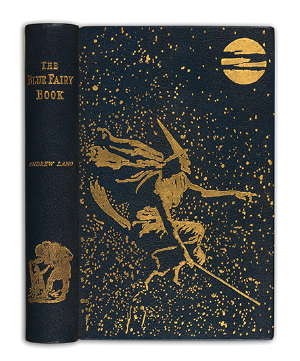
Lang (1844-1912) was one of the most prolific and versatile writers of his day – a poet, essayist, reviewer, biographer, bibliographer, historian, translator, editor, and anthropologist [1] – known mostly today for his Homeric scholarship, and his series of lovely Fairy Books [the first in 1889 was The Blue Fairy Book, followed by eleven others[2] which did much to revive interest in fairy tales.

[Andrew Lang, 1855 portrait by Sir William Blake Richmond,
Scottish National Gallery, from adelaide.edu]

 But I bought this book many years ago because of chapter VIII, “To Jane Austen”, though the other essays are certainly deserving of a read: 

Contents:  Preface

  1. To W. M. Thackeray
  2. To Charles Dickens
  3. To Pierre De Ronsard
  4. To Herodotus
  5. To Mr. Alexander Pope
  6. To Lucian of Samosata
  7. To Maitre Francoys Rabelais
  8. To Jane Austen
  9. To Master Isaak Walton
  10. To M. Chapelain
  11. To Sir John Manndeville
  12. To Alexandre Dumas
  13. To Theocritus
  14. To Edgar Allan Poe
  15. To Sir Walter Scott, Bart.
  16. To Eusebius of Caesarea
  17. To Percy Bysshe Shelley
  18. To Monsieur De Molie’re, Valet De Chambre du Roi
  19. To Robert Burns
  20. To Lord Byron 
  21. To Omar Khayya’m
  22. To Q. Horatius Flaccus

*********************************

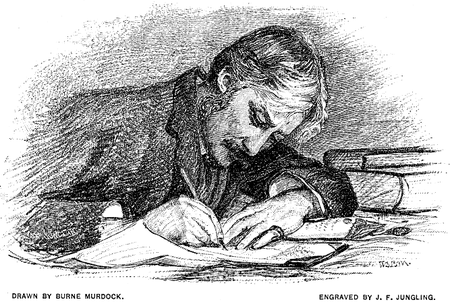
[‘Lang at Work’ from Wikisource]

You will note, of course, that Austen is the only female in the group and thus shows her status among the literary elite in 1886, the essay first appearing in the St. James Gazette.  Lang remarks in his preface the “it is, perhaps, superfluous to add that some of the Letters are written to suit the Correspondent than to express the writer’s own taste or opinions.” [p. vi].  I append here the full text, as it is available in numerous online versions.  Lang offers a humorous critique of Austen’s critics, as Brian Southam suggests, Lang’s own comments voicing those of Anne Thackeray and reiterating the ”cloying tradition” of Austen criticism.[3]  So whatever Lang’s intent, I think his words still stand today to those who think that “nothing happens in Austen” – his thoughts on Lydia or Kitty as heroines is one of the many chuckles in these few short paragraphs – 

With Lydia for a heroine you might have gone far; and, had you
devoted three volumes, and the chief of your time, to the passions of Kitty, you might have held your own, even now, in the circulating library. How Lyddy, perched on a corner of the roof, first beheld her Wickham; how, on her challenge, he climbed up by a ladder to her side; how they kissed, caressed, swung on gates together, met at odd seasons, in strange places, and finally eloped: all this might have been put in the mouth of a jealous elder sister, say Elizabeth, and you would not have been less popular than several favourites of our time.  [p. 79]

 **********************

So, read this, it is not that long, and comment if you will, please!

 VIII.  To Jane Austen

Madame,–If to the enjoyments of your present state be lacking a view of the
minor infirmities or foibles of men, I cannot but think (were the thought
permitted) that your pleasures are yet incomplete. Moreover, it is certain
that a woman of parts who has once meddled with literature will never wholly lose her love for the discussion of that delicious topic, nor cease to relish what (in the cant of our new age) is styled ‘literary shop.’ For these reasons I attempt to convey to you some inkling of the present state of that agreeable art which you, madam, raised to its highest pitch of perfection.

As to your own works (immortal, as I believe), I have but little that is
wholly cheering to tell one who, among women of letters, was almost alone in her freedom from a lettered vanity. You are not a very popular author: your volumes are not found in gaudy covers on every bookstall; or, if found, are not perused with avidity by the Emmas and Catherines of our generation. ‘Tis not long since a blow was dealt (in the estimation of the unreasoning) at your character as an author by the publication of your familiar letters. The editor of these epistles, unfortunately, did not always take your witticisms, and he added others which were too unmistakably his own. While the injudicious were disap-pointed by the absence of your exquisite style and humour, the wiser sort were the more convinced of your wisdom. In your letters (knowing your correspondents) you gave but the small personal talk of the hour, for them sufficient; for your books you reserved matter and expression which are imperishable. Your admirers, if not very numerous, include all persons of taste, who, in your favour, are apt somewhat to abate the rule, or shake off the habit, which commonly confines them to but temperate laudation.

‘T is the fault of all art to seem antiquated and faded in the eyes of the
succeeding generation. The manners of your age were not the manners of to-day, and young gentlemen and ladies who think Scott ‘slow,’ think Miss Austen ‘prim’ and ‘dreary.’ Yet, even could you return among us, I scarcely believe that, speaking the language of the hour, as you might, and versed in its habits, you would win the general admiration. For how tame, madam, are your characters, especially your favourite heroines! how limited the life which you knew and described! how narrow the range of your incidents! how correct your grammar!

As heroines, for example, you chose ladies like Emma, and Elizabeth, and
Catherine: women remarkable neither for the brilliance nor for the degradation of their birth; women wrapped up in their own and the parish’s concerns, ignorant of evil, as it seems, and unacquainted with vain yearnings and interesting doubts. Who can engage his fancy with their match-makings and the conduct of their affections, when so many daring and dazzling heroines approach and solicit his regard?

Here are princesses dressed in white velvet stamped witla golden fleurs-de-lys –ladies with hearts of icc and lips of fire, who count their roubles by the
million, their lovers by the score, and even their husbands, very often, in
figures of some arithmetical importance. With these are the immaculate
daughters of itinerant italian musicians, maids whose souls are unsoiled
amidst the contaminations of our streets, and whose acquaintance with the art of Phidias and Praxiteles, of Daedalus and Scopas, is the more admirable,
because entirely derived from loving study of the inexpensive collections
vended by the plaster-of-Paris man round the corner. When such heroines are wooed by the nephews of Dukes, where are your Emmas and Elizabeths? Your volumes neither excite nor satisfy the curiosities provoked by that modern and scientific fiction, which is greatly admired, I learn, in the United States, as well as in France and at home.

You erred, it cannot be denied, with your eyes open. Knowing Lydia and Kitty so intimately as you did, why did you make of them almost insignificant characters? With Lydia for a heroine you might have gone far; and, had you devoted three volumes, and the chief of your time, to the passions of Kitty, you might have held your own, even now, in the circulating library. How Lyddy, perched on a corner of the roof, first beheld her Wickham; how, on her challenge, he climbed up by a ladder to her side; how they kissed, caressed, swung on gates together, met at odd seasons, in strange places, and finally eloped: all this might have been put in the mouth of a jealous elder sister, say Elizabeth, and you would not have been less popular than several favourites of our time. Had you cast the whole narrative into the present tense, and lingered lovingly over the thickness of Mary’s legs and the softness of Kitty’s cheeks, and the blonde fluffiness of Wickham’s whiskers, you would have left a romance still dear to young ladies.

Or again, you might entrance your students still, had you concentrated your attention on Mrs. Rushworth, who eloped with Henrv Crawford. These should have been the chief figures of ‘Mansfield Park.’ But you timidly decline to tackle Passion. ‘Let other pens,’ you write, ‘dwell on guilt and misery. I quit such odious subjects as soon as I can.’ Ah, _there_ is the secret of your failure! Need I add that the vulgarity and narrowness of the social circles you describe impair your popularity? I scarce remember more than one lady of title, and but very few lords (and these unessential) in all your tales. Now, when we all wish to be in society, we demand plenty of titles in our novels, at any rate, and we get lords (and very queer lords) even from Republican authors, born in a country which in your time was not renowned for its literature. I have heard a critic remark, with a decided air of fashion, on the brevity of the notice which your characters give each other when they offer invitations to dinner. ‘An invitation to dinner next day was despatched,’ and this demonstrates that your acquaintance ‘went out’ very little, and had but few engagements. How vulgar, too, is one of your heroines, who bids Mr. Darcy ‘keep his breath to cool his porridge.’ I blush for Elizabeth! It were superfluous to add that your characters are debased by being invariably mere members of the Church of England as by law established. The Dissenting enthusiast, the open soul that glides from Esoteric Buddhism to the Salvation Army, and from the Higher Pantheism to the Higher Paganism, we look for in vain among your studies of character. Nay, the very words I employ are of unknown sound to you; so how can you help us in the stress of the soul’s travailings?

You may say that the soul’s travailings are no affair of yours; proving
thereby that you have indeed but a lowly conception of the duty of the
novelist. I only remember one reference, in all your works, to that
controversy which occupies the chief of our attention–the great controversy on Creation or Evolution. Your Jane Bennet cries: ‘I have no idea of there being so much Design in the world as some persons imagine.’ Nor do you touch on our mighty social question, the Land Laws, save when Mrs. Bennet appears as a Land Reformer, and rails bitterly against the cruelty ‘of settling an estate away from a family of five daughters, in favour of a man whom nobody cared anything about.’ There, madam, in that cruelly unjust performance, what a text you had for a _Tendenz-Roman_. Nay, you can allow Kitty to report that a Private had been flogged, without introducing a chapter on Flogging in the Army. But you formally declined to stretch your matter out, here and there, with solemn specious nonsense about something unconnected with the story.’ No ‘padding’ for Miss Austen! In fact, madam, as you were born before Analysis came in, or Passion, or Realism, or Naturalism, or Irreverence, or Religious Open-mindedness, you really cannot hope to rival your literary sisters in the minds of a perplexed generation. Your heroines are not passionate, we do not see their red wet cheeks, and tresses dishevelled in the manner of our frank young Maenads. What says your best successor, a lady who adcIs fresh lustre to a name that in fiction equals yours? She says of Miss Austen: ‘Her heroines have a stamp of their own. They have a _certain_gentle_self-respect_and__humour_and_hardness_of_heart_… Love with them does not mean a passion as much as an interest, deep and silent.’ I think one prefers them so, and that Englishwomen should be more like Anne Elliot than Maggie Tulliver. ‘All the privilege I claim for my own sex is that of loving longest when existence or when hope is gone,’ said Anne; perhaps she insisted on a monopoly that neither sex has all to itself. Ah, madam, what a relief it is to come back to your witty volumes, and forget the follies of to-day in those of Mr. Collins and of Mrs. Bennet! How fine, nay, how noble is your art in its delicate reserve, never insisting, never forcing the note, never pushing the sketch into the caricature! You worked without thinking of it, in the spirit of Greece. on a labour happily limited, and exquisitely organised. ‘Dear books,’ we say, with Miss Thackeray–‘dear books, bright, sparkling with wit and animation, in which the homely heroines charm, the dull hours fly, and the very bores are enchanting.’

 *************************

[Text from ReadPrint.com; etexts also available on Mollands, Google Books, Literature Network, etc.]

______________________________________________________________________

 1. Drabble, Margaret, ed.  The Oxford Companion to English Literature. Oxford, 1985, p. 548.

 2. the Fairy Books Series:  see  MythFoklore.net for contents and various etext versions [though there is nothing like holding these books!]

  • Blue Fairy Book (1889)
  • Red Fairy Book (1890)
  • Green Fairy Book (1892)
  • Yellow Fairy Book (1894)
  • Pink Fairy Book (1897)
  • Grey Fairy Book (1900)
  • Violet Fairy Book (1901)
  • Crimson Fairy Book (1903)
  • Brown Fairy Book (1904)
  • Orange Fairy Book (1906)
  • Olive Fairy Book (1907)
  • Lilac Fairy Book (1910)

3.  Southam, Brian.  Jane Austen: The Critical Heritage, 1870-1940.  Routledge,1996; Introduction, p.25.

*************************

Further Reading:

Books · Jane Austen · Regency England

Georgette Heyer at ‘Austenprose’!

Laurel Ann at Austenprose announces her latest month-long immersion ~ this time it’s all about Georgette Heyer!  The celebration starts August 1st, to include an interview with Deb Werksman of Sourcebooks Casablanca, thirty-four book reviews penned by various guest bloggers [including yours truly], fabulous giveaways, and invigorating chat on the Queen of Regency Romance.  If you haven’t picked up any of your Heyer books lately, now is the chance to revisit her; if you have never read a Heyer, this is a perfect time to start, as in right now – you are in for a treat!  Don’t risk being be a cloth-headed clodpole – join in the fun and participate!


 Further Reading: [see my previous post on Faro’s Daughter, my very first Heyer, and so a favorite]

Reference Sources, books:

  • Georgette Heyer’s Regency World, by Jennifer Kloester [2005, already out-of-print; newly published by Sourcebooks]
  • Georgette Heyer’s Regency England, by Teresa Chris [London, 1989] ~  impossible to find at an affordable price.
  • The Regency Companion,  by Sharon Laudermilk and Teresa L. Hamlin [Garland 1989] – ditto
  • The Private World of Georgette Heyer, by Jane Aiken Hodge [1983] ~ the biography, available from used bookshops.
  • Georgette Heyer: A Critical Retrospective, by Mary Fahnestock-Thomas [PrinnyWorld Press, 2001] ~ includes Heyer’s short published pieces, reveiws of her books, obituaries and responses, and critical articles and books – an indispensible resource.

 Further Reading: online

Jane Austen · News

Monday Morning Chuckles: Jane Austen ~ The Prince Regent

Visit the Two Nerdy History Girls for a video of the Prince Regent [George IV], courtesy of Horrible Histories [and while there subscribe to their blog – for an almost daily historical treasure fix.]

And this, only because it is on EVERY Austen-related site out there ~ “Jane Austen’s Fight Club” –  [and thanks to Janeite Bonnie for the reminder to put it on this blog!]

Jane Austen · News

Web Round-up ~ All Things Austen [and then some…]

Updated! – I completely missed the following: The 2010 Jane Austen Tour at Feelin’ Feminine – the competition began July 19 and runs through August 3rd, so give your creative side full-throttle and see what you can come up with… click here for entry categories [fashion, crafts, visuals, character studies, etc…]

****************

I didn’t do a separate post on the latest issue of Jane Austen’s Regency World – another fully-packed , beautifully presented collection of articles – sometimes we think that everything worth reading / knowing about Jane Austen is on the Internet – and it is such a delight to get this journal every other month and just savor this hand-held treat, to be taken anywhere anytime without needing a “connection” to anything! – so in this issue:

  • Maggie Lane article on grandparents in Austen
  • the story of Queen Adelaide, wife to William IV [successor to George IV]
  • the Austen family wills
  • the business of smuggling
  • Jane Austen on ebooks
  • Henry Cope, the “Little Green Man or Bath Bugaboo”
  • Mags of Austenblog on Austen vs. the Brontes [guess who wins!]
  • letters, Society news, newspaper reprints from 1802, tidbits*

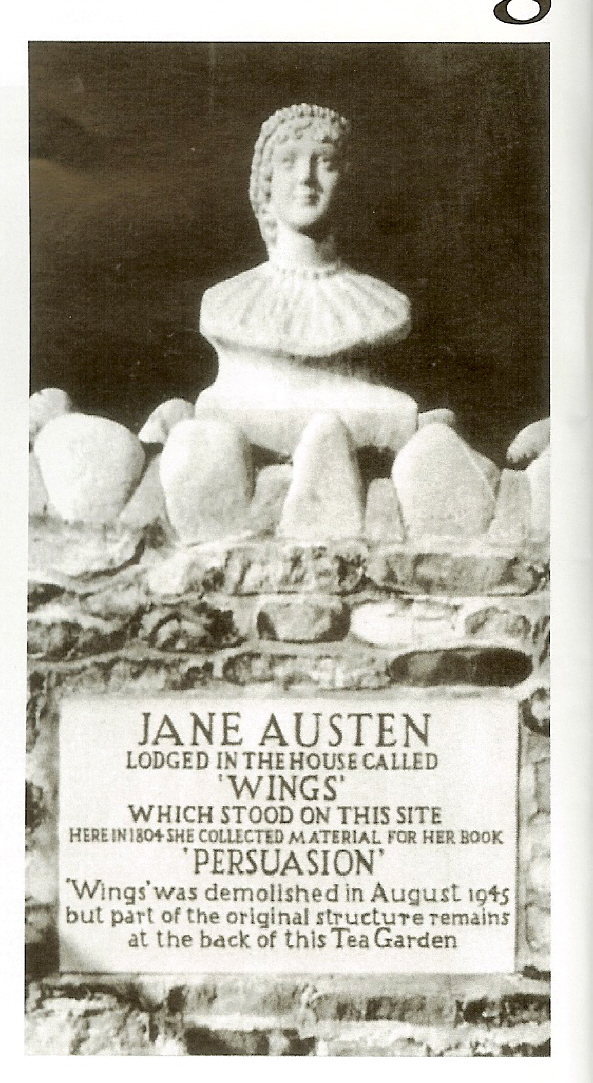
* this news item for instance:  the Austen statue in Lyme Regis  [where I genuflected and then burst into tears] has disappeared during renovation work and no one seems to know where it might be – so if any of you out there may have inadvertently taken off with it , you are to contact Maggie Lane at JARW [in confidence of course]  – and this article from March 2010, “Have you Seen Jane Austen’s Head?”  [unfortunately my picture of said head is on a slide]

[Image from JARW Magazine, No. 46, p.4]

************

This year the 200th anniversary of Elizabeth Gaskell’s birth is being celebrated ~  here are a few links to follow the festivities – if you are in the Manchester area, there is a lot to choose from:

***********

Amanda Vickery, author of A Gentleman’s Daughter and Behind Closed Doors, can be heard at BBC4 [just seven days left!] on “Wicked Women” – Voices from the Old Bailey.  The upcoming radio piece on July 29 is on the voices of the children who founds themselves in court.  Click here for Ms. Vickery’s website to keep current on her speaking schedule.

*****************

The Sotheby’s auction houses have been running amok with letters, cookery and decorative arts items selling like they were going two-for-one – here are just a few for browsing and drooling:

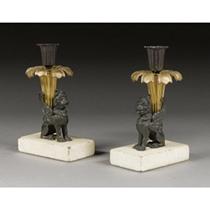
Regency Gilt-Bronze Candlesticks – £2000

************

And if you are really into your laundry and while scrubbing and folding and ironing you care to give a thought to how it used to be done, the fabulous website Old & Interesting has a new post on the History of Starching Fabric – now what would Henry Tilney have to say about starching muslin…?

*************

The Jane Austen Centre’s website is a treasure trove of all things Jane – their online Magazine includes constantly updated articles on fashion, recipes, history, book reviews [yours truly was just honored to be asked to publish my review of Jennifer Forest’s Jane Austen’s Sewing Box], biographies, craft projects and the best of all, from the pen of Mags of Austenblog,  There Must be Murder, a 12-part novella!

************

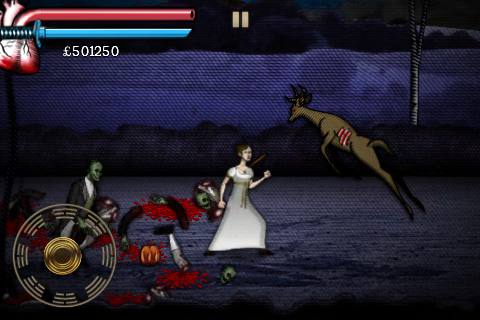
There seems to be an iphone game of P&P and Zombies – but I cannot handle this at all – this is one application my iphone will have to live without – back to the basics for me, a la Austenprose’s efforts to save us all…

[Posted by Deb]


Austen Literary History & Criticism · Jane Austen · Regency England

Jane Austen, Humphry Repton & The Pierpont Morgan

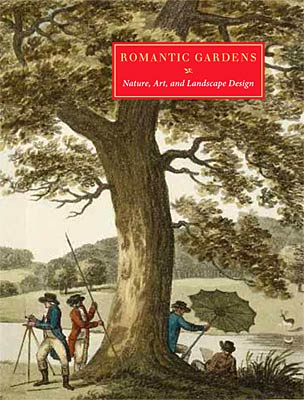
A post to merely to remind you that the exhibition at the Pierpont Morgan Library & Museum on Romantic Gardens: Nature, Art, and Landscape Design will be there only until August 29, 2010:

Scenic vistas, winding paths, bucolic meadows, and rustic retreats suitable for solitary contemplation are just a few of the alluring naturalistic features of gardens created in the Romantic spirit. Landscape designers of the Romantic era sought to express the inherent beauty of nature in opposition to the strictly symmetrical, formal gardens favored by aristocrats of the old regime.
The Romantics looked to nature as a liberating force, a source of sensual pleasure, moral instruction, religious insight, and artistic inspiration. Eloquent exponents of these ideals, they extolled the mystical powers of nature and argued for more sympathetic styles of garden design in books, manuscripts, and drawings, now regarded as core documents of the Romantic Movement. Their cult of inner beauty and their view of the outside world dominated European thought during the late eighteenth and early nineteenth centuries.
 [from the Morgan website; the Catalogue of the exhibition is available here] 

******************

Jane Austen, as her brother Henry Austen writes in his Biographical Notice [included in the Northanger Abbey and Persuasion edition of 1819]:

“was a warm and judicious admirer of landscape, both in nature and on canvass.  At a very early age she was enamoured of Gilpin on the Picturesque; and she seldom changed her opinions either on books or men.”  

 And so just how did Austen express her opinions on these matters?

From Northanger Abbey, ch. 14: 

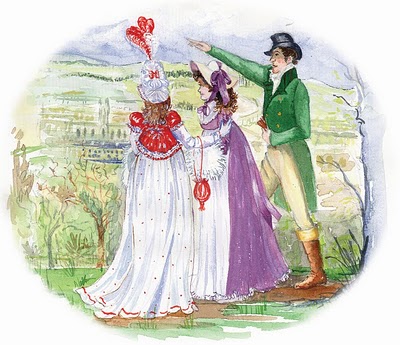
Jane Odiwe's Beechen Cliff

They were viewing the country with the eyes of persons accustomed to drawing, and decided on its capability of being formed into pictures, with all the eagerness of real taste. Here Catherine was quite lost. She knew nothing of drawing — nothing of taste… she confessed and lamented her want of knowledge, declared that she would give anything in the world to be able to draw; and a lecture on the picturesque immediately followed, in which his instructions were so clear that she soon began to see beauty in everything admired by him, and her attention was so earnest that he became perfectly satisfied of her having a great deal of natural taste. He talked of foregrounds, distances, and second distances — side–screens and perspectives — lights and shades; and Catherine was so hopeful a scholar that when they gained the top of Beechen Cliff, she voluntarily rejected the whole city of Bath as unworthy to make part of a landscape. Delighted with her progress, and fearful of wearying her with too much wisdom at once, Henry suffered the subject to decline, and by an easy transition from a piece of rocky fragment and the withered oak which he had placed near its summit, to oaks in general, to forests, the enclosure of them, waste lands, crown lands and government, he shortly found himself arrived at politics; and from politics, it was an easy step to silence….   

[The lovely watercolor of Henry, Miss Tilney and Catherine is from Jane Odiwe’s post on Beechen Cliff ]

********************

Edward Ferrars in Sense & Sensibility, ch. 18:

“You must not inquire too far, Marianne — remember, I have no knowledge in the picturesque, and I shall offend you by my ignorance and want of taste, if we come to particulars. I shall call hills steep, which ought to be bold! surfaces strange and uncouth, which ought to be irregular and rugged; and distant objects out of sight, which ought only to be indistinct through the soft medium of a hazy atmosphere. You must be satisfied with such admiration as I can honestly give. I call it a very fine country — the hills are steep, the woods seem full of fine timber, and the valley looks comfortable and snug — with rich meadows and several neat farm houses scattered here and there. It exactly answers my idea of a fine country, because it unites beauty with utility — and I dare say it is a picturesque one too, because you admire it; I can easily believe it to be full of rocks and promontories, grey moss and brush wood, but these are all lost on me. I know nothing of the picturesque.” …    I like a fine prospect, but not on picturesque principles. I do not like crooked, twisted, blasted trees. I admire them much more if they are tall, straight and flourishing. I do not like ruined, tattered cottages. I am not fond of nettles, or thistles, or heath blossoms. I have more pleasure in a snug farm-house than a watch-tower — and a troop of tidy, happy villagers please me better than the finest banditti in the world.”   

[I love this passage from Sense & Sensibility.  Edward is bantering with Marianne, and one sees here a relaxed and humorous Edward – he is comfortable with Marianne and so much more himself – he is more stilted and uncomfortable with Elinor because of the feelings he has for her – this passage has always given me hope of the real Edward when the obstacle of Lucy is removed from the equation – and thankfully she is!]…

************

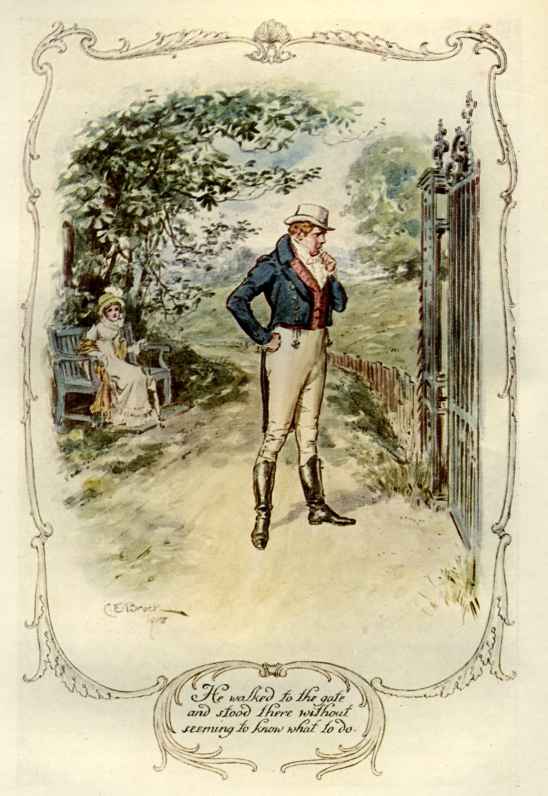
And let’s not leave out Mr. Rushworth and his efforts to “improve” Sotherton!  Mansfield Park, ch. 6: [image from Molland’s]

Mr. Rushworth at the gate at Sotherton

He [Mr. Rushworth] had been visiting a friend in the neighbouring county, and that friend having recently had his grounds laid out by an improver, Mr. Rushworth was returned with his head full of the subject, and very eager to be improving his own place in the same way; and though not saying much to the purpose, could talk of nothing else. The subject had been already handled in the drawing–room; it was revived in the dining–parlour…

 “I wish you could see Compton,” said he; “it is the most complete thing! I never saw a place so altered in my life. I told Smith I did not know where I was. The approach now, is one of the finest things in the country: you see the house in the most surprising manner. I declare, when I got back to Sotherton yesterday, it looked like a prison— quite a dismal old prison.”

“Oh, for shame!” cried Mrs. Norris. “A prison indeed? Sotherton Court is the noblest old place in the world.”

“It wants improvement, ma’am, beyond anything. I never saw a place that wanted so much improvement in my life; and it is so forlorn that I do not know what can be done with it…I must try to do something with it,” said Mr. Rushworth, “but I do not know what. I hope I shall have some good friend to help me.”

“Your best friend upon such an occasion,” said Miss Bertram calmly, “would be Mr. Repton, I imagine.”

“That is what I was thinking of. As he has done so well by Smith, I think I had better have him at once. His terms are five guineas a day.”  …

After a short interruption Mr. Rushworth began again. “Smith’s place is the admiration of all the country; and it was a mere nothing before Repton took it in hand. I think I shall have Repton.”

“Mr. Rushworth,” said Lady Bertram, “if I were you, I would have a very pretty shrubbery. One likes to get out into a shrubbery in fine weather.” …

… Mr. Rushworth, however, though not usually a great talker, had still more to say on the subject next his heart. “Smith has not much above a hundred acres altogether in his grounds, which is little enough, and makes it more surprising that the place can have been so improved. Now, at Sotherton we have a good seven hundred, without reckoning the water meadows; so that I think, if so much could be done at Compton, we need not despair. There have been two or three fine old trees cut down, that grew too near the house, and it opens the prospect amazingly, which makes me think that Repton, or anybody of that sort, would certainly have the avenue at Sotherton down: the avenue that leads from the west front to the top of the hill, you know,”

Fanny, who was sitting on the other side of Edmund, exactly opposite Miss Crawford, and who had been attentively listening, now looked at him, and said in a low voice—

“Cut down an avenue! What a pity! Does it not make you think of Cowper? ‘Ye fallen avenues, once more I mourn your fate unmerited.’”

He smiled as he answered, “I am afraid the avenue stands a bad chance, Fanny.”

************ 

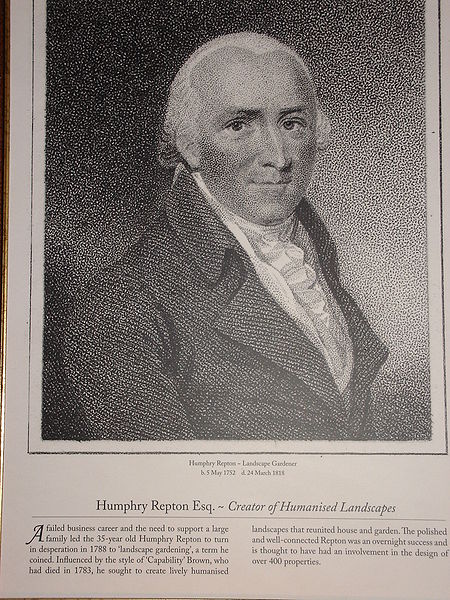
[Humphry Repton, from Wikipedia]

The exhibit at the Morgan includes two of Humphry Repton’s Red Books.  Repton [1752-1818] was the leading landscape architect of his day, as Mr. Rushworth so notes – his Red Books were the compilations of his observations in words and watercolors of his landscape plans for a client’s property, and included the use of overlays for a before-and-after scenario.  – The Morgan has made available an online page-by-page view of two of these books:  The Hatchlands and Ferney Hall. 

Hatchlands Red Book
Ferney Hall Red Book

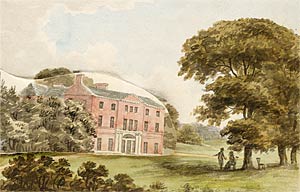
and a view of Hatchlands Park today [Ferney Hall was replaced in 1856 with a Victorian mansion and has recently been restored]


[A short note here also on William Gilpin: please visit Austenonly where Julie has posted a recent article for the Austenprose P&P event on Gilpin and Austen that covers this subject quite nicely!]

Gilpin first introduced the term “picturesque” 1782 in his Observations on the River Wye, and Several Parts of South Wales, etc. Relative Chiefly to Picturesque Beauty; made in the Summer of the Year 1770, a book that outlined for travelers in England a way to view the beauties of the country based on his rules of the picturesque.  Austen was very familiar with Gilpin’s writings – as seen above, both Henry Tilney and Edward Ferrars comment on and satirize his theories. And the trip taken by the Gardiners and Elizabeth in Pride & Prejudice closely follows a travelogue set forth by Gilpin, and so to Elizabeth relies on Gilpin to escape a walk with Mr. Darcy and the Bingley sisters:

But Elizabeth, who had not the least inclination to remain with them, laughingly answered, —

   “No, no; stay where you are. You are charmingly grouped, and appear to uncommon advantage. The picturesque would be spoilt by admitting a fourth. Good-bye.”  

[Pride & Prejudice, ch. 10]

*******************

Further Reading: [all Google Books sources are full-text]

 The two must-have books for your Austen Library on Jane Austen and the landscape:

Alistair Duckworth.  The Improvement of the Estate:  A Study Of Jane Austen’s Novels.  Baltimore:  Johns Hopkins U Press, 1971; reprinted in paperback, 1994  –  brilliant 

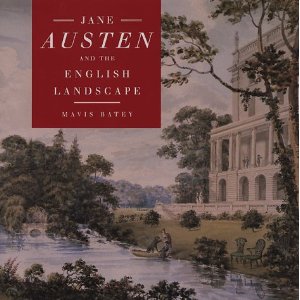
Mavis Batey.  Jane Austen and the English Landscape.  London:  Barn Elms, 1996   –  absolutely lovely!

Humphry Repton:

William Gilpin  and the “Picturesque”:

[Posted by Deb] 

Jane Austen · Regency England

Jane Austen ~ July 18, 1817

[I append here the post I wrote last year on this day – with a few updates as needed]

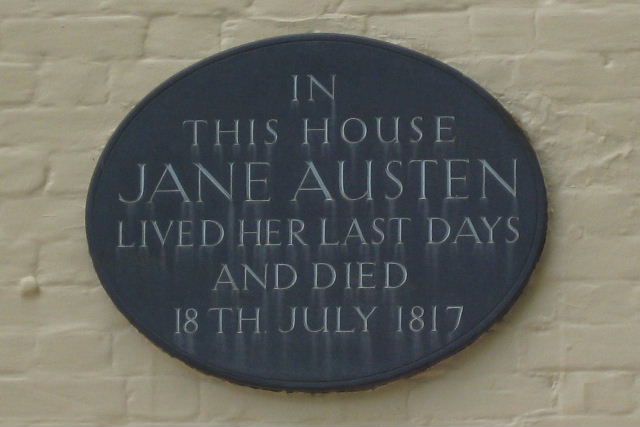
July 18, 1817.  Just a short commemoration on this sad day…

No one said it better than her sister Cassandra who wrote

I have lost a treasure, such a Sister, such a friend as never can have been surpassed,- She was the sun of my life, the gilder of every pleasure, the soother of every sorrow, I had not a thought concealed from her, & it is as if I had lost a part of myself…”

(Letters, ed. by Deidre Le Faye [3rd ed, 1997], From Cassandra to Fanny Knight, 20 July 1817, p. 343; full text of this letter is at the Republic of Pemberley)

There has been much written on Austen’s lingering illness and death; see the article by Sir Zachary Cope published in the British Medical Journal of July 18, 1964, in which he first proposes that Austen suffered from Addison’s disease.  And see also Claire Tomalin’s biography Jane Austen: A life, “Appendix I, “A Note on Jane Austen’s Last Illness” where she suggests that Austen’s symptoms align more with a lymphoma such as Hodgkin’s disease.

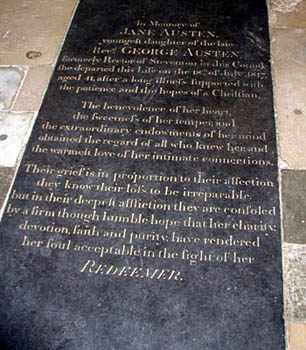
The Gravesite: 

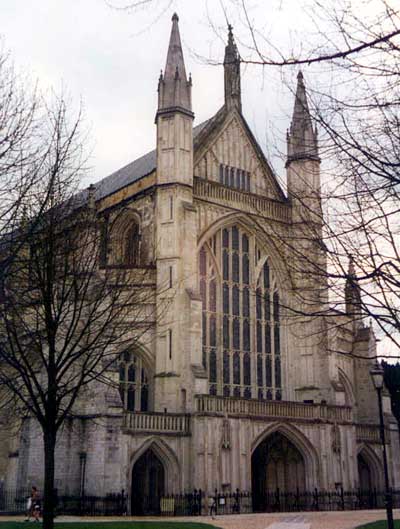
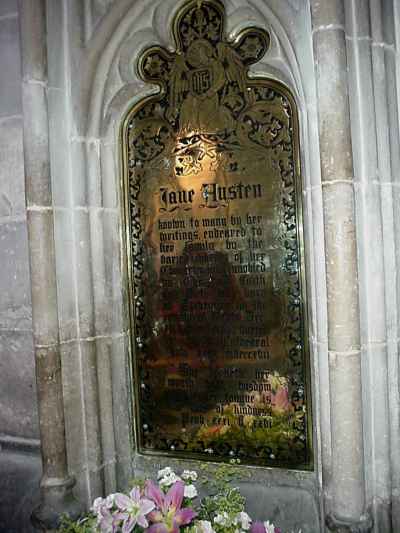
Austen is buried in Winchester Cathedral, where no mention is made of her writing life on her grave:

 It was not until after 1870 that a brass memorial tablet was placed by her nephew James Edward Austen-Leigh on the north wall of the nave, near her grave: it tells the visitor that

Jane Austen

[in part] Known to many by her writings, endeared to her
family by the varied charms of her characters
and ennobled by her Christian faith and piety
was born at Steventon in the County of Hants.
December 16 1775
and buried in the Cathedral
July 18 1817.
“She openeth her mouth with wisdom
and in her tongue is the law of kindness.”

The Obituaries:

David Gilson writes in his article “Obituaries” that there are eleven known published newspaper and periodical obituary notices of Jane Austen: here are a few of them:

  1. Hampshire Chronicle and Courier (vol. 44, no. 2254, July 21, 1817, p.4):  “Winchester, Saturday, July 19th: Died yesterday, in College-street, Miss Jane Austen, youngest daughter of the late Rev. George Austen formerly Rector of Steventon, in this county.”
  2. Hampshire Telegraph and Sussex Chronicle (vol. 18, no. 928, p. 4)…”On Friday last died, Miss Austen, late of Chawton, in this County.”
  3. Courier (July 22, 1817, no. 7744, p. 4), makes the first published admission of Jane Austen’s authorship of the four novels then published: “On the 18th inst. at Winchester, Miss Jane Austen, youngest daughter of the late Rev. George Austen, Rector of Steventon, in Hampshire, and the Authoress of Emma, Mansfield Park, Pride and Prejudice, and Sense and Sensibility.  Her manners were most gentle; her affections ardent; her candor was not to be surpassed, and she lived and died as became a humble Christian.” [A manuscript copy of this notice in Cassandra Austen’s hand exists, as described by B.C. Southam]
  4. The Hampshire Telegraph and Sussex Chronicle published a second notice in its next issue (July 28, 1817, p. 4) to include Austen’s writings.

There are seven other notices extant, stating the same as the above in varying degrees.  The last notice to appear, in the New Monthly Magazine (vol. 8, no. 44, September 1, 1817, p. 173) wrongly gives her father’s name as “Jas” (for James), but describes her as “the ingenious authoress” of the four novels…

[from Gilson’s article “Obituaries”, THE JANE AUSTEN COMPANION [Macmillan 1986], p. 320-1]  

Links to other articles and sources:

Posted by Deb

Austen Literary History & Criticism · Jane Austen · Publishing History

Jane Austen on St. Swithin’s Day

I refer you to my post from July 15th, 2009,  Austen on St. Swithin’s Day – three days before Austen died, she penned her humorous poem “Venta”  – read all about the writing and publishing of the poem, St. Swithin, and the Winchester Races…


[And like last year, our June here in Vermont has been cold and rainy – followed by the grueling heat wave of the last two weeks….!]

Books · Jane Austen · News · Publishing History

Holy Austen, Batman! ~ Marvel’s ‘Sense & Sensibility’

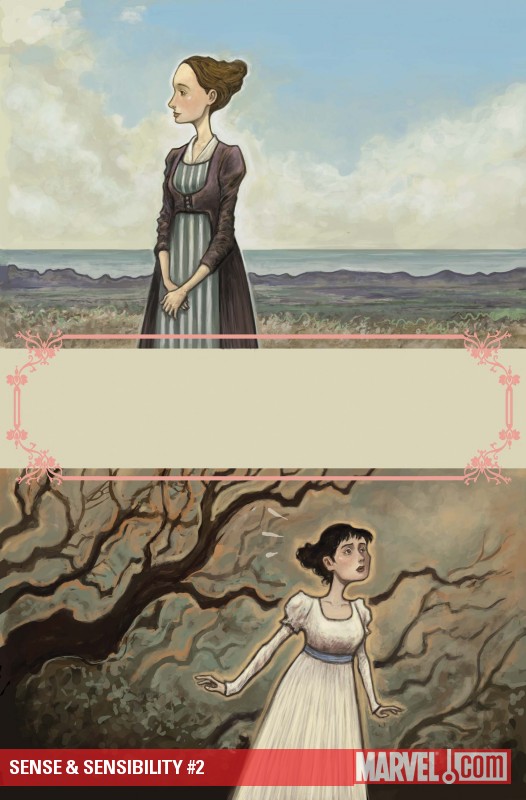
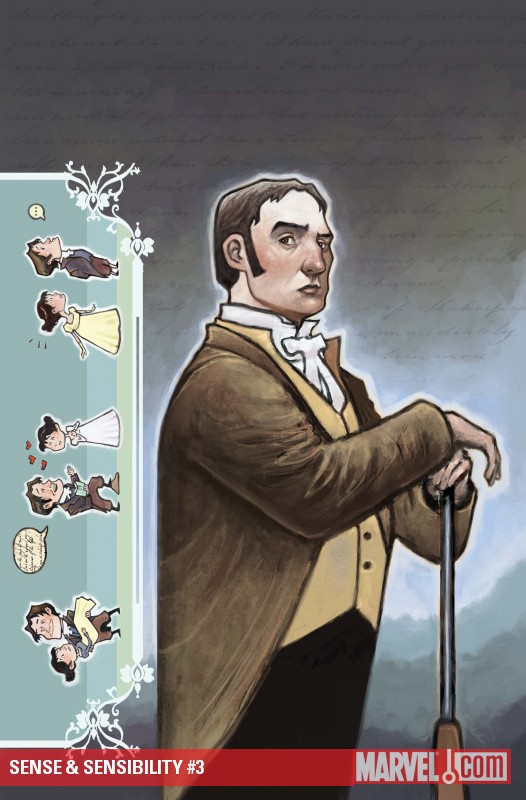
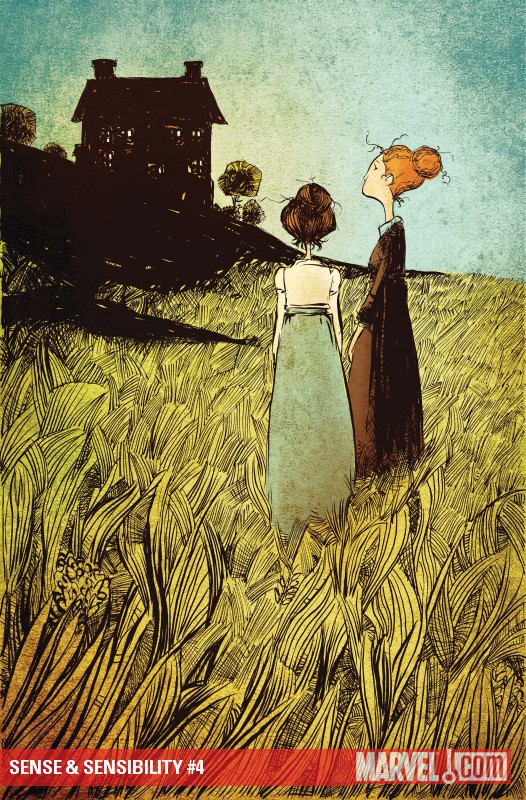
Marvel Comics has done it again – this time with Sense & Sensibility!

Here are the covers for the five issues: go the Marvel Comics website for more information and release dates [May 26 – Sept. 22, 2010]


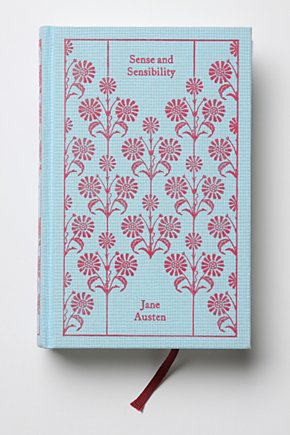
And here’s one other S&S in the shops:    Anthropologie offers this edition of S&S as the latest must-have in their literature collection published by Penguin:

Literature’s great works ditch their stuffy dust jackets for smartly embossed canvas covers. Perfect for replacing well-thumbed favorites or creating a bookshelf piece de resistance.

See Anthropologie.com – also available: Pride & Prejudice, Emma, Jane Eyre, Wuthering Heights, Great Expectations, The Woman in White, and more… click here for the full list] – each about $20.

[See the previous posts on Marvel’s Pride & Prejudice ; #2; #3; #4; #5; and the hardcover edition]

[Posted by Deb]

Book reviews · Books · Jane Austen

Book Review ~ ‘Eugenia’ by Clare Darcy

Eugenia
by Clare Darcy
Walker and Company 1977, Signet 1978
[and other various reprints]

 She had never thought a great deal about being in love before, not being romantically inclined and having read very few of the novels over which other young ladies at Miss Bascom’s had shed luxurious tears; but obviously, she thought, it was quite as uncomfortable a matter as those marbled volumes depicted it as being.                                                                                                          [Eugenia, p. 231]    

Clare Darcy’s Eugenia is a bit of a different confection than the usual Regency Romance.  The Heroine is still the smart, feisty, quick-thinking, in this case tomboy-like young lady, and Our Hero is as expected, tall, dark and handsome, strong and muscular; but there are only rare moments of sword-crossing, none of the “they started off hating each other”  – indeed, this Hero and Heroine are only occasionally found interacting on the page together, and barely ever alone – but it is quite charming all the same…  and thankfully largely lacking the incessant “infant-brat-chit” talk!

We begin in Bath in May of 1811, and Miss Eugenia Liddiard, an orphan since her father’s death three years ago and schooled at the Miss Bascom’s Select Academy for Young Ladies, is finally returning “home” to the Essex seat of her cousin / guardian Lord Chandross.  Lady Chandross, “not a proper guardian”, is to chaperon Eugenia in her first London Season, the goal to marry her off as soon as possible so she, Lady C, may return to to her own dalliances unencumbered.  Eugenia wants none of this – she is practical and not romantic and has definitely made up her mind to propose marriage to her childhood friend Tom Rowntree, brother of her best friend Muffet, so she will no longer be a burdensome project, be able to settle on land adjacent to her former home Coverts in Kent [her “place of belonging” and now in the care of a hands-off elderly clergyman cousin], and to be free to just be, taking no orders from anyone.  

Fortunately for all, characters and readers alike, the traveling chaise bearing Eugenia and her abigail is forestalled at the less than fashionable Kings Head Inn due to a raging storm and washed-out roads, and Eugenia, “who liked new experiences of any sort”, serendipitously runs into her cousin “Gerry” at the Inn, and the adventure begins.  By page nine we have met our Hero, have a full understanding of the the Heroine’s character, beauty, love of adventure, and quite wild imagination with a penchant for concocting very tall tales when the occasion calls for it.  

For “Gerry” is not Eugenia’s wild and reckless cousin Gerry at all, but the dead-ringer “Richard” [to wit, Jane Austen may not approve but he makes a fine Hero just the same!].  Richard is yet another cousin [isn’t is striking How Many Cousins there are in these Regency novels?!], also forestalled at the Inn and suffering from the lingering effects of a fever – and alas! he collapses in a dead faint in the Inn’s coffeehouse, Eugenia comes to the rescue and discovers the truth of his identity – he is the “by-blow” of her long-dead uncle Charles, thus not the true legitimate male heir to Coverts because he has only hearsay evidence, no written proof, of his parent’s marriage. Orphaned shortly after birth and raised by a clergyman in Ireland, Richard has returned to England to prove his birthright; Eugenia schemes for him to pass himself off as his look-alike cousin and come to her guardian’s estate to recuperate, offering her help to search the ecclesiastical records for the hoped-for marriage registry.  

 But, as all best-laid plans must indeed go awry or we wouldn’t have a tale to tell, real cousin Gerry is being sought by the Bow Street Runners for Highway Robbery and Murder – Richard must go into hiding until Gerry can be captured or he risks the gallows…

… so… her wondrous and fertile imagination madly at work, Eugenia sets up a new plan [she calls it “acting, not lying” ] – with much disguise, masquerading, outrageous fabrications to family and friends, and many a character entering her play – her old nurse Nan and her old groom Haggart to whom she confides Richard’s secrets; Lady Brassbororough [!], Lady B, the former “scarlet woman” famous for her stage past and various liaisons among the the rich of the ton, now a rather large woman covered in emeralds and diamonds, with a pug named Wellington who bites on command, with a resource of ready swears to send any man staggering into a corner, and who thankfully, in the end, saves the day.  

I’ll tell no more – but Miss Darcy, like Heyer before her in False Colours, gives us an almost gentle tale of mistaken identity, complete with Regency cant, French sayings, and an abundance of Regency references [Stulz the tailor, the 1697 play “The Deceiver Deceived“, Hessian soup, Fanchon, ices at Gunter’s  [though it is misnamed Gunther’s – her mistake or a typo?] are just a few examples … there are a good many more with the fun of looking them up!]; the two bumbling Bow Street Runners, Baker and Cartwright [perfect name for a TV show!]; dance requests and marriage proposals from all the wrong people; the “highest kick of fashion” described; the settings of Town and Country knowingly depicted; the ever-present cadre of servants, who keep “up a dignified pretence, for the sake of [their] positions, of being deaf and blind as well as quite uninterested” [p. 242]; the requisite pistols and grown men brawling; a charming and defiant Heroine who unromantic as she believes herself to be discovers “the joy of knowing love” and the pain of not having it returned; and finally The Hero, more Fitzwilliam Darcy-like  – aloof and composed with a quiet, impenetrable reserve and decisive manner – and thankfully knows how to perform the proper Embraces and Crushing Kisses when so called upon.  

 Lady Chandross, “with her usual air of fashionable indifference“, sums it all up nicely with “so it seems that everything has turned out for the best in the end, quite in the manner of one of those dull little comedies where everyone reforms or is suitably paired off just before the curtain falls”  [p. 224] – Miss Darcy may laugh so at her own little creation, but so do we, and again, though this is not Heyer, it is great fun – put it on your summer reading list!  

3 1/2 full inkwells out of 5  

[Posted by Deb]