Jane Austen

July 18, 1817 ~ In Memoriam

[I append here the post I wrote last year on this day – with a few updates as needed]

July 18, 1817.  Just a short commemoration on this sad day…

No one said it better than her sister Cassandra who wrote

have lost a treasure, such a Sister, such a friend as never can have been surpassed,- She was the sun of my life, the gilder of every pleasure, the soother of every sorrow, I had not a thought concealed from her, & it is as if I had lost a part of myself…”

(Letters, ed. by Deidre Le Faye [3rd ed, 1997], From Cassandra to Fanny Knight, 20 July 1817, p. 343; full text of this letter is at the Republic of Pemberley)

There has been much written on Austen’s lingering illness and death; see the article by Sir Zachary Cope published in the British Medical Journal of July 18, 1964, in which he first proposes that Austen suffered from Addison’s disease.  And see also Claire Tomalin’s biography Jane Austen: A life, “Appendix I, “A Note on Jane Austen’s Last Illness” where she suggests that Austen’s symptoms align more with a lymphoma such as Hodgkin’s disease.

The Gravesite: 

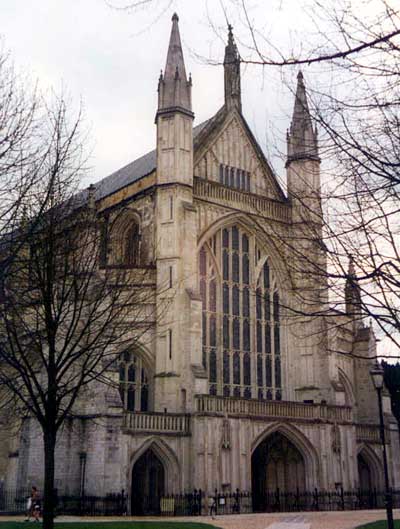
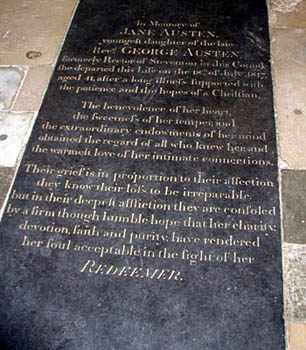
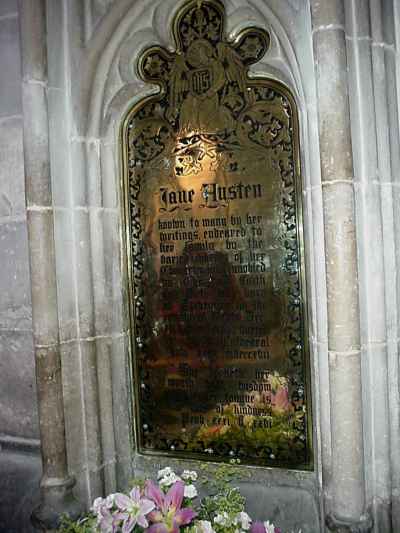
Austen is buried in Winchester Cathedral, where no mention is made of her writing life on her grave:

 It was not until after 1870 that a brass memorial tablet was placed by her nephew James Edward Austen-Leigh on the north wall of the nave, near her grave: it tells the visitor that

Jane Austen

[in part] Known to many by her writings, endeared to her
family by the varied charms of her characters
and ennobled by her Christian faith and piety
was born at Steventon in the County of Hants.
December 16 1775
and buried in the Cathedral
July 18 1817.
“She openeth her mouth with wisdom
and in her tongue is the law of kindness.”

The Obituaries:

David Gilson writes in his article “Obituaries” that there are eleven known published newspaper and periodical obituary notices of Jane Austen: here are a few of them:

  1. Hampshire Chronicle and Courier (vol. 44, no. 2254, July 21, 1817, p.4):  “Winchester, Saturday, July 19th: Died yesterday, in College-street, Miss Jane Austen, youngest daughter of the late Rev. George Austen formerly Rector of Steventon, in this county.”
  2. Hampshire Telegraph and Sussex Chronicle (vol. 18, no. 928, p. 4)…”On Friday last died, Miss Austen, late of Chawton, in this County.”
  3. Courier (July 22, 1817, no. 7744, p. 4), makes the first published admission of Jane Austen’s authorship of the four novels then published: “On the 18th inst. at Winchester, Miss Jane Austen, youngest daughter of the late Rev. George Austen, Rector of Steventon, in Hampshire, and the Authoress of Emma, Mansfield Park, Pride and Prejudice, and Sense and Sensibility.  Her manners were most gentle; her affections ardent; her candor was not to be surpassed, and she lived and died as became a humble Christian.” [A manuscript copy of this notice in Cassandra Austen’s hand exists, as described by B.C. Southam]
  4. The Hampshire Telegraph and Sussex Chronicle published a second notice in its next issue (July 28, 1817, p. 4) to include Austen’s writings.

There are seven other notices extant, stating the same as the above in varying degrees.  The last notice to appear, in the New Monthly Magazine (vol. 8, no. 44, September 1, 1817, p. 173) wrongly gives her father’s name as “Jas” (for James), but describes her as “the ingenious authoress” of the four novels…

[from Gilson’s article “Obituaries”, THE JANE AUSTEN COMPANION [Macmillan 1986], p. 320-1]  

Links to other articles and sources:

Posted by Deb

Austen Literary History & Criticism · Jane Austen · Publishing History

Austen on St. Swithin’s Day

On July 15, 1817, three days before she died, Jane Austen wrote several lines of comic verse, dictating them to her sister Cassandra.  Henry Austen refers to these verses in his biographical sketch: “The day preceding her death [though she died on July 18], she composed some stanzas replete with fancy and vigour.” [Biographical Notice]

Venta

[Written at Winchester on Tuesday the 15th of July 1817]

When Winchester races first took their beginning
It is said the good people forgot their old Saint
Not applying at all for the leave of St. Swithin
And that William of Wykham’s approval was faint.

The races however were fix’d and determin’d
The company met & the weather was charming
The Lords & the Ladies were sattin’d and ermin’d
And nobody saw any future alarming.– 

But when the old Saint was inform’d of these doings
He made but one spring from his shrine to the roof
Of the Palace which now lies so sadly in ruins
And then he address’d them all standing aloof. 

Oh subjects rebellious,  Oh Venta depraved
When once we are buried you think we are dead
But behold me Immortal. –  By vice you’re enslaved
You have sinn’d & must suffer. – Then further he said 

These races & revels & dissolute measures
With which you’re debasing a neighboring Plain
Let them stand–you shall meet with your curse in your pleasures
Set off for your course, I’ll pursue with my rain.

Ye cannot but know my command in July
Henceforward I’ll triumph in shewing my powers
Shift your race as you will it shall never be dry
The curse upon Venta is July in showers.

[text from Minor Works, ed. Chapman, Oxford, 1988 [revised edition]

*********************************

saint swithin 

St. Swithin [sometimes written as Swithun] was the Bishop of Winchester in the 9th century.  Legend has it that Swithin requested upon his death to be buried in the churchyard, but his remains were later brought into the church on July 15, 971.  The Saint’s obvious displeasure with this move resulted in a hard rain for forty days and he was thus removed again to the outside [the location of this grave was at the Old Minster, now covered by Winchester Cathedral – there is some authority for the belief that Swithin’s body parts may be buried in various places…] – but these mysterious rain happenings gave England the still-held weather prediction that:

St Swithun’s day if thou dost rain
For forty days it will remain
St Swithun’s day if thou be fair
 For forty days ’twill rain na mair 

The Winchester horse races were run on July 15th at “the neighboring plain” of Worthy Down.  Austen in a light-hearted moment composed these lines to  “Venta” [ Venta was the name given to Winchester during Roman Britain, “Venta Belgarum”, which means market or meeting place – it is also the name of the University of Winchester’s Alumni Magazine] – she was pointing out the incongruity of the races taking place on a Saint’s Day and his punishment for the “revels & dissolute measures.”

The appearance of these verses is an interesting side story in the history of publishing Austen’s works.  After Henry’s reference to them in his Biographical Notice, his comment was deleted from the 1833 edition.  James Edward Austen-Leigh in his 1870 Memoir makes no mention of them, nor in his second edition.  The fifth Earl Stanhope, an early collector of Austen’s works, had tried unsuccessfully to find out what these “stanzas replete with fancy and vigour” were actually about.  His efforts prompted Austen’s niece Caroline to write:

Nobody felt any curiosity about them then – but see what it is to have a growing posthumous reputation! we cannot keep anything to ourselves now it seems…. Tho’ there are no reasons ethical or orthodox against the publication of these stanzas, there are reasons of taste – I never thought there was much of a point to them – they were good enough for a passing thought, but if she had lived she would probably soon have torn them up – however, there is a much stronger objection to their being inserted in any memoir, than want of literary merit – If put in at all they must have been introduced as the latest working of her mind – Till a few hours before she died, she had been feeling much better, & there was hope of amendment at least, if not a recovery – but the joke about the dead Saint, & the Winchester races, all jumbled up together, would read badly as amongst the few details given, of the closing scene.  [Le Faye, p. 89-90]

So Austen’s last words fell to the axe of Henry’s protective spirit and the later Victorian sensibilities.  The poem was first published in 1906 in the Hubback’s Jane Austen’s Sailor Brothers.   Chapman in his notes to the Minor Works, questions at first if they are hers – that is until he realizes he was overlooking the clear evidence in Henry Austen’s deleted comment and concludes “that no doubt settles the question.” [Chapman, MW, p. 451] 

 There are actually two manuscripts, the copy in Cassandra’s hand as dictated by Austen [owned by the Carpenter family], where the lines “When once we are buried – but behold me Immortal” are underlined, likely by Cassandra at a later date, and a second copy written out by James Edward Austen-Leigh, now in the Berg Collection at the NY Public Library, and the manuscript used in Chapman’s edition.  There were a few changes to the text, especially with the use of the word “dead”, where the manuscript reads “gone” – this does not rhyme with the “said”, and again conjecture is the Cassandra could not write what Jane actually spoke.

For me, I am heartened that in her last few days, Austen was able to rally her spirit to write yet another of her light verses, reminiscent of her juvenilia, even in the face of what she knew had to be the fast-approaching end of her life.

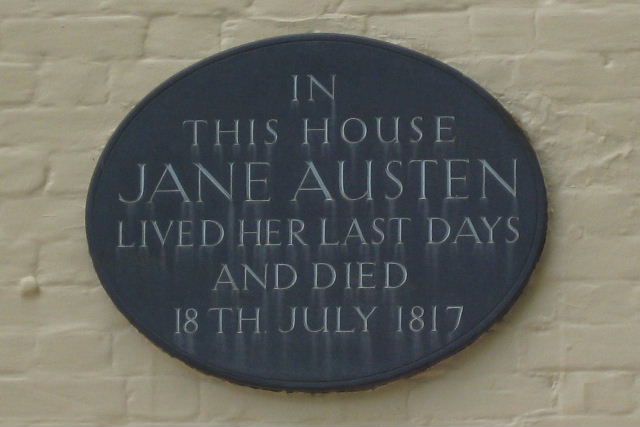
Winchester House college st

Further Reading:

  1. Chapman, R.W.  Minor Works.  Oxford University Press, 1988 [c1954], pp. 450-452.
  2. Doody, Margaret Ann, ed.  Catharine and Other Writings.  Oxford University Press, 1998, pp. xxi-xxiii. 
  3. Le Faye, Deirdre.  “Jane Austen’s Verses and Lord Stanhope’s Disappointment,” Book Collector, Vol. 37, No.1  (Spring 1988), pp. 86-91.
  4. Modert, Jo., ed.  Jane Austen’s Manuscript Letters in Facsimile.  Southern Illinois University Press, 1990. pp. xxiii- xxiv.]
  5. see also Joanna Waugh’s post on on St. Swithin, Jane Austen: Sleeping with the Saints

[image of St. Swithin from Wikipedia]

*[today in Vermont it is FINALLY a bright and sunny day, after what has felt like forty days of rain – so hopefully this bodes well for an end to our soggy-summer!]

Posted by Deb

Jane Austen · Movies · News

BBC’s ‘Emma’ ~ trailer now online

This just in from Janeite Mae – the BBC has a trailer for the new Emma now available online for viewing:  go to the BBC here, and scroll through the carousel of new productions and click on “Emma” for a few quite lovely scenes [check out all the others as well – quite the feast! – this carousel idea is amazing!] 

set272

Thanks Mae for the heads-up! 

Posted by Deb

Jane Austen · Literature · Women Writers

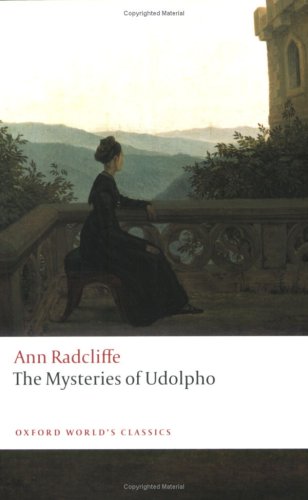
Ann Radcliffe ~ July 9, 1764

You are cordially invited to visit my Bygone Books blog for a short bio – bibliography on Ann Radcliffe, born today, July 9, 1764.

cover mysteries udolpho

Posted by Deb

Books · Jane Austen · News

Holy Austen, Batman! ~ Pride & Prejudice # 4

News Alert!  Issue 4 to be released today July 8, 2009!

marvel P&P 4 large

  • COVER BY: Sonny Liew
  • WRITER: Nancy Butler
  • PENCILS: Hugo Petrus
  • INKS: Hugo Petrus
  • COLORED BY: Aubrey Sitterson|Aubrey Sitterson
  • LETTERED BY: Dave Sharpe

******************************

NOTE:  a hardcover edition of the 5 issues will be released later this year on November 11, 2009!!

marvel P&P hardcover

And here is a sneak preview of the cover for Issue # 5, to be released in August:

marvel P&P 5

Posted by Deb

Book reviews · Fashion & Costume · Jane Austen · Regency England · Social Life & Customs

Book Review ~ Jane Austen’s Sewing Box

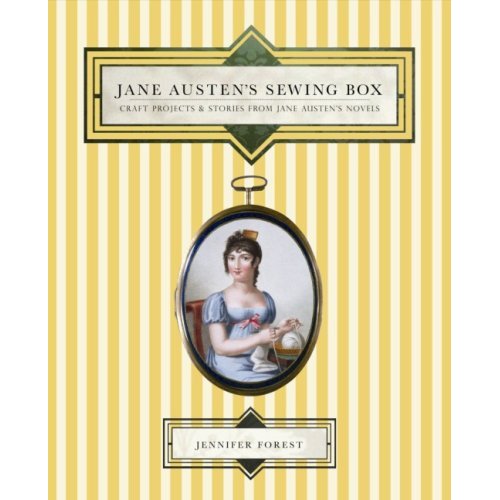
book cover jane austens sewing boxJane Austen’s Sewing Box: Craft Projects & Stories from Jane Austen’s Novels. 
by Jennifer Forest.  Murdoch Books Australia, 2009 

ISBN:  9781741963748, paperback, 224 pages.


 This is a lovely, sumptuous book.  When it first arrived, I did a quick skim – it is filled with photographs, decorated papers, fashion plates, quotes from Austen, and a good number of handiwork projects – hmmm, I thought, maybe one of those books that just looks nice but is of little substance – a coffee table [albeit a small one] book you look at once and then relegate it to collect dust in the “parlor” –  But on further study I found within these 224 pages a wealth of information – a brief but amazingly thorough introductory commentary on Regency historic and social life, the world of “women’s work” in Austen’s time, and the references to Austen’s many mentions of these real-life activities in her novels and letters.

 Ms. Forest has a background in history and cultural heritage, and combining this knowledge, her love of Austen and a “passion for fabric arts and crafts,” she has given us a treasure of a book.  With a starting point of finding Austen’s references to handi- and fancy work, Forest puts these quotes in their historical context, explains the meaning and use of the piece, and then provides instructions for each project – each of varying skill level, each a different task – there is knitting, sewing, embroidery, netting, paperwork, glasswork, and canvas-work, a total of eighteen different projects – from a letter case, linen cravat, fur tippet, to a pin cushion, reticule, bonnet and muslin cap – all mentioned by Jane Austen, and here lovingly replicated, with photographs of Regency era decorative arts and Ackermann’s fashion plates interspersed throughout. 

Best to show an example, so I will choose the huswife [page 100ff]  [ “the huswife was a small fabric case with pockets to hold all those tools for sewing and needlework – scissors, tape measure, thread, pins, and pin cushion”( page 104)]: 

This is a sewing task for beginners, with two pages of photographs of the finished piece, a short history of the huswife and its uses, a quote [all the quotes are written in script] from Emma where Austen uses the term [there is also a second quote from Sense & Sensibility spoken by Anne Steele] – here Miss Bates has misplaced a letter from Jane Fairfax that she later reads to Emma:

 “Thank you. You are so kind!” replied the happily deceived aunt, while eagerly hunting for the letter. “Oh here it is.  I was sure it could not be far off, but I had put my huswife on it, you see, and without being aware, and so it was hid.”  [page 104, quoting Emma]

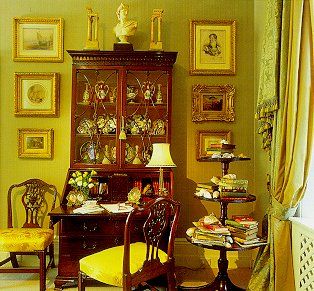
 This is followed by a full page of blue decorated paper with a part of the quote, a full page fashion plate from Ackermann’s, and a full page of an art reproduction depicting a woman at her fancy work, then a full page photograph of a detail from a piece of Regency furniture [all photographs are from the Johnston Collection *], and then three pages of project instructions with black and white drawings, and a final photograph of a furniture detail.  This format and sequence is followed for each of the eighteen projects, ending with a list of suppliers, references and an index.

johnston collection desk
from The Johnston Collection


All these Austen quotes, taken out of context, are quite a wonderful discovery! – they can so easily be passed over in the reading – what indeed IS a huswife? or a tippet? [“Jane, dear Jane, where are you? here is your tippet.  Mrs. Weston begs you to put on your tippet.”]  Or a transparency? [“and its greatest elegancies and ornaments were a faded footstool of Julia’s work, too ill done for the drawing room, three transparencies, made in a rage for transparencies…”] or a reticule? [“…a letter which she [Mrs. Elton] had apparently been reading aloud to Miss Fairfax, and return it into the purple and gold reticule by her side.”]  or “netting” for that matter [“They all paint tables, cover screens and net purses” says Charles Bingley]; and then of course Lady Bertram’s carpet-work and “yards of fringe!” 

This book opened up a whole new awareness of Austen’s writing in the NOW – her knowing what her readers would glean from these almost off-hand references [as in Mrs. Elton’s purple and gold reticule, “expensive colours that Austen possibly chose to sketch her character’s pretensions to grandeur, associated as they were with royalty and luxury.” [page 182] – and as always one is awed by Austen’s use of such fine details to delineate character.

fashion plate yellow dress
from Costumes.org

 The book is by no means comprehensive on the subject – but there are so many tidbits of Regency social life and customs, coupled with Austen’s words – I found in the reading an “oasis of calm”, a slowing down, a return to a time of sewing for the poor, or making your brother’s shirts (done in private), and your embroidery and fancy work and painting put on public display to show yourself as “an accomplished woman” [a la Mr. Darcy] – and the exquisite paper and decoration, the furniture details, and the fashion illustrations all combine to create this time-warp, invoking the Regency era and “its enthusiastic appreciation of design in all forms – dress, architecture, interiors, furniture, wallpaper and fabric” [page 17] – the whole sphere is beautifully presented in these pages and makes this a wonderful addition to your Jane Austen collection and a great starting point for your creative endeavors! 

5 full inkwells [out of 5]

* The Johnston Collection is “a Fine and Decorative Arts Museum, Gallery and Reference Library in East Melbourne, Australia.  It is no ordinary museum with roped off exhibits, but presents an astonishing and diverse collection arranged in the English Country House Style.”  Visit their website for the history, gallery exhibits, and a sampling of the treasures in the collection.

Posted by Deb

Books · Jane Austen · News

New Book ~ Dancing with Mr. Darcy [short stories]

book cover dancing mr darcyThe anthology of the winning entries in the Jane Austen Short Story contest hosted by the Chawton House Library will be published in October 2009 by Honno Press. 
The intention is to publish the very best short fiction inspired by Jane Austen or Chawton House and the Chair of Judges is Sarah Waters, bestselling author of Tipping the Velvet and Fingersmith, who will select a winner and two runners-up. The winners will be announced at the Jane Austen Society Conference at Chawton on July 18.

The anthology will contain introductions from both Sarah Waters, and Rebecca Smith, the great great great great great niece of Jane Austen. [from the website]

For more information go to Honno Press: Discovering Women Writers of Wales [Honno is an independent co-operative press run by women and committed to bringing you the best in Welsh women’s writing.]

Posted by Deb

Postscript [July 6, 2009]:  the winner of the short story contest has been announced, along with two runners-up and seventeen entrants whose stories will be published in the above anthology.  Prizes will be presented on July 18th:

  • Winner: Victoria Owens
  • Runner up: Kirsty Mitchell
  • Runner up: Elsa Solender

Works selected for publication:

  • Andrea Watsmore
  • Clair Humphries
  • Elaine Grotefeld
  • Elizabeth Hopkinson
  • Esther Belamy
  • Felicity Cowie
  • Hilary Spiers
  • Jacqui Hazell
  • Lane Ashfeldt
  • Mary Howell
  • Nancy Saunders
  • Penelope Randall
  • Rebecca Cordingly
  • Stephanie Shields
  • Stephanie Tillotson
  • Suzy Hughes

Congratulations one and all!

Posted by Deb

Book reviews · Books · Fashion & Costume · Jane Austen · Regency England · Social Life & Customs

Interview with Jennifer Forest, author of “Jane Austen’s Sewing Box”

book cover jane austens sewing box


Today we have Jennifer Forest joining us to share her thoughts on her new book Jane Austen’s Sewing Box: Craft Projects & Stories from Jane Austen’s Novels [NSW, Australia: Murdoch Books, 2009]:

What inspired Jane Austen’s Sewing Box? 

I love Jane Austen, history and craft so it seemed quite natural for me to join these  interests.  A few years ago, re-reading Jane Austen’s novels I noticed that she makes quite a few references to craft including sewing, knotting, painting and netting. It spurred me on to start digging around to find out what the crafts were that Jane Austen’s women were doing.  The Regency left a strong design legacy and there are many examples of the beautiful craft worked by women during this great period for arts and craft. 

What types of projects are in the book?  

Just as Jane Austen includes a range of craft references in her novels, there are also a range of projects in the book.  All projects are based on her novels and letters, so there’s everything from making paper flowers, to embroidery, sewing, painting, knitting and those lost arts of netting and knotting.  

What skills do you need to do the projects? 

I really believe that craft should be something you can do, not something you struggle with to the end! So there is something for all skill levels from beginner and intermediate projects to more advanced projects for experienced crafty people.  I also used materials and tools true to the period that can be sourced from shops today. 

How did you use original objects from the Regency for Jane Austen’s Sewing Box? 

I have been fortunate to work in museums where I was surrounded by beautiful objects from the past, so I knew there was a collection of Regency items available for research. Each project is based on original examples from the Regency period, from the overall design right down to details like the actual size of a finished piece, colours and materials. 

Were Regency women the original “domestic goddess”?

Well, the home was their empire in the Regency and craft skills were so important to the management of a household that it was called “women’s work”.  The ability of women to hand sew was crucial to clothing the family and helping support the poor in their village.  This was a time before sewing machines and shopping malls, when it wasn’t so easy to buy what ever you needed.  Even when tailors and dressmakers were used, women’s work in many families provided the men’s shirts, children’s clothes, nightwear, towels, sheets and bedding.  

How long would she spend on “women’s work”?

A Regency woman either alone or in a work party could easily spend 4 to 5 hours a day working.  Jane and Cassandra Austen often made their brother’s shirts, even when they had left home, married and in Charles’ case, joined the navy.  Jane Austen was proud of her neat running stitch in making up her brother’s shirts!

 Was it all sewing shirts and making towels?

No, craft skills gave women a way to show their creative talents.  Much of the professional world, including art, was only really open to men.  But Regency women also loved arts and design. Craft skills allowed a woman to express her creativity and design abilities, whether that was in a handmade huswife or purse to be given as a gift or in painted pieces like the firescreens made by Elinor Dashwood in Sense and Sensibility.  

Why do you love Jane Austen? 

I think every time I read her novels my reasons for liking them change!  Her character portrayals are far better than most writers.  I think most of us today still recognise her characters in people we know – we’ve all known an ‘Emma Woodhouse’, a ‘Miss Bates’ or a ‘Fitzwilliam Darcy’.  She is actually quite funny and witty in a beautiful and clever way.  But at the same time I think she was an acute observer and sharp commentator on her times. 

What handiwork / craft do you do? 

I love trying out new crafts skills so I’ve experimented with a range of different things. What I keep coming back to though is screen printing (love combining paint and fabric), felting, sewing and embroidery.

*******************************************************

Thank you Jennifer for joining us today!  If anyone has any questions, please send a comment and I will get those answered for you.  I received the book in the mail yesterday and will be posting a review of it tomorrow – it is a wonderful compilation of history, Austen quotes, visual treats and, of course, the crafts!  The book is now available for ordering on amazon.co.uk ; there are several available copies from independent sellers on the US Amazon site, but is not actually available yet in the US.

Further reading:

Posted by Deb

Books · Fashion & Costume · Jane Austen · Regency England · Social Life & Customs

On My Bookshelf ~

I love my mailman!  He brings me such gifts almost on a daily basis – yesterday he brought these two books:

book cover ja unrequited love 

Jane Austen: an Unrequited Love, by Andrew Norman [The History Press, 2009] – where the author proposes “that Jane and Cassandra had a falling out over a young clergyman, whom he identifies for the first time.  He also suggests that along with the Addison’s disease that killed her, Jane Austen suffered from TB.”  [from the jacket]


book cover jane austens sewing boxJane Austen’s Sewing Box: Craft projects and stories from Jane Austen’s Novels,  by Jennifer Forest [Murdoch Books, 2009] [see Janiete Kelly’s post on this title] – it is a sumptuous book! 
Please join us tomorrow when I will post an interview with the author, as well as review the book. ~

[I am now going in search of my long-abandoned embroidery supplies… ]


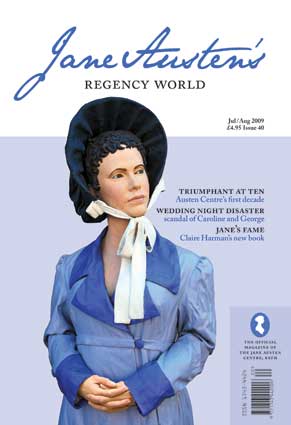
 … and today he brought me the latest issue of Jane Austen’s Regency World [July/August 2009] – as always cram-packed with interesting articles and lovely illustrations – on Austen, Mary Shelley, Queen Caroline, global warming in JA’s time, book reviews, and much more [I will post the full contents tomorrow], but you can see hightlights of the issue as well as download a sample article from a previous issue at the magazine’s website [note that this is the NEW website for JARW, so change your links in your “favorites.”]

JARW_40_Cover_small


How sad to be burdened with a day-job with all this reading to be done!

Posted by Deb

Austen Literary History & Criticism · Book reviews · Collecting Jane Austen · Jane Austen · Publishing History

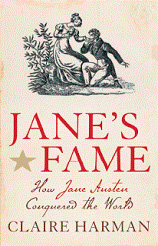
Book Review ~ “Jane’s Fame” by Claire Harman

book cover jane's fameMany of us who grew up in the late 40s – early 50s had our Jane Austen force-fed to us in high school (unless we were fortunate enough to be blessed with an Austen-loving mother or father!).  Pride & Prejudice was the standard text with little reference to the other works; followed by George Eliot’s Silas Marner, Dickens’s A Tale of Two Cities and / or Great Expectations, Shakespeare (hopefully!), and Hemingway, Steinbeck, Salinger for contemporary authors.  But I’ve often thought that Austen got a bum-rap with this “required-reading” status, the educational system’s way of compensating for what an early critic said in calling Austen “a critic’s novelist – highly spoken of and little read.” [p. 120]  And while I am the first to admit that Austen is not for everyone [their terrible loss!], I have long believed that this approach to Austen added to her suffering from the great reader-turnoff. 

For me, a voracious reader as a youngster and teenager, I went on to read some of her novels, but alas! not all, feeling more at home with Alcott, the Brontes, Dickens, and later Wilkie Collins, all those more accessible Victorian novelists.  So it was in later life that I returned to Austen – and I perhaps needed that distance of time (and some wisdom!) to re-appreciate her brilliance – the humor and irony, the language, that characterization, and of course, the age-old love stories.  So from my current vantage point I marvel at Austen’s ability to stay fresh, to speak to different generations, and to speak to each individual in different ways through one’s own life. And in these fifteen plus years of “re-Austenising” myself, I’ve gone much beyond the novels, to the biographies, criticism, her Regency / Georgian world, and the current surfeit of films, and sequels and continuations, and even the latest parodies, creating quite a book collection in the process – and I have really barely begun!  

So I was most excited to hear about the release of Claire Harman’s new book, Jane’s Fame: How Jane Austen Conquered the World [Canongate, 2009], stirring up controversy even before it hit the bookstores [see my previous post, “Discord in Austen Land”].  [Harman has authored Fanny Burney: A Biography (Knopf, 2001) and works on Sylvia Townsend Warner and Robert Louis Stevenson].   It is an engaging read – historical, biographical, critical and anecdotal, all rolled into a capsule of Austen’s claim to fame – and just why was she so popular?  “the public whipped into a frenzy” [p. 243]  in the late nineteenth century and again in the late twentieth? – by “[James Edward] Austen-Leigh’s Memoir in the first instance, and in the second, a man in a wet shirt” [p. 243] [with thanks to Colin Firth!] – simplified reasoning perhaps, but a good chuckle and that glimmer of truth. 

Harman explains that

…this book charts the growth of Austen’s fame, the changing status of her work and what it has stood for, or been made to stand for, in English culture over the past two-hundred years.  In the foreground is the story of Austen’s authorship, one of persistence, accident, advocacy, and sometimes surprising neglect.  Not only did Austen publish her books anonymously and enjoy very little success during her lifetime, but publication itself only came very late, after twenty years of unrewarded labor.  I have sought to reconstruct these pre-fame years in the spirit of uncertainty through which Austen lived them.  Her prized irony and famous manipulation of tone I believe owes much to it; part of the reason why she pleases us so much now is that she was, for years, pleasing only herself.  [p. 7-8]

Thus, Harman starts by placing Austen squarely in the context of her times – her family and friends as writers – her mother, brothers James and Henry, her friend Anne Lefroy’s brother Samuel Egerton Brydges, and her pride in her own quite delightful juvenile writings.  Incorporating a general account of Austen’s life [Harman assumes the reader brings much knowledge of Austen’s life and gives only a cursory telling], she presents us with a great summary of Austen’s writings, the publication history and early responses to each work, drawing heavily on Brian Southam’s Jane Austen, The Critical Heritage [London 1968], and emphasizing Austen’s literary ambitions. [for more on this, see Jan Fergus’s The Professional Woman Writer” in The Cambridge Companion to Jane Austen, one of the earlier scholarly arguments to clearly see Austen in this light, far removed from the portrait painted by her brother Henry and later her nephew.]

Following Austen’s death in 1817, her copyrights still owned by Cassandra were sold to Richard Bentley and his issue of all six novels in 1833 did much to keep Austen in print; but her popularity waned, the rise of the Victorian novel sending Austen to the shadows, not to mention Charlotte Bronte’s dislike of Austen, quoted by Elizabeth Gaskell in her Bronte biography in 1857 [but ironically, how close is Gaskell’s North & South to Pride & Prejudice!]  So Austen remained largely unread until the Austen-Leigh Memoir of 1870, followed by various new editions of the novels and the selected letters in 1890. 

Harman explores in her chapter on the “Divine Jane” [quoting W.D. Howells] the publishing of these new editions and the illustrated versions that sought to “fix the characters in one’s mind” [p.159], the biographies, and critical analyses in this first burgeoning fame-fest, and her new status as darling of the intellectual snobbish-elite, championed by the likes of Leslie Stephen, Henry James, George Saintsbury, and Howells [and of course, not to leave out Mark Twain’s adamant dislike!] – all this culminating in R.W. Chapman’s Oxford edition of her works in 1923, “the first complete scholarly edition of any English novelist.” [p. 192]. 

In “Canon and Canonisation,” Harman chronicles the scholarly critical analysis that continues unabated to the present – the vast extent of academic and non-academic writing – on the one hand, Austen as a pleasure-read, the writer “who wrote so clearly and simply, and who was so small scale” [p. 200] – and on the other, the critical study of Austen’s “unconsciousness and brilliance” and here we see her “easy passage into English literature courses” [p. 201].  Austen makes critical literary history as manuscripts and contemporary memoirs became available for study – resulting in library collections, various illustrated editions, Jane Austen Societies, interest in her “homes and haunts,” more biographies from various standpoints, new paths of criticism taking into account the political, sociological and historical elements, and the many works on the manners and mores, fashion and handiwork, cookery and letter-writing – all things Austen indeed! [A friend visiting my home recently asked me what could all these Austen-related books on my shelves possibly be about when she only wrote six books!] 

And finally to film and what she terms “Jane Austen TM”, Harman again summarizing all that came before the “wet shirt” and after – the movies, the sequels, the internet and YouTube concoctions, the blogsphere , the Societies, the fan-fiction sites, the costume-driven fanatics, etc.  And Harman ends with the question, “What would Austen have made of all this? [p. 278] – in answer, she cites the differing views of D.W. Harding, Lionel Trilling, Henry James, and E.M. Forster to prove to us that “the significance of Jane Austen is so personal and so universal, so intimately connected with our sense of ourselves and of our whole society, that it is impossible to imagine a time when she or her works could have delighted us long enough.” [p. 281]

 One of the criticisms of Harman’s book has been her light non-academic approach to Austen [and perhaps her re-working of others’ ideas into this “popular” framework] – but it all works so well for what and for whom it is intended.  Harman’s gift is taking an inordinate amount of primary and secondary material and presenting it into a very readable, information-packed and anecdotal whole – everything you would ever want to know about Jane Austen all put together in a neat little package of 342 pages.  This of course may be its greatest shortcoming – too neat a package with strong authorial opinions thrown in [and a feeling to this reader of all being rather rushed at the end – “let’s wrap this up, throw in a few final tales and get it published” sort of feeling…] –  it must needs be leaving something out! [Indeed, the 2005 Pride & Prejudice barely gets a mention, either an oversight or the expression of the author’s opinion of that film – but no matter what your views of that adaptation might be, it has to be praised for bringing Jane Austen and P&P  to yet another generation who do not find Colin Firth’s wet shirt scene all that WE make it out to be – and thus it is a clear topic for Jane’s current and ongoing “fame.”] 

But as a resource, with a terrific reading list to be gleaned from the text and bibliography [though I do quibble with the number of un-sourced quotations and overly shortened citations that are unclear (especially in regard to the letters – a number and date would have been most helpful!)], Jane’s Fame should be required reading [not force-fed please…] for anyone interested in the facts of Austen’s writing life and how she has risen to such heights and commands such a presence in so many people’s lives.  And you will likely take away new and interesting tidbits such as finding what Katherine Mansfield had to say about Emma:  “Mr. Knightley in the shrubbery would be something!” [p. 247] [aah! indeed!]

4 1/2 full inkwells [out of 5]

 Further Reading: [all page citations above are to Janes’ Fame]

  • See my post on the various Reviews of Jane’s Fame
  • Copeland, Edward, Juliet McMaster, eds.  The Cambridge Companion to Jane Austen.  Cambridge University Press, 1997.
  • Fergus, Jan.  “The Professional Woman Writer” in The Cambridge Companion, pp. 12-31, where Fergus summarizes and expands these arguments first presented in her Jane Austen: A Literary Life. London: Macmillan 1991.  These are must-reads…
  • Sutherland, Kathryn.  Jane Austen’s Textual Lives: from Aeschylus to Bollywood. Oxford, 2005, pb 2007.  Note that it is Professor Sutherland who started the controversy that Harman essentially lifted her ideas – I have this book and have skimmed it only, so cannot comment fully – but just looking at the table of contents, one finds the similarities a little alarming, and the Sutherland book has far more depth to the notes and bibliography – but again, I emphasize the “popular” nature of Harman’s book. 
  • Todd, Janet, ed.  Jane Austen in Context.  Cambridge University Press, 2005, 2007 with corrections. 
  • Claire Harman’s website with cites to reviews of Jane’s Fame
  • Austenblog:  Mag’s review of Jane’s Fame

Posted by Deb