Books · Jane Austen · Literature · News

Edgar Allan Poe ~ January 19, 1809

I again direct you to my Bygone Books Blog for a celebration of the birthday of Edgar Allan Poe, 1809-1849.  Though you may wonder what this has to do with Jane Austen, and I agree that the link is tenuous as best [though indeed, is Emma not a mystery??]   But I did find this link to the Book Mine Set blog that quoted Mark Twain as saying the following about Poe (and we know what he had to say about our Dear Jane!):

Of Poe, [Mark Twain] said,”To me his prose is unreadable—like Jane Austen’s.”

This Book Mine Set blog does a weekly post “The Great Wednesday Compare” pitting two authors against each other. Austen beat out Poe 48-8! [she then went on to beat Lucy Montgomery and Kurt Vonnegut, but lost by 2 points to Dr. Seuss the following week!] Go to the blog and read the many comments…it is quite entertaining! 

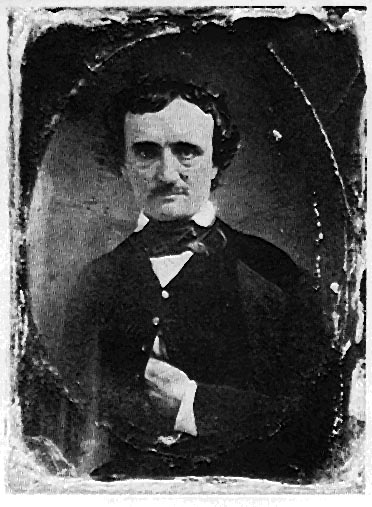
 edgar-allan-poe-imagejane-austen-poe


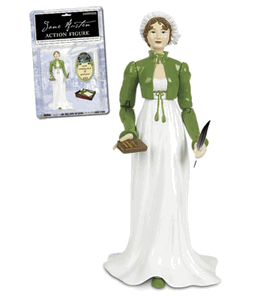
And there are of course those action figures…

poe-action-figure

jane-austen-action-figure

Books · Literature

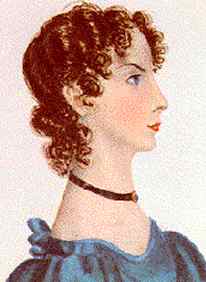
Anne Bronte ~ January 17, 1820

I refer you to my Bygone Books Blog which celebrates today the birthday of Anne Bronte [1820-1849], author of Agnes Grey and The Tenant of Wildfell Hall.

anne_bronte

Books · Jane Austen · News · Rare Books

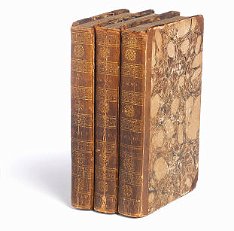
For Sale in Hong Kong: Anne Sharp’s “Emma”

The 1816 first edition of Emma that Jane Austen signed and gave to her friend Anne Sharp [thought to be the inspiration for the character of Mrs. Weston] will be available for sale at this weekend’s International Antiquarian Book Fair in Hong Kong [January 17-19, 2009].   It will cost you a mere HK$3.95 million.  See the full article about other titles for sale at The Standard.com.hk and the link above for the full downloadable catalogue of fair offerings.

By my calculations (this can vary depending on which currency converter you use):

  • this book sold for £180,000 at a Bonhams auction in June = US $262,692.
  • it is for sale at the book fair for HK $ 3,950,000.
  • which equals £348,744. GBP or US $508,958.
  • which is a profit of £168,744 GBP or US $246,265.
  • …if it sells..
  • and whatever would Jane (or Anne!) think!

Jane Austen's 'Emma'


Further reading:

Book reviews · Books · Regency England

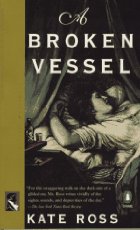
Book Review ~ “A Broken Vessel”

ross-broken-vessel-coverJulian Kestrel returns in this second mystery by Kate Ross [Viking 1994], A Broken Vessel.  Several months after his amateur but superior sleuthing at Bellegarde, home of the Fontclairs, [see Ross’s first book, Cut to the Quick, and my review] Kestrel is again thrown into the mix of murder and mayhem when the sister of his manservant, Dipper, shows up in her brother’s life after a two-year absence.  Sally Stokes is a prostitute and a thief, made of the same cloth as her now-reformed [hopefully] pick-pocket brother. After an evening of turning tricks with three very different “coves,” from each of whom she steals a handkerchief,  she discovers a letter written by an unknown woman, mysteriously locked up in an unnamed place, begging forgiveness and help from her family.  But whose pocket did Sally lift the letter from? – Bristles, the middle-aged skittish man; Blue Eyes, the elegant and handsome gentleman of the “Quality”; or Blinkers, the be-speckled young man who played all too rough with Sally, leaving her sore, battered and frightened. 

Here is how we first see Sally: 

She pulled the pins out of her hair and put them on the washstand for safe-keeping; she was always losing hairpins.  Her nut-brown hair tumbled over her shoulders: long at the back, but curling at the front and sides, in imitation of the fashion plates in shop windows.  Not that she would ever look like one of them, with their fair skins, straight noses, and daintily pursed lips.  She had a brown complexion, a snub nose and a wide mouth, with a missing tooth just visible when she smiled.  Still, she was satisfied with her face.  There was not much an enterprising girl could not do with a little cunning and a pair of liquid brown eyes.

So Dipper brings Sally to his apartment to get her off the street and give her a chance to heal.  He shares this apartment with his employer, Julian Kestrel, the Regency dandy, known far and wide for his fashion and manners, the man everyone emulates in all things dress and gentlemanly behavior.  We have already learned in Ross’s first book that there is so much more to Kestrel than this dandified appearance – his growing friendship with Dr. MacGregor serves as a foil for the reader to see Kestrel in more human terms, and MacGregor’s unasked questions become ours: all we know is that Kestrel’s father was a gentleman, disinherited upon marrying an actress, and that Kestrel has been an orphan for a good many years.  Although he appears to have money and is viewed as such by his cohorts, we, the reader, and Dipper know this not to be the case – but where DOES he get the funds to lead this gentleman’s life, buy these fine clothes, live in France and Italy for years before settling in London?  We learn a bit more in this book…but not much!

 Here is Dr. MacGregor, not of London and critical of all the goings-on there, learning about the gentlemanly art of duelling:

 ‘If you thought he was lying or hiding something. Why didn’t you tax him with it?’ asks MacGregor.

[Kestrel]  ‘If I called him a liar point-blank, I should have had to stand up with him, which would have been deuced inconvenient, and not at all part of my plans.’

‘Do you mean to say you’d have exchanged pistol shots with him over a mere matter of words?’

‘Not if there were any honourable way to avoid it.  But accusing a gentleman of lying is the deadliest of insults. If he’d insisted on receiving satisfaction, I should have had no choice but to give it to him.”

‘But that’s preposterous! It’s criminal!  I don’t understand you at all.  One minute you’re investigating a possible murder with all the seriousness it deserves – and the next minute you say you’d stand up and shoot at a man because he took offence at something you said!’

‘Duelling isn’t murder, whatever the press and pulpit say about it.  If one gentleman insults another, he knows what the consequences will be: they’ll fight according to the laws of honour, as nations fight according to the laws of war.  Killing an unarmed man, or -God forbid!- a woman, is completely different.’

‘Well, I suppose you can’t help those wrong-eaded notions.  You probably learned them at your father’s knee before you were old enough to know better.’

‘Oddly enough, my father had much the same view of duelling as you do.  But then, my father was too good to live.’ He added quietly,  ‘And he didn’t.’


 The discovery of the letter wrapped up in one of Sally’s stolen handkerchiefs sets the plot in motion – they must find which of the three men carried the letter, who the woman is, and where she is being held.  Many plot twists, many characters appearing, each with a tale to tell – are they all connected in some way, or are they all separate unrelated but oh so interesting mysteries of their own?  When Sally finally discovers that the woman who wrote the letter was an “inmate” of the Reclamation Society’s prison-like home for recovering prostitutes and has been found dead from an apparent suicide, Kestrel’s shackles are raised, his detective skills in high gear, and he, Sally and Dipper pursue the three men to find out the truth.  And along the way, we see Dr. MacGregor’s astute eye upon Sally and her effect on Kestrel – can this street-wise, sharp little spitfire possibly soften the edges of the leader of the ton?  Or is Kestrel immune to such feminine wiles? (and those “liquid brown eyes!) 

Ross writes a compelling tale, her research into Regency England, its language (she is adept at presenting the dialect of the streets and the Regency-speak of the “Quality”), the manners and mores, evident on every page; her knowledge of the underside of London life makes the telling very graphic and realistic – you will learn much about prostitution on the streets of London, the religious zealots who acted against it (indeed, the title is from a Psalm), the Bow Street Runners and the all too-ineffective police forces of the time, and best of all, the mystery is excellent!  and while I often “figure” these things out, I was most pleased to have the various side stories pull together with a few surprises along the way.  All in all, a fine mystery, with wonderfully drawn characters, and enough tidbits about Kestrel’s background to more than gently coax this reader into the third book in the series, Whom the Gods Love.

 4 1/2 full inkwells (out of 5)
Jane Austen · News

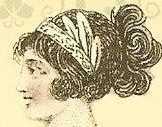
Fashion Quiz

The Jane Austen Centre in Bath has just sent out its latest online newsletter ~ one of the articles is a fashion quiz, 10 questions to test your knowledge of the clothing of Austen’s day.

The whole newsletter is available here, this month with a few visual-musical treats, sales at the gift shop, Persuasion in French, and much more.  And while there, be sure to look at the Online Magazine which contains many articles of interest.

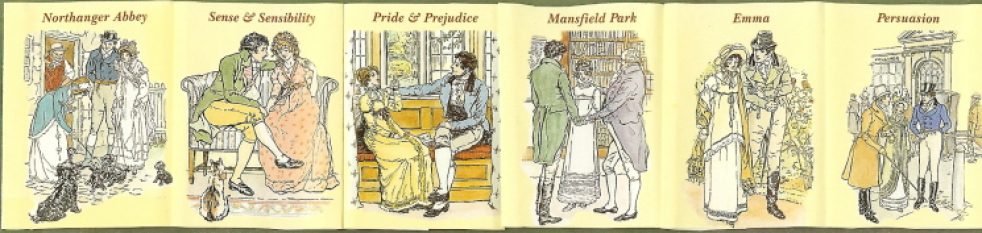
Cards from the Gift Shop
Cards at the Gift Shop
Jane Austen · News

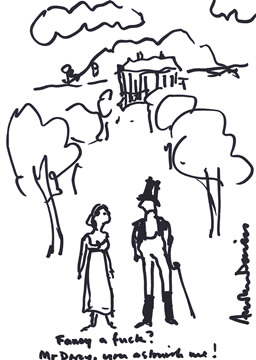
Andrew Davies, the doodler…

Thanks to an alert Janeite and Laurie Viera Rigler’s facebook site, we have the following delightful doodles from the king of costume drama, Andrew Davies:


andrew-davies-doodle1

andrew-davies-doodle2

Well, now we know what Mr. Darcy was really thinking (or at least in the mind of Andrew Davies!)…yikes!

You can go to the National Doodle Day site for more information and other celebrity doodles.

Jane Austen · Schedule of Events · Social Life & Customs

Georgiana Darcy in Hyde Park (VT)

Janeite mrs-hurst-1Kelly will give a talk entitled Georgiana Darcy and the ‘Naïve Art’ of Young Ladies at the Governor’s House in Hyde Park on Friday, 30 January 2009. Our hostess, Suzanne Boden (a new JASNA -Vermont member!) invites you to join us for an entire Weekend dedicated to Austen’s Pride and Prejudice:
Friday, 30 January – 8:00 pm informal talk (see below), with coffee and dessert ($14)

Saturday, 31 January – 3:00 pm Afternoon Tea ($20)

Saturday, 31 January – 7:00 pm Book Discussion & Dinner ($35)

Sunday, 1 February – 11:30 am Brunch & Austen Quiz ($15)

All four activities ($75) and a weekend package that includes B&B accommodation at the Governor’s House (starting at $295 single) also available. Contact Suzanne at info [at] onehundredmain [dot] com or (802) 888-6888 (toll free 866-800-6888).

The starting point for Kelly’s illustrated talk is Elizabeth Bennet’s journey through Derbyshire with the Gardiners (also the subject of her article “Derbyshires Corresponding: Elizabeth Bennet and the Austen Tour of 1833,” which appears in Persuasions this spring). As Elizabeth tours Pemberley, P&P’s narrator tells readers:

 “The picture gallery, and two or three of the principal bed-rooms, were all that remained to be shown. In the former were many good paintings: but Elizabeth knew nothing of the art; and from such as had been already visible below, she had willingly turned to look at some drawings of Miss Darcy’s, in crayons, whose subjects were usually more interesting, and also more intelligble.”

Looking at the work of several young ladies, including Cassandra Austen, during a period covering the first half of the 19th century – we examine fashion, home, family and life in England during the “lifetime” of Darcy’s young sister Georgiana.

As the little drawing above done by Diana Sperling illustrates: Elizabeth Bennet had good taste!

Jane Austen · News

Cardinal Newman says…

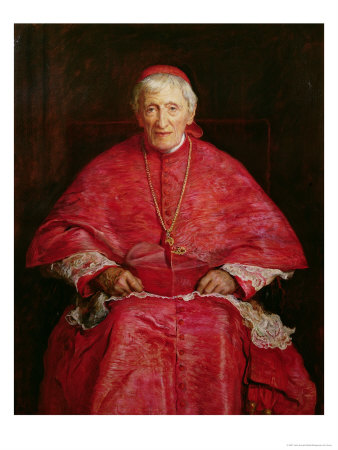
According to one of my literary calendars, today [ January 10, 1837 ] is the day that Cardinal Newman made his oft-quoted remark:

Miss Austen has no romance!… What vile creatures her parsons are.’

… though he supposedly admired her works [and goodness! how we love those parsons!]


John Newman (1801-1890) was an English Catholic who at the age of 15 moved to Alton with his parents and lived at 59 High Street for three years (1816-1819) after his father took over the Baverstock Brewery. The house dating to 1769 bears a blue plaque by the door highlighting the fact.  The previous owners were involved in a lawsuit with Austen’s brother Edward Knight over his failed Hampshire property.  Alton is the nearest town to the village of Chawton where Austen lived until 1817.  One wonders, did they ever meet in that overlapping year??


Cardinal Newman
Cardinal Newman

Further reading on Alton and Cardinal Newman:   

***********************

and on another note of important dates, I missed Cassandra’s birthday yesterday:  January 9, 1773.

Book reviews · Jane Austen · Movies · News · Regency England · Social Life & Customs

In My Mailbox ~

I love my mailman ~ it seems he brings me a surprise almost daily!  Today, I find the latest issue of Jane Austen’s Regency World  [Jan/Feb 2009, Issue 37], and here give you some thoughts on the contents:

jarw_37_cover

“End of the Regency” about the soon to be released film on young Queen Victoria [March 2009 in Britain], starring Emily Blunt (on the cover above) as Victoria and Rupert Friend as Prince Albert (he starred in the 2005 P&P as Wickham and was fabulous in Mrs. Palfrey at the Claremont

“Write-on” about the importance of correspondence and the ways of letter-writing in Jane Austen’s time

“Why I Dig Jane” a talk with Alan Titchmarsh, popular British TV personality, gardener, and novelist [his latest book, Folly, is set in Bath and currently on the British best-selling fiction list] ~ He confesses that his favorite character is Emma.

“Illustrating Jane Austen” an article on the incomparable Hugh Thomson

“Playing Mary Bennet” on the actress Ruby Bentall, who acted the role of Mary Bennet in the Lost in Austen series (“with spindly glasses and horrible hair”…)

“Pottery and Poetry” which traces the life of Thomasina Dennis, 1770-1809, a comtemporary of Austen’s who worked for the Wedgwood Pottery family.  The article includes some history of Josiah Wedgwood and his business [ironically, this week the Waterford / Wedgwood company announced it is filing for bankruptcy]

“Petticoat Politics” looks at the complex nature of Regency undergarments, never mentioned, but a large part of “dressing Jane” and her contemporaries

“Madame de Stael” and the story of why perhaps Jane Austen refused to attend a London literary salon at which Madame de Stael was to be present (could it have been her tempestuous love-life??)

“My Jane Austen” the column this month by Virginia Claire Tharrington on her months as an intern at the Jane Austen Centre in Bath (she also posted several weekly articles on Austenprose while she was there)

“A Goodly Heritage” by Marsha Huff, President of JASNA, on this past year’s Annual JASNA AGM in Chicago

“Portrait of a Lady” on the Jane Austen Society of the U.K. and the event presented in the fall by History Wardrobe on the fashion of Austen’s time

And Joceline Bury offers three book Reviews:  An Aristocratic Affair by Janet Gleeson, a biography of Henriette Ponsonby, Countess of Bessborough and sister of Georgiana, Duchess of Devonshire [The American title is: Privilege and Scandal: The Remarkable Life of Harriet Spencer, Sister of Georgiana];  The Immortal Jane Austen by Maggie Lane, a no-frills biography of a mere 50 pages, but laced with many illustrations and highly recommended by the reviewer; and Jane Austen Visits London by Vera Quinn, the charming little book that concentrates only on Austen’s travels to and writings about London [see my comments on this book here.]

So all in all a fine issue, and a perfect way to spend the upcoming weekend, immersed in all things Regency!

Books · Literature

A Few Words on Wilkie Collins

I send you over to my Bygone Books Blog for a few short words on one of my favorite writers, Wilkie Collins ~ January 8, 1824 – September 23, 1889.

woman-in-white-cover