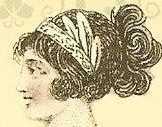
The Kent-Delord House Museum (Plattsburgh, NY) offers a 2-day “accessories” Make-and-Take Sewing Workshop on April 26 and May 31 (11:00 a.m., in the Carriage Barn, on both days). There is a $5 fee. The accessories mentioned are caps, aprons and reticules. For more information, call the KDH at 518-561-1035. Located at 17 Cumberland Ave., the Kent-Delord House is named for its three generations of family resident in the house from 1797 until 1913.
Musings
Yesterday I received the spring edition of JASNA News. Some interesting reading, including about our own chapter! Alas, like interviews, things get jumbled or remain unprinted. So a mixed blessing to see the activities of our Chapter’s last half-year in the News. We draw members from several counties, so it is a misnomer to say Burlingtonians alone gathered for our organizational meeting. And we actually met in the Kellogg-Hubbard Library in Montpelier, thanks to the efforts of Carol Madden in securing us the space. (For those who do not know Vermont geography, Montpelier, our state capitol, is about an hour‘s drive south of the Burlington area.) Our Austen Birthday tea, another event planned for the Montpelier area, indeed was blown by a strong nor’easter coming through the state the very weekend of December 15/16. However, we rescheduled, having a wonderful gathering in Deb Barnum’s Burlington home in February. There, members got to meet or renew acquaintance, and everyone read out a favorite passage from Austen. The company was most congenial, and the food and tea very appealing.
It was with great interest that I read Terri Hunter’s article JANE AUSTEN AND ME. I also applied for JASNA’s 2007 IVP (International Visitor Program). When that went unfunded, I searched high and low for affordable accommodation and lucked into a wonderful landlady in Kings Worthy. Therefore, I kept my plan to spend two months at Winchester’s Hampshire Record Office. JASNA’s Kerri Spennicchia had given me contact information for the previous year’s IVP, Alice White, who was back in Winchester for a few weeks; Alice in turn introduced me to Terri; they were both living at the dorms at Winchester University. Alice, a PhD candidate at USC, centers her research on Catherine Hubback; Terri was focusing on Chawton in the time of Austen, bringing together, as she says in her article, genealogy and history. Like others, I look forward to seeing the produce of these researches.
As I told Deb a week or so ago, one’s writing is affected by one’s reading. Reading good writing makes the words flow oh so much more easily! Having little money to spend, I’ve been combing my library for something entertaining. That’s when I picked up Evelina. But, like many a book of mine, the bookmark has remained stationary some many days… So, still searching, I took up a wonderful mystery by Rhys Bowen, the ninth in her Evan Evans series which is set in one of my favorite parts of the world: Wales. Evan Blessed whetted my appetite for more by Bowen, but South Burlington’s B&N isn’t exactly well stocked with her books. I’m really intrigued by her new series’ first entry, Her Royal Spyness. It sure starts off hilariously. (Amazon offers a sample of the first couple chapters.)
So what to read, what to read…?
I ended back in Burney territory; though – after pulling down Cecilia – not a novel by her, but a biography about her – Faithful Handmaid: Fanny Burney at the Court of George III. Hester Davenport has concentrated on Burney’s years of service to Queen Charlotte, after Burney became Keeper of the Robes in 1786. With this narrow focus, this biography becomes one of the most interesting (and well-written) biographies I’ve read in a quite a while, presenting a picture of court life as lived by one rather reluctant to be there in the first place. It’s rather like Upstairs-Downstairs; it pulls you into the lives of those served as well as those serving. And, as a piece of women’s history, it is thought-provoking to read of Fanny Burney’s reactions to her position as a paid servant, as well as her interactions with the Royal Family and of court-life during the time of Austen’s own girlhood. So, I will now restart my CD of Charles Trenet “hits” and settle in with Burney back in the year 1787.
A last little ‘plug,’ for our blog’s own AUSTEN POLL: vote for your favorite Austen novel! (See the sidebar on the right.)
So much information!
There are so many interesting articles on the various Austen-related sites, that I am going to list and link some of them for your ease of use!….
On Jane Austen’s World, Ms. Place writes of the architect Robert Adam; The Grand Tour in the 18th & 19th century; a review of PBS’s Room with a View; Traveling at Night in Jane Austen’s Time; and Calling Cards in S&S and Persuasion.
Ms. Place also has penned a great article on the actress Anna Chancellor (of Four Weddings & a Funeral fame, as well as the most perfect Caroline Bingley in P&P95)…turns out she is an Austen descendant. See the Jane Austen Today Blog. On the same page, scroll down for a great article by Laurie Viera Rigler on “Ten Ways to Cope without the Complete Jane Austen Series.” The first six suggestions are to READ THE BOOKS! (yes! I love this suggestion!) (and of course see the best adaptations), followed by the terrific advice to join JASNA, go to an English country dance event, and finally to read Rigler’s own book, Confessions of a Jane Austen Addict (which is quite a good I might add!) The book is being offered as a prize for the best posted suggestion, so go to the site and comment on!
And over at Austenprose, Laurel Ann, writes of Maggie Lane, the author of numerous books on Jane Austen, and reviews her book Jane Austen’s World: the Life and times of England’s Most Popular Author. And take a look at some the previous posts on Sense & Sensibility, and a very comment-worthy post on the best and worst of PBS’s Complete Jane Austen.
Maggie Sullivan at Austenblog has some interesting tidbits and “Jane” sightings.
Oh! there is way too much delightful information…who can keep up with all this reading! I, for one, have immersed myself in Northanger Abbey, and will soon post on my thoughts…
The Blue-Stockings
I was skimming through Charlotte Bronte’s Shirley today and find a chapter titled “The First Blue-Stocking” and thought I should share some of the history of this term, though there remains some debate as to the origins of the group as well as the term itself.
“The Blue Stocking Circle” or “Blue Stocking Ladies” was an informal group of learned, intelligent and socially-fashionable women formed in the second half of 18th-century London. Talk of politics and the playing of cards was prohibited, literature and the arts were the main topics of conversation, and the learned men of the time were invited to participate in the discussions. The gatherings were initiated by Elizabeth Montegu (1720-1800), Elizabeth Vesey (1715?-1791), and along with Frances Boscawen (1719-1805), were considered the leaders and hostesses of what became a group of considerable size. Notable members included Fanny Burney, Anna Laetitia Barbauld, Sarah Fielding, Hester Chapone, Ada Lovelace, Margaret Cavendish-Harley, Mary Delaney, Elizabeth Carter, Lady Mary Wortley Montagu, Anna Williams, Hester Thrale, and Hannah More. Some of the more famous men in attendance were Samuel Johnson (who, largely ignored by the “fashionable” world, was “lionized” at any Blue Stocking evening, as Boswell notes in 1781), David Garrick, Sir Joshua Reynolds, Edmund Burke, Horace Walpole, William Pulteney, James Beattie, Samuel Richardson, and George Lyttelton. Indeed, Hannah Moore wrote her poem Bas Bleu in 1786, describing the charm of the Blue Stocking Society and characterizing her friends.

[ Dr. Syntax with a Blue Stocking Beauty, by T. Rowlandson ]
The origin of the term “Blue Stocking” is still disputed, but critical authorities generally embrace the story of Benjamin Stillingfleet, who, unable to afford “proper and fashionable” dress (i.e black stockings), was invited By Mrs. Vesey to “not mind [your] dress…and come in your blue stockings”…and thus came the name.
See the following for more information:
-Drabble, Margaret. THE OXFORD COMPANION TO ENGLISH LITERATURE. 5th ed. Oxford, 1985, p. 111.
Miegon, Anna. Biographical Sketches of Principal Bluestocking Women. THE HUNTINGTON LIBRARY QUARTERLY, Vol. 65, No. 1/2 (2002), pp.25-37. Also published as RECONSIDERING THE BLUESTOCKINGS.
– “The Bluestockings” at Bartleby.com, where there are several articles and a bibliography.
– Wikipedia: “The Blue Stockings Society (England) with additional links.
– The Bluestocking Archive by Elizabeth Fay of UMass Boston .
– and for a contemporary touch: the Bas Bleu Catalogue, for a nice selection of books!
Hugh Thomson’s Illustrated PRIDE & PREJUDICE
One wonderful memory of visiting Chawton Cottage – Jane Austen’s home from 1809 until her death, was the hallway lined with Hugh Thomson’s drawings for Pride and Prejudice.  So a BIG surprise when a copy of that very book was found ONLINE via the Internet Archive! And what a beautiful book it is, with a golden peacock filling the front cover, and what seems like hundreds of illustrations on the inside. Take a look…..
UPDATE: Thrilled to see that Ms. Place’s happiness at locating this book equals my own. Isn’t it gorgeous?!? And even signed by the illustrator. I cannot stress more the importance of such endeavors for those of us far from large research libraries, and I applaud everyone involved in such a noble cause. Many 19th-century books are hard to get, even as interlibrary loans. They are sometimes fragile; oftentimes they are locked away in “Special Collections” and do not circulate. This same site, Internet Archive, offers Thomson’s Sense and Sensibility. Watch our BIBLIOGRAPHY page for more such jewels, as we find them; and, please, let us know of similar Internet Archive or Books.google sites as you discover them.
RED-The Reading Experience Database 1450-1945
 The Reading Experience Database 1450-1945 is a project the Open University (UK) launched in 1996, with the aim of accumulating data about the reading experience of British subjects. It is a searchable database of all citations in printed materials (i.e. letters, memoirs, diaries, journals, reading notebooks, autobiographies, court records, annotations, marginalia, etc.) linking an individual to their reading. An example is Susan Ferrier, who commented in a letter on reading Jane Austen’s Emma in 1816, and there are many citations to Jane Austen’s own reading. This material is already prompting the need for a reassessment of the opinions about 18th and 19th century reading practices. For instance, the belief that 19th-century women read nothing but novels is disputed by the findings that women of this period read an extremely wide range of genres, including philosophy, mathematics and the Classics. You can find the link at: http://www.open.ac.uk/Arts/RED/index.html (the link is also in our ‘Literary Resources” list.) And note that RED actively solicits contributions of material for inclusion in the database. 1
[1. See The Female Spectator, vol.11, no.1, Spring 2007]
A different Jane: Jane Welsh Carlyle
My interests are drawn by letters and diaries – especially of English women, from a broad range of times. Mid-18th century, to complement my love of Mozart (his letters make for wonderful reading; I highly recommend the Anderson translation); early-19th century to complement my research into the lives of Emma Smith and Mary Gosling; I value my Queen Victoria collection of letters and journals; World War I and World War II – nothing of politics or “war,” but personal responses to these adverse times.
Therefore, I had long ago bookmarked a wonderful website dealing with the letters of Thomas and Jane Carlyle. Jane is the half of this pair who interests me, especially after having read Thea Holme’s delightful The Carlyles at Home (a terrific piece of writing). This Duke University Press-related website has FULL TEXT letters, searchable, browseable. I cannot praise the site more highly. And looking at it today, I put in AUSTEN just to see what would turn up; my findings are what I want to share.
The first letter was written by Jane to Thomas on 5 August 1852. Jane is on the road, and recounts a little of her journey to her husband:
‘Some twenty minutes after; I started myself, in a little gig, with a brisk little horse, and silent driver— Nothing could be more pleasant—than so pirring thro’ quiet roads in the dusk—with the moon coming out—I felt as if I were reading about myself in a Miss Austin novel! (Could she have been thinking of NORTHANGER ABBEY??) But it got beyond Miss Austin when at the end of some three miles before a sort of Carrier’s Inn, the gentleman of the barouchette stept into the middle of the road, making a sort of military signal to my driver, which he repeated with impatience when the man did not at once draw up!— I sat confounded—’ (And there, I’m afraid, we must leave poor Jane, in the middle of the thoroughfare and about to be accosted by who knows what sort of man… to find out the end of her tale and WHY he waved Jane’s carriage down, take a look at the complete letter.)
The second letter, and so comical, was written by Jane to Helen Welsh on 27 February 1843. It concerns Jane’s uncle, whom she visits:
‘My dearest Helen
After (in Dumfries & Galloway-courier phraseology) “taking a birds-eye view” of all modern literature, I am arrived at the conclusion; that to find a book exactly suited to my Uncle’s taste I must—write it myself! and alas, that cannot be done before tomorrow morning!
“La Motte Fouque’s Magic Ring”? suggests Geraldine—“too mystical! My Uncle detests confusion of ideas”—
“Paul de Kock? HE is very witty”— “Yes but also very indecent!—and my Uncle would not relish indecencies read aloud to him by his daughters.”—
“Oh!— Ah!— Well! Miss Austin?”— “Too washy—watergruel for mind and body at the same time were too bad”—
Timidly and after a pause— “Do you think he could stand Victor Hugo’s Notre Dame? “— The idea of my uncle listening to the sentimental monstrosities of Victor Hugo!— a smile of scorn was this time all my reply.’
Recent Reading…
In need of something entertaining to read, I searched my library and came up with EVELINA, by Fanny Burney. I own a few Burney items: two biographies, her Cecilia (nearly as large and thick as Richardson’s Clarissa), and a journal volume. EVELINA came from TUTTLE’s Antiquarian Books in Rutland — now sadly gone (and one less reason to travel from Burlington to Rutland!).
Who knows if I will finish EVELINA. Burney’s epistolary novel holds my interest, but at the same time I have to say I find nine-tenths of the characters thoroughly obnoxious! Early on, this novel feels a genuine precursor to Austen in several ways: the young girl entering society (Catherine in Northanger Abbey; though Bath vs London society); the odious suitor (Evelina’s Sir Clement Willoughby; Catherine’s Mr Thorpe or Elizabeth Bennet’s Mr Collins); the eligible hero (Evelina’s Lord Orville and Elizabeth’s Mr Darcy). Or IS Orville a ‘hero’?? Part of me wants to peek at the end to see if he turns out to be Lovelace-like instead!
Austen’s crowd of characters are funny, endearing, even when they slightly annoy (I’m talking about the BOOKS, not films; a little Lydia sometimes goes a long way…), while Burney’s cast here seems black or white – innocent Evelina; obnoxious Capt. Mirvan; lovely Mrs Mirvan; odious Mme Duval, etc. etc; and the scenes chatter on at such length. This would undoubtedly make for entertaining reading aloud, as would have often been done in Austen’s day. It reads VERY like a play, with a VAST amount of dialogue. Poor Evelina must surely have gotten writer’s cramp after penning some of her missives! (Was Les liaisons dangereuses as wordy w/o plot movement? Hardly… Short, pithy letters that feel like correspondence; in fact, the letters become the dialogue.)
Trying to get some AUSTEN research read, I took out from the library the second edition of Deirdre Le Faye’s Jane Austen: A Family Record. One interesting thing about it is the amount of family diaries and letters Le Faye culls in order to fill in the narrative of Austen’s life, whereabouts, and actions. I was telling Deb about the references to SUSAN, Austen’s original title for Northanger Abbey (‘til another novel of the same title got published in 1809): Publisher buys it, promises to publish quickly — then sits and sits and sits on the manuscript. How frustrating for her! So with great joy, one reads this paragraph: “It was probably early in 1816, ‘when four novels of steadily increasing success had given the writer some confidence in herself’, that Jane decided to recover the manuscript of Susan from Crosby & Co. Henry undertook the negotiation, and ‘found the purchaser very willing to receive back his money, and to resign all claim to the copyright. [Crosby had paid Jane a mere £10.] When the bargain was concluded and the money paid, but not till then, the negotiator had the satisfaction of informing him that the work which had been so lightly esteemed was by the author of “Pride and Prejudice”.’”
This is not my favorite Austen biography, there are a few too many phrases containing ‘maybe, perhaps, probably’ tossed into the narrative; but Le Faye includes much primary information, from published and unpublished sources, not found in a lot of other biographies, and therefore she presents a fleshed-out picture of Austen’s life, even when the evidence for a particular period is a bit thin. For an interesting evaluation of SEVERAL Austen biographies, see Keiko Parker, ‘Sense and “Non-Sense” in Eight Jane Austen Biographies.’
JASNA – Massachusetts: May 4 meeting
Sunday, May. 4th at 2 p.m.
Wheelock College, Brookline Campus
43 Hawes Street, Brookline, MA
Wheelock College, Brookline Campus
43 Hawes Street, Brookline, MA
His and Hers: The Politics of Domestic Space
in Austen’s Novels
Dr. Joan R. Vredenburgh
Naval Academy Preparatory School in Newport RI
Pre-meeting roundtable discussion of PBS Austen film series:
Those who would like to join a roundtable discussion of the PBS film series are invited to come a half hour before the regular meeting time at 1:30 p.m.
Those who would like to join a roundtable discussion of the PBS film series are invited to come a half hour before the regular meeting time at 1:30 p.m.
Wheelock’s Brookline Campus is easily accessible. By subway, take the “C” line to Hawes Street (after St. Mary’s Street) or “D” line to Longwood Avenue. See reverse for driving directions. Additional driving and subway information: http://www.wheelock.edu/about/abodirections_brookline.asp
$5.00 per person (*Massachusetts Chapter members free)
For more information, you may contact: The Jane Austen Society of North America, Nancy Yee, Regional Coordinator, 82 Collins Road, Waban, 02468, (617) 965-5699.
Jane Austen in Brookline
News from JASNA – Massachusetts: This Sunday (April 13th) Sarah Emsley, a Jane Austen scholar in our midst, will give a talk on Jane Austen to the adult education group at the Church of Our Saviour (Episcopal) in Brookline. It’s at 10 a.m. in the church hall, and the church is on Monmouth Street, next to the building where we have our JASNA meetings. She’s going to focus on Mansfield Park as she gave a general talk last Sunday. It’s free, and you are welcome to attend. If any of you have been fortunate enough to hear Sarah Emsley speak at a JASNA event, you know that this should be a memorable occasion.
 Jane Austen in Vermont