Gentle Readers All: Please see below to enter into the Giveaway for a copy of Susannah Fullerton’s Celebrating Pride and Prejudice.
**********************
Today I welcome Susannah Fullerton, president of JASA,author of numerous articles on Jane Austen, a leader of literary tours , and author of Jane Austen and Crime (2006), A Dance with Jane Austen (2012), and most recently the author of Celebrating Pride and Prejudice: 200 Years of Jane Austen’s Masterpiece [Happily Ever After in the UK].
Susannah shares with us a few thoughts on the her new work and the joys of discovering and re-discovering Austen’s most popular novel – and out just in time as we all celebrate the 200th bicentenary of Pride and Prejudice this year, all beginning on January 28th. I highly recommend this book, a must-have for your Austen Library, a perfect companion to the novel, and a lovely work in its own right.
And now Susannah:
______________________
I was about 11 years old when my mother first read me Pride and Prejudice. We were away on a family holiday in Christchurch, New Zealand, and the only thing I remember of the visit there was lying at the end of a double bed while my Mum read aloud. It was not all joy – I did get very frustrated when she stopped to laugh. I was too young to appreciate the irony of the novel and just wanted to know what would happen to Elizabeth and Darcy. Now of course I know exactly why my mother laughed. In spite of my mother’s ‘interruptions’, I loved the story, and soon went back to read it by myself.
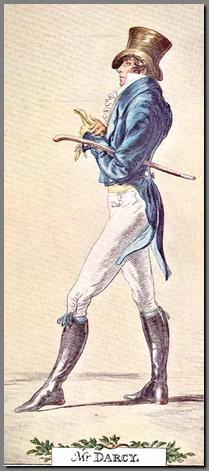
Mr Darcy, by Robert Ball. Pride and Prejudice (Doubleday 1945)
[image from Austenprose.com]
So for just over 40 years Pride and Prejudice has been a vital part of my life. That first reading has been followed by countless others. Sometimes I have just picked up the book and it has fallen open in just the right place (any place is the right place) and I’ve read of the Meryton Ball, or one of Darcy’s proposals, or a scene with Mr Collins making a fool of himself. Even a ‘one page reading’ has always left me feeling better. Again and again I have picked it up and started with that brilliant opening sentence (to which I devote a whole chapter in my book!) and gone through to the end, knowing exactly what would happen but loving it more every single time.
And I have read ‘P & P’ in other ways – I adore unabridged audio versions, I’ve read it as a comic book, I’ve read it on my Kindle, and of course I’ve seen film versions and loved them too. Elizabeth and Darcy are my dear friends and while I would not want to actually meet Mr Collins, I always delight in his company within the pages of Jane Austen’s great novel.
It has been said that you never read the same book twice! Every re-reading is a different experience – you know what is going to happen within the plot and so you look out for other things. And with ‘P & P’ there are always other things – some slight nuance you missed last time you read it, a different inflection by an audio book reader can make you react to a sentence you know well in a different way, and you pick up on the tiny details of setting or character that you failed to notice last time. And the other thing that means you are not reading exactly the same novel, is that you yourself have changed. You have grown older and wiser, experienced things in your own life that have slightly altered you from the person you were on the first reading. I groaned over Mrs Bennet when I first met her – she was so vulgar and embarrassing and I pitied Elizabeth for having to put up with her. But now I’m a mother myself, with children who are forming romantic partnerships, and I have so much more sympathy for Mrs Bennet. And as a wife, I can understand her frustration when Mr Bennet goes off to the library and shuts the door, leaving the worries of 5 unmarried daughters totally up to her. Reading Pride and Prejudice changes your life, but your life also changes each re-reading of Pride and Prejudice.
With such a deep love of this novel, you can imagine what a joy it was for me to sit down and write a book about its incredible 200 years. I could not think of a nicer way to celebrate this important literary anniversary. For months I was immersed in its pages, learning even more about the book and its characters as I worked on my own book. I was so fascinated by the translations of it – how very quickly it was translated into another language and what a mess was made of that first translation, and what huge challenges it gives a translator (do you think Mr and Mrs Bennet should say ‘vous’ or ‘tu’ to each other in a French translation – I’d love to hear your opinion?). I especially loved writing my chapter on Elizabeth, trying to analyse what it is that makes her so charming and lovable, while not making her a ‘goody-goody’ in whom we can’t believe. I had lots of fun with my chapter on all the merchandise inspired by this novel – don’t you just love the idea of a BBQ apron that announces ‘Let’s BBQ Wickham!’ And I was fascinated by the responses to ‘P & P’ over 200 years from famous people. A.A. Milne quite rightly judged people by their reactions to this book, while Robert Louis Stevenson wanted to go down on his knees and worship Elizabeth Bennet whenever she opened her mouth.
My book is very gorgeously illustrated and has pictures that may be unfamiliar to many. It is available in two editions – the American edition is Celebrating Pride and Prejudice: 200 Years of Jane Austen’s Masterpiece and the UK edition is Happily Ever After: Celebrating Jane Austen’s Pride and Prejudice. I do hope my book gives pleasure to those of you who read it, and also teaches you new things about this much-loved novel.
HAPPY PRIDE AND PREJUDICE ANNIVERSARY YEAR!
********************
About the Author:
Susannah Fullerton is President of JASA, and author of Jane Austen – Antipodean Views, Jane Austen and Crime, A Dance with Jane Austen, and her latest Celebrating Pride and Prejudice: 200 Years of Jane Austen’s Masterpiece – note that the UK title of this work is Happily Ever After: Celebrating Jane Austen’s Pride and Prejudice (Frances Lincoln, 2012).
Celebrating Pride and Prejudice
Voyageur Press, January 1, 2013
ISBN-10: 0760344361; ISBN-13: 978-0760344361
$25.99
Contents: (I have abbreviated the title to P&P)
‘My Own Darling Child’- The Writing of P&P
‘A Very Superior Work’ – Reactions to P&P
‘A Truth Universally Acknowledged’ – The Famous First Sentence
‘Bright and Sparkling’ – The Style of P&P
‘As Charming a Creature’ – The Heroine, Elizabeth Bennet
‘Mr Darcy … is the Man!’ – The Hero, Fitzwilliam Darcy
‘The Female Line’ – Her Relations
‘The Same Noble Line’ – His Relations
‘Delighting in the Ridiculous’ – Other Characters
P&P Goes Overseas – The Translations
‘Pictures of Perfection’ – Illustrating and Covering P&P
Did They Live Happily Ever After? – Sequels and Adaptations
Bonnets and Bosoms – Film and Theatrical Versions
Mugs and Skateboards – Selling P&P
‘Behold Me Immortal’ – P&P Now and in the Future
Bibliography and Index
_____________________________________
Please enter into the drawing for a copy of Celebrating Pride and Prejudice by commenting below: either by asking Susannah a question or telling us of your first experience in reading Pride and Prejudice [or like Susannah, perhaps being read to?]. Deadline is Tuesday January 29, 2013 11:59 pm; winner will be announced on Wednesday January 30th. Worldwide eligibility. Good luck all, and thank you to the publisher for donating the book for the giveaway [please note that I happily purchased my own copy].
… and the winner is: Dianna Anderson who commented on January 15:
I would love to comment on a book I’ve read but sadly I haven’t, but I would love to. If I were to win a book though I could easily read it and email a question later. :-)
Congratulations Dianna! – please email me your contact information and the book shall be sent to you right away. And after you have read it, we hope you shall comment!
And thank you all for your comments and to Syrie James for her great post about JASNA.
Giveaway winner for Susannah Fullerton’s A Dance with Jane Austen: How a Novelist and Her Characters went to the Ball is Diana Birchall! – she wrote this on November 3:
I love Susannah’s writing, and I have long been a great admirer of her awe-inspiring range of abilities. That is why I cast her as “my Marianne”! I must and shall own this book, but they ran out of them at the AGM, and I haven’t got mine yet. I just won a fabulous biography of Keats on the Dovegreyreader blog, and my mother-in-law’s electricity got restored in NYC today, so let’s make it good luck comes in threes. Please enter me to win Susannah’s book!
Congratulations Diana – luck comes in threes indeed! And the fact you cast Susannah in your play as “Marianne” makes this even sweeter – I promise a completely objective random drawing [you can thank my husband who picks a number from 1-whatever in order of posting – he doesn’t even know what I am asking for!]
Please email me privately with postal direction!
Thank you all for such wonderful responses, to Susannah for her lovely post and responses, and to Sue Forgue, my go-to person for all things Regency (and London!) for her dance information! For those of you who will be attending the JASNA-Vermont Tea on December 2nd, this book will be one of the door prizes, with thanks again to the publisher Frances Lincoln for their generosity.
This just in from Beth at Sourcebooks! – get your camera ready and off you go!…
Hi there! In the June memoir, All Roads Lead to Austen the author Amy Elizabeth Smith took Jane Austen’s works along with her as she traveled to foreign countries. Her goal was to see if the magic of Jane Austen could hold its power across borders, languages and cultures. Amy took Jane to far off countries – and we need your help to take her even further! We are holding a contest called All Around the World with Jane! Join us on our Austen love fest by printing out our Jane Austen “flat Stanley.” [see below] – Take pictures of yourself with Jane in your hometown or on your vacation, and submit it from April 30th – June 30th!
We will award the following prizes to the individuals with the most creative picture:
1 Grand Prize Winner will receive:
An E-reader with all of our available Austen sequels/continuations downloaded on to it
A signed copy of All Roads Lead to Austen by Amy Elizabeth Smith
A Skype session with Amy Elizabeth Smith
3 Second Place Winners will receive:
A signed copy of All Roads Lead to Austen by Amy Elizabeth Smith
A choice of 5 Jane Austen sequels/continuations from Sourcebooks
5 Third Place Winners will receive:
A signed copy of All Roads Lead to Austen by Amy Elizabeth Smith
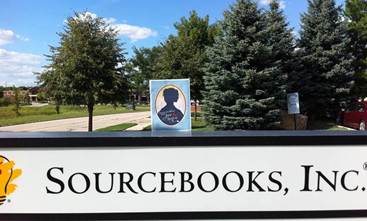
Below are some examples of where Jane has been already (Times Square, The Jane Austen Centre in Bath, and the Sourcebooks offices!) and attached is the flat Stanley that you can print off (also available on the Facebook page).
One more thing! Barnes & Noble is offering this title as a NOOK First! The eBook is being offered early now and at only $6.99 for a limited time! Please pass this along! We want to see Jane go as many places as possible!
Thank you!
Beth
Beth PehlkeAssociate Publicist | Sourcebooks, Inc.
Congratulations! to Danielle, who has won the random drawing for The Perfect Visit by Stuart Bennett. The interview with Mr. Bennett can be found at these two posts: Part I, and Part II.
Danielle, please email me the address you would like me to send the book to, and I will get it off to you right away …
Thank you all for your comments! – I do hope that you will all buy a copy of the book, either in the paperback edition or as an ebook on your kindle – I promise you an enjoyable read!
Today I again welcome Stuart Bennett, for Part II of our interview where we discuss his new book The Perfect Visit, a time-travel tale, a romance, and a pure escape into the Regency world of Jane Austen and the Elizabethan world of William Shakespeare! [Please go to this link for Part I of the interview.]
You can enter the book giveaway by commenting on either postbefore 11:59 pm 15 April 2012. Winner will be announced on Monday April 16, 2012. [worldwide eligibility]
Talking about the Feminist Question: [because I always have to ask…]
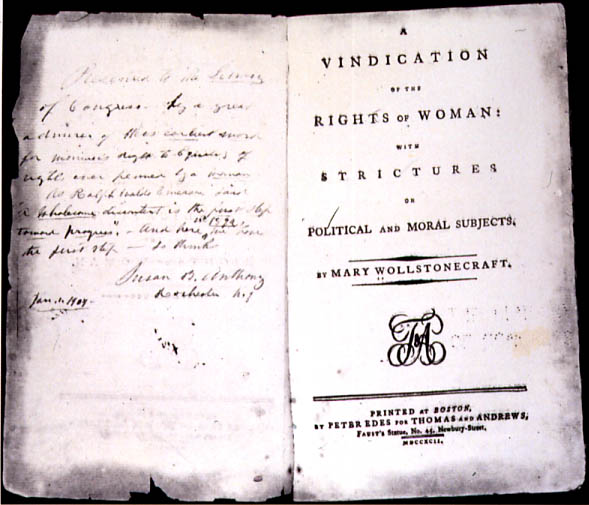
JAIV: Vanessa is in all ways a 21st century woman, yet when she finds herself stranded in the early 19th century England she is “visiting” she must, I assume, “just fit in” – she even goes to the lengths of wanting marriage for protection alone – she cannot earn a living as she would have done here in the present – she is trapped and at times just so incredibly sad. You do have her debating women’s rights and voting and the realities for women publishing, and she does stand up for herself innumerable times – and you did create Meg, a lovely character, true to her time and herself – but I am perhaps taking Vanessa and her story too much to heart here? – she feels very real to me [and I thought only Jane Austen’s characters are really real!] – and I felt that if I were there, I would be pushing Wollstonecraft’s Vindication on every passer-by, screaming for equality, hanging out with the bluestockings! – yet you have her taking such a back seat in these socio-political conversations of the day. I just see that as a difficult issue for you as a writer – making her a very modern woman living in an earlier time and not scaring all the people around her! Did you feel this in creating her? – needing to make her an almost “invisible” being, with your own time travel rules at play to not change things, to lay-low so to speak, to not bring too much attention to oneself? … And did you find her enforced silence painful as well? Or is this more my response as a female reader moved by her inability to speak out – more so than even for you who created her? [you might just answer ‘yes’ or ‘no’ and head on to the next question!]
[Image: wikipedia]
SB: It is tempting just to say “yes” and move along. But a question that shows such close and sympathetic reading deserves better than that. Vanessa is young at the beginning of The Perfect Visit. Resourceful and tough as she is, she still has to deal with the triple-whammy of being trapped in another time, imprisoned, and ill. Without Meg (and other interventions which I hope readers will discover for themselves) Vanessa would surely have died.
And so she does her best to lie low, to get by, to fit in. And at times it all makes her feel like she is about to explode. This is the Vanessa who came alive for me, and as a writer it brings me joy to know that she came alive for you too. Thank you!
Talking about Books:
JAIV: All references to book titles, authors, prices, etc. are you say valid – in your words, you may have “tinkered a little with history, but I have done my best not to tinker with bibliography.” [p.341] – and this book abounds in Bibliography! I love to come away from such a story with pages of things, people and places, and books to research! – And I thank you for your “Historical postscript – the truth in Jane Austen’s life and her fiction, and the amalgamations of real people to create your heroine and hero and all the various booksellers… [though I did miss the Godwin reference I am ashamed to say! – so clear after reading your postscript…]
So I would ask, can your story be enjoyed by the non-Austen aficionado? The non-bookseller? The person little acquainted with Shakespeare bibliography? – What can you tell us about your basic plot without all these fabulous extras that give the book such depth and meaning…?
SB: I suspect most authors, like me, have readers they can count on for honest opinions. Several of my readers, warned that the typescript was on its way, voiced advance worries about the time-travel, others about the bibliographical elements. Virtually all reported that neither got in the way of what I wanted above all to be a romance: a romance for those who wish we could meet the authors we love, and for those who love (or wish they could love) someone as bookish as they are. The rest of the novel could perhaps be seen as illustrating the old adage “be careful what you wish for. . . .”
JAIV: The value of Jane Austen’s books today either seems outrageous [to those who know that she received so little for her labors] or a fair accounting of what the market will bear… what are your thoughts on this, as a bookseller and an author?
SB: First, I don’t think Jane Austen fared too badly in the context of the commercial publishing world of her day. It may have helped (here comes the gender discrimination again) that she had her father and brothers on her side in dealing with publishers, and she certainly had the last laugh when in 1816 (through her brother Henry) she bought back the manuscript and copyright of what became Northanger Abbey, for the same ten pounds a neglectful publisher had paid for it in 1803. The net proceeds to JA’s heirs from the first edition of Northanger Abbey and Persuasion amounted to a hefty £453.14.11 – somewhere (by my rough reckoning) on the order of £35,000 in today’s money.
Second, I suppose if JA’s first editions are selling at today’s hefty prices (a nice Sense and Sensibility or Pride and Prejudice, the two most difficult first editions, might well appear on the market for the same £35,000 I just mentioned) then those prices must surely be judged a fair accounting.
But I’m not sure those prices are sustainable. When I was selling J.A. first editions in the early 1980s, auction prices were normally in the mid-hundreds of pounds, and my copies – almost never more than £1,000 – flew off the shelf. When the modern movies came along prices went up, and up, and up – and now many high-end antiquarian booksellers have copies of the first editions that have lingered for years.
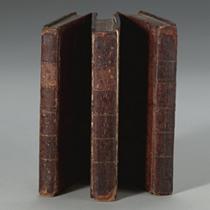
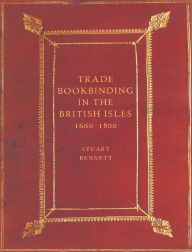
JAIV: You have published the book Trade Bookbinding in the British Isles (2004), which surely comes into this story with the variety of publishers and booksellers and Vanessa’s publication of children’s books. What were the realities of publishing in the Regency period? And how different from today? …
Indeed, you created your own press [the aptly named Longbourn Press!] to publish your book, as well as offer it as a kindle ebook. Did you try to publish with a traditional publisher? And how is this form of publishing any different from what was available to Jane Austen as a first time novel-writer [sell her copyright outright or pay for printing and marketing costs herself, etc.]?
SB: I’ve given a couple of clues about Regency publishing in my previous answer. “How different from today?” Well, today’s publishing, with Kindle etc., seems to me to be reverting more to the Regency model than otherwise, with those able to pay for self-publication able to get their books printed and distributed more easily than in the last half-century or so.
Regency publishers were, of course, always on the lookout for potential blockbusters, especially if they could buy the copyrights outright (often for small sums, like the ten pounds originally paid for Northanger Abbey – then titled Susan). Many women writers, often publishing anonymously, produced novels and other works, especially children’s books, at their leisure; others were desperate for money and sold manuscripts and copyrights for whatever they could get. Those (men and women) able to pay the cost of their own publications could negotiate commissions with commercial publishers. John Murray took only ten percent of the net proceeds of Jane Austen’s later novels, a deal which if available to J.K. Rowling might have made her a whole, whole lot richer than the Queen of England.
The Perfect Visit had wonderful literary agents in London and New York who offered the manuscript to commercial publishers in the even-darker-than-usual publishing days of early 2009. There were no takers; one London publisher described it as a nice “potential mid-list” novel, but not the blockbuster they were looking for. But some wayward typescripts kept bringing notes and e-mails, and when a couple of enthusiastic ones came from perfect strangers as far away asAustralia, I decided to consider the Amazon route. Another bonus, as a much-published friend observed: printing the book meant I had to stop revising.
JAIV: Well, I for one am certainly glad you listened to those perfect strangers! And yes, it is interesting to read about Austen’s publication history – very ironic that the only work for which she sold the copyright outright was Pride and Prejudice, always her most popular and enduring work.
One question I have about the story: what might the ethical issues be about this bringing of old manuscripts and books into the present to sell? even if the resulting profit is for a good cause?
SB: I think any reader’s guess is as good as mine. Would it be unfair to the original author? If so, how? Certainly if I could go back to Jane Austen’s time (not to mention Shakespeare’s) and buy new copies of her first editions to bring back to sell in 2012, I could also undercut the prices of my high-end bookselling colleagues. Does caveat emptor apply in such circumstances?
But of course the paramount ethical issue involves time-travel itself. Surely time-traveller appearances would change the past, à la Ray Bradbury’s “Sound of Thunder,” and so skew subsequent history. People who should have been born might not be, and vice versa.
Someone once wrote an apocalyptic story where only the very rich could afford to travel back in time to escape the end of the world. Against those kinds of fantasy possibilities, surely sneaking a few otherwise-vanished books and manuscripts out of their own times seems comparatively harmless. Or not?
JAIV: Yes, it is an interesting question – one way to look at it is to believe you might be preserving a work that would have been destroyed in a fire or such, and otherwise lost to posterity…. [and I do have to remember, this is a fiction, after all!]
Here is a very specific question about a book you mention: You place your heroine in a library reading The Invisible Gentleman– I had to research this one I confess – written in 1833 by J. Dalton, author of Chartley the Fatalist, and The Robber, all published by Edward Bull of Holles St, London… you call it “a heavy-handed historical romance set in the twelfth century” [p. 312]… no wonder Vanessa tossed it aside! – So I ask, why this book for that scene?? –
SB: Because Vanessa wished she were invisible – and because I found it on an 1833 list of novels “just published” and couldn’t resist.
JAIV: Oh good! glad I don’t have to add this to my TBR pile!
Can you share anything about your writing process? – When, Where, and How [and maybe even Why?] – any advice for budding writers?
SB: I don’t think this is any kind of advice for budding writers, but here’s the truth behind my Perfect Visit process. I’d written a couple of non-fiction books, lots of magazine articles on rare books and auctions, and during the 1980s attempted and abandoned a couple of novels. I knew a little bit about sitting down and writing, and even writing with deadlines. This helps.
But the inspiration for The Perfect Visit and its (unpublished) sequels came as a surprise. I have George R.R. Martin to thank – and if your readers aren’t sure who he is, the ubiquitous advertisements for the television version of his Game of Thrones gives the clue.
[SPOILER ALERT re: Game of Thrones] At the beginning of 2006 I started reading Martin’s “Fire and Ice” series (Game of Thrones is Book One). Initially I was hooked, but I started having doubts somewhere in Book Two. By the middle of Book Three (I’ve repressed the books’ individual names) I felt like I was being had, that the author had realized he was onto a cash cow and decided to turn what might have been a trilogy into a five-parter (is there a name for that?)
And Martin also killed off the one character I felt close to, whose name happened to be Ned. Sometime towards the end of January 2006 – I remember the moment – I flung Martin’s Book Three across the room, stood up, and said “I’m going to write a book I’d want to read.” The result was The Perfect Visit, central male character by name of Ned Marston.
I should add, in case I appear delusional, that I am in no doubt Mr. Martin’s formula has a much broader appeal than mine.
Are there any nuggets of gold here for budding writers? I don’t know. All I can say is that once I started, my characters took over large parts of my life. They woke me up in the middle of the night with their dialogues; I started walking to work with bits of paper in my pockets so I could write down what they were doing and more of what they had to say. And I would scribble, or clatter away on the computer most mornings, until I thought I’d done them some kind of justice. Then I’d work at my business until the characters interrupted all over again. The original typescript of The Perfect Visit went on, and on. . . .
JAIV: I love this story of your inspiration! [I have always thought a really good blog post would be to question people about the one book they most remember throwing across the room!] I have not read the “Fire and Ice” books but do admit to being quite absorbed with the Game of Thrones on HBO, and like you, stunned at the outcome of Book I – indeed the only character I liked as well [being Sean Bean helps too!]
You mention above other books revolving around The Perfect Visit. Can you tell us more about these? A sequel to this tale, or another time-travel book to another time? And if so where would you next most like to go?
SB: Oh yes, there are a couple of sequels, one close to finished, and a kind of “part-prequel” set in 1823 in which Vanessa discovers the “truth” behind a lost episode in Jane Austen’s life. There’s even, for better or worse, a half-written (maybe “half-baked” would be a better term) prequel about Ned Marston’s adventures in classical Greece.
JAIV: Can’t wait!
And finally, in your answer to my question on London – because it was so convoluted and actually contained four questions, so no guilt please for missing it! – I asked what is your favorite London haunt, other than perhaps the British Library?
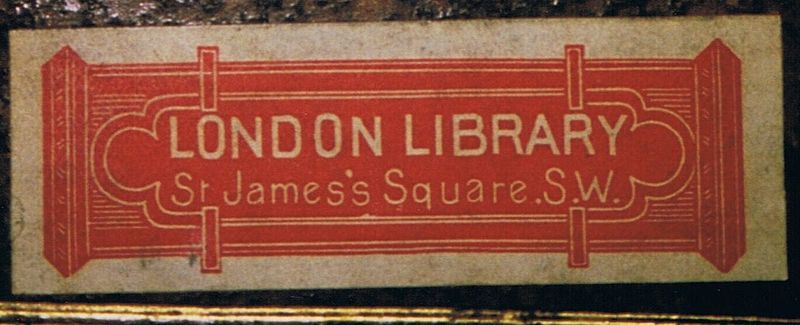
SB: I confess I love the London Library more than the British. It’s climbing around in the stacks that does it, and all the books you find that way that you’d otherwise never known existed.
London Library - Geograph.uk
London Library label – wikipedia
But you asked my favorite London haunt, and I have to confess a hopelessly bourgeois affection for the Wolseley restaurant on Piccadilly. I take myself there for breakfast whenever I can, all alone, reveling in perfectly-cooked bacon and eggs, and the best pastries in the universe. People-watching there brings me as close as I can get to the way I think Vanessa must have felt at Molland’s Tea-Rooms in Bath.
The Wolseley, London
JAIV: You make me want to go back to 1833! Just for a cup of tea!
Thank you Stuart for answering all my questions – you have been a gentleman and a scholar and I appreciate it!
Readers, please ask any question you might have for Stuart or leave a comment on either this post or the Part I post, and you will be entered into the random drawing for a copy of The Perfect Visit. Please do so by 11:59 pm, April 15, 2012. The winner will be announced on Monday April 16, 2012 – all are welcome to particpate, i.e. worldwide eligibility.
*******************
Stuart Bennett was an auctioneer at Christie’s inLondon before starting his own rare book business. He is the author of the Christie’s Collectors Guide How to Buy Photographs (1987), Trade Binding in the British Isles (2004) which the London Times Literary Supplement called “a bold and welcome step forward” in the history of bookbinding, and many publications on early photography, auctions and auctioneers, and rare books. He currently lives and works near Boston, Massachusetts.
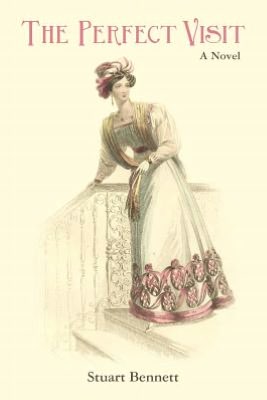
The Perfect Visit, by Stuart Bennett
Longbourn Press, 2011
ISBN: 9780615542706
The Perfect Visit (Longbourn Press, 2011) is, no way to say it otherwise, a perfect treat – who of us would not want to spend a few days [or pull an all-nighter!] in the company of a time-travelling couple who are each in turn lovers of books, Jane Austen, Shakespeare, and just possibly each other? –
Today I welcome the author Stuart Bennett for a blog interview where we talk about how a rare bookseller became a writer of a first novel that brings to life both Jane Austen and Shakespeare, takes us on a whirlwind tour of their times, regales us with book history as we trek about the bookstalls of London and Bath, and all this in a mere 342 pages, a book sure to take a prime spot on your bookshelf. So join us today for Part I of the interview, stay tuned for Part II this weekend, and enter the Book Giveaway by commenting or asking a question on either post before 11:59 pm 15 April 2012. Winner will be announced on Monday April 16, 2012 (worldwide eligibility).
************************
Welcome Stuart! Thank you so much for joining us here at Jane Austen in Vermont. I have known of you for a good number of years as a rare bookseller and for a time president of the ABAA [Antiquarian Booksellers’ Association of America] – needless to say when I discovered you had recently published this book on Jane Austen [the title even comes from Emma: “It was a delightful visit; – perfect in being much too short.” [Vol. I, Ch. XIII]] – I saw my two worlds colliding in the most marvelous of cosmic alignments! I was so greedy to begin, I immediately downloaded it on my kindle, my hardcopy order far too slow to arrive, and was happily transported to the various times in your tale. So lets talk a bit about your background as a rare bookseller, your love of Jane Austen and Shakespeare [and how you dared to put both in the same tale!], the history of books, the time-travel bits, the woman-issue, and of course, just the sheer pleasure of a really nice romance…
*****************************
Talking about the story:
JAIV: To start, please explain the premise of your tale – a time-travel, book-loving love story that you say was first titled “A Bibliographical Romance” – so tell us about “The Project,” or at least a quick synopsis without giving too much away!
SB:It starts as the tale of two bibliophiles planning to go back in time to rescue lost books and manuscripts. Vanessa decides on Regency England; Ned goes to Shakespeare’s. But they both have their own agendas as well. Vanessa wants to rewrite history. And Ned wants to meet the Bard himself.
Vanessa falls foul of the law, transported from Jane Austen’s genteel world to the dark underbelly of a Regency prison. 1607 London shows an equally black side to Ned when he antagonises one of Shakespeare’s rivals, escaping with his life only to find that an accident of time takes him only halfway home.
Talking about Jane Austen:
“It was a delightful visit; – perfect, in being too short.” [Emma, vol. 1, ch. 13]
JAIV: I know of your background as an antiquarian bookseller and former ABAA president – you have spent most of your life in books published before 1850. So why Jane Austen for you? And why Shakespeare? Why not Frances Burney or Chaucer? Is it their times or their works, their continuing popularity today?
SB:Jane Austen and Shakespeare are central to my book because I love them. A bookseller writing a “bibliographical romance” is committing a self-indulgent act – the more so with the presence of time-travel – and these two authors are part of it. Frances Burney is intriguing, but I confess that had Jane Austen never written (could I have written any kind of Perfect Visit without J.A.? – I doubt it) I might have been more tempted by Maria Edgeworth as a character. Or maybe Hester Lynch Piozzi. Chaucer and his world needs a true mediaevalist: I don’t have the knowledge of or empathy to go there.
JAIV: You say in your postscript: “It is a presumption of a very high order to bring both Jane Austen and William Shakespeare into a single work of fiction, let alone a first novel … of the two, somehow Jane Austen intimidates me more, even though Shakespeare is perhaps the greater genius.” Explain your thoughts on the intimidating Miss Austen!
SB:Wonderful question. What is it that’s so intimidating? I think it may be that, compared to Shakespeare, we really know quite a bit about Jane Austen’s life, notwithstanding the wholesale destruction of her letters by her sister and niece. And what we know seems domesticated and uneventful.
So how and why did she become, as I see her, the greatest novelist ever to write in English? One could ask a similar question about Shakespeare and his plays: how did the grammar-school boy from provincial Stratford manage those. And of course the fact that we know so little about Shakespeare’s life allows those in Shakespeare-denial (Oxfordians and similar snobs) scope for their own inventions. What we have of Jane Austen’s personal history is secure.
As a novelist it’s a relief to have no sense of what Shakespeare was like as a man, let alone as a conversationalist. I could invent quite freely. The real Jane Austen, on the other hand, survives in family memoirs and letters, and I considered it my job to try to be true to her. All I felt confident about at the time went into The Perfect Visit , but she haunts me still, and features much more largely in one of the two sequels/prequels to P.V. which are complete in first drafts but still have a long way to go.
JAIV: How and when did you first discover Jane Austen? – as a reader or a collector or as a bookseller? Or was your name [despite that extra “t”!] the impetus behind reading and writing about Jane Austen?!
SB:No to the last – I didn’t know there was a character in Jane Austen with my name mis-spelled until I was in my early twenties. J.A. wasn’t quite the household name she’s become in the last thirty years, and I think I was lucky in being no younger than twenty-one, at university in England, when first introduced to the novels via Emma. I couldn’t put it down.
(I should add, however, that I take comfort in the fact that my spelling of “Bennett” is the same as the street in Bath. Perhaps J.A. – or so I like to think – was recollecting the street as a good character name and simply forgot the last “t”.)
JAIV: I don’t like to ask this question because who can ever work through such a dilemma, but I always do because the answers are so enlightening – but first I would ask if Persuasion is your favorite Austen novel? – it figures prominently in your story: Ned’s reading Persuasion; he and Vanessa are in Bath and literally take a Persuasion tour [which was great fun!]; and their romance has echoes of the Anne / Wentworth story. ….
SB:Your question – I’m sure this won’t surprise you – contains its own answer. All the elements you describe in my book derive from my love of Persuasion. which seems to me to express most clearly Jane Austen’s own longings and losses, as the most autobiographical of all her novels.
JAIV: A lovely answer! Persuasion is my own favorite, and it is wonderful how you weave Anne Elliot’s tale into your own.
Is it every antiquarian bookseller‘s dream to actually visit the time of their literary hero[es]? To meet them as Vanessa meets Jane Austen and Ned William Shakespeare – is this your own vicarious dream? And has this time-travel story been in your head for the longest time? I know you have written non-fiction works on book collecting, but have you written other yet-unpublished novels or fictional pieces?
SB:I think I may have answered the salient points of this great question in the course of dealing with other questions, but I would add this: The most successful antiquarian booksellers I know don’t spend time dreaming about time-travel. Instead they get to the auctions and flea-markets I didn’t know existed, woo wealthy collectors, and have healthier bottom lines.
JAIV: Yes! That bottom line does get in the way of day-dreaming and novel-writing, doesn’t it?! Jane Austen’s very own problem as well!
We find, along with your heroine, that we are soon to be in Jane Austen’s presence:
“The first response to Vanessa’s knock was a rustle of papers, receding footsteps, and the creak of an interior door.” [p.5]
– and we know we are in Jane Austen’s house in Chawton! … and we are there almost holding our breath as Vanessa first meets her, describes her – how difficult was she to create on your page, knowing readers all have their very own Jane Austen in their head?
Chawton Cottage
SB:I did my very best to describe the physical J.A., and also Martha Lloyd, that emerge from contemporary accounts. As to that first conversation, as well as later ones, the Jane Austen I hear is graceful, a little shy, with a ready wit and even sarcasm, but fundamentally kind. Can any J.A. aficionado really demur to that?
JAIV: Your heroine Vanessa Horwood is what Mr. Darcy would call an “accomplished woman” – even your Jane Austen character says “I have, it seems, in one young woman a literary critic, a musician, a financier, and an apothecary.” [p. 7]. Is it fair to ask a male writer with a female protagonist, for a good part of the book at least – are you a little bit in love with your Vanessa?
SB:All’s fair, and of course I am. But I was also a little taken aback when many who know me best said that my Vanessa reminds them of me, and not always my most lovable side.
JAIV: Aah – you have created your own better half it seems!
The description of clothing is very exact! – may I ask if you tend toward Henry Tilney in “understand[ing] your muslins, sir”?
Morning Dress @1819, R. Ackermann [wikicommons]
SB:I hope so. But Ackermann’s Repository and other contemporary sources are a great help too, not to mention the modern books by the Cunningtons, e.g. Handbook of English Costume in the Nineteenth Century.
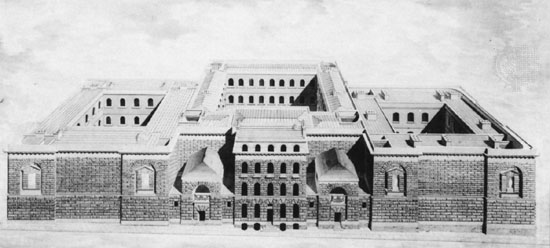
JAIV: As you mention above, these times had heavy realities that Austen kept in the background for the more astute reader to find – but they are there – your heroine is jailed for forgery and will likely hang or will be transported – so this part of your story tells this darker side, the underbelly of Regency life, especially for women. What was prison like and what resources did you use to make this seem so real?
Newgate Prison - eb.com
SB:I’ve read, and also bought and sold, so many accounts of English malefactors and their punishments in Regency and earlier times that I can’t really cite many of the sources that contributed to my sense of what a prison must have been like at that time. Did I get it right? Perhaps partly so, but I suspect the reality of most female penitentiaries was worse than I describe.
Two essential sources for the Regency period are those to which Elizabeth Fry (who makes an appearance in The Perfect Visit) contributed: Notes on a Visit to some of the Prisons in Scotland and the North of England with Elizabeth Fry (this was published by Elizabeth Fry’s brother Joseph John Gurney) and Observations, on the Visiting, Superintendence and Government of Female Prisoners.
Elizabeth Fry, by Charles Robert Leslie - wp
Talking about Time-Travel:
“Thus the whirligig of time brings in his revenges.” [Twelfth Night, Act V, Sc. 1] – [p. 113]
JAIV: This is a time-travel book: and filled with “Rules of Time –Travel” – are these of your own creation for this story or from other sources? A few of the “rules” for example:
-you cannot kill anyone
-cannot play modern music [in this case Vanessa playing Rachmaninoff if anyone is present]
-only organic clothing and material will pass through the time portal, so books, coins of the times, etc. will go, but no illuminated manuscripts
– the loss of the language of our 21st century life
-can only go the past, no travel into the future
SB:As a child I watched, and was haunted by an episode of The Twilight Zone in which (as I recall from my single viewing close to fifty years ago) a criminal transports to the past, remains a criminal, and murders his own grandfather.
Was it in the Wild West? I’m not sure. But what I remember is the image at episode’s end where the onscreen modern criminal dissolves saying something like “If I’ve just killed my grandfather, then how” [more dissolve] “can I” [almost gone] “exist?” That was the origin of the first rule. The others I developed as I sought consistency.
JAIV: Yikes! I remember that Twilight Zone episode! [also quite a faded memory!]. My other favorite was the 2-part Star Trek tale when Captain Kirk goes back in time and falls in love with Joan Collins – her character dies in “real life” and he must watch this and not step in to help so as not to completely alter the socio-political history of the future – I think I’ve seen that show 10 times! And it breaks my heart every time…
So, I must assume you are a fan of time-travel literature? Your favorite?
SB:As a kid I loved Robert A. Heinlein’s Door into Summer. And Ray Bradbury wrote perhaps the greatest of all time-travel short stories, “A Sound of Thunder,” from which “the butterfly effect” has become a scientific term of art. Alison Uttley’s Traveller in Time is a children’s book that transcends the genre (but then so do many of the best children’s books). More recently I sobbed my way through The Time Traveler’s Wife (too bad about the movie though).
JAIV: I haven’t watched the movie because I heard it was so dreadful – and yes, the book was sob-city-central!
Shakespeare’s time reads like a gazetteer of London as Ned tours around looking for booksellers and all things Shakespeare, with detailed street names and historical sites and bookseller stalls – You must be familiar with London, so I must ask what is your favorite book on London? And London during the Elizabethan period? The Regency period? And your favorite London haunt? [other than perhaps the British Library?!]
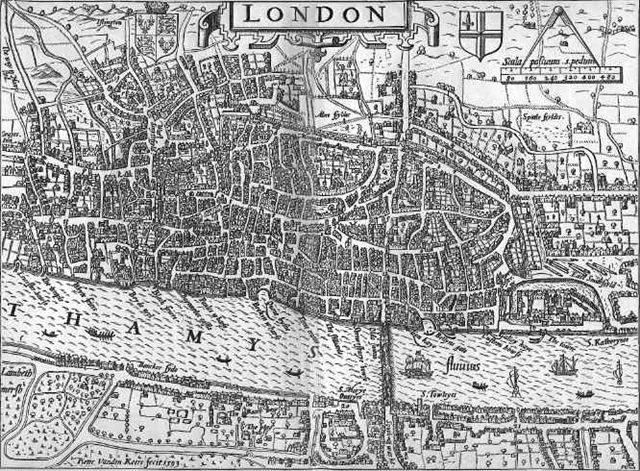
SB:Oh dear, I didn’t want to sound like a gazetteer. I lived more than ten years in London, and three in Bath, so much of what I wrote was from recollection. Then I went back, retracing my characters’ steps with period maps and other clues to get the street names right, and to remove bridges and buildings that weren’t there at the times I was writing about. I consulted all kinds of odd books, especially Regency ones, that I’d put aside during the course of my bookselling. Pierce Egan’s Walks through Bath (1819) is a good example, and a useful one too. For a modern book on London in Shakespeare’s time, the Oxford compendium Shakespeare’s England, first published in 1916, is still (I think) as good as it gets.
JAIV: On no! I meant that your book reading in parts like a gazetteer was a GOOD thing! I love the old London maps and had great fun following Ned around!
The topic of carriages interests me very much, and the question of calculating distances and times is a difficult one: you say a coach traveling to London from Winchester in 1817 [50 miles] took 7 hours. What sources did you use for those calculations?
SB:Contemporary travel guides are not easy to come by, and sometimes even give conflicting information, but quite a few of the Regency and later guides to London have appendices of travel times. I did the best I could with several of these.
JAIV: I love the little bit about Fanny Dickens, Charles’s oldest sister, though you do say you muddled the dates a bit – why Fanny and not other characters from the London or Bath of the time?
SB:My brain accumulates trivia, and from somewhere or other I knew Fanny Dickens was a talented pianist. That scene in Perfect Visit (I love it too – thank you) unexpectedly wrote itself one afternoon in the London Library where I was supposed to be doing other things. I couldn’t let go of that scene, even when I found out I’d muddled the dates. But with Fanny, Jane Austen, Elizabeth Fry, John Payne Collier, et al., already in the Regency parts of the novel, I felt that cluttering it up with even more celebrities would be too much of a good thing.
JAIV: Your Part III and IV are set in September 1833 [I will not ruin the plot and tell anyone the how and why!] – so without giving too much away, why this date?
SB:Touché! September 1833 imposed itself on an early draft of the novel when I was trying to figure out a way to get Ned to the early 19th century. My justification seemed compelling at the time, and then, quite suddenly, didn’t much matter at all. But I’d gone to a lot of trouble getting the topography and costume of 1833 London as close to right as I could, so I kept Ned there. I could invoke other reasons too, but I agree they would spoil the plot.
*****************************
Thank you Stuart! – we will continue our conversation this weekend – Gentle Readers, please ask any question you might have for Stuart or leave a comment on either this post or the Part II post, and you will be entered into the random drawing for a copy of The Perfect Visit. Please do so by 11:59 pm, April 15, 2012.
Stuart Bennett was an auctioneer at Christie’s in London before starting his own rare book business. He is the author of the Christie’s Collectors Guide How to Buy Photographs (1987), Trade Binding in the British Isles (2004) which the London Times Literary Supplement called “a bold and welcome step forward” in the history of bookbinding, and many publications on early photography, auctions and auctioneers, and rare books. He currently lives and works near Boston, Massachusetts.
The Perfect Visit, by Stuart Bennett
Longbourn Press, 2011
ISBN: 9780615542706
… Karen Field, who commented on 2-24-12 at 8:04 pm. Congratulations Karen! you have won a copy of Jane Austen in Love: An Entertainment by Elsa Solender. If you have a kindle [you mention that you do!], you can download the book here at Amazon.com, and I will reimburse you the $8.99 – or we will send you a copy of Dancing with Mr. Darcy,which includes Ms. Solender’s story “Second Thoughts.” Please let me know which you prefer and your contact information.
If I don’t hear from you by Friday March 9, 2012, I will draw another name.
Reminder!– today is the last day to comment on the post about Elsa Solender’s Jane Austen in Love: An Entertainment. Go here: http://tinyurl.com/73grlccand post your comment to be included in the drawing tomorrow March 5, 2012.
Well, I’m always interested in what authors think should or could have happened to these characters if Jane Austen had ever revisited them. But what intrigues me most about this book is how many well known authors participated in it – how many of them like Austen enough to want to write about her characters. I can’t wait to read them!
Congratulations Margay! Please email me [ jasnavermont [at] gmail [dot] com ]by Monday October 31st with your email and address and phone number, and I will have the book sent off to you right away. If I get no response I will draw another name.
Thank you all for your interesting comments about this book and all things Jane Austen! Let’s hope the dialogue never stops!
And an interesting NPR interview with two of the authors [husband and wife team Frank Delaney and Diane Meier] who have a story in this anthology titled “Faux Jane.”
Copyright @2011 Deb Barnum, of Jane Austen in Vermont



 Susannah Fullerton is President of JASA, and author of Jane Austen – Antipodean Views, Jane Austen and Crime, A Dance with Jane Austen, and her latest Celebrating Pride and Prejudice: 200 Years of Jane Austen’s Masterpiece – note that the UK title of this work is Happily Ever After: Celebrating Jane Austen’s Pride and Prejudice (Frances Lincoln, 2012).












 Jane Austen in Vermont