Austen Literary History & Criticism · Author Interviews · Books · Collecting Jane Austen · Jane Austen · JASNA · JASNA-Vermont events · Publishing History · Regency England

An Afternoon with Susan Wolfson and her Annotated Northanger Abbey

I welcome JASNA-Vermont member Margaret Harrington, who has written a few words on our last JASNA meeting. As part of the Burlington Book Festival, we were fortunate to have Susan J. Wolfson, Professor of English at Princeton University, speak on her annotated edition of Northanger Abbey (Harvard UP 2014). With many thanks to Champlain College for allowing us their fabulous space in Aiken Hall, to our hospitality team Hope Greenberg and Heather Brothers, and all our generous bakers for the usual delicious fare! We were all very honored for the opportunity to listen to and talk with Dr. Wolfson, who made us all love and appreciate Northanger Abbey all the more.

We at JASNA-Vermont also heartily thank JASNA (the Jane Austen Society of North America) for graciously offering us a grant so we could bring Dr. Wolfson to Vermont for this Burlington Book Festival event – we could not have done it without them!

******************

SusanW-NA

Susan J. Wolfson spoke on “Jane Austen before She Became Jane Austen” at our JASNA-Vermont September 27th meeting which was also an event for the Burlington Book Festival.

IMG_5292

Dr. Wolfson gave a multi-layered talk centered on Northanger Abbey, the first book Jane Austen wrote and sold. In an engaging lecture the Princeton professor placed the book into the history of the time so that we, the audience and readers, could understand events behind the episodes of the novel. We gained new insights into what captured the young author’s imagination because we were given a lively narration of the London riots, Sir William Pitt’s system of surveillance, the social circus in Bath, and most of all, the template of the Gothic novel on which Austen based Northanger Abbey.

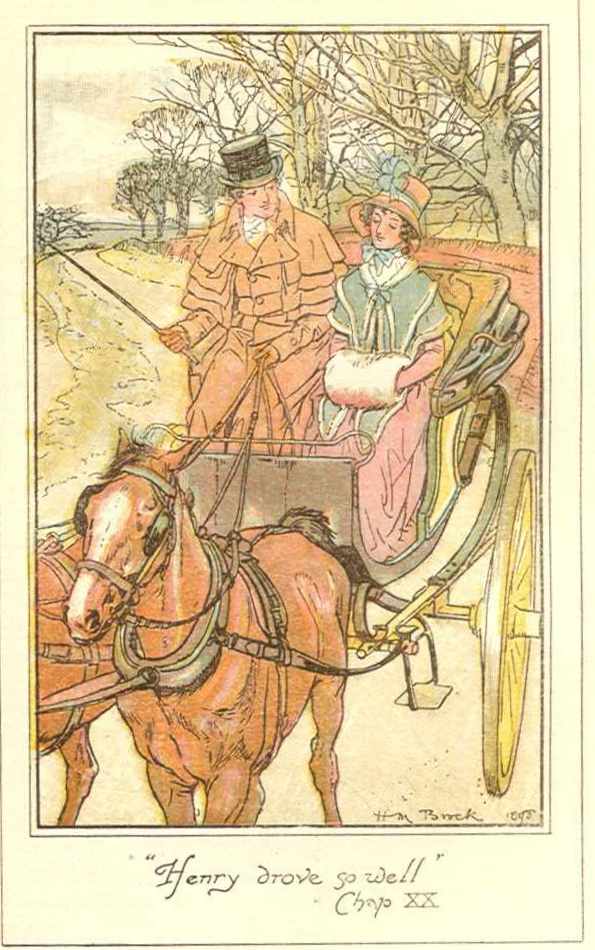
Wolfson’s talk wrapped the novel in the fabric of the society of the time so that we could understand the characters better, especially the dynamic between Henry Tilney and Catherine Morland. We also were given provocative ideas

Brock-NA-HenryDriving

such as Northanger Abbey is about training the mind of the reader, and that Jane Austen was not really interested in married life yet her first book has a Meta marriage plot. We learned that although this was her first novel it was not published until after the author’s death and there were years when it sat on the publisher’s shelf prompting Jane Austen to sign her complaint to the publisher as Mrs. Ashton Dennis, an acronym for MAD.

book cover-NA-WolfsonAs I write this short report, I have before me on my desk the Jane Austen Northanger Abbey Annotated Edition edited by Susan J. Wolfson. It is a beautiful book to see, to touch, to open, to smell, and soon I will be reading it. This gives a whole new life to the book for me because I had reread it on my eBook before the lecture. How wonderful to look forward to this edition after attending such an insightful, interesting, accessible, engaging talk.

**********

Some photos from our event:

IMG_5286

Co-Rc Marcia M

IMG_5279

Hope G setting up food

IMG_5281

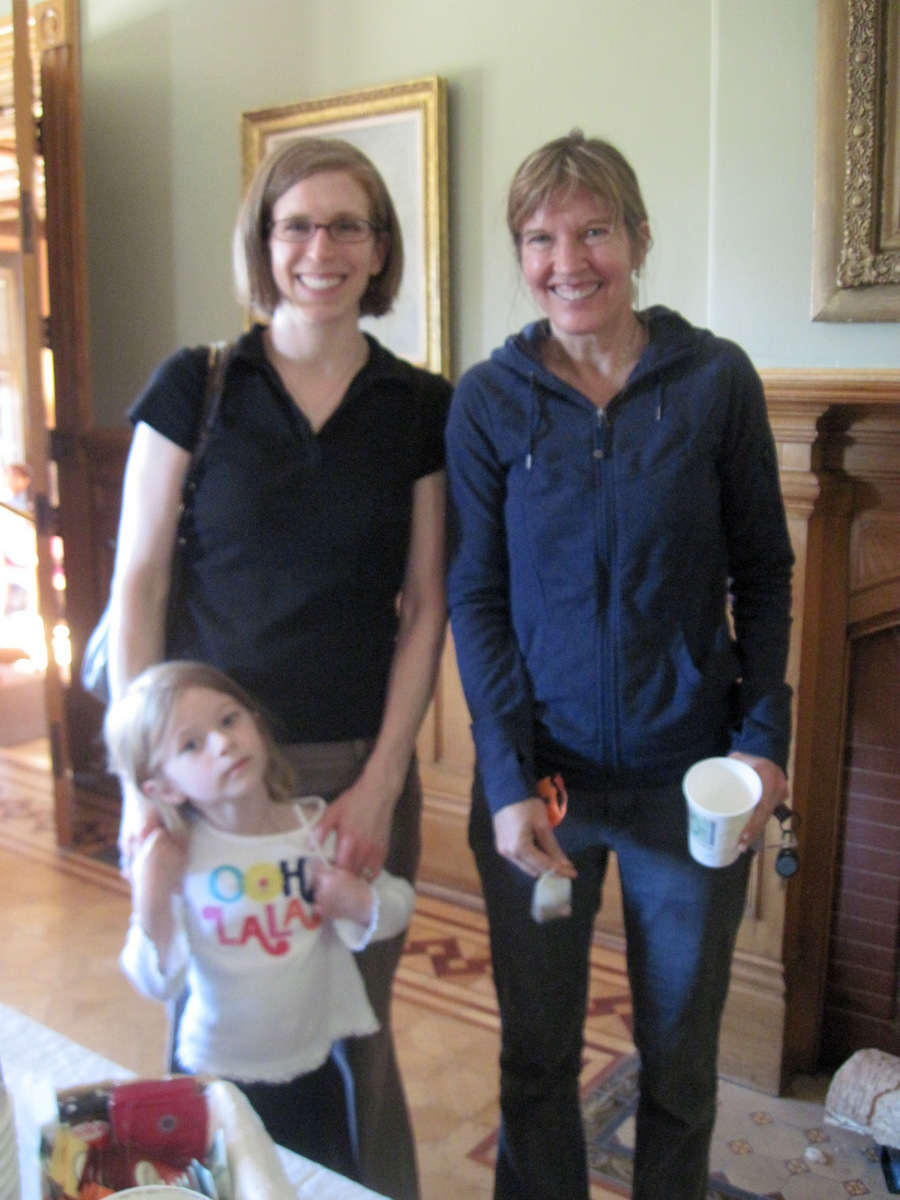
Heather B, Theresa R, and our youngest JASNA-Vermont member!

IMG_5282

Maryann P with more food

IMG_5297

Susan Wolfson with Champlain College student Kes S.

©2015 Jane Austen in Vermont; text and images by Margaret Harrington
Austen Literary History & Criticism · Fashion & Costume · Jane Austen · Jane Austen Popular Culture

Guest Post ~ The 2015 Jane Austen Summer Program on Emma ~ By Margaret Harrington

emma2015date*****************

We welcome today Margaret Harrington of JASNA-Vermont as she shares her thoughts on and several pictures from the 2015 Jane Austen Summer Program at the University of North Carolina, Chapel Hill that she attended in June.

**********

My Rave for the 3rd Annual JASP

EMMA At 200”

The Jane Austen Summer Program 2015
University Of North Carolina, Chapel Hill

by Margaret Harrington, JASNA-Vermont

Hope

Hope G – JASNA-Vermont fashionista

I had an excellent experience at this year’s Jane Austen Summer Program because I gained new insights into the marvelous book, Emma, and had a good time doing it. The JASP co-directors, Dr. Inger Brody and Dr. James Thompson, planned everything so astutely that each lecture flowed naturally into the following event and led participants happily up the road to new discoveries about Jane Austen. In my opinion, Emma is Austen’s most deeply realized character and she lives and breathes in Austen’s most intricately structured rural society, so it was a consummate pleasure to attend this conference and to come away with a deeper understanding of the book.

Participants were greeted warmly by the graduate students and volunteers. Every day and evening of the conference we were engaged with knowledgeable lecturers and wonderful events, plus dance instruction for the ball.

Highlights were Game Night, the Box Hill Picnic at Ayr Mount, and of course the welcoming dinner, the Duchess of Richmond’s Regency Ball and a delightful production of Austen’s “Henry and Eliza” by the UNC players.

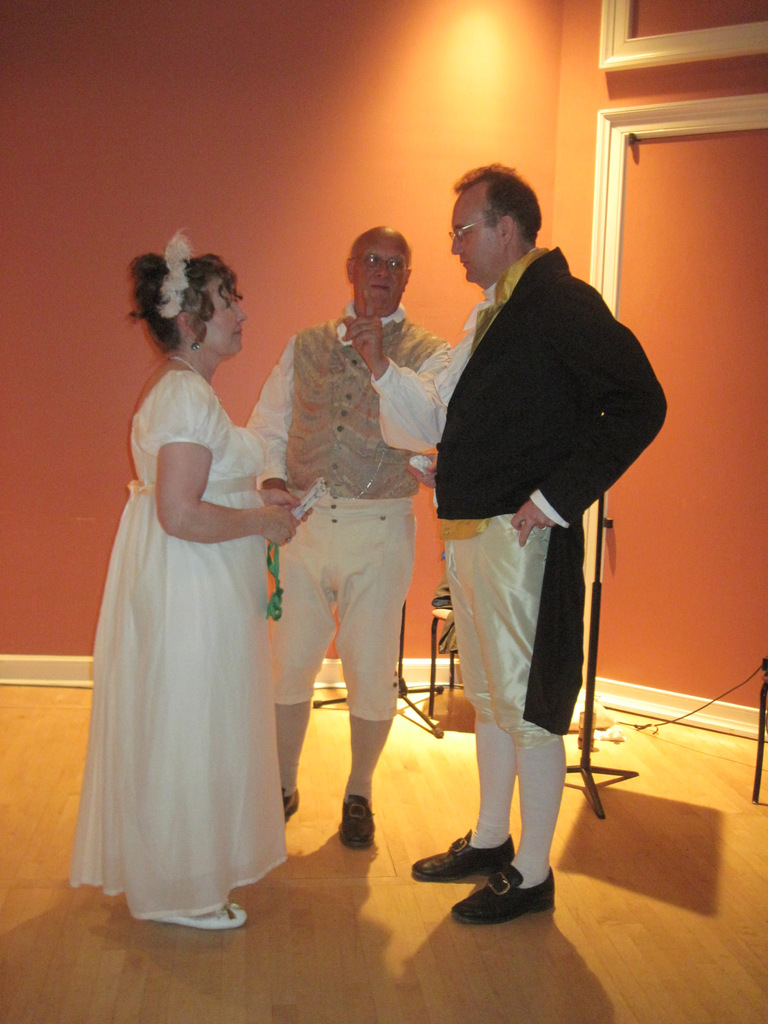
These pictures feature Hope Greenberg from JASNA-Vermont who wore different costumes of her own making for every occasion.

I certainly plan to return for next year’s JASP and Mansfield Park.

IMG_4898
Hope turbaned…

IMG_4906

Strawberries!

IMG_4912

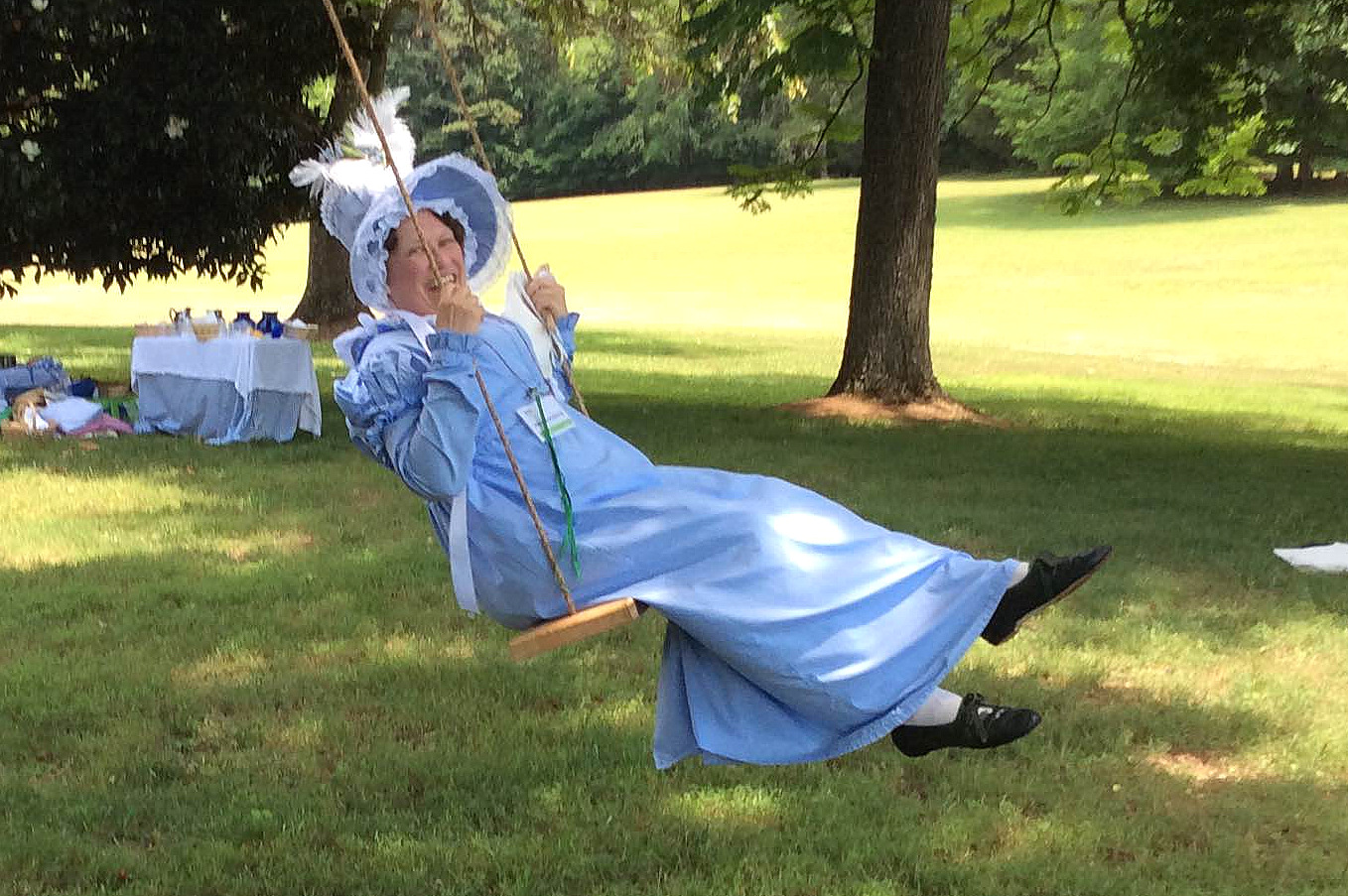
Hope off her swing

IMG_4913

Box Hill anyone?

IMG_4917

Presenting “Henry and Eliza”

IMG_4922

Deciphering Emma‘s many puzzles

IMG_4934

Off to the Duchess of Richmond’s Regency Ball…

IMG_4951

Learning to not dance like a savage … (oops! wrong book…)

IMG_4954

“…she had herself the highest value for Elegance…”

********************

Thank you Margaret for sharing your photos with us (but alas! none of you!) – it looks to have been a grand time!

mansfield

For more information on the JASP “Emma at 200” you can see the full schedule here. But rather than feeling sad that you missed it all this year, you can already start planning to participate in next year’s JASP – read about it here:

Fourth Annual Jane Austen Summer Program

Mansfield Park & its Afterlives”

June 16-19, 2016

Chapel Hill, North Carolina

The JASP website is worth a visit: it offers several teaching guides based on the various talks at JASP: on food, medicine, games, and class status in Emma, Austen’s use of free indirect discourse, an adaptation of “Henry and Eliza” – among others – good stuff here! http://janeaustensummer.org/teaching-guides/

jasp-bracelet

And finally, JASP offers a replica of this beautiful Jane Austen bracelet as a fund-raiser for the Jane Austen Summer Program. Cost is $120.00 plus $5 shipping fees. You can order it here.

c2015 Jane Austen in Vermont, photos courtesy of Margaret Harringon
Author Interviews · Book Giveaway · Books · Georgian England · Regency England

Julie Klassen’s Lady Maybe Giveaway ~ and the winner is….

… Nancy M – who wrote on September 10th

I think I have all your books aside from the latest. And they sound very intriguing. I will be happy to get them both!

Cover-LadyMaybeNancy, please email me with your contact information (address, phone, email) and the book will be sent out to you directly from Julie’s publisher.

Thank you all so much for commenting – Sorry you couldn’t all win – but suggest you order Lady Maybe pronto…(and The Painter’s Daughter in December!)

And hearty thanks to Julie for sharing her love of England and for writing such delicious stories!

©2015 Jane Austen in Vermont
Author Interviews · Book Giveaway · Book reviews · Jane Austen · Regency England · Social Life & Customs

Author Julie Klassen on her Lady Maybe ~ With Book Giveaway!

Is there a better summer read (we still have three weeks left – don’t rush it please!) than a Regency Romance? And one laced with a mystery, a good number of secrets, and echoes of Jane Eyre?  [Please see below for the Book Giveaway info].
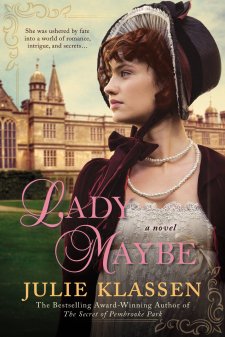
Cover-LadyMaybeJulie Klassen’s latest title is Lady Maybe, a tale of a young woman, an unwed mother, who does all in her power to protect her son, and unwilling to divulge the father’s name. This is one of the many intriguing secrets in this historical romance, and once again Klassen portrays the gruesome reality of the “fallen woman” in Regency England – Hannah Rogers’ only choice is to leave home and try to manage on her own, an impossible task in a world where women are the victims of a system that affords them no way to survive alone, or at least survive respectably.

The book begins with a horrible carriage accident and from there we encounter so many secrets and betrayals that to write any sort of substantial review would spoil the reading journey! Nothing is as it seems – you must puzzle it all out along with the characters – and though it is clear who our Heroine is after the first few chapters, the Real Hero is not truly revealed until the end. And along the way, any number of social issues in early nineteenth-century England are spread before the reader: the plight of unwed mothers, the difficulties of divorce, the prejudicial justice system, and the vagaries of gossip – all this, with some compelling bits of Jane Eyre hovering about, makes Lady Maybe an engaging must-read.

I interviewed Julie here earlier this year for her The Secret of Pembroke Park  – so today I asked her to share with us something about Lady Maybe, and here she tells up how she chose the North Devon coast as the setting for this story.

*****************

On a Cliff’s Edge

                          by Julie Klassen

Jokingly, I say the real reason I write books is to justify my long-held desire to travel to England. But the truth is, my research trips there enrich my novels’ settings and add a great deal of historical detail. So far, I’ve been able to go three times.

While writing Lady Maybe, set in Regency England, I needed to find a road dangerously near a cliff’s edge overlooking the sea. Initially, I searched for the location using Google Earth, old maps, and web sites. I finally found the ideal setting—a coastal road in North Devon along the Bristol Channel near Lynton & Lynmouth. These twin villages are nestled amid the dramatic landscape of Exmoor National Park—also the setting of the novel Lorna Doone by R.D. Blackmore.

I wrote my first draft before I ever visited the area. Then, last year, an old friend and I had the privilege of traveling there. We drove on winding, breathtakingly-narrow roads as far as we could, then continued on by foot, walking on a carriage road hundreds of years old. Wind whipped hair in our faces, pulled hoods from our heads, and drowned out our voices as we searched for the perfect spot to send a carriage careening down into the water far below. Standing on the edge of that cliff, overlooking the sun-streaked blue and gray water, the opening scenes began to play like a movie in my mind: a lady’s companion, a carriage accident, and a desperate woman trying to rescue her child…
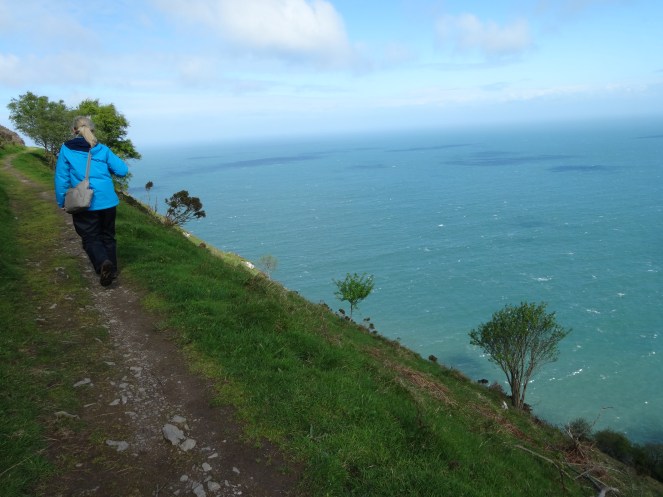
Lynton, cJulie Klassen

[Lynton, © Julie Klassen]

During an earlier trip to England, my husband and I visited a carriage museum in Devon. There, I learned the difference between a landau, barouche, traveling chariot, gig, chaise, and more. How fascinating to see so many historic carriages up close, to peer into the rich interiors, and imagine my characters heading off on their life-changing journey.

barouche

[a Barouche]

I hope readers will enjoy the journey as well!

************

Lady Maybe synopsis (from the rear cover):

A woman’s startling secrets lead her into unexpected danger and romance in Regency England…

One final cry…”God almighty, help us!” and suddenly her world shifted violently, until a blinding collision scattered her mind and shook her bones. Then, the pain. The freezing water. And as all sensation drifted away, a hand reached for hers, before all faded into darkness…

Now she has awakened as though from some strange, suffocating dream in a warm and welcoming room she has never seen before, and tended to by kind, unfamilar faces. But not all has been swept away. She recalls fragments of the accident. She remembers a baby. And a ring on her finger reminds her of a lie.

But most of all, there is a secret. And in this house of strangers she can trust no one but herself to keep it.

Lady Maybe
Berkley Trade, July 2015
Price: $16.
ISBN: 978-0-425-28207-6

**************************

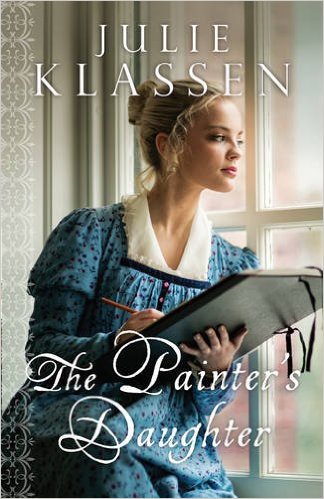
For those of you who love Klassen’s Regency novels, the wait for the next one is short one! The Painter’s Daughter will be released on December 1, 2015 (it is available for pre-order now). Here is the synopsis:
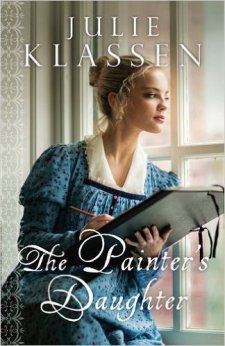
cover-PaintersDaughter

Sophie Dupont, daughter of a portrait painter, assists her father in his studio, keeping her own artwork out of sight. She often walks the cliffside path along the north Devon coast, popular with artists and poets. It’s where she met the handsome Wesley Overtree, the first man to tell her she’s beautiful. Captain Stephen Overtree is accustomed to taking on his brother’s neglected duties. Home on leave, he’s sent to find Wesley. Knowing his brother rented a cottage from a fellow painter, he travels to Devonshire and meets Miss Dupont, the painter’s daughter. He’s startled to recognize her from a miniature portrait he carries with him–one of Wesley’s discarded works. But his happiness plummets when he realizes Wesley has left her with child and sailed away to Italy in search of a new muse. Wanting to do something worthwhile with his life, Stephen proposes to Sophie. He does not offer love, or even a future together, but he can save her from scandal. If he dies in battle, as he believes he will, she’ll be a respectable widow with the protection of his family. Desperate for a way to escape her predicament, Sophie agrees to marry a stranger and travel to his family’s estate. But at Overtree Hall, her problems are just beginning. Will she regret marrying Captain Overtree when a repentant Wesley returns? Or will she find herself torn between the father of her child and her growing affection for the husband she barely knows?

*********************

Author Julie Klassen 2015 x 200About the Author:

Julie Klassen loves all things Jane—Jane Eyre and Jane Austen. She is the bestselling author of ten novels set in Regency England, including her new release, Lady Maybe. Julie is a member of the Jane Austen Society of North America, and enjoys traveling to England to research her books whenever she can. A graduate of the University of Illinois, Julie worked as a fiction editor for sixteen years and now writes full time. Three of her novels have won the Christy Award for Historical Romance. She also won the Minnesota Book Award, and has been a finalist in the Romance Writers of America’s RITA Awards. Julie and her husband have two teenaged sons and live in St. Paul, Minnesota.

For further reading:

Julie’s other novels:

  • Lady of Milkweed Manor (2008)
  • The Apothecary’s Daughter (2009)
  • The Silent Governess (2010)
  • The Girl in the Gatehouse (2011)
  • The Maid of Fairbourne Hall (2012)
  • The Tutor’s Daughter (2013)
  • The Dancing Master (2014)
  • The Secret of Pembrooke Park (2014)
  1. Website: http://www.julieklassen.com/
  2. Her research page, with pictures: http://www.julieklassen.com/Research.html
  3. Facebook page: https://www.facebook.com/pages/Author-Julie-Klassen/102060596587055
  4. Twitter page: https://twitter.com/Julie_Klassen

****************

Book Giveaway!

Please comment or ask a question of Julie in the box below to be entered into the random drawing for a copy of Lady Maybe, with hearty thanks to Julie and her publisher Berkley Books. Deadline is Tuesday September 15, 2015 11:59 pm – winner will be announced the next day – domestic mailings only, sorry to say.

Good Luck! and Thank You Julie!

©2015, Jane Austen in Vermont
Austen Literary History & Criticism · Books · Collecting Jane Austen · Jane Austen · Jane Austen Societies · JASNA · JASNA-Vermont events · Literature · Publishing History · Schedule of Events

JASNA-Vermont September Meeting ~ Susan Wolfson on Northanger Abbey

You are Cordially Invited to JASNA-Vermont’s September Meeting

at the Burlington Book Festival 

Northanger Abbey: Jane Austen’s First Novel,
before she was ‘Jane Austen.’”

with

Susan Wolfson,* Professor of English at Princeton University,
and editor of Jane Austen’s Northanger Abbey: An Annotated Edition**

book cover-NA-Wolfson

Sunday September 27, 2015, 1:00 – 3:00 pm 

Morgan Room, Aiken Hall,
83 Summit Street
Champlain College, Burlington VT***

********

Sponsored by JASNA-Vermont and Bygone Books,
funded in part by a grant from the Jane Austen Society of North America.

~ Free & open to the public ~ ~ Light refreshments served ~ 

For more information:   JASNAVTregion [at] gmail [dot] com
Please visit our blog at: http://JaneAustenInVermont.wordpress.com
Burlington Book Festival website: http://burlingtonbookfestival.com/ 

************************************ 

S.Wolfson.2015*Susan Wolfson is Professor of English at Princeton University, where she is a specialist in British Romanticism, a field in which she teaches Jane Austen’s novels. She has recently produced the Harvard Annotated Northanger Abbey, a unique edition of the novel’s text that hews, with less intervention than standard editions, to the text of the 1818 publication, and as with other volumes in the Harvard series, includes page-by-page annotations, illustrations, and other supplementary materials. With her husband Ronald Levao, she has also edited Mary Shelley’s Frankenstein for the same series. And with her colleague Claudia L. Johnson, she edited Pride and Prejudice for Longman Cultural Editions, of which she is the General Editor, and in this capacity has supervised Emma (edited by Frances Ferguson), and Persuasion (edited by William Galperin). Her most recent book is Reading John Keats (Cambridge), about Keats as a reader as well as a writer, and about how this readerly quality shapes and stimulates how he is read (very Austenian in this way!). Susan Wolfson received her PhD from the University of California, Berkeley, and taught at Rutgers University New Brunswick for 13 years, before her present appointment at Princeton. Widely published in the field of Romantic-era studies, she is the recipient of grants and fellowships from the ACLS, the Guggenheim Foundation, the National Endowment for the Humanities, and the Andrew W. Mellon Foundation. 

**The book will be available for purchase and signing
***Aiken Hall is located at 83 Summit Street [#36 on map]. Park on the street or in any College designated parking during the event: https://www.champlain.edu/Documents/Admissions/Undergraduate%20Admissions/Campus-Map.pdf

book cover-Keats

Hope you can join us!

*********

Dates for your Diary

December 6, 2015:
Annual Birthday Tea & Ball at the Essex Inn –
Celebrating 20 years of the 1995 Pride & Prejudice mini-series!
– details forthcoming
(Colin Firth is welcome if he is available and happens to be in Vermont…)

c2015, Jane Austen in Vermont
Austen Literary History & Criticism · Georgian England · Jane Austen · Regency England · Social Life & Customs

Janine Barchas on “Tastes of Home in Emma” ~ from Jane Austen Society Nederland

A great article on Emma by Janine Barchas:

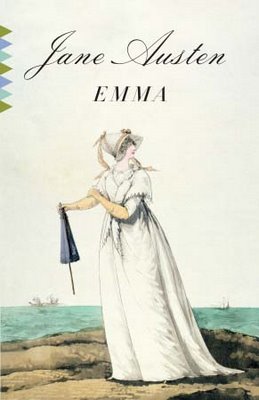
emma-vintage

Tastes of Home in Emma

                                           by Dr Janine Barchas

Whereas Marcel Proust offers us one evocative madeleine, Jane Austen talks of pork, apples, and cheeses.

I was born in Holland, where I spent my childhood in Den Haag until the age of eleven. I now live in Texas and, like all displaced souls around the globe, know what it is like to crave foods whose tastes and smells convey a sense of home (for me that includes hagelslag, stroopwafels, oude kaas, pannekoeken met spek, and, of course, verse haring). Although my fancy local grocery store in Austin, Texas, now carries many of the Dutch foods from my youth (or the ingredients that would allow me to make them myself), part of me protests the very idea of relocated delicacies. Some foods are simply not going to taste the same in a different place. Eating imported stroopwafels in Texas (perversely made with honey instead of echte stroop) violates a palpable sense of authenticity and belonging.

In many respects, Emma is a novel about that sense of belonging to a certain place, which Austen rather grandly refers to as “amor patriae.” Remarkably, in Emma the central action never leaves Highbury, a small imaginary village in Surrey. All of Austen’s other heroines, whatever their financial or social dependence, traverse significant geographic distances, travelling by necessity or pleasure to multiple counties and towns, including fashionable cities like London and Bath, or seaside resorts like Lyme Regis. But the “handsome, clever, and rich” Emma Woodhouse has never seen the sea and admits that the picnic at celebrated Box Hill, a mere seven miles away, is her first-ever sojourn to even this nearby tourist spot. Critics are divided about the novel’s narrow focus, with some warming to Emma’s small-town setting as snug or consoling and others detecting an acute claustrophobia or constant dread of feeling trapped and boxed in (think of all those puns hiding in Box Hill and Boxing Day)….

Continue reading at the Jane Austen Society Nederland website – Barchas on Emma.

*******************

barchas-janineJanine Barchas is Associate Professor of English at the University of Texas at Austin.  She is the author of  Matters of Fact in Jane Austen: History, Location, and Celebrity (Johns Hopkins University Press, August 2012).  Her  first book, Graphic Design, Print Culture, and the Eighteenth-Century Novel (Cambridge UP, 2003), won the SHARP book prize for best work in the field of book history.  You can visit (and spend hours browsing!) her online digital project What Jane Saw (www.whatjanesaw.org) which includes the gallery of the British Institution that Jane Austen visited on May 24, 1813. Look for the upcoming “Shakespeare Gallery of 1796” on this website as well . Barchas, along with colleague Kristina Straub, will be curating an exhibition at the Folger on Will & Jane: Shakespeare, Austen, and the Cult of Celebrity – look for this in 2016.

c2015, Janine Barchas

Great Britain - History · Jane Austen · Jane Austen Popular Culture

The Jane Austen in Worthing WOW Festival

Re-blogging this from Julie at Austenonly – all about celebrating Jane Austen in Worthing…with thanks to Janet Clark and Julie!

Austen Literary History & Criticism · Jane Austen · Regency England · Social Life & Customs

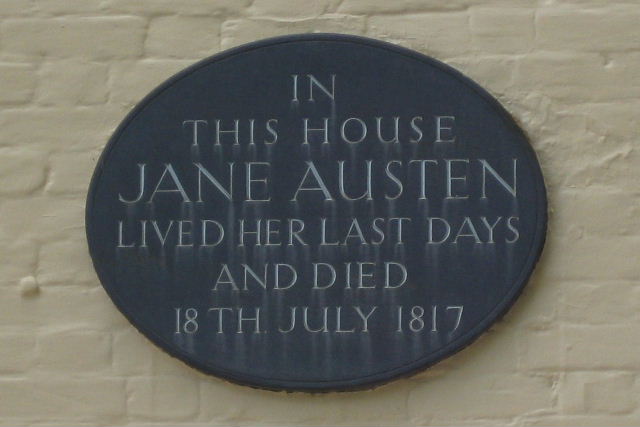
In Memory of Jane Austen ~ July 18, 1817

[I append here the post I wrote in 2009 on this day]

July 18, 1817.  Just a short commemoration on this sad day…

No one said it better than her sister Cassandra who wrote

have lost a treasure, such a Sister, such a friend as never can have been surpassed,- She was the sun of my life, the gilder of every pleasure, the soother of every sorrow, I had not a thought concealed from her, & it is as if I had lost a part of myself…”

(Letters, ed. by Deidre Le Faye [3rd ed, 1997], From Cassandra to Fanny Knight, 20 July 1817, p. 343; full text of this letter is at the Republic of Pemberley)

There has been much written on Austen’s lingering illness and death; see the article by Sir Zachary Cope published in the British Medical Journal of July 18, 1964, in which he first proposes that Austen suffered from Addison’s disease.  And see also Claire Tomalin’s biography Jane Austen: A life, “Appendix I, “A Note on Jane Austen’s Last Illness” where she suggests that Austen’s symptoms align more with a lymphoma such as Hodgkin’s disease.

The Gravesite:

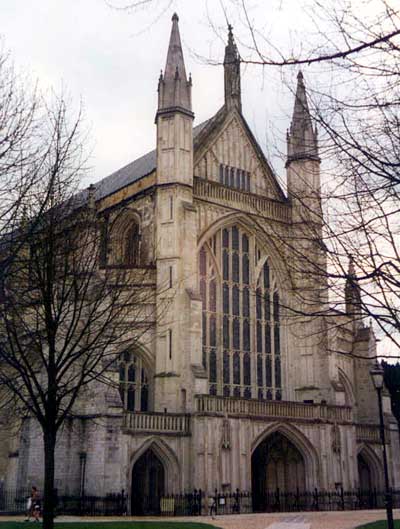
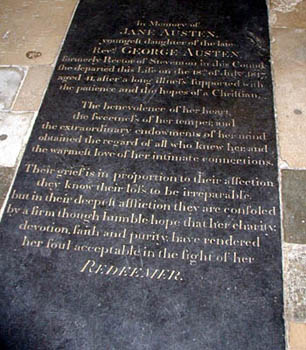
Austen is buried in Winchester Cathedral

….where no mention is made of her writing life on her grave:

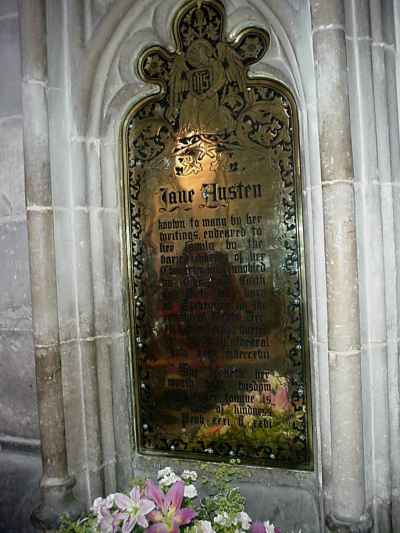
It was not until after 1870 that a brass memorial tablet was placed by her nephew James Edward Austen-Leigh on the north wall of the nave, near her grave:

It tells the visitor that:

Jane Austen

[in part] Known to many by her writings,
endeared to her family
by the varied charms of her characters
and ennobled by her Christian faith and piety
was born at Steventon in the County of Hants.
December 16 1775
and buried in the Cathedral
July 18 1817.
“She openeth her mouth with wisdom
and in her tongue is the law of kindness.”

The Obituaries:

David Gilson writes in his article “Obituaries” that there are eleven known published newspaper and periodical obituary notices of Jane Austen: here are a few of them:

  1. Hampshire Chronicle and Courier (vol. 44, no. 2254, July 21, 1817, p.4):  “Winchester, Saturday, July 19th: Died yesterday, in College-street, Miss Jane Austen, youngest daughter of the late Rev. George Austen formerly Rector of Steventon, in this county.”
  2. Hampshire Telegraph and Sussex Chronicle (vol. 18, no. 928, p. 4)…”On Friday last died, Miss Austen, late of Chawton, in this County.”
  3. Courier (July 22, 1817, no. 7744, p. 4), makes the first published admission of Jane Austen’s authorship of the four novels then published: “On the 18th inst. at Winchester, Miss Jane Austen, youngest daughter of the late Rev. George Austen, Rector of Steventon, in Hampshire, and the Authoress of Emma, Mansfield Park, Pride and Prejudice, and Sense and Sensibility.  Her manners were most gentle; her affections ardent; her candor was not to be surpassed, and she lived and died as became a humble Christian.” [A manuscript copy of this notice in Cassandra Austen’s hand exists, as described by B.C. Southam]
  4. The Hampshire Telegraph and Sussex Chronicle published a second notice in its next issue (July 28, 1817, p. 4) to include Austen’s writings.

There are seven other notices extant, stating the same as the above in varying degrees.  The last notice to appear, in the New Monthly Magazine (vol. 8, no. 44, September 1, 1817, p. 173) wrongly gives her father’s name as “Jas” (for James), but describes her as “the ingenious authoress” of the four novels…

[from Gilson’s article “Obituaries”, THE JANE AUSTEN COMPANION [Macmillan 1986], p. 320-1]

Links to other articles and sources:

Copyright @2015 Jane Austen in Vermont
Georgian England · Great Britain - History · Jane Austen · Jane Austen Popular Culture · JASNA · JASNA-Vermont events · London · Regency England

Guest Post ~ “Encountering Jane Austen…”

Governors house

My friend Suzanne is the Innkeeper at the Governor’s House in Hyde Park, Vermont, where she four times a year holds Jane Austen Weekends for those of us who like to retreat into the early 19th century for a few days. She also offers an annual In-Character Weekend, where all manner of various Austen characters people the Inn and where one must remain in character for the whole time or risk being evicted… it is all in good fun, what with archery, and fencing, and quill-making and dancing and efforts to make bonnets and turbans , one easily forgets the call of the internet or the chatter of cell phones, and as long as a resident Lady Catherine or Mr. Collins, or a grave General Tilney do not ruin the festivities, one can really get quite lost in it all. One such weekend is coming up August 7-9, 2015 and you can read all about it here: Governor’s House-JA weekends.

But I write here today about Suzanne’s and my Love of London, discovered several years ago, and about which we have yet to stop talking… We have been there together, and alas! separately, and as she was in the UK this spring without me (I am struggling to forgive her…), I here offer a post that Suzanne wrote on her Innkeeper’s blog a few weeks ago about her latest trip and the rather alarming number of encounters she had with Jane Austen! – here is the first paragraph with a link to the rest of the post … a perfect trip for armchair travelers!

************

Encountering Jane Austen

After a tough Vermont winter and a serious bout of flu what form of R and R would be good before getting back to the 24/7 business of running a small inn? As is so often the case, a little Jane Austen seemed like a good plan. I’d been noticing how amazingly often JA is mentioned in whatever I’m reading, from Mr. Churchill’s Secretary to a serious article in the Economist just last week. So I wondered how many encounters there might be as I did some walking in her part of England and decided to chronicle my adventures. And all I can say now is that it is a truth universally acknowledged that Jane Austen truly is everywhere!

Day 1

SB-NPG-Image-61

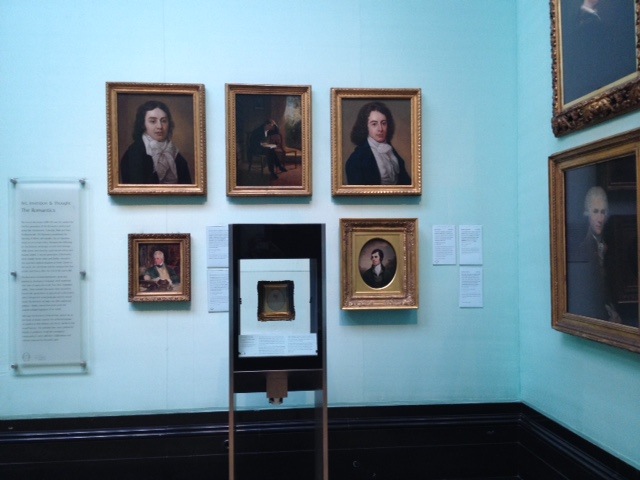
Arriving in London after an overnight flight, I immediately set out for a walk. First stop was Hatchard’s, England’s oldest bookshop founded in 1797. JA’s writings were well represented and it’s always a great place to look for guides to Regency London and places with literary ties, but the appeal for me is the list of authors who were also customers. Next stop was the National Portrait Gallery for “Sargent: Portraits of Artists and Friends”, John Singer Sargent’s striking portraits of Monet, Rodin, Robert Louis Stevenson and others, but certainly not JA who’d lived a century earlier. But returning the long way down from the third floor ladies, I came to this wall of JA’s contemporaries surrounding the tiny portrait of her we know so well.
Day 2… Continue reading at Suzanne’s blog here: http://www.onehundredmain.com/encountering-jane-austen/

**********

You can read more about the In Character Jane Austen Weekend for August 7-9, 2015 here: http://www.onehundredmain.com/events/jane-austen-weekends/ – it is not too late to sign up to give the performance of your life, Mr. Collins anyone?? and all you closet Mrs. Allens (dare I say Mrs. Norris??) can come and rave about your fashions to your heart’s content…

Showing off the Regency style turbans they made that afternoon in Hope Greenberg’s workshop

*********

On another note of interest to members of JASNA-Vermont – Suzanne is hosting us at the Governor’s House for an Afternoon Tea on July 26, 2015, from 2-4, where we will hear my good friend Ingrid Graff speak on “A Home of Her Own: Space and Synthesis in Sense and Sensibility.” As a member of JASNA, Suzanne is offering us this Tea at minimal cost to us, $8. / per person – reservations are required, so please email or call – invitations are being emailed later today to all on our JASNA-Vermont mailing list. Hope to see many of you there!

[Images courtesy of Suzanne B. from her Governor’s House website]

c2015 Jane Austen in Vermont
American History · Georgian Period · Jane Austen

Finding Jane Austen in the Most Unlikely Places: Savannah, Georgia

How to annoy friends and loved ones: offering daily proof that all things come back to Jane Austen, no matter the context. There have been a good number of very funny and unexpected results to support this theory – I always surprised and delighted in these “sightings” of Austen in the strangest places – my friends? – they merely roll their eyes. But a discovery a few weeks ago while on an architectural walking tour of Savannah Georgia might be the most bizarre yet… As we trekked around the beautiful and history-laden downtown, the whole of it a National Historic Landmark, our guide was asked how James Oglethorpe was able to communicate with the Native Americans he encountered when he chose Savannah for his settlement.

James Oglethorpe - HistoryCentral.com
James Oglethorpe – HistoryCentral.com

This was in 1733 and much later than the earlier colonies in South Carolina, Virginia, and those in the north, when Oglethorpe, under a charter granted by King George II, founded Georgia on the spot of this small river town. He started out with the best of intentions – he designed one of the most interesting towns likely ever planned and only thankfully for the machinations of a group of women in the 1950s, this city of twenty-two squares remains largely intact today (there were originally 24 squares). But Oglethorpe saw perfection not only in his architectural plan of Savannah – he expected it of his fellow colonists: no slavery, no Catholics (due to the proximity to the Spanish-controlled area of Florida just south), and no liquor…all of these prohibitions were eventually lifted.  [There is an old-wives tale that lawyers were banned as well, but I shall leave that to the history writers to separate fact from fiction!]

SavannahCityPLan-1734

Savannah City Plan 1734
source: http://www.georgiaencyclopedia.org/articles/history-archaeology/savannah-city-plan

[The original caption of this print by Paul Fourdrinier reads: “A View of Savannah as it stood on the 29th of March 1734. To the Hon[orable] Trustees for establishing the Colony of Georgia in America. This View of the Town of Savannah is humbly dedicated by their Honours Obliged and most Obedient Servant, Peter Gordon.” – Courtesy of Hargrett Rare Book and Manuscript Library, University of Georgia Libraries]

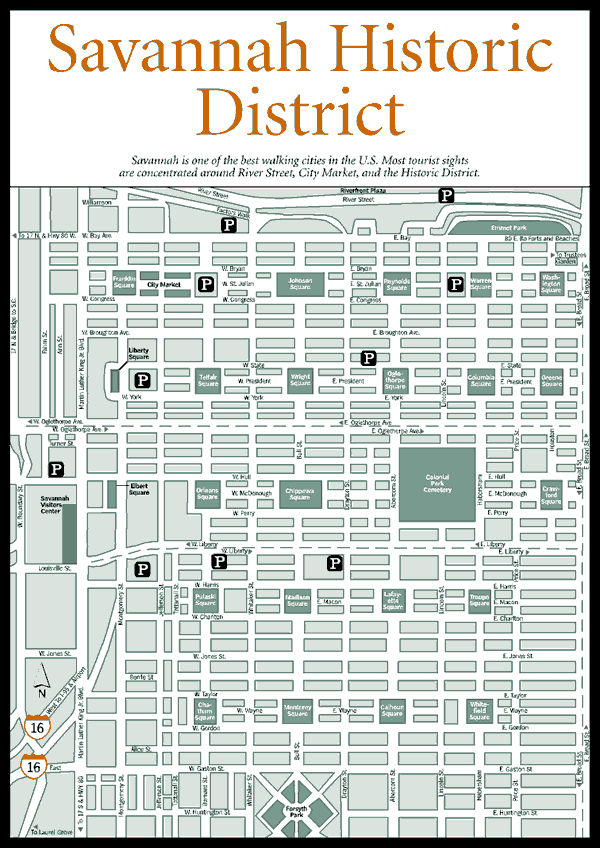
map_savannah_historicdistrict

Savannah Historic District map: see this link for a description of the 22 squares. http://sherpaguides.com/georgia/coast/northern_coast/savannah_historic_district.html

*************

My intention here is not to give you a full-blown accounting of the founding of Savannah, fascinating subject though it be – but merely to share this tidbit. Back to our walking guide: it seems that there was a Creek woman, married to an English trader, who lived comfortably in both her worlds and served as interpreter, translator, and facilitator to Oglethorpe and his band of colonists, and therefore was largely responsible for the peaceful establishment and development of Savannah. Her name? Mary Musgrove. Now I know the guide was in a quandary when I yelped aloud and burst out laughing (I did explain the outburst after the walk – but when I said that Mary Musgrove was the name of one of Jane Austen’s most infamous characters, I am quite sure he was even more baffled…)

But there you have it – Mary Musgrove in America and Jane Austen once again rears her brilliant head!

Oglethorpe, Mary Musgrove, and Chief Tomochichi
Oglethorpe, Mary Musgrove, and Chief Tomochichi – Courtesy of Ed Jackson*

Now I am not saying that Jane Austen knew of this Mary Musgrove of course – there is nothing in her hypochondriac self-absorbed character to link her to a Creek woman living in the colonies nearly a century before. But it gave me a start nonetheless – and there is always the slight chance that Jane Austen may have seen something in her history books. Oglethorpe returned to England in 1734 with the chief of the Yamacraw Tomochichi and others from the Creek tribe to meet the King, and Mary’s husband John Musgrove went along to serve as interpreter. Mary remained in the Georgia colony and ran the trading post – but she too traveled to England in 1754 with her third husband Thomas Bosomworth [now there’s a name…] to settle the twenty year-long dispute over her ownership of several of the Georgia sea islands. In the end, she was granted title only to St Catherines Island, where after several more years as interpreter between the colonists and the Creeks, she died around 1765. Could any of this very interesting history have been part of the Austen family dinner conversation?

[*Image above from Ed Jackson’s website with thanks: http://georgiainfo.galileo.usg.edu/gastudiesimages/Oglethorpe-Mary%20Musgrove-Tomochichi%201.htm ]

There is another important aside with respect to Oglethorpe and slavery. He was one of the earliest to speak out against it, his founding of the Georgia colony prohibiting slaves proof of his humanistic beliefs. It was he who brought Granville Sharp and Hannah More into the argument – and they, after Oglethorpe’s death in 1785, joined with William Wilberforce and others in fighting slavery in England, on the seas, and in the colonies. For those of us who see the subtext of the slavery issue in Mansfield Park, it is certainly a possibility that Jane Austen knew of Oglethorpe, his history in settling Georgia, and his anti-slavery sentiments – and maybe something perhaps about Mary Musgrove?

Musgrove-GAEncycl

Mary Musgrove (pictured with her third husband, the Reverend Thomas Bosomworth) –
From First Lessons in Georgia History, by L. B. Evans
Source: http://www.georgiaencyclopedia.org/articles/history-archaeology/mary-musgrove-ca-1700-ca-1763

She was known as Coosaponakeesa among the Creek Indians, the daughter of an English trader Edward Griffin and a Creek Indian mother (the Creeks were a matrilineal society and children took the clan identities of their mothers). Living among both cultures she learned to speak both English and Muskogee (the language of the Creeks), and learned from her father the trading post business. Her marriage to John Musgrove, the son of a South Carolina trader and planter and a Creek mother, was settled to reinforce the peace treaty between the Native Americans and the English. They lived within the Creek culture until they established a trading post near the Savannah River, and where Oglethorpe found them in 1733. We know that Oglethorpe was appreciative of her efforts on the colonists’ behalf because in his will he left her £100 and a diamond ring from his finger … And Musgrove was important enough to the history of Georgia that in 1993 she was inducted into Georgia Women of Achievement. http://georgiawomen.org/

****************

Sophie Thompson as Mary Musgrove (1995)

 Source:  https://www.pinterest.com/pin/460844974341615969/

As for Austen’s own Mary Musgrove – here are a few of the priceless quotes:

“My sore-throats, you know, are always worse than anybody’s.” 

“If there is anything disagreeable going on, men are always sure to get out of it.” 

“So, you are come at last! I began to think I should never see you. I am so ill I can hardly speak.” 

“Yes, I made the best of it; I always do: but I was very far from well at the time; and I do not think I ever was so ill in my life as I have been all this morning: very unfit to be left alone, I am sure. Suppose I were to be seized of a sudden in some dreadful way, and not able to ring the bell!” 

“…. as long as I could bear their noise; but they are so unmanageable that they do me more harm than good. Little Charles does not mind a word I say, and Walter is growing quite as bad.” 

“… and it is so very uncomfortable, not having a carriage of one’s own.” 

***********************

book-cover-barchas-mattersJanine Barchas in her book Matters of Fact in Jane Austen offers the possibility that Austen took the name from a small village in Somersetshire called Charlton-Musgrove and that this served as a real world setting for her imaginary Uppercross. In her geographical mapping of Persuasion, Barchas notes that this village as well as Lyme and Bath would be within the travel distances Austen lays out from her fictional “Uppercross” and “Kellynch Hall” [p. 235-6].

And this has nothing to do with any of this naming of characters, but I have always wondered why ever did Austen have Mary Elliot marry Charles Musgrove on December 16th, her very own birthday? Any thoughts?

***********

Further reading: [there is a great deal on Mary Musgrove – I take some of this bibliography from the online Georgia Encyclopedia] 

  1. Baine, Rodney M. “Myths of Mary Musgrove,” Georgia Historical Quarterly 76 (summer 1992).
  2. Fisher, Doris. “Mary Musgrove: Creek Englishwoman,” (Ph.D. diss., Emory University, 1990). 
  3. Frank, Andrew K. “Mary Musgrove (ca. 1700-ca. 1763).” New Georgia Encyclopedia. http://www.georgiaencyclopedia.org/articles/history-archaeology/mary-musgrove-ca-1700-ca-1763 
  4. Georgia Women of Achievement: http://georgiawomen.org/2010/10/bosomworth-mary-musgrove/
  5. Gillespie, Michele Gillespie. “The Sexual Politics of Race and Gender: Mary Musgrove and the Georgia Trustees.” The Devil’s Lane: Sex and Race in the Early South. Ed. Catherine Clinton and Michele Gillespie. New York: Oxford UP, 1997.
  6. Green, Michael D. “Mary Musgrove: Creating a New World.” Sifters: Native American Women’s Lives. Ed. Theda Perdue. New York: Oxford UP, 2001.
  7. Hahn, Steven C. The Life and Times of Mary Musgrove. Gainesville: UP of Florida, 2012.
  8. Irby, Richard E., Jr. “Mary Musgrove, Queen of the Creeks.” On the About North Georgia website: http://www.aboutnorthgeorgia.com/ang/Mary_Musgrove,_Queen_of_the_Creeks
  9. Perdue, Theda. “Native Women in the Early Republic: Old World Perceptions, New World Realities.” Native Americans in the Early Republic. Ed. Ronald Hoffman and Frederick Hoxie. Charlottesville: U of Virginia P, 1999.
  10. Sweet, Julie Anne. “Mary Musgrove: Maligned Mediator or Mischievous Malefactor.” Georgia Women: Their Lives and Times, Vol. 1. Ed. Ann Short Chirhart and Betty Wood. Athens: U of Georgia P, 2009.
  11. Wikipedia on Mary Musgrove: http://en.wikipedia.org/wiki/Mary_Musgrove
  12. And even a YouTube! “Mary Musgrove: Georgia’s Own Pocahontas”- https://www.youtube.com/watch?v=Jwy8dvPTPVo
  13. [Legal] indenture executed by Henry Ellis and Thomas [and] Mary Bosomworth [with sworn statements and opinion], 1760 Apr. 19 – Thomas and Mary Bosomworth (a.k.a. Mary Musgrove or Coosaponakeesa) and Henry Ellis (Royal Governor of Georgia, 1757-1760). The Bosomworths herein agree to cede the two islands of Ossabaw and Sapelo to the Crown in exchange for a sum of money and title to St. Catherine’s Island. Sworn statements given by Mary Bosomworth and her husband, Thomas, follow the indenture as does criticism, offered by an unknown author, relative to the negotiations between the Governor and Bosomworths. [WorldCat]

There is also a book for young people: published in 1997 with the title Call the River Home, a 2nd edition was published in 2011 as Mary Musgrove, Queen of Savannah:

bookcover-MaryMusgrove-Statham

And here we find Mary Musgrove very present in present-day Savannah:

IndianTradingPostsign

c2015 Jane Austen in Vermont