Austen Literary History & Criticism · Books · Jane Austen · Jane Austen Circle · Regency England · Social Life & Customs

In such good company as this ~ the 2009 AGM!

The 2009 JASNA AGM ~  
Jane Austen’s Brothers and Sisters in the City of Brotherly Love

Philadelphia October 9-11, 2009

 AGM 2009 banner

The best-laid plans of course often go astray – so my hopes to do a close analysis of everything going on the 2009 AGM have been sadly reduced to a mild wish to present a quick summary… so here goes… 

The Eastern Pennsylvania Chapter of JASNA has indeed put on a lovely event – the City of Brotherly Love opened its wide arms for all 550 of us obsessed Janeites, offering great tours, excellent hospitality, lively and elegant evenings, and fabulous sessions filled with all things Jane.  I always upon returning home have the worst time re-entering the 21st century – and this time more than ever.  And time spent with my best-AGM and travel buddy Sara, just adds to the treat … and this year the special treat of JASNA-Vermont friends Kelly and Carol…

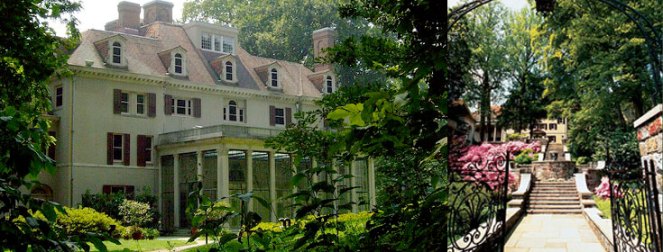
 Day 1:  A tour of Winterthur on the Thursday, one of my favorite places through books only, was a living reality of the beauties of home and garden, what one man with a lot of money was been able to preserve for future generations.  I discovered that Electra Havemeyer Webb, the founder of the Shelburne Museum here in Vermont and one of the first collectors of American art and decorative arts, was the inspiration behind Henry du Pont’s veering away from the popular collecting of European antiques toward acquiring Americana.  It was a lovely day and a wonderful way to start that entry into the late 18th-century the rest of the weekend promised!  [only downside: I missed the talks on writing and Wedgwood.]
winterthur-museum-header


Thursday evening ~ “Elizabeth Garvie in Conversation with Dr. Elisabeth Lenckos” was a special offering this year and began with a short clip of the first proposal scene in the 1980 Pride & Prejudice.  Ms. Garvie, who most everyone knows as Elizabeth Bennet in that adaptation, and now an active patron of the Jane Austen’s House Museum in Chawton, charmed the audience with her engaging and honest responses to Dr. Lenckos’s questions: the realities of filming a television production in the late seventies; how she portrayed a sister with four sister siblings without any of her own [she had a mother with FIVE sisters!]; a few comments on deleted scenes [falling off the log during that outdoor reading of Darcy’s letter…]; how each new P&P adaptation has something to offer each new generation with a reinterpretation of Austen [though she didn’t like the pig in the 2005 movie either!]  She ended the talk with a very humorous reading from one of Austen’s juvenilia pieces, “The Three Sisters.”

ElizabethGarvieElizabethBennett


Day 2:  Had breakfast with several Austen-L / Janeites participants [though I have been only a lurker for years!] – and ended up having a rousing discussion on Georgette Heyer!

An early visit to the Regency Emporium always ends with too many books and items that add to the weight of my suitcase [and those flying rules now are intimidating – even Austen cannot impel me to go over that 50lb limit!] – thankfully Jane Austen Books where I spent most of my time [and money] sends everything media mail after the conference, so I just set up a running account of sorts – almost guilt-free ~ and shopped happily away… The Emporium is great fun to catch up with many of the other regions, Chawton House Library [director Steve Lawrence was there], Jane Austen’s Regency World Magazine [with editor Tim Bullamore], Austentation [two tables filled with regency accessories!] and a few other vendors with Austen-related goodies ~ I went back many times over the course of the conference…

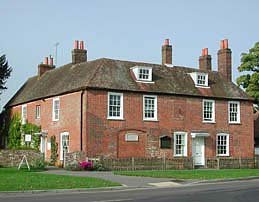
 Off to a talk on tea by Mim Enck from the East Indies Company – and learned how to make the perfect “cuppa”…  and then a talk with visuals by Louise West, from the Jane Austen’s House Museum, on the exciting new addition to Chawton Cottage, the dreams, the funding, and the lovely reality.  The grand opening was in July – if you have been to Chawton, but not since this work was done, put it on your next Austen trip itinerary!
chawton cottage

***************************

Marsha Huff, current JASNA President, welcomed all to the first official gathering, giving over the podium to our very own Vermont member Lorraine Hanaway [who was there for the founding of JASNA in 1978] who introduced the first Plenary speaker, Jan Fergus.  I love Dr. Fergus’s talks  – she inspired a whole new way of looking at Austen in her “The Whinnying of Harpies”? Humor in Jane Austen’s Letters” [Persuasions 27 (2005)] and has continued to regale her audiences with the humor of Austen’s whines ever since!  Today she spoke on “’Rivalry, Treachery between sisters!’ Tensions between Brothers and Sisters in Austen’s Novels” –  and the various ways in which Austen’s fictional siblings either love and support or compete with one another. Some of this thinking is based on the conduct books of the 18th-century, but also the reader must have awareness of the problems that arose between siblings due to the inheritance laws of the time.  Fergus showed by example Austen’s use of humor as a form of criticism between characters and how a sense of humor or lack thereof is an important gauge in understanding Austen’s characters:  i.e Marianne lacks humor and openness, thus her lack of understanding Elinor’s humor causes friction between them; Mr. Woodhouse has no sense of humor, just doesn’t get it!; and finally an emphasis on Elizabeth and Jane and how their different personalities and use of humor causes an undercurrent of almost comic aggression on Elizabeth’s part.  I liked this differing view of Elizabeth, not so perfect but with a tendency toward jealousy…

************************************

One of the problems in the AGM is choosing between the breakout sessions – so much to hear, so many speakers – whichever one you choose leaves you knowing that you are, regardless of how great your chosen session might be, missing so much else.  One can only hope that many of the talks you miss will be in the next issue of Persuasions.  I am a voluminous note-taker – but alas! none of my friends are, so after a full day of events and all things Austen being bandied about, one is lucky to get a few intelligible sentences about a missed session – I know if I didn’t take notes, I would have trouble piecing this all together – and indeed even my notes leave me stupefied occasionally! – so I can only present a few thoughts of the four sessions I did go to, knowing full well I am only scratching the surface of the possibilities…

I went to hear Jocelyn Harris, author of ….Jane Austen’s Art of Memory and A Revolution Almost Beyond Expression:  Jane Austen’s ‘Persusaion’, who spoke on “Jane Austen:  Frances Burney’s Younger Sister”.  Harris’s emphasis is to move away from the biological interpretation of Austen toward an historical one, Austen being very connected to her historical and literary references.  In Persuasion, Austen shows her knowledge of the Navy, Nelson and the Napoleonic Wars, but Harris also shows how the two cancelled chapters of Persuasion are steeped in Frances Burney’s The Wanderer.  I confess to having read several books by and about Burney, but The Wanderer has sat upon my TBR pile for many a year, never opened, largely due to the negative contemporary reviews and all those succeeding.  But Dr. Harris has inspired me to finally pick it up, though she says herself it will be a bit of a “slog” – a perfect winter read perhaps…?

*************************

Then on to Susan Allen Ford’s “’Exactly what a brother should be’? The Failures of Brotherly Love”:  Again, with an emphasis on the contemporary conduct literature [and with a very helpful handout with bibliography and selected paragraphs], Ford reviews the examples of fraternal love in the various novels in the context of the time – issues of inheritance, personality differences, the role of women and the emphasis on them as daughters and mothers rather than sisters, the economic realities of the sister’s lives.  And while she says that “the fraternal role is difficult to define in Austen because the characters as brothers are not often in the foreground”, it was an interesting discussion on their varying degrees of success and failure:  John Dashwood as a brother [yikes!]; the parallels between Edward and Robert Ferrars; Tom Bertram, the prodigal son; the jealousy between Darcy and Wickham, but Darcy’s anxiety and his overriding concern to be a good brother; James Morland as a good brother who wrongly throws his sister into the hands of the Thorpes [yikes again!]; and Edmund, brother / lover who neglects Fanny once Mary appears on the scene [this is when one audience member graciously invited everyone to join the SLEUTH club = “SLap Edmund Upside The Head” – there were many joiners on the spot!] ~ Dr. Ford’s choices? – Edmund the biggest failure [he indeed has NO relationship with his sisters], and most successful? [drum-roll please!] HENRY TILNEY [Mags are you listening??] – and I couldn’t agree more! [love the Henry!] – but an interesting question – who would yours be??

 Then off to dinner with Sara and friends of hers who live in Philadelphia for a few short hours back in the 21st century – we went to an Israeli restaurant right across from the hotel [ Zahav ] and one of the best meals I have had in a good while – even the wine from the Golem Heights was superb!

Up tomorrow – Day 3 and 4…. meanwhile post a comment on your choice for the best and worst brother in Austen…

Books · Jane Austen · News · Social Life & Customs

News from Chawton House Library and “The Female Spectator” ~

My mailbox gives such pleasure most days! – I have been away for the past week, but before leaving I received the latest issue of The Female Spectator [Vol. 13, No. 3, Summer 2009], published by the Chawton House Library and thus have a few things of interest to share with you….

1.  “Reprinting the Domestic:  New Publications from the Chawton Collection” –

book cover compleat housewife

The Chawton House Library has published the first in its projected series of reprints of books in their collection on women’s lives in the long eighteenth century – cookery books, guides on how to manage domestic servants, how to dress and educate one’s children, instructions on behavior and self-improvement:  Elizabeth Smith’s The Compleat Housewife, originally published in 1753, is now available for purchase for £18 [+ shipping], by visiting the Library’s new online shop at www.chawtonhouse.org/shop/index.html

The next title in the series is James Fordyce’s Sermons to Young Women, the reading of which made the Bennet sisters cringe, though it may have been the reader [Mr. Collins] rather than the content?…  can’t wait for this one…

2.  Gillian Dow’s introduction to the July 2009 conference at the Chawton House Library on “New Directions in Austen Studies” is included in the newsletter with the news that selected papers from the conference will be published in a special issue of Persuasions On-Line in Spring 2010.  This is great news for those of us who could not attend the conference!

3.  An article on Frances Brooke, an English writer living in Canada from 1763-1768, by Richard J. Lane.  Brooke wrote her novel The History of Emily Montague [1769] during her Canadian stay and it has been considered the first Canadian novel due to its commentary on social life in Quebec at that time.  Lane contends that her writings deserve a reassessment.

4.  another article “Jane Austen’s Bad Girl: ‘The Beautiful Cassandra’ vs the Conduct Books” by Olivia Murphy.  Murphy writes that Austen’s juvenile work The Beautiful Cassandra [from Volume the First] was an explicit reaction to the conduct books of the late eighteenth century – i.e Cassandra in her “day well spent” engaged in all manner of “bad” behaviors for young ladies.  But such a day! [if you haven’t read this, do so now – it is Austen at her very best!]

***********************************

The Female Spectator is the quarterly newsletter of Chawton House Library.  You can subscribe by sending a donation to the Library [£55 annual membership] or to the North American Friends of Chawton House Library [starting donation is $50.] – see the website for more information.  It is a worthy cause – and one of the perks is this newsletter showing up in your mailbox!

[Posted by Deb]

Fashion & Costume · Jane Austen · News · Regency England · Social Life & Customs

Elegant Arts Society invites you…

New Haven, Connecticut is the scene for the Elegant Arts Society’s Regency Assembly, taking place on Saturday, October 17; further events on Sunday, October 18:

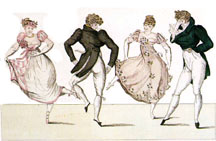
country-dance-pic“Please join the Ladies and Gentlemen of The Elegant Arts Society for a weekend of the delightful dances of the era of Jane Austen, Napoleon, Lords Nelson and Byron, and Beau Brummel.” There will be country dances done in period style, quadrilles, waltzes (including the bouncy sauteuse waltz), and reels, including the lively nine-person Country Bumpkin. “Spare Parts” provides the music.

This is part of a weekend of events that includes a park stroll, and tea-and-games on Sunday. Venues are Trinity Lutheran Church and St. Thomas Episcopal Church, both in New Haven. Advance reservations are strongly recommended, as the Assembly has a limit of sixty attendees.

We include the flyer (in PDF): page 1 and page 2; and a registration form.

As well, for further information, dance-instructor Susan de Guardiola’s website (www.kickery.com) and an email address for the Elegant Arts Society (info at elegantarts dot org).

A dance workshop takes place on the Saturday from 2:00 to 4:30, with the Assembly Ball beginning at 7:30 p.m. Period costume is admired and encouraged, but not required (though they will assist you in proper attire should you desire!); otherwise, dress is formal for the ball, informal (no jeans or T-shirts) for the card party, and casual for the workshop.

[posted by Kelly, thanks to Janeite Bonnie]

Books · Jane Austen · Jane Austen Sequels · News

Book Giveaway ~ and the winner is….!

Corinne!  Congratulations on winning the book giveaway of Juliet Archer’s The Importance of Being Emma!  Please email me your address and contact information –  the publisher Choc-Lit will send you the book directly.

Many thanks to everyone for the great questions and comments – and especially to Juliet Archer for her in-depth responses that gave us some great insights into her imaginative re-creation of a 21st century Emma and Mr. Knightley.  Cannot wait for the next book with Captain Wentworth and Anne!

[On a side note – I have Austen scholar Dr. Joan Klingel Ray here with me for the weekend as she will be speaking at our JASNA-Vermont gathering tomorrow – she happily assisted me by pulling the winning name out of a hat this evening!  I also I think she has become very interested in this very modern Mr. Knightley!]

Again, thanks to all, and a hearty thanks to Laurel Ann at Austenprose for posting the book giveaway news on Jane Austen Today – and hence sending all those comments our way!

Book reviews · Books · Jane Austen · Jane Austen Sequels · News

Last Chance! ‘The Importance of Being Emma’ ~ Book Giveaway

Reminder to all:  the deadline for posting comments and / or queries to author Juliet Archer to win a free copy of The Importance of Being Emma is midnight Friday September 25! 

book cover importance of being emma

Posts to comment on:

Just a comment or a query and you will be entered in the drawing.  The book will be sent to you directly from the publisher Choc-Lit.

Thanks to all who have participated, and a hearty thank you to Juliet Archer for her very thoughtful responses!

[Posted by Deb]

Books · Jane Austen · JASNA-Vermont events · News

You are Cordially Invited to an Afternoon with Professor Joan Klingel Ray!

A reminder to all who happen to be in lovely autumnal Vermont on Sunday September 27, to join us for our celebration of Jane Austen’s move to Chawton!  We are hosting former JASNA President and current President of the North American Friends of Chawton House Library Joan Klingel Ray.

joan ray picture

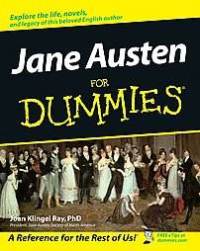
Author of Jane Austen for Dummies, Prof. Ray, as “Doctor of Austenology”  will regale us with her humorous Austenesque insights in her presentation “Jane Austen for Smarties” ~  to be followed by a mini-concert with Lar Duggan and Dominique Gagne of “Impropriety” and dancing demonstrations by a few couples from the Burlington Country Dancers[with our own JASNA member Val Medve and husband Tom!]  Light refreshments will be served, plenty of time for questions and answers with Joan, and copies of JA for Dummies will be available for sale – all graciously autographed by the author!

book cover ja for dummies

 Dr. Ray is a Professor of English and President’s Teaching Scholar at the University of Colorado, Colorado Springs.  She has published scholarly articles on Charles Dickens, George Herbert, Nathaniel Hawthorne, Samuel Johnson [the subject of her dissertation], and thankfully for all of us, Jane Austen.  A number of these articles on Austen are available at the JASNA website, and I append several of the links here for your reading enjoyment. 

We are celebrating the 200th anniversary of Austen’s July 1809 move to  Chawton Cottage.  After five years of living in Bath [1801-1806] and three years in Southampton [1806-1809], Mrs. Austen and Cassandra and Jane finally were coming home to their beloved Hampshire.  Her brother Edward Knight [nee Austen] had inherited the estate at Chawton House, now home to the Chawton House Library for Early Women Writers, and offered the nearby Cottage to his mother and two sisters.  It was here that Austen was finally able to persue her writing – she revised the three novels she had penned at Steventon [Northanger Abbey, Sense & Sensibility, Pride & Prejudice] and wrote three more [Mansfield Park, Emma, Persuasion].  We can be forever grateful to Edward for this gift of a such a home!

Hope you can join us for the celebration!  The event runs from 2-5 pm and is free and open to the public.  The Hauke Family Campus Center is at 375 Maple Street, Champlain College, Burlington, Vermont.

Further Reading:

  • A few articles by Joan Klingel Ray:

“Jane Austen’s Case Study of Child Abuse:  Fanny Price,”  Persuasions 13 (1991), p. 16-26

 “In Defense of Lady Russell, or the Godmother Knew Best,”   Persuasions 15 (1993), p. 207-215.

“The One-sided Romance of Jane Austen and Tom Lefroy,”  Persuasions On-Line Vol. 28, No. 1 (Winter 2007)

“‘The Amiable Prejudices of a Young [Writer’s] Mind’: The Problems of Sense and Sensibility,”  Persuasions On-Line, vol. 26, No. 1 (Winter 2005)

“James Stanier Clarke’s Portrait of Jane Austen,”  with Richard James Wheeler, Persuasions 27 (2005), p. 112-118  [available in Adobe pdf file]

“Victorians versus Victorians – Understanding Dear ‘Aunt Jane’,”  Persuasions30 (2008), p. 53-66.   [not yet online; this is also the paper of her “Smarties” talk, so don’t read it if you are joining us on Sunday!]

  • A few articles on Chawton:

McDonald, Irene B.  “The Chawton Years (1809-1817) – ‘Only’ Novels,”  Persuasions On-Line, vol. 22 No. 1 (Winter 2001)

Bowden, Jean K.  “Living at Chawton Cottage,”  Persuasions 12 (1990), p. 79-86.

  • Reviews of Jane Austen for Dummies
  1. A review at JASNA.org
  2. Reviews and comments at Amazon
  3. Information at the Dummies Store at Wiley Publishing
  4. Laurel Ann’s review at Austenprose

And finally, see the post at AustenBlog for August 18, 2006, where Mags and Joan have a lively conversation on reading Austen, writing about Austen, JASNA, the AGMs, the writing of Dummies, and the dangling “equipment” of pigs in the 2005 Pride & Prejudice.

And now, after all that reading homework, please join us on Sunday!

Austen Literary History & Criticism · Jane Austen · Jane Austen Circle

An Austen Brothers & Sisters Bibliography

Take a quick look at the JASNA website where a select bibliography on “Austen’s Siblings in Fact and Fiction in JASNA Publications”  has been posted ~ all in preparation for the upcoming AGM in Philadelphia, City of Brotherly Love.  All the articles are in JASNA publications, many with online links.

Here is a taste to start your reading adventure:

Tthe facts“Austen Brothers and Sisters” by Park Honan. Persuasions 10 (1988): 59-64.

The fiction:  “Sisterhood and Friendship in Pride and Prejudice by Deborah J. Knuth. Persuasions 11 (1989): 99-109.

AGM 2009 banner

Books · Jane Austen · News · Rare Books

“Emma” on the Auction Block

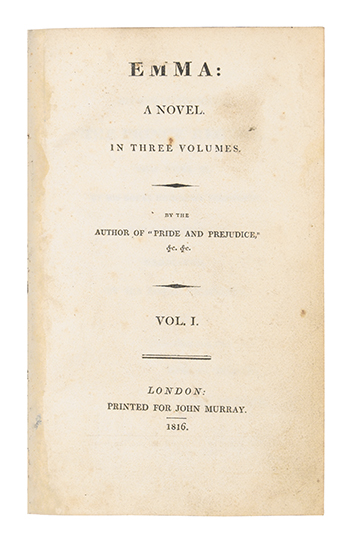
I entreat you to visit my Bygone Books blog for information on TWO first editions of Jane Austen’s Emma coming soon to the auction block …

auction picture emma swann 1009


[Posted by Deb]

Book reviews · Books · Jane Austen · Jane Austen Sequels

Juliet Archer’s “Emma”, Part 2 ~ Book Giveaway!

Life certainly gets in the way of blogging! – here is the promised Part 2 of my interview with Juliet Archer, author of The Importance of Being Emma, and a confessed “19th-century mind in a 21st-century body.”  [see Part 1 of this interview here].  Please see below for the book giveaway info… we welcome your queries and comments!

book cover importance of being emma


Deb:  Welcome back Juliet!  You mention in your last answer that the next novel in your series  “Jane Austen in the 21st Century Series”  is “Persuade Me”, after Austen’s “Persuasion”–  why did you start with “Emma”?

 JA:  Although Emma’s the first Austen modernisation I’ve had published, it’s actually my third attempt. I’ve done very early drafts of both Pride and Prejudice and Persuasion. When I realised how wide a gulf there was between writing something and getting it published, I focused on Emma because it was my most recent work and I thought it would need less doing to it. I was wrong! 

I think Emma is Austen’s most comic novel, so I was thrilled when The Importance of Being Emma was shortlisted for the 2009 Melissa Nathan Award for Comedy Romance.  

Deb:  [Congratulations on that! ] ~ What do you think Austen would say to your “meddling” with her story?  What would she say about all the sexual content? 

JA:  There’s been so much ‘meddling’ with Austen already that she’d probably be bored rigid by the time she got to The Importance of Being Emma! I hope she’d be proud to see her story adapt so well to a different time period and social setting, and that she’d be sympathetic to the changes I’ve made. Most of all, I hope she’d have a good laugh!

 As for the sexual content, for my hero and heroine it sits firmly within a framework of love, commitment and ultimately marriage – a scenario which comes across very strongly in the original novels. Given the world we live in, I felt I couldn’t modernise Austen without including some sexual content and, fortunately, readers seem to think I’ve struck the right balance.

 Deb:  I do agree with your readers here!  I think your characterization and plot devices are spot-on and the sexual scenes are so very well done, and of course we know how it ends – marriage IS the goal after all!  Which leads me to my next question:  We all do know this story and how it ends, so there are no surprises here – how did you go about creating enough interest and tension to make your reader want to keep turning those pages?  [I know that I did!] 

JA:  [Thank you!] First, with most mainstream romantic fiction, Austen-based or not, we can guess instantly who’s destined for whom – the interest is in how they get together. So in that respect my story’s no different from many others. Second, as you’ve already indicated, the alternating 1st person point of view helps to create interest and tension. And finally, in my opinion Austen does two things – effortlessly – that make the reader want to keep turning the pages: characterisation and dialogue, often laced with humour. By imitating her work, I hope I’ve written what many readers see as a ‘page turner’.

Deb:  Yes, indeed you have!   And now for a few personal questions if you don’t mind…  What else have you written? 

JA:  What started me writing novels was the BBC’s dramatisation of Gaskell’s North and South, starring Richard Armitage. So I’ve got a few modern ‘fanfics’ lying around and still hope to have a 21st-century version of North and South published – although not until I’ve got Austen modernisations out of my system. 

Before that, I wrote very bad, unpublishable poetry – rather like my version of Giles Benwick in Persuade Me.

 Deb:  The Armitage “North & South” adaptation seems to have set off a number of fan-fic writers – there are whole blogs devoted to it!  I would eagerly await your updated version – [and hopefully Mr. Armitage could be persuaded to play the part yet again…?] – but I digress! – What is your writing habit?

JA:  I work full-time in London Monday through Friday, so I fit my writing into my spare time and also get up early most mornings. In the evenings, a glass of wine is known to get me in the mood! My family keep me grounded and occasionally remember to feed me. 

Most of my first draft goes straight onto the computer – PC in the study, laptop in the garden or bed! But I’m always printing pages off so that I can read and edit on the train going to and from work. For me, there’s no substitute for the printed word – yet. 

Deb:  Oh, I like hearing about your love of the PRINTED word! Anything else you would like to share? 

JA:  I’m married with two teenage children and live in Hertfordshire, Pride and Prejudice country. Unlike Anne Elliot in Persuasion, I resisted well-meant advice and married young, before graduating from university with a First in French and Russian. Initially I worked in IT and company acquisitions, then ran my own consultancy business, and now I work for a national healthcare organisation. 

Finally, I love hearing from Jane Austen fans, so please visit my website – and I welcome readers to contact me directly.

Deb:  Thanks so much Juliet for visiting us and sharing your thoughts on the writing of YOUR “Emma”!   I wish you much success – and am looking forward to “Persuade Me ” and making the acquaintance of your Captain Wentworth! ~ Now Gentle Readers, please send in your queries and comments to participate in the book giveaway…

***************************************

Book Giveaway:  Juliet has most graciously offered to answer any questions you might have for her – all queries and comments posted between today and midnight September 25, 2009 will be entered into a drawing for the free book giveaway, courtesy of Choc-Lit.  All are eligible to enter.

The Importance of Being Emma
by Juliet Archer
Harpenden, UK:  Choc-Lit, 2008   £7.99 / $13.07 [paperback]; also available in an ebook version direct from the publisher for £3.99 / $5.99
ISBN:  978-1-906931-20-9

[Posted by Deb]

Book reviews · Books · Jane Austen · Jane Austen Sequels

Interview with Juliet Archer ~ Author of ‘The Importance of Being Emma’

Today we welcome author Juliet Archer, author of The Importance of Being Emma, [Choc-Lit, 2008].  Ms. Archer, who says she is a 19th-century mind in a 21st-century body [though she adds that some days it is the other way around!] joins us today from London to talk about her very humorous modernization of Jane Austen’s Emma.  [Click here for my review of the book].  We are also offering a free book giveaway direct from the publisher, the winner drawn from all comments posted by September 25th [see below for full details]

book cover importance of being emma


Hello Juliet ~ thank you for joining us here at Jane Austen in Vermont!  I enjoyed your spin on Austen’s ‘Emma’ very much, and look forward to others in this series of “Jane Austen in the 21st Century.”

JA [note the initials!]:  Hi Deb, thank you for the opportunity to ‘talk’ to you and your blog readers.

Deb:  To start, just tell us briefly what YOUR Emma is about. 

JA:  I’ve lifted the plot and characters of Austen’s original and plonked (a technical term!) them very much into the 21st century. Cue mobile phones, emails, jobs and liberated attitudes to social and sexual interaction! 

Deb:  So many Austen “fans” are drawn to the historical period of the Regency, and like their sequels, etc. to be so set as well.  What inspired you to do a re-telling of ‘Emma’ in our modern-day world?  And why do you think lovers of Austen will enjoy reading your book?

JA:  Modernising Jane Austen is not an original idea – for example, Melissa Nathan wrote versions of Pride and Prejudice and Persuasion almost ten years ago. Then we have Helen Fielding imagining Bridget Jones as a modern-day Lizzy Bennet; and even Stephenie Meyer has admitted that Bella and Edward’s early relationship in Twilight was influenced by Pride and Prejudice.  In effect, Austen’s novels seem to provide an elegant template for most romantic fiction and chick lit, whether consciously or unconsciously. So, if you like, there are lots of ‘unofficial’ as well as ‘official’ modern versions out there already. I’ve just kept more closely to the originals!

I have several reasons for retelling these novels through 21st-century eyes. First, I’m learning from the master of my chosen genre. As Claire Harman notes in Jane’s Fame, a wonderful account of the Austen phenomenon, ‘It seems almost redundant to itemize aspects of Austen’s appeal; there are the brilliantly constructed plots, the romance, the comedy.’  Second, what started as a bit of an experiment has become compulsive fun: who will I tamper with next – delectable Darcy or calculating Crawford?  Third, a 21st-century context gives me an opportunity to explore some aspects of the originals that Austen couldn’t, or wouldn’t, develop – particularly the male point of view. And finally I hope to appeal to those – like my own daughter – who adore the dramatisations of Austen’s work yet can’t get into the books themselves. 

If you’re an Austen lover, then my versions have an extra dimension – looking for the parallels with the originals and, I hope, appreciating the differences. For example, the Box Hill incident in Emma: I couldn’t see this working as a picnic these days, so I’ve changed the setting – but, I hope, kept to the spirit of the original. And I wanted to give Emma’s outburst to Miss Bates the context of a rare moment of self-awareness, so I added something to the original. 

Interestingly, I’ve met with far more support than resistance from Austen lovers. When one of my publisher’s reps gave a copy of The Importance of Being Emma to the manager of a local Waterstone’s store (a leading UK book chain), she threw up her hands in horror and exclaimed, ‘Who would want to tamper with Jane Austen?’  After reading the book, however, she became a staunch fan, gave it a glowing staff recommendation and arranged for me to do a talk at the local literary festival.

 Deb: Comparisons will be made with the movie “Clueless” – how is your story different? 

JA:  I love that movie! But the high school setting and teenage culture are a step too far for a middle-aged author like me, and I wanted to stick as closely to Austen’s settings as possible. 

So my story takes place mainly in the village of Highbury, Surrey, England, and my characters are nearer in age to the originals. Donwell Abbey with its farming interests has evolved into Donwell Organics, while the Woodhouses also have a family business, Highbury Foods. As Knightley observes, however, in spite of various precautions Henry ‘never ate anything labelled “Highbury Foods”; he said his digestion was far too delicate.’ 

Deb:  You make Knightley quite “hot” and obviously very interested in sex!– what in Austen’s ‘Emma’ made you want to expand on this aspect of Knightley’s character?

JA:  If we turn this question round, it becomes ‘How do I make Austen’s Knightley fit into a modern world?’ Don’t get me wrong, I love the original Knightley just the way he is. But ‘a 37-year-old farmer leading a solitary existence, until he realises he loves the nubile 21-year-old next door’ just didn’t translate convincingly to the 21st century! And what appeal would there be in the modern equivalent of Knightley’s immortal line ‘God knows, I have been a very indifferent lover’?! 

So my Knightley had to have a makeover. I cut the age difference, to make sure he wasn’t old enough (technically) to be Emma’s father. Gave him a stunning girlfriend who’s looking to settle down. And kept him well away from Highbury while Emma was growing up. But the most enjoyable part was filling in the gaps that Austen left in our understanding of Knightley. Austen provided a starting point, an end point and a few little clues along the way – the rest was up to me! 

And, remember, in my version we meet Knightley when he’s thousands of miles away from his girlfriend and confronted by this gorgeous young girl he used to call ‘Mouse’! Is it surprising that his mind, er, wanders? 

Deb:  I mention this in my review, but just again explain why you changed the names of some of the main characters? 

JA:  As I modernise Austen’s novels, I change characters’ names only with good reason. The most obvious change in The Importance of Being Emma is Knightley. I don’t know any men in their mid-30s called George – they are either much older or much younger. I certainly like the name, especially when it is attached to a certain Mr Clooney! 

So I reserved ‘George’ for Mr Knightley Senior; in my version I felt he had to be alive, since enough parents in the original Emmahave expired as it is – and I include Henry Woodhouse in this! Then I looked round for a similar, solid-sounding name of one syllable for his son and – for personal reasons – chose ‘Mark’. Same with Frank – in the UK, at least, it no longer has a contemporary feel, so I went for ‘Flynn’ Churchill, with its shades of Irish blarney! 

In Persuade Me (my version of Persuasion), I’ve changed Anne and Frederick to Anna and Rick, again for a more contemporary feel. Similarly, Anne’s sister Mary (an unusual name these days in the UK) has become Mona – for obvious reasons. 

Deb:  You tell the story in alternating chapters from Emma’s and then Mark Knightley’s point of view – it certainly helps us to know exactly what is going on in Knightley’s mind as well as the she says / he says that can be quite funny with all the gender miss-readings of any given encounter! – why this format?  Advantages and disadvantages? 

JA:  Not all of Austen’s novels lend themselves to this format, but in my version of Emma I wanted to heighten the sense of misunderstanding and conflict between the two main characters. The alternating 1st person points of view are intended to assist this and, as you say, to provide a comic touch. It also means that we see the secondary characters through the eyes of Emma and Mark and, of course, their views are usually diametrically opposed. 

Advantages? I can explore the main characters’ innermost thoughts in a much more intense and, at times, humorous way. Disadvantages? It’s limited to what two characters are experiencing. Interestingly, Stephenie Meyer chose the 1st person for her Twilight series; it’s told from Bella’s point of view, although I understand she’s now written a version of the first book from Edward’s point of view. At least I’m giving the reader two for the price of one!

I’ve also written my second novel, Persuade Me, through the eyes of the main characters Anna and Rick, but here I’ve chosen the 3rd person throughout. This has enabled me to introduce other perspectives occasionally – to create humour, such as the musings of Sir Walter Elliot, 8th baronet, or a different slant on one of the main characters, such as Sophie Croft puzzling over her brother’s behaviour.

Deb: Thank you Juliet for joining us today and sharing your insights ~  stay-tuned for Part 2!

************************************

Join us for Part 2 of this interview with Juliet Archer tomorrow ~ she will talk more on the backstory of writing her Emma and her thoughts on what Austen might say about her book.

Book Giveaway:  Juliet has most graciously offered to answer any questions you might have for her – all queries and comments posted between today and midnight September 25, 2009 will be entered into a drawing for the free book giveaway, courtesy of Choc-Lit.  All are eligible to enter.

[Posted by Deb]