Books · Jane Austen · News

Pride & Prejudice ~ the Comic Book

marvel-comic-pp

Late to the table, but here is a reminder about the first issue of the Marvel Comic’s Pride & Prejudice  due out April 1st.  See the story and images from the first issue at Marvel.com :

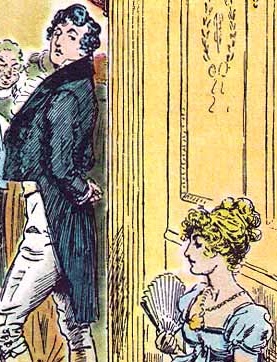
Two-time Rita Award-Winner Nancy Butler and acclaimed artist Hugo Petrus bring PRIDE & PREJUDICE #1 to life—and we’ve got an exclusive preview for you! Follow the gripping story of Lizzy Bennet and her loveable, yet eccentric, family as they navigate the treacherous waters of British high society, in this faithful adaptation of the seminal Jane Austen novel.

Further reading:

Books · Collecting Jane Austen · Jane Austen

Novels & Letters (1906) now complete

mpFINALLY!

Internet Archive now has all twelve volumes of the 1906 edition entitled “The Novels & Letters of Jane Austen”. Especially, I was happy to see the second part of Mansfield Park (the illustration is the volume’s frontispiece).

The search is still on to provide our audience with the missing volume of Pride & Prejudice‘s first edition; ditto the entire three-volume set of Sense & Sensibility.

Find all the online editions via our bibliography, or click on the tabs above to go to the individual works.

Books · Jane Austen · Literature · News

An Austen-Inspired Author ~

Robert Goolrick, author of the upcoming book A Reliable Wife, has this to say about Jane Austen:

If anything, I was inspired by earlier writers. I’m always inspired by Jane Austen, curiously enough. She has a great thing that she does, which is her novels are about complicated, romantic situations in which all the happiness comes at the very end—like a magic trick. I love that about her, and I wanted to write a novel in which people seemingly unable to be happy suddenly find redemption and happiness all in a second.

[Quoted from Publisher’s Weekly]

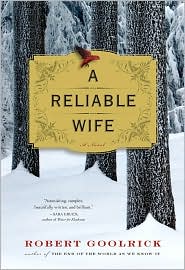
book-cover-reliable-wife 


Goolrick’s new work, following his memoir The End of the World as We Know It, will be released on March 31, 2009….


Synopsis:

Rural Wisconsin, 1909. In the bitter cold, Ralph Truitt, a successful businessman, stands alone on a train platform waiting for the woman who answered his newspaper advertisement for “a reliable wife.” But when Catherine Land steps off the train from Chicago, she’s not the “simple, honest woman” that Ralph is expecting. She is both complex and devious, haunted by a terrible past and motivated by greed. Her plan is simple: she will win this man’s devotion, and then, ever so slowly, she will poison him and leave Wisconsin a wealthy widow. What she has not counted on, though, is that Truitt — a passionate man with his own dark secrets —has plans of his own for his new wife. Isolated on a remote estate and imprisoned by relentless snow, the story of Ralph and Catherine unfolds in unimaginable ways.

With echoes of Wuthering Heights and Rebecca, Robert Goolrick’s intoxicating debut novel delivers a classic tale of suspenseful seduction, set in a world that seems to have gone temporarily off its axis.

[from the Barnes & Noble website]

[BTW, the book has already been optioned for a movie and is hitting various favorite lists, so this is not the first you will hear about this book…]

Austen Literary History & Criticism · Books · Jane Austen · Literature

Discord in Austen Land

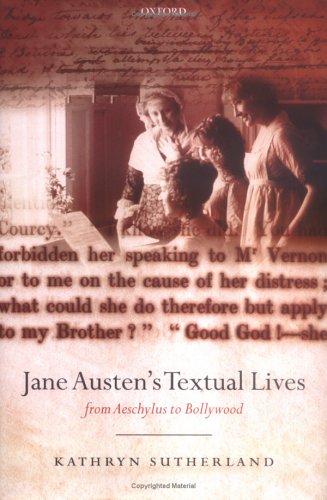
Here is an interesting article at the Guardian.co.uk about a new book on Austen by Claire Harman (author of the 2001 biography Fanny Burney) ~ Jane’s Fame: How Jane Austen Conquered the World, to be published next month, and a conflict with the academic writings of Professor Kathryn Sutherland, author of the ground-breaking 2005 Jane Austen’s Textual Lives, from Aeschylus to Bollywood.  It’s quite the kerfuffle….

book-cover-janes-fame

book-cover-ja-textual-lives

Further reading:

[Adding here 3/17/09:  I had noted in my comments below that Ellen Moody has addressed this issue in more depth on Austen-L and Janeites as well as her blog, so I add here the link to her post: 

http://server4.moody.cx/index.php?id=1016#comment

 NB: scroll down further on her blog as there is quite a bit more after the reference to Emily Hahn’s book on Fanny Burney]

Jane Austen · Literature

Sir Walter Scott on Austen ~ March 14, 1826

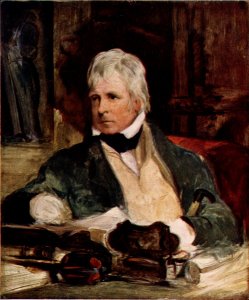
scott-portrait1

Sir Walter Scott wrote in his journal on March 14, 1826:

I have amused myself occasionally very pleasantly during the last few days, by reading over Lady Morgan’s novel of _O’Donnel_,[221] which has some striking and beautiful passages of situation and description, and in the comic part is very rich and entertaining. I do not remember being so much pleased with it at first. There is a want of story, always fatal to a book the first reading–and it is well if it gets a chance of a second. Alas! poor novel! Also read again, and for the third time at least, Miss Austen’s very finely written novel of _Pride and Prejudice_. That young lady had a talent for describing the involvements and feelings and characters of ordinary life, which is to me the most wonderful I ever met with. The Big Bow-wow strain I can do myself like any now going; but the exquisite touch, which renders ordinary commonplace things and characters interesting, from the truth of the description and the sentiment, is denied to me. What a pity such a gifted creature died so early![222]

Scott’s journal entry for September 18, 1827, has the following reference  to Austen: 

September 18.–Wrote five pages of the _Tales_. Walked from Huntly Burn, having gone in the carriage. Smoked my cigar with Lockhart after dinner, and then whiled away the evening over one of Miss Austen’s novels. There is a truth of painting in her writings which always delights me. They do not, it is true, get above the middle classes of society, but there she is inimitable.

And this is Austen’s famous comment on Scott:

Walter Scott has no business to write novels, especially good ones. – It is not fair. – He has Fame & Profit enough as a Poet, and should not be taking the bread out of other people’s mouths. – I do not like him, & do not mean to like Waverley if I can help it – but fear I must…

[ Letter 108, 28 September 1814, to Anna Austen (Le Faye)]

Further reading on Scott:

scott-abbotsford-house
Abbotsford
  • Millgate, Jane.  “Persuasion and the Presence of Scott,”  Persuasions 15, 1993
  • Sabor, Peter.  “Finished up to Nature” :  Walter Scott’s Review of Emma, Persuasions 13, 1991
  • text of Scott’s review of Emma in the Quarterly Review (1816) at The Literary Encyclopedia

 [Portrait image from University of Michigan website]

Book reviews · Jane Austen · Regency England · Social Life & Customs

On My Booklist ~ ‘Jane Austen & Marriage’

A new book alert:  Jane Austen & Marriage by Hazel Jones, to be published in July 2009, is now available for pre-order.

jane-austen-marriage-cover1 

Jane Austen & Marriage

by Hazel Jones

Continuum Books, 2009

 “It is a truth universally acknowledged, that a single man in possession of a good fortune must be in want of a wife.” –Pride and Prejudice

Description:

The question of marriage lies at the center of Jane Austen’s novels. The issues bound up in the pursuit of love, happiness, money, and status were those of her day and informed the plots and morals of her work. In this fascinating book, Hazel Jones explores the ways in which these themes manifest themselves in Jane Austen’s life and fiction, against the backdrop of contemporary conduct manuals, letters, diaries, journals and newspapers. Drawing on original research, this entertaining and detailed study provides a charming and profound insight into the world of Jane Austen. 


Table Of Contents:


Acknowledgements


Introduction

1: The Advantage of Choice

2: The Power of Refusal

3: An Acquaintance Formed in a Public Place

4: White Satin and Lace Veils

5: Where N Takes M, For Better, For Worse

6: Wedding Journeys

7: Scandal and Gossip

8: A Contract of Mutual Agreeableness

9: Domestic Happiness Overthrown

10: The Simple Regimen of Separate Rooms

11:The Years of Danger

12:  An Old Maid at Last


Notes

Bibliography

Index

Review at Continuum Books:

Hazel Jones has written a masterful accounting of the crucial role played by marriage in Jane Austen’s novels and the world she and her characters lived in. Brilliantly researched and documented  — including information taken from the fascinating and sometimes troubling “conduct manuals” on the proper interaction between the sexes — Jane Austen and Marriage offers deep insights that inform not only one’s reading of Austen’s novels but of the treacherous social bedrock underlying the lives of women living in that time. And in so doing, Hazel Jones has presented the reader with another testament to the long, hard march of women throughout history. It is a book that reflects Jane Austen’s own penetrating gaze and insight into Regency society and no doubt will find a place in the library of even the most sophisticated “Janeite”.’  

[Alice Steinbach, Pulitzer Prize-winning journalist and author of Without Reservations: The Travels of an Independent Woman.]

About the Author:


Hazel Jones taught English at Exeter University, specializing in Jane Austen. She tutored courses on the novelist for the thriving Summer Academy Programme, which attracted students from all over the world. She continues to organize Jane Austen residential courses for adults at various venues in the UK, focusing on her novels and her life and times.


Pre-order at Continuum Books [$29.95] or Amazon.com [$19.77]

Books · Jane Austen · JASNA-Vermont events · Publishing History

Publishing ‘ Persuasion ‘

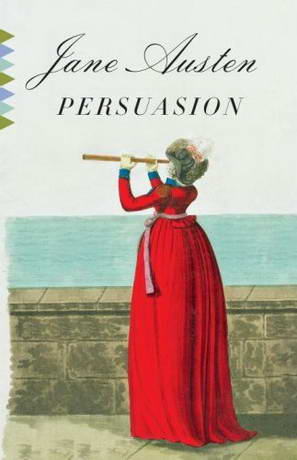
persuasion-cover-vintageWe had our JASNA-Vermont gathering last Sunday and Mary Ellen Bertolini of Middlebury College spoke on Persuasion [see Kelly’s post below on our event]

Mary Ellen brought Austen’s final novel to life for us all.  In speaking on “The Grace to Deserve” and taking as her starting point Captain Wentworth’s last spoken words in the book, “I must learn to brook being happier than I deserve.”  [Persuasion, ch. 23], she addressed the issue of “deserving” and “earning ones’ blessings”  in the context of the social and political realities of the time – the war in France and the role of the Navy; an analysis of the criteria of WHO deserves; and finally in the linguistics of the work – whose words deserve to be heard?  The plot centers on Anne moving from “nothingness” and” carrying “no weight” to realizing her own worth, and Wentworth moving from anger and disappointment to deserving to hear Anne’s words – their individual growth bringing them together at last. 

Prof. Bertolini’s insightful, dramatic and often humorous presentation on how Austen tells her tale around these three words “the grace to deserve” gave all in attendance much to think about and surely most of us went right home to begin a re-read of the novel!  So we thank you Mary Ellen for sharing your affection for this book with all of us, and turning a very cold winter day into a fabulous afternoon! 

**************************************

As a bookseller and librarian I am interested in the publishing history of the literature of the 18th and 19th centuries, and I spoke very briefly on the publishing journey of Persuasion;  I append that here:

 We know from Cassandra’s Memorandum [see Minor Works, facing pg.  242 ] in which she wrote the dates of Austen’s composition of each of her novels, that Jane Austen began Persuasion on August 8, 1815; it was finished July 18, 1816 – i.e. her first draft. We know she was unhappy with the ending, she thought it “tame and flat” and rewrote chapter 10 [i.e.chapter 10 of volume 2], added chapter 11, and retained chapter 12 (which had been the final chapter 11).  This final version was finished on August 6, 1816.  The manuscript of the original two chapters are the ONLY extant manuscripts of Austen’s novels.  These were first printed in the second edition of James Edward’s Austen-Leigh’s Memoir of 1871, and this was the accepted text until the actual MS became available on December 12, 1925  [ published separately by Chapman in 1926 under the title Two Chapters of Persuasion [Oxford, 1926]; the manuscripts are housed in the British Library].  This text is different from the printed cancelled chapter in the Memoir – so it is believed that Austen made a fresh copy of her final draft and this is what went to the printer. [Chapman,  NA & P, p. 253 ]

I am assuming that most everyone has read these cancelled chapters, as they are usually included in most printings of the novel.  But to summarize:  Austen has Anne meeting Admiral Croft on her way home from Mrs. Smith’s [where she has just learned the true nature of William Elliot] – she is invited to visit Mrs. Croft, and assured of her being alone, she accepts, and to her consternation finds Capt. Wentworth at home.  Admiral Croft has asked Wentworth to find out from Anne if the rumors are true she is to marry her cousin and thus might want to live at Kellynch Hall ~ and with Anne’s adamant denial of this, Wentworth and Anne had a 

 silent but very powerful Dialogue;- on his side, Supplication, on hers acceptance. – Still, a little nearer- and a hand taken and pressed – and “Anne, my own dear Anne!” – bursting forth in the fullness of exquisite feeling – and all Suspense & Indecision were over. – They were reunited.  They were restored to all that had been lost.

 Etc. etc… and then one more chapter of explanation and future plans.

 It is not my intention here to talk about these changes – we can argue the point of why she made them:  the need to pull all the characters together – the Musgroves, Benwick, & Harville, the Crofts, and the Elliots; the increased tension and suspense between Anne and Wentworth; Anne’s conversation with Harville overheard by Wentworth; and of course the LETTER – what would Persuasion be without “you pierce my soul” ? !

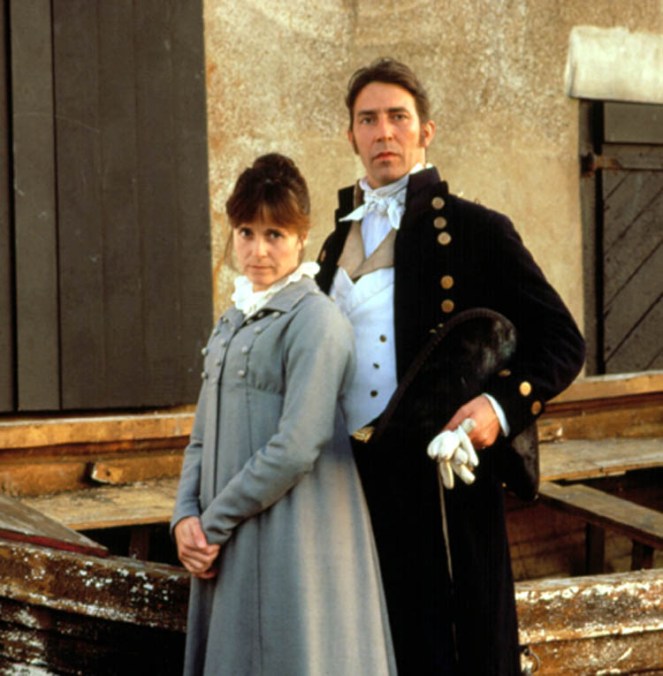
 However, in the movie version [Amanda Root – Ciaran Hinds, Sony/BBC 1995] a part of this scene with Wentworth confronting Anne is added to the plot – this is worthy of some further conversation!  
508950F

But one of Austen’s classic lines is not in the final novel – the first draft is a bit more comic in nature, and perhaps she thought it not fitting the rest of the work:

It was necessary to sit up half the Night & lie awake the remainder to comprehend with composure her present state, & pay for the overplus of Bliss, by Headake & Fatigue.

____________________________________________

That Austen made these changes was a gift to later generations, as it is in this manuscript that we have the only documentation of how meticulous she was in her writing and editing methods.  And what I find most fascinating is what she was working on at the same time:

 *In 1815, she was drafting Emma; began Persuasion in August; revised Mansfield Park  for its 2nd edition; and finished and passed Emma through publication [it was published in December 1815]

 *In 1816:  she was drafting and finalizing Persuasion; she wrote her very funny “Plan of a Novel”; she made revisions to “Susan” [later Northanger Abbey]; AND she was working with the publisher on the 3rd edition of Pride & Prejudice.

 As an aside:  in the context of the wider world, there was the ever-expanding and more competitive market for publishing novels in Austen’s time.  In 1775, the year she was born, 31 new novels were published; in 1811, when Sense & Sensibility appeared, 80 new fiction works appeared; for the year 1818, Northanger Abbey and Persuasion were published along with 61 other novels.  Altogether, 2,503 new novels were published in the years between 1775 and 1818. [Raven, p. 195-6]

We know little about Persuasion from Austen herself:  it is only mentioned in her Letters twice, though not by name: 

 On March 13, 1817, she wrote to her niece Fanny Knight:  

“I WILL answer your kind questions more than you expect. – Miss Catherine [meaning Northanger Abbey] is put upon the Shelve for the present, and I do not know if she will ever come out; – but I have a something ready for Publication, which may perhaps appear about a twelvemonth hence.  It is short, about the length of Catherine – This is for yourself alone…”  [Letter 153, Le Faye]

 And again on March 23, 1817: 

Do not be surprised at finding Uncle Henry acquainted with my having another ready for publication.  I could not say No when he asked me, but he knows nothing more of it. – You will not like it, so you need not be impatient.  You may PERHAPS like the Heroine, as she is almost too good for me. [Letter 155, Le Faye]

The working title for Persuasion was “The Elliots” – there is no evidence that Austen chose the titles for either Northanger Abbey [it is accepted that her brother Henry did this] or Persuasion [though the word is mentioned in one form or another more than 20 times – you can go to this link at the Republic of Pemberley for all the occurrences] 


So, the details of the book:
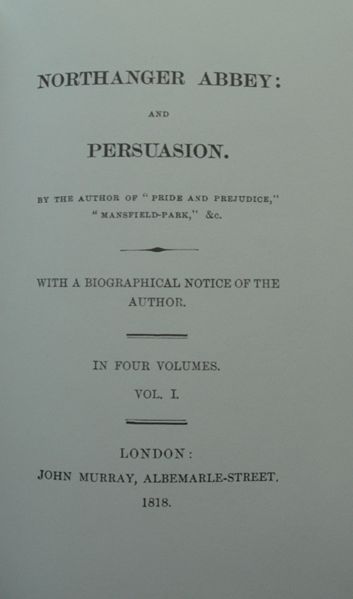


na-title-page

 [Title Page, 1st edition]

-It was published posthumously in December 1817 [though the title page says 1818] with Northanger Abbey

Title page states:  “By the Author of Pride & Prejudice, Mansfield Park, etc.”; With a Biographical Notice of the Author [dated Dec. 20, 1817, by Henry Austen, thus identifying his sister as the author to the public for the first time]

 -Included is the “Advertisement to Northanger Abbey by The Authoress [we discussed this at our NA gathering, where Austen “apologizes” for the datedness of the story, and zings the dastardly publisher for withholding the book for 10 years…]

Published by John Murray, London; 1818; in four volumes:  the two Northanger Abbeyvolumes printed by T. Davison; the two Persuasion volumes by C. Roworth. 

Advertised in the Morning Chronicle, Dec. 19 & 20, 1817

-Physical description:blue-grey boards, brown paper backstrips, white paper labels (there are a few variants)

Size of book:  about 19cm x 10.5 cm [ 7.5 x 4.25″]

Size of run: @ 1750 copies [various opinions on this] – 1409 copies sold very quickly [majority to circulating libraries]

Cost:  24 shillings for 4 volumes

Profit:  £515 [like Austen’s other works, Persuasion was published on commission:  Austen paid for costs of production and advertising and retained the copyright; the publisher paid a commission on each book sold – exception was Pride & Prejudice for which she sold the copyright] 

-Reviews:  minor notices until the first extensive review in January 1821. 

-Worth today:  a quick search brought up 7 copies of the 4-vol. first edition, all have been rebound in leather, range $9500. – $15,000. 

-Tidbit:  the Queen has in her personal library  Sir Walter Scott’s copy of the 1st edition.

First American edition:  not published until 1832 in Philadelphia; the title page says “by Miss Austen, author of P&P and MP, etc.” 

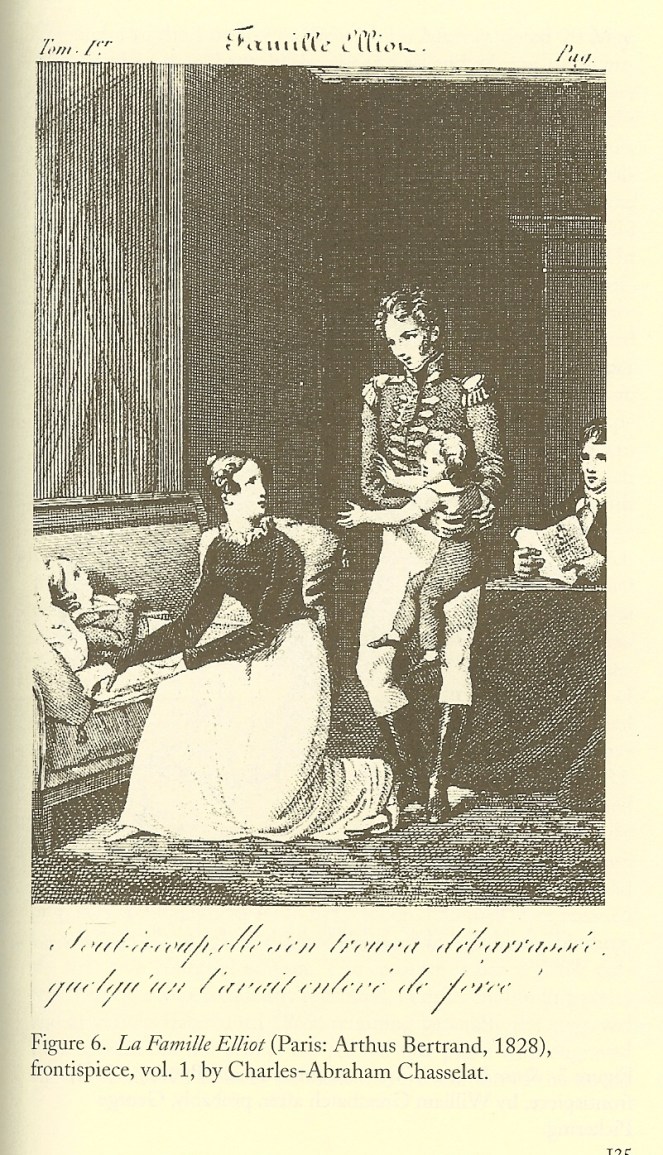
-French TranslationLa Famille Elliot ou “L’Ancienne Inclination” [ the old or former inclination] translated by Isabelle de Montolieu, Paris, 1821 :  this is the first published Austen work to have her full name on the title page and to include illustrations:  in vo1 1, Wentworth removing Walter Musgrove from Anne [see below]; vol 2:  Wentworth placing his letter before Anne.
persuasion-french-illus

[Source:  Todd, p. 125] Anne was called Alice; one aside about these translations:  Baroness de Montolieu took liberties with the text :  made them more sentimental for the French audience – but this too is a topic for another discussion!

Sources: 

  1. Chapman, R.W.  The Novels of Jane Austen: the Text Based on Collation of the Early Editions.  3rd ed. Vol. V, Northanger Abbey & Persuasion, Oxford, 1933. [with revisions]  Introductory material.
  2. Gilson, David.  A Bibliography of Jane Austen.  Oak Knoll Press, 1997.
  3. Raven, James. “Book Production.” in Janet Todd, ed. Jane Austen in Context.  Cambridge, 2007.
Jane Austen · JASNA-Vermont events · News

Join Us! ~ JASNA-Vermont ~ Sunday March 1st

mebMARY ELLEN BERTOLINI
(Middlebury College)
“THE GRACE TO DESERVE: WEIGHING MERIT IN JANE AUSTEN’S PERSUASION


Following Waterloo, rich naval officers vied with impoverished aristocrats for position and importance. Against this political drama, Jane Austen unfolds her story of Anne Elliot, who pines for Frederick Wentworth, the Naval Captain she rejected. Wentworth’s final words in the novel, “I must learn to brook being happier than I deserve” are no coincidence, for the idea of deserving, of earning one’s blessings, is at the very core of Persuasion, Austen’s last completed novel.

Read here  on Mary Ellen’s blog, her comments on her talk to us last week.

Sunday, 1 March 2009
2:00 p.m.
Champlain College
Hauke Family Campus Center (375 Maple St.)
Burlington, VT

free and open to the public ~ light refreshments served

persuasion-cover-vintage

Book reviews · Jane Austen · News

Zombies & Aliens in Austenland??

This is just too good not to print the whole thing right here.  Much has been made the past few weeks about the zombied-out Pride & Prejudice and Elton John’s latest foray into a literary alien-infested monster-land – I’ve not commented on it, just  taking it all in and wondering what to make of it really!  But today in the New York Times, Jennifer  Schuessler writes on this so perfectly, I copy it all here for your delight and save you the need to even click on a link:

I Was a Regency Zombie

By JENNIFER SCHUESSLER

These days, America is menaced by zombie banks and zombie computers. What’s next, a zombie Jane Austen?

In fact, yes. Minor pandemonium ensued in the blogosphere this month after Quirk Books announced the publication of “Pride and Prejudice and Zombies,” an edition of Austen’s classic juiced up with “all-new scenes of bone-crunching zombie mayhem” by a Los Angeles television writer named Seth Grahame-Smith. (First line: “It is a truth universally acknowledged that a zombie in possession of brains must be in want of more brains.”) 

Then, last week, the monster alert at Meryton went from orange to red when it was reported that Elton John‘s Rocket Pictures was developing a project called “Pride and Predator,” in which the giant alien from the 1987 cult classic pays a call on the Bennet family. 

Holy Northanger Abbey! Is this some mutant experiment in intellectual property law escaped from the lab? Proof of the essentially vampiric nature of today’s culture industry? Or an attempt to make Austen safe for audiences – read “boys” – raised on “Mortal Kombat” and “Evil Dead”? 

According to Mr. Grahame-Smith, who confessed to being “bored to tears” by “Pride and Prejudice” in high school, the idea was mostly to sell resistant readers on the joys of Jane while having a bit of fun. The book, probably the first Austen/horror mashup to make it into print, is roughly 85 percent Austen’s original text, with references to monsters, putrefying flesh and ninja swordplay added on just about every page.

 “I think Austen would have a sense of humor about it,” said Mr. Grahame-Smith, whose previous books include “How to Survive a Horror Movie.” (Rule No. 1 in a zombie attack: “Stop Being So Pathetic.”) “Or maybe she’s rolling in her grave. Or climbing out of it.”

 But not everyone in the Austen world relishes the idea of Elizabeth Bennet, action hero. Myretta Robens, site manager and co-founder of the Austen fan site Republic of Pemberley, pemberley.com, (and herself the author of two Regency romance novels), said she was cautiously pessimistic about the forthcoming zombie invasion. 

“I’m interested in anything relating to Jane,” she said. “But to me this is like Jane Austen jumping the shark.” 

To some scholars, however, it’s a short leap from verbal sparring to real swordplay. “It makes sense to give Lizzie a grander scope for her action,” said Deidre Lynch, an associate professor of English at the University of Toronto and editor of “Janeites,” a collection of scholarly essays about Austen devotees. “It goes with the muddy petticoats and the rambling across the countryside in this unladylike way. The next step is ninja training.”

 In fact, “Pride and Prejudice” may already be a zombie novel, contends Brad Pasanek, a specialist in 18th-century literature at the University of Virginia.

“The characters other than the protagonist are so often surrounded by people who aren’t fully human, like machines that keep repeating the same things over and over again,” Professor Pasanek said. “All those characters shuffling in and out of scenes, always frustrating the protagonists. It’s a crowded but eerie landscape. What’s wrong with those people? They don’t dance well but move in jerky fits. Oh, they are headed this way!”

 While the vast industry of Austen sequels and pastiches runs heavily toward the romance-novel end of the literary spectrum – see “The Private Diary of Mr. Darcy” by Maya Slater, to be published in the United States in June – scholars have long emphasized the mean-girl side of Jane’s personality. Professor Pasanek, who has collaborated on a project that uses spam-detection software to analyze Austen fan fiction, cites the psychologist D. W. Harding’s 1940 essay “Regulated Hatred,” which sounds more like a death-metal band than a piece of influential Austen scholarship.

“Most people try to ignore the fact that Austen’s novels are sort of acid baths,” Professor Pasanek said. “She’s so much better, deeper, more sensitive and intelligent than everyone around her that she has to regulate her own misanthropy. Her novels are hostile environments.”

Despite her own reservations, Ms. Robens acknowledged that Austen would probably be “laughing her head off” at the new mashups. 

Or maybe plotting delicious revenge. Next year, Ballantine Books will publish Michael Thomas Ford’s novel “Jane Bites Back,” in which Austen turns into a vampire, fakes her own death and lives quietly as a bookstore owner before finally driving a stake through the heart of everyone who has been making money off her for the last two centuries. 

“She’s a woman who has been middle-aged for 200 years and is fed up,” Mr. Ford said. “She finally gets to restart her life and reclaim her literary fame.”

The undead Austen also settle scores with some old literary rivals, though Mr. Ford declined to name names. Another mashup in the making? 


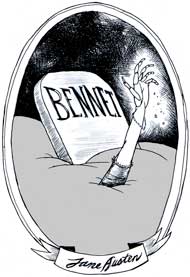
bennet-zombie-pic[Leah Hayes]


Jane Austen · Query

Food for Thought: Austen Astrology

Does the following sound familiar? Remind you of anyone??

aqu1Aquarians “basically possess strong and attractive personalities. They fall into two principle types: one shy, sensitive, gentle and patient; the other exuberant, lively and exhibitionist, sometimes hiding their considerable depths of their character under a cloak of frivolity. …. In spite of the often intensely magnetic forthcoming and open personality of the more extrovert kind of Aquarian, and of their desire to help humanity, neither type makes friends easily. They sometimes appear to condescend to others and take too little trouble to cultivate the acquaintance of people who do not particularly appeal to them. They do not give themselves easily – perhaps their judgment of human nature is too good for that – and are sometimes accounted cold. But once they decide that someone is worthy of their friendship or love, they can exert an almost hypnotic and irresistible mental attraction on them and will themselves become tenacious friends or lovers, ready to sacrifice everything for their partners and be faithful to them for life. However, they are sometimes disappointed emotionally because their own high personal ideas cause them to demand more of others than is reasonable. And if they are deceived their anger is terrible. If disillusioned, they do not forgive.”

pp2It does a lot to explain the personality of Mr. Darcy… Wouldn’t you agree?

Was Jane at all interested in astrology?? Born 16 December, she would have been Sagittarius — The Archer. Interesting that the sign is described as the “bow & arrow,” but also as a sign with a burden or struggle. Hmm…

What sign accounts for Lizzy Bennet’s characteristics??


If you have any particulars among the other novels, What about star signs for any of the characters in Austen’s novels??