Comment below for the chance to win a surprise Jane Austen-related giveaway!
*****************
The Ten Best Reasons to Go to a JASNA AGM, Or, Why I would celebrate Jane Austen’s Birthday
by Spiriting Her Around Such an Event
Well, I had the best of intentions to do a full write-up of all the major events at the latest JASNA AGM in Brooklyn – a special location for me personally as I am a New Yorker born and bred – but as I have mentioned elsewhere life gets in the way of our best-laid plans and as the AGM now seems light-years away, I propose to just offer a grand summary in the context of why one should go to this annual Jane Austen conference; and why do so many plan on being there year after year? Friends and family just shake their heads with the typical “she only wrote 6 books, whatever can you talk about for 4 days??” and I nod knowingly that a lifetime of conferences would not satisfy… It takes me a long while to re-enter the 21st century – how delightful it is to enjoy the late 18th and early 19th without all the attendant inconveniences! I shall make a best effort to give the salient points of this year’s conference, memory perhaps failing me, with a dependence upon sketchy notes, not enough pictures taken (and those that were, not very good…)
*Sandy Lerner, co-founder of Cisco Systems, founder of Urban Decay Cosmetics, founder of the Ayrshire Farm in Virginia, and, most dear to us, is also the founder and moving force behind the Chawton House Library. She is now Chairman of Trustees, Chawton House Library and the Centre for the Study of Early English Women’s Writing, a place for research and camaraderie for scholars from all over the world. What better place than the former home of Jane Austen’s brother Edward Austen-Knight to study Austen and her literary antecedents and contemporaries!
Lerner’s book Second Impressions, written under the nom de plume of Ava Farmer, is set 10 years after the action in Pride and Prejudice, and explores the changes to the Darcy family’s lives, to Europe post-Napoleon, and to life in late Regency England, all as homage to Jane Austen, written in her “stile”, and with a fascinating yet credible plot. So let’s step into Lerner’s world to discover such things as: What do Darcy and Elizabeth do all day at Pemberley? Is Lady Catherine a welcome and constant visitor? Are the Wickhams reformed? And what becomes of England’s most eligible female Georgiana Darcy? And Anne de Bourgh? And dare we ask about Mr. and Mrs. Collins?!
Second Impressionswill be available for purchase and signing, all proceeds to benefit Chawton House Library.
During the Tea we shall engage in Playing Word Games with Jane Austen, a most suitable and refined entertainment for a wintry afternoon!
I have not gone missing, though it may seem that indeed I have fallen off the planet – not quite so dramatic though it does almost feel like that – we have sold our house and amidst the joys of house packing, packing up my book business – all gone to storage as we do not have a place to call home – concerns about my son’s surgery, a September 23rd JASNA-Vermont event of grandiose proportions [three speakers, a fabulous afternoon!], and then off to the JASNA AGM in Brooklyn – a lovely respite into the late 18th century from which I am still fighting re-entry! I was hoping to post about the AGM right away and fear I am slowly forgetting about all the fabulous events of Jane Austen Land in Brooklyn – but I shall start today with a booklist of new purchases – the Emporium filled with goodies as usual – and though the lack of a home and the memory of packing all those books forced me into more conservative behavior at the book stalls, I confess that book buying is my only true vice and I could not completely resist, so here are the latest additions to my Jane Austen library:!
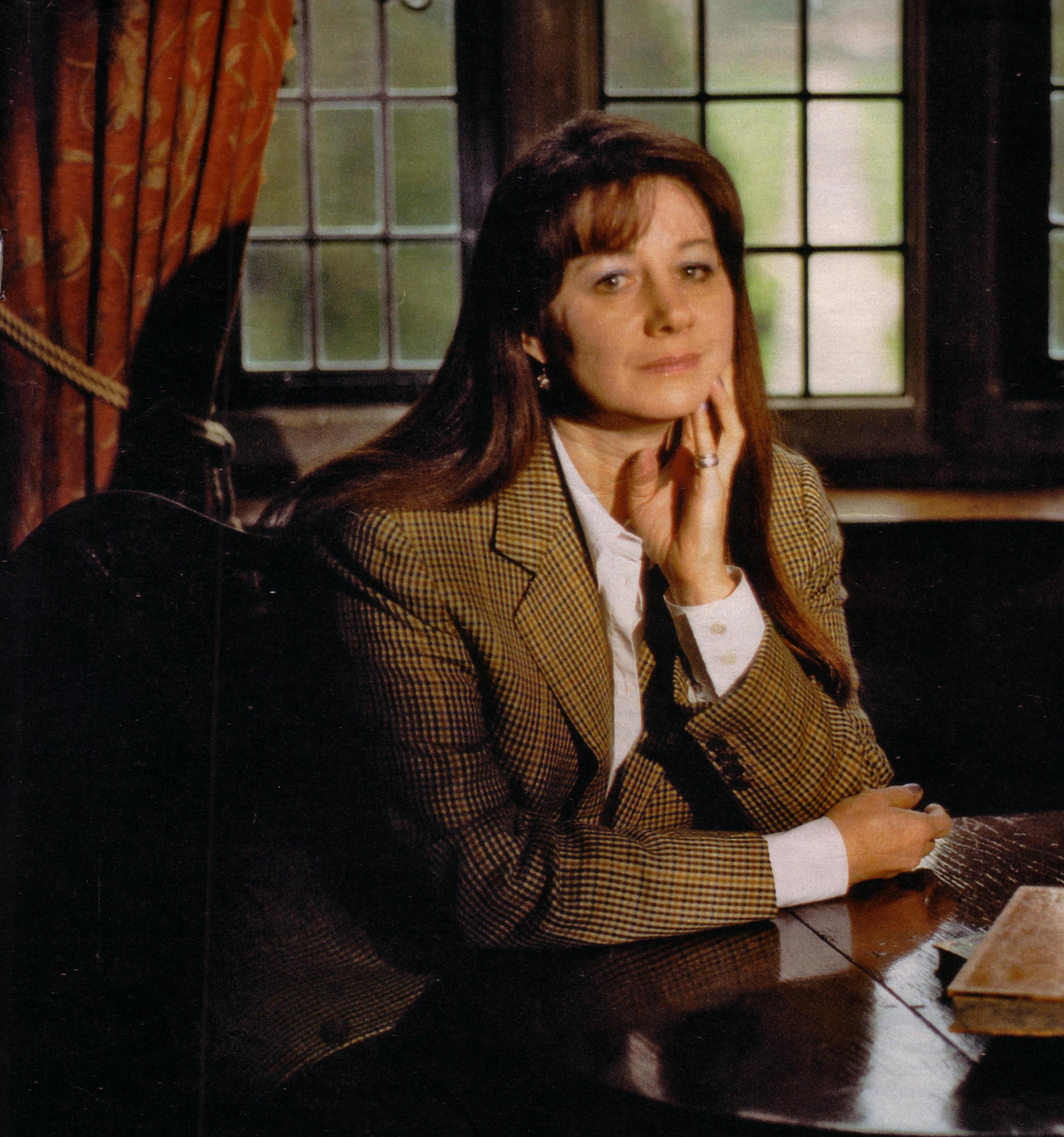
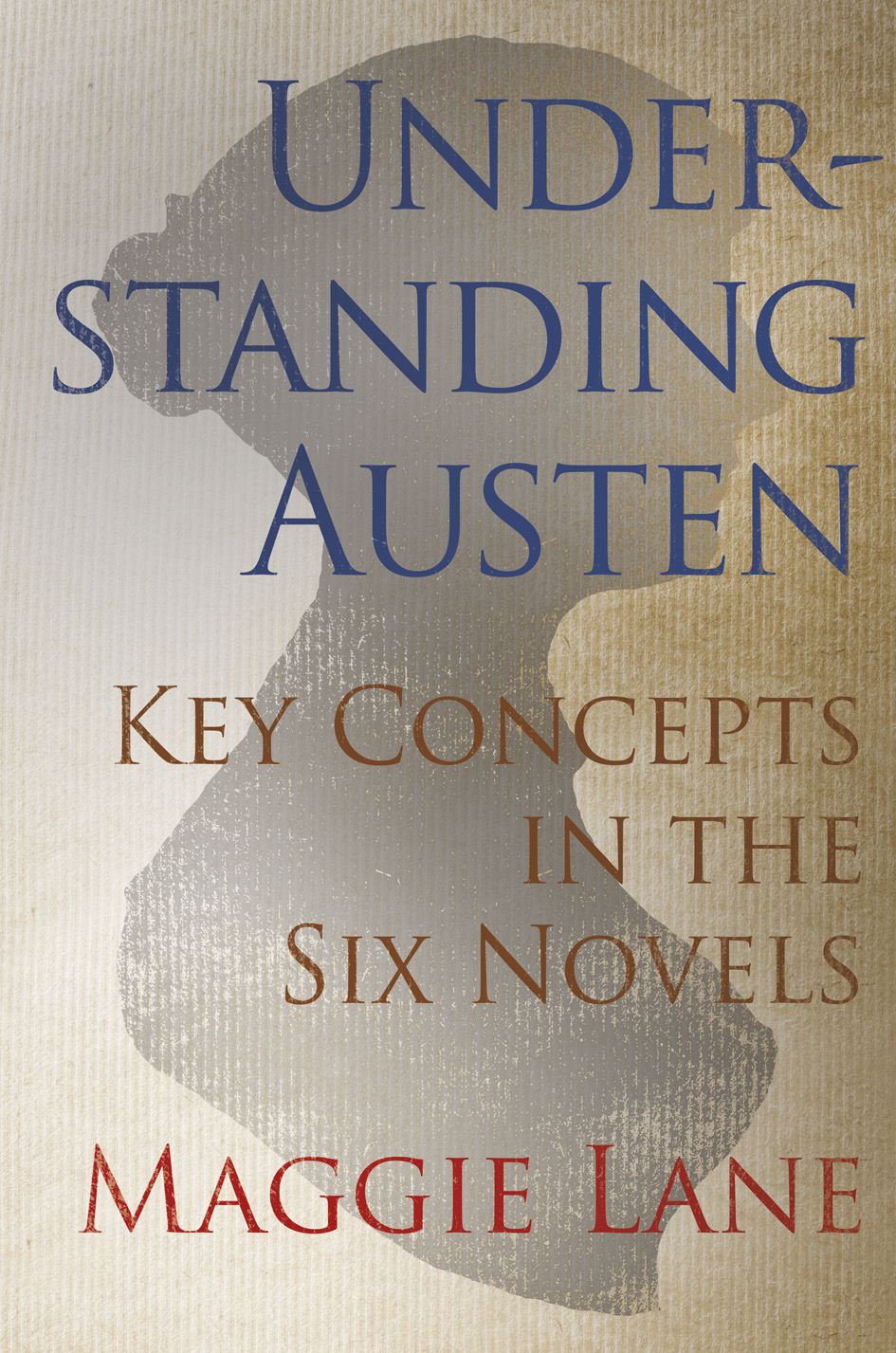
Maggie Lane. Understanding Austen: Key Concepts in the Six Novels. London: Robert Hale, 2012. ISBN: 978-0-7090-9078-6
Lane has written a number of Austen-related texts and this book will be a most welcome addition to my collection of her other works. Her essays in Jane Austen’s Regency World magazine are always insightful, often just focusing on a single term and how Austen employs it [for example in the Mar / April 2011 issue, she takes on Austen’s concept of “home”] – in this book, Lane delineates Austen’s 18th century language, clarifying for the reader the meanings of such words as “elegance” and “openness” to “candour” and “gentility” and “mind” and “spirit” – a lively entry into Austen’s world that adds to our understanding and appreciation of what she was really saying to her readers…
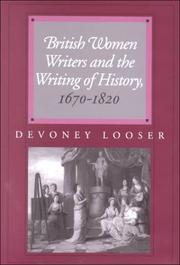
Devoney Looser. British Women Writers and the Writing of History, 1670-1820. Baltimore: Johns Hopkins UP, 2000. ISBN: 0-8018-6448-8
Ashamed to say I do not have this in my collection – so happy to remedy that with this discussion of Lady Hutchinson, Lady Mary Wortley Montagu, Charlotte Lennox, Catharine Macaulay, Hester Lynch Piozzi, and Jane Austen and their historically-informed writings… perfect winter reading…
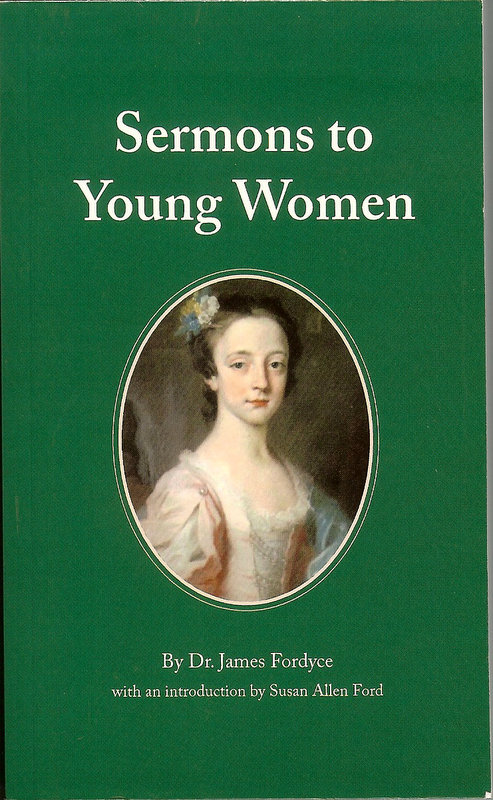
James Fordyce. Sermons to Young Women. Introduction by Susan Allen Ford. Chawton: Chawton House Press, 2012.
ISBN: 978-1-907254-07-9
One of the best-selling conduct books of Jane Austen’s day, Fordyce’s Sermons to Young Women we mostly know as the reading material of the odious Mr. Collins, the words of which Lydia Bennet patently ignored… This is a paperback facsimile of the 10th edition from the Chawton House Library collection, and necessary reading material if one is to understand the world that Jane Austen was writing in – we might laugh at some of the directives for female behavior now and think we indeed have “come a long way baby” – but read it we must to truly “get” Austen… purchase supports the Chawton House Library, and as Susan Allen Ford, JASNA’s intrepid Persuasions editor, has written the introduction, one should just add this to their shelves without further ado…
******************
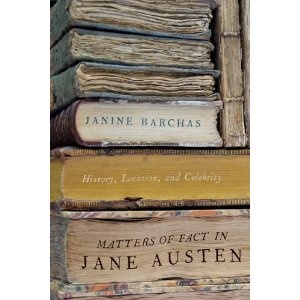
Janine Barchas. Matters of Fact in Jane Austen: History, Location, and Celebrity. Baltimore: Johns Hopkins UP, 2012. ISBN: 978-1-4214-0640-4
“Janine Barchas makes the bold assertion that Jane Austen’s novels allude to actual high-profile politicians and contemporary celebrities as well as to famous historical figures and landed estates…the first scholar to conduct extensive research into the names and locations in Austen’s fiction by taking full advantage of the explosion of archival materials now available online.” [from the jacket]
I had the pleasure of introducing Professor Barchas at her AGM presentation on “Jane Austen Between the Covers: A Brief History of Book Cover Art.” She took us through the last 200 years of marketing Jane Austen through the physical aspect of the book, a long-term project she is working on to create a visual bibliography of Austen’s works. Barchas has given a number of breakout sessions at the past AGMs, always incorporating the graphic and visual aspects of Austen’s world and tying them to her fiction. I am most anxious to read her newest work, and can heartily recommend it…
Claudia L. Johnson. Jane Austen’s Cults and Cultures. Chicago: U Chicago P, 2012. ISBN: 978-0-226-40203-1
Also another must-have for your Austen collection… Johnson “shows us how Jane Austen became ‘Jane Austen,’ an exalted yet seemingly ordinary figure… [by passing] through the four critical phases of Austen’s reception: the Victorian era, the First and Second World Wars, and the establishment of the Austen House and Museum in 1949…” [from the jacket]
Elizabeth Aldrich. From the Ballroom to Hell: Grace and Folly in Nineteenth-Century Dance. Evanston: Northwester UP, 1991. ISBN: 0-8101-0913-1
This book went into a second printing in 2000, so very happy to pick it up. It offers up “a collection of over 100 little-known excerpts from dance, etiquette, beauty , and fashion manuals from roughly 1800-1890, to include step-by-step instructions for performing the various dances, as well as musical scores, costume patterns, and the proper way to hold one’s posture, fork, gloves, and fan…”
Hazel Jones and Maggie Lane. Celebrating Pride and Prejudice: 200 Years of Jane Austen’s Darling Child. Bath: Lansdown Media, 2012. ISBN: 978-0-9573570-0-6
A compact, illustration-filled tribute to P&P, as Jones and Lane “investigate the reasons for its popularity and describe the extraordinary history, reception and afterlife of the phenomenon that is Pride and Prejudice.” [from the back cover]. I was fortunate enough to be purchasing this from publisher Tim Bullamore just as Maggie Lane was at the Jane Austen’s Regency World magazine table – so having it signed by both authors is an additional treat! – and Colin Firth graces the cover, so who could resist!
Sarah Emsley, ed. Jane Austen and the North Atlantic: Essays from the 2005 Jane Austen Society Conference in Halifax, Nova Scotia, Canada. Jane Austen Society, 2006. ISBN: 0-9538174-7-4
I had wanted to go to this conference but was alas! unable to, so happy to pick up this collection of four essays – have meant to since 2006 when it was first published…
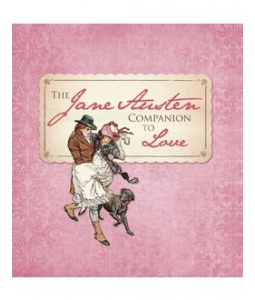
The Jane Austen Companion to Love. Naperville: Sourcebooks, 2009. ISBN: 978-1-4022-4016-4
This was a lovely gift from Sourcebooks in our AGM bag of goodies…. Filled with quotes from the novels and illustrations by the two Brock brothers – a perfect bedside book…and gift for your favorite Austen-loving friend.
***********************
Several books highlighted at the AGM I already have, so shall give them a mention here as well:
Ava Farmer, a.k.a. Sandy Lerner. Second Impressions. Chawton House Press, 2011. ISBN: 978-1-61364-750-9
Ms. Lerner was at the AGM as a plenary speaker – her talk “Money Now and Then: Has Anything Changed?” – was an interesting analysis of whether Jane Austen was knowledgeable about the issue of money in her novels – will write more about this in another post – but want to mention her book here – she will be coming to Vermont in December to speak at our annual birthday Tea! – and her book will be available for sale, all profits to support Chawton House Library. You can visit the book’s website here: http://www.secondimpressions.us/
Susannah Fullerton. A Dance with Jane Austen: How a Novelist and her Characters went to the Ball. London: Frances Lincoln, 2012. ISBN: 978-0-7112-3245-7
A delight to meet and chat with Susannah, the president of JASA, and author also of Jane Austen and Crime, one of my favorite books on Austen. Here Susannah takes on the Regency ballroom, filled with beautiful contemporary illustrations, and everything you wanted to know about Dance!
Juliette Wells. Everybody’s Jane: Austen in the Popular Imagination. New York: Continuum, 2011. ISBN: 9781441145543
Nearly done with this one – and another must-have for your Austen library: “An investigation of Jane Austen’s popular significance today – why Austen matters to readers, how they make use of her novels, what they gain from visiting places associated with her, and why they create works of fiction and nonfiction inspired by her novels and life.” [from the back cover]
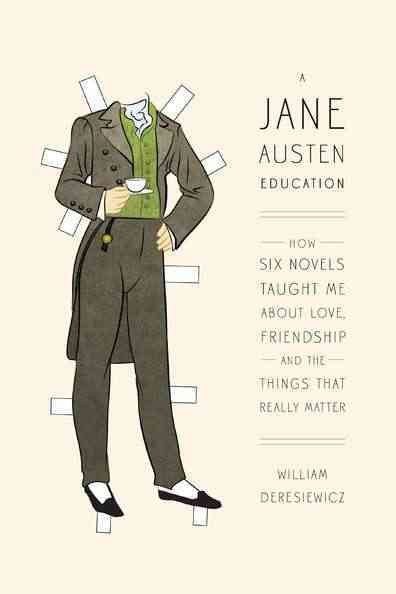
William Deresiewicz. A Jane Austen Education: How Six Novels Taught Me About Love, Friendship, and the Things That Really Matter. New York: Penguin, 2011.
Deresiewicz spoke the evening of the Ball on “Becoming a Hero: Being a Man in Austen’s World” – his book is a delightful journey through the six novels and how his reading of them made him a better man…
*************************
Used Books? – my real downfall, but I only bought two items from the used bookseller Traveler’s Tales, where I usually drop a bit more blunt – I didn’t get to the booth until a few days after the Emporium opened and most items of interest were already gone… but I did find this:
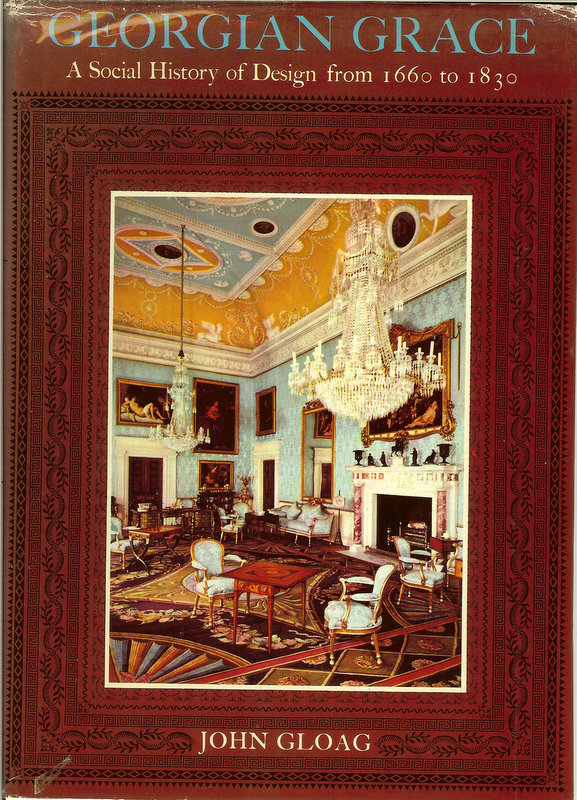
John Gloag. Georgian Grace: A Social History of Design from 1600 to 1830. London: Spring Books, 1967, c1956. – a must have for anyone interested in the architecture and decorative arts of the period – who can resist a book with chapters such as “‘A Dish of Tea’” and “Pray be seated” and “‘The toilet stands dispay’d’” and the like!
And this, a Rowlandson print – you must visit theJane Austen’s World blog where Vic [my delightful roommate!] shares her purchase of FOUR of these Rowlandson prints!
Here is my one and only: “The Harvest Home” by Thomas Rowlandson (1821)
****************
…and last but not least, my favorite annual purchase at the AGMs is the Wisconsin Region’s “A Year with Jane Austen” Calender, this for 2013 a celebration of Pride and Prejudice: you can order your own copy here: http://www.jasna.org/merchandise/calendar-2013.html [I purchased a number to sell at our JASNA-Vermont Austen Boutique…]
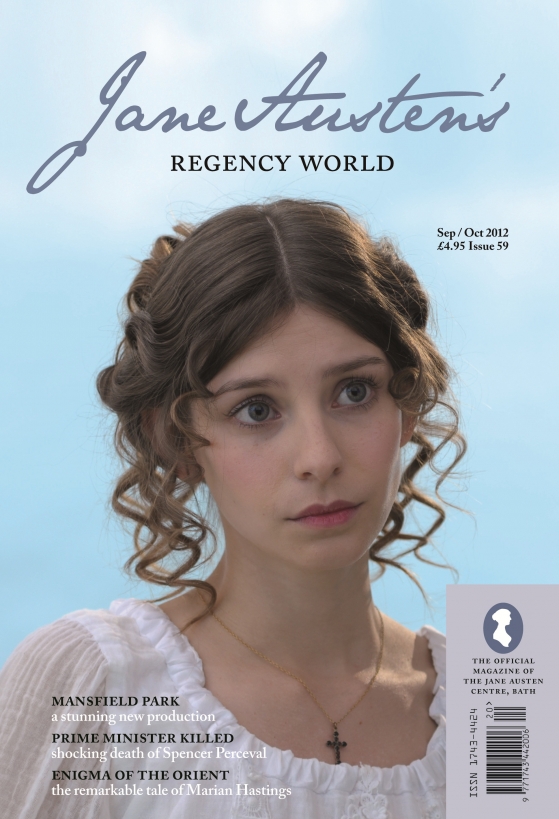
Mansfield Park on tour: a new stage adaptation tours the UK – we speak to the director Colin Blumenau
Prime Minister killed: marking the bicentenary of the assassination of Spencer Perceval
Enigma of the Orient: the remarkable tale of Marian Hastings, wife of the British ruler of India
Brooklyn preview what’s coming up at the JASNA AGM in New York
Festival experience: regular visitors to the Bath Jane Austen Festival describe their time in the city
Plus … all the latest news from the world of Jane Austen, your letters, round-ups from the Jane Austen Society of the UK and the Jane Austen Society of North America, book reviews and quiz.
The latest issue of Perusasions – volume 33 [not as the image indicates!], papers from the Fort Worth AGM on 200 Years of Sense and Sensibility has been mailed to members [and like me you hopefully already have received it!] The journal is not online – you must be a JASNA member to receive it. Here is the table of contents:
the June 3 2012 flyer: share with your friends! ****************************
*We are honored to welcome Professor Rachel Brownstein, author of Becoming a Heroine (1982), Tragic Muse: Rachel of the Comedie-Francaise (1993), and Why Jane Austen? (2011). Films, feminism, and popular fetishes are among the subjects of her new work, an engaging treasure-filled meditation on Jane Austen as writer, woman, social commentator, and 21st-century icon. But most of all it is about reading, which Brownstein has been encouraging people to do, at Brooklyn College and the Graduate School of CUNY, for several decades.
**********************
Please Join Us!
*********************************
~ Upcoming in 2012 and beyond ~
Sept. 23: Burlington Book Festival: ‘An Afternoon with Jane Austen’: authors Elsa Solender on Jane Austen in Love: An Entertainment, Stuart Bennett on The Perfect Visit; and Hope Greenberg on “Dressing Jane”!
Dec. 2: Annual Birthday Tea with Paul Monod of Middlebury College on
“The Royal Navy in the Age of Nelson, 1775-1815”
Mar. 2013 [TBA]: “’Fifty Miles of Good Road’: Travelling in Jane Austen” with Deb Barnum
the June 3 2012 flyer: share with your friends! ****************************
*We are honored to welcome Professor Rachel Brownstein, author of Becoming a Heroine (1982), Tragic Muse: Rachel of the Comedie-Francaise (1993), and Why Jane Austen? (2011). Films, feminism, and popular fetishes are among the subjects of her new work, an engaging treasure-filled meditation on Jane Austen as writer, woman, social commentator, and 21st-century icon. But most of all it is about reading, which Brownstein has been encouraging people to do, at Brooklyn College and the Graduate School of CUNY, for several decades.
**********************
Please Join Us!
*********************************
~ Upcoming in 2012 and beyond ~
Sept. 23: Burlington Book Festival: ‘An Afternoon with Jane Austen’: authors Elsa Solender on Jane Austen in Love: An Entertainment, Stuart Bennett on The Perfect Visit, and more!
Dec. 2: Annual Birthday Tea with Paul Monod of Middlebury College on
“The Royal Navy in the Age of Nelson, 1775-1815”
Mar. 2013 [TBA]: “’Fifty Miles of Good Road’: Travelling in Jane Austen” with Deb Barnum
Along with a dramatic new look and easier navigation, the website has been enhanced with several new features:
*A dedicated page for each GCR event with more information, including driving instructions and parking options
*Online Exhibits explaining historical elements in the Austen novels
*Reading Guides for teachers and reading groups
*Fun Stuff pages of puzzles and links
*An Austen-inspired mystery short story by GCR member and author, Felicia Carparelli
*Special Member Area
*And, much more for you to explore!
The Web Committee wants this website not only to provide programming and interactive learning resources but also be a place to have fun. We want you to be a part of our community even if you cannot attend our events. We aim to continually add more content to keep the website fresh and current for you. We hope you visit the site regularly. If you join us on Facebook at https://www.facebook.com/JASNA.GCR you can receive alerts of new content and announcements.
We hope you enjoy exploring the new website!
*************************
Visit when you can – the website header alone is worth the price of admission (and I cannot copy it)! and there are lots of other goodies to get lost in…
[Image: from the JASNA-GCR online exhbition “Men, Women, and Marriage” by Jeff Nigro, RC for the Region]
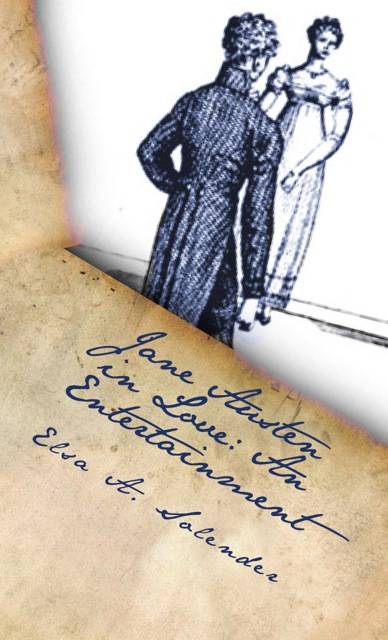
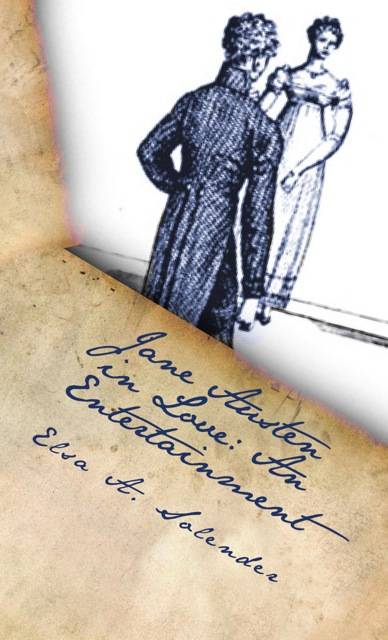
We welcome today Elsa Solender, former JASNA president, now author of Jane Austen in Love: An Entertainment. The book is currently available as a kindle ebook, and I heartily recommend that you download it immediately from Amazon.com– if you have no kindle, you can add a free kindle app to your computer and various i-products, and read it that way… rightaway…
Solender’s sub-title of “An Entertainment” clearly states what this book is about – a fanciful confection of Jane Austen in love, where we are given a birds-eye view of episodes in her childhood, intimate moments with her sister, her family, and friends; an imaginary take on her feelings for Tom Lefroy; her 1-day engagement to Harris Bigg-Wither; and the fateful meeting with the rumored and wished-for ‘Gentleman suitor of the seaside’ – part real, part imaginary, and part straight from Austen’s own fiction, all beautifully woven together into this tribute to love in the life of Jane Austen. Read it, and then, as you would any Austen novel, read it again – there is much to discover and savor, and great fun to stumble upon the allusions to the letters, the known people in her life, and her very own fictional characters!
Please see below the interview for the giveaway rules [either a kindle book reimbursement or if the winner is kindle-less, a copy of Dancing with Mr. Darcy, the anthology which contains Ms. Solender’s short story “Second Thoughts.”
****************************
JAIV: Welcome Elsa! I appreciate you visiting Jane Austen in Vermont today, as we talk about your new book Jane Austen in Love: An Entertainment.
But first, tell us a little about your beginnings, your discovery of Jane Austen.
ES:My mother gave me Pride and Prejudice when I was in seventh grade and just 12. I was too young and put it aside. The next year, I returned to it, read it, loved it, and spent the month of July that year speeding through the other five Austen novels non-stop every day as if I were running—or reading — in a marathon . I didn’t reread them again until freshman year at Barnard College. The papers I produced on Emma and for assignments were all close textual analyses (I recently re-read one or two of those papers – they’re not bad). My professors were New Critics focused almost exclusively on texts and critiques, with little historical or biographical background considered. To read too much into the author’s intentions or personal background was to commit one of the dreaded critical fallacies of New Criticism. But Jane Austen’s texts stood up magnificently with minimal background material. I really didn’t learn much about her life until I joined JASNA at its inception in 1979. After all is said and done, though, it’s the novels that count – which is a rather strange thing for the author of a biographical novel to admit, I guess.
JAIV: And because I have to always at least ask the impossible-to-answer question: which is your favorite Austen novel and why?
ES:My favorite changes. I liked Emma best when I was younger – she’s an enfant terrible and a bit of a monster, with all the fascination of a monster, but Mr. Knightley loves her, and so must we. I was enamored of Mansfield Park for a while because of its problems and artistic challenges: Imagine choosing Fanny Price as your protagonist and Edmund as your “hero.” What a task Jane Austen set for herself there! I loved Northanger Abbey because I found it reassuringly imperfect in its structure, yet wonderfully entertaining, with so many amusing characters and clever lines. Then again, I think Captain Wentworth’s letter in Persuasion is one of the most passionate — but I am going on and on! Let me just say that I have always loved Pride & Prejudice – but add that when I’m not with the one I love, I love the one I’m with!
JAIV: Why do you think that Jane Austen continues to be the “darling” of academia as well as popular culture?
ES:Austen is endlessly fascinating – just as Shakespeare is. Her themes are universal, her language is rich, her psychological insights are penetrating, her social commentary is flawless, her moral compass unfailingly true. As times and trends change, new approaches to her work and life stimulate new thinking. For example, feminists in the 1970’s found her “conservative.” Then they read her again —with new eyes—and discovered her subversive qualities. Academics can still mine her work and her life – and all the spin-offs of those basic materials. JASNA’s journal, Persuasions, provides a juried venue for publication, another factor encouraging the academicians. I suspect that every gifted and ambitious young actress of every age yearns to have a go at playing Elizabeth Bennet if she can, just as the best young (and not so young) actors want to give Hamlet a try. We’ll have another bunch of filmed versions soon again, I suspect.
JAIV: You have written a novel around your short story “Second Thoughts” – the runner-up in the first Chawton House Library Short Story Contest and published in the anthology Dancing with Mr. Darcy – explain how you went from that story [did you write it first with no intention to write more?], to the full novel, and why?
ES:The idea for the story came to me in a flash when I read the contest topic (and learned that the judging would be done anonymously – my name would not be on the manuscript so no judge would know I had been president of JASNA). I wrote it very quickly and polished it for weeks afterward. I felt it was pretty risky to dare to try to enter Jane Austen’s consciousness, so I had better write it all out before I let myself get intimidated. Since I was entering her mind, not trying to imitate her prose, there could be some leeway for stylistic imperfections. While I was in residence at Chawton House Library —part of the prize for the three prizewinners of the contest— I began experimenting with the narrative point of view to see if I might extend the story into something broader than a single event in Jane Austen’s life. I was looking for a narrator who was not Jane Austen, but wrote like her – though not as well, of course.
JAIV: How do you change that story in this novel? And why? [without giving too much away!]
ES:I didn’t change much. As my narrator writes, she learns to write better, and to enter Jane Austen’s consciousness more confidently. The story is the culmination of that process, both artistically and in the merging of her own consciousness with Jane’s.
JAIV: You use Cassandra Austen as your first-person narrator – how did you decide on her and not Jane Austen, or another person in Austen’s life?
Cassandra Austen
ES:I would never try to directly imitate Jane Austen’s style although I have imitated Defoe, Boswell and Johnson in the past. I needed someone who was privy to Jane Austen’s most intimate thoughts and feelings. Who but Cassandra?
JAIV: You write in a 19th century style that does not actually imitate Austen [who can!] but sounds true to the times and Cassandra’s inner voice – how did you go about creating that voice in that time?
ES:Since my college days, I have been told that I have a pretty good ear for imitation, especially of dialogue. When I was working at Barnard after graduation, I actually ghost wrote two pieces for a symposium in a national publication which were supposed to be by two different people. When I was a student, one could sometimes substitute an imitation for a term paper in the eighteenth century literature courses that we at Barnard could take in the Columbia Graduate Faculties. I chose that option because I was so busy: I was a married student with a part–time but demanding job as a stringer for The New York Times as well as a full program of courses. An imitation required little research, just familiarity with the mechanics of style (which I had) and a good ear and a taste for satire – so I wrote “Moll Flanders in New York” and “Samuel Johnson in New York”— with lots of dialogue—and I got A’s on both. What I did was start out reading something by the author I was imitating and just continued on in the same voice into my own plot. I familiarized myself with Cassandra’s letters and found I could pretty well pick up on her sentence structures and vocabulary– although one has to reach beyond imitation and empathize with the character one is creating for a novel. I hope I did that in my book.
JAIV:Jane Austen in Love: An Entertainment tells the story of some of the most private and intimate episodes in Austen’s life. We know so little really – the “facts” are quite sparse and there has been much speculation through the years. It is so tempting for her “disciples” to fill in the blanks – from the letters, the works and anything else one can find! What inspired you to take this on? – to tell her story from the viewpoint of her closest confidant and fill in those many blanks with such realistic happenings?
ES:Strangely enough, I find that the idea of borrowing Jane Austen’s characters is —for me at least — very uncomfortable. Her characters are her intellectual property. In my mind, they still belong to her. I tried once taking a very minor flat character and working out a fiction from the few hints we were given, but I really didn’t enjoy doing it. In reading biographies of Jane Austen, I always felt unsatisfied (In fact, that’s my problem with many biographies – and with autobiographies, too. Where there is speculation about a subject’s inner life in a biography, which purports to be factual, I tend to irrationally dislike and distrust it. I am also leery of the revelations of autobiographers about themselves.] Yet my interest was in the inner life of Jane Austen that was concealed from us, but might possibly be perceived intuitively from her writing. What facets of Jane Austen’s inner life, I asked myself, might have led her to write as she did? What events and people might she have examined and used as grist for her fictional mill? And what might have happened that influenced her to leave out some matters – like religion, for example, or war? Somehow, speculating in a clearly marked work of fiction seemed more seemly to me than speculating in a historical or biographical study. Others may well disagree – if so, they shouldn’t read my book. Also, there was a bit of wish fulfillment involved: I wanted to find my beloved author a partner, at least for a while, who was worthy of her genius. I meant my “gentleman at Sidmouth” to be a kind of gift or tribute in gratitude for the joy her work has given me. Does that sound corny? Well, perhaps it’s because I’ve been happily married for many years.
JAIV: No, not corny at all! – I think many of us wish for her seaside suitor to have been real for her. How else we ask could she have written such passionate tales of love, and of love lost and found?
You title your book “Jane Austen in Love” – and it is really about the many loves of Jane Austen: her sister, her family, her cousin Eliza, Madame Lefroy, her flirtation with Tom Lefroy, her proposal from Bigg-Wither, and her mysterious suitor at the seaside. You create dialogue and story to bring these known facts to life, brilliantly piecing all with a fully imagined Austen by using many references and at times actual dialogue from the novels. Which leads me to ask, how ever did you decide on what to include from her real life experiences and from her fiction? – At times I had to check my Letters biographical index to see if someone was real or not! Mr. and Mrs. Austen are at times the Bennets; fictional neighbors become the Mrs. and Miss Bates; several “real life” adventures are straight from the books [including a rescue a la Willoughby and Marianne!] – it was great fun to stumble upon these, and I am sure I would find more on a second reading! – but how did you manage this? –
ES:You are both a perceptive and astute reader! Thank you for “getting” so much of what I was after. I think all her loves contributed to Jane Austen’s concept of a meaningful romantic partnership and to her development as a novelist. I worked mostly from memory—I have been reading and rereading her novels for decades, as well as reams of secondary source material— but occasionally I sought out a suitable phrase and planted it for my reader to find and enjoy – a bit like a literary treasure hunt. At the same time, someone with only a little knowledge of the background and biography—like a latter day New Critic— ought to be able to enjoy the characters and the story without consulting any other work. As I wrote in my acknowledgements, Deirdre Le Faye’s books were invaluable resources when my memory didn’t serve or I needed verification. She deals in facts—brilliantly — and I deal—ultimately— in fancy, which is why I call the book an “entertainment.” I think all writers use real life and, if they are successful, transmute it into fiction which, in some ways, can become “truer” or “better” or “more real” than mere facts could ever be: Facts are both random and fixed, but a fiction writer has the freedom (and responsibility) to shape —and stack— and change— facts for his or her own artistic purposes.
JAIV: An author can find themselves on dangerous ground combining known biographical facts and a fictional telling of what might have actually happened, dialogue and all – are you at all concerned about the reception of this novel? concerned that Austen “fans” might feel their own private Austen has been tampered with?
ES:I think we who love Jane Austen’s novels yearn for a better image of her, whether it’s a visual image or a persuasive word picture that syncs with the novels. We want to know her intimately, although she (and Cassandra) did their best to keep what they deemed “private” away from us. I speculate in the novel whether the destruction Cassandra wrought was really such a good idea in the end: The varying images of Jane Austen that have come down to us over two centuries —Saint Jane, Jane the Hater, Dear Jane, Sour Jane — might not have pleased or satisfied either sister. Even so, through the novels, she seems to belong to each of us in a special way. I offer my speculations, with the blanks filled in as I would like them to be; but it’s clearly my own personal notion of her (as well as a bit of a dream for her). I am perhaps presumptuous in my presentation – but I did at least spare her from vampires, zombies and sea monsters.
JAIV: Yes, it was quite delightful to spend my reading hours with a real Jane and her family and friends! I love especially your description of Madame Lefroy – she jumps off the page as such a lively, lovely character – did you have a particular portrait in mind when you wrote this?
ES:Not really – although she likes some of the same poems as one of my favorite high school teachers and looks rather like my freshman English professor.
JAIV: Ah yes, the autobiographical comes out doesn’t it!
Which leads me to the reader’s confusion of this real and fictional world … I found myself reminded of many Austen’s biographical tidbits that have retreated in my brain to a “save for later” file – and now pleasantly brought to the fore, such as her Abbey school experience, details about Eliza de Feuillide – and then there are the various characters and incidents that I know must be fictional – I feel as though I need to do a re-read of the letters and all biographies, and all the novels to cipher the facts from your tale! – what advice can you give the reader?
ES:Read and re-read the novels, themselves, for pleasure and illumination. Look to Deirdre Le Faye for facts.
JAIV: Indeed, where would we be in Austen scholarship without Deirdre Le Faye!
In my mind the seaside suitor you imagine for Austen is very like one of her fictional heroes – I will not say which he most reminds me of! – everyone might find their own – but is this gentleman a composite of all her heroes or does he lean toward personifying one of them? And if so, is this your own favorite Austen hero? [i.e. who did you have on your nametag at the Richmond AGM “Jane Austen and Her Men” in 1996 – I realize you cannot really say… but skim around it if you can!
ES:He’s entirely my creation – but of course, any ideal male character of mine would have to be strongly influenced by Jane Austen’s heroes – and by the virtues of my own particular husband, to whom the book is dedicated.
JAIV: Just a question about the publishing process: though I am an avid book collector, I do have a kindle and use it mostly for those books I don’t really need on my already over-stuffed shelves [though alas! it is a rare book I read that I don’t want to own!] – I would have liked your book in a hardcopy to add to my Austen collection, but it is right now only available exclusively in the kindle format. Can you tell us how this came about and if this has worked for you?
ES:There is no more room on my shelves for new books either, but I keep on buying them. I have about a dozen double-booked shelves. I make myself give up a book (usually an old paperback) whenever I add a new book. I bought the Kindle for my husband after shipping ten shelves of his books to his office. Then I bought one for myself – good for reading on buses and subways. Sometimes I read a book on Kindle and then buy a “hard copy.”
My literary agent and I turned to the Amazon Kindle publication after she received, over the space of a year, “the most beautiful and admiring rejection letters of (her) career.” One reason for declining the book was that biographical novels don’t seem to be selling well (despite “Wolf Hall”). Another editor said she liked it but it “moved at the pace of a Jane Austen novel” – which she didn’t regard as a virtue. Then, a couple of months ago, an executive at Amazon — with whom my agent used to work when she was an editor at a major publishing house — asked to put her backlist on Kindle. He also asked if she had something new that she loved that was not being picked up by a traditional publishing house. She suggested my book. He was enthusiastic – and in the end, it was presented as a e-book on Amazon at absolutely no cost to me. The object was to “get it out there” and have it read. No one doubts that eBooks have a future – as many of them are sold now as “regular” books. Unfortunately, neither the editing process nor the marketing have been what we hoped (and expected) they would be. We are working on correcting irritating reversals of words, missing words, etc. for which I ask your patience. Also, Amazon’s plan for marketing turned out to be quite different than we expected and we need to establish a “presence” for the book on the Web during what they deem a “slow rollout.”
Incidentally, the free Kindle “app” can be downloaded easily from Amazon so that a Kindle e-book can be read on any computer or tablet. I learned that after my book was published.
JAIV: Are you expecting that it will be available as a “real” book at some point?
ES:My agent ardently hopes that one of the editors who held the book for months and months, and complimented it warmly, but then declined to purchase it, will ultimately publish it. That’s our objective. It needs to sell rather well to attract any attention, and I do have the right to take it back from Amazon after a year (and they can make a counter offer). Right now, I am receiving immense pleasure hearing from readers who enjoy the book – and tell me(and Amazon and the world) why they like it.
JAIV: Do you enjoy any of the Austen-inspired fiction? – the sequels, continuations, the mash-ups? Can you share any of your favorites and why?
ES:I am hyper-critical and impatient with slips in voice and style (including my own). One sequel I read years ago about Jane Fairfax in the Burke Collection at Goucher College made me think about writing one of my own – but in the end I didn’t feel comfortable doing it. I thought Joan Austen-Leigh’s Return to Highbury, built around a very minor character in Emma, had its own merit. [this was the first title of her book, it was later changed to Mrs. Goddard, Mistress of a School.] And borrowing another writer’s very minor character is what Tom Stoppard does so wonderfully in Rosenkranz and Guildenstern are Dead and he borrows biographical characters for his Arcadia.
JAIV: Your say your book is about love, but it is not a formula romance. Into what genre, if any, do you think it might fit?
ES: It’s true that my plot doesn’t follow the traditional romantic course of Girl meets Boy, they fall in love, complications arise, they work them out, Girl and Boy get married and live happily after. It might have been more salable if it had fit into that genre. I was limited – and also challenged – by the known facts of Jane Austen’s life, sketchy as they are. Mine is a work of fiction based on those facts, but embroidered with my own— hopefully plausible— imaginings. It is, in a sense, a feminist novel – not overtly so, but implicitly: I think I show how a young woman’s romantic “career” could be influenced, even destroyed by lack of fortune and the influence of people who had power over her, even those who loved her and acted in what they may have thought was her best interest. I wanted to show, however, that even in restricted circumstances, without marriage, women of spirit and ingenuity could build a meaningful and satisfying life if they were allowed space to develop their talents and build relationships with family and friends. In that sense, it may be as much a modern novel as a historical one.
JAIV: If Jane Austen had married Mr. Bigg-Wither—or her mysterious suitor—do you think we would have had the six novels? Perhaps we would have nothing but the Juvenilia and random letters that no one would care about….
ES:I doubt very much that we would have had any novels if she had married, even if her husband meant to be supportive of her ambition to write. With either man as her husband, she would have had responsibilities as a wife and helpmate that would have left her very little time of her own, whether as the lady of the manor or a clergyman’s wife. Children would have demanded even more of her attention. I do believe that her sister Cassandra protected Jane’s writing time once they settled at Chawton with a generosity that a husband and children of her era would not likely have been able to equal. Very few women I know have been able to demand what psychologists call “self-time” until very recently when professional women have become equal contributors to their family’s finances and in a position to insist on certain prerogatives in return. Perhaps Jane Austen might have completed novels if she had managed to live to a ripe old age—like her mother, or her brother Francis, who became Admiral of the Fleet at 90 when he outlived his contemporaries —and that would only have happened with a husband willing to tolerate and nurture her rather unusual ambitions. In my short story, I wanted to suggest that she rejected conventional comfort and security that marriage to Bigg-Wither would have brought her for two reasons: One was her conviction that a marriage without affection and respect could not flourish, the second was her irresistible drive to write.
JAIV: I know you have written about “Recreating Austen’s World on the Screen” in JASNA’s Persuasions – What are your quick thoughts on the movies – Your favorites? Those that got it wrong?
ES:I liked the Colin Firth P&P best. I hated all the Mansfield Parks.
JAIV: If you could tell us the best five works in your Austen collection [besides the Works themselves], what would you choose? Which books have been the most valuable to you in understanding Austen and her times?
For instance, you write in Jane Austen in Love, a bit on “the secret language of the fan” [all quite fun where you have Eliza impart to her younger cousins all her thoughts about “love”!] – what books have you found most helpful in understanding these social customs?
ES:All of Deirdre Le Faye‘s works are helpful. All Juliet McMaster’s critical studies are of comparable value in their own way. I often refer to The Jane Austen Companion (by J. David Grey, Brian Southam and Walt Litz). I also make great use of the Internet when I am looking for something I vaguely remember – or don’t recall, but need.
JAIV: What else do you like to read?
ES:I am a voracious reader. I usually keep about four books going at one time. On my bed table and on my Kindle, I have bookmarks right now in: Here, an anthology of wonderful poems by the late Wislawa Szymborska, whose outlook and tone resembled Jane Austen’s in many ways; The Life of Super-Earths by Dimitar Sasselov (I am almost as passionate about astrophysics as I am about Jane Austen); Boswell’s Presumptuous Task: The Making of the Life of Dr. Johnson by Adam Sisman, and Sugar Street, Book II of the Cairo Trilogy of Mahfouz. I am passionate about — and often reread— the novels in Patrick O’Brian’s Aubrey – Maturin series (he told me Jane Austen was his stylistic muse); the trilogies of the late great Canadian novelist, Robertson Davies, and the works of my favorite teacher in The Committee on Social Thought at University of Chicago, Saul Bellow.
JAIV: And for the writers out there: what is your writing process? And your best advice to aspiring writers?
ES:Every writer has his or her own peculiar process. If you need to write – just do it. Otherwise, find something easier to do.
JAIV: Do you have any other fiction in the works?
ES:Yes.
JAIV: Ok, I shall not ask more on that! Anything else you would like to share with my readers?
ES:Just that I hope they will give my novel a try and let me know what they think of it.
*****************
Thank you Elsa for your graciousness in answering all these questions! I wish you the very best with your new book – and we at JASNA-Vermont look forward to your visit to us next fall as part of the Burlington Book Festival!
About the author: Elsa A. Solender, a New Yorker, was president of the Jane Austen Society of North America from 1996-2000. Educated at Barnard College and the University ofChicago, she has worked as a journalist, editor, and college teacher in Chicago, Baltimore and New York. She represented an international non-governmental women’s organization at the United Nations during a six-year residency in Geneva. She wrote and delivered to the United Nations Social Council the first-ever joint statement by the Women’s International Non-Governmental Organizations (WINGO) on the right of women and girls to participate in the development of their country. She has published articles and reviews in a variety of American magazines and newspapers and has won three awards for journalism. Her short story, “Second Thoughts,” was named one of three prizewinners in the 2009 Chawton House Library Short Story Competition. Some 300 writers from four continents submitted short stories inspired by Jane Austen or the village of Chawton, where she wrote her six novels. Ms. Solender was the only American prizewinner, and she is the only American writer whose story was published in Dancing With Mr. Darcy, an anthology of the twenty top-rated stories of the contest
Ms. Solender’s story “A Special Calling” was a finalist in the Glimmer Train Short Short Story Competition. Of more than 1,000 stories submitted, Ms. Solender’s story was ranked among the top fifty and was granted Honorable Mention. She has served on the boards of a non-profit theater, a private library and various literary and alumnae associations. Ms. Solender is married, has two married sons and seven grandchildren, and lives in Manhattan.
*****************************
Book Giveaway!
Please post your comments or questions ~ Elsa will happily respond to you! All commenters will be entered into the random Book Giveaway drawing for a copy of Jane Austen in Love: An Entertainment, which is only available as an Amazon kindle ebook. If the winner has a kindle, I will reimburse the $8.99 it costs to download. If you are alas! kindle-less, the winner will be sent a copy of the Chawton House Library’s Dancing With Mr. Darcy, which includes Ms. Solender’s story “Second Thoughts” – an imaginary tale of Jane Austen’s sleepless night after accepting the proposal of Harris Bigg-Wither, which is part of this new work.
The deadline to comment is 11:59 pm Sunday March 4, 2012 – Winner will be announced on Monday March 5, 2012. Worldwide eligibility.
For those of us on this side of the pond, those who cannot yet see the just broadcast “The Many Lovers of Jane Austen” with Amanda Vickery on BBC Two – here is a short clip from the show about the JASNA AGM in Fort Worth Texas this past October… enjoy, at least until we can see more of the show…














 Jane Austen in Vermont