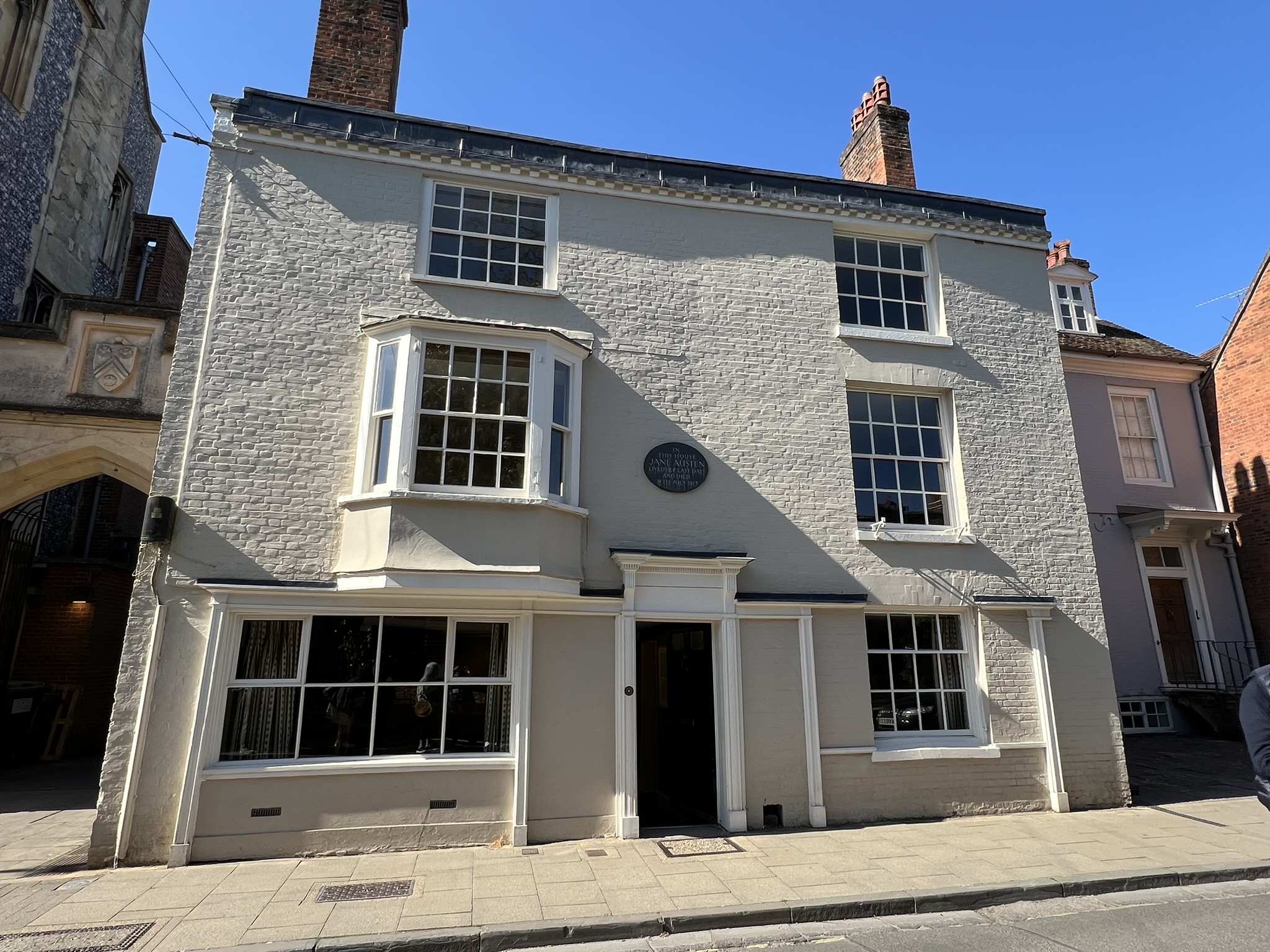
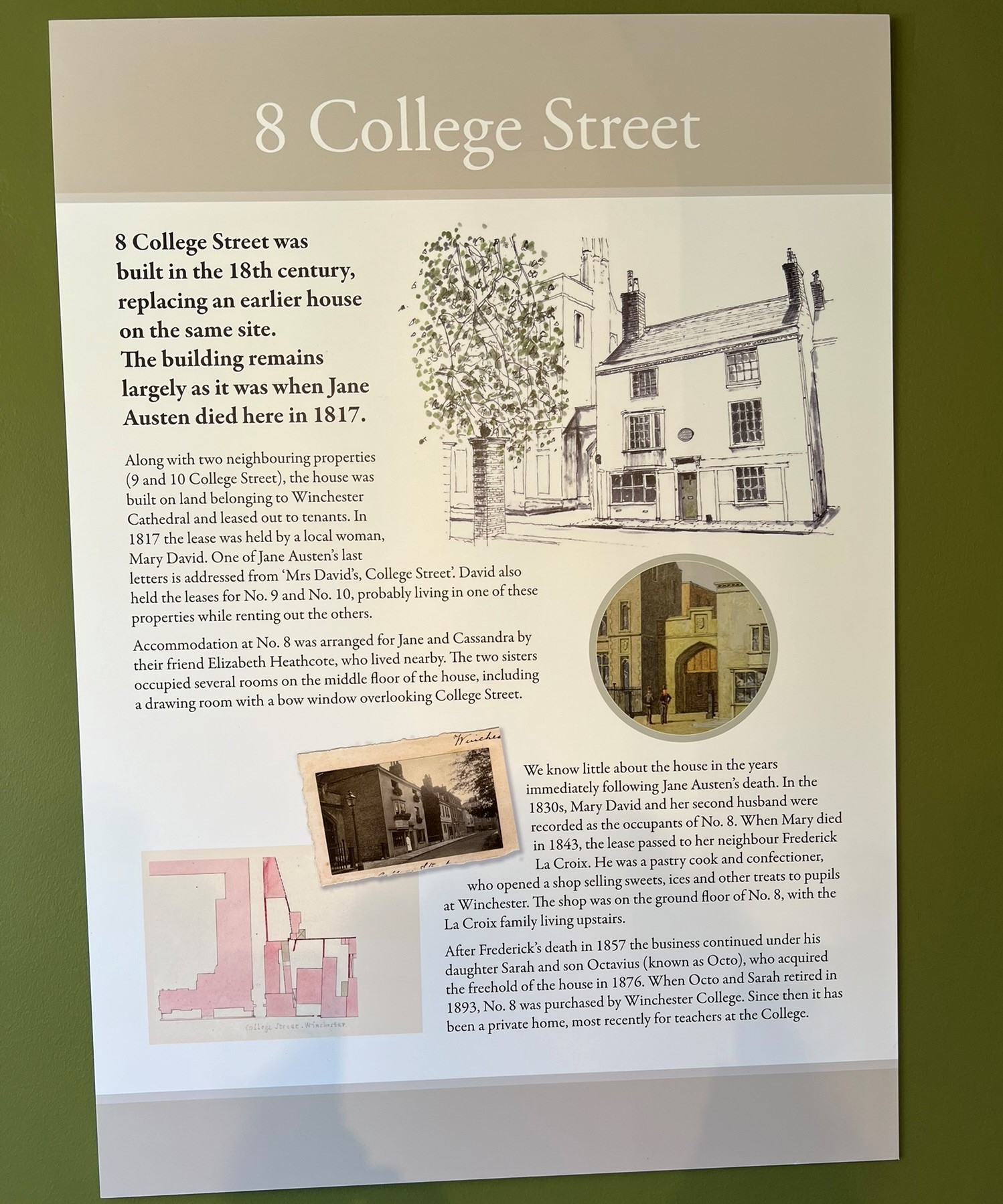
We are off to Winchester College to learn of its history and its connection to Jane Austen – several of her nephews went here – and we were privileged to see many of the treasures in the library, as well as the what was to be an exterior visit to 8 College Street, the location where Austen dies on July 18, 1817….
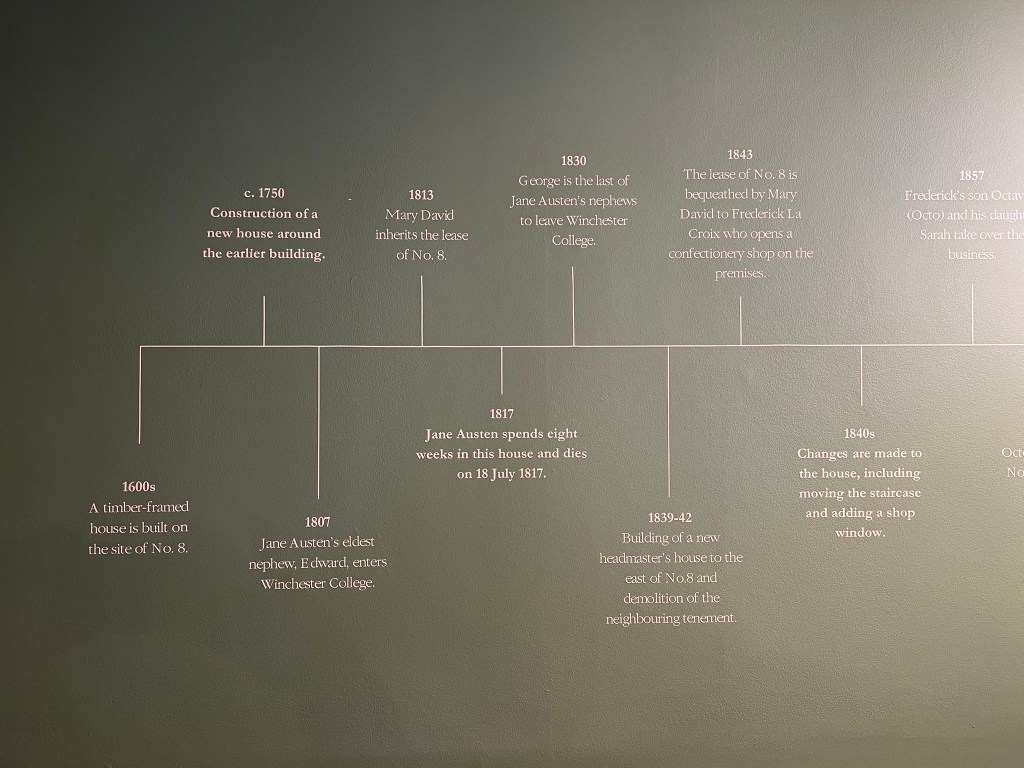
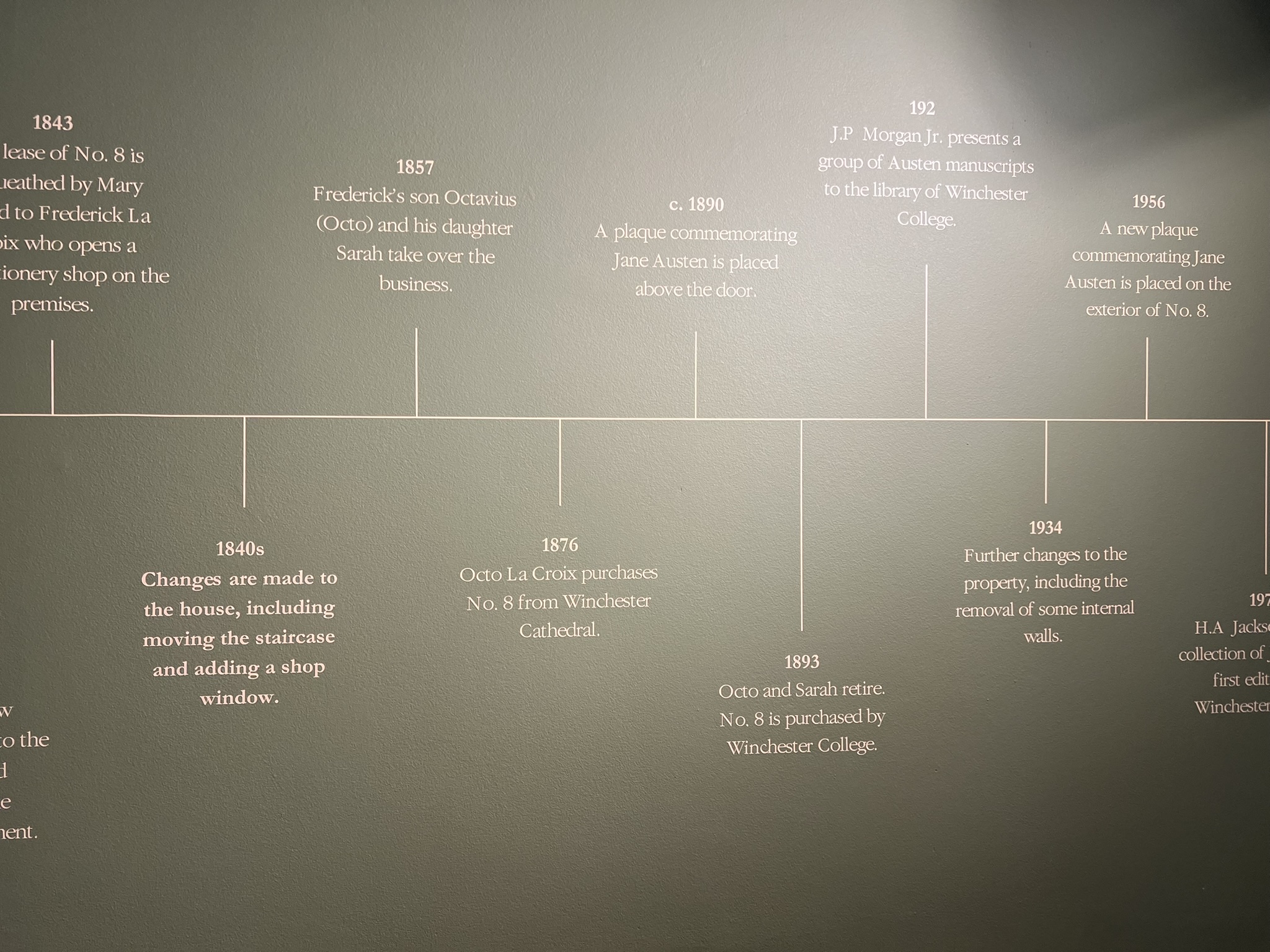
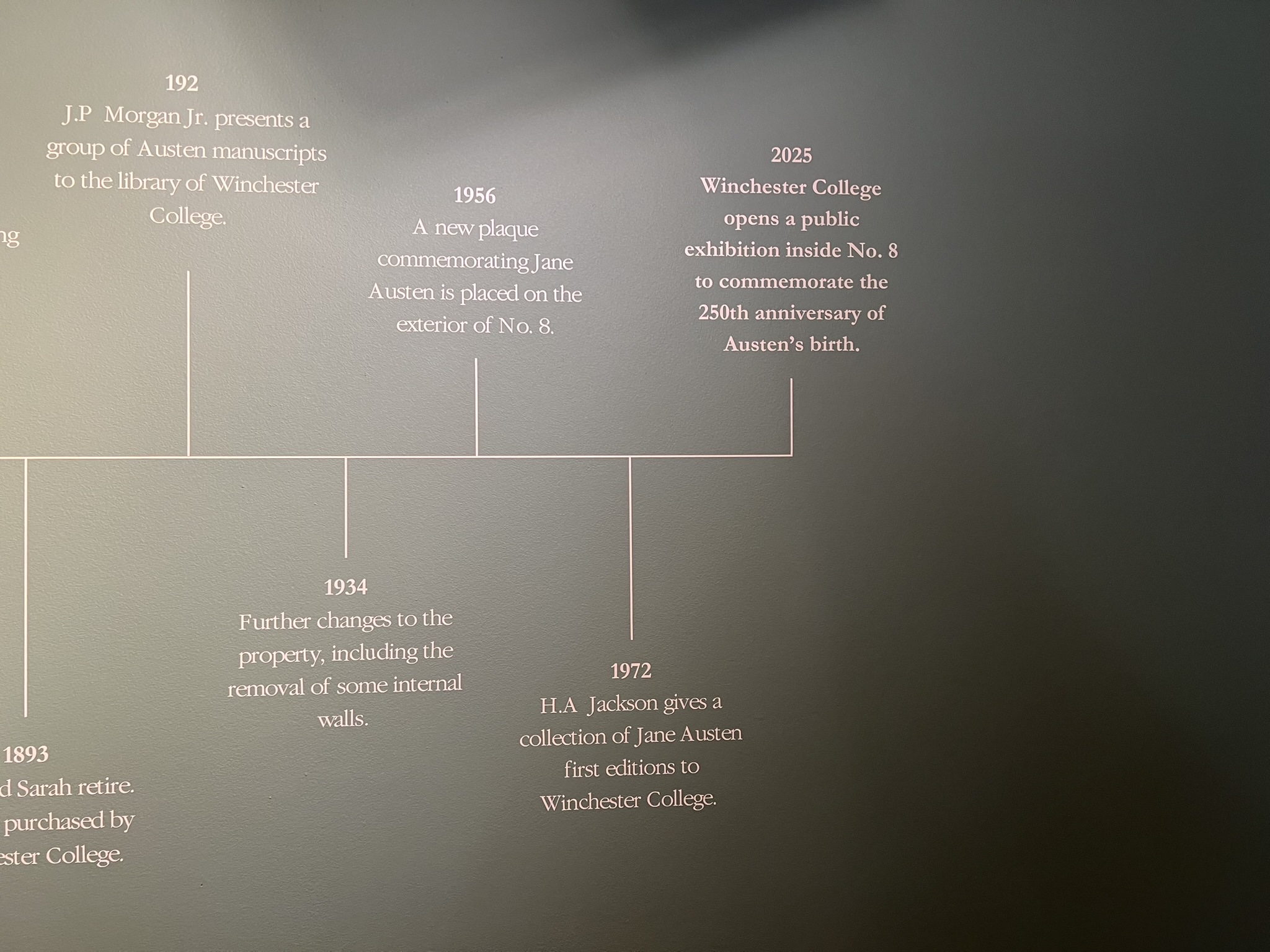
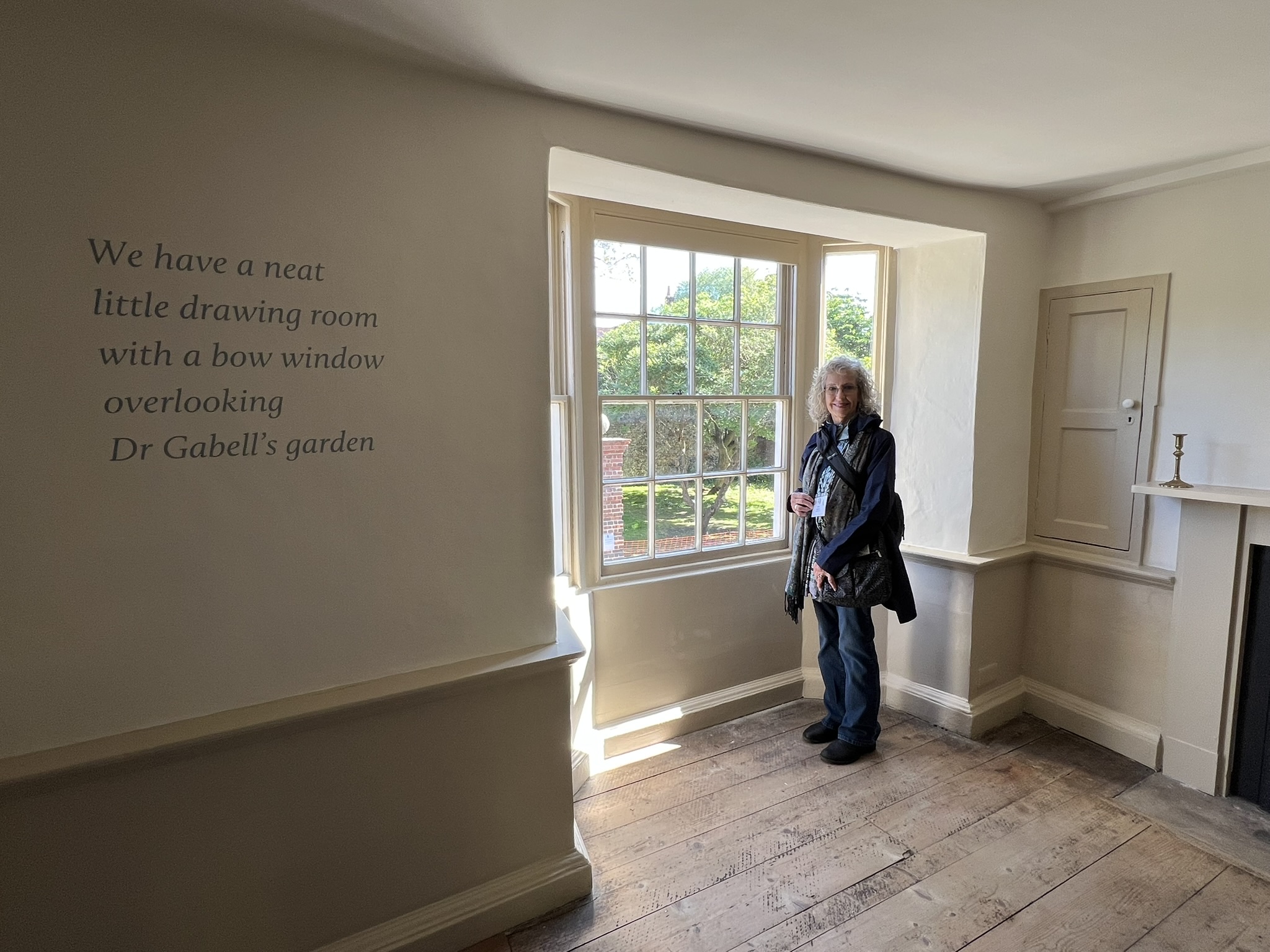
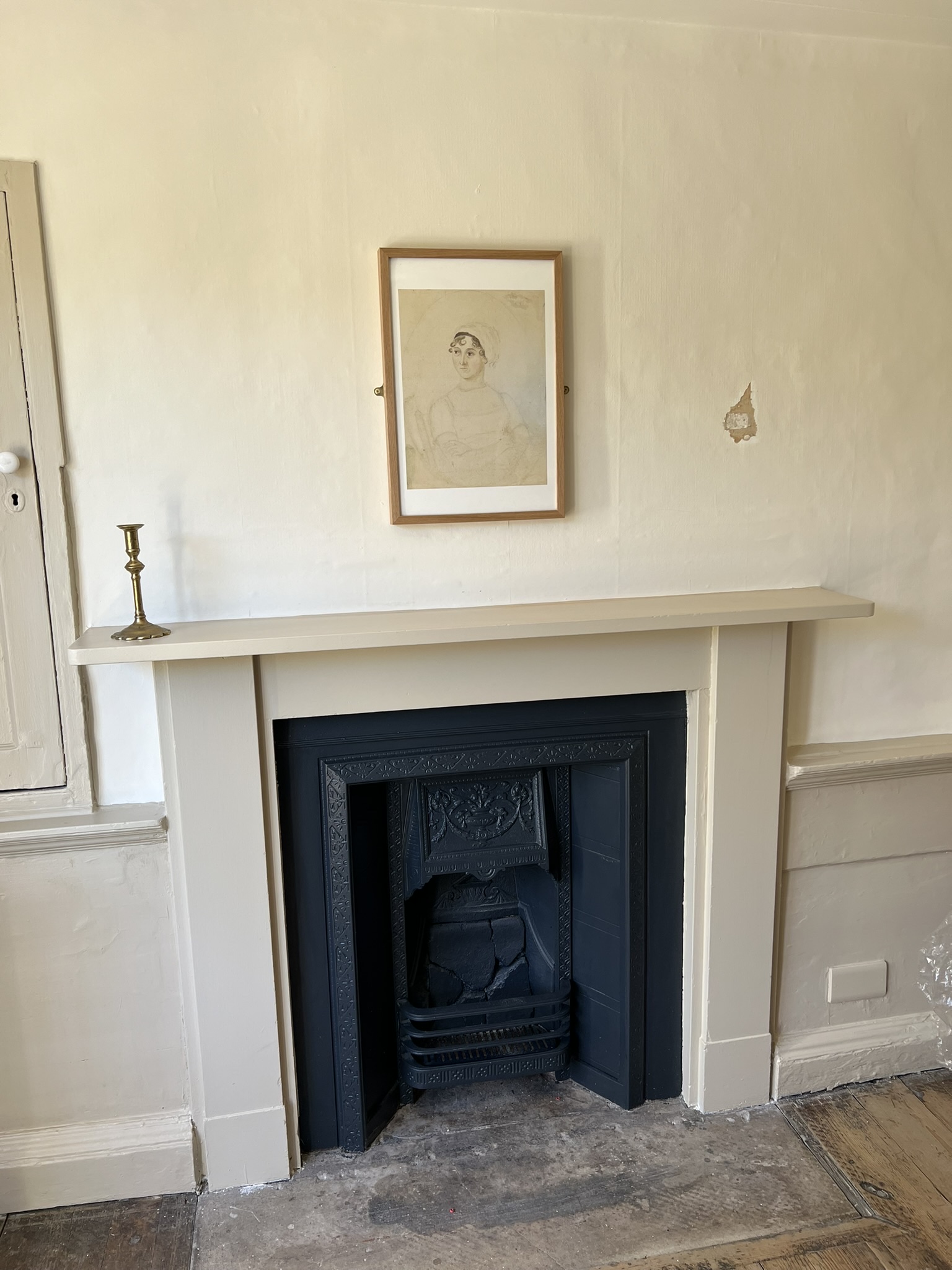
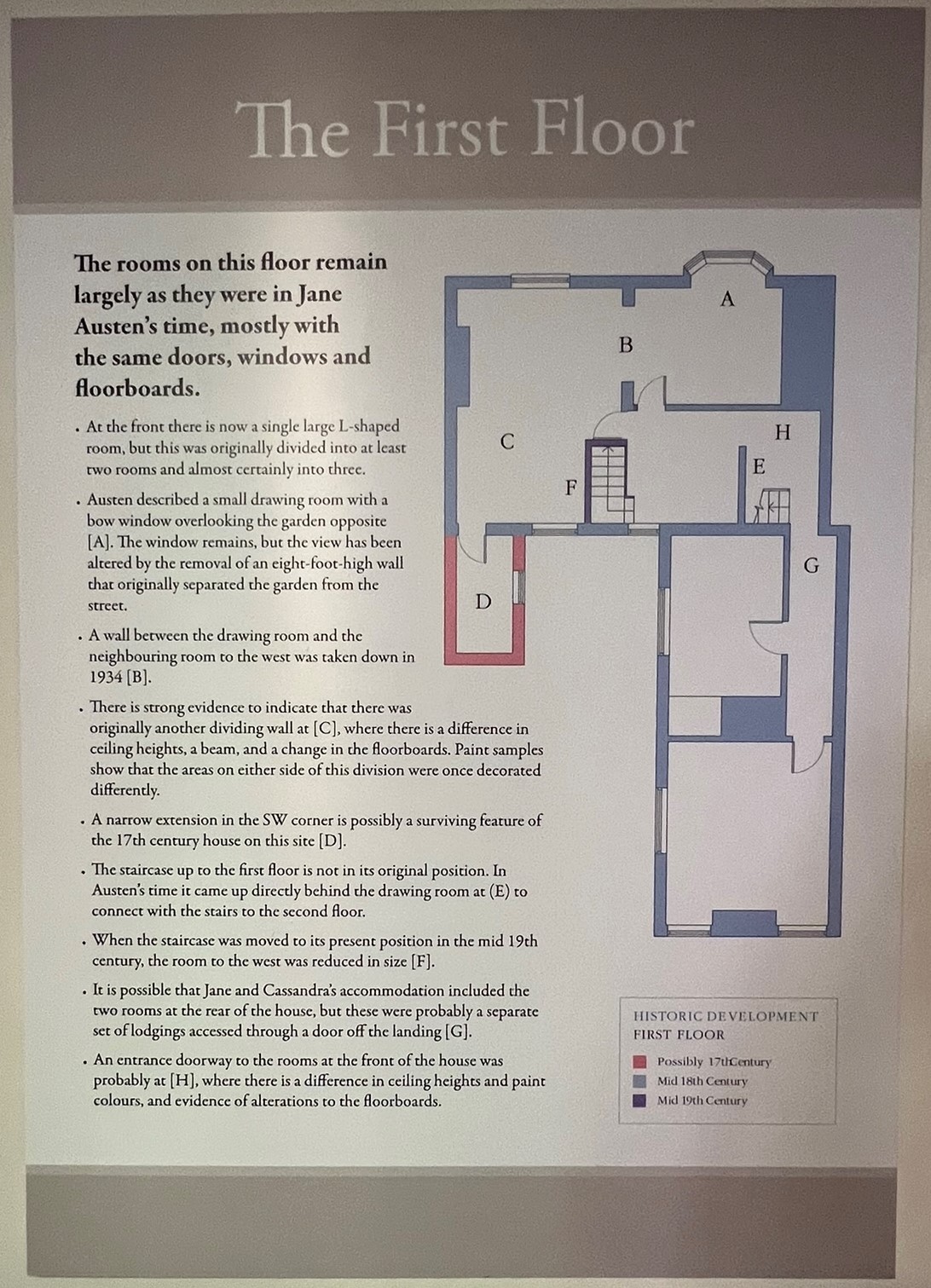
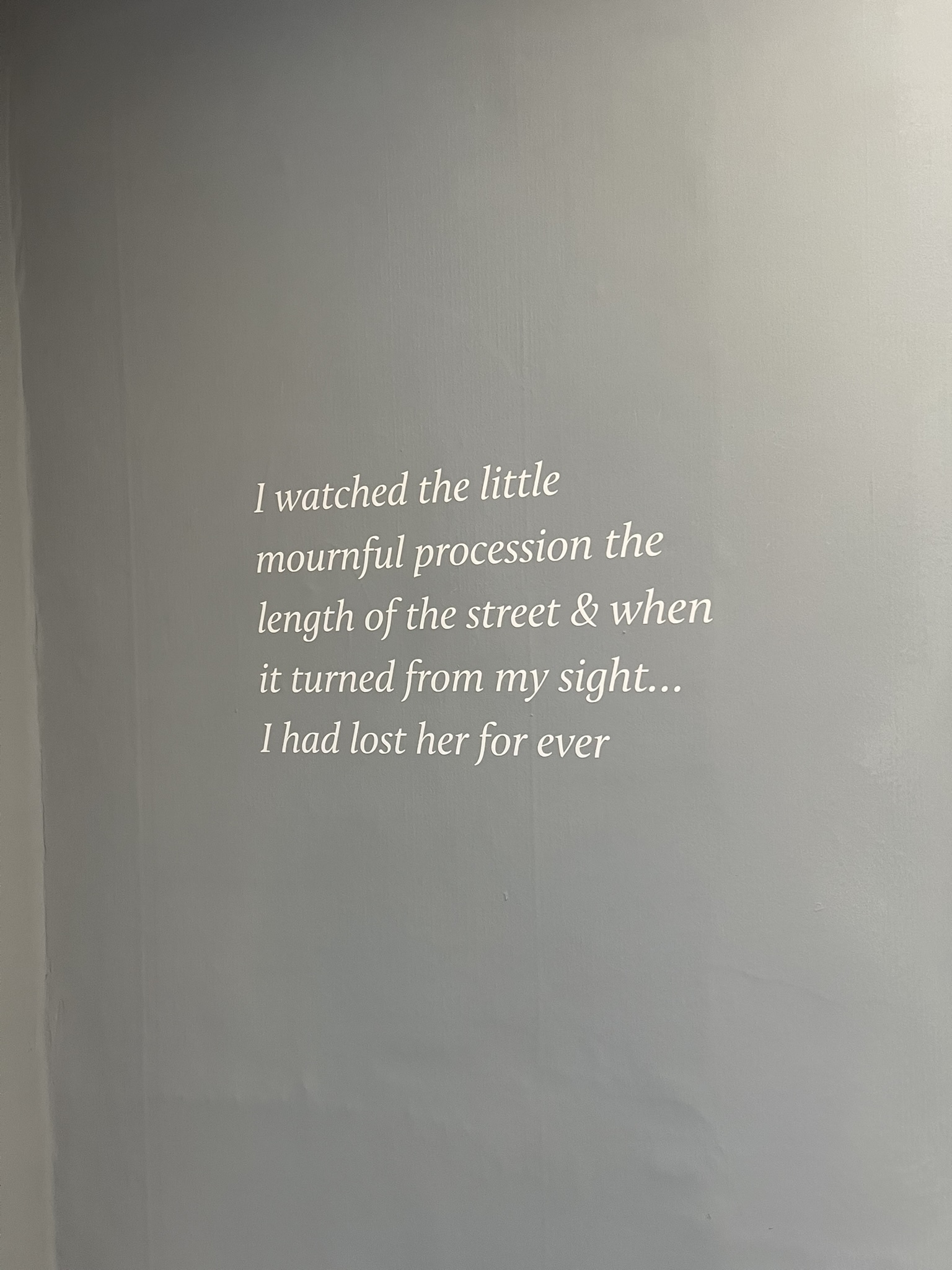
What a wonderful and unexpected surprise to find that the College, who owns the building, had just the day before put some of the finishing touches on the house, readying it for the onslaught of Jane people in this 250th anniversary year. They had literally just finished painting some of the wall signs and quotations just the day before, and while the restoration is still ongoing, this very welcome gift to us on the JASNA tour is too much to put into words. I have been to this house before a couple of times, standing across the street and looking longingly at the spot where Austen spent her last weeks – but to go inside and see the interior walls, painted now as they were in her time, was so much more emotional than I expected [this now just edging out my seeing where Keats* died in Rome as the saddest literary moment I’ve experienced…]
Just showing a few of the photos I took – you really do need to be there yourself to feel the intensity of this place…tears flowed from many of us.
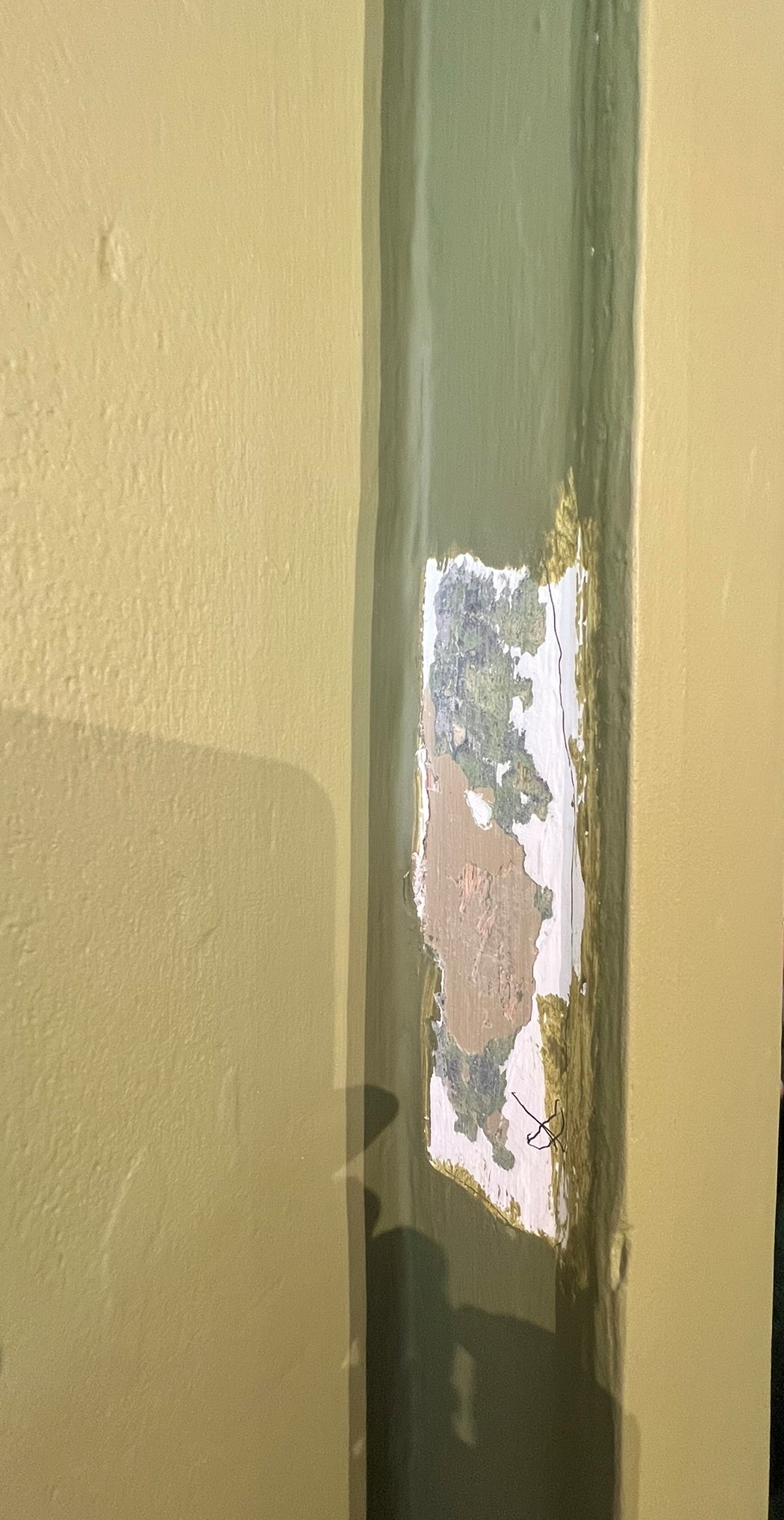
Matching the original paint colors…[the colors surprised me – different in every room, colorful and deep – I didn’t take photos of every room sorry to say…]
It was here at 8 College Street that Austen penned her final verse about St. Swithin’s Day – “Venta” just a few days before her death. You can read the poem here.
****************
Then we headed back to the College:
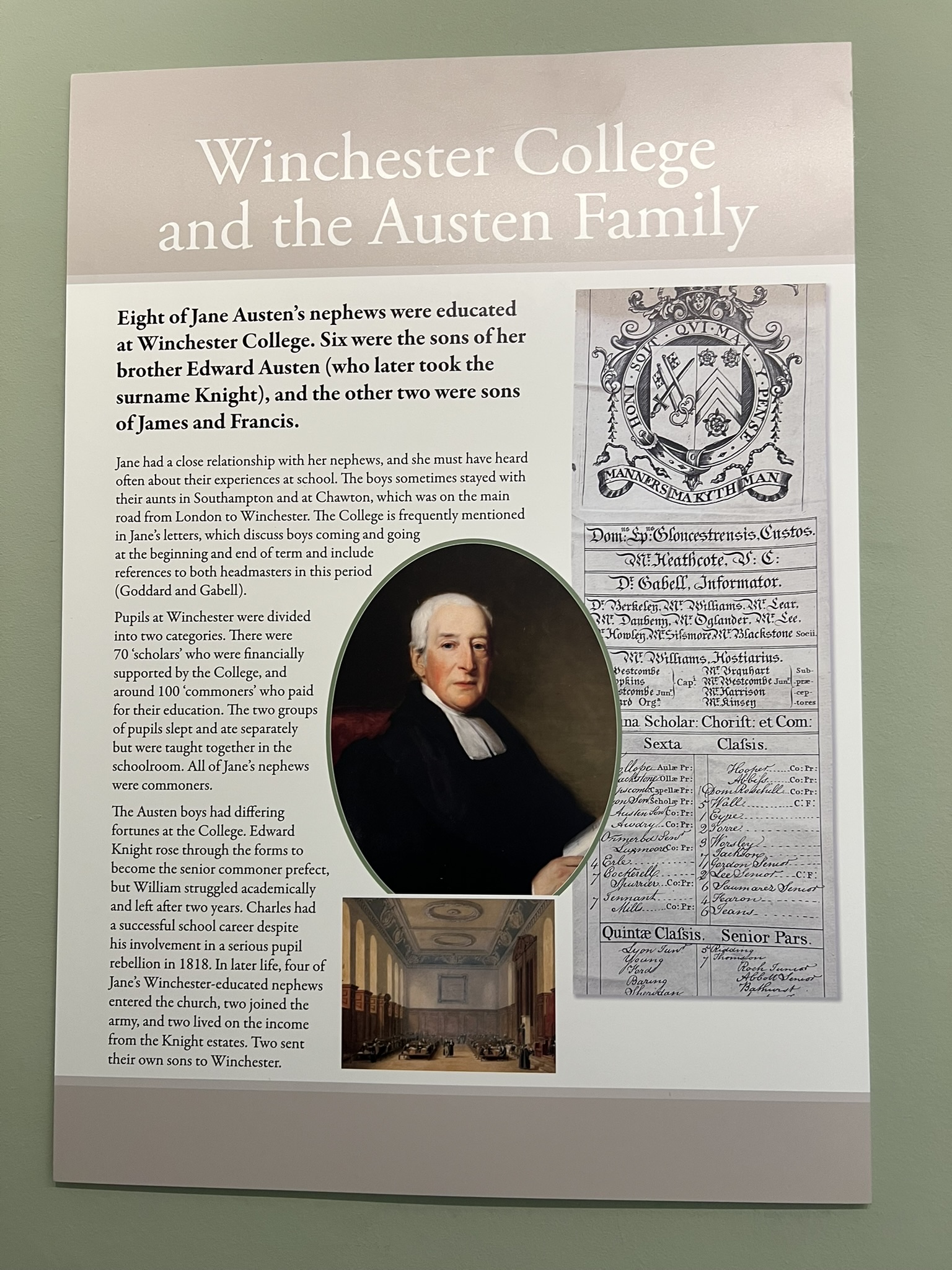
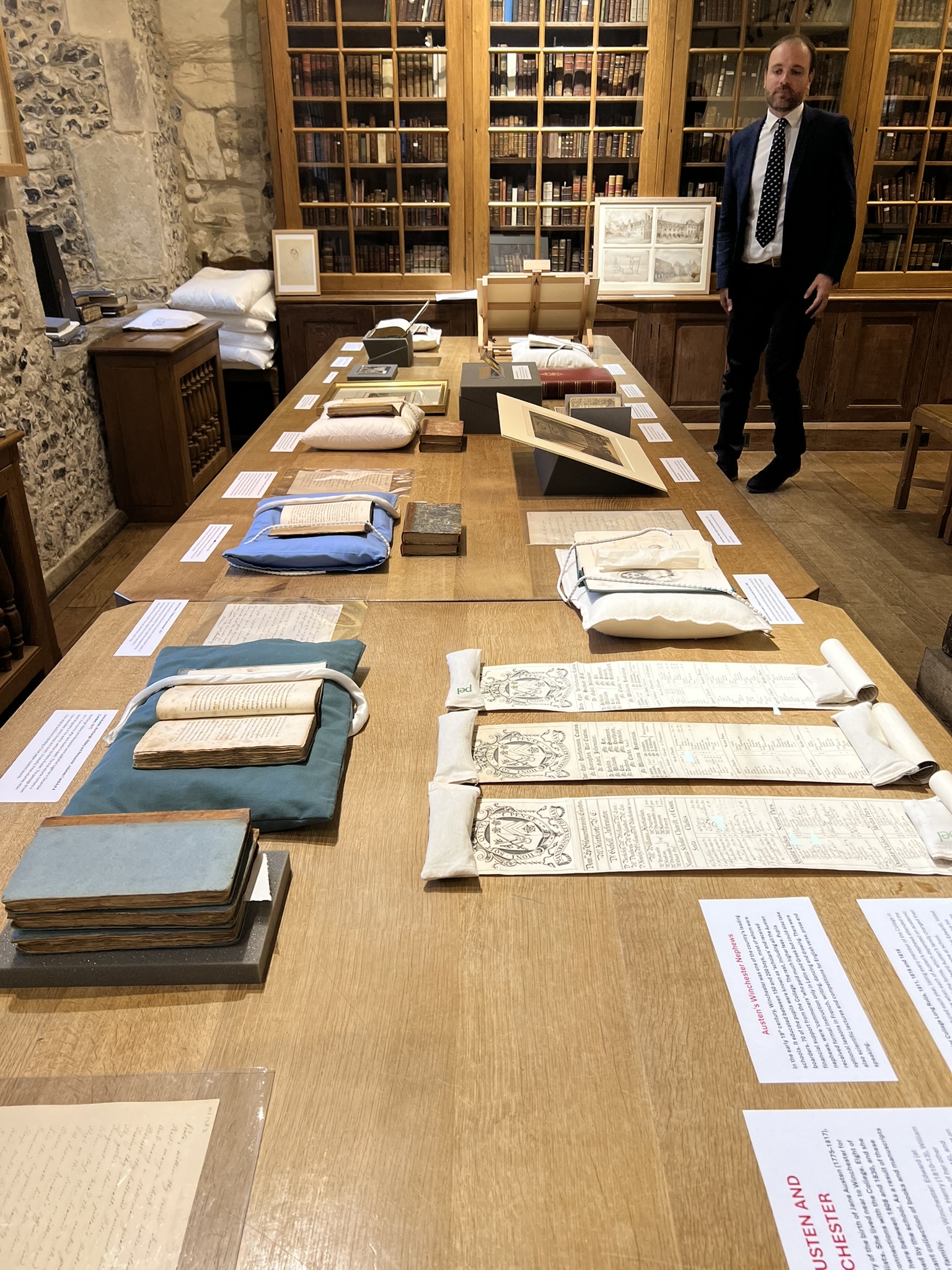
And then to the library where the Special Collections Librarian Dr. Richard Foster spoke to us about the several items of interest to a crowd of Janeites – including the rolls of students where we could see the names of her attending nephews.
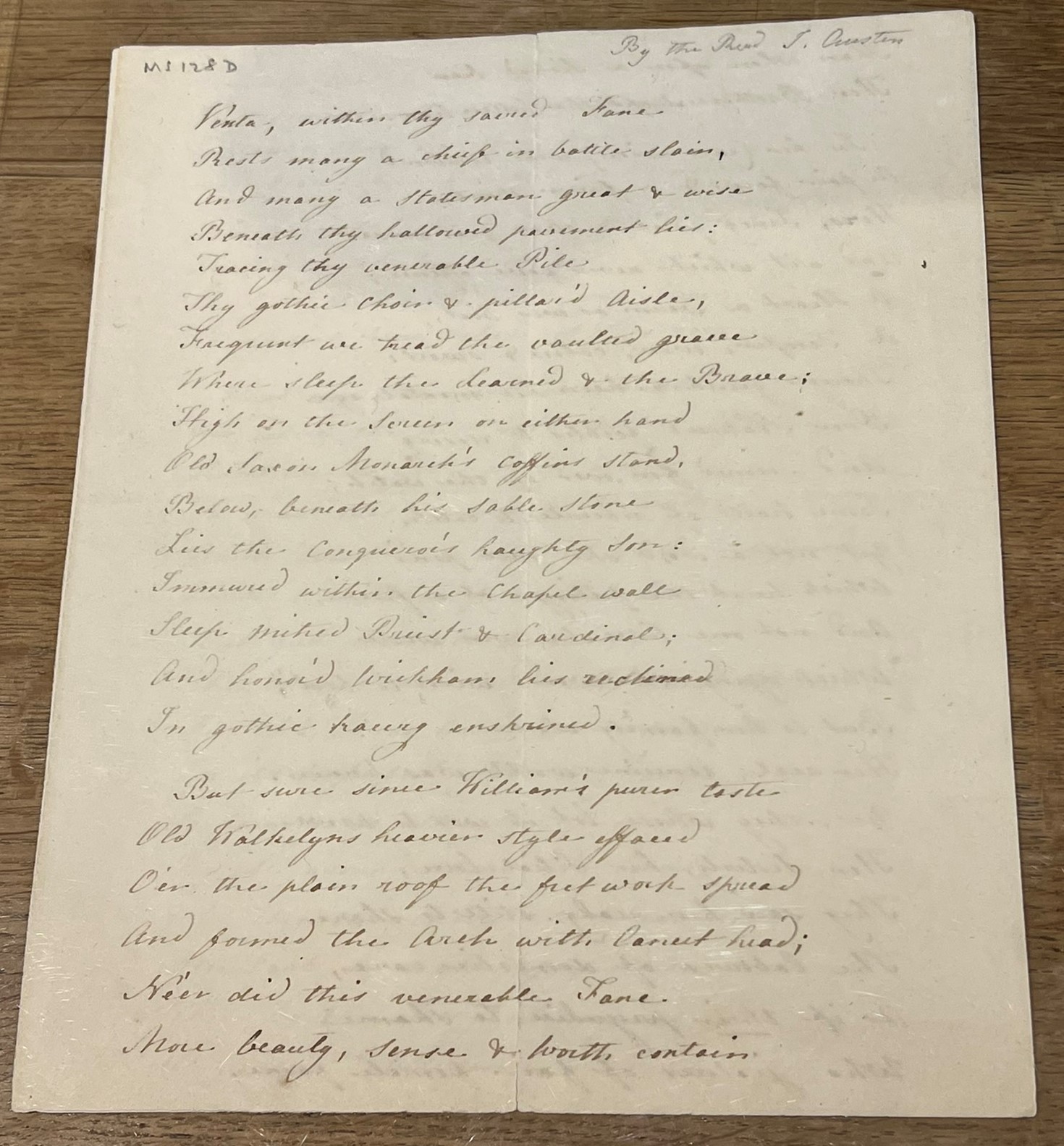
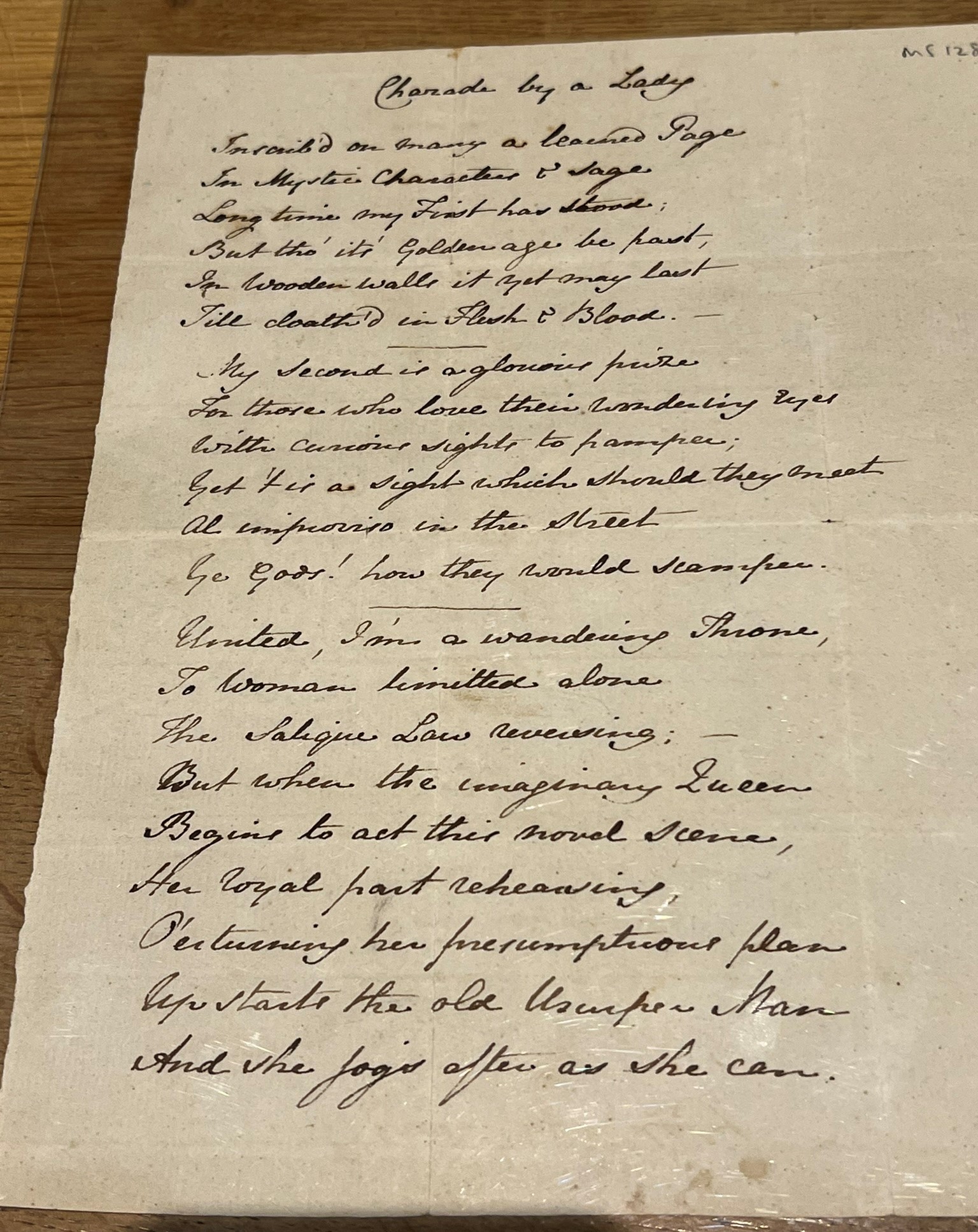
here is a poem written out by James Austen / and a charade by Jane:
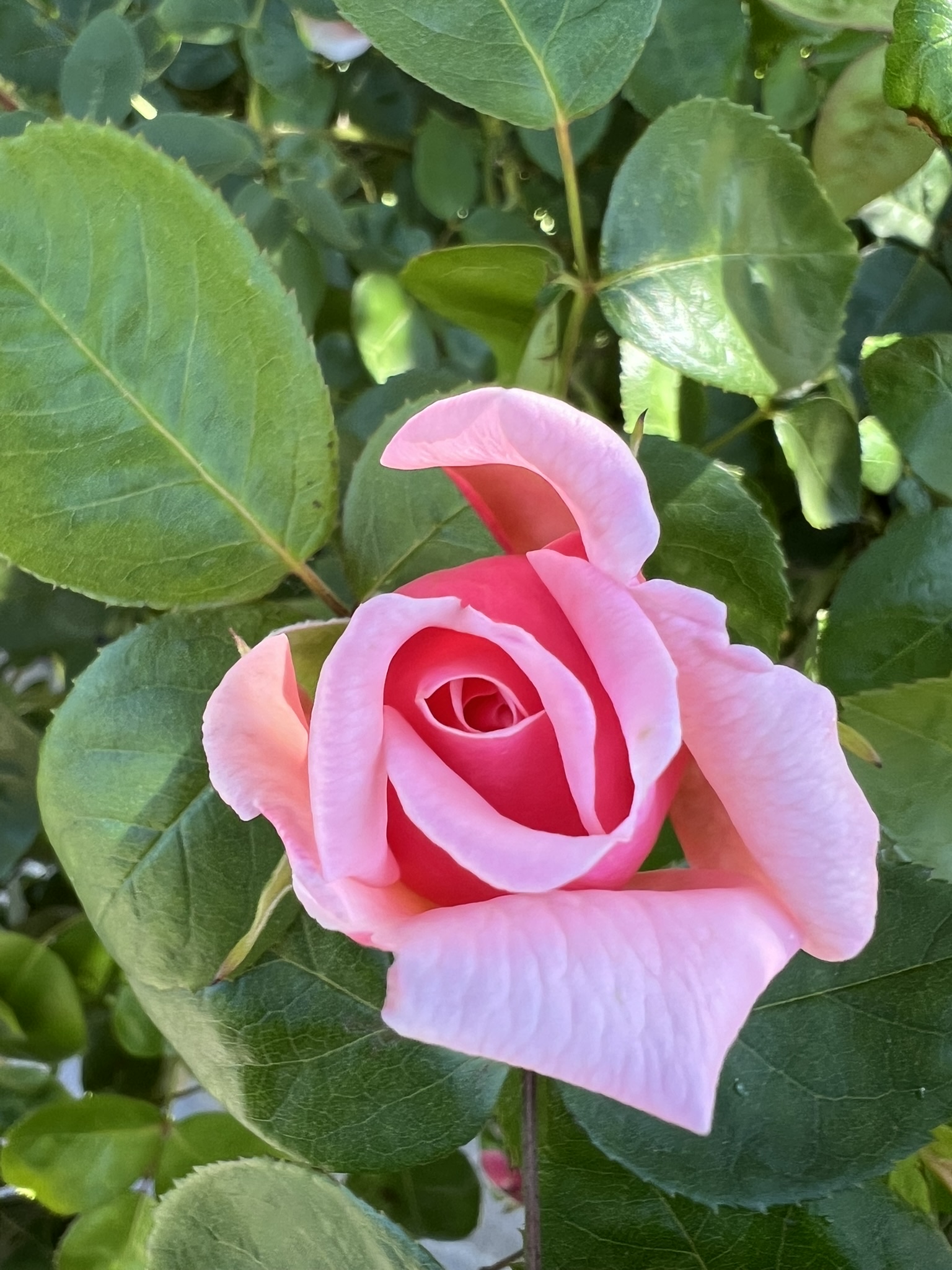
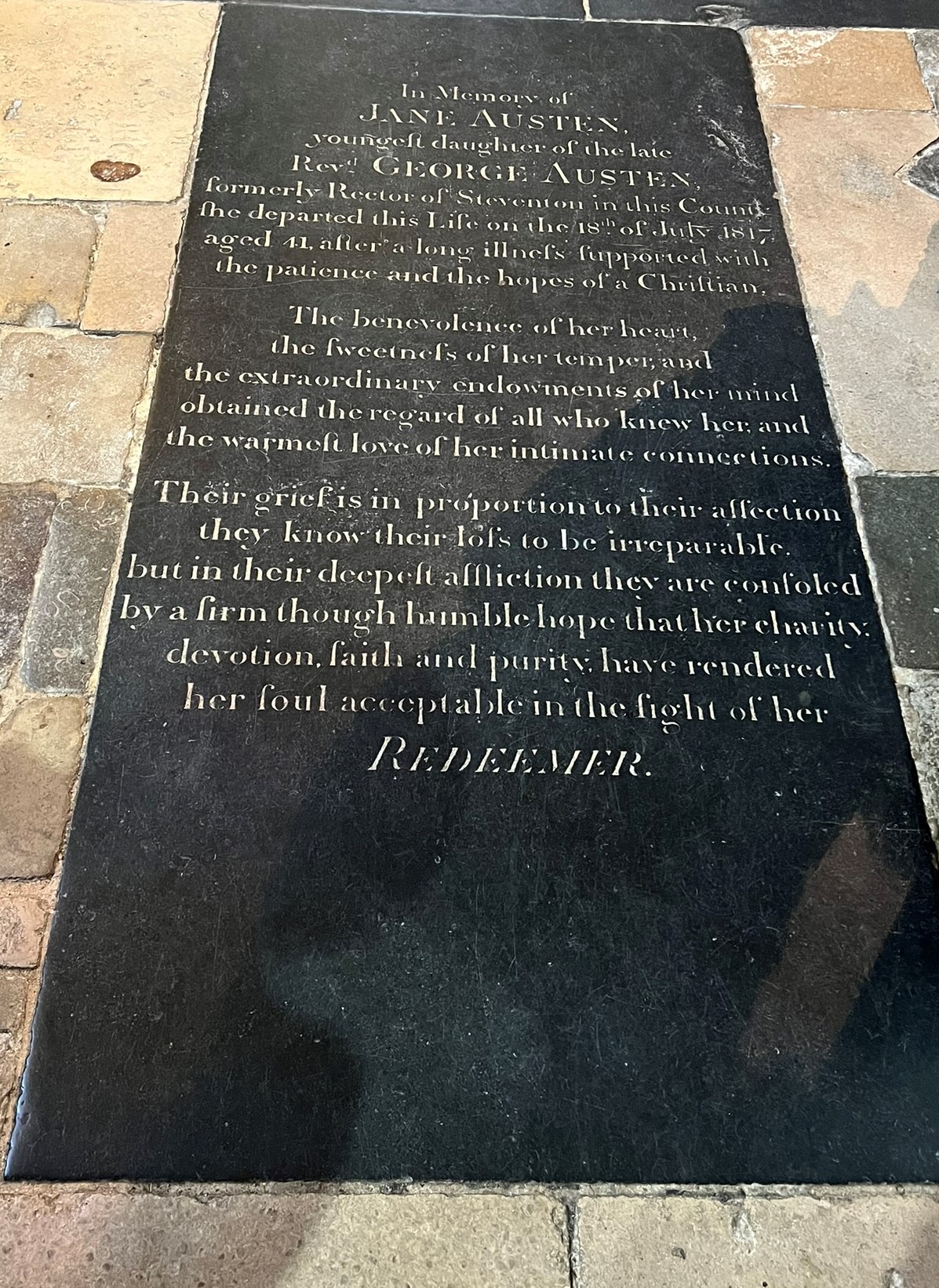
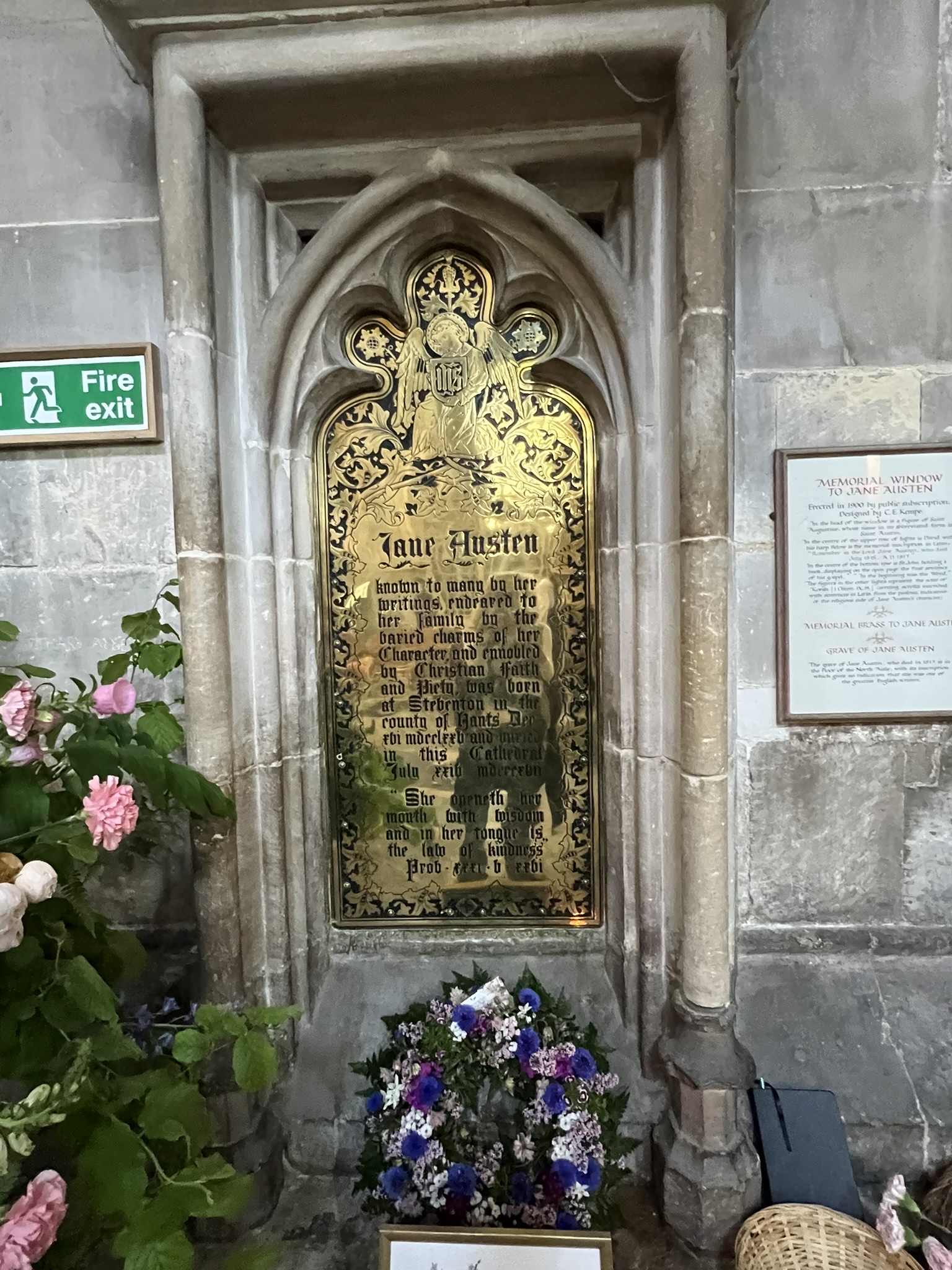
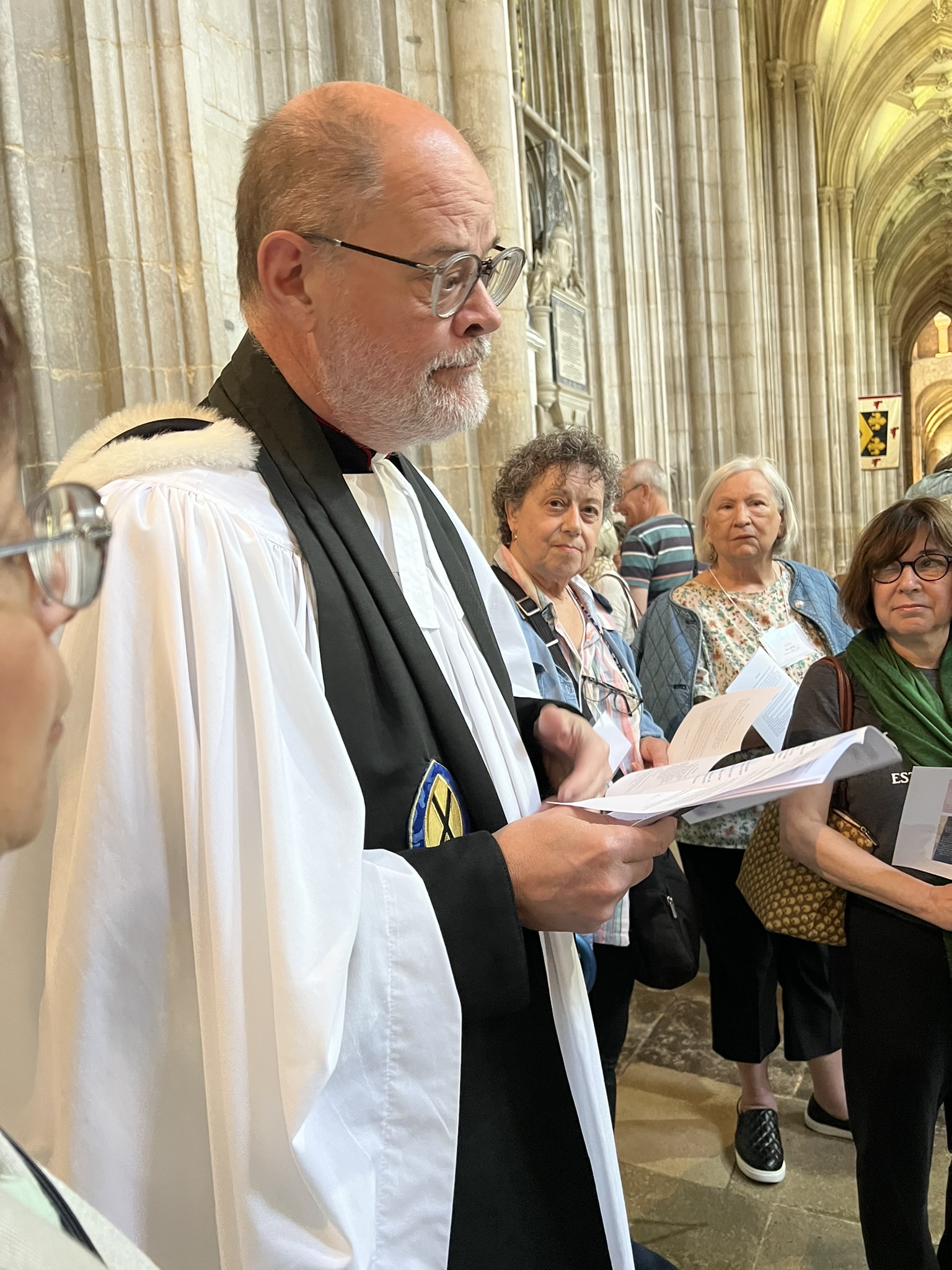
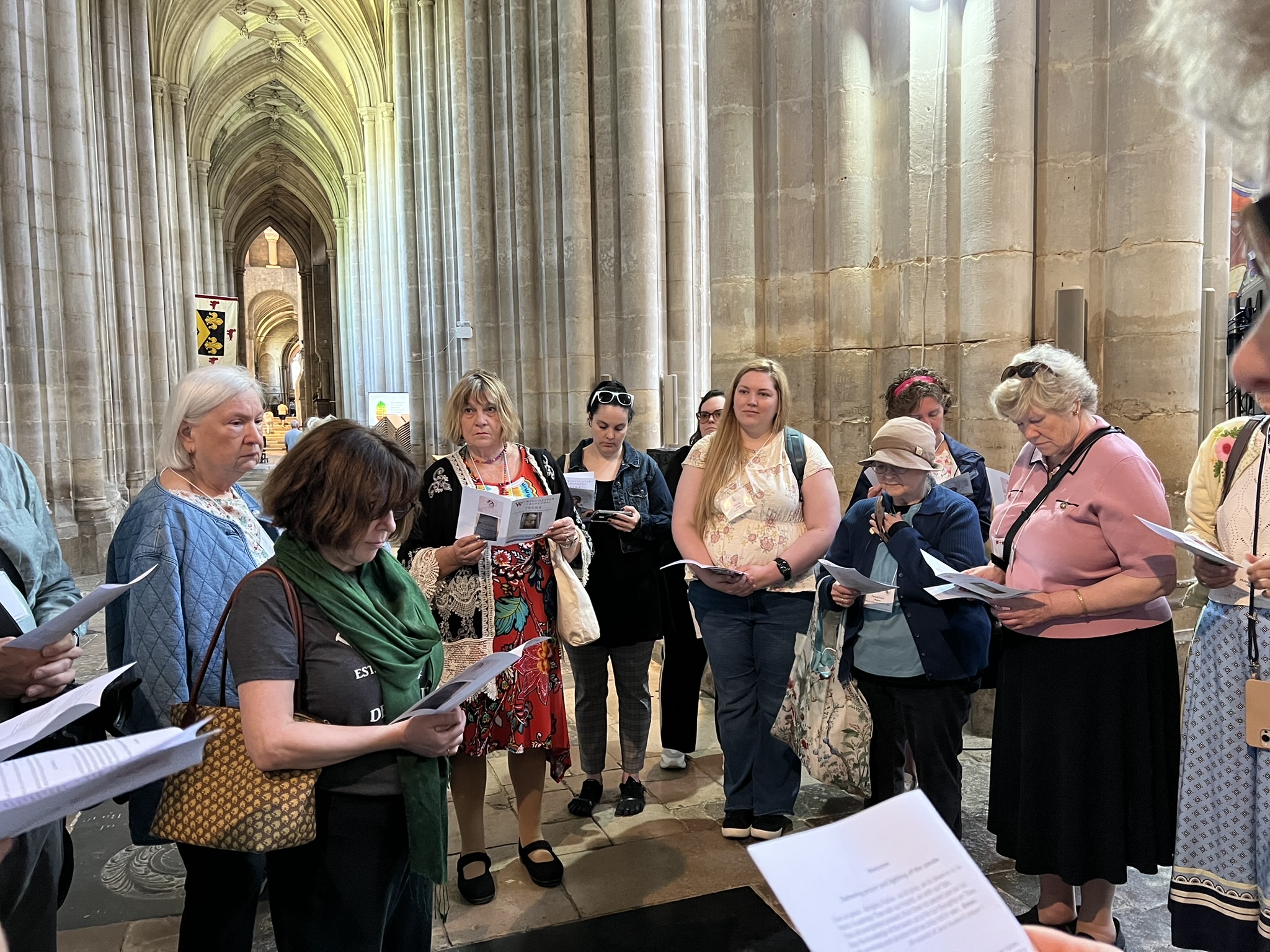
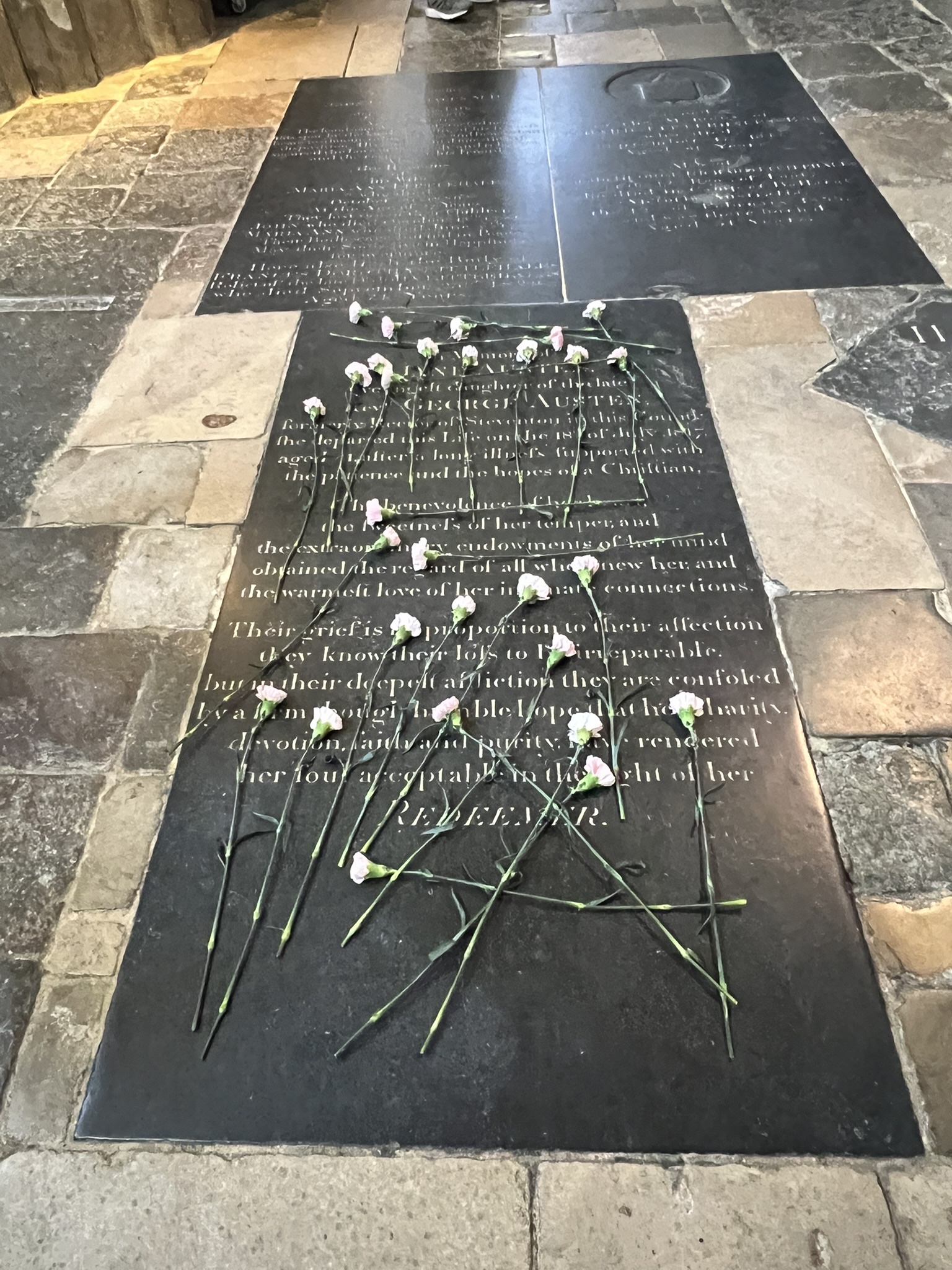
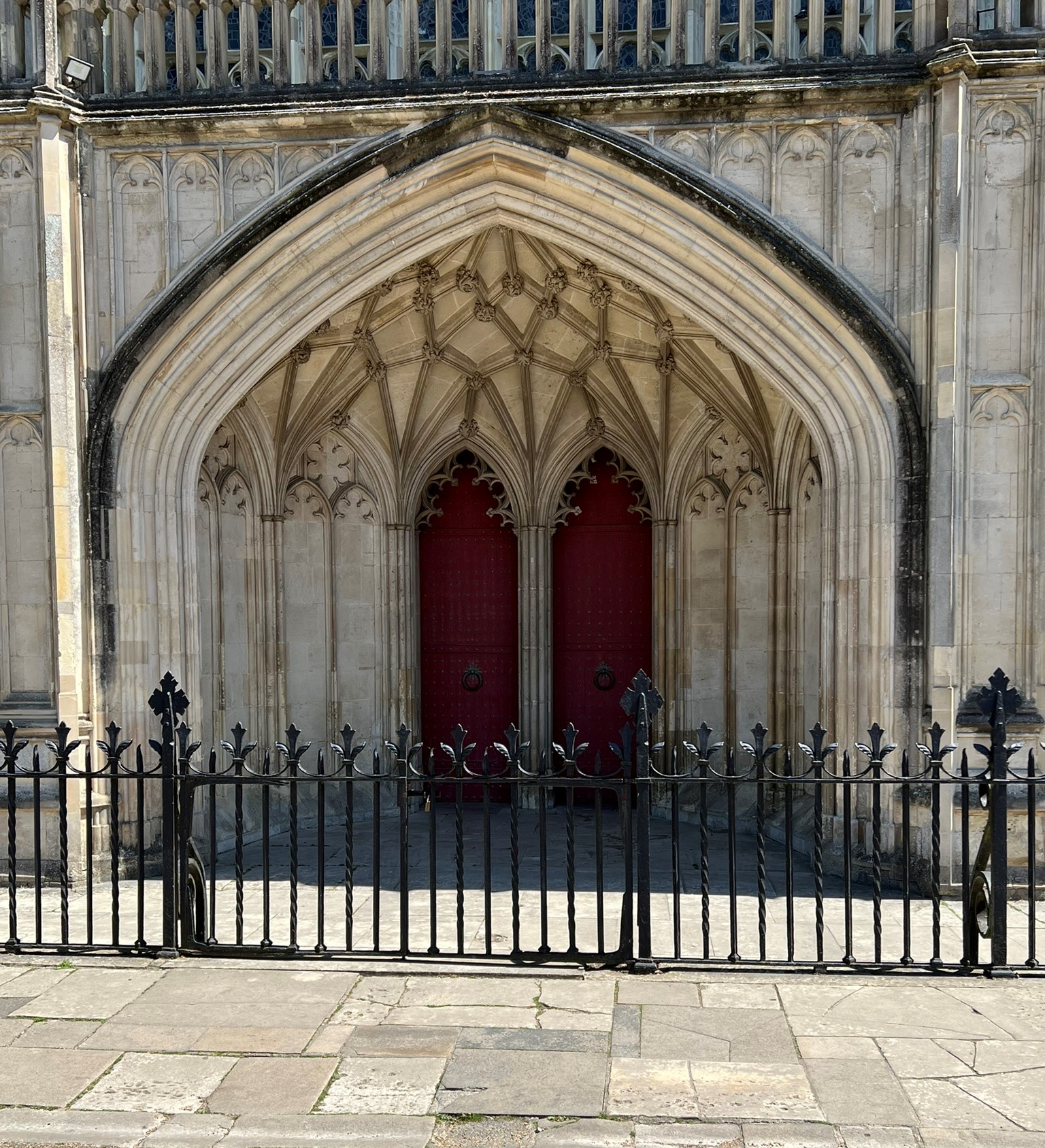
Inside the Cathedral, we find Austen’s grave, another somber spot – and the wall memorial – here one of the deacons awaited our arrival to perform a short celebratory service of prayers and a short eulogy as we stood around the memorial – each given a pink carnation to then leave on the tomb:
– it was quite lovely –
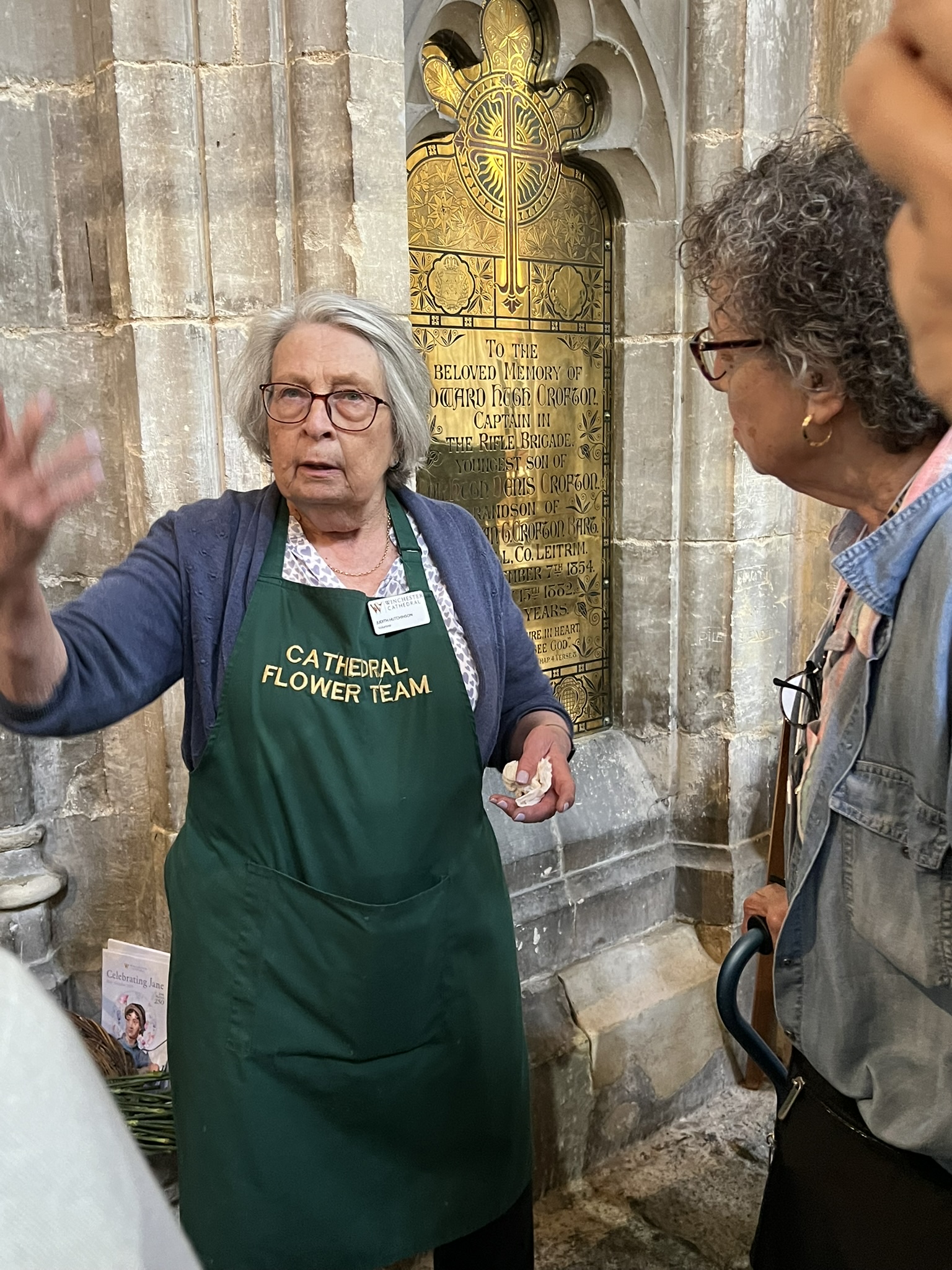
– a quick chat with the flower lady cheered me immensely – how they replace all the flowers around the wall memorial on a weekly basis – she agreed with me when I said I thought she had the best job in the entire cathedral!
And of course one cannot but sing [or at least whistle] the tune “Winchester Cathedral” – have I really spent my entire life since the 60s thinking the Beatles sang this song??
It is actually by the New Vaudeville Band – also appearing here on the Ed Sullivan Show… [lots of others think the Beatles sang this too – it comes up in Google as a common search!]
Following the service we went to one of the private chapels to listen to Cathedral Curator and Librarian Eleanor Swire talk on the poem Jane Austen wrote about the death of her dear friend Madame Lefroy – the manuscript of the poem is housed here and it was another emotional moment to gaze on it for a bit… written four years after Anne Lefroy’s death on Austen’s birthday after falling off a horse – you can read the poem here.
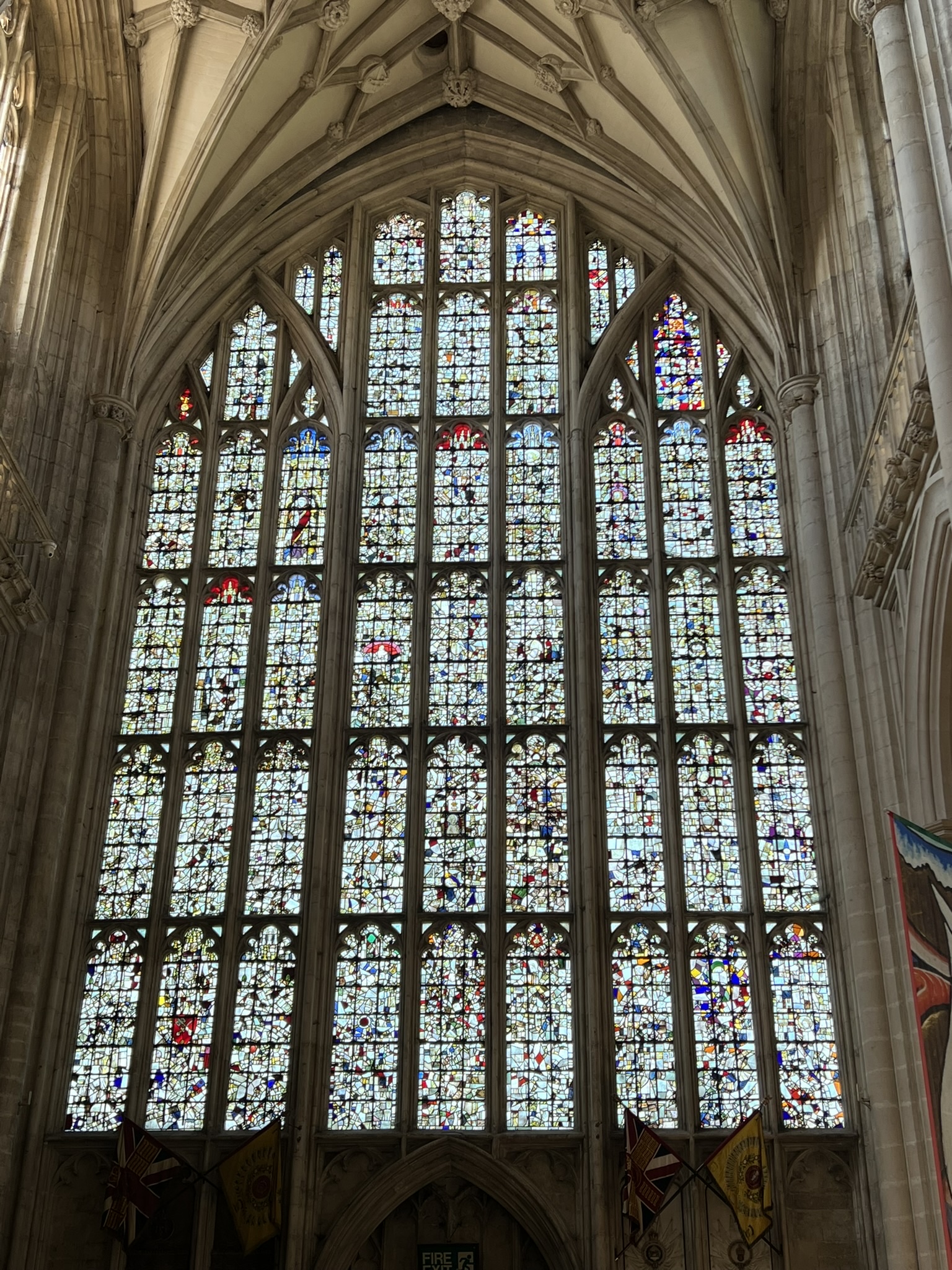
This Epiphany Chapel houses the most stunning stained glass windows, designed by Pre-Raphaelite artist Edward Burne–Jones. Here is one image I took:
We were then sent off on our own to explore the Cathedral as we chose, so I just wandered around for a bit to find this kneeler by the author Tracy Chevalier memorializing Hampshire women (Florence Nightingale, Charlotte Yonge, and Jane Austen):
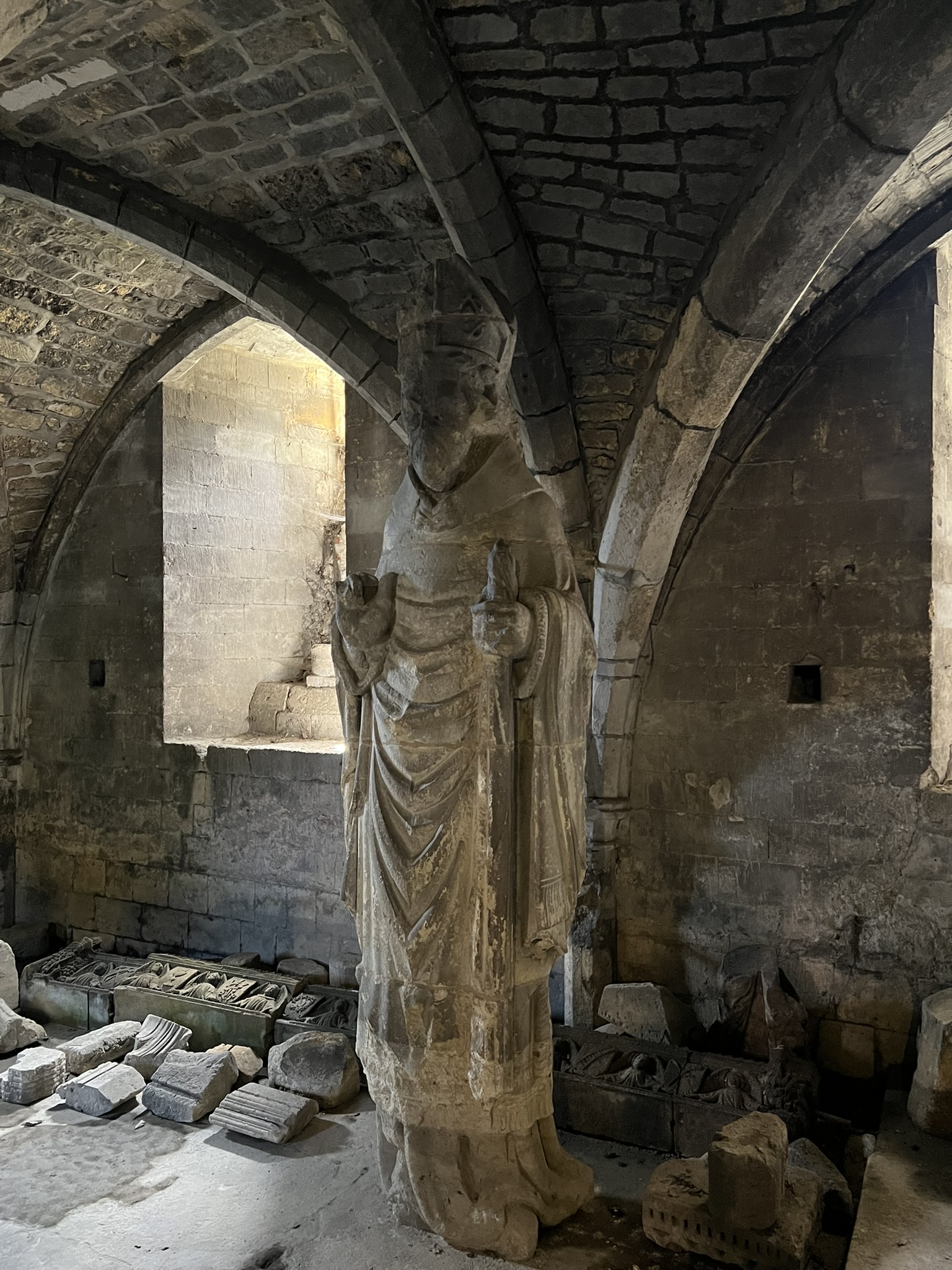
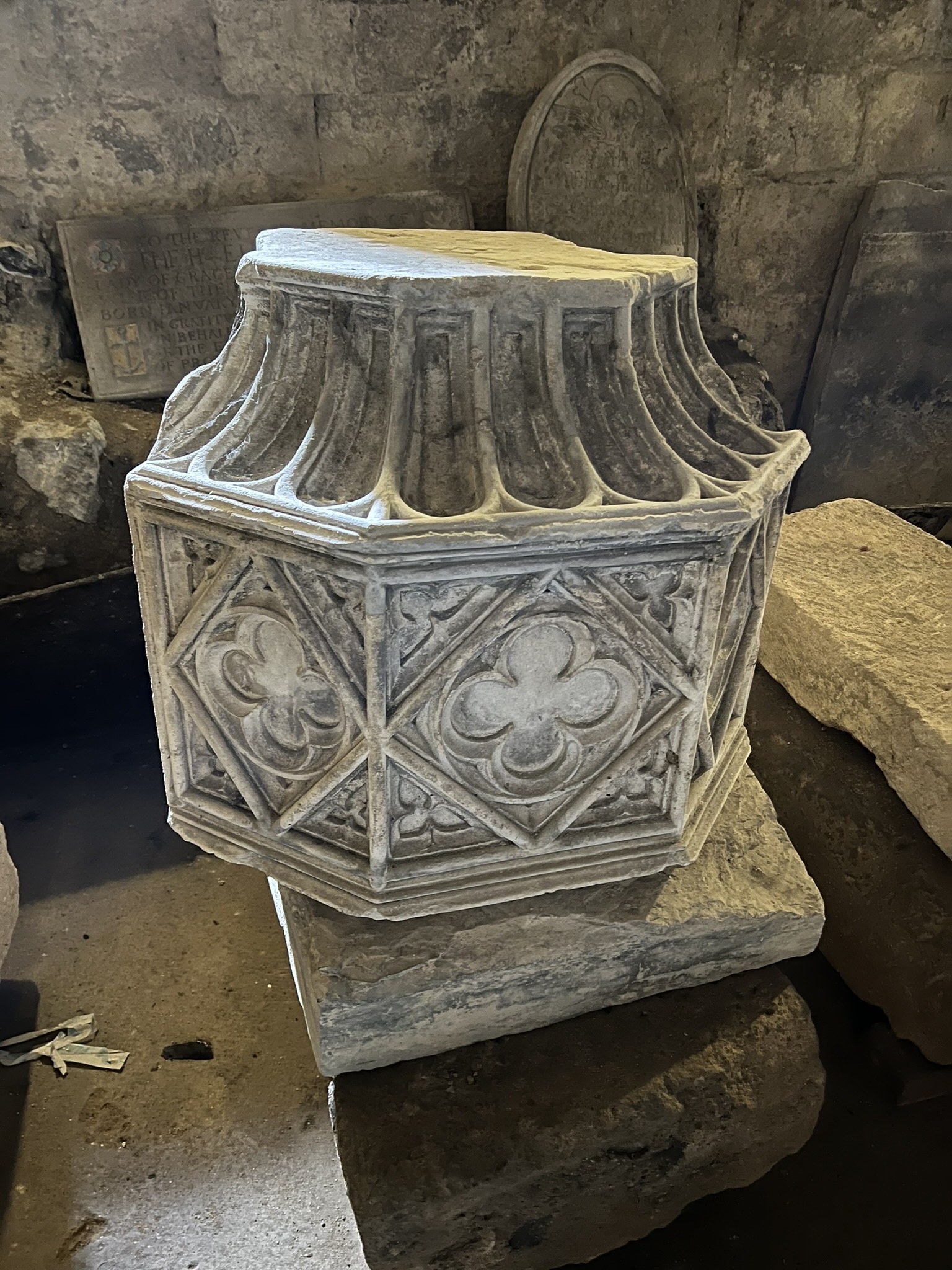
And then I could not resist a trek to the nether regions of the crypt and the guided tour did not disappoint. Who knew that any piece of absolutely anything that falls off the Cathedral has to be kept in perpetuity – that means any pieces of exterior sculpture or stone or anything inside that has fallen or removed is moved to the crypt – so it is full of all sorts of disused figures, columns, etc. – quite fun – these original pieces are then sourced for any ongoing restoration work:
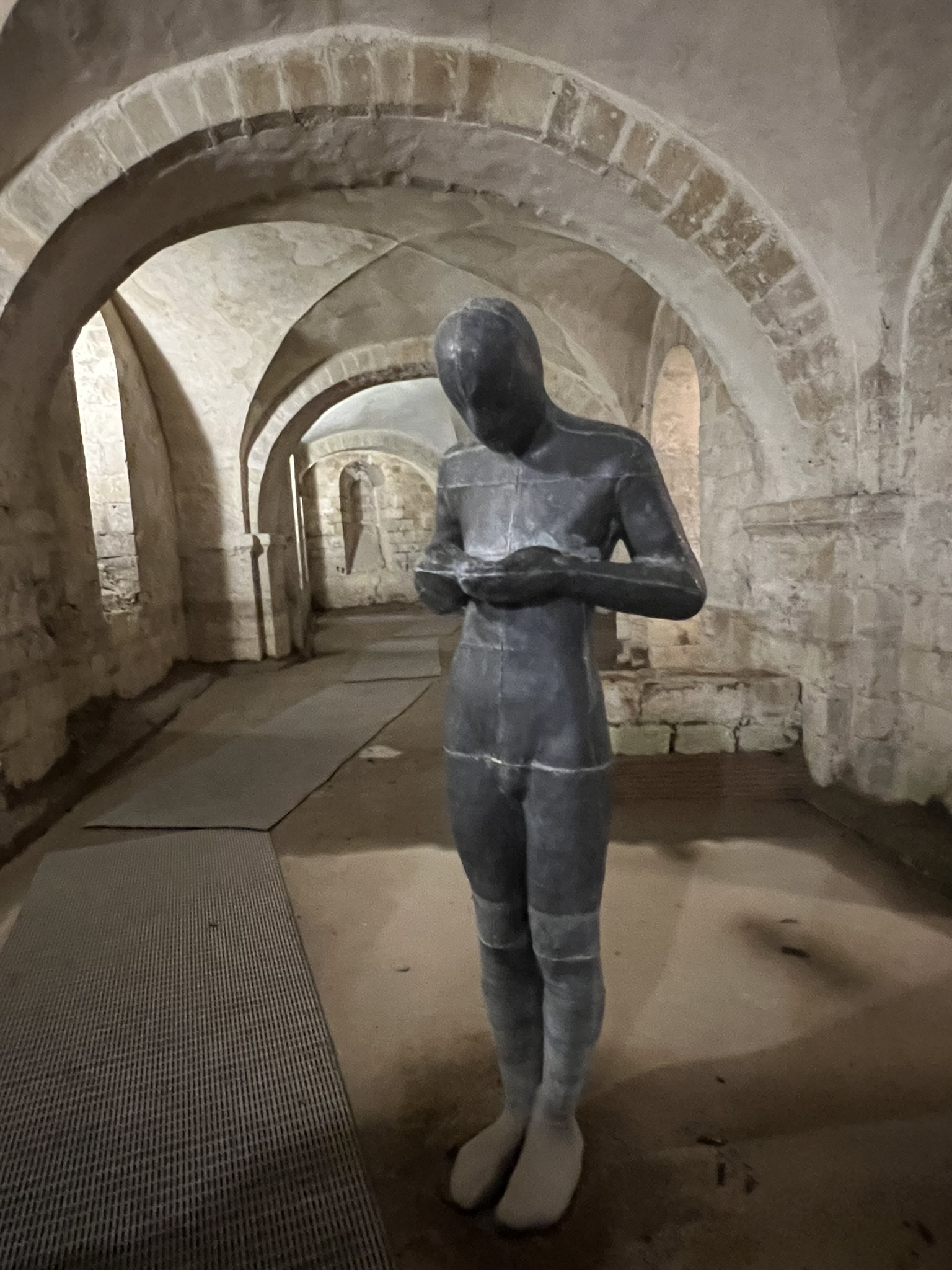
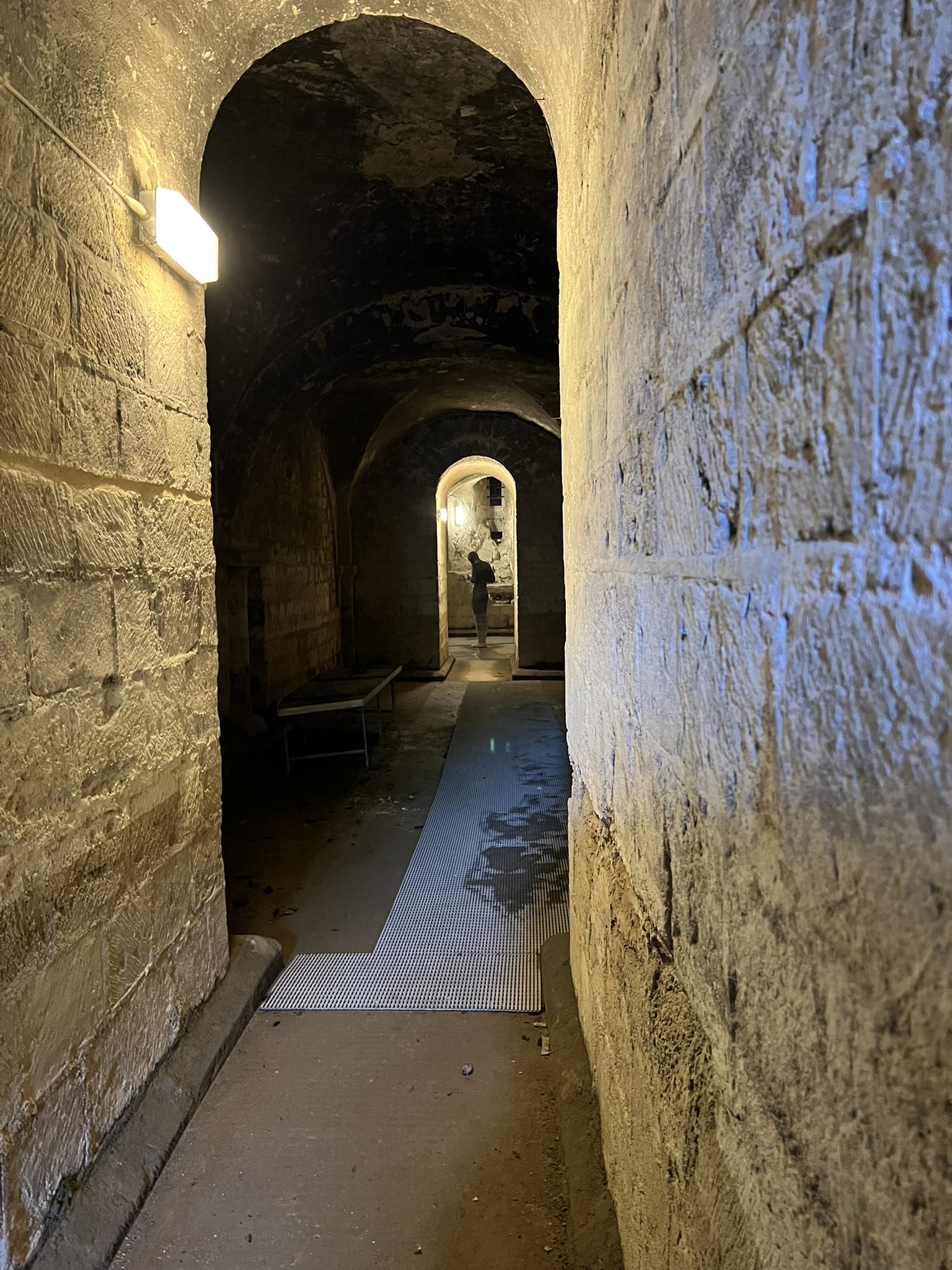
Even more interesting was to find that the entire Cathedral at one point risked collapsing because of how the water table rose to such heights in the crypt that it was only a matter of time until it all fell down – an amazing story of one man, William Walker, an experienced diver who would spend several years diving below the surface and reinforcing the foundation with concrete – today the water still rises in the crypt and you can see the levels on the walls – along with this very modern sculpture “Sound II” by Antony Gormley that periodically finds itself knee-deep in water as well as actually holding water in his cupped hands… :
[quite unnerving really because you come upon it unexpectedly from various vantage points]
During lunch at the Cathedral café I found this monument to William Walker, known affectionately as “Diver Bill” – “The diver who with his own hands saved Winchester Cathedral.” Nothing to do with Jane, but good to know the building which holds her tomb is safe from disintegrating…
***********
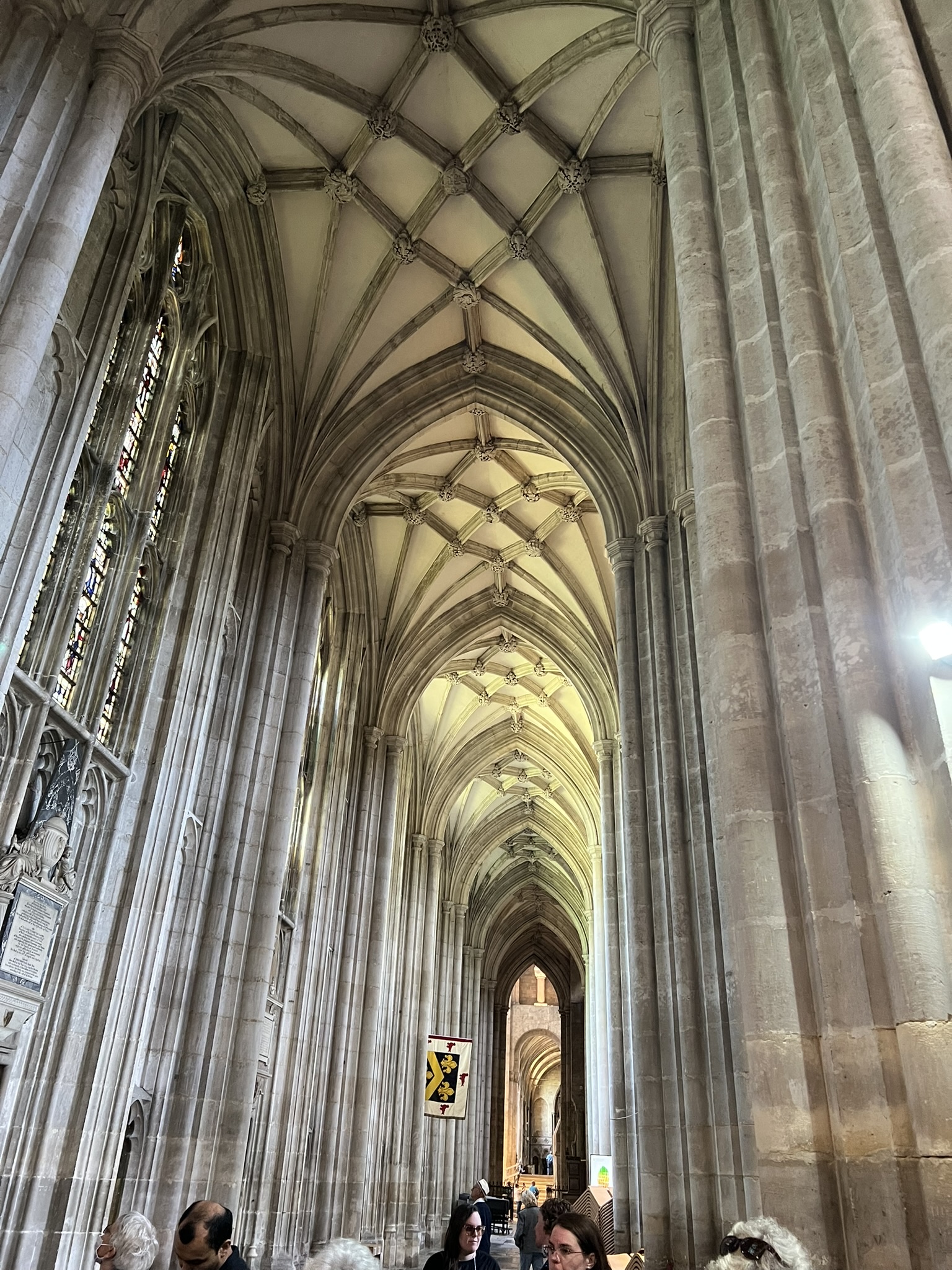
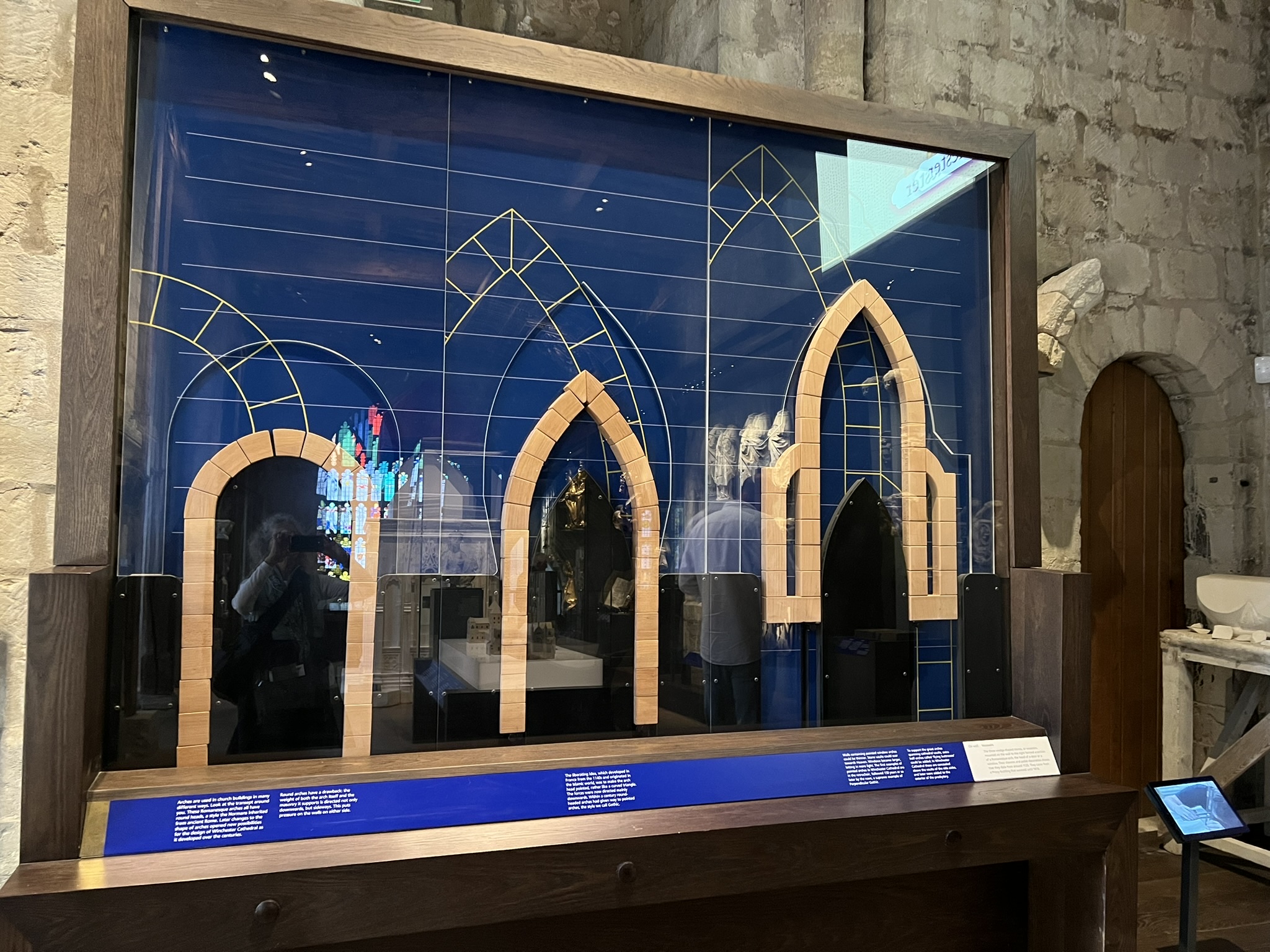
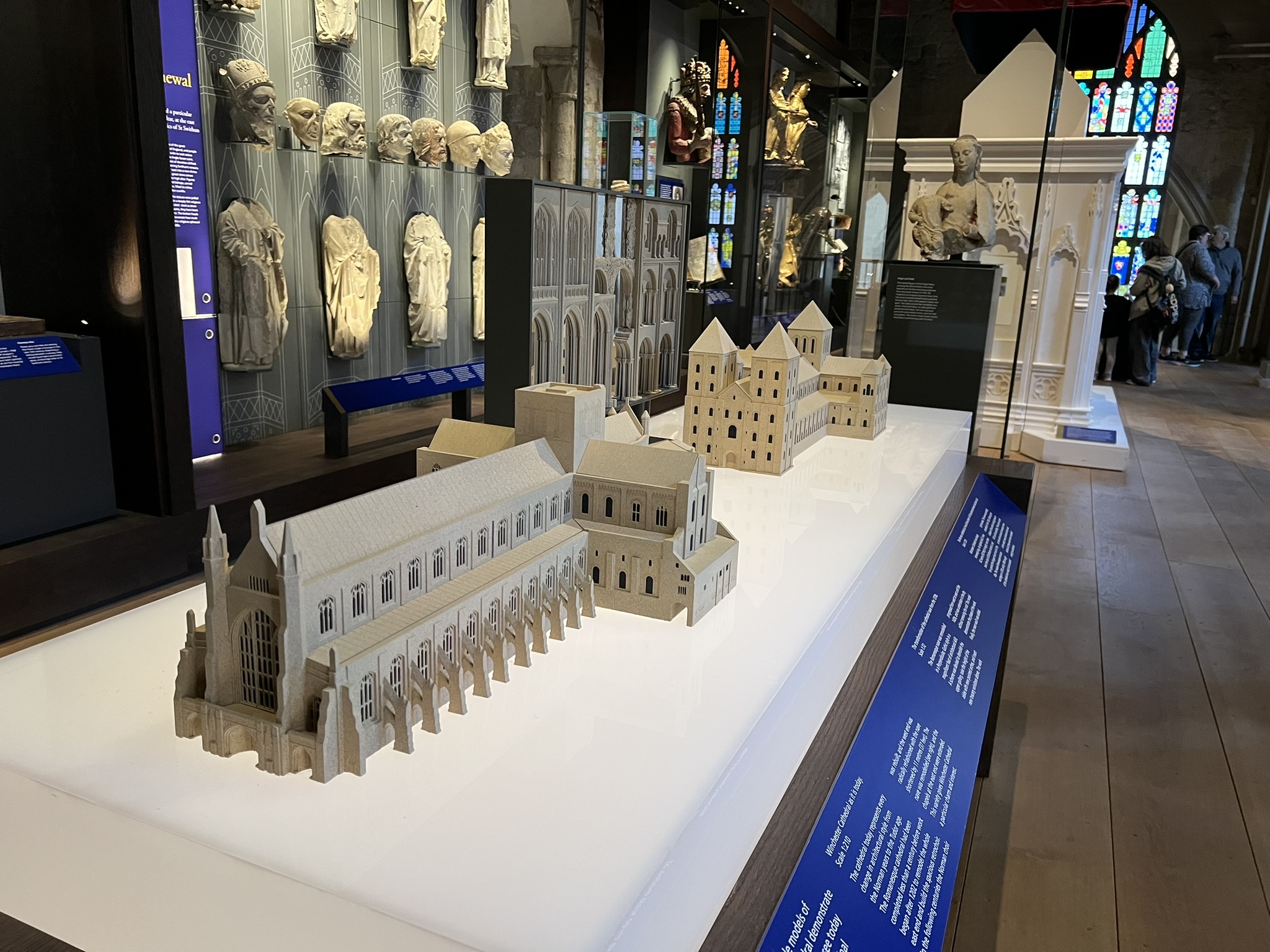
The Cathedral exhibition “Kings and Scribes: Birth of a Nation” tells the over 1,000 year history of Britain with many treasures, as well as this nicely done explanation of the architectural differences through the ages:
And the various illuminated manuscripts – you can see a bit of it here in this video: [since I didn’t take many photos]
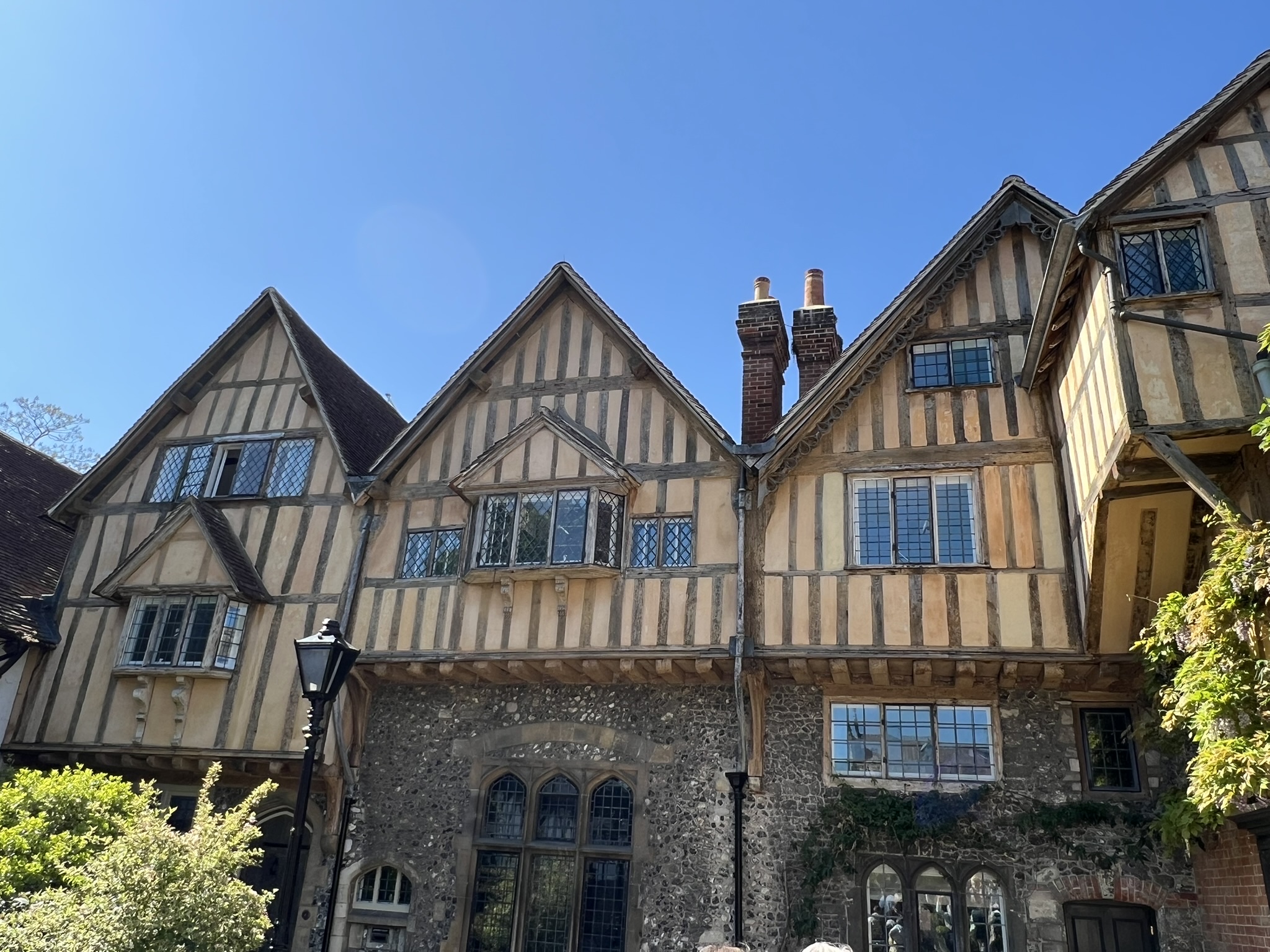
Leaving the Cathedral, I had lunch at the café, then wandered around in search of Bookshops – first finding the current building of The Hampshire Chronicle, publishing since 1772 – and certainly a paper the Austens would have read:
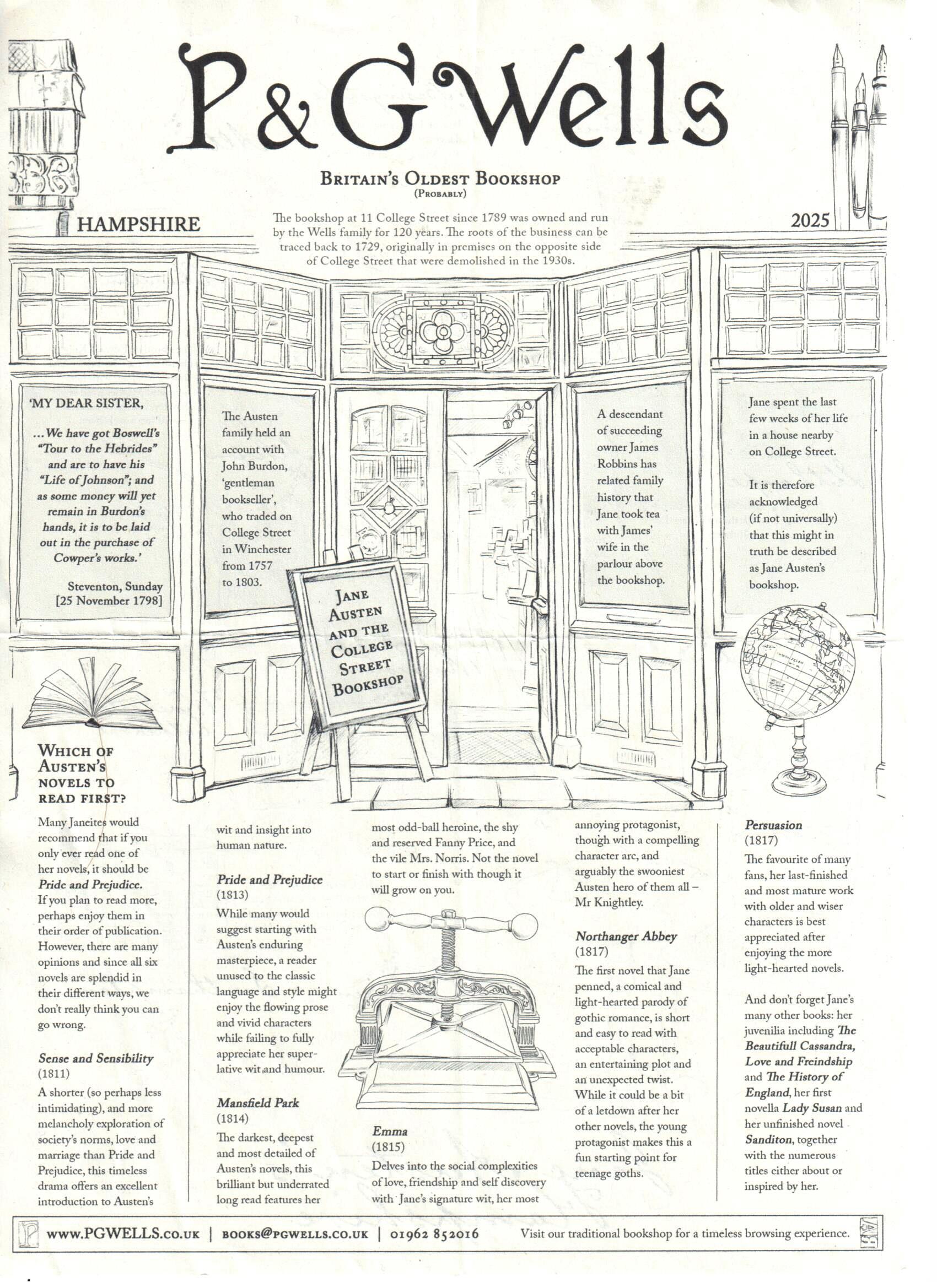
The P&G Wells bookshop is just down the street from 8 College St and where the Austens had a standing account with the then bookseller John Burdon. I missed an exterior photo but I do have this tile of the front, a gift from my roomie Joy! : it looks just like this:
– the interior retains much of the original Georgian furniture – the bookshelves, drawers, etc.
Here is the flier they have celebrating Jane Austen’s 250th:
[I didn’t buy anything, but did find this Ladybird book [didn’t buy; didn’t handle…] – apparently “specially planned to help grown-ups with the world about them” – what a concept…
The Deanery Bookstall in the Cathedral’s Inner Close, run completely by volunteers, was a book searcher’s delight – not enough time to spend as one would want… but did find a few things [and knowing now I would have to buy another suitcase to get home…once you pass that point, there is no stopping you…will tell the tale of the actual suitcase in the last of these posts…]
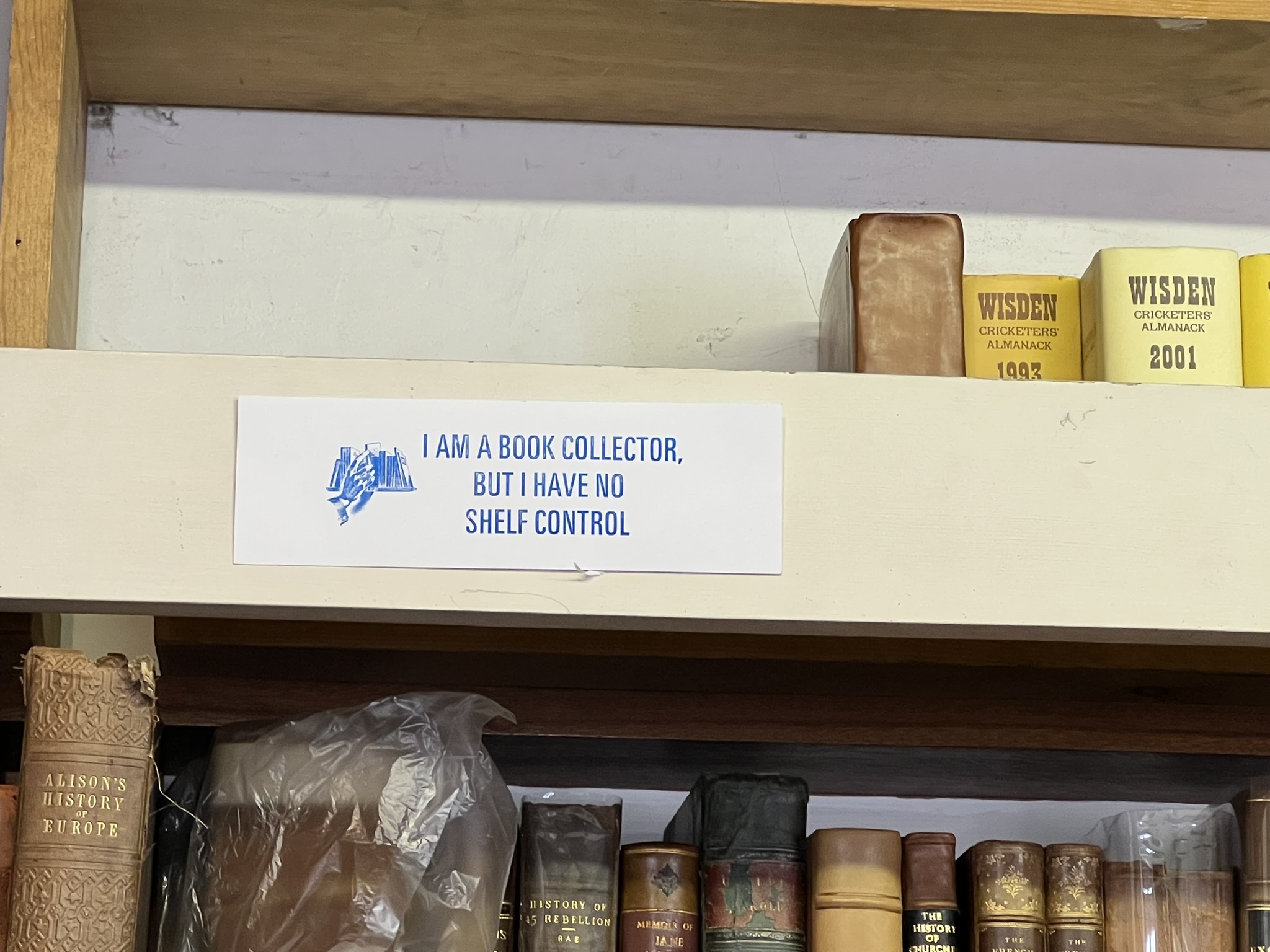
Found The Winchester Bookshop on St. Georges St – and DID find a few things there, including this sign, one I had never seen before, though it certainly could be my mantra…
I like nothing better than a staircase in a bookshop that beckons…
A day is always well-spent with it ending in random book searching … and of course, yet another dose of wisteria:
c2025JaneAustenInVermont
*There is a Keats walking tour in Winchester– he visited here for about two months in the late summer and early fall of 1819, his daily walks inspiring his poem “To Autumn”. I did not follow the tour but you can download the guide here:
*Susan Wolfson is Professor of English at Princeton University, where she is a specialist in British Romanticism, a field in which she teaches Jane Austen’s novels. She has recently produced the Harvard AnnotatedNorthanger Abbey, a unique edition of the novel’s text that hews, with less intervention than standard editions, to the text of the 1818 publication, and as with other volumes in the Harvard series, includes page-by-page annotations, illustrations, and other supplementary materials. With her husband Ronald Levao, she has also edited Mary Shelley’s Frankenstein for the same series. And with her colleague Claudia L. Johnson, she edited Pride and Prejudice for Longman Cultural Editions, of which she is the General Editor, and in this capacity has supervised Emma (edited by Frances Ferguson), and Persuasion (edited by William Galperin). Her most recent book is Reading John Keats (Cambridge), about Keats as a reader as well as a writer, and about how this readerly quality shapes and stimulates how he is read (very Austenian in this way!). Susan Wolfson received her PhD from the University of California, Berkeley, and taught at Rutgers University New Brunswick for 13 years, before her present appointment at Princeton. Widely published in the field of Romantic-era studies, she is the recipient of grants and fellowships from the ACLS, the Guggenheim Foundation, the National Endowment for the Humanities, and the Andrew W. Mellon Foundation.
December 6, 2015:
Annual Birthday Tea & Ball at the Essex Inn –
Celebrating 20 years of the 1995 Pride & Prejudice mini-series!
– details forthcoming
(Colin Firth is welcome if he is available and happens to be in Vermont…)
Gentle Readers: Today I welcome Tony Grant who has written for us a post on Box Hill. I had the pleasure this spring to spend a day with Tony, as he squired me around Southampton, Portsmouth and Box Hill – it was a rainy, quite miserable day, but the touring was grand, the company terrific! I’ve been to most of the Jane Austen sites – but not to anything we saw this day, from the Dolphin Inn to The Victory, and to the top of Box Hill – it was a world-wind tour of Jane, History, and Geology all rolled into one – Tony here tells of Box Hill, the infamous location that Austen chooses to place her Emma in one of her more self-illuminating “badly-done” scenes… with heartfelt thanks to Tony for the tour to the heart of it all…
**************
A view of Box Hill, Surrey – George Lambert
Box Hill in Jane Austen’s Emma
On Monday 26th May this year, Deb Barnum [a.k.a. Jane Austen in Vermont] and I drove up to the top of Box Hill. The quickest route is to come off The London Road, known as the A24, which sweeps past the base of Box Hill, paralleling the River Mole, which itself, arcs around Box Hill to the south and west. The A24 leads south from Epsom towards Dorking. A mile before Dorking we turned left at Rykas Café, which is a popular venue for motorcyclists. We took a small B road, overhung with trees. An old rusty sign leaning out of the hedgerow on the left pointed its finger to the summit of Box Hill. We turned into a wooded and high hedged lane which began to immediately rise steeply, bending towards the right. We passed a weathered red brick cottage on the left, set within a ragged, vibrant country garden surrounded by high, smoothly manicured hedges bulging and swelling outwards in billowing shapes. The road soon opened out onto steeply rising chalk grassland. A precipitous drop on our right formed and a steep incline to our left reached upwards.
Mist and cloud swirled around us as we mounted the hill along the switch back road. The corners made us turn almost back on ourselves but always took us to steeper and higher levels. The drop to the right revealed hedges of box and scrub, clinging tightly to the side of the hill, interspersed with finely cropped grasses. Chalky outcrops appeared to our left as we rose higher and higher amongst the mist and low clouds. As we neared the summit, trees and woodland gathered around us again. The squat whitewashed National Trust shop and café appeared in front of us and a car park was situated on the left amongst Scots Pines and firs.
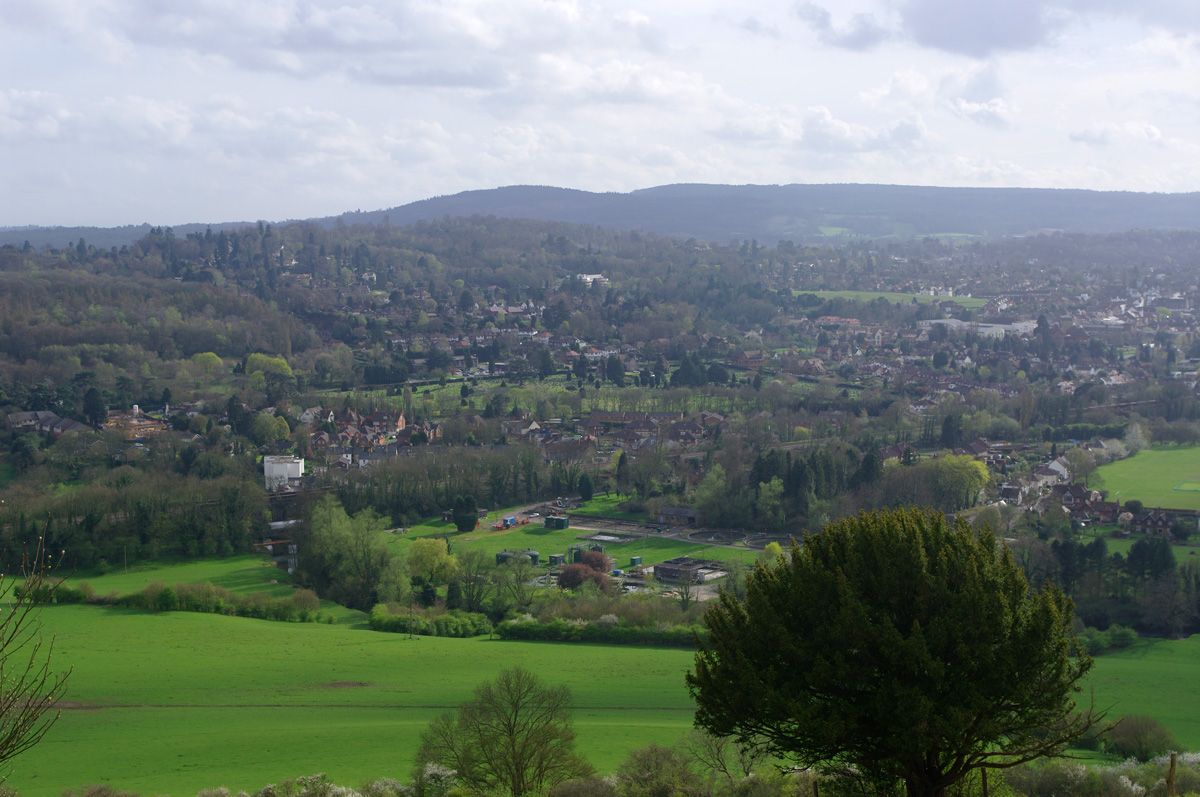
We parked the car and I showed Deb the way to the viewpoint we had come to see. We were seven hundred and thirty-five feet above the River Mole and Dorking town was to our right. We could see far into the distance across the
Town of Dorking below
woodlands and fields of Surrey. I suggested Deb take the part of Emma Woodhouse, who in Jane Austen’s novel of that name, visited this very spot with her friends and neighbours but she would have nothing of it. She would be Mrs Elton and nobody else. Deb stood and acclaimed the world standing high on the stone viewing plinth Leopold Salomons had erected in 1914, arms wide to the sky.
It was very near here that Emma Woodhouse and Mrs Elton and their party of friends alighted to picnic at the top of Box Hill in Jane Austen’s novel, Emma. The groups from Highbury and Hartfield, in the novel, have an inauspicious start to their trip, an inauspicious execution of it and an inauspicious end to it. It is a turning point in all their lives. The surface veneer begins to slip from various relationships. Reality begins to poke through Emmas carefully stage managed attempts of conducting other people’s lives. Nothing becomes certain. The Sucklings do not arrive at Hartfield and Mrs Elton’s plan of visiting Box Hill to show the Sucklings the views seems to lose its purpose but she has another thought and becomes adamant about the trip going ahead. The Sucklings can go another time. Mrs Elton’s idea about a trip to Box Hill has an effect on Emma. Emma does not want to be outdone. She has never visited Box Hill before and decides that,
“she wished to see what everybody found so well worth seeing…”
She discusses the trip with the amiable Mr Weston. He is perhaps too amenable and accommodating. In discussion with Mrs Elton he gets the approval of that lady that the two parties, hers and Emma’s join together for one combined trip to Box Hill. Emma is unhappy with the arrangement but as they will all go in different carriages with the people of their own choice perhaps it will not be so bad, she reasons. It would have been better if the horse that was to pull Emma’s carriage had stayed lame of course and so preventing Emma from going, but a quick recovery from this condition, inconveniently perhaps, gave no excuse for Emma not to proceed. A lame horse is a rather lame Jane Austen joke, I think, sprung in the midst of such serious matters. Tongue in cheek comes to mind – a joke at Emma’s expense between Austen and the reader.
Seven miles were travelled in expectation of enjoyment, and everybody had a burst of admiration on first arriving; but in the general amount of the day there was deficiency. There was a languor, a want of spirits, a want of unison, which could not be got over. They separated too much into parties.
This is an interesting passage because Jane Austen seems uncertain. She lists a litany of possible causes for the lack of harmony. She can’t herself decide on one exact cause. This adds realism to the situation. We cannot explain everything in real life and neither can Austen in this scene in Emma.
Austen has Frank Churchill perpetrate, perhaps, a cruel joke, to divert attention from himself and Emma. He asks the ultimate psychoanalysts question, in Emma’s name of course. He whispers to her:
“Our companions are excessively stupid. What shall we do to rouse them? Any nonsense will serve. They shall talk….”
And then for all to hear,
“Ladies and gentlemen, I am ordered by Miss Woodhouse (who, wherever she is, presides,) to say that she desires to know what you are all thinking of.”
Emma immediately tries to nervously laugh the question off. She is taken unawares by this and denies she has anything to do with any such request. There is a desperation in her voice. There is almost fear. She knows she could not, “stand the brunt,” of such raw honesty.
“Let me hear any thing rather than what you are all thinking of.”
There are one or two perhaps, (glancing at Mr Weston and Harriet,) whose thoughts I might not be afraid of knowing.”
Who can or would want to express their real thoughts at the drop of a hat? Is it possible for anybody to express their exact thoughts as they are thinking them? Our relationships would be very strange and probably be put under incredible stresses if we did. Emma is naïve to think even that the thoughts of Mr Weston and Harriet would bear hearing. Our subconscious level is below manners and the social veneer we all carry. It would be delving into our primal depths. This is the sort of thing that Sigmund Freud tried to study and explore. Frank Churchill is being cruel and he knows that nobody would answer this, certainly not himself. Imagine what sort of story would be written if everybody told their thoughts? It is almost the final nail in the coffin of harmony and wellbeing amongst the group on Box Hill.
Deb as Mrs Elton
Deb and I certainly didn’t even approach such a question. Deb, as I said before was just happy to be Mrs Elton and of course Mrs Elton and Mr Elton walked away on their own at Frank Churchill’s question. I wonder what Mrs Elton thought about it? Maybe Deb knows. As for my first suggestion to Deb to play Emma on the top of Box Hill; Emma is obviously an anti-hero. Neither Deb nor anybody else I have spoken to, would willingly be an Emma.
Geology:
Standing high on Box Hill you notice the thinness of the grass under your feet. You see flints sticking out of the pathways and white chalk is revealed in patches everywhere. Box Hill is a geological phenomenon. The cretaceous chalk that comprises Box Hill, was laid down as the microscopic calcareous bodies of plankton on the floor of a tropical sea between 100 and 65 million years ago. Globally chalk is a rare rock formation so it makes the North Downs, of which Box Hill is part, a unique geological area. Originally it was laid as a horizontal chalk platform of uniform thickness. During the period the Alps were formed, about 50 million years ago, upheavals in the Earth’s crust forced this chalk layer into a vast dome. The northern most edge was where the North Downs are now. The dome stretched over to France. The British Isles were joined to the mainland of Europe then. Chalk, being a porous and relatively soft rock, it has been eroded and worn down by the actions of water. All that remains are the North Downs stretching from Guildford in Surrey, just south of London into the northern part Kent and The South Downs stretching from a line formed by the Itchen River between Southampton and Winchester in the west to The Cliffs of Dover on the coast of Kent in the East.
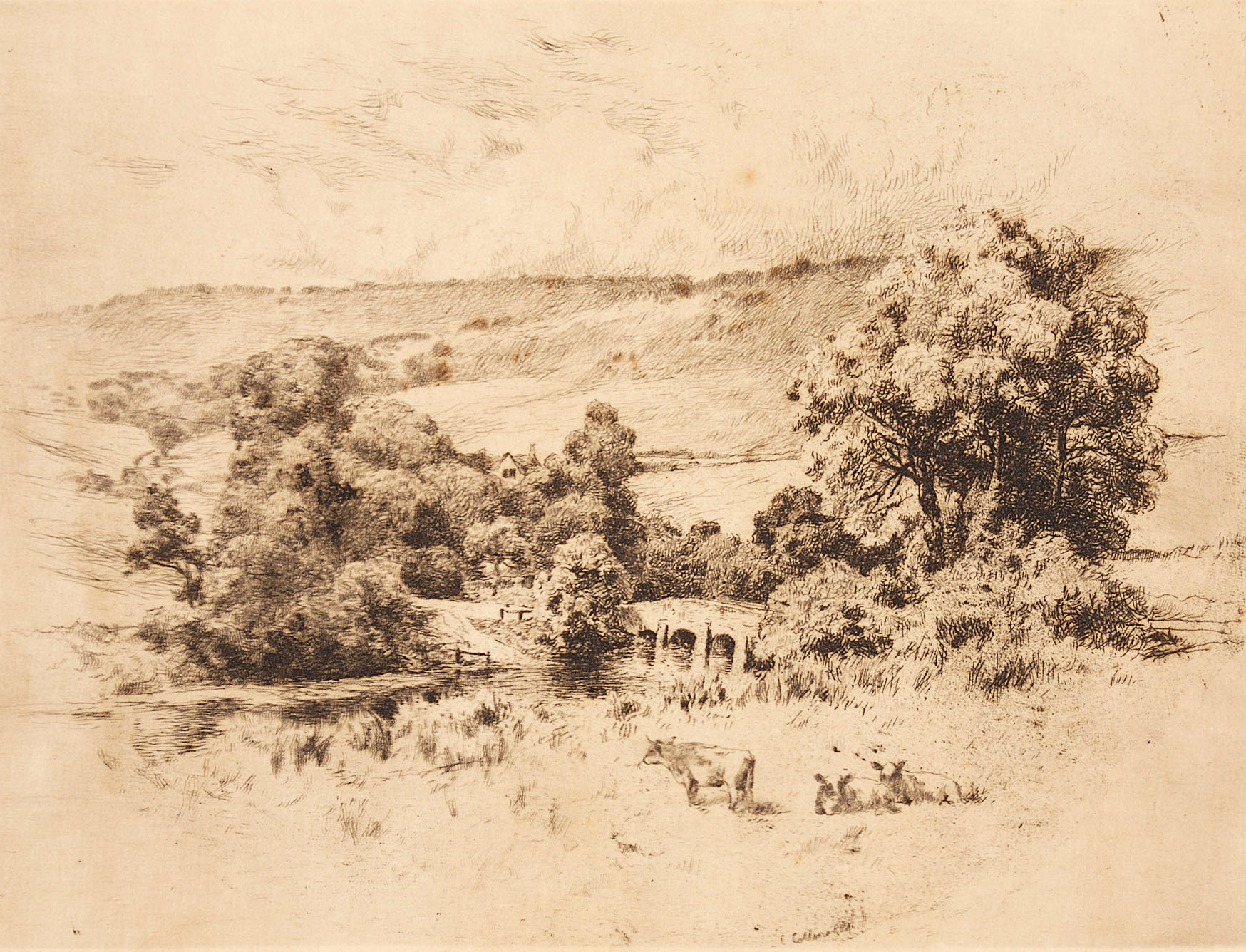
Box Hill Bridge, Dorking – by Alfred Charles Jerome Collins
image: Dorking Museum
On the steep chalk slopes of Box Hill, the 394 feet escarpment and on the sides of the surrounding valleys, downland plants flourish. Because chalk is porous it hardly ever dries out, even in drought conditions which might affect the surrounding landscape. This means plants always have a ready water supply. It is said that plants on chalk downland have a brighter richer colour because of this. Plants such as hawk weed rock rose, bird’s foot trefoil, milkwort, squinancywort and dwarf thistle all thrive in this environment. Box woodland, which is extremely ancient, grows on the steep chalky, thin soiled slopes. It is one of the only trees that will grow in these conditions. The escarpments and valley sides face southwards which means it is often a hot exposed environment. Box Hill derives its name from the box that grows on it. Box has been around since probably the end of the Ice Age and perhaps before that. The characteristics of chalk downland are unique to Box Hill’s geology. There are dry valleys cut into the north side of the hill. This is where the River Mole, which runs under the escarpment of Box Hill has cut its course in the past and where drainage streams and rivulets flowed into it, but because the rocks are porous any streams and rivulets that remain are no longer on the surface but underground. Chalk is easily eroded so it gives a gentle undulating quality to the general landscape. On the steep slopes there are patches of bare chalk and these can gleam white in the sunshine.
Chalk from the North Downs has been quarried in the past. Surrey County Council had a quarry at Brockham nearby to Box Hill. It was used to quarry chalk that could be burned in kilns to produce lime and cement. These quarries, many of them now abandoned have been left to regenerate, plants and wild life and some are now places of special scientific interest. The quarries, because they have sides cut into the chalk, show the structure of the chalk particularly well.
Chalk Down land is a special type of grassland habitat that is actually man made. Over centuries, sheep and cattle have been grazed on them. This has deforested the downland to a certain extent allowed unique wild flowers and animals, only found on downland, to flourish. To keep Box Hill’s downland quality a flock of sheep and a herd of cattle are grazed on it. The sheep on Box hill are Black Welsh Mountain sheep. There are twenty eight sheep, which are moved around the hill on a rotation. Because sheep are ‘nibblers’ they leave the grass short and even. There are also cattle, which graze very differently. Cows use their tongues to rip plants up, which leads to more tufted grassland. The breed used on Box Hill are called Belted Galloway cattle. They can be recognised by their fluffy black bodies with a thick white belt around their middles. Four males graze Box Hill and nearby Headley Heath is grazed by three males and nine females. The animals are moved around Box Hill all the time. If it ceased to be a grassland habitat, trees and woodland would take over and cover it. This would occur through a natural process called succession. This downland supports a great diversity of invertebrates including fourty one species of rare butterflies. The soil is good for snails too. Snails require the calcium in the chalk to form shells.
History:
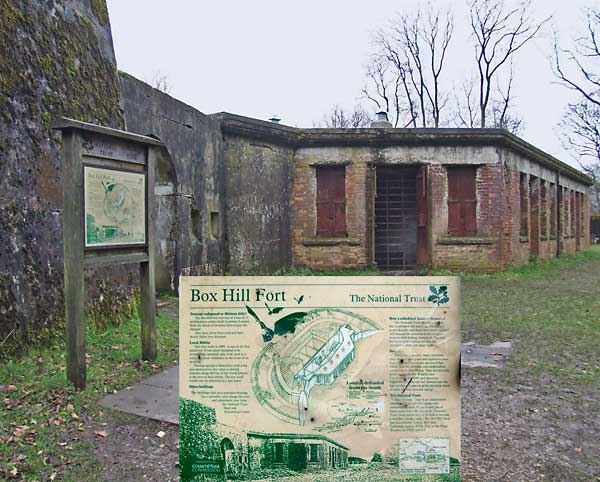
Box Hill has a varied history. The old fort, that can still be seen at the top of Box Hill, was built in the 1890’s and is one of thirteen that were built across the North Downs, collectively known as the London Defence System.. They were to be the last defence of London if Britain was ever invaded. In the late 1890’s there was a treaty with France called the entente cordial but Germany was beginning to increase its strength and many of the stresses and strains that eventually lead to the first world war were beginning to stir. Previously, in the 1860’s, during Palmerstone’s premiership, many forts had also been built around the coast of Britain to defend from a perceived threat from France then. The forts on Box Hill and across the North Downs were never used. I have visited and actually stayed in one of the forts, the fort on The Hogsback just outside of Guildford. It is owned by Surrey County Council and is used for parties of school children to stay at to enable them to explore and study wildlife and local history. The fort on The Hogs back contained officers quarters just outside the ramparts of the fort and a barracks for a small contingent of soldiers inside. The forts were basically armouries for storing shells, and explosives. They comprised of strongly reinforced chambers with specially constructed shelving. The one on The Hogsback had a large area of flat land in front of it on which artillery could be positioned if required. These forts were situated high on the downs,as much as seven hundred feet above the surrounding countryside. The one on the top of Box Hill is dilapidated now and barred from entry. A rare breed of bats has lodged itself inside the fort and cannot be disturbed. To continue the military theme, there are stepping stones that cross the River Mole at the base of Box Hill. During the second world war they were removed to impede invading forces crossing the river. In the area you can also see examples of pill boxes, which were concrete bunkers installed with heavy machine guns and concrete tank traps. Interestingly at the top of Guildford High Street, next to the railway line cutting, hidden amongst dense trees, nowadays you can see a whole swathe of Second World War tank traps covered in ivy and moss.
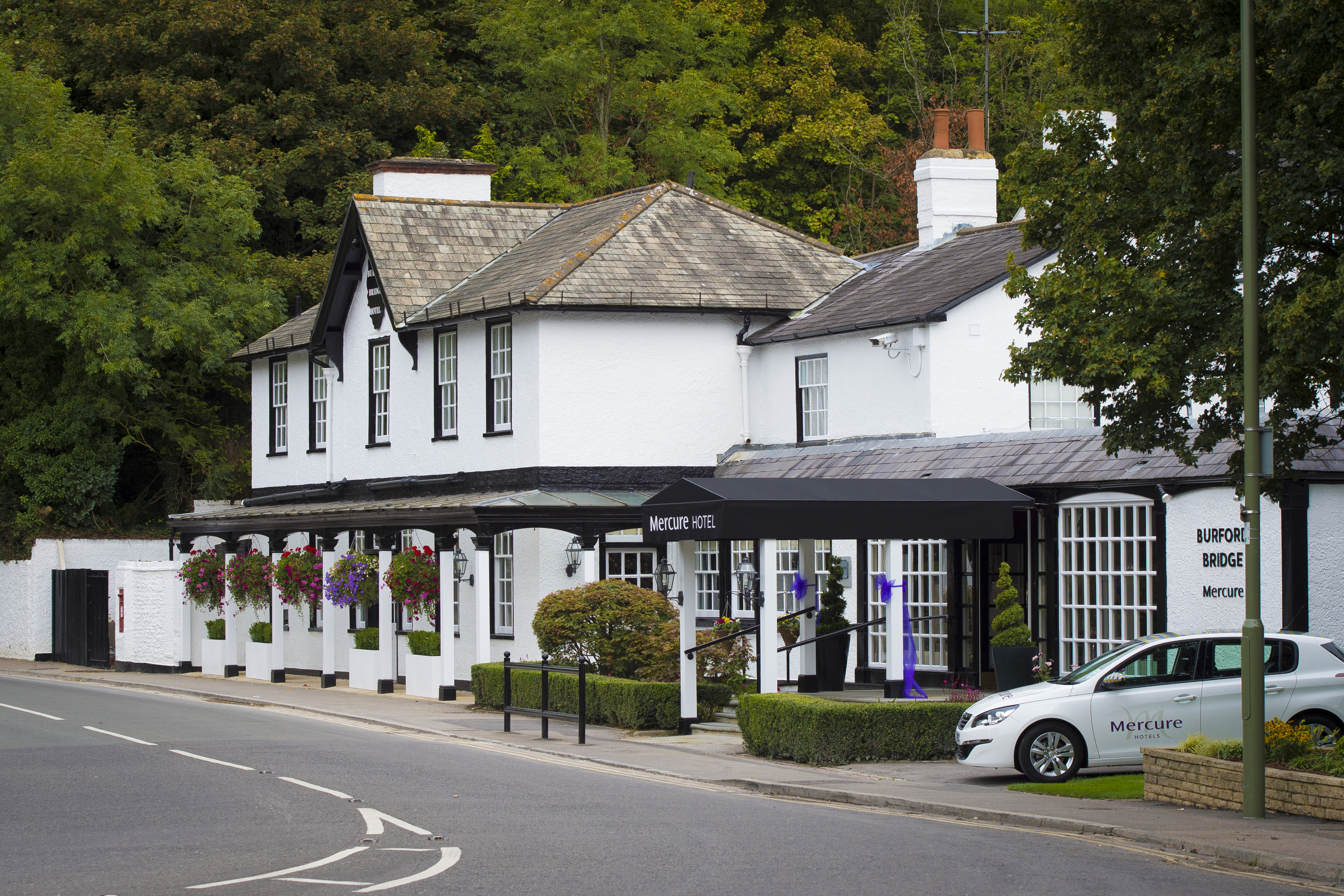
Burford Hotel
Literary Connections:
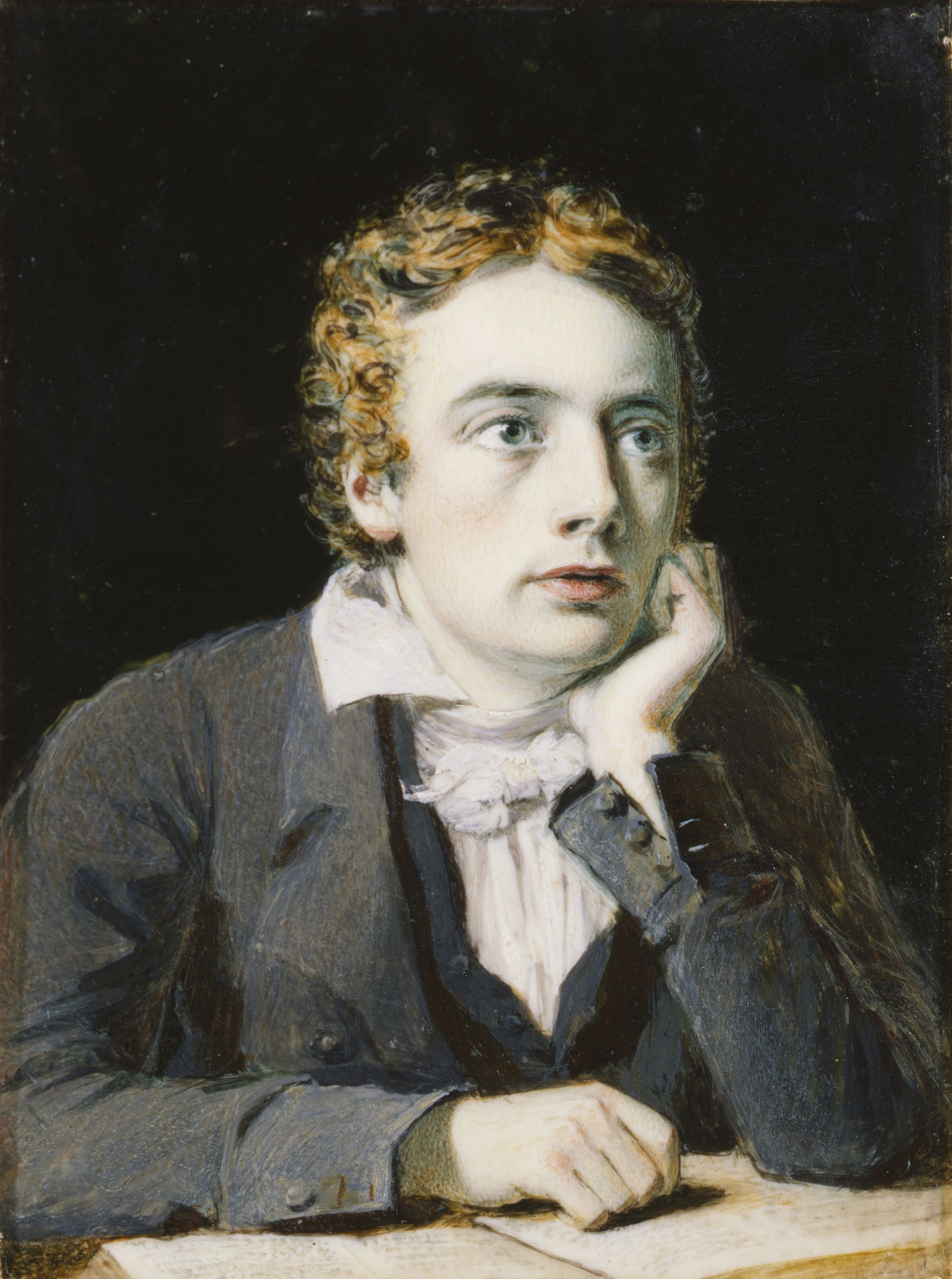
John Keats in 1819, by Joseph Severn – wikipedia
Box Hill has inspired a number of classic authors, not just Jane Austen as I mentioned at the start. John Keats, Daniel Defoe, George Meredith and Robert Louis Stevenson all visited Box Hill. J. M Barrie used to sit on one of the slopes of Box Hill getting inspiration for Peter Pan.
The Romantic Movement, led by William Wordsworth, popularised communing with nature and Box Hill became a popular place to visit. John Keats completed his poem Endymion (1816) while staying at the Burford Hotel next to Box Hill. Its famous opening lines have inspired generations,
“A thing of beauty is a joy forever
Its loveliness increases; it will never
Pass into nothingness; but still will keep
A bower quiet for us….”
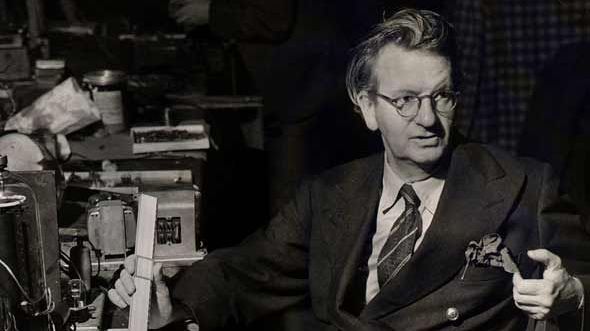
John Logie Baird, the inventor of television, lived in the Swiss Cottage at the top of Box Hill. In the 1930’s he conducted his early experiments in television from the top to the valley below.
John Logie Baird
The strangest individual connected with Box Hill is Major Peter Labelliere. He requested that he be buried upside down on the top of the hill. He believed that the world would go topsy-turvy and that one day he would be the right way up. His other dying wish was that youngest son and daughter of his land lady should dance on his coffin.
One thing you notice, as a driver, on Box Hill is when you descend, especially, winding along the switch back road on steep sided slopes and cliffs that the road surface has had strange, almost aboriginal markings painted on it. Here and there are the hoops of the Olympic movement. In 2012, The Olympics came to London. However, many events were not confined to the capital. The cycling road races were staged in the beautiful leafy, countryside of Surrey. Box Hill was the steepest part of the long distance cycling road race, hence the artistic markings that still adorn the road surface of the road..
On our way back to London, I drove Deb towards Kingston. We passed through an area called Malden Rushett, near the Chessington World of Adventures. There is a small industrial estate, farming land, a pub called The Blue Anchor and an extensive garden centre in Malden Rushett nowadays. The long straight road that passes through this area from Dorking to Kingston was a coaching road in the 18th century. Nothing apart from fields with cattle and maybe wheat growing would have existed there then. If you look on a map you can measure from Malden Rushett cross roads, seven miles to Box Hill, sixteen miles to London, twelve miles to Richmond and nine miles to Kingston – the exact distances from Highbury and Hartfield that Jane Austen reveals in Emma. I mentioned this to Deb as we drove along. I think she was impressed.
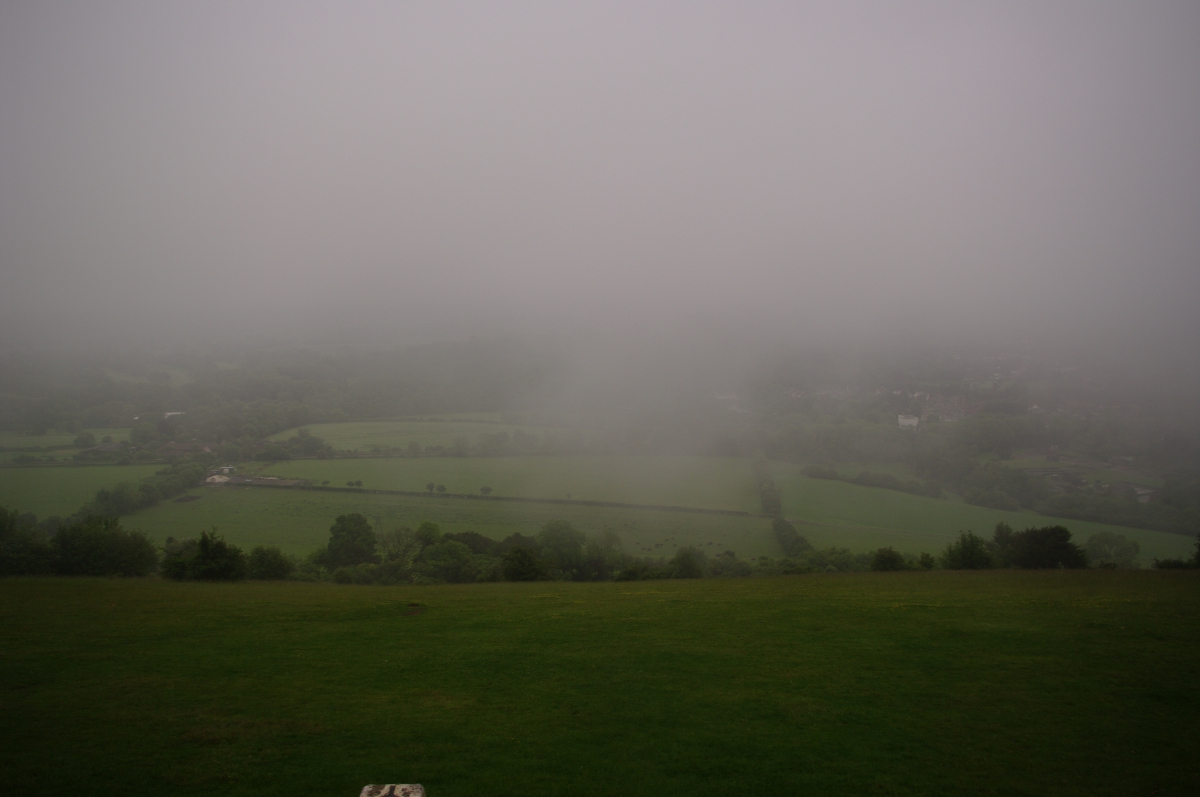
the view we saw in the mist
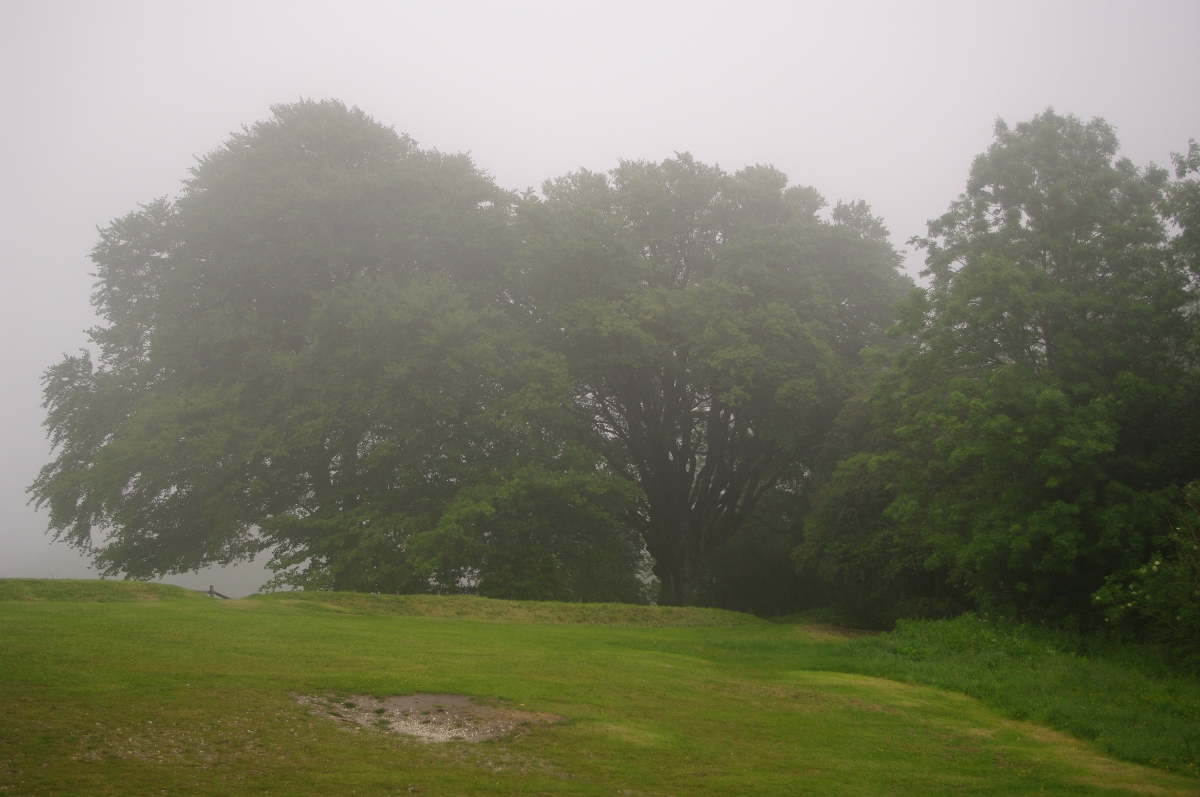
top of Box Hill in the mist
The Esteemed Author
All images c2014 Tony Grant unless otherwise noted.
… so says A.O. Scott of “Bright Star”, Jane Campion’s biopic love story of John Keats and Fanny Brawne. See his review in today’s New York Times [which has more references to Jane Austen than if it was about one of HER novels!]
The Jane Austen Pride & Prejudice for sale at the New York Bloomsbury Auction of June 23, 2009 with an estimate of $50,000. – $70, 000. remains unsold [for more details on this see my original post here]
A quick summary of a few other items of interest:
Bronte [Acton, Currer and Ellis Bell] : . Poems. Philadelphia: Lea and Blanchard, 1848. first american edition. est. $800 – $1000. Sold for $700
Samuel Taylor Coleridge. Poems on Various Subjects.London: for G.G. and J. Robinsons, and J. Cottle, Bristol, 1796. first edition of Coleridge’s first book of poems, issued together with the first published verses of Charles Lamb, signed C.L. Hayward est. $1000 – $1500. Sold for $2600 [a few other Coleridge items either did not sell or sold for less than the estimate]
John Keats – a first edition of his last collection of poems estimated at $12,000 – 15,000 was unsold
Percy Bysshe Shelley. Queen Mab; A Philosophical Poem: With Notes. London: privately printed by P.B. Shelley, 1813. very rare. est. $12000 – $18000; Sold for $11000 [ most other Shelley items did not sell]
William Wordsworth. Lyrical Ballads, with Pastoral and Other Poems, in Two Volumes. London: R. Taylor and Co., 1805. 2 volumes [the last edition in which Coleridge’s poems appear]. est. $1500 – $2000; Sold for $1700 [other Wordsworth items sold for lower than estimates or not at all]
Thomas Hardy. There were 22 Hardy items for sale, many of the books remain unsold, but most of the autograph letters sold mid-range or less than the estimates- here is one example: Three autograph letters signed to Florence Yolland on the Death of Emma, Hardy’s first wife.Max Gate, Dorchester: 24 December 1912 to 22 October 1913. 6 manuscript pages, 8vo (varying sizes). Mourning stationery, three autograph envelopes (all labeled “opened by censor” when sent to F. Adams in 1939) est. $2000 – $3000; Sold for $1000.























 Jane Austen in Vermont