Books · Jane Austen

Mrs. Tilney’s Bed-Chamber ~ and Henry Tilney’s Gentle Reprimand…

Today, March 23, Catherine Morland visits Mrs. Tilney’s bed-chamber,  where she expects to find some evidence of her murder by General Tilney, or even perhaps that she has been locked away in some distant tower – but Catherine realizes how gravely mistaken she has been in all her gothic musings,  perceiving “the warm beams of a western sun gaily pour[ing] through two sash windows!” … and she turns to leave…


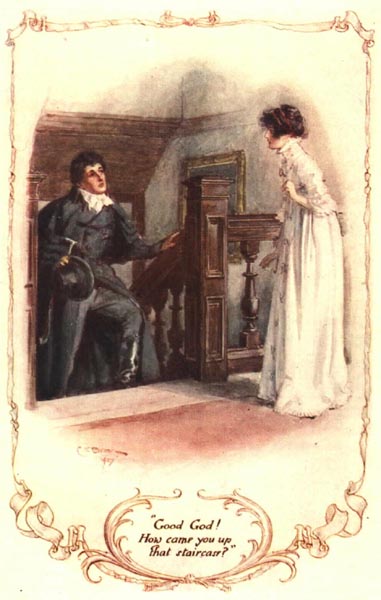
 She was sick of exploring, and desired but to be safe in her own room, with her own heart only privy to its folly; and she was on the point of retreating as softly as she had entered, when the sound of footsteps, she could hardly tell where, made her pause and tremble. To be found there, even by a servant, would be unpleasant; but by the general (and he seemed always at hand when least wanted), much worse! She listened — the sound had ceased; and resolving not to lose a moment, she passed through and closed the door. At that instant a door underneath was hastily opened; someone seemed with swift steps to ascend the stairs, by the head of which she had yet to pass before she could gain the gallery. She had no power to move. With a feeling of terror not very definable, she fixed her eyes on the staircase, and in a few moments it gave Henry to her view.

 “Mr. Tilney!”  she exclaimed in a voice of more than common astonishment.

He looked astonished too.

“Good God!” she continued, not attending to his address.  “How came you here? How came you up that staircase?”

 “How came I up that staircase!”,  he replied, greatly surprised.  “Because it is my nearest way from the stable–yard to my own chamber; and why should I not come up it?”

 Catherine recollected herself, blushed deeply, and could say no more. He seemed to be looking in her countenance for that explanation which her lips did not afford. She moved on towards the gallery.  

“And may I not, in my turn,”  said he, as he pushed back the folding doors,  “ask how you came here? This passage is at least as extraordinary a road from the breakfast–parlour to your apartment, as that staircase can be from the stables to mine.”

“I have been,”  said Catherine, looking down,  “to see your mother’s room.”

“My mother’s room! Is there anything extraordinary to be seen there?”

“No, nothing at all. I thought you did not mean to come back till tomorrow.”

“I did not expect to be able to return sooner, when I went away; but three hours ago I had the pleasure of finding nothing to detain me. You look pale. I am afraid I alarmed you by running so fast up those stairs. Perhaps you did not know — you were not aware of their leading from the offices in common use?”

“No, I was not. You have had a very fine day for your ride.”

“Very; and does Eleanor leave you to find your way into all the rooms in the house by yourself?”

“Oh! No; she showed me over the greatest part on Saturday — and we were coming here to these rooms — but only” —[  dropping her voice ] — “your father was with us.”

“And that prevented you,” [ said Henry, earnestly regarding her. ]“Have you looked into all the rooms in that passage?”

“No, I only wanted to see — Is not it very late? I must go and dress.”

 “It is only a quarter past four” showing his watch — “and you are not now in Bath. No theatre, no rooms to prepare for. Half an hour at Northanger must be enough.”

She could not contradict it, and therefore suffered herself to be detained, though her dread of further questions made her, for the first time in their acquaintance, wish to leave him. They walked slowly up the gallery.

“Have you had any letter from Bath since I saw you?”

“No, and I am very much surprised. Isabella promised so faithfully to write directly.”

“Promised so faithfully! A faithful promise! That puzzles me. I have heard of a faithful performance. But a faithful promise — the fidelity of promising! It is a power little worth knowing, however, since it can deceive and pain you. My mother’s room is very commodious, is it not? Large and cheerful–looking, and the dressing–closets so well disposed! It always strikes me as the most comfortable apartment in the house, and I rather wonder that Eleanor should not take it for her own. She sent you to look at it, I suppose?”

 “No.”

“It has been your own doing entirely?”[  Catherine said nothing. After a short silence, during which he had closely observed her, he added, ] “As there is nothing in the room in itself to raise curiosity, this must have proceeded from a sentiment of respect for my mother’s character, as described by Eleanor, which does honour to her memory. The world, I believe, never saw a better woman. But it is not often that virtue can boast an interest such as this. The domestic, unpretending merits of a person never known do not often create that kind of fervent, venerating tenderness which would prompt a visit like yours. Eleanor, I suppose, has talked of her a great deal?”

“Yes, a great deal. That is — no, not much, but what she did say was very interesting. Her dying so suddenly”  (slowly, and with hesitation it was spoken),  “and you — none of you being at home — and your father, I thought — perhaps had not been very fond of her.”

“And from these circumstances,”  he replied (his quick eye fixed on hers),  “you infer perhaps the probability of some negligence — some” — (involuntarily she shook her head)  — “or it may be — of something still less pardonable.”  She raised her eyes towards him more fully than she had ever done before.  “My mother’s illness,”  he continued,  “the seizure which ended in her death, was sudden. The malady itself, one from which she had often suffered, a bilious fever — its cause therefore constitutional. On the third day, in short, as soon as she could be prevailed on, a physician attended her, a very respectable man, and one in whom she had always placed great confidence. Upon his opinion of her danger, two others were called in the next day, and remained in almost constant attendance for four and twenty hours. On the fifth day she died. During the progress of her disorder, Frederick and I (we were both at home) saw her repeatedly; and from our own observation can bear witness to her having received every possible attention which could spring from the affection of those about her, or which her situation in life could command. Poor Eleanor was absent, and at such a distance as to return only to see her mother in her coffin.”

“But your father,”  said Catherine,  “was he afflicted?”

 “For a time, greatly so. You have erred in supposing him not attached to her. He loved her, I am persuaded, as well as it was possible for him to — we have not all, you know, the same tenderness of disposition — and I will not pretend to say that while she lived, she might not often have had much to bear, but though his temper injured her, his judgment never did. His value of her was sincere; and, if not permanently, he was truly afflicted by her death.”

 “I am very glad of it,”  said Catherine;  “it would have been very shocking!”

 “If I understand you rightly, you had formed a surmise of such horror as I have hardly words to — Dear Miss Morland, consider the dreadful nature of the suspicions you have entertained. What have you been judging from? Remember the country and the age in which we live. Remember that we are English, that we are Christians. Consult your own understanding, your own sense of the probable, your own observation of what is passing around you. Does our education prepare us for such atrocities? Do our laws connive at them? Could they be perpetrated without being known, in a country like this, where social and literary intercourse is on such a footing, where every man is surrounded by a neighbourhood of voluntary spies, and where roads and newspapers lay everything open? Dearest Miss Morland, what ideas have you been admitting?”

 They had reached the end of the gallery, and with tears of shame she ran off to her own room…. [next chapter]  The visions of romance were over.  Catherine was completely awakened…

[Northanger Abbey, Vol. II, Chap. IX [ch. 24]]
illustration:  by C.E. Brock from www.Mollands.net 

[Posted by Deb]

Books · Jane Austen

Henry Tilney’s Gothic Parody

Today [March 20] is the day that the Tilneys and Catherine leave Bath for Northanger Abbey – Catherine is riding with the innumerably-caped- greatcoated Henry:

“…she found herself with Henry in the curricle, as happy a being as ever existed. A very short trial convinced her that a curricle was the prettiest equipage in the world… the merit of the curricle did not all belong to the horses; Henry drove so well — so quietly — without making any disturbance, without parading to her, or swearing at them: so different from the only gentleman–coachman whom it was in her power to compare him with! And then his hat sat so well, and the innumerable capes of his greatcoat looked so becomingly important! To be driven by him, next to being dancing with him, was certainly the greatest happiness in the world.”

[NA, vol. II, ch. V] 


…and Henry begins his gothic tale setting Catherine well on her way to having her own imagination run wild.  Here is the full text, as you must read the whole!:

“….you must be so fond of the abbey! After being used to such a home as the abbey, an ordinary parsonage–house must be very disagreeable.” 

He smiled, and said, “You have formed a very favourable idea of the abbey.”

 “To be sure, I have. Is not it a fine old place, just like what one reads about?”

 “And are you prepared to encounter all the horrors that a building such as ‘what one reads about’ may produce? Have you a stout heart? Nerves fit for sliding panels and tapestry?”

 “Oh! yes — I do not think I should be easily frightened, because there would be so many people in the house — and besides, it has never been uninhabited and left deserted for years, and then the family come back to it unawares, without giving any notice, as generally happens.”

 “No, certainly. We shall not have to explore our way into a hall dimly lighted by the expiring embers of a wood fire — nor be obliged to spread our beds on the floor of a room without windows, doors, or furniture. But you must be aware that when a young lady is (by whatever means) introduced into a dwelling of this kind, she is always lodged apart from the rest of the family. While they snugly repair to their own end of the house, she is formally conducted by Dorothy, the ancient housekeeper, up a different staircase, and along many gloomy passages, into an apartment never used since some cousin or kin died in it about twenty years before. Can you stand such a ceremony as this? Will not your mind misgive you when you find yourself in this gloomy chamber — too lofty and extensive for you, with only the feeble rays of a single lamp to take in its size — its walls hung with tapestry exhibiting figures as large as life, and the bed, of dark green stuff or purple velvet, presenting even a funereal appearance? Will not your heart sink within you?”

“Oh! But this will not happen to me, I am sure.”

 “How fearfully will you examine the furniture of your apartment! And what will you discern? Not tables, toilettes, wardrobes, or drawers, but on one side perhaps the remains of a broken lute, on the other a ponderous chest which no efforts can open, and over the fireplace the portrait of some handsome warrior, whose features will so incomprehensibly strike you, that you will not be able to withdraw your eyes from it. Dorothy, meanwhile, no less struck by your appearance, gazes on you in great agitation, and drops a few unintelligible hints. To raise your spirits, moreover, she gives you reason to suppose that the part of the abbey you inhabit is undoubtedly haunted, and informs you that you will not have a single domestic within call. With this parting cordial she curtsies off — you listen to the sound of her receding footsteps as long as the last echo can reach you — and when, with fainting spirits, you attempt to fasten your door, you discover, with increased alarm, that it has no lock.”

 “Oh! Mr. Tilney, how frightful! This is just like a book! But it cannot really happen to me. I am sure your housekeeper is not really Dorothy. Well, what then?”

 “Nothing further to alarm perhaps may occur the first night. After surmounting your unconquerable horror of the bed, you will retire to rest, and get a few hours’ unquiet slumber. But on the second, or at farthest the third night after your arrival, you will probably have a violent storm. Peals of thunder so loud as to seem to shake the edifice to its foundation will roll round the neighbouring mountains — and during the frightful gusts of wind which accompany it, you will probably think you discern (for your lamp is not extinguished) one part of the hanging more violently agitated than the rest. Unable of course to repress your curiosity in so favourable a moment for indulging it, you will instantly arise, and throwing your dressing–gown around you, proceed to examine this mystery. After a very short search, you will discover a division in the tapestry so artfully constructed as to defy the minutest inspection, and on opening it, a door will immediately appear — which door, being only secured by massy bars and a padlock, you will, after a few efforts, succeed in opening — and, with your lamp in your hand, will pass through it into a small vaulted room.”

“No, indeed; I should be too much frightened to do any such thing.”

 “What! Not when Dorothy has given you to understand that there is a secret subterraneous communication between your apartment and the chapel of St. Anthony, scarcely two miles off? Could you shrink from so simple an adventure? No, no, you will proceed into this small vaulted room, and through this into several others, without perceiving anything very remarkable in either. In one perhaps there may be a dagger, in another a few drops of blood, and in a third the remains of some instrument of torture; but there being nothing in all this out of the common way, and your lamp being nearly exhausted, you will return towards your own apartment. In repassing through the small vaulted room, however, your eyes will be attracted towards a large, old–fashioned cabinet of ebony and gold, which, though narrowly examining the furniture before, you had passed unnoticed. Impelled by an irresistible presentiment, you will eagerly advance to it, unlock its folding doors, and search into every drawer — but for some time without discovering anything of importance — perhaps nothing but a considerable hoard of diamonds. At last, however, by touching a secret spring, an inner compartment will open — a roll of paper appears — you seize it — it contains many sheets of manuscript — you hasten with the precious treasure into your own chamber, but scarcely have you been able to decipher ‘Oh! Thou — whomsoever thou mayst be, into whose hands these memoirs of the wretched Matilda may fall’ — when your lamp suddenly expires in the socket, and leaves you in total darkness.”

“Oh! No, no — do not say so. Well, go on.”

 But Henry was too much amused by the interest he had raised to be able to carry it farther; he could no longer command solemnity either of subject or voice, and was obliged to entreat her to use her own fancy in the perusal of Matilda’s woes. Catherine, recollecting herself, grew ashamed of her eagerness, and began earnestly to assure him that her attention had been fixed without the smallest apprehension of really meeting with what he related. “Miss Tilney, she was sure, would never put her into such a chamber as he had described! She was not at all afraid.”

[NA, vol II, ch. V]

[Illustration, The Mysteries of Udolpho, Vol. 4, p. 217 (London: Longman, Rees, Orme, Brown and Green, 1830).  From wwnorton.com]

**********************************

 Sleep well! – hope to see many of you tomorrow at our gathering to celebrate Northanger Abbey!

[Posted by Deb]

Austen Literary History & Criticism · Books · Jane Austen · JASNA-Vermont events

You are Cordially Invited! ~ JASNA-Vermont March 21st

You are Cordially Invited to JASNA-Vermont’s* March Meeting

 Ingrid Graff 

on 

~ Learning to Love a Hyacinth:
Emotional Growth in Northanger Abbey ~  

Sunday, March 21, 2010  2 – 4 pm 
Champlain
College, Hauke Conference Center
375 Maple St
 
Burlington VT  

Free & Open to the Public! 

*******************************************

Ingrid Graff is a great friend of mine and will offer us all a most entertaining talk on Northanger Abbey – so if this is not one of your favorite Austen novels [and how can it not be with Henry Tilney as the hero?!], please join us – it will become so after listening to Ingrid!

**************************************************

Upcoming Events: 
June 6, 2010:  Box Hill Picnic* Kelly McDonald on “Austen – Adams ~ Journeys with Jane &  Abigail” [Deb Barnum’s garden]
September 26:  JASNA President Marsha Huff on “Viewing Austen through Vermeer’s Camera Obscura” [Champlain College]
December 5: Annual Birthday Tea with Professor Peter Sabor of McGill University on the Juvenilia [Champlain College]
March 28:  “Jane Austen’s London in Fact & Fiction” with Suzanne Boden & Deb Barnum [Champlain College]

*Please contact us to be put on our mailing list for all future events

Books · Jane Austen · Jane Austen Sequels · Literature · News · Publishing History

In the News!

WilloughbyJane Odiwe has just announced the publication of her latest novel: Willoughby’s Return.

“I’m writing to everyone about my new book Willoughby’s Return, which is about to be published on November 1st and I’m hoping you will help me spread the word by mentioning its release to anyone you think might be interested.

Here’s a bit of blurb from the publisher Sourcebooks:

A lost love returns, rekindling forgotten passions…

In Jane Austen’s Sense and Sensibility, when Marianne Dashwood marries Colonel Brandon, she puts her heartbreak over dashing scoundrel John Willoughby in the past. Three years later, Willoughby’s return throws Marianne into a tizzy of painful memories and exquisite feelings of uncertainty. Willoughby is as charming, as roguish, and as much in love with her as ever. And the timing couldn’t be worse, with Colonel Brandon away and Willoughby determined to win her back, will Marianne find the strength to save her marriage, or will the temptation of a previous love be too powerful to resist?”

Jane is also doing a blog tour, and to celebrate publication there will be giveaways, competitions to win books and paintings, plus interviews over the next couple of weeks.

Information on her blog: http://www.janeaustensequels.blogspot.com/

* * *

One of my favorite websites is the book ‘repository’ A Celebration of Women Writers. Mary Mark Ockerbloom, our hostess who has been busy ‘rescuing’ books from Geocities (before that site closes down), has announced many additions to Celebrating Women’s website, but one in particular will interest Austen enthusiasts:

The Castle of Wolfenbach
by Eliza Parsons (1739-1811)
London : printed for William Lane, at the Minerva Press, and sold by
E. Harlow, 1793.

Writes Mary in her email introduction about the latest additions: “My personal favorite of the new titles, however, is Eliza Parsons’ “The Castle of Wolfenbach”. One of the seven “horrid novels” recommended with delightful anticipation by Isabella Thorpe in Jane Austen’s Northanger Abbey, The Castle of Wolfenbach is important as an early Gothic novel, predating both Ann Radcliffe’s The Mysteries of Udolpho and Monk Lewis’s The Monk.

A virtuous young woman in peril, a wicked uncle, a mysterious castle, a noble lover, what more could one ask?

Read and enjoy”

We’d love to post a ‘review’, should anyone be interested in reading then writing…

* * *

And last – Google’s book site has *finally* given us some (note the word!) volumes of Austen’s 1811 Sense and Sensibility!!

Only volumes I and II have been found – though Google books is notorious for making it difficult to find all volumes of a title (anyone listening to this complaint, Google?). I have not yet gone through the two volumes, for Google books is also notorious for skipping pages, missing pages, popping in pages twice, mis-scanning, etc etc. Though where can most of us see an Austen first edition, except through such a site! Now if only they will give us volume III as well as finish off Pride and Prejudice by supplying volume I for that trio.

[Posted by Kelly]

JASNA-Vermont events · News · Schedule of Events

JASNA ~ Massachusetts Region ~ May 3, 2009

You are invited to join the JASNA Massachusetts Region Chapter at their next meeting scheduled for Sunday, May 3, 2009:

“Learning to Love a Hyacinth: Emotional Growth in Northanger Abbey”

with Ingrid Graff*

 ********************************

Wheelock College, Brookline Campus

43 Hawes St

Brookline, MA

2:00 pm

$5. / person [Mass Chapter members free]

For more information contact:  JASNA – MA, Nancy Yee, Regional Coordinator,  617-965-5699

[* Ingrid Graff is a great friend of mine – I heartily recommend that you attend if at all possible!]

Jane Austen · Rare Books

Northanger Abbey Cover Art

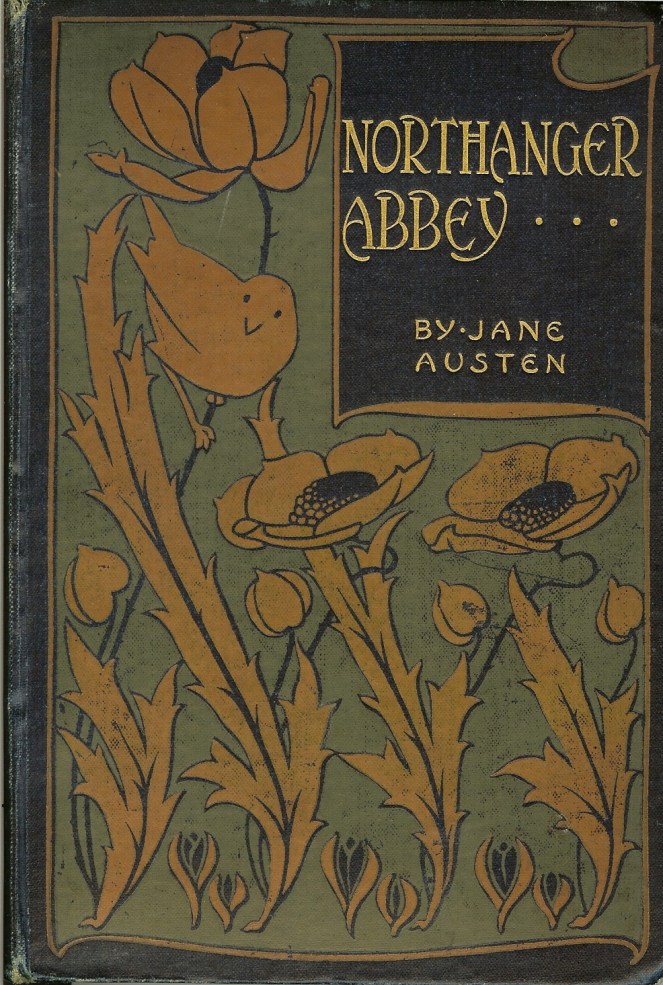
Laurel Ann at Austenprose asked about the illustration by Paul Hardy in my post on Henry Tilney.  This illustration was the frontispiece in an undated Blackie & Son [London] edition from the late 19th – early 20th century ~ there is an inscription dated February 1902 that reads –  “Florrie Steggles, for excellent work.”  [this is why I love inscriptions!]… what a gift for a young lady to receive!  I bought this book for its cover alone [alas! the pages are quite browned and there is only this one illustration], but the Art Nouveau unsigned decorative binding is just lovely ~ the front board is displayed here; the spine is similarly decorated, a welcome sight on the bookshelf!

na-art-nouveaucover2

Books · Jane Austen

A Happy Day Indeed!

Oh, be still my heart! ~  it is on this day,  February 6th,  that Catherine meets Henry Tilney in the Lower Rooms in Bath:

Bath, Lower Rooms
Bath, Lower Rooms

They made their appearance in the Lower Rooms; and here fortune was more favourable to our heroine. The master of the ceremonies introduced to her a very gentlemanlike young man as a partner; his name was Tilney. He seemed to be about four or five and twenty, was rather tall, had a pleasing countenance, a very intelligent and lively eye, and, if not quite handsome, was very near it. His address was good, and Catherine felt herself in high luck. There was little leisure for speaking while they danced; but when they were seated at tea, she found him as agreeable as she had already given him credit for being. He talked with fluency and spirit – and there was an archness and pleasantry in his manner which interested, though it was hardly understood by her. After chatting some time on such matters as naturally arose from the objects around them, he suddenly addressed her with – “I have hitherto been very remiss, madam, in the proper attentions of a partner here; I have not yet asked you how long you have been in Bath; whether you were ever here before; whether you have been at the Upper Rooms, the theatre, and the concert; and how you like the place altogether. I have been very negligent – but are you now at leisure to satisfy me in these particulars? If you are I will begin directly.”

and followed by a lively discussion of Bath, and concerts, and journals and writing and muslins, the reader is left with the narrator’s thoughts…:

…for if it be true, as a celebrated writer has maintained, that no young lady can be justified in falling in love before the gentleman’s love is declared, it must be very improper that a young lady should dream of a gentleman before the gentleman is first known to have dreamt of her…

[Northanger Abbey, ch. 3]

And Henry leaves Bath the very next day for a WHOLE week, Catherine completely distraught at the loss.  I always thought this was quite enterprising of Henry!

We all have our own view of Henry Tilney … certainly Mags at Austenblog has single-handedly brought Tilney the attention he so richly deserves! [see also her site Tilneys and Trapdoors].  When I first read Northanger Abbey, I thought Henry was a condescending bore, on a second reading I thought he was quite funny, on subsequent readings, Henry becomes more and more delightful, ever more charming on every re-reading, really quite to die-for – who needs the proud, socially awkward Mr. Darcy when there is a Henry Tilney about?!

So I bring you ~  the many faces of Henry Tilney ~

C.E. Brock
C.E. Brock

C.E. Brock
C.E. Brock

"Bath Compared with London," said Mr. Tilney, "has little variety."  [Paul Hardy]”]”]Joan Hassall [Folio Society, 1975]

“]”]Shades from Jane Austen [1975]
Shades from Jane Austen, 1975
”]”]Peter Firth as Henry [1986]

”]”]J.J. Feild as Henry [2008]


Further reading:

[Note:  Brock images courtesy of Molland’s

So what does YOUR Henry Tilney look like?? [all comments  and pictures most welcome!]

Books

The “Northanger Canon”: Jane Austen’s Booklist

Most of us who read Jane Austen are always seeking new titles to read, and ways to answer the 200-year old question of “what to read when you have finished all of Jane Austen.”  Other than the almost mandatory requirement to RE-READ Austen whenever possible, it is a “truth universally acknowledged” that an Austen reader will be soon in want of another book!   I have seen many such lists and though always subjective to the list-maker, they are a great start.  But what about Austen’s own reading?  A number of articles have been written on this, as much is known from her letters, but as our JASNA-Vermont Chapter recently had a meeting and discussion on Northanger Abbey, and we know that NA was Austen’s tribute to the novel and reading, I would like to provide a list of books she actually cites throughout NA….it is an illuminating compilation and should keep us all busy for the next year at least!  [ please note that there is no particular order to this list…. and if I have left anything out, please let me know!]

The Northanger Canon [ i.e. the “Horrid” Novels as referenced by Isabella Thorpe in Chapter 6 of NA]; also see the article describing each book in more detail at The University of Virginia’s Gothic Books Collection.

  • THE MYSTERIES OF UDOLPHO.  by Ann Ward Radcliffe.  London, 1794.
  • THE CASTLE OF WOLFENBACH.  by Mrs. Eliza Parsons. London, 1793.
  • CLERMONT: A TALE.  by Regina Maria Roche.  London, 1798.
  • THE MYSTERIOUS WARNING.  by Mrs. Eliza Parsons.  London, 1796.
  • THE NECROMANCER; OR THE TALE OF THE BLACK FOREST, FOUNDED ON FACTS.  Translated from the German of Lawrence Flammenberg by Peter Teuthold.  London, 1794.
  • THE MIDNIGHT BELL, A GERMAN STORY.  by Francis Lathom.  London, 1798.
  • THE ORPHAN OF THE RHINE: A ROMANCE.  by Mrs. Eleanor Sleath.  London, 1798.
  • THE HORRID MYSTERIES, A STORY FROM THE GERMAN OF THE MARQUIS OF GROSSE.  by P. Will.  London, 1796.
  • THE ITALIAN.  by Ann Ward Radcliffe.  London, 1797.

Other titles cited in Northanger Abbey:                          

  1. Burney, Fanny.  CECELIA, OR MEMOIRS OF AN HEIRESS  (1782)
  2. ____________.   CAMILLA, OR A PICTURE OF YOUTH (1796)
  3. Edgeworth, Maria.  BELINDA  (1801)
  4. Fielding, Henry.  TOM JONES  (1749)
  5. Richardson, Samuel.  SIR CHARLES GRANDISON (1753-4)
  6. _________________.  #97 THE RAMBLER  (quoted)
  7. Lewis, Matthew Gregory. THE MONK  (1796)
  8. Johnson, Samuel.  JOHNSON’S DICTIONARY (1755)
  9. Blair, Hugh.  LECTURES OF RHETORIC  (1783)
  10. Hume, David.  HISTORY OF ENGLAND  (1754-62)
  11. Robertson, William.  HISTORY OF SCOTLAND  (1759)
  12. “The Mirror”, an essay by John Homespun, March 6, 1779.
  13. Cowper, William [noted in the Biographical Notice by Henry Austen as JA’s favorite poetic moralist]
  14. Gilpin, William. Three essays on the Picturesque: Beauty, Travel, Sketching Landscape (1792)
  15. Gay, John. FABLES: “The Hare and Many Friends” (1727)
  16. Pope, Alexander.  “Elegy to the Memory of an Unfortunate Lady” (1717)
  17. Gray, Thomas.  [his ELEGY is misquoted]
  18. Shakespeare, William.  [misquoted OTHELLO, MEASURE FOR MEASURE, TWELFTH NIGHT ]
  19. Thompson… “The Seasons” [misquoting “The Spring” ]
  20. Milton, John.  [ mentioned ]
  21. Moss, Rev. Thomas.  “The Beggars Petition” from POEMS ON SEVERAL OCCASIONS  (1769)
  22. Prior, Matthew.  [there is an undocumented reference to Prior in the “Literary Allusions” listing noted below for NA; Prior’s HENRY AND EMMA (1709) is alluded to in Persuasion]
  23. THE SPECTATOR
  24. Sterne, Laurence.  A SENTIMENTAL JOURNEY
William Gilpin's "Picturesque" View of Tintern Abbey

Sources: 

1. “Literary Allusions in Jane Austen’s Writings” at The Republic of Pemberley (mostly compiled from Chapman’s indexes)

2. Ehrenpreis, Anne Henry.  “Introduction to Northanger Abbey“ [ Penguin, 1972 ].  An excellent introduction to the novel, with notes on all the books cited by Austen, with a nice discussion of the “horrid” novels as well as references to other works cited in the novel.

3.  Chapman, R.W.  Indexes to Northanger Abbey and Persuasion [ volume 5 of his edition ]

Books · JASNA-Vermont events · Uncategorized

On Re-Reading “Northanger Abbey”

An updated version of this blog post can be found here:

https://janeausteninvermont.blog/2017/12/15/pump-rooms-and-gothic-terrors-how-northanger-abbey-came-to-be/


JASNA-Vermont events · News

“Now I must give one smirk, then we may be rational again”

A guest-post from JANEITE MAE, a JASNA-Vermont member, who writes most happily of our June 22 meeting on Northanger Abbey and the history of JASNA:

What a merry party we were at the Vermont chapter meeting on Sunday. Several members having sent their apologies (it is the summer, after all), twenty-four Vermont (and New Hampshire) Janeites gathered in the Conference Room at the Hauke Family Campus Center, Champlain College, for an afternoon of lively discussion, camaraderie, and just plain fun.

The activities began with former JASNA president Lorraine Hanaway’s presentation on the beginnings of JASNA in the late 1970’s. It was interesting to hear about how it all started. (Who knew that JASNA’s formation was due in large part to the urgent need for restroom privileges at Chawton?) Then we were treated to 94-year-old Mildred Darrow’s musings on being a long-time Janeite. How many of us could disagree with her observation that “my favorite Austen novel is the one I just finished reading”?

The dramatic readings from Northanger Abbey were a lot of fun. Janeite Deb provided accessories and props for the readers to help them get into character. Could anyone resist a chuckle at Catherine’s innocence, or a smirk at Henry’s teasing?!

Following the readings, we joined in a group discussion of Northanger Abbey. Topics included:  What does Henry see in Catherine?  How does the voice of the narrator in Northanger Abbey differ from that of Austen’s other novels? and, of course, what people thought of the two television films adapted from the novel.

An interesting twist to the discussion came when Lorraine shared with us her idea that Amy Heckerling, screenwriter of the film Clueless, could write a fun screenplay of Northanger Abbey as an animated film. Lorraine suggested that John Thorpe should be a walrus and Catherine a goose. Personally, I found this an intriguing idea. I wondered which animal should represent Isabella? (Some suggested a cat.) And what about Mrs. Allen? Imagine the possibilities! Imagine the fun! Imagine John Thorpe as a walrus. (Perhaps you already have?)

All kidding aside, though, I was very pleased to finally attend a gathering in my home state of people who share a love of Jane Austen. It was the realization of a long-time wish. And what a surprise to bump into Debbie L. upstairs at Barnes & Noble on the very next afternoon. We looked quizzically at each other and said at the same time, “Weren’t you at JASNA yesterday?” Debbie said it best: “It was wonderful to be in the same room with so many people who were so knowledgeable about Jane Austen’s novels,” to which I replied, “And no one thought we were strange.”

[ Submitted by Janeite Mae ]