Jane Austen · JASNA · News

Vermont Sightings in JASNA News!

For those of you who are members of JASNA, you have hopefully received your latest JASNA News [Vol. 26, No. 3] in the mail – I notice that the State of Vermont has a few mentions worth re-mentioning!

There is of course, the latest news from our JASNA Region; and JASNA-Vermont member Kelly McDonald has another article on “Love and Marriage, Part 2: A Diary from the Austen Circle of Neighbors” as she continues her journey through the diaries of the Augusta Smith, mother-in-law to Jane’s nephew [and author of the Memoir] James Edward Austen-Leigh.  But there are two other references to Vermont that must be expounded upon…

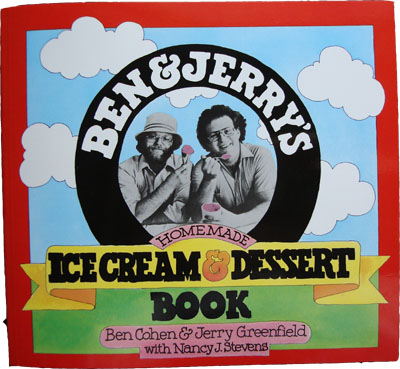
First, former JASNA President Marsha Huff in her summing up of her four years at the helm tells of her many travels and visits to various JASNA Regions :  “I’ve tasted local delicacies (Lake Champlain chocolates in Burlington, VT)”, she writes, referring to her delightful visit with us last September when she gave her talk on “Jane Austen and Vermeer.”  Lake Champlain Chocolates is one of Vermont’s many small businesses that has developed a huge chocolate-obsessed following, not unlike the famed Ben & Jerry’s Ice Cream that you can find all over the world [when in London last February, my daughter and I discovered a Ben & Jerry’s housed in a movie theater lobby! – yum!] – so I couldn’t resist this plug from Marsha to advertise one of our more delicious products [we do lots more than just Maple Syrup!] – 

Here is their website:   Lake Champlain Chocolates – what better place to visit for your Valentine treats! 

Lake Champlain Chocolates

And of course, the best source for guilt-free organic chocolate: 
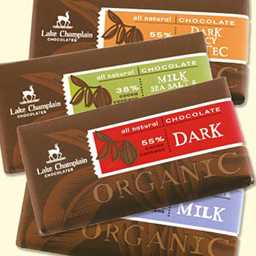
Lake Champlain Chocolates

*********************** 

And next is an article by Elsa Solender, also a former JASNA President and a runner–up in last year’s Chawton House Library’s  short story contest [she authored Second Thoughts, a fictional take on Jane Austen’s night of doubt after accepting the marriage proposal of Harris Bigg-Wither].  Here in her article on “A Return to Chawton House Library – Part I” she offers us a recipe for Chawton-style sandwiches:

Spread either honey or sweet mango chutney on one surface of each of two slices of fairly firm white or whole wheat bread.  On one of those sweetened surfaces, lay down a generous layer of thin slices of the best aged cheddar you can find.  Here in the USA, I use Grafton Vermont Cheddar aged two years [my emphasis].  Join the two treated slices, cut in quarters with or without crusts, and enjoy.  A pureed green vegetable soup goes very well with these sandwiches at lunchtime.

Now I have been eating Grafton Cheddar cheeses for years – one of the best of a good number of cheese companies in Vermont [Shelburne Farms Farmhouse Cheddar  and Cabot cheeses   to name just two others]…

Here is the website for the Grafton Village Cheese Company.

Certainly worth a look and a purchase if you want to indulge in Ms. Solender’s fine sandwiches…

*********************** 

Now I am wondering, where did Austen ever mention cheese? – here are two of several: 

In Mansfield Park, we find Fanny overwhelmed with the disorder and noise in her home in Portsmouth: 

Fanny, fatigued and fatigued again, was thankful to accept the first invitation of going to bed; and before Betsey had finished her cry at being allowed to sit up only one hour extraordinary in honour of sister, she was off, leaving all below in confusion and noise again; the boys begging for toasted cheese, her father calling out for his rum and water, and Rebecca never where she ought to be.   [MP ch. 38 ]

And in her letters:  She is speaking of Edward Bridges:

It is impossible to do justice to the hospitality of his attentions towards me; he made a point of ordering toasted cheese for supper entirely on my account.  [Le Faye, Ltr. 46, 27 August, 1805]

 ***************************

Any other cheese or chocolate sightings in Austen?  Comment if you find any!

Thank you Marsha and Elsa for your Vermont mentions! I am off to a lunch of chutney and cheese sandwiches to be finished off with some chocolate …. and maybe some…
Copyright @2011 Deb Barnum, at Jane Austen in Vermont
Jane Austen · Jane Austen's Letters · Regency England

Snow on the Ground! ~ ‘What is to Become of Us?’

Jane Austen on March 7, 1814, from London to Cassandra in Chawton:

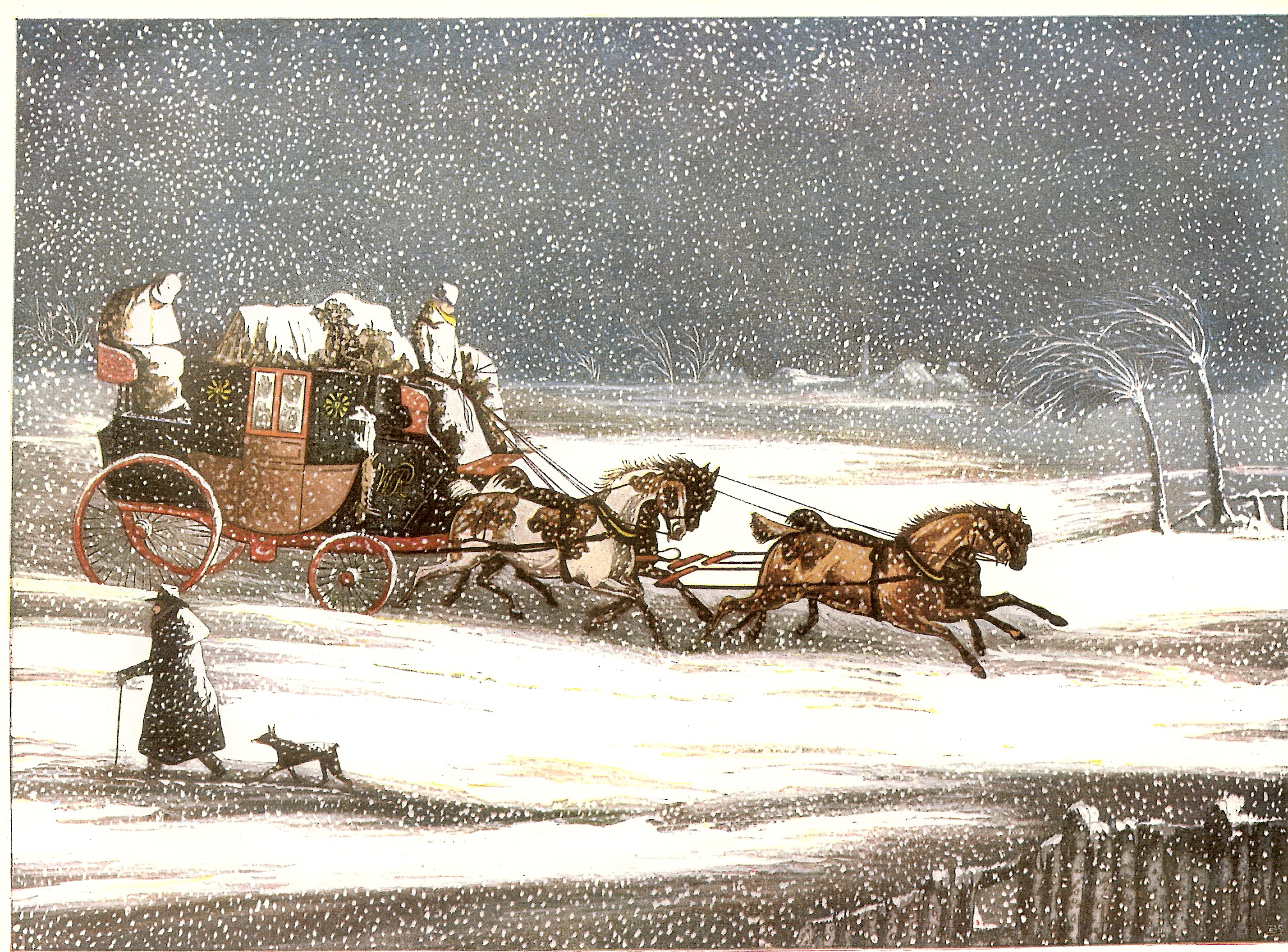
Monday.  Here’s a day! – The Ground covered with snow!  What is to become of us? – We were to have walked out early to near Shops, & had the Carriage for the more distant. – Mr. Richard Snow* is dreadfuly fond of us.  I dare say he has stretched himself out at Chawton too.

Ltr. 98, 5-8 March 1814, p. 259 [Le Faye]

*Le Faye notes Austen’s use of the mythical personifications of winter weather: Jack Frost and Dick Snow [perhaps another reason she does not like the name “Richard”?] 

The Brighton Mail, Sunday, December 25th 1836 (R. Havell)


Here’s my own take on the “Ground covered in snow! – What is to become of us?” indeed!”

Picnic anyone?


Image:  F. Gordon Roe, Sporting Prints of the Eighteenth and Early Nineteenth Centuries.  NY: Payson & Clarke, 1927.

Copyright @2011, Deb Barnum, of Jane Austen in Vermont

Jane Austen · Social Life & Customs

Travel in Sense & Sensibility ~ Part IV ~ Carriages, cont’d

Finally, the next part of my post on travel and carriages in Sense & Sensibility!

You can re-visit the first three posts here:

***********************

Now on to the specific types of coaches of the Regency era, the great coaching age of travel, pre-steam, pre-railroad, an age where the roads saw improvement, carriages became more comfortable [slightly, that is!], and the higher classes traveled more easily from place to place – it is good to remember that the majority of people still traveled by foot.   Austen knew her carriages and is often very specific in what type of carriage a character has – as stated before, we know in just learning a little about the costs of carriages, the cost of horses and their upkeep, that Willoughby in Sense & Sensibility is living far beyond his means by owning a curricle, that his giving a horse [Queen Mab] to Marianne is outrageous, not only in its impropriety but also its lack of fiscal responsibility.  Austen does this throughout her works, and even if she does not specifically tell us the type of carriage or the exact income, we understand, as the readers of her day would have understood, another piece of the puzzle about any given character.

The last post ended with the generic term “Coach” – so now some specific types:

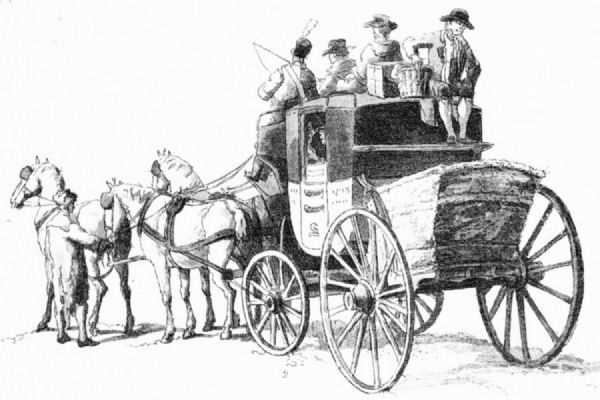
The Stage Coach:

  • very colorful
  • four passengers inside, up to eight outside
  • stopped at various pre-appointed stages, usually every 10 miles to pick up / drop-off passengers and to change horses
Stage Coach


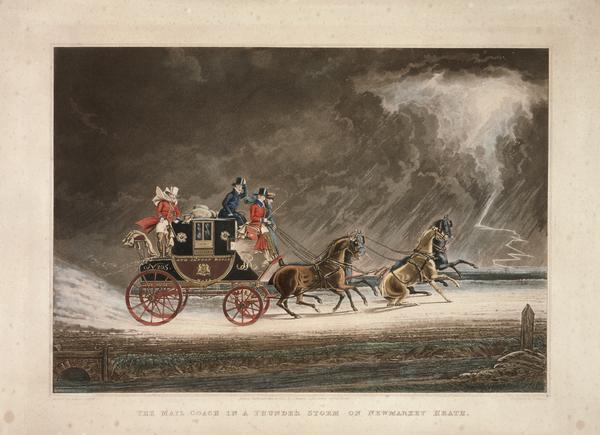
The Royal Mail Coach:  [after 1784] – there were 50 mail coaches in 1784, 700 in 1835

  • set paint color:  red wheels, maroon doors and lower body; black upper body; royal arms on each door
  • speed and excellence of Royal Mail service, usually six horses – faster because there were no tolls
  • held four inside passengers, and up to eight outside
  • Guard – a 3′ tin horn
  • cost about 1 penny / mile more than the stage coach but safer for passengers because of the guards
Royal Mail Coach


Private Coaches: 

  • simple color schemes with coat of arms on doors and boot
  • a fine carriage with owner livery, postilions, etc
  • expense:  coachman, postilions, under coachman, stable boys, footmen
  • not common because of the expense:  taxes on carriages and horses; even the wealthy often borrowed carriages and rented horses
  • cost in 1796 @ 130 pounds
  • in Sense & Sensibility:  Elinor and Mrs. Jennings visit Kensington Gardens by carriage, where Elinor connects with Miss Steele:   Miss Steele to Elinor:   “Mrs. Richardson was come in her coach to take one of us to Kensington Gardens”; and “He [Mr. Richardson] makes a monstrous deal of money, and they keep their own coach.”
  • who else:  the Bennet’s, the Musgroves [both large families]
Town Coach


Chaise:

  • an enclosed 4-wheel carriage, almost 1/2 the size of a full coach, seating up to three people, making this very tight, with one forward-facing seat, and often with a pull-out seat to add 2 more people
  • no coach box, driven by a postilion [rider mounted on one of the horses, the rear or left horse], usually two horses
  • cost @ 93 pounds in 1801 
  • In Sense & Sensibility:  Mrs. Jennings, the John Dashwoods; Robert Ferrars
  • a note on Mrs. Jennings’s carriages:  she has a chaise and a chariot, but did she have two carriages or as Chapman suggests, was Austen being uncharacteristically forgetful?  

“It will only be sending Betty by the coach and I hope I can afford that, we three will be able to go very well in my chaise.” 

Narrator:  Thomas seeing Mr. Ferrars and Lucy Steele ~“They was stopping in a chaise at the door of the New London Inn.”

  • who else?:  Mr. Bingley [ chaise & four]; General Tilney [a chaise & four]; Lady Catherine; Lady Bertram; Sir William Lucas;  and Mr. Gardiner

The Post Chaise = a chaise used with rented horses; always yellow; overlap with “hack-chaise”;

  • often a larger chaise with four horses with postilions on both lead horses and left near horse; you had more control over your trip rather than on the Stage Coach
  • a traveler who owned a carriage and horses would travel the first stage with them and then send them home with servants and rent horses the rest of the way

In Sense & Sensibility:  when Mrs. Jennings asks the Miss Steeles on their arrival in London: “Well my dear, how did you travel?”   Miss Steele to Mrs. Jennings:  “Not on the stage I assure you,” replied Miss Steele with quick exultation; “we came by post all the way and had a very smart beau to attend us.  Mr. Davies was coming to town, and we thought we would join him in a post chaise; and he behaved very genteelly, and paid ten or twelve shillings more than we did.”


Post Chaise


Chariothas the same body as the chaise, the difference is the addition of a coach-box and driver.

  • driver’s box, with four horses, four passengers, two seats facing forward like an automobile 
  • a classy vehicle, lighter than a coach, comfortable, speedy 
  • In Sense & Sensibility:  Mrs. Jennings, John Dashwoods:  Narrator on Fanny Dashwood:  …the great inconvenience of sending her carriage for the Miss Dashwoods [we know that the John Dashwoods have a chariot]
  • who else?:  Mrs. Rushworth


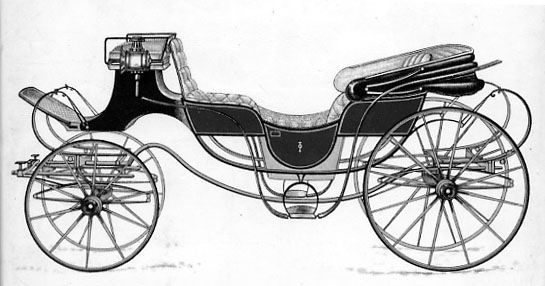
Barouche:
 

  • member of the coach family, a medium-sized, heavy 4-wheeled coach with two seats facing each other for four people with a folding top that covers only the rear seat
  • four horses with a driver box on outside for two people
  • aristocratic vehicle, for dress occasions, mainly used in town 
  • In Sense & Sensibility:  Palmers [her second carriage], though the narrator on Fanny about Edward:  It would have quieted her ambition to see him driving a barouche.  But Edward had no turn for great men or barouches. 
  • others:  Lady Dalrymple, Henry Crawford 


Barouche


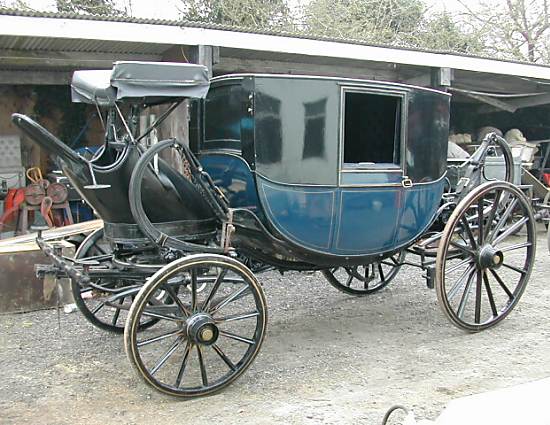
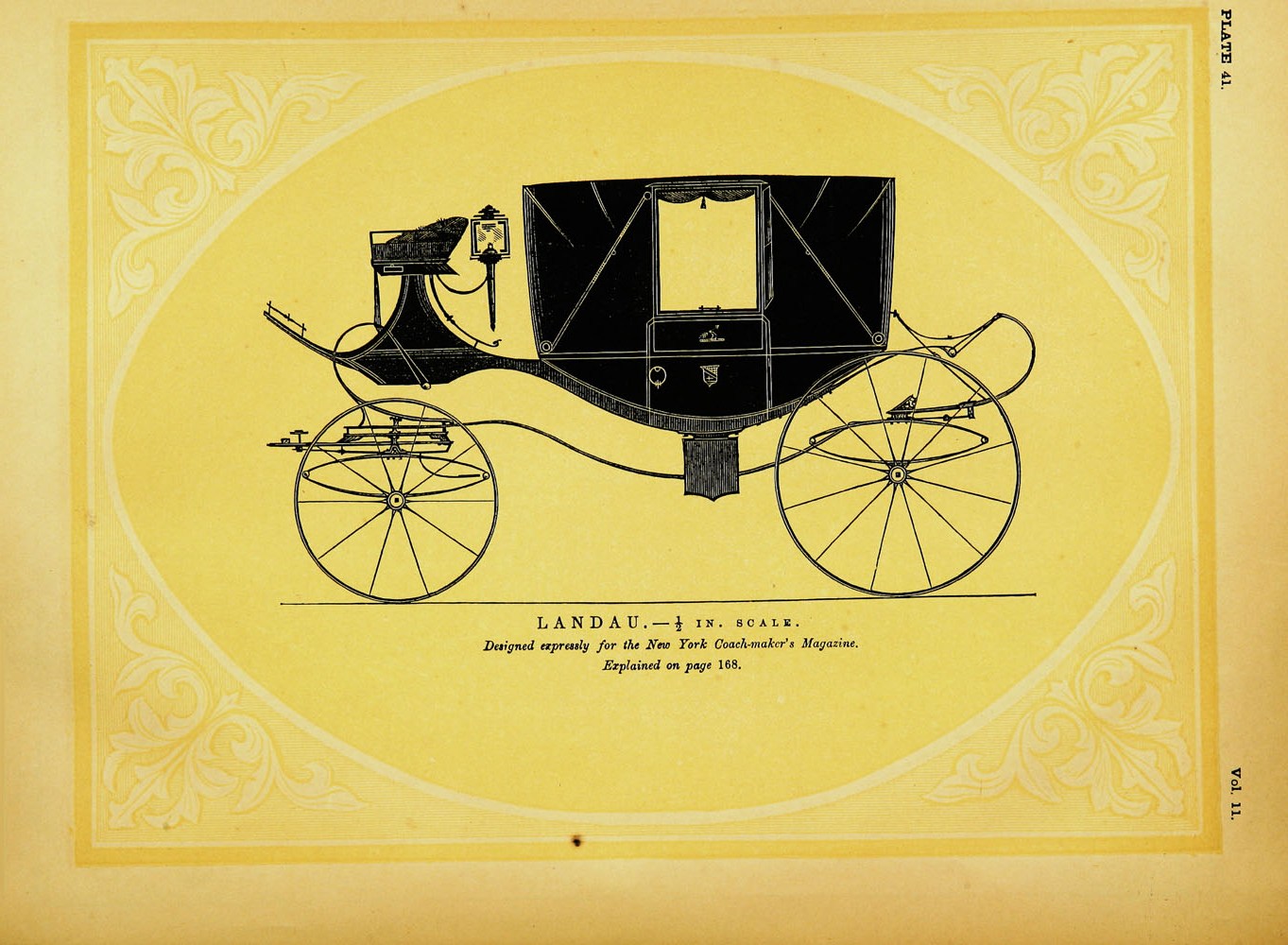
Landau [coach family]: 

  • a four-wheeled light carriage, two seats facing each other
  • two or four horses
  • high driver’s seat
  • two soft folding tops that close and lock in the middle [often made of leather], a low door
  • expensive to build and maintain:  cost @ 185 pounds, but it was popular due to its versatility in all weathers
  • In Sense & Sensibility: no one


Landau

Landaulette: 

  • landau for two passengers only; cost @ 156 pounds
  • In Sense & Sensibility:  no one
  • who else?  Anne Elliot Wentworth in Persuasion
Landaulette


Barouche-Landau:  “approach in awe”!

  • features of both, but not very popular 
  • a high driving seat
  • a rumble for two servants 
  • in Austen:  the only specific carriage named in Emma – Mrs. Elton’s sister, Mrs. Suckling
  • Chapman in the 1954 edition of Minor Works  finally supplies the illusive illustration [from Beau Monde, 1806] 
Barouche-Landau

Up next:  the sports cars of the Regency Period… [i.e Willoughby and friends!]

Copyright @2011, Deb Barnum, Jane Austen in Vermont