Austen Literary History & Criticism · Jane Austen · Regency England · Social Life & Customs

Thoughts on Travel in ‘Sense and Sensibility’ ~ Part II

Part II.  A Study of Character’s Movement in Sense and Sensibility

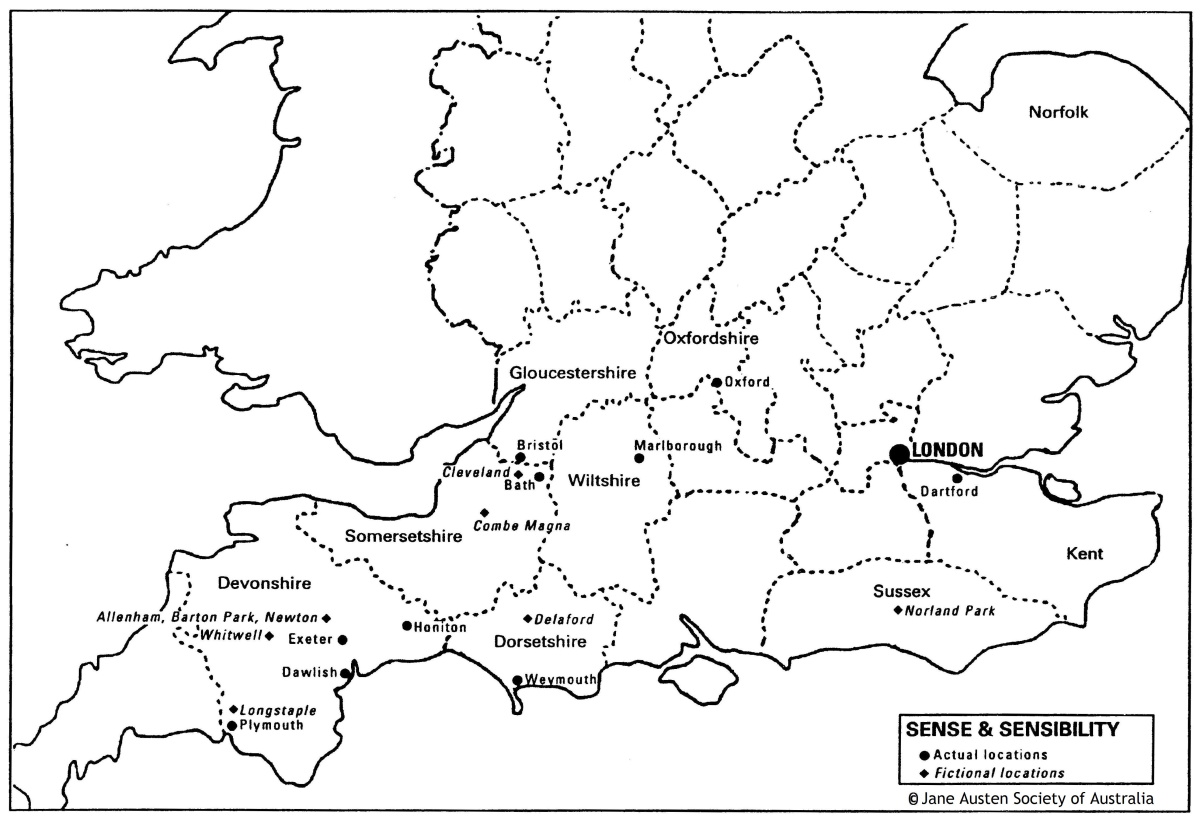
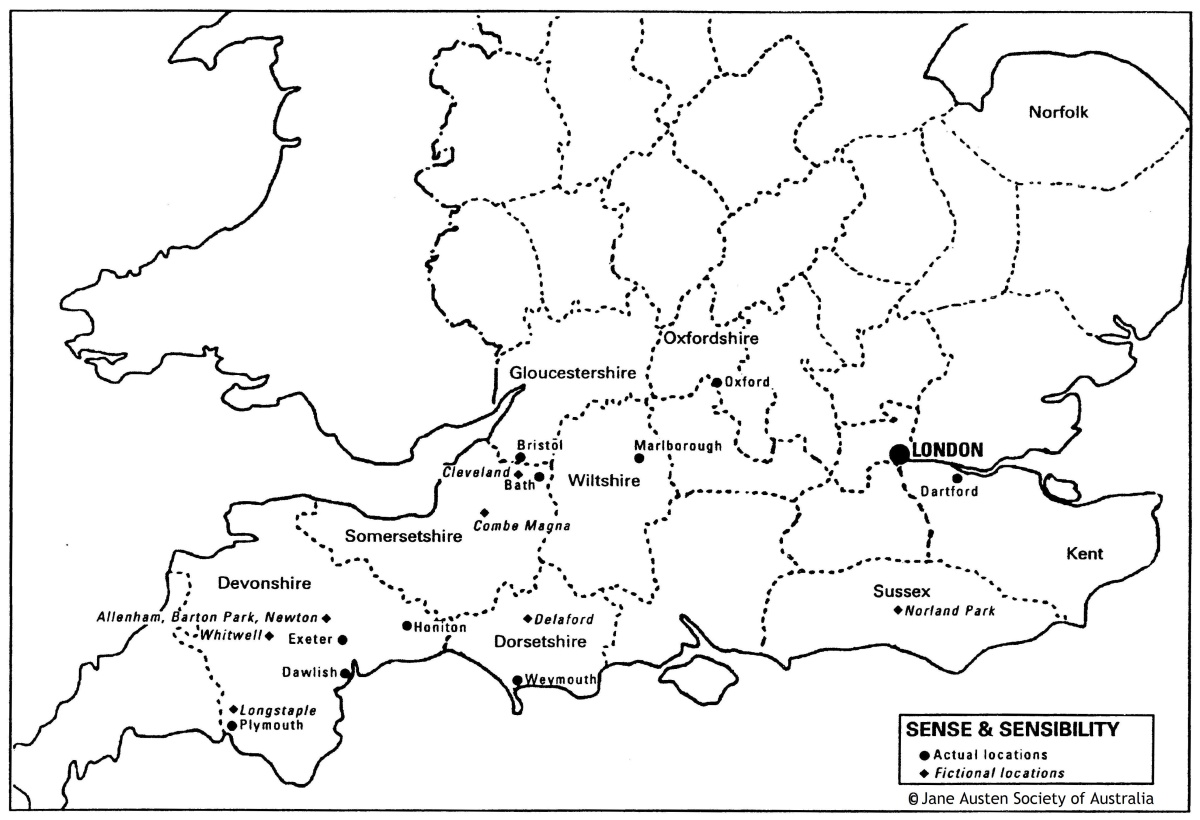
Fig. 1. Sense & Sensibility map

A startling fact! – there are 49 mentions of movement and 46 mentions of carriages [to include a few referring to travel by horseback] – and people say that nothing happens in Jane Austen!  That is a great deal of  traveling in what I have just described in the previous post as a not easy or inexpensive world to travel in!

To begin, let’s place the characters where they live and their income if known:

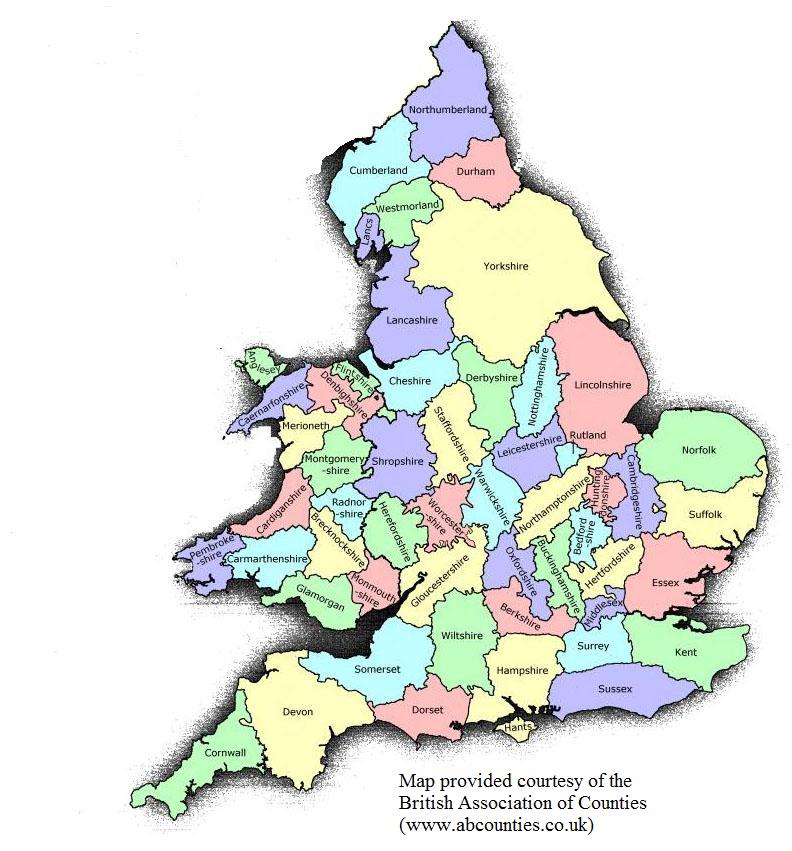
A.  Where the characters live:  see the map of England’s Counties below, and the map of places, both real and fictional above

  • Counties = Sussex, Somerset, Dorset, Devon
  • London [“Town” = London], largely Mayfair


The Dashwoods:

  • Henry Dashwood – Norland, Sussex
  • Mrs. Henry Dashwood – Norland, moves to Barton Cottage, Devonshire – £7000 = £350 / yr
  • Mrs. Dashwood’s mother – Stanhill [Sussex]
  • John and Fanny Dashwood –  Norland, Sussex; Harley St, London [renting?]; purchase East Kingham Farm, near Norland – £5,000 – £6,000 / year
  • Elinor / Marianne / Margaret:  Norland, Sussex, move to Barton Cottage, Devonshire; each have £1000 capital from their uncle = £50 pounds each annual income = £500 total for the four of them  [150 + 350 = £500]
Sussex
Devonshire

Colonel Brandon:  Delaford in Dorset; St. James St, London –  £2000 / year

  • Eliza Williams, his ward – Avignon [Brandon’s sister] – where? – found her in London
  • Brandon’s brother-in-law:  Whitwell,  near Barton
Dorset

The Ferrars:

  • Mrs. Ferrars – Park St, London
  • Edward –  his mother’s house; Pall Mall, London, after leaving home; Oxford; Edward and Elinor after marriage will have £350 / year (though this will increase to £850 with Edward’s inheritance of £10,000 from Mrs. Ferrars, reluctantly given!)
  • Robert – his mother’s house? later London with Lucy Steele
  • Fanny Ferrars Dashwood [see above]
Cavendish Square, London

John Willoughby – Combe Magna, Somerset; Bond St, London –  about £600-700 /yr 

  • Mrs. Smith, Willoughby’s Aunt – Allenham Court, Devonshire
  • Miss Gray, Willoughby’s wife – £50,000 = £2,500 /yr

The Jennings / Middletons / Palmers:

  • Sir John and Lady Mary Middleton [Mrs. Jennings daughter]:  Barton Park, Devonshire; Conduit St, London
  • Mrs. Jennings:  Berkeley St, London,  near Portman Square, otherwise she is visiting her daughters
  • Mr. Thomas Palmer and Charlotte Palmer [Mrs. Jennings’ daughter]: Cleveland, Somerset; Hanover Square, London [renting?]
Hanover Square, London

The Steeles:

  • Lucy and Anne [Nancy] Steele – Bartlett’s Buildings, London
  • Mr. Pratt  [the Steele’s Uncle] –  Longstaple [near Plymouth]


Miss Morton:
 Edward’s intended, London somewhere – £30,000 = £1500/yr 

Fig. 2. England Counties

**************************************

 B.  Movement of characters – a quick summary:

1.  The novel starts out with Mrs. Dashwood and her three daughters moving from Norland Park [Sussex] to Barton Cottage [Devonshire] – their furniture goes by way of the water [i.e. canal system]

 2.  The Elinor and Marianne go to London with Mrs. Jennings [and most everyone else], then return to Cleveland, then back to Barton Cottage, where they await their destiny, both ending up at Delaford.

 3.  Colonel Brandon lives in Delaford, but he is quite often at Barton Park, he goes to London to see his ward, later moves to London with everyone else, and when staying in London, he goes back and forth to Delaford “a few times”, and then later returns home via Cleveland and has to fetch Mrs. Dashwood in the middle of the night back and forth from Cleveland to Barton Cottage, and then finally seems to be at Barton Park / Cottage an awful lot…

Barton Cottage

4.  Edward Ferrars visits Barton Cottage and later we find that he was actually first in Plymouth – he travels a few times back and forth to London to his mother’s, then off to an unnamed Inn somewhere after he is disinherited, then to Oxford, then back to London settling in Pall Mall, and then of course to Barton to visit then marry Elinor, and they move to the parsonage at Delaford and we expect will live happily ever after…

5.  Willoughby lives in London, has his estate home at Combe Magna in Somerset, visits his Aunt in Allenham Court [Devonshire], leaves for London when HE is disinherited; he later visits Cleveland [Somerset] to see the dying Marianne, and then back to London to live with his boring, but wealthy wife

Willoughby

6.  The Middletons live at Barton Park [Devonshire], but travel to London with everyone else…

7.  The Palmers live at Cleveland [Somerset], they visit Barton Park [Devonshire], then back to Cleveland and then to London with everyone else; return to Cleveland and then leave again as Marianne falls ill.

8.  Mrs. Jennings, of course, lives in London but travels all over to visit her children at Barton Park and Cleveland

9.  the Miss Steeles live in Plymouth with their Uncle, visited Exeter and then to Barton Park, then to London where they stay with first the Middletons, then the John Dashwoods, then Lucy with her now husband Robert Ferrars leave London for Dawlish, then return to London to live unhappily ever after, while her abandoned sister has to borrow money from Mrs. Jennings to catch a coach back to Plymouth [in the endless, hopeless search of her Doctor…]

10.  Mrs. Dashwood is taken to Cleveland by Col. Brandon to see Marianne at Cleveland [Somerset]; she is the only character who does not go to London.

11.  As noted above, Everyone but Mrs. Dashwood goes to London, and while there they travel for their daily visiting calls and excursions around Town.

12.  And of course, Mrs. Ferrars stays put, selecting / de-selecting her heir from her comfortable seat in London – BUT the book ends with her visiting Elinor and Edward: ‘She came to inspect the happiness which she was almost ashamed of having authorized.”

Fig. 3. 1812 Cary map England

And how did they travel?? –  stay tuned for Part III:  Carriages in Sense and Sensibility

*****************************************

Sources:  Fig. 1 and 2 maps from the JASNA.org website; Fig. 3 Cary map from Pemberley.com

Austen Literary History & Criticism · Book reviews · Books · Collecting Jane Austen · Jane Austen · Literature · Publishing History · Regency England

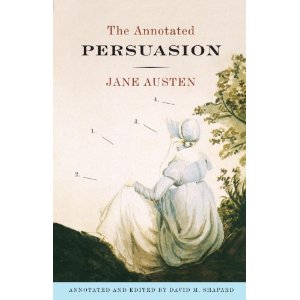
Book Review ~ ‘The Annotated Persuasion’

Last week I ran into Barnes & Noble to pick up the latest annotated Pride and Prejudice, edited by Patricia Meyer Spacks, and since then I have been “gadding about” as Austen would say – so no time to really give it a complete read and review; but in another trek yesterday into yet another Barnes & Noble [no worries, I also have haunted the local USED booksellers!], my husband stumbled upon the just published [as in October 5, 2010]  The Annotated Persuasion, annotated and edited by David M. Shapard [New York: Anchor Books, 2010; paperbound; ISBN:  978-0-307-39078-3] – and I have discovered a veritable feast! 

Shapard is known for his annotated edition of Pride and Prejudice [which I have but it is not in hand, as I am in “gadding about” mode as mentioned above…] – so I cannot compare this book to that edition [his annotated Sense & Sensibility is to be, I believe, published in April 2011] – though I have found that work quite useful as a reliable reference source – it was first published in hardcover followed by a paperback edition; this Persuasion is only in paperback… it is also a smaller format, likely because the novel is so much shorter, but this renders the many illustrations quite small – but I quibble about these few drawbacks …. publishers decisions do not always make the most sense… 

I first look for the extras:  

An Introduction which gives a brief history of the publishing of Persuasion, and the differences in this final novel from Austen’s other works

A Chronology of the novel [will compare this to Ellen Moody’s calendar 

Maps of sites that relate to the characters and storyline: the world, England, Somerset, Lyme, and two of Bath 

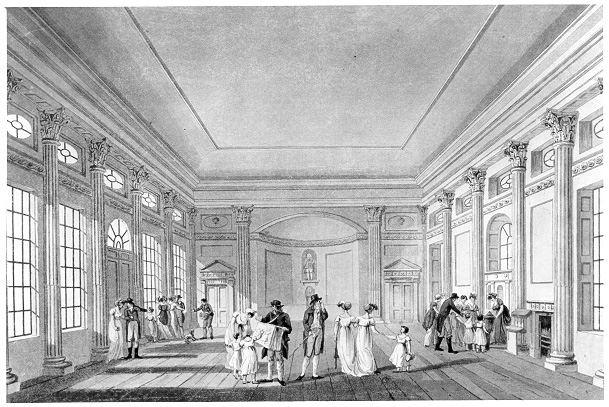
A good number of b/w Illustrations – there is unfortunately no listing of these; the source is indicated under each picture, but a listing would have served as an index to the subjects, which cover all manner of Regency life:  architecture such as that in Bath with interior and exterior scenes of the Assembly Rooms; various carriages; fashion; furniture; Naval life; the Cobb in Lyme Regis; etc.  – many of these illustrations will be familiar to most readers with a modicum of knowledge about the period – and color would have been nice – but the point here of these illustrations is to serve as a starting reference for further research, and it is an added plus to have any of these included. 

Bibliography:  this also serves as a starting point – it is in no way a complete listing of sources, but likely those sources that Shapard relied on for his research.  How complete can a bibliography of Austen be without mention of Claire Tomalin’s biography under that category, or Claudia L. Johnson’s Jane Austen: Women, Politics and the Novel or Kaplan’s Jane Austen Among Women nowhere to be found – but as Shapard is an historian, it is that strength that resides in this bibliography, again a great starting point for further study – it is organized by broad subjects:  language; cultural and literary background; marriage and the family; position of women; children; housekeeping and servants; entails and estates and the landed gentry; rural and urban life; the military; medicine; the law; education; books, media, libraries; writing; postal service; transportation; theater [but no mention of the two works Jane Austen and the Theatre – two works with the same title and both quite comprehensive]; music and dance; sports; weather; the seaside resorts; houses and gardens; fashion; food; etiquette and female conduct books; and others – again, a good select listing of resources on various topics.   

The Literary commentary and annotations:  Shapard begins with the caveat that “the comments on the techniques and themes of the novel represent the personal views and interpretations of the editor…such views have been carefully considered, but inevitably they will still provoke disagreement among some readers “ [xi] – which Shapard encourages…; these annotations include such literary commentary, historical context, and definitions of words in context if they had a different meaning in Austen’s time, some repeated when necessary or cross-references provided.  

The book is arranged with the original text on the verso, the annotations and illustrations on the recto – the annotations are extensive as the following few very random examples show: 

  1. Persuasion starts with the full description of Sir Walter Elliot’s obsession with both his own personal charms and his listing in the baronetage – Shapard here provides information on that book and others of the time and the definition of “baronet” and how Sir Walter acquired his own status…
  2. Gout is fully described on pages 311 and 315, when Anne learns that the Crofts are removing to Bath dues to the Admiral’s “gouty” condition.
  3. “replaced” – [p. 103] – “they suspected great injury, but knew not where; but now the collar-bone was soon replaced”   – the annotation explains that the word “replaced” had the meaning in Austen’s time of “to be put back in its original position” rather than “to take the place of” – there is also a description of anatomical knowledge as understood at the time.
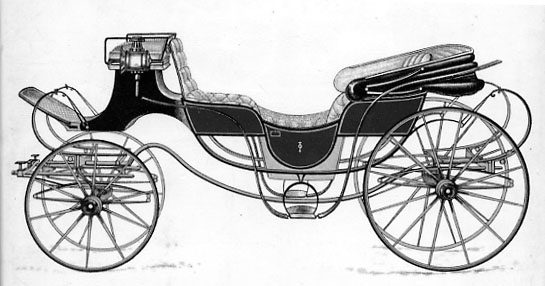
  4. Carriages get much attention whenever they are mentioned in the text – so we have descriptions and illustrations of barouches and chaise and fours, and chairs and of course Anne’s pretty little “landaulette” [p. 483]                                                                         
         

    a barouche


  5. Money and wealth – Wentworth’s income explained [p. 145]
  6. Servants:  various duties outlined [p.  87]
  7. Street names, shops, locations explained throughout; e.g. The Cobb; Tattersall’s [a mention on p. 14 with an illustration]; Milsom Street; Westgate Buildings;…etc…
  8. The Clergy in Austen’s time
  9. Austen’s language as delineating character:  as in the following: “Lady Russell had only to listen composedly, and wish them happy; but internally her heart reveled in angry pleasure, in pleased contempt” [p. 232] – and the annotation reads:  “Her reveling in such emotions indicates her moral inferiority to Anne, who never derives pleasure from anger or contempt.” [p. 233]
  10. Social rules and strictures:  some examples – Sunday traveling [p. 305]; shaking of hands between men and women [p. 427]; not using first names, even those of friends such as Anne and Mrs. Smith

 A look at a few key scenes will also illustrate Shapard’s invaluable commentary: 

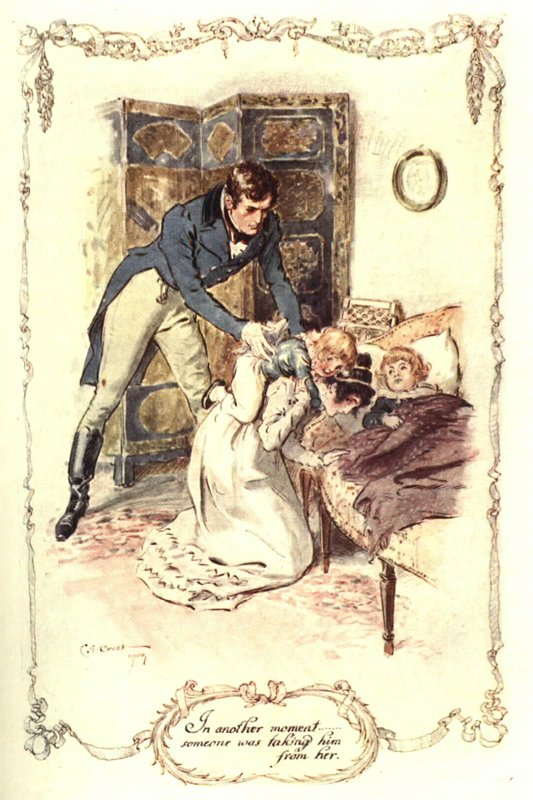
  1. Wentworth removing young Walter Musgrove from around Anne’s neck [pp. 152-5]:  Shapard emphasizes the importance of this scene in displaying both Anne’s and Wentworth’s feelings – he quotes William Dean Howell’s how “this simple, this homely scene, is very pretty, and is very like things that happen in life, where there is reason to think that love is oftener shown in quality than quantity, and does its effect as perfectly in the little as in the great events. [from Heroines of Fiction].  Shapard also suggests that Wentworth’s reluctance to converse with Anne about what has just happened is as much due to his efforts to remain aloof as it is to a “simple dislike of thanks,” [p. 155], as is true of Mr. Knightley in Emma. 
                                                                                                        

    Brock illus - from Molland's


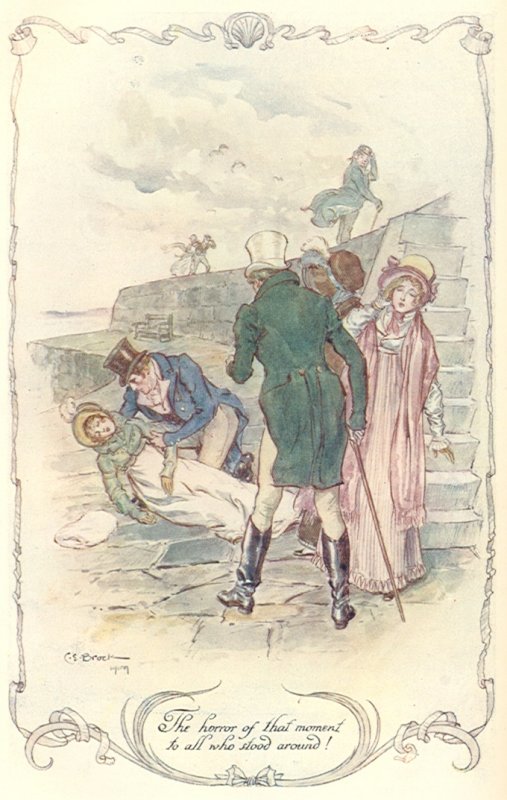
  2. Louisa’s fall in Lyme Regis [p. 210-15]:  Shapard describes the Cobb, the steps that were the scene of The Fall, comments on the feelings of Anne and Wentworth, the strength of the former and the uncharacteristic weakness of the latter; Anne’s carrying the “salts” [have you ever wondered why Anne IS carrying smelling salts and conveniently has them in her possession? – “here are salts – take them, take them.” [p. 210]]; the calling for the surgeon and the differences between he and an apothecary; the comic relief of “the sight of a dead young lady, nay, two dead young ladies, for it proved twice as fine as the first report.” [p. 213-4] 
    "The horror of the moment" - from Molland's


  3. and of course, The Letter! [p. 452] – Shapard so rightly states that “Wentworth’s passionate language contrasts him with other Jane Austen heroes, who are often much cooler and more rational.  It also fits with the more intense emotional tone of this novel … the letter itself is arguably the moment of highest emotion in her works…” [p. 453]  – and we are given a picture of a writing table of the time [p. 457] – there is also extensive commentary on the conversation between Capt. Harville and Anne. 

As referred to above, there are disappointments in this work – I would most wish for an index to the annotations – these could be just general subject areas, such as similar divisions as in the bibliography – so for instance – all annotations which discuss medicine could be cited, or any references to carriages, or fashion, or Bath locations, the Navy, or examples of Free Indirect Discourse, the literary allusions such as Byron’s The Corsair and Matthew Prior’s poem “Henry and Emma”, etc.  As it is, one needs to read through the entire work to find the references, and as Shapard wishes for this to be a work for reference purposes, this addition of an index would seem to be a necessity.  A index of Characters would have also been a helpful addition – one must reach for their Chapman for this information; and finally there is also no “note on the text”, important information in any such reference source – the bibliography lists Chapman’s 1933 edition, Spacks’s Norton critical edition [1995]; and the latest Cambridge edition edited by Janet Todd and Antje Blank [2006] – but I would have liked to see from whence he took the exact text…

That all said – this is a delightful and fact-filled addition to your Austen Library – and if you are already fairly well-versed in the Regency period and Austen criticism, this will serve as a copy of Persuasion where much of this information is at your fingertips; if you are just starting your adventure in reading Austen, this will be a great introduction to the very rich world of her writings, her world, and her literary themes – what more can we ask for!  [other than a hardcover with an index!]

 4 full inkwells out of 5

[please note that the illustrations are meant to illustrate this post and are not illustrations in the work being reviewed] 

Jane Austen Circle · Literature · Women Writers

Gaskell Blog Tour ~ Comment deadline

Tonight at midnight [10-7-10, Pacific Time] is the deadline for commenting on any of the blog posts on the Elizabeth Gaskell Blog Tour and to enter to win the Naxos audiobook of North and South.  You can comment on my Gaskell post:  Your Gaskell Library, or any of the posts below.  Good luck! – Lovely prize!  Laurel Ann at Austenprose will be announcing the winner tomorrow, October 8th.

Biography

Novels/Biography

Novellas

Resources


Jane Austen · News

Web Round-up ~ All Things Austen!!

I’ve been out of the loop for the past week, so just a catch up post of items of Austen-interest, some old news, some new, but always interesting and chock full of Austen tidbits: 

Jane Austen Conference at the British Library:  a 6-minute YouTube video of a student conference at the British Library–speakers Kathryn Sutherland and Elizabeth Garvie, shots of Austen’s manuscripts, English Country Dancing, etc. – great fun!


Here is an interesting interview with Patricia Meyer Spacks, JASNA member and Professor of English, who just published an annotated edition of Pride and Prejudice. 

*And from Sarah Emsley, a review at Open Letters Monthly 

*A review at Austenprose 

*A review at Jane Austen’s World ~ and also Vic’s interview with Professor Spacks [Vic’s virtual tour of the book was put on the Harvard University Press’s blog! – see the video here ] 

I just got this book  – and it is lovely – I look forward to spending some quality time with it! 


Want to understand England and the concept of Englishness a bit more? – here is an interesting reading list for a course on “Englishness”  at Bristol University.  This should take you reading through the winter… and then some…


The Old Globe Theater in San Diego will be presenting Jane Austen’s Emma: A Romantic Comedy from January 15 – February 27: 

 “Emma, a timeless love story from one of the most widely read writers of all time, is now a musical, and will once again entice modern audiences to fall in love with one of Jane Austen’s most adored characters. Emma, a beautiful and clever young woman who prides herself on her matchmaking ability, is preoccupied with romance yet is clueless to her own feelings of love. When she takes on a young friend as her latest project, her well-intentioned efforts misfire, leading to a whirlwind of complications. Deliciously charming, this new romantic comedy from Tony Award nominated composer Paul Gordon and directed by Tony Award nominee, Jeff Calhoun, brings Jane Austen’s masterpiece to musical life.”
 

If you happen to be in Vermont in November, Claire Harman of Jane’s Fame fame will be one of the speakers at the Vermont Humanities Council Fall Conference on Comedy and Satire: It’s No Joke, From Jonathan Swift to Jon Stewart, Ridiculing Vice and Folly, November 12–13, 2010  Stoweflake Mountain Resort, Stowe, Vermont.  Professor Harman’s talk is scehduled for the Saturday afternoon from 1:00 – 2:15 pm:

Jane Austen, Veiled Satirist. Jane Austen is not usually considered a satirist, but she began her writing life in imitation of the great practitioners of the eighteenth century. Prize-winning author Claire Harman, who teaches at Oxford and Columbia Universities, looks at Austen’s beloved novels in the context of that earlier tradition and considers how and why she molded the tones and techniques of Swift and Pope to her own purposes.   See the VHC website for details.


The Eighth Annual Regency Assembly in New Haven, Connecticut is scheduled for October 16-17, 2010.  Visit Susan de Guardiola’s website for more information, where there are various links to Regency Games, Fashion, and Dance.


 Another Vermont event!  On Saturday December 18th, a Regency clothing talk at The Inn Victoria 321 Main St Chester VT, 2-3 pm, followed by a grand tea.  Visit the website of Kandie Carle, a.k.a. The Victorian Lady to learn more about her talk, which is part of an entire Jane Austen Birthday Weekend:

Dates: December 17-19, 2010

Description: Celebrate Jane Austen’s birthday in style at a Victorian B&B that is known for its romance and antiques of the period. On December 17 – 19, we will celebrate Jane’s birthday weekend with: 

  • Pride & Prejudice on the Big Screen in the Parlor
  • Two formal afternoon teas (wear your formal period dress)
  • Two book reviews
  • Two breakfasts, each with five courses…..yes, FIVE!
  • English Christmas dinner served Saturday evening with wine.
  • Actress / performer Kandie Carle, will give a performance of “The Victorian Lady”

Two night / double occupancy starts at $130 / night….. 25% of the income will be donated to the Chester Rotary for a local Christmas fund for children.


And finally – a discovery that has pleased my DOG very much – a book by Kara Louise titled Master Under Good Regulation – you can read more about it at the First Impressions blog by Alexa Adams, and more at Kara Louise’s website.  It is about Reggie, an English Springer Spaniel, best friend and confident of Mr. Darcy – and the whole story of Pride and Prejudice is told from Reggie’s point of view.  Now, MY dog is an English springer spaniel, and he is wondering if perhaps this dog of Darcy’s might not be one of his great, great ancestors – everything always comes full circle, and always back to Jane in some way, doesn’t it?! 


Austen Literary History & Criticism · Jane Austen · Regency England · Social Life & Customs

Thoughts on Travel in ‘Sense and Sensibility’

Sense & Sensibility is about so many things, but there is an emphasis on income, inheritance and money, and how the world of the late 18th, early 19th century figured in the lives of Austen’s characters, especially the women in her novels.  But one of the things one notices after a number of readings is the amount of movement in this novel – the constant  comings and goings of the characters, with their visiting, travels to London, moving from one end of England to the other.  On first reading, you might almost miss the extent of this movement, after all, nothing really ever happens in Austen, isn’t that what we always hear?!  But take a look at the map on the JASNA.org site for Sense and Sensibility and you will see what I mean. And if you know anything about travel in late 18th – early 19th century England, you will be know how arduous such travel was.  I am going to chart the movement of characters in the novel and the means whereby they moved from place to place, or as Mrs. Jennings so aptly asks of the Misses Steele:  “How did you travel?”  

Austen knew first-hand the travel issues of her day [read her letters!] – and she was very knowledgable and consistent in writing about it in her novels – often not necessarily specific but there are clues all around!   But alas!, there is so much to discuss about travel: carriages and their parts; the history of the postal system; the history of coaching and the turnpike system; the economics of the time – taxation, income and inheritance – all these; but I will in the next several posts offer a brief outline of the travel in Regency England, its difficulty and costs with a few thoughts on economics; then a discussion of movement in S&S; the types of carriages in use in Regency England and those used by Austen’s characters; and finally a few words on the London of S&S – it has the most mention of any of her novels, and interesting to see where each character was housed in Town.  And at the end of this series of posts, I will provide a bibliography and further reading references.
 

 Part I:  Travel in Regency England  

[English Counties: Map from JASNA.org]

  • -The difficulty of travel due to the condition of the roads – each parish was responsible for its own roads but they were largely dirty and muddy, and dangerous
  • -most people traveled by foot:  certainly true of the lower classes, but recall Mrs. Dashwood: 

 …his [Mr. Middleton’s ] repeated assurances of his carriage being always at their service, the independence of Mrs. Dashwood’s spirit overcame the wish of society for her children; and she was resolute in declining to visit any family beyond the distance of a walk.  

  •   -traveling in vehicles in the daytime or only in the nights with bright moonlight, little travel in winter, no travel on Sunday
  • -improper for women to travel alone [if you read Austen’s letters, you will see that she was completely dependent upon her brothers to visit anyone or travel any distance; and how outrageous that Northanger Abbey’s Catherine Morland was put on that coach all alone!]
  • -for overnights at coaching inns, travelers often brought their own linens or silverware…
  • -travel vehicles were uncomfortable and dangerous due to the road conditions and highwaymen
  • -despite all this, the late 18th-century saw a great improvement in the roads, and one could travel great distances more quickly [and if they had the money!].   Paterson’s British Itinerary, a travel guide had 17 editions between 1785-1832 – it outlined the roads used by the stage and mail coaches, the tolls, the bridges, etc.   

[Image from Georgianindex.net]

A quick review of travel times [varies depending upon vehicles]:  

  • – Mr. Darcy:  8 miles/hr –  recall his famous line to Elizabeth:  ‘what is 50 miles of good road? little more than half a day’s journey’
  • -the Stage Coach [and General Tilney]:  7 miles /hr
  • -average travel time:  4-6 miles / hr
  • -100 miles = 2 days of travel [and remember, no travel on Sunday]
  • -in 1800, London to Edinburgh took 60 hrs; London to Norwich, 19 hrs 

The estimated mileages in Sense and Sensibility: [this is in todays distances] 

  • London to Bristol = @ 106 miles
  • London to Bath = @ 97 miles
  • London to Exeter = @ 157 miles
  • London to Plymouth = @ 192 ,iles
  • Exeter to Honiton = @ 16 miles
  • Honiton to Weymouth = @ 35 miles

[Map of S&S: from JASNA.org]

Cost of living ~ some basic facts: 

The economy in Britain during this time was very unstable – hard to effectively calculate the meaning of what the cost of living was in the early 19th century and to compare it with ours today; also some items cost more in Austen’s times than they do today, some less.

One 1988 article calculated that one pound in 1811 = $33., so Darcy’s income of 10,000 = $330,000.  The following month another article said that to compare 1810 with 1990, one should multiply today’s average per capita income by 300 [in 1990 this was $20,894.] = $6,300,000. would be Darcy’s income in today’s language.  Another article:  the pound in 1800 = $100. , so Darcy’s 10,000 = 1 million! – to be honest I just got dizzy with this whole thing!  [There are various websites where you can play around calculating these amounts, such as Measuring Worth, and the National Archives Currency Converter]

And remember that Austen often tells you exactly what someone is worth – this was common knowledge at the time and was not considered rude to talk about it.  But when there is a reference to money, for the men, she is referring to their annual income [Darcy 10,000; Bingley 5,000; Brandon 2,000; etc], but when referring to a woman, the reference is to her total assets, i.e. this money would be invested at 5% and she would earn the income from that each year, so Miss Gray’s 50,000 [Austen’s richest woman] is not her income, but rather the income from that, so £2,500 / year to live on.  [note that this is not always consistent, but is largely a general rule in Austen]

 So rather than trying to figure out what something would be worth today, it is better to look at the cost of living, i.e. what things cost in Austen’s time,  so to gain some perspective, keep the following in mind:

  • the world that Jane Austen writes about and the world we see visually in the film adaptations portrays a very small minority of the population, the “Polite World”, the upper 10,000; Austen might give various clues in each novel to that other world, but it is easy to forget it when reading about the romance and balls and carriages and fashion, etc.   
  • Edward Copeland, an Austen scholar who has written much on the economics of Austen’s world, and says she was “meticulous” in presenting these economic truths, states that this economic world in S&S is presented in terms of the power that money brings with it, and the frightening aspect of this for the women in the novel, where it seems that the “wicked, foolish and selfish” are rewarded.  
  • in 1799, in order to support and pay for the war with France, the British Government imposed a tax of 2s / pound on all income over £200; there were also taxes on windows, on malt, sugar, tea, coffee [considered a luxury tax], etc… 

Some hard economic facts ~ in a world where the lowest “respectable” income would be about £50 / year: 

  • a common laborour:  £25 / year – this to maintain himself, his wife, and 6 children in food, lodgings, clothes and fuel 
  • governess:  £25 / year 
  • curate w/ house and garden:  £40 / year  
  • average gentleman = £150 /yr
  • for a gentleman in 1825 with an income of £250 – for himself, his wife, three children and a maidservant, food cost a little over £2.5 / wk = £135 /yr.
  • £370 /yr – will support 2 servants 
  • £500 /yr – will support two servants, a boy, an occasional gardener  [Mrs. Dashwood and three daughters] 
  • Edward & Elinor when married will have £850  [after his mother gives him money – they would have married with only 350 – see Copeland in Cambridge Companion.]
  • £800 – 1200 will support a carriage  [hence Willoughby is living way beyond his means, as we shall see…]
  • £5000+ – the minimal income needed to partake of the “London Season” – [The John Dashwoods, etc] – renting and running the household, elegant parties, stabling horses, clothing, etc.

So if Austen doesn’t tell us directly about a character’s income, you can figure it out by inference:  London? any carriage? how many servants? 

 Costs of travel:  [estimates for 1800] 

  • Stage Coach:  2-3 pence / mile = 1.25 pounds from London to Bath / half-price if up top / outside [but remember the average income was about £30 / year 
  • Hired post-chaise =  estimate about £1 / mile [i.e @1 shilling / horse / mile, to include the postillion] 

Costs of Horses: for hunting, racing, riding, pleasure drives

  • -expensive to buy and maintain:  cost = 100 pounds; annual maintenance 120 pounds to stable in London
  • -costs of the carriages [discuss later] – but there were also taxes on private carriages and horses; toll roads
  •  -for perspective:  in 1801, 8 million population in England; in 1814, there were 69,200 taxed carriages [i.e. less than 1 / 100]:  23,400 four wheeled; 27,300 two-wheeled; 18,500 “tax-carts” [basic springless vehicles] [quoting All Things Austen]

 The economic realities in S&S ~ remember that Mrs. Dashwood could not keep a horse or a carriage after the loss of their inheritance:  

1.  Narrator on the Henry Dashwoods: 

…the horses that were left her by her husband had been sold soon after his death, and an opportunity now offering of disposing of her carriage, she agreed to sell that likewise at the earnest advice of her eldest daughter.  [and she had 500 pounds a year!]

 2.  Narrator on Willoughby’s gift of a horse to Marianne [his irresponsibility – the realities of owning a horse]:  

 …Willoughby had given her a horse, one that he had bred himself on his estate in Somersetshire, and which was exactly calculated to carry a woman.  Without considering that it was not in her mother’s plan to keep any horse, that if she were to alter her resolution in favour of this gift, she must buy another for a servant, and keep a servant to ride it, and after all, build a stable to receive them…

 3.  Marianne on a competence:  she wants 2000 pounds a year: 

I am sure I am not extravagant in my demands. A proper establishment of servants, a carriage, perhaps two, and hunters, cannot be supported on less.   [the irony being that that is exactly the income of Colonel Brandon!]  – and of course, Elinor responds:

TWO thousand a year! ONE is my wealth!

4.  Fanny Dashwood in the infamous scene talking down the inheritance: 

Their housekeeping will be nothing at all.  They will have no carriage, no horses, and hardly any servants; they will keep no company, and can have no expenses of any kind!

 And on that happy note, I will pause ~ next up:  what is the income of the characters in S&S, where do they live, and to where do they travel in this novel of many travels?


[Posted by Deb]

Jane Austen Circle · Literature · News · Women Writers

More Gaskell!

Just discovered today! Another Elizabeth Gaskell source!  Katherine of the Austen-related blog November’s Autumn, [where she is currently posting a series on Austen’s “paradox of names”] has started a new blog devoted to Elizabeth Gaskell. You can view the site here; as well as follow her on Twitter here.  Delighted to see Gaskell getting such attention in the blogsphere!

Katherine had written a post on Gaskell’s Wives and Daughters for the September 29th Blog Celebration that begins here – scroll down for the links to the 15 blogs that participated in this tribute to Gaskell on her 200th birthday.

Congratulations Katherine on your lovely new blog! [I have added you to my posted Gaskell bibliography.]

Jane Austen Circle · Literature · Movies · Women Writers

Elizabeth Gaskell Bicentenary Blog Tour: Your Gaskell Library


Welcome to the 14th stop on today’s celebration of Elizabeth Gaskell’s birthday – September 29, 1810!  Please join me in this blog tour honoring Gaskell as 15 bloggers, under the direction of Laurel Ann at Austenprose, each post something related to Gaskell – a look at her life and times, book reviews, movie reviews, a tour to her home in Manchester [see at the bottom of this post for the links to the various posts on the blog tour], and my post on “Your Gaskell Library” ~  where to find Gaskell in print, online, on your iPhone,  on your iPod, and on film – she is Everywhere!  By the end of the tour you will know more about Gaskell than you thought possible and be the better for it!!  There is also the opportunity to win a Naxos recording of North and South by just making a comment on any of the blogs.  Enjoy yourself as we all wish a hearty Happy Birthday to Mrs. Gaskell!
********************

I wanted to see the place where Margaret grew to what she is,
even at the worst time of all,
when I had no hope of ever calling her mine…

North and South
*************

Elizabeth Cleghorn Gaskell (1810-1865) is best known to us as the author of the then-controversial biography of Charlotte Bronte, where she laid bare the oddities of the Bronte household, publicizing the behavior of the semi-mad father and the destructive life and affairs of the son. But Gaskell was a well-respected and popular author in her own day; we have been seeing a resurgence of that popularity with the broadcast of Wives & Daughters (1999), North & South (2004) [the film that rocketed Richard Armitage to fame, and rightly so!], and Cranford (2007, 2009). So I give a very brief review of her life and works [this was originally posted here], followed by a select bibliography. 

Born in Cheshire to William Stevenson, a Unitarian minister, Elizabeth was raised by her aunt, the sister of her mother who died shortly after her birth.  The town of Knutsford and the country life she experienced there became her setting in Cranford and her “Hollingford” in North & South.  She married William Gaskell of Manchester, also a Unitarian minister, in 1832, had four daughters and one son, who died in infancy.  The loss of her son had a devastating effect on her and to keep herself from sinking into an ever-deeper depression, she took pen in hand and started to write.  She published her first book Mary Barton in 1848 (using the pseudonym Cotton Mather Mills), though there is some speculation that she actually started to write Sylvia’s Lovers (1863) first but put it aside to write the more socially conscious Mary Barton.  Gaskell, according to Lucy Stebbins, was chiefly concerned with the ethical question of ”The Lie”, i.e. a belief that “deception was the greatest obstacle to the sympathetic understanding which was her panacea for individual and class quarrels.” (1)  This reconciliation between individuals of different classes and between the wider world of masters and workers was her hope for humanity and it was this zeal that often led her into false sentiment in her novels and stories.(2)  But because she saw both sides of the labor question and pitied both the oppressor and the oppressed, she was thus able to portray with often explicit candor the realities of her world.  But Stebbins also says that life was too kind to her as a woman to make her a great artist.  Her tales of vengeance and remorse were written more to satisfy public taste, after she started publishing in Dickens’ Household Words.  And David Cecil calls Gaskell “a typical Victorian woman….a wife and mother”….he emphasizes her femininity, which he says gives her the strengths of her detail and a “freshness of outlook” in her portrayals of the country gentry, while at the same time this femininity limits her imagination.  In comparing her to Jane Austen, Cecil writes: 

         It is true Mrs. Gaskell lived a narrow life, but Jane Austen, living a life just as narrow, was able to make works of major art out of it.  Jane Austen…was a woman of very abnormal penetration and intensity of genius. ….. [Gaskell] cannot, as Jane Austen did, make one little room an everywhere; pierce through the surface facts of a village tea-party to reveal the universal laws of human conduct that they illustrate.  If she [Gaskell] writes about a village tea-party, it is just a village tea-party…(3) 

   Cecil is critical of her melodrama, her “weakness for a happy ending”, her overlong works that lack imagination and passion.  But he does credit her four major works (Sylvia’s Lovers, Cranford, Wives & Daughters, and Cousin Phillis) as classic and worthy English domestic novels.  
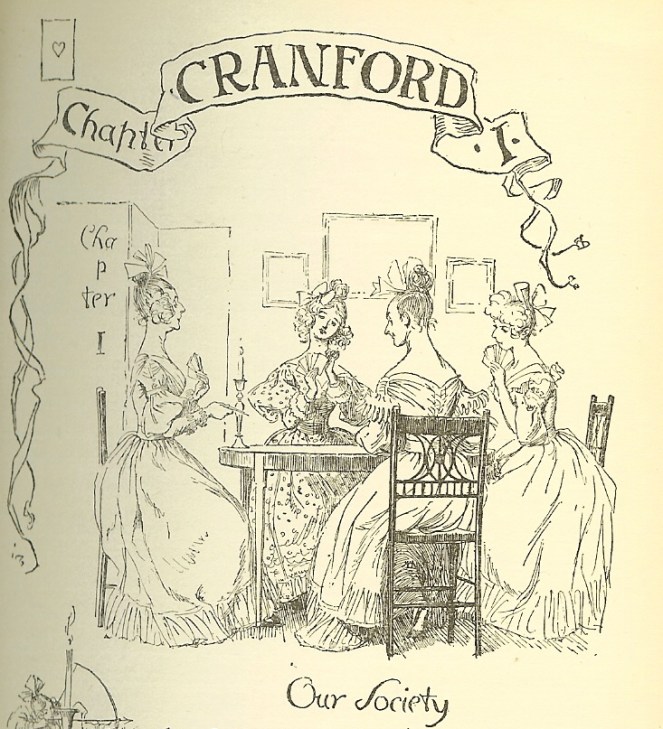
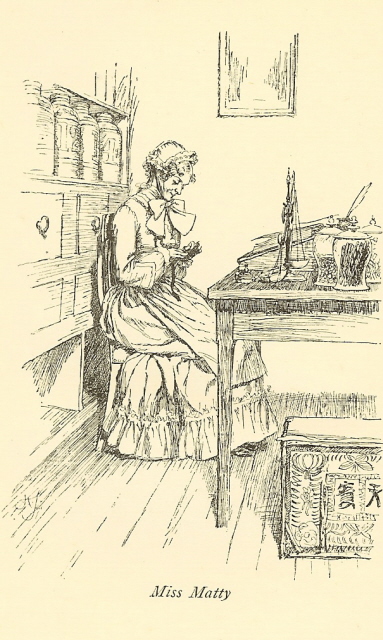
[Cranford, illustrated by Hugh Thomson.  London : Macmillan, 1891..
This copy is also available at the Illustrated Cranford site. ]

Anne Thackeray Ritchie, in her introduction to Cranford, published in 1891, also compares Gaskell to Austen, and finds the latter lacking: 

Cranford is farther removed from the world, and yet more attuned to its larger interests than Meryton or Kellynch or Hartfield….Drumble, the great noisy manufacturing town, is its metropolis, not Bath with its successions of card parties and Assembly Rooms.” …. and on love, “there is more real feeling in these few signs of what once was, than in all the Misses Bennett’s youthful romances put together…only Miss Austen’s very sweetest heroines (including her own irresistible dark-eyed self, in her big cap and faded kerchief) are worthy of this old place….”  and later, “it was because she had written Mary Barton that some deeper echoes reach us in Cranford than are to be found in any of Jane Austen’s books, delightful though they be. (4) 

Margaret Lane in her wonderful book of essays on biography, Purely for Pleasure [which also includes the essay “Jane Austen’s Sleight-of-hand”], has two essays on Mrs. Gaskell.  Lane calls her one of the greatest novelists of the time, and especially praises Wives & Daughters over Cranford for its stature, sympathies, mature grasp of character and its humour, and its effect of “creating the illusion of a return to a more rigid but also more stable and innocent world than ours” and we feel refreshed in spirit after a reading. (5) 

Wives & Daughters, Gaskell’s last work, and considered her finest, was published as a serial novel in Cornhill, the last unfinished part appearing in January 1866.  Gaskell had literally dropped dead in the middle of a spoken sentence at the age of 55, and the work remained unfinished, with only a long note from the Cornhill editor following the last serial installment.  Wives and Daughters tells the story of Molly Gibson and her new stepsister Cynthia, and their coming of age in the male-dominated mid-Victorian society of “Hollingford.” 

But it is Lane’s essay on “Mrs. Gaskell’s Task” in which she so highly praises Gaskell’s achievement in her biography of Charlotte Bronte.  While Gaskell obviously suppressed some facts (the letters to M. Heger) and exaggerated others (Mr. Bronte as a father and Branwell as a son), Lane says “her great biography remains a stirring and noble work, one of the first in our language…. and it is in essence ‘truer’ than anything about the Brontes which has been written since…”(6) 

Such contrary opinions!…certainly reminiscent of Austen’s admirers and critics!   Perhaps as Pam Morris says in her introduction to W&D, “Gaskell resists any simple categorization…her work ranges across the narrative forms of realism and fairytale, protest fiction and pastoralism, melodrama and the domestic novel.”(7) 

_______________________________________ 

Notes:
1.  Lucy Poate Stebbins. A Victorian Album: Some lady Novelists of the Period (Columbia, 1946) p. 96.
2.  Ibid.
3.  David Cecil.  Victorian Novelists: Essays in Revaluation (Chicago, 1962) p. 187.
4.  Anne Thackeray Ritchie.  Preface to Cranford (Macmillan, 1927) pp. vii, xix.
5.  Margaret Lane.  Purely for Pleasure (Hamish Hamilton, 1966)  p. 153.
6.  Ibid, p. 170.
7.  Pam Morris.  Introduction to Wives and Daughters (Penguin, 2001) p. vii. 
                                                            *****************

I append below a “Select Bibliography” of Gaskell’s works, biographies and critical works, as well as links to what can be found online, iPhone, audio, and film – and most everything Gaskell wrote IS available.  Many of her writings were originally published in the periodicals of the day, such as Howitt’s Journal, Sartain’s Union Magazine, Harper’s Monthly Magazine, Dickens’s Household Words and All the Year Round, and Cornhill Magazine; and many of these writings were later published in collections of tales. And, like Dickens, some of her novels were originally published in serial form [Cranford, North and South, Wives and Daughters].  I list below the novels as first published in book form, a list of short stories and essays with date of original appearance in print, and a list of current editions you can find in your local bookstore [I list only the Oxford, Penguin and Broadview editions – there are many others and reprints of all kinds – best to look for an edition with a good introduction and notes.]  There is a lot of information here, with links to even more information available on the web – there is no lack of writing on Mrs. Gaskell! – But what I really want to emphasize are her short stories, which often get lost in the hoopla about her major novels – there are many as you will see, with links appended – try some – you will not be disappointed!  

****************************
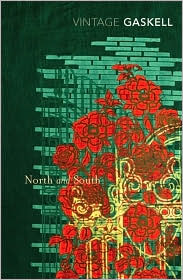
Bibliography: Selected list   [see links below for more complete bibliographies] 

Works:  Books, Short Story Collections 

  1. Mary Barton: A Tale of Manchester Life. 2 vols. London: Chapman & Hall, 1848; 1 volume, New York: Harper, 1848.
  2. Libbie Marsh’s Three Eras: A Lancashire Tale. London: Hamilton, Adams, 1850.
  3. The Moorland Cottage. London: Chapman & Hall, 1850; New York: Harper, 1851.
  4. Ruth: A Novel. 3 vols. London: Chapman & Hall, 1853; 1 volume, Boston: Ticknor, Reed & Fields, 1853.  
  5. Cranford. London: Chapman & Hall, 1853; New York: Harper, 1853.
  6. Hand and Heart; and Bessy’s Troubles at Home.  London:  Chapman and Hall, 1855.
  7. Lizzie Leigh and Other Tales. London: Chapman & Hall, 1855; Philadelphia: Hardy, 1869.
  8. North and South. 2 vols.  London: Chapman & Hall, 1855; 1 vol., New York: Harper, 1855.
  9. The Life of Charlotte Brontë; Author of “Jane Eyre,” “Shirley,” “Villette” etc.. 2 vols. London: Smith, Elder, 1857; New York: Appleton, 1857.
  10. My Lady Ludlow, A Novel. New York: Harper, 1858;  republished as Round the Sofa. 2 vols. London: Low, 1859.
  11. Right at Last, and Other Tales.  London: Low, 1860; New York: Harper, 1860.
  12. Lois the Witch and Other Tales. Leipzig: Tauchnitz 1861.
  13. Sylvia’s Lovers.  3 vols.  London: Smith, Elder, 1863; 1 vol. New York: Dutton, 1863.
  14. A Dark Night’s Work.  London: Smith, Elder, 1863; New York: Harper, 1863.
  15. Cousin Phillis: A Tale. New York: Harper, 1864; republished as Cousin Phillis and Other Tales.  London: Smith, Elder, 1865.
  16. The Grey Woman and Other Tales.  London: Smith, Elder, 1865; New York: Harper, 1882.
  17. Wives and Daughters: An Every-Day Story.  2 vols.  London: Smith, Elder, 1866; 1 vol., New York: Harper, 1866.


Works:  Short Stories and Essays [in order of publication] – most of these are available online at The Gaskell Web, Project Gutenberg, IPhone (Stanza – Munsey’s), etc. 

  1. On Visiting the Grave of my Stillborn Little Girl (1837)
  2. Sketches Among the Poor, No.1 (1837)
  3. Notes on Cheshire Customs (1839)
  4. Description of Clopton Hall (1840)
  5. Life In Manchester:  Libbie Marsh’s Three Eras (1847)
  6. The Sexton’s hero (1847)
  7. Emerson’s lectures (1847) [attributed]
  8. Christmas Storms and Sunshine (1848)
  9. Hand and Heart (1849)
  10. The Last Generation in England (1849)
  11. Martha Preston (1850) – re-written as “Half a Lifetime Ago”
  12. Lizzie Leigh  (1850)
  13. The Well of Pen-Morfa (1850)
  14. The Heart of John Middleton (1850)
  15. Mr. Harrison’s Confessions (1851)
  16. Disappearances (1851)
  17. Our Society in Cranford (1851)
  18. A Love Affair at Cranford (1852)
  19. Bessy’s Troubles at Home (1852)
  20. Memory at Cranford (1852)
  21. Visiting at Cranford (1852)
  22. The Shah’s English Gardener (1852)
  23. The Old Nurse’s Story (1852)
  24. Cumberland Sheep Shearers (1853)
  25. The Great Cranford Panic (1853)
  26. Stopped Payment at Cranford (1853)
  27. Friends in Need (1853)
  28. A Happy Return to Cranford (1853)
  29. Bran (1853)
  30. Morton Hall (1853)
  31. Traits and Stories of the Huguenots (1853)
  32. My French Master (1853)
  33. The Squire’s Story (1853)
  34. The Scholar’s Story (1853)
  35. Uncle Peter (1853)
  36. Modern Greek Songs (1854)
  37. Company Manners (1854)
  38. An Accursed race (1855)
  39. Half a lifetime Ago (1855) [see above “Martha Preston”]
  40. The Poor Clare (1856)
  41. The Siege of the Black Cottage (1857) – attributed
  42. Preface to Maria Susanna Cummins Mabel Vaughan (1857)
  43. The Doom of the Griffiths (1858)
  44. An Incident at Niagara Falls (1858)
  45. The Sin of a Father (1858) – re-titled Right at Last in collection
  46. The Manchester Marriage (1858)
  47. The Half-Brothers (1859) – in Round the Sofa collection
  48. Lois the Witch (1859)
  49. The Ghost in the Garden Room (1859) – re-titled “The Crooked Branch” in Right at Last collection
  50. Curious if True (1860)
  51. The Grey Woman (1861)
  52. Preface to C. Augusto Vecchi, Garibladi at Caprera (1862)
  53. Six Weeks at Heppenheim (1862)
  54. Shams (1863)
  55. An Italian Institution (1863)
  56. The Cage at Cranford (18863)
  57. Obituary of Robert Gould Shaw (1863)
  58. How the First Floor Went to Crowley Castle (1863)
  59. French Life (1864)
  60. Some Passages from the History of the Chomley Family (1864)
  61. Columns of Gossip from Paris (1865)
  62. A Parson’s Holiday (1865)
  63. Two Fragments of Ghost Stories [n.d]

Works ~ Collections: 

  • The Works of Mrs. Gaskell, Knutsford Edition, edited by A. W. Ward. 8 vols. London: Smith, Elder, 1906-1911.
  • The Novels and Tales of Mrs. Gaskell, edited by C. K. Shorter. 11 vols. Oxford: Oxford University Press, 1906-1919.
  • The Works of Elizabeth Gaskell, ed. Joanne Shattuck, et.al.  10 vols.  London:  Pickering and Chatto, 2005-2006.  Click here for more info on this set.

Currently in print ~ Individual Works and Collections: [only the Penguin, Oxford and Broadview Press editions are noted here – there are a number of available editions of Gaskell’s individual works – search on Abebooks, Amazon, or visit your local bookseller; and there are any number of older and out-of-print editions available at these same sources!]

  • Cousin Phillis and Other Stories.  Intro by Heather Glen. Oxford, 2010.
  • Cranford.  Intro by Patricia Ingham.  Penguin 2009; intro by Charlotte Mitchell.  Oxford, 2009;  Intro by Elizabeth Langland.  Broadview, 2010.
  • Gothic Tales. Intro by Laura Kranzler.  Penguin 2001.
  • Life of Charlotte Bronte.  Intro by Elizabeth Jay.  Penguin 1998; Intro by Angus Easson.  Oxford, 2009.
  • Mary Barton.  Intro by MacDonald Daly.  Penguin, 1997; Intro by Shirley Foster.  Oxford, 2009;  Intro by Jennifer Foster.  Broadview, 2000.
  • North and South.  Intro by Patricia Ingham.  Penguin, 1996; Intro by Sally Shuttleworth.  Oxford, 2008.
  • Ruth.  Intro by Angus Easson.  Penguin, 1998; Intro by Alan Shelston.  Oxford, 2009.
  • Sylvia’s lovers.  Intro by Shirley Foster.  Penguin, 1997;  Intro by Andrew Sanders.  Oxford, 2008.
  • Wives and Daughters.  Intro by Pam Morris.  Penguin, 1997


What’s Gaskell Worth Now?

Austen’s works show up at auction fairly regularly, but what about Gaskell – how does she compare to the high prices that Austen’s first editions command?  There is an upcoming Sotheby’s auction set for October 28 in London:  The Library of an English Bibliophile, Part I – all of Austen’s first editions are in the sale with high-end estimates; there are three Gaskell titles in the sale, so this gives a good idea of value:

  • Mary Barton.  London: Chapman and Hall, 1848.  First edition.  est. 4,000 – 6,000 GBP
  • Ruth.  London:  Chapman and hall, 1853.  First edition.  est. 2,000-3,000 GBP
  • North and South.  London:  Chapman and hall, 1855.  First edition.  est. 2,000-3,000 GBP.

 Letters / Diaries: 

  • Chapple, J.A.V. and Arthur Pollard, eds.  The Letters of Mrs. Gaskell. Manchester: Manchester UP, 1966.
  • Chapple, J. A.V.; assisted by by J. G. Sharpes. Elizabeth Gaskell: A Portrait in Letters.  Manchester: 1980.
  • Chapple, John and Alan Shelston, eds. Further Letters of Mrs. Gaskell. Manchester: Manchester UP, 2001.
  • Chapple J. A. V. and Anita Wilson, eds.  Private Voices: the Diaries of Elizabeth Gaskell and Sophia Holland.  Keele:  Keele UP, 1996.
  • Whitehill, Jane, ed.  The Letters of Mrs. Gaskell and Charles Eliot Norton, 1855-1865.  London: Oxford UP: 1932.

Bibliographies: 

  • Selig, R. L.  Elizabeth Gaskell; A Reference Guide.  Boston: G.K. Hall, 1977.
  • Jeffery Welch, Elizabeth Gaskell: An Annotated Bibliography, 1929-75. New York: Garland, 1977.
  • Weyant, Nancy S.  Elizabeth Gaskell: An Annotated Bibliography, 1976-1991. Metuchen, NJ: Scarecrow, 1994.
  • ______________.   Elizabeth Gaskell: An Annotated Guide to English Language Sources, 1992-2001.  Metuchen, NJ:  Scarecrow, 2004. 
    See also Weyant’s online Supplement, 2002-2010 [updated semi-annually]
  • See the Gaskell Web page for an online bibliography

Biographies: 

  • Chapple, John.  Elizabeth Gaskell: A Portrait in Letters.  Manchester:  Manchester UP, 1980.
  • ___________. Elizabeth Gaskell: The Early Years.  Manchester:  Manchester UP, 1997.
  • Easson, Angus.  Elizabeth Gaskell. London: Routledge & Kegan Paul, 1979.
  • Ffrench, Yvonne.  Mrs. Gaskell.  London:  Home & Van Thal, 1949.
  • Foster, Shirley.  Elizabeth Gaskell:  A Literary Life.  Houndsmills: Palgrave Macmillan, 2002.
  • Gerin, Winifred. Elizabeth Gaskell: A Biography. Oxford: Clarendon Press, 1976.
  • Handley, Graham.  An Elizabeth Gaskell Chronology.  Palgrave Macmillan, 2004.
  • Hopkins, Annette Brown. Elizabeth Gaskell: Her Life and Work. London: Lehmann, 1952.
  • Pollard, Arthur.  Mrs. Gaskell: Novelist and Biographer. Manchester: Manchester UP, 1966.
  • Uglow, Jenny.  Elizabeth Gaskell: A Habit of Stories. London: Faber and Faber, 1993.
  • Unsworth, Anna.  Elizabeth Gaskell: An Independent Woman.  London:  Minerva, 1996.

Studies: 

  • Barry, James Donald. “Elizabeth Cleghorn Gaskell,” in Victorian Fiction: A Second Guide to Research, edited by George H. Ford. New York: MLA, 1978.
  • Beer, P. Reader, I Married Him. . . . London: Macmillan, 1974.
  • Cecil, David.  Victorian Novelists: Essays in Revaluation.  Chicago, 1962.
  • Craik, W. A.  Elizabeth Gaskell and the English Provincial Novel. London: Methuen, 1975.
  • Easson, Angus, ed.  Elizabeth Gaskell: The Critical Heritage.  London, 1992.
  • Ganz, Margaret. Elizabeth Gaskell: The Artist in Conflict. New York: Twayne, 1969.
  • Lane, Margaret.  Purely for Pleasure.  London: Hamish Hamilton, 1966.  See chapters on “Mrs. Gaskell’s Task” and “Mrs. Gaskell:  Wives and Daughters’.
  • Lansbury, Coral. Elizabeth Gaskell: The Novel of Social Crisis.  London:  Paul Elek, 1975.
  • Lucas, John. “Mrs. Gaskell and Brotherhood,” in Tradition and Tolerance in Nineteenth Century Fiction, by D. Howard, J. Lucas, and J. Goode. London: Routledge & Kegan Paul, 1966.
  • Matus, Jill L. The Cambridge Companion to Elizabeth Gaskell.  Cambridge: Cambridge UP, 2007.
  • Morris, Pam.  “Introduction to Wives and Daughters”.  New York: Penguin, 2001.
  • Ritchie, Anne Thackeray.  “Preface to Cranford”.  New Edition.  London: Macmillan, 1907.
  • Rubenius, Aina.  The Woman Question in Mrs. Gaskell’s Life and Work.  Uppsala: Lundequist ; Cambridge: Harvard UP, 1950; reprinted by Russell and Russell in 1973.
  • Sharps, John Geoffrey Sharps. Mrs. Gaskell’s Observation and Invention: A Study of the Non-Biographic Works.  London: Linden, 1970.
  • Spencer, Jane.  Elizabeth Gaskell.  London: Macmillan, 1993.
  • Stebbins, Lucy Poate. A Victorian Album: Some Lady Novelists of the Period.  New York: Columbia UP, 1946.
  • Wright, Edgar. Mrs. Gaskell: The Basis for Reassessment.  London: Oxford UP, 1965.

Papers: 

Links:  


Ebooks:  

  1. Mary Barton
  2. North & South
  3. Cranford 
  4. Wives & Daughters  
  5. Life of Charlotte Bronte
  1. An Accursed Race
  2. Cousin Phillis
  3. Cranford
  4. Curious, if True Strange Tales
  5. A Dark Night’s Work
  6. Doom of the Griffiths
  7. The Grey Woman and other Tales
  8. Half a Life-Time Ago
  9. The Half-Brothers
  10. A House to Let
  11. Life of Charlotte Brontë — Volume 1
  12. Life of Charlotte Bronte — Volume 2
  13. Lizzie Leigh
  14. Mary Barton
  15. The Moorland Cottage
  16. My Lady Ludlow
  17. North and South
  18. The Poor Clare
  19. Round the Sofa
  20. Ruth
  21. Sylvia’s Lovers — Complete 
  22. Sylvia’s Lovers — Volume 1 
  23. Sylvia’s Lovers — Volume 2
  24. Sylvia’s Lovers — Volume 3
  25. Victorian Short Stories: Stories of Successful Marriages (as Contributor)
  26. Wives and Daughters  
  1. Cranford    
  2. Dark Night’s Work, A
  3. Doom of the Griffiths, The
  4. Half a Life-Time Ago
  5. Lizzie Leigh
  6. Mary Barton    
  7. My Lady Ludlow
  8. Poor Clare, The
  9. Wives And Daughters    
  10. An Accursed Race
  11. Half-Brothers, The    

Ebook editions at Amazon, Barnes & Noble and Borders: 

  • The [Kindle] Works of Elizabeth Gaskell – at Amazon, for $3.99 you can download most of her works to your Kindle; but if you search further, there are several free downloads of the individual novels, and other various collections; review the contents before selecting.
  • Barnes & Noble:  same as Amazon, some collections for $3.99, many free options.
  • Borders:  has various similar options 

iPhone Apps:   
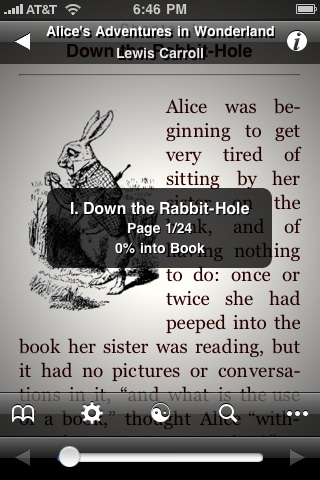
Whatever you use for books on your iPhone, there are plenty of free Gaskells available.  I use Stanza, which is a free app [there are many others – visit your iTunes store and search “books” under Apps and see what I mean!], and from there you can choose the following: Feedbooks has several; Project Gutenberg has the same as online noted above; but Munsey’s takes first prize for having the most – seems to have all the novels and stories as best I can make out – so if you are stranded at an airport or in stopped traffic, what better way to pass the time than a Gaskell short story?! 
 

Audiobooks:  

  1. Cousin Phillis (unabridged)
  2. Cranford (unabridged)
  3. North and South (abridged)
  4. North and South (unabridged)
  5. Wives and Daughters (unabridged)
  6. Wives and Daughters (abridged)
  • Silksounds:  has only My Lady Ludlow, read by Susannah York  [very good!]
  • CSA Word:  Best of Women’s Short Stories, vol. 1& 2.  Read by Harriet Walter [a.k.a. Fanny Dashwood] Includes Gaskell’s “Right at Last” and “The Half Brothers”; CSA Word also has an abridged version of Mary Barton [read by Maggie Ollerenshaw] and North and South [read by Jenny Agutter].
  • LibriVox:
  1. North & South
  2. Other Gaskell works in various states of completion 


Movies:
 [see the various blog posts listed below for movie reviews]

  1. Wives & Daughters (1999)
  2. North & South (2004) – with Richard Armitage and Daniela Denby-Ashe ~ sigh!
  3. North & South (1975)  – with Patrick Stewart and Rosalind Shanks
  4. Cranford (1972) 
  5. Cranford  / Return to Cranford (2007, 2009)
  6. Cousin Phillis (1982)
  7. The Gaskell Collection – DVDs  – includes 7 discs:  W&D, N&S, CRANFORD and all special features.

******************************* 

Well, there’s a fine list for winter reading, listening and viewing! And somewhere in the middle of all that, treat yourself to a re-watch of Armitage in North and South! [and then of course READ it again … here is a link to an older blog post about the book and movie

 ************************

This is a rather quick list of goodies – if any of you know of a particular edition of a book, or an ebook, or an audio edition you particularly like, or a movie that I do not mention, please let me know so I can add it to the list – thank you! 

Follow this link to to the next blog on the Elizabeth Gaskell Bicentenary Blog Tour by Tony Grant at London Calling:  Plymouth Grove – A Visit to Elizabeth Gaskell’s home in Manchester

***********************

The Gaskell Blog Tour:  Here is the complete tour through the 15 blog posts celebrating Gaskell’s Birthday today: and remember that one lucky commenter will win a copy of an unabridged edition of North and South by Naxos AudioBooks read by Clare Willie. That’s 18 hours of Margaret Hale and John Thornton sparring and sparking in Gaskell’s most acclaimed work.  Here is a list of participants. You can visit them in any order and all comments during the contest will count toward your chance to win. Good luck and Happy Birthday Mrs. Gaskell!

Biography

Novels/Biography

Novellas

Resources

Sometimes one likes foolish people for their folly, better than wise people for their wisdom.” Elizabeth Gaskell, Wives and Daughters

[Posted by Deb]
Books · Jane Austen · News · Publishing History · Rare Books

MORE Austen on the Block!

Sotheby’s  has just announced the following October 28th  auction in London:


The Library of  an English Bibliophile, Part I.    Jane Austen is duly represented and is among the great company of the Brontes, Burney, Chaucer, Shakespeare, Gaskell, Eliot (George and T. S.), Darwin, Fielding, Hardy, James, Joyce, Keats, Mary Shelley, Wollstonecraft, and many more, and interesting in only having ONE Dickens [Lot 40, A Christmas Carol, est. 150,000 – 200,000 GBP]

Here are the five Austen lots: [# 1-5]

SENSE AND SENSIBILITY: A NOVEL… BY A LADY. AND PUBLISHED BY T. EGERTON, 1811.  LONDON: PRINTED FOR THE AUTHOR BY C. ROWORTH 

12mo (187 x 114mm.), 3 volumes, first edition, half-titles, watermarks, uncut in the original publisher’s boards, original pink paper labels on spines, preserved in folding brown cloth chemises and quarter brown morocco slipcase, rebacked preserving most of the original spines, occasional spotting and foxing, some slight marginal stains on D10-D11 in volume 1, minor discolouration and staining of a few gatherings in volumes 2 and 3, short tears on B11 and H5 in volume 2 (affecting three lines and two lines respectively), tiny paper flaw on I2 in volume 2, some slight wear to boards.

ESTIMATE 40,000 – 60,000 GBP 

PRIDE AND PREJUDICE: A NOVEL. LONDON: G. SIDNEY FOR T. EGERTON, 1813

12mo (182 x 110mm.), 3 volumes, first edition, watermarks, uncut in the original publisher’s drab boards, half-titles, advertisements dated November 1812 inserted at the beginning of volume 1, preserved in folding blue cloth chemises and quarter blue morocco folding box by Zaehnsdorf, spines repaired (some cracks and slight tears present), upper joint of volume 3 slightly split, without spine labels (volume numbers stamped on spine), skilful repairs to inner margin of half-title, title-page and first text leaf of volume 1.

ESTIMATE 75,000 – 100,000 GBP 

EMMA: A NOVEL. LONDON: C. ROWORTH FOR JOHN MURRAY, 1816

12mo (186 x 110mm.), first edition, half-titles, uncut in the original publisher’s blue-grey boards with grey-brown spines, preserved in quarter brown morocco folding box, rebacked preserving significant portions of the spines, original spine labels, tear to lower corner of P1 in volume 1 (not affecting text), occasional spotting, some slight further wear to binding.

ESTIMATE 20,000 – 30,000 GBP 

MANSFIELD PARK: A NOVEL. LONDON: FOR J. MURRAY, 1816

12mo (176 x 104mm.), 3 volumes, second edition, half-titles, contemporary or near contemporary blue half morocco, marbled boards, speckled edges, leaves C6-7 in volume 1 partially loose, some slight foxing and spotting, one gathering in volume 3 crudely opened, some slight wear to edges of binding.

ESTIMATE 1,500 – 2,000 GBP 

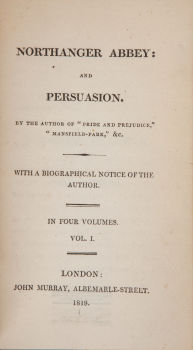
NORTHANGER ABBEY: AND PERSUASION…WITH A BIOGRAPHICAL NOTICE OF THE AUTHOR.  LONDON: JOHN MURRAY, 1818

12mo (189 x 112mm.), 4 volumes, first edition, watermarks, half-titles as called for by Gilson, uncut in the original grey-brown boards, original spine labels, preserved in red quarter morocco folding box, some spotting and foxing, neat repairs to a few minor tears on spines, some wear to labels and edges and extremities of binding, boards slightly spotted, corners very slightly bumped.

ESTIMATE 20,000 – 30,000 GBP

************************

You can view the entire catalogue with pictures and fuller description online at the Sotheby’s website.  An Exhibition is to be held in Paris, then London prior to the auction on October 28th [see site for details]; a catalogue can be purchased for $53.

Can’t wait to see Part II!

[Image of  Thomas Rowlandson’s “Doctor Syntax at an Auction” from The Private Library]
[Posted by Deb]
Books · Collecting Jane Austen · Jane Austen · News · Publishing History · Rare Books

Austen on the Block!

Auction Alert!   Heritage Auction Galleries has announced its upcoming “Signature Rare Books Auction”, October 14-16 – Beverly Hills, CA.  Auction #6048.  You will all be happy to see that all of Jane Austen’s first editions will be on the block! – all in lovely bindings and now viewable online and open for bidding: [note the opening bid and estimated value, and buyer’s premium; if there is a reserve it has not been noted] 

*First Edition of Jane Austen’s Fourth Novel in a Full Morocco Binding by Rivière & Son:

 [Jane Austen]. Emma: A Novel. In Three Volumes. By the Author of “Pride and Prejudice,” &c. &c. Vol. I. [II. III.] London: Printed for John Murray, 1816.  Opening bid:  $7500.  [estimated value = $15,000+] 

*

*First Edition of Jane Austen’s Mansfield Park in an Attractive Full Morocco Binding by Rivière & Son:

 [Jane Austen]. Mansfield Park: A Novel. In Three Volumes. By the Author of “Sense and Sensibility,” and “Pride and Prejudice.” Vol. I [II. III.]. London: Printed for T. Egerton, 1814 (Volume II with imprint: London: Printed for T. Egerton, Whitehall, 1814).  Opening bid:  $5,000.  [est. $10,000+]

*

*First Edition of Jane Austen’s Posthumously Published Northanger Abbey and Persuasion Attractively Bound in Full Morocco Gilt by Rivière & Son:

[Jane Austen]. Northanger Abbey: and Persuasion. By the Author of “Pride and Prejudice,” “Mansfield-Park,” &c. With a Biographical Notice of the Author. In Four Volumes. Vol. I. [II. III. IV.]. London: John Murray, 1818.   Opening bid: $3,750. [est.$7500+]

*

*A Lovely First Edition of Jane Austen’s Pride and Prejudice:

[Jane Austen]. Pride and Prejudice: A Novel. In Three Volumes. By the Author of “Sense and Sensibility.” Vol. I. [II. III.] London: Printed for T. Egerton, Military Library, Whitehall, 1813.  Opening bid:  $15,000.  [est. $30,000+]

*

*Scarce First Edition of Jane Austen’s First Published Novel, in a Full Morocco Binding by Rivière & Son:

[Jane Austen]. Sense and Sensibility: A Novel. In Three Volumes. By a Lady. Vol. I. [II. III.]. London: Printed for the Author, By C. Roworth, Bell-yard, Temple-bar, and Published by T. Egerton, Whitehall, 1811.  Opening bid:  $20,000.  [est. value $40,000+]

*

See the Heritage Auction Galleries website for full descriptions of each title.

*******************

 Oh Jane, whatever would you say?! – Let the bidding begin! 

[Posted by Deb]

Books · Jane Austen Sequels · News

Win a copy of “Darcy’s Voyage”

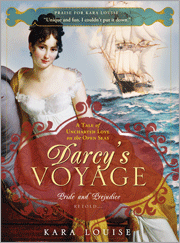
Book Giveaway Alert! –  Head on over to romance writer Linda Banche’s blog, read visiting author Kara Louise’s post about her new book Darcy’s Voyage, A Tale of Unchartered Love on the Open Seas, and ‘Why Regency Women Sailed to America’ ~ then leave a comment for a chance to win a copy of the book.  In this re-telling of Pride & Prejudice, Ms. Louise has Darcy and Elizabeth meeting on board a ship bound for America – interesting stuff!

[Note: this book was originally titled “Pemberley’s Promise” and is being re-released with its new title Darcy’s Voyage by Sourcebooks this month.]

[and visit Linda’s blog again on September 23rd, when C. Allyn Pierson, author of Mr. Darcy’s Little Sister, will be offering two copies of her book as well – a great way to stock up on winter reading!]


[Posted by Deb]