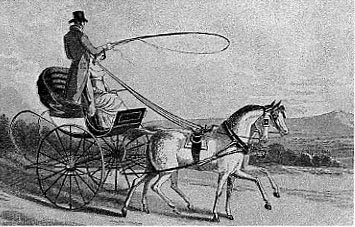
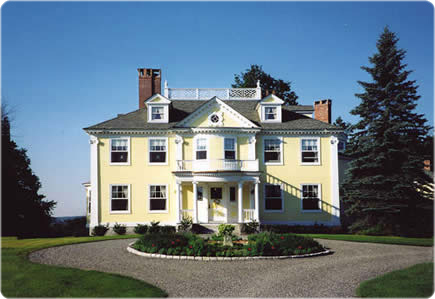
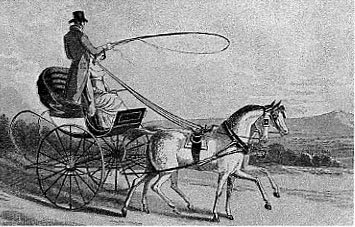
A leisurely weekend of literary-inspired diversions has something for every Jane Austen devoteé. Slip quietly back into Regency England in a beautiful old mansion. Take afternoon tea. Listen to Mozart. Bring your needlework. Share your thoughts at a discussion of Sense & Sensibility and how the movies stand up to the book. Attend the talk entitled ~ “Making Sense of Jane Austen’s World” * ~ Test your knowledge of Sense & Sensibility and the Regency period and possibly take home a prize. Take a carriage ride. For the gentleman there are riding and fly fishing as well as lots of more modern diversions if a whole weekend of Jane is not his cup of tea. Join every activity or simply indulge yourself quietly all weekend watching the movies. Dress in whichever century suits you. It’s not Bath, but it is Hyde Park and you’ll love Vermont circa 1800.
**************************
* “Making Sense of Jane Austen’s World” – Inn owner Suzanne Boden will be talking on the architecture, furnishings and other decorative arts of the Regency Period; Deb Barnum of JASNA-Vermont [yours truly] will be talking about travel in the late 18th and early 19th century – the horse and carriage era – and how Austen’s characters travelled in Sense & Sensibility – [and there is a lot of moving about in this book!]
*Or come for just an afternoon or evening and choose from these activities:
Informal Talk with Coffee and Dessert, Friday, 8:00 p.m., $14.00
Afternoon Tea, Saturday, 3:00 p.m., $20.00
Book Discussion and Dinner, Saturday, 7:00 p.m., $35.00
Jane Austen Quiz and Sunday Brunch, Sunday, 11:30 a.m., $15.00
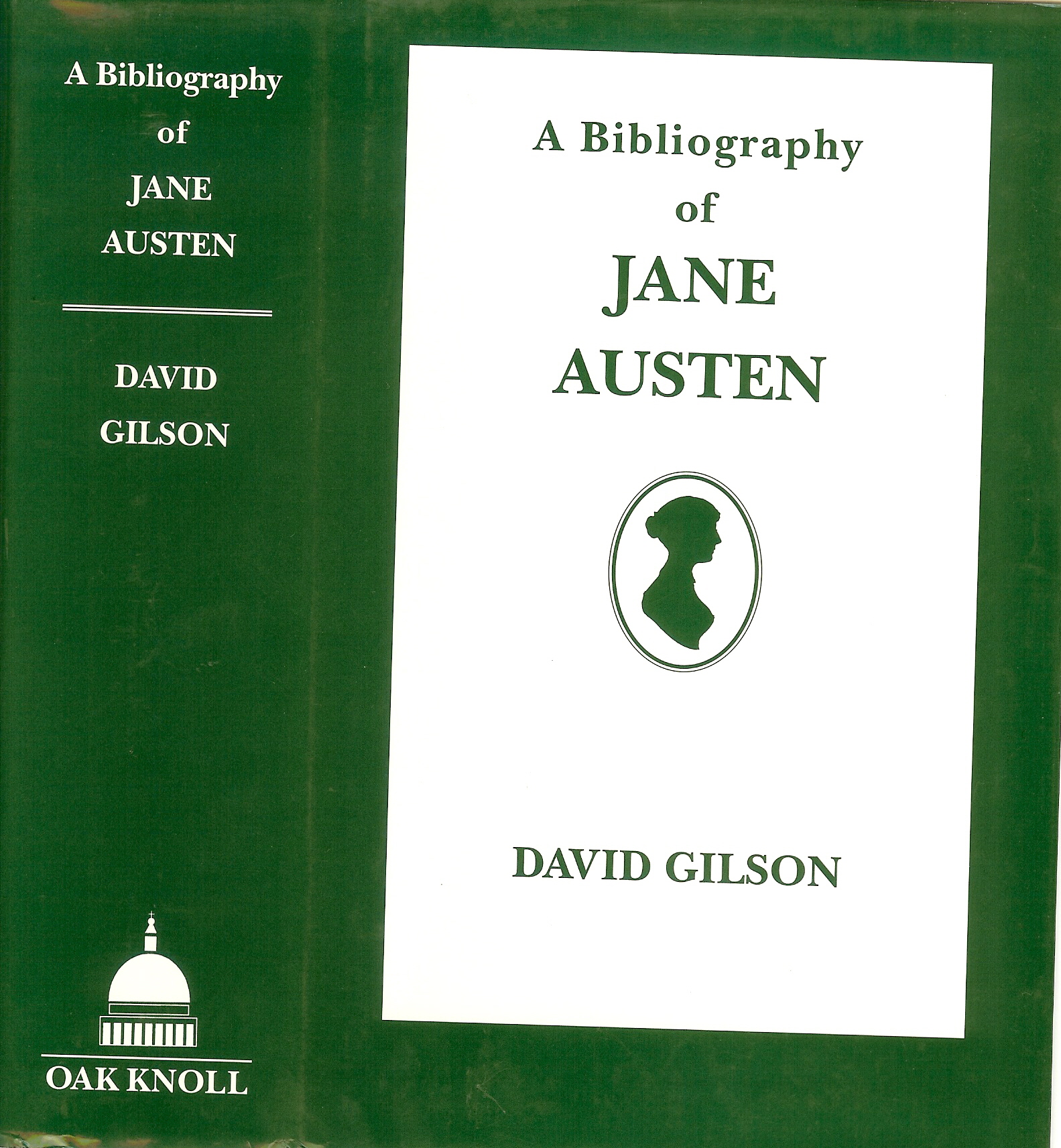
Gilson, David. A Bibliography of Jane Austen. New Introduction andCorrections by the Author. Winchester: St. Paul’s Bibliographies / New Castle, Delaware: Oak Knoll Press, 1997.
***********************
I am often asked what I would consider the most important book to add to ones own “Jane Austen Library.” Primary sources of course, the Chapman Oxford set of all the novels, minor works, juvenilia, etc – these volumes remain the source for citation in any scholarly work. The new Cambridge edition would be lovely, but presently beyond my pocketbook, so the local University Library suffices for this ; though I do wonder when this edition of the works will supplant the Chapman for citation purposes – shall start saving now…
But after that, what? I would choose and most highly recommend David Gilson’s Bibliography of Jane Austen. Originally published in 1982, Gilson had set out to revise and update the Sir Geoffrey Keynes’ 1929 Nonesuch Press Austen bibliography, after discovering the lack of information in the Keynes relating to the early American editions of Austen’s works. Gilson wrote about these and other discoveries of the various early translations in his articles for The Book Collector. At Keynes’ suggestion, Gilson began a second edition but found it best to present a whole new work based on Keynes but with much additional information and to include the work of Chapman in his 1955 Austen bibliography. The 1997 edition is not a revision of the 1982 work but does include a new introduction, corrections, some additions, and a brief bibliographic essay on material published since 1978. It is less physically attractive and lacks the frontispiece illustrations of the 1st edition, but I consider this very comprehensive work [at 877 pages!] the starting point for all Austen research. Gilson writes a very informative essay prefacing each of the twelve chapters, includes a chronological listing of editions and reprints and an exhaustive index that links back to all the entries.
I offer here a brief capsule of each of these chapters:
A. The Original Editions: Gilson follows the principles set down by Philip Gaskell in his New Introduction to Bibliography [1972] and the entry for each original edition is exhaustive: full bibliographical details of the physical book [title; collation; contents; technical notes on the paper, printing, headlines, chapter headings and endings, binding; etc]; its publishing history; reviews and contemporary comments; later publishing history; auction records [fascinating!]; listing of copies examined; and other copies known to exist. [I LOVE this stuff!]
B. First American Editions: as Austen mentions nothing about foreign editions of her work, Gilson assumes she knew nothing about the Emma that was published by Matthew Carey in 1816, a very rare edition, and unknown of by the earlier bibliographers – [Gilson B1]. Gilson again gives full bibliographical data as for the original editions, noting the textual variations in punctuation and spelling.
C. Translations: as Gilson states, despite that “JA’s opinion of the French seems not to have been high [citing her letter of Sept 8, 1816]…the French first paid her the compliment of translating her novels in 1813 and 1815.” [Gilson, p. 135] Same full bibliographic details here for the various translations.
D. Editions Published by Richard Bentley: no reissue of Austen’s novels is known after 1818 until 1832 when Richard Bentley decided to include them in his series of Standard Novels [quoting Chapman]. The copyrights had been sold to him by Cassandra for £210 and the P&P copyright was purchased from Egerton for £40. [Gilson, p. 211] Covers all the Bentley editions through 1882, with bibliographical details.
E. Later Editions and Selections: lists “as far as it has been practicable” all other later editions of the novels from the 1830s onwards, with cursory bibliographical details and a focus on the statistical details for these editions, excepting the “textually significant edition edited by Chapman (E150)” [Gilson, p. 238] – there are 425 entries in this section.
F. Minor Works: great literary history here! – with complete bibliographical details for Lady Susan, The Watsons, Charades, Love & Freindship, Sanditon, “Plan of a Novel”, Persuasion chapters, Prayers, the Juvenilia, etc.
G. Letters: Brabourne, Bodley Head, Chapman editions, Le Faye coming later [the new 3rd edition, in 1995]
H. Dramatisations: Gilson states that in 1929 Keynes could only find three dramatic adaptations, but fifty are listed here, and only those that are published works, and surprise of surprises, P&P being the most popular. [Gilson, p. 405]
J. Continuations and Completions [no “I” so not skipping anything]: Gilson lists 14, adds a good number in his 1997 update, but since then the world has been inundated with all manner of sequels, prequels, and mash-ups – this chapter is a good starting point for some of the less known early sequels that have gotten lost in the back room library stacks – some are quite good [Brinton and Bonavia-Hunt for example]
K. Books Owned by Jane Austen: there is much evidence of what Austen actually read – in Chapman’s indexes and other studies on literary influences on her – but as Gilson states, “the actual copies prove more elusive” [p. 431], so these twenty entries listed are noted in some way to have been subscribed to by her or inscribed in some way – the essay here is very informative and great to learn of the provenance of some of these titles Austen owned and read. [Note: I have set up a page in the Bibliography section on this blog titled Jane Austen’s Reading ~ a Bibliography – a list of all the books that Austen owned or is known to have read, compiled from various sources – it makes a great reading list! – (it is still a work in progress…)]
L. Miscellaneous: the ever-needed catch-all and quite a little find, as Gilson says “unclassifiable miscellanea (with yet a curious fascination of their own!) [p. 449] – for example an Elizabeth Goudge short story “Escape for Jane”, a romanticized re-telling of the Harris Bigg-Wither episode (L24), a number of works adapted for children, and a few works on the Leigh-Perrot trial.
M. Biography and Criticism: everything from 1813 on, to include books, journal articles, reviews, etc, chronologically arranged and annotated [though not consistently], 1814 items in total, with a bibliographical essay in the updated version to touch on recent resources, ALL examined by Gilson personally. No words here to adequately explain this section – just an amazing piece of scholarship –
Appendix: ca chronological listing of all editions, reprints and and adaptations of JA’s works recorded in the bibliography
Index: pp. 753-877 – exhaustive!
… but here of course is where any printed book falls short – before it hits the stands, it is outdated. Recent efforts to keep Austen bibliography current have been largely produced by Barry Roth in his three works:
Roth, Barry and Joel Clyde Weinsheimer. An Annotated Bibliography of Jane Austen Studies, 1952-1972. Charlottesville, VA: University Press of Virginia, 1973.
Roth, Barry. An Annotated Bibliography of Jane Austen Studies, 1973-1983. Charlottesville, VA: University Press of Virginia, 1985.
__________. An Annotated Bibliography of Jane Austen Studies, 1984-1994. Ohio University Press, 1996.
__________ . bibliographies in Persuasions and Persuasions On-Line published annually by the Jane Austen Society of North America [JASNA]: each annual issue has a bibliography titled “Jane Austen Works and Studies” [and later the “Jane Austen Bibliography”] and is available online since the 1999 bibliography appeared in the 2001 Persuasions On-Line. [Note that the bibliographies in the earlier issues of Persuasions were compiled by Patricia Latkin, and later by Latkin and Roth together, then just by Professor Roth.]
And now the Internet with such immediate access to journals and books, tons of bibliographies, etc. has made all of us capable of being completely on top of everything every minute of the day – but for me, there is nothing quite like going to my Gilson to get back to those earlier days of bibliography, when a scholar such as he lovingly handled each work and made the effort to describe with such fullness each edition so it may become present before you [because you certainly cannot afford them!] and thus we are brought a little bit closer to the Austen we all love and admire – indeed, we can feel as excited as she did upon receipt of her own first copy of Pride & Prejudice as she exclaimed to Cassandra “ I want to tell you that I have got my own darling Child from London “ [Le Faye, Letter 79, p. 201]
If you don’t have this book, get it – it makes for fascinating reading! [I confess to being a librarian and I know we are all a little bit weird about this bibliography and classification thing, but this book will give you much to ponder, trust me…]
Further Reading:
Chapman, R.W. Jane Austen: A Critical Bibliography. 2nd ed. London: Oxford University Press, 1969.
Keynes, Geoffrey. Jane Austen: A Bibliography. NY: Burt Franklin, 1968 [originally published in London, 1929]
The Roth bibliographies noted above
A few other sources, mostly Gilson, though not a complete list:
Gilson, David. “Auction Sales,” in A Jane Austen Companion, ed. J. David Grey. NY: Macmillan, 1986. See also his “Editions and Publishing History,” “Obituaries, “ and “Verses” in this same volume.
____________. “Books and Their Owners: Some Early American Editions of Jane Austen.” Book Collector 48 (1999): 238-41.
___________. “The Early American Editions of Jane Austen.” The Book Collector 18 (1969): 340-52.
___________. “Henry Austen’s ‘Memoir of Miss Austen,” Persuasions 19 (1997):12-19.
___________. “Later Publishing History with Illustrations” in Jane Austen in Context, ed. Janet Todd. The Cambridge Edition of the Works of Jane Austen, Cambridge University Press, 2005.
____________. Putting Jane Austen in Order. Persuasions 17 (1995):12-15
____________. “Serial Publication of Jane Austen in French,” The Book Collector 23 (1974): 547-50.
* I will be posting occasional reviews of books recommended “For Your Austen Library” – these will be listed on the bibliography page so titled. You can also visit the the other Bibliography pages for more reading recommendations.
Laurel Ann at Austenprose announces her latest month-long immersion ~ this time it’s all about Georgette Heyer! The celebration starts August 1st, to include an interview with Deb Werksman of Sourcebooks Casablanca, thirty-four book reviews penned by various guest bloggers [including yours truly], fabulous giveaways, and invigorating chat on the Queen of Regency Romance. If you haven’t picked up any of your Heyer books lately, now is the chance to revisit her; if you have never read a Heyer, this is a perfect time to start, as in right now – you are in for a treat! Don’t risk being be a cloth-headed clodpole – join in the fun and participate!
Further Reading: [see my previous post on Faro’s Daughter, my very first Heyer, and so a favorite]
NEW: listen to Helen Simonsen, author of the must-read Major Pettigrew’s Last Stand, on her love of Heyer on NPR
Reference Sources, books:
Georgette Heyer’s Regency World, by Jennifer Kloester [2005, already out-of-print; newly published by Sourcebooks]
Georgette Heyer’s Regency England, by Teresa Chris [London, 1989] ~ impossible to find at an affordable price.
The Regency Companion, by Sharon Laudermilk and Teresa L. Hamlin [Garland 1989] – ditto
The Private World of Georgette Heyer, by Jane Aiken Hodge [1983] ~ the biography, available from used bookshops.
Georgette Heyer: A Critical Retrospective, by Mary Fahnestock-Thomas [PrinnyWorld Press, 2001] ~ includes Heyer’s short published pieces, reveiws of her books, obituaries and responses, and critical articles and books – an indispensible resource.
The Georgette Heyer Challenge Blog” join the blog author’s challenge to read all of Heyer’s works or at least some, or maybe even only one… and review and comment if you would like
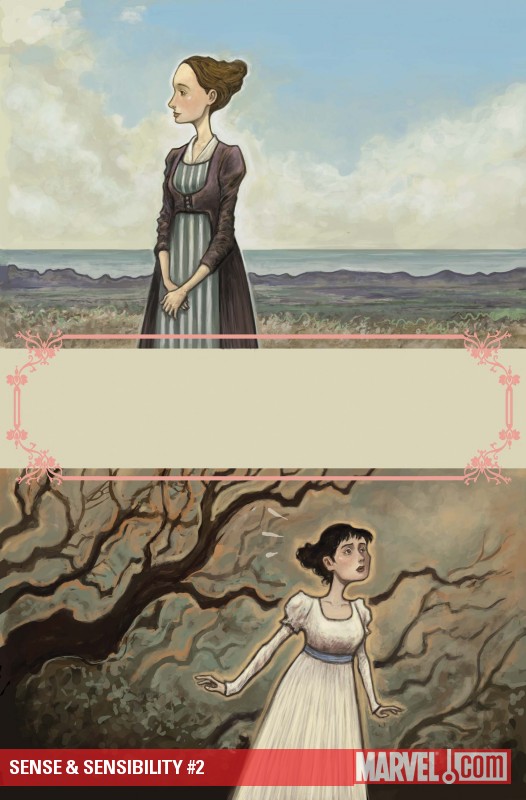
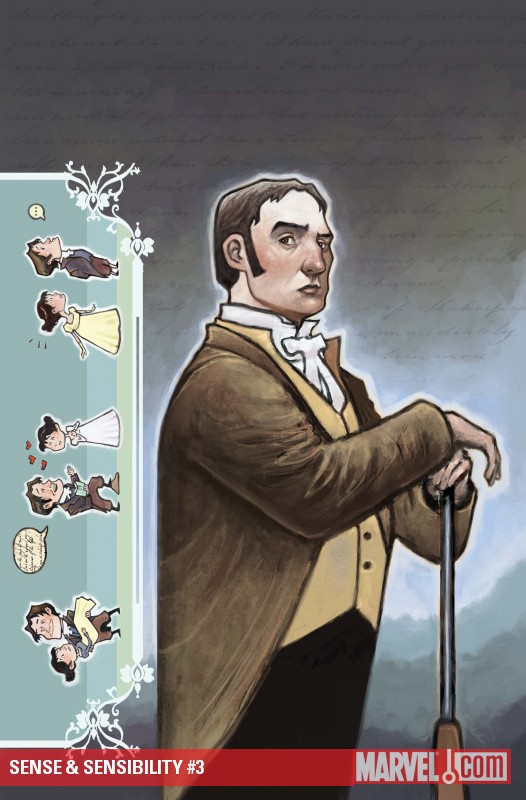
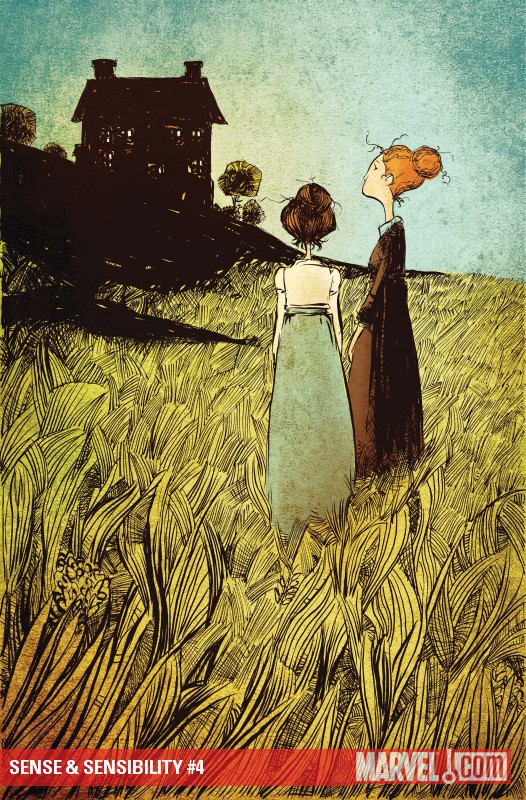
Marvel Comics has done it again – this time with Sense & Sensibility!
Here are the covers for the five issues: go the Marvel Comics website for more information and release dates [May 26 – Sept. 22, 2010]
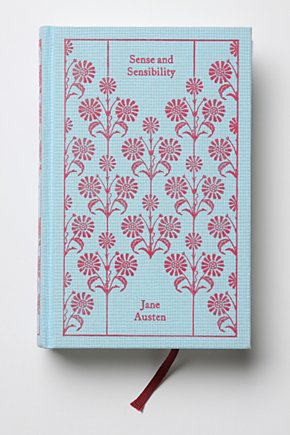
And here’s one other S&S in the shops: Anthropologie offers this edition of S&S as the latest must-have in their literature collection published by Penguin:
Literature’s great works ditch their stuffy dust jackets for smartly embossed canvas covers. Perfect for replacing well-thumbed favorites or creating a bookshelf piece de resistance.
See Anthropologie.com – also available: Pride & Prejudice, Emma, Jane Eyre, Wuthering Heights, Great Expectations, The Woman in White, and more… click here for the full list] – each about $20.
Eugenia by Clare Darcy
Walker and Company 1977, Signet 1978
[and other various reprints]
She had never thought a great deal about being in love before, not being romantically inclined and having read very few of the novels over which other young ladies at Miss Bascom’s had shed luxurious tears; but obviously, she thought, it was quite as uncomfortable a matter as those marbled volumes depicted it as being. [Eugenia, p. 231]
Clare Darcy’s Eugenia is a bit of a different confection than the usual Regency Romance. The Heroine is still the smart, feisty, quick-thinking, in this case tomboy-like young lady, and Our Hero is as expected, tall, dark and handsome, strong and muscular; but there are only rare moments of sword-crossing, none of the “they started off hating each other” – indeed, this Hero and Heroine are only occasionally found interacting on the page together, and barely ever alone – but it is quite charming all the same… and thankfully largely lacking the incessant “infant-brat-chit” talk!
We begin in Bath in May of 1811, and Miss Eugenia Liddiard, an orphan since her father’s death three years ago and schooled at the Miss Bascom’s Select Academy for Young Ladies, is finally returning “home” to the Essex seat of her cousin / guardian Lord Chandross. Lady Chandross, “not a proper guardian”, is to chaperon Eugenia in her first London Season, the goal to marry her off as soon as possible so she, Lady C, may return to to her own dalliances unencumbered. Eugenia wants none of this – she is practical and not romantic and has definitely made up her mind to propose marriage to her childhood friend Tom Rowntree, brother of her best friend Muffet, so she will no longer be a burdensome project, be able to settle on land adjacent to her former home Coverts in Kent [her “place of belonging” and now in the care of a hands-off elderly clergyman cousin], and to be free to just be, taking no orders from anyone.
Fortunately for all, characters and readers alike, the traveling chaise bearing Eugenia and her abigail is forestalled at the less than fashionable Kings Head Inn due to a raging storm and washed-out roads, and Eugenia, “who liked new experiences of any sort”, serendipitously runs into her cousin “Gerry” at the Inn, and the adventure begins. By page nine we have met our Hero, have a full understanding of the the Heroine’s character, beauty, love of adventure, and quite wild imagination with a penchant for concocting very tall tales when the occasion calls for it.
For “Gerry” is not Eugenia’s wild and reckless cousin Gerry at all, but the dead-ringer “Richard” [to wit, Jane Austen may not approve but he makes a fine Hero just the same!]. Richard is yet another cousin [isn’t is striking How Many Cousins there are in these Regency novels?!], also forestalled at the Inn and suffering from the lingering effects of a fever – and alas! he collapses in a dead faint in the Inn’s coffeehouse, Eugenia comes to the rescue and discovers the truth of his identity – he is the “by-blow” of her long-dead uncle Charles, thus not the true legitimate male heir to Coverts because he has only hearsay evidence, no written proof, of his parent’s marriage. Orphaned shortly after birth and raised by a clergyman in Ireland, Richard has returned to England to prove his birthright; Eugenia schemes for him to pass himself off as his look-alike cousin and come to her guardian’s estate to recuperate, offering her help to search the ecclesiastical records for the hoped-for marriage registry.
But, as all best-laid plans must indeed go awry or we wouldn’t have a tale to tell, real cousin Gerry is being sought by the Bow Street Runners for Highway Robbery and Murder – Richard must go into hiding until Gerry can be captured or he risks the gallows…
… so… her wondrous and fertile imagination madly at work, Eugenia sets up a new plan [she calls it “acting, not lying” ] – with much disguise, masquerading, outrageous fabrications to family and friends, and many a character entering her play – her old nurse Nan and her old groom Haggart to whom she confides Richard’s secrets; Lady Brassbororough [!], Lady B, the former “scarlet woman” famous for her stage past and various liaisons among the the rich of the ton, now a rather large woman covered in emeralds and diamonds, with a pug named Wellington who bites on command, with a resource of ready swears to send any man staggering into a corner, and who thankfully, in the end, saves the day.
I’ll tell no more – but Miss Darcy, like Heyer before her in False Colours, gives us an almost gentle tale of mistaken identity, complete with Regency cant, French sayings, and an abundance of Regency references [Stulz the tailor, the 1697 play “The Deceiver Deceived“, Hessian soup, Fanchon, ices at Gunter’s [though it is misnamed Gunther’s – her mistake or a typo?] are just a few examples … there are a good many more with the fun of looking them up!]; the two bumbling Bow Street Runners, Baker and Cartwright [perfect name for a TV show!]; dance requests and marriage proposals from all the wrong people; the “highest kick of fashion” described; the settings of Town and Country knowingly depicted; the ever-present cadre of servants, who keep “up a dignified pretence, for the sake of [their] positions, of being deaf and blind as well as quite uninterested” [p. 242]; the requisite pistols and grown men brawling; a charming and defiant Heroine who unromantic as she believes herself to be discovers “the joy of knowing love” and the pain of not having it returned; and finally The Hero, more Fitzwilliam Darcy-like – aloof and composed with a quiet, impenetrable reserve and decisive manner – and thankfully knows how to perform the proper Embraces and Crushing Kisses when so called upon.
Lady Chandross, “with her usual air of fashionable indifference“, sums it all up nicely with “so it seems that everything has turned out for the best in the end, quite in the manner of one of those dull little comedies where everyone reforms or is suitably paired off just before the curtain falls” [p. 224] – Miss Darcy may laugh so at her own little creation, but so do we, and again, though this is not Heyer, it is great fun – put it on your summer reading list!
Laurel Ann at her Austenprose blog is currently posting a month-long group read through Pride & Prejudice – do visit and join in the discussion! – she is as always an insightful reader and discussion leader, and what better way to spend the first month of summer musing on P&P and the finer points of Austen’s magic!
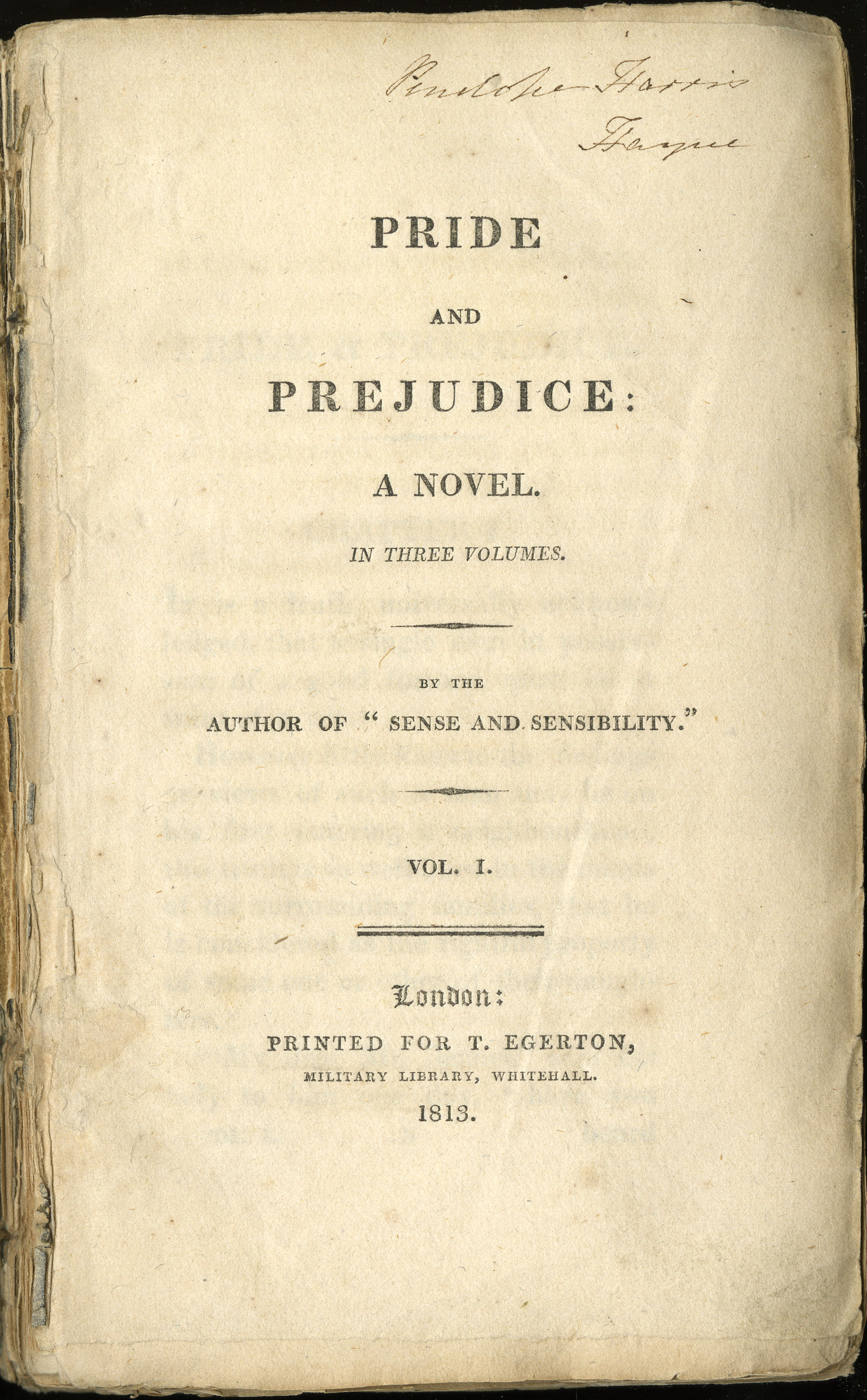
The publishing history of P&P, Austen’s most popular book, then and now, is an interesting study in the book trade of early 19th century England. First completed in 1797 [and called First Impressions] and rejected by the publisher her father took the manuscript to, Austen reworked P&P and submitted it to Thomas Egerton, the publishing house of her Sense & Sensibility, in 1812 [published January 28, 1813]. She sold the copyright outright for £110, and did not incur other expenses in its publication, as in the three other works published in her lifetime [see links below for more information.] How we would love to know her thoughts on this road to publication! – how we would love to have her letters written while in the process of the writing to give us some idea of her imagination at work [where WAS the model for Pemberley? was Mr. Darcy someone REAL? was Elizabeth Bennet her alter ego? was MR COLLINS drawn from life?], or to have the letters to her brother Henry and his to Egerton – but alas! we have nothing, just a few comments scattered among the surviving letters.
Austen does not give us much in her letters as to her writing practices or narrative theory [and thus such a disappointment when they were first published, criticized for their “mundaneness,” their focus on domestic nothings and neighborhood gossip!] – but if you dig for diamonds you will find them, and these scattered mentions are certainly diamonds – it is the feeling of having her right over your shoulder when you read that she is “disgusted” with the way her mother is reading her book aloud, or that she REALLY likes this earning money for her labors, or being miffed [but also full of pride!] with Henry for telling her Secret to one and all – we see Jane Austen here in her own words – the funny, ironic, brilliant Jane Austen – never enough, but this is as good as it is going to get.
So in this post I offer all the references she makes to Pride & Prejudice, her “own darling Child” – read them and enjoy!
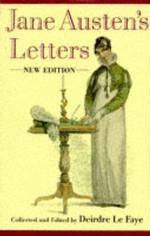
[NOTE: page references are to Deirdre Le Faye, ed., Jane Austen’s Letters, 3rd ed., Oxford, 1997; all abbreviations and spelling errors are retained]
Letter 17. January 8-9, 1799 to Cassandra, from Steventon
I do wonder at your wanting to read first impressions again, so seldom as you have gone through it, & that so long ago.[page 35]
[Le Faye notes that this is the first surviving mention of Austen’s literary work, this prototype of P&P having been finished in August 1797; Note, p. 366]
Letter 21. June 11, 1799, To Cassandra, from Bath
I would not let Martha read First Impressions again upon any account, & I am very glad that I did not leave it in your power. – She is very cunning, but I see through her design; – she means to publish it from Memory, & one more perusal must enable her to do it.[p.44]
Letter 77. November 29-30, 1812, to Martha Lloyd from Chawton
P.& P. is sold. – Egerton gives £110 for it. – I would rather have had £150, but we could not both be pleased, & I am not at all surprised that he should not chuse to hazard so much. – It’s being sold will I hope be a great saving of Trouble to Henry, & therefore must be welcome to me. – The Money is to be paid at the end of the twelvemonth. [p. 197]
Letter 79. January 29, 1813, to Cassandra from Chawton
I want to tell you that I have got my own darling Child from London; – on Wednesday I received one Copy, sent down by Falknor, with three lines from Henry to say that he had given another to Charles & sent a 3d by the Coach to Godmersham; just the two Sets which I was least eager for the disposal of. I wrote to him immediately to beg for my own two other Sets, unless he would take the trouble of forwarding them at once to Steventon & Portsmouth – not having any idea of his leaving Town before today; – by your account however he was gone before my Letter was written. The only evil is the delay, nothing more can be done till his return. Tell James & Mary so, with my Love. – For your sake I am as well pleased that it shd be so, as it might be unpleasant to you to be in the Neighborhood at the first burst of the business. – The Advertisement is in our paper to day [the Morning Chronicle of January 28, 1813]. – 18s – He shall ask £1-1- for my two next, & £1-8 – for my stupidest of all. I shall write to Frank, that he may not feel himself neglected. Miss Benn dined with us on the very day of the Books coming, & in the eveng we set fairly at it & read half the 1st vol. to her – prefacing that having intelligence from Henry that such a work wd soon appear we had desired him to send it whenever it came out – & I beleive it passed with her unsuspected. – She was amused, poor soul! that she cd not help you know, with two such people to lead the way [JA and her mother]; but she really does seem to admire Elizabeth. I must confess that I think her as delightful a creature as ever appeared in print, & how I shall be able to tolerate those who do not like her at least, I do not know. – There are a few Typical errors – & a “said he” or a “said she” would sometimes make the Dialogue more immediately clear – but “I do not write for such dull Elves” “As have not a great deal of Ingenuity themselves.” [from Scott’s Marmion] – The 2d vol. is shorter than I cd wish – but the difference is not so much in reality as in look, there being a a larger proportion of Narrative in that part. I have lopt & cropt so successfully however that I imagine it must be rather shorter than S. & S. altogether. – Now I will try to write of something else; – it shall be a complete change of subject – Ordination.[p. 201-2]
Letter 80. February 4, 1813, to Cassandra from Chawton
Your letter was truely welcome & I am much obliged to you all for your praise; it came at a right time, for I had had some fits of disgust. – our 2d evening’s reading to Miss Benn had not pleased me so well, but I beleive something must be attributed to my Mother’s too rapid way of getting on – & tho’ she perfectly understands the Characters herself, she cannot speak as they ought. – upon the whole however I am quite vain enough & well satisfied enough. – The work is rather too light & bright & sparkling; – it wants shade; – it wants to be stretched out here & there with a long Chapter – of sense if it could be had, if not of solemn specious nonsense – about something unconnected with the story; an Essay on Writing, a critique on Walter Scott, or a history of Buonaparte – or anything that would form a contrast & bring the reader with increased delight to the playfulness & Epigrammatism of the general stile. – I doubt your quite agreeing with me here – I know your starched Notions. – The caution observed at Steventon with regard to the possession of the book is an agreable surprise to me, & I heartily wish it may be the means of saving you from everything unpleasant; – but you must be prepared for the Neighbourhood being perhaps already informed of there being such a Work in the World, & in the Chawton World! Dummer will do that you know. – It was spoken of here one morng when Mrs. D. [Digweed] called with Miss Benn. – The greatest blunder in the Printing that I have met with is in Page 220 – Vol.3 where two speeches are made into one. – There might as well have been no suppers at Longbourn, but I suppose it was the remains of Mrs. Bennet’s old Meryton habits.[p. 203]
Mrs. George Austen
I had a letter from Henry yesterday, written on Sunday from Oxford; mine had been forwarded to him… he says that copies were sent to S. [Steventon] & P. [Portsmouth] at the same time as the others. [p. 204]
Letter 81. February 9, 1813, to Cassandra from Chawton
I am exceedingly pleased that you say what you do, after having gone thro the whole work – & Fanny’s praise is very gratifying; – my hopes were tolerably strong for her, but nothing like a certainty. Her liking Darcy & Elizabeth is enough. She might hate all the others, if she would. I have her opinion under her own hand this morning, but your transcript of it which I read first, was not & is not the less acceptable. – To me, it is of course all praise – but the more exact truth which she sends you is good enough. [p. 205]
Yes, I beleive I shall tell Anna – & if you see her, & donot dislike the commission, you may tell her for me. You know I meant to do it as handsomely as I could. But she will probably not return in time[p. 205, referring to telling her niece Anna that she is the author of S&S and P&P, note p. 414]
…- there is still work for one evening more.[p. 206, to finish reading P&P aloud, note p. 414]
Letter 85. May 24, 1813, to Cassandra from London
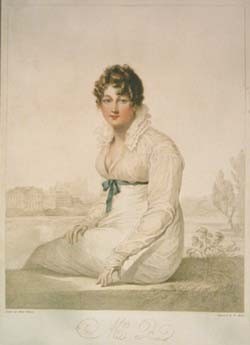
…Henry & I went to the Exhibition in Spring Gardens. It is not thought a good collection, but I was very well pleased – particularly [pray tell Fanny] with a small portrait of Mrs. Bingley, excessively like her. I was in hopes of seeing one of her Sister, but there was no Mrs. Darcy; – perhaps however, I may find her in the Great Exhibition which we shall go to, if we have time; – I have no chance of her in the collection of Sir Joshua Reynolds’s Paintings which now is shewing in Pall Mall & which we are also to visit. – Mrs. Bingley is exactly herself, size, shaped face, features and sweetness; there never was a greater likeness. She is dressed in a white gown, with green ornaments, which convinces me of what I have always supposed, that green was a favourite colour with her. I dare say Mrs. D. will be in Yellow. [p. 212]
[Portrait of a Lady, by J.F.M. Huet-Villiers]
a.k.a. Mrs. Bingley
I am very much obliged to Fanny for her Letter; – it made me laugh heartily; but I cannot pretend to answer it. Even had I more time, I should not feel at all sure of the sort of Letter that Miss D. would write…[p. 213, referring to a letter from Fanny written to and expecting a response from Georgiana Darcy – Note p. 417]
We have been to both the Exhibition & Sir J. Reynolds’, – and I am disappointed, for there was nothing like Mrs. D. at either. – I can only imagine that Mr. D. prizes any Picture of her too much to like it should be exposed to the public eye. – I can imagine he wd have that sort [of, omitted] feeling – that mixture of Love, Pride & Delicacy. [p. 213]
Letter 86. July 3-6, 1813, to Francis Austen from Chawton
You will be glad to hear that every Copy of S.&S. is sold & that it has brought me £140 – besides the Copyright, if that shd ever be of any value. – I have now therefore written myself into £250. – which only makes me long for more. – I have something on hand – which I hope on the credit of P. & P. will sell well, tho’ not half so entertaining…[referring to Mansfield Park] [p. 217]
Letter 87. September 15-16, 1813, to Cassandra from London
Lady Robert [Kerr, nee Mary Gilbert] delighted with P. & P – and really was so I understand before she knew who wrote it – for, of course, she knows now. – He [Henry] told her with as much satisfaction as if it were my wish. He did not tell me this, but he told Fanny. And Mr. Hastings – I am quite delighted with what such a Man writes about it. – Henry sent him the Books after his return from Daylesford – but you will hear the Letter too. // Let me be rational & return to my two full stops. [p. 218]
I long to have you hear Mr. H’s [Warren Hastings] opinion of P&P. His admiring of Elizabeth so much is particularly welcome to me. [p. 221]
Letter 89. September 23-24, 1813, to Cassandra from Godmersham Park
Poor Dr. Isham is obliged to admire P.&P. – & to send me word that he is sure he shall not like Mde. Darblay’s new Novel half so well.– Mrs. C. [Cooke] invented it all of course.[referring to Frances Burney’s The Wanderer, published in 1814] [p. 227]
Letter 90. September 25, 1813, to Francis Austen from Godmerhsam Park
I thank you very warmly for your kind consent to my application & the kind hint that followed it. [asking Frank if she can use the names of his old ships in her her current work, MP] – but the truth is that the Secret has spread so far as to be scarcely the Shadow of a secret now – & that I beleive whenever the 3d appears I shall not even attempt to tell Lies about it. – I shall rather try to make all the Money than all the Mystery I can of it. – People shall pay for their knowledge if I can make them. – Henry heard P. & P. warmly praised in Scotland, by Lady Robt Kerr & another Lady; – and what does he do in the warmth of his Brotherly vanity & Love, but immediately tell them who wrote it! – A Thing once set going in that way – one knows how it spreads! – and he, dear Creature, has set is going so much more than once. I know it is done from affection & partiality – but at the same time, let me here again express to you & Mary my sense of the superior kindness which you have shewn on the occasion, in doing what I wished. – I am trying to harden myself. – After all, what a trifle it is in all its Bearings, to the really important points of one’s existence even in the World![p. 231]
Henry Austen
There is to be a 2d Edition of S.&S. Egerton advises it.[p. 232, referring to her publisher]
Letter 104. August 10-18, 1814, to Anna Austen from Chawton
Now we have finished the 2d book – or rather the 5th – I do think you had better omit Lady Helena’s postscript; to those who are acquainted with P.&P it will seem an Imitation. [p. 268, referring to Anna’s manuscript sent to JA for advice]
Letter 128. November 26, 1815, to Cassandra from London
Mr. H is reading Mansfield Park for the first time & prefers it to P&P.[p. 301, referring to Mr. Haden, London surgeon, “who brought good Manners & clever conversation” ]
Letter 132(Draft). December 11, 1815, to James Stanier Clarke from London
My greatest anxiety at present is that this 4th work [Emma] shd not disgrace what was good in the others. But on this point I will do myself the justice to declare that whatever may be my wishes for its’ success, I am very strongly haunted by the idea that to those readers who have preferred P&P. it will appear inferior in Wit, & to those who preferred MP. very inferior in good sense… [p. 306]
Letter 134(A). December 27, 1815, from the Countess of Morley to JA at Chawton
I am most anxiously waiting for an introduction to Emma…. I am already become quite intimate in the Woodhouse family, & feel that they will not amuse & interest me less than the Bennetts [sic], Bertrams, Norriss & all their admirable predecessors – I can give them no higher praise-[p. 308]
************************************
[a letter-writing Fanny Austen-Knight by Cassandra]
The set of Jane Austen’s novels published by Bentley in 1833 and up for auction at Bonham’s sale today [June 8, 2010] has come under the gavel and has sold for £3,360 [= @ $4827.] [the estimate was for £2000 – £3000 ]
Here are the details:
AUSTEN, Jane. Works, Bentley’s Standard Novel edition, 6 vol. in 5, 5 engraved frontispieces and additional titles, some light spotting to first and final few leaves, small corner tear to printed title “Pride and Prejudice”, without half-titles, ownership inscription of Eularia E. Burnaby (1856) on printed titles, bookplate of Henry Vincent, bookseller’s label of H.M. Gilbert, Southampton, uniform contemporary half calf, red and dark green morocco labels, extremities lightly rubbed [Gilson D1-D5], 8vo, R. Bentley, 1833
Sold for £3,360 inclusive of Buyer’s Premium
Footnote:
“No English reissue of JA’s novels is known after 1818 until in 1832 Richard Bentley decided to include them in his series of Standard Novels” (Gilson, p.211). See illustration on preceding page.
See the Bonham’s site here for details and other auction items in this ‘Printed Books, Maps and Manuscripts’ auction [Sale No. 17809]
See Laurel Ann’s post analyzing this set [along with her super sleuthing as to the provenance!] atAustenprose
Someone has gone home very happy today! [and hopefully this has gone to either a fine institution or a fine home with an Austen-loving owner…]
The following fabulous information just received from Janeite Hope!
Last year there was quite a bit of discussion around the kerfuffle between author Claire Harman (Jane’s Fame) and Professor Kathryn Sutherland (Jane Austen’s Textual Lives) [see post: Discord in Austen Land from March 15, 2009]. The dust appears to have settled and now we can be indebted to Professor Sutherland for yet another wonderful contribution to all Janeites and the world of Jane Austen scholarship.
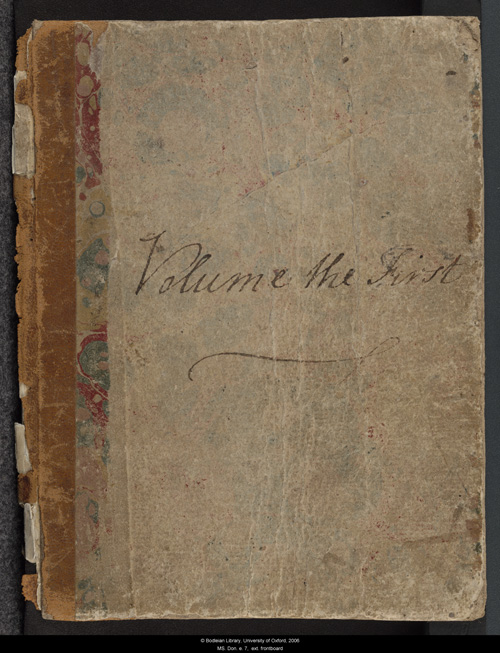
Under the direction of Professor Sutherland, and a joint project of the University of Oxford and Kings College London, the Centre for Computing in the Humanities of King’s College London has published the website: Jane Austen’s Fiction Manuscripts. The site includes transcriptions as well as high quality facsimiles. Of particular interest to scholars, though not yet apparent on the website, is the fact that the manuscripts have been encoded with “orthographic variants and punctuation symbols in minute detail for subsequent computational interrogation” as well as complex structural metadata. This means that interesting reconstruction, deconstruction and analysis will be possible.
Meanwhile we have the current Austen site to study and enjoy.
“Jane Austen’s fiction manuscripts are the first significant body of holograph evidence surviving for any British novelist. They represent every stage of her writing career and a variety of physical states: working drafts, fair copies, and handwritten publications for private circulation. The manuscripts were held in a single collection until 1845, when at her sister Cassandra’s death they were dispersed among family members, with a second major dispersal, to public institutions and private collections, in the 1920s Digitization enables their virtual reunification and will provides scholars with the first opportunity to make simultaneous ocular comparison of their different physical and conceptual states; it will facilitate intimate and systematic study of Austen’s working practices across her career, a remarkably neglected area of scholarship within the huge, world-wide Austen critical industry.
Many of the Austen manuscripts are frail; open and sustained access has long been impossible for conservation and location reasons. Digitization at this stage in their lives not only offers the opportunity for the virtual reunification of a key manuscript resource, it will also be accompanied by a record in as complete a form as possible of the conservation history and current material state of these manuscripts to assist their future conservation.
The digital edition will include in the first instance all Jane Austen’s known fiction manuscripts and any ancillary materials held with them.”
Manuscripts now online are:
• Volume the First, Bodleian Library, Oxford
• Volume the Second, British Library, London
• Volume the Third, British Library, London
• Lady Susan, Morgan Library & Museum, New York
• Susan, Morgan Library & Museum, New York
• The Watsons, Morgan Library & Museum, New York
• The Watsons, Queen Mary, University of London, London
• Persuasion, British Library, London
• Sanditon, King’s College Cambridge, Cambridge
• Opinions of Mansfield Park Opinions of Emma, British Library, London
• Plan of a Novel, according to hints from | various quarters, Morgan Library & Museum, New York
• Profits of my Novels, Morgan Library & Museum, New York
Today, March 23, Catherine Morland visits Mrs. Tilney’s bed-chamber, where she expects to find some evidence of her murder by General Tilney, or even perhaps that she has been locked away in some distant tower – but Catherine realizes how gravely mistaken she has been in all her gothic musings, perceiving “the warm beams of a western sun gaily pour[ing] through two sash windows!” … and she turns to leave…
She was sick of exploring, and desired but to be safe in her own room, with her own heart only privy to its folly; and she was on the point of retreating as softly as she had entered, when the sound of footsteps, she could hardly tell where, made her pause and tremble. To be found there, even by a servant, would be unpleasant; but by the general (and he seemed always at hand when least wanted), much worse! She listened — the sound had ceased; and resolving not to lose a moment, she passed through and closed the door. At that instant a door underneath was hastily opened; someone seemed with swift steps to ascend the stairs, by the head of which she had yet to pass before she could gain the gallery. She had no power to move. With a feeling of terror not very definable, she fixed her eyes on the staircase, and in a few moments it gave Henry to her view.
“Mr. Tilney!” she exclaimed in a voice of more than common astonishment.
He looked astonished too.
“Good God!” she continued, not attending to his address. “How came you here? How came you up that staircase?”
“How came I up that staircase!”, he replied, greatly surprised. “Because it is my nearest way from the stable–yard to my own chamber; and why should I not come up it?”
Catherine recollected herself, blushed deeply, and could say no more. He seemed to be looking in her countenance for that explanation which her lips did not afford. She moved on towards the gallery.
“And may I not, in my turn,” said he, as he pushed back the folding doors, “ask how you came here? This passage is at least as extraordinary a road from the breakfast–parlour to your apartment, as that staircase can be from the stables to mine.”
“I have been,” said Catherine, looking down, “to see your mother’s room.”
“My mother’s room! Is there anything extraordinary to be seen there?”
“No, nothing at all. I thought you did not mean to come back till tomorrow.”
“I did not expect to be able to return sooner, when I went away; but three hours ago I had the pleasure of finding nothing to detain me. You look pale. I am afraid I alarmed you by running so fast up those stairs. Perhaps you did not know — you were not aware of their leading from the offices in common use?”
“No, I was not. You have had a very fine day for your ride.”
“Very; and does Eleanor leave you to find your way into all the rooms in the house by yourself?”
“Oh! No; she showed me over the greatest part on Saturday — and we were coming here to these rooms — but only” —[ dropping her voice ] — “your father was with us.”
“And that prevented you,” [ said Henry, earnestly regarding her. ]“Have you looked into all the rooms in that passage?”
“No, I only wanted to see — Is not it very late? I must go and dress.”
“It is only a quarter past four” showing his watch — “and you are not now in Bath. No theatre, no rooms to prepare for. Half an hour at Northanger must be enough.”
She could not contradict it, and therefore suffered herself to be detained, though her dread of further questions made her, for the first time in their acquaintance, wish to leave him. They walked slowly up the gallery.
“Have you had any letter from Bath since I saw you?”
“No, and I am very much surprised. Isabella promised so faithfully to write directly.”
“Promised so faithfully! A faithful promise! That puzzles me. I have heard of a faithful performance. But a faithful promise — the fidelity of promising! It is a power little worth knowing, however, since it can deceive and pain you. My mother’s room is very commodious, is it not? Large and cheerful–looking, and the dressing–closets so well disposed! It always strikes me as the most comfortable apartment in the house, and I rather wonder that Eleanor should not take it for her own. She sent you to look at it, I suppose?”
“No.”
“It has been your own doing entirely?”[ Catherine said nothing. After a short silence, during which he had closely observed her, he added, ] “As there is nothing in the room in itself to raise curiosity, this must have proceeded from a sentiment of respect for my mother’s character, as described by Eleanor, which does honour to her memory. The world, I believe, never saw a better woman. But it is not often that virtue can boast an interest such as this. The domestic, unpretending merits of a person never known do not often create that kind of fervent, venerating tenderness which would prompt a visit like yours. Eleanor, I suppose, has talked of her a great deal?”
“Yes, a great deal. That is — no, not much, but what she did say was very interesting. Her dying so suddenly” (slowly, and with hesitation it was spoken), “and you — none of you being at home — and your father, I thought — perhaps had not been very fond of her.”
“And from these circumstances,” he replied (his quick eye fixed on hers), “you infer perhaps the probability of some negligence — some” — (involuntarily she shook her head) — “or it may be — of something still less pardonable.” She raised her eyes towards him more fully than she had ever done before. “My mother’s illness,” he continued, “the seizure which ended in her death, was sudden. The malady itself, one from which she had often suffered, a bilious fever — its cause therefore constitutional. On the third day, in short, as soon as she could be prevailed on, a physician attended her, a very respectable man, and one in whom she had always placed great confidence. Upon his opinion of her danger, two others were called in the next day, and remained in almost constant attendance for four and twenty hours. On the fifth day she died. During the progress of her disorder, Frederick and I (we were both at home) saw her repeatedly; and from our own observation can bear witness to her having received every possible attention which could spring from the affection of those about her, or which her situation in life could command. Poor Eleanor was absent, and at such a distance as to return only to see her mother in her coffin.”
“But your father,” said Catherine, “was he afflicted?”
“For a time, greatly so. You have erred in supposing him not attached to her. He loved her, I am persuaded, as well as it was possible for him to — we have not all, you know, the same tenderness of disposition — and I will not pretend to say that while she lived, she might not often have had much to bear, but though his temper injured her, his judgment never did. His value of her was sincere; and, if not permanently, he was truly afflicted by her death.”
“I am very glad of it,” said Catherine; “it would have been very shocking!”
“If I understand you rightly, you had formed a surmise of such horror as I have hardly words to — Dear Miss Morland, consider the dreadful nature of the suspicions you have entertained. What have you been judging from? Remember the country and the age in which we live. Remember that we are English, that we are Christians. Consult your own understanding, your own sense of the probable, your own observation of what is passing around you. Does our education prepare us for such atrocities? Do our laws connive at them? Could they be perpetrated without being known, in a country like this, where social and literary intercourse is on such a footing, where every man is surrounded by a neighbourhood of voluntary spies, and where roads and newspapers lay everything open? Dearest Miss Morland, what ideas have you been admitting?”
They had reached the end of the gallery, and with tears of shame she ran off to her own room…. [next chapter] The visions of romance were over. Catherine was completely awakened…
[Northanger Abbey, Vol. II, Chap. IX [ch. 24]]
illustration: by C.E. Brock from www.Mollands.net
Today [March 20] is the day that the Tilneys and Catherine leave Bath for Northanger Abbey – Catherine is riding with the innumerably-caped- greatcoated Henry:
“…she found herself with Henry in the curricle, as happy a being as ever existed. A very short trial convinced her that a curricle was the prettiest equipage in the world… the merit of the curricle did not all belong to the horses; Henry drove so well — so quietly — without making any disturbance, without parading to her, or swearing at them: so different from the only gentleman–coachman whom it was in her power to compare him with! And then his hat sat so well, and the innumerable capes of his greatcoat looked so becomingly important! To be driven by him, next to being dancing with him, was certainly the greatest happiness in the world.”
[NA, vol. II, ch. V]
…and Henry begins his gothic tale setting Catherine well on her way to having her own imagination run wild. Here is the full text, as you must read the whole!:
“….you must be so fond of the abbey! After being used to such a home as the abbey, an ordinary parsonage–house must be very disagreeable.”
He smiled, and said, “You have formed a very favourable idea of the abbey.”
“To be sure, I have. Is not it a fine old place, just like what one reads about?”
“And are you prepared to encounter all the horrors that a building such as ‘what one reads about’ may produce? Have you a stout heart? Nerves fit for sliding panels and tapestry?”
“Oh! yes — I do not think I should be easily frightened, because there would be so many people in the house — and besides, it has never been uninhabited and left deserted for years, and then the family come back to it unawares, without giving any notice, as generally happens.”
“No, certainly. We shall not have to explore our way into a hall dimly lighted by the expiring embers of a wood fire — nor be obliged to spread our beds on the floor of a room without windows, doors, or furniture. But you must be aware that when a young lady is (by whatever means) introduced into a dwelling of this kind, she is always lodged apart from the rest of the family. While they snugly repair to their own end of the house, she is formally conducted by Dorothy, the ancient housekeeper, up a different staircase, and along many gloomy passages, into an apartment never used since some cousin or kin died in it about twenty years before. Can you stand such a ceremony as this? Will not your mind misgive you when you find yourself in this gloomy chamber — too lofty and extensive for you, with only the feeble rays of a single lamp to take in its size — its walls hung with tapestry exhibiting figures as large as life, and the bed, of dark green stuff or purple velvet, presenting even a funereal appearance? Will not your heart sink within you?”
“Oh! But this will not happen to me, I am sure.”
“How fearfully will you examine the furniture of your apartment! And what will you discern? Not tables, toilettes, wardrobes, or drawers, but on one side perhaps the remains of a broken lute, on the other a ponderous chest which no efforts can open, and over the fireplace the portrait of some handsome warrior, whose features will so incomprehensibly strike you, that you will not be able to withdraw your eyes from it. Dorothy, meanwhile, no less struck by your appearance, gazes on you in great agitation, and drops a few unintelligible hints. To raise your spirits, moreover, she gives you reason to suppose that the part of the abbey you inhabit is undoubtedly haunted, and informs you that you will not have a single domestic within call. With this parting cordial she curtsies off — you listen to the sound of her receding footsteps as long as the last echo can reach you — and when, with fainting spirits, you attempt to fasten your door, you discover, with increased alarm, that it has no lock.”
“Oh! Mr. Tilney, how frightful! This is just like a book! But it cannot really happen to me. I am sure your housekeeper is not really Dorothy. Well, what then?”
“Nothing further to alarm perhaps may occur the first night. After surmounting your unconquerable horror of the bed, you will retire to rest, and get a few hours’ unquiet slumber. But on the second, or at farthest the third night after your arrival, you will probably have a violent storm. Peals of thunder so loud as to seem to shake the edifice to its foundation will roll round the neighbouring mountains — and during the frightful gusts of wind which accompany it, you will probably think you discern (for your lamp is not extinguished) one part of the hanging more violently agitated than the rest. Unable of course to repress your curiosity in so favourable a moment for indulging it, you will instantly arise, and throwing your dressing–gown around you, proceed to examine this mystery. After a very short search, you will discover a division in the tapestry so artfully constructed as to defy the minutest inspection, and on opening it, a door will immediately appear — which door, being only secured by massy bars and a padlock, you will, after a few efforts, succeed in opening — and, with your lamp in your hand, will pass through it into a small vaulted room.”
“No, indeed; I should be too much frightened to do any such thing.”
“What! Not when Dorothy has given you to understand that there is a secret subterraneous communication between your apartment and the chapel of St. Anthony, scarcely two miles off? Could you shrink from so simple an adventure? No, no, you will proceed into this small vaulted room, and through this into several others, without perceiving anything very remarkable in either. In one perhaps there may be a dagger, in another a few drops of blood, and in a third the remains of some instrument of torture; but there being nothing in all this out of the common way, and your lamp being nearly exhausted, you will return towards your own apartment. In repassing through the small vaulted room, however, your eyes will be attracted towards a large, old–fashioned cabinet of ebony and gold, which, though narrowly examining the furniture before, you had passed unnoticed. Impelled by an irresistible presentiment, you will eagerly advance to it, unlock its folding doors, and search into every drawer — but for some time without discovering anything of importance — perhaps nothing but a considerable hoard of diamonds. At last, however, by touching a secret spring, an inner compartment will open — a roll of paper appears — you seize it — it contains many sheets of manuscript — you hasten with the precious treasure into your own chamber, but scarcely have you been able to decipher ‘Oh! Thou — whomsoever thou mayst be, into whose hands these memoirs of the wretched Matilda may fall’ — when your lamp suddenly expires in the socket, and leaves you in total darkness.”
“Oh! No, no — do not say so. Well, go on.”
But Henry was too much amused by the interest he had raised to be able to carry it farther; he could no longer command solemnity either of subject or voice, and was obliged to entreat her to use her own fancy in the perusal of Matilda’s woes. Catherine, recollecting herself, grew ashamed of her eagerness, and began earnestly to assure him that her attention had been fixed without the smallest apprehension of really meeting with what he related. “Miss Tilney, she was sure, would never put her into such a chamber as he had described! She was not at all afraid.”
[NA, vol II, ch. V]
[Illustration, The Mysteries of Udolpho, Vol. 4, p. 217 (London: Longman, Rees, Orme, Brown and Green, 1830). From wwnorton.com]





 Jane Austen in Vermont