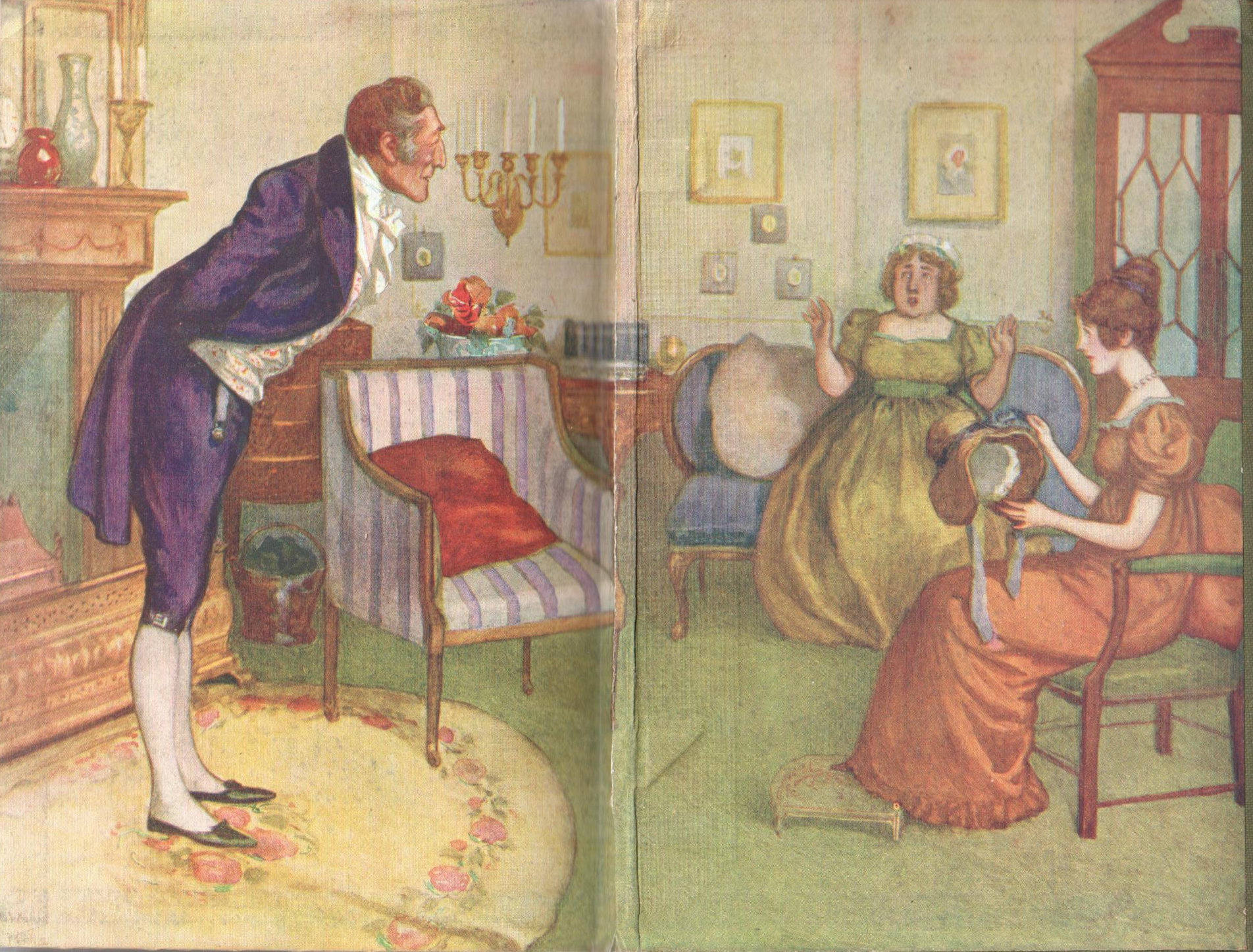
Of all the Jane Austen sets, this Dent publication is probably the most well-known because of the Brock brothers illustrations – they have continued to be published over and over again, and the ones we think of when we think of “Jane Austen illustrated.”
The Novels of Jane Austen, J. M. Dent, 1898 [Molland’s]
1892 was a watershed year for Austen and the beginning of the many Dents – but today we will focus on this set published by J. M. Dent in 1898 in 10 volumes and edited by R. Brimley Johnson – it was the first to offer Jane Austen in color. You can find all the interesting information in Gilson at E90. But a quick summary and a few pictures will surely entice you to want this on your shelves – and if the set is hard to come by or beyond your price range, a fine adventure is trying to put a set together yourself, as individual volumes are often available.
Dent had originally published Austen’s novels in 1892, also edited by Johnson, but with sepia-toned illustrations by William C. Cooke [more on this set in another post]. But in 1898, Dent used the same text plates but deep-sixed the Cooke illustrations and took on the Brock brothers to render Austen in livelier watercolors reproduced by 6-color lithography with each volume having 6 illustrations. Charles Edmund Brock did Sense & Sensibility (vols. 1 and 2), Emma (vols. 7 and 8), and Persuasion (vol. 10). Henry Matthew Brock did Pride & Prejudice (vol. 3 and 4), Mansfield Park (vols. 5 and 6), and Northanger Abbey (vol. 9).
[You can read about the Brocks here at Molland’s with an excellent essay by Cinthia García Soria here: http://www.mollands.net/etexts/other/brocks.html ] You can also google their names and many of the Jane Austen blogs have posts on the Brocks and other illustrators.
CE Brock / HM Brock
The Brocks owned a number of Regency era furnishings and decorative arts, as well as a large collection of fashion prints – they had many costumes made, having family and friends model for them and perhaps why their illustrations seem so very authentic! Laura Carroll and John Wilshire call these Brock-illustrated editions “Chocolate-box” – gift-book quality, beautiful inside with delicate pen or brush drawings, and outside with gilt embossing and Arts and Crafts inspired design; another critic refers to the Brocks’ work as “delicate teacup and saucer primness”! [See their essay “Jane Austen, Illustrated” in A Companion to Jane Austen, Wiley-Blackwell, 2012, pp. 62-77.]
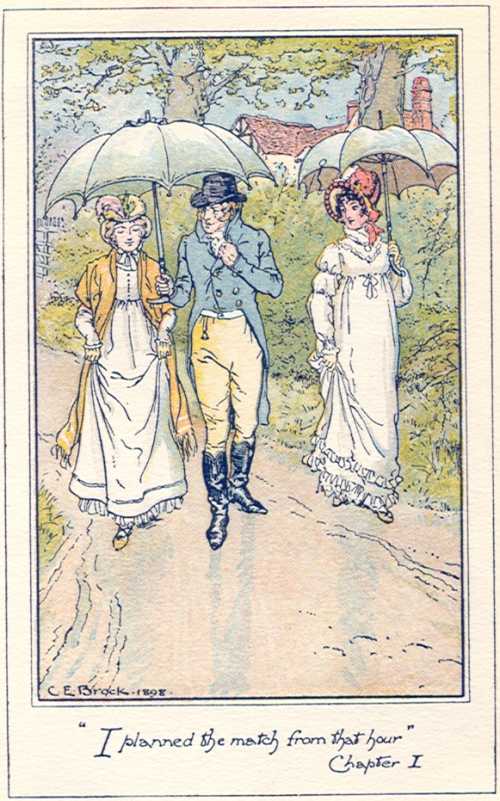
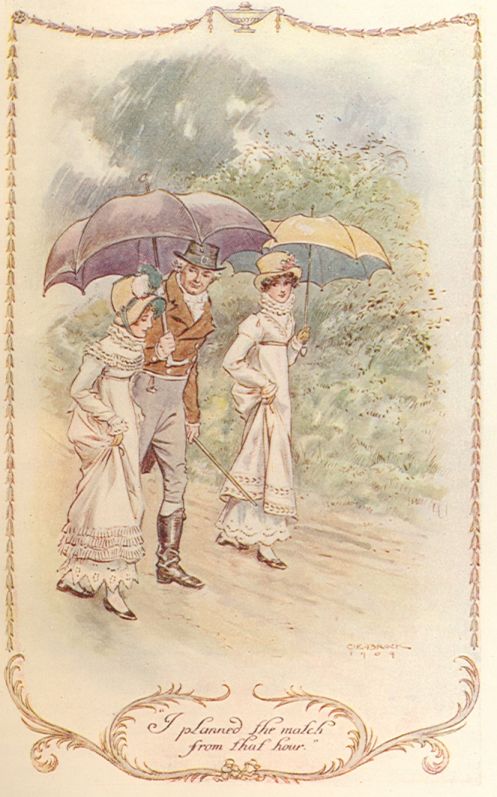
C. E. Brock had previously illustrated Pride and Prejudice with black and white line drawings – this was published by Macmillan in 1895. He would go on in the years 1907-09 to illustrate all the novels for another Dent publication, their Series of English Idylls (with 24 watercolor illustrations in each volume; they were all later published as a set with fewer illustrations in each volume.) To compare CE Brock’s two very different styles in these two editions is an interesting way to spend at least an afternoon! Here is one example from Emma, the infamous romance-inducing umbrella scene:
CE Brock, Emma. Dent, 1898 / CE Brock, Emma. Dent, 1909
******************
To follow all the wild publishing of Austen at the end of the 19th century and the beginning of the 20th requires a degree in bibliography, or at least a great deal of patience – and certainly you must have Gilson by your side. There were many, many reprints with many variations as to the number of illustrations, the quality of the reproductions, and binding types – it is great mess for the book buyer / collector – and all I can say is do your homework and buyer beware…!
American printings are another great mess, various publishers over a span of years, with varying number of illustrations, and in many cases a poorer reproduction quality. The most important thing to remember is that the earliest edition will have the higher price but also better quality printing and illustrations. As an example, compare these HM Brock 1898 and 1907 printings of Darcy giving Elizabeth his letter in Pride & Prejudice:
[this doesn’t show up very well in the scan – but there is a huge difference in the detail, color, and quality of the print]
Here are a few illustrations: I have various volumes and parts of the green cloth 1898 set, but also this 1898 set bound in leather – this one my favorite, but alas! it is missing something very important!
Dent 1898 – red leather – my set, lacking the all-important what? P&P!
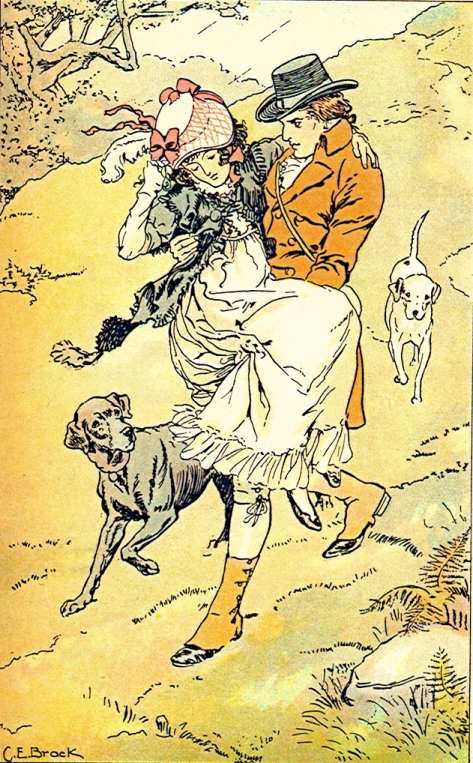
CE Brock, S&S – Willoughby rescuing Marianne
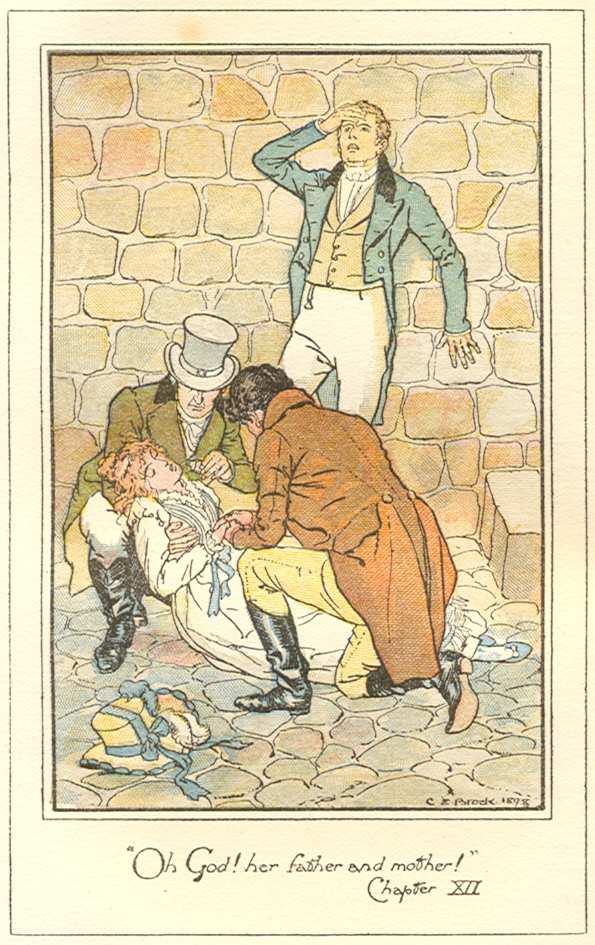
CE Brock, Persuasion, 1898: The Fall! / The Letter!
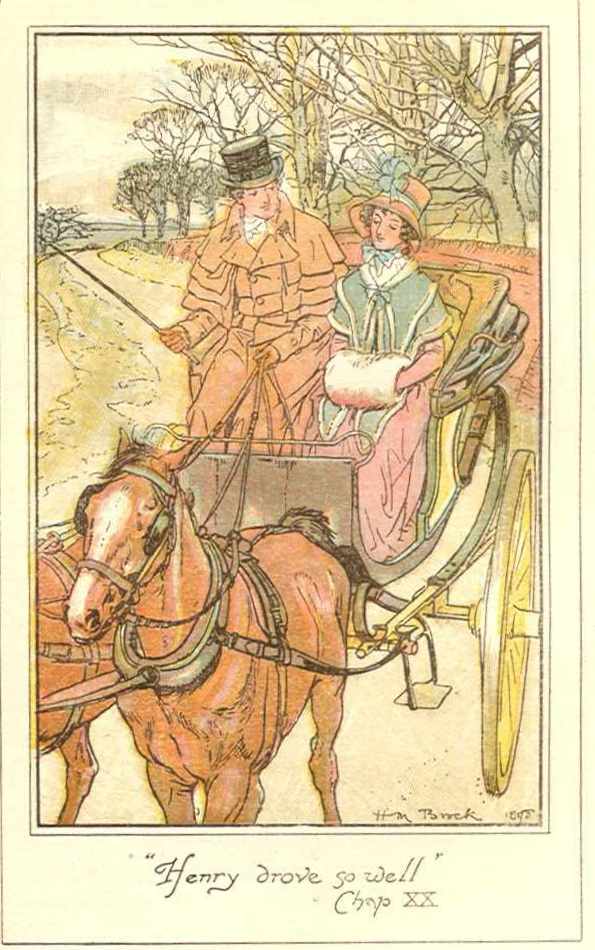
HM Brock, NA, Henry drove so well [Mollands]
HM Brock, MP, Mary and her Harp
********************
Compare:
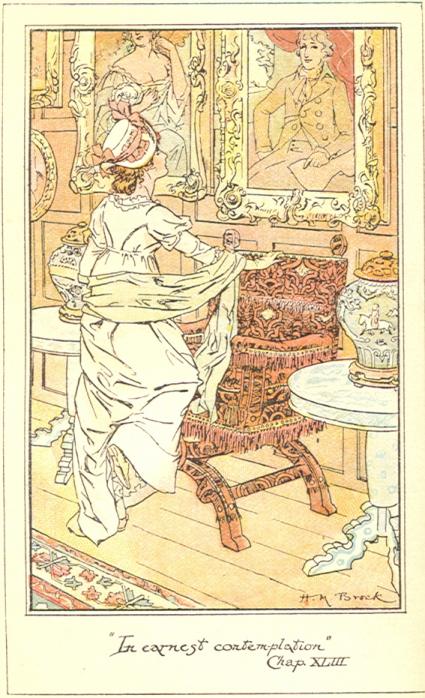
One of my favorite scenes in Pride & Prejudice is Elizabeth “in earnest contemplation” – here we can see CE Brock’s line drawing for Macmillan in 1895 and HM Brock’s in 1898, and CE Brock’s in 1907 [are you sufficiently confused yet??]
CE Brock, Macmillan, 1895 / HM Brock, Dent, 1898
CE Brock, Dent, 1907 [though this is not exactly the same quote you get the idea…]
*************
You can see the many Brock illustrations for the various editions of each novel by visiting the amazing Molland’s here: http://www.mollands.net/etexts/
******************
The Brocks are most often compared with Hugh Thomson: there are various critical interpretations of these two most popular Austen artists, some more approving of Thomson’s humor and his almost caricatured characters, while others preferring the more effective facial expressions and body language of the Brocks that seem more realistic despite the rather overdrawn borders and settings – do notice the detail in the fashion, the furnishings, and landscape, and what scenes are chosen – we can compare these to Thomson in future posts. The point is, you need them both…
Stay tuned for a post on Hugh Thomson and his several Jane Austen editions – in the meantime, tell me your favorite of the Austen illustrators – I haven’t posted about mine yet…
I shall take a little side road today with this discussion of must-haves in your Jane Austen collection – here an example of a book Jane Austen had read, referred to, satirized, and which then became the most interesting thing about Mr. Collins in Pride and Prejudice.
Part of collecting Jane Austen is to learn about and possibly add to your collection those books known to have been read by her, a fascinating list compiled from the many allusions in her novels and her letters. You can start with R. W. Chapman’s “Index of Literary Allusions, which you can find online.
Chapman’s list first appeared in the NA and P volume of the Oxford edition we looked at last week – more has been added to this – but this is a good start – you could spend the rest of your life just collecting “allusion” books and you will completely forget what you were collecting in the first place.
But Fordyce is one you must have, should read, for if nothing else it will give you a better idea of where Mr. Collins is coming from and what Austen has to say about both he AND Fordyce.
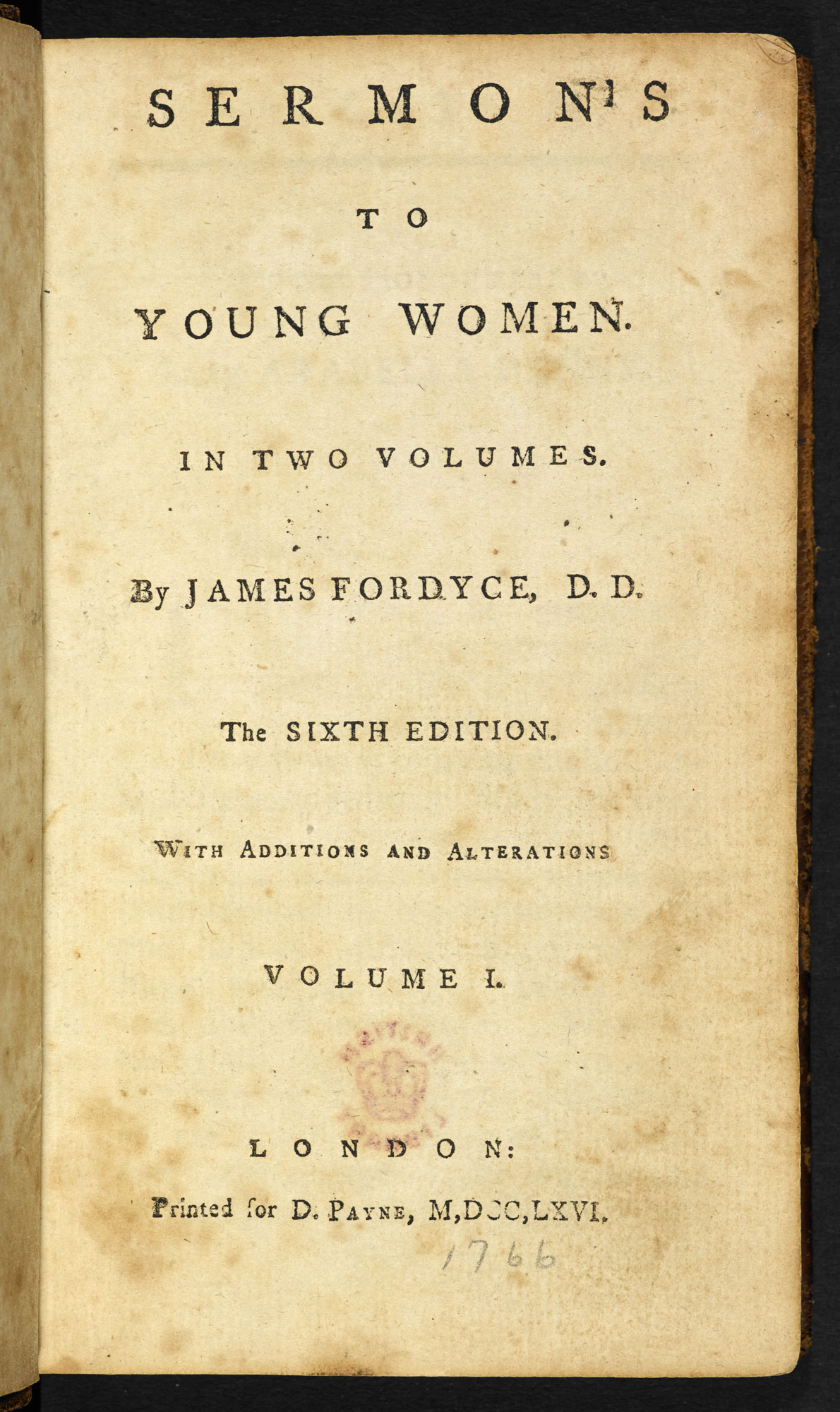
Sermons to Young Women, by Dr. James Fordyce, is certainly one the most well-known of all the various conduct manuals Austen would have had access to, published in London in 1766, “and by 1814, the year after Pride and Prejudice appeared, it had gone though 14 editions published in London alone.” [Ford, intro, i].
We all recall that in Pride and Prejudice, Mr. Collins chooses to read Fordyce’s Sermons aloud to the Bennet sisters, Lydia especially unimpressed:
By tea-time, however, the dose had been enough, and Mr. Bennet was glad to take his guest into the drawing-room again, and, when tea was over, glad to invite him to read aloud to the ladies. Mr. Collins readily assented, and a book was produced; but, on beholding it (for everything announced it to be from a circulating library), he started back, and begging pardon, protested that he never read novels. Kitty stared at him, and Lydia exclaimed. Other books were produced, and after some deliberation he chose Fordyce’s Sermons. Lydia gaped as he opened the volume, and before he had, with very monotonous solemnity, read three pages, she interrupted him with:
“Do you know, mama, that my uncle Philips talks of turning away Richard; and if he does, Colonel Forster will hire him. My aunt told me so herself on Saturday. I shall walk to Meryton to-morrow to hear more about it, and to ask when Mr. Denny comes back from town.”
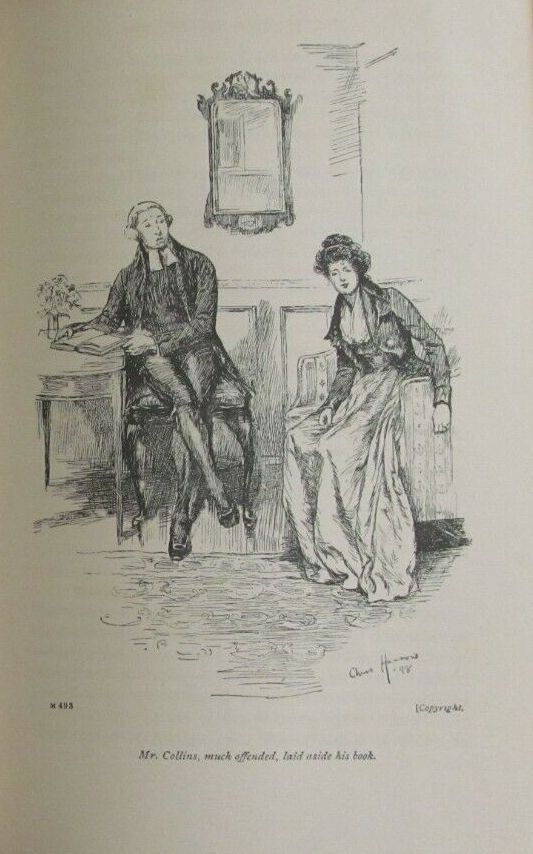
Lydia was bid by her two eldest sisters to hold her tongue; but Mr. Collins, much offended, laid aside his book, and said:
“I have often observed how little young ladies are interested by books of a serious stamp, though written solely for their benefit. It amazes me, I confess; for, certainly, there can be nothing so advantageous to them as instruction. But I will no longer importune my young cousin.” [P&P, Ch. XIV]
Collins, done with such young and frivolous young ladies, heads off for a game of backgammon with Mr. Bennet…
Illustrators of Pride and Prejudice have turned this scene into a visual treat:
Hugh Thomson, P&P (George Allen, 1894)
Chris Hammond, P&P, Gresham, 1900
**************
Fordyce (1720-1796) was a Scottish Presbyterian minister and a poet, but is most known for his Sermons. He also published Addresses to Young Men in 1777. But would we even be talking about him today if it weren’t for Jane Austen??!
As for his poetry, this is the only poem to be found on the Eighteenth-Century Poetry Archive, attesting to Fordyce’s seeming obsession with Female Virtue…
TRUE BEAUTY
The diamond’s and the ruby’s blaze Disputes the palm with Beauty’s queen: Not Beauty’s queen commands such praise, Devoid of virtue if she’s seen.
But the soft tear in Pity’s eye Outshines the diamond’s brightest beams; But the sweet blush of Modesty More beauteous than the ruby seems.
If your main concern is with “Female Virtue,” the University of Toronto has these two abstracts for your reading pleasure – From Sermon IV: On Female Virtue; and From Sermon V: On Female Virtue, Friendship, and Conversation: http://individual.utoronto.ca/dftaylor/Fordyce_Sermons.pdf
Much has been written about Austen and Fordyce – the point being, you need a copy. You can find it in one of its original editions on used bookstore sites for not over the top prices – or there are many, many reprints out there.
One of the best of these is the facsimile reprint of the 10th ed. of 1786 and published by Chawton House Press in 2012. Susan Allen Ford wrote the valuable introduction and it also includes a fine bibliography. This edition is unfortunately out-of-print and I am hoping that they will republish it in the near future. It was a best-seller in its time and again today! Who knew!
1923 large paper ed. with the 1932 Letters – 7 vols – with frontispiece to ‘Emma’: Ball Dress from Ackermann’s Repository, October 1816 [Louella Kerr Books]
I mentioned in the first post on collecting Jane Austen, that the Oxford edition of the novels edited by R. W. Chapman is essential, so now a little history.
Here is how David Gilson annotated this edition in his Bibliography under the year1923:
E150. The Novels of Jane Austen: the text based on collation of the early editions by R. W. Chapman. With notes, indexes and illustrations from contemporary sources. 5 volumes. Oxford: Clarendon Press, 1923. 1000 sets …
And then goes on for 5 pages [p. 296-300].
Gilson notes an undated memorandum in the files of the Clarendon Press: “The publishers are bitterly opposed to any imaginative illustrations, and would cheerfully have no illustrations at all. But they would be in favor of a few objective illustrations.”
“They” were perhaps responding to Henry James who had famously complained that the public’s enthusiasm for Jane Austen was being aided and abetted “by a body of publishers, editors and illustrators who find their dear, our dear, everybody’s dear, Jane, so infinitely to their material purpose, so amenable to pretty reproduction in every variety of what is called tasteful, … and what proves to be saleable form.”
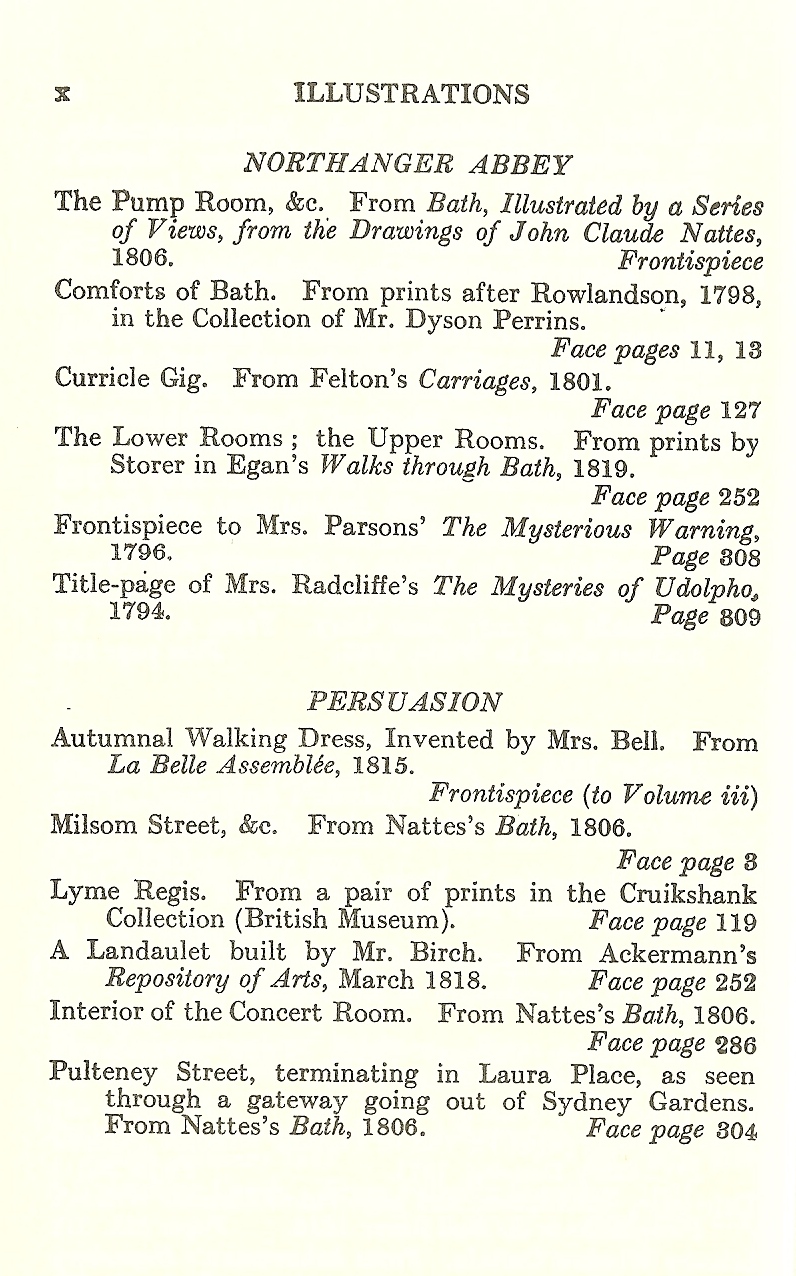
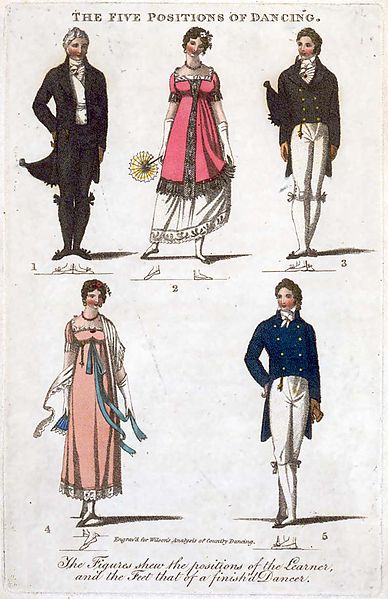
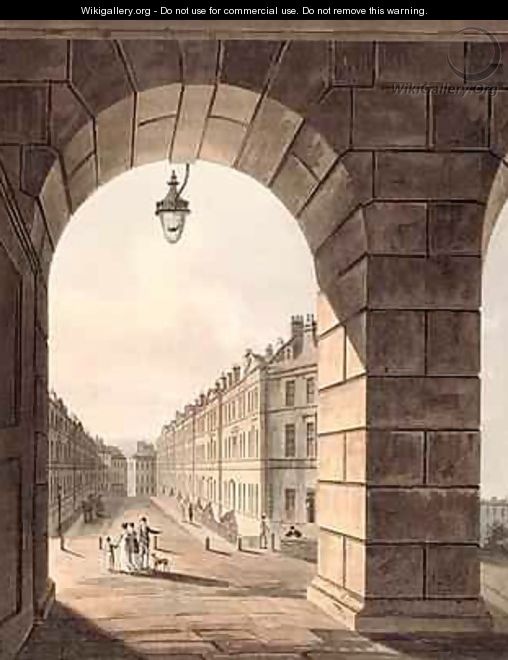
Chapman did choose “objective” illustrations – from contemporary sources that Jane Austen would have been familiar with: the landscape, art, architecture, fashion, carriages, etc. of the time period. The lists of appendices (essays on the times, Austen’s language, chronologies and Index of Characters, etc.) and the illustrations found in all 5 volumes are repeated in each volume.
Here is the list of all the illustrations:
Only 1000 sets were printed, 950 for sale – the value of this 1st edition set is about $1,500 and is described as the “Large Paper Edition” by booksellers. The set pictured above included the 1934 2-volumes Letters and sold for $5,500 a few years ago [not to me unfortunately!]
Some of the contemporary illustrations that Chapman chose we are all now quite familiar with – here are just 3 examples:
In P&P: frontispiece for Wilson’s Analysis of Country Dancing, 1811 / In P: Pulteney St, Natte’s Bath, 1806From P: A Landaulet by Mr. Birch. Ackermann’s Repository, March 1818
****************
There are various re-printings of this Oxford set and buyer beware as to what you are getting – here’s a quick analysis:
The set was reissued in 1926 and though called a “Second edition,” it was really just a reprint on cheaper paper and less elaborate illustrations. A note to this edition and some additional notes by Chapman are included.
1926 – 2nd edition covers and title page [Charles Bossom , Abebooks]
In 1933, the 5 volumes were re-printed again as a “Third edition” but the text was printed from the same plates, so not officially a 3rd ed at all.
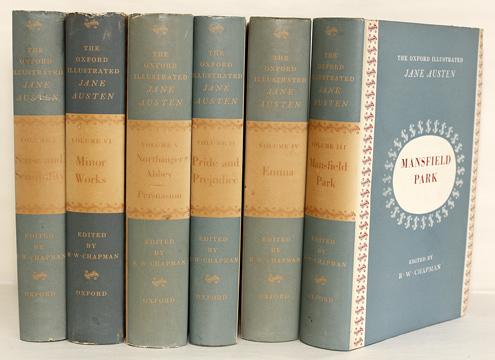
After various re-printings [see Gilson’s notes on these], the Oxford set was issued in 1965-66, now called the official 3rd edition – same text but with alterations to notes etc. by Mary Lascelles based on Chapman’s notes. Chapman had issued the Minor Works volume in 1954, and the set has been the 6 volumes ever since.
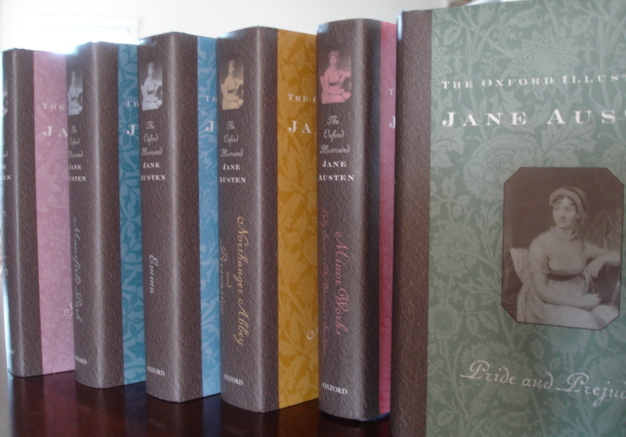
1950s printing with volume 6, the Minor Works [1st published in 1954]
Oxford ed, 1988 printing – $175. [but you can find it for less]
Just to give you an idea of the confusing publishing history and the possible printings out there, here is the copyright notice in one of my sets, the 1988 printing you see above:
This Chapman set was the first to offer complete scholarly notes and textual analysis for an English author and has been the source for citation ever since. The Cambridge Edition of the Works of Jane Austen, with Janet Todd as General Editor and each of the novels edited by a different Austen scholar, began publishing in 2005 [it is now complete in 8 volumes with Juvenilia and Later Manuscripts included.] This has begun to supersede the Oxford set for citation purposes. You really need them both, as daunting as that might be! More on this Cambridge set in another post.
Frontis to ‘Lovers’ Vows’ in the Oxford ‘Mansfield Park’
I am cheating this week by copying and expanding an old post, but as it fits nicely into the “collecting Jane Austen” theme, I shall hopefully be pardoned [plus the original post is 11 years old!]
This post began back in February of 2009 when Laurel Ann at Austenprose asked about the illustration by Paul Hardy in my post on Henry Tilney. This illustration was the frontispiece in an undated Blackie & Son [London] edition from the late 19th – early 20th century. There is a bookseller ticket for “R. F. Hunger, Stationer & Printer.”
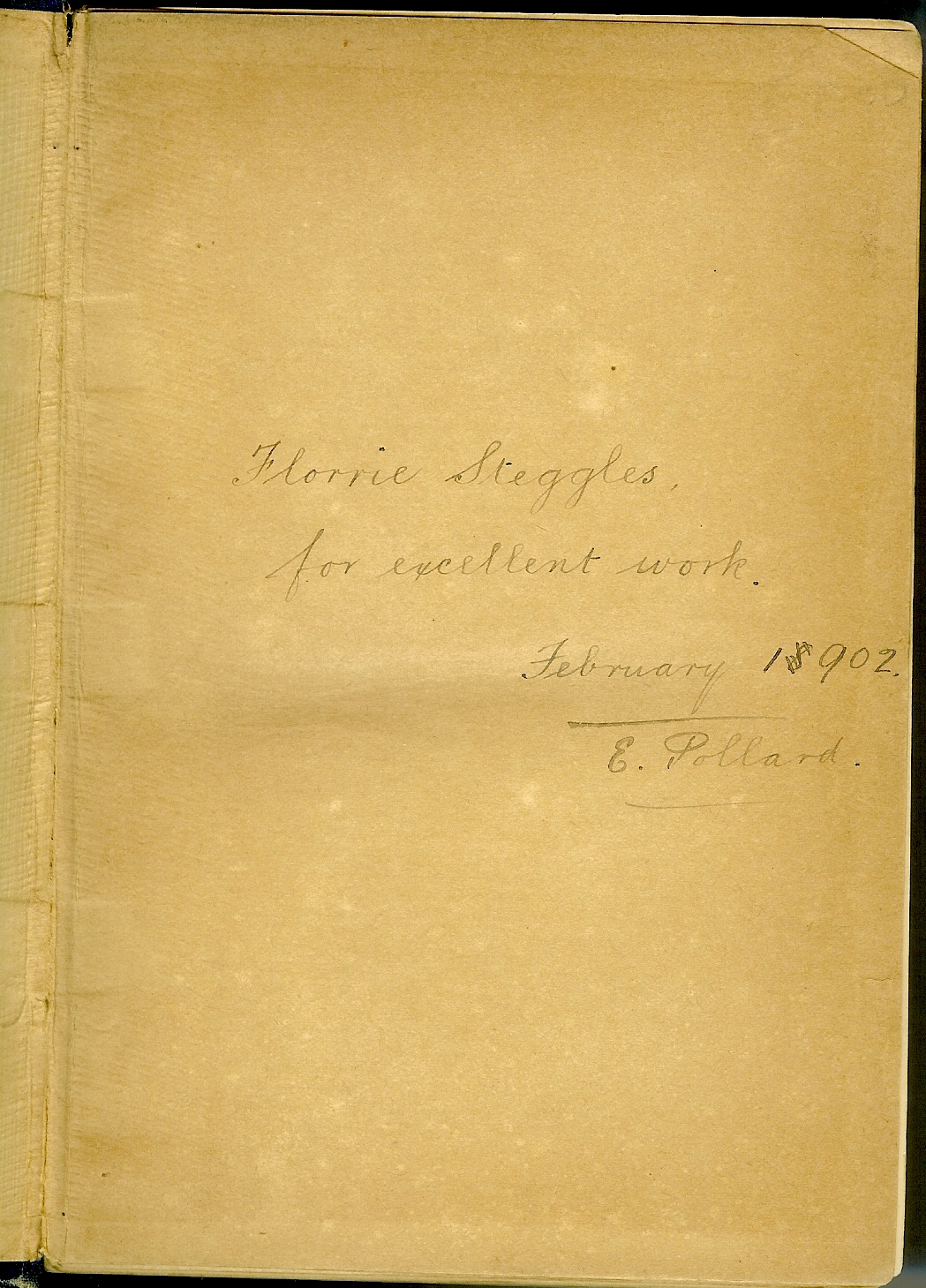
And there is an inscription dated February 1902 that reads – “Florrie Steggles, for excellent work. E. Pollard 1902.” [this is why I love inscriptions!] … what a gift for a young lady to receive! [Notice the inscriber first wrote 8 rather than 9 in 1902 – over a year later and still not used to the 1900s!)
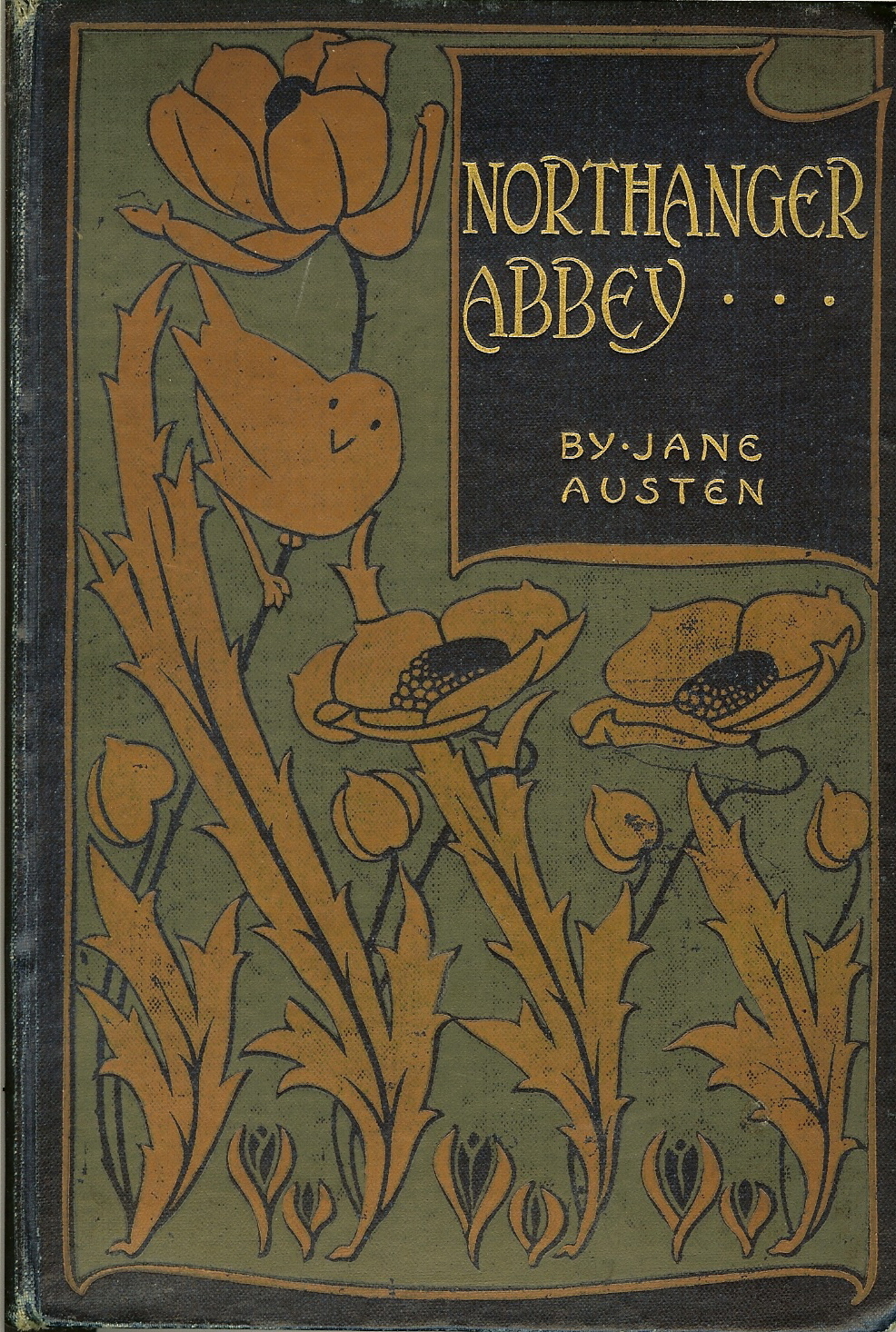
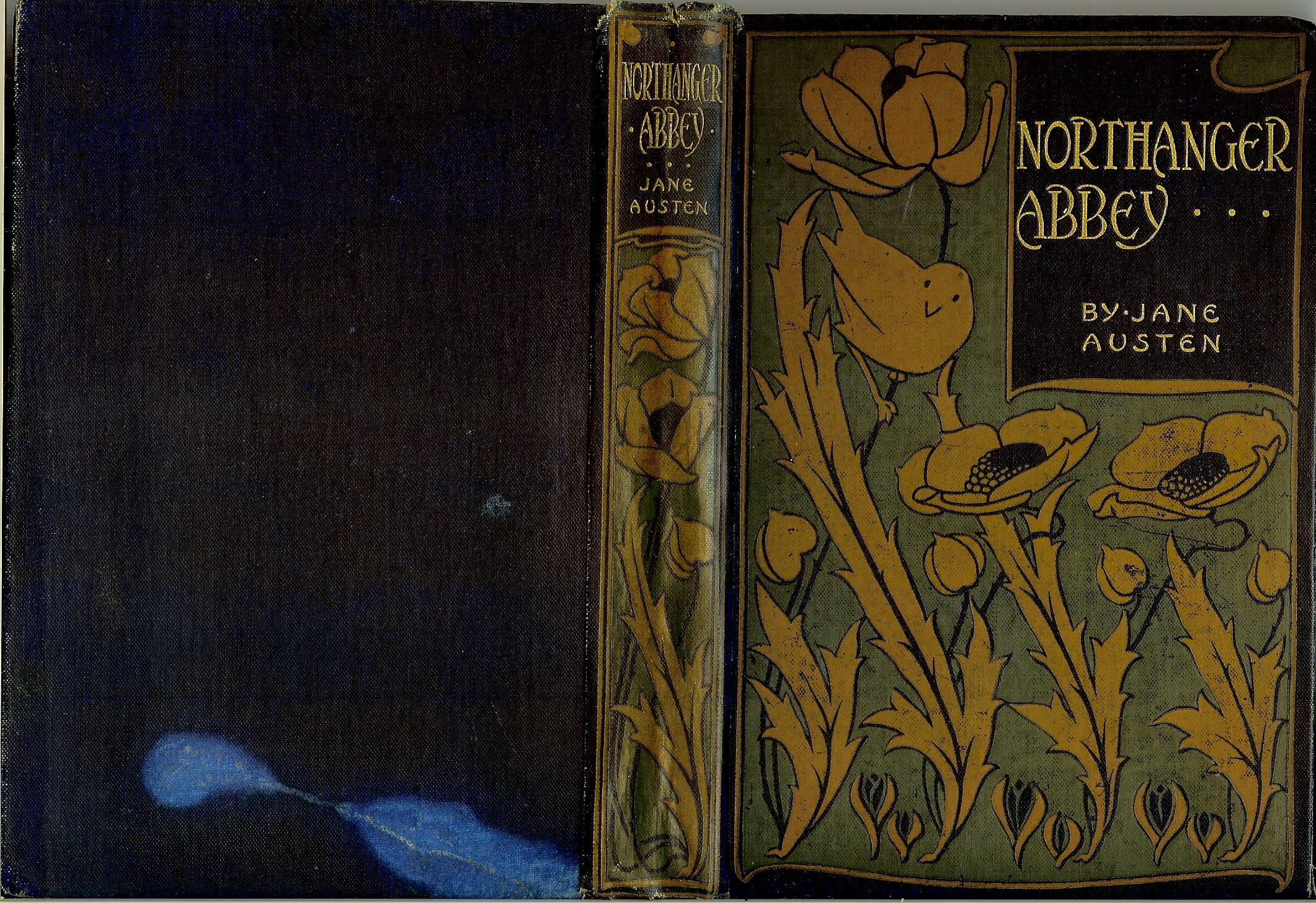
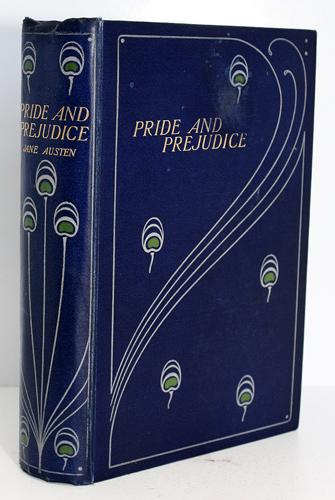
I bought this book for its cover alone [alas! the pages are quite browned and there is only one illustration], but the Art Nouveau unsigned decorative binding is just lovely, the spine also decorated – it is a welcome sight on my book shelves:
You can also see this rather unfortunate stain on the rear board – a damp stain that faded the navy cloth to this beautiful blue!
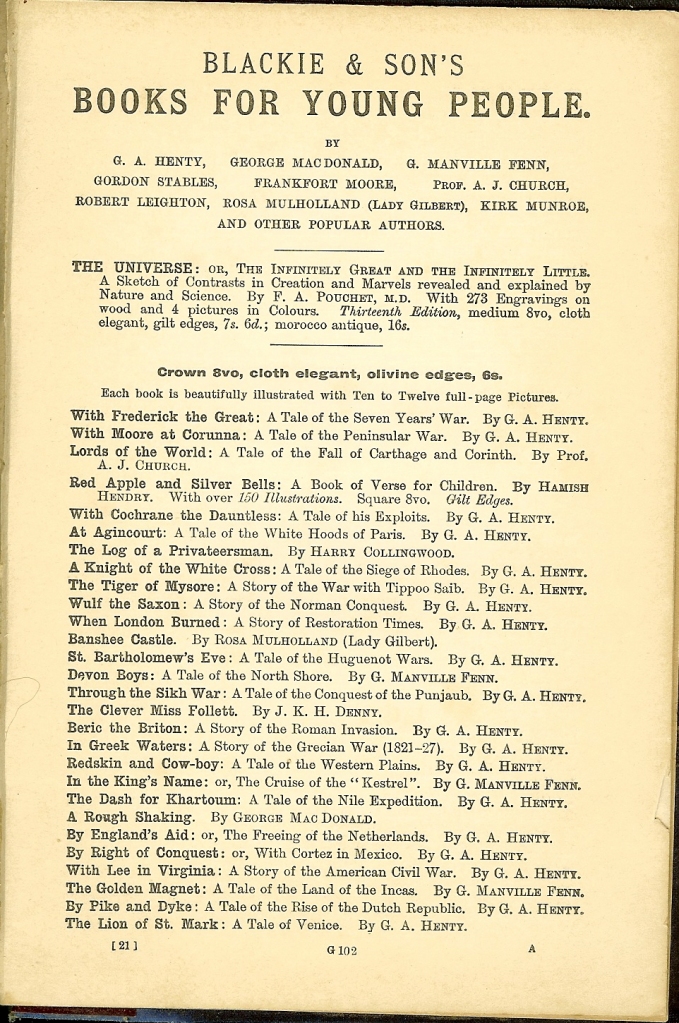
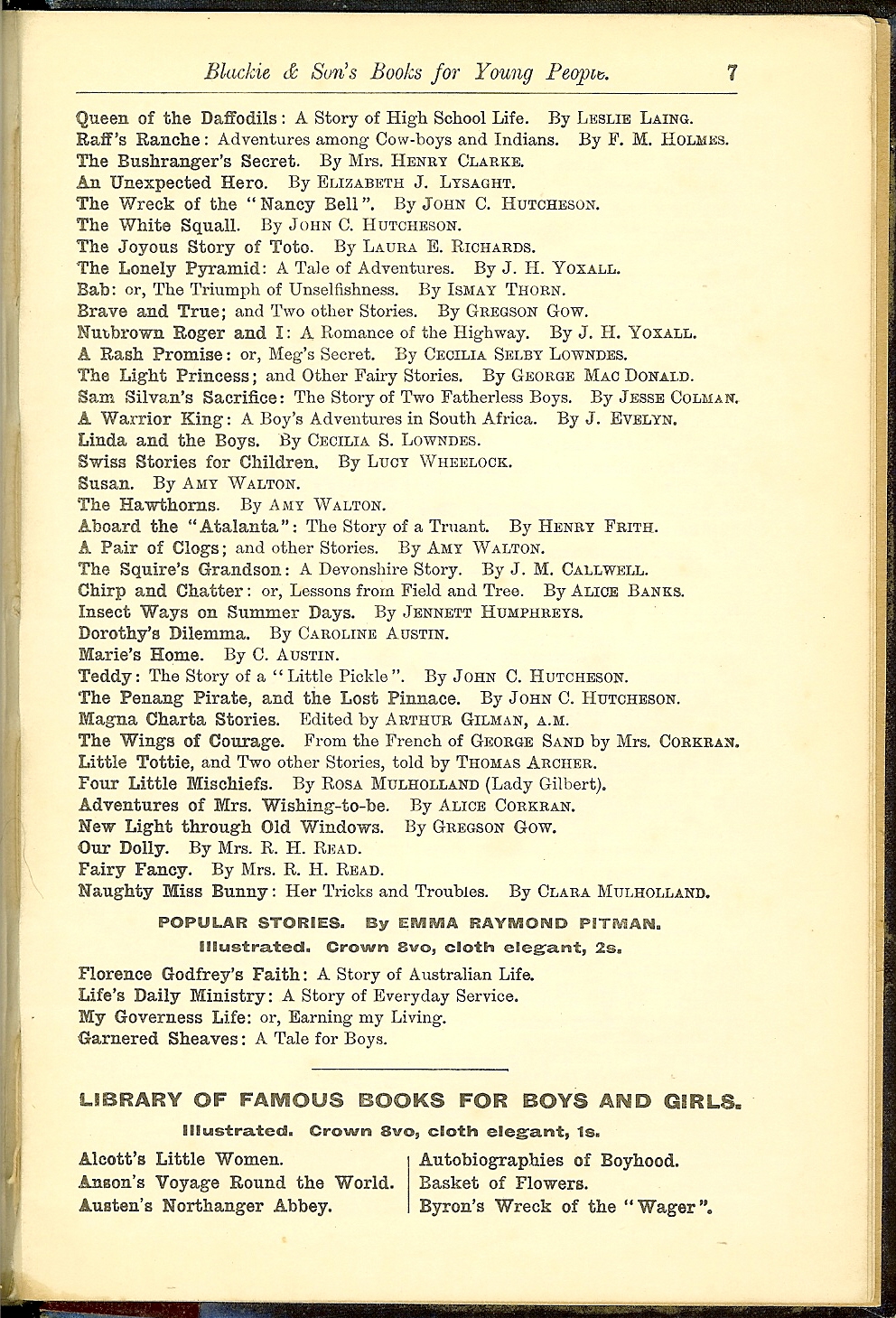
There are 8 pages of advertisements for Blackie & Son’s in the rear: here the first page and page 7 with Austen’s Northanger Abbey listed under “Library of Famous Books for Boys and Girls.”
The one and only illustration is by Paul Hardy:
“Bath, compared with London,” said Mr. Tilney, “has little variety.”
Paul Hardy (1862-1942) was an English illustrator, known for his illustrations in The Strand Magazine and his painting of Canterbury Pilgrims. Austen is listed as one of the novelists he illustrated, but I find only this Northanger Abbey. You can read about Hardy and see a good number of his illustrations here: https://commons.wikimedia.org/wiki/Category:Paul_Hardy_(illustrator)
Hardy’s efforts to get the Regency right are a tad off – he seems to have a confused fashion sense! – your thoughts??
As for collecting, scouting out the decorated covers of Austen’s works is a worthy endeavor. Both Janine Barchas’s The Lost Books of Jane Austen (Johns Hopkins, 2019), and Margaret Sullivan’s Jane Austen Cover to Cover (Quirk, 2014) are excellent references to aid in your search.
Do you have any favorite covers in your Austen collection?
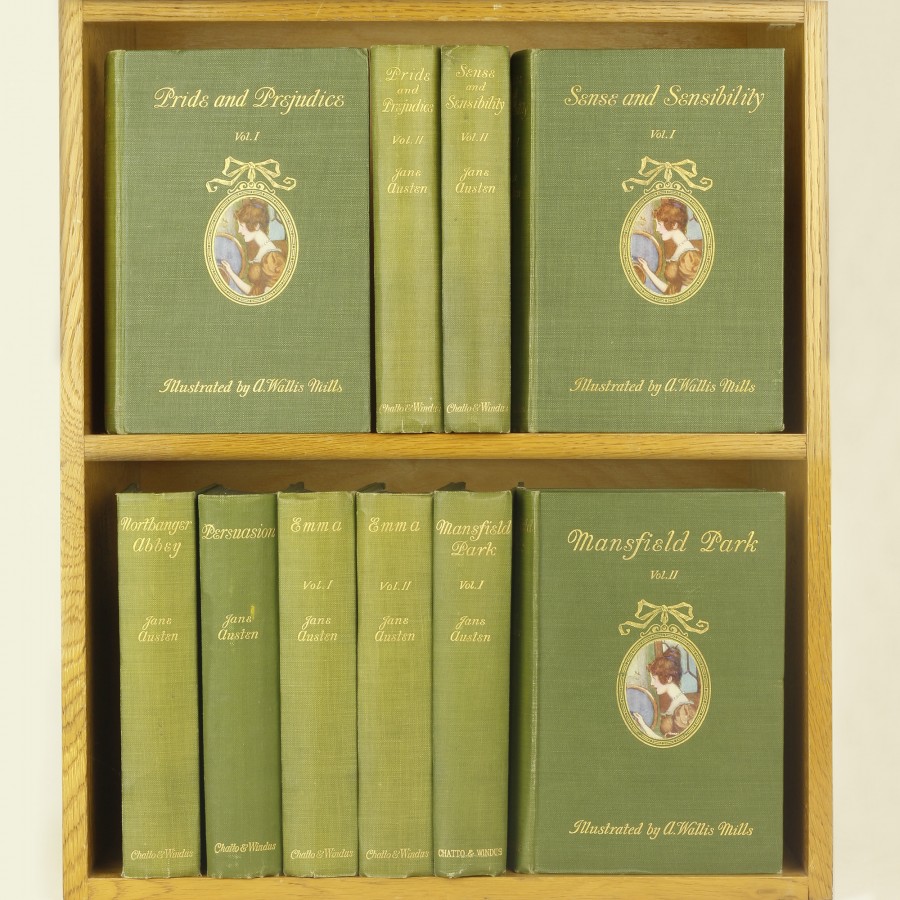
The Novels of Jane Austen. London: Chatto & Windus, 1908-09 [Source: Jonkers Rare Books]
At number E117 in the Gilson Bibliography we find this 10-volume set listed with the following description:
“Printed by Arden Press, Letchworth. Olive green cloth gilt, with small oval colour illustration pasted down on each front board, endpapers [same in all volumes] reproducing a watercolour drawing by A. Wallis Mills, green dustwrappers printed in black. A general introduction and introductory notes by R. Brimley Johnson, title pages printed in blue and black, each volume has a frontispiece and nine other colour plates also by Mills [they plates do not always face the page specified in the illustration].
The volumes were available separately, or as a set bound in whole green parchment. Reissued in 1925 by George C. Harrap, London, bound in mid brown diagonal fine-ribbed cloth, otherwise identical with the original issue.”
So, I don’t actually have this full set, just the Persuasion volume, the one novel I focus my collecting energies on. I was doing a talk on illustrating Persuasion and wanted to have my own copy, and I broke all the rules of collecting to get it – I found it online, knew it was in terrible condition, but bought it anyway – it didn’t cost much and I wanted it for the illustrations and the endpapers. Alas!, it smells – so it is kept in its own place and not on the shelves with my other Persuasion copies – but, no regrets.
I am posting on this for a few reasons – because it is often the illustrated editions that are the most interesting and therefore the most collectible. And while we know our Brock and Thomson and Hammond editions, this set is not as well known.
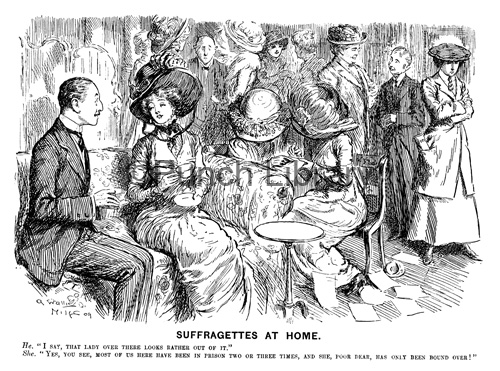
A[rthur] Wallis Mills [1878-1940] was a British artist of mostly humorous subjects – he is famous for his cartoons and illustrations for Punch and The Strand magazines, and he illustrated more P. G. Wodehouse stories than any other artist.
“Suffragettes at Home” for Punch Magazine, published 14 April 1909.
He: I say, that lady over there looks rather out of it’. She: Yes, you see, most of us here have been in prison two or three times, and she, poor dear, has only been bound over!’
We might wonder why Chatto chose a political cartoonist to illustrate Austen – but at least we can give them credit for acknowledging her satirical wit.
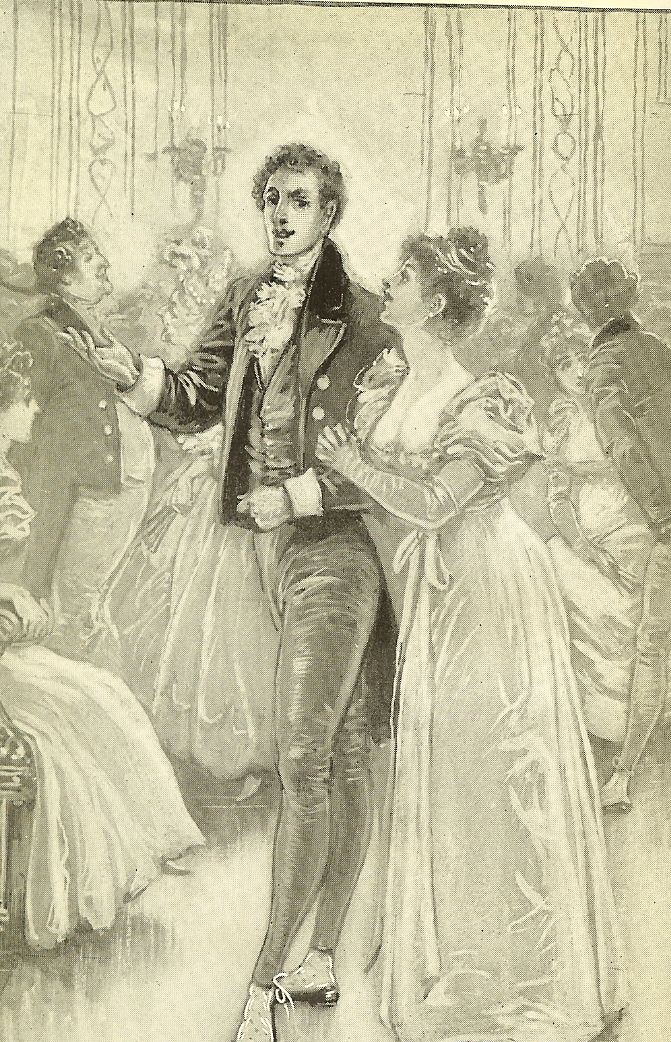
Here is a composite of a number of the illustrations across all the volumes:
A review of the two Sense and Sensibility volumes in the set appeared in The Literary Digest of October 1908, page 561, published by Duffield & Co., New York: the reviewer wrote:
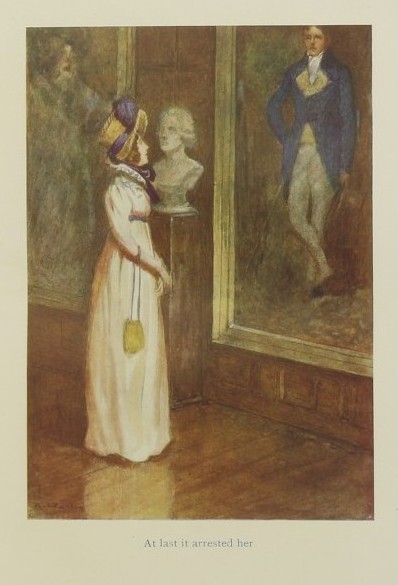
“These two volumes in the new ten-volume set of Jane Austen’s writings, illustrated in colors by A. Wallis Mills, follow closely upon the publication of the first two, which contained “Pride and Prejudice.” Mr. Mills has caught the spirit of the original rather better in these volumes than he did in the other. His Mr. Darcey [sic] was not quite convincing, nor were his Miss Bennets, altho he was more successful with Mrs. Bennet—quite successful, in fact. In the present volume his Sir John is entirely satisfying and so are Mrs. Jennings and Mrs. Ferriar. We like immensely, also, his Dashwood girls. His picture of Mrs. John Dashwood’s arrival in her new home is entirely adequate. A more satisfying edition of Jane Austen is not known to us.”
[One can only assume the reviewer never saw a single Brock, Thomson, or Hammond!]
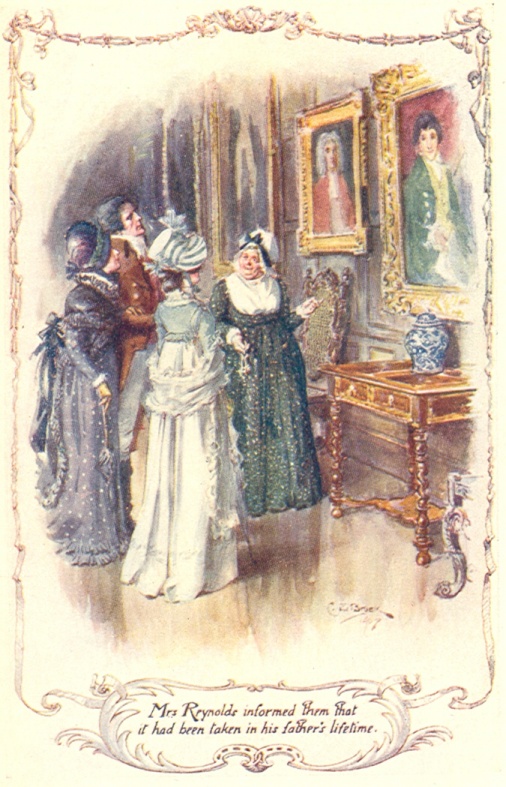
Here’s a larger image of the scene of Elizabeth in “earnest contemplation” of Mr. Darcy’s portrait – I cannot help but agree with the above reviewer’s opinion of Mr. Darcy:
Though I find him a far better Darcy here:
***********************
What most interests me about these Mills illustrations is that the Austen illustrator Joan Hassall found them so distasteful, she did the unpardonable [in my view] with regard to a book: She writes, “Unfortunately, I could not like these pictures and spent a long time perseveringly tearing out about 50 coloured plates.” [JAS Report, 1973] – which means she left 50 intact – I wonder which ones! David Gilson calls them insipid! – these are very strong responses to poor Mr. Mills, and sure proof that the illustrations in a Jane Austen novel can either make or break the story for you.
Here are some examples from the set:
the very busy endpapers
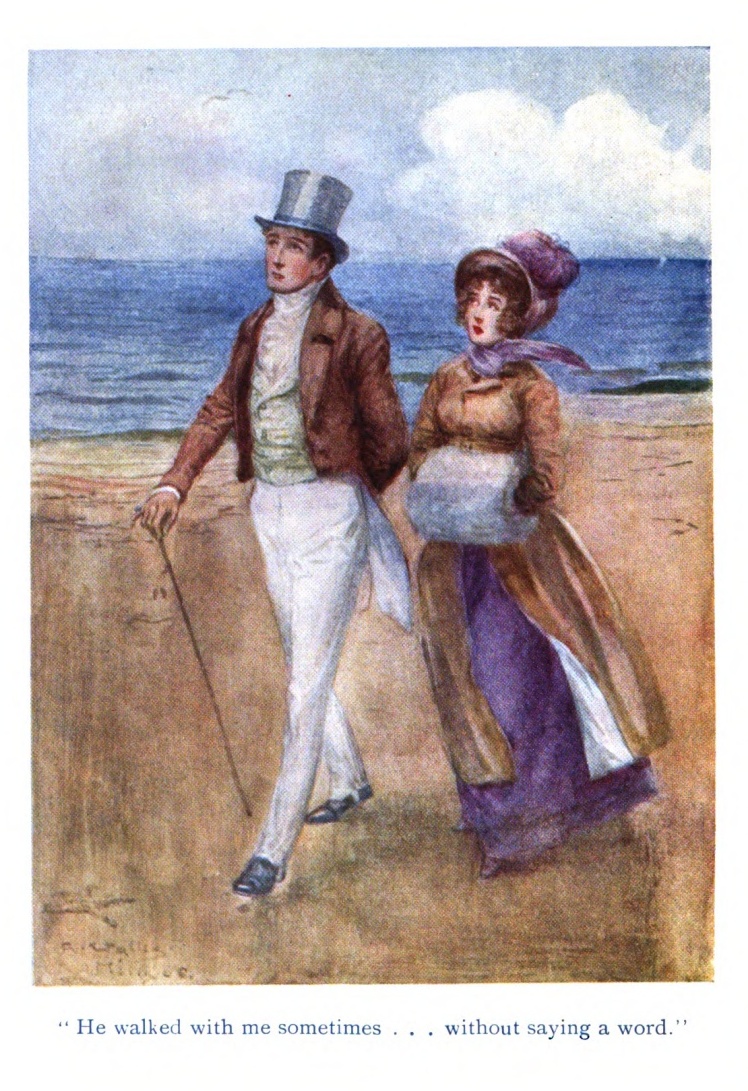
From Persuasion – here is the frontispiece, which makes no sense at all – it is the frontispiece, which should be a grand introduction to the book, and here we have Benwick and Mary Musgrove walking the beach at Lyme Regis – can you recall they even did this together?? Certainly no poetry conversation between them…
And this also from Persuasion of Charles Musgrove and Benwick “rat-hunting”: Musgrove a dead ringer for Prince Charles [and again, a rather odd scene to illustrate…]:
We must see Captain Wentworth or you shall never forgive me…he’s on the left looking rather disturbed… cramped “on the same sofa… divided only by Mrs. Musgrove, no insignificant barrier indeed…” and perhaps wondering why he ever left his ship…
I don’t find Mr. Mills’ attempts at giving us Austen’s humor in watercolor as awful as some – I do think they are a tad wishy-washy and far too-cute, but he is spot-on with the fashions and his humorous side is apparent, just maybe not as effective as Hugh Thomson? I do think you need to see all the illustrations from each volume to get the full effect, his comedy more subtle. They in some ways remind me of the 2013 Royal Mail postage stamps by Angela Barrett, where you can see the Persuasion scene is that of Mr. Elliot first spotting Anne on the Cobb:
Royal Mail Jane Austen Stamps, 2013
You find these volumes often sold separately, and often in not great conidtion [be sure to check for those 10 illustrations in each volume!] – full sets appear infrequently and might run to $1000 or more depending upon condition.
Thoughts anyone? Would you cut these illustrations out of your set [thereby making it worthless], or call them insipid??
Gentle Readers: In an effort to offer weekly posts on collecting Jane Austen, I shall start with the basics of book collecting – this a general summary of things to consider with a few examples specific to Jane Austen and Pride and Prejudice in particular. This will be followed by weekly posts on randomly chosen books in the various categories I list here that I think are essential to a Jane Austen collection.
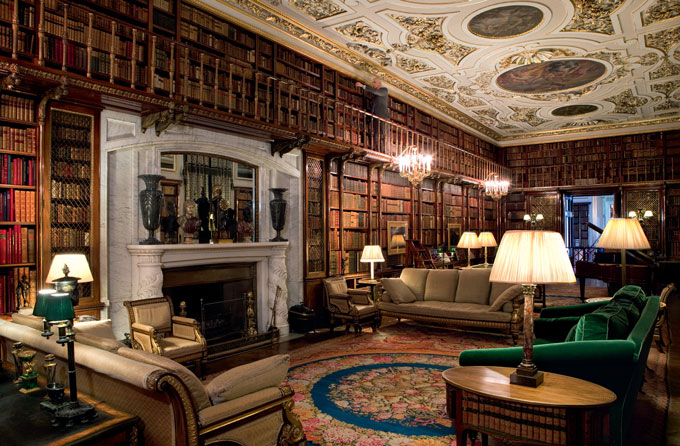
Let’s start in the pages of Pride and Prejudice in the library at Netherfield where we find Elizabeth, Miss Bingley, Mr. Bingley, and Mr. Darcy:
[Elizabeth] walked towards a table where a few books were lying. He [Bingley] immediately offered to fetch her others; all that his library afforded.
“And I wish my collection were larger for your benefit and my own credit; but I am an idle fellow, and though I have not many, I have more than I ever look into.”
Elizabeth assured him that she could suit herself perfectly with those in the room.
“I am astonished,” said Miss Bingley, “that my father should have left so small a collection of books. What a delightful library you have at Pemberley, Mr. Darcy!”
“It ought to be good,” he replied; “it has been the work of many generations.”
“And then you have added so much to it yourself, you are always buying books.” [my emphasis]
“I cannot comprehend the neglect of a family library in such days as these.”
And so, here we have the permission of Mr. Darcy himself to buy as many books as we would like!
II. The Collecting of Books:
Terry Belanger, a veteran book collector and rare book librarian once famously said “you are a collector if you have more than one copy of a single title” –
So, I ask you, how many of you have more than one copy of any of Jane Austen’s novels? And how many of you already realize that to collect all copies of books by and about Jane Austen is surely an impossible task? Even focusing on one title, say Pride and Prejudice, we would find it an impossible undertaking!
So where to start?
1. The first rule of book collecting is Collect what you Love – so I can assume that any of you reading this alllove Jane Austen, and so that will be our focus… and not only the books but also the myriad objects and ephemera. You can collect anything – my son collects Sneakers, only Nike Jordans, which leads to books about sneakers, etc…!
An amusing tale about collecting one title: In a used bookshop in England a few years ago I hit the mother-load of A Child’s Garden of Verses – a title I collect –
I brought five different editions to the register, manned by a young man obviously neither the owner nor all that well-versed in the vagaries of collecting – he hesitated for a moment, looked thoughtful, and finally blurted out “Do you know that all these books are the same?” [epilogue: I bought them all…]
2. Try to find the 1st edition (and by “first edition” I mean “first printing”), and how do we do that?
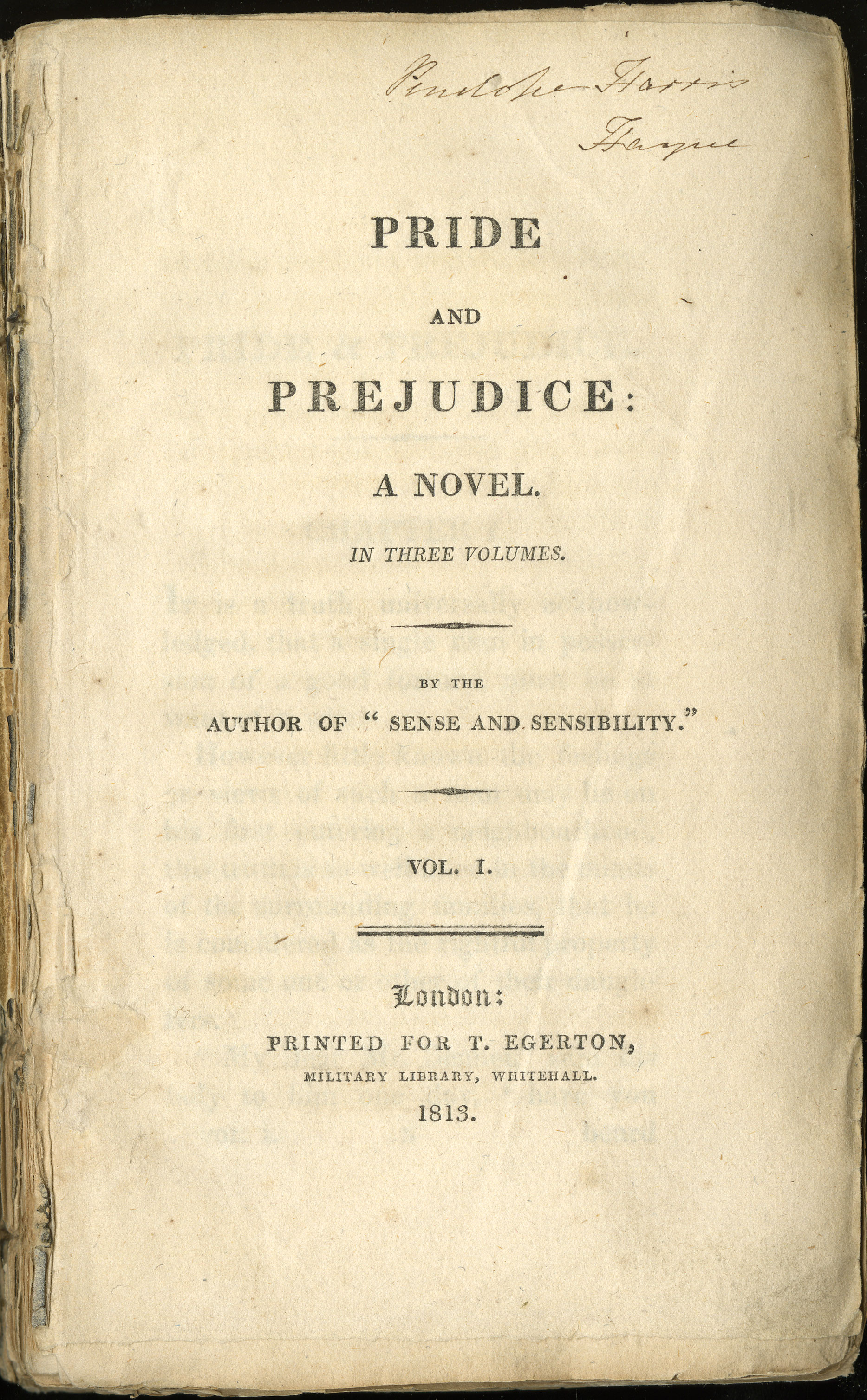
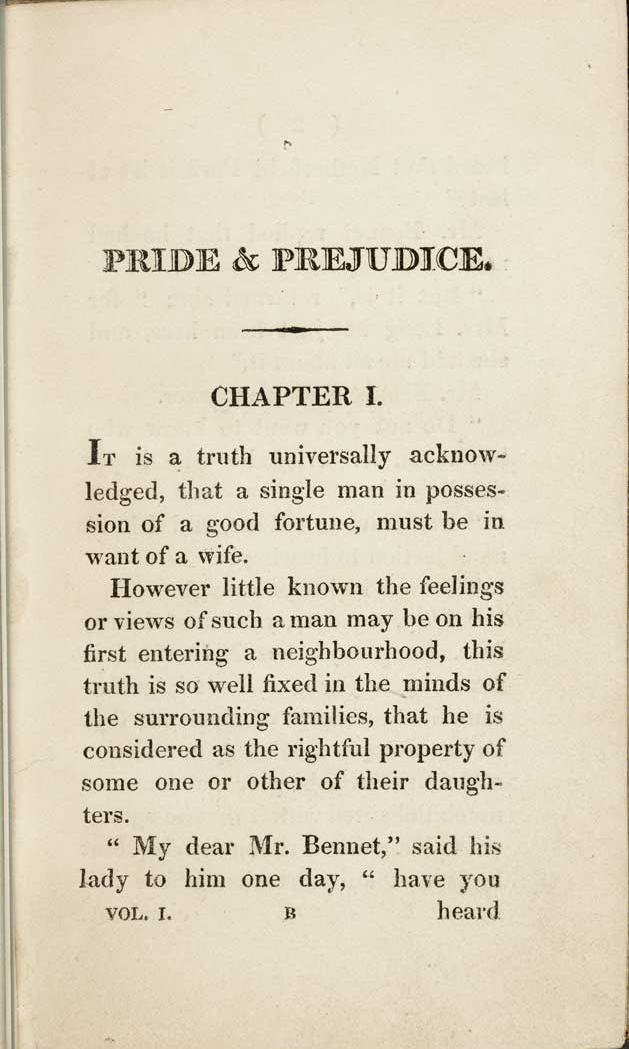
1st edition Pride and Prejudice [National Library of Scotland]
For most of us, Jane Austen first editions are beyond our pocketbooks – but you will need to know the basics of book collecting to understand why some books are harder to find, and why, when you find them, they can often be expensive.
It is here you will need to decide if you want the first edition in pristine condition or if you only need a reading copy, or not even a first edition at all – this is a question to ask at every purchase.
The most difficult aspect of book collecting is how to identify a first edition – every publisher did it differently and often changed their indicators over time. There are many guides to help with this.
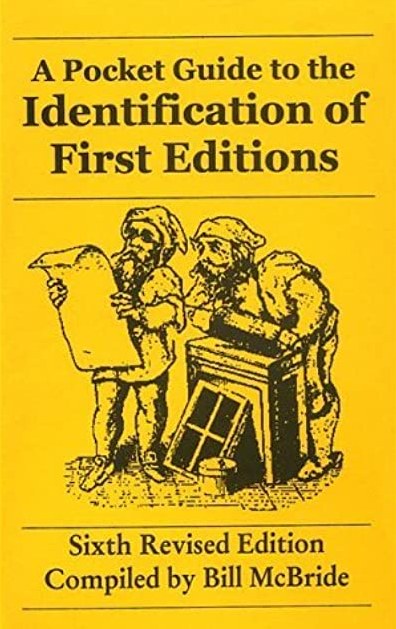
This Pocket Guide to the Identification of First Editions by Bill McBride is the best starting point for a general understanding of the practices of various publishers. You can also find this information online at Quill & Brush Books: https://www.qbbooks.com/first_ed_pub.php
Then you will need more specific detail on the author/subject you are collecting, and thankfully for us Jane Austen enthusiasts, David Gilson, and Keynes and Chapman before him, have largely done this work for us…
If you want to understand book terminology, you must have John Carter’s ABC for Book Collectors – the 8th edition by John Carter and Nicolas Barker. Oak Knoll Press / British Library, 2004.
4. Determining value: supply and demand – Desirability+Scarcity=Value
Is the book still in print?
How many copies were printed?
Is this the author’s first book? – Sense and Sensibility is the most valuable
How did the book first appear? – binding, dust jacket? [value greatly reduced if lacking jacket: 75% – fiction, 20% – non-fiction]. Eg. S&S first published in boards is more valuable than the finest leather binding
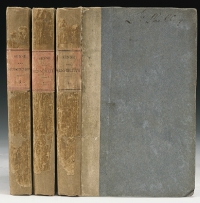
1st ed. S&S in original boards;
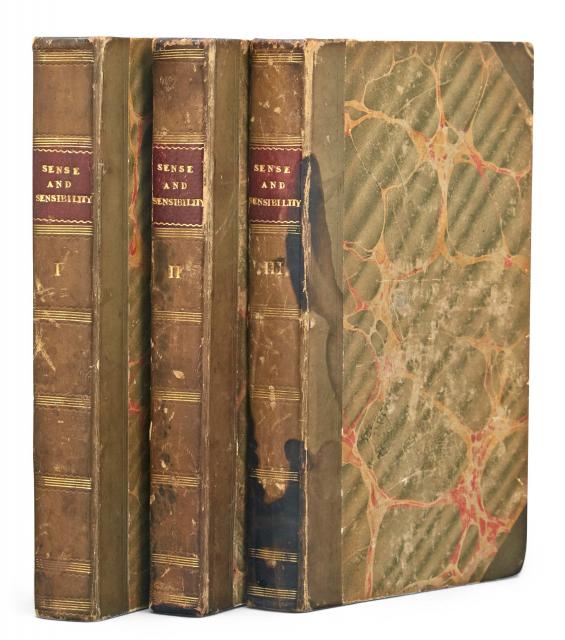
1st ed, S&S leather bound
S&S 1st ed in boards and leather bound]: estimated value: $200,000 / $50,000.
Illustrations present? are they all there?
Condition, Condition, Condition! – most important factor! [see more below]
Where do you find values? There are many guides to consult:
Allen and Patricia Ahearn. Collected Books: A Guide to Identification and Values. 4th ed. (2011); see also their author guides – one on JA from 2007
American Book Prices Current: auction sales, so actual value
Bookseller catalogues: what titles are selling for
Author and subject bibliographies
Internet: bookselling sites: be wary – prices all over the place
5. CONDITION is the most important issue: prices will vary depending upon condition – even if you have the 1st edition – if it is in deplorable condition that will affect the value.
Booksellers grade a book’s condition using the terms below, from “As New” down to “Poor”: for instance VG [for the book ] / VG [for the jacket] – anything less than a VG is really not collectible:
VERY FINE/NEW [VF / NEW]: As new, unread.
FINE: Close to new, showing slight signs of age but without any defects.
VERY GOOD [VG]: A used book that shows some sign of wear but still has no defects.
GOOD [G]: A book that shows normal wear and aging, still complete and with no major defects.
FAIR: A worn and used copy, probably with cover tears and other defects.
POOR: a mess really, but might have some redeeming qualities
READING COPY: any book less than VG
*************
An interesting tale to demonstrate this: The rare bookseller Stuart Bennett [no relation to our esteemed Bennet family!] writes in his book Trade Bookbinding in the British Isles 1660-1800.
Alas! pre-Austen, but we find her in a NOTE: [an aside – always check indexes for Jane Austen – you will be pleasantly surprised to see how often she turns up and in the most amazing places!]
Bennett writes in a footnote on the issue of publishing in boards vs. the wealthy having their favorite books bound in leather:
What is certain is that wrappered and boarded popular literature was not part of the visual landscape of country house libraries. In my experience these books, when kept, found their way into cupboards underneath the display bookcases, or into passages or rooms used by servants. In my days at Christie’s I once spent hours in the pantry cupboards of a Scottish country house, searching through stacks of these wrappered and boarded books among which I found, virtually as new, Volume III of the first edition of Sense and Sensibility. When I found the other two volumes I remarked to the aristocratic owners that this was one of the most valuable books in the house, as exceptional survival in original condition, and doubtless so because one of their ancestors had bought Jane Austen’s first novel, read it, and hadn’t cared enough to send it to for rebinding, and never bought another. My ebullience was arrested by an icy stare from the Countess, who replied, “I am sure, Mr. Bennett, that our ancestors would never have felt that way about Jane Austen.” [3]
Stuart tells me: this S&S set the then-record auction price in 1977 or 1978 (he was the auctioneer!), and turned up about twenty or maybe 25 years later offered by a London bookseller for, as he recalls, $200,000. Then it disappeared again.
Question: Should you buy a less collectible book because you cannot afford the higher price? – do you just want a reading copy or need to fill a gap in your collection? – you can decide this on a case-by-case basis – what becomes available and when and how much you can spend…
6. Where to find Books:
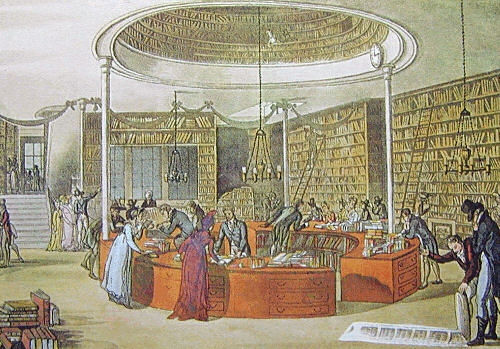
“Beauty in Search of Knowledge” – Thomas Rowlandson
– Local bookstores: sadly less of them, but still the best resource of Jane Austen books – a bookseller who will know your likes, will buy with you in mind, someone to trust… – Specific booksellers: those who specialize in Jane Austen and other women writers – shops, catalogues – you can find at book-fairs, being on their catalogue mailing list, and on the internet. For eg. Jane Austen Bookshttps://www.janeaustenbooks.net/ – Auctions / auction catalogues – The Internet: major used bookselling sites: you need to be an informed consumer!
The Good, the Bad, and the Ugly of the Internet: I could write a very lengthy post just on this – so I will only emphasize the biggest positive – you have at your fingertips a Global marketplace – no longer dependent on a brick & mortar shop around the corner [sad as this is to me!]
Biggest negative: be in be-wary mode – who are you buying from? – how to decide which is the best copy with so many price and condition discrepancies? – my best advice? – choose a bookseller who knows what they are about: valid and complete descriptions and a price that seems reasonable in light of other copies on offer.
A word about EBAY: a Gigantic auction house always open! – an amazing resource but also the biggest potential for getting a bad deal – you need to be an informed consumer!
Best use of the internet: Want Lists – most book sites do this and auction houses offer “alerts” – you will be notified when an item becomes available…
7. Caring for your collection: lots of information here to consider…just not today.
II. What to Collect:
Now comes the hard part – with so much out there on Jane Austen, where do you even begin? The need to focus on one particular aspect [say just collecting copies of Pride and Prejudice], or by zeroing in on a certain illustrator you like [the Brock brothers], or only books with fine decorative bindings [so many] – this list covers the gamut of possibilities – you just need to choose what you are most interested in. You must however start with a core collection:
A. A Jane Austen Core Collection
Oxford edition of The Novels of Jane Austen, ed. R. W. Chapman, 3rd ed.
1. The Works: the Oxford edition, ed. by Chapman (1923); the Cambridge edition, general editor Janet Todd, with each volume edited by a a different scholar; a set of reading copies of each novel – ones you can markup, underline, and make notes
2. The Letters – all editions [Brabourne, Chapman, Le Faye, Modert]
3. R. W. Chapman’s books on Jane Austen
4. Biography: the Memoir and everything since!
5. A Chronology of Jane Austen, Deirdre Le Faye (Cambridge, 2006)
6. The Bibliographies: Keynes, Chapman, Gilson, Barry Roth’s 3 volumes, and those continued annually in Persuasions; the Cambridge Bibliographies, etc…
7. Brian Southam. The Critical Heritage. Vol I. 1811-1870. Routledge, 1979; The Critical Heritage, Vol. II. 1870-1940. Routledge, 1987. – now available as digital reprints, 2009
8. Critical works: starting off point to further study – where to start?? The bibliographies; “Companions” – “Handbooks” – “Casebooks”
9. The World of Jane Austen: [endless material!]
The Arts: Music, Art, Architecture; Interior Design and Decorative Arts; Landscape
Georgian and Regency History: Political, Economic, Social, Religious
Social life and customs: Etiquette; Gender / Class issues; Dancing; Costume and Fashion
Domestic Arts: Cookery, Needlework, Women’s work, Family life, Home-life, Servants
Medical History
Military History: the Royal Navy, the Militia, The French Revolution, the American Revolution, Napoleonic Wars, War of 1812
Geographical History and Maps
Travel and Transportation: Carriages, Roads, Guidebooks, etc…
Literary Theory, History of the Novel, Narrative Theory, Language
B. Collecting a specific Jane Austen novel: as an example Pride & Prejudice
P&P, Gresham, 1900, illus. by Chris Hammond, Talwin Morris binding
1st editions
American editions
Specific Publishers: Bentley, Macmillan, Dent, Oxford, Folio Society, LLC, Penguin, etc.
Translated editions
Illustrators: also single illustrations
Decorative bindings / cover art – to include paperbacks
Critical editions: with scholarly editing and introductions
Books where P&P shows up
Association copies: e.g. Sarah Harriet Burney’s copy
Books that influenced Austen: e.g. Frances Burney’s Cecilia
Adaptations: Editions for young readers; Dramatizations; Films, Audiobooks
Sequels! – endless potential!
History / Social Life and Customs of the times, specific to P&P – fill your bookshelves!
Ephemera and Physical Objects – P&P merchandise in popular culture, many to do with Colin Firth…(!)
Royal Mail, Jane Austen Stamps 1975, by Barbara Brown
*****************
Ok, now you know everything to know about Book Collecting – you can begin this lifelong fun-filled endeavor! Join me next week for the first of many [I hope] Jane Austen-related titles you must have on your shelves…all with Mr. Darcy’s approval. Any questions or suggestions, please comment.
My plan: to post each week a book by or about Jane Austen that a collector should have in their growing library. The post that follows was first posted in August 2010, but I must start with this Gilson Bibliography because if your plan is to actively collect Jane Austen, this book is your starting point, an absolute must-have. I hope each week to give short snippets on the various books in my own collection, as well as books that never made it to my shelves but should be there…I welcome your comments on what your favorite books are, the essentials in your collection, or any questions you might have about how to go about starting such a collection. It’s a lifetime endeavor!
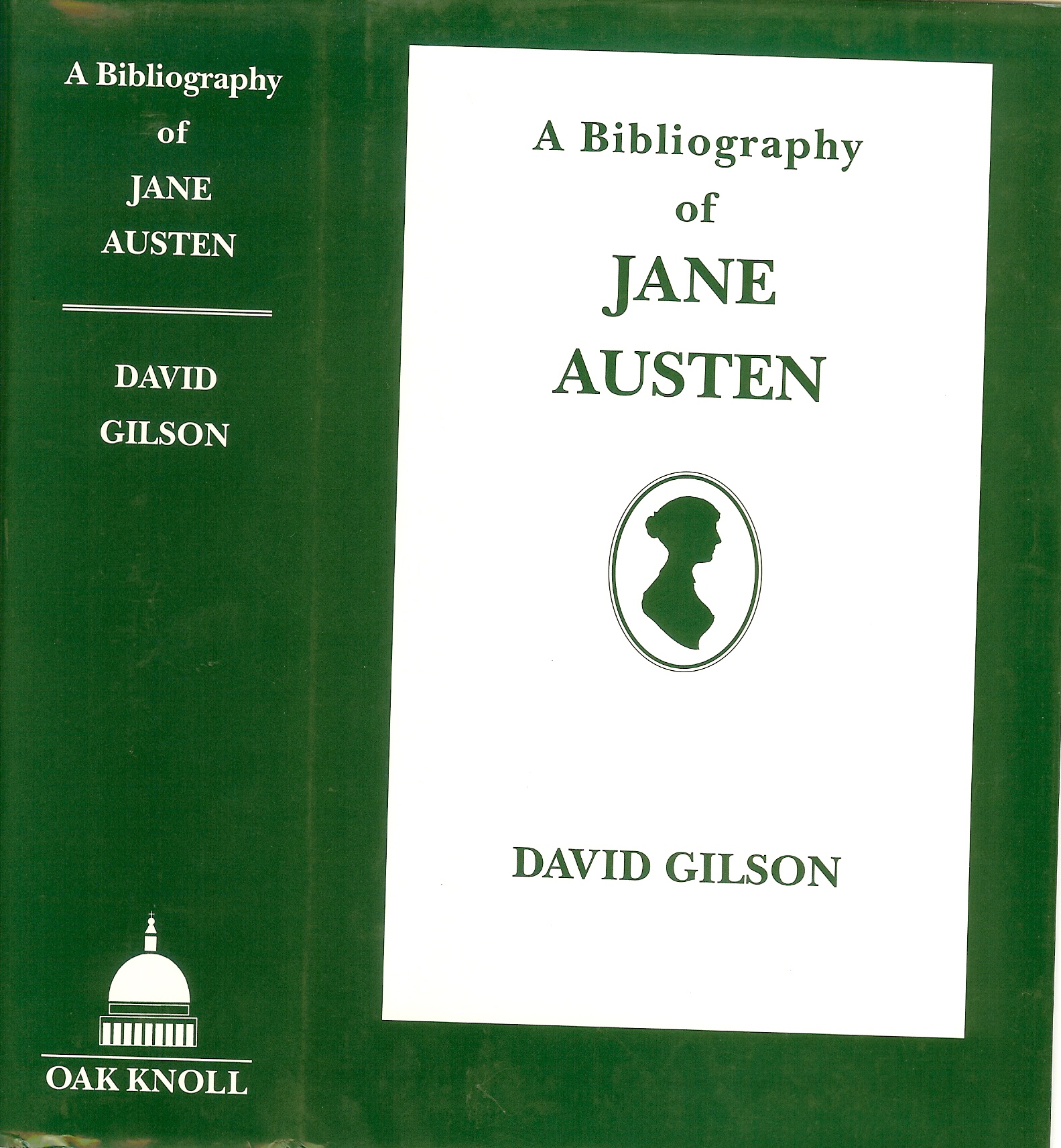
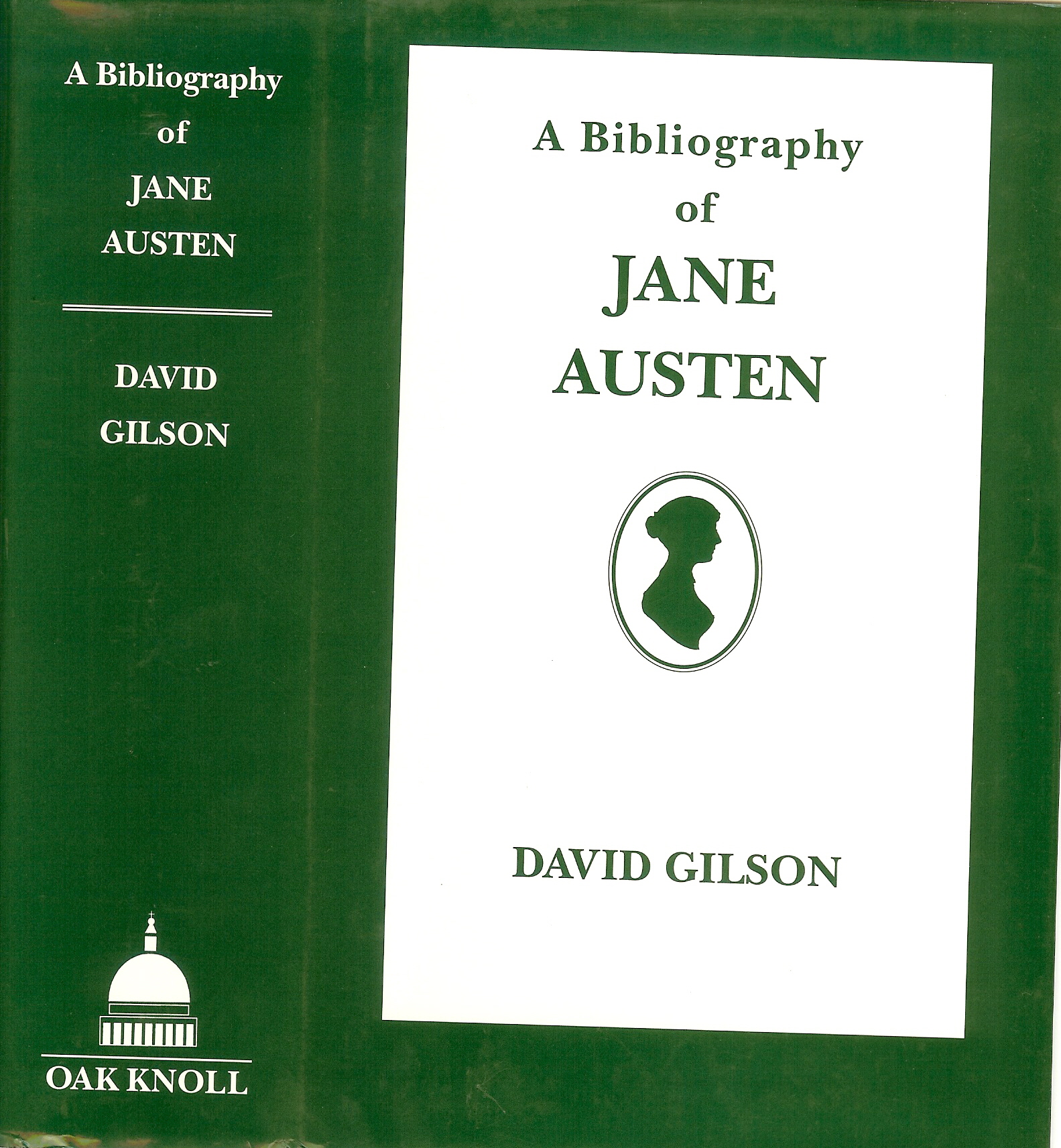
Gilson, David. A Bibliography of Jane Austen. New Introduction and Corrections by the Author. Winchester: St. Paul’s Bibliographies / New Castle, Delaware: Oak Knoll Press, 1997.
***********************
I am often asked what I would consider the most important book to add to ones own “Jane Austen Library.” Primary sources of course, the Chapman Oxford set of all the novels, minor works, juvenilia, etc – these volumes remain the source for citation in any scholarly work. The new Cambridge edition is lovely [and now thankfully in paperback and more affordable], and this edition of the works has begun to supplant the Chapman for citation purposes – so, you really need both…[more on this in a future post].
But after that, what? I would choose and most highly recommend David Gilson’s Bibliography of Jane Austen. Originally published in 1982, Gilson had set out to revise and update the Sir Geoffrey Keynes’ 1929 Nonesuch Press Austen bibliography, after discovering the lack of information in the Keynes relating to the early American editions of Austen’s works. Gilson wrote about these and other discoveries of the various early translations in his articles for The Book Collector. At Keynes’ suggestion, Gilson began a second edition but found it best to present a whole new work based on Keynes but with much additional information and to include the work of Chapman in his 1955 Austen bibliography. The 1997 edition is not a revision of the 1982 work but does include a new introduction, corrections, some additions, and a brief bibliographic essay on material published since 1978. It is less physically attractive and lacks the frontispiece illustrations of the 1st edition, but I consider this very comprehensive work [at 877 pages!] the starting point for all Austen research. Gilson writes a very informative essay prefacing each of the twelve chapters, includes a chronological listing of editions and reprints and an exhaustive index that links back to all the entries.
I offer here a brief capsule of each of these chapters, essentially a list of what to collect:
A. The Original Editions: Gilson follows the principles set down by Philip Gaskell in his New Introduction to Bibliography [1972] and the entry for each original edition is exhaustive: full bibliographical details of the physical book [title; collation; contents; technical notes on the paper, printing, headlines, chapter headings and endings, binding; etc]; its publishing history; reviews and contemporary comments; later publishing history; auction records [fascinating!]; listing of copies examined; and other copies known to exist. [I LOVE this stuff!]
B. First American Editions: as Austen mentions nothing about foreign editions of her work, Gilson assumes she knew nothing about the Emma that was published by Matthew Carey in 1816, a very rare edition, and unknown of by the earlier bibliographers – [Gilson B1]. Gilson again gives full bibliographical data as for the original editions, noting the textual variations in punctuation and spelling.
C. Translations: as Gilson states, despite that “JA’s opinion of the French seems not to have been high [citing her letter of Sept 8, 1816]…the French first paid her the compliment of translating her novels in 1813 and 1815.” [Gilson, p. 135] Same full bibliographic details here for the various translations.
D. Editions Published by Richard Bentley: no reissue of Austen’s novels is known after 1818 until 1832 when Richard Bentley decided to include them in his series of Standard Novels [quoting Chapman]. The copyrights had been sold to him by Cassandra for £210 and the P&P copyright was purchased from Egerton for £40. [Gilson, p. 211] Covers all the Bentley editions through 1882, with bibliographical details.
E. Later Editions and Selections: lists “as far as it has been practicable” all other later editions of the novels from the 1830s onwards, with cursory bibliographical details and a focus on the statistical details for these editions, excepting the “textually significant edition edited by Chapman (E150)” [Gilson, p. 238] – there are 425 entries in this section.
F. Minor Works: great literary history here! – with complete bibliographical details for Lady Susan, The Watsons, Charades, Love & Freindship, Sanditon, “Plan of a Novel”, Persuasion chapters, Prayers, the Juvenilia, etc.
G. Letters: Brabourne, Bodley Head, Chapman editions, Le Faye coming later [the 3rd edition, in 1995, 4th ed. in 2011]
H. Dramatisations: Gilson states that in 1929 Keynes could only find three dramatic adaptations, but fifty are listed here, and only those that are published works, and surprise of surprises, P&P being the most popular. [Gilson, p. 405]
J. Continuations and Completions [there is no “I” section]: Gilson lists 14, adds a good number in his 1997 update, but since then the world has been inundated with all manner of sequels, prequels, and mash-ups – this chapter is a good starting point for some of the less known early sequels that have gotten lost in the back room library stacks – some are quite good [Brinton and Bonavia-Hunt for example]
K. Books Owned by Jane Austen: there is much evidence of what Austen actually read – in Chapman’s indexes and other studies on literary influences on her – but as Gilson states, “the actual copies prove more elusive” [p. 431], so these twenty entries listed are noted in some way to have been subscribed to by her or inscribed in some way – the essay here is very informative and great to learn of the provenance of some of these titles Austen owned and read. [Note: I have set up a page in the Bibliography section on this blog titled Jane Austen’s Reading ~ a Bibliography – a list of all the books that Austen owned or is known to have read, compiled from various sources – it makes a great reading list! ]
L. Miscellaneous: the ever-needed catch-all and quite a little find, as Gilson says “unclassifiable miscellanea (with yet a curious fascination of their own!) [p. 449] – for example, an Elizabeth Goudge short story “Escape for Jane”, a romanticized re-telling of the Harris Bigg-Wither episode (L24), a number of works adapted for children, and a few works on the Leigh-Perrot trial.
M. Biography and Criticism: everything from 1813 on, to include books, journal articles, reviews, etc, chronologically arranged and annotated [though not consistently], 1814 items in total, with a bibliographical essay in the updated version to touch on recent resources, ALL examined by Gilson personally. No words here to adequately explain this section – just an amazing piece of scholarship –
Appendix: a chronological listing of all editions, reprints and and adaptations of JA’s works recorded in the bibliography
Index: pp. 753-877 – exhaustive!
… but here of course is where any printed book falls short – before it hits the stands, it is outdated. Recent efforts to keep Austen bibliography current have been largely produced by Barry Roth in his three works:
Roth, Barry and Joel Clyde Weinsheimer. An Annotated Bibliography of Jane Austen Studies, 1952-1972. Charlottesville, VA: University Press of Virginia, 1973.
Roth, Barry. An Annotated Bibliography of Jane Austen Studies, 1973-1983. Charlottesville, VA: University Press of Virginia, 1985.
__________. An Annotated Bibliography of Jane Austen Studies, 1984-1994. Ohio University Press, 1996.
The annual “Jane Austen Bibliography” in the JASNA journals Persuasions and Persuasions On-Line began in 1993, first by Patricia Latkin, then by Latkin and Barry Roth, then by Roth alone, followed by yours truly from 2007-2018, and since by Carol Grigas, Lise Snyder, and Claire Bellanti. Starting with the 2020 bibliography, Eileen Horansky has joined the team.
NEWS ALERT! JASNA has just made all of them easily accessible from one starting point – you can find all the bibliographies by year right here: http://jasna.org/publications-2/bibliographies/
The Internet gives us such immediate access to journals and books, tons of bibliographies, etc. – this has made all of us capable of being completely on top of everything every minute of the day – but for me, there is nothing quite like going to my Gilson to get back to those earlier days of bibliography, when a scholar such as he lovingly handled each work and made the effort to describe with such fullness each edition so it may become present before you and thus we are brought a little bit closer to the Austen we all love and admire – indeed, we can feel as excited as she did upon receipt of her own first copy of Pride & Prejudice as she exclaimed to Cassandra “ I want to tell you that I have got my own darling Child from London “ [Le Faye, Letter 79, p. 201]
If you don’t have this book, get it – it makes for fascinating reading! [I confess to being a librarian and I know we are all a little bit weird about this bibliography and classification thing, but this book will give you much to ponder, trust me…]
Further Reading:
Chapman, R.W. Jane Austen: A Critical Bibliography. 2nd ed. London: Oxford University Press, 1969.
Keynes, Geoffrey. Jane Austen: A Bibliography. NY: Burt Franklin, 1968 [originally published in London, 1929]
A few other sources, mostly Gilson [not a complete list]:
Gilson, David. “Auction Sales,” in A Jane Austen Companion, ed. J. David Grey. NY: Macmillan, 1986. See also his “Editions and Publishing History,” “Obituaries, “ and “Verses” in this same volume.
____________. “Books and Their Owners: Some Early American Editions of Jane Austen.” Book Collector 48 (1999): 238-41.
___________. “The Early American Editions of Jane Austen.” The Book Collector 18 (1969): 340-52.
___________. “Henry Austen’s ‘Memoir of Miss Austen,” Persuasions 19 (1997):12-19.
___________. “Later Publishing History with Illustrations” in Jane Austen in Context, ed. Janet Todd. The Cambridge Edition of the Works of Jane Austen, Cambridge University Press, 2005.
____________. Putting Jane Austen in Order. Persuasions 17 (1995):12-15
____________. “Serial Publication of Jane Austen in French,” The Book Collector 23 (1974): 547-50.
In Janice Hadlow’s The Other Bennet Sister, a brilliant effort to give the neglected-by-everyone Mary Bennet a life of her own, Mary’s reading is one of the most important aspects of the book – we see her at first believing, because she knows she is different than her other four far prettier and more appealing sisters, that her prospects for the expected life of a well-married woman are very limited, and that she must learn to squash her passions and live a rational life. She also mistakenly thinks that by becoming a reader of philosophical, religious, and conduct texts that she will finally gain approval and maybe even love from her distant, book-obsessed father.
So Mary embarks on a course of serious rational study – and one of the most insightful things in the book is that she learns, after much pain, that this is no way to lead a life, to find happiness, to find herself. She rejects the novels like the ones Mrs. Bennet finds at the local circulating library as being frivolous, largely because James Fordyce tells her so…
So, I have made a list of all the titles that Hadlow has Mary reading or referring to – all real books of the time, and many mentioned and known by Jane Austen. Hadlow is very specific in what books she puts in Mary’s hands! And shows her own knowledge of the reading and the reading practices of Austen’s time. [If anyone detects anything missing from this list, please let me know…]
I am giving the original dates of publication of each title; most all the titles in one edition or another are available on Google Books, HathiTrust, Internet Archive, or the like – I provide a few of those links, if you are so inclined to become such a rational reader as Mary….
***************
Anonymous. The History of Little Goody Two Shoes (show JA’s copy). London: John Newbury, 1765. Attributed to various authors, including Oliver Goldsmith. We know that Jane Austen has her own copy of this book, here with her name on it as solid proof.
Mrs. [Sarah] Trimmer. The Story of the Robins. Originally published in 1786 as Fabulous Histories, and the title Trimmer always used. You can read the whole book here: https://en.wikisource.org/wiki/The_Story_of_the_Robins
Rev. Wetenhall Wilkes. A Letter of Genteel and Moral Advice to a Young Lady: Being a System of Rules and Informations: Digested Into a New and Familiar Method, to Qualify the Fair Sex to be Useful, and Happy in Every Scene of Life. London, 1746. Another conduct book.
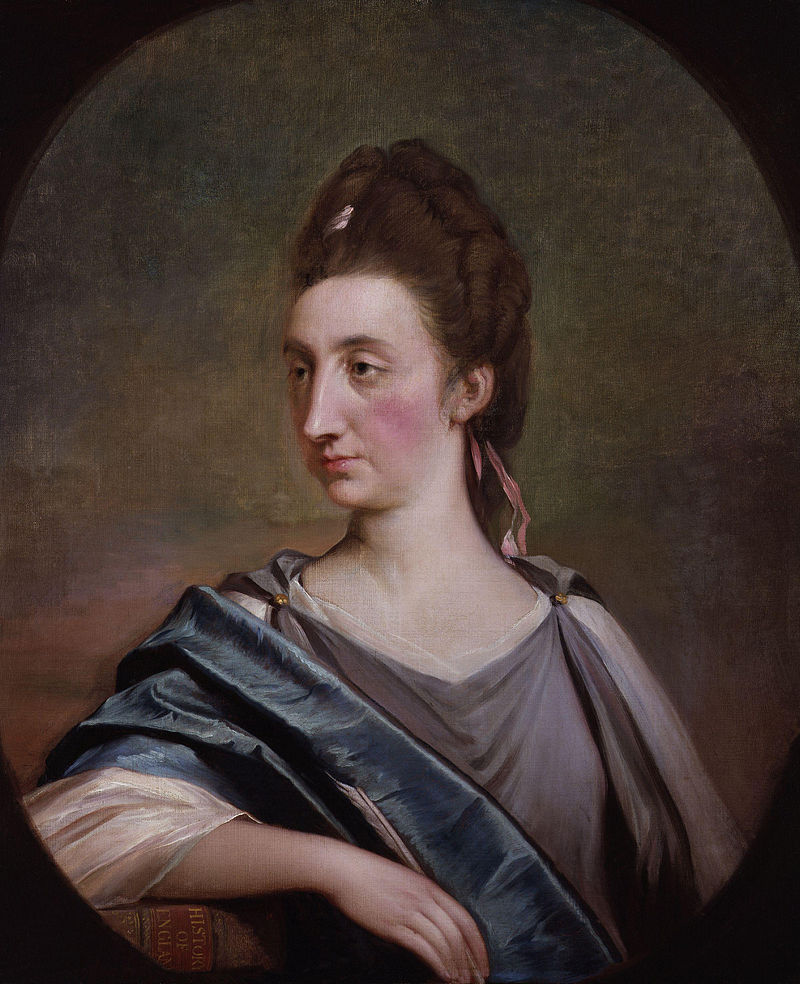
Catharine Macaulay. The History of England. 8 vols. London, 1763-83. A political history of the seventeenth century, covering the years 1603-1689. This was very popular and is in no way related to the later History published by Thomas Babington Macaulay. You can read more about this influential female historian in this essay by Devoney Looser: Catharine Macaulay: The ‘Female Historian’ in Context
Rev. James Fordyce. Sermons to Young Women. London, 1766. A conduct manual.
In Pride and Prejudice, Mr. Collins chooses to read Fordyce’s Sermons to Young Women aloud to the Bennet sisters, Lydia especially unimpressed: “Lydia gaped as he opened the volume, and before he had, with very monotonous solemnity, read three pages, she interrupted him …’.
Frances Burney. Evelina, or the History of a Young Lady’s Entrance into the World. London, 1778. Hadlow gives Evelina a good hearing – in the discussion in Mr. Bennet’s library with Elizabeth and Mary. Elizabeth directly quotes Austen’s own words in defense of the novel that are found in Northanger Abbey. [Evelina, and Mary’s difficulty in coming to terms with such a frivolous story, is mentioned more than once].
Evelina. U Michigan Library
***********
Other Novels mentioned are:
– Samuel Richardson. The History of Sir Charles Grandison. London, 1753. 7 vols. Reported to be Austen’s favorite book, all seven volumes!
– Henry Fielding. The History of Tom Jones, a Foundling. 4 vols. London, 1749. Supposedly the reason Richardson wrote his Grandison. [Mentioned more than once] – I think we should read this book next for our JABC!
– Laurence Sterne. The Life and Opinions of Tristram Shandy, Gentleman. 9 vols. London, 1759-1767.
***************
Hugh Blair – wikipedia
Hugh Blair. Sermons. Vol. 1 of 5 published in 1777.
“You assign greater consequence to the clergyman than one has been used to hear given, or than I can quite comprehend. One does not see much of this influence and importance in society, and how can it be acquired where they are so seldom seen themselves? How can two sermons a week, even supposing them worth hearing, supposing the preacher to have the sense to prefer Blair’s to his own, do all that you speak of? govern the conduct and fashion the manners of a large congregation for the rest of the week? One scarcely sees a clergyman out of his pulpit.”
***************
William Paley. A View of the Evidences of Christianity. London, 1794.
Aristotle. The Ethics of Aristotle. [no way to know the exact edition that Mr. Collins gives to Mary – it’s been around for a long time!]
Mentions: all Enlightenment thinkers and heavy reading for Mary!
– John Locke
– William Paley (again)
– Jean-Jacques Rousseau
– David Hume
A Dictionary of the Greek Language – Mr. Collins gives a copy to Mary.
*************
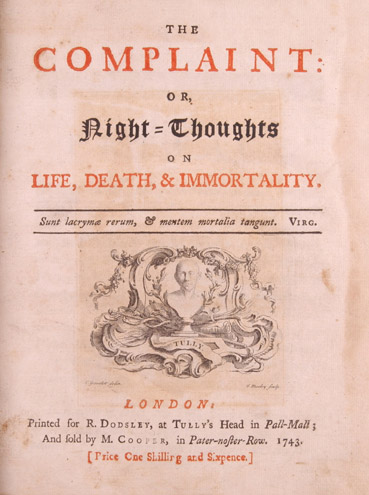
Edward Young. Night Thoughts. 1743. wikipedia
Edward Young. The Complaint: or, Night-Thoughts on Life, Death, and Immortality. [Known as Night-Thoughts]. London, 1742-45. [No wonder Mr. Hayward suggested a lighter type of poetry!]
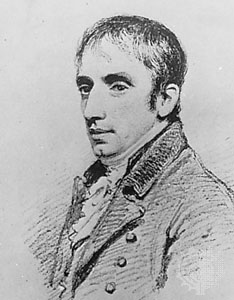
William Wordsworth, portrait by Henry Edridge, 1804; in Dove Cottage, Grasmere, England. Britannica.com
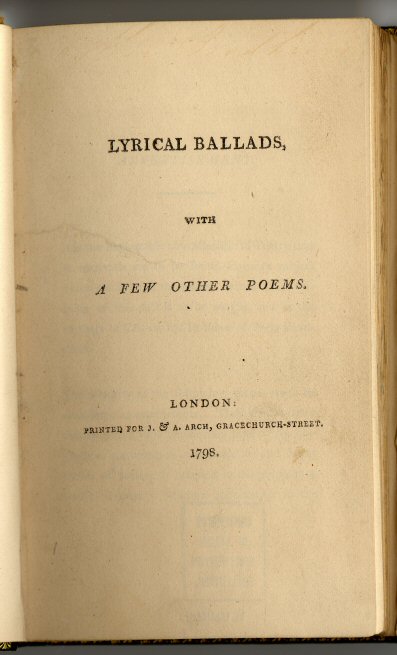
William Wordsworth. Lyrical Ballads. London, 1798. Full title: Lyrical Ballads, with a Few Other Poems is a collection of poems by William Wordsworth and Samuel Taylor Coleridge [Mr. Hayward does not mention Coleridge at all!], first published in 1798 and considered to have marked the beginning of the English Romantic movement in literature. Most of the poems in the 1798 edition were written by Wordsworth; Coleridge has only four poems included, one being his most famous work, The Rime of the Ancient Mariner.
William Godwin. Enquiry Concerning Political Justice and its Influence on Morals and Happiness. London, 1793. [Godwin, it is worth noting, married Mary Wollstonecraft and was the father of Mary Godwin Shelley]. Outlines Godwin’s radical political philosophy.
William Godwin (portrait by James Northcote) and Mary Wollstonecraft (portrait by John Opie) – from BrainPickings.org
************
Machiavelli – is referred to by Mary, so assume she is familiar with his The Prince (1513).
****************
Image: Guide to the Lakes. ‘View on Winandermere’ [now called Windermere], by Joseph Wilkerson. Romantic CirclesWilliam Wordsworth. Guide to the Lakes. [full title: A Guide through the District of the Lakes] – first published in 1810 as an anonymous introduction to a book of engravings of the Lake District by the Reverend Joseph Wilkinson. A 5th and final edition was published in 1835 – you can read that online at Romantic Circles here, along with a full account of its rather tormented publication history: https://romantic-circles.org/editions/guide_lakes
******************
John Milton. Paradise Lost. A mention by Mr. Ryder who is defeated by its length, so we know Mary was familiar with it.
***********
The Edinburgh Review / The Quarterly Review – brought to Mary by Mr. Ryder, and for which Mr. Hayward perhaps wrote his reviews. The Edinburgh Review (1802-1929); Quarterly Review (1809-1967, and published by Jane Austen’s publisher John Murray) – both were very popular and influential publications of their time…
*********************
The Other Bennet Sister is an enjoyable read – it is delightful to see Mary Bennet come into her own, that despite what she viewed as an unhappy childhood, she finds her way through a good number of books in a quest to live a rational, passionless existence. And that the development of some well-deserved self-esteem with the help of various friends and family, might actually lead her to a worthy equal partner in life, just maybe not with Mrs. Bennet’s required £10,000 !
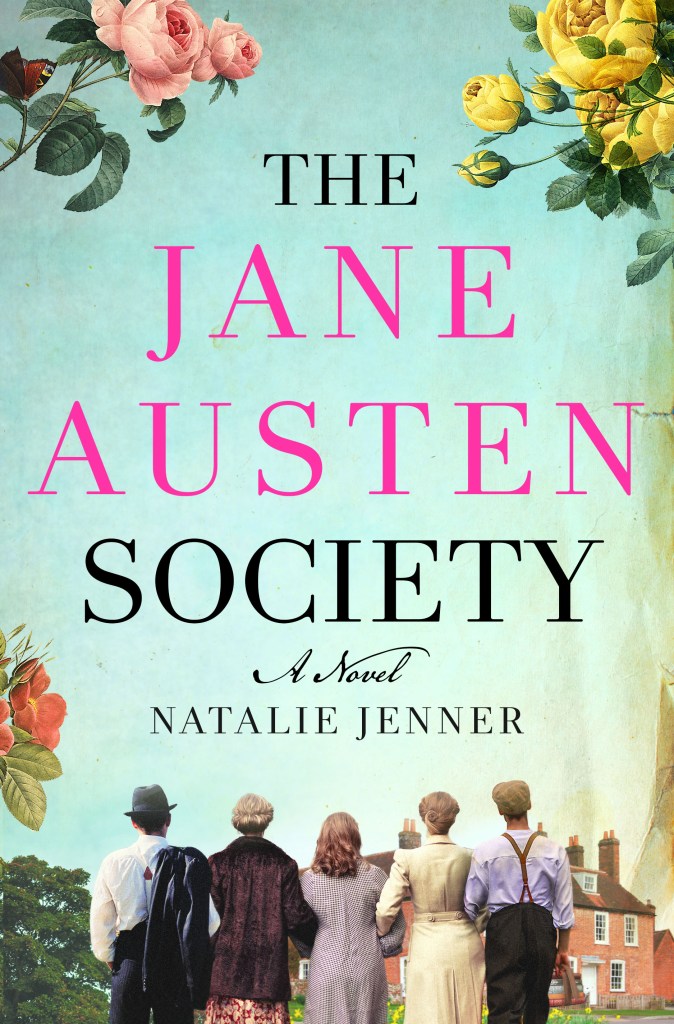
Are you a maker of Lists? Do you keep a List of books to read, lists of books read, movies to watch, TV shows not to be missed, lists of gifts, grocery lists, house to-do lists, a master To-Do List? Do you have a List of Lists? Or, as one friend asked me years ago, do you ever add something to your To-Do list already done so you can cross it off? (I said absolutely NO!). But I do love lists – they organize a life, give a sense of control (false though that may be), especially in these troubled times. And so I find that instead of writing a more traditional book review of The Jane Austen Society, that I’d make a List, a very important list of at-least TEN reasons you should read this book – one reason alone is enough; ten means you should buy it immediately and jump right into its world.
1. The Characters: Real and True
The author Natalie Jenner has said she had no outline for this tale, envisioned about eight characters, half male and half female, and essentially let them run amok.* We can only be glad she did! As one of her more Willoughby-like characters says of this rag-tag motley crew of folk all bent on forming a Jane Austen society: they were “a band of misfits with negligible expertise and no head for business: a country doctor, an old maid, a schoolmarm, a bachelor farmer, a fey auctioneer, a conflict-averse solicitor, a scullery maid, and one Hollywood movie star.” [276] – a “band of misfits” indeed. They are all from different backgrounds and histories, all part of the small rural community of Chawton, all with tragedy, pain and grief permeating and controlling their lives. Yet each is fully-drawn – you like, even love, these people.
2. The Plot: So Inventive
This is fiction (more on this below) – and not even historical fiction – it has nothing to do with the Real Jane Austen Society formed in the 1940s, same as our fictional group – so don’t confuse them. Let this story tell itself, as it brilliantly does: how this unlikely cast of characters discover a commonality in Jane Austen of all people, and strive to honor her in some way – they do live in Chawton after all… And in so doing, each finds Hope and Love and Self-Knowledge. And as the tale of each unfolds and their lives become inexorably intertwined, we have mysteries and secrets, stories of war and deaths, disagreements among neighbors, gossipy goings-on, and Love and Romance. What is there not to like? Jane Austen has given them a purpose, a sense of hope and a road map into an understanding of the heart. You find fast friends over Jane Austen, as many of us have found in our own lives.
3. The Setting: Chawton, of course
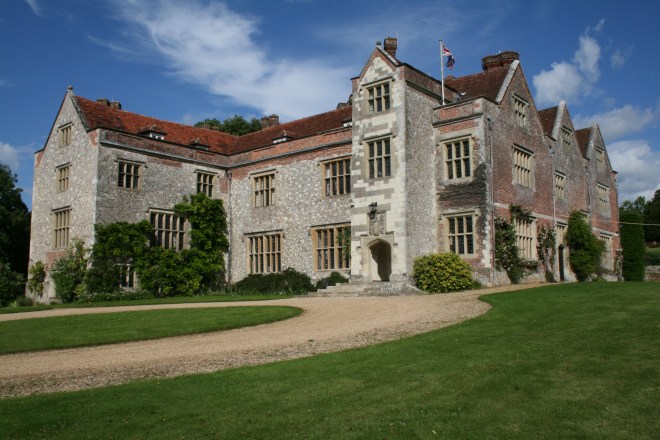
Chawton House
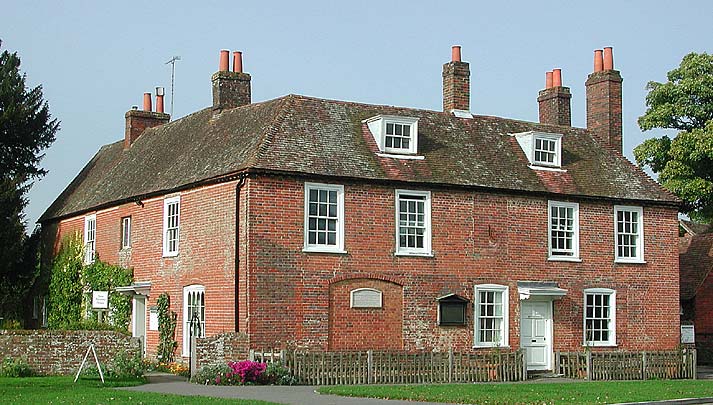
Not everyone living in this fictional Chawton reads or even likes Jane Austen. Some resent the weird travelers looking for sites associated with her. Even the family heir confesses a preference for the Brontës (especially Villette – pay attention here). But the setting is one we all are very familiar with, if we know a bit about Austen’s life after 1809. Living in Chawton Cottage (now Jane Austen’s House ) and trekking to her brother Edward’s Great House (now Chawton House), Jane Austen walked these walks, sat in these chairs, read in this library, all so beautifully and authentically described by Jenner. You are in this world in the 1940s, right along with the characters.
Jane Austen’s House
4. The Library [not as “In the Library with Colonel Mustard and the lead pipe”…but a Real Library]
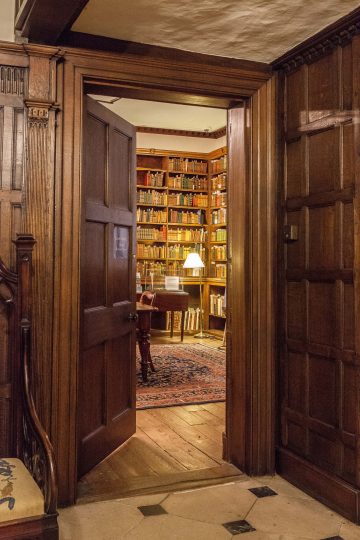
One of my favorite parts of the book (the librarian-bookseller in me). Jenner confesses to a wee mistake about the location of the library at Chawton, but literary license allows just about anything, so she is heartily forgiven. Because she gives us Evie, the aforementioned scullery maid, who at 16 (and without giving too much away) has been secretly cataloguing the entire library in the Great House for the past two years and therefore is more knowledgeable about what’s there, what it’s all worth (and with the added bit of a FOUND letter by Austen, of which I shall say no more…), than anyone else in the family (who have ignored the library for generations) or anyone else in town. Evie is a delightful character – we would like to recruit her for our Reading with Austen / Godmersham Lost Sheep Society project!**
Reading Room at Chawton House
5. Jane Austen in Plain Sight:
One of the pure joys of this book is the light-hearted yet insightful analysis of Austen and her novels: characters actively discussing all the works in their general conversation with each other. Farmer Adam, on first reading Pride and Prejudice considers that “he was becoming quite worried about Mr. Darcy.” [10] The town doctor and the local schoolteacher have a lively chat about Emma: the teacher dislikes Emma, the doctor adores her – they wrangle over Mr. Knightley’s true feelings as Austen drops her clues. [I was delighted to find a new-to-me hint to add to my ever-growing List of Clues that Mr. Knightley is very much in Love.]
Then there are the almost direct correlations between characters – you’ll certainly find a Willoughby or Henry Crawford or a William Elliot in these pages, several of Austen’s couples, maybe even a Mr. Rushworth and a Mrs. Elton – there’s even a Dog! – the fun is finding them and going “aah…” Here’s a standout: one of the characters says “within the pages of Mansfield Park was the playbook for making a good woman fall for a cad.” [151] How true that is – and I never looked at Crawford’s behavior in such a light before…
And then the direct quotes in different contexts, which leads us to…
6. Jane Austen Is Not for “Dull Elves”:
The Austen discussion and character correlations are more straightforward than the many allusions scattered throughout, multiple readings likely needed to flesh them all out. Austen was a master of the allusion herself and again, it’s great fun to find these little crumbs:
“You have borne it as no other woman in England would have…” [295]
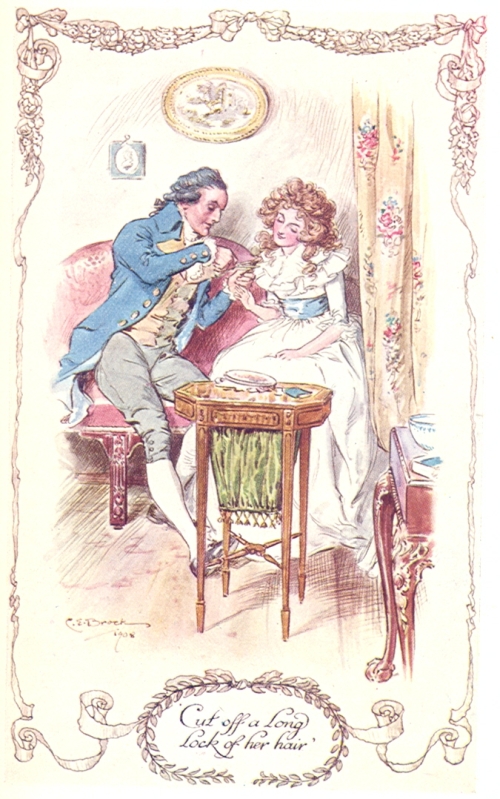
“I probably would’ve cut him a lock of my own hair if he’d asked for it.” [188]…
Sense & Sensibility – CE Brock – Molland’s
So many – don’t want to inhibit your “sharp-elves” detective skills, so that’s all I shall share…which leads us to another no-spoilers here item on our list…
7. The Mystery(ies)wherein lies a will and an heir just like an Austen plot…
….and shall just say there are secrets and mysteries in abundance. So much under the surface, so much history Jenner gradually allows the reader to see, like the proverbial peeling away of an onion – layers of stories to reveal truths… and again, not unlike Austen, Jenner feeds us more and more of each character and their motivations, and we care largely because of ….
8. The Romance: There’s A Lot of It!
So we have eight major characters, and a house full of minors (some of whom, like in Austen, have a lot to say, and a lot to do to move the plot along). Part of the fun (and mystery) is who will end up with whom? Even one of the characters falls asleep one night musing on and making mental lists of possible couplings. Evie at 16 is perhaps the most perceptive at seeing what the heck is going on. It’s all quite endearing – but no spoilers here (though can I say there is a Wentworth-like letter??)
9. It’s Fiction!
Ok, have to repeat this – this is pure fiction, not even great literature (though it is very well written), not based on the real Jane Austen Society as I’ve said (and that real story is compelling it is own right – you can read about it here.)
But even if you are not an avid reader of fiction, but you like Jane Austen, you will get much out of your few hours of time invested. And even if you don’t know squat about Jane Austen, you’ll love this book (you can also listen to it – spending several hours with Richard Armitage is top on my Must-Do list] – because of the humor, the grace, and the romance, and because…
10. We Need This Right Now:
This is a Feel Good book – and goodness, we need that right now more than anything – pick it up and wander back into a simpler (though in so many ways harder) time, to a place ravaged by war, when loss and grief were the bywords of the day, and live for a bit with this delightful “band of misfits” as they each find their way to a better future, all with thanks to Jane Austen, a lesson for us all, especially now…
** For a real-life cataloguing project concerning Edward Austen Knight’s libraries at his Godmersham and Chawton estates, please visit the Reading with Austen website and the Reading with Austen blog. Under the direction of Professor Peter Sabor, the hope is to locate (and return if possible) as many of the books that were originally in the Knight library during Jane Austen’s time. We need Evie on this project!
************
About the author:
Natalie Jenner is the debut author of THE JANE AUSTEN SOCIETY, a fictional telling of the start of the society in the 1940s in the village of Chawton, where Austen wrote or revised her major works. Born in England and raised in Canada, Natalie graduated from the University of Toronto with degrees in English Literature and Law and has worked for decades in the legal industry. She recently founded the independent bookstore Archetype Books in Oakville, Ontario, where she lives with her family and two rescue dogs.
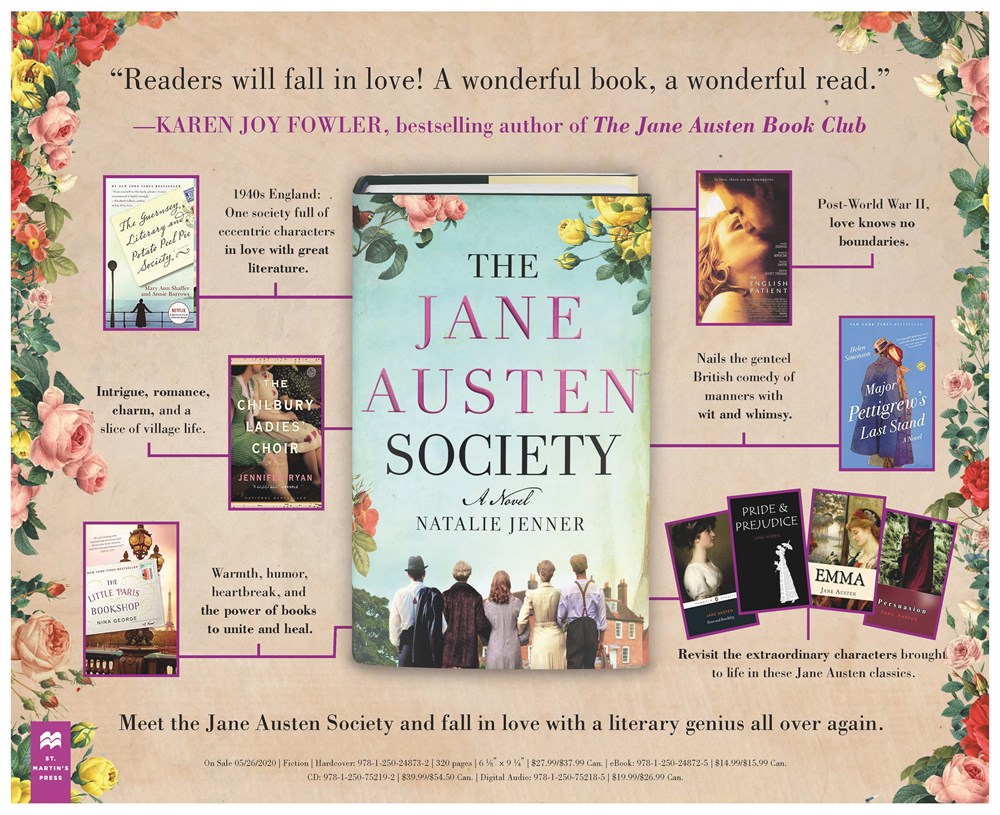
Just after the Second World War, in the small English village of Chawton, an unusual but like-minded group of people band together to attempt something remarkable.
One hundred and fifty years ago, Chawton was the final home of Jane Austen, one of England’s finest novelists. Now it’s home to a few distant relatives and their diminishing estate. With the last bit of Austen’s legacy threatened, a group of disparate individuals come together to preserve both Jane Austen’s home and her legacy. These people—a laborer, a young widow, the local doctor, and a movie star, among others—could not be more different and yet they are united in their love for the works and words of Austen. As each of them endures their own quiet struggle with loss and trauma, some from the recent war, others from more distant tragedies, they rally together to create the Jane Austen Society.
Book details: Genre: Historical Fiction, Austenesque Fiction
The Jane Austen Society: A Novel, by Natalie Jenner St. Martin’s Press (May 26, 2020) Hardcover ISBN: 978-1250248732 eBook ASIN: B07WQPPXFW Audiobook ASIN: B082VL7VRR
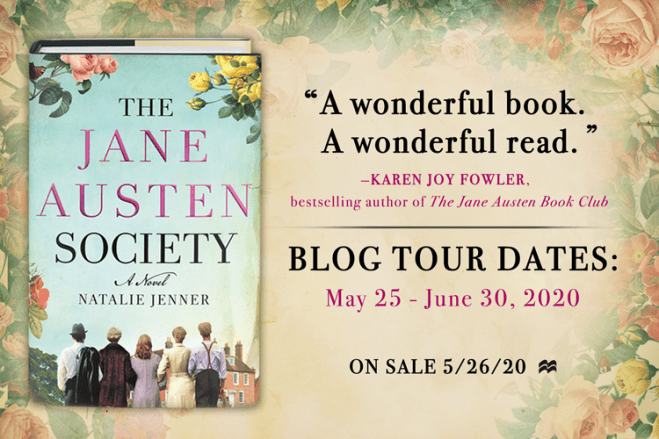
Hello there Gentle Readers: I welcome you to join in on the virtual online book tour of THE JANE AUSTEN SOCIETY, Natalie Jenner’s highly acclaimed debut novel May 25 through June 30, 2020. Seventy-five popular blogs and websites specializing in historical fiction, historical romance, women’s fiction, and Austenesque fiction will feature interviews and reviews of this post-WWII novel set in Chawton, England. All is sponsored and coordinated by Laurel Ann at Austenprose. The pandemic has limited the author from engaging in the usual real-life book talks and marketing tours, so we are going all out to be sure that this book gets a full-court press in our now largely virtual world. Please enjoy all the chat, then get thee to a bookstore and add it to your TBR pile (on top!) – you will not be disappointed…
My review will go live tomorrow but wanted to list here all the blog tour sites that over the next month will be offering reviews and interviews of this delightful tale:
About the Book:
Just after the Second World War, in the small English village of Chawton, an unusual but like-minded group of people band together to attempt something remarkable.
One hundred and fifty years ago, Chawton was the final home of Jane Austen, one of England’s finest novelists. Now it’s home to a few distant relatives and their diminishing estate. With the last bit of Austen’s legacy threatened, a group of disparate individuals come together to preserve both Jane Austen’s home and her legacy. These people—a laborer, a young widow, the local doctor, and a movie star, among others—could not be more different and yet they are united in their love for the works and words of Austen. As each of them endures their own quiet struggle with loss and trauma, some from the recent war, others from more distant tragedies, they rally together to create the Jane Austen Society.
*************
Book details:
Genre: Historical Fiction, Austenesque Fiction
The Jane Austen Society: A Novel, by Natalie Jenner St. Martin’s Press (May 26, 2020) Hardcover ISBN: 978-1250248732 eBook ASIN: B07WQPPXFW Audiobook ASIN: B082VL7VRR
Blog Tour Dates: May 25 – June 30, 2020 [see below]
****************
About the author:
Natalie Jenner is the debut author of THE JANE AUSTEN SOCIETY, a fictional telling of the start of the society in the 1940s in the village of Chawton, where Austen wrote or revised her major works. Born in England and raised in Canada, Natalie graduated from the University of Toronto with degrees in English Literature and Law and has worked for decades in the legal industry. She recently founded the independent bookstore Archetype Books in Oakville, Ontario, where she lives with her family and two rescue dogs.
One of Goodreads Big Books of Spring & Hot Books of Summer
One of Audible’s Top 50 Most Anticipated Spring Audiobooks
June 2020 Indie Next Pick
May 2020 Library Reads Pick
Starred Review – Library Journal
Starred Review – Booklist
Audiobook Narrated By Actor Richard Armitage (!!):
The full unabridged text of THE JANE AUSTEN SOCIETY was read by the distinguished English film, television, theatre and voice actor Richard Armitage for the audiobook recording. Best known by many period drama fans for his outstanding performance as John Thornton in the BBC television adaptation of North and South (2004), Armitage also portrayed Thorin Oakenshield in Peter Jackson’s film trilogy adaptation of The Hobbit (2012 – 2014).
Spotify users can access a playlist for THE JANE AUSTEN SOCIETY at the following link: https://open.spotify.com/playlist/5Q1Vl17qyQQIvvPGeIPCkr?si=-iMhVz8uRk2v2mTdolrPdg. The playlist includes music from various film adaptions of Jane Austen’s books, as well as film scores by such incomparable artists as Hans Zimmer, Ennio Morricone, Rachel Portman, and Michael Nyman.
************
BLOG TOUR SCHEDULE: [I’ll add live links once the post is active]








































 Jane Austen in Vermont