Susannah Fullerton, president of the Jane Austen Society of Australia, has just published her memoir about her life-long love affair with Jane Austen, something many of us can understand and appreciate, but mostly marvel at what Susannah has done with this obsession! Here is Susannah’s blurb on her new book – see below on how you can order it. I for one cannot wait for mine to show up in my mailbox…
JANE & I
A TALE OF AUSTEN ADDICTION
By Susannah Fullerton
You must allow me to tell you how ardently I admire and love … Jane Austen.
When I was a young girl, l was read Pride and Prejudice by my mother. I listened entranced, but little dreamed how that reading would change my life and would be the start of a life-long addiction. For I fell in love with Elizabeth and Darcy, went on to read the other novels of Jane Austen, studied them, re-read them often, lectured about them and wrote about them. As President of the Jane Austen Society of Australia for more than twenty years, I have shared my passion for Sense and Sensibility, Pride and Prejudice, Mansfield Park, Emma, Northanger Abbey and Persuasion with thousands of people around the world. As a leader of literary tours, I have taken people to ‘Jane Austen country’. It is thanks to Jane Austen that I developed a career as a popular literary lecturer. Jane Austen, quite simply, altered the course of my life!
My memoir shows how a love of Jane Austen’s novels developed into a passionate addiction, something that I hope all readers of this blog will understand. Jane Austen expert Maggie Lane has called my new book “a vivid and original memoir”, while author Jennifer Kloester has said “More than just a memoir, this delightful account of Susannah Fullerton’s lifelong love of books will enchant, inspire and amuse her readers. A joyful reminder of why books matter.”
*********************
About the author:
Susannah Fullerton has been president of the Jane Austen Society of Australia for 21 years. She is a popular literary tour leader, guiding literary pilgrims in England, Scotland, Ireland, USA, Canada, France and Italy. Previous books include A Dance with Jane Austen, Happily Ever After: Celebrating Pride and Prejudice, Jane Austen and Crime (one of my favorite books!), Georgette Heyer: Complete to a Shade, and others. You can find out more about her, her books, and her literary tours at the links below. She also writes a newsletter titled “Notes from a Book Addict,” a monthly treat for your inbox – you can sign up for it here: https://susannahfullerton.com.au/newsletter/
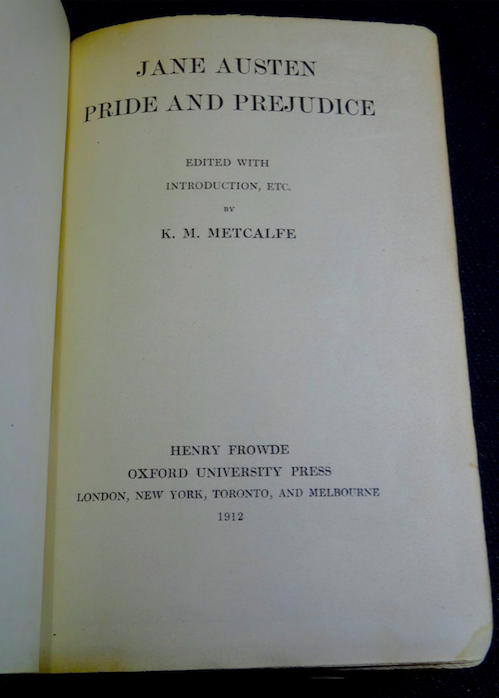
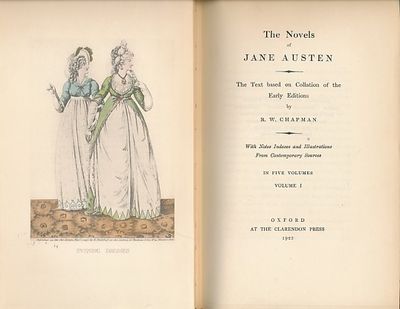
When I have given talks on the publishing history of Pride and Prejudice, one of my favorite editions to share is the little-known Pride and Prejudice edited by K. M. Metcalfe and published by Oxford University Press in 1912.
Pride and Prejudice, ed. K M Metcalfe, Oxford, 1912
I first “discovered” this edition several years ago when reading an essay by Margaret Lane in her book Purely for Pleasure (London, 1966), a collection of biographical pieces that never quite made it into book form. In a chapter on R. W. Chapman, she writes of an edition of P&P published by Oxford in 1912, edited by K. M. Metcalfe – that is, Katharine Metcalfe, a young tutor at Oxford’s Somerville College [there is, for the trivia minded, a Lady Metcalfe in P&P!]. It was “a new, textually accurate edition of P&P” [Lane] – and included an introduction, an overview of Austen’s life and works; essays on social history, domestic life, and language in the Regency period; as well as criticism and textual notes. There are no illustrations…
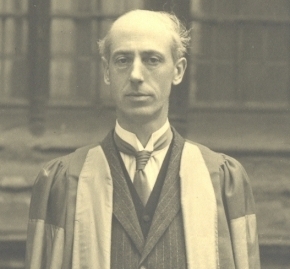
R W Chapman in 1928 – OED
At some point in 1912, Metcalfe met Chapman, he an editor at the Oxford University Press – by all accounts it was a whirlwind courtship – they shared a love of book collecting! – and they married in 1913. Metcalfe clearly introduced Chapman to Austen and they planned to jointly produce an edited complete works. All was cut short by the First World War in which Chapman served, and Metcalfe, now married with children (and thus required to give up her fellowship) “had little time or strength for editorial labours.” [Lane, 197]. Chapman’s Oxford set of the novels was published in 1923. But Metcalfe had also published her own Northanger Abbey four months earlier [see Gilson, E151, what Kathryn Sutherland calls “an unexplained oddity” in her Jane Austen’sTextual Lives (Oxford, 2005)[Sutherland, 43]. The interesting bit is that the text of her ownP&P edition (as well as her Northanger Abbey) was used for Chapman’s edition – same pagination, etc. – yet he does not mention her anywhere. In his 1948 Jane Austen: Facts and Problems he pens grateful acknowledgments to those critics…, etc., etc. and “my wife” in his preface.
[photo courtesy of J Barchas]
In Chapman’s Jane Austen: A Critical Bibliography (Oxford: Clarendon Press, 1953), again there is no mention of Metcalfe, but he annotates her 1912 edition of P&P thusly:
“This unassuming edition is equipped with a perceptive introduction and notes, and anticipates the textual rigours of the next item.” [Chapman, 6]
That next item is his 1923 edition of the novels! – which takes up a full page of annotation!
And he makes no mention at all of her 1923 Northanger Abbey!
Sutherland believes that Metcalfe essentially provided the model for Chapman’s editions – and she wonders at his public silence – I wonder what went on at their dinner table!! In studying Chapman’s papers, Sutherland does find that Metcalfe continued to work on editing the novels – there is a note in the margin of the Mansfield Park work in progress: “I want, oh so badly, to do it at least once with you.” [Sutherland, 44].
Don’t’ ever say that bibliography isn’t interesting!! – there is a novel in there somewhere!
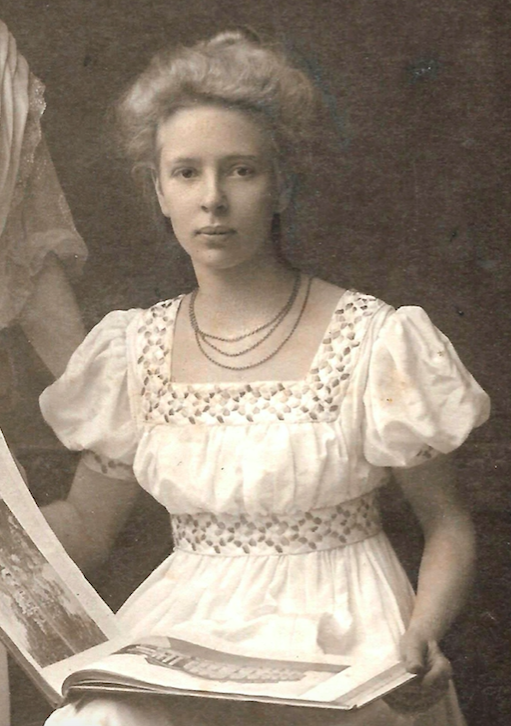
So I have long had lingering questions – there has to be more to this story than just these few references in scholarly texts – who was she? what did she look like? how did Chapman seem to take over her earlier editing work? what really was Metcalfe’s influence on Chapman in the making of his great Oxford edition of Austen’s works, and what were her feelings about being surpassed as Austen’s editor, and barely referenced by her own husband for the work she did do.
Finding many letters and notes in both the Chapman and Metcalfe papers at Chawton and the Bodleian, Barchas traces the complete history of Metcalfe’s editing and her hand in the subsequent work by Chapman.
Barchas found her own copy of this edition in an Australian bookstore – it is a presentation copy with Metcalfe’s inscription to her Uncle Hugh, sure proof of pride in her creation:
Presentation copy of Jane Austen’s Pride and Prejudice, edited by K. M. Metcalfe and inscribed by her to ‘Uncle Hugh’(Oxford, 1912). Photo courtesy of J Barchas
[You might like to note that Janine has just loaned this copy to the Chawton House Library, where it will be on display in their upcoming Austen/De Stael exhibition beginning in July 2017].
*************
At Chawton, Barchas discovers a letter addressed to the founder of the Chawton Cottage Museum (now the Jane Austen House Museum) where Metcalfe states “I was really the originator in the editing of Jane Austen (when I married my publisher in the process!)” (Letter to T. Edward Carpenter, 22 May 1954) [Barchas, 12].
Ferreting out the documented facts of the Metcalfe / Chapman collaboration, Barchas conveys the truth of the times:
“The mundane facts of the case may be sexist but it would be naïve and anachronistic to think these professional restraints surprising in historical context. Here is not a grand conspiracy but a commonplace wrong. Plenty of parallel examples exist in the history of editing where a woman’s scholarship became merely contributory to that of her male partner…”[Barchas, 7]
Find this essay however you can – it is brilliant in its recovery work of the woman who, long before Chapman, saw the importance of returning to Austen’s original editions to truly give the modern reader a pure printing of her work.
Katharine Marion Metcalfe, 1912. Photo was provided by the Chapman family for use in the RES article by J Barchas. This detail is used with her permission here.
*****************
I treasure my copy of Metcalfe’s Pride and Prejudice, despite a fair amount of writing and it smells a tad off (!), but I am very happy to own it, flaws and all! The introduction is a lovely meditation on Jane Austen and should be more readily available. Find this as well if and where you can. Hopefully the work now done by Professor Barchas might induce a publisher to issue an edition with Metcalfe’s insightful introduction. It should certainly stand proudly aside and before any of Chapman’s works.
About the author:Janine Barchas is Professor of English at the University of Texas at Austin. She is the author of Matters of Fact in Jane Austen: History, Location, and Celebrity (Johns Hopkins University Press, August 2012). Her first book, Graphic Design, Print Culture, and the Eighteenth-Century Novel (Cambridge UP, 2003), won the SHARP book prize for best work in the field of book history. You can visit (and spend hours browsing!) her online digital project What Jane Saw(www.whatjanesaw.org) which includes the gallery of the British Institution that Jane Austen visited on May 24, 1813 and the “Shakespeare Gallery of 1796.” Barchas, along with colleague Kristina Straub, recently curated an exhibition at the Folger on Will & Jane: Shakespeare, Austen, and the Cult of Celebrity. (You can read more about that exhibition here.)
The first order of business today, on this 241st birthday of Jane Austen, is the annual publication of JASNA’s Persuasions On-Line Vol. 37, No. 1 (Winter 2016). Click here for the Table of Contents to yet another inspiring collection of essays, some from the 2016 AGM in Washington DC on EMMA AT 200, “NO ONE BUT HERSELF” – and other “Miscellany” – all about Jane Austen…and perfect winter reading material…
Here are the essays: (you might especially notice Gillian Dow’s essay on the Emma exhibition at Chawton House Library this year (website under redevelopment til Christmas) – for those of you who could not attend, this is the next best thing to being there!)
Let’s look at what Austen’s father wrote about her arrival on December 16, 1775:
You have doubtless been for some time in expectation of hearing from Hampshire, and perhaps wondered a little we were in our old age grown such bad reckoners but so it was, for Cassy certainly expected to have been brought to bed a month ago: however last night the time came, and without a great deal of warning, everything was soon happily over. We have now another girl, a present plaything for her sister Cassy and a future companion. She is to be Jenny, and seems to me as if she would be as like Henry, as Cassy is to Neddy. Your sister thank God is pure well after it, and send her love to you and my brother, not forgetting James and Philly…
[Letter from Mr. Austen to his sister Philadelphia Walter, December 17, 1775, as quoted from Deirdre Le Faye, Jane Austen, A Family Record, Cambridge, 2004, p.27.]
Happy Birthday Miss Austen! – you continue to inspire, intrigue, and offer insights like no other!
Join us today for a guest post by Sue Wilkes, as she shares one of her spy tales from her new book Regency Spies: Secret Histories of Britain’s Rebels & Revolutionaries(more information on the book below).
The Cato Street Conspiracy, 1820
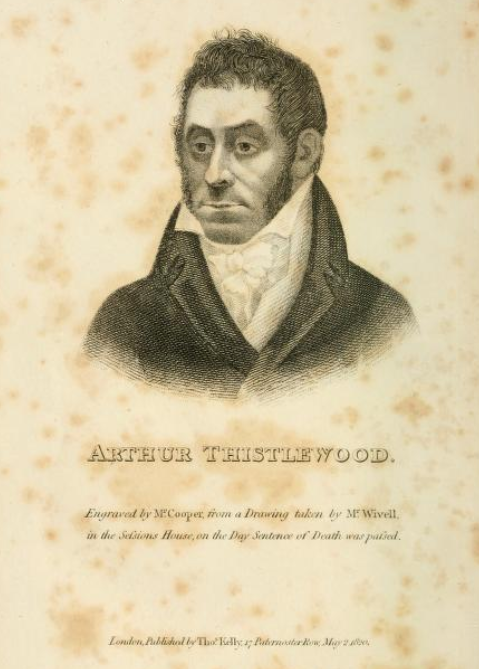
The year 1820 began with grave news – the death of George III on 29 January, after years of illness. The King was buried a week later with great pomp and ceremony on 16 February. But his son George IV’s reign did not get off to a good start. A week later, news broke to an astounded British public of the arrest of ‘a gang of diabolical ruffians’ at Cato Street, in London. The conspirators, led by the ‘notorious’ Arthur Thistlewood, planned to kill members of the Cabinet (government ministers) while they dined at Earl Harrowby’s house in Mansfield Street (Gentleman’s Magazine, February 1820).
This was no chance discovery, however. Thistlewood and his gang were well known to the authorities – the government’s spies had kept them under surveillance for years. Arthur Thistlewood, a brooding, dangerous man known to be deadly with a sword, led a group of revolutionaries called the ‘Spencean Philanthropists’.
The Spenceans were followers of the late Thomas Spence, who advocated the common ownership of all land – a truly anarchic idea in an unequal society rooted in land, wealth and property. Thistlewood first came to prominence in the Spa Fields riot of December 1816 in London. The riot was thought to be a ‘trial run’ by the Spenceans to see if they could get enough popular support to attack the Tower of London, Bank of England, and seize the city. Thistlewood and his friends were arrested and tried for treason the following year, but acquitted as most of the evidence against them was based on unreliable spy evidence.
After his release from prison, Thistlewood and his followers were constantly watched. In 1817 a spy called Shegoe reported, ‘They entertain the plan of assassination, and Lords Castlereagh, Sidmouth, Liverpool and Ellenborough have been marked as objects of their pursuit’. Some conspirators guessed that Shegoe was a spy, however, and his usefulness declined.
A new spy, George Edwards (code-name ‘W—r’ in the surveillance reports) infiltrated the gang and actively encouraged their plans. Edwards also recruited more conspirators: one of the people he ‘groomed’ was John Thomas Brunt, a shoe-maker. Another was Richard Tidd, who came from Thistlewood’s native Lincolnshire, and met Edwards through Brunt. Edwards’ actions and words were so ludicrously violent that several men he approached sent him packing, convinced that he was trying to entrap them.
Early in 1820, Edwards brought Thistlewood the news he had been waiting for: a Cabinet dinner was planned at Lord Harrowby’s house. Thistlewood and his gang rented a loft in Cato Street. They arranged to meet on Tuesday 22 February, bringing as many weapons as they could lay their hands on. But thanks to Edwards, the time and place for the planned assassination were already known to the police and Home Office. Everything was now set to nip the conspiracy in the bud.
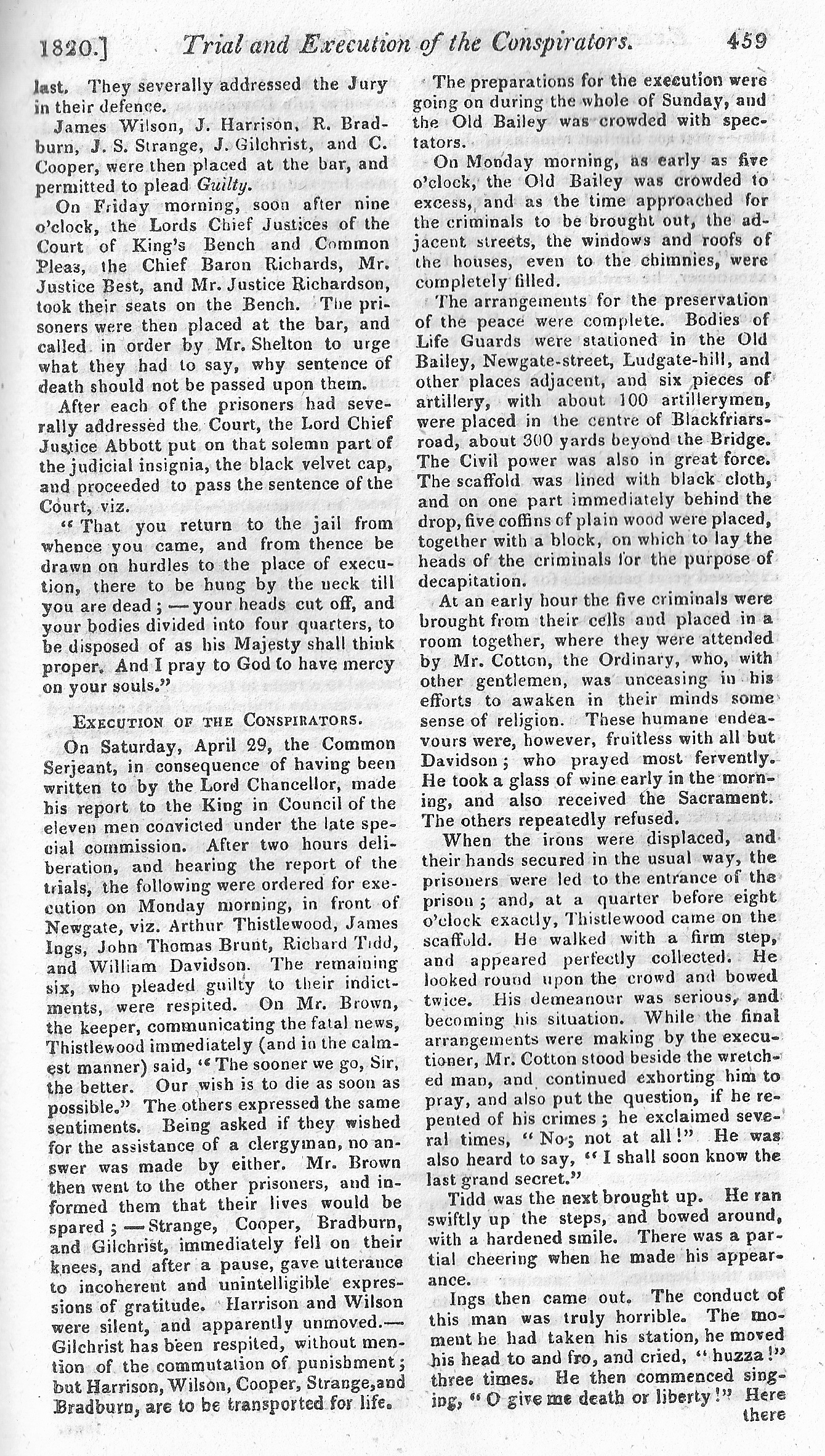
On Monday 1 May 1820, Arthur Thistlewood, James Ings, John Thomas Brunt, Richard Tidd and William Davidson were executed guilty for high treason at Newgate. But was it really Thistlewood’s idea to kill the Cabinet – or was it the spy George Edwards’s plan, as Arthur claimed at his trial?
An account of the death sentence passed by the judge, and the conspirators’ execution,
from the Gentleman’s Magazine, May 1820. (Author’s collection).
********************
About the book: [from the jacket]
In her new book, Sue Wilkes reveals the shadowy world of Britain’s spies, rebels and secret societies from the late 1780s until 1820. Drawing on contemporary literature and official records, Wilkes unmasks the real conspirators and tells the tragic stories of the unwitting victims sent to the gallows.
In this ‘age of Revolutions’, when the French fought for liberty, Britain’s upper classes feared revolution was imminent. Thomas Paine’s incendiary Rights of Man called men to overthrow governments which did not safeguard their rights. Were Jacobins and Radical reformers in England and Scotland secretly plotting rebellion? Ireland, too, was a seething cauldron of unrest, its impoverished people oppressed by their Protestant masters.
Britain’s governing elite could not rely on the armed services – even Royal Navy crews mutinied over brutal conditions. To keep the nation safe, a ‘war chest’ of secret service money funded a network of spies to uncover potential rebels amongst the underprivileged masses. It had some famous successes: dashing Colonel Despard, friend of Lord Nelson, was executed for treason. Sometimes in the deadly game of cat-and-mouse between spies and their prey suspicion fell on the wrong men, like poets Wordsworth and Coleridge.
Even peaceful reformers risked arrest for sedition. Political meetings like Manchester’s ‘Peterloo’ were ruthlessly suppressed, and innocent blood spilt. Repression bred resentment – and a diabolical plot was born. The stakes were incredibly high: rebels suffered the horrors of a traitor’s death when found guilty. Some conspirators’ secrets died with them on the scaffold…
About the author:
Sue Wilkes is the author of several works of social and family history: Regency Spies (Pen & Sword, 2016) and A Visitor’s Guide to Jane Austen’s England (Pen & Sword, 2014), Regency Cheshire (Robert Hale, 2011), The Children History Forgot (Robert Hale, 2010), Narrow Windows, Narrow Lives (Tempus, 2007), as well as guides for family historians on tracing ancestors in various UK counties and towns.
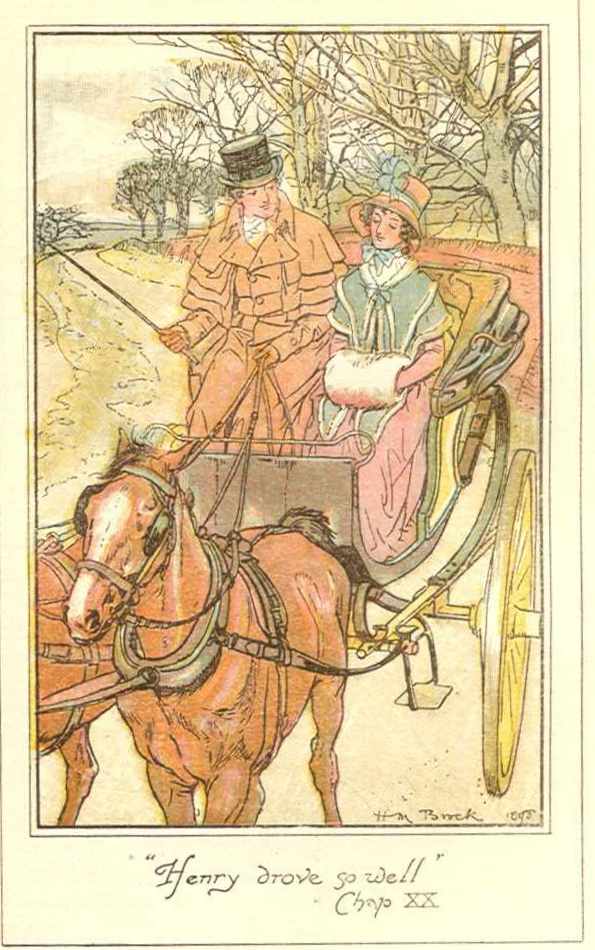
Thank you Sue for telling us about one your tales! This book is filled with such – I will be interviewing Sue in the coming weeks, so please return to learn more about this world of spies in Jane Austen’s time … my first question? Whatever would our dear Henry Tilney have to say about it all?!
Dear Miss Morland, consider the dreadful nature of the suspicions you have entertained. What have you been judging from? Remember the country and the age in which we live. Remember that we are English, that we are Christians. Consult your own understanding, your own sense of the probable, your own observation of what is passing around you. Does our education prepare us for such atrocities? Do our laws connive at them? Could they be perpetrated without being known, in a country like this, where social and literary intercourse is on such a footing, where every man is surrounded by a neighbourhood of voluntary spies, and where roads and newspapers lay everything open? Dearest Miss Morland, what ideas have you been admitting?” [NA, Vol. II, Ch ix. Image: Mollands.net]
Image sources:
All four images from George Theodore Wilkinson, The Newgate Calendar Improved Vol. 5, (Thomas Kelly, 1836). Courtesy the Internet Archive, archive.org.
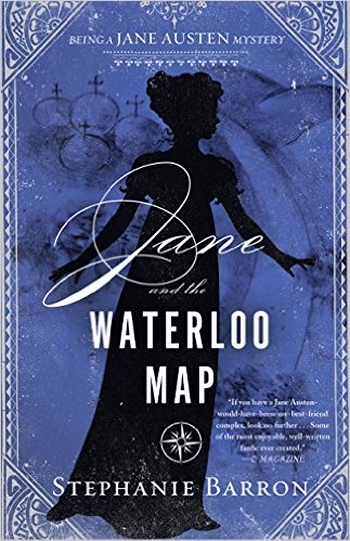
Amateur sleuth Jane Austen returns in Jane and the Waterloo Map,
the thirteenth novel in Stephanie Barron’s delightful Regency-era mystery series.
Gentle Readers: Today Jane Austen in Vermont is taking part in the ‘Jane Austen and the Waterloo Map’ blog tour that began on February 2, 2016 (see other tour stops below). Ms. Barron has done it again! – this time taking us into the Battle of Waterloo, but not before presenting our Jane with a body in the Carlton House Library! Read here an except from Chapter 8, followed by the details for the Giveaway – you can comment here or any of the other blog posts until February 29th.
***************************
About the book:
November, 1815. The Battle of Waterloo has come and gone, leaving the British economy in shreds; Henry Austen, high-flying banker, is about to declare bankruptcy—dragging several of his brothers down with him. The crisis destroys Henry’s health, and Jane flies to his London bedside, believing him to be dying. While she’s there, the chaplain to His Royal Highness the Prince Regent invites Jane to tour Carlton House, the Prince’s fabulous London home. The chaplain is a fan of Jane’s books, and during the tour he suggests she dedicate her next novel—Emma—to HRH, whom she despises. However, before she can speak to HRH, Jane stumbles upon a body—sprawled on the carpet in the Regent’s library. The dying man, Colonel MacFarland, was a cavalry hero and a friend of Wellington’s. He utters a single failing phrase: “Waterloo map” . . . and Jane is on the hunt for a treasure of incalculable value and a killer of considerable cunning.
And now….
AN EXCERPT FROM CHAPTER 8: In which Jane discusses the Battle of Waterloo with one of its survivors,
Lieutenant James Dunross of the Scots Greys.
“I did wonder whether the Colonel’s final words had any connexion to his valor on the field at Waterloo.” I looked at the Lieutenant rather than my hostess’s rigid form. “I have heard him described as a Hero. Would it trouble you to speak of him—or might I persuade you to recount his actions on that glorious day?”
There was the briefest pause.
“James?” Miss MacFarland queried in a lowered tone, her gaze fixed on the glowing coals.
“My dear,” he replied.
“Will it distress you?”
“Naturally. But as I expect to be hearing of Waterloo for the rest of my life, I had as well become accustomed.” The Lieutenant’s aspect was light, but his voice betrayed his distaste. “I should not use the word glory, however, to describe it. Carnage is more apt.”
“No,” Miss MacFarland protested. She turned impulsively to face us. “It shall always be a day of glory to me, because you and Ewan were spared! I cannot tell you how incomprehensible it is, Miss Austen, that my brother survived that battle—only to end in the fashionable desert of Carlton House. Incomprehensible!”
“The Colonel belonged to the Scots Greys, I believe?”
“He began military life in an hussar regiment, and saw years of active service in the Peninsula; but being better suited to heavy dragoon work, exchanged two years ago into the Greys. That is how we came to be acquainted with Lieutenant Dunross—James served in the regiment under my brother.”
Battle of Waterloo 1815 – William Sadler [Wikipedia]The gentleman forced himself heavily to his feet, and crossed with the aid of his cane to the draped window. He pulled aside the dark blue curtain and leaned into the casement, staring expressionlessly down at Keppel Street.“Are you at all familiar with the course of the battle?” Miss MacFarland asked.
“What little I learned from published accounts.”
“Then you will know that the cavalry was commanded by Lord Uxbridge.”
As who did not? Uxbridge had cut a dash among the Great for most of his life: He was an earl as well as a general; head of the Paget family; a darling of the ton; and Wellington’s reputed enemy. A few years since, Uxbridge ran off with the Duke’s sister-in-law, and embarrassed all their acquaintance. Divorce and outrage are nothing new to people of Fashion, however; and tho’ Uxbridge and Wellington might not sit down to whist together, once battle was joined with Napoleon, one was in command of the other’s cavalry. Some ten brigades, in fact.
“In the early afternoon of that wearing day, Wellington’s left was under serious attack from the French batteries,” Miss MacFarland said. I collected from her unvaried tone that she had told this story—or heard it told by her brother—many times. “General Picton was killed, and shells were exploding with horrific effect all along the British line. Our troops were giving way under the assault of d’Erlon’s columns. Uxbridge saw it as Wellington could not, being far down the right. The Earl threw Lord Edward Somerset and the Household Brigade into the thick of the fight, then galloped off to the Union Brigade. This is composed, as perhaps you may know, of three regiments: the English, or Royals; the Scots Greys; and the Irish, or Inniskillings.”
“Ah,” I managed. I had never thought to consider which regiments comprised the Union Brigade.
“Sir William Ponsonby was in command.”
Another man of Fashion. The Ponsonbys had spawned Lady Caroline Lamb, one of most outrageous ladies I have ever encountered.
“And above Ponsonby was Uxbridge,” I said encouragingly, having got it all straight. “So Somerset and Ponsonby and Uxbridge—who might normally have met peaceably in a ballroom—charged off together on horseback to slaughter the French.”
“Indeed. Or at least, their gun batteries.” Miss MacFarland glanced almost unwillingly at Lieutenant Dunross, but the silent figure by the parlour window gave no sign that he was attending to our conversation.
“The Greys were supposed to be held in reserve,” she continued. “But in fact they attacked the longest—well after the Royals and the Inniskillings had given up.”
“Of their own volition? –Without waiting for the command to charge?”
“No Scotsmen would be left in the rear while the English and Irish attack,” Miss MacFarland said proudly. “And indeed, the Union Brigade succeeded in their object so well that the French were turned.”
“For a little while, perhaps,” James Dunross tossed over his shoulder. “A half hour, even. But as is so often true in the smoke and confusion of battle, the hunters became the hunted.”
“I am sure that Ewan regarded that charge as having won the day,” Miss MacFarland argued.
“So he may have done! But he was wrong, Georgie. The battle was won by Blücher and his Prussians, not the Scots Greys.” He turned abruptly from the window and stumped back to us on his cane, his countenance alight with anger. “You must apprehend, Miss Austen, that most of our commanders and cavalrymen know nothing of military science. Excellent fellows, to be sure—Uxbridge was an hussar in his youth, and could not be called green—but we are gentlemen first and soldiers a distant second. What we know of cavalry manoeuvres was learnt on the hunting field. We are apt to get carried away by our own daring, as tho’ a confrontation with the French were a day’s hunting with the Quorn. Which is rather what happened at Waterloo.”
I stared at him frowningly. “You were distracted by a fox?”
“In our enthusiasm to have at Buonaparte, we charged too far,” Dunross explained, “and then could not get back again to the British lines. Most of us had never been in battle before. Ponsonby was unhorsed—he’d left his best charger in the rear because he could not bear to expose so expensive a mount to enemy fire. When the hack he rode into battle failed him, he was shot dead where he stood. The French cavalry counterattacked with Lancers. Do you know of them?”
I shook my head.
“Quite a new thing in military circles, but utterly terrifying. They carry something like a jousting stick and can stab anything on two or four legs to death. One of them stabbed me as I lay on the ground, unhorsed after that celebrated charge.”
“The hunters became the hunted, as you say?”
He smiled thinly. “Our cavalry were broken up, cut off, surrounded, and destroyed.”
I glanced at Miss MacFarland. Her expression was grim, as tho’ it were physical pain to hear Dunross speak.
“You will admit, James, that the Greys showed the most dramatic charge of all, in the midst of a sunken lane between hedges, where they sabered the French to pieces?” she cried. “You will admit that they seized one of Napoleon’s Eagles–the most dreadful shame a Frenchman may know?”
“Certainly,” he returned. “And then the French threw themselves down and pretended to surrender to us. Being honourless rogues, however, they stood up and fired on us as we approached to disarm them.”
She threw up her hands. “I wonder you regard even my brother as worthy of your respect, James,” she cried.
“I must,” he returned. “I owe him my life. Such as it is.”
******************
Grand Giveaway Contest!!
Win One of Three Fabulous Prizes
In celebration of the release of Jane and the Waterloo Map, Stephanie is offering a chance to win one of three prize packages filled with an amazing selection of Jane Austen-inspired gifts and books!
To enter the giveaway contest, simply leave a comment on any or all of the blog stops on Jane and the Waterloo Map Blog Tour starting February 02, 2016 through 11:59 pm PT, February 29, 2016. Winners will be drawn at random from all of the comments and announced on Stephanie’s website on March 3, 2016. Winners have until March 10, 2016 to claim their prize. Shipment is to US addresses. Good luck to all!
“Barron deftly imitates Austen’s voice, wit, and occasional melancholy while spinning a well-researched plot that will please historical mystery readers and Janeites everywhere. Jane Austen died two years after the events of Waterloo; one hopes that Barron conjures a few more adventures for her beloved protagonist before historical fact suspends her fiction.”
The Blog Tour: For more about Jane and the Waterloo Map, you can visit and comment on these other blogs throughout the month of February – there are reviews, interviews, guest blogs, and more excerpts, plus the fabulous giveaway opportunity. Join the fun!
Stephanie Barron was born in Binghamton, New York, the last of six girls. She attended Princeton and Stanford Universities, where she studied history, before going on to work as an intelligence analyst at the CIA. She wrote her first book in 1992 and left the Agency a year later. Since then, she has written fifteen books. She lives and works in Denver, Colorado. Learn more about Stephanie and her books at her website, visit her on Facebook and Goodreads.
All the FACTS:
Title: Jane and the Waterloo Map (Being a Jane Austen Mystery)
I welcome JASNA-Vermont member Margaret Harrington, who has written a few words on our last JASNA meeting. As part of the Burlington Book Festival, we were fortunate to have Susan J. Wolfson, Professor of English at Princeton University, speak on her annotated edition of Northanger Abbey (Harvard UP 2014). With many thanks to Champlain Collegefor allowing us their fabulous space in Aiken Hall, to our hospitality team Hope Greenberg and Heather Brothers, and all our generous bakers for the usual delicious fare! We were all very honored for the opportunity to listen to and talk with Dr. Wolfson, who made us all love and appreciate Northanger Abbey all the more.
We at JASNA-Vermont also heartily thank JASNA (the Jane Austen Society of North America) for graciously offering us a grant so we could bring Dr. Wolfson to Vermont for this Burlington Book Festival event – we could not have done it without them!
******************
Susan J. Wolfson spoke on “Jane Austen before She Became Jane Austen” at our JASNA-Vermont September 27th meeting which was also an event for the Burlington Book Festival.
Dr. Wolfson gave a multi-layered talk centered on Northanger Abbey, the first book Jane Austen wrote and sold. In an engaging lecture the Princeton professor placed the book into the history of the time so that we, the audience and readers, could understand events behind the episodes of the novel. We gained new insights into what captured the young author’s imagination because we were given a lively narration of the London riots, Sir William Pitt’s system of surveillance, the social circus in Bath, and most of all, the template of the Gothic novel on which Austen based Northanger Abbey.
Wolfson’s talk wrapped the novel in the fabric of the society of the time so that we could understand the characters better, especially the dynamic between Henry Tilney and Catherine Morland. We also were given provocative ideas
such as Northanger Abbey is about training the mind of the reader, and that Jane Austen was not really interested in married life yet her first book has a Meta marriage plot. We learned that although this was her first novel it was not published until after the author’s death and there were years when it sat on the publisher’s shelf prompting Jane Austen to sign her complaint to the publisher as Mrs. Ashton Dennis, an acronym for MAD.
As I write this short report, I have before me on my desk the Jane Austen Northanger AbbeyAnnotated Edition edited by Susan J. Wolfson. It is a beautiful book to see, to touch, to open, to smell, and soon I will be reading it. This gives a whole new life to the book for me because I had reread it on my eBook before the lecture. How wonderful to look forward to this edition after attending such an insightful, interesting, accessible, engaging talk.
**********
Some photos from our event:
Co-Rc Marcia M
Hope G setting up food
Heather B, Theresa R, and our youngest JASNA-Vermont member!
Maryann P with more food
Susan Wolfson with Champlain College student Kes S.
*Susan Wolfson is Professor of English at Princeton University, where she is a specialist in British Romanticism, a field in which she teaches Jane Austen’s novels. She has recently produced the Harvard AnnotatedNorthanger Abbey, a unique edition of the novel’s text that hews, with less intervention than standard editions, to the text of the 1818 publication, and as with other volumes in the Harvard series, includes page-by-page annotations, illustrations, and other supplementary materials. With her husband Ronald Levao, she has also edited Mary Shelley’s Frankenstein for the same series. And with her colleague Claudia L. Johnson, she edited Pride and Prejudice for Longman Cultural Editions, of which she is the General Editor, and in this capacity has supervised Emma (edited by Frances Ferguson), and Persuasion (edited by William Galperin). Her most recent book is Reading John Keats (Cambridge), about Keats as a reader as well as a writer, and about how this readerly quality shapes and stimulates how he is read (very Austenian in this way!). Susan Wolfson received her PhD from the University of California, Berkeley, and taught at Rutgers University New Brunswick for 13 years, before her present appointment at Princeton. Widely published in the field of Romantic-era studies, she is the recipient of grants and fellowships from the ACLS, the Guggenheim Foundation, the National Endowment for the Humanities, and the Andrew W. Mellon Foundation.
December 6, 2015:
Annual Birthday Tea & Ball at the Essex Inn –
Celebrating 20 years of the 1995 Pride & Prejudice mini-series!
– details forthcoming
(Colin Firth is welcome if he is available and happens to be in Vermont…)
Gentle Readers: Today I welcome Linda Slothouber, author of Jane Austen, Edward Knight, & Chawton: Commerce & Community (Woodpigeon Publishing, 2015), the result of her research at Chawton House Library in 2013. As the recipient of a grant through JASNA’s International Visitor Program, Linda’s project was to research the management of the Chawton estate in Hampshire during Edward Knight’s [nee Austen] ownership and this recently published book presents her findings. It is a most interesting and informative read, giving insights into the life and character of Jane Austen’s brother, thereby showing us how knowledgeable Jane Austen was in creating her own Heroes as landlords [think Mr. Knightley and Mr. Darcy! Henry Crawford, not so much…] – she had a fine model in her very own brother! I cannot improve upon what Deirdre Le Faye has written, that this book is “an essential addition to the Austenian bookshelf.”
I asked Linda how she chose this topic, what prompted her to apply for the JASNA grant, and here is her response: “Having written about other businesses in Jane Austen’s time, such as Wedgwood and Richard Arkwright’s cotton-spinning empire, I was very interested in how the business of estate management worked, both in the real world and in Jane Austen’s fiction. I made some preliminary inquiries and found out from Chawton House Library about the Knight Archive and other potential resources. My original intention, when I applied to JASNA’s International Visitor Program, was to write a much shorter book, but each question I answered spawned two more, and I discovered some stories and information I just couldn’t bear to leave out.” She tells us more about it all in her post below.
Linda has generously offered us a copy of her book for a giveaway, so please leave any comments and questions for her after this post in order to be entered into the random drawing [details below].
**************
Edward Knight, Landlord by Linda Slothouber
The number of books, websites, magazines, and television programs that aim to explain the world in which Jane Austen lived must number well into the hundreds. Many of them give a broad view of historical events and cultural conditions, compressing decades of time and significant regional diversities into a notional Georgian/Regency England.
In researching my book, Jane Austen, Edward Knight, & Chawton: Commerce and Community, I wanted to complement the more general histories by looking closely at specific people in a specific place. My goal was to answer my own questions about the structure and economy of the English estate by looking at the experience of the estate-owner who would have been most familiar to Jane Austen: her brother, Edward. Adopted by rich relations, Edward inherited Godmersham Park in Kent; property in Chawton, Steventon, and elsewhere in Hampshire; and property in three other counties, changing his surname to Knight as a condition of the inheritance. (Ronald Dunning gives more background on the Knight family here.)
Presentation of Edward Austen to Thomas and Catherine Knight – wikipedia
I knew that the landed gentry made their money from renting and using their inherited lands, but how exactly did that happen? How involved were landowners in estate management? Jane Austen’s brother was an excellent case study. I also wanted to explore how Chawton actually functioned as a community and get a better look at the people who lived in the cottages and farmhouses. Who were the people that Jane Austen would have encountered during her years in Chawton? When Chawton Great House was vacant or in the hands of tenants, what effect did that have on the estate and the village?
A View of Chawton @1740 by Mellichamp. Chawton House Library (BBC – Your Paintings)
My research into these questions was possible because of the availability of the Knight Archive, a treasure trove of several centuries’ worth of papers. In 1961, 1986, and at various points in the 1990s, the Knight family gathered up record books, official documents, and random bits of paper from Chawton House and turned them over to the Hampshire Record Office in Winchester. The HRO’s archivists created an index, but, because many entries refer to bundles of documents, the index can’t comprehensively describe everything in the archive. The experience of going through one bundle after another, carefully unfolding 200-year-old papers to discover what each one contained, is something I will never forget! Among the fascinating odds and ends I came across were the bills for Elizabeth Austen’s funeral and for the care of Jane and Edward’s brother George in his last weeks, the seating plan for the church in Chawton, and the list of poor old ladies to whom flannel petticoats were given after Edward Knight’s death.
Most of the documents in the Knight Archive concern the management of the Chawton estate and other Knight holdings. While there are significant gaps, what has survived provides important insight into the Knights’ estate operations in Hampshire over a long period of time. I read estate papers written by Elizabeth Knight and her steward in the early 1700s, and then turned to an estate wages book from the early 1900s, when Montagu Knight was the squire; some of the activities done on the estate remained remarkably constant, and some of the same surnames appeared on the lists of workers in both centuries. As the focus of my research fell exactly between these two points, the range of documents provided an invaluable context for understanding Edward Knight’s period of ownership.
Excerpt from Edward Knight’s 1807 bank ledger, showing several deposits of estate income made by his steward, Bridger Seward, and forwarded through Henry Austen’s bank in Alton. (Courtesy of Barclays Group Archives)
The period between 1808 and 1819, encompassing the years when Jane Austen lived in Chawton, is, by chance, particularly well documented. An estate accounts book has survived and is supported by bundles of vouchers documenting specific purchases and jobs done on the estate. To pursue some questions, such as how much money Edward Knight earned from all his property in a typical year, I had to do some detective work, comparing the data found in the Knight Archive with that from other sources, including the Godmersham Heritage Centre, Barclays Group Archives (which holds Knight’s banking ledgers), and previously published sources such as Deirdre Le Faye’s Chronology of Jane Austen and Her Family.
So what did I learn? It turns out Edward Knight had more land, and less money, than has commonly been believed. I estimate that his contemporaries would have spoken of him as having “7,000 or 8,000 pounds a year,” not the £15,000 his near-contemporary Mary Russell Mitford stated (admittedly based on hearsay) as his income. Knight had to contend with a lawsuit that threatened his ownership of his Hampshire property – that much is well-known – but his wealth was also affected by changes in the national economy that affected land values and farming income, presenting problems that plagued him throughout the 1820s and seem to have had an effect on his health, as well.
Edward Austen Knight – CHL
Knight felt deeply his responsibilities to his family, to the community, and to his own posterity – his son and the future heirs of the Knight estates. Throughout his life, he provided financial assistance to many members of his family, though his female relations received far less direct financial support than his brothers did, or received assistance in ways that were not recorded in bank ledgers. As for the community, Knight’s support for education, health care, and housing for the poor made Chawton more stable and less miserable than many other villages at the time. It may be tempting to criticize some of his actions and omissions from our 21st-century vantage point, but L.P. Hartley’s maxim holds true: “The past is another country: they do things differently there.”
Learning about Edward Knight’s history and experience in estate management is valuable in its own right, but adding to the body of knowledge about Jane Austen is always a goal. By discovering more about the people she knew during her eight years in Chawton and comparing the facts of their lives with what she wrote about them, we may come a tiny step closer to understanding her views and feelings.
One individual she knew well is William Triggs, Edward Knight’s gamekeeper at Chawton. Triggs was by far the most well-paid of the Chawton estate servants; his salary of £52 was nearly half that of the estate steward. His primary responsibility was to protect game on the estate for Edward Knight’s sons and guests to shoot when they came to stay. Since this didn’t happen often, some of his time was spent overseeing hay-making and other projects on the land, paying workers, and selling hay and potatoes on behalf of the estate (all tasks a bailiff might have done, but Knight didn’t employ one at Chawton at the time). He was trusted with the money required to carry out these tasks and he earned a commission on sales. He had guns and dogs and a horse that was purchased with estate funds, as was his hat, which cost a guinea (four times the cost of a common laborer’s hat). Gamekeepers at the time were often resented by villagers for their high-handed ways and for siding with landowners, and this may have been the case with Triggs. I found only one record in Knight’s estate accounts of poachers being conveyed to jail, but I did find a mention of a charge of assault brought against Triggs, which was settled by the estate paying the large sum of 9 pounds to the victim.
Jane Austen mentioned Triggs several times in her letters. She found in him a worthy subject of long-running jokes shared with several members of her family. She ended one letter, written from Godmersham Park to Cassandra back in Chawton, “With love to you all, including Triggs.” In another letter, she wrote of seeing Triggs scurry down the lane, laden with birdcages and luggage, to meet the coach—not the kindest observation surely, but it seems to me she took some delight in seeing Triggs lose his swagger and struggle with lowly tasks. In 1817, an interesting meeting took place: “Tell William [Edward Knight’s son] that Triggs is as beautiful & condescending as ever, & was so good as to dine with us today,” wrote Jane. We must imagine Triggs, the servant who perhaps acted above his station, sitting down to dine with the Austen women, who were related to the squire at the Great House but living in much humbler circumstances. How did Jane Austen feel about being condescended to by her brother’s employee? She tried to make conversation with him, but was it the sort of conversation Mr. Bennet had with Mr. Collins at dinner? Did she speak aloud, teasingly, what she later wrote in her letter, that Triggs must have looked “very handsome” in his green coat at a recent funeral procession? By discovering more about the dinner guest at the cottage table, it becomes easier to at least formulate such questions, even if the answers remain elusive.
A final word: Even a scrap of paper of no obvious significance, which might easily have gone in the fire 200 years ago, has its magic today: the words, the spelling, the quality of signatures (or X’s marked down by the unlettered), and the amount of paper allocated to a particular purpose all tell us something. If such ephemera is worth saving and studying, then how much more essential is it to preserve a unique document that is central to Jane Austen’s life story? Right now, Jane Austen’s House Museum is engaged in a campaign to collect £10,000 to purchase the letter that Cassandra Austen wrote to her niece Fanny immediately after Jane Austen’s death. To secure the letter, this sum must be collected within less than three months. Please read about the letter and consider contributing to the fundraising campaign. [ The letter is CEA / 3, dated July 29, 1817 – Le Faye, 4th ed., p. 363 – you can read the text here]
**************
About the Author: A 20-year career in management and technology consulting, degrees in English and Administration, and a stint as JASNA’s International Visitor to Chawton in 2013 created the foundation for Linda to write her 2015 book, Jane Austen, Edward Knight, & Chawton: Commerce & Community. The book is available from Amazon, Woodpigeon Publishing, and Jane Austen Books in the U.S., and is available in the shop at Chawton House Library. Linda blogs about new findings and supplemental research at chawtoncommerceandcommunity.blogspot.com. [Please note that Linda will be donating all profits from U.S. sales to the JASNA 2016 AGM. For those of you attending JASNA-Vermont’s 7 June 2015 meeting, I will have copies for sale.]
*************
Book Giveaway:
Thanks you so much Linda for your guest post on Edward Knight! Readers, please leave a comment or question for Linda in order to be entered into a random drawing to win a copy of Jane Austen, Edward Knight, & Chawton: Commerce and Community. Deadline is next Friday May 22, 2015 at 11:59 pm. Winner will be announced on May 23. Limited to domestic mailings, sorry to say, but don’t let that keep you from commenting!
Chawton House Library today – cTony Grant
[Tony Grant and I visited CHL last May on a very rainy day –
his picture was better than mine so I use it here with thanks!]
When Jane Austen sold the copyright of her Pride and Prejudice outright to her publisher Thomas Egerton, she, we now know, made the biggest mistake of her life. But hindsight is a dangerous beast, and easy for us to lament this 200 years later. We could also regale Cassandra for selling all the remaining copyrights to Richard Bentley in 1832 for a meager £210 pounds (Bentley also paid the Egerton estate £40 for the P&P copyright). She must have thought it a good bargain at the time – how was she to know that her sister’s novels would continue to be read through the generations, thus granting heirs much in royalty checks.
We don’t really know why Jane Austen chose to sell the Pride & Prejudice copyright rather than publish on commission, the way she published her other works; in all likelihood she didn’t want to take the financial risk. But she really had four options to publish at the beginning of the 19-th century, as did other authors of this time:
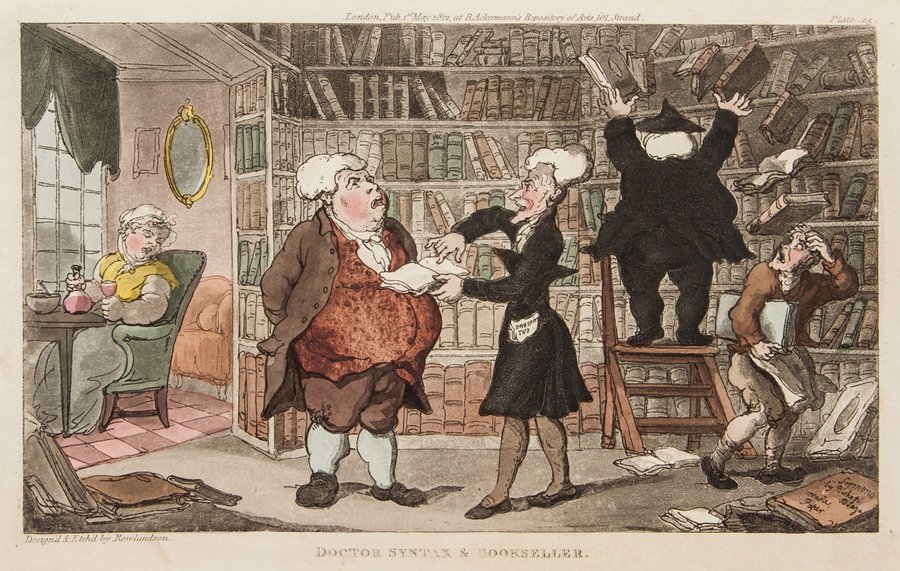
Thomas Rowlandson’s “Dr. Syntax & Bookseller” from William Combe’s The Tour of Dr. Syntax in Search of the Picturesque (1812)
Profit-sharing: the publisher paid for printing and advertising costs; these expenses were repaid as books sold and any profit above those production costs was shared with the author; any loss was absorbed by the publisher. This was a popular way of publishing for unknown authors. Jan Fergus notes that if Austen had used this method for the four novels published in her lifetime, she would have made more money than she did. (Fergus, p. 16)
–
Commission: the author was responsible for all publication expenses – paper, printing, advertising – the publisher distributed the books and took a 10% commission on all copies sold. The author took all the risk here, as if not enough copies sold to cover the costs, the author would be responsible. Austen published all her books this way, excepting her Pride and Prejudice… and from her letters we know that her brother Henry Austen was her financial backer. This seems to have been the most popular way to publish in the early 19-th century, especially for women writers. And it is interesting to note that this form of publishing is in vogue again! – just see all the number of self-published works that appear on Amazon!, this “vanity” publishing no longer less respected than publishing in the traditional way.
–
Sale of Copyright: the author sells the copyright outright to the publisher and is no longer involved. Here the publisher takes all the risk, especially for an unknown author, but also has control over any future editions and can benefit if the book sells well. In the case of P&P, sold to Egerton for £110, Austen would have done better to have published by commission – it went into three editions, though she had no further input in making changes to the text.
–
Subscription: the author would solicit subscribers, who would pay in advance for the promised work and have the privilege of seeing their name in print in the list of subscribers in the work itself. This option usually only worked for well-known and successful authors, or for a work that people might want to see their name identified with. We can look at the concept of modern-day “crowd-funding” as an example of how this works.
***************
It is this last option of publishing that holds our interest today. Jane Austen published anonymously, “By a Lady” (on Sense and Sensibility), or “By the Author of ‘Sense and Sensibility’” (on P&P) (see note below) – she was an unknown authoress and would have had difficulty finding enough willing and wealthy donors to publish by subscription. But Frances Burney, a very successful author at the time, did publish her Camilla (1796) by subscription, the only work she did this way – and this first edition is notable because among the list of 1,058 subscribers (Dow, p. 38) is the name of “Miss J. Austen, Steventon,” only one of two times that Austen’s name appeared in print during her lifetime. She likely paid a guinea for the privilege (Dow, p. 40), and just look at the list on this one page of the illustrious fellow-subscribers!
I have thought for a number of years that this was the only place to find Austen’s name, but Gillian Dow in her article on “Jane, the Subscriber” notes that there is another such title: the non-fiction work Two Sermons by the Rev. T. Jefferson, published in 1808, and where her name is listed as “Miss Jane Austen” and her brother and sister-in-law as “Mr and Mrs Edward Austen of Godmersham.” A look at her letters finds Austen’s references to this Thomas Jefferson (1760-1829) of Tonbridge:
I have read Mr. Jefferson’s case to Edward, and he desires to have his name set down for a guinea and his wife’s for another, but does not wish for more than one copy of the work. [Letter 52. Le Faye, Letters, 4th ed. (2011), p. 132-3.]
And later:
I have now some money to spare, & I wish to have my name put down as a subscriber to Mr. Jefferson’s works. My last Letter was closed before it occurred to me how possible, how right, & how gratifying such a measure would be.” [Letter 54, p. 138]
Thus, we see Jane Austen’s name in print again – one wonders if others might yet surface!
Becoming a Subscriber at Chawton House Library
Chawton House Library
The point of all this is to tell you about a program at Chawton House Library, where you too can become a subscriber! An age-old way of publishing, where you can see your name in print, acquire a copy of a reprint edition of an interesting old title, and support the Chawton House Library in the bargain. Slightly more than a guinea is required of you, but not too much more (a minimum of $50)… You can read about the program and how to donate at the Chawton House Library website here: http://www.chawtonhouse.org/?page_id=58839
“Further to the success of our most recent subscriber publication, The Knight Family Cookbook, which thrilled Subscribers and has proven to be one of the most purchased books in our shop, we are now seeking to progress our latest publication- The Duties of a Lady’s Maid; with directions for conduct, and numerous receipts for the toilette (1825). This facsimile edition, with a new introduction by Mary Ann O’Farrell, will be a fascinating book certain to entertain those who would welcome guidance on how to behave as maid to Lady Catherine De Bourgh – or indeed those who wish to emulate Downton Abbey’s Miss O’Brien. Originally published in 1825, it is a rather rare conduct book offering a unique insight into the lives and duties of servants, as well as the trends and tastes of the Georgian age. Readers can learn how religion should direct a maid in her work, which character traits are essential, and how to keep family secrets. Amusing practical instructions, such as how to dress your lady using padding and bandages to improve her figure and tips on the most advantageous way to display the forehead, are also to be enjoyed.”
[From the CHL website]
Let’s take a peek into this book that you can own in a facsimile edition – no author is noted as you can see: The Duties of a Lady’s Maid; with directions for conduct, and numerous receipts for the toilette (1825).
title pageFrontispiece
Now, I must tell you that you can find this book on Google Books, or at the Hathi Trust – but where is the fun in that? You need this book on your shelf, not only because it is a rare book (it only seems to have been published in this one edition of 1825), but also because you will find the most indispensable information in order to continue on with your life as you know it – after all, we most of us have become our own Ladys’ Maids, haven’t we? – if for any reason you don’t find this all completely relevant (the chapters on cleaning your wardrobe definitely remain so!), then at least it will be a daily reminder of exactly how far we have come. Take a look at the Contents:
CONTENTS _______________
1. DUTIES OF BEHAVIOUR.
-Religion 6
-Honesty and Probity 19
-Diligence and Economy 26
-Attention 39
-Familiarity with Superiors 43
-Good Temper and Civility 50
-Confidence in Keeping Family Secrets 57
-Vanity and Dress 70
-Amusements 84
-Vulgar and Correct Speaking 98
-Change of Place 123
-Courtship 128
2. DUTIES OF KNOWLEDGE AND ART.
-Taste in the Colours of Dress 135
-Carnation 145
-Florid 146
-Fair 147
-Pale 148
-Sallow 149
-Brunette 150
-Artificial Flowers 159
-Taste in the Forms of Dress 162
-Stays and Corsets 175
-Padding, Bandaging, &c, to Improve the Figure 184
-Display of the Forehead 192
-Taste in Head Dresses 199
-Taste in Dressing the Hair 220
-Practical Directions for Hair Dressing, with Receipts. 233
-Cosmetics, &c. with. Receipts 256
-Paints, with Receipts for Rouge, Pearl White, &c 289
-Use and Abuse of Soap 306
-Dress-making and Fancy Needle-work 315
-Care of the Wardrobe, and the Method of Taking out Stains 321
-Method of Cleaning Silks and Chintz, and of Clear Starching, and Getting-up Lace and Fine Linen 324
******************
Some excerpts to entice you:
1. In case you perhaps don’t speak the King’s English – here are some pointers on correcting your shortcomings:
VULGARITIES PECULIAR TO ENGLAND.
The first vulgarity which I shall point out to you as prevalent among the lower orders in England, from Cumberland to Cornwall, is the practice of ending every thing they say with a question. For instance, instead of saying “the bonnet looks very smart,” an English girl will add the question, “an’t it?” or “don’t it?” If this practice of ending what is said by a question, were only employed occasionally, and when it appears necessary, it might be proper enough; but when it is repeated every time a person speaks, as you may observe is the case among the ill-educated all over England, it becomes extremely vulgar. You may thus hear a person say, “I went very quick, did’nt I?” for “I always do, don’t I?” or “Susan worked that very well, didn’t she? she is a good girl, an’t she? and I am very kind to her, an’t I?” You must carefully avoid this vulgar practice of ending what you say with a question, if you are desirous of speaking correctly….
Still more vulgar than either of these is a certain use of the words there and here, along with that and this, as when it is said “that there house,” instead of “that house,” or “this here book,” instead of “this book.” You may, however, without impropriety say “this book here,” or “that house there’s” but never, “this here” nor “that there.” …
One of the very common vulgarities prevalent in England is a peculiarly awkward way of bringing in the name of a person at the end of a sentence, with the words “is” or “was” before it. I cannot describe this more intelligibly, except by an example; for instance, you may hear an ill educated girl say “she was very kind to me, was Mrs. Howard,” instead of correctly saying “Mrs. Howard was very kind to me.” Again, “he is a very worthy man, is Mr. Howard” instead of “Mr. Howard is a very worthy man.” I say that such expressions are not only vulgar but uncouth and awkward, and more like the blunders of a foreigner than a person speaking in her mother tongue; yet nothing is more common than this awkward vulgarity, which I expect you, will never commit after it has been now pointed out to you….
The manner in which certain words are pronounced is also a very evident mark of vulgarity. One of the most remarkable instances of this kind in England is the sounding of an r at the close of words ending in a or o, as when you say “idear” for “idea,” or “fellor” for “fellow,” or “windor” for “window,” or “yellor” for “yellow.” This is extremely difficult to be corrected when once it has become a habit; and so regularly does it follow in every word of similar ending, that you may hear persons say “Genevar” for “Geneva,” as commonly as children say “mammar” and “papar.”
[etc, etc… the Author then goes on to cover the various “Vulgarities in Scotland”…]
***********
2. Mrs. Clay might find a solution to her unsightly freckles with these solutions, Sir Walter would be pleased to know:
CE Brock – Sir Walter Elliot (Mollands)
Freckles.—The sun produces red spots, which are known by the name of freckles. These have no apparent elevation but to the touch it may be perceived that they give a slight degree of roughness to the epidermis. These spots come upon the skin in those parts which are habitually exposed to the air. To prevent freckles, or sunburn, it is necessary to avoid walking abroad uncovered; a veil alone, or a straw hat, is sufficient for most women. There are however others whose more delicate skins require a more powerful preservative. The following is recommended by an intelligent physician:—
Take one pound of bullock’s gall, one drachma of rock alum, half an ounce of sugar candy, two drachms of borax, and one drachm of camphor. Mix them together, stir the whole for a quarter of an hour, and then let it stand. Repeat this three or four times a day, for a fortnight, that is to say, till the gall appears as clear as water. Then strain it through blotting paper, and put it away for use. Apply it when obliged to go abroad in the sunshine or into the country, taking care to wash your face at night with common water, those who have not taken the precautions mentioned above must resort to the means which art has discovered for removing these spots. The following process is recommended as one of the most efficacious for clearing a sunburnt complexion, and imparting the most beautiful tint to the skin ;—at night on going to bed, crush some strawberries upon the face, leaving them there all night and they will become, dry. Next morning wash with chervil water, and the skin will appear fresh, fair, and brilliant.
[Etc, etc – there are several other rather drastic directions…]
*************
3. I must say that the seven pages on “Display of the Forehead” is worth the price of admission alone! But this on making a French dressing for your hair is a must-learn:
Parisian Pomatum.—Put into a proper vessel two pounds and a half of prepared hog’s lard with two pounds of picked lavender flowers, orange flowers, jasmine, buds of sweet briar, or any other sweet scented flower, or a mixture according to your choice, and knead the whole with the hands into a paste as uniform as possible. Put this mixture into a pewter, tin, or stone pot, and cork it tight. Place the vessel in a vapour bath, and let it stand in it six hours, at the expiration of which time strain the mixture through a coarse linen cloth by means of a press. Now throw away the flowers which you have used as being useless, pour the melted lard back into the same pot, and add four pounds of fresh lavender flowers. Stir the lard and flowers together while the lard is in a liquid state, in order to mix them thoroughly, and repeat the first process. Continue to repeat this till you have used about ten pounds of flowers.[my emphasis]
After having separated the pomatum from the refuse of the flowers, set it in a cool place to congeal, pour off the reddish brown liquor, or juice extracted from the flowers, wash the pomatum in several waters, stirring it about with a wooden spatula to separate any remaining watery particles, till the last water remains perfectly colourless. Then melt the pomatum in a vapour bath, and let it stand in it about one hour, in a vessel well corked, then leave it in the vessel to congeal. Repeat this last operation till the watery particles are entirely extracted, when the wax must be added, and the pomatum melted for the last time in a vapour bath in a vessel closely corked, and suffered to congeal as before. When properly prepared it may be filled into pots, and tie the mouths of them over with wet bladder to prevent the air from penetrating. This pomatum will be very fragrant, and form an excellent preparation for improving the gloss and luxuriance of the hair.
[I’m exhausted just thinking about it…] – You might end up looking like this, flowers and all:
[Source: ‘The Flower Garden’ – hand-coloured etched engraving published by M Darly in 1777.
See Bibliodyssey for additional such outrageous hair-dos]
***************
So that gives you a very small inkling of what lies in store in this fascinating little book. You will find insights into the daily life and work of the many rarely seen but obviously-there-lurking-about servants in all of Austen’s novels – what was it like to be the lady’s maid to Lady Catherine or her daughter Anne – dreadful thought! Was it easier being maid to Mrs. Jennings with her overwhelming busyness, or Mrs. Bennet, despite her poor fluttering nerves? We watch Downton Abbey as much for the sometimes more interesting “below-stairs” life than anything that transpires upstairs – and indeed not much changed in servant’s lives from 1825 to the early 1900s. Certainly Anna would have been familiar with this book or something like it.
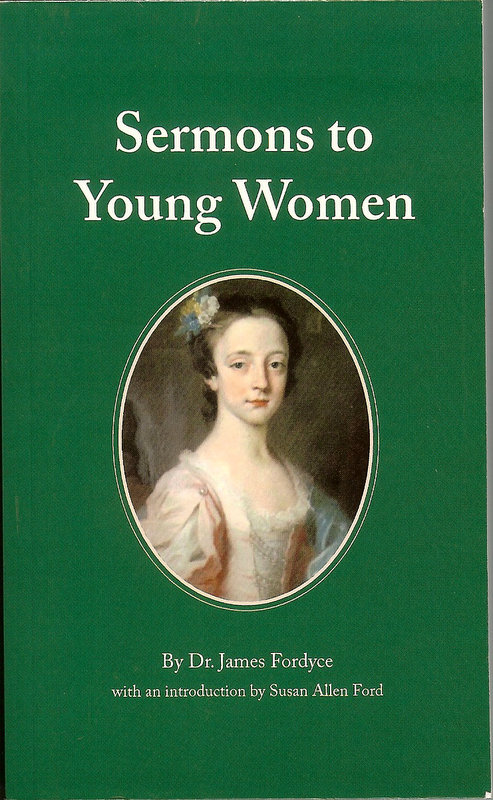
Think about adding this to your collection of conduct books [everyone should have a collection of conduct books, starting of course with Fordyce’s Sermons, Mr. Collins’ pride and joy in Pride and Prejudice, now published with an introduction by Susan Allen Ford and also available from the Chawton House Library: you can order it here through Jane Austen Books].
Hope I have convinced you of the need to become a subscriber to Duties of a Lady’s Maid – go to http://www.chawtonhouse.org/?page_id=58839 – click on the appropriate link for UK or US contributions. Or think what a great gift this would be for your favorite friend in need of a conduct book of her (or his) own!
The Library will be preparing for publication soon, as the list of subscribers is growing – don’t miss out in seeing your name, or a best friend’s, in print, just like Jane Austen….
1. Dow, Gillian. “Jane, the Subscriber.” Jane Austen’s Regency World 68 (Mar-Apr 2014), 38-43.
2. Fergus, Jan. The Professional Woman Writer.” Cambridge Companion to Jane Austen. Ed. Edward Copeland and Juliet McMaster. Cambridge UP, 1997. See this chapter in both editions of the Cambridge Companion, as well as her Jane Austen: A Literary Life. Macmillan, 1991.
3. The title pages of each of Austen’s works read as follows:
Sense and Sensibility: “By a Lady”
Pride and Prejudice: “By the Author of ‘Sense and Sensibility’
Mansfield Park: “By the Author of ‘Sense and Sensibility’ and ‘Pride and Prejudice’
Emma: “By the Author of ‘Pride and Prejudice,’ &c, &c.”
Northanger Abbey and Persuasion: “By the Author of ‘Pride and Prejudice,’ ‘Mansfield Park,’ &c.”
Be on the lookout in your mailbox! – the March/April 2015 (issue 74) of Jane Austen’s Regency World magazine is published this week and is being mailed to subscribers. In it you can read about:
The Iron Duke: A major exhibition marks the Duke of Wellington’s triumph at the Battle of Waterloo
A Book’s Life: One of the rare books at Chawton House Library reveals all
Anyone for Pyms? Barbara Pym, the novelist who was known as the “Jane Austen of the 20th century”
Georgian Illnesses: Examining some of the ailments suffered by Jane Austen’s characters
From Daylesford to Delaford: Is there a connection between Warren Hastings and Sense & Sensibility?
*Plus News, Letters, Book Reviews and information from Jane Austen Societies in the US, UK and Australia
*To subscribe now click here – and make sure that you are among the first to read all the news from Jane Austen’s Regency World!

 About the author:

























 Jane Austen in Vermont