Jane Austen Circle · Literature · News · Women Writers

More Gaskell!

Just discovered today! Another Elizabeth Gaskell source!  Katherine of the Austen-related blog November’s Autumn, [where she is currently posting a series on Austen’s “paradox of names”] has started a new blog devoted to Elizabeth Gaskell. You can view the site here; as well as follow her on Twitter here.  Delighted to see Gaskell getting such attention in the blogsphere!

Katherine had written a post on Gaskell’s Wives and Daughters for the September 29th Blog Celebration that begins here – scroll down for the links to the 15 blogs that participated in this tribute to Gaskell on her 200th birthday.

Congratulations Katherine on your lovely new blog! [I have added you to my posted Gaskell bibliography.]

Jane Austen Circle · Literature · Movies · Women Writers

Elizabeth Gaskell Bicentenary Blog Tour: Your Gaskell Library


Welcome to the 14th stop on today’s celebration of Elizabeth Gaskell’s birthday – September 29, 1810!  Please join me in this blog tour honoring Gaskell as 15 bloggers, under the direction of Laurel Ann at Austenprose, each post something related to Gaskell – a look at her life and times, book reviews, movie reviews, a tour to her home in Manchester [see at the bottom of this post for the links to the various posts on the blog tour], and my post on “Your Gaskell Library” ~  where to find Gaskell in print, online, on your iPhone,  on your iPod, and on film – she is Everywhere!  By the end of the tour you will know more about Gaskell than you thought possible and be the better for it!!  There is also the opportunity to win a Naxos recording of North and South by just making a comment on any of the blogs.  Enjoy yourself as we all wish a hearty Happy Birthday to Mrs. Gaskell!
********************

I wanted to see the place where Margaret grew to what she is,
even at the worst time of all,
when I had no hope of ever calling her mine…

North and South
*************

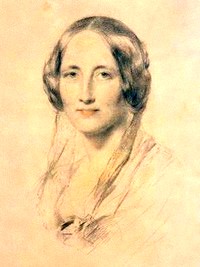
Elizabeth Cleghorn Gaskell (1810-1865) is best known to us as the author of the then-controversial biography of Charlotte Bronte, where she laid bare the oddities of the Bronte household, publicizing the behavior of the semi-mad father and the destructive life and affairs of the son. But Gaskell was a well-respected and popular author in her own day; we have been seeing a resurgence of that popularity with the broadcast of Wives & Daughters (1999), North & South (2004) [the film that rocketed Richard Armitage to fame, and rightly so!], and Cranford (2007, 2009). So I give a very brief review of her life and works [this was originally posted here], followed by a select bibliography. 

Born in Cheshire to William Stevenson, a Unitarian minister, Elizabeth was raised by her aunt, the sister of her mother who died shortly after her birth.  The town of Knutsford and the country life she experienced there became her setting in Cranford and her “Hollingford” in North & South.  She married William Gaskell of Manchester, also a Unitarian minister, in 1832, had four daughters and one son, who died in infancy.  The loss of her son had a devastating effect on her and to keep herself from sinking into an ever-deeper depression, she took pen in hand and started to write.  She published her first book Mary Barton in 1848 (using the pseudonym Cotton Mather Mills), though there is some speculation that she actually started to write Sylvia’s Lovers (1863) first but put it aside to write the more socially conscious Mary Barton.  Gaskell, according to Lucy Stebbins, was chiefly concerned with the ethical question of ”The Lie”, i.e. a belief that “deception was the greatest obstacle to the sympathetic understanding which was her panacea for individual and class quarrels.” (1)  This reconciliation between individuals of different classes and between the wider world of masters and workers was her hope for humanity and it was this zeal that often led her into false sentiment in her novels and stories.(2)  But because she saw both sides of the labor question and pitied both the oppressor and the oppressed, she was thus able to portray with often explicit candor the realities of her world.  But Stebbins also says that life was too kind to her as a woman to make her a great artist.  Her tales of vengeance and remorse were written more to satisfy public taste, after she started publishing in Dickens’ Household Words.  And David Cecil calls Gaskell “a typical Victorian woman….a wife and mother”….he emphasizes her femininity, which he says gives her the strengths of her detail and a “freshness of outlook” in her portrayals of the country gentry, while at the same time this femininity limits her imagination.  In comparing her to Jane Austen, Cecil writes: 

         It is true Mrs. Gaskell lived a narrow life, but Jane Austen, living a life just as narrow, was able to make works of major art out of it.  Jane Austen…was a woman of very abnormal penetration and intensity of genius. ….. [Gaskell] cannot, as Jane Austen did, make one little room an everywhere; pierce through the surface facts of a village tea-party to reveal the universal laws of human conduct that they illustrate.  If she [Gaskell] writes about a village tea-party, it is just a village tea-party…(3) 

   Cecil is critical of her melodrama, her “weakness for a happy ending”, her overlong works that lack imagination and passion.  But he does credit her four major works (Sylvia’s Lovers, Cranford, Wives & Daughters, and Cousin Phillis) as classic and worthy English domestic novels.  
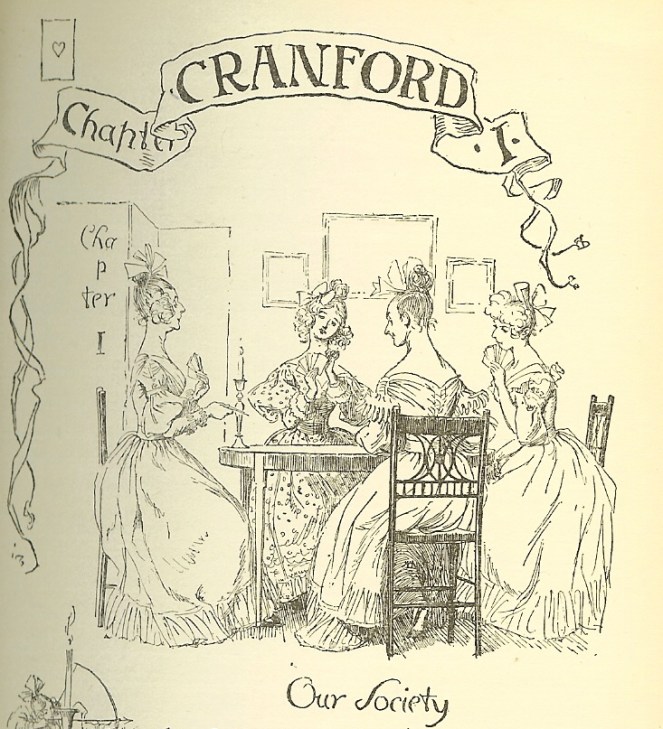
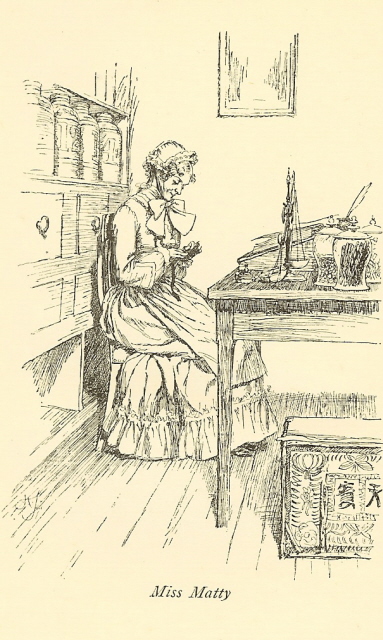
[Cranford, illustrated by Hugh Thomson.  London : Macmillan, 1891..
This copy is also available at the Illustrated Cranford site. ]

Anne Thackeray Ritchie, in her introduction to Cranford, published in 1891, also compares Gaskell to Austen, and finds the latter lacking: 

Cranford is farther removed from the world, and yet more attuned to its larger interests than Meryton or Kellynch or Hartfield….Drumble, the great noisy manufacturing town, is its metropolis, not Bath with its successions of card parties and Assembly Rooms.” …. and on love, “there is more real feeling in these few signs of what once was, than in all the Misses Bennett’s youthful romances put together…only Miss Austen’s very sweetest heroines (including her own irresistible dark-eyed self, in her big cap and faded kerchief) are worthy of this old place….”  and later, “it was because she had written Mary Barton that some deeper echoes reach us in Cranford than are to be found in any of Jane Austen’s books, delightful though they be. (4) 

Margaret Lane in her wonderful book of essays on biography, Purely for Pleasure [which also includes the essay “Jane Austen’s Sleight-of-hand”], has two essays on Mrs. Gaskell.  Lane calls her one of the greatest novelists of the time, and especially praises Wives & Daughters over Cranford for its stature, sympathies, mature grasp of character and its humour, and its effect of “creating the illusion of a return to a more rigid but also more stable and innocent world than ours” and we feel refreshed in spirit after a reading. (5) 

Wives & Daughters, Gaskell’s last work, and considered her finest, was published as a serial novel in Cornhill, the last unfinished part appearing in January 1866.  Gaskell had literally dropped dead in the middle of a spoken sentence at the age of 55, and the work remained unfinished, with only a long note from the Cornhill editor following the last serial installment.  Wives and Daughters tells the story of Molly Gibson and her new stepsister Cynthia, and their coming of age in the male-dominated mid-Victorian society of “Hollingford.” 

But it is Lane’s essay on “Mrs. Gaskell’s Task” in which she so highly praises Gaskell’s achievement in her biography of Charlotte Bronte.  While Gaskell obviously suppressed some facts (the letters to M. Heger) and exaggerated others (Mr. Bronte as a father and Branwell as a son), Lane says “her great biography remains a stirring and noble work, one of the first in our language…. and it is in essence ‘truer’ than anything about the Brontes which has been written since…”(6) 

Such contrary opinions!…certainly reminiscent of Austen’s admirers and critics!   Perhaps as Pam Morris says in her introduction to W&D, “Gaskell resists any simple categorization…her work ranges across the narrative forms of realism and fairytale, protest fiction and pastoralism, melodrama and the domestic novel.”(7) 

_______________________________________ 

Notes:
1.  Lucy Poate Stebbins. A Victorian Album: Some lady Novelists of the Period (Columbia, 1946) p. 96.
2.  Ibid.
3.  David Cecil.  Victorian Novelists: Essays in Revaluation (Chicago, 1962) p. 187.
4.  Anne Thackeray Ritchie.  Preface to Cranford (Macmillan, 1927) pp. vii, xix.
5.  Margaret Lane.  Purely for Pleasure (Hamish Hamilton, 1966)  p. 153.
6.  Ibid, p. 170.
7.  Pam Morris.  Introduction to Wives and Daughters (Penguin, 2001) p. vii. 
                                                            *****************

I append below a “Select Bibliography” of Gaskell’s works, biographies and critical works, as well as links to what can be found online, iPhone, audio, and film – and most everything Gaskell wrote IS available.  Many of her writings were originally published in the periodicals of the day, such as Howitt’s Journal, Sartain’s Union Magazine, Harper’s Monthly Magazine, Dickens’s Household Words and All the Year Round, and Cornhill Magazine; and many of these writings were later published in collections of tales. And, like Dickens, some of her novels were originally published in serial form [Cranford, North and South, Wives and Daughters].  I list below the novels as first published in book form, a list of short stories and essays with date of original appearance in print, and a list of current editions you can find in your local bookstore [I list only the Oxford, Penguin and Broadview editions – there are many others and reprints of all kinds – best to look for an edition with a good introduction and notes.]  There is a lot of information here, with links to even more information available on the web – there is no lack of writing on Mrs. Gaskell! – But what I really want to emphasize are her short stories, which often get lost in the hoopla about her major novels – there are many as you will see, with links appended – try some – you will not be disappointed!  

****************************
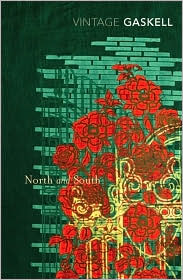
Bibliography: Selected list   [see links below for more complete bibliographies] 

Works:  Books, Short Story Collections 

  1. Mary Barton: A Tale of Manchester Life. 2 vols. London: Chapman & Hall, 1848; 1 volume, New York: Harper, 1848.
  2. Libbie Marsh’s Three Eras: A Lancashire Tale. London: Hamilton, Adams, 1850.
  3. The Moorland Cottage. London: Chapman & Hall, 1850; New York: Harper, 1851.
  4. Ruth: A Novel. 3 vols. London: Chapman & Hall, 1853; 1 volume, Boston: Ticknor, Reed & Fields, 1853.  
  5. Cranford. London: Chapman & Hall, 1853; New York: Harper, 1853.
  6. Hand and Heart; and Bessy’s Troubles at Home.  London:  Chapman and Hall, 1855.
  7. Lizzie Leigh and Other Tales. London: Chapman & Hall, 1855; Philadelphia: Hardy, 1869.
  8. North and South. 2 vols.  London: Chapman & Hall, 1855; 1 vol., New York: Harper, 1855.
  9. The Life of Charlotte Brontë; Author of “Jane Eyre,” “Shirley,” “Villette” etc.. 2 vols. London: Smith, Elder, 1857; New York: Appleton, 1857.
  10. My Lady Ludlow, A Novel. New York: Harper, 1858;  republished as Round the Sofa. 2 vols. London: Low, 1859.
  11. Right at Last, and Other Tales.  London: Low, 1860; New York: Harper, 1860.
  12. Lois the Witch and Other Tales. Leipzig: Tauchnitz 1861.
  13. Sylvia’s Lovers.  3 vols.  London: Smith, Elder, 1863; 1 vol. New York: Dutton, 1863.
  14. A Dark Night’s Work.  London: Smith, Elder, 1863; New York: Harper, 1863.
  15. Cousin Phillis: A Tale. New York: Harper, 1864; republished as Cousin Phillis and Other Tales.  London: Smith, Elder, 1865.
  16. The Grey Woman and Other Tales.  London: Smith, Elder, 1865; New York: Harper, 1882.
  17. Wives and Daughters: An Every-Day Story.  2 vols.  London: Smith, Elder, 1866; 1 vol., New York: Harper, 1866.


Works:  Short Stories and Essays [in order of publication] – most of these are available online at The Gaskell Web, Project Gutenberg, IPhone (Stanza – Munsey’s), etc. 

  1. On Visiting the Grave of my Stillborn Little Girl (1837)
  2. Sketches Among the Poor, No.1 (1837)
  3. Notes on Cheshire Customs (1839)
  4. Description of Clopton Hall (1840)
  5. Life In Manchester:  Libbie Marsh’s Three Eras (1847)
  6. The Sexton’s hero (1847)
  7. Emerson’s lectures (1847) [attributed]
  8. Christmas Storms and Sunshine (1848)
  9. Hand and Heart (1849)
  10. The Last Generation in England (1849)
  11. Martha Preston (1850) – re-written as “Half a Lifetime Ago”
  12. Lizzie Leigh  (1850)
  13. The Well of Pen-Morfa (1850)
  14. The Heart of John Middleton (1850)
  15. Mr. Harrison’s Confessions (1851)
  16. Disappearances (1851)
  17. Our Society in Cranford (1851)
  18. A Love Affair at Cranford (1852)
  19. Bessy’s Troubles at Home (1852)
  20. Memory at Cranford (1852)
  21. Visiting at Cranford (1852)
  22. The Shah’s English Gardener (1852)
  23. The Old Nurse’s Story (1852)
  24. Cumberland Sheep Shearers (1853)
  25. The Great Cranford Panic (1853)
  26. Stopped Payment at Cranford (1853)
  27. Friends in Need (1853)
  28. A Happy Return to Cranford (1853)
  29. Bran (1853)
  30. Morton Hall (1853)
  31. Traits and Stories of the Huguenots (1853)
  32. My French Master (1853)
  33. The Squire’s Story (1853)
  34. The Scholar’s Story (1853)
  35. Uncle Peter (1853)
  36. Modern Greek Songs (1854)
  37. Company Manners (1854)
  38. An Accursed race (1855)
  39. Half a lifetime Ago (1855) [see above “Martha Preston”]
  40. The Poor Clare (1856)
  41. The Siege of the Black Cottage (1857) – attributed
  42. Preface to Maria Susanna Cummins Mabel Vaughan (1857)
  43. The Doom of the Griffiths (1858)
  44. An Incident at Niagara Falls (1858)
  45. The Sin of a Father (1858) – re-titled Right at Last in collection
  46. The Manchester Marriage (1858)
  47. The Half-Brothers (1859) – in Round the Sofa collection
  48. Lois the Witch (1859)
  49. The Ghost in the Garden Room (1859) – re-titled “The Crooked Branch” in Right at Last collection
  50. Curious if True (1860)
  51. The Grey Woman (1861)
  52. Preface to C. Augusto Vecchi, Garibladi at Caprera (1862)
  53. Six Weeks at Heppenheim (1862)
  54. Shams (1863)
  55. An Italian Institution (1863)
  56. The Cage at Cranford (18863)
  57. Obituary of Robert Gould Shaw (1863)
  58. How the First Floor Went to Crowley Castle (1863)
  59. French Life (1864)
  60. Some Passages from the History of the Chomley Family (1864)
  61. Columns of Gossip from Paris (1865)
  62. A Parson’s Holiday (1865)
  63. Two Fragments of Ghost Stories [n.d]

Works ~ Collections: 

  • The Works of Mrs. Gaskell, Knutsford Edition, edited by A. W. Ward. 8 vols. London: Smith, Elder, 1906-1911.
  • The Novels and Tales of Mrs. Gaskell, edited by C. K. Shorter. 11 vols. Oxford: Oxford University Press, 1906-1919.
  • The Works of Elizabeth Gaskell, ed. Joanne Shattuck, et.al.  10 vols.  London:  Pickering and Chatto, 2005-2006.  Click here for more info on this set.

Currently in print ~ Individual Works and Collections: [only the Penguin, Oxford and Broadview Press editions are noted here – there are a number of available editions of Gaskell’s individual works – search on Abebooks, Amazon, or visit your local bookseller; and there are any number of older and out-of-print editions available at these same sources!]

  • Cousin Phillis and Other Stories.  Intro by Heather Glen. Oxford, 2010.
  • Cranford.  Intro by Patricia Ingham.  Penguin 2009; intro by Charlotte Mitchell.  Oxford, 2009;  Intro by Elizabeth Langland.  Broadview, 2010.
  • Gothic Tales. Intro by Laura Kranzler.  Penguin 2001.
  • Life of Charlotte Bronte.  Intro by Elizabeth Jay.  Penguin 1998; Intro by Angus Easson.  Oxford, 2009.
  • Mary Barton.  Intro by MacDonald Daly.  Penguin, 1997; Intro by Shirley Foster.  Oxford, 2009;  Intro by Jennifer Foster.  Broadview, 2000.
  • North and South.  Intro by Patricia Ingham.  Penguin, 1996; Intro by Sally Shuttleworth.  Oxford, 2008.
  • Ruth.  Intro by Angus Easson.  Penguin, 1998; Intro by Alan Shelston.  Oxford, 2009.
  • Sylvia’s lovers.  Intro by Shirley Foster.  Penguin, 1997;  Intro by Andrew Sanders.  Oxford, 2008.
  • Wives and Daughters.  Intro by Pam Morris.  Penguin, 1997


What’s Gaskell Worth Now?

Austen’s works show up at auction fairly regularly, but what about Gaskell – how does she compare to the high prices that Austen’s first editions command?  There is an upcoming Sotheby’s auction set for October 28 in London:  The Library of an English Bibliophile, Part I – all of Austen’s first editions are in the sale with high-end estimates; there are three Gaskell titles in the sale, so this gives a good idea of value:

  • Mary Barton.  London: Chapman and Hall, 1848.  First edition.  est. 4,000 – 6,000 GBP
  • Ruth.  London:  Chapman and hall, 1853.  First edition.  est. 2,000-3,000 GBP
  • North and South.  London:  Chapman and hall, 1855.  First edition.  est. 2,000-3,000 GBP.

 Letters / Diaries: 

  • Chapple, J.A.V. and Arthur Pollard, eds.  The Letters of Mrs. Gaskell. Manchester: Manchester UP, 1966.
  • Chapple, J. A.V.; assisted by by J. G. Sharpes. Elizabeth Gaskell: A Portrait in Letters.  Manchester: 1980.
  • Chapple, John and Alan Shelston, eds. Further Letters of Mrs. Gaskell. Manchester: Manchester UP, 2001.
  • Chapple J. A. V. and Anita Wilson, eds.  Private Voices: the Diaries of Elizabeth Gaskell and Sophia Holland.  Keele:  Keele UP, 1996.
  • Whitehill, Jane, ed.  The Letters of Mrs. Gaskell and Charles Eliot Norton, 1855-1865.  London: Oxford UP: 1932.

Bibliographies: 

  • Selig, R. L.  Elizabeth Gaskell; A Reference Guide.  Boston: G.K. Hall, 1977.
  • Jeffery Welch, Elizabeth Gaskell: An Annotated Bibliography, 1929-75. New York: Garland, 1977.
  • Weyant, Nancy S.  Elizabeth Gaskell: An Annotated Bibliography, 1976-1991. Metuchen, NJ: Scarecrow, 1994.
  • ______________.   Elizabeth Gaskell: An Annotated Guide to English Language Sources, 1992-2001.  Metuchen, NJ:  Scarecrow, 2004. 
    See also Weyant’s online Supplement, 2002-2010 [updated semi-annually]
  • See the Gaskell Web page for an online bibliography

Biographies: 

  • Chapple, John.  Elizabeth Gaskell: A Portrait in Letters.  Manchester:  Manchester UP, 1980.
  • ___________. Elizabeth Gaskell: The Early Years.  Manchester:  Manchester UP, 1997.
  • Easson, Angus.  Elizabeth Gaskell. London: Routledge & Kegan Paul, 1979.
  • Ffrench, Yvonne.  Mrs. Gaskell.  London:  Home & Van Thal, 1949.
  • Foster, Shirley.  Elizabeth Gaskell:  A Literary Life.  Houndsmills: Palgrave Macmillan, 2002.
  • Gerin, Winifred. Elizabeth Gaskell: A Biography. Oxford: Clarendon Press, 1976.
  • Handley, Graham.  An Elizabeth Gaskell Chronology.  Palgrave Macmillan, 2004.
  • Hopkins, Annette Brown. Elizabeth Gaskell: Her Life and Work. London: Lehmann, 1952.
  • Pollard, Arthur.  Mrs. Gaskell: Novelist and Biographer. Manchester: Manchester UP, 1966.
  • Uglow, Jenny.  Elizabeth Gaskell: A Habit of Stories. London: Faber and Faber, 1993.
  • Unsworth, Anna.  Elizabeth Gaskell: An Independent Woman.  London:  Minerva, 1996.

Studies: 

  • Barry, James Donald. “Elizabeth Cleghorn Gaskell,” in Victorian Fiction: A Second Guide to Research, edited by George H. Ford. New York: MLA, 1978.
  • Beer, P. Reader, I Married Him. . . . London: Macmillan, 1974.
  • Cecil, David.  Victorian Novelists: Essays in Revaluation.  Chicago, 1962.
  • Craik, W. A.  Elizabeth Gaskell and the English Provincial Novel. London: Methuen, 1975.
  • Easson, Angus, ed.  Elizabeth Gaskell: The Critical Heritage.  London, 1992.
  • Ganz, Margaret. Elizabeth Gaskell: The Artist in Conflict. New York: Twayne, 1969.
  • Lane, Margaret.  Purely for Pleasure.  London: Hamish Hamilton, 1966.  See chapters on “Mrs. Gaskell’s Task” and “Mrs. Gaskell:  Wives and Daughters’.
  • Lansbury, Coral. Elizabeth Gaskell: The Novel of Social Crisis.  London:  Paul Elek, 1975.
  • Lucas, John. “Mrs. Gaskell and Brotherhood,” in Tradition and Tolerance in Nineteenth Century Fiction, by D. Howard, J. Lucas, and J. Goode. London: Routledge & Kegan Paul, 1966.
  • Matus, Jill L. The Cambridge Companion to Elizabeth Gaskell.  Cambridge: Cambridge UP, 2007.
  • Morris, Pam.  “Introduction to Wives and Daughters”.  New York: Penguin, 2001.
  • Ritchie, Anne Thackeray.  “Preface to Cranford”.  New Edition.  London: Macmillan, 1907.
  • Rubenius, Aina.  The Woman Question in Mrs. Gaskell’s Life and Work.  Uppsala: Lundequist ; Cambridge: Harvard UP, 1950; reprinted by Russell and Russell in 1973.
  • Sharps, John Geoffrey Sharps. Mrs. Gaskell’s Observation and Invention: A Study of the Non-Biographic Works.  London: Linden, 1970.
  • Spencer, Jane.  Elizabeth Gaskell.  London: Macmillan, 1993.
  • Stebbins, Lucy Poate. A Victorian Album: Some Lady Novelists of the Period.  New York: Columbia UP, 1946.
  • Wright, Edgar. Mrs. Gaskell: The Basis for Reassessment.  London: Oxford UP, 1965.

Papers: 

Links:  


Ebooks:  

  1. Mary Barton
  2. North & South
  3. Cranford 
  4. Wives & Daughters  
  5. Life of Charlotte Bronte
  1. An Accursed Race
  2. Cousin Phillis
  3. Cranford
  4. Curious, if True Strange Tales
  5. A Dark Night’s Work
  6. Doom of the Griffiths
  7. The Grey Woman and other Tales
  8. Half a Life-Time Ago
  9. The Half-Brothers
  10. A House to Let
  11. Life of Charlotte Brontë — Volume 1
  12. Life of Charlotte Bronte — Volume 2
  13. Lizzie Leigh
  14. Mary Barton
  15. The Moorland Cottage
  16. My Lady Ludlow
  17. North and South
  18. The Poor Clare
  19. Round the Sofa
  20. Ruth
  21. Sylvia’s Lovers — Complete 
  22. Sylvia’s Lovers — Volume 1 
  23. Sylvia’s Lovers — Volume 2
  24. Sylvia’s Lovers — Volume 3
  25. Victorian Short Stories: Stories of Successful Marriages (as Contributor)
  26. Wives and Daughters  
  1. Cranford    
  2. Dark Night’s Work, A
  3. Doom of the Griffiths, The
  4. Half a Life-Time Ago
  5. Lizzie Leigh
  6. Mary Barton    
  7. My Lady Ludlow
  8. Poor Clare, The
  9. Wives And Daughters    
  10. An Accursed Race
  11. Half-Brothers, The    

Ebook editions at Amazon, Barnes & Noble and Borders: 

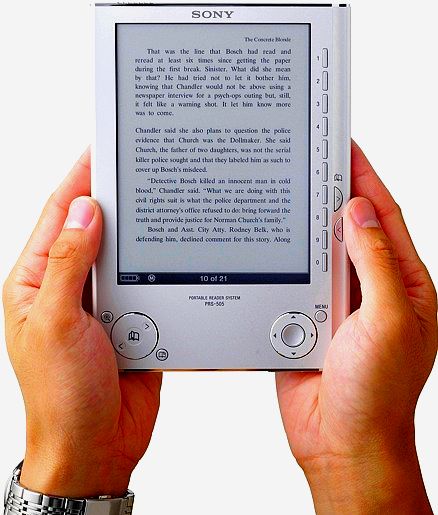
  • The [Kindle] Works of Elizabeth Gaskell – at Amazon, for $3.99 you can download most of her works to your Kindle; but if you search further, there are several free downloads of the individual novels, and other various collections; review the contents before selecting.
  • Barnes & Noble:  same as Amazon, some collections for $3.99, many free options.
  • Borders:  has various similar options 

iPhone Apps:   
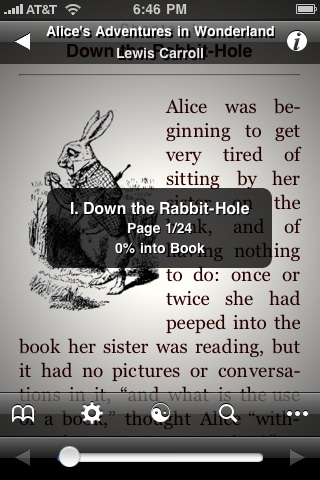
Whatever you use for books on your iPhone, there are plenty of free Gaskells available.  I use Stanza, which is a free app [there are many others – visit your iTunes store and search “books” under Apps and see what I mean!], and from there you can choose the following: Feedbooks has several; Project Gutenberg has the same as online noted above; but Munsey’s takes first prize for having the most – seems to have all the novels and stories as best I can make out – so if you are stranded at an airport or in stopped traffic, what better way to pass the time than a Gaskell short story?! 
 

Audiobooks:  

  1. Cousin Phillis (unabridged)
  2. Cranford (unabridged)
  3. North and South (abridged)
  4. North and South (unabridged)
  5. Wives and Daughters (unabridged)
  6. Wives and Daughters (abridged)
  • Silksounds:  has only My Lady Ludlow, read by Susannah York  [very good!]
  • CSA Word:  Best of Women’s Short Stories, vol. 1& 2.  Read by Harriet Walter [a.k.a. Fanny Dashwood] Includes Gaskell’s “Right at Last” and “The Half Brothers”; CSA Word also has an abridged version of Mary Barton [read by Maggie Ollerenshaw] and North and South [read by Jenny Agutter].
  • LibriVox:
  1. North & South
  2. Other Gaskell works in various states of completion 


Movies:
 [see the various blog posts listed below for movie reviews]

  1. Wives & Daughters (1999)
  2. North & South (2004) – with Richard Armitage and Daniela Denby-Ashe ~ sigh!
  3. North & South (1975)  – with Patrick Stewart and Rosalind Shanks
  4. Cranford (1972) 
  5. Cranford  / Return to Cranford (2007, 2009)
  6. Cousin Phillis (1982)
  7. The Gaskell Collection – DVDs  – includes 7 discs:  W&D, N&S, CRANFORD and all special features.

******************************* 

Well, there’s a fine list for winter reading, listening and viewing! And somewhere in the middle of all that, treat yourself to a re-watch of Armitage in North and South! [and then of course READ it again … here is a link to an older blog post about the book and movie

 ************************

This is a rather quick list of goodies – if any of you know of a particular edition of a book, or an ebook, or an audio edition you particularly like, or a movie that I do not mention, please let me know so I can add it to the list – thank you! 

Follow this link to to the next blog on the Elizabeth Gaskell Bicentenary Blog Tour by Tony Grant at London Calling:  Plymouth Grove – A Visit to Elizabeth Gaskell’s home in Manchester

***********************

The Gaskell Blog Tour:  Here is the complete tour through the 15 blog posts celebrating Gaskell’s Birthday today: and remember that one lucky commenter will win a copy of an unabridged edition of North and South by Naxos AudioBooks read by Clare Willie. That’s 18 hours of Margaret Hale and John Thornton sparring and sparking in Gaskell’s most acclaimed work.  Here is a list of participants. You can visit them in any order and all comments during the contest will count toward your chance to win. Good luck and Happy Birthday Mrs. Gaskell!

Biography

Novels/Biography

Novellas

Resources

Sometimes one likes foolish people for their folly, better than wise people for their wisdom.” Elizabeth Gaskell, Wives and Daughters

[Posted by Deb]
Jane Austen · Jane Austen Circle · News · Social Life & Customs

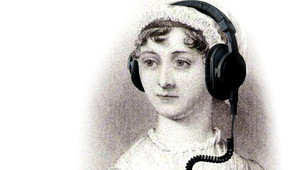
Jane Austen’s Ipod ~ you can listen!

Three days left to listen to the BBC Radio 4 program of Jane Austen’s Ipod [first heard in January and now repeated] – here’s the link:

BBC Radio 4 Programme  – Jane Austen’s Ipod

A rare insight into the family life of Jane Austen through her favourite songs. She collected songs all her life, but many of them have only just come to light, in manuscripts inherited by one of her descendants. Jazz singer Gwyneth Herbert performs some of these songs.

Professor Richard Jenkyns inherited a pile of music manuscripts which are only just being looked at by the Austen scholars. He shows us what he found: some have been laboriously copied out by Jane herself – among the music manuscripts in Jane’s handwriting is a piano piece which he believes she composed.

David Owen Norris brings him together with scholars Deirdre Le Faye and Samantha Carrasco at Jane Austen’s house in Chawton, Hampshire. Together they cast a new light on one of our best-loved and most enigmatic writers.

Some of the songs included are:

  • A romantic song by Robert Burns, to which she changed the words, so that the final words referred to herself -“the charms of your Jane.”
  • A tragic French song, “Les Hirondelles”, which ends with imprisonment and death. Jane’s sister in law Eliza had lived in France, and her first husband was guillotined in the Terror.
  • “The Ploughboy” – a popular song of the time, witty, and with a politically subversive message about corrupt politicians who are only interested in money, and manage to buy their way into power.
  • “Goosey Goosey Gander” – Jane had a lot of nursery rhymes, and was constantly surrounded by boisterous nephews and nieces.

Producer: Elizabeth Burke
A Loftus production for BBC Radio 4.

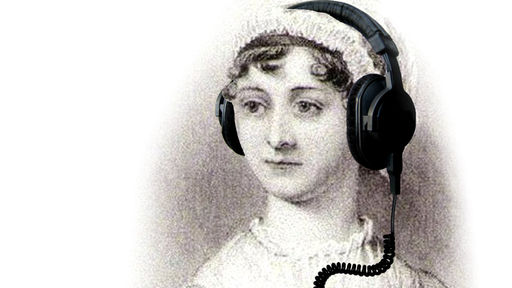
[Image and text from the BBC site]

[Posted by Deb, with thanks to Janeite Kerri]

…AND if you happen to be around the University of Southampton on June 30th, don’t miss this Jane Austen program at Turner Sims:

Calling all Jane Austen enthusiasts!

Discover the music that influenced Jane Austen whilst writing her classic novels, as pianist David Owen Norris explores the nine newly-discovered volumes of the Austen family music collection. Entertaining Miss Austen is on Wednesday 30 June at 8pm.

David Owen Norris is Professor of Musical Performance at the University of Southampton, an Honorary Fellow of Keble College, Oxford, an Educational Fellow of the Worshipful Company of Musicians, and an authority and leading performer on early pianos and rare piano concertos. Joined by soprano Amanda Pitt, David sheds unique light on the musical loves of Jane Austen and her family.

This fascinating recital includes favourite airs and dances – and the only piece of music actually mentioned in Jane’s novels; Kiallmark’s ‘Robin Adair’, which is performed expertly by Jane Fairfax in Emma.

Tickets are £10 and free to Friends of Turner Sims.

[from the Turner Sims website]


Books · Jane Austen · Jane Austen Circle · Regency England · Social Life & Customs

In My Mailbox…

The most recent issue of Jane Austen’s Regency World [March / April 2010, Issue 44], this issue titled “Jane Austen’s Musical World,” brought a delightful surprise – a free cd containing the six works by composers who were working in Bath in the late 18th century [see a list of the selections below], as well as  several articles on the music of Austen’s time:

~ the guest essay by Franz Joseph Hayden describing his visit to Bath in 1794

~ Maggie Lane on Jane Austen, Music Lover? where Ms. Lane posits that “Jane’s attitude toward music seems to have been occasionally hostile, often ambivalent, and only rarely enthusiastic.”

~ David Owen Norris on What was on Jane’s Ipod? on newly discovered music within the Austen family, suggesting that Eliza de Feuillide was an even more considerable pianist than previously thought, as well as the discovery of a hand-written piece possibly composed by Austen herself!

~ Patrick Wood on Thomas Linley, Mozart’s boyhood rival [and subject of one of Gainsborough’s famous paintings]

~ Mike Parker, Tidings of My Harp, “argues that Jane Austen uses the harp in her novels to identify privileged and spoilt women, while knowing little of the mechanics of the instrument herself.”  [think Mary Crawford, the Musgrove sisters and Georgiana Darcy]

~ our very own JASNA-Vermont ‘s Kelly McDonald in A Golden Time, tells of the diaries of Emma Austen-Leigh, wife of Austen’s nephew James Edward Austen-Leigh, which provide valuable insight into London’s music scene during the Regency – here focusing on the Knyvett family of musicians. 

~ Gillian Dooley considers the question of taste in Sense & Sensibility in Matters of Taste and its relationship to moral worth.

~ an interview with Austen scholar Richard Jenkyns – who enlightens us with admitting a special affection for Mansfield Park, thinking the latest BBC adaptation of MP “wins the competition for the worst ever adaptation of any classic novel by a mile”, and wanting most to be like Henry Tilney [but would like to marry Lizzy Bennet]!  [and I add that Jenkyns book A Fine Brush on Ivory: an Appreciation of Jane Austen (2004) is a wonderful read…]

~ articles from JASNA’s Carol Adams on the score for the 1995 P&P; JASA’s Ann Bates on their one-day symposium on Jane and Occupations; reviews of cds, letters, news from 1802, and as always, a great number of fabulous illustrations…

The enclosed cd contains works by:

  • Thomas Linley the Elder : Cantata: Awake my lyre and Invocation: Fly to my aid, O mighty love
  • Henry HarringtonEnchanting Harmonist
  • Thomas Linley the YoungerTo heal the wound a bee had made
  • William Jackson after Thomas ArneWhere the bee sucks
  • William HerschelSonata in D

Subscribe and enjoy!  Jane Austen’s Regency World Magazine

[Posted by Deb]

Jane Austen Circle · News

Austenesque Vermont ~ & Other Austen Sightings…

There are a few Austen-related happenings in Vermont coming up, so mark your calendars:

 1. Take a Class:

AUSTEN: PAGE & FILM
Wednesdays, 4:05-7:05pm, January 20, 2010 – May 4, 2010
University of Vermont Continuing Education: Spring 2010

 After nearly two centuries in print, Jane Austen’s works continue to enthrall us, whether in their original form or in the numerous television and film adaptations created since 1938. This course examines the role Austen played during her own time as well as the role she continues to play within our contemporary cultural imagination by analyzing four of Austen’s novels (Sense and Sensibility, Pride and Prejudice, Mansfield Park, and Emma) and by viewing faithful adaptations, reinterpretations and modernizations of each novel. We begin by placing each novel within its social and historical context, by defining themes that may help explain Austen’s modern appeal, and by creating our own vision of the action and characters. We then turn to the adaptations and investigate the historical moment of production, analyze changes to script and character, and read several essays that raise questions about how prose fiction differs from film in an attempt to understand the screenwriter’s choices and our current love of anything Austen. Course requirements include lively participation, a presentation, reading quizzes, various response assignments, and a final essay.

Register today at http://www.uvm.edu/~learn/ or contact UVM Continuing Education at:  800-639-3210 or 802-656-2085
[NOTE: Vermont residents 65+ call and ask how you can enroll in this course for FREE!]

This would be great to take – but alas!  who has the time OR the money! [maybe next year…?] 

*************************************************

2.  Learn to Dance:

 English Country Dance Classes in Richmond, VT
Learn about and enjoy Jane Austen’s favorite social pastime!

What is English Country Dance? It’s a social dance form with roots in 15th century England and France, was extremely popular in Jane Austen’s time, and continues to be widely enjoyed today. Some of the dances are old, from the 17th and 18th centuries, and some are modern compositions, and are danced to a wide variety of beautiful music. The dance movements are easy to learn: if you can walk, you can do English Country Dancing! You get to dance with lots of people, but you don’t need to bring a partner. ECD is a great way to get mild exercise, meet friendly people, enjoy beautiful dance forms, and express your inner joy (and get out on a cold winter evening)!

4 Tuesday Night Classes in 2010:  7:30 – 9:30 p.m.
January 12 & 19 ~ Teaching by Val Medve
January 26 & February 2 ~ Teaching by Judy Chaves

Richmond Free Library, 201 Bridge Street, Richmond, VT
Voluntary donation to defray cost of heat & electricity ($2 per class suggested)

For adults & teens. Come with or without a partner; we’ll change partners throughout the evening. Dress comfortably and bring clean, flat-heeled shoes with smooth soles (avoid sneakers & mules). Recorded music. All dances taught and walked through.
No sign-up or registration required. Just show up and join us for some fun evenings!

Visit the website for contact information: Burlington Country Dancers 

[I’ve done these classes – they are fabulous! – so dust off your dancing shoes and just show up – you will glad you did – a perfect antidote to winter!]

*******************************************************

 3.  A Weekend retreat: 


[just use your imagination and add a little snow!]

Jane Austen Weekend: Pride and Prejudice
The Governor’s House in Hyde Park
Friday to Sunday, January 8 – 10, 2010
http://www.OneHundredMain.com/jane_austen.html

802-888-6888, tollfree 866-800-6888 or info@OneHundredMain.com

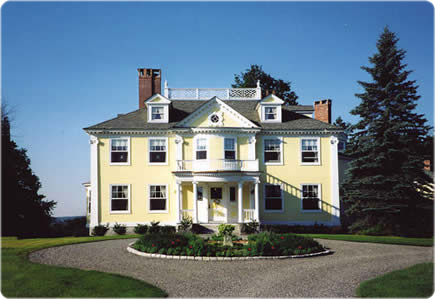
A leisurely weekend of literary-inspired diversions has something for every Jane Austen devoteé. Slip quietly back into Regency England in a beautiful old mansion. Take afternoon tea. Listen to Mozart. Bring your needlework. Share your thoughts at a discussion of Pride and Prejudice and how the movies stand up to the book. Attend the talk entitled The World of Jane Austen, where JASNA-Vermont’s very own Kelly McDonald will be speaking on “The Naive Art of Georgiana Darcy.”  Test your knowledge of Pride and Prejudice and the Regency period and possibly take home a prize. Take a carriage ride or sleigh ride. For the gentleman there are riding and fly fishing as well as lots of more modern diversions if a whole weekend of Jane is not his cup of tea. Join every activity or simply indulge yourself quietly all weekend watching the movies. Dress in whichever century suits you. It’s not Bath, but it is Hyde Park and you’ll love Vermont circa 1800.    

Jane Austen Tea at Governor’s House in Hyde Park
Saturday, January 9, 2010  – 3:00 p.m  $14.00
http://www.OneHundredMain.com/jane_austen.html
802-888-6888 [Advance reservations required]

Part of the Jane Austen weekend at The Governor’s House, the afternoon tea is open to the public. Although this is English afternoon tea made popular in the Victorian Era with scones and clotted cream, finger sandwiches and tea cakes, there will be readings and discussion of the tea that Jane Austen would have enjoyed during the Regency.

*********************************************************** 

4.  Austen sightings: 

A Podcast

This has been making its way about the blogsphere, the news, listservs, etc – but there are only a few days left to hear this Jane Austen podcast on BB4 Radio: – catch it before it is too late…


Jane Austen collected songs all her life but many of them have only just come to light, in manuscripts inherited by one of her descendants. Jazz singer Gwyneth Herbert performs Austen’s favourite songs, with new piano and clarinet accompaniment by David Owen Norris. At Austen’s house in Chawton, Hampshire, scholars and biographers discuss how they cast a new light on one of our best-loved writers. 

[Image and text from BBC Radio website  ]- the scholars are Deirdre LeFaye and Richard Jenkyns.  Visit soon as it is only available for a few more days; or you can download the podcast to your ipod until January 15th…]

 ********************************************************

A Talking Jane

 Another item clogging the airwaves of late, Janeite Bonnie alerting me to this several weeks ago [and I confess it fell through the holiday cracks… there have been many such fallings by the wayside..] – is a YouTube video of Jane Austen reading aloud her own letter to the Revd. James Stanier Clarke, the Prince Regent’s Librarian, who notoriously wrote to Austen suggesting a topic for her next book [“…to delineate in some future Work the Habits of Life and Character and enthusiasm of a Clergyman – who should pass his time between the metropolis & the Country…” – did he not perhaps like Mr. Collins??] –  her response? – listen [though another confession – I hate these things with movable lips, like the babies in commercials who talk like adults – they give me the creeps – but it is Austen, after all, or at least the bonneted, bug-eyed, full-lipped Victorianized version of Dear Jane, babbling away – so enjoy [I also think she sounds like she is a priggish 85 years old, rather than a mere 40…but I am getting a tad snarky now… so just listen for yourself and I will shut-up.]  The letter, if you want to follow along is in the LeFaye edition, No. 138(D), dated April 1, 1816.  I think this cured him of wanting to be her editor – she never heard from him again… or at least there is nothing extant…

************************************************ 

Austen Blogs abuzz

There is a new Austen blog [since October!], Austenonly, penned by the author of the lovely My English Country Garden blog – she adds much to the Austen blogging community with almost daily postings about Austen’s world, filled with luscious illustrations and insightful commentary.  Plan to visit every day – you will be glad you did!

 And speaking of Austen blogs, Laurel Ann at Austenprose has posted a list of her favorite books of 2009 [those she has read of course!] – many titles to add to your TBR pile, along with her wonderful reviews!

Vic at Jane Austen’s World Blog has done what I have so far failed to do [another tumbling into the now pot-hole sized cracks…] – pen her take on the Austen exhibit at the Morgan she was fortunate enough to visit.  She has some wonderful thoughts and pictures, so follow her along as she treks through the letters on display.  I promise to post my thoughts soon – if I can remember them.

*********************************************

The Movies

This in from Janeite Marti:  [she was watching a holiday show on Lifetime and has this to say:]

Around Christmas I was watching a made for TV movie because it had Kristin Chenoweth in it. It was called the ‘12 Men of Christmas’ or something like that and took place in Montana.

 Partway through the movie I started yelling at my husband that it was starting to look like P&P!   Our heroine thought she had met her dream man (Wickham) who blamed the hardware tycoon (Darcy) for his troubles.  Dreamy disappears for a while and later it is found out that he was away with a Rich New Yorker. In the end our heroine ended up with the Darcy character and the truth’s behind the lies are revealed. 

Believe me it was the last place I would have guessed to find a nod to our favorite author!

 Marti

 [thanks Marti for the alert – anyone else see this? – the reviews seemed to be universally horrific, excepting the hero’s apparently often bare chest…]

***************************************************

 Stay tuned – I have some thoughts to post on the BBC Sense & Sensibility 1981 movie I am currently watching – for those of you who have seen this, I welcome your comments…

[Posted by Deb]

Austen Literary History & Criticism · Jane Austen · Jane Austen Circle · Literature · News · Women Writers

“Literary Property Changing Hands” ~ after the auction…

Ever wonder what happens to all those books and manuscripts that show up at auction and then disappear somewhere into the ether, briefly looked at wistfully in the catalogue and then only something you file away in your bibliographic memory chip??  I know I do this with all the Jane Austen materials  [see the post my Bygone Books blog for the latest Austen titles on the block ]

The recent Bloomsbury Auction, The Paula Peyraud Collections:  Samuel Johnson and Women Writers in Georgian Society [New York City, 6 May 2009] [click here for the catalogue and auction results] was of great interest to collectors and readers of 18th and early 19th century women writers.  A recent article by Dr. Maureen E. Mulvihill (Princeton Research Forum, Princeton, NJ), titled “Literary Property Changing Hands: The Peyraud Auction (New York City, 6 May 2009)”  [Eighteenth-Century Studies, vol 43, no. 1 (2009) pp. 151-63…..] sheds light on this world of auctions and book collecting, and tells us who bought many of the lots and where they are now to be found.   As Dr. Mulvihill writes, “the sale was a dramatic validation of continuing interest and commercial investment in cultural property of the Georgian period, especially its women writers.”  [p.152] 

The sale consisted of 483 lots, mostly books, manuscripts and letters, but also many visual works of art somehow relating to the authors Ms. Peyraud collected.  [The dominant figures in the collection were the women writers of the era:  Frances Burney, Hester Thrale Piozzi, the Bluestockings, Maria Edgeworth, Jane Austen and the Brontes; but also several male writers:  Samuel Johnson, Alexander Pope, Edmund Burke, David Garrick, Horace Walpole, and Lord Byron.]

The article also gives some history of Paula Peyraud [1947-2008] and the depth of her collection [the auction barely scratched the surface it seems…], and this alone is a compelling  story of the habits of a woman collector.

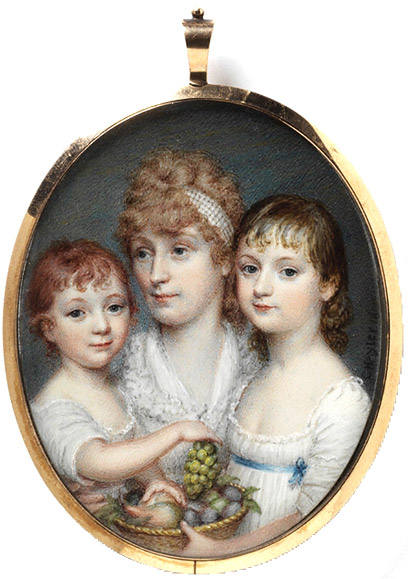
My interest here is largely with the Jane Austen lots in the auction [see my post on this auction here], and unfortunately, although the results of the auction are available online [see below as well as my previous post], the five lots of Austen works seem to have been purchased by private collectors and are undisclosed.  And the one Austen-related piece of art, a miniature of Elizabeth Bridges, Austen’s sister-in-law, remained unsold.   

[title, estimate, price realized]

  • Emma-1816- 3 volumes: [$8,000-12,000] – $9500.
  • Mansfield Park-1814- 3 volumes: [$7,000-10,000] – $7500.
  • Northanger Abbey-1818- 4 volumes: [$5,0008,000 ]-   $5500.
  • Pride and Prejudice-1813- 3 volumes Carysfort copy: [$20,000-30,000] – $26,000.
  • Sense and Sensibility-1811- 3 volumes: [$25,000-35,000] – $38,000. [or $46,360. with premium]

Austen aside, it is fascinating to see how many of the other lots are now in Library collections, and thus available for research purposes:  The British Library, Dr. Johnson’s House, the University of Manchester, McGill University [10 lots of Frances Burney materials], the Houghton Library at Harvard [Johnson and Hester Thrale], the Morgan Library, New York Public Library, the University of Pennsylvania Rare Book Library, Princeton University [Maria Edgeworth], Vassar Library [Burney], and Yale University Beinecke Library [Yale acquired the “star of the show” for $140,300. – 8 volumes of Hester Thrale Piozzi’s heavily annotated copy of The Spectator.]  Harvard purchased the most lots, and a Zoffany full-length portrait of Hester Thrale [lot 379] was the second highest sale at $58,560.

[from the Bloomsbury Auction Catalogue]


 See the full article at this link at Bloomsbury Auctions: [prices in the article reflect hammer prices and premium]

bloomsburyauctions-peyraud-mulvihill.pdf

Just added:  Dr. Mulvihill’s February 2010 article “Captured by Jane” on the Morgan Library’s Jane Austen exhibition is in the online magazine of the Jane Austen Centre.  If you did not get to see this wonderful exhibition last year, this is the next best thing to being there… you can view the article here.

[Posted by Deb]

Austen Literary History & Criticism · Jane Austen · Jane Austen Circle · Social Life & Customs

Jane Austen in Philadelphia ~ the JASNA 2009 AGM ~ Part 2

AGM 2009 banner

Ok, here I go again…. [please note that due to a computer / camera glitch, all my pictures of the AGM which I was to include in this post, i.e the “Darcy” models, the Regency Ball fashionistas, etc. will not be on here at present – still working on this, but lack the time and patience to be honest! – will post them separately when I can…] 

Day 3:  Up for a continental breakfast, another Regency Emporium visit… then on to the next Plenary speaker, the always delightful Maggie Lane ~ “Brothers of the more Famous Jane:  the Literary Aspirations, Achievements and Influences of James and Henry Austen”.   As the emphasis is often on Austen’s brothers Francis and Charles and their naval world, Lane spoke only here on the professional and literary brothers, Henry, often considered Jane’s favorite brother, and James, who she thinks is in need of a reassessment. It is James, she says, who wrote the majority of the essays in his and Henry’s publication “The Loiterer” [Lane also posits here that the “Sofia Sentiment” letter is NOT by Jane – more on this in another post…] – and James who wrote plays and poetry throughout his life, and it was James with whom Jane shared a similar taste in literature.  Austen’s one negative comment about him [and the only negative comment about a family member] has perhaps been over-credited as her general view.  Lane goes on to compare James to Austen’s characters:  in youth, like Edmund Bertram; in later life, Dr. Grant!, and the use of the name “James” in two of her characters, James Morland and James Benwick, both young men who fell in love easily, a trait attributed to James Austen in his youth. 

Henry Austen, [Oh! what a Henry!] the brother who had a lot of enthusiasm [but often of the short-term variety!], is credited with being the chief negotiator with Austen’s first publisher Thomas Egerton, and likely helped to fund her publications.  He was the “interesting” brother, the one who married his “outlandish” cousin Eliza de Feuillide, the one who is likely the model for Henry Tilney, as well as Henry Crawford!  But Lane also gave us the side of Henry that resulted in the Biographical notice of Austen that began the “Dear Jane” view that persists today – Henry puffed up their social standing, and in the second edition added more religious references and removed the literary mentions of Burney and Edgeworth.  Lane also believes it was Henry’s ambition that resulted in Austen being buried in Winchester Cathedral rather than her beloved Steventon. In the end however, the immortality of both brothers “is only due to Austen’s genius.”

 On to the next two breakouts, and again a struggle to choose, but I decided on Peter Sabor’s “Brothers and Sisters for Brothers and Sisters:  Jane Austen’s Juvenilia, a wonderful discussion of the various dedications written by Austen to her siblings in her juvenile works.  This was very informative and enjoyable, Dr. Sabor being an energetic and engaging speaker, with all sorts of tidbits about Austen’s early works [he is the editor of the Cambridge edition of the Juvenilia].  As I have been reading through these works over the past few months [with much laughing out loud in the process!], this offered a different approach to the works based on her dedications, what Sabor feels were very thoughtful choices on Austen’s part.  As most readers of Austen know, none of her novels bear dedications, excepting of course Emma, where her over-wrought dedication to the Prince Regent was not of her own choosing!

After lunch, a quick pop-in to Lisa Brown’s fun fashion demonstration “Dressing Mr. Darcy” ~ with most excellent and accommodating models, walking the “runway” in all manner of Regency fashions for the men of consequence and their military counterparts.  [pictures forthcoming…]

The third Plenary session with Dr. Ruth Perry who eloquently spoke on the topic of the weekend, “Brotherly Love.”  The author of Novel Relations:  the History of the Novel and the Family in English Society 1750-1810, [and speaker at the Boston 2000 AGM on “Sleeping with Mr. Collins” for those who recall that!], Dr. Perry summarized how the changes in English society changed the view and treatment of women within the family:  as Susan Allen Ford in her session [as mentioned above] suggested, class mobility and geographical movement, changes in marriage choices, the inheritance laws, the increase in population, all led to changes in what was considered the immediate family – emphasis shifted to the conjugal family rather than the biological.  This is apparent in Austen’s own life with her dependence on her brothers’ voluntary support and provision of means of travel, when their priority was their own families.   Perry also emphasizes the literary / historical as well as the biological influences on Austen in her writings, and how good brothers = good husbands:  in Northanger Abbey, Henry Tilney as affectionate brother and lover of muslin; John Thorpe shows his character by the way he talks to his sister and mother; Captain Tilney chafes at family responsibility; James Morland a good brother and friend to Catherine;   the various brother and sister ties in Mansfield Park – Edmund combines the conjugal and fraternal but is inattentive to his sisters [perhaps because there are two of them? – this is a good question…]; the selfish Henry Crawford, fond of Mary, but does not write to her or provide her with a home; Mr. Knightley who speaks of Mr. Martin as an excellent son and brother; Charles Musgrove, who tellingly supports his sisters over his wife; the housekeeper’s praise of Mr. Darcy as a good brother… etc. … lots to mine here as you can see – the need to re-read each book to just look at the brothers and what they do and say and what they don’t!

book cover my dear charlotte

Last breakout session – Jan Fergus on “My Dear Charlotte” the new book by mystery writer Hazel Holt.  I wanted to hear Dr. Fergus’s talk because I had just read the book and was intrigued by it – it is a novel set in the early 19th century written in letters, like Austen’s Lady Susan, but Holt uses selected words or sentences or ideas from the text of Austen’s actual letters and weaves in Austen’s words with her own story.  It is a fun read [I will review it in another post] – and what Fergus calls the “only successful imitation of Austen” on the market today.  The plot does not come from Austen, only those words taken out of context that fit into Holt’s story – at once a mystery and a romance.  Fergus is a friend of Holt, and after her talk she graciously made herself available in the Regency Emporium to offer the book with signed bookplates for sale.  I highly recommend it – the most fun is the ferreting out Austen’s words from Holt’s – it helps to be very familiar with Austen’s letters!


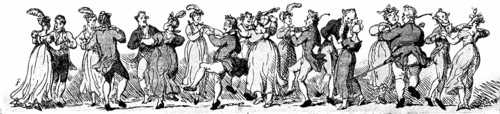
dancing longways rowlandson

 The Banquet and Regency Ball: after a few moments at the author’s book signing table, on to a delicious dinner to meet old and new friends at our table, watched the promenade of those regally dressed, and took some pictures for your viewing enjoyment [all photographs shown with permission of the subjects! – and will be forthcoming…]


And after watching the dancers for a bit, I wandered into the evening talk I unfortunately only heard the last two-thirds:  Dr. Janine Barchas on “The Sister Arts and Jane Austen”, a fascinating visual exploration of the surnames and places that Austen uses in her novels and the possible connection to contemporary artists:  Reynolds, William Hodges, William Larkin, and Charles Hayter’s miniatures.  It was a packed, standing room only crowd for those non-English Country Dancers among us [though I do so love to dance!] – and all were entranced with this take on names in Austen.  [Dr. Barchas will be presenting an address titled “A Big Name: Jane Austen and the Wentworths” at the August 2010 conference Jacobites and Tories, Whigs and True Whigs: Political Gardening in Britain c.1700 – c.1760, to be held at Wentworth Castle, given by the Wentworth Castle Trust and The Garden History Society.]

Charles hayter minitature

[Charles Hayter miniature – from Wikipedia]

Day 4:  After some housekeeping duties for the Regional Coordinators [a great meeting for sharing ideas, as always…but alas! missed the Episcopal Church Service at the historic Christ Church], we all gathered for the final Plenary session with John Mullan as he addressed us all on “Sisterly Chat” – a wonderfully engaging and humorous talk that will yet again send one back to all the novels for a re-read with a view to all the goings-on between sisters!  The sister relationship was paramount in Austen’s own life and thus in the novels; there is indeed more “chat” between sisters than between lovers.  Mullan is talking about the intimate talk between sisters when they are alone in a special place – the films show this visually, but in the books you have to look for it closely.  He reviewed the controversy from a few years back – “Was Jane Austen Gay?” complete with the newspaper articles and letters, the question hinging on the sleeping arrangements between she and Cassandra – Mullan quoted the final letter in the months-long submissions of raging letters which referenced the furniture company records that proved that Jane and Cassandra did indeed have separate beds!  But all this led to the many examples of the various sisters in the novels and how and where they do or do NOT share confidences.  And after quoting Keats’s “unheard talk”, Mullan runs through the examples of the talk that takes place off-stage, where the reader is “invited to infer what has been said”, with nods to Fanny [his favorite parts of Mansfield Park are when Fanny is not there!], the sisters Steele in what he calls their “mutual espionage” and of course can you imagine the chat between the Bingley sisters who are “always together, almost ganging up” on all around them!  This was fabulous – I hope it will be published in Persuasions, so all may enjoy this fresh approach!

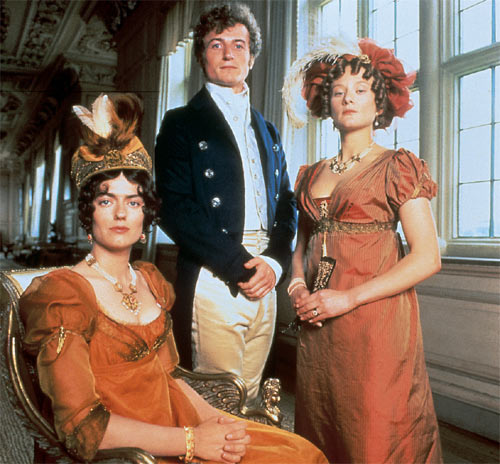
bingley sisters
The Bingleys in P&P

So another AGM is done – I have skimmed over a lot – there were the essays by high school and college students, and the winning short story in that contest [see the JASNA site to read these – very inspiring to see another generation making room for Austen’s books in their lives!]; Steve Lawrence, the Director of Chawton House Library quickly summarized all the goings-on and handed out hearty thanks to all of JASNA for the generosity of so many members. 

The JASNA banner was then dutifully passed on to the coordinators in the  Oregon / Southwest Washington Chapter who will be hosting next year’s AGM:  Jane Austen and the Abbey:  Mystery, Mayhem and Muslin in Portland on the Halloween weekend of October 29-31.  We were also given a delightful treat by the North Texas Region, who will be hosting us in October 14-16, 2011 in Fort Worth, Texas for  200 Sense & Sensibility, celebrating the 200th anniversary of its publication –  two very cute cowboys [and they could sing too!], who to the tune of “Home on the Range” gave us a good sampling of how terrific this 2011 AGM will be [“chatting with Deirdre Le Faye” brought the house down!]  

Final thanks to Elizabeth Jane Steele and her team at the Eastern Pennsylvania JASNA Chapter, who put on a lovely weekend – no words really to thank all the volunteers who have spent countless hours in preparation, just so a very appreciative crowd of Austen-obsessed souls could spend four days in the early nineteenth century! – I know this Janeite is still having troubling re-entering the 21st!

[Posted by Deb]

Austen Literary History & Criticism · Books · Jane Austen · Jane Austen Circle · Regency England · Social Life & Customs

In such good company as this ~ the 2009 AGM!

The 2009 JASNA AGM ~  
Jane Austen’s Brothers and Sisters in the City of Brotherly Love

Philadelphia October 9-11, 2009

 AGM 2009 banner

The best-laid plans of course often go astray – so my hopes to do a close analysis of everything going on the 2009 AGM have been sadly reduced to a mild wish to present a quick summary… so here goes… 

The Eastern Pennsylvania Chapter of JASNA has indeed put on a lovely event – the City of Brotherly Love opened its wide arms for all 550 of us obsessed Janeites, offering great tours, excellent hospitality, lively and elegant evenings, and fabulous sessions filled with all things Jane.  I always upon returning home have the worst time re-entering the 21st century – and this time more than ever.  And time spent with my best-AGM and travel buddy Sara, just adds to the treat … and this year the special treat of JASNA-Vermont friends Kelly and Carol…

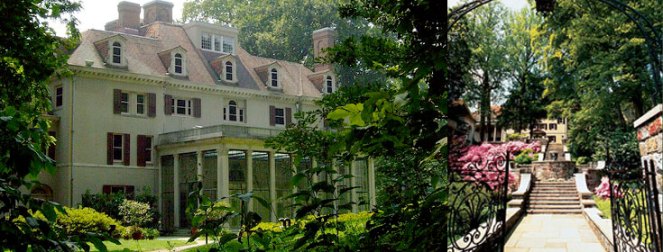
 Day 1:  A tour of Winterthur on the Thursday, one of my favorite places through books only, was a living reality of the beauties of home and garden, what one man with a lot of money was been able to preserve for future generations.  I discovered that Electra Havemeyer Webb, the founder of the Shelburne Museum here in Vermont and one of the first collectors of American art and decorative arts, was the inspiration behind Henry du Pont’s veering away from the popular collecting of European antiques toward acquiring Americana.  It was a lovely day and a wonderful way to start that entry into the late 18th-century the rest of the weekend promised!  [only downside: I missed the talks on writing and Wedgwood.]

winterthur-museum-header


Thursday evening ~ “Elizabeth Garvie in Conversation with Dr. Elisabeth Lenckos” was a special offering this year and began with a short clip of the first proposal scene in the 1980 Pride & Prejudice.  Ms. Garvie, who most everyone knows as Elizabeth Bennet in that adaptation, and now an active patron of the Jane Austen’s House Museum in Chawton, charmed the audience with her engaging and honest responses to Dr. Lenckos’s questions: the realities of filming a television production in the late seventies; how she portrayed a sister with four sister siblings without any of her own [she had a mother with FIVE sisters!]; a few comments on deleted scenes [falling off the log during that outdoor reading of Darcy’s letter…]; how each new P&P adaptation has something to offer each new generation with a reinterpretation of Austen [though she didn’t like the pig in the 2005 movie either!]  She ended the talk with a very humorous reading from one of Austen’s juvenilia pieces, “The Three Sisters.”

ElizabethGarvieElizabethBennett


Day 2:  Had breakfast with several Austen-L / Janeites participants [though I have been only a lurker for years!] – and ended up having a rousing discussion on Georgette Heyer!

An early visit to the Regency Emporium always ends with too many books and items that add to the weight of my suitcase [and those flying rules now are intimidating – even Austen cannot impel me to go over that 50lb limit!] – thankfully Jane Austen Books where I spent most of my time [and money] sends everything media mail after the conference, so I just set up a running account of sorts – almost guilt-free ~ and shopped happily away… The Emporium is great fun to catch up with many of the other regions, Chawton House Library [director Steve Lawrence was there], Jane Austen’s Regency World Magazine [with editor Tim Bullamore], Austentation [two tables filled with regency accessories!] and a few other vendors with Austen-related goodies ~ I went back many times over the course of the conference…

 Off to a talk on tea by Mim Enck from the East Indies Company – and learned how to make the perfect “cuppa”…  and then a talk with visuals by Louise West, from the Jane Austen’s House Museum, on the exciting new addition to Chawton Cottage, the dreams, the funding, and the lovely reality.  The grand opening was in July – if you have been to Chawton, but not since this work was done, put it on your next Austen trip itinerary!

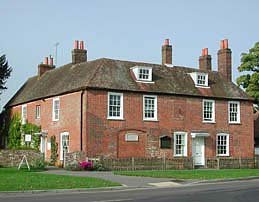
chawton cottage

***************************

Marsha Huff, current JASNA President, welcomed all to the first official gathering, giving over the podium to our very own Vermont member Lorraine Hanaway [who was there for the founding of JASNA in 1978] who introduced the first Plenary speaker, Jan Fergus.  I love Dr. Fergus’s talks  – she inspired a whole new way of looking at Austen in her “The Whinnying of Harpies”? Humor in Jane Austen’s Letters” [Persuasions 27 (2005)] and has continued to regale her audiences with the humor of Austen’s whines ever since!  Today she spoke on “’Rivalry, Treachery between sisters!’ Tensions between Brothers and Sisters in Austen’s Novels” –  and the various ways in which Austen’s fictional siblings either love and support or compete with one another. Some of this thinking is based on the conduct books of the 18th-century, but also the reader must have awareness of the problems that arose between siblings due to the inheritance laws of the time.  Fergus showed by example Austen’s use of humor as a form of criticism between characters and how a sense of humor or lack thereof is an important gauge in understanding Austen’s characters:  i.e Marianne lacks humor and openness, thus her lack of understanding Elinor’s humor causes friction between them; Mr. Woodhouse has no sense of humor, just doesn’t get it!; and finally an emphasis on Elizabeth and Jane and how their different personalities and use of humor causes an undercurrent of almost comic aggression on Elizabeth’s part.  I liked this differing view of Elizabeth, not so perfect but with a tendency toward jealousy…

************************************

One of the problems in the AGM is choosing between the breakout sessions – so much to hear, so many speakers – whichever one you choose leaves you knowing that you are, regardless of how great your chosen session might be, missing so much else.  One can only hope that many of the talks you miss will be in the next issue of Persuasions.  I am a voluminous note-taker – but alas! none of my friends are, so after a full day of events and all things Austen being bandied about, one is lucky to get a few intelligible sentences about a missed session – I know if I didn’t take notes, I would have trouble piecing this all together – and indeed even my notes leave me stupefied occasionally! – so I can only present a few thoughts of the four sessions I did go to, knowing full well I am only scratching the surface of the possibilities…

I went to hear Jocelyn Harris, author of ….Jane Austen’s Art of Memory and A Revolution Almost Beyond Expression:  Jane Austen’s ‘Persusaion’, who spoke on “Jane Austen:  Frances Burney’s Younger Sister”.  Harris’s emphasis is to move away from the biological interpretation of Austen toward an historical one, Austen being very connected to her historical and literary references.  In Persuasion, Austen shows her knowledge of the Navy, Nelson and the Napoleonic Wars, but Harris also shows how the two cancelled chapters of Persuasion are steeped in Frances Burney’s The Wanderer.  I confess to having read several books by and about Burney, but The Wanderer has sat upon my TBR pile for many a year, never opened, largely due to the negative contemporary reviews and all those succeeding.  But Dr. Harris has inspired me to finally pick it up, though she says herself it will be a bit of a “slog” – a perfect winter read perhaps…?

*************************

Then on to Susan Allen Ford’s “’Exactly what a brother should be’? The Failures of Brotherly Love”:  Again, with an emphasis on the contemporary conduct literature [and with a very helpful handout with bibliography and selected paragraphs], Ford reviews the examples of fraternal love in the various novels in the context of the time – issues of inheritance, personality differences, the role of women and the emphasis on them as daughters and mothers rather than sisters, the economic realities of the sister’s lives.  And while she says that “the fraternal role is difficult to define in Austen because the characters as brothers are not often in the foreground”, it was an interesting discussion on their varying degrees of success and failure:  John Dashwood as a brother [yikes!]; the parallels between Edward and Robert Ferrars; Tom Bertram, the prodigal son; the jealousy between Darcy and Wickham, but Darcy’s anxiety and his overriding concern to be a good brother; James Morland as a good brother who wrongly throws his sister into the hands of the Thorpes [yikes again!]; and Edmund, brother / lover who neglects Fanny once Mary appears on the scene [this is when one audience member graciously invited everyone to join the SLEUTH club = “SLap Edmund Upside The Head” – there were many joiners on the spot!] ~ Dr. Ford’s choices? – Edmund the biggest failure [he indeed has NO relationship with his sisters], and most successful? [drum-roll please!] HENRY TILNEY [Mags are you listening??] – and I couldn’t agree more! [love the Henry!] – but an interesting question – who would yours be??

 Then off to dinner with Sara and friends of hers who live in Philadelphia for a few short hours back in the 21st century – we went to an Israeli restaurant right across from the hotel [ Zahav ] and one of the best meals I have had in a good while – even the wine from the Golem Heights was superb!

Up tomorrow – Day 3 and 4…. meanwhile post a comment on your choice for the best and worst brother in Austen…

Austen Literary History & Criticism · Jane Austen · Jane Austen Circle

An Austen Brothers & Sisters Bibliography

Take a quick look at the JASNA website where a select bibliography on “Austen’s Siblings in Fact and Fiction in JASNA Publications”  has been posted ~ all in preparation for the upcoming AGM in Philadelphia, City of Brotherly Love.  All the articles are in JASNA publications, many with online links.

Here is a taste to start your reading adventure:

Tthe facts“Austen Brothers and Sisters” by Park Honan. Persuasions 10 (1988): 59-64.

The fiction:  “Sisterhood and Friendship in Pride and Prejudice by Deborah J. Knuth. Persuasions 11 (1989): 99-109.

AGM 2009 banner

Jane Austen Circle · Literature · Movies

‘Bright Star’ ~ “perfectly chaste and insanely sexy”

bright_star movie poster


… so says A.O. Scott of “Bright Star”,  Jane Campion’s biopic love story of John Keats and Fanny Brawne.  See his review in today’s New York Times [which has more references to Jane Austen than if it was about one of HER novels!]

Check your local listings – it opens in Manhattan on Wednesday! [it opens at the Roxy in Burlington on October 2nd!]