Austen Literary History & Criticism · Book reviews · Books · Collecting Jane Austen · Jane Austen · Literature · Regency England · Social Life & Customs

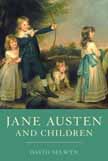
Book Review ~ “Jane Austen and Children” by David Selwyn

To be at the beginning of life, one must start at the end of the novel.  For although Jane Austen concludes her books with the marriage of the hero and heroine to which the whole thrust of the narrative has been leading, and the reader rejoices in the perfect happiness of the union, in reality the best is yet to come: they will have children – procreation  being not only the natural and desirable end of marriage, but also an economic and dynastic necessity.  And those children will have their own stories…What will become of the Darcy children?…”  (Ch. 1, Confinement, p. 5)

And thus does David Selwyn begin his treatise on Jane Austen and Children (Continuum, 2010), a most enjoyable journey through the world of childhood and parenting and education and growing-up in the life of Jane Austen, and the lives of her fictional characters.  If you are perhaps one of those people who think that Jane Austen does not like children, an idea certainly fed buy such comments about women “breeding again” or the child-generated “dirt and noise” or “the two parties of Children is the cheif Evil” [Ltr. 92], or the proper child-rearing “Method has been wanting” [Ltr. 86], etc. – you need to read this book!

Selwyn takes his reader essentially through the nine ages of man [with apologies to Shakespeare] beginning with confinement and birth, through infancy, childhood, parenting, sibling relations, reading and education, and finally maturity, as Selwyn says, the “end of the novel” when the Hero and Heroine come together, after all manner of trial and tribulation, to begin their own family.

We are given a general survey of the shift in the attitudes toward children, that late eighteenth – early nineteenth century view that fell between viewing children as not just “little adults” to the Victorian view of “seen but not heard”, following Locke and Rousseau and believing children to be natural innocents.  In each chapter Selwyn seamlessly weaves pieces of Austen’s life as gleaned from her letters and scenes from all her writings – and it is masterly done, all with a historical perspective.  We see Jane as a child, as a madly composing adolescent, a loving and humorous Aunt imaginatively interacting with her nieces and nephews, and as an accomplished writer whose fictional children are far more worthy of our notice than we have previously supposed: the frolicsome Walter hanging on Anne’s neck in Persuasion; the spoiled Middletons; the noisy and undisciplined Musgroves; the grateful and engaging Charles Blake in The Watsons; the John Knightley brood in the air courtesy of their Uncle George; the dynamics of the five Bennet sisters; Henry Dashwood the center of attention for the manipulative Steele sisters; the reality-based scenes of Betsy and Susan Price at Portsmouth; and finally Fanny Price, Austen’s only heroine we see grow up from childhood, having an elegant come-out, finding true-live and ends “needing a larger home.”

In all her works, Austen uses children as “a resource for her narrative strategies” (p. 4), be that comedy, a plot device to further the action, or a means of revealing attitudes and responses of the adults around them (p. 3).  Austen’s children are easy to miss – they won’t be after reading this book – here they are brought to life, given character and meaning, and you will see what Selwyn terms “Austen’s satirical delight in children behaving in character” (p. 73)

If Austen’s fiction seems to gloss over the reality of childbirth [the exception is Sense and Sensibility’s two Elizas], her letters tell the tale of its dangers [Austen lost three sisters-in-law to death in childbirth], and Selwyn links all to the social structure of the day, the nursing of babies and swaddling practices, to child rearing theories and moralizing tracts, and governesses and Austen’s ambivalence toward them. We visit boarding schools along with Jane and her characters and we hear the voices of a number of contemporary diarists (Agnes Porter, Sophia Baker, Susan Sibbald, Elizabeth Ham and Sarah Pennington).  There is a lovely in-depth chapter on the reading materials written especially for children and Austen’s first-hand knowledge of these titles.  The discussion on sisters and brothers, those so important in Austen’s own life, and those in her fiction, for example, characters with confidants (Lizzy and Jane, Elinor and Marianne), those isolated (Fanny, Anne Elliot, Emma Watson, Mary Bennet), and those with younger sisters (Margaret Dashwood and Susan Price).  As part of the growing-up process, Selwyn uncovers much on “coming-out” as Austen herself writes of in her “Collection of Letters” [available online here] – with the emphasis here on Fanny as the only heroine to have a detailed “coming-out” party.

The chapter on “Parents” starts with the premise that “in Jane Austen’s novels the parents best suited to bringing up children are dead” (p.95) and Selwyn takes us from the historical view of parenting, through Dr. Johnson’s “Cruelty of Parental Tyranny” [shadows of Northanger Abbey] to a full discussion of the marriage debate in the 18th-century – that between the worldly concerns of wealth vs. choice of partner based on emotional love as personified in Sir Thomas and Fanny Price respectively.  Excerpts are included from James Austen’s very humorous Loiterer piece   “The Absurdity of Marrying from Affection.” (p. 207) and Dr. John Gregory’s A Father’s Legacy to his Daughters (1774) [viewable at Google Books here] , and the Edgeworth’s Practical Education (1798) [Vol. III at Google Books here].  One finds that in reading all of Austen’s letters and all the works you can indeed discover a complete instruction manual for good parenting!

Jane Austen and Children appropriately ends with Selwyn’s speculation on what sort of parents her Heroes and Heroines will be, all of course based on the subtle and not-so-subtle clues that Austen has given us throughout each work – conjecturing on this is perhaps why we have so many sequels with little Darcys, Brandons, Bertrams, Knightleys, Tilneys, and Ferrars running about!

Just as in his Jane Austen and Leisure, where Selwyn analyzes the various intellectual, domestic and social pursuits of the gentry as evidenced in Austen’s world and her works, he here gives us an accessible and delightful treatise on Austen’s children, culling from her works the many quotes and references related to children and linking all to the historical context of the place of children in the long eighteenth century.  The book has extensive notes, a fine bibliography of sources on child-rearing, contemporary primary materials, children’s literature, and literary history, and several black and white illustrations.  (I did note that there are a few mixed up footnotes in chapter 3, hopefully to be corrected in the next printing).  What will this book give you? – you will never again miss the importance of Austen’s many children, peaking from behind the page, there for a set purpose to show you what great parents the Gardners are, or just to make certain you see how very selfish the John Dashwoods and the Miss Steeles are, or to see the generosity of an Emma Watson in her rescue of Charles Blake, or to feel the lack for the poor Musgrove boys having Mary for a mother, the playfulness of an otherwise conservative Mr. Knightley, and the unnerving near touch of Captain Wentworth as he relieves Anne of her burden –  thank you David Selwyn for bringing all these children to life for Austen’s many readers – you have given us all a gift!
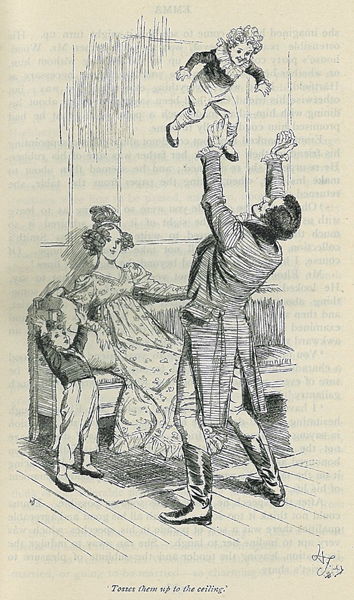
Emma – ‘Tosses them up to the ceiling’
[by Hugh Thomson, print at Solitary Elegance]

 __________________

Jane Austen and Children
Continuum, 2010
ISBN:  978-1847-250414

David Selwyn is a teacher at the Bristol School in Bristol, UK.  He has been involved with the Jane Austen Society [UK] for a number of years, has been the Chairman since 2008,  the editor of the JAS Report since 2001, and has written and edited several works on Austen.  He very graciously agreed to an “interview” about this latest work that you can find by clicking here.  See also the post on the various illustrations of Austen’s children by the Brocks and Hugh Thomson.  And finally, I append below a select bibliography of Selwyn’s writings on Jane Austen and her family.

 Select Bibliography:  

  1. Lane, Maggie, and David Selwyn, eds.  Jane Austen: A Celebration.  Manchester: Fyfield, 2000. 
  2. Selwyn, David, ed.  The Complete Poems of James Austen, Jane Austen’s Eldest Brother. Chawton: Jane Austen Society, 2003. 
  3. _____. “Consumer Goods.” Jane Austen in Context. Ed. Janet Todd. Cambridge Ed. of the Works of Jane Austen. New York: Cambridge UP, 2005. 215-24. 
  4. _____, ed.  Fugitive Pieces: Trifles Light as Air: The Poems of James Edward Austen-Leigh.  Winchester: Jane Austen Society, 2006. 
  5. _____. “A Funeral at Bray, 1876.” Jane Austen Society, Collected Reports V (1998): 480-86. 
  6. _____. “Games and Play in Jane Austen’s Literary Structures.” Persuasions 23: 15-28 
  7. _____. “Incidental closures in Mansfield Park.”  [Conference on “Jane Austen and Endings”, University of London, 17 November 2007] – unpublished paper. 
  8. _____. “James Austen – Artist.” Jane Austen Society Report 1998. 157-63. 
  9. _____.  Jane Austen and Leisure.  London: Hambledon Continuum, 1999. 
  10. _____, ed.  Jane Austen: Collected poems and Verse of the Austen Family.  Manchester:  Carcanet / Jane Austen Society, 1996. 
  11. _____, ed.  Jane Austen Society Report, 2001 – present. 
  12. ­_____. “Poetry.” Jane Austen in Context. Ed. Janet Todd. Cambridge Ed. of the Works of Jane Austen. New York: Cambridge UP, 2005. 59-67. 
  13. _____. “Shades of the Austens’ Friends.” Jane Austen Society Collected Reports V (2002): 134. 
  14. _____. “Some Sermons of Mr Austen.” Jane Austen Society Collected Reports V (2001): 37-38. 
Austen Literary History & Criticism · Jane Austen · Literature · Publishing History

Jane Austen and Her Editor…

Update:   read this very welcome response to this discussion by Geoff Nunberg at NPR here.

I am on the road, so not able to connect to all my Austen “feeds” on a daily basis, so I was grateful to hear from Janeite Marti who sent me the information on this latest kerfuffle in Austenland – it seems that Professor Kathryn Sutherland has, in her releasing the latest digital editions of Austen’s fiction manuscripts [see the link here Jane Austen Fiction Manuscripts], made comments on Austen’s spelling and punctutaion and the need for a proper editor to clean everything up for publication – how the press has picked up on this in a world-class endeavor to bring Austen down a peg or two,  tossing her from her very high literary pedestal!  Vic at Jane Austen’s World has addressed the issue most adequately, so I send you there to read her near perfect defense of “Dear Jane.”

I will add this – we have long known that Austen was no Marian Grammarian – her spelling WAS appalling [thankfully spelling is not a requirement for imaginative thinking, brilliant characterization and comic timing] – and we do know, if you are at all conversant with her letters, that she worked diligently with her publishers [and likely an editor as well! alas!] correcting proofs of her novels. And those of us who have seen any of her working manuscripts, or indeed have read Sanditon or The Watsons in their unpunctuated, unparagraphed state have also long known how Austen wrote – we should also take into account her need to conserve paper – her letters attest to this – the cross-writing, the writing on all available edges  –  but these mentions of her unruly notetaking, scribbling, lack of paragraph formation and quotation marks and obvious need of an editor, is not all that Sutherland had to say, and the media emphasis on this is unfair to both her and Austen.  One should read further:

Still more interesting to her, however, is the authorial voice one hears in the manuscripts. She calls it “a more innovative, more experimental voice” than Austen gets credit for. “By not working with the grammatical form, she’s actually coming much closer to writing real conversation” than in the printed versions where “she’s pulled back into a more conventional form,” the scholar said. “It’s a voice you’re perhaps not hearing again until the early 20th century.”

So let’s embrace this gift of seeing Austen at work and instead of quibbling about commas and quotation marks that make it look like some male editor made the Austen we all admire, do as Sutherland suggests and take Austen’s works to yet another level… what an opportunity we have!
 
 
Further reading: 
‘Persuasion’ manuscript
Austen Literary History & Criticism · Book reviews · Books · Collecting Jane Austen · Jane Austen · Literature · Publishing History · Regency England

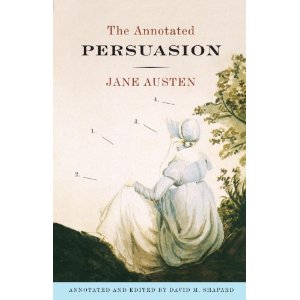
Book Review ~ ‘The Annotated Persuasion’

Last week I ran into Barnes & Noble to pick up the latest annotated Pride and Prejudice, edited by Patricia Meyer Spacks, and since then I have been “gadding about” as Austen would say – so no time to really give it a complete read and review; but in another trek yesterday into yet another Barnes & Noble [no worries, I also have haunted the local USED booksellers!], my husband stumbled upon the just published [as in October 5, 2010]  The Annotated Persuasion, annotated and edited by David M. Shapard [New York: Anchor Books, 2010; paperbound; ISBN:  978-0-307-39078-3] – and I have discovered a veritable feast! 

Shapard is known for his annotated edition of Pride and Prejudice [which I have but it is not in hand, as I am in “gadding about” mode as mentioned above…] – so I cannot compare this book to that edition [his annotated Sense & Sensibility is to be, I believe, published in April 2011] – though I have found that work quite useful as a reliable reference source – it was first published in hardcover followed by a paperback edition; this Persuasion is only in paperback… it is also a smaller format, likely because the novel is so much shorter, but this renders the many illustrations quite small – but I quibble about these few drawbacks …. publishers decisions do not always make the most sense… 

I first look for the extras:  

An Introduction which gives a brief history of the publishing of Persuasion, and the differences in this final novel from Austen’s other works

A Chronology of the novel [will compare this to Ellen Moody’s calendar 

Maps of sites that relate to the characters and storyline: the world, England, Somerset, Lyme, and two of Bath 

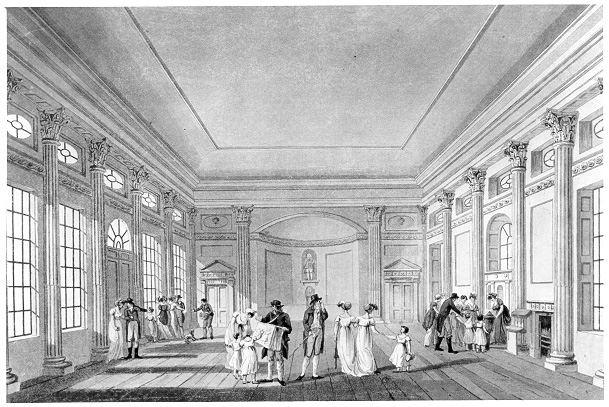
A good number of b/w Illustrations – there is unfortunately no listing of these; the source is indicated under each picture, but a listing would have served as an index to the subjects, which cover all manner of Regency life:  architecture such as that in Bath with interior and exterior scenes of the Assembly Rooms; various carriages; fashion; furniture; Naval life; the Cobb in Lyme Regis; etc.  – many of these illustrations will be familiar to most readers with a modicum of knowledge about the period – and color would have been nice – but the point here of these illustrations is to serve as a starting reference for further research, and it is an added plus to have any of these included. 

Bibliography:  this also serves as a starting point – it is in no way a complete listing of sources, but likely those sources that Shapard relied on for his research.  How complete can a bibliography of Austen be without mention of Claire Tomalin’s biography under that category, or Claudia L. Johnson’s Jane Austen: Women, Politics and the Novel or Kaplan’s Jane Austen Among Women nowhere to be found – but as Shapard is an historian, it is that strength that resides in this bibliography, again a great starting point for further study – it is organized by broad subjects:  language; cultural and literary background; marriage and the family; position of women; children; housekeeping and servants; entails and estates and the landed gentry; rural and urban life; the military; medicine; the law; education; books, media, libraries; writing; postal service; transportation; theater [but no mention of the two works Jane Austen and the Theatre – two works with the same title and both quite comprehensive]; music and dance; sports; weather; the seaside resorts; houses and gardens; fashion; food; etiquette and female conduct books; and others – again, a good select listing of resources on various topics.   

The Literary commentary and annotations:  Shapard begins with the caveat that “the comments on the techniques and themes of the novel represent the personal views and interpretations of the editor…such views have been carefully considered, but inevitably they will still provoke disagreement among some readers “ [xi] – which Shapard encourages…; these annotations include such literary commentary, historical context, and definitions of words in context if they had a different meaning in Austen’s time, some repeated when necessary or cross-references provided.  

The book is arranged with the original text on the verso, the annotations and illustrations on the recto – the annotations are extensive as the following few very random examples show: 

  1. Persuasion starts with the full description of Sir Walter Elliot’s obsession with both his own personal charms and his listing in the baronetage – Shapard here provides information on that book and others of the time and the definition of “baronet” and how Sir Walter acquired his own status…
  2. Gout is fully described on pages 311 and 315, when Anne learns that the Crofts are removing to Bath dues to the Admiral’s “gouty” condition.
  3. “replaced” – [p. 103] – “they suspected great injury, but knew not where; but now the collar-bone was soon replaced”   – the annotation explains that the word “replaced” had the meaning in Austen’s time of “to be put back in its original position” rather than “to take the place of” – there is also a description of anatomical knowledge as understood at the time.
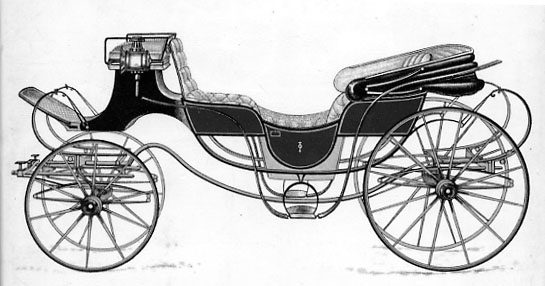
  4. Carriages get much attention whenever they are mentioned in the text – so we have descriptions and illustrations of barouches and chaise and fours, and chairs and of course Anne’s pretty little “landaulette” [p. 483]                                                                         
         

    a barouche


  5. Money and wealth – Wentworth’s income explained [p. 145]
  6. Servants:  various duties outlined [p.  87]
  7. Street names, shops, locations explained throughout; e.g. The Cobb; Tattersall’s [a mention on p. 14 with an illustration]; Milsom Street; Westgate Buildings;…etc…
  8. The Clergy in Austen’s time
  9. Austen’s language as delineating character:  as in the following: “Lady Russell had only to listen composedly, and wish them happy; but internally her heart reveled in angry pleasure, in pleased contempt” [p. 232] – and the annotation reads:  “Her reveling in such emotions indicates her moral inferiority to Anne, who never derives pleasure from anger or contempt.” [p. 233]
  10. Social rules and strictures:  some examples – Sunday traveling [p. 305]; shaking of hands between men and women [p. 427]; not using first names, even those of friends such as Anne and Mrs. Smith

 A look at a few key scenes will also illustrate Shapard’s invaluable commentary: 

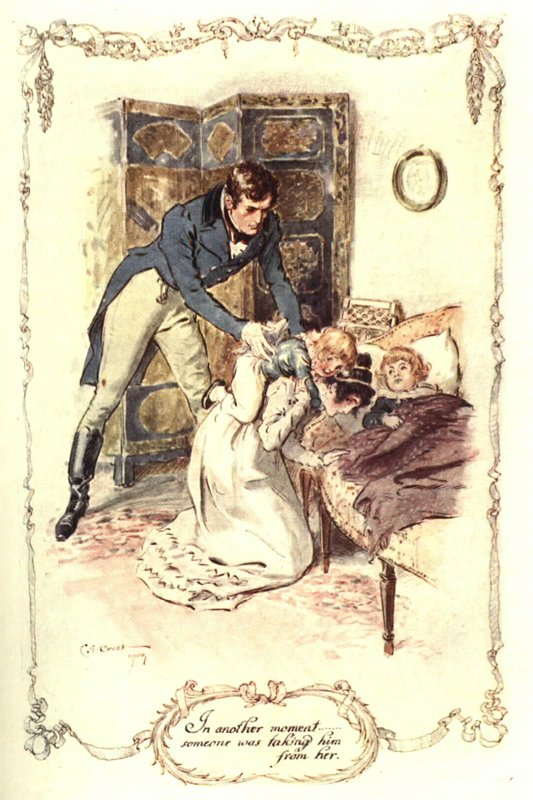
  1. Wentworth removing young Walter Musgrove from around Anne’s neck [pp. 152-5]:  Shapard emphasizes the importance of this scene in displaying both Anne’s and Wentworth’s feelings – he quotes William Dean Howell’s how “this simple, this homely scene, is very pretty, and is very like things that happen in life, where there is reason to think that love is oftener shown in quality than quantity, and does its effect as perfectly in the little as in the great events. [from Heroines of Fiction].  Shapard also suggests that Wentworth’s reluctance to converse with Anne about what has just happened is as much due to his efforts to remain aloof as it is to a “simple dislike of thanks,” [p. 155], as is true of Mr. Knightley in Emma. 
                                                                                                        

    Brock illus - from Molland's


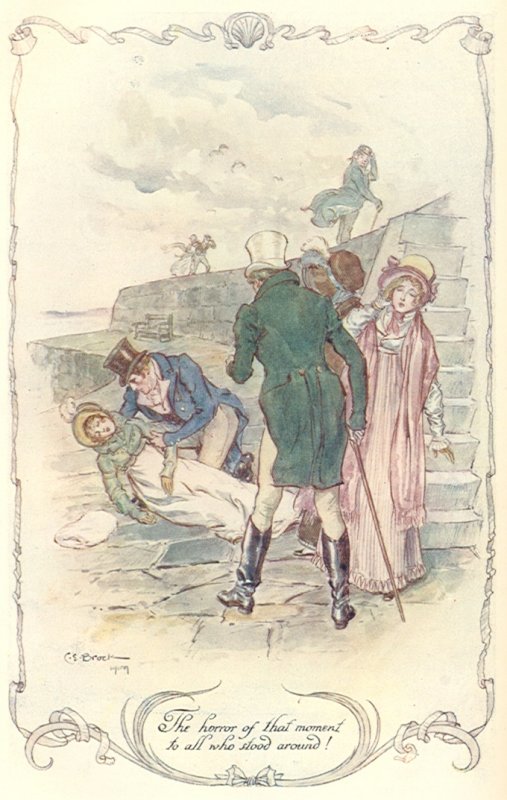
  2. Louisa’s fall in Lyme Regis [p. 210-15]:  Shapard describes the Cobb, the steps that were the scene of The Fall, comments on the feelings of Anne and Wentworth, the strength of the former and the uncharacteristic weakness of the latter; Anne’s carrying the “salts” [have you ever wondered why Anne IS carrying smelling salts and conveniently has them in her possession? – “here are salts – take them, take them.” [p. 210]]; the calling for the surgeon and the differences between he and an apothecary; the comic relief of “the sight of a dead young lady, nay, two dead young ladies, for it proved twice as fine as the first report.” [p. 213-4] 
    "The horror of the moment" - from Molland's


  3. and of course, The Letter! [p. 452] – Shapard so rightly states that “Wentworth’s passionate language contrasts him with other Jane Austen heroes, who are often much cooler and more rational.  It also fits with the more intense emotional tone of this novel … the letter itself is arguably the moment of highest emotion in her works…” [p. 453]  – and we are given a picture of a writing table of the time [p. 457] – there is also extensive commentary on the conversation between Capt. Harville and Anne. 

As referred to above, there are disappointments in this work – I would most wish for an index to the annotations – these could be just general subject areas, such as similar divisions as in the bibliography – so for instance – all annotations which discuss medicine could be cited, or any references to carriages, or fashion, or Bath locations, the Navy, or examples of Free Indirect Discourse, the literary allusions such as Byron’s The Corsair and Matthew Prior’s poem “Henry and Emma”, etc.  As it is, one needs to read through the entire work to find the references, and as Shapard wishes for this to be a work for reference purposes, this addition of an index would seem to be a necessity.  A index of Characters would have also been a helpful addition – one must reach for their Chapman for this information; and finally there is also no “note on the text”, important information in any such reference source – the bibliography lists Chapman’s 1933 edition, Spacks’s Norton critical edition [1995]; and the latest Cambridge edition edited by Janet Todd and Antje Blank [2006] – but I would have liked to see from whence he took the exact text…

That all said – this is a delightful and fact-filled addition to your Austen Library – and if you are already fairly well-versed in the Regency period and Austen criticism, this will serve as a copy of Persuasion where much of this information is at your fingertips; if you are just starting your adventure in reading Austen, this will be a great introduction to the very rich world of her writings, her world, and her literary themes – what more can we ask for!  [other than a hardcover with an index!]

 4 full inkwells out of 5

[please note that the illustrations are meant to illustrate this post and are not illustrations in the work being reviewed] 

Jane Austen Circle · Literature · Women Writers

Gaskell Blog Tour ~ Comment deadline

Tonight at midnight [10-7-10, Pacific Time] is the deadline for commenting on any of the blog posts on the Elizabeth Gaskell Blog Tour and to enter to win the Naxos audiobook of North and South.  You can comment on my Gaskell post:  Your Gaskell Library, or any of the posts below.  Good luck! – Lovely prize!  Laurel Ann at Austenprose will be announcing the winner tomorrow, October 8th.

Biography

Novels/Biography

Novellas

Resources


Jane Austen Circle · Literature · News · Women Writers

More Gaskell!

Just discovered today! Another Elizabeth Gaskell source!  Katherine of the Austen-related blog November’s Autumn, [where she is currently posting a series on Austen’s “paradox of names”] has started a new blog devoted to Elizabeth Gaskell. You can view the site here; as well as follow her on Twitter here.  Delighted to see Gaskell getting such attention in the blogsphere!

Katherine had written a post on Gaskell’s Wives and Daughters for the September 29th Blog Celebration that begins here – scroll down for the links to the 15 blogs that participated in this tribute to Gaskell on her 200th birthday.

Congratulations Katherine on your lovely new blog! [I have added you to my posted Gaskell bibliography.]

Jane Austen Circle · Literature · Movies · Women Writers

Elizabeth Gaskell Bicentenary Blog Tour: Your Gaskell Library


Welcome to the 14th stop on today’s celebration of Elizabeth Gaskell’s birthday – September 29, 1810!  Please join me in this blog tour honoring Gaskell as 15 bloggers, under the direction of Laurel Ann at Austenprose, each post something related to Gaskell – a look at her life and times, book reviews, movie reviews, a tour to her home in Manchester [see at the bottom of this post for the links to the various posts on the blog tour], and my post on “Your Gaskell Library” ~  where to find Gaskell in print, online, on your iPhone,  on your iPod, and on film – she is Everywhere!  By the end of the tour you will know more about Gaskell than you thought possible and be the better for it!!  There is also the opportunity to win a Naxos recording of North and South by just making a comment on any of the blogs.  Enjoy yourself as we all wish a hearty Happy Birthday to Mrs. Gaskell!

********************

I wanted to see the place where Margaret grew to what she is,
even at the worst time of all,
when I had no hope of ever calling her mine…

North and South
*************

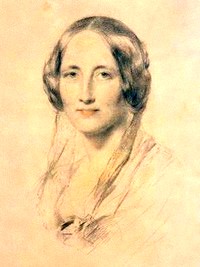
Elizabeth Cleghorn Gaskell (1810-1865) is best known to us as the author of the then-controversial biography of Charlotte Bronte, where she laid bare the oddities of the Bronte household, publicizing the behavior of the semi-mad father and the destructive life and affairs of the son. But Gaskell was a well-respected and popular author in her own day; we have been seeing a resurgence of that popularity with the broadcast of Wives & Daughters (1999), North & South (2004) [the film that rocketed Richard Armitage to fame, and rightly so!], and Cranford (2007, 2009). So I give a very brief review of her life and works [this was originally posted here], followed by a select bibliography. 

Born in Cheshire to William Stevenson, a Unitarian minister, Elizabeth was raised by her aunt, the sister of her mother who died shortly after her birth.  The town of Knutsford and the country life she experienced there became her setting in Cranford and her “Hollingford” in North & South.  She married William Gaskell of Manchester, also a Unitarian minister, in 1832, had four daughters and one son, who died in infancy.  The loss of her son had a devastating effect on her and to keep herself from sinking into an ever-deeper depression, she took pen in hand and started to write.  She published her first book Mary Barton in 1848 (using the pseudonym Cotton Mather Mills), though there is some speculation that she actually started to write Sylvia’s Lovers (1863) first but put it aside to write the more socially conscious Mary Barton.  Gaskell, according to Lucy Stebbins, was chiefly concerned with the ethical question of ”The Lie”, i.e. a belief that “deception was the greatest obstacle to the sympathetic understanding which was her panacea for individual and class quarrels.” (1)  This reconciliation between individuals of different classes and between the wider world of masters and workers was her hope for humanity and it was this zeal that often led her into false sentiment in her novels and stories.(2)  But because she saw both sides of the labor question and pitied both the oppressor and the oppressed, she was thus able to portray with often explicit candor the realities of her world.  But Stebbins also says that life was too kind to her as a woman to make her a great artist.  Her tales of vengeance and remorse were written more to satisfy public taste, after she started publishing in Dickens’ Household Words.  And David Cecil calls Gaskell “a typical Victorian woman….a wife and mother”….he emphasizes her femininity, which he says gives her the strengths of her detail and a “freshness of outlook” in her portrayals of the country gentry, while at the same time this femininity limits her imagination.  In comparing her to Jane Austen, Cecil writes: 

         It is true Mrs. Gaskell lived a narrow life, but Jane Austen, living a life just as narrow, was able to make works of major art out of it.  Jane Austen…was a woman of very abnormal penetration and intensity of genius. ….. [Gaskell] cannot, as Jane Austen did, make one little room an everywhere; pierce through the surface facts of a village tea-party to reveal the universal laws of human conduct that they illustrate.  If she [Gaskell] writes about a village tea-party, it is just a village tea-party…(3) 

   Cecil is critical of her melodrama, her “weakness for a happy ending”, her overlong works that lack imagination and passion.  But he does credit her four major works (Sylvia’s Lovers, Cranford, Wives & Daughters, and Cousin Phillis) as classic and worthy English domestic novels.  

[Cranford, illustrated by Hugh Thomson.  London : Macmillan, 1891..
This copy is also available at the Illustrated Cranford site. ]

Anne Thackeray Ritchie, in her introduction to Cranford, published in 1891, also compares Gaskell to Austen, and finds the latter lacking: 

Cranford is farther removed from the world, and yet more attuned to its larger interests than Meryton or Kellynch or Hartfield….Drumble, the great noisy manufacturing town, is its metropolis, not Bath with its successions of card parties and Assembly Rooms.” …. and on love, “there is more real feeling in these few signs of what once was, than in all the Misses Bennett’s youthful romances put together…only Miss Austen’s very sweetest heroines (including her own irresistible dark-eyed self, in her big cap and faded kerchief) are worthy of this old place….”  and later, “it was because she had written Mary Barton that some deeper echoes reach us in Cranford than are to be found in any of Jane Austen’s books, delightful though they be. (4) 

Margaret Lane in her wonderful book of essays on biography, Purely for Pleasure [which also includes the essay “Jane Austen’s Sleight-of-hand”], has two essays on Mrs. Gaskell.  Lane calls her one of the greatest novelists of the time, and especially praises Wives & Daughters over Cranford for its stature, sympathies, mature grasp of character and its humour, and its effect of “creating the illusion of a return to a more rigid but also more stable and innocent world than ours” and we feel refreshed in spirit after a reading. (5) 

Wives & Daughters, Gaskell’s last work, and considered her finest, was published as a serial novel in Cornhill, the last unfinished part appearing in January 1866.  Gaskell had literally dropped dead in the middle of a spoken sentence at the age of 55, and the work remained unfinished, with only a long note from the Cornhill editor following the last serial installment.  Wives and Daughters tells the story of Molly Gibson and her new stepsister Cynthia, and their coming of age in the male-dominated mid-Victorian society of “Hollingford.” 

But it is Lane’s essay on “Mrs. Gaskell’s Task” in which she so highly praises Gaskell’s achievement in her biography of Charlotte Bronte.  While Gaskell obviously suppressed some facts (the letters to M. Heger) and exaggerated others (Mr. Bronte as a father and Branwell as a son), Lane says “her great biography remains a stirring and noble work, one of the first in our language…. and it is in essence ‘truer’ than anything about the Brontes which has been written since…”(6) 

Such contrary opinions!…certainly reminiscent of Austen’s admirers and critics!   Perhaps as Pam Morris says in her introduction to W&D, “Gaskell resists any simple categorization…her work ranges across the narrative forms of realism and fairytale, protest fiction and pastoralism, melodrama and the domestic novel.”(7) 

_______________________________________ 

Notes:
1.  Lucy Poate Stebbins. A Victorian Album: Some lady Novelists of the Period (Columbia, 1946) p. 96.
2.  Ibid.
3.  David Cecil.  Victorian Novelists: Essays in Revaluation (Chicago, 1962) p. 187.
4.  Anne Thackeray Ritchie.  Preface to Cranford (Macmillan, 1927) pp. vii, xix.
5.  Margaret Lane.  Purely for Pleasure (Hamish Hamilton, 1966)  p. 153.
6.  Ibid, p. 170.
7.  Pam Morris.  Introduction to Wives and Daughters (Penguin, 2001) p. vii. 
                                                            *****************

I append below a “Select Bibliography” of Gaskell’s works, biographies and critical works, as well as links to what can be found online, iPhone, audio, and film – and most everything Gaskell wrote IS available.  Many of her writings were originally published in the periodicals of the day, such as Howitt’s Journal, Sartain’s Union Magazine, Harper’s Monthly Magazine, Dickens’s Household Words and All the Year Round, and Cornhill Magazine; and many of these writings were later published in collections of tales. And, like Dickens, some of her novels were originally published in serial form [Cranford, North and South, Wives and Daughters].  I list below the novels as first published in book form, a list of short stories and essays with date of original appearance in print, and a list of current editions you can find in your local bookstore [I list only the Oxford, Penguin and Broadview editions – there are many others and reprints of all kinds – best to look for an edition with a good introduction and notes.]  There is a lot of information here, with links to even more information available on the web – there is no lack of writing on Mrs. Gaskell! – But what I really want to emphasize are her short stories, which often get lost in the hoopla about her major novels – there are many as you will see, with links appended – try some – you will not be disappointed!  

****************************

Bibliography: Selected list   [see links below for more complete bibliographies] 

Works:  Books, Short Story Collections 

  1. Mary Barton: A Tale of Manchester Life. 2 vols. London: Chapman & Hall, 1848; 1 volume, New York: Harper, 1848.
  2. Libbie Marsh’s Three Eras: A Lancashire Tale. London: Hamilton, Adams, 1850.
  3. The Moorland Cottage. London: Chapman & Hall, 1850; New York: Harper, 1851.
  4. Ruth: A Novel. 3 vols. London: Chapman & Hall, 1853; 1 volume, Boston: Ticknor, Reed & Fields, 1853.  
  5. Cranford. London: Chapman & Hall, 1853; New York: Harper, 1853.
  6. Hand and Heart; and Bessy’s Troubles at Home.  London:  Chapman and Hall, 1855.
  7. Lizzie Leigh and Other Tales. London: Chapman & Hall, 1855; Philadelphia: Hardy, 1869.
  8. North and South. 2 vols.  London: Chapman & Hall, 1855; 1 vol., New York: Harper, 1855.
  9. The Life of Charlotte Brontë; Author of “Jane Eyre,” “Shirley,” “Villette” etc.. 2 vols. London: Smith, Elder, 1857; New York: Appleton, 1857.
  10. My Lady Ludlow, A Novel. New York: Harper, 1858;  republished as Round the Sofa. 2 vols. London: Low, 1859.
  11. Right at Last, and Other Tales.  London: Low, 1860; New York: Harper, 1860.
  12. Lois the Witch and Other Tales. Leipzig: Tauchnitz 1861.
  13. Sylvia’s Lovers.  3 vols.  London: Smith, Elder, 1863; 1 vol. New York: Dutton, 1863.
  14. A Dark Night’s Work.  London: Smith, Elder, 1863; New York: Harper, 1863.
  15. Cousin Phillis: A Tale. New York: Harper, 1864; republished as Cousin Phillis and Other Tales.  London: Smith, Elder, 1865.
  16. The Grey Woman and Other Tales.  London: Smith, Elder, 1865; New York: Harper, 1882.
  17. Wives and Daughters: An Every-Day Story.  2 vols.  London: Smith, Elder, 1866; 1 vol., New York: Harper, 1866.


Works:  Short Stories and Essays [in order of publication] – most of these are available online at The Gaskell Web, Project Gutenberg, IPhone (Stanza – Munsey’s), etc. 

  1. On Visiting the Grave of my Stillborn Little Girl (1837)
  2. Sketches Among the Poor, No.1 (1837)
  3. Notes on Cheshire Customs (1839)
  4. Description of Clopton Hall (1840)
  5. Life In Manchester:  Libbie Marsh’s Three Eras (1847)
  6. The Sexton’s hero (1847)
  7. Emerson’s lectures (1847) [attributed]
  8. Christmas Storms and Sunshine (1848)
  9. Hand and Heart (1849)
  10. The Last Generation in England (1849)
  11. Martha Preston (1850) – re-written as “Half a Lifetime Ago”
  12. Lizzie Leigh  (1850)
  13. The Well of Pen-Morfa (1850)
  14. The Heart of John Middleton (1850)
  15. Mr. Harrison’s Confessions (1851)
  16. Disappearances (1851)
  17. Our Society in Cranford (1851)
  18. A Love Affair at Cranford (1852)
  19. Bessy’s Troubles at Home (1852)
  20. Memory at Cranford (1852)
  21. Visiting at Cranford (1852)
  22. The Shah’s English Gardener (1852)
  23. The Old Nurse’s Story (1852)
  24. Cumberland Sheep Shearers (1853)
  25. The Great Cranford Panic (1853)
  26. Stopped Payment at Cranford (1853)
  27. Friends in Need (1853)
  28. A Happy Return to Cranford (1853)
  29. Bran (1853)
  30. Morton Hall (1853)
  31. Traits and Stories of the Huguenots (1853)
  32. My French Master (1853)
  33. The Squire’s Story (1853)
  34. The Scholar’s Story (1853)
  35. Uncle Peter (1853)
  36. Modern Greek Songs (1854)
  37. Company Manners (1854)
  38. An Accursed race (1855)
  39. Half a lifetime Ago (1855) [see above “Martha Preston”]
  40. The Poor Clare (1856)
  41. The Siege of the Black Cottage (1857) – attributed
  42. Preface to Maria Susanna Cummins Mabel Vaughan (1857)
  43. The Doom of the Griffiths (1858)
  44. An Incident at Niagara Falls (1858)
  45. The Sin of a Father (1858) – re-titled Right at Last in collection
  46. The Manchester Marriage (1858)
  47. The Half-Brothers (1859) – in Round the Sofa collection
  48. Lois the Witch (1859)
  49. The Ghost in the Garden Room (1859) – re-titled “The Crooked Branch” in Right at Last collection
  50. Curious if True (1860)
  51. The Grey Woman (1861)
  52. Preface to C. Augusto Vecchi, Garibladi at Caprera (1862)
  53. Six Weeks at Heppenheim (1862)
  54. Shams (1863)
  55. An Italian Institution (1863)
  56. The Cage at Cranford (18863)
  57. Obituary of Robert Gould Shaw (1863)
  58. How the First Floor Went to Crowley Castle (1863)
  59. French Life (1864)
  60. Some Passages from the History of the Chomley Family (1864)
  61. Columns of Gossip from Paris (1865)
  62. A Parson’s Holiday (1865)
  63. Two Fragments of Ghost Stories [n.d]

Works ~ Collections: 

  • The Works of Mrs. Gaskell, Knutsford Edition, edited by A. W. Ward. 8 vols. London: Smith, Elder, 1906-1911.
  • The Novels and Tales of Mrs. Gaskell, edited by C. K. Shorter. 11 vols. Oxford: Oxford University Press, 1906-1919.
  • The Works of Elizabeth Gaskell, ed. Joanne Shattuck, et.al.  10 vols.  London:  Pickering and Chatto, 2005-2006.  Click here for more info on this set.

Currently in print ~ Individual Works and Collections: [only the Penguin, Oxford and Broadview Press editions are noted here – there are a number of available editions of Gaskell’s individual works – search on Abebooks, Amazon, or visit your local bookseller; and there are any number of older and out-of-print editions available at these same sources!]

  • Cousin Phillis and Other Stories.  Intro by Heather Glen. Oxford, 2010.
  • Cranford.  Intro by Patricia Ingham.  Penguin 2009; intro by Charlotte Mitchell.  Oxford, 2009;  Intro by Elizabeth Langland.  Broadview, 2010.
  • Gothic Tales. Intro by Laura Kranzler.  Penguin 2001.
  • Life of Charlotte Bronte.  Intro by Elizabeth Jay.  Penguin 1998; Intro by Angus Easson.  Oxford, 2009.
  • Mary Barton.  Intro by MacDonald Daly.  Penguin, 1997; Intro by Shirley Foster.  Oxford, 2009;  Intro by Jennifer Foster.  Broadview, 2000.
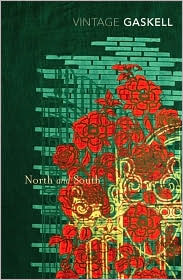
  • North and South.  Intro by Patricia Ingham.  Penguin, 1996; Intro by Sally Shuttleworth.  Oxford, 2008.
  • Ruth.  Intro by Angus Easson.  Penguin, 1998; Intro by Alan Shelston.  Oxford, 2009.
  • Sylvia’s lovers.  Intro by Shirley Foster.  Penguin, 1997;  Intro by Andrew Sanders.  Oxford, 2008.
  • Wives and Daughters.  Intro by Pam Morris.  Penguin, 1997


What’s Gaskell Worth Now?

Austen’s works show up at auction fairly regularly, but what about Gaskell – how does she compare to the high prices that Austen’s first editions command?  There is an upcoming Sotheby’s auction set for October 28 in London:  The Library of an English Bibliophile, Part I – all of Austen’s first editions are in the sale with high-end estimates; there are three Gaskell titles in the sale, so this gives a good idea of value:

  • Mary Barton.  London: Chapman and Hall, 1848.  First edition.  est. 4,000 – 6,000 GBP
  • Ruth.  London:  Chapman and hall, 1853.  First edition.  est. 2,000-3,000 GBP
  • North and South.  London:  Chapman and hall, 1855.  First edition.  est. 2,000-3,000 GBP.

 Letters / Diaries: 

  • Chapple, J.A.V. and Arthur Pollard, eds.  The Letters of Mrs. Gaskell. Manchester: Manchester UP, 1966.
  • Chapple, J. A.V.; assisted by by J. G. Sharpes. Elizabeth Gaskell: A Portrait in Letters.  Manchester: 1980.
  • Chapple, John and Alan Shelston, eds. Further Letters of Mrs. Gaskell. Manchester: Manchester UP, 2001.
  • Chapple J. A. V. and Anita Wilson, eds.  Private Voices: the Diaries of Elizabeth Gaskell and Sophia Holland.  Keele:  Keele UP, 1996.
  • Whitehill, Jane, ed.  The Letters of Mrs. Gaskell and Charles Eliot Norton, 1855-1865.  London: Oxford UP: 1932.

Bibliographies: 

  • Selig, R. L.  Elizabeth Gaskell; A Reference Guide.  Boston: G.K. Hall, 1977.
  • Jeffery Welch, Elizabeth Gaskell: An Annotated Bibliography, 1929-75. New York: Garland, 1977.
  • Weyant, Nancy S.  Elizabeth Gaskell: An Annotated Bibliography, 1976-1991. Metuchen, NJ: Scarecrow, 1994.
  • ______________.   Elizabeth Gaskell: An Annotated Guide to English Language Sources, 1992-2001.  Metuchen, NJ:  Scarecrow, 2004. 
    See also Weyant’s online Supplement, 2002-2010 [updated semi-annually]
  • See the Gaskell Web page for an online bibliography

Biographies: 

  • Chapple, John.  Elizabeth Gaskell: A Portrait in Letters.  Manchester:  Manchester UP, 1980.
  • ___________. Elizabeth Gaskell: The Early Years.  Manchester:  Manchester UP, 1997.
  • Easson, Angus.  Elizabeth Gaskell. London: Routledge & Kegan Paul, 1979.
  • Ffrench, Yvonne.  Mrs. Gaskell.  London:  Home & Van Thal, 1949.
  • Foster, Shirley.  Elizabeth Gaskell:  A Literary Life.  Houndsmills: Palgrave Macmillan, 2002.
  • Gerin, Winifred. Elizabeth Gaskell: A Biography. Oxford: Clarendon Press, 1976.
  • Handley, Graham.  An Elizabeth Gaskell Chronology.  Palgrave Macmillan, 2004.
  • Hopkins, Annette Brown. Elizabeth Gaskell: Her Life and Work. London: Lehmann, 1952.
  • Pollard, Arthur.  Mrs. Gaskell: Novelist and Biographer. Manchester: Manchester UP, 1966.
  • Uglow, Jenny.  Elizabeth Gaskell: A Habit of Stories. London: Faber and Faber, 1993.
  • Unsworth, Anna.  Elizabeth Gaskell: An Independent Woman.  London:  Minerva, 1996.

Studies: 

  • Barry, James Donald. “Elizabeth Cleghorn Gaskell,” in Victorian Fiction: A Second Guide to Research, edited by George H. Ford. New York: MLA, 1978.
  • Beer, P. Reader, I Married Him. . . . London: Macmillan, 1974.
  • Cecil, David.  Victorian Novelists: Essays in Revaluation.  Chicago, 1962.
  • Craik, W. A.  Elizabeth Gaskell and the English Provincial Novel. London: Methuen, 1975.
  • Easson, Angus, ed.  Elizabeth Gaskell: The Critical Heritage.  London, 1992.
  • Ganz, Margaret. Elizabeth Gaskell: The Artist in Conflict. New York: Twayne, 1969.
  • Lane, Margaret.  Purely for Pleasure.  London: Hamish Hamilton, 1966.  See chapters on “Mrs. Gaskell’s Task” and “Mrs. Gaskell:  Wives and Daughters’.
  • Lansbury, Coral. Elizabeth Gaskell: The Novel of Social Crisis.  London:  Paul Elek, 1975.
  • Lucas, John. “Mrs. Gaskell and Brotherhood,” in Tradition and Tolerance in Nineteenth Century Fiction, by D. Howard, J. Lucas, and J. Goode. London: Routledge & Kegan Paul, 1966.
  • Matus, Jill L. The Cambridge Companion to Elizabeth Gaskell.  Cambridge: Cambridge UP, 2007.
  • Morris, Pam.  “Introduction to Wives and Daughters”.  New York: Penguin, 2001.
  • Ritchie, Anne Thackeray.  “Preface to Cranford”.  New Edition.  London: Macmillan, 1907.
  • Rubenius, Aina.  The Woman Question in Mrs. Gaskell’s Life and Work.  Uppsala: Lundequist ; Cambridge: Harvard UP, 1950; reprinted by Russell and Russell in 1973.
  • Sharps, John Geoffrey Sharps. Mrs. Gaskell’s Observation and Invention: A Study of the Non-Biographic Works.  London: Linden, 1970.
  • Spencer, Jane.  Elizabeth Gaskell.  London: Macmillan, 1993.
  • Stebbins, Lucy Poate. A Victorian Album: Some Lady Novelists of the Period.  New York: Columbia UP, 1946.
  • Wright, Edgar. Mrs. Gaskell: The Basis for Reassessment.  London: Oxford UP, 1965.

Papers: 

Links:  


Ebooks:  

  1. Mary Barton
  2. North & South
  3. Cranford 
  4. Wives & Daughters  
  5. Life of Charlotte Bronte
  1. An Accursed Race
  2. Cousin Phillis
  3. Cranford
  4. Curious, if True Strange Tales
  5. A Dark Night’s Work
  6. Doom of the Griffiths
  7. The Grey Woman and other Tales
  8. Half a Life-Time Ago
  9. The Half-Brothers
  10. A House to Let
  11. Life of Charlotte Brontë — Volume 1
  12. Life of Charlotte Bronte — Volume 2
  13. Lizzie Leigh
  14. Mary Barton
  15. The Moorland Cottage
  16. My Lady Ludlow
  17. North and South
  18. The Poor Clare
  19. Round the Sofa
  20. Ruth
  21. Sylvia’s Lovers — Complete 
  22. Sylvia’s Lovers — Volume 1 
  23. Sylvia’s Lovers — Volume 2
  24. Sylvia’s Lovers — Volume 3
  25. Victorian Short Stories: Stories of Successful Marriages (as Contributor)
  26. Wives and Daughters  
  1. Cranford    
  2. Dark Night’s Work, A
  3. Doom of the Griffiths, The
  4. Half a Life-Time Ago
  5. Lizzie Leigh
  6. Mary Barton    
  7. My Lady Ludlow
  8. Poor Clare, The
  9. Wives And Daughters    
  10. An Accursed Race
  11. Half-Brothers, The    

Ebook editions at Amazon, Barnes & Noble and Borders: 

  • The [Kindle] Works of Elizabeth Gaskell – at Amazon, for $3.99 you can download most of her works to your Kindle; but if you search further, there are several free downloads of the individual novels, and other various collections; review the contents before selecting.
  • Barnes & Noble:  same as Amazon, some collections for $3.99, many free options.
  • Borders:  has various similar options 

iPhone Apps:   

Whatever you use for books on your iPhone, there are plenty of free Gaskells available.  I use Stanza, which is a free app [there are many others – visit your iTunes store and search “books” under Apps and see what I mean!], and from there you can choose the following: Feedbooks has several; Project Gutenberg has the same as online noted above; but Munsey’s takes first prize for having the most – seems to have all the novels and stories as best I can make out – so if you are stranded at an airport or in stopped traffic, what better way to pass the time than a Gaskell short story?! 
 

Audiobooks:  

  1. Cousin Phillis (unabridged)
  2. Cranford (unabridged)
  3. North and South (abridged)
  4. North and South (unabridged)
  5. Wives and Daughters (unabridged)
  6. Wives and Daughters (abridged)
  • Silksounds:  has only My Lady Ludlow, read by Susannah York  [very good!]
  • CSA Word:  Best of Women’s Short Stories, vol. 1& 2.  Read by Harriet Walter [a.k.a. Fanny Dashwood] Includes Gaskell’s “Right at Last” and “The Half Brothers”; CSA Word also has an abridged version of Mary Barton [read by Maggie Ollerenshaw] and North and South [read by Jenny Agutter].
  • LibriVox:
  1. North & South
  2. Other Gaskell works in various states of completion 


Movies:
 [see the various blog posts listed below for movie reviews]

  1. Wives & Daughters (1999)
  2. North & South (2004) – with Richard Armitage and Daniela Denby-Ashe ~ sigh!
  3. North & South (1975)  – with Patrick Stewart and Rosalind Shanks
  4. Cranford (1972) 
  5. Cranford  / Return to Cranford (2007, 2009)
  6. Cousin Phillis (1982)
  7. The Gaskell Collection – DVDs  – includes 7 discs:  W&D, N&S, CRANFORD and all special features.

******************************* 

Well, there’s a fine list for winter reading, listening and viewing! And somewhere in the middle of all that, treat yourself to a re-watch of Armitage in North and South! [and then of course READ it again … here is a link to an older blog post about the book and movie

 ************************

This is a rather quick list of goodies – if any of you know of a particular edition of a book, or an ebook, or an audio edition you particularly like, or a movie that I do not mention, please let me know so I can add it to the list – thank you! 

Follow this link to to the next blog on the Elizabeth Gaskell Bicentenary Blog Tour by Tony Grant at London Calling:  Plymouth Grove – A Visit to Elizabeth Gaskell’s home in Manchester

***********************

The Gaskell Blog Tour:  Here is the complete tour through the 15 blog posts celebrating Gaskell’s Birthday today: and remember that one lucky commenter will win a copy of an unabridged edition of North and South by Naxos AudioBooks read by Clare Willie. That’s 18 hours of Margaret Hale and John Thornton sparring and sparking in Gaskell’s most acclaimed work.  Here is a list of participants. You can visit them in any order and all comments during the contest will count toward your chance to win. Good luck and Happy Birthday Mrs. Gaskell!

Biography

Novels/Biography

Novellas

Resources

Sometimes one likes foolish people for their folly, better than wise people for their wisdom.” Elizabeth Gaskell, Wives and Daughters

[Posted by Deb]

Jane Austen · Literature · Schedule of Events · Social Life & Customs

A Jane Austen Weekend ~ Spectacular!

“My idea of good company, is the company of clever, well-informed people, who have a great deal of conversation; that is what I call good company.”
[Jane Austen, Persuasion]

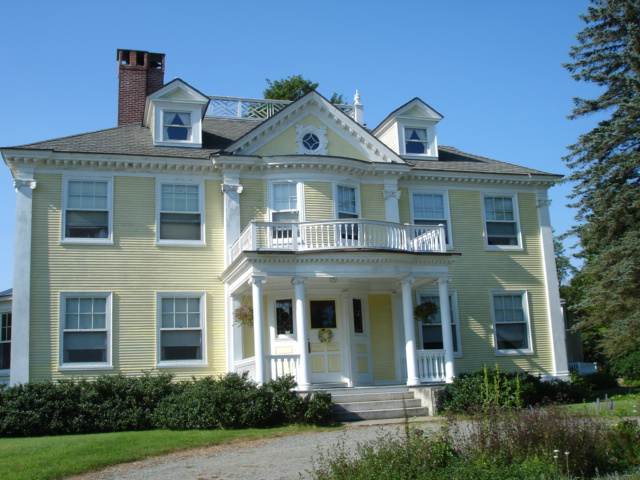
Well, just another summer weekend, lounging around in a lovely old Inn – a Victorian reproduction of a Georgian style house – in a sleepy Vermont town surrounded by mountains; being waited on by the Inn’s owner and most excellent cook for lavish breakfasts, a full Afternoon Tea, and a dinner reminiscent of the repast at the Netherfield Ball [lacking ‘white soup’ of course but that is saved for winter gatherings!]; and all this with lively discussions of Jane Austen and Sense & Sensibility late into the evening – Absolutely Perfect!

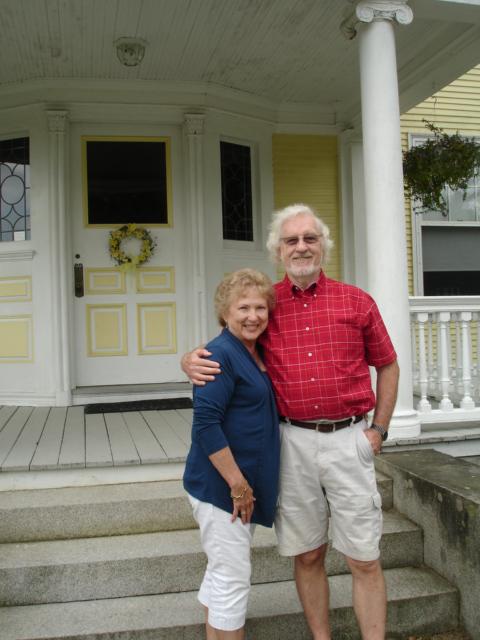
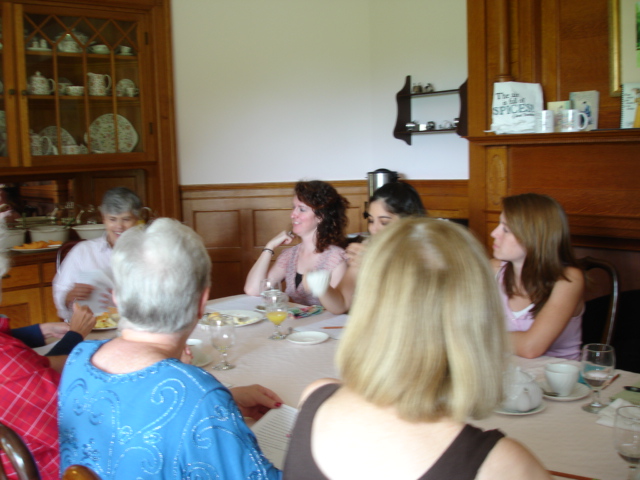
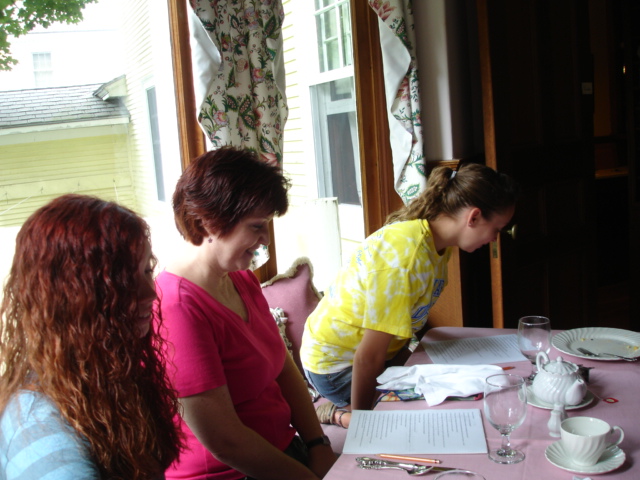
The Governor’s House in Hyde Park Vermont has been hosting these Jane Austen Weekends for the past few years – I have been to a few of the evening events and have stayed for those weekends where I was speaking – each event is made more special by the participants, people from all over who have found their way, for their very different reasons, to mingle with complete strangers and talk about Jane.  This past weekend brought a full house of fourteen people [sixteen to include Suzanne and me…] –

 *A mother celebrating her 50th birthday, her only wish for her two daughters [one still in high school, the other in college] and her two sisters to share in her love of Austen – none of them [except the Mom!] Austen readers in the least.  After being subjected to a nine-hour car ride listening to a BBC audio of S&S ALL the way, they arrived bleary-eyed and just FULL of S&S, and now I can safely say, all ready to go home to read the book! [love these convert stories!] – they win the “We’ll do anything to keep peace in the family [and this S&S thing isn’t so bad after all]” Award!

**********************************

*A couple from Minnesota [the husband one of the best sports I have yet to encounter!]  – he created a complete notebook of his wife’s ‘Jane Austen Collection’ – a bibliography of all her books, resources on the Regency period and Austen’s life, and a collection of all the emails received on their Minneapolis Region events – what a gift, a surprise no less! – and he actually really seems to be quite taken with Jane himself – though not so far as appearing in a superfine waistcoat [nor flannel for that matter!], pantaloons and hessians! – hopefully next time! – and his wife, a joy to see another so taken with Austen, re-discovering her, as so many do after the kids have left the house and there is time to reflect and savor – and she is enjoying all the recent sequels [with perhaps the exception of P&P and Zombies, a gift to her, that like me, she cannot quite get beyond that first page!] – they win the “Couples who read Austen together have a finer understanding of Love” Award!

********************************

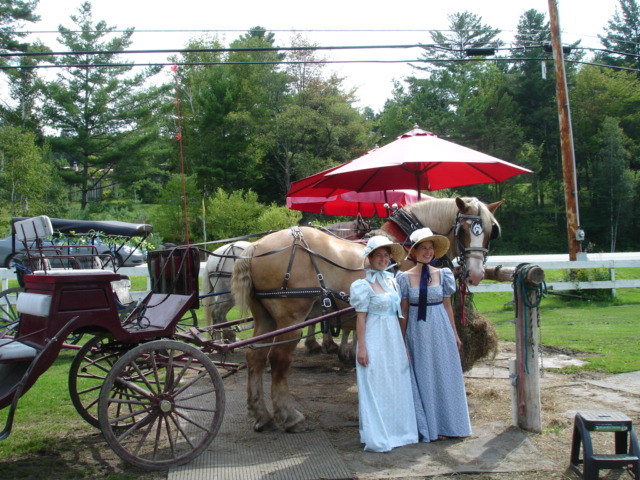
*Another family, “dragged” away for the weekend by the elder Austen-loving daughter, good sports all – her Mother, her Aunt, and her younger sister – all cramming the reading of S&S into their busy lives over the past month [we did discover that those who were still cramming their S&S the night before the quiz, fared far better than those of us who actually have read the thing ten times!] – the Aunt came from a distance so a family reunion of sorts – they win the “Now will you finally believe me when I keep saying how wonderful Austen is” Award! [I think they believe her now…] – AND First Prize in the “Love to dress up in Regency” Award!

***************************** 

[two Austen-quoting friends with Suzanne pouring Tea]

*Two young women who love Austen, can recite most lines from the books AND movies on command [my son can do this with Caddyshack – and my goodness, how much more enjoyable to hear the quotes from Austen!], brought along the sister of one of them whose husband dropped them all off so he could mountain bike Vermont for a few days – they did their knitting and needlepoint and completed the very difficult Jane Austen puzzle in no time at all – [[but alas! the Regency dress made by hand by one of the sisters was not quite finished – she promises to wear it next time!] – they win the “We LOVE Jane Austen and want to shout it to the whole world” Award!

********************************

And the conversation? – Suzanne talked about the “lay of the land” during this Regency period – the government, town and village life, domestic life, AND the proper serving of Tea; I spoke on traveling in S&S – the economics, the distances, and the carriages of each of the characters [Willoughby and his curricle getting far too much attention] – and much discussion on who is “sense” and who is “sensibility” and what does “sensibility” mean anyway, and how does the first sentence compare to the opening line of Pride & Prejudice, and a most gruelling but laughter-inducing quiz with fabulous prizes, and of course the MOVIES – so many different opinions on each of the adaptations – Hugh Grant is to die-for to Hugh Grant is a wimp; Colonel Brandon is way cool in his waistcoat to Marianne is quite right to be disgusted with his aches and pains; Mr. Palmer we all agreed is the best of the comic characters, his wife a silly fool and more the pity for him [and Hugh Laurie got well-deserved high marks] – and though it was an S&S weekend, Colin Firth, a.k.a. Mr. Darcy was never far from the table conversation [as is quite proper] and the 2005 rendition causing quite the heated talk – endless chat, not one thought really completed, but certainly all agreeing that a more delightful weekend would be hard to come by!

On a personal note, one always finds at these gatherings how very small the world is – one group from a small town in New Jersey “I would never have heard of” which turned out to be where my college roommate grew up and I had visited it a number of times; and the mother of the other mother-daughter group was in the Army at the same place and same time that my husband and I were in the early 1970s – we were nearly neighbors!

And of course, great kudos and a hearty thank you to Suzanne who runs these weekends so beautifully, bringing so many people from all parts of the country together – new friends found in this resplendent world of Jane Austen – a step back from the 21st century for a few short days that energizes and soothes at the same time  – Jane would approve, I have no doubt  – she was there, after all…

… the Austen-era feeling certainly was helped along with a
leisurely morning carriage ride through the Stowe Vermont woods…

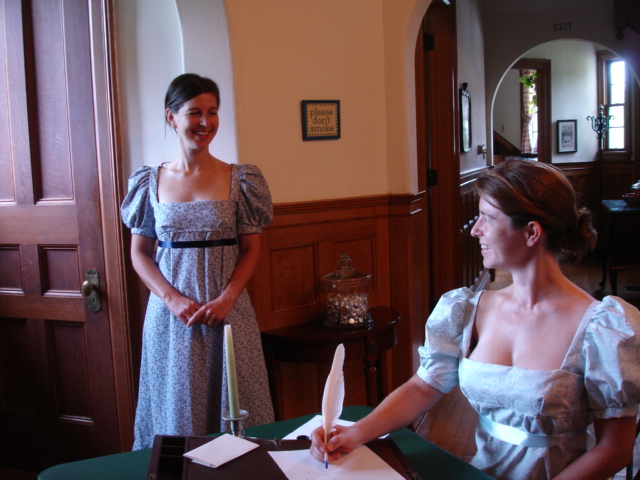
… and letter-writing exercises with quills
[but alas! no Darcy to mend our pens] …

…and mulling over that very difficult quiz!

… and reading up on carriages, bonnets in hand awaiting an outing …

**********************************

Next up:  

series 3: Sense and Sensibility
Friday evening talk: Making Sense of the Regency World

Friday – Sunday, September 10 – 12, 2010
Friday – Sunday, January 7 – 9, 2011

Click here for more details and here for the Governor’s House website

[Posted by Deb] 

Book reviews · Literature

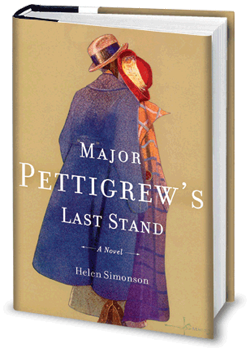
Book Review ~ ‘Major Pettigrew’s Last Stand’

Inquiring Readers:  I welcome guest blogger Janeite Lynne, a JASNA-Vermont member, who has penned a review of Helen Simonson’s Major Pettigrew’s Last Stand.  Thank you Lynne for sharing your thoughts about this book that everyone I know has been touting very loudly!

When I first began reading Major Pettigrew’s Last Stand by Helen Simonson, I wasn’t sure that I wanted to spend a whole book with Major Pettigrew, a widower and retired military man living in Somerset, England.  He seemed like a mix of Jane Austen’s minor characters—a stuffy member of the local gentry focused on his position and his guns.  But Simonson deftly lets the Major develop and come to life in the first half of the book, and I became engrossed in his story. 

The Major, (please don’t refer to him as Mr. or Ernest), is the center of the book and the reason to read it.  He is an opinionated man.

 On women drivers:  “He didn’t like being driven by a woman.  He hated their cautious creeping about at intersections, and their heavy-handed indifference to the nuances of gear changing, and their complete ignorance of the rearview mirror.”

 On Americans: Americans seemed to enjoy the sport of publicly humiliating one another.  The occasional American sitcoms that came on TV were filled with childish fat men poking fun at others, all rolled eyeballs and metallic taped laughter.”

 On the golf club: “It was a source of annoyance to the Major that what had once been a very refined black tie dance, with simple steak menu and a good band, had been turned into a series of increasingly elaborate theme evenings.” 

                                                              And…

“…it freed them from the sullen charms of waitresses who, culled from the pool of unmotivated young women being spat out by the local school, specialized in a mood of suppressed rage.  Many seemed to suffer from some disease of holes in the face and it had taken the Major some time to work out that the club rules required young women to remove all jewelry and that the holes were piercings bereft of decorations.”

As Major Pettigrew’s Last Stand opens, the Major has just learned that his only brother, Bertie, is dead.  It is through his reaction to his brother’s death, as well as his growing relationship with Mrs. Ali, a local shop keeper, that Simonson shows us Major Pettigrew as a whole person.  As he struggles with the changes in his life, his opinions become less strident and more blurred by the human relationships that he allows himself to experience. 

 Later in the novel, Mrs. Ali must make a decision to mail a letter that will likely change her life.  Major Pettigrew watches her at the postbox. 

“He never imagined so clearly the consequences of mailing a letter—the impossibility of retrieving it from the iron mouth of the box…It suddenly seemed horrible that one’s words could not be taken back, one’s thoughts allowed none of the remediation of speaking face to face.” 

Major Pettigrew’s Last Stand, for me, came down to the importance of risking the face to face relationships of life.  There are many other plot elements in the book.  There are issues of prejudice, land development, and prickly relationships between parents and children.  Simonson competently explores each of these, but her writing is at its best when she is drawing the Major and his re-entry into his emotional life.  When the book ended, I had come full circle.  I was happy in Major Pettigrew’s company, and I wanted to know what he would do next.

**********************************

Helen Simonson
Major Pettigrew’s Last Stand
Random House, 2010
ISBN:  978-1400068937

[Posted by Janiete Lynne]

Austen Literary History & Criticism · Jane Austen · Literature

Andrew Lang’s ‘Letter to [a dead] Jane Austen’

Andrew Lang’s Letters to Dead Authors  [NY:  Scribner’s, 1889, c1886] is one of my favorite little books [because I like and collect little books, love Andrew Lang, as in Fairy Book fame, and love the title – my book is a very dark green with gilt lettering, has a Greek myth book-plate and a few notes from a previous owner penned in a beautiful calligraphic hand].

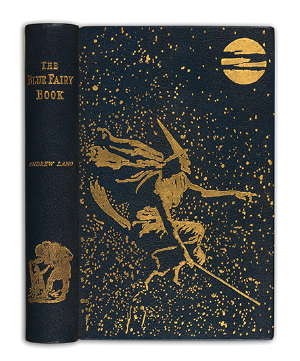
Lang (1844-1912) was one of the most prolific and versatile writers of his day – a poet, essayist, reviewer, biographer, bibliographer, historian, translator, editor, and anthropologist [1] – known mostly today for his Homeric scholarship, and his series of lovely Fairy Books [the first in 1889 was The Blue Fairy Book, followed by eleven others[2] which did much to revive interest in fairy tales.

[Andrew Lang, 1855 portrait by Sir William Blake Richmond,
Scottish National Gallery, from adelaide.edu]

 But I bought this book many years ago because of chapter VIII, “To Jane Austen”, though the other essays are certainly deserving of a read: 

Contents:  Preface

  1. To W. M. Thackeray
  2. To Charles Dickens
  3. To Pierre De Ronsard
  4. To Herodotus
  5. To Mr. Alexander Pope
  6. To Lucian of Samosata
  7. To Maitre Francoys Rabelais
  8. To Jane Austen
  9. To Master Isaak Walton
  10. To M. Chapelain
  11. To Sir John Manndeville
  12. To Alexandre Dumas
  13. To Theocritus
  14. To Edgar Allan Poe
  15. To Sir Walter Scott, Bart.
  16. To Eusebius of Caesarea
  17. To Percy Bysshe Shelley
  18. To Monsieur De Molie’re, Valet De Chambre du Roi
  19. To Robert Burns
  20. To Lord Byron 
  21. To Omar Khayya’m
  22. To Q. Horatius Flaccus

*********************************

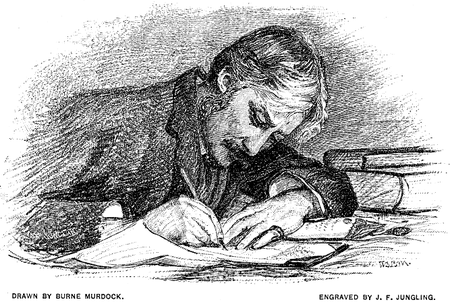
[‘Lang at Work’ from Wikisource]

You will note, of course, that Austen is the only female in the group and thus shows her status among the literary elite in 1886, the essay first appearing in the St. James Gazette.  Lang remarks in his preface the “it is, perhaps, superfluous to add that some of the Letters are written to suit the Correspondent than to express the writer’s own taste or opinions.” [p. vi].  I append here the full text, as it is available in numerous online versions.  Lang offers a humorous critique of Austen’s critics, as Brian Southam suggests, Lang’s own comments voicing those of Anne Thackeray and reiterating the ”cloying tradition” of Austen criticism.[3]  So whatever Lang’s intent, I think his words still stand today to those who think that “nothing happens in Austen” – his thoughts on Lydia or Kitty as heroines is one of the many chuckles in these few short paragraphs – 

With Lydia for a heroine you might have gone far; and, had you
devoted three volumes, and the chief of your time, to the passions of Kitty, you might have held your own, even now, in the circulating library. How Lyddy, perched on a corner of the roof, first beheld her Wickham; how, on her challenge, he climbed up by a ladder to her side; how they kissed, caressed, swung on gates together, met at odd seasons, in strange places, and finally eloped: all this might have been put in the mouth of a jealous elder sister, say Elizabeth, and you would not have been less popular than several favourites of our time.  [p. 79]

 **********************

So, read this, it is not that long, and comment if you will, please!

 VIII.  To Jane Austen

Madame,–If to the enjoyments of your present state be lacking a view of the
minor infirmities or foibles of men, I cannot but think (were the thought
permitted) that your pleasures are yet incomplete. Moreover, it is certain
that a woman of parts who has once meddled with literature will never wholly lose her love for the discussion of that delicious topic, nor cease to relish what (in the cant of our new age) is styled ‘literary shop.’ For these reasons I attempt to convey to you some inkling of the present state of that agreeable art which you, madam, raised to its highest pitch of perfection.

As to your own works (immortal, as I believe), I have but little that is
wholly cheering to tell one who, among women of letters, was almost alone in her freedom from a lettered vanity. You are not a very popular author: your volumes are not found in gaudy covers on every bookstall; or, if found, are not perused with avidity by the Emmas and Catherines of our generation. ‘Tis not long since a blow was dealt (in the estimation of the unreasoning) at your character as an author by the publication of your familiar letters. The editor of these epistles, unfortunately, did not always take your witticisms, and he added others which were too unmistakably his own. While the injudicious were disap-pointed by the absence of your exquisite style and humour, the wiser sort were the more convinced of your wisdom. In your letters (knowing your correspondents) you gave but the small personal talk of the hour, for them sufficient; for your books you reserved matter and expression which are imperishable. Your admirers, if not very numerous, include all persons of taste, who, in your favour, are apt somewhat to abate the rule, or shake off the habit, which commonly confines them to but temperate laudation.

‘T is the fault of all art to seem antiquated and faded in the eyes of the
succeeding generation. The manners of your age were not the manners of to-day, and young gentlemen and ladies who think Scott ‘slow,’ think Miss Austen ‘prim’ and ‘dreary.’ Yet, even could you return among us, I scarcely believe that, speaking the language of the hour, as you might, and versed in its habits, you would win the general admiration. For how tame, madam, are your characters, especially your favourite heroines! how limited the life which you knew and described! how narrow the range of your incidents! how correct your grammar!

As heroines, for example, you chose ladies like Emma, and Elizabeth, and
Catherine: women remarkable neither for the brilliance nor for the degradation of their birth; women wrapped up in their own and the parish’s concerns, ignorant of evil, as it seems, and unacquainted with vain yearnings and interesting doubts. Who can engage his fancy with their match-makings and the conduct of their affections, when so many daring and dazzling heroines approach and solicit his regard?

Here are princesses dressed in white velvet stamped witla golden fleurs-de-lys –ladies with hearts of icc and lips of fire, who count their roubles by the
million, their lovers by the score, and even their husbands, very often, in
figures of some arithmetical importance. With these are the immaculate
daughters of itinerant italian musicians, maids whose souls are unsoiled
amidst the contaminations of our streets, and whose acquaintance with the art of Phidias and Praxiteles, of Daedalus and Scopas, is the more admirable,
because entirely derived from loving study of the inexpensive collections
vended by the plaster-of-Paris man round the corner. When such heroines are wooed by the nephews of Dukes, where are your Emmas and Elizabeths? Your volumes neither excite nor satisfy the curiosities provoked by that modern and scientific fiction, which is greatly admired, I learn, in the United States, as well as in France and at home.

You erred, it cannot be denied, with your eyes open. Knowing Lydia and Kitty so intimately as you did, why did you make of them almost insignificant characters? With Lydia for a heroine you might have gone far; and, had you devoted three volumes, and the chief of your time, to the passions of Kitty, you might have held your own, even now, in the circulating library. How Lyddy, perched on a corner of the roof, first beheld her Wickham; how, on her challenge, he climbed up by a ladder to her side; how they kissed, caressed, swung on gates together, met at odd seasons, in strange places, and finally eloped: all this might have been put in the mouth of a jealous elder sister, say Elizabeth, and you would not have been less popular than several favourites of our time. Had you cast the whole narrative into the present tense, and lingered lovingly over the thickness of Mary’s legs and the softness of Kitty’s cheeks, and the blonde fluffiness of Wickham’s whiskers, you would have left a romance still dear to young ladies.

Or again, you might entrance your students still, had you concentrated your attention on Mrs. Rushworth, who eloped with Henrv Crawford. These should have been the chief figures of ‘Mansfield Park.’ But you timidly decline to tackle Passion. ‘Let other pens,’ you write, ‘dwell on guilt and misery. I quit such odious subjects as soon as I can.’ Ah, _there_ is the secret of your failure! Need I add that the vulgarity and narrowness of the social circles you describe impair your popularity? I scarce remember more than one lady of title, and but very few lords (and these unessential) in all your tales. Now, when we all wish to be in society, we demand plenty of titles in our novels, at any rate, and we get lords (and very queer lords) even from Republican authors, born in a country which in your time was not renowned for its literature. I have heard a critic remark, with a decided air of fashion, on the brevity of the notice which your characters give each other when they offer invitations to dinner. ‘An invitation to dinner next day was despatched,’ and this demonstrates that your acquaintance ‘went out’ very little, and had but few engagements. How vulgar, too, is one of your heroines, who bids Mr. Darcy ‘keep his breath to cool his porridge.’ I blush for Elizabeth! It were superfluous to add that your characters are debased by being invariably mere members of the Church of England as by law established. The Dissenting enthusiast, the open soul that glides from Esoteric Buddhism to the Salvation Army, and from the Higher Pantheism to the Higher Paganism, we look for in vain among your studies of character. Nay, the very words I employ are of unknown sound to you; so how can you help us in the stress of the soul’s travailings?

You may say that the soul’s travailings are no affair of yours; proving
thereby that you have indeed but a lowly conception of the duty of the
novelist. I only remember one reference, in all your works, to that
controversy which occupies the chief of our attention–the great controversy on Creation or Evolution. Your Jane Bennet cries: ‘I have no idea of there being so much Design in the world as some persons imagine.’ Nor do you touch on our mighty social question, the Land Laws, save when Mrs. Bennet appears as a Land Reformer, and rails bitterly against the cruelty ‘of settling an estate away from a family of five daughters, in favour of a man whom nobody cared anything about.’ There, madam, in that cruelly unjust performance, what a text you had for a _Tendenz-Roman_. Nay, you can allow Kitty to report that a Private had been flogged, without introducing a chapter on Flogging in the Army. But you formally declined to stretch your matter out, here and there, with solemn specious nonsense about something unconnected with the story.’ No ‘padding’ for Miss Austen! In fact, madam, as you were born before Analysis came in, or Passion, or Realism, or Naturalism, or Irreverence, or Religious Open-mindedness, you really cannot hope to rival your literary sisters in the minds of a perplexed generation. Your heroines are not passionate, we do not see their red wet cheeks, and tresses dishevelled in the manner of our frank young Maenads. What says your best successor, a lady who adcIs fresh lustre to a name that in fiction equals yours? She says of Miss Austen: ‘Her heroines have a stamp of their own. They have a _certain_gentle_self-respect_and__humour_and_hardness_of_heart_… Love with them does not mean a passion as much as an interest, deep and silent.’ I think one prefers them so, and that Englishwomen should be more like Anne Elliot than Maggie Tulliver. ‘All the privilege I claim for my own sex is that of loving longest when existence or when hope is gone,’ said Anne; perhaps she insisted on a monopoly that neither sex has all to itself. Ah, madam, what a relief it is to come back to your witty volumes, and forget the follies of to-day in those of Mr. Collins and of Mrs. Bennet! How fine, nay, how noble is your art in its delicate reserve, never insisting, never forcing the note, never pushing the sketch into the caricature! You worked without thinking of it, in the spirit of Greece. on a labour happily limited, and exquisitely organised. ‘Dear books,’ we say, with Miss Thackeray–‘dear books, bright, sparkling with wit and animation, in which the homely heroines charm, the dull hours fly, and the very bores are enchanting.’

 *************************

[Text from ReadPrint.com; etexts also available on Mollands, Google Books, Literature Network, etc.]

______________________________________________________________________

 1. Drabble, Margaret, ed.  The Oxford Companion to English Literature. Oxford, 1985, p. 548.

 2. the Fairy Books Series:  see  MythFoklore.net for contents and various etext versions [though there is nothing like holding these books!]

  • Blue Fairy Book (1889)
  • Red Fairy Book (1890)
  • Green Fairy Book (1892)
  • Yellow Fairy Book (1894)
  • Pink Fairy Book (1897)
  • Grey Fairy Book (1900)
  • Violet Fairy Book (1901)
  • Crimson Fairy Book (1903)
  • Brown Fairy Book (1904)
  • Orange Fairy Book (1906)
  • Olive Fairy Book (1907)
  • Lilac Fairy Book (1910)

3.  Southam, Brian.  Jane Austen: The Critical Heritage, 1870-1940.  Routledge,1996; Introduction, p.25.

*************************

Further Reading:

Jane Austen · Literature · Regency England

The Mystery of Clare Darcy

For the past year I have been interspersing my regular reading with a taste of Georgette Heyer – a delightful romp through her Regency romances – not quite done yet [gad! There are so Many! – not to mention the Mysteries and the Historicals…], and I fear as I look back that I am getting them all confused – I must learn to take better notes! – But I have taken a break for a bit, and in looking around for other such books to get my “Regency fix” [or is it the “romance”?!], I have discovered Clare Darcy – or at least discovered her books, as there seems to be cloak of complete mystery about the author.  Even the know-it-all Internet brings up little evidence:

1.  A Wikipedia entry  that only lists her books and repeats the biography given on all the novels:  “an American novelist from Ohio” 

2.  The Books Themselves:  “…her recent Regency tales have all been acclaimed as the truest successors to those of Georgette Heyer.  It is hard not to believe that Miss Darcy was born and raised in the best Society of that day – rather than in the Ohio of our own time.”   All copyright notices state either the publisher “Walker and Company” or “Clare Darcy”

3.  Rave Reviews:  “The latest addition to the author’s piquant, literate romances of life among the ton in Regency England celebrates one of Darcy’s spunkiest heroines yet” [Publisher’s Weekly on Eugenia] and “An enchanting Regency novel…which makes one rejoice in finding what could have been taken for a new Georgette Heyer novel”  [Library Journal on Victoire]

4.  A Blog Post by the Regency author Lesley-Anne McLeod  dated September 16, 2008: Ms. McLeod raises the same questions I have: Who was she?  Where is she?  Was she a “she” or a “he”?  Is Clare Darcy a penname? [it must be!], Did she write other books?  she is obviously versed in Heyer, but original and knowledgeable enough to put the reader into a living, breathing Regency world.  Ms. McLeod asks for any information, and a reader commented: “I would like to point out in the front of my book it states that ‘this is the last of the novels discovered after Clare Darcy’s death’.  It was first published in 1982.” – this last title is Caroline and Julia.  [I have the Signet paperback and it makes no such mention, so this must be in the hardcover edition; but the author note in my copy says “Miss Darcy was very much at home in her special world, Regency England” and the previous books note that “she is very much at home…” [well, at least that answers ‘where she is’]

 [and BTW, on another post, Lesley Ann lists her top dozen Regency reads:  Clare Darcy’s Lydia sits in great company at number 11; Persuasion is 6, but the list is in no particular order]

 5.  At Good Ton there is a list of all her works with character names and short summaries

6.  There are two reviews at An Evening at Almack’s:  one of Lydia and one of Victoire

7.  And finally at Fantastic Fiction, there is a list of titles with several images of book covers, but nothing else

 So, scanty information!  I’ll share some thoughts and pen a few “rapid reviews” over my next few posts [don’t want to give too much away!] – I begin with the titles of her fourteen published works [thankfully, more manageable than Heyer!] – all published by Walker, and in paperback by Signet, other various reprints, no longer in print but readily available from used booksellers.  You can also search Amazon and read a few customer reviews.

 Here’s the list: 

  • Georgina [1971]
  • Cecily: Or a Young Lady of Quality [1972)]
  • Lydia: Or Love in Town [1973]
  • Victoire [1974]
  • Lady Pamela [1975]
  • Allegra [1976]
  • Elyza [1976]
  • Regina [1976]
  • Cressida [1977]
  • Eugenia [1977]
  • Gwendolen [1979]
  • Rolande [1979]
  • Letty [1980]
  • Caroline and Julia [1982]

******************************* 


So far I have read eight of the fourteen in my continuing efforts to flunk my regular bookgroup – and now, as with my Heyer immersion, I am getting all the plot lines confused, relying on notes to keep them fresh in my mind, and now taking a much needed break [not to mention that I am increasingly frustrated with my husband for not wanting to dress in superfine blue waistcoats and a cravat in the Mathematical style, his “dark locks”  in the Stanhope Crop, and must desist in those efforts for family harmony…]

I cannot compare Darcy to Heyer – she falls short; everyone does, just as anyone trying to imitate Jane Austen, fails miserably despite best efforts.  Heyer is incomparable in plot, characterization, and laugh-out-loud humor – I first read Faro’s Daughter and at every turn of the page I yelled at myself for not Reading Her Before Now –  so I will not compare them – read Clare Darcy for herself – here too we find great plots, characters [some that jump off the page], sparkling dialogue, and almost as much humor as Heyer – there is at least one classic scene in each novel that sends you into peels, and any of the books will certainly cure you of a “fit of the dismals”!   

Some Regency Romance conventions:

 The Romance Writers of America site defines the “Romance Genre” thusly – it must comprise these two elements:   

A Central Love Story: The main plot centers around two individuals falling in love and struggling to make the relationship work. A writer can include as many subplots as he/she wants as long as the love story is the main focus of the novel. 

An Emotionally-Satisfying and Optimistic Ending: In a romance, the lovers who risk and struggle for each other and their relationship are rewarded with emotional justice and unconditional love.

 A “Regency Romance” must have these and be set for the most part in Regency England.  And what else? – these seem to be the recurring conventions , what shows up in each tale, what we expect from page one to the end [I confess to NOT being a reader of romances, so bear with me as I try to piece all this together]

1.  The Regency World of Town and Country

real settings in England, either in London and during the London Season, or in a Country house; Ireland figures here and there, and one heroine is AMERICAN from New Orleans [and thus fashioned appropriately in all the latest French fashions]; Waterloo is also prominent:  we see settings such as Vauxhall Gardens; the Covent Garden Theatres, complete with the acting greats Kean, Kemble, Siddons; the boxing saloons and gambling houses; Almack’s and its Patronesses; circulating libraries; Tattersalls and horses [“ a bang-up set of blood and bones”] and carriages [chaises and hackney coaches and fast-driven curricles and gigs] and coaching inns for traveling escapades, complete with races, mishaps and crashes; Restorative Pork Jelly makes an appearance, as does even the Prince Regent himself.

 2.  A world of Regency fashion:– where male and female dress is described in full, vivid, colorful detail, ones attention to their dress delineating their character – there is indeed an abundance of the color “puce” – the “why” of this I will persue further… 

3.  Regency language:  Miss Darcy either kept lengthy notes while reading her Heyer or she had her own “Regency Lexicon” close by – each novel is replete with Regency cant, adding to the authenticity and the humor: you can read my post on Frederica  where all I do is compile a list of Heyer’s terms –  so here I list some of Darcy’s, in no particular order [and laughing at my frustrated spell-checker’s efforts!] – you can refer to the online Regency Lexicon if you need a definition!:   

outside of enough; flummery; fustian; fall into the ropes; rake-shame; faradiddle; light-skirts; roundaboutations [my very favorite!]; Banbury Tales and Cheltenham Tragedies; bumblebroth; miff-maff; flying up into the boughs; cloth-headed; moonlings; Top of the Trees, Lady of Quality; the ton; shatter-brained; bird-witted; gudgeon; on dits and tattle-boxes; put-downs and cuts and quizzing glasses;  those requisite vapours and dismals; don’t like it above half; rag-mannered; the high fidgets; cutting a wheedle; coming to cuffs; etc.  – you get the idea – we are in Heyeresque territory here…and feel quite at home.

4.  The Heroine:  she will be independent, feisty and high-spirited; a Lady of Quality but unconventional in her behaviors, setting the tattle-boxes wagging their tongues and the Hero intrigued; sometimes wealthy in her own right, but usually in need of some assistance, either for herself or a family member and thus searching for work, rank, money, an introduction into Society, etc; always beautiful, not always a “traditional” beauty, but can be dark, or titian / chestnut or blond; usually tall and slim, but can be petite [Elyza]; will have numerous gentleman sitting at her feet, interested in all manner of coupling arrangements; knows all the dances, even the WALTZ; adept at male-dominated activities as riding, hunting, fishing, carriage driving; seems to be most adept at getting into scrapes – enter the Hero; always calls the Hero “abominable” or “wretch” and is always “crossing swords” with him [that’s how we know he is The Hero… or as Lady St. Abbs says in Lady Pamela:

You mark my words… when a woman comes to dagger-drawin’ with a man every time she meets him, there’s mischief in it! [p.126]

5.  The Hero:  usually wealthy, either by birthright or inheritance from a distant relative; always has some grand name like Lord Dalven, or Sir Derek Herington, Lord Wrexam, Viscount Northover, Cleve Redmayne [Cleve??!], the Marquis of Tarn, or Robert Ranleigh; he will be handsome but not perfectly so [compare to Lord Harlbury in Lydia, first name “Shafto”, reason enough to rule him out as Hero, but he is also “a very worthy young man – and the most beautiful creature I have ever set eyes on – and an earl – and fabulously rich-“ – but alas! NOT our Hero]; OUR Hero is handsome but this is usually coupled with a sardonic, cynical look, a darkening brow; mostly dark locks, occasionally fair, with grey or black eyes; dressed like a dandy in the fashion of the moment, but detached enough from his own appearance to be attractive not foppish, with only the occasional grab for his snuff box – he wears a well-fitting superfine blue coat, starched neckcloths, he is ALWAYS broad-shouldered and powerfully built; he calls the heroine all sorts of charming endearments:  my girl, a chit, a vixen, hoyden, infant, brat [these can grate on my 21st century feminist leanings, but I shake it off in an effort to get into the spirit of it all…]; he is calm and rational and in control in the face of any hysteria, tribulation or catastrophe, his behavior bordering on the arrogant [those feminist sensibilities having trouble yet again…]; often languid with a “drawl” in speaking; a sense of humor, but has a “dangerous look” when pushed to the limit; is an accomplished boxer and knocks adversaries to the ground in one blow; and of course is an experienced whip.  In short, the perfect man for us all… except for that horrible gossip-feeding reputation as… a Rake…


6.  Other Characters:  often a sibling of the heroine in need of Help, can be a bit “bird-witted”; the Other Men, hanging about the Heroine, often Mama’s boys, dandies, or wimps; those gossipy Matrons of the ton, and the Mothers with marriageable daughters a la Lady Catherine de Bourgh; a coterie of landladies, butlers, cooks, maids, grooms and tigers, each with their own personality that propel the plot, add the humor, and give the main characters someone to sound off to, play off of…

7.  Like in Heyer, everything is revealed in the Eyes of the Hero – the gleam; the odd light; the intense warmth; the laughing eyes; the eyes that are alight; the hard grey eyes strangely softening… etc…

 8.  The Consummate Ending: the thickened voice of the hero; the melting heroine weak in the knees suddenly unable to look The Hero in the face; the “ruthless” nearly crushing embraces; the “violent” kisses… I could go on but won’t – you must read each ending…

 9. And Austen? – well of course, all these Heroes are made of Darcy’s [as in Fitzwilliam] cloth, so Austen is everywhere really – but in Lady Pamela there is this wonderful reference to Sir Charles Grandison by The Hero: 

In love with him! No, no – you mean you made up your mind to have him when you were a schoolroom chit and hadn’t any more idea of what you wanted in a man than what you read in novels.  And I must say Babcoke [another name to surely alert us to his I-am-not-the-hero status] could do Sir Charles Grandison very well if he had the least idea of what it was all about and didn’t fall asleep in the middle of it.  [p. 120]

Aah! The Hero has actually READ Sir Charles Grandison! 

And like Austen in her Letters where she freely used Capital Letters, there is a penchant in Lady Pamela for the same: it adds to the humor in the dialogue, such as “I will Get to the Bottom of This”.

A quick summary – but lest you think that all the stories are the same, be not afraid of treading into Clare Darcy’s land – each story, like most romance novels, begins on page one and by page two you have figured out who is the Heroine and who will be Her Hero, and I suppose you could turn to the last few pages and get into all the Ending Embraces and Kisses and call it a day – but don’t do that – each story brings unique characters, fun plot lines, all that Regency chatter, the lovely fashions described, the Heroine’s adventures amidst the Society constraints on her Behavior, the Hero’s awakening to being a “marrying man” after all, and the Heroine realizing that she really has had a passion for this “abominable wretch” quite from the start – we knew it all along, but don’t pass up the ride… 

Join me for several reviews, spaced over the next few days…. 

[Posted by Deb]