Austen Literary History & Criticism · Jane Austen · Regency England · Social Life & Customs

Thoughts on Travel in ‘Sense and Sensibility’

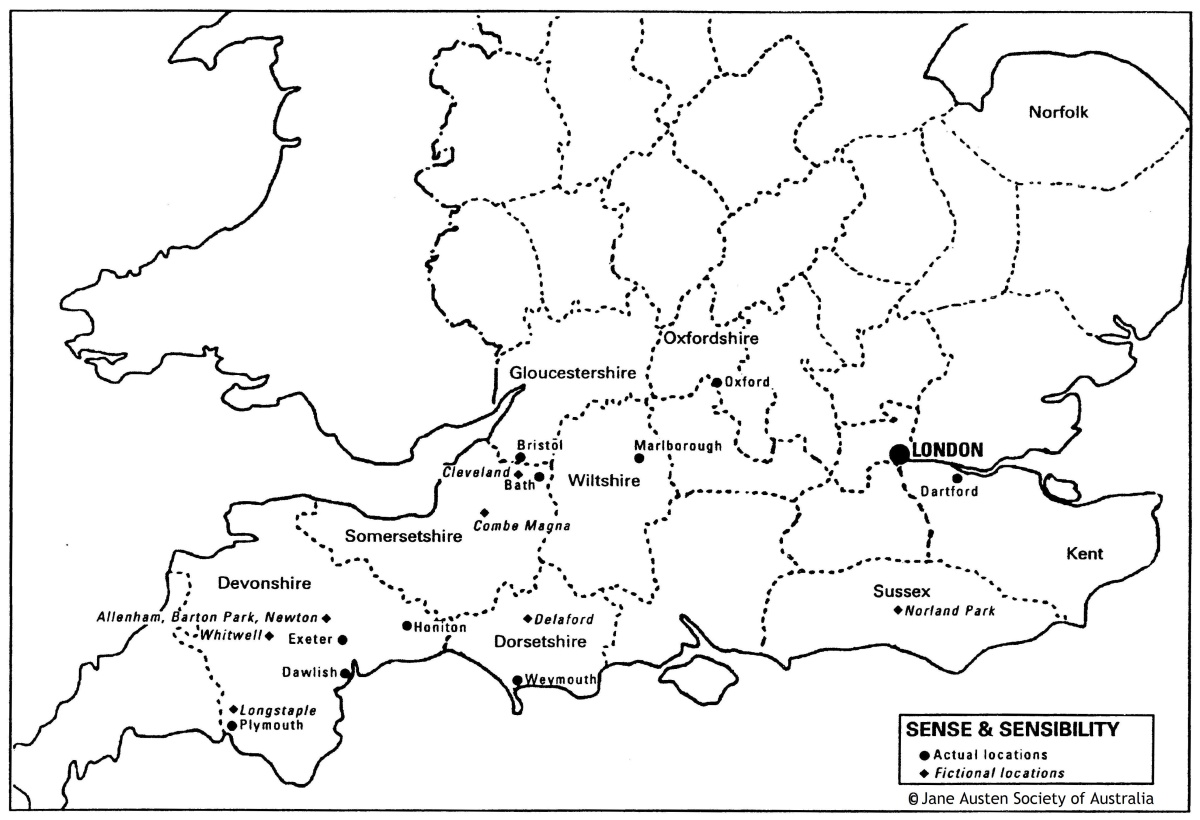
Sense & Sensibility is about so many things, but there is an emphasis on income, inheritance and money, and how the world of the late 18th, early 19th century figured in the lives of Austen’s characters, especially the women in her novels.  But one of the things one notices after a number of readings is the amount of movement in this novel – the constant  comings and goings of the characters, with their visiting, travels to London, moving from one end of England to the other.  On first reading, you might almost miss the extent of this movement, after all, nothing really ever happens in Austen, isn’t that what we always hear?!  But take a look at the map on the JASNA.org site for Sense and Sensibility and you will see what I mean. And if you know anything about travel in late 18th – early 19th century England, you will be know how arduous such travel was.  I am going to chart the movement of characters in the novel and the means whereby they moved from place to place, or as Mrs. Jennings so aptly asks of the Misses Steele:  “How did you travel?”  

Austen knew first-hand the travel issues of her day [read her letters!] – and she was very knowledgable and consistent in writing about it in her novels – often not necessarily specific but there are clues all around!   But alas!, there is so much to discuss about travel: carriages and their parts; the history of the postal system; the history of coaching and the turnpike system; the economics of the time – taxation, income and inheritance – all these; but I will in the next several posts offer a brief outline of the travel in Regency England, its difficulty and costs with a few thoughts on economics; then a discussion of movement in S&S; the types of carriages in use in Regency England and those used by Austen’s characters; and finally a few words on the London of S&S – it has the most mention of any of her novels, and interesting to see where each character was housed in Town.  And at the end of this series of posts, I will provide a bibliography and further reading references.
 

 Part I:  Travel in Regency England  

[English Counties: Map from JASNA.org]

  • -The difficulty of travel due to the condition of the roads – each parish was responsible for its own roads but they were largely dirty and muddy, and dangerous
  • -most people traveled by foot:  certainly true of the lower classes, but recall Mrs. Dashwood: 

 …his [Mr. Middleton’s ] repeated assurances of his carriage being always at their service, the independence of Mrs. Dashwood’s spirit overcame the wish of society for her children; and she was resolute in declining to visit any family beyond the distance of a walk.  

  •   -traveling in vehicles in the daytime or only in the nights with bright moonlight, little travel in winter, no travel on Sunday
  • -improper for women to travel alone [if you read Austen’s letters, you will see that she was completely dependent upon her brothers to visit anyone or travel any distance; and how outrageous that Northanger Abbey’s Catherine Morland was put on that coach all alone!]
  • -for overnights at coaching inns, travelers often brought their own linens or silverware…
  • -travel vehicles were uncomfortable and dangerous due to the road conditions and highwaymen
  • -despite all this, the late 18th-century saw a great improvement in the roads, and one could travel great distances more quickly [and if they had the money!].   Paterson’s British Itinerary, a travel guide had 17 editions between 1785-1832 – it outlined the roads used by the stage and mail coaches, the tolls, the bridges, etc.   

[Image from Georgianindex.net]

A quick review of travel times [varies depending upon vehicles]:  

  • – Mr. Darcy:  8 miles/hr –  recall his famous line to Elizabeth:  ‘what is 50 miles of good road? little more than half a day’s journey’
  • -the Stage Coach [and General Tilney]:  7 miles /hr
  • -average travel time:  4-6 miles / hr
  • -100 miles = 2 days of travel [and remember, no travel on Sunday]
  • -in 1800, London to Edinburgh took 60 hrs; London to Norwich, 19 hrs 

The estimated mileages in Sense and Sensibility: [this is in todays distances] 

  • London to Bristol = @ 106 miles
  • London to Bath = @ 97 miles
  • London to Exeter = @ 157 miles
  • London to Plymouth = @ 192 ,iles
  • Exeter to Honiton = @ 16 miles
  • Honiton to Weymouth = @ 35 miles

[Map of S&S: from JASNA.org]

Cost of living ~ some basic facts: 

The economy in Britain during this time was very unstable – hard to effectively calculate the meaning of what the cost of living was in the early 19th century and to compare it with ours today; also some items cost more in Austen’s times than they do today, some less.

One 1988 article calculated that one pound in 1811 = $33., so Darcy’s income of 10,000 = $330,000.  The following month another article said that to compare 1810 with 1990, one should multiply today’s average per capita income by 300 [in 1990 this was $20,894.] = $6,300,000. would be Darcy’s income in today’s language.  Another article:  the pound in 1800 = $100. , so Darcy’s 10,000 = 1 million! – to be honest I just got dizzy with this whole thing!  [There are various websites where you can play around calculating these amounts, such as Measuring Worth, and the National Archives Currency Converter]

And remember that Austen often tells you exactly what someone is worth – this was common knowledge at the time and was not considered rude to talk about it.  But when there is a reference to money, for the men, she is referring to their annual income [Darcy 10,000; Bingley 5,000; Brandon 2,000; etc], but when referring to a woman, the reference is to her total assets, i.e. this money would be invested at 5% and she would earn the income from that each year, so Miss Gray’s 50,000 [Austen’s richest woman] is not her income, but rather the income from that, so £2,500 / year to live on.  [note that this is not always consistent, but is largely a general rule in Austen]

 So rather than trying to figure out what something would be worth today, it is better to look at the cost of living, i.e. what things cost in Austen’s time,  so to gain some perspective, keep the following in mind:

  • the world that Jane Austen writes about and the world we see visually in the film adaptations portrays a very small minority of the population, the “Polite World”, the upper 10,000; Austen might give various clues in each novel to that other world, but it is easy to forget it when reading about the romance and balls and carriages and fashion, etc.   
  • Edward Copeland, an Austen scholar who has written much on the economics of Austen’s world, and says she was “meticulous” in presenting these economic truths, states that this economic world in S&S is presented in terms of the power that money brings with it, and the frightening aspect of this for the women in the novel, where it seems that the “wicked, foolish and selfish” are rewarded.  
  • in 1799, in order to support and pay for the war with France, the British Government imposed a tax of 2s / pound on all income over £200; there were also taxes on windows, on malt, sugar, tea, coffee [considered a luxury tax], etc… 

Some hard economic facts ~ in a world where the lowest “respectable” income would be about £50 / year: 

  • a common laborour:  £25 / year – this to maintain himself, his wife, and 6 children in food, lodgings, clothes and fuel 
  • governess:  £25 / year 
  • curate w/ house and garden:  £40 / year  
  • average gentleman = £150 /yr
  • for a gentleman in 1825 with an income of £250 – for himself, his wife, three children and a maidservant, food cost a little over £2.5 / wk = £135 /yr.
  • £370 /yr – will support 2 servants 
  • £500 /yr – will support two servants, a boy, an occasional gardener  [Mrs. Dashwood and three daughters] 
  • Edward & Elinor when married will have £850  [after his mother gives him money – they would have married with only 350 – see Copeland in Cambridge Companion.]
  • £800 – 1200 will support a carriage  [hence Willoughby is living way beyond his means, as we shall see…]
  • £5000+ – the minimal income needed to partake of the “London Season” – [The John Dashwoods, etc] – renting and running the household, elegant parties, stabling horses, clothing, etc.

So if Austen doesn’t tell us directly about a character’s income, you can figure it out by inference:  London? any carriage? how many servants? 

 Costs of travel:  [estimates for 1800] 

  • Stage Coach:  2-3 pence / mile = 1.25 pounds from London to Bath / half-price if up top / outside [but remember the average income was about £30 / year 
  • Hired post-chaise =  estimate about £1 / mile [i.e @1 shilling / horse / mile, to include the postillion] 

Costs of Horses: for hunting, racing, riding, pleasure drives

  • -expensive to buy and maintain:  cost = 100 pounds; annual maintenance 120 pounds to stable in London
  • -costs of the carriages [discuss later] – but there were also taxes on private carriages and horses; toll roads
  •  -for perspective:  in 1801, 8 million population in England; in 1814, there were 69,200 taxed carriages [i.e. less than 1 / 100]:  23,400 four wheeled; 27,300 two-wheeled; 18,500 “tax-carts” [basic springless vehicles] [quoting All Things Austen]

 The economic realities in S&S ~ remember that Mrs. Dashwood could not keep a horse or a carriage after the loss of their inheritance:  

1.  Narrator on the Henry Dashwoods: 

…the horses that were left her by her husband had been sold soon after his death, and an opportunity now offering of disposing of her carriage, she agreed to sell that likewise at the earnest advice of her eldest daughter.  [and she had 500 pounds a year!]

 2.  Narrator on Willoughby’s gift of a horse to Marianne [his irresponsibility – the realities of owning a horse]:  

 …Willoughby had given her a horse, one that he had bred himself on his estate in Somersetshire, and which was exactly calculated to carry a woman.  Without considering that it was not in her mother’s plan to keep any horse, that if she were to alter her resolution in favour of this gift, she must buy another for a servant, and keep a servant to ride it, and after all, build a stable to receive them…

 3.  Marianne on a competence:  she wants 2000 pounds a year: 

I am sure I am not extravagant in my demands. A proper establishment of servants, a carriage, perhaps two, and hunters, cannot be supported on less.   [the irony being that that is exactly the income of Colonel Brandon!]  – and of course, Elinor responds:

TWO thousand a year! ONE is my wealth!

4.  Fanny Dashwood in the infamous scene talking down the inheritance: 

Their housekeeping will be nothing at all.  They will have no carriage, no horses, and hardly any servants; they will keep no company, and can have no expenses of any kind!

 And on that happy note, I will pause ~ next up:  what is the income of the characters in S&S, where do they live, and to where do they travel in this novel of many travels?


[Posted by Deb]

Fashion & Costume · Jane Austen · Regency England · Social Life & Customs

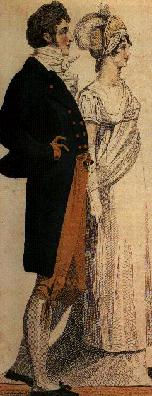
It’s all about The Men

Here are a few interesting posts about men’s clothing, two Regency related from the fairly new [since May 2010] multi-author blog, Historical Belles and Beaus, and the other on Victorian men’s fashions from the Victorian Magazine Blog.

Regency author Linda Banche has written two posts on “Gorgeous Men in Tight Breeches and Ruffled Shirts” – where she addresses the often frustrating-to-the-reader mistakes in the cover depictions  [those open shirts were really not the thing!] and the descriptions of the man’s dress [trousers, not pants]

           Gorgeous Men, Post #1   and   Gorgeous Men, Post #2

The Victorian Magazine blog, Victoriana, offers a collection of men’s various fashion options for their various activities in “Guys ‘Just Want to Have Fun'”: 


The Jane Austen Centre Online Magazine offers a number of articles and images on Regency men’s fashions:


And a number of men’s fashion plates at The Regency Fashion Page


and ALL those images of Men Dressing at the Costumer’s Manifesto and Jessamyn’s Regency Costume Companion


I could go on, and on.. if you search google for “Regency Men’s Fashions”, a mere 402,00 are retrieved – certainly a daunting task…  this just gives a small taste of what is out there – and see also the post at Historical Hussies, on “Pants Breeches and Pantaloons, Oh My!”

[Posted by Deb]


Book reviews · Regency England

Book Review ~ ‘Bath Tangle’ by Georgette Heyer

Here is the review of Georgette Heyer’s Bath Tangle that I wrote for the “Georgette Heyer Celebration” at Austenprose:

I first encountered Georgette Heyer’s Bath Tangle via audio and I was enchanted – the head-strong Hero and Heroine, not always likeable, at odds with each other from page one – so I was delighted to read the book when Laurel Ann asked me to do this review – another Heyer, another cast of characters, and an abundance of Regency settings to savor!

Serena Carlow, 25, a titian-haired beauty, strong-willed, headstrong, accomplished*, daring and tempestuous, certainly anything but “serene”, has suddenly lost her father, the Earl of Spenborough.  He leaves a twenty-two year old wife, no male heir with his estate passing to a cousin, and a will that provides for Serena’s fortune to be under the trusteeship of the Marquis of Rotherham.  Fanny, now the widowed Lady Spenborough, a young girl, barely out of the schoolroom when she was pledged to the 47 year-old Earl against her will, is well-named – Austen’s Fanny Price looms over this character.  Though of a shy, retiring disposition and propriety-bound, she and Serena, so very different, have forged a true friendship – they move together to the Dower House, leaving the cousin and wife, a la the John Dashwoods in Sense & Sensibility, to take over the Earl’s entire estate. Serena is left with an allowance, her fortune of 10,000 pounds a year to be passed to her only upon her marriage to a man approved by Rotherham …which of course sends Serena “up into the boughs.”

Major back story, as in Persuasion:  Serena and Rotherham were betrothed three years before, her father’s wish, but Serena crying-off shortly before the ceremony because “they did not suit”.  Rotherham is after all a harsh and arrogant fellow, with an “imperious and tyrannical disposition”, “high in the instep”, barely even handsome [but he has great hands! and those powerful shoulders!] – they do their “dagger-drawing” from page one and while they may not think they suit, we know quite differently, that they are meant for each other, everyone else paling in comparison…..[Shakespeare’s Taming of the Shrew comes to mind!]

Fanny and Serena decamp to Bath for a change of scene during their mourning period – and so enters Major Hector Kirkby, Serena’s “first and only true love” from six years before – and she, Hector’s “goddess”, his dream become real when they once again meet.  Hector is fine and handsome, but a tad frightened of Serena’s strong personality of “funning humours and openness of temper”. They set all the tongues of Bath wagging, embark on a secret engagement [due to mourning etiquette], Rotherham is consulted and approves, then announces his own engagement to the not-yet 18 year old Emily, and suddenly, Everyone Ends Up In Bath: Mothers in the marriage mart; Aunts critical of Serena’s behaviors; Rotherham’s family demanding attention and money; Hector’s dream; Serena feeling 19 again; the fortune-seeking Lalehams, pushing Emily into the arms of the Marquis; and Mrs. Floore, Emily’s grandmother, one very lively jump-off-the-page character, “of little height and astonishing girth”, vulgar and socially stigmatized, with an outrageous sense of fashion; and Rotherham, the jilted lover, who says of Serena “she would have been well-enough if she ever broke to bridle”, he is“blue-devilled” and angry, bordering on the cruel throughout most of the book…

Heyer gives us what we love her for: the witty dialogue; the fashions described; the list of cant terms [ramshackle, clodpole, “the dismals” feather-headed, ninny-hammer, on-dits, bird-witted, toad-eating, etc]; the Hero and Heroine throwing all the barbs known – abominable, wretch, odious, detestable, termagant, etc.]; and Bath in all its glory – the Libraries, Assemblies, name-dropping of real residents [Madame D’Arblay, Mrs. Piozzi, the scandalous Caroline Lamb and her Glenarvon];  the political arena of the time [Rotherham is in Parliament] – all the many details that make this visit to the Bath of Regency England so very real, so very engaging, and with that Heyeresque rollicking Romance, a courtship novel with its Many Tangles to help turn the pages – Delightful!

[*Note:  Jude Morgan’s An Accomplished Woman [St. Martin’s, 2009] literally duplicates this Heyer formula and does so quite well – I recommend it!]

[Posted by Deb]

Book reviews · Jane Austen · Regency England · Women Writers

Book Review ~ ‘The Quiet Gentleman’ at Austenprose

As mentioned in a previous post, Laurel Ann at Austenprose has been celebrating Georgette Heyer through the month of August, with various guest reviews of the novels and interviews with Heyer experts.  Laurel Ann had asked me to write a review of The Quiet Gentleman, which is posted today, and Bath Tangle which will be posted August 20th. 

Reading Georgette Heyer is a new experience for me, and the immersion has been quite enjoyable – I most like stumbling upon her Austen echoes, and they are there in her characters, her settings, her plots – Heyer greatly admired Austen amd read and re-read her through the years.  I don’t agree with those who think that Heyer is another Austen [here is a short article on the topic], but it is a lesson in influence to read Heyer’s romances [and her mysteries aren’t half-bad either!], and see where Austen touches her.

You can read the review of ‘The Quiet Gentleman’ here  at Austenprose – please visit and comment; I’ll post the full text here next week.

Austen Literary History & Criticism · Books · Jane Austen · News · Regency England · Schedule of Events · Social Life & Customs

A Jane Austen Weekend in Vermont!

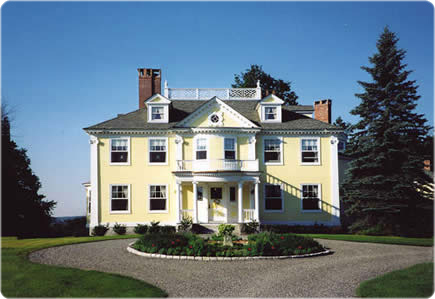
The Governor’s House in Hyde Park will be hosting another Jane Austen event this coming weekend August 13 -15, 2010  ~ topic is Sense and Sensibility.

 Jane Austen Weekend: Sense & Sensibility
The Governor’s House in Hyde Park
Friday to Sunday, August 13-15, 2010

http://www.OneHundredMain.com/jane_austen.html
802-888-6888, tollfree 866-800-6888 or info@OneHundredMain.com

 Reservations are required! 

A leisurely weekend of literary-inspired diversions has something for every Jane Austen devoteé. Slip quietly back into Regency England in a beautiful old mansion. Take afternoon tea. Listen to Mozart. Bring your needlework. Share your thoughts at a discussion of Sense & Sensibility and how the movies stand up to the book.  Attend the talk entitled ~ “Making Sense of Jane Austen’s World” * ~  Test your knowledge of Sense & Sensibility and the Regency period and possibly take home a prize. Take a carriage ride. For the gentleman there are riding and fly fishing as well as lots of more modern diversions if a whole weekend of Jane is not his cup of tea. Join every activity or simply indulge yourself quietly all weekend watching the movies. Dress in whichever century suits you. It’s not Bath, but it is Hyde Park and you’ll love Vermont circa 1800. 

  **************************

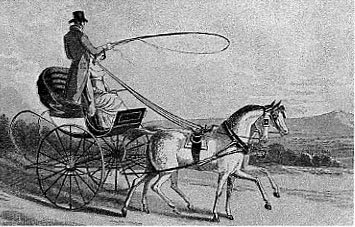
* “Making Sense of Jane Austen’s World” – Inn owner Suzanne Boden will be talking on the architecture, furnishings and other decorative arts of the Regency Period; Deb Barnum of JASNA-Vermont [yours truly] will be talking about travel in the late 18th and early 19th century – the horse and carriage era – and how Austen’s characters travelled in Sense & Sensibility – [and there is a lot of moving about in this book!]

*Or come for just an afternoon or evening and choose from these activities:

  • Informal Talk with Coffee and Dessert, Friday, 8:00 p.m., $14.00
  • Afternoon Tea, Saturday, 3:00 p.m., $20.00
  •  Book Discussion and Dinner, Saturday, 7:00 p.m., $35.00
  •  Jane Austen Quiz and Sunday Brunch, Sunday, 11:30 a.m., $15.00
  • All four activities: $75.00

The Governor’s House in Hyde Park
100 Main St
Hyde Park, VT 05655
http://www.OneHundredMain.com/jane_austen.html
802-888-6888, tollfree 866-800-6888 or info@OneHundredMain.com

**If you cannot make this weekend, make a note on your calendars of the  following dates as well:

series 3: Sense and Sensibility
Friday evening talk: Making Sense of the Regency World

Friday – Sunday, September 10 – 12, 2010
Friday – Sunday, January 7 – 9, 2011

******************************

and for your 2011 calendar:

series 4: Persuasion
Friday evening talk: Captain Wentworth’s Royal Navy
Friday – Sunday, January, 28 – 30, 2011
[other dates TBA]

Jane Austen · Regency England · Social Life & Customs

So What the Heck are ‘Holland Covers’, anyway??

One of my most favorite scenes in a movie is the opening of the 1995 Persuasion  and the slow-motion laying on of the “holland covers” to protect all the Kellynch furniture as the Elliots retrench to Bath.  One can read just about any book of historical fiction and see this term used to refer to furniture coverings:  “shrouded in holland covers” or some such reference [just google ”holland covers” and you will see what I mean – even Balzac used the term!]  It is such a common reference in today’s historical fiction writings, and one reads along, knowing what it means, but where does the term come from? and most important of all, did Jane Austen ever use the term? 

 I have a book titled Regency Furniture, by Clifford Musgrave [any relation to The Watson’s Tom?], and there is much on Henry Holland, and I recall when I first bought this book that I thought perhaps this is where the term originated – Holland designed furniture, so coverings for said furniture could be called ‘holland covers’ – no?  Holland was the architect appointed by the Prince Regent [then the Prince of Wales] to rebuild and refurbish Carlton House, the Prince’s London establishment since 1783.  Carlton House was subjected to an endless series of alterations to the building and the furnishings for the next forty years, all to end in demolition in 1827.  But Mr. Holland is a topic for another post [he was the pupil and assistant of the landscape architect ‘Capability’ Brown and married his daughter Bridget, designed the PR’s Marine Pavilion in Brighton, laid out parts of the development of the fashionable Knightsbridge and Chelsea areas of London [including Sloane Square where Austen’s brother Henry lived] – so he will make a most interesting topic in his own right…] – but indeed he has nothing to do with ‘holland covers’ ….  But it is this thought that got me to wonder at its meaning…

Now,  if you search “Holland covers” on the ever-reliable, all-knowing, all-seeing internet, barely anything comes up, and certainly not an image in sight –  to whit: 

*There is a link to a description of the above-mentioned Persuasion

At the begining, we see Anne Elliot (Sally Hawkins) going through the rooms of her home, Kellynch Hall, as harried servants are trying to pack up, and placing holland covers on the furniture. She is marking items on lists and trying to direct the servants.

*A link to an online Google book  from 1909, Mrs. Wilfrid Ward’s Great Possessions, with chapter 33 titled “Brown Holland Covers”  [the full text is here in the event you cannot resist the whole book…]

*And Edith Nesbit makes mention of them here in her The Enchanted Castle.  

*There is a short advertisement in an 1856 edition of Punch, that is quite funny: 

 A MAD WAG’S ADVERTISEMENT.

 We beg leave to call the attention of ProFessor Owen to the very contradictory animal referred to in an extraordinary advertisement, relating to a Bath chair, which we are told “may be drawn by either a man or pony, painted maroon, lined with drab cloth and holland covers.” We can understand the possibility of painting either a man or a pony “maroon,” though we shonld question the good taste or the utility of applying such a mode of external decoration to either animal ; but that either of t them should be “lined with drab cloth and holland covers ” is a phenomenon we at once pro! nounce incredible. It is true that a man’s stomach has a coat, and so we presume has a pony’s, which may account in some degree for the very whimsical notion of a man or pony ” lined with cloth ;” and we hâve a faint glimmering of an idea suggestive of ” holland covers ” arising out of the tendency of an inveterate gin drinker to cover his inside with Hollands. Nevertheless, the advertisement is so odd, that if the advertiser were to take it into his head to poison half his relations, make away with himself, or steal a pound of pork sausages, we 1 dare say that no intelligent British jury would find any difficulty in pronouncing him ” Not Guilty,” on the ground of insanity.

*And from a book on Textiles in America, describing the proper way to make slipcovers, where we are told that these covers are removed for company, but that Holland, though the most durable, looks cold and chintz is thus much preferred…

*And a 1919 article in The Independent on “Summer Clothes for the House”.

[This dates me terribly I’m afraid to say, but my grandmother and mother always covered every piece of upholstered furniture in the summer with beautifully made slipcovers, holland covers being their precursor – they also rolled up all the rugs and put down lighter summer carpets and changed all the curtains to summer sheers and changed all the bedlinens [well, I still do that] and washed down all the walls – yikes!]

Now as for Austen:  I find no mention in the novels; indeed, the only reference comes up in a short tale found in the RoP’s “Bits of Ivory” section called The Key:   

He looked around at the furniture which has not seen any use for over five years, it was draped with Holland covers to keep off the dust–even though Mrs. Reynolds, being a conscientious housekeeper, regularly cleaned and dusted the room. Darcy was unaware that she often thought what a pity it was that the Master’s suite was not being used.

I can find no references in the letters, and wonder about the Juvenilia, where one would think Austen would have her heroines fainting on sofas that might be so covered…

So for me, back to the books:  A Dictionary of Costume and Fashion by Mary Brooks Picken [Dover, 1999] says the following under “Holland”: 

Closely woven linen fabric originally made in Holland.  The first Hollands were made of this fabric [i.e. a form-fitting foundation made by big establishments for special customers and used as a size guide in cutting and draping to save fittings] – a linen or fine cotton in plain weave, sized and often glazed [p. 175];

and under “Linens”:  firm, course, plain-woven, linen, unbleached or partly bleached, glazed and unglazed; originally from Holland.  Used for aprons, furniture covers, window shades, dress-form covers, etc. [p. 213]

And in Inside the Victorian Home: A Portrait of Domestic life in Victorian England, by Judith Flanders [Norton, 2004]:  

As the second half of the century progressed, hygiene became the overriding concern.  Mrs. Panton, still distressed about bedroom carpets, remembered a carpet that had spent twenty years on the dining room floor, “covered in Holland in the summer,” and preserved from winter wear by the most appallingly frightful printed red and green ‘felt square’ I ever saw.” [with a note:  Holland was a hard-wearing linen fabric, usually left undyed.  It was much used in middle- and upper-class households to cover and protect delicate fabrics and furniture.”  [p.  43] 

[quoting Mrs. Jane Ellen Panton, 1848-1923, author of many books on home decorations and home economics, her From Kitchen to Garret, published in eleven editions in ten years!]

And now I see that searching ‘holland linen’ and ‘holland cloth’ is more productive: 

*Here being the whole history of Dutch linen at A Fabric Collector’s Diary

*And at ehow.com, a definition and a picture of plain old linen: 

Holland linen is a plain-woven linen fabric that is treated with oil and starch, making it opaque and hard for the sunlight to penetrate. This quality makes it well-suited for use in making window shades and lampshades.


*And even at British History Online, we find history of the import of holland linen:   

Holland and its neighbours were major producers of LINEN of all grades, the finest of which was usually designated simply as HOLLAND or HOLLAND CLOTH. It was much used for making the highest quality of NAPERY and BED LINEN above those made of DIAPER, HUCKABACK, FLAXEN CLOTH, HEMPEN CLOTH and TOW.

OED earliest date of use: 1617

Found described as PLAIN

[From: ‘Hobnail – Holliwortle’, Dictionary of Traded Goods and Commodities, 1550-1820 (2007)]

*And on this side of the pond at the MFA in Boston – their CAMEO site on materials: 

Material Name: holland cloth : 

Originally, the name for any fine, plain-weave, linen cloth manufactured in the Netherlands. Holland cloth now refers to a plain-weave cotton or linen fabric made opaque by fillers, sizing, and/or glazing. It is typically sized with starch, then glazed with a filled oil. Holland cloth is used for window shades, lamp shades, bookbinding, upholstery, labels, and gummed tapes.

 And so it goes – this search, much like my previous short post on the Steventon Rectory that started from a real estate ad and resulted in two posts and is still to be updated with new and amazing information – has just opened a huge can of worms – I just want to find an IMAGE of a piece of furniture in “holland covers” – if anyone has such, and there MUST be one out there somewhere, please email me the link – I will be forever grateful, and can thus bring this post to a close… and lacking holland covers, I am having this awful feeling of the need to vacuum and dust…

Books · Jane Austen · Regency England

Georgette Heyer at ‘Austenprose’!

Laurel Ann at Austenprose announces her latest month-long immersion ~ this time it’s all about Georgette Heyer!  The celebration starts August 1st, to include an interview with Deb Werksman of Sourcebooks Casablanca, thirty-four book reviews penned by various guest bloggers [including yours truly], fabulous giveaways, and invigorating chat on the Queen of Regency Romance.  If you haven’t picked up any of your Heyer books lately, now is the chance to revisit her; if you have never read a Heyer, this is a perfect time to start, as in right now – you are in for a treat!  Don’t risk being be a cloth-headed clodpole – join in the fun and participate!


 Further Reading: [see my previous post on Faro’s Daughter, my very first Heyer, and so a favorite]

Reference Sources, books:

  • Georgette Heyer’s Regency World, by Jennifer Kloester [2005, already out-of-print; newly published by Sourcebooks]
  • Georgette Heyer’s Regency England, by Teresa Chris [London, 1989] ~  impossible to find at an affordable price.
  • The Regency Companion,  by Sharon Laudermilk and Teresa L. Hamlin [Garland 1989] – ditto
  • The Private World of Georgette Heyer, by Jane Aiken Hodge [1983] ~ the biography, available from used bookshops.
  • Georgette Heyer: A Critical Retrospective, by Mary Fahnestock-Thomas [PrinnyWorld Press, 2001] ~ includes Heyer’s short published pieces, reveiws of her books, obituaries and responses, and critical articles and books – an indispensible resource.

 Further Reading: online

Austen Literary History & Criticism · Jane Austen · Regency England

Jane Austen, Humphry Repton & The Pierpont Morgan

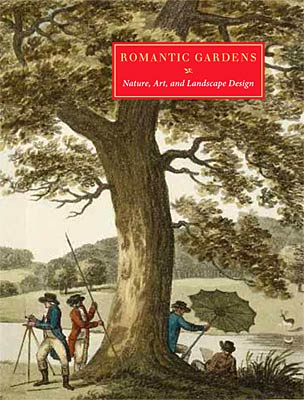
A post to merely to remind you that the exhibition at the Pierpont Morgan Library & Museum on Romantic Gardens: Nature, Art, and Landscape Design will be there only until August 29, 2010:

Scenic vistas, winding paths, bucolic meadows, and rustic retreats suitable for solitary contemplation are just a few of the alluring naturalistic features of gardens created in the Romantic spirit. Landscape designers of the Romantic era sought to express the inherent beauty of nature in opposition to the strictly symmetrical, formal gardens favored by aristocrats of the old regime.
The Romantics looked to nature as a liberating force, a source of sensual pleasure, moral instruction, religious insight, and artistic inspiration. Eloquent exponents of these ideals, they extolled the mystical powers of nature and argued for more sympathetic styles of garden design in books, manuscripts, and drawings, now regarded as core documents of the Romantic Movement. Their cult of inner beauty and their view of the outside world dominated European thought during the late eighteenth and early nineteenth centuries.
 [from the Morgan website; the Catalogue of the exhibition is available here

******************

Jane Austen, as her brother Henry Austen writes in his Biographical Notice [included in the Northanger Abbey and Persuasion edition of 1819]:

“was a warm and judicious admirer of landscape, both in nature and on canvass.  At a very early age she was enamoured of Gilpin on the Picturesque; and she seldom changed her opinions either on books or men.”  

 And so just how did Austen express her opinions on these matters?

From Northanger Abbey, ch. 14: 

Jane Odiwe's Beechen Cliff

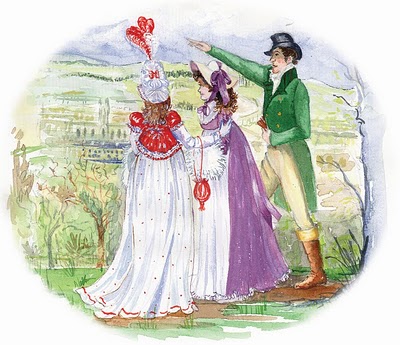
They were viewing the country with the eyes of persons accustomed to drawing, and decided on its capability of being formed into pictures, with all the eagerness of real taste. Here Catherine was quite lost. She knew nothing of drawing — nothing of taste… she confessed and lamented her want of knowledge, declared that she would give anything in the world to be able to draw; and a lecture on the picturesque immediately followed, in which his instructions were so clear that she soon began to see beauty in everything admired by him, and her attention was so earnest that he became perfectly satisfied of her having a great deal of natural taste. He talked of foregrounds, distances, and second distances — side–screens and perspectives — lights and shades; and Catherine was so hopeful a scholar that when they gained the top of Beechen Cliff, she voluntarily rejected the whole city of Bath as unworthy to make part of a landscape. Delighted with her progress, and fearful of wearying her with too much wisdom at once, Henry suffered the subject to decline, and by an easy transition from a piece of rocky fragment and the withered oak which he had placed near its summit, to oaks in general, to forests, the enclosure of them, waste lands, crown lands and government, he shortly found himself arrived at politics; and from politics, it was an easy step to silence….   

[The lovely watercolor of Henry, Miss Tilney and Catherine is from Jane Odiwe’s post on Beechen Cliff ]

********************

Edward Ferrars in Sense & Sensibility, ch. 18:

“You must not inquire too far, Marianne — remember, I have no knowledge in the picturesque, and I shall offend you by my ignorance and want of taste, if we come to particulars. I shall call hills steep, which ought to be bold! surfaces strange and uncouth, which ought to be irregular and rugged; and distant objects out of sight, which ought only to be indistinct through the soft medium of a hazy atmosphere. You must be satisfied with such admiration as I can honestly give. I call it a very fine country — the hills are steep, the woods seem full of fine timber, and the valley looks comfortable and snug — with rich meadows and several neat farm houses scattered here and there. It exactly answers my idea of a fine country, because it unites beauty with utility — and I dare say it is a picturesque one too, because you admire it; I can easily believe it to be full of rocks and promontories, grey moss and brush wood, but these are all lost on me. I know nothing of the picturesque.” …    I like a fine prospect, but not on picturesque principles. I do not like crooked, twisted, blasted trees. I admire them much more if they are tall, straight and flourishing. I do not like ruined, tattered cottages. I am not fond of nettles, or thistles, or heath blossoms. I have more pleasure in a snug farm-house than a watch-tower — and a troop of tidy, happy villagers please me better than the finest banditti in the world.”   

[I love this passage from Sense & Sensibility.  Edward is bantering with Marianne, and one sees here a relaxed and humorous Edward – he is comfortable with Marianne and so much more himself – he is more stilted and uncomfortable with Elinor because of the feelings he has for her – this passage has always given me hope of the real Edward when the obstacle of Lucy is removed from the equation – and thankfully she is!]…

************

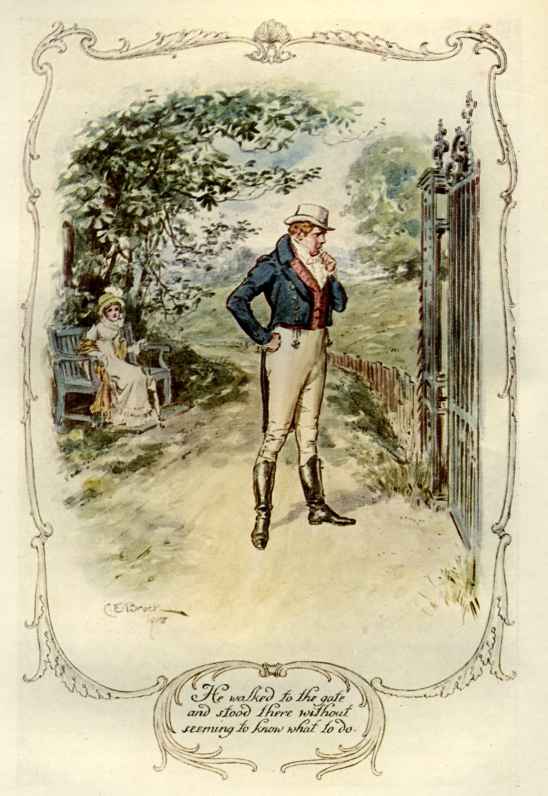
And let’s not leave out Mr. Rushworth and his efforts to “improve” Sotherton!  Mansfield Park, ch. 6: [image from Molland’s]

Mr. Rushworth at the gate at Sotherton

He [Mr. Rushworth] had been visiting a friend in the neighbouring county, and that friend having recently had his grounds laid out by an improver, Mr. Rushworth was returned with his head full of the subject, and very eager to be improving his own place in the same way; and though not saying much to the purpose, could talk of nothing else. The subject had been already handled in the drawing–room; it was revived in the dining–parlour…

 “I wish you could see Compton,” said he; “it is the most complete thing! I never saw a place so altered in my life. I told Smith I did not know where I was. The approach now, is one of the finest things in the country: you see the house in the most surprising manner. I declare, when I got back to Sotherton yesterday, it looked like a prison— quite a dismal old prison.”

“Oh, for shame!” cried Mrs. Norris. “A prison indeed? Sotherton Court is the noblest old place in the world.”

“It wants improvement, ma’am, beyond anything. I never saw a place that wanted so much improvement in my life; and it is so forlorn that I do not know what can be done with it…I must try to do something with it,” said Mr. Rushworth, “but I do not know what. I hope I shall have some good friend to help me.”

“Your best friend upon such an occasion,” said Miss Bertram calmly, “would be Mr. Repton, I imagine.”

“That is what I was thinking of. As he has done so well by Smith, I think I had better have him at once. His terms are five guineas a day.”  …

After a short interruption Mr. Rushworth began again. “Smith’s place is the admiration of all the country; and it was a mere nothing before Repton took it in hand. I think I shall have Repton.”

“Mr. Rushworth,” said Lady Bertram, “if I were you, I would have a very pretty shrubbery. One likes to get out into a shrubbery in fine weather.” …

… Mr. Rushworth, however, though not usually a great talker, had still more to say on the subject next his heart. “Smith has not much above a hundred acres altogether in his grounds, which is little enough, and makes it more surprising that the place can have been so improved. Now, at Sotherton we have a good seven hundred, without reckoning the water meadows; so that I think, if so much could be done at Compton, we need not despair. There have been two or three fine old trees cut down, that grew too near the house, and it opens the prospect amazingly, which makes me think that Repton, or anybody of that sort, would certainly have the avenue at Sotherton down: the avenue that leads from the west front to the top of the hill, you know,”

Fanny, who was sitting on the other side of Edmund, exactly opposite Miss Crawford, and who had been attentively listening, now looked at him, and said in a low voice—

“Cut down an avenue! What a pity! Does it not make you think of Cowper? ‘Ye fallen avenues, once more I mourn your fate unmerited.’”

He smiled as he answered, “I am afraid the avenue stands a bad chance, Fanny.”

************ 

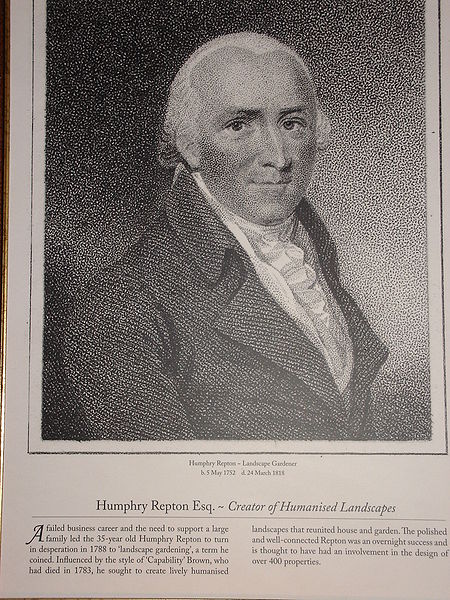
[Humphry Repton, from Wikipedia]

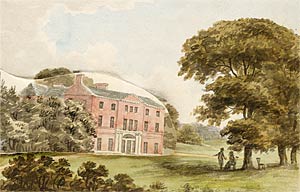
The exhibit at the Morgan includes two of Humphry Repton’s Red Books.  Repton [1752-1818] was the leading landscape architect of his day, as Mr. Rushworth so notes – his Red Books were the compilations of his observations in words and watercolors of his landscape plans for a client’s property, and included the use of overlays for a before-and-after scenario.  – The Morgan has made available an online page-by-page view of two of these books:  The Hatchlands and Ferney Hall. 

Hatchlands Red Book
Ferney Hall Red Book

and a view of Hatchlands Park today [Ferney Hall was replaced in 1856 with a Victorian mansion and has recently been restored]


[A short note here also on William Gilpin: please visit Austenonly where Julie has posted a recent article for the Austenprose P&P event on Gilpin and Austen that covers this subject quite nicely!]

Gilpin first introduced the term “picturesque 1782 in his Observations on the River Wye, and Several Parts of South Wales, etc. Relative Chiefly to Picturesque Beauty; made in the Summer of the Year 1770, a book that outlined for travelers in England a way to view the beauties of the country based on his rules of the picturesque.  Austen was very familiar with Gilpin’s writings – as seen above, both Henry Tilney and Edward Ferrars comment on and satirize his theories. And the trip taken by the Gardiners and Elizabeth in Pride & Prejudice closely follows a travelogue set forth by Gilpin, and so to Elizabeth relies on Gilpin to escape a walk with Mr. Darcy and the Bingley sisters:

But Elizabeth, who had not the least inclination to remain with them, laughingly answered, —

   “No, no; stay where you are. You are charmingly grouped, and appear to uncommon advantage. The picturesque would be spoilt by admitting a fourth. Good-bye.”  

[Pride & Prejudice, ch. 10]

*******************

Further Reading: [all Google Books sources are full-text]

 The two must-have books for your Austen Library on Jane Austen and the landscape:

Alistair Duckworth.  The Improvement of the Estate:  A Study Of Jane Austen’s Novels.  Baltimore:  Johns Hopkins U Press, 1971; reprinted in paperback, 1994  –  brilliant 

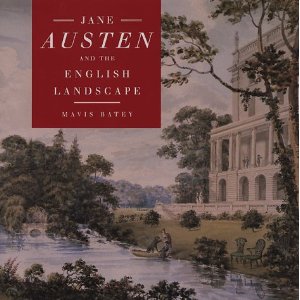
Mavis Batey.  Jane Austen and the English Landscape.  London:  Barn Elms, 1996   –  absolutely lovely!

Humphry Repton:

William Gilpin  and the “Picturesque”:

[Posted by Deb] 

Jane Austen · Regency England

Jane Austen ~ July 18, 1817

[I append here the post I wrote last year on this day – with a few updates as needed]

July 18, 1817.  Just a short commemoration on this sad day…

No one said it better than her sister Cassandra who wrote

have lost a treasure, such a Sister, such a friend as never can have been surpassed,- She was the sun of my life, the gilder of every pleasure, the soother of every sorrow, I had not a thought concealed from her, & it is as if I had lost a part of myself…”

(Letters, ed. by Deidre Le Faye [3rd ed, 1997], From Cassandra to Fanny Knight, 20 July 1817, p. 343; full text of this letter is at the Republic of Pemberley)

There has been much written on Austen’s lingering illness and death; see the article by Sir Zachary Cope published in the British Medical Journal of July 18, 1964, in which he first proposes that Austen suffered from Addison’s disease.  And see also Claire Tomalin’s biography Jane Austen: A life, “Appendix I, “A Note on Jane Austen’s Last Illness” where she suggests that Austen’s symptoms align more with a lymphoma such as Hodgkin’s disease.

The Gravesite: 

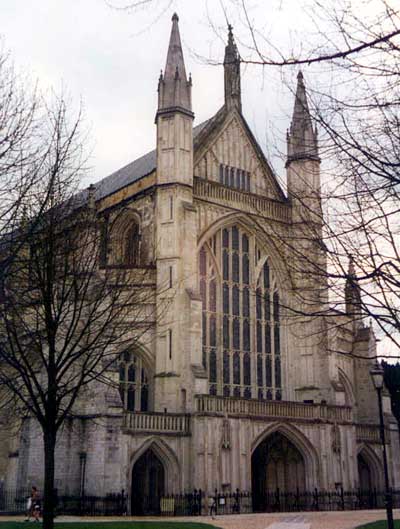
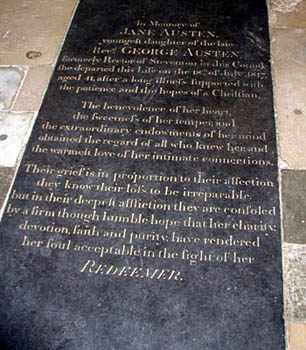
Austen is buried in Winchester Cathedral, where no mention is made of her writing life on her grave:

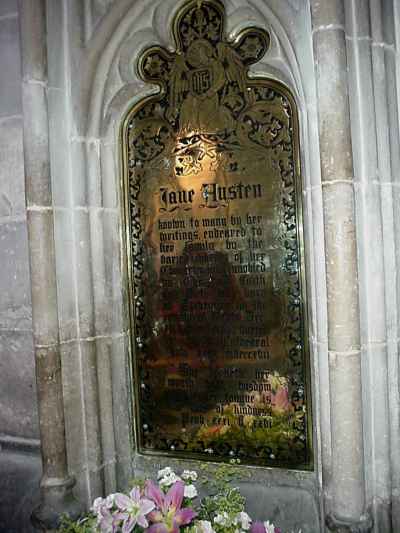
 It was not until after 1870 that a brass memorial tablet was placed by her nephew James Edward Austen-Leigh on the north wall of the nave, near her grave: it tells the visitor that

Jane Austen

[in part] Known to many by her writings, endeared to her
family by the varied charms of her characters
and ennobled by her Christian faith and piety
was born at Steventon in the County of Hants.
December 16 1775
and buried in the Cathedral
July 18 1817.
“She openeth her mouth with wisdom
and in her tongue is the law of kindness.”

The Obituaries:

David Gilson writes in his article “Obituaries” that there are eleven known published newspaper and periodical obituary notices of Jane Austen: here are a few of them:

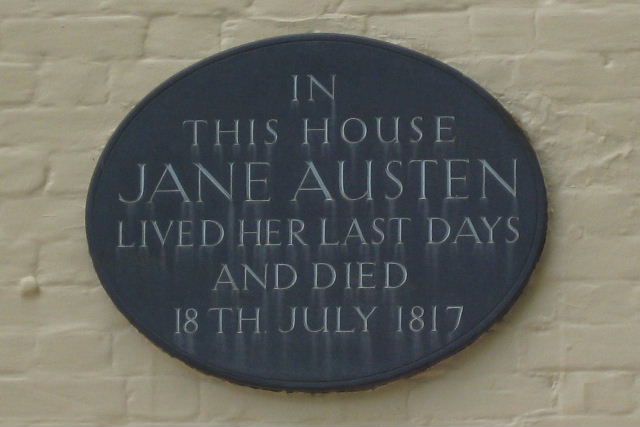
  1. Hampshire Chronicle and Courier (vol. 44, no. 2254, July 21, 1817, p.4):  “Winchester, Saturday, July 19th: Died yesterday, in College-street, Miss Jane Austen, youngest daughter of the late Rev. George Austen formerly Rector of Steventon, in this county.”
  2. Hampshire Telegraph and Sussex Chronicle (vol. 18, no. 928, p. 4)…”On Friday last died, Miss Austen, late of Chawton, in this County.”
  3. Courier (July 22, 1817, no. 7744, p. 4), makes the first published admission of Jane Austen’s authorship of the four novels then published: “On the 18th inst. at Winchester, Miss Jane Austen, youngest daughter of the late Rev. George Austen, Rector of Steventon, in Hampshire, and the Authoress of Emma, Mansfield Park, Pride and Prejudice, and Sense and Sensibility.  Her manners were most gentle; her affections ardent; her candor was not to be surpassed, and she lived and died as became a humble Christian.” [A manuscript copy of this notice in Cassandra Austen’s hand exists, as described by B.C. Southam]
  4. The Hampshire Telegraph and Sussex Chronicle published a second notice in its next issue (July 28, 1817, p. 4) to include Austen’s writings.

There are seven other notices extant, stating the same as the above in varying degrees.  The last notice to appear, in the New Monthly Magazine (vol. 8, no. 44, September 1, 1817, p. 173) wrongly gives her father’s name as “Jas” (for James), but describes her as “the ingenious authoress” of the four novels…

[from Gilson’s article “Obituaries”, THE JANE AUSTEN COMPANION [Macmillan 1986], p. 320-1]  

Links to other articles and sources:

Posted by Deb

Book reviews · Jane Austen · Regency England

Book Review ~ ‘Georgina’ by Clare Darcy


Georgina, by Clare Darcy. 
NY:  Walker and Company, 1971;
NY:  Dell, 1977 [and other reprints]

***********

The opening scene finds us in a house on Great Pulteney Street in Bath, where a rejected marriage proposal has all the Power family at odds – we quickly see that Miss Georgina Power is not going to be forced into an arranged marriage with one Mr. Smallwoods, despite his prospective title and comfortable fortune – and to avoid the inevitable resulting gossip, she is quickly shipped off to Ireland to visit her father’s cousin, the widowed Arabella Quinlevan, who has her own plans for Georgina to marry her son Brandon.  They reside at The Place of the Oaks, a fine estate, slowing running to seed since the death of the owner, Georgina’s uncle, whose daughter Nuala had recently died and the estate rather than going to the next rightful heir, our Heroine Georgina, fell to Nuala’s “odious adventurer” rake of a husband, Mr. Shannon. [phew! sufficiently confused?] 

Now Mr. Shannon has all the qualities of the Regency Rake – but he has no place in this closed Society, as he is the “natural son” of the Scottish Lord Cartan, and this, coupled with his arrogant air and lack of proper manners and a bad reputation fueled by the gossip-mongers, sets the entire cast of characters off to a rousingly bad start when Shannon returns to The Place unannounced, asserts his rights as owner and expects the Quinlevans to vacate immediately.  

He walked into the book-room with Brandon.  Her concept of arrogance was immediately strengthened by the sight of a tall figure, carried with distinction and set off to careless advantage in a well-fitting drab coat, buckskins, and top boots, and a harsh-featured face with cool grey eyes. [p. 33]

 Georgina labels him a “rag-mannered basket-scrambler” [p.36] and the sparks begin, that ever-present in a Regency Romance “crossing of swords”.  Shannon IS an arrogant, cold-hearted Hero. They both are hot-tempered, she “devilishly obstinate” and persistent, with a sharp and honest tongue, displaying all manner of improper behaviors for a Lady; he showing no emotion, no feelings, but seemingly a hardened rake who had married Nuala for her fortune. But Georgina begins to see that in his fine management of the estate, the respect the servants and tenants show him, his growing friendship with Brandon, his protectiveness of her [like all Regency Heroes, he does have a penchant for showing up exactly when the Heroine has landed in the suds!], that perhaps the neighborhood’s opinion is not so justified after all – her efforts to defend him bring on the tattle-boxes and the damage is done. 

True to this genre, the conventional escapades begin, Georgina in numerous scrapes, masquerades, marriage proposals in abundance – some for love, some for her fortune – balls, midnight runaways, the machinations of a few nasty and jealous Matrons, and like Heyer before her, Miss Darcy’s strong, silent, Hero does indeed have feelings – all conveyed in his Eyes:  “the glad incredulous welcome in his eyes” changing to “an indifferent sardonic coolness”, “the contempt she read in those eyes”, “a look of such bleak unhappiness in those grey eyes”, “those hard grey eyes, strangely softening”, etc…, otherwise we would be at a loss…!

Georgina was Clare Darcy’s first book, though I did not read it first, and I recollect that I thought it more serious than anything Heyer had certainly ever written – truth be told, it lacks that expected humor and even Darcy’s own hand at it improves in her later works.  I wonder perhaps that she was not sure where her Regency era talents would take her in this first book.  There is a certain gravity to the narrative -we have a dark Hero, a mystery in his past about his marriage and the death of his wife, rejected by a Society that seems more mean-spirited than funny, and a Heroine who fights the fortune-focused, behavior-constraining society she lives in, breaking almost every Rule in the Book to clarify what she instinctively knows about this man.  Thankfully, her young cohort Brandon, whose mother is set to have him betrothed to Georgina, is the salvation here – the bookish, Byron-like figure [with the required limp] is quite adorable and amusing, bringing much-needed levity. 

I liked this book very much – and while we again know from the first moment that the name of Mr. Shannon is introduced on the page, where it is all headed, it was great fun.  And one must like a book where the proposing Hero says: “Nay, I’m no hand at speeches!” – even Jane Austen’s Mr. Knightley would approve!

 4/5 full inkwells