Author Interviews · Collecting Jane Austen · Great Britain - History · Jane Austen · Jane Austen Circle · Regency England · Social Life & Customs

An Interview with Ron Dunning on his Jane Austen Genealogy ~ The New and Improved Jane Austen Family Tree!

UPDATE: April 25, 2023

Ron Dunning has asked me to update this blog post to reflect changes to the RootsWeb WorldConnect family trees, which were retired on 15 April 2023.  Ancestry.com, which owns the RootsWeb site, has promised to migrate the WorldConnect genealogical collection to a new free-access site later in the year. Ron asks that you be cognizant that none of his own research is available at present, though his website janeaustensfamily.co.uk, and its component, Akin to Jane, has not been affected.  The hope is that once the migration of the genealogical collection is complete, all will fall back into place – including many additions and corrections which had not been available on the old WorldConnect site. Please email Ron if you have questions.

*****************

Some of you may be familiar already with the Ancestry.com Jane Austen Family Tree created by Ronald Dunning.  It is quite the amazing compilation of ancestors and descendants of “Dear Aunt Jane” – a resource for Austen fans and scholars alike the world over.

So we are happy to announce that Mr. Dunning has continued with his Austen genealogical work and his new and improved website is to be “unveiled” at the Jane Austen Society meeting tomorrow (21 July 2012) at the Chawton House Library [an article about the history of the website will appear in the next JAS Report] – details of the meeting are here: http://www.janeaustensoci.freeuk.com/pages/AGM_details.htm.

The link to the new website is here: http://www.janeaustensfamily.co.uk/  where you will find new content, the complete transcribed text of the manuscript of Akin to Jane, and links to the original RootsWeb site noted above [see below for information on how best to access the data.]

Ron has been very kind to answer a few of my questions about how and why he took on this monumental research project, so hope you enjoy learning more about it – then you must take some time to search the database – it is great fun to poke around in when you might have an extra minute or two on any given day – you might even find that somewhere deep in the listings some of your very own relatives share a connection to Jane!

********************************

A hearty welcome to you Ron – with thanks for sharing with us the history of your website!

JAIV:  What prompted you to get involved with this Austen family research project to begin with? 

RD:  I grew up in Toronto, a city, and a wonderful city it is, whose civilised history only goes back for two centuries. All of my grandparents were English, but the thought of having interesting ancestors would have seemed too ridiculous to entertain. My paternal grandmother was the sort who wrote regularly to every English member of her and my grandfather’s families, and was always nattering about their current situations. In 1972, aged 25, I left Toronto to find work as a classical musician, and the idea of going to England, where there would be a ready-made family, was deeply appealing. Just before my departure, my grandmother told me that we had some sort of connection with the Austens, though she didn’t know what.

We must have been almost the only branch of descendants who’d lost sight of it!  I was pleased to be able to tell her, before she died, that Frank Austen [Jane’s brother] was her great-great-grandfather.  It was difficult to get much further back than that in the 1970s, so I gave up the search to get on with work, and to raise my own brace of descendants. In 1998 my wife bought a computer for our kids and, Luddite that I am, I grumbled and scowled in the background – till I thought that I might just see what it’s like.

I was soon drawn back to family history. The kids were old enough that they preferred neglect to parental attention, though we did meet occasionally to fight over whose turn it was to use the computer. At the time I thought that it would stand to reason that the Austen genealogy had been exhausted, so for the next five years I worked through the seven non-Austen great-grandparents’ lines, and just copied the charts in the backs of Jane Austen biographies.

When that was thoroughly exhausted I was addicted, and needed a fix! Simultaneously it became evident that the authors of the biographies had all copied the family charts from one another, and there was a lot further to go.  In particular they mainly recorded the male lines, dishonouring the women. I’ve found that not just Cassandra Leigh but George Austen too had eminent ancestors, which means that their records go back, potentially, to the beginning of recorded history.

Now I have a lifetime’s supply of fixes, and in retirement, a full time job.  Do not call it a hobby.  And don’t say that I’m obsessed. Oh well, all right, perhaps I am. This study means a lot more to me than just a growing collection of names – it makes me feel organically connected, not just to the Austen family (and I don’t feel at all proprietorial about Jane) but to the whole of English history.

JAIV: Tell us something about Joan Corder and her manuscript, Akin to Jane – how and when and where did you first come upon it – what a find! – and why did she not publish her research? 

RD:  Joan Corder was born and lived through her life in the English county of Suffolk. She served as a young woman, during World War 2, in intelligence as a plotter, then moved back home to look after her widowed mother. She didn’t marry. Over the course of her life she became a distinguished herald and genealogist; Akin to Jane was her first big project.

It was to her enduring disappointment that she couldn’t interest a publisher – so only two copies of the manuscript were made. One was presented to the Jane Austen Society and can be seen at the Jane Austen’s House Museum at Chawton, where it has been, presumably, consulted by most if not all of Jane Austen’s later biographers.

With use, the manuscript has become increasingly fragile; people still visit the Museum to inspect it. My Austen cousin Patrick Stokes scanned the work to help preserve it for posterity, and it’s his scans that are displayed on the website. The museum curator is pleased that she can now refer interested parties to the web, and retire the original.

[Ron says on the website: “I would like to acknowledge and thank my Austen cousin, Patrick Stokes, who first brought the manuscript of Akin to Jane to my attention, and gave me a copy.”]

Joan Corder


JAIV:  What, of all the discoveries in your research, surprised you the most?

RD:  So many discoveries! They constantly amaze, but no longer surprise.  I’ve been making a list, and intend to write articles about them. Here is a sample and though many of them seem improbable, they are all true.

Direct Ancestors

1.  William IX, Duke of Aquitaine.  William was a leader of the 1101 Crusade.  He is best known today as the earliest troubadour – a vernacular lyric poet in the Occitan language – whose work has survived.  Grandfather of Eleanor of Aquitaine, and Jane Austen’s 19th-great-grandfather.
2.  Owain Glyndwr, Prince of Wales. Shakespeare’s Owen Glendower. Jane’s 13th-great-grandfather.
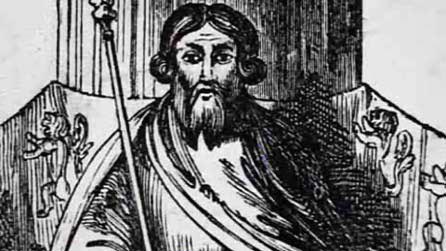
Owain Glyndwr – the BBC

3. John King, Bishop of London, from 1611 (the year of the King James Bible) to 1621. John King ordained John Donne. Jane’s  4th-great-grandfather.

John King, Bishop of London (1611-1621)

4.  Faith Coghill, the wife of Sir Christopher Wren. The  1st cousin once removed of George Austen.

5. Lizzie Throckmorton, the wife of Sir Walter Raleigh. A distant cousin of Cassandra Leigh.

Elizabeth Throckmorton

[image from Peerage.com]

6.  Katherine Leigh, the wife of Robert Catesby, the Gunpowder plotter, another distant cousin.

7.  Both of Jane’s parents were descended from royalty. Cassandra was descended from John of Gaunt, the son of Edward III, so every previous English king, back to William the Conqueror, and some beyond, was her ancestor.  For George we have to go back two generations further, to Edward I.

8.  Some Scottish royalty – the real-life Duncan I of Scotland who was either murdered by his cousin, the real-life Macbeth, or killed in battle against him.  Macbeth, as we know, succeeded him as King.  Duncan was Jane’s 21st-great-grandfather.

9.  By the way, we all know from Jane’s juvenilia that she “preferred” Mary Queen of Scots to Queen Elizabeth. Well – not only was she related to both, but in Jane Austen’s Sailor Brothers she is quoted favourably comparing her brother Frank with Queen Elizabeth.
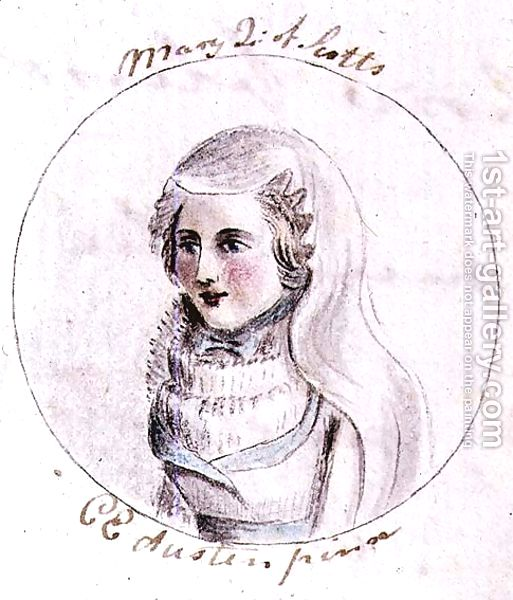
Cassandra Austen’s Mary Queen of Scots – The History of England


JAIV:  This is all wonderful! 
But I must ask, any real gossip – things hidden for generations?

RD:  Ooh – I’d be banished from the family if I revealed any of those!

JAIV: Oh, but the story of Elizabeth and Herbert is quite an interesting one! All hidden from the family and worthy of a Victorian novel! –  or at least akin to the writers of Victorian novels, as the lives of Charles Dickens and Wilkie Collins can attest! [see below for the link!]

JAIV:  Where do you go from here? 

RD:  I began the web project thinking that I would be producing a revision of Akin to Jane , but it eventually became obvious that the plan was unworkable. I want the reader to be drawn to my research, and not to think that Joan Corder’s work was the end of it. She managed to record a little over 300 of George and Cassandra Austen’s descendants, and gave ancestors no attention. My genealogical database contains more than 1200 descendants – that is, another 900 – and another ten thousand people, who include ancestors, collateral families, and families of social connections. The address of that, by the way, is http://wc.rootsweb.ancestry.com/~janeausten.

There is a link beneath each individual in Akin to Jane to that database, but in the long run I plan to organise things better. I’ll spend next winter learning the html to create a proper design (you won’t know it, but the current one is improper), and intend to do wondrous things with a sidebar. That will take care of technicalities. I have only just begun thinking beyond the current content, and have decided that I will add more original family history source material. I believe that one can jinx plans by talking about them too soon, so I’ll do that when I know that the material can be used.

JAIV:  Is there a book in the works?

RD: I’m sorry. No book. Articles, yes. Though I’ve really enjoyed building the Jane Austen’s Family website, it has absorbed an immense amount of time – time taken away from research, my first love.

 ****************************************************** 

Thank you Ron for joining us here today! [well, really you are at the JAS meeting at the Chawton House Library, and I am here in Vermont, but we can pretend, can’t we?] – it has been delightful getting to know you via emails! and I very much appreciate you sharing all this with us. What a gift of research you have given the Jane Austen world…

Now Dear Readers, it is time for you to journey through these ancestry files, both those of Joan Corder’s Akin to Jane manuscript, now transcribed for all to see on the website, as well as the expanded genealogical research at the Ancestry.com site that Ron has lovingly put together over these past how many years?!   Ron makes it clear that this is still a work in progress [isn’t everything?] and he will continue to make changes to the set-up and continuously add content.  But it is best to just dive in and see all that is there – [as an aside, so please forgive the intrusion, I must say that I put in several of my family names (both my parents were born in England, so I knew there was a chance of some connection somewhere), and find that the mother of Sir Christopher Wren has my maiden name, and his wife, mentioned above [Faith Coghill] was a direct cousin to George Austen! – now I have some serious sleuthing to do to find the exact connection – but I have been quite annoying to friends and family these past few days since my discovery – and not sure in any given minute whether to sit down and write a Novel, or get out my drafting table and design a Cathedral – this genealogy stuff can be quite daunting!]

So back to the matter at hand – let’s head into the Austen genealogy: to begin, go first to the main page: where you will see these links:

1. Akin to Jane – Joan Corder’s original and transcribed manuscript – click on this and you will find these links:
Akin to Jane title page
  • Jane Austen’s Family– Index of Names, and Lists: Corder’s notes on the Austen family, indexed by Austen family members, all surnames of the extended family – you will find links to:

1.  Jane’s family and their descendants: George and Cassandra Austen; James Austen; George Austen; Edward Austen, later Knight; Henry Thomas Austen; Cassandra Elizabeth Austen; Francis William Austen; Jane Austen; and Charles John Austen

2.  Index of people by surname: Austen Family; Austen-Leigh; Bradford, Hill and Hubback; Knatchbull; Knight; Lefroy and Purvis; and Rice

  • Highlights page – oh! much here and much more to be added:

“There is good reason for the general reader to delve into this manuscript. One of Joan Corder’s informants, Miss Marcia Rice, who was 84 in 1954 when the work was written, was the granddaughter of Edward Knight’s daughter Elizabeth, and her husband Edward Royd Rice. Miss Rice wrote extensive memoirs of her family, which Joan Corder copied. Her recollections of her distant childhood were refracted through the most rosy of tinted spectacles; few could read those for her grandmother without needing the discreet use of a tissue. Here is a direct link to Elizabeth.

Please don’t stop with Elizabeth – Miss Rice didn’t. She left a wonderful record immortalising her entire Rice family, from aunts who could be quirky or intellectual, to uncles who could be courageous or reckless. For many of them there are links in the text to portraits. Be sure not to neglect reading Miss Rice’s personal memories, on page 115; and those following, on her great-aunt Marianne Knight.” –

  • Heraldry – Eleven Coats of Arms: these are worthy of a website all their own!
Austen Coat-of-Arms
  • Joan Corder – author of Akin to Jane: information on the author of the original family tree.
  • Author’s and Editor’s Notes: notes from both Corder and Dunning with explanations on how to use the Akin to Jane database and links to Dunning’s Roots Web database.
  • Contact Me – Ronald Dunning: he would love to hear from you!

Ron Dunning

2.  Recent Research – Ron’s explanation of his research that continues that of what is in Akin to Jane at the Jane Austen Family Tree website at RootsWeb:
http://wc.rootsweb.ancestry.com/cgi-bin/igm.cgi?db=janeausten

3.   Articles – there are three articles now, more to be added:

  • “An Unconventional Love Match”
  • “The Last Welsh Prince of Wales – Jane Austen’s Welsh Ancestry”
  • “Latitude and Longitude”

Be sure to read all the extra links – these often explain the contents and how the database works; and do not miss all the illustrations that appear throughout the website:

http://www.janeaustensfamily.co.uk/akin-to-jane/text/illustrations-and-portraits.html
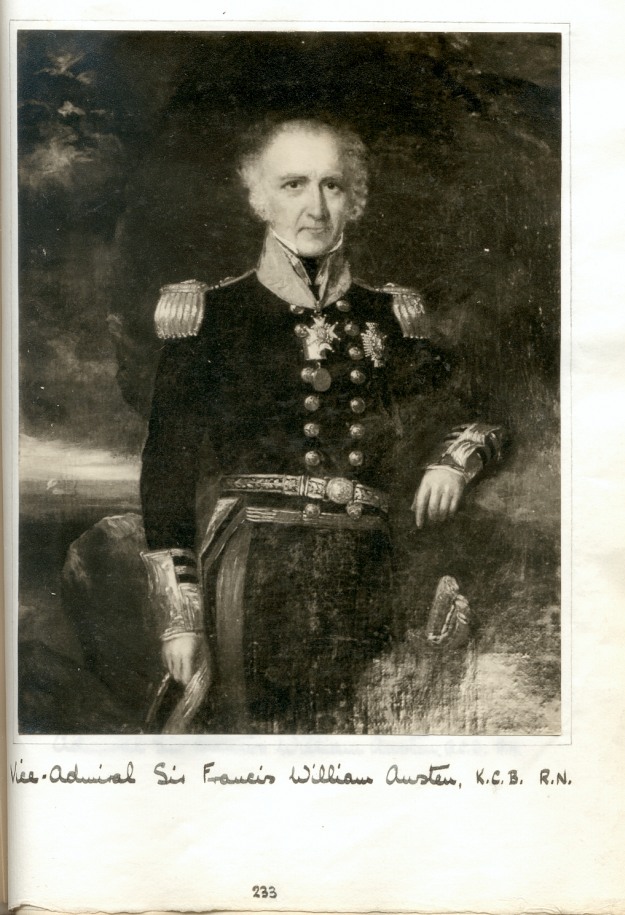
Vice Admiral Francis William Austen

Now the fun part: you really do need to explore – but I shall give you this start – the wonderful story noted on the “Highlights Page” above of Elizabeth Austen [later Knight], daughter of Jane Austen’s brother Edward, from her grand-daughter Marcia Alice Rice, as written for Joan Corder in 1953:

http://www.janeaustensfamily.co.uk/akin-to-jane/text/edward/051a.html
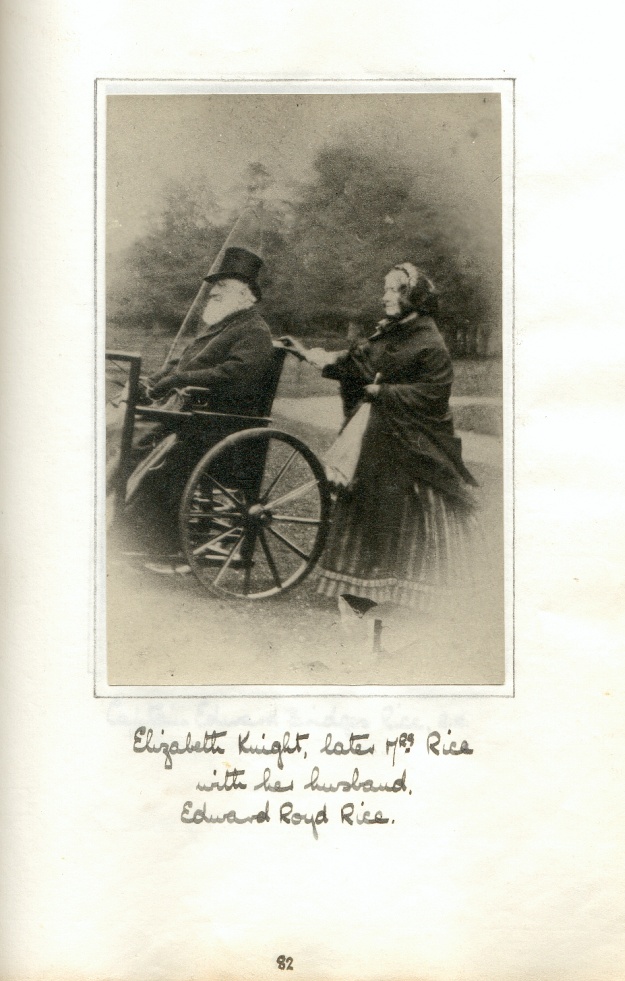
 Image of Elizabeth Austen-Knight Rice and her husband Edward Royd Rice

and then this quite romantic tale that I mentioned above of another Elizabeth and her husband Herbert: Herbert was the last child of Fanny Catherine Austen Knight Knatchbull (Jane Austen’s favorite niece – quite the mouthful! – and later on they added Hugessen to the name!) –  here we have a tale of a secret marriage, he and his wife Elizabeth living under an assumed name, Herbert never telling his mother, never telling his colleagues in Parliament, having many children – all right out of a Victorian novel! : you can find it here on the ancestry.com website:

http://wc.rootsweb.ancestry.com/cgi-bin/igm.cgi?op=GET&db=janeausten&id=I3046

and you can read Ron’s take on the story and his research here:

http://www.janeaustensfamily.co.uk/articles/unconventional-love-match.html

So just dig around – click on any link of interest – there are treasures to be discovered lurking behind those links! – whatever would Jane Austen make of all this do you think? – would she be absolutely appalled to discover she was related to Queen Elizabeth?? I now wonder after all if even I am related to Queen Elizabeth … and maybe you are too!

If you have any questions for Ron, please leave a comment here – he is happy to respond to any queries or suggestions…
c2012, Jane Austen in Vermont
Fashion & Costume · Great Britain - History · Jane Austen · Jane Austen Popular Culture · Jane Austen Societies · JASNA · Regency England · Social Life & Customs

This Weekend – The 5th Jane Austen Festival in Louisville, Kentucky!

Well, another year and yet again I am not attending The Annual Jane Austen Festival in Louisville, Kentucky that begins tomorrow; so I thought I would share the schedule so you all can be as depressed as I over what we shall be missing… you can watch this video to get into the spirit of things:


 The 5th  ANNUAL JANE AUSTEN FESTIVAL

JULY 21 & 22, 2012-10 a.m. – 4:30 p.m. each day

Historic Locust Grove-561 Blankenbaker Lane, Louisville, KY 40207

Sponsored by: Jane Austen Society of North America, Greater Louisville

$10 admission each day

For more detailed information, please visit http://www.jasnalouisville.com/

or www.locustgrove.org

Locust Grove, a circa 1790 Georgian home and farm is just
six miles from downtown Louisville, KY.

Each day of the festival you can:

  •  Enjoy a Four-Course Afternoon Tea (several sittings each day),
  • Shop in the Regency Emporium inside and in the Shoppes of Meryton outside
    (fabric, patterns, bonnets, pre-made dresses, chemisettes, men’s waistcoats, trousers &
    tail coats, tea sets, tea, jewelry, antiquarian books, shawls, silhouette cuttings,
    miniatures painted & lots more!)
  • See a Regency Style Show,
  • Watch a bobbin lace making demonstration inside the historic home and
  • See Regency fashions on mannequins in each room of the second floor of the house.
  • The last tea of the day on Sunday is reserved as a special Children’s Tea with a menu to appeal to children.
    Perks include goodies such as a cup and saucer to take home.

Outside, under the tent hear interesting talks such as

* A Dangerous Indulgence:
Jane
Austen’s Illness and Her Doctors – this reviews possible causes of Jane Austen’s death,
her letters, the doctors that cared for her, and how updates in genetic mapping may
help us determine what caused her death. Also

*Austen-itis:
Sickness and Health in the Novels of Jane Austen –
reviews characters in the novels that suffer from illness (real and imagined).

*A one-woman theatrical performance about Fanny Kemble called,
Shame the Devil : An Audience with Fanny Kemble
will be performed under the Big Top Tent. Fanny Kemble
was a member of the famous English Kemble-Siddons acting dynasty
who married an American and moved to the American South.
She became active in the early anti-slavery movement.

*New this year, will be the Earl of Sandwich Tea Shop located near the Shoppes of
Meryton and the Big Top Tent with simple libations such as –
sandwiches, scones, cookies and drinks.

Meanwhile out on the Village Green you can expect to see:

*Side-Saddle Demonstration

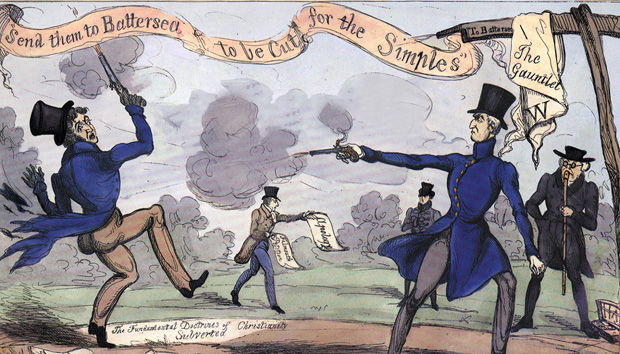
*A Duel Between Gentlemen

*Tutorial on Fencing

*A Bare Knuckle Boxing Demonstration

Roving musician Jack Salt will entertain as will
Commonstock Entertainment with
shadow stories and their Potato Wagon of Wonders!

Workshops will involve learning about Tea
(Tea, Anyway you Steep it! and Play with your Leaves),
offered by Bingley’s Teas,

and How to Paint a Fan taught by Jenni Miller.

The Grand Ball will take place on Saturday evening at Spalding University in downtown
Louisville. The ball room is reminiscent of a Georgian Assembly Room. A practice
session will be held in the afternoon.

Admission is $10 each day which admits you to the Emporium, Shoppes, most
everything under the Big Top Tent and tours of the 1790 Georgian home (usually $8).

The Afternoon Tea is $20 per person, the workshops are $25 each, the theatrical
performance is $10 and the Grand Ball is $20 per person.

Advance reservations are highly recommended and begin on-line June 1st at

http://www.jasnalouisville.com

For those traveling from out-of-town, please contact Regional Coordinator Bonny Wise
 for a list of recommended B&Bs and hotels.

Answers to frequently asked questions: You do not have to be a member of the Jane
Austen Society of North America to attend the festival. Regency attire is not required,

but is admired!

2012 Festival T-shirts are available – shirt_order_form.pdf

Thank you for your interest and we look forward to seeing you!

[image from Princeton Tiger Magazine,
wherein you will find an essay on “Modern Applications of Dueling”]]

[Text from Bonnie Wise, JASNA-Louisville Regional Coordinator]

c2012

Jane Austen · Regency England · Social Life & Customs

In Memory of Jane Austen ~ July 18, 1817

[I append here the post I wrote in 2010 on this day]

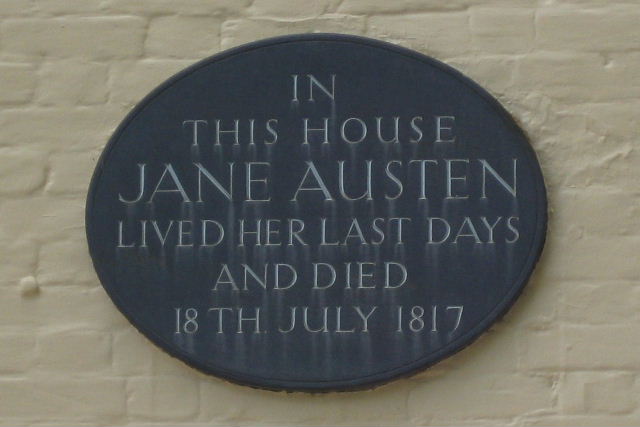
July 18, 1817.  Just a short commemoration on this sad day…

No one said it better than her sister Cassandra who wrote

have lost a treasure, such a Sister, such a friend as never can have been surpassed,- She was the sun of my life, the gilder of every pleasure, the soother of every sorrow, I had not a thought concealed from her, & it is as if I had lost a part of myself…”

(Letters, ed. by Deidre Le Faye [3rd ed, 1997], From Cassandra to Fanny Knight, 20 July 1817, p. 343; full text of this letter is at the Republic of Pemberley)

There has been much written on Austen’s lingering illness and death; see the article by Sir Zachary Cope published in the British Medical Journal of July 18, 1964, in which he first proposes that Austen suffered from Addison’s disease.  And see also Claire Tomalin’s biography Jane Austen: A life, “Appendix I, “A Note on Jane Austen’s Last Illness” where she suggests that Austen’s symptoms align more with a lymphoma such as Hodgkin’s disease.

The Gravesite:

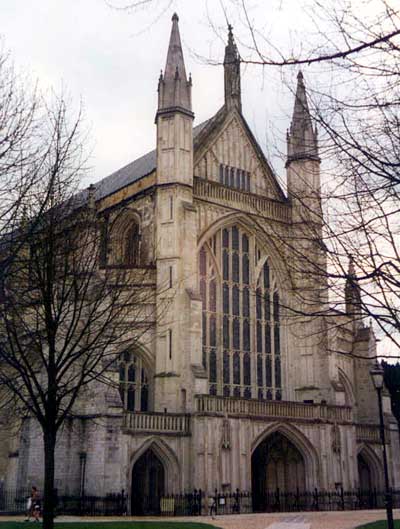
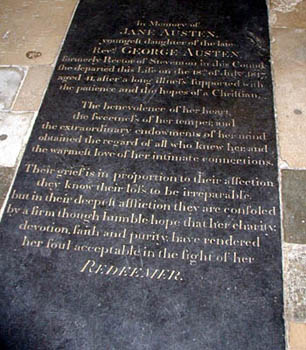
Austen is buried in Winchester Cathedral

….where no mention is made of her writing life on her grave:

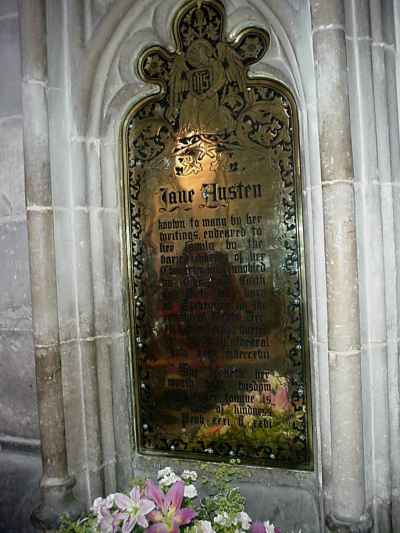
It was not until after 1870 that a brass memorial tablet was placed by her nephew James Edward Austen-Leigh on the north wall of the nave, near her grave:

It tells the visitor that:

Jane Austen

[in part] Known to many by her writings,
endeared to her family
by the varied charms of her characters
and ennobled by her Christian faith and piety
was born at Steventon in the County of Hants.
December 16 1775
and buried in the Cathedral
July 18 1817.
“She openeth her mouth with wisdom
and in her tongue is the law of kindness.”

The Obituaries:

David Gilson writes in his article “Obituaries” that there are eleven known published newspaper and periodical obituary notices of Jane Austen: here are a few of them:

  1. Hampshire Chronicle and Courier (vol. 44, no. 2254, July 21, 1817, p.4):  “Winchester, Saturday, July 19th: Died yesterday, in College-street, Miss Jane Austen, youngest daughter of the late Rev. George Austen formerly Rector of Steventon, in this county.”
  2. Hampshire Telegraph and Sussex Chronicle (vol. 18, no. 928, p. 4)…”On Friday last died, Miss Austen, late of Chawton, in this County.”
  3. Courier (July 22, 1817, no. 7744, p. 4), makes the first published admission of Jane Austen’s authorship of the four novels then published: “On the 18th inst. at Winchester, Miss Jane Austen, youngest daughter of the late Rev. George Austen, Rector of Steventon, in Hampshire, and the Authoress of Emma, Mansfield Park, Pride and Prejudice, and Sense and Sensibility.  Her manners were most gentle; her affections ardent; her candor was not to be surpassed, and she lived and died as became a humble Christian.” [A manuscript copy of this notice in Cassandra Austen’s hand exists, as described by B.C. Southam]
  4. The Hampshire Telegraph and Sussex Chronicle published a second notice in its next issue (July 28, 1817, p. 4) to include Austen’s writings.

There are seven other notices extant, stating the same as the above in varying degrees.  The last notice to appear, in the New Monthly Magazine (vol. 8, no. 44, September 1, 1817, p. 173) wrongly gives her father’s name as “Jas” (for James), but describes her as “the ingenious authoress” of the four novels…

[from Gilson’s article “Obituaries”, THE JANE AUSTEN COMPANION [Macmillan 1986], p. 320-1]

Links to other articles and sources:

Copyright @2011 by Deb Barnum, of Jane Austen in Vermont
Books · Jane Austen · Literature · Museum Exhibitions · News · Social Life & Customs · Women Writers

In My Mailbox! ~ The Female Spectator Spring 2012

The Female Spectator, (Vol. 16, No. 2, Spring 2012), the newsletter of the Chawton House Library, showed up last week in my mailbox – this 12 page newsletter always offers something new and exciting to be discovered and shared!: 

1. “Chawton Chronicles: A Letter from the CEO” – Stephen Lawrence talks about what has been accomplished at the Library since its inception in 2003, especially the academic initiatives and activities and the Visiting Fellowship Programme.  And he writes of the upcoming Spring Gala of the JASNA-Greater Chicago Region where Sandy Lerner, Elizabeth Garvie, Lindsay Ashford, and Stephen will all be in attendance for the “Chawton Comes to Chicago” event [which took place on May 5 – visit the website for a photo gallery of the event – accessible to members only I’m sorry to say!]

2. A lovely tribute to Vera Quin, author of In Paris with Jane Austen (2005) and Jane Austen in London (2008), by Gillian Dow – you can read my blog post on Ms. Quin here. 

3.  “Talking Portraits at CHL” – by Sarah Parry – about the project to bring to life with actors in full costume the various portraits housed in the Library: the portraits of Mary Robinson, Elizabeth Hartley, and Catherine (Kitty) Clive were the portraits chosen for this first effort. 

[Image of  Catherine “Kitty” Clive from CHL at the BBC Collection]

4. “Curious Consumption: Cookery Books at CHL” – by Lindsey Phillips. An essay on her research into the exchange of culinary information and recipes between Britain and the West Indies; included is a recipe for “pepper pot” from Maria Eliza Ketelby Rundell’s American Domestic Cookery (ed. of 1823), which you can find here at Google Books. 

5. “The Day the Descendants Came to Tea: Revelations and Connections from a Chawton House Fellowship” – by Katharine Kittredge, on the author’s study of Melesina Trench (1768 – 1827), an Irish writer, poet and diarist, and Kittredge’s connection with her relatives after her research was published in Aphra Behn Online. [her article in ABO can be found here.]  And click here for Kittredge’s biography of Trench on the CHL website.

Melesina Trench – wikipedia

6.  “The Language of Women’s Fiction, 1750-1830” – a conference report by Christina Davidson – one hopes the papers discussed will be published at some point…?

7. “‘Not in All Things Perfect’: The North Welsh Gentry in Fiction and History” –  Mary Chadwick shares her research on a collection of English-language manuscript letters, poems, etc. written by members of a North Welsh gentry community and collected by one family, the Griffiths of Garn, and how this compares to the writing of the various novelists who set their tales in Wales (including Jane Austen in her Juvenilia!), in particular Elizabeth Hervey’s The History of Ned Evans (1796) [and recently re- published in the CHL / Pickering & Chatto series.

 ******************

And reasons to be at the CHL, and a continuing source of depression for those of us who cannot! : 

Lectures:

June 7 [today!]: Dr Laura Engel on “Much Ado About Muffs: Actresses, Accessories, and Austen”

June 20. Professor Elizabeth Kowaleski Wallace on “‘Penance and Mortification for Ever’: Jane Austen and Catholicism.”

June 25. Evening Talk and Book Launch: Dr. Katie Halsey “‘A Pair of Fine Eyes’: Sight and Insight in Jane Austen’s Novels.”

When Mr. Darcy meditates on the pleasure bestowed by “a pair of fine eyes” in Pride and Prejudice, he does so because eyes are so very expressive. In this talk, Dr Katie Halsey explores the relationship between the physical eye and the eyes of the mind in Austen’s novels.

This talk is part of Alton’s Jane Austen Regency Week, and the launch of Katie Halsey’s new book: Jane Austen and her Readers, 1786 – 1945 [and soon to be added to my bedside table…]

 Exhibition:

“Jane Austen’s Bookshop: An Exhibition” 18 June – 6 July, 2012

This exhibition explores how readers and writers in Winchester shared printed material (books, playbills, engravings &c). Men and women, young and old, gentry and middle classes, rich and poor, Protestant and Catholic – all participated. The Austen family purchased literature from the bookshop of John Burdon (today still a bookshop), while scholars at Winchester College published their works in their own city. The newly founded hospital produced annual reports, and local newspapers such as the Hampshire Chronicle promoted all kinds of publications in advertisements and reviews.

Come to Chawton House Library to learn more about book production and circulation. Find out what kind of material was published in Hampshire in the eighteenth century, and just what the Austen family might have read.

You can receive The Female Spectator from CHL by becoming a member / friend – information is here: I heartily recommend it!

@2012 Jane Austen inVermont
Jane Austen · News · Social Life & Customs

Jacqueline Schwab in Concert ~ ‘Across the Lake’ English Country Dance Weekend

A Concert open to all
at the Across the Lake English Country Dance Weekend:


Ken Burns’ Pianist Jacqueline Schwab in Concert 

Elley-Long Music Center
223 Ethan Allen Avenue, Colchester
Saturday, June 9, 2012
Daytime — 11:15am to 12:30pm
$10. / person 

Enjoy a concert by pianist Jacqueline Schwab, known for her music on the soundtracks of Ken Burns’ award-winning documentaries, like “Civil War” and “Baseball”, and for her work with the popular English country dance band, Bare Necessities. Jacqueline’s concert will feature vintage American and Celtic dance music. To learn more about her, see her website.

Here’s what Ken Burns says: Jacqueline Schwab brings more feeling and intensity to music than anyone I know. Her playing is insistent, physical, heartfelt and … unusually moving.

*********************

@2012 Jane Austen in Vermont
Fashion & Costume · Jane Austen · Regency England · Social Life & Customs

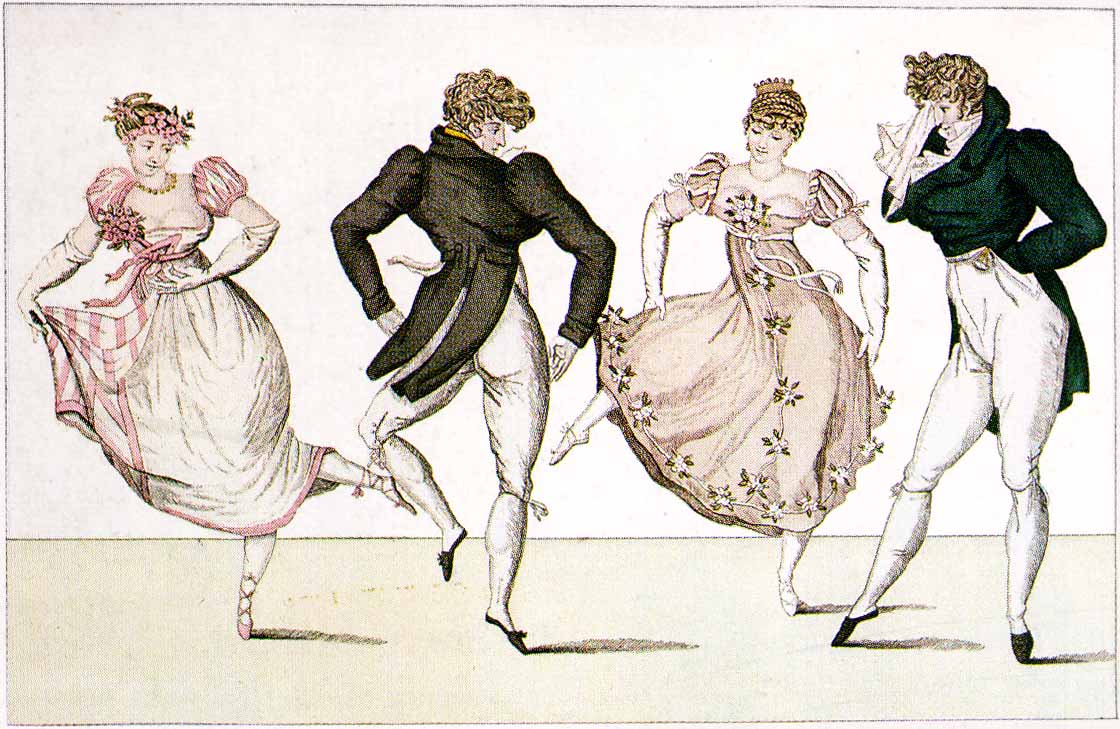
Dance Like Jane Austen! ~ With the Burlington Country Dancers ~ June 8 – 10, 2012

The annual Across the Lake 2012 event put on by the Burlington English Country Dancers is already sold out this weekend for Dancers – but you are welcome and encouraged to join in the festivities as a Spectator, certainly more fun for those with two left feet or perhaps too shy to display an ankle to the masses! So here are the details:

Spectators are welcome to the dance sessions at the Across the Lake English Country Dance Weekend, held at the Elley-Long Music Center, 223 Ethan Allen Avenue, Colchester, VT.

Friday Night, June 8 – Welcome Dance — casual dress, 8pm to 11pm

Saturday Afternoon, June 9 – Challenging Dance Workshop in the Big Hall 1:30pm to 4:30pm

Saturday Night, June 9 – Gala Dance 8pm to 11pm — dancers are requested to wear period (typically Regency) or formal/dressy attire

The Spectator price is $10 per session — and includes the refreshments served during that session. The live music is by Bare Necessities and promises to be incredible.

Details about the Across the Lake Weekend (filled/sold out for dancers): www.burlingtoncountrydancers.org

Info about the band, Bare Necessities: http://homepages.sover.net/~marylea/bnhome.htm

Join in the fun, even if you must only stand on the sidelines – who knows, you might find yourself in a state not unlike Harriet Smith, and a Mr. Knightley might offer you his hand for a dance or two!


*******************************

Also mark your calendars for the BCD instruction series scheduled this summer at the Richmond Library: take part, learn a few steps, and next year you can advance from Spectator to Dancer, happily abandoning those left feet and ankle shyness to the sidelines…

English Country Dance

Move to joyful music in a relaxed, beginner-friendly atmosphere

Richmond Free Library
201 Bridge Street, Richmond, VT
6 Tuesday Nights in 2012: July 10, 17, 24, 31 &  August 7, 14
7:00 pm to 9:30pm

More information here: ECD class in richmond summer 2012

[from Val and Tom Medve, for the Burlington Country Dancers]

@2012 Jane Austen in Vermont
Holidays · Jane Austen · Social Life & Customs

Happy Mother’s Day!

Wishing all a Happy Mother’s Day!
[you either are one and / or have one!]

Vintage Postcard, USA @1944, No. 5013


A few words on Mother’s Day: [text from Wikipedia

The United States celebrates Mother’s Day on the second Sunday in May. Julia Ward Howe first issued her Mother’s Day Proclamation in 1870 as a call for women to join in support of disarmament, and asked for the [2nd of June] 1872 to be established as a “Mother’s Day for Peace”. In the 1880s and 1890s there were several further attempts to establish an American Mother’s Day, but these did not succeed beyond the local level. The current holiday was created by Anna Jarvis in Grafton,West Virginia, in 1908 as a day to honor one’s mother. Jarvis wanted to accomplish her mother’s dream of making a celebration for all mothers, although the idea did not take off until she enlisted the services of wealthy Philadelphia merchant John Wanamaker. She kept promoting the holiday until President Woodrow Wilson made it an official national holiday in 1914. 

The holiday eventually became so highly commercialized that many, including its founder, Anna Jarvis, considered it a “Hallmark holiday,” i.e. one with an overwhelming commercial purpose. Jarvis eventually ended up opposing the holiday she had helped to create. She died in 1948, regretting what had become of her holiday. In the United States, Mother’s Day remains one of the biggest days for sales of flowers, greeting cards, and the like; it is also the biggest holiday for long-distance telephone calls. Moreover, churchgoing is also popular, yielding the highest church attendance after Christmas Eve and Easter. Many worshipers celebrate the day with carnations, colored if the mother is living and white if she has been deceased.

 You can look here for a listing of how Mother’s Day is celebrated the world over: http://en.wikipedia.org/wiki/Mother’s_Day 

In the UK, Mothering Sunday occurs on the fourth Sunday in Lent, and the custom was well established in the mid 17th-century. I find this in the book The English Year, by Steve Roud (Penguin, 2006) – one of my favorite books on English customs.

It was one of the few vernacular customs which was universally regarded as a good thing, and which therefore attracted no reformers who wanted it abolished. (p. 105)

This traditional religious-based Mothering Sunday has also, as in the US, been supplanted by the commercial enterprise of cards, gifts and flowers…  

… not a bad thing, I say, patiently awaiting said cards, gifts and flowers!

Happy Mother’s Day to all!

 Further reading [and listening and doing!]:

Copyright @2012 Jane Austen in Vermont
Books · Domestic Arts · Fashion & Costume · Social Life & Customs

A Textile Bibliography ~ with free online access

Exciting news for those interested in Textiles:

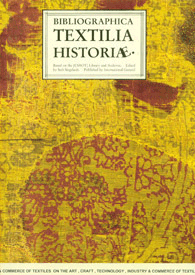
The Center for Social Research on Old Textiles [CSROT] is a research project founded in 1986 in France whose purpose is to contribute to the critical study of the history of textiles, especially by means of research concerning its bibliographic history. Its bibliographic publication, the Bibliographica Textilia Historiae, the first and only annotated general bibliography attempting to document all facets of the world history of textiles, contained over 5,000 titles —printed books and pamphlets, serials, articles and offprints, dissertations, royal decrees and laws— published in all languages, but mostly European, since the late fifteenth century to date, treating all aspects of the history of handwoven textiles, including woven and printed textiles, embroidery, lace, tapestry, dyeing, carpets, weaving and fiber technology, pattern books, and costume, among many other subjects.

This Bibliographica Textilia Historiae was published in the late 1990s and has been since enlarged to contain over 9,000 records with over 25,000 individual entries of authors, articles, reviews and books, of which over 500 titles are pre-1800. This enlarged database has now been catalogued with a full indexing program and is now available on this website as an free open-access database fully-searchable by multple keywords and criteria.


[Text and images from the CSROT website]

You can search the online database here: Bibliographica Textilia Historiae

For eg.: if your interest is in Georgian textiles, search “georgian” for a listing of sources in the bibliography, or if like Henry Tilney, your thoughts run to “muslin” – here is a book that Jane Austen would likely have known:

* PACKER, Thomas. The dyer’s guide; being a compendium of the art of dyeing linen, cotton, silk, wool, muslin, dresses, furniture &c. &c. with the method of scouring wool, bleaching cotton &c. and directions for ungumming silk and for whitening and sulphuring silk and wool …. Second edition, corrected and materially improved.  London: Sherwood, Gilbert and Piper, 1830. [ 1st edition: 1816]

The main website is here:  Stichting Egress Foundation

Copyright @2012 Jane Austen in Vermont
Collecting Jane Austen · Great Britain - History · Jane Austen · Jane Austen Circle · Jane Austen Popular Culture · Regency England · Social Life & Customs

Hot off the Press! ~ Jane Austen’s Regency World ~ No. 57

Coming soon to your mailbox! ~ the new issue of Jane Austen’s Regency World (May/June 2012, No 57):

  • Mozart’s Sister: a stunning new film tells of the talented musician eclipsed by a famous brother
  • Oops, I did it again: drink, drugs, sex and gambling… lax morals prevailed in Georgian England
  • Taking a tour around Steventon, birthplace of Jane Austen
  • Rage against the machine: how the Luddites sought to protect their jobs and their families
  • Exploring the character of Elizabeth Bennet

Plus … all the latest news from the world of Jane Austen, your letters, round-ups from the Jane Austen Society of the UK and the Jane Austen Society of North America, book reviews and quiz!

AND: Watch out for the new JARW website and BREAKING NEWS pages – coming soon to www.janeaustenmagazine.co.uk

You can subscribe here – a most enjoyable treat to show up in your mailbox every other month…

Jane Austen · Jane Austen Societies · JASNA · Social Life & Customs

JASNA – Greater Chicago Region Website Launched Today!

News from the JASNA-Greater Chicago Region:

The Board of Directors of the Greater Chicago Region is pleased to announce the launch of our newly revamped website:

http://www.jasnachicago.org/

 Along with a dramatic new look and easier navigation, the website has been enhanced with several new features:

*A dedicated page for each GCR event with more information, including driving instructions and parking options
*Online Exhibits explaining historical elements in the Austen novels
*Reading Guides for teachers and reading groups
*Fun Stuff pages of puzzles and links
*An Austen-inspired mystery short story by GCR member and author, Felicia Carparelli
*Special Member Area
*And, much more for you to explore!

The Web Committee wants this website not only to provide programming and interactive learning resources but also be a place to have fun.  We want you to be a part of our community even if you cannot attend our events. We aim to continually add more content to keep the website fresh and current for you.  We hope you visit the site regularly. If you join us on Facebook at https://www.facebook.com/JASNA.GCR you can receive alerts of new content and announcements.

We hope you enjoy exploring the new website!
*************************

Visit when you can – the website header alone is worth the price of admission (and I cannot copy it)! and there are lots of other goodies to get lost in…

[Image: from the JASNA-GCR online exhbition “Men, Women, and Marriage” by Jeff Nigro, RC for the Region]

@2012 Jane Austen in Vermont