English Country Dance Classes in Richmond
Learn about and enjoy Jane Austen’s favorite social pastime! Richmond Free Library
201 Bridge Street, Richmond, VT
4 Wednesday Nights i n 2011:
July 6, 13, 20, 27
7pm to 9:30pm
please note that the library locks its door at 8pm
7pm to 8pm ~ basics/styling tips/review
8pm to 8:10pm ~ break
8:10pm to 9:30pm ~ dancing for all
Voluntary donation to defray cost of air conditioning
($3 per class suggested)
For adults & teens. Come with or without a partner; we’ll change
partners throughout the evening. Dress comfortably and bring
c l e a n , flat-heeled shoes with smooth soles (avoid sneakers & mules /
slides) .
~ No sign-up or registration required ~
Just show up and join us for some fun evenings!
INFORMATION ~ www. burlingtoncountrydancers.org
**********************
You can also enhance your ECD skills here:
This first one is through the UVM OLLI program [ Osher Lifelong Learning Institute ]:
English Country Dancing in Jane Austen’s World Instructor: Judy Chaves Date: Monday, July 11, 6-8pm Location: Ira Allen Chapel at UVM Price: Members – $20 / Non-Members – $30
Do you enjoy 19th-century British literature? If you’ve ever read any of Jane Austen’s novels or seen any of the recent film adaptations, English country dance plays a prominent role in the culture of the time. The forerunner of American contra dance, English country dance is done in two facing lines (sometimes in squares, less often in circles) and requires no more than a knowledge of left from right and the ability and willingness to move to simply wonderful music. Through a combination of lecture (not much) and dance (as much as we can), you’ll learn the basics of the dance, gain an insider’s appreciation of the vital role it played in the lives of Austen’s characters, understand the etiquette and logistics underpinning Austen’s dance scenes–and have a great deal of fun in the process. You may come by yourself or as a couple!
Copyright @2011 by Deb Barnum, of Jane Austen in Vermont
JASNA.org in celebration of and preparation for the Fort Worth AGM on Sense and Sensibility has posted a partial bibliography of readings in Persuasions and Persuasions On-Line – http://jasna.org/agms/news-articles/about-ss-reading.html
The British Library announces an iPad app accessing 19th century books http://www.bibliolabs.com/. Users can experience the British Library 19th Century Historical Collection App for free from the App Store on iPad or at www.itunes.com/appstore/.
Victorian Secrets revives the works of neglected nineteenth-century writers and makes them available to the modern reader. Although over 60,000 novels were published during the 19th century, only a very small number have remained in print. See here for their catalogue: http://www.victoriansecrets.co.uk/
Notable Women Authors of the Day by Helen C. Black
A Book List: if you are looking for a book list, go no further that “Best Holiday Reads” at The Guardian where writers share their favorite works – no Austen I’m sorry to say, but read Antonia Fraser’s account of reading Anthony Powell’s Dance to the Music of Time – just a great story! http://www.guardian.co.uk/books/2011/jun/17/best-holiday-reads?INTCMP=SRCH
I too often get so caught up in Jane Austen’s time and place – England, the Regency Period – that I forget that there is an abundance of resources right here in my own American backyard. The Shelburne Museum is one such gem of a place to visit, and only a few miles from my home. I spent my teenage years (and later dragging my own children) visitingPlimoth Plantation and Sturbridge Villageand Colonial Williamsburg, such “living” museums feeding my love of history. There is so much to see, to absorb, to understand! and the internet, while it makes so much so readily available, does create its own problem – how does one possibly keep up with new material being added to the websites of every and all of the museums, art galleries, stately houses, historical societies, libraries, auction houses, etc. out there? – the list is endless!
But I do periodically randomly scout around and as anyone knows who researches on the web you find one thing and that leads to another that leads to another, etc., ad infinitum, and alas! you look at the clock and two hours have passed and that cannot possibly be true! – and then you want to post on something you find, but where is the time for that? – I am literally bogged down with thoughts – I maintain notebooks of ideas, most never to make the airwaves…
But I must share one such discovery from the other day: this was just going to be a short note in my weekly Penny Post, but I think it deserves a post all its own. I cannot even quite recall how I got there! – a book related link perhaps that sent me off to the American Antiquarian Society, and while lurking about I found their collection of online exhibitions – most all of interest to Janeites everywhere – so here goes, all images courtesy of the AAS: click on the links to tour the online images – great stuff!
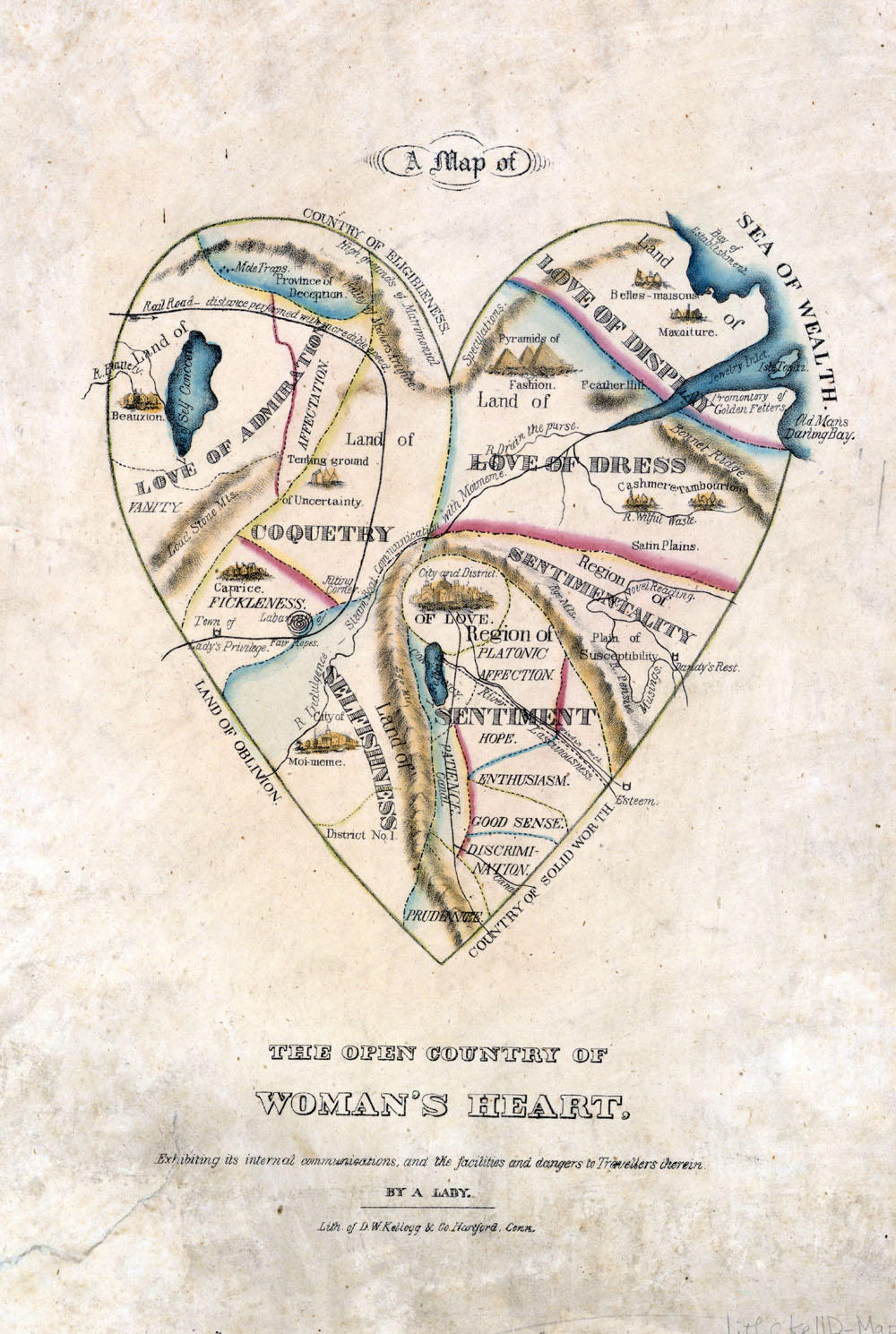
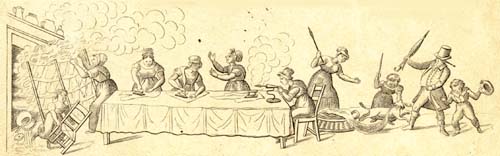
A Map of the Open Country of a Woman's Heart c.1833-1842
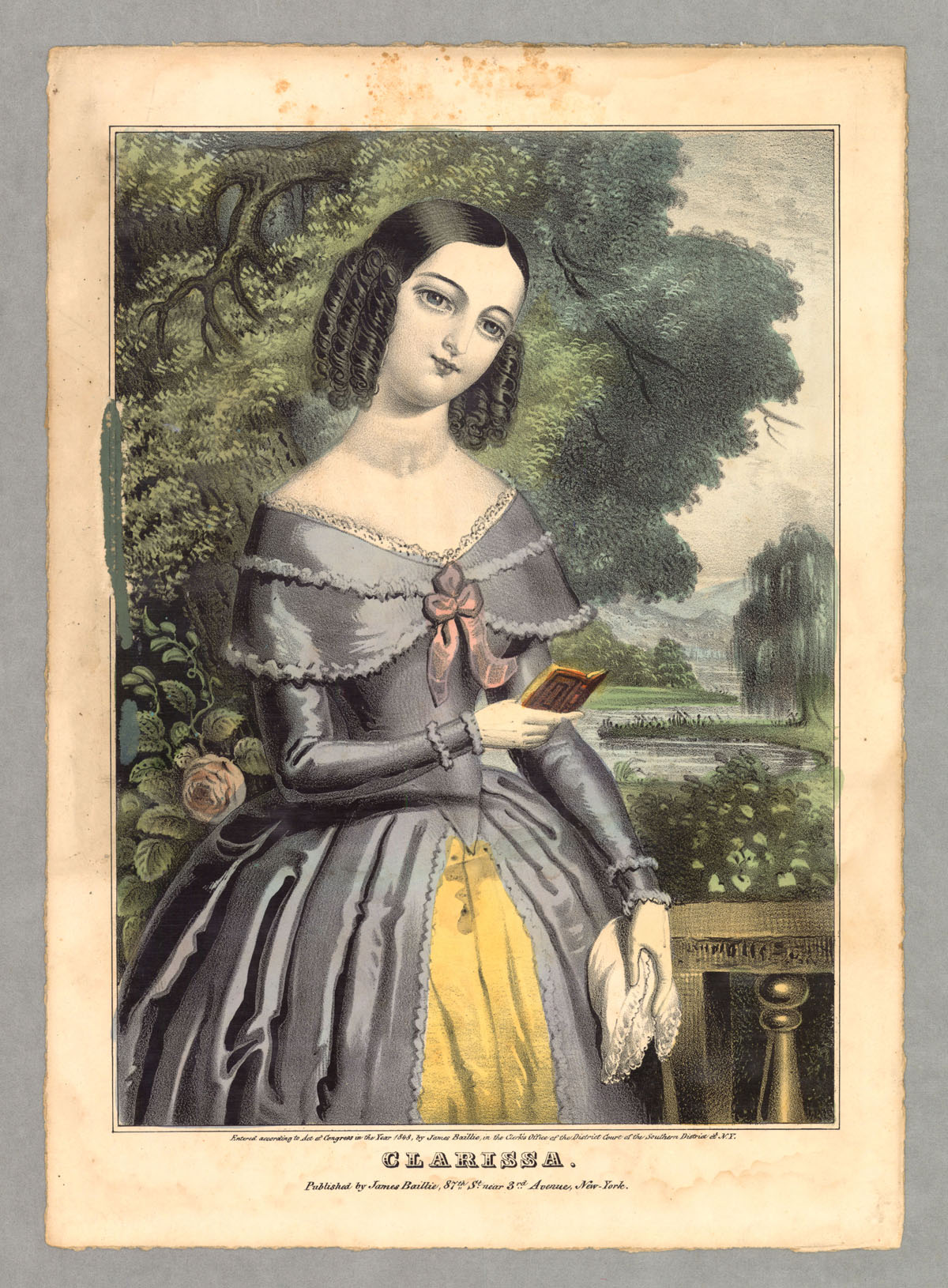
Most of the prints in the exhibit “Beauty, Virtue and Vice: Images of Women in Nineteenth-Century American Prints” were designed simply to please the eye, but they are also useful to historians who would like to understand how nineteenth-century Americans thought about the world in which they lived. Although prints are often works of imagination (even when they are grounded in fact), they still have much to tell us about the time and place in which they were created.
Artists were seldom concerned with representing people and scenes accurately, as we expect photographs to do, but took broad artistic license in creating scenes that would please the viewer’s eye. Even when artists depicted notable people, places, and events, artistic convention generally was more important than accuracy. Of course, these prints also tell us something of their creators’ point of view. Prints can be extremely useful for understanding the history of popular ideas, understandings, and beliefs. When read carefully and conscientiously, prints can be very useful documentary sources for understanding the past.
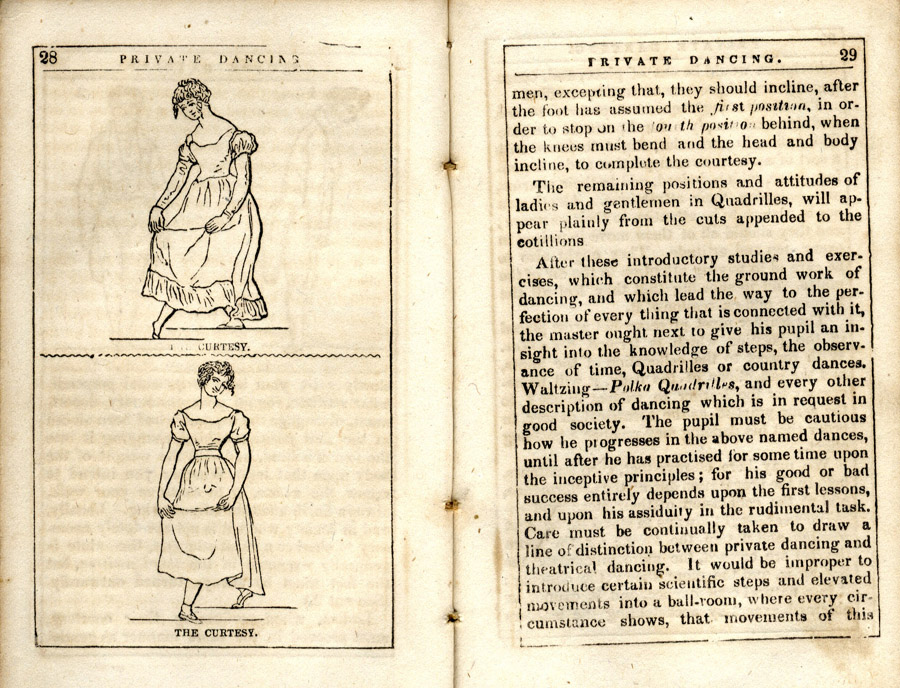
The illustrations and objects depicted in this exhibition provide a brief glimpse into the history of social dance. The abundance of artwork and social artifacts available attest to dance’s importance throughout American history. Featured is not only its origin, fashion and forms, but also the unspoken language of dance. Always moving, always changing, dancing has never failed to enchant American society.
In the eighteenth and nineteenth centuries, dance became a forum for purposeful social activity; elaborate balls and private parties offered a means for a gentleman to seek his wife and allowed friends and family to share the new trends in music and dance. In the political sphere, balls provided a setting for politicians to exhibit their wealth and standing by their knowledge of the most fashionable dances.
Although the majority of women chose to stay home, where society believed a woman should be, many ventured out into the working world either to begin their own business or to work for others in order to support themselves and their families. But whether a woman sought paid employment, or stayed at home to work in the domestic realm, she was always working. As Martha Ballard, a well-known eighteenth-century woman, wrote in her journal on Nov. 26, 1795, “A womans work is Never Done as ye Song Says, and happy Shee whos Strength holds out to the End…”
This exhibition brings together a selection of images from the Society’s collections that illustrate many facets of American women’s work, from the beginning of the American Revolution through the Industrial Revolution.
************************
And the link that likely brought me here in the first place:
A goal of this exhibition, and one of the goals of the American Antiquarian Society (AAS) itself, is to engage scholars in the study of the history of the book. The history of reading is but one component of this broad and dynamic field of scholarship. It is also an exceptionally difficult one. In highlighting the locations where individuals performed the act of reading in America, through the use of images and objects from the AAS collections, we hope to tell a story. It is not a definitive story by any means, but a story of three centuries’ worth of individuals ‘caught’ in the act of reading in homes, taverns, libraries, military camps, parlors, kitchens, and beds, among other places.
At times we can see a person reading in a specific location; at other times people tell us where they are reading; and sometimes we have to perform leaps of faith and imagine, for example, a cookbook being read in the kitchen. It’s the only logical location. Or is it? Our hope is that this exhibition will encourage other students of the history of the book to expand on this topic in as many imaginative and varied ways as the Society’s collection permits.
Spend some time if you can at this online exhibition – a wonderful collection of images of readers!
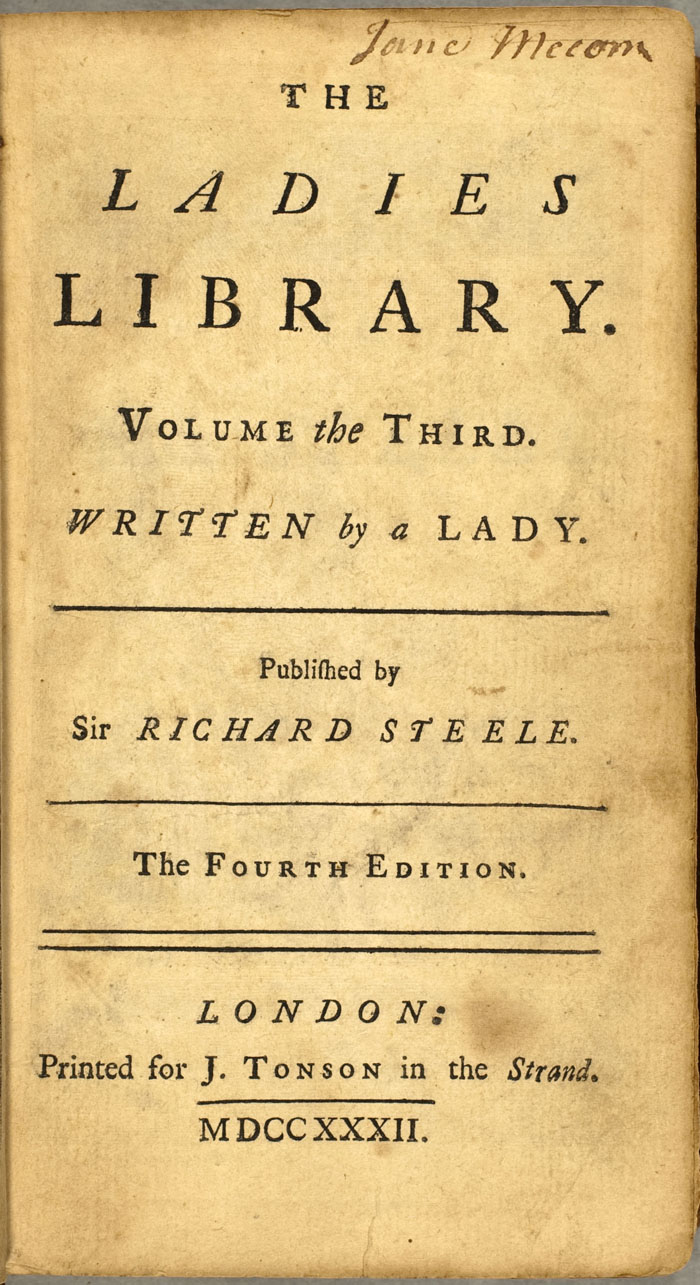
But here is my favorite find: note very closely this image of the title page of The Ladies Library and the owner’s signature Jane Mecom
Serendipitous, don’t you think that I read this article a few weeks ago and then find this title page image on the AAS site with her name in the book! [this is not noted on the website – I called to confirm that this book was indeed Jane Mecom’s and given to her by her brother and indeed it is! – and BTW, the reference person on the phone was delightful and most helpful!]
Well, as I said, one thing leads to another and somehow I rambled over from the AAS in Worcester Massachusetts to the website of the Boston, MA based Bostonian Society [at least I am still in New England!] – they have an online exhibition titled:
9 June: Volume 1 Letter 21- Volume 2 Letter 6 (21-37)
16 June: Volume 2 Letter 7- 22 (38-53)
23 June: Volume 2 Letter 23- Volume 3 Letter 9 (54-71)
30 June: Volume 3 Letter 10-23 (72-84)
4. In the UK: The Jane Austen Regency Week [ June 18 – June 26, 2011], celebrating the time Jane Austen spent in Alton and Chawton, is sponsored by the Alton Chamber of Commerce – website with event information here: http://www.janeaustenregencyweek.co.uk/index.html
5. As part of the above Regency Week celebration, the Chawton House Library will be hosting tea, talk, and tours on June 21st and 23rd : http://www.chawton.org/news/
6. Two posts on the British and their lovely habit, the drinking of tea: at Mary Ellen Foley’s Anglo-American Experience blog:
– but as one gentleman on one of the listservs I subscribe to so eloquently said: “Oh yeah Naipaul, how many movies have been made from YOUR books, huh?”
2. Vauxhall Gardens, by David Coke and Alan Borg: http://www.vauxhallgardens.com/ – the book is to be published by Yale University Press on June 8, 2011
3. Jane Austen: Two Centuries of Criticism, by Laurence Mazzeno. Camden Press, 2011:
1. This one deserves repeating: The Jane Austen Music Transcripts Collection at Flinders Academic Commons, transcribed by Gillian Dooley [this is a wonderful resource, most all from Austen’s music manuscript notebooks]: http://dspace.flinders.edu.au/dspace/handle/2328/15193
2. William Godwin’s Diary: Reconstructing a Social and Political Culture, 1788-1836: http://godwindiary.politics.ox.ac.uk/ [husband to Mary Wollstonecraft, Mary Shelley’s father, Austen’s time]
* I hope to return to doing a weekly update of various Austen-related discoveries – so much out there – so little time – one must set aside some time for BOOKS, don’t you think??
Copyright @2011 Deb Barnum, at Jane Austen in Vermont
A reminder about our JASNA-Vermont event, tomorrow June 5, 2011 from 2-4 pm!
~The Musical World of Jane Austen ~
with
Dr. William Tortolano
Dr. Tortolano is Professor Emeritus of Fine Arts at Saint Michael’s College and an internationally-known expert on Gregorian Chant. A forty-seven year faculty member at the college, he leads a busy “non-retirement” life as educator, concert organist, church musician, editor, author and director of Gregorian Chant workshops. He will be presenting a short lecture on the music of Jane Austen’s world, followed by an organ / piano recital of works
she would have known and heard:
Froberger, Pachelbel, Handel, Mozart, Purcell, Gluck and more…
If you love English Country Dance, then Burlington Vermont is the place to be this summer!
There are two English Country Dance classes that are being offered:
This first one is through the UVM OLLI program [ Osher Lifelong Learning Institute ]:
English Country Dancing in Jane Austen’s World Instructor: Judy Chaves Date: Monday, July 11, 6-8pm Location: Ira Allen Chapel at UVM Price: Members – $20 / Non-Members – $30
Do you enjoy 19th-century British literature? If you’ve ever read any of Jane Austen’s novels or seen any of the recent film adaptations, English country dance plays a prominent role in the culture of the time. The forerunner of American contra dance, English country dance is done in two facing lines (sometimes in squares, less often in circles) and requires no more than a knowledge of left from right and the ability and willingness to move to simply wonderful music. Through a combination of lecture (not much) and dance (as much as we can), you’ll learn the basics of the dance, gain an insider’s appreciation of the vital role it played in the lives of Austen’s characters, understand the etiquette and logistics underpinning Austen’s dance scenes–and have a great deal of fun in the process. You may come by yourself or as a couple!
****************
Judy is also teaching a series of classes in Charlotte, VT…
at the Charlotte Senior Center, Wednesdays from 4:30 to 6 pm, starting on July 22 and running for 5 weeks. It will be geared for beginners. Come with or without a partner. Cost is $45 and registration is required. Call 425-6345 to register.
One of the best places to visit in London if you have any interest in English domestic life is the Geffrye Museum – this has been on my ‘to-visit’ list for several years and I just haven’t made it there on previous trips to London – so when I met up with Tony Grant and he said said his favorite museum is the Geffrye – well, done deal, off we went!
As mentioned above, I did not have my camera, and we got there late, spent too much time chatting over tea, and the place closed down before I could finish the tour on contemporary life and go to the shop – so I cannot offer much more than a link to their fabulous website, where you can take any number of virtual tours through the various rooms, and begin to imagine Jane Austen in her own time and place!
From their website:
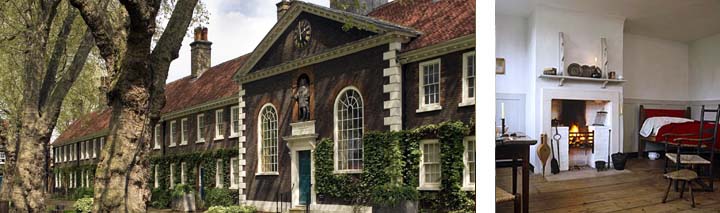
The Geffrye Museum depicts the quintessential style of English middle-class living rooms. Its collections of furniture, textiles, paintings and decorative arts are displayed in a series of period rooms from 1600 to the present day.
The displays lead the visitor on a walk through time, from the 17th century with oak furniture and panelling, past the refined splendour of the Georgian period and the high style of the Victorians, to 20th century modernity as seen in a 1930s flat, a mid-century room in ‘contemporary style’ and a late-20th century living space in a converted warehouse.
The museum is set in elegant 18th century almshouses with a contemporary wing surrounded by attractive gardens, which include an award-winning walled herb garden and a series of period gardens.
A parlour in 1790 – photography John Hammond
The use of the parlour remained much the same as earlier in the century; it was the room where the family would have gathered, received guests and taken meals. However, the way it was decorated and furnished had changed considerably.
In diaries, journals and letters of the time people often referred to rooms and furnishings that they liked as ‘neat’, which meant bright and stylish as well as clean and tidy. This taste required lighter colours and more delicate decoration. Wallpapered walls were particularly useful for achieving this effect, replacing heavily moulded panelling.
In the museum’s room the wallpaper is a modern replica copied from a fragment dating to around 1780. The plaster frieze is copied from a house in Cross Street, Islington. Interest in classical design and decoration was increasingly widespread towards the end of the century.
***************************
When you first walk in, you are faced with a series of chairs depicting each era – a wondeful way to see the changes in that most essential piece of furniture – the lofty chair. And then you begin your tour through the period rooms, starting with a Hall of 1630. Each room is arranged to look as though someone just got up and left – letters half written, chairs a bit askew, cards spread out. Tony is a teacher and he said he loves bringing young people to this very hands-on museum – he would focus on a particular item or habit – for example, light – and have his students really think about how our use of and access to different kinds of light has changed through the years. It is a marvelous way of really putting yourself in each room and seeing how one would have to function in that context.
A drawing room in 1830 – photography Chris Ridley
The Almshouse was not open when I visited, so here again from their website:
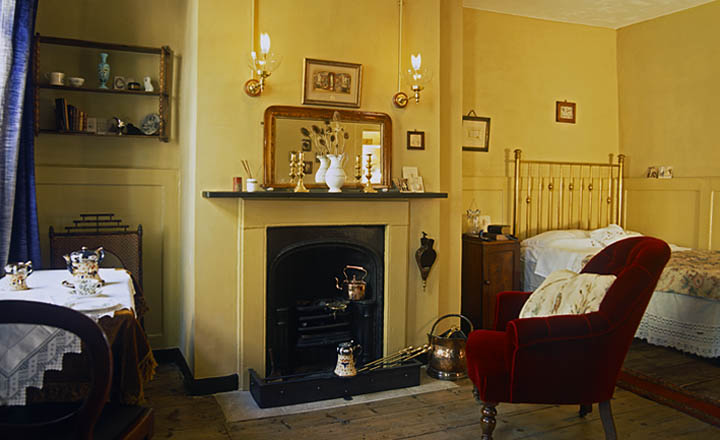
An almshouse room in 1880 – photography Morley von Sternberg
The 1880s room, situated on the upper floor, shows how a former governess living in the Geffrye almshouses during the 1880s may have furnished it.
The interior exemplifies the principle of genteel poverty. Within this context, the objects on display reflect many of the principal themes related to daily life during the nineteenth century, such as scientific and technological developments, moral and social trends, travel, and educational and artistic accomplishments.
*****************************
The Museum also houses elegant gardens from the 17th to 20th centuries; here is one from the 18th c – you can visit the website for lists of key plants:
18th century period garden – photography Jayne Lloyd
A lovely visit, despite my lack of camera! – and again my hearty thanks to Tony Grant for taking me there!
All the images posted here are from the website, where you can visit all the rooms, take virtual tours, shop*, and discover this magical world of the English home.
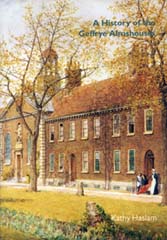
*the shop has many books, such as The History of the Geffrye Almshouses, by Kathy Haslam.
or gifts:
You can also visit them on Facebook here, where you can like them!
Copyright @2011 by Deb Barnum, of Jane Austen in Vermont
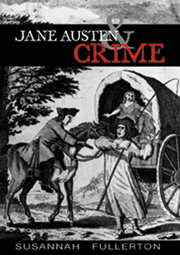
The ABC Sydney, Australian Broadcasting Corporation, has posted online its weekly “Self-Improvement Wednesday.” This week’s lesson is an 11 minute chat on “Jane Austen’s Crime” with Susannah Fullerton, the JASA President and author of the fabulous Jane Austen & Crime.
Enjoy this very quick and entertaining run through all the possible crimes in Georgian England as seen in Austen’s writings: adultery and crim con, dueling, prostitution, murder, elopement, rape, theft, smuggling, gaming, and the various punishments. Better yet, read the book! [you can read my review here.]
Copyright @2011 by Deb Barnum, of Jane Austen in Vermont
















 Jane Austen in Vermont