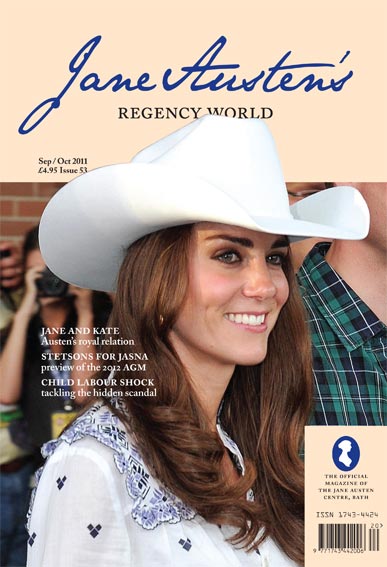
Hot off the presses is the November/December 2012 (No 60) edition of Jane Austen’s Regency World magazine, the ultimate Austen reading indulgence. Here are the featured articles!
Some great Christmas gift ideas for the Jane Austen fan in your life
You shall go to the dance – public and private balls in Jane Austen’s time
How keeping a bawdyhouse could be a tough business
Baiting, coursing and fishing: blood sports were big business in the Georgian era
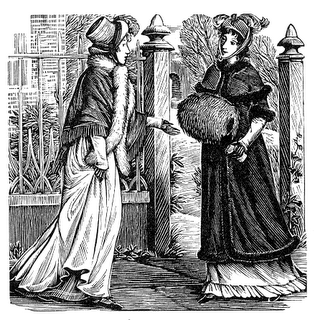
Looking at Jane’s use of fashion accessories in Emma
The life of Sir Thomas Bernard, a prominent philanthropist
Jane in the Garden of England
This new issue also includes reports from the recent Jane Austen Festival in Bath and the JASNA AGM in Brooklyn; news, letters, book reviews and much, much more!
Need a seasonal gift?
A subscription to Jane Austen’s Regency World magazine is the perfect gift for friends and family who…
Lot 169. AUSTEN, Jane (1775-1817). Northanger Abbey and Persuasion. With a Biographical Notice of the Author [by Henry Austen]. London: C. Rowarth [vols I-II], and T. Davison [vols III- IV] for John Murray, 1818 [but ca. 20 December 1817].
Well, first a very Happy New Year to one and all!! – I have been away from my computer, and find some of my gathered “news” is no longer actually new, so I include here just some goodies discovered on the internet, a good number only peripherally related to Jane, but interesting nonetheless… [or so I believe…]
News /Gossip
* How about taking a Jane Austen Cruise?! This coming July, you can head from Southampton to Guernsey, Spain and France for an 8-day cruise filled with all manner of Jane Austen diversions – http://janeaustencruise.com/
* The Amanda Vickery broadcast of The Many Lovers of Jane Austen may have only aired in the UK, but we can view it here, with thanks to Diana Birchall for sending me the video link:
You might also like to check in at Jane Austen’s Regency World blog to see a review of the show by Tony Grant and the numerous (some indignant!) comments on his take on the Fort Worth JASNA AGM. You should watch the video and then read the review and comment if you can…!
The Circulating Library
* If you have enjoyed the Bitch in a Bonnet blog, you will be interested to know that Rodi’s writings on the first three Austen novels are available for your ereader! – all for 99c… read about it here:
* Dr. Maureen Mulvihill spoke at the Florida Bibliophile Society on “The Evolution and Education of a Collector (1980s-): The Mulvihill Collection of Rare and Special Books and Images.” http://www.floridabibliophilesociety.org/mulvihill.html
* If you have an interest in bygone etiquette books, Abebooks compiled a list several months ago – here are some items for sale by various booksellers:
The Lady's Guide to Perfect Gentility - Emily Thornwell, 1856
Jane Austen’s six complete novels and her juvenilia are examined in the context of civil society and gender. Steiner’s study uses a variety of contexts to appraise Austen’s work: Scottish Enlightenment theories of societal development, early-Romantic discourses on gender roles, modern sociological theories on the civilizing process and postmodern feminist positions on moral development and interpersonal relations.
Austen is presented as a writer who not only participated in late eighteenth-century debates, but who is able to address twenty-first-century concerns of a theoretical and practical nature.
* Gentleman’s Magazine exhibit at University of Otago – not yet online:
Gentleman's Magazine - Monash University
Special Collections,University of Otago Library, is fortunate to have an entire run of the Gentleman’s Magazine from 1731 to 1866. Started by Edward Cavein January 1731, and printed form many years at St. John’s Gate in London, it was a ‘repository of all things worth mentioning’. It was the first ‘magazine’ in the modern sense. It was also the most important periodical in 18th century England, reflecting in its pages the diversity of Georgian life, politics and culture. It covered current affairs, political opinion, lead articles from other journals, miscellaneous information such as quack cures and social gossip, prices of stocks, science and technological discoveries, notices of births, deaths, and marriages, ecclesiastical preferments, travel, parliamentary debates, and poetry. Writers such as Dr Johnson, John Hawkesworth, Richard Savage, and Anna Seward were just a few of the thousands who contributed to it. At 6d per issue, it was an outstanding bargain. It remains an inexhaustible mine of information for scholars of eighteenth century life, and because of the wealth of genealogical information and records, it has become an important resource for family historians.
Our exhibition ‘The Gentleman’s Magazine. The 18th century Answer to Google ‘ begins on 21 December 2011 and runs through to 16 March 2012, just in time for the new student intake. Eventually it will be online.
But while we wait for that – you can visit their latest online exhibition “In Search of Scotland”
As we will are celebrating Charles Dickens 200th birthday throughout 2012, I will be posting a number of Dickens-related goings-on – I can only think that Austen would heartily approve of giving him his just due, and thus, he now has his own category in the PPWR:
1. A bookseller’s list of some of his works that they have for sale [Tavistock Books]: http://tinyurl.com/7c2t2y3
2. This one is very exciting as it combines my love of Dickens and my love of London and makes full use of my iphone capabilities: Dickens Dark London from The Museum of London:
* Thomas Jefferson’s Granddaughter in Queen Victoria’s England: The Travel Diary of Ellen Wayles Coolidge, 1838-1839. Edited by Ann Lucas Birle and Lisa A. Francavilla. Hardbound, 464 pages, 20 color and 10 black and white illustrations. Copublished by the Massachusetts Historical Society and the Thomas Jefferson Foundation. http://www.monticellocatalog.org/205632.html
Ellen Wayles Coolidge arrived in London in June 1838 at the advent of QueenVictoria’s reign – the citizens were still celebrating the coronation. During her nine-month stay, Coolidge kept a diary that reveals the uncommon education of her youth, when she lived and studied at Monticello with her grandfather Thomas Jefferson. This volume brings the full text of her diary to publication for the first time, opening up her text for today’s reader with carefully researched annotations that provide the historical context.
London’s clocks, theaters, parks, public buildings, and museums all come under Coolidge’s astute gaze as she and her husband, Joseph Coolidge, Jr., travel the city and gradually gain entry into some of the most coveted drawing rooms of the time. Coolidge records the details of her conversations with writers such as Samuel Rogers, Thomas Carlyle, and Anna Jameson and activists including Charles Sumner and Harriet Martineau. She gives firsthand accounts of the fashioning of the young queen’s image by the artists Charles Robert Leslie and Sir Francis Chantrey and takes notes as she watches the queen open Parliament and battle the first scandal of her reign. Her love of painting reawakened, Coolidge chronicles her opportunities to view over four hundred works of art held in both public and private collections, acknowledging a new appreciation for the modern art of J. M. W. Turner and a fondness for the Dutch masters.
As rich as her experience in England proves to be, Coolidge often reflects on her family in Boston andVirginia and her youth at Monticello. As she encounters her mother’s schoolgirl friends and recalls the songs her grandfather sang while working in his study, Coolidge’s thoughts return to Monticello and the lessons she learned there. Across the spectrum of her observations, Coolidge’s diary is always strikingly vivid and insightful – and frequently quite funny.
* Cambridge University Press has just published Samuel Johnson in Context, a collection of 47 short essays about the great lexicographer and his world. The book, which is aimed at a college and general audience, is edited by DSNA member Jack Lynch (also author of The Lexicographer’s Dilemma: The Evolution of English from Shakespeare to South Park [2009]).Lynda Mugglestone contributes an article on “Dictionaries” and Lisa Berglund, the introductory chapter on “Life.” Visit the Cambridge UP website for a complete Table of Contents: http://www.cambridge.org/gb/knowledge/isbn/item6476720/?site_locale=en_GB
Few authors benefit from being set in their contemporary context more than Samuel Johnson. Samuel Johnson in Context is a guide to his world, offering readers a comprehensive account of eighteenth-century life and culture as it relates to his work. Short, lively and eminently readable chapters illuminate not only Johnson’s own life, writings and career, but the literary, critical, journalistic, social, political, scientific, artistic, medical and financial contexts in which his works came into being. Written by leading experts in Johnson and in eighteenth-century studies, these chapters offer both depth and range of information and suggestions for further study and research. Richly illustrated, with a chronology of Johnson’s life and works and an extensive bibliography, this book is a major new work of reference on eighteenth-century culture and the age of Johnson. [from CUP site]
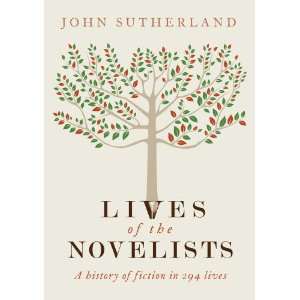
* John Sutherland, Lives of the Novelists: A History of Fiction in 294 Lives (Profile Books, 2011)
[ok. I have finished this – will post a short review and a compilation of other reviews – very mixed – but most Austen people seem to be universally disappointed … a shame really – it should have been better…]
Articles of Interest
* Rudd, Amanda. “The Spaces Between: Creating A Space for Female Sexuality in Frances Burney’s Evelina, Ann Radcliffe’s The Italian, and Jane Austen’s Sense and Sensibility.” Plaza: Dialogues in Language and Literature 2.1 (2011): 82-91. Full text here: http://journals.tdl.org/plaza/article/viewFile/5934/pdf_415
Queens in Waiting: Charlotte & Victoria [26 November 2011 – 9 September 2012]
Princess Charlotte and Prince Leopold
[by William Thomas Fry, after George Dawe, 1817]
In the early nineteenth century two young women would occupy the position of ‘heir to the throne’ in quick succession. One died tragically early, while the other, born to replace her, went on to reign for over sixty years as Queen Victoria. Telling a tale of romance, sorrow and renewed hope, this display focuses on the fateful linkage in the history of Princess Charlotte of Wales and Princess Victoria of Kent, and how both their lives pivoted around Prince Leopold – beloved husband to one, and trusted uncle to the other.
Featuring a range of portraits in wax, watercolour, and print, as well as commemorative images, it includes an engraving of Princess Charlotte’s last portrait from life by Sir Thomas Lawrence, completed posthumously. By bringing together these images, the display traces the idealised nature of the imagery used to represent a young woman in direct line to the throne at a time when the nation tired of the debauched Prince Regent’s rule. [from the NPG website]
* Exhibition at the Boston Public Library – Rare Books Exhibition Room, through March 30, 2012:
From Pen to Print: the Handwriting Behind the Book features handwritten letters, notes, postcards, and other manuscripts that reveal personal, private, and otherwise veiled aspects of the production of books. Putting authors’ manuscript materials on display alongside their print books, the exhibition reveals the passions, obsessions, lofty dreams, and gritty realizations triggered by the writing and publishing process. These materials capture the relationships between 19th- and 20th-century American authors, editors, and readers, including Nathaniel Hawthorne, Edgar Allan Poe, Alice Cary, Walt Whitman, Henry Wadsworth Longfellow, Robert Frost, and more. Open in the Rare Books Lobby at the Central Library in Copley Square through Friday, March 30, 2012, 617-536-5400. Special hours: M, T, W, F: 9am-5pm; Th: 11am-7pm
* American Christmas Cards 1900-1960: by Kenneth Ames: the exhibit at the Bard Graduate Center is now over, but you can read about it here:
And you can follow the Museum’s Textile Tuesday, a weekly post of a piece from their extensive textile collection : http://charlestonmuseum.tumblr.com/
Shopping: [I’m done with shopping…]
For Fun:
Visit the blog of the Jane Austen House Museum [now penned by Julie Wakefield of Austenonly!] for a post on board games for the holidays – “Snakes and Ladders the Jane Austen Way” …
News from the Editor of Jane Austen’s Regency World magazine: the September/October 2010 issue is published this week:
Featured on the cover is a scene from The Secret Diary of Anne Lister, the BBC’s new drama about a Georgian heiress who follows an unconventional path in life and love.
Highlights of the new issue of the magazine include:
The Latin touch: how Jane’s fame is spreading in Brazil
A very secret diary: the heiress Anne Lister’s love for a woman has been turned into a film
A Cornish exile: Maggie Lane explores the life and times of Charles Austen, Jane’s seafaring brother
Jane’s best jest: Paul Bethel compares Emma with Mansfield Park
Required reading: Sue Wilkes explains how no Georgian gentleman could afford to miss
Enter stage right: Jane Austen would have known the old Theatre Royal in Bath
My Jane Austen, Marsha Huff: The outgoing president of JASNA shares her love of Jane Austen
Full details of Jane Austen’s Regency World Magazine, which is published every two months, are available on our website http://www.janeaustenmagazine.co.uk/
******
Jane Austen’s Regency World Magazine is also delighted to announce that it will be at the following events:
Bath Jane Austen Festival, country fayre at the Guildhall, Bath, on Saturday, September 19
JASNA AGM, Regency Emporium, in Portland, Oregon, October 28-30
Readers are invited to visit our stand and say hello!
[Posted by Deb, who will write more on this when it shows up in her mailbox…]
The JASNA newsletter which I receive yesterday (April 21) mentioned that the Vermont chapter is interested in Nicholls’ “White soup.” There are several recipes available on line for this concoction, which is so called because no dark meat (that is beef or mutton) are used in making it, but only veal and or chicken. It is a very rich soup with anchovies, cream, egg and ground almonds added, as well as herbs and onion.
However, soup spoils readily, and it is possible that Nicholls was making a white portable soup, which is described at length in The Frugal Colonial Housewife. One takes a leg of veal, a LOT of chicken and a LOT of water and cooks it all down to a jelly, strains and boils down some more, until one winds up with what amounts to dry bouillon cubes, which, according to the cookbook, you can carry in your pocket. These could be reconstuted when wanted, and the fancier ingredients mentioned above added.
Incidentally–Nicholls is Mr Bingley’s cook, not his housekeeper. In a household of that level of wealth, there would be both, as indeed Mr Bennet’s also has, although we do not know the name of his cook. The Bennet’s housekeeper is Mrs Hill.
Those who do not receive JASNA News will need a bit of a filling-in: At the Pride & Prejudice Weekend held end-January/beg-February, our hostess Suzanne Boden (owner of The Governor’s House in Hyde Park, a B&B) had a quiz based on the novel. I am hopeless at such quizzes; as I’ve said before, I do not read Austen in order to retain minutae.
One question had to do with Who ‘Nicholls’ was–we’ll come back to that point in a moment–this person shows up twice in the novel, once just as a last name, and once designated “Mrs Nicholls” (or could they be two people?). Anyway, after reading the comment about ‘white soup enough’ – a requirement for Bingley to begin sending out invitations to the Netherfield ball, we did two things: looked up a recipe for ‘white soup’ and wondered among ourselves WHY the dance would depend so heavily upon this. Suzanne, as an excellent cook, of course could come up with a book that included a recipe for ‘white soup’ — but not being a cook, I didn’t read it thoroughly, much less retain it! So what Judith tells us is of great interest! Especially about the ‘portable’ soup!! Who knew?!
For Nicholls’ place in the household, I believe I deferred to Chapman (I had had the book with me that w/e); so will have to look further into the matter (Would Bingley allude to her merely as ‘Nicholls’ or would she always receive the title-treatment, Mrs Nicholls? Is Nicholls male, and has a wife who does the shopping??)
The relevant passages: in the 1918 edition online at Google, p. 56: “‘If you mean Darcy,’ cried her brother, ‘he may go to bed, if he chooses, before it begins–but as for the ball, it is quite a settled thing; and as soon as Nicholls has made white soup enough, I shall send round my cards.’”
The second mention of Nicholls, in VOL II of the first edition, p. 193: “‘You may depend on it,’ replied the other, “for Mrs. Nicholls was in Meryton last night; I saw her passing by, and went out myself on purpose to know the truth of it; and she told me that it was certain true. He comes down on Thursday at the latest, very likely on Wednesday. She was going to the butcher’s, she told me, on purpose toorder in some more meat on Wednesday, and she has got three couple of ducks, just fit to be killed.'”
Therefore, my BIG question was WHY: Why would the invitations (if that is what his “cards” allude to) depend upon Nicholls making ‘white soup enough’?? Was this a staple at a dance? did you nourish your visitors before sending them on their way at 2 or 4 a.m.? Was the staff, or townsfolk given this as a ‘thank you’ treat kind of thing?? It’s such a little sentence, but (as often in Austen) the author was pointing out something that was a ‘norm’ then — and just isn’t thought about (maybe known much about) now.
So thank you for your insights, Judith. I’m sure readers will have more to add regarding both white soup and the position of Nicholls within the Bingley household. And if anyone knows the ‘why’, as well, do write in!
Two Saturdays ago (March 14th, to be exact) I ventured up to Bishop’s University (Lennoxville, Quebec) for a Pride & Prejudice Weekend – a symposium, thanks to English department professor Claire Grogan; a delicious ‘Jane Austen’s Cream Tea’ at Uplands; a Pride & Prejudice play, adapted by drama professor George Rideout; and an Austen-era Sunday Service in the university’s beautiful chapel. Sure the footlights have dimmed, the curtain has dropped, and the weekend’s events have faded into memory – but readers should know what they missed; and why they should keep an eye out for a production of this well-thought-out new play.
Saturday afternoon’s symposium featured three speakers; a full-hall (a good 70 people) had gathered to hear them.
Prof. Peter Sabor McGill University, Montreal
“Portraying Jane Austen: How Anonymous became a Celebrity”.
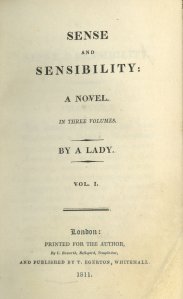
Illustrated by images, Dr. Sabor brought the audience along Austen’s circuitous route to celebrity – beginning with the original “BY A LADY” title page of Sense and Sensibility and showing near the end a publicity photo that made everyone chuckle: Jane Austen Hollywood-ized, complete with cell phone (the giant, 1980s version), conducting business while lounging on a poolside chaise.
In between these humble beginnings and the 20th-century hype lay a lot of Austen territory to be explored. Austen, of course, sold the copyright to Pride & Prejudice – her most popular novel – for ₤110. In 1813, the three volumes sold for 18 shilling (“about $2 Canadian today”).
Austen’s name has been located on a few subscription lists (Burney’s Camilla; the 1808 sermons of the Rev. Thomas Jefferson). Dr. Sabor explained that it was costly to purchase books by subscription. Such lists, however, can be invaluable to the researcher (I have located many Goslings and Smiths on subscription lists; it gives a thrill to realize they knew the author or valued the work enough to purchase a copy – or more than one – before the presses rolled).
The anonymous review (in reality Walter Scott) of Emma highlights Austen’s soon-acknowledged authorship a few years later: Although the title page of Northanger Abbey cited “By the author of ‘Pride and Prejudice,’ ‘Mansfield Park,’ &c,” the first volume included brother Henry’s biographical notice – thereby naming in print for the first time exactly who authored all six of these novels. [See also Henry’s updated version in the Bentley edition (1833) of S&S.] Beginning in 1818, we see reviews that mention Austen by name. (In an aside: Emma Smith, the future Mrs James-Edward Austen, was in 1817 already citing her as the author, specifically, of Mansfield Park; though Emma spelled the last name, as many did and often still do, Austin.)
A French translation of Austen’s last completed novel – published under the title La famille Elliot – becomes the first book in which Austen’s name appears as author on a title page. The year is 1821. [For information on the translator, see Ellen Moody.]
When discussion of the known and purported Austen portraits began, the audience was given a truly informative lesson on the pitfalls, as well as hopes and shattered dreams, of claimants to “authentic Janes”. Even the 1804 sketch: Is it a depiction of Jane by her sister Cassandra?? Anna Lefroy (half-sister to James-Edward Austen) inherited it, and to this day it resides within the family. (It was first presented by Chapman in his volume of Letters.)
The illustrations of Austen grow more wild as the publicity picks up – paper dolls, figures made for ‘action,’ plush and bobble-headed dolls, even an Austen Powers ‘superhero’. From recreations to fantasy depictions, Austen’s ‘anonymity’ has certainly turned a complete 360-degrees.
ADDENDUM: for an observation on the so-called ‘wedding ring portrait’ of Jane Austen (which Dr. Sabor called “bizarre”, see SEPARATED AT BIRTH?)
*
next: Prof. Robert Morrison (Queen’s), “Getting Around Pride & Prejudice: Gothicism, Fairy Tales & the Very World of All Us”
To the Cinderella who lost her black earring at the Austen Tea on Sunday, December 7 (at Champlain College): We have it! contact us at jasna-vt [at] hotmail [dot] com.
Writers necessarily edit as they write; to make paragraphs and resultant chapters coherent, some information has to be gone into in depth, while other information reluctantly or automatically must be jettisoned. Too much information, unskillfully crafted, will leave readers in the dust. A skillful author, however, molds the story with the facts at hand, picking and choosing what to include, and how to phrase or emphasize those inclusions. This is particularly true of biography.
Take, for instance, the prize-winning A MIDWIFE’S TALE, by Laurel Thatcher Ulrich. While confronted with an entire decades-long diary (spanning 1785-1812), Dr Ulrich carefully chose certain illustrative sections in which to pinpoint aspects of Martha Ballard’s life. Reader’s interested in the minutiae of that life, as described by its protagonist, must unearth a copy of the published diary or go to the copy online.
The minutiae of life is exactly what Deirdre Le Faye gives readers in her superb and invaluable A CHRONOLOGY OF JANE AUSTEN AND HER FAMILY. This is certainly not the type of book one takes to bed, but it is nevertheless an engrossing read. Within its pages are the lives of not only Jane Austen, but also her forebears, immediate family, cousins, aunts and uncles, nieces and nephews – a three-hundred-year span from 1700 to 2000. This result of Le Faye’s digging through archives, private collections and published works provides Austen fans the bones with which to build biographies all our own. Through it, you can uncover the additions and deductions of Austen bank accounts; follow the rise and fall of Henry Austen’s partnership with Tilson; chart the Hampshire weather utilizing the notations in neighbor Eliza Chute’s diaries; and find the private thoughts of girls like Fanny Austen Knight.
Some random samples:
In 1796 [p. 187]
September 2, Friday
Rowling: HTA leaves to return to Great Yarmouth. He will write soon to Steventon. Hampshire: A ball is held in the Steventon district, possibly today (or possibly it is the next assembly ball at Basingstoke, on 8 September, Thursday), at which CEA is present. Other dancers include a large party from the Terry family of Dummer, Mr John Lovett, Mr Tincton, Mr John Harwood, Mary Lloyd, Mary Harrison and James Austen.
[Letters 4, 5]
September 3, Saturday
Rowling: EAK, Elizabeth, JA and FWA, dine at Goodnestone and have an impromptu dance afterwards. Others present are Lady Bridges and her children Edward, Harriet, Louisa and George, as well as Fanny and Lewis Waltham, the Misses Anne and Mary Finch. The invalid Marianne Bridges does not appear. The Rowling four walk home afterwards.
[Letters 5]
In 1802 [p. 267]
January 18, Monday
Dummer: ‘Miss Terry, Anne & I rode & called at Worting, Manydown, Oakley Hall, & Deane.’
[Powlett journal 119A00/1]
January 21, Thursday
London: Army agents Cox & Greenwood debit Major Thomas Austen’s account: ‘Cash paid freight of a Hogshead of rum from Jamaica, £2.8s.11d.’
[Cox & Greenwood ledger, fo. 33]
January 24, Sunday
London: Army agents Cox & Greenwood credit Major Thomas Austen’s account: ‘By 31 days Pay to 24 January 1802, £21.16s.7d.’
[Cox & Greenwood ledger fos. 33, 212] The Vyne: ‘Misling small rain most of the day. Church. Mr. Austin to dinner.’
[Chute pb 23M93/70/1/9]
In 1809 [p. 369]
mid-June
Alton: MLA goes to stay with Mary Gibson in Rose Cottage for about a month, while Mary G is expecting her second child.
[CMCA Rems 19]
June 14, Wednesday
Canterbury: ‘Aunt Louisa came & dressed here & dined with [three words illegible] where we met G.M. Bridges, Uncle B. & Mr. Champneys. Papa & Aunt J. with G.M. [Austen] & Aunt C. from Godmersham dined with Mrs Knight & called here in the morning. Mr. & Mrs. E. Cage & Annetta called. Aunt Louisa slept here. Little George Moore not very well went to stay at Goodnestone Farm for change of air.’
[FCKpb U.951/F.24/6]
June 15, Thursday
Canterbury: ‘Uncle & Aunt M. dined at Dr. Walsby’s & Aunt L. & I with Mrs. Knight where we met G.M. Bridges again & Aunt L. went back with her. Walked about the town in the morning. Fine & hottish.’
[FCKpb U.951/F.24/6]
The abbreviations utilized (fully explained at the front of the book) are, most of them, the typical used for personages and already well known: CEA = Cassandra Elizabeth Austen [Jane’s sister]; EAK = Edward Austen Knight [Jane’s brother]; CMCA = Caroline Mary Craven Austen [Jane’s niece, younger daughter of James]. Pb = pocket book. Entries are arranged with the geographic (town, estate, etc) in italics; and the source is clearly marked on the side margin [they appear below entries only in this review].
The sources for these listings are astounding: letters, diaries (pocket books), accounts books, taxation records, published memoirs and biographies, privately-held papers.
The one minus: while readers will be grateful for the extensive Personal Names index (which runs from pages 757-776, three columns per page), you do end up searching for references because, rather than indexed by page number, everyone is indexed by year. For instance:
Knatchbull, Joan: 1796
Knatchbull, Mary Dorothea, see Knight
Knatchbull, Wadham: 1813
Knatchbull, Wyndham: 1784, 1805, 1808, 1810-14 [page 768]
This obviously works best for people who occur multiple times within a given year; it does give a quick indication of which ‘periods someone appears in; and must have provided the publisher with a space-savings.
The structure of the book includes a substantial bibliography (712-724); thirty-two family trees (725-756); a frontispiece map and several illustrations. This is truly a publication of Le Faye’s DECADES of research into the Austen family; readers will feel as if they are sitting down with the scholar and picking her brain. In her preface, she says: ‘I hope that this uniquely detailed chronology will be of the greatest use to all future biographers, literary critics and historians, providing as it does accurate documented facts gathered from a wide variety of sources.’ We all owe her a debt of gratitude (to Cambridge University Press as well; although the steep $168 price tag does seem more geared towards library rather than individual purchase) for sharing the results of her researches with us all. It represents Le Faye’s gift to serious scholars, making this an Essential Austen volume.
* * *
ESSENTIAL AUSTEN is a series we will continue, which will introduce or earmark those books (and other items?) essential to an Austen collection.

 Hot off the presses is the November/December 2012 (No 60) edition of Jane Austen’s Regency World magazine, the ultimate Austen reading indulgence. Here are the featured articles!















 Writers necessarily edit as they write; to make paragraphs and resultant chapters coherent, some information has to be gone into in depth, while other information reluctantly or automatically must be jettisoned. Too much information, unskillfully crafted, will leave readers in the dust. A skillful author, however, molds the story with the facts at hand, picking and choosing what to include, and how to phrase or emphasize those inclusions. This is particularly true of biography.
 Jane Austen in Vermont