Jane Austen Circle · Literature · Women Writers

Gaskell Blog Tour ~ Comment deadline

Tonight at midnight [10-7-10, Pacific Time] is the deadline for commenting on any of the blog posts on the Elizabeth Gaskell Blog Tour and to enter to win the Naxos audiobook of North and South.  You can comment on my Gaskell post:  Your Gaskell Library, or any of the posts below.  Good luck! – Lovely prize!  Laurel Ann at Austenprose will be announcing the winner tomorrow, October 8th.

Biography

Novels/Biography

Novellas

Resources


Jane Austen Circle · Literature · News · Women Writers

More Gaskell!

Just discovered today! Another Elizabeth Gaskell source!  Katherine of the Austen-related blog November’s Autumn, [where she is currently posting a series on Austen’s “paradox of names”] has started a new blog devoted to Elizabeth Gaskell. You can view the site here; as well as follow her on Twitter here.  Delighted to see Gaskell getting such attention in the blogsphere!

Katherine had written a post on Gaskell’s Wives and Daughters for the September 29th Blog Celebration that begins here – scroll down for the links to the 15 blogs that participated in this tribute to Gaskell on her 200th birthday.

Congratulations Katherine on your lovely new blog! [I have added you to my posted Gaskell bibliography.]

Jane Austen Circle · Literature · Movies · Women Writers

Elizabeth Gaskell Bicentenary Blog Tour: Your Gaskell Library


Welcome to the 14th stop on today’s celebration of Elizabeth Gaskell’s birthday – September 29, 1810!  Please join me in this blog tour honoring Gaskell as 15 bloggers, under the direction of Laurel Ann at Austenprose, each post something related to Gaskell – a look at her life and times, book reviews, movie reviews, a tour to her home in Manchester [see at the bottom of this post for the links to the various posts on the blog tour], and my post on “Your Gaskell Library” ~  where to find Gaskell in print, online, on your iPhone,  on your iPod, and on film – she is Everywhere!  By the end of the tour you will know more about Gaskell than you thought possible and be the better for it!!  There is also the opportunity to win a Naxos recording of North and South by just making a comment on any of the blogs.  Enjoy yourself as we all wish a hearty Happy Birthday to Mrs. Gaskell!
********************

I wanted to see the place where Margaret grew to what she is,
even at the worst time of all,
when I had no hope of ever calling her mine…

North and South
*************

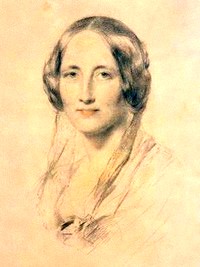
Elizabeth Cleghorn Gaskell (1810-1865) is best known to us as the author of the then-controversial biography of Charlotte Bronte, where she laid bare the oddities of the Bronte household, publicizing the behavior of the semi-mad father and the destructive life and affairs of the son. But Gaskell was a well-respected and popular author in her own day; we have been seeing a resurgence of that popularity with the broadcast of Wives & Daughters (1999), North & South (2004) [the film that rocketed Richard Armitage to fame, and rightly so!], and Cranford (2007, 2009). So I give a very brief review of her life and works [this was originally posted here], followed by a select bibliography. 

Born in Cheshire to William Stevenson, a Unitarian minister, Elizabeth was raised by her aunt, the sister of her mother who died shortly after her birth.  The town of Knutsford and the country life she experienced there became her setting in Cranford and her “Hollingford” in North & South.  She married William Gaskell of Manchester, also a Unitarian minister, in 1832, had four daughters and one son, who died in infancy.  The loss of her son had a devastating effect on her and to keep herself from sinking into an ever-deeper depression, she took pen in hand and started to write.  She published her first book Mary Barton in 1848 (using the pseudonym Cotton Mather Mills), though there is some speculation that she actually started to write Sylvia’s Lovers (1863) first but put it aside to write the more socially conscious Mary Barton.  Gaskell, according to Lucy Stebbins, was chiefly concerned with the ethical question of ”The Lie”, i.e. a belief that “deception was the greatest obstacle to the sympathetic understanding which was her panacea for individual and class quarrels.” (1)  This reconciliation between individuals of different classes and between the wider world of masters and workers was her hope for humanity and it was this zeal that often led her into false sentiment in her novels and stories.(2)  But because she saw both sides of the labor question and pitied both the oppressor and the oppressed, she was thus able to portray with often explicit candor the realities of her world.  But Stebbins also says that life was too kind to her as a woman to make her a great artist.  Her tales of vengeance and remorse were written more to satisfy public taste, after she started publishing in Dickens’ Household Words.  And David Cecil calls Gaskell “a typical Victorian woman….a wife and mother”….he emphasizes her femininity, which he says gives her the strengths of her detail and a “freshness of outlook” in her portrayals of the country gentry, while at the same time this femininity limits her imagination.  In comparing her to Jane Austen, Cecil writes: 

         It is true Mrs. Gaskell lived a narrow life, but Jane Austen, living a life just as narrow, was able to make works of major art out of it.  Jane Austen…was a woman of very abnormal penetration and intensity of genius. ….. [Gaskell] cannot, as Jane Austen did, make one little room an everywhere; pierce through the surface facts of a village tea-party to reveal the universal laws of human conduct that they illustrate.  If she [Gaskell] writes about a village tea-party, it is just a village tea-party…(3) 

   Cecil is critical of her melodrama, her “weakness for a happy ending”, her overlong works that lack imagination and passion.  But he does credit her four major works (Sylvia’s Lovers, Cranford, Wives & Daughters, and Cousin Phillis) as classic and worthy English domestic novels.  
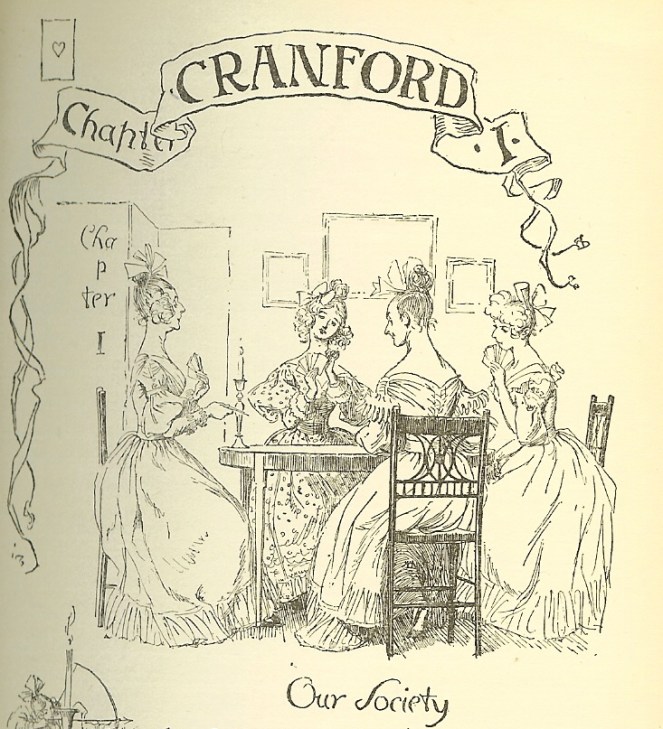
[Cranford, illustrated by Hugh Thomson.  London : Macmillan, 1891..
This copy is also available at the Illustrated Cranford site. ]

Anne Thackeray Ritchie, in her introduction to Cranford, published in 1891, also compares Gaskell to Austen, and finds the latter lacking: 

Cranford is farther removed from the world, and yet more attuned to its larger interests than Meryton or Kellynch or Hartfield….Drumble, the great noisy manufacturing town, is its metropolis, not Bath with its successions of card parties and Assembly Rooms.” …. and on love, “there is more real feeling in these few signs of what once was, than in all the Misses Bennett’s youthful romances put together…only Miss Austen’s very sweetest heroines (including her own irresistible dark-eyed self, in her big cap and faded kerchief) are worthy of this old place….”  and later, “it was because she had written Mary Barton that some deeper echoes reach us in Cranford than are to be found in any of Jane Austen’s books, delightful though they be. (4) 

Margaret Lane in her wonderful book of essays on biography, Purely for Pleasure [which also includes the essay “Jane Austen’s Sleight-of-hand”], has two essays on Mrs. Gaskell.  Lane calls her one of the greatest novelists of the time, and especially praises Wives & Daughters over Cranford for its stature, sympathies, mature grasp of character and its humour, and its effect of “creating the illusion of a return to a more rigid but also more stable and innocent world than ours” and we feel refreshed in spirit after a reading. (5) 

Wives & Daughters, Gaskell’s last work, and considered her finest, was published as a serial novel in Cornhill, the last unfinished part appearing in January 1866.  Gaskell had literally dropped dead in the middle of a spoken sentence at the age of 55, and the work remained unfinished, with only a long note from the Cornhill editor following the last serial installment.  Wives and Daughters tells the story of Molly Gibson and her new stepsister Cynthia, and their coming of age in the male-dominated mid-Victorian society of “Hollingford.” 

But it is Lane’s essay on “Mrs. Gaskell’s Task” in which she so highly praises Gaskell’s achievement in her biography of Charlotte Bronte.  While Gaskell obviously suppressed some facts (the letters to M. Heger) and exaggerated others (Mr. Bronte as a father and Branwell as a son), Lane says “her great biography remains a stirring and noble work, one of the first in our language…. and it is in essence ‘truer’ than anything about the Brontes which has been written since…”(6) 

Such contrary opinions!…certainly reminiscent of Austen’s admirers and critics!   Perhaps as Pam Morris says in her introduction to W&D, “Gaskell resists any simple categorization…her work ranges across the narrative forms of realism and fairytale, protest fiction and pastoralism, melodrama and the domestic novel.”(7) 

_______________________________________ 

Notes:
1.  Lucy Poate Stebbins. A Victorian Album: Some lady Novelists of the Period (Columbia, 1946) p. 96.
2.  Ibid.
3.  David Cecil.  Victorian Novelists: Essays in Revaluation (Chicago, 1962) p. 187.
4.  Anne Thackeray Ritchie.  Preface to Cranford (Macmillan, 1927) pp. vii, xix.
5.  Margaret Lane.  Purely for Pleasure (Hamish Hamilton, 1966)  p. 153.
6.  Ibid, p. 170.
7.  Pam Morris.  Introduction to Wives and Daughters (Penguin, 2001) p. vii. 
                                                            *****************

I append below a “Select Bibliography” of Gaskell’s works, biographies and critical works, as well as links to what can be found online, iPhone, audio, and film – and most everything Gaskell wrote IS available.  Many of her writings were originally published in the periodicals of the day, such as Howitt’s Journal, Sartain’s Union Magazine, Harper’s Monthly Magazine, Dickens’s Household Words and All the Year Round, and Cornhill Magazine; and many of these writings were later published in collections of tales. And, like Dickens, some of her novels were originally published in serial form [Cranford, North and South, Wives and Daughters].  I list below the novels as first published in book form, a list of short stories and essays with date of original appearance in print, and a list of current editions you can find in your local bookstore [I list only the Oxford, Penguin and Broadview editions – there are many others and reprints of all kinds – best to look for an edition with a good introduction and notes.]  There is a lot of information here, with links to even more information available on the web – there is no lack of writing on Mrs. Gaskell! – But what I really want to emphasize are her short stories, which often get lost in the hoopla about her major novels – there are many as you will see, with links appended – try some – you will not be disappointed!  

****************************
Bibliography: Selected list   [see links below for more complete bibliographies] 

Works:  Books, Short Story Collections 

  1. Mary Barton: A Tale of Manchester Life. 2 vols. London: Chapman & Hall, 1848; 1 volume, New York: Harper, 1848.
  2. Libbie Marsh’s Three Eras: A Lancashire Tale. London: Hamilton, Adams, 1850.
  3. The Moorland Cottage. London: Chapman & Hall, 1850; New York: Harper, 1851.
  4. Ruth: A Novel. 3 vols. London: Chapman & Hall, 1853; 1 volume, Boston: Ticknor, Reed & Fields, 1853.  
  5. Cranford. London: Chapman & Hall, 1853; New York: Harper, 1853.
  6. Hand and Heart; and Bessy’s Troubles at Home.  London:  Chapman and Hall, 1855.
  7. Lizzie Leigh and Other Tales. London: Chapman & Hall, 1855; Philadelphia: Hardy, 1869.
  8. North and South. 2 vols.  London: Chapman & Hall, 1855; 1 vol., New York: Harper, 1855.
  9. The Life of Charlotte Brontë; Author of “Jane Eyre,” “Shirley,” “Villette” etc.. 2 vols. London: Smith, Elder, 1857; New York: Appleton, 1857.
  10. My Lady Ludlow, A Novel. New York: Harper, 1858;  republished as Round the Sofa. 2 vols. London: Low, 1859.
  11. Right at Last, and Other Tales.  London: Low, 1860; New York: Harper, 1860.
  12. Lois the Witch and Other Tales. Leipzig: Tauchnitz 1861.
  13. Sylvia’s Lovers.  3 vols.  London: Smith, Elder, 1863; 1 vol. New York: Dutton, 1863.
  14. A Dark Night’s Work.  London: Smith, Elder, 1863; New York: Harper, 1863.
  15. Cousin Phillis: A Tale. New York: Harper, 1864; republished as Cousin Phillis and Other Tales.  London: Smith, Elder, 1865.
  16. The Grey Woman and Other Tales.  London: Smith, Elder, 1865; New York: Harper, 1882.
  17. Wives and Daughters: An Every-Day Story.  2 vols.  London: Smith, Elder, 1866; 1 vol., New York: Harper, 1866.


Works:  Short Stories and Essays [in order of publication] – most of these are available online at The Gaskell Web, Project Gutenberg, IPhone (Stanza – Munsey’s), etc. 

  1. On Visiting the Grave of my Stillborn Little Girl (1837)
  2. Sketches Among the Poor, No.1 (1837)
  3. Notes on Cheshire Customs (1839)
  4. Description of Clopton Hall (1840)
  5. Life In Manchester:  Libbie Marsh’s Three Eras (1847)
  6. The Sexton’s hero (1847)
  7. Emerson’s lectures (1847) [attributed]
  8. Christmas Storms and Sunshine (1848)
  9. Hand and Heart (1849)
  10. The Last Generation in England (1849)
  11. Martha Preston (1850) – re-written as “Half a Lifetime Ago”
  12. Lizzie Leigh  (1850)
  13. The Well of Pen-Morfa (1850)
  14. The Heart of John Middleton (1850)
  15. Mr. Harrison’s Confessions (1851)
  16. Disappearances (1851)
  17. Our Society in Cranford (1851)
  18. A Love Affair at Cranford (1852)
  19. Bessy’s Troubles at Home (1852)
  20. Memory at Cranford (1852)
  21. Visiting at Cranford (1852)
  22. The Shah’s English Gardener (1852)
  23. The Old Nurse’s Story (1852)
  24. Cumberland Sheep Shearers (1853)
  25. The Great Cranford Panic (1853)
  26. Stopped Payment at Cranford (1853)
  27. Friends in Need (1853)
  28. A Happy Return to Cranford (1853)
  29. Bran (1853)
  30. Morton Hall (1853)
  31. Traits and Stories of the Huguenots (1853)
  32. My French Master (1853)
  33. The Squire’s Story (1853)
  34. The Scholar’s Story (1853)
  35. Uncle Peter (1853)
  36. Modern Greek Songs (1854)
  37. Company Manners (1854)
  38. An Accursed race (1855)
  39. Half a lifetime Ago (1855) [see above “Martha Preston”]
  40. The Poor Clare (1856)
  41. The Siege of the Black Cottage (1857) – attributed
  42. Preface to Maria Susanna Cummins Mabel Vaughan (1857)
  43. The Doom of the Griffiths (1858)
  44. An Incident at Niagara Falls (1858)
  45. The Sin of a Father (1858) – re-titled Right at Last in collection
  46. The Manchester Marriage (1858)
  47. The Half-Brothers (1859) – in Round the Sofa collection
  48. Lois the Witch (1859)
  49. The Ghost in the Garden Room (1859) – re-titled “The Crooked Branch” in Right at Last collection
  50. Curious if True (1860)
  51. The Grey Woman (1861)
  52. Preface to C. Augusto Vecchi, Garibladi at Caprera (1862)
  53. Six Weeks at Heppenheim (1862)
  54. Shams (1863)
  55. An Italian Institution (1863)
  56. The Cage at Cranford (18863)
  57. Obituary of Robert Gould Shaw (1863)
  58. How the First Floor Went to Crowley Castle (1863)
  59. French Life (1864)
  60. Some Passages from the History of the Chomley Family (1864)
  61. Columns of Gossip from Paris (1865)
  62. A Parson’s Holiday (1865)
  63. Two Fragments of Ghost Stories [n.d]

Works ~ Collections: 

  • The Works of Mrs. Gaskell, Knutsford Edition, edited by A. W. Ward. 8 vols. London: Smith, Elder, 1906-1911.
  • The Novels and Tales of Mrs. Gaskell, edited by C. K. Shorter. 11 vols. Oxford: Oxford University Press, 1906-1919.
  • The Works of Elizabeth Gaskell, ed. Joanne Shattuck, et.al.  10 vols.  London:  Pickering and Chatto, 2005-2006.  Click here for more info on this set.

Currently in print ~ Individual Works and Collections: [only the Penguin, Oxford and Broadview Press editions are noted here – there are a number of available editions of Gaskell’s individual works – search on Abebooks, Amazon, or visit your local bookseller; and there are any number of older and out-of-print editions available at these same sources!]

  • Cousin Phillis and Other Stories.  Intro by Heather Glen. Oxford, 2010.
  • Cranford.  Intro by Patricia Ingham.  Penguin 2009; intro by Charlotte Mitchell.  Oxford, 2009;  Intro by Elizabeth Langland.  Broadview, 2010.
  • Gothic Tales. Intro by Laura Kranzler.  Penguin 2001.
  • Life of Charlotte Bronte.  Intro by Elizabeth Jay.  Penguin 1998; Intro by Angus Easson.  Oxford, 2009.
  • Mary Barton.  Intro by MacDonald Daly.  Penguin, 1997; Intro by Shirley Foster.  Oxford, 2009;  Intro by Jennifer Foster.  Broadview, 2000.
  • North and South.  Intro by Patricia Ingham.  Penguin, 1996; Intro by Sally Shuttleworth.  Oxford, 2008.
  • Ruth.  Intro by Angus Easson.  Penguin, 1998; Intro by Alan Shelston.  Oxford, 2009.
  • Sylvia’s lovers.  Intro by Shirley Foster.  Penguin, 1997;  Intro by Andrew Sanders.  Oxford, 2008.
  • Wives and Daughters.  Intro by Pam Morris.  Penguin, 1997


What’s Gaskell Worth Now?

Austen’s works show up at auction fairly regularly, but what about Gaskell – how does she compare to the high prices that Austen’s first editions command?  There is an upcoming Sotheby’s auction set for October 28 in London:  The Library of an English Bibliophile, Part I – all of Austen’s first editions are in the sale with high-end estimates; there are three Gaskell titles in the sale, so this gives a good idea of value:

  • Mary Barton.  London: Chapman and Hall, 1848.  First edition.  est. 4,000 – 6,000 GBP
  • Ruth.  London:  Chapman and hall, 1853.  First edition.  est. 2,000-3,000 GBP
  • North and South.  London:  Chapman and hall, 1855.  First edition.  est. 2,000-3,000 GBP.

 Letters / Diaries: 

  • Chapple, J.A.V. and Arthur Pollard, eds.  The Letters of Mrs. Gaskell. Manchester: Manchester UP, 1966.
  • Chapple, J. A.V.; assisted by by J. G. Sharpes. Elizabeth Gaskell: A Portrait in Letters.  Manchester: 1980.
  • Chapple, John and Alan Shelston, eds. Further Letters of Mrs. Gaskell. Manchester: Manchester UP, 2001.
  • Chapple J. A. V. and Anita Wilson, eds.  Private Voices: the Diaries of Elizabeth Gaskell and Sophia Holland.  Keele:  Keele UP, 1996.
  • Whitehill, Jane, ed.  The Letters of Mrs. Gaskell and Charles Eliot Norton, 1855-1865.  London: Oxford UP: 1932.

Bibliographies: 

  • Selig, R. L.  Elizabeth Gaskell; A Reference Guide.  Boston: G.K. Hall, 1977.
  • Jeffery Welch, Elizabeth Gaskell: An Annotated Bibliography, 1929-75. New York: Garland, 1977.
  • Weyant, Nancy S.  Elizabeth Gaskell: An Annotated Bibliography, 1976-1991. Metuchen, NJ: Scarecrow, 1994.
  • ______________.   Elizabeth Gaskell: An Annotated Guide to English Language Sources, 1992-2001.  Metuchen, NJ:  Scarecrow, 2004. 
    See also Weyant’s online Supplement, 2002-2010 [updated semi-annually]
  • See the Gaskell Web page for an online bibliography

Biographies: 

  • Chapple, John.  Elizabeth Gaskell: A Portrait in Letters.  Manchester:  Manchester UP, 1980.
  • ___________. Elizabeth Gaskell: The Early Years.  Manchester:  Manchester UP, 1997.
  • Easson, Angus.  Elizabeth Gaskell. London: Routledge & Kegan Paul, 1979.
  • Ffrench, Yvonne.  Mrs. Gaskell.  London:  Home & Van Thal, 1949.
  • Foster, Shirley.  Elizabeth Gaskell:  A Literary Life.  Houndsmills: Palgrave Macmillan, 2002.
  • Gerin, Winifred. Elizabeth Gaskell: A Biography. Oxford: Clarendon Press, 1976.
  • Handley, Graham.  An Elizabeth Gaskell Chronology.  Palgrave Macmillan, 2004.
  • Hopkins, Annette Brown. Elizabeth Gaskell: Her Life and Work. London: Lehmann, 1952.
  • Pollard, Arthur.  Mrs. Gaskell: Novelist and Biographer. Manchester: Manchester UP, 1966.
  • Uglow, Jenny.  Elizabeth Gaskell: A Habit of Stories. London: Faber and Faber, 1993.
  • Unsworth, Anna.  Elizabeth Gaskell: An Independent Woman.  London:  Minerva, 1996.

Studies: 

  • Barry, James Donald. “Elizabeth Cleghorn Gaskell,” in Victorian Fiction: A Second Guide to Research, edited by George H. Ford. New York: MLA, 1978.
  • Beer, P. Reader, I Married Him. . . . London: Macmillan, 1974.
  • Cecil, David.  Victorian Novelists: Essays in Revaluation.  Chicago, 1962.
  • Craik, W. A.  Elizabeth Gaskell and the English Provincial Novel. London: Methuen, 1975.
  • Easson, Angus, ed.  Elizabeth Gaskell: The Critical Heritage.  London, 1992.
  • Ganz, Margaret. Elizabeth Gaskell: The Artist in Conflict. New York: Twayne, 1969.
  • Lane, Margaret.  Purely for Pleasure.  London: Hamish Hamilton, 1966.  See chapters on “Mrs. Gaskell’s Task” and “Mrs. Gaskell:  Wives and Daughters’.
  • Lansbury, Coral. Elizabeth Gaskell: The Novel of Social Crisis.  London:  Paul Elek, 1975.
  • Lucas, John. “Mrs. Gaskell and Brotherhood,” in Tradition and Tolerance in Nineteenth Century Fiction, by D. Howard, J. Lucas, and J. Goode. London: Routledge & Kegan Paul, 1966.
  • Matus, Jill L. The Cambridge Companion to Elizabeth Gaskell.  Cambridge: Cambridge UP, 2007.
  • Morris, Pam.  “Introduction to Wives and Daughters”.  New York: Penguin, 2001.
  • Ritchie, Anne Thackeray.  “Preface to Cranford”.  New Edition.  London: Macmillan, 1907.
  • Rubenius, Aina.  The Woman Question in Mrs. Gaskell’s Life and Work.  Uppsala: Lundequist ; Cambridge: Harvard UP, 1950; reprinted by Russell and Russell in 1973.
  • Sharps, John Geoffrey Sharps. Mrs. Gaskell’s Observation and Invention: A Study of the Non-Biographic Works.  London: Linden, 1970.
  • Spencer, Jane.  Elizabeth Gaskell.  London: Macmillan, 1993.
  • Stebbins, Lucy Poate. A Victorian Album: Some Lady Novelists of the Period.  New York: Columbia UP, 1946.
  • Wright, Edgar. Mrs. Gaskell: The Basis for Reassessment.  London: Oxford UP, 1965.

Papers: 

Links:  


Ebooks:  

  1. Mary Barton
  2. North & South
  3. Cranford 
  4. Wives & Daughters  
  5. Life of Charlotte Bronte
  1. An Accursed Race
  2. Cousin Phillis
  3. Cranford
  4. Curious, if True Strange Tales
  5. A Dark Night’s Work
  6. Doom of the Griffiths
  7. The Grey Woman and other Tales
  8. Half a Life-Time Ago
  9. The Half-Brothers
  10. A House to Let
  11. Life of Charlotte Brontë — Volume 1
  12. Life of Charlotte Bronte — Volume 2
  13. Lizzie Leigh
  14. Mary Barton
  15. The Moorland Cottage
  16. My Lady Ludlow
  17. North and South
  18. The Poor Clare
  19. Round the Sofa
  20. Ruth
  21. Sylvia’s Lovers — Complete 
  22. Sylvia’s Lovers — Volume 1 
  23. Sylvia’s Lovers — Volume 2
  24. Sylvia’s Lovers — Volume 3
  25. Victorian Short Stories: Stories of Successful Marriages (as Contributor)
  26. Wives and Daughters  
  1. Cranford    
  2. Dark Night’s Work, A
  3. Doom of the Griffiths, The
  4. Half a Life-Time Ago
  5. Lizzie Leigh
  6. Mary Barton    
  7. My Lady Ludlow
  8. Poor Clare, The
  9. Wives And Daughters    
  10. An Accursed Race
  11. Half-Brothers, The    

Ebook editions at Amazon, Barnes & Noble and Borders: 

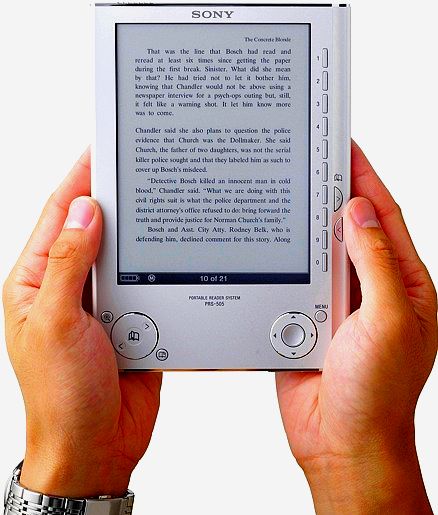
  • The [Kindle] Works of Elizabeth Gaskell – at Amazon, for $3.99 you can download most of her works to your Kindle; but if you search further, there are several free downloads of the individual novels, and other various collections; review the contents before selecting.
  • Barnes & Noble:  same as Amazon, some collections for $3.99, many free options.
  • Borders:  has various similar options 

iPhone Apps:   
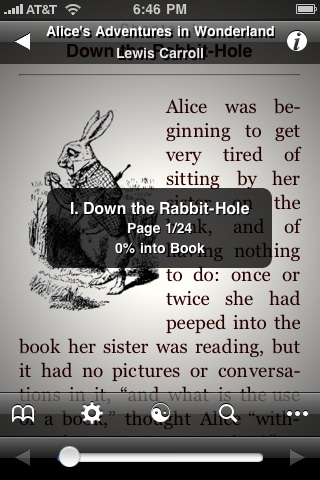
Whatever you use for books on your iPhone, there are plenty of free Gaskells available.  I use Stanza, which is a free app [there are many others – visit your iTunes store and search “books” under Apps and see what I mean!], and from there you can choose the following: Feedbooks has several; Project Gutenberg has the same as online noted above; but Munsey’s takes first prize for having the most – seems to have all the novels and stories as best I can make out – so if you are stranded at an airport or in stopped traffic, what better way to pass the time than a Gaskell short story?! 
 

Audiobooks:  

  1. Cousin Phillis (unabridged)
  2. Cranford (unabridged)
  3. North and South (abridged)
  4. North and South (unabridged)
  5. Wives and Daughters (unabridged)
  6. Wives and Daughters (abridged)
  • Silksounds:  has only My Lady Ludlow, read by Susannah York  [very good!]
  • CSA Word:  Best of Women’s Short Stories, vol. 1& 2.  Read by Harriet Walter [a.k.a. Fanny Dashwood] Includes Gaskell’s “Right at Last” and “The Half Brothers”; CSA Word also has an abridged version of Mary Barton [read by Maggie Ollerenshaw] and North and South [read by Jenny Agutter].
  • LibriVox:
  1. North & South
  2. Other Gaskell works in various states of completion 


Movies:
 [see the various blog posts listed below for movie reviews]

  1. Wives & Daughters (1999)
  2. North & South (2004) – with Richard Armitage and Daniela Denby-Ashe ~ sigh!
  3. North & South (1975)  – with Patrick Stewart and Rosalind Shanks
  4. Cranford (1972) 
  5. Cranford  / Return to Cranford (2007, 2009)
  6. Cousin Phillis (1982)
  7. The Gaskell Collection – DVDs  – includes 7 discs:  W&D, N&S, CRANFORD and all special features.

******************************* 

Well, there’s a fine list for winter reading, listening and viewing! And somewhere in the middle of all that, treat yourself to a re-watch of Armitage in North and South! [and then of course READ it again … here is a link to an older blog post about the book and movie

 ************************

This is a rather quick list of goodies – if any of you know of a particular edition of a book, or an ebook, or an audio edition you particularly like, or a movie that I do not mention, please let me know so I can add it to the list – thank you! 

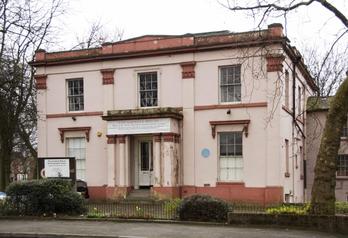
Follow this link to to the next blog on the Elizabeth Gaskell Bicentenary Blog Tour by Tony Grant at London Calling:  Plymouth Grove – A Visit to Elizabeth Gaskell’s home in Manchester

***********************

The Gaskell Blog Tour:  Here is the complete tour through the 15 blog posts celebrating Gaskell’s Birthday today: and remember that one lucky commenter will win a copy of an unabridged edition of North and South by Naxos AudioBooks read by Clare Willie. That’s 18 hours of Margaret Hale and John Thornton sparring and sparking in Gaskell’s most acclaimed work.  Here is a list of participants. You can visit them in any order and all comments during the contest will count toward your chance to win. Good luck and Happy Birthday Mrs. Gaskell!

Biography

Novels/Biography

Novellas

Resources

Sometimes one likes foolish people for their folly, better than wise people for their wisdom.” Elizabeth Gaskell, Wives and Daughters

[Posted by Deb]
Book reviews · Jane Austen · Regency England · Women Writers

Book Review ~ ‘The Quiet Gentleman’ at Austenprose

As mentioned in a previous post, Laurel Ann at Austenprose has been celebrating Georgette Heyer through the month of August, with various guest reviews of the novels and interviews with Heyer experts.  Laurel Ann had asked me to write a review of The Quiet Gentleman, which is posted today, and Bath Tangle which will be posted August 20th. 

Reading Georgette Heyer is a new experience for me, and the immersion has been quite enjoyable – I most like stumbling upon her Austen echoes, and they are there in her characters, her settings, her plots – Heyer greatly admired Austen amd read and re-read her through the years.  I don’t agree with those who think that Heyer is another Austen [here is a short article on the topic], but it is a lesson in influence to read Heyer’s romances [and her mysteries aren’t half-bad either!], and see where Austen touches her.

You can read the review of ‘The Quiet Gentleman’ here  at Austenprose – please visit and comment; I’ll post the full text here next week.

Austen Literary History & Criticism · Collecting Jane Austen · Jane Austen · News · Social Life & Customs · Women Writers

Janeites at the Morgan

A triple series of Janeite interest in the Pierport Morgan Library & Museum’s Austen Exhibit —

From Janeite Hope:

From now until March 14th the Morgan Library and Museum is exhibiting “A Woman’s Wit: Jane Austen’s Life and Legacy.” According to the website, the exhibition “explores the life, work, and legacy of Jane Austen (1775–1817), regarded as one of the greatest English novelists. Offering a close-up portrait of the iconic British author, whose popularity has surged over the last two decades with numerous motion picture and television adaptations of her work, the show provides tangible intimacy with Austen through the presentation of more than 100 works, including her manuscripts, personal letters, and related materials, many of which the Morgan has not exhibited in over a quarter century.”

There is an online exhibition that includes images of pages from the manuscript of “Lady Susan” along with a short documentary film commissioned for the exhibit. The film contains brief interviews with several writers, scholars, and actors (you’ll recognize Harriet Walker – Fanny Dashwood in the Thompson Sense and Sensibility). Though the interviews are interesting, what I like best about the documentary is watching the participants handle Austen’s letters and manuscripts. Bit of a vicarious thrill, there.

More at: www.themorgan.org/exhibitions/exhibition.asp?id=22


From Janeite Suzanne:

I’d never been to the Morgan, so I’m glad to have discovered it. There was a little film showing downstairs in the theater to introduce the JA exhibit. It had a variety of people giving their thoughts about the letters. It was ok, but seemed like rather a stretch to pad the exhibit and not particularly valuable. And it bothered me a bit to see someone actually handling the letters. They were also playing the movie, none too quietly, in the actual exhibit room which I found annoying because at that point I wanted to enjoy looking at the letters undisturbed.

They were hard to read, of course, but one could read much of it, even with cross writing and that was nice. Seeing the actual “JA” was a thrill. I was surprised that one letter had the JA squished right down to the edge of the paper and the “a” was a large lowercase a, not the one we think of as her signature and which was on everything else.

 There were period copies of the books she would have read and some delightful period satirical illustrations, but what I liked best was a letter she’d written to a youthful Cassy. It would have been better if the presenters hadn’t “translated” it for us because that was the fun. I felt that I gained some insight into J’s character from seeing how she wrote this to a child and also that she was able to form the words as smoothly as if they had been familiar letters sequences. I shall have to make up my own text, but it will give you the idea of her “code”.

Read Yssac,

Ew Era ta emoh yadot dna ti si gniniar. Spahrep ew lliw eb elba ot og rof  a egairrac edir siht noonretfa. I ylniatrec epoh os esuaceb ereht era ynam sgniht ew dluohs tisiv erofeb ew evael Thab.

Rouy gnivol tnua, Enaj

Now, wasn’t that fun! It’s much harder than simply writing backwards, especially the capitalization. Now I have to wonder if she thought it up herself.


from Janeite Bonnie:

JUST WANTED TO LET YOU KNOW:

Last night, I went to the Morgan Library and Museum’s exhibition “A Woman’s Wit: Jane Austen’s Life and Legacy”, and, oh, what I saw!! I didn’t know that the Morgan holds the world’s largest collection of Austen’s letters, 51 of the 160 known ones. The curators trotted out many of the more well-known letters, and it was thrilling to see them in the original hand. Among the Austenalia I got to examine:

–cross-hatched letters and letters with lines excised by Cassandra
–the backwards letter to her niece Cassy
–the letter in which she writes of the gentleman on which she “once doated”
–the letter in which she writes of having a shaking hand from having drunk so much wine, and mentions the woman with the diamond bandeau, pink husband, and fat neck, and James Digweed having made a gallant remark about the two elms falling down in grief over the absence of Cassandra (a particularly enjoyable letter, and dated November 20–serendipitously read by me 209 years to the day later)
–the letter in which she drew the pattern of the lace for her new cloak
–the letter in which she asks Cassandra to tell Fanny that she has found a portrait that looks “excessively like” how she pictures Mrs. Bingley
–the page on which she sums up her expenditures for a year
–her satirical “Plan of a Novel” (very difficult to read)
–Cassandra’s letter to Fanny describing Austen’s last days and her death
–some pages of the manuscript of “The Watsons” with much editing
–some pages of the manuscript of “Lady Susan” (of which the Morgan holds the entire manuscript)
–James Stanier Clarke’s letter to Austen, in which he tells her that it is not *incumbent* on her to dedicate her next novel to His Royal Highness the Prince of Wales, but…
–first editions of all six novels, including the spines of a three-volume set of “Emma” with the price on the original labels
–one of the books that Austen owned, “The Spectator”, with her signature and “Steventon” inscribed inside

There was other material on display related to Jane Austen, such as books by Richardson and Cowper, a copy of “Camilla” open to the page of subscribers where “Miss J. Austen, Steventon” is listed (believed to be the only time her name was in print before her death), Walter Scott’s original journal open to the page of his comment about Austen’s “exquisite touch” versus his “Big Bow-wow strain”, material by Yeats, Nabokov, and Kipling, an edition of Pride and Prejudice with a preface by George Saintsbury (he who coined the term “Janite”, now “Janeite”), and, to top it off, original prints by James Gillray interspersed among Austen’s letters to punctuate some of the trenchant comments she made in them.

As a little bonus, on the way out I stopped by Mr. Morgan’s library and took a peep at the original 1843 manuscript of “A Christmas Carol” and one of the three Gutenberg Bibles (1455) in the Morgan collection.

All I can say is, I’m so thankful for the Morgans’ use of their money in this manner.

in a second email, the following wonderful & exciting tidbit was added:

I have one more thing to tell. It happened during the question-taking portion of the gallery talk. One of the enthusiasts in the crowd questioned Declan Kiely, the curator of the exhibition, about the attribution of one of the documents — a scrap attributed to Jane Austen, with the titles of all her novels. The woman questioned whether it was actually Jane Austen who had written it, as the title “Persuasion” was listed, and she thought that that was the title Henry had given it after Jane’s death, and that she had always called it “The Elliots”. I had read that too, but I wasn’t sure that it had not been settled on before her death, as there are other theories out there.

Afterwards, a few of us compared it with the note that she wrote summing up some profits from her books, which was in the same frame, and we saw that the capital P’s didn’t match. However, now that I see the “Profits” scrap close up on the Morgan website, I do see two different ways that Austen wrote capital P on the same scrap

(See the P in “Mansfield Park”, then compare it to the P in “Profits from Emma” quite near the blot of ink.)

If it is the case that Jane Austen habitually wrote her capital P two ways, then the scrap with all the titles of her novels that is attributed to her would confirm that she intended the title of her last novel to be “Persuasion”, and all the speculation should be laid to rest.

I think it will require another trip to take a closer look and see if there are similarities of script in Cassandra’s letter to Fanny, and look for capital P’s in all of Jane Austen’s other letters…

I don’t know if people are aware of this, but the Morgan has no entrance fee from 7:00 PM and 9:00 PM on Fridays.

Austen Literary History & Criticism · Jane Austen · Jane Austen Circle · Literature · News · Women Writers

“Literary Property Changing Hands” ~ after the auction…

Ever wonder what happens to all those books and manuscripts that show up at auction and then disappear somewhere into the ether, briefly looked at wistfully in the catalogue and then only something you file away in your bibliographic memory chip??  I know I do this with all the Jane Austen materials  [see the post my Bygone Books blog for the latest Austen titles on the block ]

The recent Bloomsbury Auction, The Paula Peyraud Collections:  Samuel Johnson and Women Writers in Georgian Society [New York City, 6 May 2009] [click here for the catalogue and auction results] was of great interest to collectors and readers of 18th and early 19th century women writers.  A recent article by Dr. Maureen E. Mulvihill (Princeton Research Forum, Princeton, NJ), titled “Literary Property Changing Hands: The Peyraud Auction (New York City, 6 May 2009)”  [Eighteenth-Century Studies, vol 43, no. 1 (2009) pp. 151-63…..] sheds light on this world of auctions and book collecting, and tells us who bought many of the lots and where they are now to be found.   As Dr. Mulvihill writes, “the sale was a dramatic validation of continuing interest and commercial investment in cultural property of the Georgian period, especially its women writers.”  [p.152] 

The sale consisted of 483 lots, mostly books, manuscripts and letters, but also many visual works of art somehow relating to the authors Ms. Peyraud collected.  [The dominant figures in the collection were the women writers of the era:  Frances Burney, Hester Thrale Piozzi, the Bluestockings, Maria Edgeworth, Jane Austen and the Brontes; but also several male writers:  Samuel Johnson, Alexander Pope, Edmund Burke, David Garrick, Horace Walpole, and Lord Byron.]

The article also gives some history of Paula Peyraud [1947-2008] and the depth of her collection [the auction barely scratched the surface it seems…], and this alone is a compelling  story of the habits of a woman collector.

My interest here is largely with the Jane Austen lots in the auction [see my post on this auction here], and unfortunately, although the results of the auction are available online [see below as well as my previous post], the five lots of Austen works seem to have been purchased by private collectors and are undisclosed.  And the one Austen-related piece of art, a miniature of Elizabeth Bridges, Austen’s sister-in-law, remained unsold.   

[title, estimate, price realized]

  • Emma-1816- 3 volumes: [$8,000-12,000] – $9500.
  • Mansfield Park-1814- 3 volumes: [$7,000-10,000] – $7500.
  • Northanger Abbey-1818- 4 volumes: [$5,0008,000 ]-   $5500.
  • Pride and Prejudice-1813- 3 volumes Carysfort copy: [$20,000-30,000] – $26,000.
  • Sense and Sensibility-1811- 3 volumes: [$25,000-35,000] – $38,000. [or $46,360. with premium]

Austen aside, it is fascinating to see how many of the other lots are now in Library collections, and thus available for research purposes:  The British Library, Dr. Johnson’s House, the University of Manchester, McGill University [10 lots of Frances Burney materials], the Houghton Library at Harvard [Johnson and Hester Thrale], the Morgan Library, New York Public Library, the University of Pennsylvania Rare Book Library, Princeton University [Maria Edgeworth], Vassar Library [Burney], and Yale University Beinecke Library [Yale acquired the “star of the show” for $140,300. – 8 volumes of Hester Thrale Piozzi’s heavily annotated copy of The Spectator.]  Harvard purchased the most lots, and a Zoffany full-length portrait of Hester Thrale [lot 379] was the second highest sale at $58,560.

[from the Bloomsbury Auction Catalogue]


 See the full article at this link at Bloomsbury Auctions: [prices in the article reflect hammer prices and premium]

bloomsburyauctions-peyraud-mulvihill.pdf

Just added:  Dr. Mulvihill’s February 2010 article “Captured by Jane” on the Morgan Library’s Jane Austen exhibition is in the online magazine of the Jane Austen Centre.  If you did not get to see this wonderful exhibition last year, this is the next best thing to being there… you can view the article here.

[Posted by Deb]

Books · Jane Austen · Literature · Women Writers

‘Dancing with Mr. Darcy’ ~ a Book Review & Book Giveaway!

book cover dancing mr darcyDancing with Mr Darcy: Stories inspired by Jane Austen and Chawton House Library
Selected and introduced by Sarah Waters
Honno Modern Fiction, 2009
ISBN:  978-1-906784-08-9
UK  £7.99 [paperback]

[I made mention of this book in another post in which Lane Ashfeldt, author of one of the short stories in this anthology [titled Snowmelt ] did an interview for this blog.  Ms. Ashfeldt has graciously offered to send a copy of the book to anyone who comments on this or the previous post –  please comment by Saturday, November 14, 2009 – I will announce the winner on November 15th – see below for full details.]

My reading over the years has not tended to short stories.  But I do remember when my children were little, I spent my scattered reading allowance doing just that – it was the need to finish something, the escape perhaps for a few moments at least to another place that widened my world – a time to re-read the short novels of John Steinbeck, to discover Alice Munro, Flannery O’Connor, short detective works, etc… anything to keep the mind at work!  But short stories never held much interest for me – I wanted a bigger canvas, a longer immersion – but it was perhaps really an understanding of my own inability to appreciate the short story in its best incarnation. 

I picked up Dancing with Mr. Darcy at the Chawton House Library table at the JASNA AGM more as the need to add it to my Jane Austen collection with thoughts of at least reading Ms. Ashfeldt’s story… so it is with great delight that I found I could not put this book down!  Sarah Waters, in her introduction, outlines the criteria for the competition: it must be well-written, be a self-contained short story that stands on its own, and must have a connection to Jane Austen, her life, her work, her Chawton home, or the Chawton House Library.  The author of each of the twenty stories in this anthology appends a paragraph explaining how Jane Austen inspired their writing – these alone are worth the reading!

I read Snowmelt first – and this tribute to reading and libraries and books seems to have come from my very own thoughts, my concerns with the future of same.  Miss Campbell, who fears the end of the world is at hand, is a librarian at a library that is closing its old building and reopening in a new space with far more computers than books – she visits Chawton House Library to research an early nineteenth century author*, and realizes that life it too short to not be doing what she truly loves and makes drastic changes to her life as a result.

She rang the bell, signed in, climbed the uneven wooden steps and knocked at the library door.  A simple room.  Books, wooden desks, lamps.  A concentrated silence that she longed to bottle and unleash in her own library.   

This is a lovely story – and as I said, it conveyed so many thoughts of my own – the future of libraries, the technological changes that are on the one hand absolutely amazing and on the other frightening – what will the future be for the book in this world of kindles and Google books and the like. I was right there along with Miss Campbell, with the aching longing to be working in a library that houses all the works of human accomplishment that one can touch!

[* the previous post asked the question of who the author might be that Miss Campbell is researching and the book she requests at the library…. If you can guess this, please post it in your comment…I will announce the name of the book and author at the end of the giveaway; see below for a few hints…]

The winner of the competition is the first story in the anthology:  Jane Austen Over the Styx by Victoria Owens, where we find Austen in Hades, before the “court of the dead” expecting to address her “faults” in life [think her wicked tongue, her accepting-rejecting Bigg-Wither, etc], and instead facing the likes of Mrs. Bennet, Lady Catherine de Bourgh, Mrs. Ferrars, Mrs. Churchill, Lady Russell and Mrs. Norris! – her creations all – the crime? “her willful portrayal of female characters of advanced years, as a snob, a scold, or a harpy who selfishly or manipulatively interferes with the happiness of an innocent third party” [p. 11] – and invoking the words of the great Austen critic DW Harding himself with his theories of “regulated hatred”, Jane is brought to task – an inspired story and great fun! [and you must read it to find if Jane is deemed guilty or not, and how she indeed defends herself! – and of course, it is such a delight to see and hear Mrs. Norris again!]]

JASNA’s own Elsa Solender shared runner- up status with her Second Thoughts – which in Austen’s own voice, following her accepting the marriage proposal of Harris Bigg-Wither, tells of the agonizing decision to tell him the next morning “we should not suit” – it is beautifully conveyed and one feels that Ms. Solender captures exactly what happened that night.

Jayne, by Kirsty Mitchell, also a runner-up, tells of a young woman of a literary bent, struggling to survive at all costs, working as a soft-porn nude model, all the while quoting Shakespeare and knowing full well she must “if she have the misfortune of knowing anything, [should] conceal it as well as she can”  [p. 39, quoting Northanger Abbey] – conveying the 21st-century version of the economic struggles of single females of a certain class…

The twenty stories offer the gamut – some use Austen’s characters in new situations, as Elinor Dashwood Ferrars as a detective [she does after all in Sense & Sensibility hear everyone else’s secrets!] [The Delaford Ladies’ Detective Agency by Elizabeth Hopkinson]; or in Somewhere by Kelly Brendel, where Mrs. Grant of Mansfield Park is given a voice of her own.  There are re-tellings of a particular story in a contemporary setting, as in Second Fruits by Stephanie Tillotson, where, as in Persuasion, her characters “experience separation, maturation and second chance.” [p. 201]  And likewise in Eight Years Later by Elaine Grotefeld, where a young man visiting Chawton House with his mother plans to reunite with his teenage crush from eight years before – he is, like Captain Wentworth, “half agony, half hope.” [p. 75]

There are several stories with teenage protagonists where Austen either inspires, as in The Watershed by Stephanie Shields, where a found used copy of Pride & Prejudice alleviates family and school stresses, and the young bookworm in Hilary Spiers’s Cleverclogs, who finds that her grandmother’s favorite book Sense & Sensibility is also hers.  Or the story that mirrors Austen as in The Oxfam Dress, by Penelope Randall, where a 21st-century Lydia Bennet goes on a shopping spree.  Bina, by Andrea Watsmore, tells of a teenage girl who finds that her true love was right there all along [an Emma of sorts]; and in The School Trip [Jacqui Hazell], a young woman finds on visiting Chawton that all ones needs to write is “a little space, a tiny desk and a creaky door.” [p. 212]

And there are a few stories that resonate but don’t fit a category:  An older, lonely spinster in We Need to Talk About Mr. Collins by Mary Howell finds that perhaps she didn’t let romance into her life…; an amateur play group putting on a Pride & Prejudice theatrical during a bombing raid in Miss Austen Victorious [Esther Bellamy]; a bridesmaids’ weekend gone completely awry in The Jane Austen Hen Weekend by Claire Humphries; and one of my favorites, One Character in Search of her Love Story Role by Felicity Cowie, where a fictional character in the making pays a call on Jane Bennet and Jane Eyre for some insightful conversation about love and choices!

We seem of late to be surrounded in Austen sequels and prequels and spin-offs and re-tellings with zombies and vampires and sea monsters and all manner of creatures, and while I have often sounded off on these largely because I just want to read Austen “as she was wrote” I do also admit to liking some of them! – but these stories in Dancing with Mr. Darcy are so much more – they take the Jane Austen that we all love and admire and cannot get enough of, and create something new and lovely in her wake – be it a character, an idea, a storyline, or just a feeling – here is Austen as she inspires 21st century writers and it is a gift to all of us.  I very much hope that Chawton House Library will offer such a competition every year – this is the true legacy of Jane Austen and such writing should be heartily encouraged.

[I should also add that along with Miss Campbell, I react strongly to the physical tactile nature of a book – and Dancing with Mr. Darcy does not disappoint – it is just physically lovely, very nicely put together, and just one more reason to add this to your Jane Austen collection!]

5 of 5 full inkwells – Highly recommended!


Book Giveaway:  Please post a comment or a question to me or author Lane Ashfeldt by November 14, 2009 and you will be entered in a book giveaway contest.  Please also try to guess the title of the book and its author that Ms. Ashfeldt’s character Miss Campbell has requested at the library [HINT:  written in the early 19th century, the novel takes as its theme the wiping out of the entire human race by the year 2073.]

I will announce the winner on November 15, 2009.  All are welcome to enter.  Ms. Ashfeldt will send a copy of the book directly to the winner.

Thank you for all your comments…and many thanks to Ms. Ashfeldt for her offer of the book…!

Further information:

Honno Press
Chawton House Library
Lane Ashfeldt website
Lane Ashfeldt blog

[Posted by Deb]


Books · Regency England · Women Writers

Some Thoughts on Georgette Heyer’s Heroines

The following is a guest post from one of our JASNA-Vermont members, Janeite Lynne.  After she commented on my post on Georgette Heyer’s ‘Frederica’ , Lynne and I were in touch and discovered that we both seem to be having a parallel summer of reading Heyer! – she sent along the following thoughts on Heyer’s heroines  ~ we welcome comments on YOUR favorite Heyer female lead and why ~ and thank you Lynne for sharing your thoughts!

I recently submitted a comment to Deb’s blog about Georgette Heyer’s novel Frederica.  I noted in my comment that Heyer’s plots were formulaic.    I hope that this isn’t a spoiler, but the lead male and female characters do end the novels by expressing, admitting, or realizing their love for their opposites.  The more Heyer you read, the more you see stock characters: the arrogant but honorable duke; the rake with a good heart; the headstrong heiress; the penniless relation in a noble family, etc.  Yet within these stock shells, Heyer brings out three dimensional characters.  

book cover bath tangle

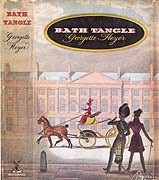
I especially admire Heyer’s strong female leads.  But strong is not always the same.  Serena Spenborough in Bath Tangle is a powerful woman in the traditional sense.  She is rich, beautiful, and she travels in the highest circles of society.  The plot device of Bath Tangle involves her fortune being tied up after her father’s death until she marries.  Even when she is more financially constricted, you are never in doubt that she will always be rich, so this is one form of power.  She also refuses to follow the accepted social conventions that coddle and restrict women of her class.  She is a vigorous walker and refuses chairs in Bath.  She rides on horseback all day in pursuit of a runaway without thought to comfort or propriety.  And she cried off  from a marriage earlier in her life because she believed they would not suit without thinking about how it would affect her social standing.  Serena’s character is a good match for the male lead, the Marquis of Rotherham.  He is the man she rejected years before the novel opens, and the dialogue between them is like swordplay. 

book cover sprig muslin

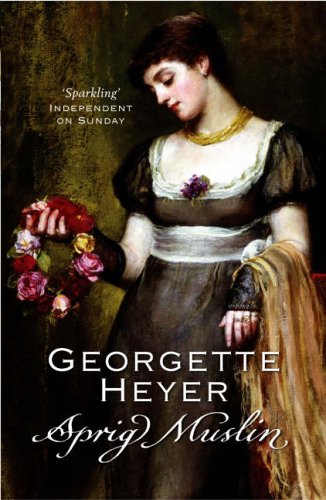
Still, powerful women in Heyer come in many different packages.  Another of my favorites is Lady Hester Theale in Sprig Muslin.  She is a spinster daughter whose father describes her as insipid and without fortune or “any extraordinary degree of beauty.”  When he tells Hester that she will soon receive a proposal from the extremely eligible Sir Gareth Ludlow, he says: “ I don’t mind owning to you, Hester, that when he broke it to me that it was my permission to address you that he was after, I thought he was either foxed, or I was!” Every member of her family attempts to browbeat her into accepting his proposal, but she refuses.  She reminds me of Melville’s Bartleby in his short story Bartleby the Scrivener.   She simply chooses not to.  Hester is the anti-Serena.  She is not rich or beautiful, and she has no one to support her, yet in her own ethereal way she asserts her independence.  She will not accept a marriage of convenience, even if it would seem to offer her a better life.  She knows what it is to love, and she will not compromise.

 So while there is formula in Heyer, there is also wonderful character development and dialogue.  Best of all, she was such a prolific writer that there are many novels to escape to during this rainy summer!

[by Janeite Lynne, posted by Deb]

Jane Austen · Literature · Women Writers

Ann Radcliffe ~ July 9, 1764

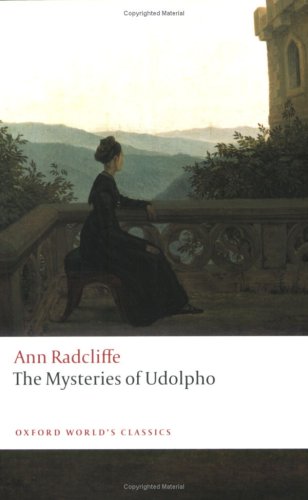
You are cordially invited to visit my Bygone Books blog for a short bio – bibliography on Ann Radcliffe, born today, July 9, 1764.

cover mysteries udolpho

Posted by Deb

Book reviews · Jane Austen · Literature · Women Writers

Book Review ~ ‘North and South’ by Elizabeth Gaskell [with special thanks to Richard Armitage]

North-and-South cover

I think I must be the only costume-drama-loving-female in all of America who did not see the 2004 (2005 USA) adaptation of Elizabeth Gaskell’s North and South – where my head was that year I do not know – and add to that a further confession of never having read the book! – I am ashamed of myself!  Can I have lived this long so in the dark?  Are my English degrees so worthless in the light of this omission? 

I have a good number of Gaskell’s books on my shelves, but there they sit awaiting that future day to begin my Gaskell immersion.  But all this endless chatter on the airwaves [as well as a few friends imploring me to see the movie – largely a Richard Armitage thing…],  I finally broke one of my cardinal rules – I saw the movie before reading the book.  There were advantages of course to this sequence – every appearance of John Thornton on the page most pleasantly brought the absolutely lovely Mr. Armitage to mind – not a bad punishment for breaking this long-held rule of mine! – but I digress…

 The story [for those of you more in the sand than me…] – Margaret Hale, a young woman from rural southern England [Austen’s Hampshire to be exact], daughter of a clergyman, proud of her roots and her class, must adjust to the changes in her life when her father resigns from his clerical post and moves the family to the northern industrial town of Milton [Gaskell’s fictitonalized Manchester].  Margaret gradually discovers her own strengths in taking on the many domestic duties of her now ill mother and those of their former servants.  But Margaret carries with her the prejudices of the gentrified South with her “queenly” snobbish views of the industrial North and the manufacturers and tradesmen who run the mills.  She is soon introduced to John Thornton, a self-made “Master” of one of the cotton mills and a local magistrate, well respected by his peers and his employees, yet aware of his shortcomings in the social and intellectual worlds outside of Milton.  He comes to Reverend Hale for tutoring and intellectual stimulation – but it is Margaret who soon captures his heart, his passions aroused in spite of himself, all too sure of his own unworthiness in her eyes…

n&s- margaret

Margaret opened the door and went in with the straight, fearless, dignified presence habitual to her.  She felt no awkwardness; she had too much the habits of society for that.  Here was a person come on business to her father; and, as he was one who had shown himself obliging, she was disposed to treat him with a full measure of civility.  Mr. Thornton was a good deal more surprised and discomfited than she.  Instead of a quiet, middle-aged clergyman, a young lady came forward with frank dignity – a young lady of a different type to most of those he was in the habit of seeing.  Her dress was very plain: a close straw bonnet of the best material and shape, trimmed with white ribbon; a dark silk gown, without any trimming or flounce; a large Indian shawl, which hung about her in long heavy folds, and which she wore as an empress wears her drapery.  He did not understand who she was, as he caught the simple, straight, unabashed look, which showed that his being there was of no concern to the beautiful countenance, and called up no flush of surprise to the pale ivory of the complexion.  He had heard that Mr. hale had a daughter, but he had imagined that she was a little girl …  Mr. Thornton was in habits of authority himself, but she seemed to assume some kind of rule over him at once…. [p 72-3]   He almost said to himself that he did not like her, before their conversation ended; he tried so to compensate himself for the mortified feeling, that while he looked upon her with an admiration he could not repress, she looked at him with proud indifference, taking him, he thought for what, in his irritation, he told himself he was – a great rough fellow, with not a grace or a refinement about him.  Her quiet coldness of demeanour he interpreted into contemptuousness, and resented it is his heart … [p.74]

 And Margaret’s view of Thornton:

 “Oh! I hardly know what he is like,” said Margaret lazily; too tired to tax her powers of description much.  And then rousing herself, she said, “He is a tall, broad-shouldered man, about- how old, papa?”…  “About thirty, with a face that is neither exactly plain, nor yet handsome, nothing remarkable – not quite a gentleman; but that was hardly to be expected.”… “altogether a man who seems made for his niche, mamma; sagacious and strong, as becomes a great tradesman.”

n&s first look


 Ahh!  the pride and prejudices are set on each side, each thwarting their developing relationship – and a scenario not unlike Austen’s Pride & Prejudice unfolds.  Margaret’s ingrained dislike of northern ways are gradually tempered by her sympathetic friendship with a family of mill workers and her growing appreciation for Thornton’s true nature;  and Thornton’s own views of his employees and his responsibility to them are enlarged by Margaret’s very “democratic” views of an industrialized social system gone awry.  It is a compelling read – [alert! there are some spoilers here ]– 

Gaskell wrote North and South in 1854-5 – it appeared in serialized novel form in Dickens’s Household Words [Gaskell felt the ending was “unnatural” and “deformed” (1) – she added and edited for its publication as a book in 1855].  North and South is another of her works to focus on the social ills of the day – religious doubt; “Master” vs. hands and accompanying union struggles; male vs. female in the male-dominated industrial world; the responsibility of the owner / ruling classes to involve themselves in the lives of the less fortunate.  But this novel has a more romantic telling than her previous works and perhaps why it remains one of her most enduring titles.. [ See my previous post on Gaskell for some background.] 

And this comparison to Austen’s Pride & Prejudice cannot be ignored [just the title alone echoes Austen’s work] — Jenny Uglow in her introduction to the book (2) and in her fabulous biography of Gaskell (3) called North and South an “industrialized Pride & Prejudice,” “sexy, vivid and full of suspense” (4) – and indeed this states the case most eloquently.  At last year’s JASNA AGM in Chicago on Austen’s legacy, Janine Barchas spoke on Gaskell’s North and South being the first of many Pride & Prejudice clones (5).  The basic formula of P&P is what keeps people coming back for more, an annual re-read one of life’s many pleasures – and one can readily make a list of the similarities, all too clear despite Gaskell’s never making mention of her debt to Austen – this conflict of pride and prejudices, though often a gender reversal in Gaskell’s work [see Barchas’s article for a complete analysis of Margaret as Darcy and Thornton as Elizabeth], the awakening of their passions, and the emotional growth of Margaret and Thornton, the similarities in the secondary characters [Thornton’s sister Fanny is certainly as silly as Lydia; Mrs. Thornton’s visit to Margaret is almost a word for word Lady Catherine exhorting Elizabeth]; Thornton anonymously saving Margaret from a shameful exposure just as Darcy saves Elizabeth by forcing Wickham to do right by Lydia; and a final resolution of two people who finally overcome their own limited mindsets;  and of course the turning point in both novels is the proposal scene, halfway through each book, the language similar, the devastating results the same.

But in Austen, who never felt comfortable with writing what she did not know, the mind of Darcy is never fully exposed to the reader [and the reason for the endless stream of sequels from Darcy’s point of view! –  and also why the Andrew Davies adaptation with a glaring, agonized Colin Firth has such a strong hold on us all…] – but Gaskell was no prim Victorian in bringing the thoughts of Thornton to the page – he is clearly obsessed with Margaret from their first meeting noted above –  and when he is visiting the Hales for tea, he focuses relentlessly on her arm and her bracelet: 

She stood by the tea-table in a light-coloured muslin gown, which had a good deal of pink about it.  She looked as if she was not attending to the conversation, but solely busy with the tea-cups, among which her round ivory hands moved with pretty, noiseless daintiness.  She had a bracelet on one taper arm, which would fall down over her round wrist.  Mr. Thornton watched the replacing of this troublesome ornament with far more attention that he listened to her father.  It seemed as if it fascinated him to see her push it up impatiently until it tightened her soft flesh; and then to mark the loosening – the fall.  He could almost have exclaimed – “there it goes again!”  [p. 95]

Thornton watches her, listens to her, seeks her out, thinks of her all the time, and only when he believes he must protect her virtue does he express these pent-up feelings to her.  Her rejection of him is devastating, though only unexpected because he believes she can do no less than submit to him – Gaskell clearly gives us a picture of a passionate, inconsolable man, almost beautiful in his agony – we do not need an Andrew Davies to draw this picture for us.  It is as though Gaskell needed to put some finishing touches on the Darcy of our imaginations…

His heart throbbed loud and quick.  Strong man as he was, he trembled at the anticipation of what he had to say, and how it might be received.  She might droop, and flush, and flutter to his arms, as her natural home and resting-place.  One moment he glowed with impatience at the thought that she might do this – the next he feared a passionate rejection, the very idea of which withered up his future with so deadly a blight that he refused to think of it…

He offers his love, she rejects him:

 “Yes, I feel offended.  You seem to fancy that my conduct of yesterday was a personal act between you and me; and that you come to thank me for it, instead of perceiving, as a gentleman would – yes! a gentleman,” she repeated….. – he says she does not understand him; she says “I do not care to understand” –  [p.242-3] … and she afterward thinks, “how dared he say that he would love her still, even though she shook him off with contempt?” [p.245]


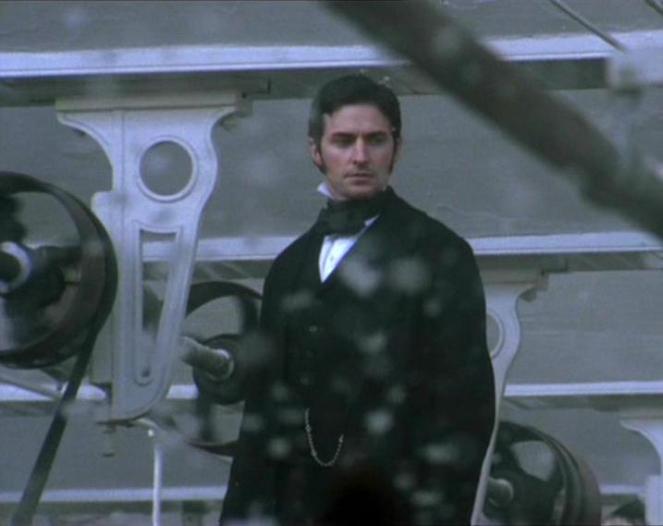
As only Hollywood [and the BBC] can do, there is the usual mucking about with the novel – a few changes [how they first meet, how they at last connect for starters!],  deletions and insertions, a few character shifts, to make the movie more palatable to a contemporary audience – and though one can always quibble with the results of these probable midnight discussions [and I so often ask – WHY did they DO that?  Why not just leave the book as it is, PLEASE!] – but that all aside, this movie is just lovely, no way around it… Daniela Denby-Ashe is a beautiful heroic and compassionate Margaret, and Richard Armitage SO perfect as John Thornton – he brings Thornton’s internal life so beautifully to the screen – it is a pitch-perfect performance [and the spring-board for his subsequent career – not to mention the Armitage online sites, the Facebook pages, YouTube concoctions, endless bloggings, women the world over in a communal swoon about this man!] [and alas! we ALL suffer for his NOT being the latest now-in-production Knightley incarnation…]  Really, this all makes the 1995 Darcy-fever / Colin Firth insanity look like a kindergarten flirtation.  I should just do an Armitage post with all the many links, pictures, readings – but I AM struggling here to stick to the book! 

[but as an aside, if you haven’t seen Armitage as the evil Guy of Gisborne in BBC’s latest Robin Hood, get thee hence to your nearest video store and see the first two seasons now – there was never such fun in obsessing over the ultimate bad guy – a man just shouldn’t look and sound this lovely! – and after that, see The Impressionists [he is the young Monet], and then for a complete hoot see the last two shows of The Vicar of Dibley…] – but back to North and South [who can resist?], is there any scene in ANY movie to compare to “Look back – Look back at me” ?? !

N&S look back at me

[though even I have to admit it has to run a close second to Cary Grant in An Affair to Remember at his wrenching discovery of the painting in Deborah Kerr’s bedroom]…

But again, I digress! –  Gaskell has given us a story similar to Pride & Prejudice in the basics, but set in the northern Victorian world she depicts so graphically – this is darker than Austen, without her language and ironic wit, there are certainly no Mr. Collinses around to give us needed comic relief [though on second thought, Fanny Thornton jumps right off the page as a very real self-absorbed very ridiculous girl and there are indeed many moments of humor] – this is a fabulous read, not easily forgotten with its powerful romance with its strong sexual tensions and the very real social issues of the time with such engaging characters in the lower class world of the mill workers.  Read this book – then buy the movie [you will want to see it more than once!] – and thank you Richard Armitage for bringing me to this book in the most delightful roundabout way!

N&S kiss


Notes and Further reading: 

1.  Uglow, Jenny.  Elizabeth Gaskell: A Habit of Stories.  NY:  Farrar Straus Giroux, 1993, p. 368.

2.  Gaskell, Elizabeth.  North and South, with an introduction by Jenny Uglow.  London:  Vintage Books, 2008. [page numbers cited are to this edition]

north and south vintage cover

3.  Uglow, Jenny. 1993 biography.

4.  Gaskell, Elizabeth.  North and South, 2008 edition, p. xvi.

5.  Barchas, Janine.  “Mrs. Gaskell’s North and South: Austen’s Early Legacy.”  Persuasions, No. 30, 2008, pp. 53-66.

 Movies: 

1. North and South, BBC 2004 [2005 USA] starring Daniela Denby-Ashe and Richard Armitage [see Imdb.com]

2. North and South, BBC 1975, starring Rosalie Shanks and Patrick Stewart [see Imdb.com]

Links: [a very select few to Gaskell, the book, the movie, and finally Richard Armitage, who indeed requires a post all his own…]