Austen Literary History & Criticism · Jane Austen · Jane Austen Popular Culture · Jane Austen Sequels · Query

A Colonel Brandon by any Other Name?

One of the funnier lines in Emma is when Mr. Knightley asks Emma to call him “George” after he has proposed to her. We of course know he is named George because the narrator tells us so, but while we are introduced to him in Chapter 1, we do not learn his full name until Chapter 12, in this very off-hand remark: 

…when John Knightley made his appearance, and “How d’ye do, George?” and “John, how are you?” succeeded in the true English style… [Emma, vol. 1, ch 12.]

We are given an earlier hint in Chapter 6 when one of John Knightley’s children is called “George”, but if you haven’t been paying attention to these very easy to miss throwaway lines, you will be happy to learn his name in vol. 3, ch. 17. 

    ‘Mr. Knightley.’ You always called me, ‘Mr. Knightley;’ and, from habit, it has not so very formal a sound. And yet it is formal. I want you to call me something else, but I do not know what.”

    “I remember once calling you ‘George,’ in one of my amiable fits, about ten years ago. I did it because I thought it would offend you; but, as you made no objection, I never did it again.”

    “And cannot you call me ‘George’ now?”

    “Impossible! I never can call you any thing but ‘Mr. Knightley.’ I will not promise even to equal the elegant terseness of Mrs. Elton, by calling you Mr. K. But I will promise,” she added presently, laughing and blushing, “I will promise to call you once by your Christian name. I do not say when, but perhaps you may guess where; — in the building in which N. takes M. for better, for worse.” [Emma vol. 3, ch. 17]

“My dearest most beloved Emma, tell me at once…” – C. E. Brock, Emma at Molland’s

But what of the other Austen heroes and their given names?:  we have George, and Edward, Edmund, Fitzwilliam, Henry, Charles, Frederick, and even Willoughby is named “John” – but it seems that Colonel Brandon is alone among her men to be first-nameless … though as you will see, no one seems to actually know this!

When I attended several of the Sense and Sensibility weekends at the Governor’s House in Hyde Park , one of the questions on the innkeeper’s very-hard-to-score-well-quiz during the brunch on Sunday, is What is Col. Brandon’s first name?  Every weekend ended with the majority of people saying “Christopher” – but it is of course a trick question:  Austen does not give her Col. Brandon a first name: you can re-read / search the book, but the surest proof is Chapman’s index of characters, where it notes thus:

Colonel BRANDON, of Delaford in Dorsetshire; thirty-five (34, 37); thirty-six (369); 2,000£ a year (196); m. Marianne Dashwood.

Now we trust Chapman because he names some of the most obscure of Austen’s characters that many of us would be at a loss to even say which book they are from …  he must be right, so why then is  “Christopher” so commonly thought of as his first name…?

Enter Popular Culture:

I was surprised a few weeks ago, and the reason I started to write this post, to notice this on Wikipedia:

Colonel Christopher Brandon — a close friend of Sir John Middleton. In his youth, Brandon had fallen in love with his father’s ward, but was prevented by his family from marrying her because his father was determined to marry her to his older brother. He was sent into the military abroad to be away from her, and while gone, the girl suffered numerous misfortunes partly as a consequence of her unhappy marriage, finally dying penniless and disgraced, and with a natural (i.e., illegitimate) daughter, who becomes the ward of the Colonel. He is 35 years old at the beginning of the book. He falls in love with Marianne at first sight as she reminds him of his father’s ward. He is a very honorable friend to the Dashwoods, particularly Elinor, and offers Edward Ferrars a living after Edward is disowned by his mother.

[From Wikipedia on S&S the Book]

Now one knows to read everything on the internet and especially Wikipedia with a wary eye, but this is a glaring error… 

If you go to The Republic of Pemberley, and its Genealogy of Characters in S&S, a very trusted source, it is very clear that his name is only Col. Brandon, as Austen wrote him.

 And what of the Sequels and Fan-Fiction?  I show here only a few, but now we are in a bit of a naming muddle…

Amanda Grange calls him “James” in her Col. Brandon’s Diary

And in the new book The Three Colonels: Jane Austen’s Fighting Men, by Jack Caldwell,
we are given a very romantic Brandon complete with a “Christopher.”

 And see this Fan Fiction.net site we find Col and Mrs. Brandon by Drusilla Dax – where he is also named “Christopher.” 

And Jane Odiwe in her Willoughby’s Return? She names her Col. Brandon “William.”

I asked her why?: 

 I named him William in Willoughby’s Return – just because I like the name, and it’s one that Jane used (William Price). I’ve always been fascinated by the fact that she used the same names for completely different characters.

I like this answer from Ms. Odiwe – she has been thoughtful in choosing a name for her Brandon. But I also want to share with you a very nasty review from an irate reader of Odiwe’s sequel – you can read the whole piece on Amazon.co.uk but here is the relevant rant [which makes the whole review seem quite ridiculous]: 

…. and not even well researched. Marianne is married to William Brandon – whoever he may be – Colonel Brandon’s Christian name was Christopher…..

I had to comment on this – I am not a big fan of really nasty reviews – I would rather say nothing at all, so I blanche at such negativity, but here I wonder if the woman has ever actually read Sense & Sensibility The Book by Jane Austen at all – she has perhaps only seen the movie? wherein we find our illusive “Christopher”…. 

… courtesy of Emma Thompson, her Col. Brandon the “Christopher” most of us seem to want!

 IMDB:  Emma Thompson’s S&S

 and her Brandon, a.k.a. Alan Rickman, even has a Facebook presence as Colonel Christopher Brandon !

 So on to Andrew Davies 2008 Sense & Sensibility with David Morrissey in the role – though Davies succeeds in “sexing” up his Brandon, he does get this right – his Brandon has no first name…

At the Masterpiece Theatre S&S site, click on Col. Brandon and “Christopher” is nowhere in sight…

We can ask what were the most used names in late 18th century England?

 Common 18th Century Male Names [from the Official Fanfiction Universityof the Caribbean website ( ! )]

Alexander, Andrew, Benjamin, Bernard, Charles, David, Edmund, Edward, Emmett, Francis, Frederick, George, Harold, Henry, Hugh, James (Jim, Jimmy, Jem), John (Johnny, Jack), Jonathan, Joseph, Julian, Louis, Matthew, Nicholas, Oliver, Paul, Peter, Phillip, Richard, Robert, Rupert, Samuel, Sebastian, Seymour, Simon, Stephen, Stuart, Thaddeus (Tad), Theodore, Thomas, Timothy, Tobias, Walter, Wesley, William

Notice how many of the names are those used by Austen!  but alas! no “Christopher” – though I am perhaps not being fair – the name has been a common one in England since the 15th century. 

So, these are just some thoughts – I am without my research tools as I write this, so wonder if in Emma Thompson’s screenplay and diaries to her Sense & Sensibility, does she mention baptizing her Brandon with the Christian name of Christopher? – does it appear in any earlier sequels, other movies? –  and the most interesting question of all? – why did Jane Austen not give him a name? – and why are we all so compelled to do so?

Please comment if you can add anything to this dilemma – and do tell us if you wanted to give Brandon a first name, what might you name him?? – just  please do not let it be “Richard”!*

“Colonel Brandon was invited to visit her” – a C. E. Brock illus from S&S at  Molland’s

******************

*Note: Austen’s commentary on the name Richard is from Northanger Abbey: Catherine’s father is “a very respectable man, though his name was Richard.” [NA vol. 1, ch. 1]

 Copyright @2012 Jane Austen in Vermont 
Austen Literary History & Criticism · Jane Austen · JASNA-Vermont events · News · Schedule of Events

JASNA-Vermont ~ “How to Love Jane Austen’s Sanditon” ~ April 15, 2012


You are Cordially Invited to JASNA-Vermont’s April Meeting

 ~ How to Love ‘Sanditon’ ~

with


  Eric Lindstrom* 

A celebration of Jane Austen’s last unfinished work: Many readers find it difficult to “love” Sanditon. Critics and readers alike can find it alternately boring, bitter and uproariously wild, either likening it to her juvenilia or seeing only the morose shadow of her impending death. Join us as UVM Professor Eric Lindstrom helps us relate to and learn to love this text, even though it does not offer the typical Austen marriage plot. 

*****

Sunday, 15 April 2012, 2 – 4 p.m. 

 Champlain College, Hauke Conference Center, 375  Maple St Burlington VT  

Free & Open to the Public
Light refreshments served 

For more information:   JASNAVermont@gmail.com 
Please visit our blog at: http://JaneAustenInVermont.wordpress.com

************************************ 

*We are honored to welcome Eric Lindstrom, an Assistant Professor at the University of Vermont where he teaches courses primarily on Romantic Literature and Critical Theory.  He is the author of Romantic Fiat (2011), and is currently working on a study of Austen’s canny relation to philosophical developments since her time, tentatively titled “Jane Austen and  Other Minds.”

Eric Lindstrom

Please Join Us!

**************

**Upcoming in 2012 ~ see blog for details and mark your calendars!**

Ju
ne 3: Brooklyn College Professor Rachel Brownstein on her book Why Jane Austen?
Sept. 23: Author Elsa Solender on her book Jane Austen in Love: An Entertainment
Dec. 2: Annual Birthday Tea with Paul Monod of Middlebury College on
                “The Royal Navy in the Age of Nelson, 1775-1815”

*****************************

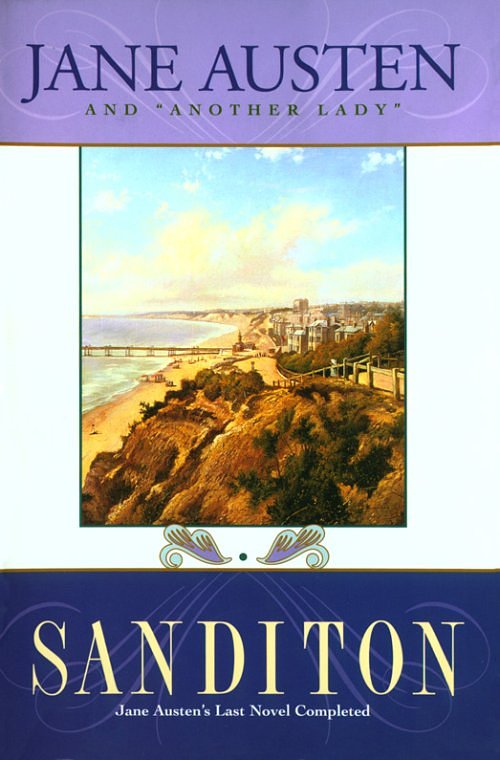
I will be shortly posting more information on Sanditon – its publishing history and criticism, and the continuations, and various links.  But please try to read this short fragment for the meeting – we promise lively discussion, but thankfully no quizzes! – think about how Austen might have completed this last work – who is the heroine, the hero? what was she trying to convey about the seaside? – many thoughts to consider, so bring your questions and ideas!

Copyright @2012 Jane Austen in Vermont
Books · Collecting Jane Austen · Jane Austen · London · News

A Sad Loss in the World of Jane Austen

I was saddened today to read about the death of Vera Quin. A message was sent to various JASNA contacts from Louise West, curator of the Jane Austen House Museum in Chawton.

 Claire Bellanti, Margaret Chittick & Vera Quin at JASNA’s 2011 AGM in Fort Worth,Texas
[photograph from Kerri S. with thanks] 

I had the pleasure these past few years of hearing Ms. Quin and her friend Margaret Chittick speak on all things Jane Austen at the JASNA AGMs: 

  • in 2008 in Chicago, we saw “Looking at Landscape with Austen in Her Time and Ours”
  • in 2009 inPhiladelphia, we discovered how “Marginal Siblings Stir the Plot”
  • In 2011 in Fort Worth, we heard that indeed “Sense and Sensibility is Full of Surprises”!

…all three offering a great interchange between Vera and Margaret as they shared their knowledge and love of Jane Austen with an abundance of information, insight and laughter!

And two of my favorite books in my Jane Austen collection are by Vera Quin:

Jane Austen Visits London. Cappella Archive, 2008. 50pp.
PB: 978-1-902918-46-4: £6.00

Most of the thirty surviving letters that Jane Austen wrote during her visits to London between 1796 and 1815 were written to her sister Cassandra. They provide a detailed account of the people she met and the many events she attended.

Vera Quin gives particulars of the houses where she stayed and Jane’s relationship with her London relatives, especially her brother Henry, who started in business as a banker and then became a parish priest. Despite their length and wealth of information, the letters reveal very little of Jane’s feelings, although there is more than a hint of a flirtation with the young Tom Lefroy. [from the publisher’s website]

and… 

In Paris with Jane Austen. Cappella Archive, 2005. 250pp.
HB:1-902918-22-3: £17.00; PB: 1-902918-32-0: £12.00

One fascinating byway of English Literature is how quickly pirated versions of Jane Austen’s novels were translated into French and made available in Paris so soon after their publication in England. Despite the Napoleonic Wars a variety of English books and scientific papers was smuggled to France for translation, sometimes on cartel ships exchanging French and English prisoners of war.

Vera Quin has writen an engaging guide book to those streets in Geneva and Paris where Jane’s Austen’s novels were translated; where the printers and booksellers lived, and the libraries from which copies were borrowed.

She considers the differences between the English and French versions whereby, much like modern television adaptations, subtlety of language was lost but romantic appeal was amplified. She includes much background material, providing a very clear account of the French Revolution and details of the work of contemporary female novelists who were Jane Austen’s continental literary competitors. [from the publisher’s website]

[You can find copies at Cappella Archive; the London book is also available at Jane Austen Books [call to see if they might have the Paris book as well…] ]

Vera did much for her Jane Austen Society in the UK and we have been fortunate to have her attend and participate in our own JASNA gatherings where she brought much grace and humor.  I am most grateful to have seen her and to have these two book gems to remember her by – she shall be greatly missed…

 Copyright @2010 Jane Austen in Vermont
Books · Jane Austen · Jane Austen Popular Culture · Literature · Rare Books

A Jane Austen Sighting ~ in Northumberland!

If you have seen the Friday Video on the Two Nerdy History Girls blog today, you will find this great short on the background to the “Keep Calm and Carry On” poster that is now seen and heard everywhere.  I didn’t realize that the poster was discovered in a box at this fabulous bookstore, Barter Books in Alnwick Station, Northumberland, and the rest as they say is history.

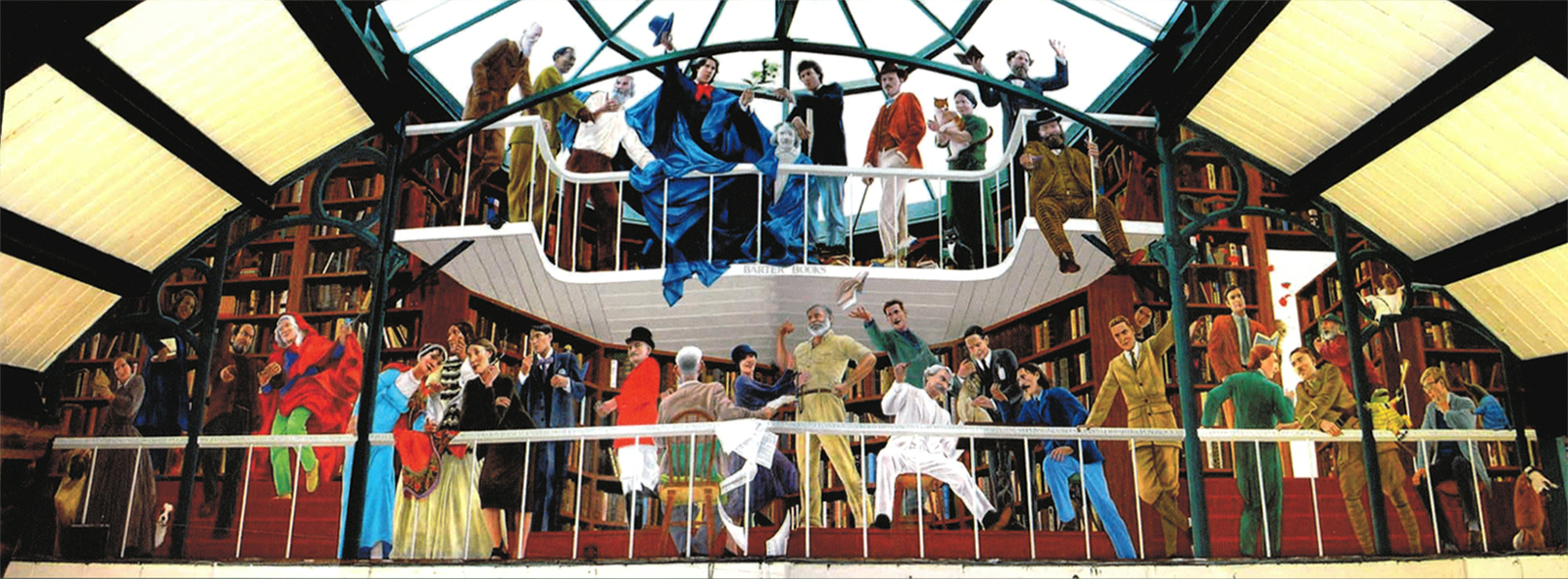
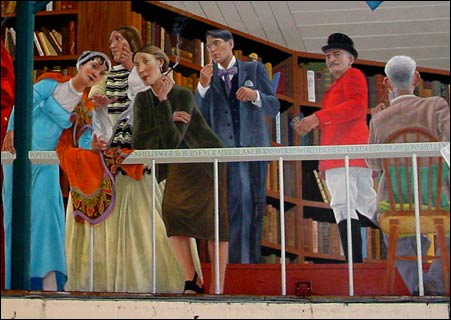
But in searching around the bookstore’s website (one of my addictions sorry to say), I discover a lurking Jane Austen in the “Writer’s Mural” in the shop:  visit the website yourself to explore the painting and enlarge the various images and find out why each author has been included, but here is the full painting, by Peter Dodd, the panel with Jane Austen, and a closeup of her image…

Famous Writers Gallery, by Peter Dodd
Jane Austen and Friends
Jane Austen closeup

Are any of your other favorite writers lurking about here? – if you were to compile such a wall mural, which authors would you put in it?

All Images courtesy of Barter Books – visit them soon!

Copyright @2012 Jane Austen in Vermont
Jane Austen · Jane Austen Popular Culture · News

A Jane Austen Character Weekend ~ at the Governor’s House in Hyde Park, VT

Last August, the Governor’s House in Hyde Park Vermont hosted an “in character” Jane Austen Weekend.  One of the participants, Tess, who appeared as Miss Darcy, has prepared a delightful video of the weekend, capturing the antics of the likes of Mrs. Croft, Mrs. Elton, Isabella Thorpe, and other various Austen characters as they rode horses, engaged in archery and croquet and needlework, and danced the night away! Here is the video of the fun now on youtube for all to enjoy!

If you would like to take part in this Austen back-in-time adventure this coming year, you can sign up for the upcoming August 10-12, 2012 weekend by visiting the inn’s website here: http://www.onehundredmain.com/jane_austen.html – Mr. Collins anyone?

Books · Jane Austen Popular Culture

Book Giveaway announced! ~ and the winner is…

… Karen Field, who commented on 2-24-12 at 8:04 pm.  Congratulations Karen! you have won a copy of Jane Austen in Love: An Entertainment by Elsa Solender.  If you have a kindle [you mention that you do!], you can download the book here at Amazon.com, and I will reimburse you the $8.99 – or we will send you a copy of Dancing with Mr. Darcy, which includes Ms. Solender’s story “Second Thoughts.”  Please let me know which you prefer and your contact information.

If I don’t hear from you by Friday March 9, 2012, I will draw another name.

Thank you all for particpating, and to Elsa Solender for her gracious answers to all my questions!

Copyright @2012 Jane Austen in Vermont
Author Interviews · Books · Jane Austen · Jane Austen Popular Culture

Book Giveaway Reminder! ~ Jane Austen in Love by Elsa Solender

Reminder! – today is the last day to comment on the post about Elsa Solender’s Jane Austen in Love: An Entertainment.  Go here: http://tinyurl.com/73grlcc and post your comment to be included in the drawing tomorrow March 5, 2012.

Copyright @2012 Jane Austen in Vermont
Great Britain - History · Jane Austen · Jane Austen Societies · News

The “Library Passage” in Worthing Under Threat of Closure ~ How You Can Help

I have just heard from a friend of mine, Chris Sandrawich, membership secretary of the Jane Austen Society Midlands Branch, and his concern about the threat to the “Library Passage” in Worthing.  This path is termed a “twitten” – an old Sussex dialect word said to be a corruption of “betwixt and between.” Jane Austen stayed in Worthing in the fall of 1805 after the death of her father, and there met Edward Ogle, Worthing’s leading citizen. Austen was there with her mother, friend Martha Lloyd, and sister Cassandra [and why we have no letters!], and they would have used this “twitten” as a short-cut by-way to both the sea-front and the Library.    

[You can read more about Austen’s connection with Worthing and Mr. Ogle in this October 2011 article in Sussex Life.   [[and note that the full-text of this article is in the JAS Report for 2010, “Edward Ogle of Worthing and Jane Austen’s Sanditon.”] 

The importance of Austen’s stay in Worthing and her meeting Mr. Ogle? – the town is very likely the model for Sanditon, and Mr. Ogle the inspiration for Tom Parker.   

The former Library is now a bus station and the bus company wants to close this passage off for what they say are safety reasons – this connection to Jane Austen is at risk of disappearing. The house in Warwick Street where Jane Austen stayed was called Stanford’s Cottage – it is now a Pizza Express, but proudly displays a plaque on the wall commemorating Austen’s stay. 

Mr. Sandrawich visited Worthing last year on a tour with his Midlands group – he has written an essay on this tour which will be published in their journal Transactions this year – and I append here, with his permission, an extract from his article on this twitten:  [and I append a map here in the event you haven’t a clue where Worthing actually is…]

West Sussex - wikipedia

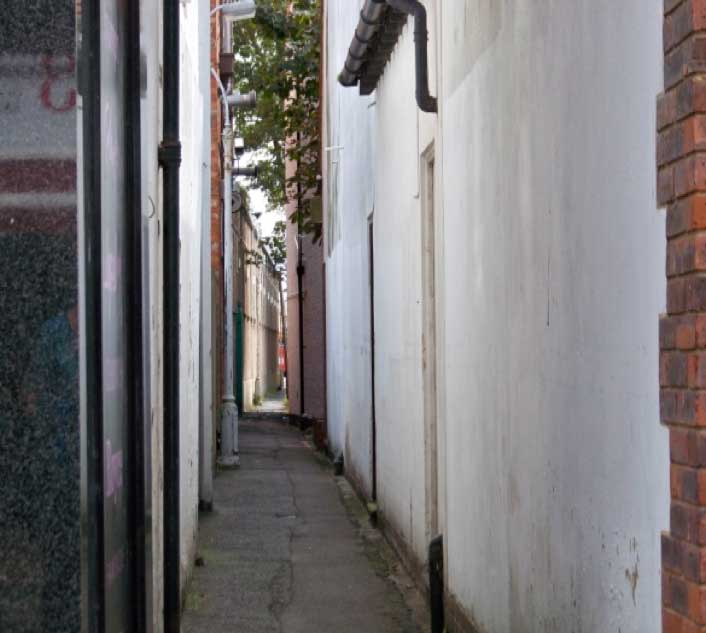
So, what of Worthing the place? It is clear that the town is struggling through the doldrums given the number of estate agents’ signs over empty shop fronts, but it is pleasant enough to stroll through, and you can always find something of interest. For example, the history of English is varied and fascinating and along with so many new words we have some that are very old, and still in use. Worthing has an interesting old Sussex dialect word, twitten , said to be a corruption of ‘betwixt and between’ although the on-line Oxford Dictionary suggests it is an early 19th Century word (unbelievably!) perhaps related to Low German twiete ‘alley, lane’, used for a path or an alleyway. It is still in common use in both East and West Sussex, and oddly enough in Hampstead Garden Suburb. As tussen, steggen or steeg in the Netherlands has a similar meaning it would be all too easy to assume that source as the derivation. Such pathways between buildings have other names around the world, but elsewhere in England twittens are called variously, twitchells (north-west Essex, east Hertfordshire and Nottingham), chares (north-east England, especially Newcastle), ginnels – which can also be spelt jennels or gennels – (Manchester, Oldham, Sheffield and south Yorkshire), opes (Plymouth), jiggers or entry (Liverpool), gitties or jitty (Derbyshire and Leicestershire), snickleways or snicket (York), shuts (Shropshire) and are called vennels in Scotland; but it is not known what our Jane called them, but it is very likely she may have called the “Library Passage” shown on the right a twitten as Jane used it with her family to get from Stanford Cottage to Stafford’s Library, as well as the sea front. This fine example of a Worthing twitten is just off Warwick Street, and only a lady’s baseball (see Northanger Abbey) throw from Stanford Cottage. Janet Clarke informed me that this twitten is currently under threat from a bus company, Stagecoach, who owns the land and wish to “stop it up” permanently. This twitten now runs from Warwick Street into the bus depot. Of course, anything being an ancient historic “right of way” for the ordinary people of England and Wales does not put off Companies from making such proposals whenever it suits the moment. Look at it again, while you have the chance, and if this twitten through your half-closed eyes and with some imagination resembles a footpath through dense woodland; then, there you have it.

 ********************

Mr. Sandrawich is looking to muster support from all of us who have an interest in Jane Austen, asking us to voice our concern for the loss of this pathway, so What can we do? 

Here is the text of the letter that the Midlands Branch has sent to Janet Clarke of Worthing, who is spearheading this effort to halt the closure:

                                                       The Jane Austen Society Midlands

A Worthing twitten, and right-of-way, known as “Library Passage” 

We understand that you are seeking support to prevent the present owners of the land including the ‘Library Passage’ from permanently stopping it up and at one stroke preventing future use as a short-cut and right of way, and also removing an historical connection between Worthing and Jane Austen. 

As you know, in 1805, at the time of the Trafalgar and Nelson’s famous victory Jane Austen and her family stayed at Stanford’s Cottage, adjacent to this twitten, and would certainly have used this short-cut known as the ‘Library Passage’ to gain direct access to both the sea-front and the library. The library in those days was the focal point of social gatherings to meet, discuss and converse as well as to see and be seen and take refreshments whilst perhaps reading papers, magazines and books. In their months staying in Worthing Jane Austen and her family probably used this route on a daily basis.

This very library has changed its use and now forms part of the administrative buildings for the bus depot, where the twitten ends. 

Sir Walter Scott is famous for his fulsome praise of Jane Austen but Anthony Trollope also praised her work and wrote, “Miss Austen was surely a great novelist. What she did, she did perfectly. Her work, as far as it goes, is faultless.” and many other examples in praise of her genius can be found placing Jane Austen at the forefront of great British novelists. 

The connection between Worthing and Jane Austen has only comparatively recently come to light and our Society visited Worthing in October last year, and we were very interested to see the twitten known as the ‘Library Passage’ and to understand its connection with Jane Austen’s stay. We feel sure that our Society’s visit to Worthing will be only one of many, as other Societies all around the world learn of this Austen connection, and any Jane Austen fan would be very pleased to see the twitten, she must certainly have used, remain open and unaltered and would be equally dismayed to see it lost forever. 

We, the Committee of The Jane Austen Society Midlands, fully support the view that the twitten known as ‘Library Passage’ should remain open and its connection with Jane Austen made more widely known. 

Yours sincerely  
Chris Sandrawich, Membership Secretary

and Jennifer Walton, Chairman                                                                                                                  

_________________________________________ 

Written submissions have to be in before March 28th and the actual hearing is on April 25th at the Chatsworth Hotel in Worthing.  If you would like to have a voice in this, please comment here and I will let you know who and where to send your letter of support.

 Thank you all! – this is your chance to be proactive and do something to save this important connection to Jane Austen’s life and her writing of Sanditon.

Copyright @2012 Jane Austen in Vermont 
Collecting Jane Austen · Jane Austen · Jane Austen Popular Culture · Regency England · Social Life & Customs

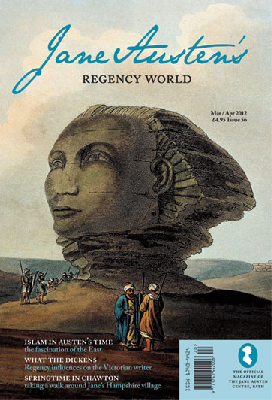
Hot off the Presses! ~ Jane Austen’s Regency World No. 56

Coming soon to your mailbox!

In the new issue (No. 56, March / April 2012): 

  • Archaeologists excavate the site of Steventon rectory
  • Romance of the East: how Regency travellers were fascinated by Islam and the Orient
  •  Best-selling novelist Karen Doornebos asks why grown men swoon over Mr Darcy
  •  How Charles Dickens, the bicentenary of whose birth is celebrated this year, was influenced by Jane Austen’s contemporaries
  •  Maggie Lane explores Frances Burney’s experiences at the Royal Court
  •  Jane Austen’s nieces in Ireland- the amazing true story of May, Lou and Cass
  • Finding the fools in Northanger Abbey *
  • Plus the latest Jane Austen news, readers’ letters, book reviews and news from Jane Austen societies around the world

[*John Thorpe anyone?]

Subscription information is available at www.janeaustenmagazine.co.uk

Jane Austen’s Regency World magazine is the only full-colour glossy magazine dedicated to Jane Austen and the Georgian and Regency times. It is published six times a year in Bath, England, and mailed worldwide by subscription. Copies are also sold via Jane Austen’s House Museum, Chawton; the Jane Austen Centre, Bath; and Jane Austen Books in the US.

[Text and image from JARW]

Copyright @2012 Jane Austen in Vermont
Great Britain - History · Jane Austen · Regency England

Jane Austen in Kent ~ Or, How a Set of Pimpernel Coasters Set Me on a Journey…

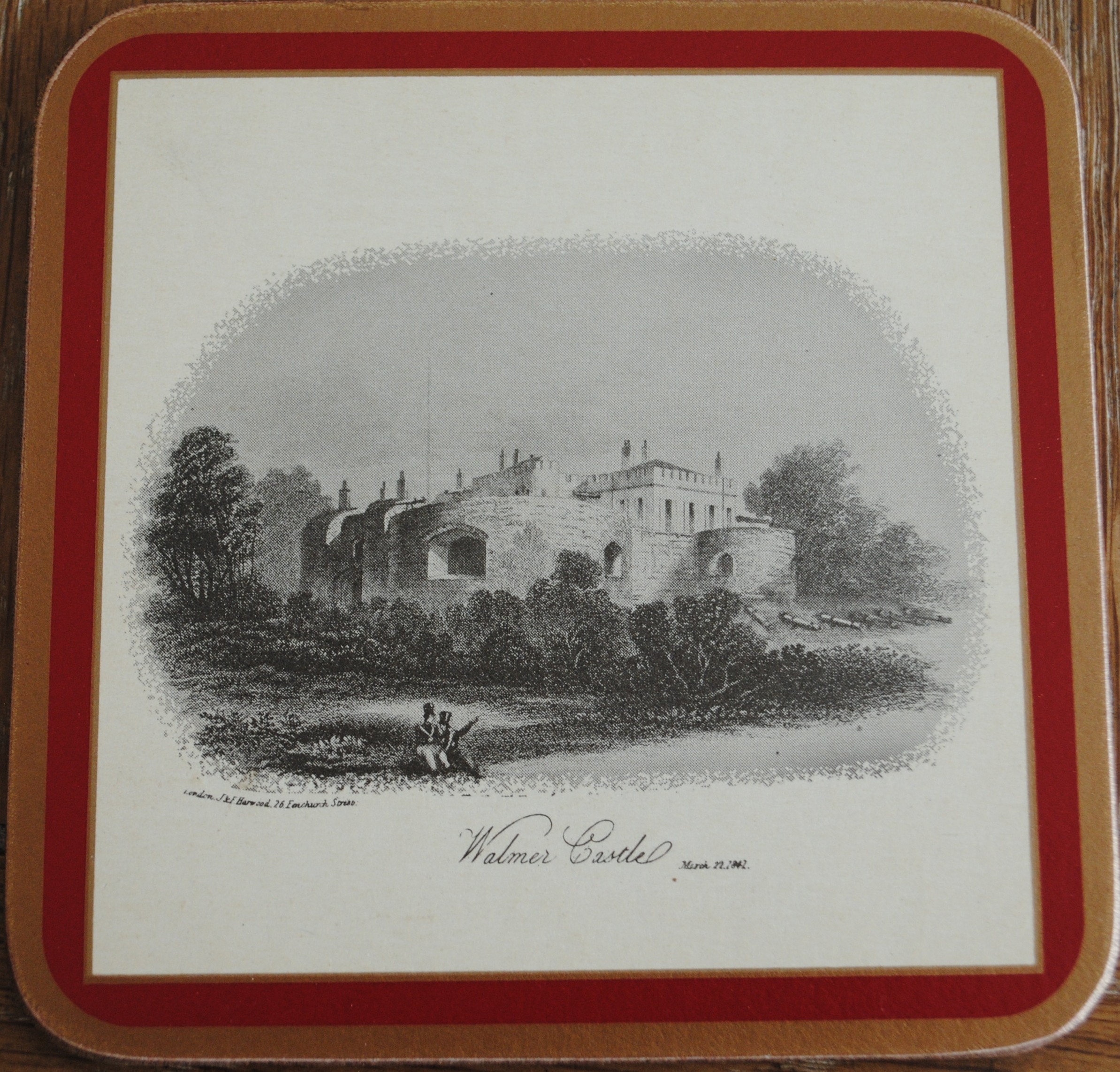
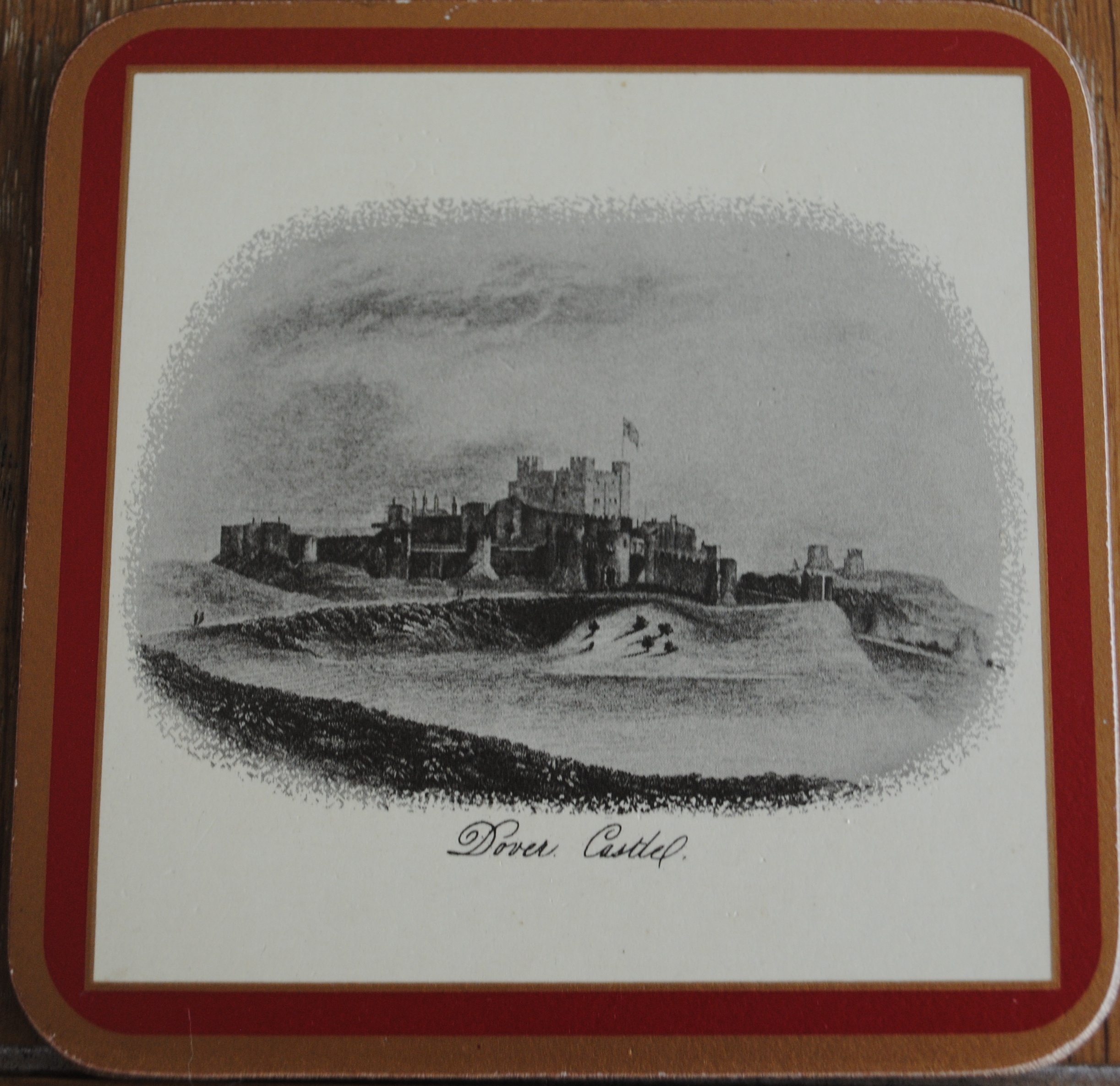
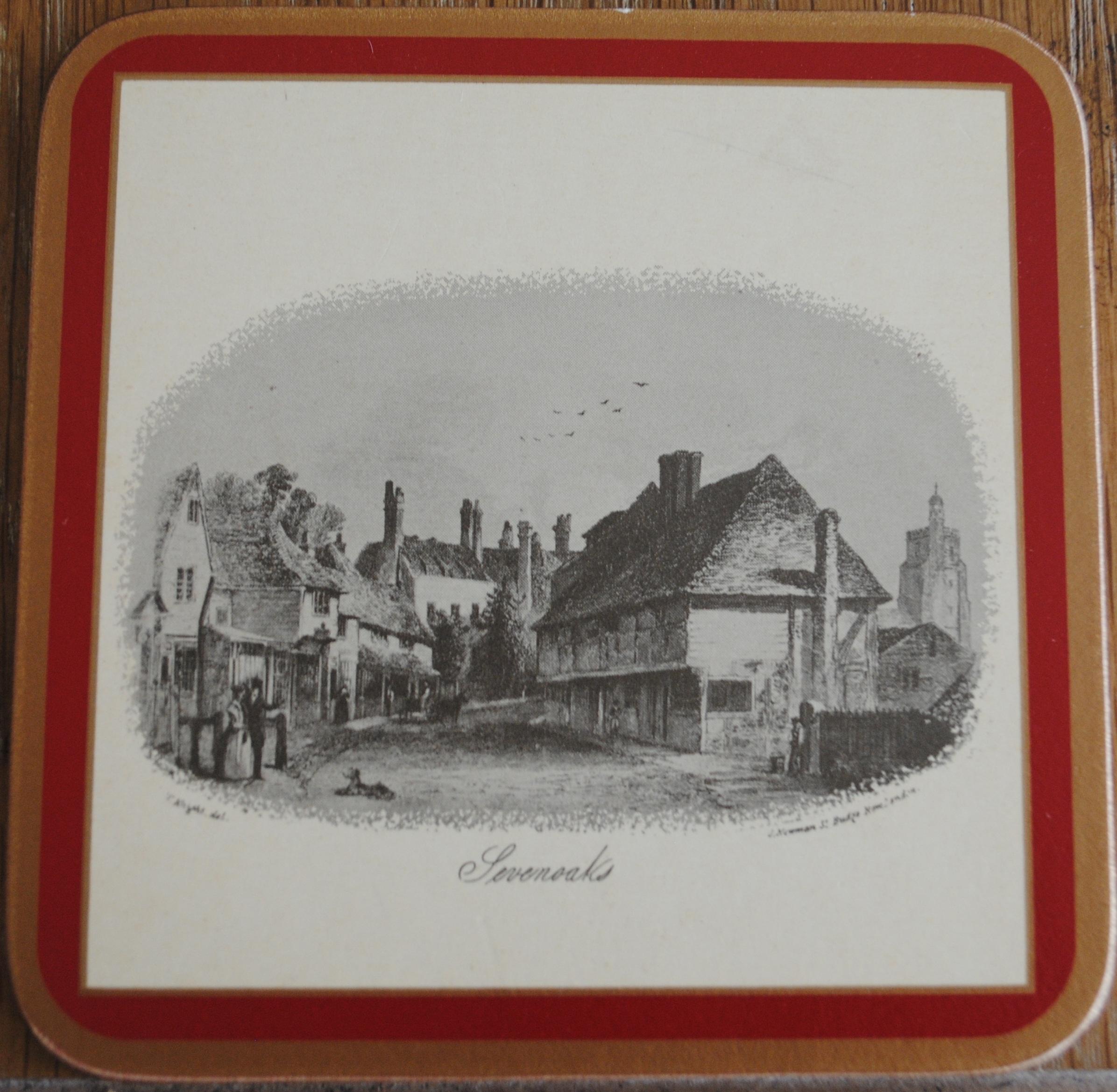
Browsing around an antique shop last week, I spotted a boxed set of six Pimpernel coasters, each coaster’s image an engraving of a British Heritage site in Kent, and all bordered by red and gold bands.

Pimpernel Coasters - British Heritage, Kent

Not sure how old these are – the box is plain white with an image on the front, but they were $3.00 in unused condition, and who could resist them? – all places that Jane Austen may have visited on her many trips to Kent [alas! my book Jane Austen in Kent by David Waldron Smithers is not in hand – I am lost!]

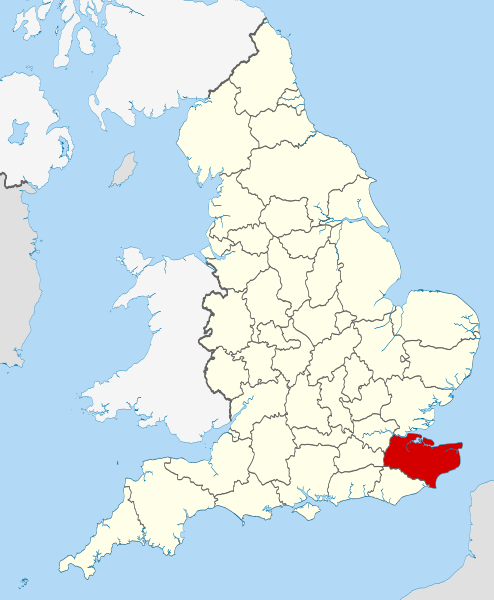
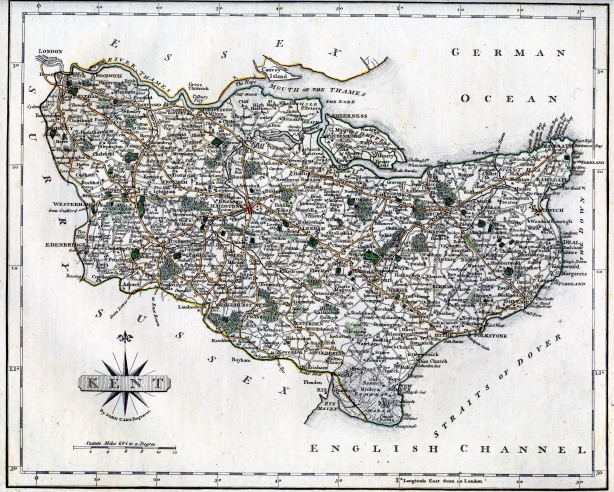
I have been to England many times, but have not seen the Jane Austen sites in Kent, so let’s take a short tour through these six coastered” sites, wondering if Austen visited any of them, beginning with, where IS Kent anyway?

Map of Kent’s location in England – wikipedia

and here a map of Kent, from Julie Wakefield’s Jane Austen Gazetteer

**********************

We do know that Jane Austen visited Kent many times, traveling through to her brother Edward Austen-Knight’s home at Godmersham Park, and staying in various coaching inns along the way:

 Godmersham Park – image from Frontispiece.co.uk

 and to Goodnestone Park, the home of the Bridges family and Jane Austen’s sister-in-law Elizabeth Bridges [when Austen’s brother Edward and Elizabeth first married, they lived in Rowling, a house on the Goodnestone estate.

Goodnestone Park (wikipedia)

Austen may have indeed visited each of these places on my now treasured coasters. We have only her letters to tell us for sure and I depend upon the homework already done by Deirdre Le Faye in her indexes to those letters [4th ed., Oxford, 2011], and by Julie Wakefield at the aforementioned sister site to Austenonly,  A Jane Austen Gazetteer, where Kentish sites are cross-referenced to the letters.

So here are the six places on the coasters – a perfect journey through Kent, with a little bit of history thrown in, and perhaps following in Jane Austen’s footsteps! 

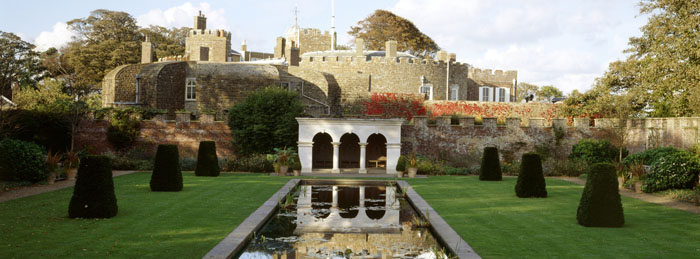
1. Walmer Castle, Kingsdown Road, Deal, Kent

Built during the reign of King Henry VIII, Walmer Castle is one of the most fascinating visitor attractions in the South East. Originally designed as part of a chain of coastal artillery defences it evolved into the official residence of the Lord Warden of the Cinque Ports. The Duke of Wellington held the post for 23 years and enjoyed his time spent at the castle and in recent years Her Majesty Queen Elizabeth the Queen Mother made regular visits to the castle.

The armchair in which Wellington died and an original pair of  ‘Wellington boots’ along with some of the rooms used by the Queen Mother are among the highlights. And with the magnificent gardens, a woodland walk and some excellent bird spotting there’s something for everyone to enjoy. There is also a pleasant cycle path along the beach front to nearby Deal Castle.

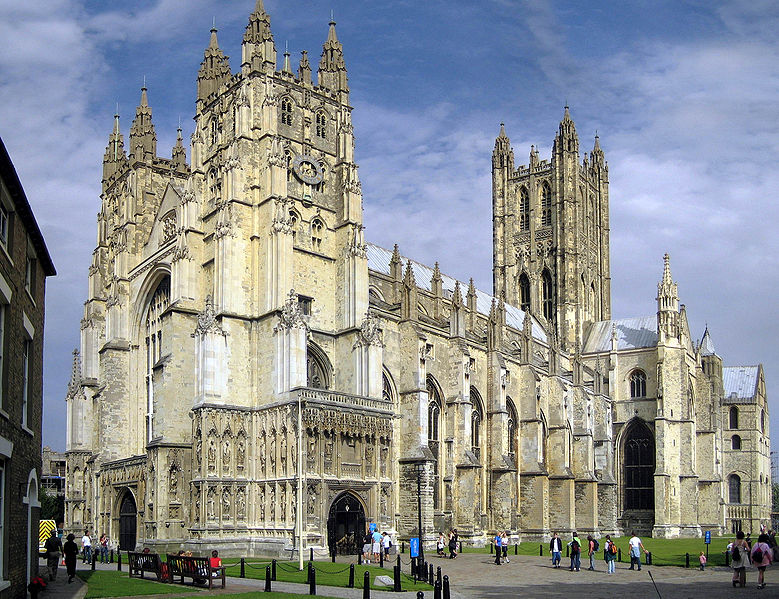
2. Canterbury Cathedral, Kent

St Augustine, the first Archbishop of Canterbury, arrived on the coast of Kent as a missionary to England in 597 AD. He came from Rome, sent by Pope Gregory the Great. It is said that Gregory had been struck by the beauty of Anglo slaves he saw for sale in the city market and dispatched Augustine and some monks to convert them to Christianity.

Augustine was given a church at Canterbury (St Martin’s, after St Martin of Tours, still standing today) by the local King, Ethelbert whose Queen, Bertha, a French Princess,, was already a Christian. This building had been a place of worship during the Roman occupation of Britain and is the oldest church in England still in use. (from the Cathedral website) 

Canterbury Cathedral - wikipedia

3.  Rochester Castle,  Kent  

“It wanted five minutes of twelve when we left Sittingbourne, from whence we had a famous pair of horses, which took us to Rochester in an hour and a quarter; the postboy seemed determined to show my mother that Kentish drivers were not always tedious, and really drove as fast as Cax.”

Austen’s letter No. 9 of 24 Oct. 1798. Letters p. 14.

Rochester Castle stands on the east bank of the River Medway in Rochester, Kent, England. The 12th-century keep or stone tower, which is the castle’s most prominent feature, is one of the best preserved in England or France. Located along the River Medway and Watling Street, Rochester was a strategically important royal castle. During the medieval period it helped protect England’s south-east coast from invasion. The first castle at Rochester was founded in the aftermath of the Norman Conquest. It was given to Bishop Odo by his half-brother, William the Conqueror. During the Rebellion of 1088 over the succession to the English throne, Odo supported Robert Curthose, the Conqueror’s eldest son, against William Rufus. It was during this conflict that the castle first saw military action; the city and castle were besieged after Odo made Rochester a headquarters for the rebellion. After the garrison capitulated, this first castle was abandoned. [wikipedia]

Rochester Castle – English Heritage

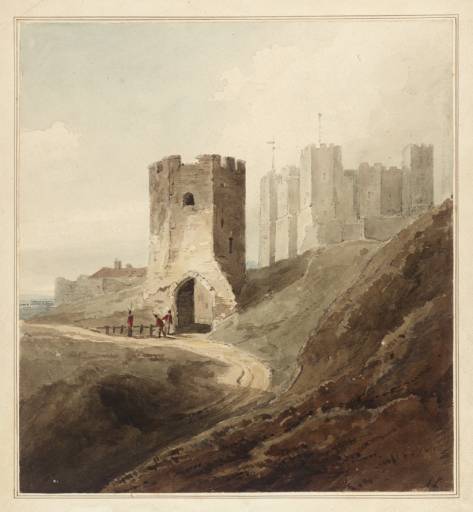
4. Dover Castle, Castle Hill, Dover, Kent

Commanding the shortest sea crossing between England and the continent, Dover Castle has a long and immensely eventful history. Many centuries before King Henry II began the great stone castle here in the 1160s, its spectacular site atop the famous ‘White Cliffs’ was an Iron Age hill fort, and it still houses a Roman lighthouse, one of the best-preserved in Europe. The Anglo-Saxon church beside it was once probably part of a Saxon fortified settlement: very soon after his victory at Hastings in 1066, this was converted by William the Conqueror into a Norman earthwork and timber-stockaded castle.

From then on Dover Castle was garrisoned uninterruptedly until 1958, a continuous nine-century span equalled only by the Tower of London and Windsor Castle. The stronghold hosted royal visits by Henry VIII, Elizabeth I and Charles I’s Queen Henrietta Maria: and from 1740 until 1945, its defences were successively updated in response to every European war involving Britain. [from English Heritage]

Dover Castle, by Amelia Long (Lady Farnborough) 1772-1837, No date, prior to 1837
Source: Tiny image at the Tate Gallery


5.  Sevenoaks, Kent.

Francis Austen, a great-uncle of Jane’s, was a solicitor in Sevenoaks.  Austen sends a letter to her cousin Philadelphia Walter in Seal, an area of Sevenoaks [Ltr. 8]. 

Sevenoaks is a commuter town situated on the London fringe of west Kent, England, some 20 miles (31.2 km) south-east of Charing Cross, on one of the principal commuter rail lines from the capital. The town gives its name to the Sevenoaks district, of which it is the principal town, followed by Swanley and Edenbridge.

The presence of Knole House, a large mansion, led to the earlier settlement becoming a village and in the 13th century a market was established. Sevenoaks became part of the modern communications network when one of the earlier turnpikes was opened in the 18th century; the railway was relatively late in reaching it. [wikipedia]

Knole House image:  Morris’s Seats of Noblemen and Gentlemen (1880) – wikipedia

High Street in Chiddingstone, a village in the Sevenoaks area, [and where James Stanier Clarke visits when he is writing to Jane Austen in Letters 125(A) and 132(A)], has been described as “the most perfect surviving example of a Tudor village in the county.”

Sevenoaks High Street: image from Grosvenor Prints

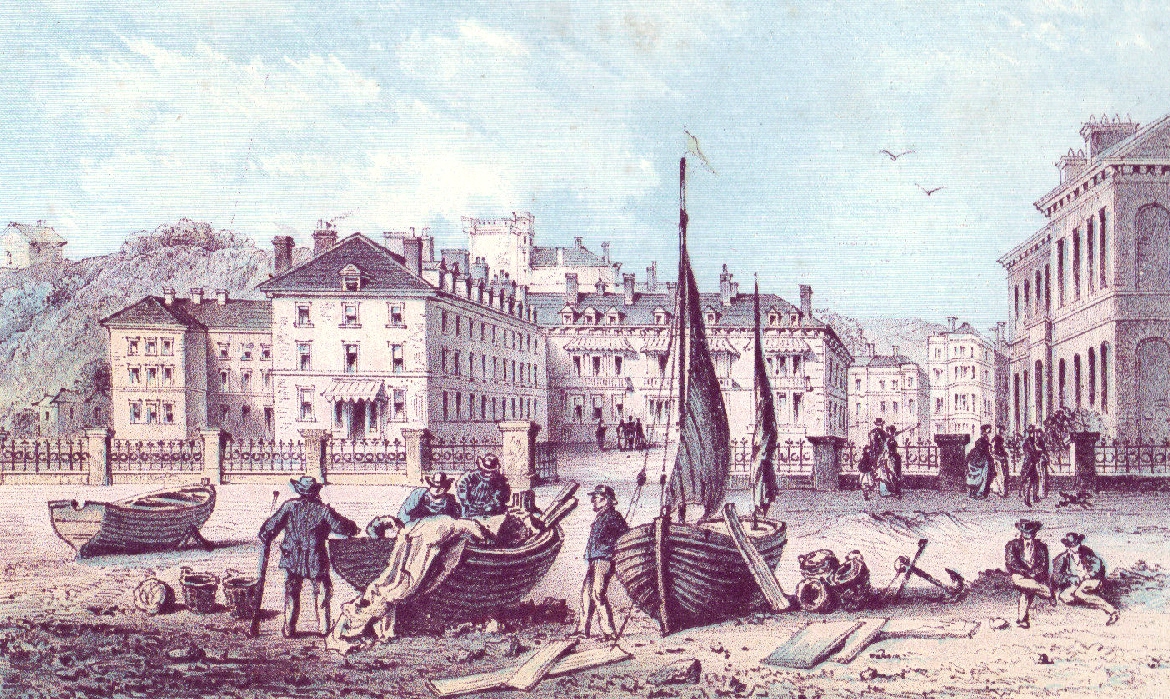
6.  Folkstone Harbour & Pavillion, Kent

A Norman knight held a Barony of Folkestone, by which time the settlement had become a fishing village. That led to its entry as a part of the Cinque Ports in the thirteenth century and with that the privilege of being a wealthy trading port. At the start of the Tudor period it had become a town in its own right. Wars with France meant that defences had to be built here and soon plans for a Folkestone Harbour began. Folkestone, like most settlements on the south coast, became involved in smuggling during the eighteenth century. At the beginning of the 1800s a harbour was developed, but it was the coming of the railways in 1843 that would have the bigger impact.

 Until the 19th century Folkestone remained a small fishing community with a seafront that was continually battered by storms and encroaching shingle that made it hard to land boats. In 1807 an Act of Parliament was passed to build a pier and harbour which was built by Thomas Telford in 1809. By 1820 a harbour area of 14 acres (5.7 hectares) had been enclosed. Folkstone’s trade and population grew slightly but development was still hampered by sand and silt from the Pent Stream. The Folkestone Harbour Company invested heavily in removing the silt but with little success. In 1842 the company became bankrupt and the Government put the derelict harbour up for sale. It was bought by the South Eastern Railway Company (SER), which was then building the London to Dover railway line. George Turnbull was responsible in 1844 for building the Horn pier. Dredging the harbour, and the construction of a rail route down to it, began almost immediately, and the town soon became the SER’s principal packet station for the Continental traffic to Boulogne.

Image and text from Folkestone History.org

****************************

So thank you for joining me on my journey through Kent – I should like to write more on this, once I have my proper research tools in hand – especially about the coaching inns that Austen stayed in her travels – so stay tuned please! And if any of you have any Kentish tales to share, especially those involving Jane Austen, please do!

And with hearty thanks to Julie at Austenonly for her references and map and to Deirdre Le Faye for her invaluable indexes!

Copyright @2012 Jane Austen in Vermont