Be on the lookout in your mailbox! – the March/April 2015 (issue 74) of Jane Austen’s Regency World magazine is published this week and is being mailed to subscribers. In it you can read about:
The Iron Duke: A major exhibition marks the Duke of Wellington’s triumph at the Battle of Waterloo
A Book’s Life: One of the rare books at Chawton House Library reveals all
Anyone for Pyms? Barbara Pym, the novelist who was known as the “Jane Austen of the 20th century”
Georgian Illnesses: Examining some of the ailments suffered by Jane Austen’s characters
From Daylesford to Delaford: Is there a connection between Warren Hastings and Sense & Sensibility?
*Plus News, Letters, Book Reviews and information from Jane Austen Societies in the US, UK and Australia
*To subscribe now click here – and make sure that you are among the first to read all the news from Jane Austen’s Regency World!
When I was in Library School, one of my favorite classes was a study of book conservation and visit to the NEDCC (the Northeast Document Conservation Center) – this I thought was the place where the things I most loved were given the care they sorely needed. Sadly, I didn’t go into that field [hindsight is a dreadful thing!] – I was more into reading and making sure the right book got into the right person’s hands, believing that our system of free libraries was the grandest example of a free world. I remember as a 15 year-old page in our hometown library, roaming the shelves and discovering the Brownings, and rather than doing my job of re-shelving (I confess this now many years later), I was secretly discovering Poetry, finding Love and Words in the pages of these old books. I’ve never lost that love of an old book – the smell, the touch, the beauty of bindings and paper, the scribbled notes or bookplates or inscriptions of previous owners – not to mention the story being told. That I ended up a used bookseller was likely destiny at work – my favorite set of books in my home was an 1890 Encyclopedia Britannica! (I was not the most current student in history class!)
We now live in a world where the physical book is being rejected for the joy of carrying around 1500 titles on a small tablet that we can also use for all manner of interruptive connections to the real world. This escape into a book can be initiated wherever you are, whenever you want, without the inconvenience of lugging around poundage – I readily admit to loving my kindle! – But it is not the same, no matter how many people argue the point. I don’t remember the books I read this way – I don’t retain where such and such was on a particular page, I miss that smell, that touch, that communion with a physical object that has a history that somehow brings me closer to the author or a binder or papermaker or some previous owner or owners.
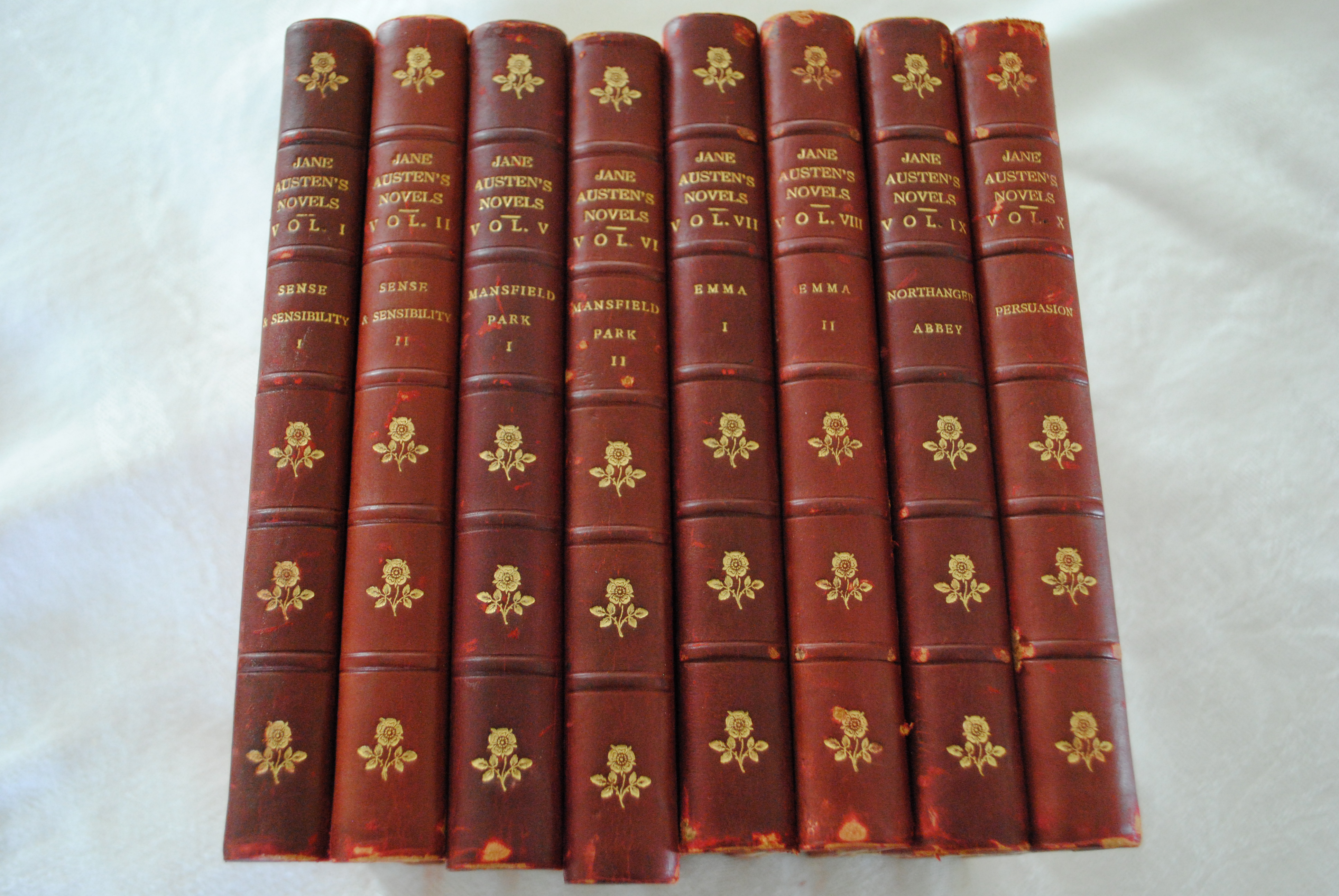
[1898 Dent edition of Jane Austen’s novels – trivia: what is missing??]
I think, I have to believe that the book is not Dead, that an appreciation for the book as an object of beauty and worth may even be stronger than ever, fear of it all disappearing making it all the more valuable to us. And this then brings us to Book Conservation. Because if we don’t take care we shall be losing our very own heritage. I have had any number of books come across my desk that are in appalling states, either too well loved through the years, or just left to disintegrate in some old attic or basement – it is one of the saddest things to encounter really – a book of special significance that is rendered nearly worthless by its poor condition. Enter the conservationist! – Magic can happen! I have been fortunate in finding the most brilliant of these magicians, who has salvaged many a book for me and my customers … And though the value of a repaired work can be affected by such tampering, it is the return to its former state that is the end result, to preserve, protect and savor for the future… The digitizing efforts of so many of our libraries is a glorious thing – making so much accessible to all – I marvel at what is only a keystroke away – but preserving the original must and should be part of this plan.
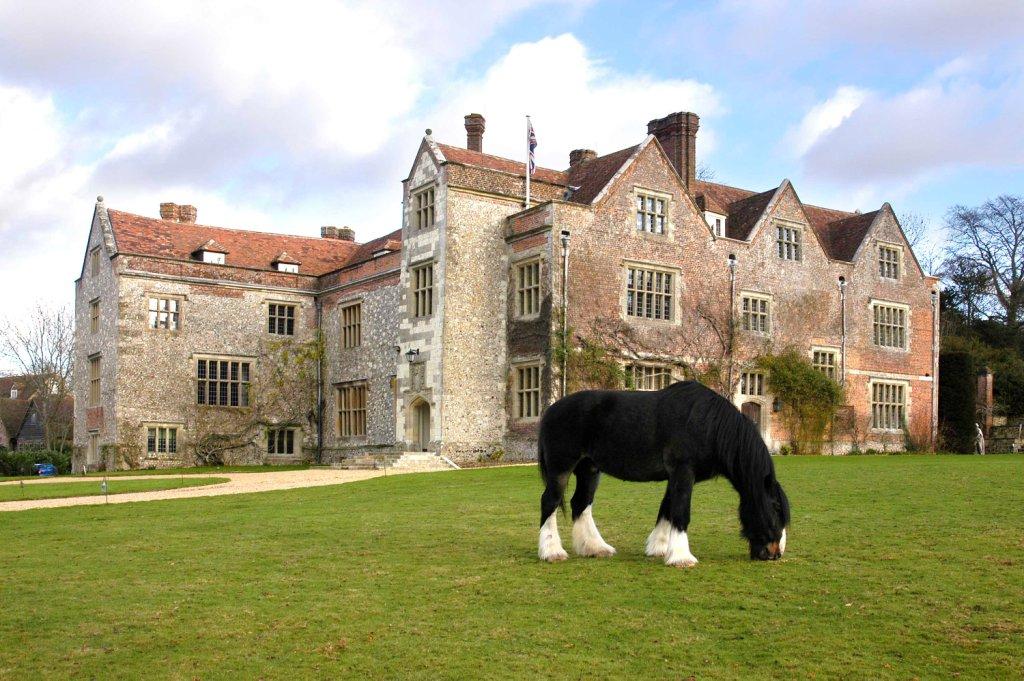
Chawton House Library
And this brings us to Chawton House Libraryand their appeal for their book conservation program – they need our help!
The history of the Chawton House Library [CHL] is a well-known story, at least among most of my readers here, who perhaps have come to know of CHL because Jane Austen brought us there. Read its history if you don’t know it, and you will come away with unending gratitude to Sandy Lerner for making it all possible. If you have read Dale Spender’s classic Mothers of the Novel: 100 Good Women Writers before Jane Austen (Pandora 1986), and other various titles on the subject, you know that the entire literary tradition of women writers has been essentially silenced – if you are over 50, how many women writers did you read in college? How many did you even know about? The foundation and purpose of CHL has been to correct that horrible omission in our collective history, to give these women writers a home of their own, and to make sure none of them are ever again consigned to the neglected heap of second-class literature.
The CHL website offers a wealth of information on many of these women writers:
[for example: Aphra Behn’s The Rover; or, the Banish’d Cavaliers (1729), and Penelope Aubin’s The Inhuman Stepmother, or the History of Miss Harriot Montague (1770)]
The quarterly publication The Female Spectator is mailed to those who become Friends of the Library. Some of the past issues are available online from 1995 – 2010 here: http://www.chawtonhouse.org/?page_id=55522
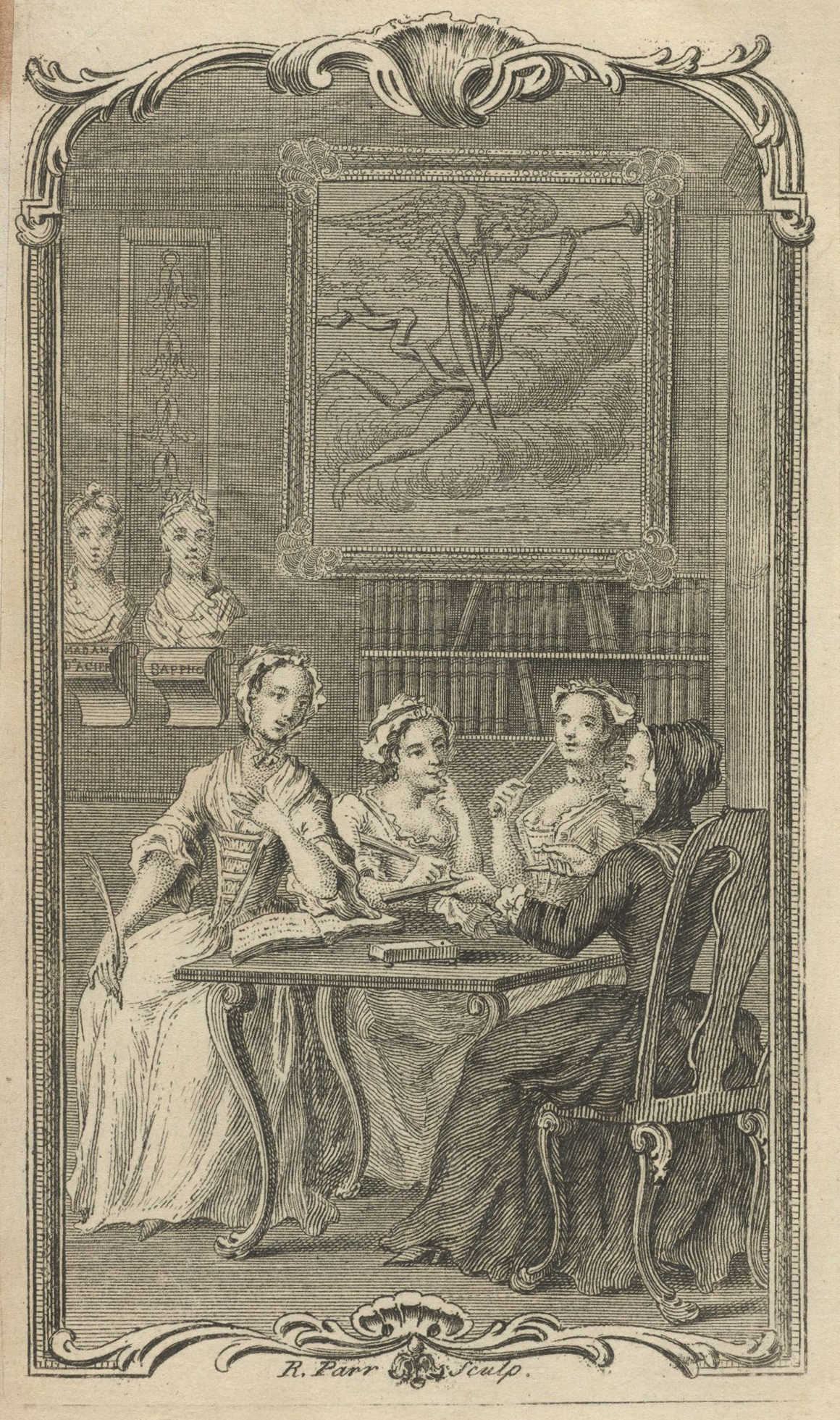
Frontispiece, vol. 1 The Female Spectator, by Eliza Haywood (1744-46) – the title CHL now uses for its quarterly newsletter [image: wikipedia]
_________________
More books in need at Chawton House Library
But the books themselves, the majority really, are in need of repair. Keith Arscott, the Development Director of CHL, in the kick-off for this fund-raising effort, writes:
Thanks to our first and biggest single donation to date – over $3,000 from the George Cadbury Quaker Foundation – we have been able to organise our first conservation skills training day for 10 of our library volunteers to be run by a professional conservator. The donation also covers the first purchase of materials to enable our first volunteers to make a start. And for those of you that don’t know, we also had two generous donations at the reception – one from a red rose and the other from a yellow![the reception for CHL members at the JASNA AGM in Montreal – we were all given roses!] But it is only a start – the Book Condition Survey that we were able to commission after a number of successful funding initiatives concluded that the cost of such a conservation programme would be easily a very large six figure sum – if all the conservation work was undertaken by professional conservators in studio conditions. However, the tremendous interest that our appeal has had with volunteers and their willingness to give their time to help with much of the work – means we have an appeal target in mind of something in the $90,000 range.
And so this is where your help is needed. Gillian Dow, the Executive Director, writes on the website that “small amounts of money can make a very big difference to our programme” and outlines how any donation can contribute to protecting this unique collection:
£1 / $1.70 can buy document repair tape
£6 / $10 can buy unbleached cotton archival ribbon
£10 / $17 can buy an archival box to protect a fragile book
£100 / $162 can pay for a full set of conservation equipment including unbleached cotton archival ribbon, document repair tape and archival boxes
£300 / $486 can pay for a volunteer training day, giving a whole team the necessary skills to carry out vital conservation work
*And here, some great PR from the BBC: last November, they visited CHL and produced a video on the appeal, where Frankenstein and Sense & Sensibility are featured among other titles: http://www.bbc.com/news/uk-england-hampshire-29949168
How to donate? For those of you living in the States, you can donate online directly to the North American Friends of Chawton House Library (NAFCHL) [NAFCHL is a U.S. 501 (c) (3) tax-exempt organization and all donations are deductible for purposes of U.S. income taxes]. NAFCHL will acknowledge U.S. donations as being specifically allocated to our Book Conservation Appeal. See the link on the right sidebar on this page: http://www.chawtonhouse.org/?page_id=58943 . [Everyone else can donate by visiting the same page and choosing the “Virgin Money Giving” link.]
______________
Mary Brunton (1778-1818) – Jane Austen writes about Brunton in her letters [image: wikipedia]
You will find if you spend a bit of time on the CHL website just how many of these women writers have been resurrected from their centuries-long oblivion. They are being studied more than ever as our female literary tradition finds its rightful place in the history of literature. The Chawton House Library has been and continues to be instrumental in finding and keeping these materials – the books, manuscripts, diaries, letters, and artifacts – and we need to preserve it all as best we can so that the Book as we now know it will be there for future generations of readers and scholars. Any donation will be greatly appreciated…hope you can help!
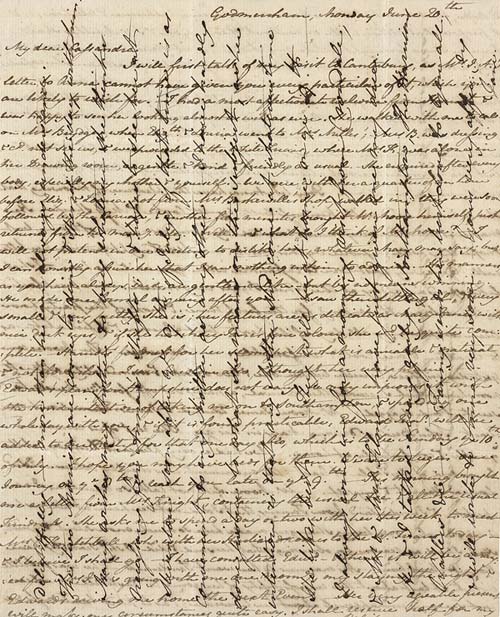
And to end with something about Jane Austen, an essay from the Conservation Center at the Morgan that tells the tale of Austen’s letters and what has been learned in the process of their preservation: “Jane Austen’s Writing: A Technical Perspective” http://www.themorgan.org/blog/jane-austens-writing-technical-perspective
The JASNA AGM in Montreal was quite wonderful – five days immersed in Mansfield Park! – Fanny Price and Jane Austen were celebrated in style and received their just due in attention and adoration… The Montreal-Quebec Region outdid themselves in making us all comfortable [much more than “tolerable”!], entertained, and enlightened! I haven’t had a chance to post anything but start here with my annual compilation of book purchases at the Emporium [Jane Austen Books, Traveller’s Tales from Picton Ontario, and The Word Bookstore in Montreal] – successful as always with finding several goodies at the book stalls! – in no particular order…
1. Mudrick, Marvin. Jane Austen: Irony as Defense and Discovery. Berkeley: U of California P, 1968. [originally published in 1952 by Princeton UP].
One of the classic works of Austen literary criticism – I’ve always borrowed this from the library – now happy to have my own copy. Mudrick was one of the earliest to appraise the ironic aspects of Jane Austen – “her ironic detachment that enabled her to expose and dissect, in novels that are masterpieces of comic wit and brilliant satire, the follies and delusions of eighteenth-century English society.” In his preface, Mudrick writes “this book began as an essay to document my conviction that Emma is a novel admired, even consecrated, for qualities which it in fact subverts or ignores.” – and he goes on from there to apply his theory to all the novels, juvenilia and minor works. A must have for your Austen collection…
2. Mrs. Beeton’s Book of Needlework, Consisting of Descriptions and Instructions, Illustrated by 600 Engravings. London: Bounty Books, 2007.
A facsimile of the original 1870 edition by Ward, Lock and Tyler. Just because I didn’t have this, and do quite adore anything my dear Mrs. Beeton [despite being in the wrong period].
3. Fleishman, Avrom. A Reading of Mansfield Park: An Essay in Critical Synthesis. Minneapolis: U of Minnesota P, 1967.
One of the few critical works just on an Austen novel, and in this year of celebrating MP, I wanted to add this to my collection… I have not read it other than in excerpts in other essays.
4. Favret, Mary A. Romantic Correspondence: Women, Politics and the Fiction of Letters. Cambridge: Cambridge UP, 1993.
Has a chapter “Jane Austen and the Look of Letters” which examines the letters in Austen’s fiction as well as her real-life correspondence. A must-have…
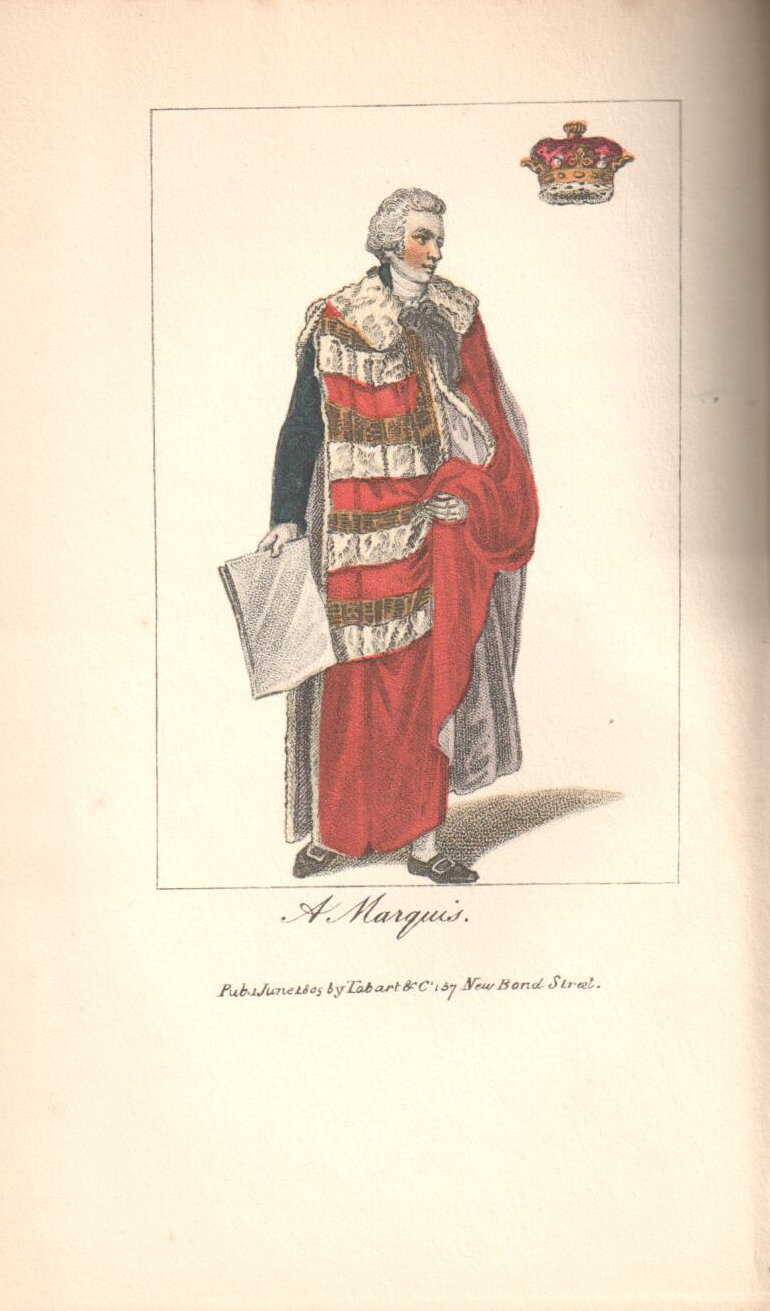
5. Lamb, Charles. The Book of the Ranks and Dignities of British Society. London Jonathan Cape, 1924.
A reprint of Lamb’s 1805 edition published by William Henry for Tabart & Co. Includes 8 coloured plates and 16 in monochrome [the original edition has 24 in color]. I couldn’t resist, as you can see from this plate of “A Marquis.” The original seems to range upwards from $350.
*********
6. Tristram, W. Outram. Coaching Days and Coaching Ways. Illus. Hugh Thomson and Herbert Railton. London: Macmillan, 1894.
A 3rd printing of the 2nd edition [first edition published in 1888] – another must-have for anyone with an interest in travel and the carriages of Austen’s period – with the added plus of Thomson’s and Railton’s 214 illustrations. [You also must try to say the author’s name 10 times very fast …]
From an exhibition during the Overton Regency Sheep Fair, 2008. With many illustrations of ephemera from the time. Overton was near Steventon and Basingstoke; Austen would have walked there and mentions it in her letters.
8. The Knight Family Cookbook; Preface by Richard Knight. Introd. Gillian Dow. Chawton House Press, 2013.
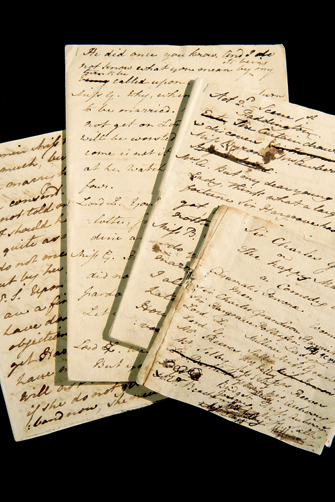
A Facsimile edition of the handwritten cookbook of the Knight Family, never published but dated circa 1793. Who can resist this family treasure so you too can make some of the recipes that were in use at Chawton House and Godmersham Park during Jane Austen’s time:
To Make Plumb Porridge (p. 70)
To Make Cracknails (p. 51)
To Make Hedge-Hog-Cream (p. 35)
To Make Tansy without Frying (p. 28)
To dress a Codds-Head (p. 111)
To Pickle Pigeons (p. 193)
There is even a handwritten index, but alas! I find nothing to help make Mr. Woodhouse’s famous gruel – just as well I think!
This book was published by subscription; i.e. if you had made a donation to Chawton House Library as a subscriber (just as Jane Austen subscribed to Frances Burney’s Cecilia), your name will be listed on the “subscriber” page. More information on this at the CHL website. Their next book is The Duties of a Lady’s Maid; with directions for conduct, and numerous receipts for the toilette (1825). Make a donation if you can and see your name in print!
9. Simo, Melanie Louise. Loudon and the Landscape: From County Seat to Metropolis, 1783-1843. New Haven: Yale UP, 1988.
John Claudius Loudon (1783-1843) was the designer of England’s first public park and inventor of the means to construct curvilinear glasshouses, and the first landscape gardener to address the problems of the modern city. A must-have study to have on your shelves next to your Humphry Repton, Capability Brown, and others. Illustrated with maps, photographs, and drawings.
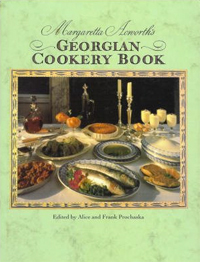
10. Prochaska, Alice and Frank Prochaska, eds. Margaretta Acworth’s Georgian Cookery Book. London: Pavilion / Michael Joseph, 1987.
The cookery book of a London housewife of the Georgian period, of which 90 recipes are transcribed and “updated” with modern ingredients and modern cooking practices by the Prochaskas. Lovely black and white and full-page color illustrations. The introduction offers biographical background on Acworth.
11. Lucas, E. V. Mr. Punch’s County Songs. Illus. Ernest H. Shepard. London: Methuen, 1928.
A delightful book of poems by Lucas on each county in England with each on the recto, verso is blank. Shepard’s [of Winnie-the-Pooh fame] drawings get you into the spirit of each place, and the poems tell of history and story.
Here is the page on Austen’s own Hampshire
But I bought this solely for its page on London:
Though a Wren built St. Paul’s, sacerdotal and grey,
That fame is a stronghold of pigeons today:
They bill there and coo there and bring up their brood,
And swarm on the pavement at lunchtime for food.
…. Etc.
**********
12. Archbold, Rick. Last Dinner on the Titanic. Recipes by Dana McCauley. Introd. Walter Lord. New York: Hyperion, 1997.
Wonderful illustrations of the Titanic interior and the various recipes from the last meal. Why you ask? Well, I have been obsessed with the Titanic since I was a little girl. Both my parents emigrated from England as children, but my father was 11 years old in 1912, when his entire family boarded a ship to take them to America only a few months after the Titanic had taken its maiden and tragic voyage. I always thought that if my father had been on the Titanic I would not exist – I also have marveled at how brave they all were to do this crossing… so hence I have collected various Titanic things for years. I do not have this book and especially like it because it is signed by the author…
13. The Infant’s Grammar, or a Picnic Party of the Parts of Speech. London: Scholar Press, 1977. Reprint of the original 1824 edition by Harris and Son.
This picture says it all:
*******
14. Rocque’s Map of Georgian London, 1746. Colchester, Essex, UK: Old House, 2013.
First published in 1746, it extends from Marylebone to Bow and from Vauxhall to Knightsbridge and Hyde Park. Reproduced here in four detailed sheets, it gives a fascinating glimpse of Georgian London in the early industrial age and is a perfect research tool for the historian and genealogist. As well as over 5,500 street and place names, the survey also includes: Markets, churches, barracks, parks, bridges, hospitals, workhouses, schools, prisons, asylums, theatres, inns and much more.
*********
15. Crow, Donna Fletcher. A Jane Austen Encounter (#3 The Elizabeth and Richard Mysteries). Boise: StoneHouse Ink, 2013.
I haven’t read the previous two mysteries (about Dorothy L. Sayers and Shakespeare), but this one is about the married professors Elizabeth and Richard on a vacation trekking through Jane Austen country – they encounter murder and mayhem and a missing letter about The Watsons. Can’t wait to read this one…
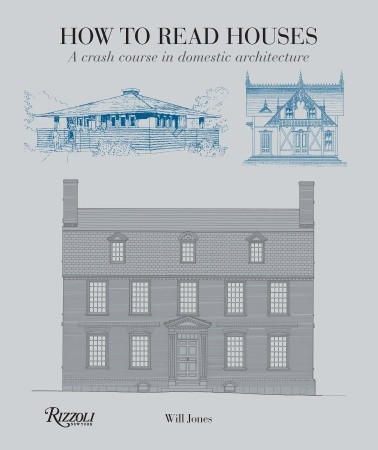
16. Jones, Will. How to Read Houses: A Crash Course in Domestic Architecture. New York: Rizzoli, 2014.
I picked this up at the Musee des Beaux-Arts Montreal shop – a compact little guide to architecture with photographs and drawings and enlightening text to answer all your questions about the differences between Queen Ann and Georgian and Federal and all the various decorations…
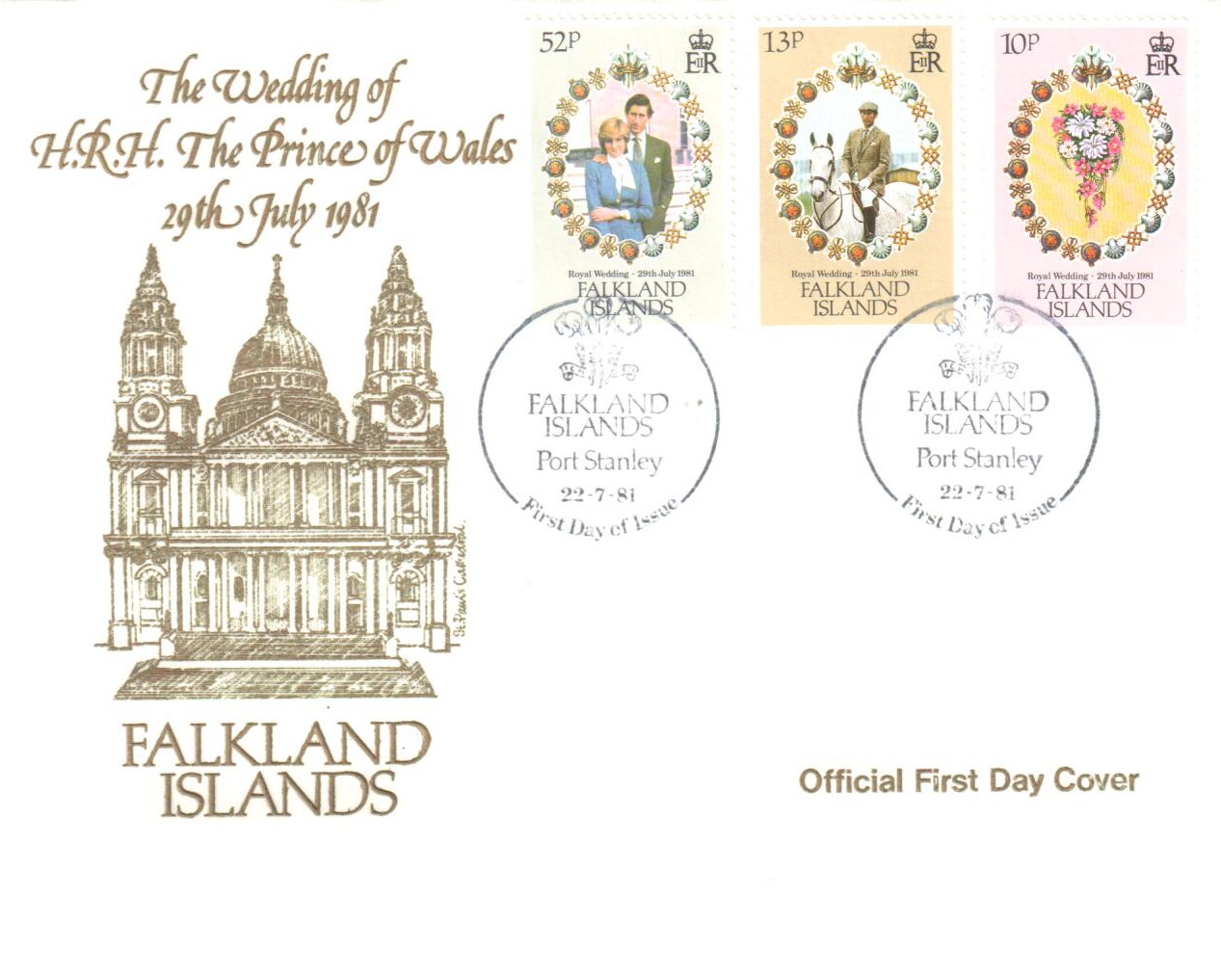
17. First Day of Issue – Royal Mint coin commemorating Charles and Diana’s wedding with stamps; and another First Day of Issue from the Falkland Islands with new stamps:
–
***********
So, all in all, a goodly haul – this time I didn’t have to worry about luggage weight, only crossing through immigration from Canada into Vermont. They only seem to ask about alcohol, cigarettes and fruit! so Jane Austen passed through with nary a glitch… now to find room on the bookshelves and the added dilemma of time for reading…
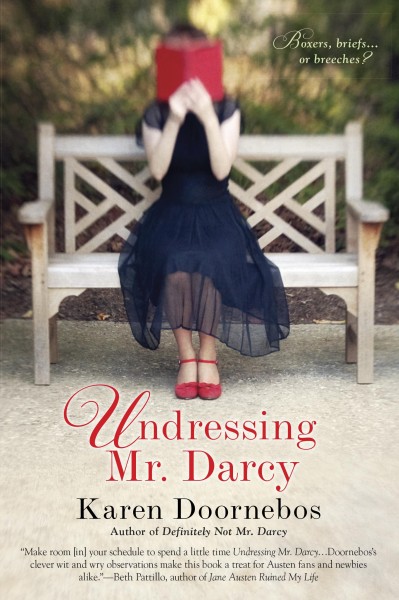
Hello Gentle Readers: I welcome today Karen Doornebos, author of UNDRESSING MR. DARCY, as she travels the web for a blog tour and book giveaway. I had reviewed Karen’s first book Definitely Not Mr. Darcy back in 2011 [click here], and have enjoyed entering her Jane Austen world yet again with her new book, just released on December 3, 2013. Karen joins us today to tell a bit about her trip to Jane Austen country and how it inspired her – you should visit the other blogs on the tour to get the whole travelogue! And please see below for the giveaway info to win one of two copies of Undressing Mr. Darcy!…
*****************
Happy 238th Birthday to Jane Austen…from her writing table at Chawton!
Thank you, Janeite Deb, for hosting me on this very special day for Janeites worldwide. It’s an honor to be here today. Shall we raise a glass of French wine that Austen liked to have when it was offered her?
As an ice-breaker to each leg of my Blog Tour for UNDRESSING MR. DARCY, I’m taking you along for a ride to England, where I traveled during the summer of 2012 to do some research for my book. Yes, I was on The Jane Austen Trail all right!
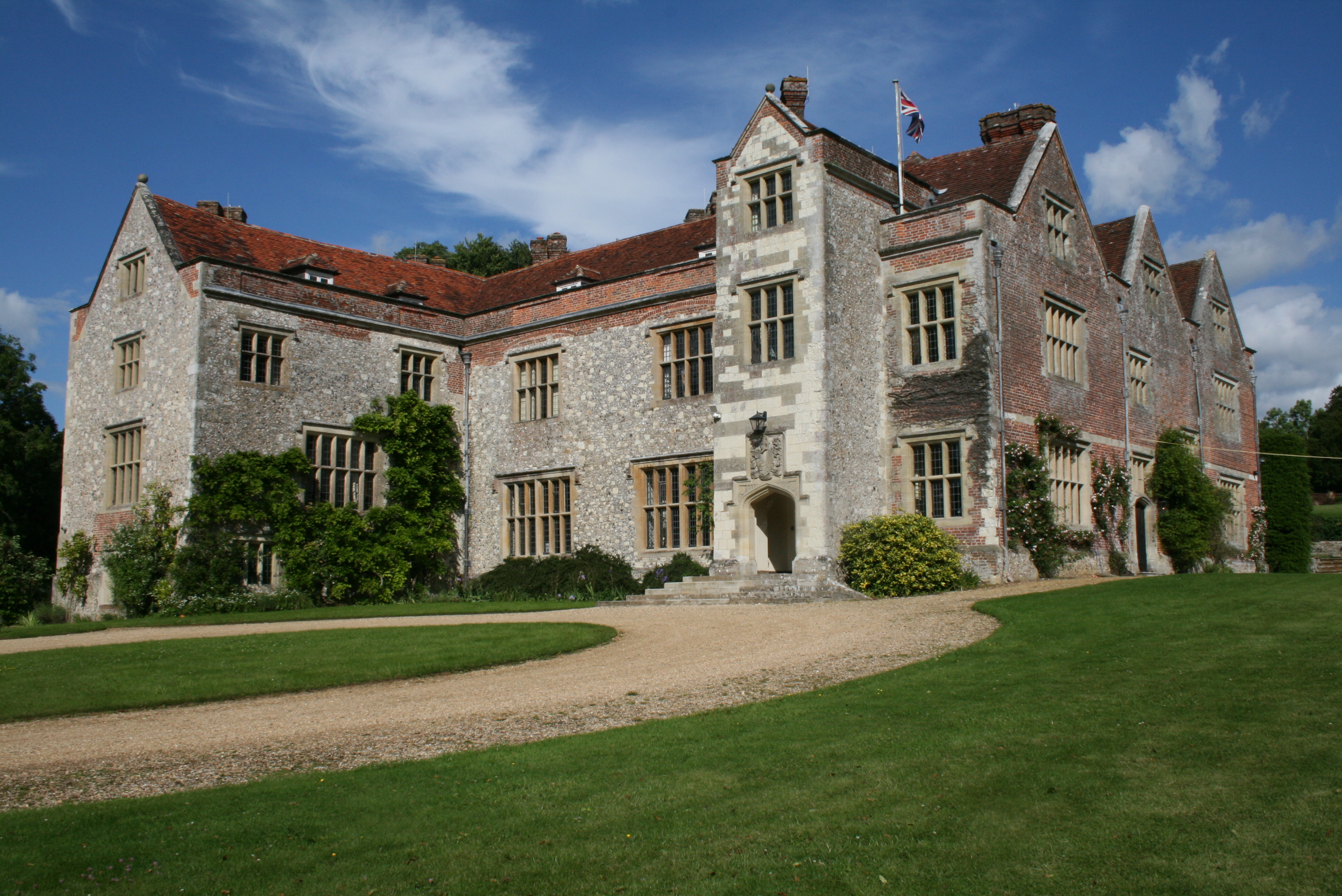
Where am I on this stop? Jane Austen’s cottage in Chawton and her brother Edward’s inherited estate just up the road, the gorgeous mansion that is now Chawton House Library. I was lucky enough to spend the night on the grounds of Chawton House Library, and you can too, in the renovated stables that serve as the most stunning B&B. You will soon get an insider’s look at that gorgeous estate owned and so lovingly restored by Sandy Lerner.
First, let’s have a cuppa at Cassandra’s Cup…
Across the street from Jane Austen’s cottage is Cassandra’s Cup tearoom, where I can recommend the scones with jam and clotted cream as well as looking up at the ceiling to admire all of the teacups. I had to set part of a scene in my new book here, didn’t I?! How could anyone resist the charm? [I have heard, however, that the shop had recently gone up for sale. Has anyone heard anything further about that?]
A visit to Jane Austen’s cottage and yes…her chamber pot.
Jane Austen in Vermont readers, you’ve seen photos of Austen’s cottage before. But have you seen a photo of her chamber pot? Here it is! You can count on me to point out the offbeat:
**************
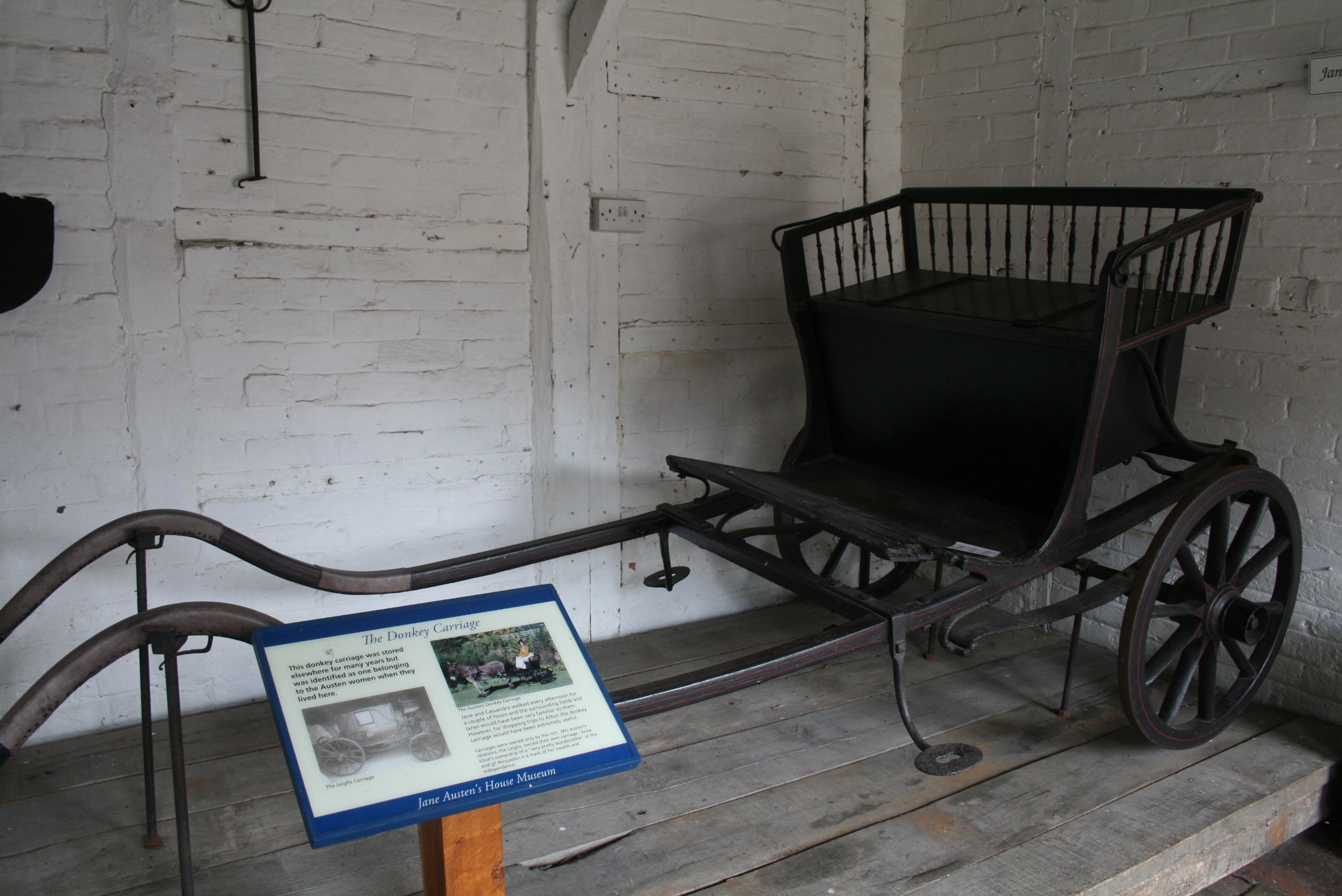
Knowing as I do the distinct hierarchy of carriages, I stood for a long time in front of Jane Austen’s donkey cart. She most certainly did not even have a gig like the lowly John Thorpe, much less a chaise and four like Lady Catherine. Somehow, our Jane deserved more than a donkey cart, did she not? But there it was, a simple, rudimentary, but functional contraption. A distinct reminder of her position in her society.
I had to admire the oak leaf and acorn Wedgwood pattern on the Austen’s china, and there is a moment in my new novel where my heroine and some tourists from Australia discuss the significance of this pattern. Acorns figure prominently in Regency art and architecture, and I found it interesting that acorns can symbolize strength and power in small things. I think Austen herself gathered strength and inspiration from the simple, small things in her life, would you agree? Speaking of simple, I really enjoyed the Austen’s bake house and the range where Austen herself would make breakfast every morning.
***************
Chawton House Library…a home Austen knew well…
I was lucky enough to spend a night at the renovated stables on the grounds of what is now Chawton House Library, and you too can stay there when you visit. It was the most stunning B&B I’d ever stayed in. I’ll never forget having breakfast in the solarium off the kitchen in the stables: bliss. The grounds, the gardens, the long drive leading up to the house…all of it stood in sharp contrast to Jane Austen’s simple cottage. Yet, Austen herself no doubt had plenty of opportunity to visit here and partake of the opulence and…the library.
One of the most striking paintings in the home to me was the one done of Edward Austen Knight. This painting, as well as the silhouette done of Edward’s adoption by the Knights signify turning points in my novel for my heroine. The silhouette in particular, dramatized to great effect, nevertheless captures the poignancy of the moment. Young Edward, just a boy, had been plucked from his family, but destined for wealth, position, and security his Austen siblings would never know. If it weren’t for Edward’s luck at being adopted by the wealthy and childless Knights, his sister Jane may never have known the comfort of her Chawton cottage…and we might never have known her novels…that only could have been written with a certain amount of security that the cottage provided. Granted, Jane Austen had to work hard, sewing shirts, cooking, making orange wine and brewing spruce beer, but thanks to the Knights she was able to sneak in a little time to write.
Edward Austen
Edward’s adoption
************
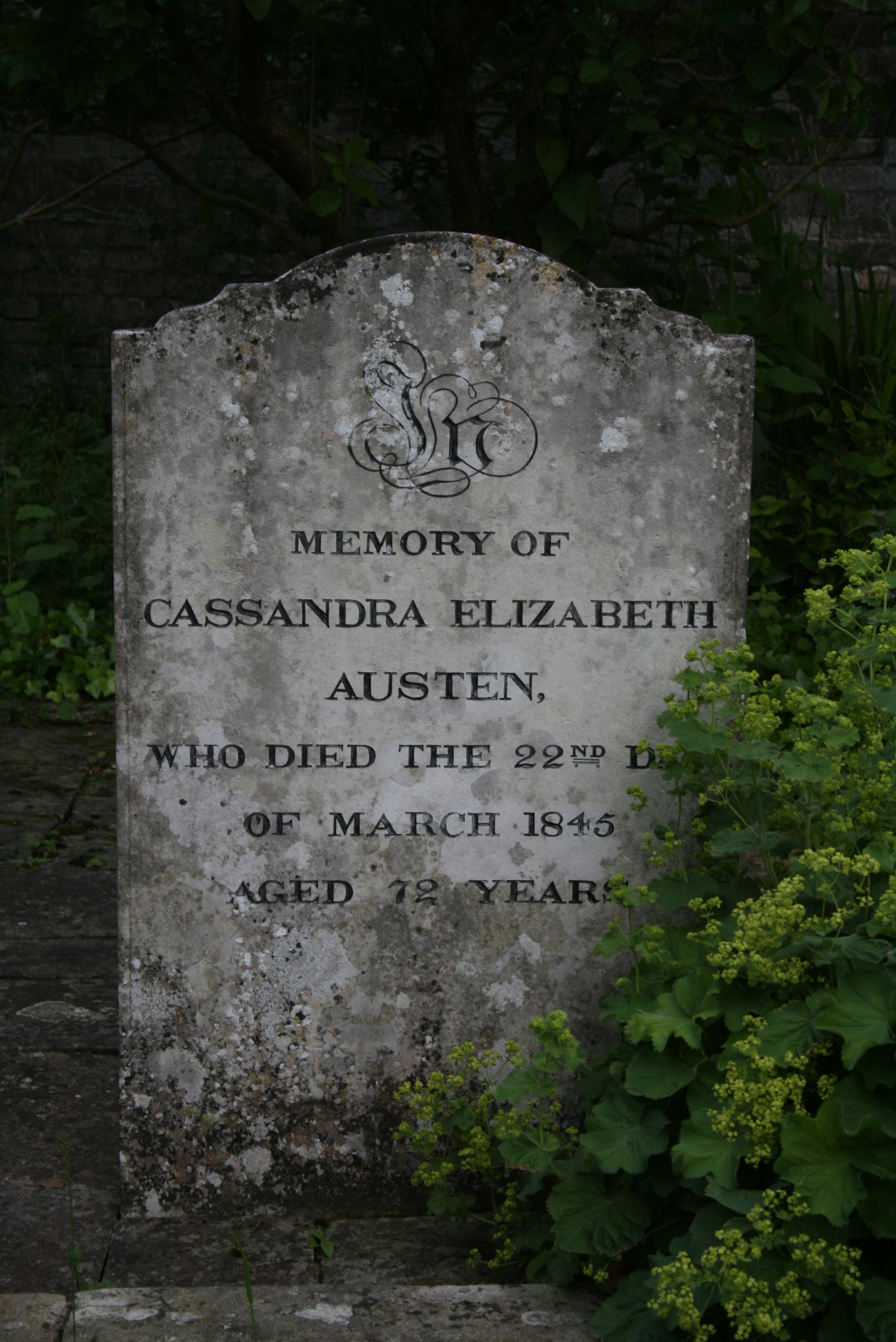
Come the evening at Chawton House Library, I ambled over to the nearby churchyard and stumbled across Cassandra Austen’s gravestone. Sigh. Nothing could have prepared me for the range of emotions I experienced at Chawton.
**************
Thank you once again, Deb for having me visit your delightful blog! Happy Birthday to our favorite author Jane Austen! In celebration of her birthday, I invite your readers to comment and win…
Imagine a history lesson where you watch a very handsome Regency gentleman lecture about his clothing as he proceeds to take it off—down to his drawers. This is the premise of UNDRESSING MR. DARCY!
He’s an old-fashioned, hard-cover book reader who writes in quill pen and hails from England. She’s an American social media addict. Can he find his way to her heart without so much as a GPS?
Jane Austen in Vermont readers, comment below for your chance to win one of TWO copies of UNDRESSING MR. DARCY… How are YOU celebrating Jane Austen’s birthday? To increase your chances of winning you can share this post on your Facebook page or Twitter—let us know you’ve done that! You can also increase your odds by following me on Twitter or Facebook, or, if you’re not already, following Deb on her social media [Jane Austen in Vermont on facebook or Austen in Vermont on twitter]—don’t forget to let us know about it in your comment, thanks! Contest limited to US entrants only.
Mr. Darcy’s Stripping Off…
…his waistcoat! At each blog stop Mr. Darcy will strip off another piece of clothing. Keep track of each item in chronological order and at then end of the tour you can enter to win a GRAND PRIZE of the book, “DO NOT DISTURB I’m Undressing Mr. Darcy” door hangers for you and your friends, tea, and a bottle of wine (assuming I can legally ship it to your state). US entries only, please.
*******************
Karen Doornebos is the author of UNDRESSING MR. DARCY published by Berkley, Penguin and available here or at your favorite bookstore. Her first novel, DEFINITELY NOT MR. DARCY, has been published in three countries and was granted a starred review by Publisher’s Weekly. Karen lived and worked in London for a short time, but is now happy just being a lifelong member of the Jane Austen Society of North America and living in the Chicagoland area with her husband, two teenagers and various pets—including a bird. Speaking of birds, follow her on Twitter and Facebook! She hopes to see you there, on her website www.karendoornebos.com and her group blog Austen Authors.
Thank you Karen for joining us today to celebrate Jane Austen’s birthday and sharing your trip to Chawton with everyone! We wish you the very best with your new book!
Everyone, please comment by Wednesday December 18th at 11:59 pm to be entered into the drawing for one of two copies of Undressing Mr. Darcy: tell us how you are celebrating Jane Austen’s 238th Birthday today! Winners will be announced on the morning of December 19th. [US entries only, sorry to say]
c2013 Jane Austen in Vermont – text and images Karen Doornebos
*Sandy Lerner, co-founder of Cisco Systems, founder of Urban Decay Cosmetics, founder of the Ayrshire Farm in Virginia, and, most dear to us, is also the founder and moving force behind the Chawton House Library. She is now Chairman of Trustees, Chawton House Library and the Centre for the Study of Early English Women’s Writing, a place for research and camaraderie for scholars from all over the world. What better place than the former home of Jane Austen’s brother Edward Austen-Knight to study Austen and her literary antecedents and contemporaries!
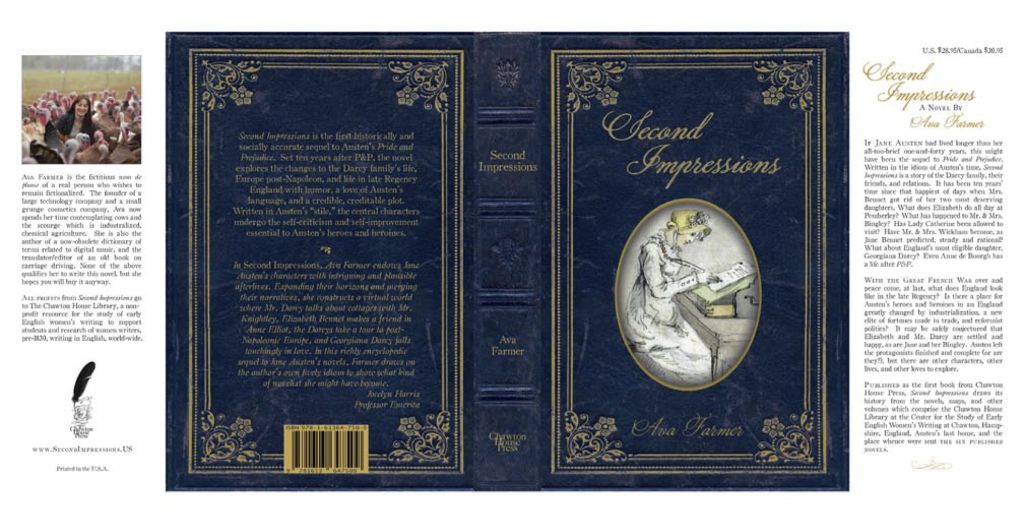
Lerner’s book Second Impressions, written under the nom de plume of Ava Farmer, is set 10 years after the action in Pride and Prejudice, and explores the changes to the Darcy family’s lives, to Europe post-Napoleon, and to life in late Regency England, all as homage to Jane Austen, written in her “stile”, and with a fascinating yet credible plot. So let’s step into Lerner’s world to discover such things as: What do Darcy and Elizabeth do all day at Pemberley? Is Lady Catherine a welcome and constant visitor? Are the Wickhams reformed? And what becomes of England’s most eligible female Georgiana Darcy? And Anne de Bourgh? And dare we ask about Mr. and Mrs. Collins?!
Second Impressionswill be available for purchase and signing, all proceeds to benefit Chawton House Library.
During the Tea we shall engage in Playing Word Games with Jane Austen, a most suitable and refined entertainment for a wintry afternoon!
The Female Spectator, (Vol. 16, No. 2, Spring 2012), the newsletter of the Chawton House Library, showed up last week in my mailbox – this 12 page newsletter always offers something new and exciting to be discovered and shared!:
1. “Chawton Chronicles: A Letter from the CEO” – Stephen Lawrence talks about what has been accomplished at the Library since its inception in 2003, especially the academic initiatives and activities and the Visiting Fellowship Programme. And he writes of the upcomingSpring Gala of the JASNA-Greater Chicago Region where Sandy Lerner, Elizabeth Garvie, Lindsay Ashford, and Stephen will all be in attendance for the “Chawton Comes to Chicago” event [which took place on May 5 – visit the website for a photo gallery of the event – accessible to members only I’m sorry to say!]
3. “Talking Portraits at CHL” – by Sarah Parry – about the project to bring to life with actors in full costume the various portraits housed in the Library: the portraits of Mary Robinson, Elizabeth Hartley, and Catherine (Kitty) Clive were the portraits chosen for this first effort.
[Image of Catherine “Kitty” Clive from CHL at the BBC Collection]
4. “Curious Consumption: Cookery Books at CHL” – by Lindsey Phillips. An essay on her research into the exchange of culinary information and recipes between Britain and the West Indies; included is a recipe for “pepper pot” from Maria Eliza Ketelby Rundell’s American Domestic Cookery (ed. of 1823), which you can find here at Google Books.
5. “The Day the Descendants Came to Tea: Revelations and Connections from a Chawton House Fellowship” – by Katharine Kittredge, on the author’s study of Melesina Trench (1768 – 1827), an Irish writer, poet and diarist, and Kittredge’s connection with her relatives after her research was published in Aphra Behn Online. [her article in ABO can be found here.] And click here for Kittredge’s biography of Trench on the CHL website.
Melesina Trench – wikipedia
6. “The Language of Women’s Fiction, 1750-1830” – a conference report by Christina Davidson – one hopes the papers discussed will be published at some point…?
7. “‘Not in All Things Perfect’: The North Welsh Gentry in Fiction and History” – Mary Chadwick shares her research on a collection of English-language manuscript letters, poems, etc. written by members of a North Welsh gentry community and collected by one family, the Griffiths of Garn, and how this compares to the writing of the various novelists who set their tales in Wales (including Jane Austen in her Juvenilia!), in particular Elizabeth Hervey’s The History of Ned Evans (1796) [and recently re- published in the CHL / Pickering & Chatto series.
******************
And reasons to be at the CHL, and a continuing source of depression for those of us who cannot! :
Lectures:
June 7 [today!]: Dr Laura Engel on “Much Ado About Muffs: Actresses, Accessories, and Austen”
June 20. Professor Elizabeth Kowaleski Wallace on “‘Penance and Mortification for Ever’: Jane Austen and Catholicism.”
June 25. Evening Talk and Book Launch: Dr. Katie Halsey “‘A Pair of Fine Eyes’: Sight and Insight in Jane Austen’s Novels.”
When Mr. Darcy meditates on the pleasure bestowed by “a pair of fine eyes” in Pride and Prejudice, he does so because eyes are so very expressive. In this talk, Dr Katie Halsey explores the relationship between the physical eye and the eyes of the mind in Austen’s novels.
This talk is part ofAlton’s Jane Austen Regency Week, andthe launch of Katie Halsey’s new book: Jane Austen and her Readers, 1786 – 1945 [and soon to be added to my bedside table…]
Exhibition:
“Jane Austen’s Bookshop: An Exhibition” 18 June – 6 July, 2012
This exhibition explores how readers and writers in Winchester shared printed material (books, playbills, engravings &c). Men and women, young and old, gentry and middle classes, rich and poor, Protestant and Catholic – all participated. The Austen family purchased literature from the bookshop of John Burdon (today still a bookshop), while scholars at Winchester College published their works in their own city. The newly founded hospital produced annual reports, and local newspapers such as the Hampshire Chronicle promoted all kinds of publications in advertisements and reviews.
Come to Chawton House Library to learn more about book production and circulation. Find out what kind of material was published in Hampshire in the eighteenth century, and just what the Austen family might have read.
The Female Spectator, Vol. 16, No. 1 (Winter 2012) , the newsletter of theChawton House Library is out!
Here are the contents to whet your appetite:
“Some Treasures in the Chawton House Library Collection” – by Margaret S. Yoon, about her “discovery” at the CHL of two very important books for her studies.
“The Suit for a Case; Or, A Case for a Suit” – by Eleanor Marsden – on the recently restored suit belonging to Edward Austen Knight, and the need for a conservation-grade display case. [Lovely to see that JASNA member Sue Forgue of the JASNA-Greater Chicago Region, and author of the website Regency Encyclopedia, has already made a generous donation to the cause!] – if your are interested in helping, please email the Development Director at eleanor.marsden@chawton.net
“The Sheridan Trial” – by Helen Cole – an account of the 1787 Trial of Mrs. Lydia Sheridan, wife of Major Henry Sheridan, for adultery with Francis Newman, Esq., and the inclusion of an engraving in the CHL copy that does not seem to fit the tale…
“A Conference of Our Own: On the 20th Anniversary of the BWWA” – by Pamela Corpron Parker – on the upcoming conference of the British Women Writers Association, June 7-10, 2012 at the University of Colorado, Boulder. See here for more details: http://www.bwwc2012.com/
“Second Impressions by Ava Farmer: A History of a Novel” – by Sandy Lerner – on the writing and publication of her recently published Second Impressions, a sequel to Pride and Prejudice, and 26 years in the making…[see more at the Chawton House Press website.
“‘Poetry of Taste and Refinements’: Consumer Literature in Nineteenth-Century Annuals” – by Serena Baiesi – on the fashionable gift-books with their collection of engravings and literary pieces, published between 1822 and 1850.
And, “The Chawton Chronicles” – the letter from the CEO Stephen Lawrence [with the very exciting news that Dr. Gillian Dow will be taking on a broader role at CHL as Deputy Chief Executive and Director of Research!]; this issue’s “Faces of Chawton” column on Ray Clarke, the Maintenance Technician at CHL and his appreciation of CHL for his own and future generations; and the always-depresses-me because-I-live-over-here-and-not-over-there “Dates for your Diary” feature of upcoming lectures, tours, and conferences [you can look here on the website for upcoming events: http://www.chawton.org/news/index.html ]
Note that Pickering & Chatto is re-publishing a number of the rare books housed in the Chawton House Library collection in new scholarly editions. This Chawton House Library Series is organized into three areas: Women’s Memoirs, Women’s Travel Writings, and Women’s Novels. How lovely it would be to buy at least ALL the 10 novels for $675 / £395 !
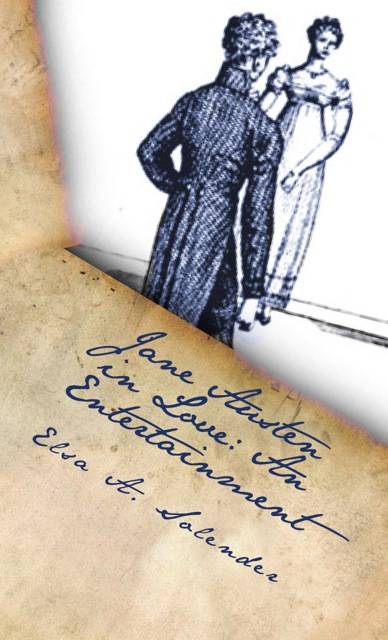
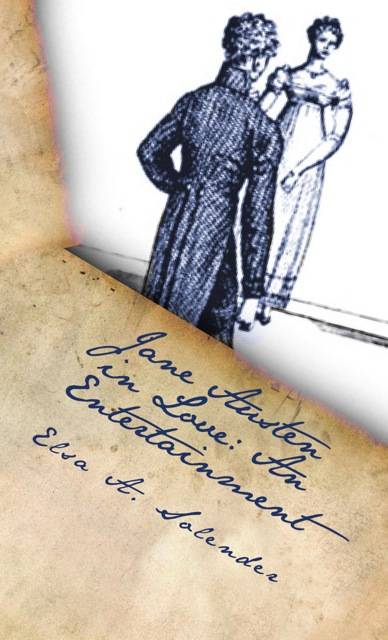
We welcome today Elsa Solender, former JASNA president, now author of Jane Austen in Love: An Entertainment. The book is currently available as a kindle ebook, and I heartily recommend that you download it immediately from Amazon.com– if you have no kindle, you can add a free kindle app to your computer and various i-products, and read it that way… rightaway…
Solender’s sub-title of “An Entertainment” clearly states what this book is about – a fanciful confection of Jane Austen in love, where we are given a birds-eye view of episodes in her childhood, intimate moments with her sister, her family, and friends; an imaginary take on her feelings for Tom Lefroy; her 1-day engagement to Harris Bigg-Wither; and the fateful meeting with the rumored and wished-for ‘Gentleman suitor of the seaside’ – part real, part imaginary, and part straight from Austen’s own fiction, all beautifully woven together into this tribute to love in the life of Jane Austen. Read it, and then, as you would any Austen novel, read it again – there is much to discover and savor, and great fun to stumble upon the allusions to the letters, the known people in her life, and her very own fictional characters!
Please see below the interview for the giveaway rules [either a kindle book reimbursement or if the winner is kindle-less, a copy of Dancing with Mr. Darcy, the anthology which contains Ms. Solender’s short story “Second Thoughts.”
****************************
JAIV: Welcome Elsa! I appreciate you visiting Jane Austen in Vermont today, as we talk about your new book Jane Austen in Love: An Entertainment.
But first, tell us a little about your beginnings, your discovery of Jane Austen.
ES:My mother gave me Pride and Prejudice when I was in seventh grade and just 12. I was too young and put it aside. The next year, I returned to it, read it, loved it, and spent the month of July that year speeding through the other five Austen novels non-stop every day as if I were running—or reading — in a marathon . I didn’t reread them again until freshman year at Barnard College. The papers I produced on Emma and for assignments were all close textual analyses (I recently re-read one or two of those papers – they’re not bad). My professors were New Critics focused almost exclusively on texts and critiques, with little historical or biographical background considered. To read too much into the author’s intentions or personal background was to commit one of the dreaded critical fallacies of New Criticism. But Jane Austen’s texts stood up magnificently with minimal background material. I really didn’t learn much about her life until I joined JASNA at its inception in 1979. After all is said and done, though, it’s the novels that count – which is a rather strange thing for the author of a biographical novel to admit, I guess.
JAIV: And because I have to always at least ask the impossible-to-answer question: which is your favorite Austen novel and why?
ES:My favorite changes. I liked Emma best when I was younger – she’s an enfant terrible and a bit of a monster, with all the fascination of a monster, but Mr. Knightley loves her, and so must we. I was enamored of Mansfield Park for a while because of its problems and artistic challenges: Imagine choosing Fanny Price as your protagonist and Edmund as your “hero.” What a task Jane Austen set for herself there! I loved Northanger Abbey because I found it reassuringly imperfect in its structure, yet wonderfully entertaining, with so many amusing characters and clever lines. Then again, I think Captain Wentworth’s letter in Persuasion is one of the most passionate — but I am going on and on! Let me just say that I have always loved Pride & Prejudice – but add that when I’m not with the one I love, I love the one I’m with!
JAIV: Why do you think that Jane Austen continues to be the “darling” of academia as well as popular culture?
ES:Austen is endlessly fascinating – just as Shakespeare is. Her themes are universal, her language is rich, her psychological insights are penetrating, her social commentary is flawless, her moral compass unfailingly true. As times and trends change, new approaches to her work and life stimulate new thinking. For example, feminists in the 1970’s found her “conservative.” Then they read her again —with new eyes—and discovered her subversive qualities. Academics can still mine her work and her life – and all the spin-offs of those basic materials. JASNA’s journal, Persuasions, provides a juried venue for publication, another factor encouraging the academicians. I suspect that every gifted and ambitious young actress of every age yearns to have a go at playing Elizabeth Bennet if she can, just as the best young (and not so young) actors want to give Hamlet a try. We’ll have another bunch of filmed versions soon again, I suspect.
JAIV: You have written a novel around your short story “Second Thoughts” – the runner-up in the first Chawton House Library Short Story Contest and published in the anthology Dancing with Mr. Darcy – explain how you went from that story [did you write it first with no intention to write more?], to the full novel, and why?
ES:The idea for the story came to me in a flash when I read the contest topic (and learned that the judging would be done anonymously – my name would not be on the manuscript so no judge would know I had been president of JASNA). I wrote it very quickly and polished it for weeks afterward. I felt it was pretty risky to dare to try to enter Jane Austen’s consciousness, so I had better write it all out before I let myself get intimidated. Since I was entering her mind, not trying to imitate her prose, there could be some leeway for stylistic imperfections. While I was in residence at Chawton House Library —part of the prize for the three prizewinners of the contest— I began experimenting with the narrative point of view to see if I might extend the story into something broader than a single event in Jane Austen’s life. I was looking for a narrator who was not Jane Austen, but wrote like her – though not as well, of course.
JAIV: How do you change that story in this novel? And why? [without giving too much away!]
ES:I didn’t change much. As my narrator writes, she learns to write better, and to enter Jane Austen’s consciousness more confidently. The story is the culmination of that process, both artistically and in the merging of her own consciousness with Jane’s.
JAIV: You use Cassandra Austen as your first-person narrator – how did you decide on her and not Jane Austen, or another person in Austen’s life?
Cassandra Austen
ES:I would never try to directly imitate Jane Austen’s style although I have imitated Defoe, Boswell and Johnson in the past. I needed someone who was privy to Jane Austen’s most intimate thoughts and feelings. Who but Cassandra?
JAIV: You write in a 19th century style that does not actually imitate Austen [who can!] but sounds true to the times and Cassandra’s inner voice – how did you go about creating that voice in that time?
ES:Since my college days, I have been told that I have a pretty good ear for imitation, especially of dialogue. When I was working at Barnard after graduation, I actually ghost wrote two pieces for a symposium in a national publication which were supposed to be by two different people. When I was a student, one could sometimes substitute an imitation for a term paper in the eighteenth century literature courses that we at Barnard could take in the Columbia Graduate Faculties. I chose that option because I was so busy: I was a married student with a part–time but demanding job as a stringer for The New York Times as well as a full program of courses. An imitation required little research, just familiarity with the mechanics of style (which I had) and a good ear and a taste for satire – so I wrote “Moll Flanders in New York” and “Samuel Johnson in New York”— with lots of dialogue—and I got A’s on both. What I did was start out reading something by the author I was imitating and just continued on in the same voice into my own plot. I familiarized myself with Cassandra’s letters and found I could pretty well pick up on her sentence structures and vocabulary– although one has to reach beyond imitation and empathize with the character one is creating for a novel. I hope I did that in my book.
JAIV:Jane Austen in Love: An Entertainment tells the story of some of the most private and intimate episodes in Austen’s life. We know so little really – the “facts” are quite sparse and there has been much speculation through the years. It is so tempting for her “disciples” to fill in the blanks – from the letters, the works and anything else one can find! What inspired you to take this on? – to tell her story from the viewpoint of her closest confidant and fill in those many blanks with such realistic happenings?
ES:Strangely enough, I find that the idea of borrowing Jane Austen’s characters is —for me at least — very uncomfortable. Her characters are her intellectual property. In my mind, they still belong to her. I tried once taking a very minor flat character and working out a fiction from the few hints we were given, but I really didn’t enjoy doing it. In reading biographies of Jane Austen, I always felt unsatisfied (In fact, that’s my problem with many biographies – and with autobiographies, too. Where there is speculation about a subject’s inner life in a biography, which purports to be factual, I tend to irrationally dislike and distrust it. I am also leery of the revelations of autobiographers about themselves.] Yet my interest was in the inner life of Jane Austen that was concealed from us, but might possibly be perceived intuitively from her writing. What facets of Jane Austen’s inner life, I asked myself, might have led her to write as she did? What events and people might she have examined and used as grist for her fictional mill? And what might have happened that influenced her to leave out some matters – like religion, for example, or war? Somehow, speculating in a clearly marked work of fiction seemed more seemly to me than speculating in a historical or biographical study. Others may well disagree – if so, they shouldn’t read my book. Also, there was a bit of wish fulfillment involved: I wanted to find my beloved author a partner, at least for a while, who was worthy of her genius. I meant my “gentleman at Sidmouth” to be a kind of gift or tribute in gratitude for the joy her work has given me. Does that sound corny? Well, perhaps it’s because I’ve been happily married for many years.
JAIV: No, not corny at all! – I think many of us wish for her seaside suitor to have been real for her. How else we ask could she have written such passionate tales of love, and of love lost and found?
You title your book “Jane Austen in Love” – and it is really about the many loves of Jane Austen: her sister, her family, her cousin Eliza, Madame Lefroy, her flirtation with Tom Lefroy, her proposal from Bigg-Wither, and her mysterious suitor at the seaside. You create dialogue and story to bring these known facts to life, brilliantly piecing all with a fully imagined Austen by using many references and at times actual dialogue from the novels. Which leads me to ask, how ever did you decide on what to include from her real life experiences and from her fiction? – At times I had to check my Letters biographical index to see if someone was real or not! Mr. and Mrs. Austen are at times the Bennets; fictional neighbors become the Mrs. and Miss Bates; several “real life” adventures are straight from the books [including a rescue a la Willoughby and Marianne!] – it was great fun to stumble upon these, and I am sure I would find more on a second reading! – but how did you manage this? –
ES:You are both a perceptive and astute reader! Thank you for “getting” so much of what I was after. I think all her loves contributed to Jane Austen’s concept of a meaningful romantic partnership and to her development as a novelist. I worked mostly from memory—I have been reading and rereading her novels for decades, as well as reams of secondary source material— but occasionally I sought out a suitable phrase and planted it for my reader to find and enjoy – a bit like a literary treasure hunt. At the same time, someone with only a little knowledge of the background and biography—like a latter day New Critic— ought to be able to enjoy the characters and the story without consulting any other work. As I wrote in my acknowledgements, Deirdre Le Faye’s books were invaluable resources when my memory didn’t serve or I needed verification. She deals in facts—brilliantly — and I deal—ultimately— in fancy, which is why I call the book an “entertainment.” I think all writers use real life and, if they are successful, transmute it into fiction which, in some ways, can become “truer” or “better” or “more real” than mere facts could ever be: Facts are both random and fixed, but a fiction writer has the freedom (and responsibility) to shape —and stack— and change— facts for his or her own artistic purposes.
JAIV: An author can find themselves on dangerous ground combining known biographical facts and a fictional telling of what might have actually happened, dialogue and all – are you at all concerned about the reception of this novel? concerned that Austen “fans” might feel their own private Austen has been tampered with?
ES:I think we who love Jane Austen’s novels yearn for a better image of her, whether it’s a visual image or a persuasive word picture that syncs with the novels. We want to know her intimately, although she (and Cassandra) did their best to keep what they deemed “private” away from us. I speculate in the novel whether the destruction Cassandra wrought was really such a good idea in the end: The varying images of Jane Austen that have come down to us over two centuries —Saint Jane, Jane the Hater, Dear Jane, Sour Jane — might not have pleased or satisfied either sister. Even so, through the novels, she seems to belong to each of us in a special way. I offer my speculations, with the blanks filled in as I would like them to be; but it’s clearly my own personal notion of her (as well as a bit of a dream for her). I am perhaps presumptuous in my presentation – but I did at least spare her from vampires, zombies and sea monsters.
JAIV: Yes, it was quite delightful to spend my reading hours with a real Jane and her family and friends! I love especially your description of Madame Lefroy – she jumps off the page as such a lively, lovely character – did you have a particular portrait in mind when you wrote this?
ES:Not really – although she likes some of the same poems as one of my favorite high school teachers and looks rather like my freshman English professor.
JAIV: Ah yes, the autobiographical comes out doesn’t it!
Which leads me to the reader’s confusion of this real and fictional world … I found myself reminded of many Austen’s biographical tidbits that have retreated in my brain to a “save for later” file – and now pleasantly brought to the fore, such as her Abbey school experience, details about Eliza de Feuillide – and then there are the various characters and incidents that I know must be fictional – I feel as though I need to do a re-read of the letters and all biographies, and all the novels to cipher the facts from your tale! – what advice can you give the reader?
ES:Read and re-read the novels, themselves, for pleasure and illumination. Look to Deirdre Le Faye for facts.
JAIV: Indeed, where would we be in Austen scholarship without Deirdre Le Faye!
In my mind the seaside suitor you imagine for Austen is very like one of her fictional heroes – I will not say which he most reminds me of! – everyone might find their own – but is this gentleman a composite of all her heroes or does he lean toward personifying one of them? And if so, is this your own favorite Austen hero? [i.e. who did you have on your nametag at the Richmond AGM “Jane Austen and Her Men” in 1996 – I realize you cannot really say… but skim around it if you can!
ES:He’s entirely my creation – but of course, any ideal male character of mine would have to be strongly influenced by Jane Austen’s heroes – and by the virtues of my own particular husband, to whom the book is dedicated.
JAIV: Just a question about the publishing process: though I am an avid book collector, I do have a kindle and use it mostly for those books I don’t really need on my already over-stuffed shelves [though alas! it is a rare book I read that I don’t want to own!] – I would have liked your book in a hardcopy to add to my Austen collection, but it is right now only available exclusively in the kindle format. Can you tell us how this came about and if this has worked for you?
ES:There is no more room on my shelves for new books either, but I keep on buying them. I have about a dozen double-booked shelves. I make myself give up a book (usually an old paperback) whenever I add a new book. I bought the Kindle for my husband after shipping ten shelves of his books to his office. Then I bought one for myself – good for reading on buses and subways. Sometimes I read a book on Kindle and then buy a “hard copy.”
My literary agent and I turned to the Amazon Kindle publication after she received, over the space of a year, “the most beautiful and admiring rejection letters of (her) career.” One reason for declining the book was that biographical novels don’t seem to be selling well (despite “Wolf Hall”). Another editor said she liked it but it “moved at the pace of a Jane Austen novel” – which she didn’t regard as a virtue. Then, a couple of months ago, an executive at Amazon — with whom my agent used to work when she was an editor at a major publishing house — asked to put her backlist on Kindle. He also asked if she had something new that she loved that was not being picked up by a traditional publishing house. She suggested my book. He was enthusiastic – and in the end, it was presented as a e-book on Amazon at absolutely no cost to me. The object was to “get it out there” and have it read. No one doubts that eBooks have a future – as many of them are sold now as “regular” books. Unfortunately, neither the editing process nor the marketing have been what we hoped (and expected) they would be. We are working on correcting irritating reversals of words, missing words, etc. for which I ask your patience. Also, Amazon’s plan for marketing turned out to be quite different than we expected and we need to establish a “presence” for the book on the Web during what they deem a “slow rollout.”
Incidentally, the free Kindle “app” can be downloaded easily from Amazon so that a Kindle e-book can be read on any computer or tablet. I learned that after my book was published.
JAIV: Are you expecting that it will be available as a “real” book at some point?
ES:My agent ardently hopes that one of the editors who held the book for months and months, and complimented it warmly, but then declined to purchase it, will ultimately publish it. That’s our objective. It needs to sell rather well to attract any attention, and I do have the right to take it back from Amazon after a year (and they can make a counter offer). Right now, I am receiving immense pleasure hearing from readers who enjoy the book – and tell me(and Amazon and the world) why they like it.
JAIV: Do you enjoy any of the Austen-inspired fiction? – the sequels, continuations, the mash-ups? Can you share any of your favorites and why?
ES:I am hyper-critical and impatient with slips in voice and style (including my own). One sequel I read years ago about Jane Fairfax in the Burke Collection at Goucher College made me think about writing one of my own – but in the end I didn’t feel comfortable doing it. I thought Joan Austen-Leigh’s Return to Highbury, built around a very minor character in Emma, had its own merit. [this was the first title of her book, it was later changed to Mrs. Goddard, Mistress of a School.] And borrowing another writer’s very minor character is what Tom Stoppard does so wonderfully in Rosenkranz and Guildenstern are Dead and he borrows biographical characters for his Arcadia.
JAIV: Your say your book is about love, but it is not a formula romance. Into what genre, if any, do you think it might fit?
ES: It’s true that my plot doesn’t follow the traditional romantic course of Girl meets Boy, they fall in love, complications arise, they work them out, Girl and Boy get married and live happily after. It might have been more salable if it had fit into that genre. I was limited – and also challenged – by the known facts of Jane Austen’s life, sketchy as they are. Mine is a work of fiction based on those facts, but embroidered with my own— hopefully plausible— imaginings. It is, in a sense, a feminist novel – not overtly so, but implicitly: I think I show how a young woman’s romantic “career” could be influenced, even destroyed by lack of fortune and the influence of people who had power over her, even those who loved her and acted in what they may have thought was her best interest. I wanted to show, however, that even in restricted circumstances, without marriage, women of spirit and ingenuity could build a meaningful and satisfying life if they were allowed space to develop their talents and build relationships with family and friends. In that sense, it may be as much a modern novel as a historical one.
JAIV: If Jane Austen had married Mr. Bigg-Wither—or her mysterious suitor—do you think we would have had the six novels? Perhaps we would have nothing but the Juvenilia and random letters that no one would care about….
ES:I doubt very much that we would have had any novels if she had married, even if her husband meant to be supportive of her ambition to write. With either man as her husband, she would have had responsibilities as a wife and helpmate that would have left her very little time of her own, whether as the lady of the manor or a clergyman’s wife. Children would have demanded even more of her attention. I do believe that her sister Cassandra protected Jane’s writing time once they settled at Chawton with a generosity that a husband and children of her era would not likely have been able to equal. Very few women I know have been able to demand what psychologists call “self-time” until very recently when professional women have become equal contributors to their family’s finances and in a position to insist on certain prerogatives in return. Perhaps Jane Austen might have completed novels if she had managed to live to a ripe old age—like her mother, or her brother Francis, who became Admiral of the Fleet at 90 when he outlived his contemporaries —and that would only have happened with a husband willing to tolerate and nurture her rather unusual ambitions. In my short story, I wanted to suggest that she rejected conventional comfort and security that marriage to Bigg-Wither would have brought her for two reasons: One was her conviction that a marriage without affection and respect could not flourish, the second was her irresistible drive to write.
JAIV: I know you have written about “Recreating Austen’s World on the Screen” in JASNA’s Persuasions – What are your quick thoughts on the movies – Your favorites? Those that got it wrong?
ES:I liked the Colin Firth P&P best. I hated all the Mansfield Parks.
JAIV: If you could tell us the best five works in your Austen collection [besides the Works themselves], what would you choose? Which books have been the most valuable to you in understanding Austen and her times?
For instance, you write in Jane Austen in Love, a bit on “the secret language of the fan” [all quite fun where you have Eliza impart to her younger cousins all her thoughts about “love”!] – what books have you found most helpful in understanding these social customs?
ES:All of Deirdre Le Faye‘s works are helpful. All Juliet McMaster’s critical studies are of comparable value in their own way. I often refer to The Jane Austen Companion (by J. David Grey, Brian Southam and Walt Litz). I also make great use of the Internet when I am looking for something I vaguely remember – or don’t recall, but need.
JAIV: What else do you like to read?
ES:I am a voracious reader. I usually keep about four books going at one time. On my bed table and on my Kindle, I have bookmarks right now in: Here, an anthology of wonderful poems by the late Wislawa Szymborska, whose outlook and tone resembled Jane Austen’s in many ways; The Life of Super-Earths by Dimitar Sasselov (I am almost as passionate about astrophysics as I am about Jane Austen); Boswell’s Presumptuous Task: The Making of the Life of Dr. Johnson by Adam Sisman, and Sugar Street, Book II of the Cairo Trilogy of Mahfouz. I am passionate about — and often reread— the novels in Patrick O’Brian’s Aubrey – Maturin series (he told me Jane Austen was his stylistic muse); the trilogies of the late great Canadian novelist, Robertson Davies, and the works of my favorite teacher in The Committee on Social Thought at University of Chicago, Saul Bellow.
JAIV: And for the writers out there: what is your writing process? And your best advice to aspiring writers?
ES:Every writer has his or her own peculiar process. If you need to write – just do it. Otherwise, find something easier to do.
JAIV: Do you have any other fiction in the works?
ES:Yes.
JAIV: Ok, I shall not ask more on that! Anything else you would like to share with my readers?
ES:Just that I hope they will give my novel a try and let me know what they think of it.
*****************
Thank you Elsa for your graciousness in answering all these questions! I wish you the very best with your new book – and we at JASNA-Vermont look forward to your visit to us next fall as part of the Burlington Book Festival!
About the author: Elsa A. Solender, a New Yorker, was president of the Jane Austen Society of North America from 1996-2000. Educated at Barnard College and the University ofChicago, she has worked as a journalist, editor, and college teacher in Chicago, Baltimore and New York. She represented an international non-governmental women’s organization at the United Nations during a six-year residency in Geneva. She wrote and delivered to the United Nations Social Council the first-ever joint statement by the Women’s International Non-Governmental Organizations (WINGO) on the right of women and girls to participate in the development of their country. She has published articles and reviews in a variety of American magazines and newspapers and has won three awards for journalism. Her short story, “Second Thoughts,” was named one of three prizewinners in the 2009 Chawton House Library Short Story Competition. Some 300 writers from four continents submitted short stories inspired by Jane Austen or the village of Chawton, where she wrote her six novels. Ms. Solender was the only American prizewinner, and she is the only American writer whose story was published in Dancing With Mr. Darcy, an anthology of the twenty top-rated stories of the contest
Ms. Solender’s story “A Special Calling” was a finalist in the Glimmer Train Short Short Story Competition. Of more than 1,000 stories submitted, Ms. Solender’s story was ranked among the top fifty and was granted Honorable Mention. She has served on the boards of a non-profit theater, a private library and various literary and alumnae associations. Ms. Solender is married, has two married sons and seven grandchildren, and lives in Manhattan.
*****************************
Book Giveaway!
Please post your comments or questions ~ Elsa will happily respond to you! All commenters will be entered into the random Book Giveaway drawing for a copy of Jane Austen in Love: An Entertainment, which is only available as an Amazon kindle ebook. If the winner has a kindle, I will reimburse the $8.99 it costs to download. If you are alas! kindle-less, the winner will be sent a copy of the Chawton House Library’s Dancing With Mr. Darcy, which includes Ms. Solender’s story “Second Thoughts” – an imaginary tale of Jane Austen’s sleepless night after accepting the proposal of Harris Bigg-Wither, which is part of this new work.
The deadline to comment is 11:59 pm Sunday March 4, 2012 – Winner will be announced on Monday March 5, 2012. Worldwide eligibility.
For the next seven days I will post a daily want of Austen-related items that I think everyone should ask for this Christmas – [some of these things I already have, some I really want, so I hope my family or Santa is paying close attention…] – great ideas for the Austen-lover in your life and / or add these to your own want-list and I promise you will not be disappointed on Christmas morning!
DAY I: 19 December 2011
Chawton House -Wikipedia
A Membership in
North American Friends of Chawton House Library
A terrific cause supporting early women writers, housed at the home of Jane Austen’s brother Edward Austen Knight…
You also receive their lovely newsletter 4 times a year: The Female Spectator – herewith the latest to grace my mailbox: Volume 15, No. 4, received this past week:
Starting with the “Chawton Chronicles” the column from Stephen Lawrence, CEO, is always a great summary of happenings in JA’s world both in and out of the CHL doors: this issue Steve recounts his attendance at JASNA’s AGM in Fort Worth.
Other essays:
1. The Diverse Women of Chawton House Library” – by Gillian Dow
On the portrait of Mary Robinson which CHL has loaned to the National Portrait Gallery’s for the exhibition The First Actresses: Nell Gwynn to Sarah Siddons, along with Robinson’s 1801 Memoirs.
Mary Robinsion as Perdita - John Hoppner
[Image from The Guardian UK – image copyright CHL; exhibit runs through January 12, 2012]
Dow also references the several lectures offered at CHL, with links to the podcasts of two of them [scroll down for the links]: Dr. Mark Towsey on Elizabeth Rose of Kilravock; and Dr. Debbie Welham on the life of Penelope Aubin.
2. “The Contradictory Rhetoric of Needlework in Jane Austen’s Letters and Novels,” by Ellen Kennedy Johnson, author of the dissertation [and forthcoming book? ] Alterations: Gender and Needlework in Late Georgian Arts and Letters. [available now in dissertation format – you can add this to my want-list]
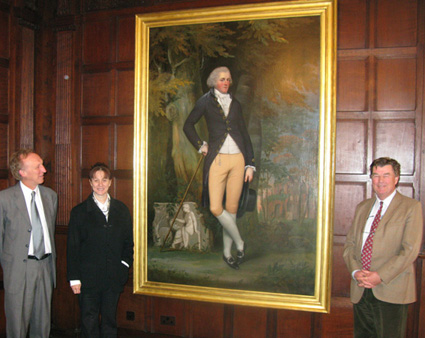
4. “Edward Austen’s Suit” – by Sarah Parry, tells of the portrait recently returned to CHL, and the suit as worn by Edward now on display [though not the same suit as in the portrait]
Edward Austen Knight portrait, with Steve Lawrence, Sandy Lerner,
and Richard Knight [image: JAS Society]
5. “Jane Austen and Chawton House Library: A New Patron’s View” by Deirdre Le Faye. Ms. Le Faye shares her thoughts on new areas of study in Austen’s world. She wrote of this also here in the Spring 2010 Persuasions On-Line and well-worth the read:http://jasna.org/persuasions/on-line/vol30no2/lefaye.html
6. “Literary and Literal Landscapes” by Eleanor Marsden, wherein you are reminded to help CHL in whatever way you can…
7. “North Meets South: Women’s Travel Narratives at Chawton House Library” by Isabelle Baudino, a Visiting Fellow at CHL in 2010, on her use of the CHLibrary for her research on women travel writers, such as Anne Plumptre.
Anne Plumptre (LibraryThing)
8. The quarterly column “Faces of Chawton” is in this issue about Ray Moseley, the Information Officer, and the man behind the various PR postings, the facebook and twitter pages, membership databases, and the CHL shop! – a feast of a job!
The Calendar of upcoming events is the only column that leaves me in quite a melancholic mood: so much going on with lectures, balls and gatherings, I am sick at being so far away…
The title of the second book in the Chawton House Library / Honno Press Jane Austen Short Story Award has been announced – the anthology will be released November 17, 2011. Title? Wooing Mr. Wickham. [alas! – no cover image yet]
This year’s collection, which follows on from the huge success of the inaugural award set up in 2009 to celebrate the bicentenary of Jane Austen’s arrival at Chawton, takes as its point of inspiration the heros and villains in Jane Austen’s books. [from the Honno Press Newsletter]
This year’s Chair of the Judges is novelist Michele Roberts, who will write the introduction to the anthology. Ms. Roberts is the author of twelve highly acclaimed novels, including The Looking Glass and Daughters of the House, which was short-listed for the Booker Prize and won the W.H Smith Literary Award. You can learn more at the Michele Roberts website.
Wooing Mr. Wickham is available for pre-order at WHSmith – or wait until it is available through either Chawton House Library or Honno Press directly.
Copyright @2011 by Deb Barnum. of Jane Austen in Vermont



































 Jane Austen in Vermont