Great Britain - History · Jane Austen

Guest Post ~ Brian Austen on “A Genealogical Interest in Jane and the Many Other Austens”

Several months ago I posted an interview with Ron Dunning about his Jane Austen Family Tree website

Dunning - jane-austen-frontispiece-1870

I have recently heard from another Austen who lives in Australia. Brian Austen has been long at work on his own Austen Families, and while it does not yet appear that there is a relation to Jane Austen, his efforts have put him in touch with many of her descendants, including Ron Dunning! –  Brian has been compiling his own family tree with global connections to both the Austen and Austin families [see website links below].  He has graciously written a few words on his findings, and I welcome him here today to share his story with you.

A Genealogical Interest in Jane and
the Many Other Austens

By chance and while googling for Ron Dunning’s website address, I came across the Jane Austen website with your interview with Ron Dunning on his wonderful genealogical contribution on Jane’s family. As I said in my comments* I have met Ron and emailed him on a number of occasions to solicit his help, answer a query of his or to give him a lead.

Quite some years ago I began to research my own Austen family history. Not much was known. My father thought that his father was born on the boat coming to Tasmania but that was all. However the Tasmanian archives did have a record of his passenger record, albeit spelt as IN.

Nevertheless I was underway. I was given copies of some family letters written during WW2 so I had various family stories, and some names and relationships. So armed I wrote to several Austens listed in the Kent (UK) telephone directory. I since found out that this did cause quite some consternation as none of the recipients knew of Australian connections! – but a couple were familiar with some of the people I had mentioned. I had pretty much scored a bulls eye, and across different branches of the family, branches that no longer had contact. So I managed to unite families in Kent and across the world.

Gradually I pieced together a part of the family history. But I realised that the task might be made a lot easier if I searched for others who had researched the family. I decided to track down genealogical histories of Austen families and although this was before the tremendous surge in the popularity of family history, I soon had a mushrooming pile of Austen information. Unfortunately none of it related to my family.

But it did two things. It demonstrated that although the name was relatively uncommon in Tasmania, it was much more common in England, very common in fact and we shared the same name and spelling as England’s famous Jane. If only we were related to her! And I did learn that part of the family folklore is that yes, we are related, although no one knew how.

I also learnt that I enjoyed the collecting and examining of other people’s family histories. Occasionally I would find connections between families who were overjoyed at being given links to lost family members. I exchanged emails, research and information with many Austens across the world and was even invited to family gatherings and reunions. This was great fun. I joined the Austins Families Association of America and attended Conventions. I joined other Genealogical groups and went on holidays meeting fraternal Austen researchers. And it hasn’t stopped.

Gradually I built my own tree by broadening the number of branches, rather than by extending very far back in time: [see the website Austens of St Peters and Tasmania ]. But it has been very satisfying to find new “cousins” and add to the store of family stories such as “Rediffusion” (early days of cable television in England) and a connection with the breaking of the German Enigma Code. But no connection with Jane, unfortunately. And I am not alone.

Most of the Austen families with whom I have been in contact claim an unknown family connection to Jane Austen; the rest just hope to be related. Naturally (before I found Ron – actually he found me) I developed a Jane Austen tree, which although being incomplete was nevertheless quite good which all too often gave me the information to be able to disappoint a lot of people, including myself. But the search for links goes on for even though Jane’s immediate family has now been well documented (thanks to Ron and others), there are still enough gaps in the families of her ancestors to be encouraged while her distant past remains unproven….

[For some recent considerations see “Untangling the Austens” by Pam Griffiths: http://www.genealogycrank.co.uk/austen.php – the document is here: http://www.genealogycrank.co.uk/pdfs/austen_evidence.pdf ].

To that end my great hope is to be able to convince a genuine, documented family descendant of one of Jane’s brothers to provide a properly conducted DNA sample. We are still looking and are still hopeful for there are some descendants somewhere in the world yet to locate.

So after twenty years what have I found? Mainly that despite an expanding collection of Austen families, I have just scratched the surface. And I really have not done very much at all with our sister families, the INs. I do have to learn how to improve my website presentation, (http://austenfamilies.weebly.com/ ) and I need to recruit extra hands to the task. But it keeps me off the street, and it is fun, especially meeting new family and contacts.

by Brian Austen, Hobart, Australia

Brian Austen

************************

Thank you Brian for sharing your family histories and the joys of genealogy!  When you first contacted me, I related to you my own story of recently receiving a call from a young man in Australia who has been looking for my family for 10 years – his great-grandmother was my grandfather’s sister – we were the side of the English family who came to America in 1912 – there were five siblings – two stayed in the UK, two went to Australia, and my father and his family all came to America, losing touch through the years – now this young man, eager to find us has gotten us all together, cousins appearing everywhere! – so I understand the great joy that these connections can generate!  I have no Austens in my family [none that I know of anyway!], but it is the global aspect of bringing veritable strangers together that is the most intriguing and heartening, as you so rightly say! Perhaps you and I are even related somewhere there in Australia!

*Brian’s comment on the JAIV Ron Dunning Interview:  In the course of my attempt at collecting Austen family histories I have exchanged many emails with Ron and met him in London. I regard his work as a role model, a fine example for all of us who are trying to research and present our family histories. Thank you for this interview and transcript; I shall add a link to it from my page on Jane Austen’s family.

Brian Austen Hobart Australia

If anyone would like to comment or ask Brian a question, please to so below.

c2012 Jane Austen in Vermont
Books · Jane Austen · Literature

A Jane Austen Reading Group Wanders into Anthony Trollope

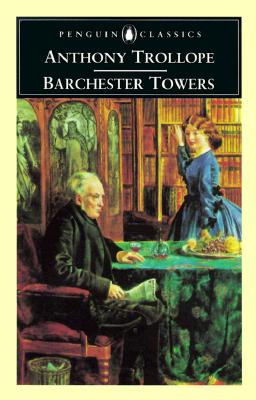
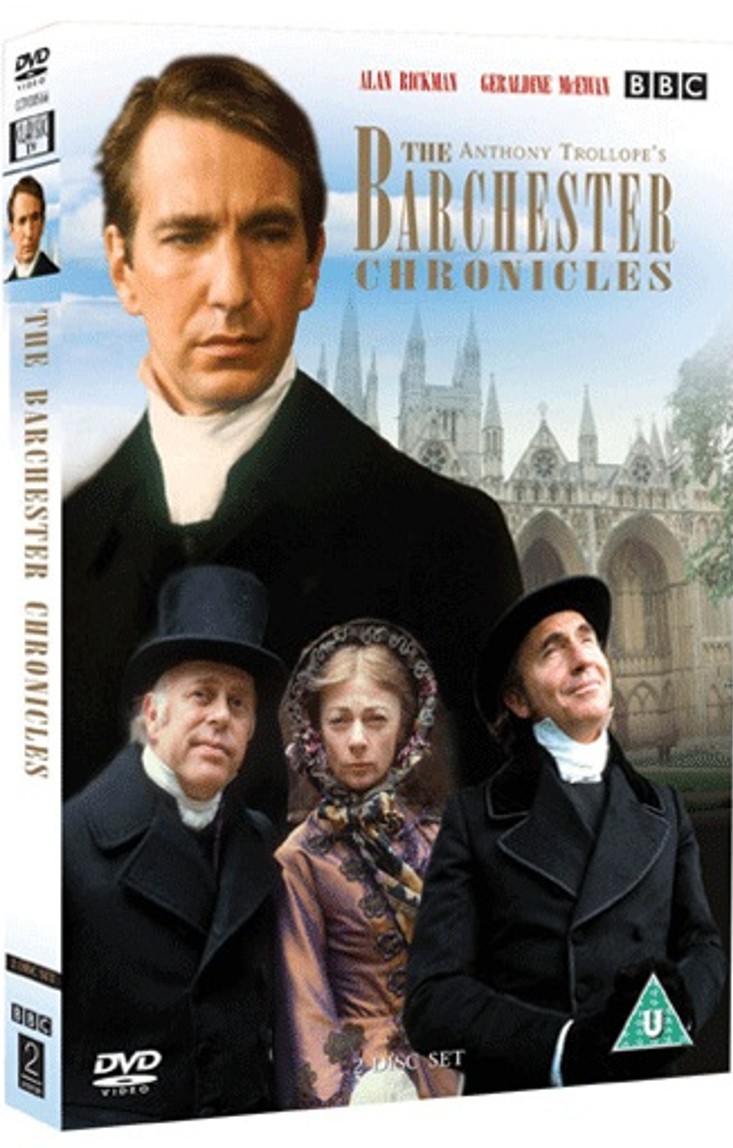
Our JASNA Jane Austen Reading Group has wandered astray and is currently reading Anthony Trollope.  We have started with Barchester Towers and will be discussing this on Wednesday night, though we know the series really starts with The Warden, which some have already read – some have seen the 1982 BBC production with Alan Rickman playing Slope [perhaps a prerequisite for playing Snape?], and some have listened to it on audiobooks – we most certainly shall have a lively discussion this week!

Anyway, I have had a few complaints about this Trollope read and have asked a member of the famed Men’s Austen Book Group from Montpelier [they started out with Austen and have gone onto Eliot and now Hardy, and now call themselves ‘Finches of the Grove’, from Great Expectations] – John is in another co-ed off-shoot of that group and they have wandered into Trollope as well – I have asked him to share with us why he loves Trollope so much.  You can also see the blog of two members of this group, Sarah and Michelle, who write about their collective reading – here are their thoughts on Barchester Towers at Two Girls Fishing .

So I welcome John Bollard, on Anthony Trollope:

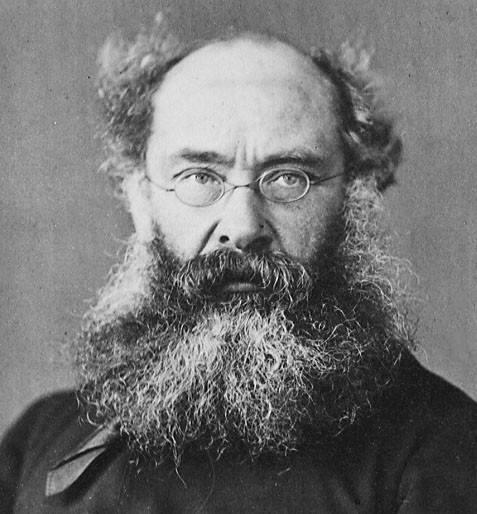
Anthony Trollope

Hi Deb,

You asked me a while ago to write something about why I like Anthony Trollope so much, which I will now attempt to do. Share with others if you wish.

One thing I really like is the narrator. Trollope’s narrator is always very much a character, although not a character who participates in the action–so the point of view is not quite omnipotent, but not quite first person either. I love the way he (the narrator) invites the reader into the story, invites him to take a particular view of this or that character or situation–to be not too hard on this character because of that circumstance, or to remember that this other character has shown a certain weakness in the past, and so forth. It’s a device that’s very much out of fashion these days, but I find that it draws the reader in, and creates a unique intimacy between the reader and the story. Sitting down to read a Trollope novel is like sitting down for a cup of tea with a good friend who knows all the news and gossip and talks about it in the most charming, entertaining way.

Another thing I like is Trollope’s heroines. They are very nuanced characters–always good, of course, but not without flaws. They tend to succeed by courageous adherence to principle–in fact, stubbornness is probably their most common failing, vide Eleanor Bold. In this they are more like Jane Austen’s heroines than like anyone else’s. All Trollope’s characters, even the comic ones, are complex. Villains tend to be more ignorant or blind than really evil. Heroes have their weaknesses, their vanities, etc. Trollope, through the narrator, always has a very gentle touch with his characters. Virtue is rewarded and vice punished, but there is always affection and sympathy even for the most difficult people.

Many of the novels involve whole networks of relationships, and do not simply follow the progress of a single hero and heroine; Trollope often chooses to comment on a particular relationship by contrasting it or setting it in conflict with another. Many of the books revolve around an Austen-style marriage plot, but Trollope is also very interested in marriages per se, especially the inner dynamic versus the outer appearance.

Look at all the marriages in Barchester Towers: the Grantlys, the Stanhopes, the Proudies, the Quiverfuls, even the quasi-marriage of the Thornes of Ullathorn. Quite a cast, you must admit, and quite an elaborate social scene in which to bring the love and the money together at the end.

Since I discovered Trollope, a couple of years ago, I’ve read a dozen of his novels, and the only one I have not cared for is The Way We Live Now. I mention this because many critics have claimed that this is his greatest, so any of your members who enjoyed Barchester Towers, and were looking for more might be steered that way. I would suggest rather sticking with the Barsetshire series and going on to Dr. Thorne, which is a delightful book, although not at all a continuation BT. (Books 3 through 5 in the series deal mainly with other characters in the county, and the BT characters are mentioned only casually. Things come together a bit in the final book with a return to the affairs of Barchester and the clergy.) Or, the first novel of the Palliser series: Can You Forgive Her?, which is wonderful, and typical Trollope. (Three heroines! Six suitors!) There is sly, gentle humor in all his books, however Barchester Towers is by far the most overtly comic, and is in that sense not quite typical.

Some have wondered why Trollope is not more widely read, and I have no real answer for that. Perhaps in part because he rather deprecated his own work. Perhaps he is more read in England than here, but I don’t really know that. I always imagine there is a book group in England who are scratching their heads, wondering why nobody reads Mark Twain.

Hope you’re well.  Looking forward to the meeting on the 28th. … Now to throw another log on the fire and get back to The Eustace Diamonds.
John

******************

Thanks John for sharing your love of Trollope with us! – Anyone out there who is a Trollope reader? –  please comment and offer your reasons for liking him – I love John’s comment about Mark Twain – anyone in the UK who is scratching their head about him??

Further Reading:

and if you must, there is this:

c2012, Jane Austen in Vermont
Austen Literary History & Criticism · Author Interviews · Books · Jane Austen · Literature · Regency England · Social Life & Customs

Maggie Lane on Understanding Austen: Key Concepts in the Six Novels

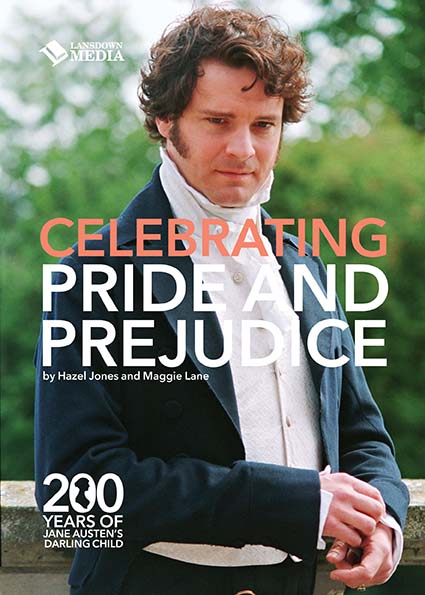
I had the pleasure to converse a bit with author Maggie Lane at the Brooklyn AGM last month – she signed a copy for me of her new book co-authored with Hazel Jones Celebrating Pride and Prejudice (Bath: Lansdown Media, 2012]


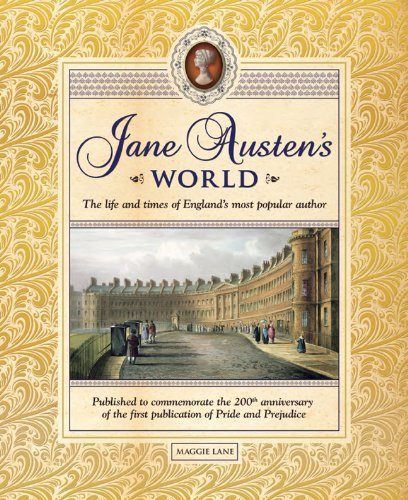
But Ms. Lane has been very busy! – I also purchased her just published Understanding Austen: Key Concepts in the Six Novels (London: Robert Hale, 2012) and in February 2013, her invaluable Jane Austen’s World: The Life and Times of England’s Most Popular Novelist (Carlton, 2013) will be published in a new revised edition with a new cover.

[You may pre-order here at Amazon.uk  ]

Those of us who subscribe to the Jane Austen’s Regency World magazine [and who does not! – if you have perchance let this fall through the cracks, it is a perfect holiday gift to request for yourself and / or give to your Austen friends: http://janeaustenmagazine.co.uk/subscribe/

… but those who do already subscribe will know that Maggie is the consultant editor, and author in each issue of the always interesting take on Austen “minutiae”, wherein she will take what the average reader will often gloss over and suggest the significance of the most obscure terms, themes or ideas, thereby making a reading all the more interesting and compelling.  Indeed in the latest Nov – Dec 2012 issue in her essay on “Shoelaces and Shawls”, Maggie addresses the clothing accessories in Emma’s Highbury, offering a discussion of shawls and shoes, and tippets and umbrellas, and the “elegance” of Mrs. Elton’s garish purple and gold; and she too makes reference to the importance of the already-famous Mr. Knightley’s gaiters

But today I want to share with you some of Maggie Lane’s own words on her book Understanding Austen.  She has most graciously written us a lovely essay on how the book came into being.  If you have any questions for Maggie or would like more information on the book, please comment below – she will be happy to answer you.

For some years now I have enjoyed being Consultant Editor of, and writer for, the Jane Austen and her Regency World magazine.  While other contributors explore the visual, social or political aspects of the world that Jane Austen inhabited, or discuss prominent personalities of the period, when writing my own articles I see my brief as keeping close to the novels themselves.  In each issue, I attempt to illuminate some theme or idea that plays a subtle yet vital part in Austen texts.  Thus it was that I hit on the idea of investigating some of the abstract nouns – elegance, openness and reserve, to take three examples – that feature so often in the six novels.

I soon realised that there was far more to say about these concepts than could be encompassed in the word-length of an article.  The idea for a new book was born!  The subject seems to me replete with interest.  There is the linguistic interest of how the meanings of certain words have shifted in the two centuries between Jane Austen’s time and our own.  Candour is a good example of that.  It now means frankness amounting sometimes even to rudeness, yet in Austen’s time it still carried the sense of generosity of spirit, of giving other people the benefit of the doubt, which Elizabeth Bennet so admires in her sister Jane.  And then there is the moral weight which Austen attaches to certain words.  Composure is almost always a quality to be recommended and tried for.  It preserves the individual from unpleasant notice and calms the nerves.  Yet when Willoughby displays composure in his London encounter with the deeply distressed Marianne, he is behaving as a heartless cad.  Anne Elliot’s “elegance of mind” is of a wholly different calibre from “the sameness and the elegance” of her eldest sister’s way of life.

The nuances which Jane Austen accords to all her favourite abstract terms make them an endlessly fascinating study.  By focussing on her vocabulary, noticing which words keep company with others, juxtaposing and comparing familiar sentences from across the novels, I gained new insights and new understanding which I hope my readers will share.

 *******************

Thank you Maggie!

I append here the Table of Contents to the work – an abundance of terms under discussion!

  1. Genius, Wit and Taste
  2. Elegance
  3. Openness and Reserve
  4. Exertion and Composure
  5. Liberality and Candour
  6. Gentility
  7. Delicacy
  8. Reason and Feeling
  9. Person and Countenance
  10. Air and Address
  11. Mind
  12. Temper
  13. Spirit
  14. Sensibility, Sense and Sentiment
  15. Firmness, Fortitude and Forbearance
  16. Propriety and Decorum
  17. A Nice Distinction

By way of example, let’s look at the Heroes of the novels and how they fare comparatively in the chapter on “Person and Countenance”:

Henry Tilney had a pleasing countenance, a very intelligent and lively eye, and if not quite handsome, was very near it; Bingley was good looking and gentlemanlike; he had a pleasant countenance and easy, unaffected manners; but alas! his friend Mr. Darcy is soon discovered to be proud, to be above his company and above being pleased; and not all his large estate in Derbyshire could then save him from having a most forbidding, disagreeable countenance.

Wickham had all the best part of beauty, a fine countenance, a good figure, and a very pleasing address.

Edward Ferrars does not at first appeal: at first sight, his address is certainly not striking, and his person can hardly be called handsome; Brandon: though his face was not handsome, his countenance was sensible, and his address was particularly gentlemanlike. And Willoughby? His person and air were equal to what her [Marianne] fancy had ever drawn for the hero of a favourite story. – which should send up red flags to the reader immediately!

Frank Churchillhis countenance had a great deal of the spirit and liveliness of his father’s – he looked quick and sensible.

And this description of Henry Crawford has always given me a chuckle: he was plain to be sure, but then he had so much countenance, and his teeth were so good. !

And Elizabeth Elliot is quick to observe [in the chapter on “Air and Address” which links quite nicely with “Person and Countenance”] this about Captain Wentworth: [she] had been long enough in Bath to understand the importance of a man of such an air and appearance as his…Captain Wentworth would move about well in her drawing room. Indeed!

And so it goes – are you not intrigued to find how Mr. Knightley is so described? I highly recommend this book – you will find you shall choose to re-read all the novels all over again, all the more appreciating the language and narrative meaning through Maggie’s insightful view – it is perhaps another holiday gift to add to your own ‘want-list’?

Do you have a favorite term or description in Austen that you would like to share? or a question about a term that might be confusing to you? – please comment below, along with any questions for Maggie.

About the author:

Maggie Lane is the author of numerous (and invaluable!) works on Jane Austen [see list below]–
She has also published articles in the Jane Austen Society Annual Reports,
the JASNA journal Persuasions, and has lectured on Austen
in the UK, the US, Canada, and Australia.

Having served for many years on the committee of the Jane Austen Society UK,
she is now Chair of its South West branch; she lives in Exeter.

Maggie Lane.
Understanding Austen: Key Concepts in the Six Novels.
London: Robert Hale, 2012.
ISBN: 978-0-7090-9078-6
£16.99 ($24.95)

Her works:

  • Jane Austen’s England (1986)
  • Jane Austen’s World (1996, 2005, new edition out in Feb 2013]
  • Jane Austen’s Family Through Five Generations (1984, 1992)
  • Literary Daughters (1989)
  • Jane Austen and Names (2002)
  • A Charming Place: Bath in the Life and Novels of Jane Austen (1988)
  • Jane Austen and Food (1995)
  • The Jane Austen Quiz and Puzzle Book (1982) [and various other quiz books on Dickens, Hardy, Bronte, Shakespeare, and more!]
  • Jane Austen in Lyme (2003)
  • Celebrating Pride and Prejudice: 200 Years of Jane Austen’s Darling Child
c2012, Jane Austen in Vermont
Auctions · Austen Literary History & Criticism · Books · Jane Austen · Jane Austen Circle · Literature · Rare Books

Austen on the Block! ~ An Austen-Filled Autumn at Upcoming Auctions

UPDATE: Prices realized noted in red as they become available

There are a number of Jane Austen materials coming up for auction in the next few weeks, some actually affordable! – and then some, not so much…  here are brief synopses – visit the auction house websites for more information.

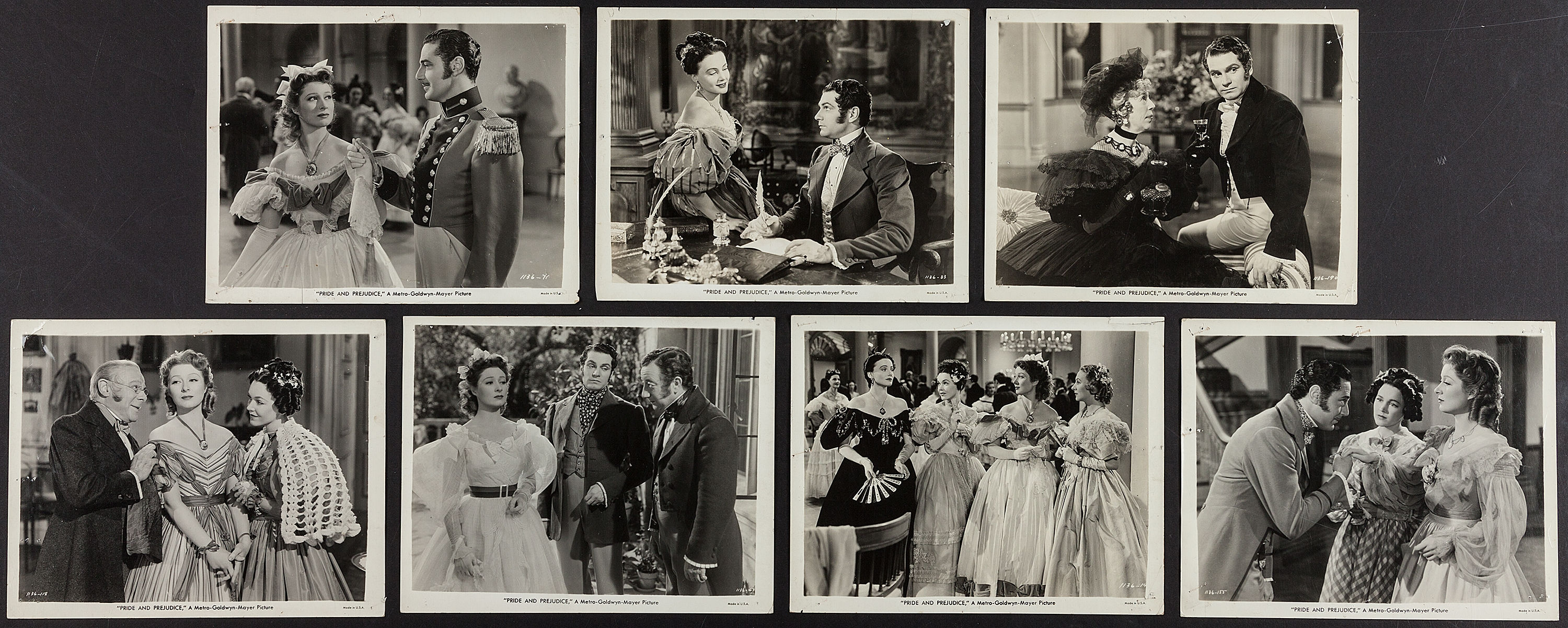
This one is a bit different and an interesting addition to anyone’s Pride and Prejudice collection!

November 18, 2012. Heritage Auctions, Lot 54353. Pride and Prejudice 1939 Movie photographs:
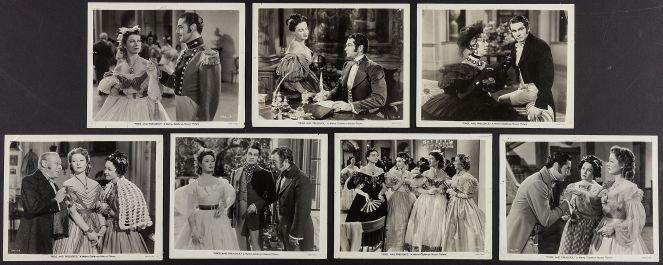
Pride and Prejudice (MGM, 1939). Photos (16) (8″ X 10″). Drama.

Vintage gelatin silver, single weight, glossy photos. Starring Greer Garson, Laurence Olivier, Mary Boland, Edna May Oliver, Maureen O’Sullivan, Ann Rutherford, Frieda Inescort, Edmund Gwenn, Karen Morley, Heather Angel, Marsha Hunt, Bruce Lester, Edward Ashley, Melville Cooper, Marten Lamont, E.E. Clive, May Beatty, Marjorie Wood, Gia Kent. Directed by Robert Z. Leonard.

There are 14 different photos with a duplicate each of 1136-190, and 1136-149; unrestored photos with bright color and a clean overall appearance. They may have general signs of use, such as slight edge wear, pinholes, surface creases and crinkles, and missing paper. All photos have a slight curl. Please see full-color, enlargeable image below for more details. Fine.

SOLD $179.25 (incl buyer’s premium)

 **********************

November 18, 2012.  Skinner, Inc. – Fine Books and Manuscripts, Boston. Sale 2621B

Lot 208:  Austen, Jane (1775-1817). Letters. London: Richard Bentley & Son, 1884. 
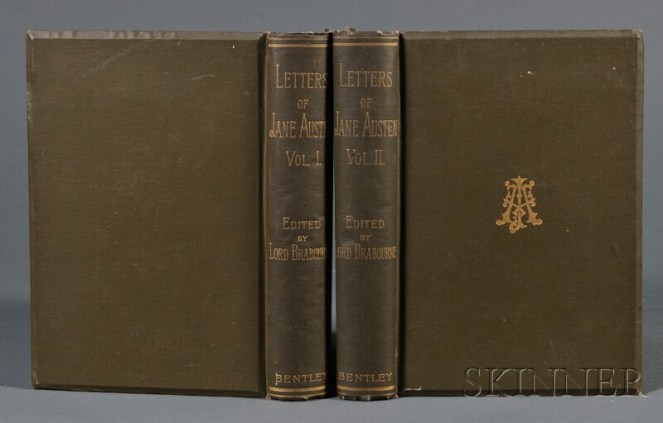
Octavo, in two volumes, first edition, edited by Edward Knatchbull-Hugessen, first Baron Brabourne (1829-1893), in publisher’s green cloth, ex libris Henry Cabot Lodge, with his bookplate; preliminaries in volume one a bit cockled, with some discoloration.

Jane Austen’s letters speak for themselves: “Dr. Gardiner was married yesterday to Mrs. Percy and her three daughters.” “I cannot help thinking that it is more natural to have flowers grow out of the head than fruit? What do you think on the subject?”

Estimate $300-500. SOLD $250. (incl buyer’s premium)

*****************

Lot 4 : AUSTEN, JANE. Northanger Abbey. Volume 1 (only, of 2). 12mo, original publisher’s drab boards backed in purple cloth (faded to brown), lacking paper spine label, edgewear; text block almost entirely loose from spine, few binding threads and signatures loose, several leaves in first third heavily creased, few other margins creased; else quite clean overall. Philadelphia: Carey & Lea, 1833

FIRST AMERICAN EDITION AND ONE OF 1250 COPIES. In need of some repair, but complete and in original cloth. All First American Editions of Austen are difficult to find. Later printings of this title did not occur until 1838, as a one-volume collected edition and, as a single volume in 1845. Gilson B5.

Estimate $500-750. SOLD: $600. [incl buyer’s premium]

**********************

This is the big one!

November 21, 2012. Christie’s. Valuable Manuscripts and Printed Books. London.  Sale 5690.
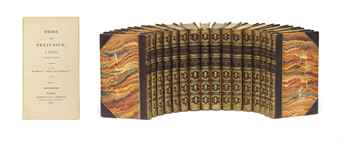
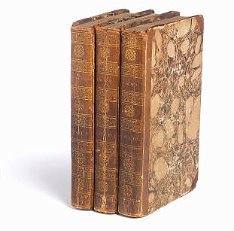
Lot 150:  AUSTEN, Jane (1775-1817). Sense and Sensibility … second edition. London: for the author by C. Roworth and published by T. Egerton, 1813. 3 volumes. (Lacks half-titles and final blanks, some browning and staining.) Gilson A2; Keynes 2.

Lot Description

AUSTEN, Jane (1775-1817). Sense and Sensibility … second edition. London: for the author by C. Roworth and published by T. Egerton, 1813. 3 volumes. (Lacks half-titles and final blanks, some browning and staining.) Gilson A2; Keynes 2.

Pride and Prejudice. London: T. Egerton, 1813. 3 volumes. (Lacks half-titles, lightly browned, a few leaves slightly torn along inner margin or with fragments torn from outer margin, margin of B10 in vol. I a little soiled, title of vol. III with slight stain at bottom margin, quires I and M in same vol. somewhat stained.) FIRST EDITION. Gilson A3; Keynes 3.

Mansfield Park. London: T. Egerton, 1814. 3 volumes. (Lacks half-titles, without blank O4 in vol. II or final advertisement leaf in vol. III, weak printing impression affecting 3 lines on Q10r.) FIRST EDITION. Gilson A6; Keynes 6.

Emma. London: John Murray, 1816. 3 volumes. (Lacks half-titles, E12 of vol. I misbound before E1, tear to bottom margin of E7 in vol. II, other marginal tears, L7-8 of vol. II remargined at bottom, title of vol. III with closed internal tear, some spotting, staining and light soiling.) FIRST EDITION. Gilson A8; Keynes 8.

Northanger Abbey and Persuasion. London: John Murray, 1818. 4 volumes. (Lacks half-titles and blanks P7-8 at end of vol. IV, some browning and spotting.) FIRST EDITION. Gilson A9; Keynes 9.

Together 6 works in 16 volumes, 12° (177 x 100mm). Uniformly bound in later 19th-century black half morocco over comb-marbled boards, marbled endpapers and edges (vol. I of Mansfield Park with scuffing at joints and upper corner of front cover).

Second edition of Sense and Sensibility, ALL OTHER TITLES IN FIRST EDITION. A rare opportunity to purchase the six most admired novels in the English language as a uniformly bound set. (16)

Estimate: £30,000 – £50,000 ($47,610 – $79,350) SOLD: £39,650 ( $63,004) (incl buyer’s premium)

**********************

November 27, 2012. Bonham’s. Printed Books and Maps. Oxford. 19851.
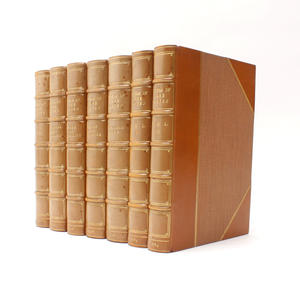
Lot 26:  AUSTEN (JANE) The Novels…Based on Collation of the Early Editions by R.W. Chapman. 5 vol., second edition, Oxford, Clarendon Press, 1926; together with The Letters of Jane Austen, 2 vol., frontispieces, uniform half calf by Hatchards, gilt panelled spines, faded, 8vo, Richard Bentley, 1884 (7)

Estimate: £300 – 500 ( US$ 480 – 810); (€380 – 630) – SOLD: £525  ($844.) (incl. buyer’s premium)

**************************

December 7, 2012. Christies. Fine Printed Books and Manuscripts Including Americana. New York. Sale 2607.
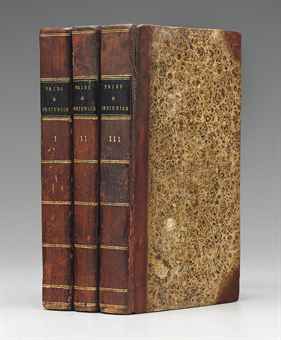
 Lot 140: [AUSTEN, Jane (1775-1817)]. Pride and Prejudice. London: Printed for T. Egerton, 1813.

Lot Description:

[AUSTEN, Jane (1775-1817)]. Pride and Prejudice. London: Printed for T. Egerton, 1813.

Three volumes, 8o (171 x 101 mm). Contemporary half calf and marbled boards, spines gilt-ruled, black morocco lettering pieces (a few stains and some rubbing); cloth folding case. Provenance: H. Bradley Martin (bookplate; his sale Sotheby’s New York, 30 April 1990, lot 2571).

FIRST EDITION. Originally titled First Impressions, Pride and Prejudice was written between October 1796 and August 1797 when Jane Austen was not yet twenty-one, the same age, in fact, as her fictional heroine Elizabeth Bennet. After an early rejection by the publisher Cadell who had not even read it, Austen’s novel was finally bought by Egerton in 1812 for £110. It was published in late January 1813 in a small edition of approximately 1500 copies and sold for 18 shillings in boards. In a letter to her sister Cassandra on 29 January 1813, Austen writes of receiving her copy of the newly publishing novel (her “own darling child”), and while acknowledging its few errors, she expresses her feelings toward its heroine as such: “I must confess that I think her as delightful a creature as ever appeared in print, & how I shall be able to tolerate those who do not like her at least, I do not know.” Gilson A3; Grolier English 69; Keynes 3; Sadleir 62b. (3)

Estimate: $30,000 – $50,000 –  SOLD:  $68,500  (incl buyer’s premium)

***********************

Lot 86: Presentation copy of Emma. Provenance: Anne Sharp (1776-1853) “Anne Sharp” in vol. 1 and “A. Sharp” in vol. 2 and 3.

Lot Description:

One of twelve presentation copies recorded in the publisher’s archives and presented to Jane Austen’s “excellent kind friend”: the only presentation copy given to a personal friend of the author.

In a letter to the publisher John Murray dated 11 December 1815, Austen noted that she would “subjoin a list of those persons, to whom I must trouble you to forward a Set each, when the Work is out; – all unbound, with From the Authoress, in the first page”. Most of these copies were for members of Austen’s family. David Gilson in his bibliography of Austen lists these presentation copies, based on information in John Murray’s records, as follows:

  • two to Hans Place, London (presumably for Jane Austen and Henry Austen)
  • Countess of Morley
  • Rev. J.S. Clarke (the Prince Regent’s librarian)
  • J. Leigh Perrot (the author’s uncle)
  • two for Mrs Austen
  • Captain Austen (presumed to be Charles Austen)
  • Rev. J. Austen
  • H.F. Austen (presumed to be Francis)
  • Miss Knight (the author’s favourite niece Fanny Knight)
  • Miss Sharpe [sic]

Anne Sharp (1776-1853) was Fanny-Catherine Knight’s governess at Godmersham in Kent from 1804 to 1806. She resigned due to ill-health and then held a number of subsequent positions as governess and lady’s companion. Deirdre Le Faye notes that by 1823 she was running her own boarding-school for girls in Liverpool (see Jane Austen’s Letters, third edition, 1995, p. 572). She retired in 1841 and died in 1853.

In 1809 Austen wrote to her sister Cassandra Austen that “Miss Sharpe… is born, poor thing! to struggle with Evil…” Four years later Jane wrote to Cassandra that “…I have more of such sweet flattery from Miss Sharp! – She is an excellent kind friend” (which may refer to Anne Sharp’s opinion of Pride and Prejudice). It is known that Anne Sharp thought Mansfield Park “excellent” but she preferred Pride and Prejudice and rated Emma “between the two” (see Jane Austen’s Letters, third edition, 1995, p. 573).

There is one known extant letter from Jane Austen to Anne Sharp, dated 22 May 1817. She is addressed as “my dearest Anne”. After Jane Austen’s death, Cassandra Austen wrote to Anne Sharp on 28 July 1817 sending a “lock of hair you wish for, and I add a pair of clasps which she sometimes wore and a small bodkin which she had had in constant use for more than twenty years”.

“In Miss Sharp she found a truly compatible spirit… Jane took to her at once, and formed a lasting relationship with her… [she occupied] a unique position as the necessary, intelligent friend” (Claire Tomalin, Jane Austen: A Life, 2000).

Anne Sharp is known to have visited Chawton on at least two occasions: in June 1815 and in August-September 1820. Deirdre Le Faye notes that James-Edward Austen-Leigh described her as “horridly affected but rather amusing” (see Jane Austen’s Letters, third edition, 1995, p.573)

Estimate: 150,000-200,000 GBP* UPDATE: UNSOLD

[*Now this confuses me: this copy of Anne Sharp’s Emma sold at Bonhams for a record £180,000 in 2008, and was subsequently sold to an undisclosed buyer for £325,000. in 2010 [see my post here and here on these sales] – I have got to hit the calculator to see what’s up with this…]

 ************************

Also in this sale:

Lot 87:  Austen, Jane. Northanger Abbey and Persuasion. John Murray, 1818.

Lot Description:

A set of Austen’s posthumously published novels in an attractive binding to a contemporary design. It appears that this set was the property of the Revd Fulwar-Craven Fowle (1764-1840). He was a pupil of Rev. George Austen at Steventon between 1778 and 1781. He is occasionally mentioned in Austen’s letters; it appears he participated in a game of vingt-un in 1801 and sent a brace of pheasants in 1815. Fulwar-Craven Fowle’s brother, Thomas (1765-1797) had been engaged to Cassandra Austen in 1792.

Deirdre Le Faye notes that he had “an impatient and rather irascible nature” and “did not bother to read anything of Emma except the first and last chapters, because he had heard it was not interesting” (see Jane Austen’s Letters, 1995, p. 525).

 Estimate: 4,000 – 6,000 GBP UPDATE: UNSOLD

**********************

And a few from Austen’s Circle I could not resist reporting on: these are all in the Swann Auction on November 20th – lots of other finds, so take a look:

Swann Sale 2295 Lot 40
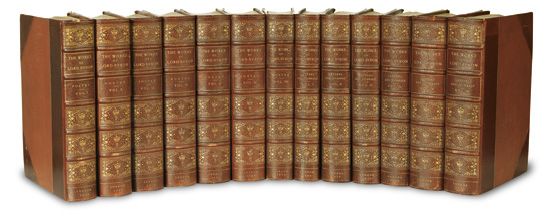
BYRON, LORD GEORGE GORDON NOEL. Works. 13 volumes. Titles in red and black. Illustrated throughout with full page plate engravings. 4to, contemporary 1/4 brown crushed morocco, spines handsomely tooled and lettered in gilt in compartments, shelfwear to board extremities with some exposure, corners bumped; top edges gilt, others uncut. London, 1898-1904
Estimate $1,000-1,500   SOLD: $1200. (incl buyer’s premium)

limited edition, number 97 of 250 sets initialed by the publisher. This set includes a tipped-in ALS (8vo, one folded sheet. April 7, 1892) by the editor of this edition, Ernest Hartley Coleridge, the grandson of Samuel Taylor Coleridge, to a Mr. Tours[?], recounting a lecture he had recently given in Minneapolis.

********************


Swann  Sale 2295 Lot 204:
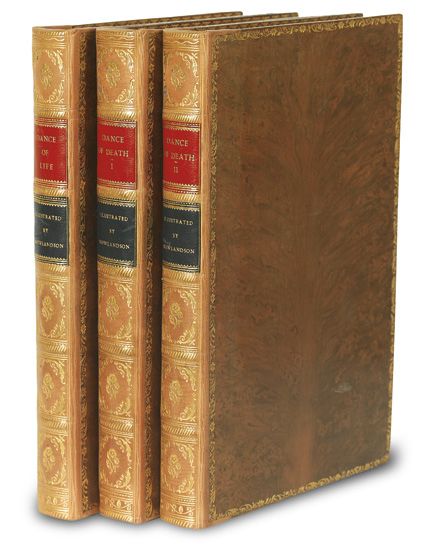
(ROWLANDSON, THOMAS.) The English Dance of Death. 2 volumes. * The Dance of Life. Together, 3 volumes. Engraved colored title-page and 37 hand-colored engraved plates in each volume of the Dance of Death, 25 hand-colored plates in the Dance of Life, by Rowlandson. Tall 8vo, later full tree calf gilt, spines tooled in gilt in 6 compartments with morocco lettering pieces in 2, rebacked; top edges gilt; occasional offsetting to text from plates and spotting to preliminaries; leather bookplates of Stephen M. Dryfoos mounted to front pastedown of 2 volumes; the whole slipcased together. London: R. Ackerman, 1815-16; 1817
Estimate $1,000-1,500 – SOLD: $3600. (incl buyer’s premium)

first editions in fine condition. “Indispensable to any Rowlandson collection, one of the essential pivots of any colour plate library, being one of the main works of Rowlandson”–(Tooley 410-411); Hardie 172; Abbey Life, 263-264; Prideaux 332; Grolier, Rowlandson 32.


Swann Sale 2295 Lot 205:
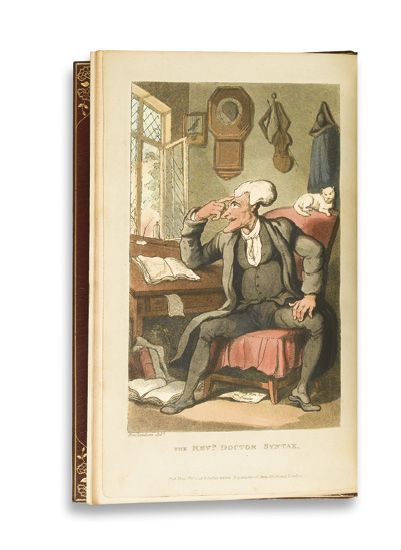
ROWLANDSON, THOMAS.) [Combe, William.] The Tour of Doctor Syntax, in Search of the Picturesque * In Search of Consolation * In Search of a Wife. Together, 3 volumes. Colored aquatint frontispiece in each volume, volumes 1 and 3 with additional aquatint title-page, and 75 colored plates by Rowlandson, colored vignette at end of vol. 3. Large 8vo, uniform full crimson crushed morocco blocked in gilt with corner floral ornaments, spines richly gilt in 4 compartments, titles in 2; turn-ins; by Root & Son, top edges gilt; bookplates of Edward B. Krumbhaar (vol. 1 only) and Christopher Heublein Perot (with his autograph). first edition in book form, second state, handsomely bound. London: R. Ackerman, 1812-20-(21)
Estimate $600-900 – SOLD: $960. (incl buyer’s premium)

 ***************************

And despite my love of Austen, I do periodically enter the 20th century [sometimes the 21st!] and I still harbor my great admiration and love of John Steinbeck, so this I share because it is so rare and lovely to behold:

Swann Sale 2295 Lot 234 John Steinbeck. Cup of Gold.
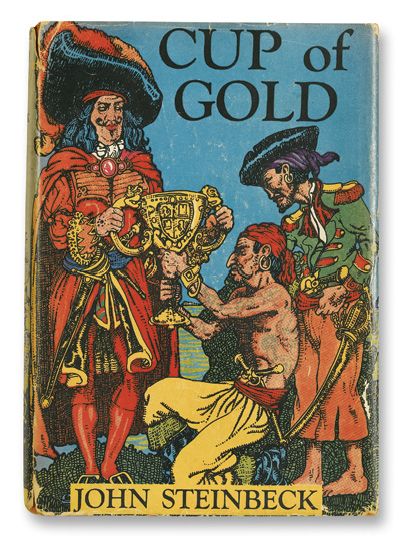
STEINBECK, JOHN. Cup of Gold. 8vo, original yellow cloth lettered in black; pictorial dust jacket, spine panel evenly faded with minor chipping to ends with slight loss of a few letters, light rubbing along folds, small rubber inkstamp on front flap; bookplate with name obscured in black pen on front pastedown. New York: Robert M. McBride & Co., 1929
Estimate $8,000-12,000 – SOLD: $14,400 (incl buyer’s premium)

scarce first edition, first issue of steinbeck’s first book with the McBride publisher imprint and “First Published, August 1929” on copyright page. Jacket flap corners evenly clipped as issued with “$2.50” printed price present. The publisher printed only 2476 copies, 939 of which were remaindered as unbound sheets and evidently sold to Covici-Friede who issued them with new preliminaries, preface, binding, and jacket in 1936. Variant copy (no priority) with the top edges unstained. Goldstone-Payne A1.a.

**********************

All images are from the respective auction houses with thanks.

Have fun browsing, and bidding if you wish!
 c2012 Jane Austen in Vermont
Books · Domestic Arts · Fashion & Costume · Jane Austen

An Austen Sighting! ~ Mr. Knightley’s Gaiters

One often finds Jane Austen popping up in the oddest places; and this one that I stumbled upon the other day points out a scene in Emma that one can so easily pass by without much notice [Austen being such an expert at this – and the reason for repeated readings!] – this time in a book on of all things, “Buttons”!

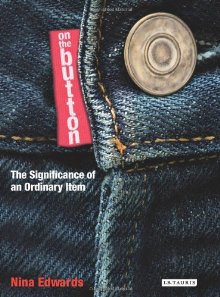
Nina Edwards new book, On the Button: The Significance of an Ordinary Item (London: Tauris, 2012), has this little gem in the introduction:

In Jane Austen’s Emma, when Emma contrives to find out if Mr. Knightley is considering Jane Austen romantically, buttons both betray his real affections to the reader and come to his aid by concealing his distress from Emma herself: (xix-xx, I have added a bit to the quoted text]

“I know how highly you think of Jane Fairfax,” said Emma. Little Henry was in her thoughts, and a mixture of alarm and delicacy made her irresolute what else to say.

“Yes,” he replied, “any body may know how highly I think of her.”

“And yet,” said Emma, beginning hastily and with an arch look, but soon stopping — it was better, however, to know the worst at once — she hurried on — “And yet, perhaps, you may hardly be aware yourself how highly it is. The extent of your admiration may take you by surprize some day or other.”

Mr. Knightley was hard at work upon the lower buttons of his thick leather gaiters, and either the exertion of getting them together, or some other cause, brought the colour into his face, as he answered,

“Oh! are you there? But you are miserably behindhand. Mr. Cole gave me a hint of it six weeks ago.”

He stopped. Emma felt her foot pressed by Mrs. Weston, and did not herself know what to think. In a moment he went on —

“That will never be, however, I can assure you. Miss Fairfax, I dare say, would not have me if I were to ask her; and I am very sure I shall never ask her.”

Emma returned her friend’s pressure with interest; and was pleased enough to exclaim,

“You are not vain, Mr. Knightley. I will say that for you.”

He seemed hardly to hear her; he was thoughtful, and in a manner which shewed him not pleased, soon afterwards said,

“So you have been settling that I should marry Jane Fairfax.”

                                                                                          (Emma, Vol. II, Ch. XV)

Here the gaiters seen to represent his morally dependable (but compared with the dashing Henry Crawford*) unexciting character; the buttons provide a refuge, the simple task of buttoning masking his emotion.

 ******************

what Mr. Knightley was so busily buttoning
image: Gaiters, 1805-10, British, the MetMuseum.org

(*I think she must mean Frank Churchill here, as Mansfield Park is nowhere in sight…!)

Isn’t this a wonderful passage? – one forgets how clearly Austen has strewn clues throughout the book as to Knightley’s true affections. Significant indeed! And it harks back to the scene with Emma contriving to repair her broken boot-lace to aid Mr. Elton and Harriet in their “courtship.”

Any thoughts?

The book, by the way, for anyone who has an  interest in fashion and its cultural history, and especially the all-important button, looks quite wonderful:

What do you use every day that is small and large, worthless and beyond price? It’s easily found in the gutter, yet you may never be able to replace it. You are always losing it, but it faithfully protects you; sexy and uptight, it is knitted in to your affections or it may give you nightmares. It has led to conflict, fostered and repressed political and religious change, and epitomizes the great aesthetic movements. It’s Eurocentric, and is found all over the world.

On the Button is an inventive and unusual exploration of the cultural history of the button, illustrated with a multiplicity of buttons in black and white and color. It tells tales of a huge variety of the button’s forms and functions, its sometimes uncompromising glamour, its stronghold in fashion and literature, its place in the visual arts, its association with crime and death, and its tender call to nostalgia and the sentimental. There have been works addressed to the button collector and general cultural histories, but On the Buttonlinks the two, revealing why we are so attracted to buttons, and how they punch way above their weight.You can view it here:  http://books.google.com/books/ibtauris?id=Rb46WTFfQAAC&dq=jane+austen&source=gbs_navlinks_s
c2012 Jane Austen in Vermont
Austen Literary History & Criticism · Jane Austen

G. K. Chesterton ~ “On Jane Austen in the General Election”

I stumbled upon this yesterday and think it rather appropriate as we approach The Election tomorrow – from G. K. Chesterton’s Come to Think of It (Methuen, 1930, originally published in The Illustrated London News, 1 June 1929) – a lovely piece about Wickham and his sort – we shall forgive Mr. Chesterton for misspelling “Bennett” – a curiously common error….

“On Jane Austen in the General Election” – by G. K. Chesterton

THERE was a remark about–Jane Austen in connexion with the General Election. We have most of us seen a good many remarks about Jane Austen in connexion with the Flapper or the New Woman or the Modern View of Marriage, or some of those funny things. And those happy few of us who happen to have read Jane Austen have generally come to the conclusion that those who refer to her have not read her. Feminists are, as their name implies, opposed to anything feminine. But some times they disparaged the earlier forms of the feminine, even when they showed qualities commonly called masculine. They talk of Sense and Sensibility without knowing that the moral is on the side of Sense. They talk about fainting. I do not remember any woman fainting in any novel of Jane Austen. There may be an exception that I have forgotten; there is indeed a lady who falls with a great whack off the Cobb at Lyme Regis. But few ladies would do that as a mere affected pose of sentiment. But rarely does a lady dash herself from Shakespeare’s Cliff or the Monument solely to assume a graceful attitude below. Jane Austen herself was certainly not of the fainting sort. Nor were her favourite heroines, like Emma Woodhouse or Elizabeth Bennett. The real case against Jane Austen (if anybody is so base and thankless as to want to make a case against her) is not that she is sentimental, but that she is rather cynical. Allowing for the different conventions of subject-matter in the two periods, she was rather like Miss Rose Macaulay. But Miss Rose Macaulay finds herself in a world where fainting-fits would be a very mild form of excitement. There is something very amusing about this appeal to a comparison between the novels of the two periods. The heroine of many a modern novel writhes and reels her way through the story, chews and flings away fifty half-smoked cigarettes, is perpetually stifling a scream or else not stifling it, howling for solitude or howling for society, goading every mood to the verge of madness, seeing red mists before her eyes, seeing green flames dance in her brain, dashing to the druggist and then collapsing on the doorstep of the psycho-analyst; and all the time congratulating herself on her rational superiority to the weak sensibility of Jane Austen….

Click here for the rest of the essay at Martin Ward’s Chesterton site: http://www.cse.dmu.ac.uk/~mward/gkc/books/Jane_Austen_GE.html

___________________________

Chesterton and wife Frances – wikipedia

You can also read the full text at Google Books from the Collected Works, Vol 35 , essay from The Illustrated London News, June 1, 1929 [this text includes footnotes]

It has also been recently reprinted in: Chesterton, G. K. “Jane Austen in the General Election.” In Defense of Sanity: The Best Essays of G.K. Chesterton. Ed. Dale Ahlquist, Joseph Pearce, and Aidan Mackey. San Francisco: Ignatius, 2011. 196-200.

Chesterton is most known to us as the author of the preface to the first printing of Love and Freindship (Chatto & Windus, 1922) – that essay can be read here as well: http://www.cse.dmu.ac.uk/~mward/gkc/books/intro-love-and-freindship.html

A reminder to all Vote tomorrow, and hopefully there shall be no Wickhams on any of the winning teams… [I live in Hope…]

c2012 Jane Austen in Vermont
Austen Literary History & Criticism · Collecting Jane Austen · Jane Austen · Regency England · Social Life & Customs

Giveaway winner announced ~ A Dance with Jane Austen by Susannah Fullerton!

Giveaway winner for Susannah Fullerton’s A Dance with Jane Austen: How a Novelist and Her Characters went to the Ball is Diana Birchall! – she wrote this on November 3:

I love Susannah’s writing, and I have long been a great admirer of her awe-inspiring range of abilities.  That is why I cast her as “my Marianne”!  I must and shall own this book, but they ran out of them at the AGM, and I haven’t got mine yet.  I just won a fabulous biography of Keats on the Dovegreyreader blog, and my mother-in-law’s electricity got restored in NYC today, so let’s make it good luck comes in threes.  Please enter me to win Susannah’s book!

Congratulations Diana – luck comes in threes indeed! And the fact you cast Susannah in your play as “Marianne” makes this even sweeter – I promise a completely objective random drawing [you can thank my husband who picks a number from 1-whatever in order of posting – he doesn’t even know what I am asking for!]

Please email me privately with postal direction!

Thank you all for such wonderful responses, to Susannah for her lovely post and responses, and to Sue Forgue, my go-to person for all things Regency (and London!) for her dance information!  For those of you who will be attending the JASNA-Vermont Tea on December 2nd, this book will be one of the door prizes, with thanks again to the publisher Frances Lincoln for their generosity.

c2012 Jane Austen in Vermont
Books · Collecting Jane Austen · Jane Austen · Jane Austen Sequels · Jane Austen Societies · JASNA · JASNA-Vermont events · Schedule of Events

JASNA-Vermont ~ Annual Jane Austen Birthday Tea! ~ Dec 2, 2012, with Sandy Lerner!

  Please Join us if you can!    

You are Cordially Invited to JASNA-Vermont’s December Meeting 

~ The Annual Jane Austen Birthday Tea! ~

  Sandy Lerner* 

“Writing Second Impressions 

*****

~ Traditional English Afternoon Tea ~
~
and Playing Word Games with Jane Austen! ~ 

Sunday, 2 December 2012, 2 – 5 p.m. Champlain College, Hauke Conference Center,
375 Maple St Burlington VT 
 

$25. / JASNA members and pre-registrants;
$30. at the door; $5. / student

Pre-registration is required!  ~ Please do so by 23 Nov 2012!

~ the form: Dec Tea 2012 Reservation form
~ Regency Period or Afternoon Tea finery (hats!) encouraged! ~ 

For more information:   JASNAVermont [at] gmail [dot] .com
Please visit our blog at: http://JaneAustenInVermont.wordpress.com

************************************ 

*Sandy Lerner, co-founder of Cisco Systems, founder of Urban Decay Cosmetics,  founder of the Ayrshire Farm in Virginia, and, most dear to us, is also the founder and moving force behind the Chawton House Library. She is now Chairman of Trustees, Chawton House Library and the Centre for the Study of Early English Women’s Writing, a place for research and camaraderie for scholars from all over the world. What better place than the former home of Jane Austen’s brother Edward Austen-Knight to study Austen and her literary antecedents and contemporaries!

Lerner’s book Second Impressions, written under the nom de plume of Ava Farmer, is set 10 years after the action in Pride and Prejudice, and explores the changes to the Darcy family’s lives, to Europe post-Napoleon, and to life in late Regency England, all as homage to Jane Austen, written in her “stile”, and with a fascinating yet credible plot. So let’s step into Lerner’s world to discover such things as: What do Darcy and Elizabeth do all day at Pemberley? Is Lady Catherine a welcome and constant visitor? Are the Wickhams reformed?  And what becomes of England’s most eligible female Georgiana Darcy? And Anne de Bourgh? And dare we ask about Mr. and Mrs. Collins?!

Second Impressions will be available for purchase and signing, all proceeds to benefit Chawton House Library.

During the Tea we shall engage in Playing Word Games with Jane Austen, a most suitable and refined entertainment for a wintry afternoon!

*****

Sandy Lerner, c2012 Pal Hansen

Links for further reading:

c2012, Jane Austen in Vermont
Austen Literary History & Criticism · Author Interviews · Books · Collecting Jane Austen · Fashion & Costume · Great Britain - History · Jane Austen · Regency England · Social Life & Customs

Guest post: Susannah Fullerton on her A Dance with Jane Austen and book giveaway!

The AGM in Brooklyn brought many pleasures, and one of the most pleasurable was meeting and talking with Susannah Fullerton.  I have long been an admirer – she is the President of the Jane Austen Society of Australia and a quick perusal of their website shows the extent of what she and her organization do, from annual meetings to conferences and the JASA publications Sensibilities and The JASA Chronicle.  Susannah also leads a number of literary tours for ASA Cultural Tours  [Australians Studying Abroad], and lectures on Austen around the world. And I must add that she was perfectly cast as the close-to-hysterical Marianne in the “Austen Assizes” script by Diana Birchall and Syrie James staged in Brooklyn!

Susannah has written many articles and a few books, one on which remains an all-time favorite, Jane Austen and Crime (Jones Books, 2004), wherein Ms. Fullerton gives us the real world that Jane Austen alludes to in all her works, the realities of such pieces in the narrative as Willoughby as serial seducer, Lydia’s “elopement,” and even the gypsies in Emma.  In her newest work, A Dance with Jane Austen: How a Novelist and her Characters went to the Ball (London: Frances Lincoln, 2012), Fullerton offers up the same detailed analysis of what Austen so off-handedly tells us, most of which we don’t quite “get” as 21st-century readers – the dressing for the dance, getting to the Ball, the various types of balls, proper etiquette, the music, the conversation, the Men! – all of it to enhance our understanding of Austen’s time and therefore her stories…

I have asked Susannah to join us today to tell us a little about her book, and her publisher has generously offered a copy for a giveaway – please see the information below on entering to win!

*************************

SF:  Some years ago I was having dinner with Joan Strasbaugh of Jones Books, the publishing firm which had brought out the American edition of my book Jane Austen and Crime, when Joan suggested that a book that really needed to be written was a book about Jane Austen and Dance. I was taken aback for a moment! Surely, with dances playing such a vital role in Jane Austen’s fiction, that subject had already been covered. But when I stopped to think, I realised it had not. Many Austen scholars have written about her dance scenes as part of other works, but there was no one book devoted entirely to that subject, a book that explored the social etiquette of the ballroom, the vital role dance played in courtship, the suppers served and the music played. Would I be interested, Joan asked, because if so, she could recommend the project to Frances Lincoln UK Ltd. And so I started writing.

image: Republic of Pemberley

What I wanted to do, I decided, was to follow Jane Austen’s characters to a ball. Had I been Jane or Elizabeth Bennet, what would the whole process of going to a dance have involved? How did a heroine get to a ball in the first place if her family had no carriage (the case for Emma Watson), how did she dress for the occasion, what rules governed her behaviour while there, and what differences did she find between assembly balls and private balls? When she stood up with a young man, what were the possibilities for flirtation and courtship, and how does Jane Austen show this happening with Elizabeth and Darcy, Jane and Bingley, Emma and Mr Knightley, Catherine and Henry, Marianne and Willoughby, when they are dancing with each other? Poor Fanny Price suffers the day after the Mansfield ball when she has no suitable confidante with whom to talk it all over, but for luckier young ladies often the ‘post-ball discussion’ was almost as much fun as the event itself.

Jane Austen loved to put on her satin slippers and go off to dance. In my book I wanted to provide information about the balls she attended, from the Basingstoke assemblies of her youth when she danced happily with neighbours and family friends, to the later balls where she chaperoned nieces and preferred to sit by the fire with a glass of wine rather than dance. She too enjoyed courtship in a ballroom when she danced with Tom Lefroy; she too knew the excitement of being asked by the right man, and the challenges of avoiding the wrong one.

As I wrote my book I discovered patterns in Jane Austen’s use of dances in her fiction. Several of the novels have one informal dance and one more formal one, and she uses each to progress her themes, characterisation and relationships. In some novels what happens is romantic, as is the case when Darcy and Elizabeth are partners and you can almost see the sparks between them, but in Mansfield Park everyone always seems to be dancing with the wrong person and balls in that novel illustrate selfishness, not romance. Jane Austen makes a great deal happen at a ball!

image: Brock illus Mansfield Park, Mollands

A Dance with Jane Austen is beautifully illustrated with contemporary pictures or illustrations from the novels. I include a brief chapter about dances in the film versions, but decided not to make this extensive because so often film-makers get it wrong and put in a dance, such as Mr Beveridge’s Maggot, which Jane Austen would not have danced. However, there are some lovely pictures from some of the movies that I chose to include.

For the past 17 years I have served as President of the Jane Austen Society of Australia. In that time I have lectured extensively about Jane Austen and her works, and have seen the joy that her books give to readers around the world. I hope that my book will increase the enjoyment of those readers by taking them into the ballrooms to discover that there is “nothing like dancing after all.”

***************

JAIV: One question I would ask Susannah is ‘What is your favorite dance scene in a Jane Austen novel and why?’

SF:  My favorite dance scene is the Crown Inn ball in Emma. This is the evening when Emma first starts to view Mr. Knightley as an attractive male, rather than as an old friend and family connection. She watches his “erect” figure move about the room, sees him rescue Harriet Smith from the embarrassment of being rejected as a dance partner, prods him into asking her to dance with him, and can hardly take her eyes off him all night! Jane Austen achieves so much in all her dance scenes – she gives a sense of a full community of living people, progresses courtships, reveals character and shows faults and foibles – but this scene is particularly rich. The moment when Emma reminds Mr. Knightley that they are “not really so much brother and sister as to make (dancing together) at all improper” and he replies “Brother and sister! No, indeed!” is one of the most erotic moments in all of Jane Austen’s fiction. It thrills me every time!

image: theloiterer.org

Oh I agree – I love this scene! Thank you so much Susannah for sharing your love of Jane Austen and dance with us!

**************************

Gentle Readers!  please ask any question you might have for Susannah Fullerton or post a comment here and you will be entered into the random drawing for a copy of A Dance with Jane Austen. Please do so by 11:59 pm, Sunday November 4th, 2012. Winner will be announced on Monday Nov. 5th – Worldwide eligibility!

For a review of the book, please visit:

About the author: 

Susannah Fullerton is President of JASA, and author of Jane Austen – Antipodean Views, Jane Austen and Crime and the forthcoming Celebrating Pride and Prejudice: 200 Years of Jane Austen’s Masterpiece (due out Jan. 2013) – note that the UK title of this work is Happily Ever After: Celebrating Jane Austen’s Pride and Prejudice.

A Dance with Jane Austen
Frances Lincoln, October 2012
ISBN-13: 978-0711232457

Upcoming book: (Feb. 2013)

US edition title and cover
UK edition title and cover
Austen Literary History & Criticism · Books · Jane Austen

Here is your chance to win Janine Barchas’s Matters of Fact in Jane Austen!

brendanccoyne's avatarJohns Hopkins University Press Blog

Okay Austen-philes, now that the 2012 JASNA (that’s the Jane Austen Society of America to the uninitiated) is through and your lives have returned to some semblance of normalcy, here’s your chance to test your knowledge of Jane Austen and her times.

Allowing for variant spellings, the real-world occupants at Baddesley Clinton share with Austen’s protagonists in Sense and Sensibility so prominent a name (first and last) that it remains emblazoned upon the stained-glass windows of their medieval manor.  What is this shared name?

We’ll send a copy of Janine Barchas’s Matters of Fact in Jane Austen to the first two people to correctly answer this question in comments to this post.

(Hint: Savvy readers might pick up on the answer simply by reading Professor Barchas’s recent post to our blog. A close look at the illustrations in her book also gives away the answer.)

Have at it!

View original post