Update: the manuscript sold for £990,000 to the Bodleian Libraries of Oxford University [with a little help from The National Heritage Memorial Fund] – thanks to Tony Grant for this information in his comment below – here is the latest news from the BBC website: http://www.bbc.co.uk/news/entertainment-arts-14152092 [though they could have spelled Bodleian correctly!]
******************
I am still on the road with little access – so thanks to Julie at Austenonly for the news that Jane Austen’s The Watson’s sold for over £850,000 this morning in London! – read Julie’s post here: http://austenonly.com/2011/07/14/the-watsons-sells-at-sothebys-in-london/ – stay tuned for the announcement of who bought it – apparently an institution – I would hazard a guess it is the Pierpont Morgan in New York City – where the first pages of the manuscript are now housed – and though nothing against the Morgan, I guess I would prefer to see it at Chawton House Library, close to where it laid on a shelf somewhere in Chawton Cottage for a good number of years.
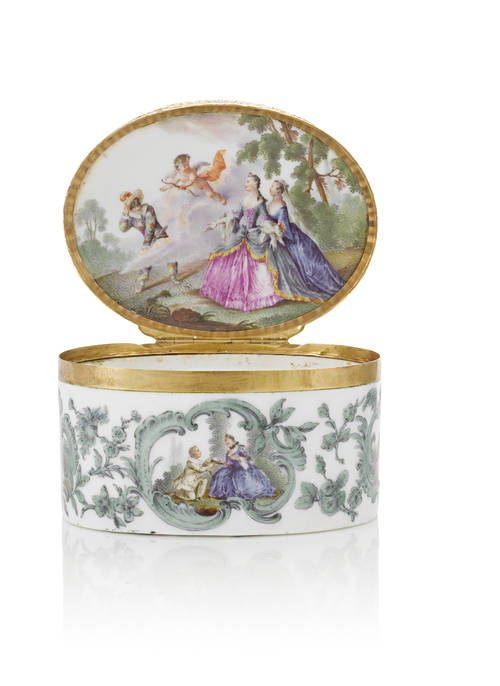
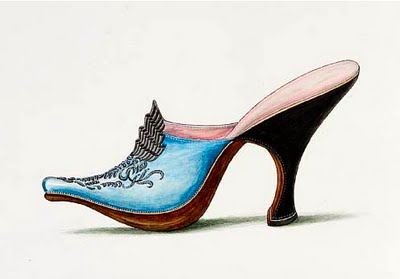
I have not fallen off the planet – have just been out of internet-access-zone – was not expecting to be cut-off from the world of Jane Austen and posts or the world in general for that matter! – but have this tiny window tonight – with a few pictures to share, alas! nothing to do with Jane Austen! – will be back soon!
Copyright @2011 by Deb Barnum, of Jane Austen in Vermont
English Country Dance Classes in Richmond
Learn about and enjoy Jane Austen’s favorite social pastime! Richmond Free Library
201 Bridge Street, Richmond, VT
4 Wednesday Nights i n 2011:
July 6, 13, 20, 27
7pm to 9:30pm
please note that the library locks its door at 8pm
7pm to 8pm ~ basics/styling tips/review
8pm to 8:10pm ~ break
8:10pm to 9:30pm ~ dancing for all
Voluntary donation to defray cost of air conditioning
($3 per class suggested)
For adults & teens. Come with or without a partner; we’ll change
partners throughout the evening. Dress comfortably and bring
c l e a n , flat-heeled shoes with smooth soles (avoid sneakers & mules /
slides) .
~ No sign-up or registration required ~
Just show up and join us for some fun evenings!
INFORMATION ~ www. burlingtoncountrydancers.org
**********************
You can also enhance your ECD skills here:
This first one is through the UVM OLLI program [ Osher Lifelong Learning Institute ]:
English Country Dancing in Jane Austen’s World Instructor: Judy Chaves Date: Monday, July 11, 6-8pm Location: Ira Allen Chapel at UVM Price: Members – $20 / Non-Members – $30
Do you enjoy 19th-century British literature? If you’ve ever read any of Jane Austen’s novels or seen any of the recent film adaptations, English country dance plays a prominent role in the culture of the time. The forerunner of American contra dance, English country dance is done in two facing lines (sometimes in squares, less often in circles) and requires no more than a knowledge of left from right and the ability and willingness to move to simply wonderful music. Through a combination of lecture (not much) and dance (as much as we can), you’ll learn the basics of the dance, gain an insider’s appreciation of the vital role it played in the lives of Austen’s characters, understand the etiquette and logistics underpinning Austen’s dance scenes–and have a great deal of fun in the process. You may come by yourself or as a couple!
Copyright @2011 by Deb Barnum, of Jane Austen in Vermont
JASNA.org in celebration of and preparation for the Fort Worth AGM on Sense and Sensibility has posted a partial bibliography of readings in Persuasions and Persuasions On-Line – http://jasna.org/agms/news-articles/about-ss-reading.html
The British Library announces an iPad app accessing 19th century books http://www.bibliolabs.com/. Users can experience the British Library 19th Century Historical Collection App for free from the App Store on iPad or at www.itunes.com/appstore/.
Victorian Secrets revives the works of neglected nineteenth-century writers and makes them available to the modern reader. Although over 60,000 novels were published during the 19th century, only a very small number have remained in print. See here for their catalogue: http://www.victoriansecrets.co.uk/
Notable Women Authors of the Day by Helen C. Black
A Book List: if you are looking for a book list, go no further that “Best Holiday Reads” at The Guardian where writers share their favorite works – no Austen I’m sorry to say, but read Antonia Fraser’s account of reading Anthony Powell’s Dance to the Music of Time – just a great story! http://www.guardian.co.uk/books/2011/jun/17/best-holiday-reads?INTCMP=SRCH
UPDATE: the winner has just been announced!Patricia’s Practicality – please email me your address and I will get the book off to you right away. Thanks all for your comments over at Maria Grazia’s blog – it seems a runaway that most were surprised by the extent of Col. Brandon’s secrets – a deep man in there somewhere with a great backstory!
Tomorrow is the last day to comment on my post “Secrets in Sense & Sensibility” at the My Jane Austen Book Club blog:
The Giveaway: You can comment either here or on Maria Grazia’s blog My Jane Austen Book Club to be entered into the giveaway:
Can you remember the first time you read Sense and Sensibility? What secret in the novel most surprised you?
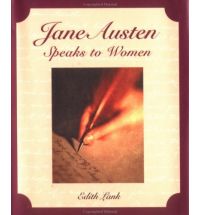
Random drawing for one of my favorites of the numerous Jane Austen gift books: Jane Austen Speaks to Women, by Edith Lank (2000) . As usual, please, don’t forget to add your e-mail address to your comment.
The giveaway is open worldwide . Winner will be announced on June 30th.
“Elinor agreed to it all, for she did not think he deserved the compliment of rational opposition.”[Elinor in Sense & Sensibility]
Copyright @2011 by Deb Barnum, at Jane Austen in Vermont
I too often get so caught up in Jane Austen’s time and place – England, the Regency Period – that I forget that there is an abundance of resources right here in my own American backyard. The Shelburne Museum is one such gem of a place to visit, and only a few miles from my home. I spent my teenage years (and later dragging my own children) visitingPlimoth Plantation and Sturbridge Villageand Colonial Williamsburg, such “living” museums feeding my love of history. There is so much to see, to absorb, to understand! and the internet, while it makes so much so readily available, does create its own problem – how does one possibly keep up with new material being added to the websites of every and all of the museums, art galleries, stately houses, historical societies, libraries, auction houses, etc. out there? – the list is endless!
But I do periodically randomly scout around and as anyone knows who researches on the web you find one thing and that leads to another that leads to another, etc., ad infinitum, and alas! you look at the clock and two hours have passed and that cannot possibly be true! – and then you want to post on something you find, but where is the time for that? – I am literally bogged down with thoughts – I maintain notebooks of ideas, most never to make the airwaves…
But I must share one such discovery from the other day: this was just going to be a short note in my weekly Penny Post, but I think it deserves a post all its own. I cannot even quite recall how I got there! – a book related link perhaps that sent me off to the American Antiquarian Society, and while lurking about I found their collection of online exhibitions – most all of interest to Janeites everywhere – so here goes, all images courtesy of the AAS: click on the links to tour the online images – great stuff!
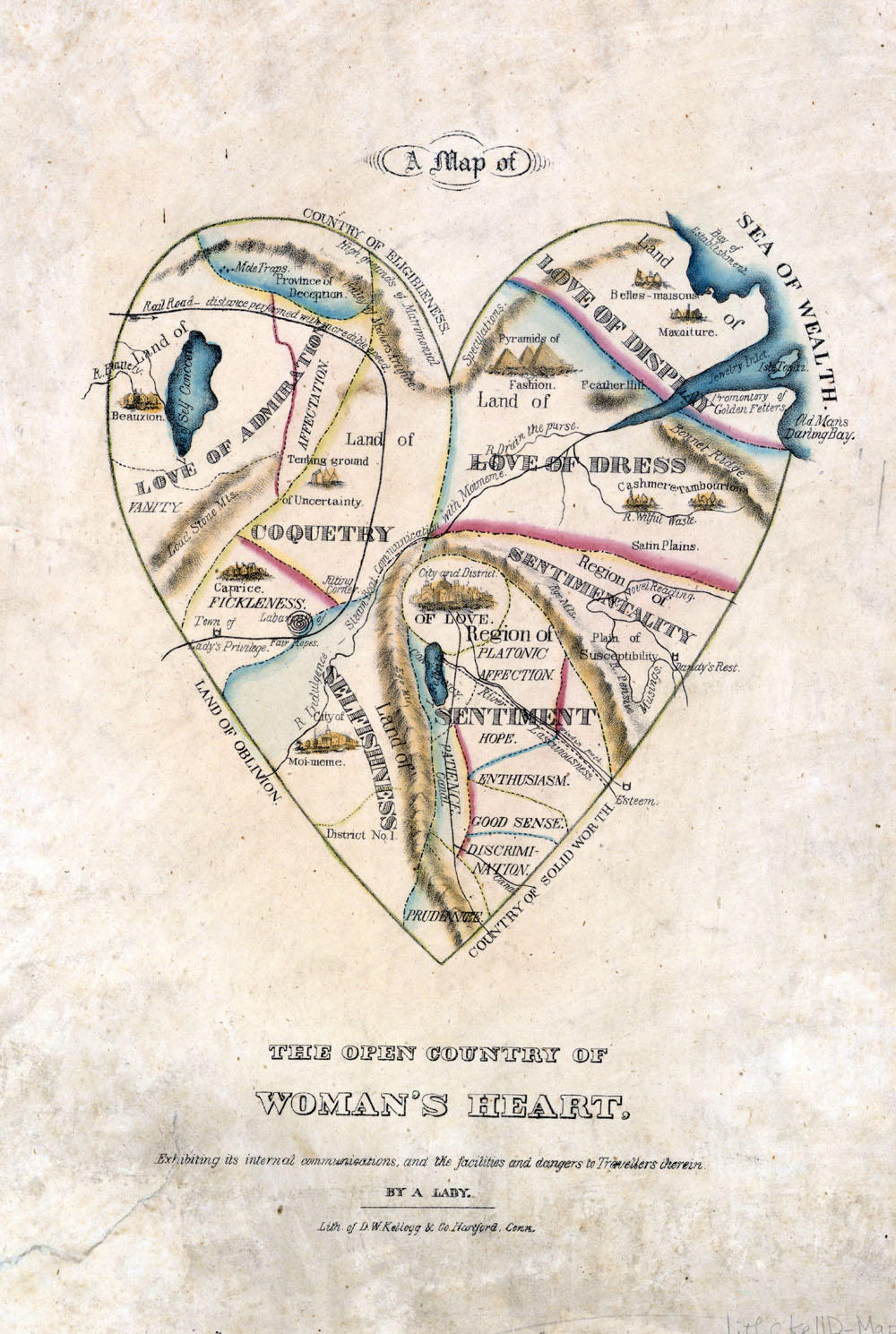
A Map of the Open Country of a Woman's Heart c.1833-1842
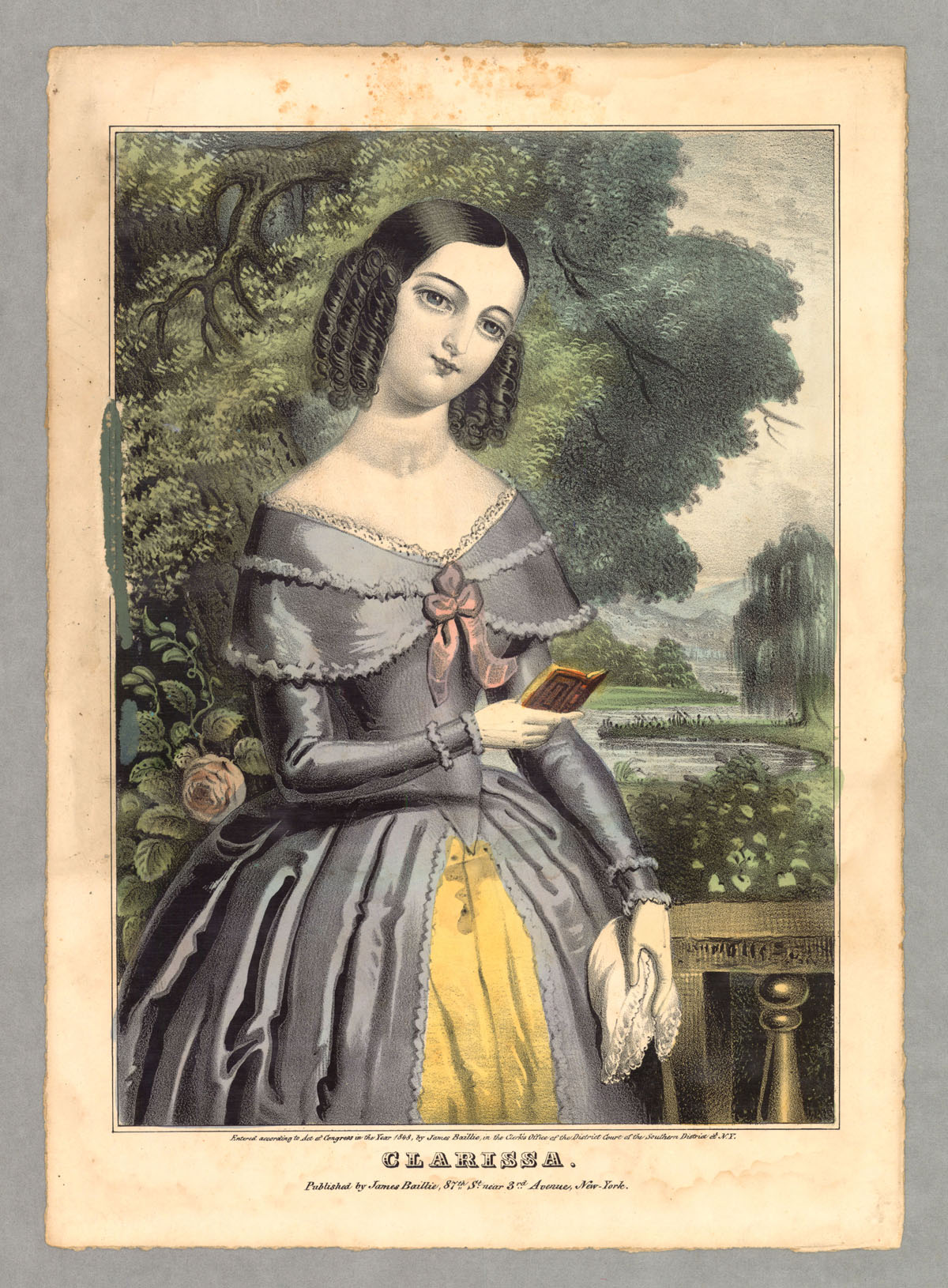
Most of the prints in the exhibit “Beauty, Virtue and Vice: Images of Women in Nineteenth-Century American Prints” were designed simply to please the eye, but they are also useful to historians who would like to understand how nineteenth-century Americans thought about the world in which they lived. Although prints are often works of imagination (even when they are grounded in fact), they still have much to tell us about the time and place in which they were created.
Artists were seldom concerned with representing people and scenes accurately, as we expect photographs to do, but took broad artistic license in creating scenes that would please the viewer’s eye. Even when artists depicted notable people, places, and events, artistic convention generally was more important than accuracy. Of course, these prints also tell us something of their creators’ point of view. Prints can be extremely useful for understanding the history of popular ideas, understandings, and beliefs. When read carefully and conscientiously, prints can be very useful documentary sources for understanding the past.
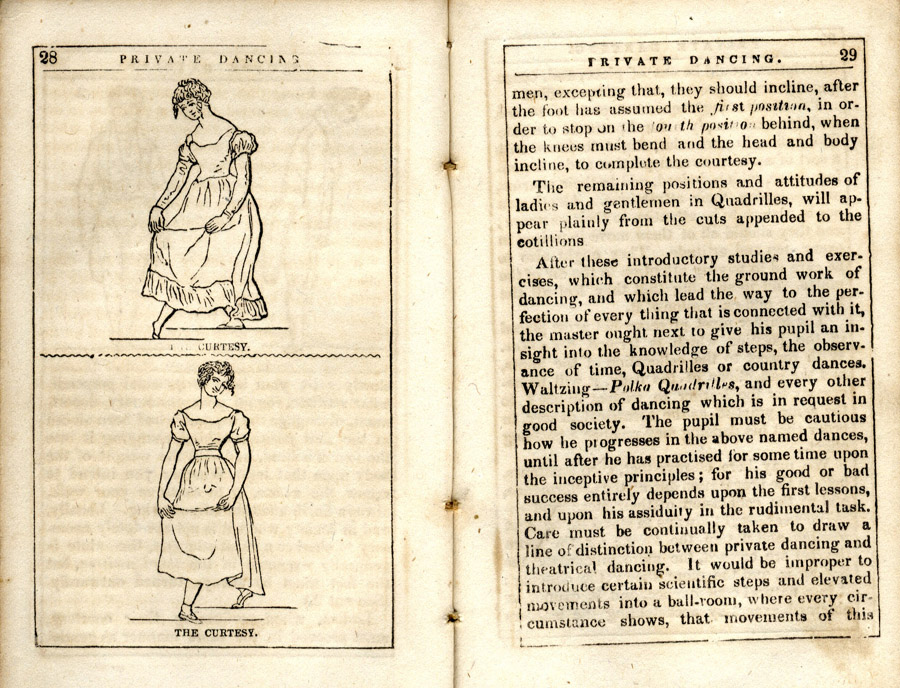
The illustrations and objects depicted in this exhibition provide a brief glimpse into the history of social dance. The abundance of artwork and social artifacts available attest to dance’s importance throughout American history. Featured is not only its origin, fashion and forms, but also the unspoken language of dance. Always moving, always changing, dancing has never failed to enchant American society.
In the eighteenth and nineteenth centuries, dance became a forum for purposeful social activity; elaborate balls and private parties offered a means for a gentleman to seek his wife and allowed friends and family to share the new trends in music and dance. In the political sphere, balls provided a setting for politicians to exhibit their wealth and standing by their knowledge of the most fashionable dances.
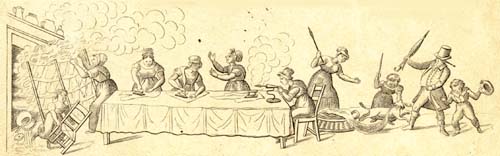
Although the majority of women chose to stay home, where society believed a woman should be, many ventured out into the working world either to begin their own business or to work for others in order to support themselves and their families. But whether a woman sought paid employment, or stayed at home to work in the domestic realm, she was always working. As Martha Ballard, a well-known eighteenth-century woman, wrote in her journal on Nov. 26, 1795, “A womans work is Never Done as ye Song Says, and happy Shee whos Strength holds out to the End…”
This exhibition brings together a selection of images from the Society’s collections that illustrate many facets of American women’s work, from the beginning of the American Revolution through the Industrial Revolution.
************************
And the link that likely brought me here in the first place:
A goal of this exhibition, and one of the goals of the American Antiquarian Society (AAS) itself, is to engage scholars in the study of the history of the book. The history of reading is but one component of this broad and dynamic field of scholarship. It is also an exceptionally difficult one. In highlighting the locations where individuals performed the act of reading in America, through the use of images and objects from the AAS collections, we hope to tell a story. It is not a definitive story by any means, but a story of three centuries’ worth of individuals ‘caught’ in the act of reading in homes, taverns, libraries, military camps, parlors, kitchens, and beds, among other places.
At times we can see a person reading in a specific location; at other times people tell us where they are reading; and sometimes we have to perform leaps of faith and imagine, for example, a cookbook being read in the kitchen. It’s the only logical location. Or is it? Our hope is that this exhibition will encourage other students of the history of the book to expand on this topic in as many imaginative and varied ways as the Society’s collection permits.
Spend some time if you can at this online exhibition – a wonderful collection of images of readers!
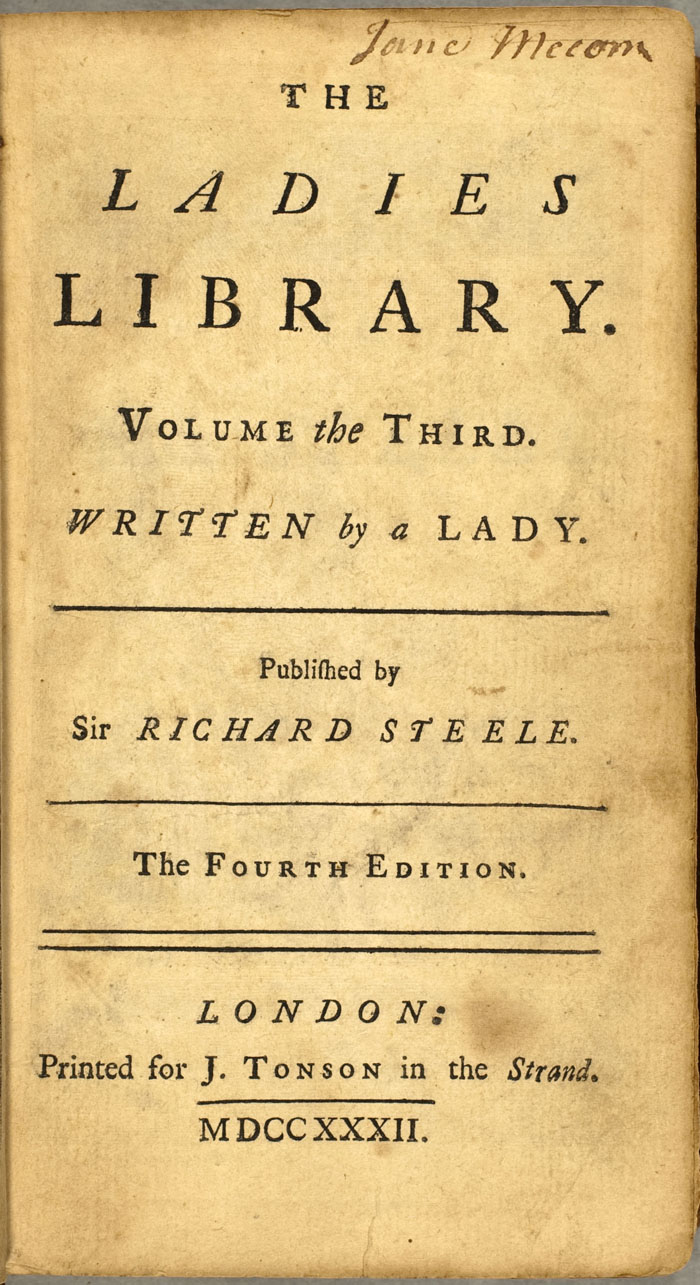
But here is my favorite find: note very closely this image of the title page of The Ladies Library and the owner’s signature Jane Mecom
Serendipitous, don’t you think that I read this article a few weeks ago and then find this title page image on the AAS site with her name in the book! [this is not noted on the website – I called to confirm that this book was indeed Jane Mecom’s and given to her by her brother and indeed it is! – and BTW, the reference person on the phone was delightful and most helpful!]
Well, as I said, one thing leads to another and somehow I rambled over from the AAS in Worcester Massachusetts to the website of the Boston, MA based Bostonian Society [at least I am still in New England!] – they have an online exhibition titled:
I am posting this on behalf of the conference organizer: please email her directly if you have questions.
CALL FOR PAPERS: 200 YEARS OF SENSE AND SENSIBILITY
a Two Day Conference
SCHOOL OF ENGLISH, UNIVERSITY OF ST ANDREWS,
9–10 SEPTEMBER 2011
Keynote speakers:
Kathryn Sutherland (St Anne’s College, Oxford)
and
Paula Byrne (author of the new Harper Collins Jane Austen biography).
‘I am never too busy to think of S&S’, Jane Austen wrote to her sister, Cassandra in April 1811. The year saw the publication of her first novel and to mark the anniversary, we are hosting a conference that reflects upon two hundred years of readership and opens up new interpretations of the novel. We invite proposals for 20-minute papers and round table panels on any aspect of the novel.
Possible topics may include but are not limited to:
Social and historical context
Reception
Tradition of Sensibility/contemporary aesthetic theory
Literary influences
Sibling relationships
Feminist readings
Adaptations and appropriations
Re-writings and sequels
The novel’s place in the canon
Please send abstracts of no more than 250 words to the conference organisers, Marina Cano López and Rose Pimentel, at 200sensibilities [at] gmail [dot] com
Please also email us with any questions at the above address. The deadline for proposals is 30 June 2011
The year of celebrating Sense & Sensibility at the blog My Jane Austen Book Club continues this month with my post on “Secrets in Sense & Sensibility”:
“Come, come, let’s have no secrets among friends.”
[Image: Vintage Classics cover]
Mrs. Jennings may request “no secrets among friends,” and Marianne may “abhor all concealment” (p. 53), but Sense and Sensibility is chock full of both – many secrets, much concealed – within each character, between characters, and between the author and the reader.
P. D. James, in her essay “Emma Considered as a Detective Story,” defines the detective story as one “requiring a mystery, facts which are hidden from the reader but which he or she should be able to discover by logical deduction from clues inserted in the novel with deceptive cunning but essential fairness. It is about evaluating evidence…it is concerned with bringing order out of disorder and restoring peace and tranquility to a world temporarily disrupted by the intrusions of alien influences” (James, p. 243-44)
Such is Emma, truly a mystery, where Jane Austen gives us clues and puzzles and hints along the way, whereby we the reader can solve the underlying mystery right along with Mr. Knightley, who gets awfully close, but not quite close enough, to the solution….
The Giveaway: You can comment either here or on Maria Grazia’s blog to be entered into the giveaway:
Can you remember the first time you read Sense and Sensibility? What secret in the novel most surprised you?
Random drawing for one of my favorites of the numerous Jane Austen gift books: Jane Austen Speaks to Women, by Edith Lank (2000) . As usual, please, don’t forget to add your e-mail address to your comment.
The giveaway is open worldwide . Winner will be announced on June 30th.
“Elinor agreed to it all, for she did not think he deserved the compliment of rational opposition.”[Elinor in Sense & Sensibility]
*******************************
The monthly S&S posts on Maria’s blog can be viewed here:
1. January: Jennifer Becton Men, Marriage and Money in Sense and Sensibility
2. February: Alexa Adams Sense and Sensibility on Film
3. March: C. Allyn Pierson Property and Inheritance Law in S &S
4. April: Beth Pattillo Lost in Sense and Sensibility
5. May: Jane Odiwe Willoughby: a rogue on trial
6. June: Deb @JASNA Vermont Secrets in Sense and Sensibility
7. July: Laurie Viera Rigler Interview with Lucy Steele
8. August: Regina Jeffers Settling for the Compromise Marriage
9. September: Lynn Shepherd The origins of S&S: Richardson, Jane Austen, Elinore & Marianne
10. October: Meredith @Austenesque Reviews Sense and Sensibility fanfiction
11. November: Vic @Jane Austen’s World Minor characters in Sense and Sensibility
12. December: Laurel Ann @Austenprose Marianne Dashwood: A passion for dead Leaves and other Sensibilities
[Copyright @2011 by Deb Barnum of Jane Austen in Vermont]
UPDATE: Results in red = Hammer price with Buyer’s Premium.
The results of today’s New YorkSotheby’s Sale No. NO8755: Fine Books and Manuscripts are in: note the unsold items!
LOT 5
Pride and Prejudice: A Novel. London: T. Egerton, 1813 SOLD for $35,000.[estimate: 25,000—35,000 USD]
LOT 50
Sense and Sensibility.London: Printed for the Author and published by T. Egerton, 1811SOLD for $28,125.[ est: 15,000—25,000 USD]
LOT 51
Pride and Prejudice: A Novel. London: T. Egerton, 1813 SOLD for $20,000. [est: 10,000—15,000 USD]
LOT 52
Mansfield Park.London: Printed for T. Egerton, 1814 SOLD for $5,625. [ est: 6,000—8,000 USD]
LOT 53
Emma: A Novel.London: Printed for John Murray, 1816 UNSOLD[high bid $7,500] [est. 10,000—15,000 USD]
LOT 54
Northanger Abbey: and Persuasion. London, John Murray, 1818 UNSOLD [high bid $4,250] [est. 6,000—8,000 USD]
******************
The Brontes fared well today: there were two lots of books by all three : Lot 55 sold for $80,500 [Wuthering Heights and Agnes Grey]; Lot 56 sold for $33,750.[leather bound 1st editions of Emily, Charlotte and Anne, 17 volumes total].















 Jane Austen in Vermont