I have posted about this very rich resource before, but doing so again as much had been added: The Regency Encyclopedia. I met up with the creator, Sue, at the Portland JASNA AGM, and we talked about some of the new items – maps, authors, and various bells and whistles. This is a password protected site, but Sue gave me permission to again provide the logins [case-sensitive]:
User ID – JAScholar
PW – Academia
I suggest you first look at the 18-page User’s Guide [no worries – it is largely visual with big print!] – to get a sense of how the database works. Then scan the various categories; and always check the “What’s New” tab to see what has been added – it is constantly being updated and Sue asks for suggestions of good resources that she can add. Here are the categories to give you an idea of what is included – all are keyword searchable:
Map Gallery that includes a Time & Distances option – this all based on John Cary’s New Itinerary (1819)
London: many maps, a tour, and shopping locations!
Georgian Names index
Fashion Print Gallery
Novel Calendars w/ Chapman’s Lists of Characters
Source list of work catalogued [my only criticism: this is a great bibliography of Regency resources but it is listed A-Z by first name, not the most helpful access point]
Online resource links [a select list]
A perfect weekend project – this database need some time spent with it to find all that is hidden behind its main menu page!
Forgot to mention that the JASNA General Meeting was yesterday before the Ball: always nice to applaud the outgoing and incoming officers and offer a collective Thank You to all the volunteers that people this organization. Plus, the official announcement that Montreal will be the host of the 2014 AGM – on Mansfield Park in celebration of its publication 200 years ago. Very close to Vermont, so very excited!
Sunday morning – the business meeting for the RCs – an updating on the finances, new features for RCs and another opportunity to share program ideas: beer-tasting [it brings the men out!]; military history [ditto!]; book swaps; Sherlock Holmes; whist and other games; a cemetery tour; balls and festivals – so much happening about Austen everywhere!
Brunch delicious and shared with Laurel Ann and Laurie Viera Rigler and several others at the round table – the winner of the High School essay contest read her winning entry – “Exposure of Truth” about Catherine in Mrs. Tilney’s bedroom – delightful to see another generation discovering and interpreting Jane Austen’s BOOKS!
Then a panel discussion “Dispute without Mayhem” – moderated by Kimberly Brangwin with Diana Birchall, Joan Ray and William Phillips – all responding to such questions as: What is the great joy of Northanger Abbey? What is to be made of Henry’s “We are English” reprimand? Does Northanger Abbey show Austen’s literary immaturity? Etc. – all ended quite amicably – no mayhem at all! – with a push and a Hurrah! for a Team Catherine to gain equal footing with the very vocal Team Tilney!
So future AGMs? Mark your calendars now – check out the details at the JASNA website:
RCs Nili Olay and Jerry Vetowich gave a rousing intro and welcome to the appropriately titled Sex, Money and Power in Jane Austen’s Fiction, in Brooklyn NY October 5-7, 2012. Admiral Jerry protested the “sex” part but was promptly silenced by Nili…looks to be great fun!
All very exciting to contemplate! – but up next is October in Fort Worth Texas to celebrate Sense & Sensibility: 2011 Annual General Meeting, Oct. 14-16, Fort Worth, TX USA Theme: “Jane Austen: 200 years of Sense and Sensibility” – If their introduction is any indication of what they have in store for us, saddle up your best Palomino and giddy-up to Texas – the AGM team presented a rollicking video of Emma Thompson’s Sense & Sensibility interspersed with Western movie scenes featuring the likes of John Wayne and friends – an absolute hoot! – raucous laughter all around [you can also listen to the Austen ‘Home of the Range’ sung at last year’s AGM here – alas! link not accessible – will add tomorrow…]. So this Janeite will be certainly packing up her saddle bags and band boxes – for long before obsessions with Gregory Peck in a grey-flannel suit, Russell Crowe in Roman gear, Colin Firth in a wet white shirt, and Richard Armitage in Victorian costume and black leather with metal – long before any of them – Cowboys were my thing – I was Annie Oakley, Calamity Jane and Dale Evans all rolled into one – and my heart was really only for one fellow: how perfect to run into Him [ i.e. Roy Rogers for the uninitiated] on our cross-country trek [see the blog of our trip here] in a pub in South Dakota:
So Fort Worth, here I come! And Portland, thank you for a glorious few days! – here are some final pictures that capture the fun:
lovely gown!Kimberly Brangwin in evening dress
Jill Kristensen, Wyoming
Marsha Huff at the Ball
Thank you Marsha for a fabulous four years, your beautiful Vermeer insights,
and for sharing your love of Austen with all of us!
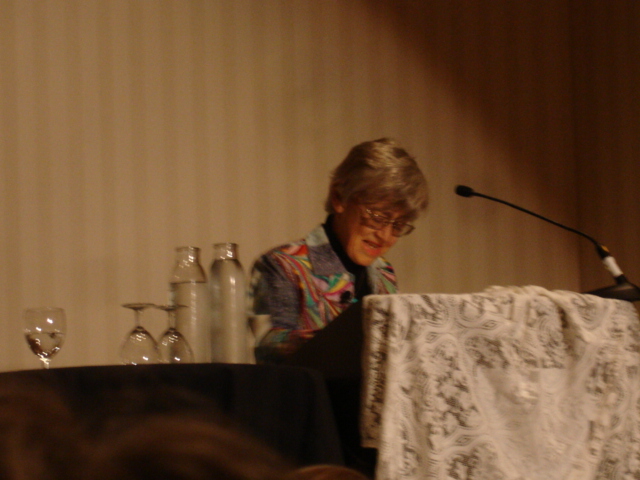
Day Three at the JASNA AGM in Portland: A quick continental breakfast with Laurel Ann and a few friends at the table – discovered that Elaine Bander is quite a scholar of Dorothy L. Sayers –more on this in another post – and then off to the Plenary with JASNA North American Scholar Juliet McMaster on – “‘A Surmise of such Horror’: Catherine Morland’s Imagination.” I have heard Prof. McMaster speak on several occasions and she never fails to express “in the best chosen language” all there is to love about Jane Austen. Today she begins with showing us a “cheap” 1965 paperback edition of Northanger Abbey, where “gothic’ is everything, cover and blurbs teasing us with the horrors that await us in these pages – she ends her talk with surmising that perhaps they didn’t get it so wrong! She presents this by examining the quality of Catherine’s mind – a combination of innocence and wisdom, likening her to the “holy fool” of Shakespeare or Dickens, a “good fool”. Where Henry Tilney is so often the focus of Northanger Abbey criticism, Catherine relegated to the “heroine” that Austen herself seems to denigrate, McMaster gives us a gift: Catherine redeemed and placed in her rightful home next to Austen’s other great heroines.
Juliet McMaster
Catherine, as we know, is described in negatives in those first pages, and Henry teases her about the “intellectual poverty” of a visit with Mrs. Allen – McMaster likens her “brain as a closet,” Catherine’s cluttered and well-stocked but vacuous [Henry and Eleanor are well-stocked but ordered; John Thorpe has a “double occupancy”!] – this “moving toyshop of her mind” is a perfect metaphor for Catherine – she learns aesthetic sensibility [that hyacinth!], not unlike the Romantic sensibility of Coleridge and Wordsworth, and her gothic readings and Henry’s very near prediction of her experiences in the Abbey all serve Catherine in her “awakening, an imaginative awakening, and we end able to love her “faults and all.” [as Mr. Knightley on his Emma!] – and what of Henry’s reprimand? The one scene in NA that has caused the most commentary? often an expression of concern that Henry could end up as tyranical as his father? McMaster believes that Henry is revitalized and rejuvenated by Catherine, and she views his rebuke as almost a “cover-up” – that his surmising Catherine’s thoughts before she has clearly expressed them [go back and read the book!], that Henry is all too aware of the truths about his father – Catherine awakens his own fears, and indeed contributes to his strength in openly defying his father.
I later, in yet another trip to the Emporium!, talked with Professor McMaster and added four more books to my Juvenilia Pressedition, now complete as to Austen’s works, with McMaster’s fanciful illustrations… and one last thought – McMaster threw out this tidbit – “pay attention to when Austen uses the word ‘almost.’”
Juliet McMaster with her "The Beautiful Cassandra"
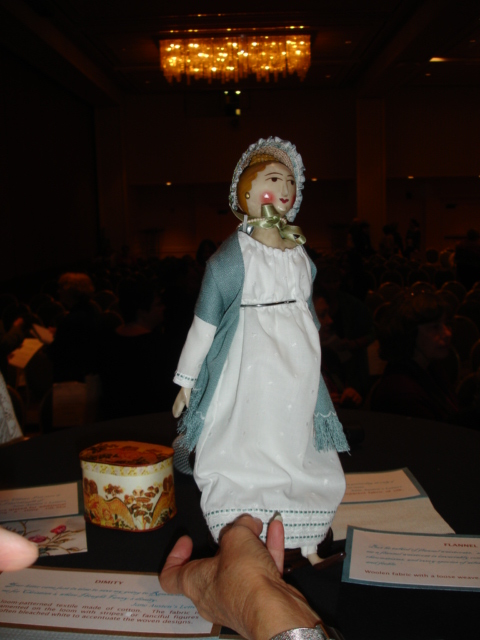
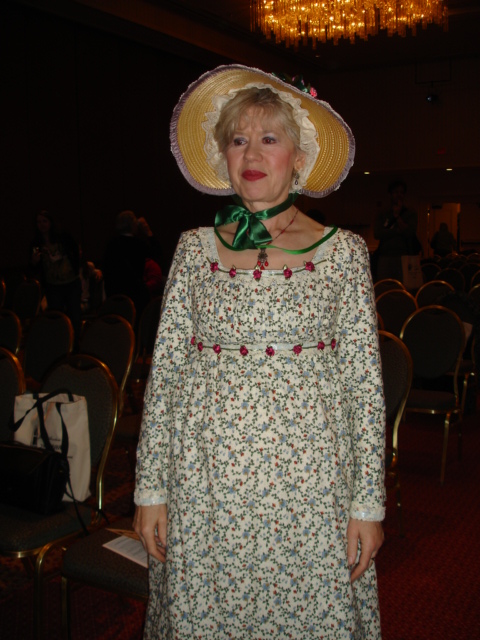
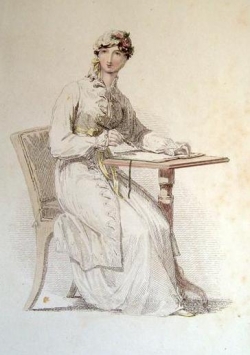
So after feeling quite confident in Catherine’s true place in the Austen canon, on to a fashion session with Mary Hafner-Laney, a specialist in construction of historic clothing in “ ‘I was tempted by a pretty coloured muslin’: Jane Austen and the Art of being Fashionable” – a presentation covering the various fashion sources in magazines, such as La Belle Assemblee, the use of fashion dolls [see illus. below] in the marketing, purchasing and sewing process, all the while citing Austen’s many references to the fashions of the day in her letters, filled as well all know with fashion gossip! and her novels. Mary took us through the process of purchasing the materials, choosing styles, finding a dressmaker, and the costs – i.e. nothing off the racks in Austen’s time! She spoke about Eleanor’s white gowns and other color options, types of fabrics and where they came from and the stores that sold them. Then a few words on undergarments, laundering, remaking and dying, and how one can never have “too much trim”! A lovely and informative talk! and now some pictures of the beautifully clad listeners:
fashion doll
Syrie James and Bonnie WiseKimberly BrangwinPat Panshinthe always lovely Baronda Bradley!
*******
And here, one of the rare negatives at a JASNA event but have to mention because I was so stunned! – Mary did not expect such a large audience [149!] and came without enough handouts – a facsimile of La Belle Assemblee [100], a booklet of fashion samples [50], and a regency fashion illustration with samples [50] – before Mary finished her Q&A, several people started going up front to get a handout – raging mutiny from the ranks! – they returned to their seats abashed [but with their booty…] and I turned to the woman next to me and said “Oh dear! This is going to be like a bra sale at Filene’s basement!” [what are the chances that this woman used to actually work at a Filene’s basement! – yikes!] and sure enough, as soon as Mary gave the go, a mad rush to the front, pushing and grabbing and quite appalling really! – who would have thought this lovely sedate group [and some so fashionably attired] could turn into such a greedy rabble! – yikes again!
On to Elvira Casel – always expected to present a thought-provoking topic, this time on “The Abduction of Catherine Morland: Deception, Sex and Courtship in Northanger Abbey” – she began with first eliminating any expectations that this talk would be about “SEX” – sex is inferred in Austen but that courtship process is full of sexual overtones in being all about finding a sexual / life partner – and the sex part dealt with, she talked about “how honest people can negotiate a world that is often dishonest.” Casal gives us a Henry and a John Thorpe as rivals in the first part of the book – Thorpe’s abduction of Catherine tantamount to a gothic rape, his insidious lies, though propelling the plot, are ineffective because Catherine is on to him early on – and Henry’s immediate attraction to Catherine [who asked for that introduction from Mr. King after all?!], their conversation of the dance showing their developing relationship – Catherine might be puzzled but she does understand that Henry is defining his values, his idea of commitment. Casal posits Henry and Thorpe as would-be narrators – Thorpe’s “fictions” propel the plot, but it is Henry as the true narrator / storyteller – he is very attuned to others, but there are concerns about his controlling nature – it is he who introduces the gothic story to Catherine, he stimulates her imagination – he is culpable here – but Casal sees Henry as ceasing to be the narrator when he seeks to be the hero in Catherine’s own story in the making. During the Q&A, she said what I thought was the most interesting point in her argument: Henry Tilney most resembles Elizabeth Bennet as a character – they both use humor to distance themselves from pain, disguising their true feelings.
Fourth session [wow! My brain is totally taxed – McMaster’s “closet” of clutter, and completely disordered!]
Susan Allen Ford on “Ingenious Torments: Reading Instructive Texts in Northanger Abbey” – Professor Ford, who is working on a book about what Austen’s characters are reading focused on the didactic texts inherent in Northanger Abbey – those specifically mentioned or inferred: Mrs. Morland’s Mirror, with info on John Homespun and family [i.e Henry McKenzie of The Man of Feeling fame] as “cousins” of the Morlands – plain country folk, yet Mrs. Morland’s inadequacy as a parent in her oft-quoted platitudes and clichés of life; the Richardson footnote on woman’s behavior in courtship; and finally Jane Collier’s An Essay on the Art of Ingeniously Tormenting, a satiric anti-conduct book. Collier outlines the various human relationships, emphasizing the aspects of teasing and torment [recall Catherine’s historians “labouring only for the torment of little boys and girls”] in all these relationships. Prof. Ford talks of Austen’s use of the word “torment” – Henry four times, Catherine three, how Isabella personifies the “tormenting” by a friend, the extent of General Tilney “tormenting” Mrs. Tilney. In the end, Austen mocks the prevailing didactic texts of the time by showing their inadequacies “for the emotional tortures in friendship, courtship and family relationships.”
End of breakouts! – so much learned, so much missed – look forward to Persuasions On-line [December 2010] and Persuasions 32 [May 2011] to fill in the gaps!
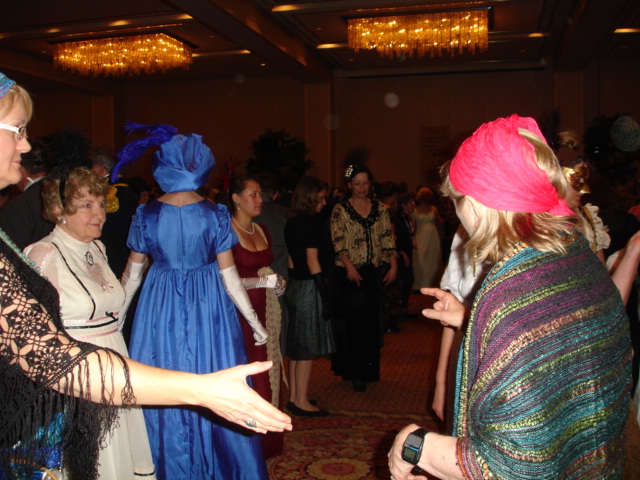
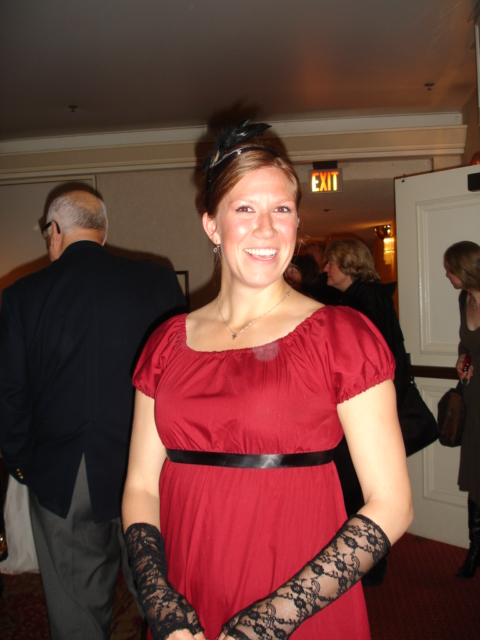
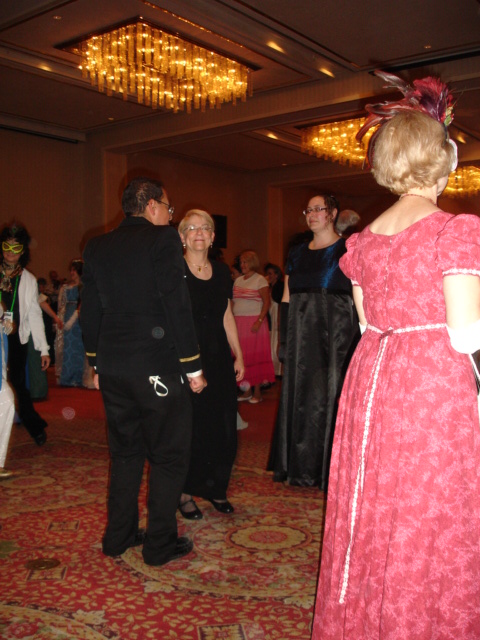
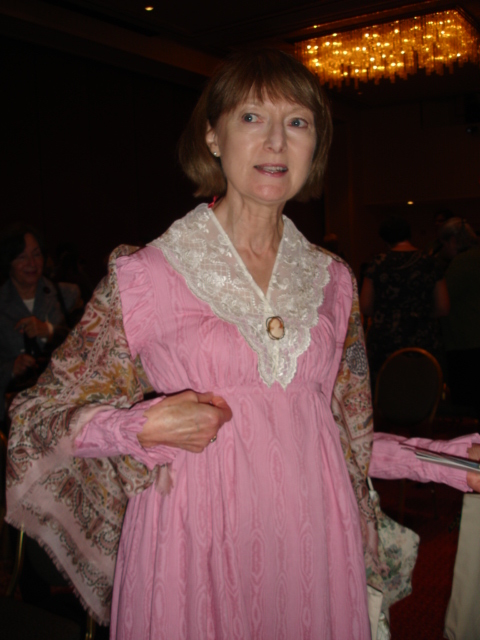
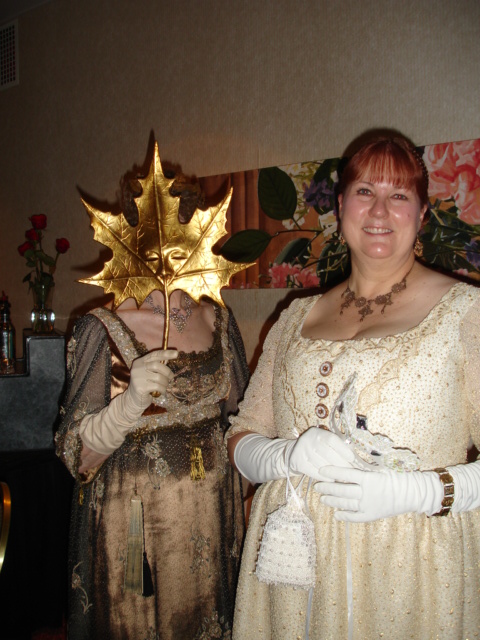
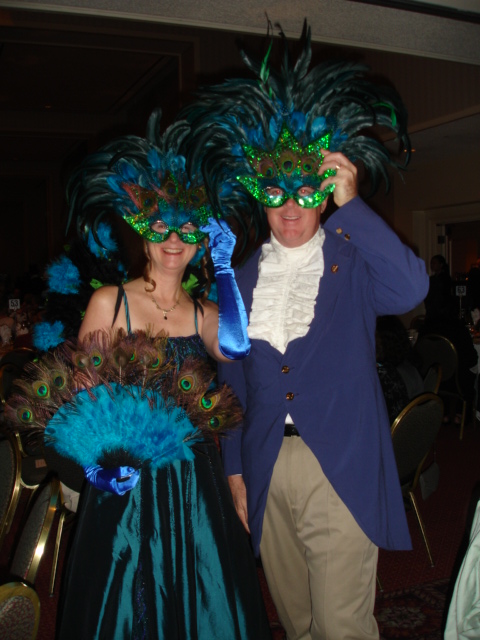
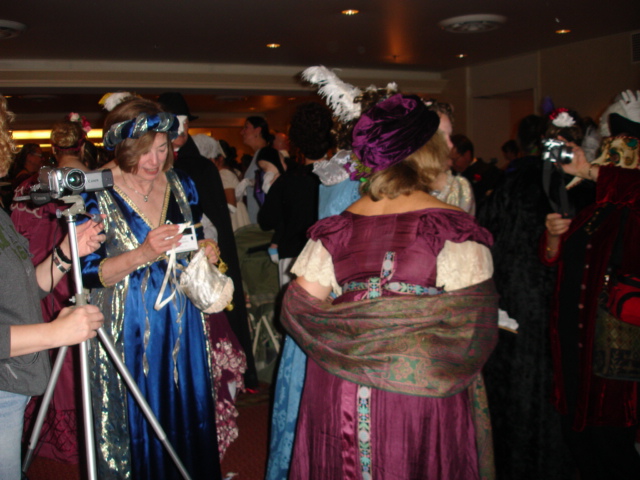
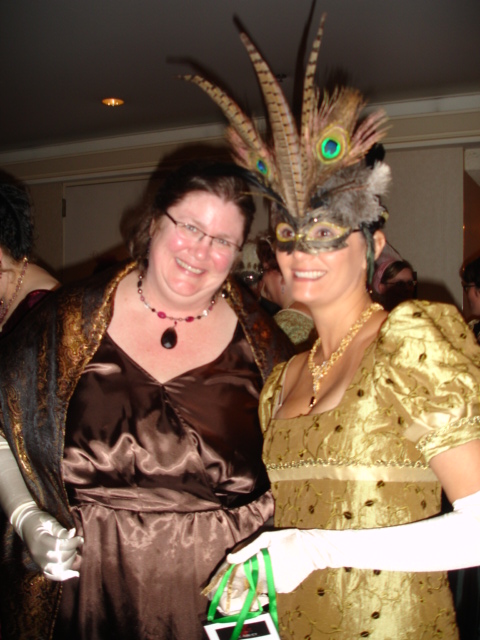
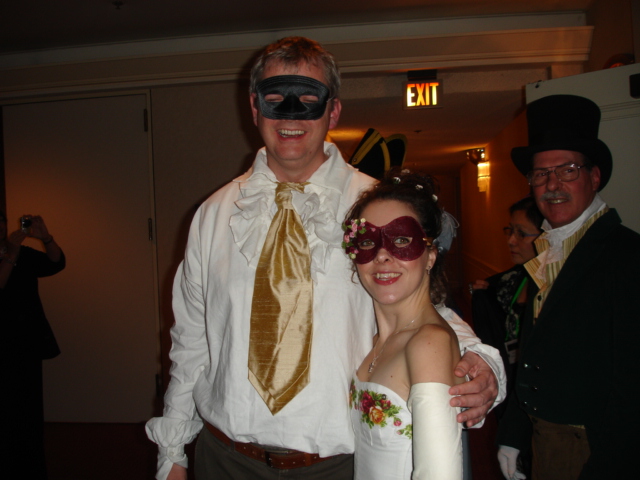
And then, the Banquet and Ball – the AGM had more fashionable Ladies and Gentlemen than I have ever seen – some elaborate Regency, some outrageous costumes for the Bal Masque – my costume still the “pattern-in-the-bag state – only a black velvet Spencer over a long dress – best I could do, but certainly not Promenade material! – which was great because I could just stand there and take pictures. Dinner was great fun – we had a fun table and met all manner of Austen bloggers and web masters: Sue Forgue of Regency Encyclopedia [contact me for passwords]; Diana Birchall of Mrs. Darcy’s Dilemma fame and her blog “Light, Bright and Sparkling”- we bonded on our “born and bred” in New York heritage; she introduced me to Ellen Moody, long known to me from the Austen listservs – I marvel at her Calendars of the novels – so great to meet her – we also bonded on our “born and bred” in New York heritage!… others across the table beyond the hollering needed to hear – will get in touch with them via email – then off to see the Promenade, a fiasco of elevator limitations, so no parading about the streets of Portland for this year – no matter, the foyer and ballroom were quite fine to exhibit the finery! pictures follow with names of those I got permission from – I did go into the Monster Mash event for a bit to hear the three different talks on the gothic – but headed back to the room for a needed respite – alas! my skills at English Country Dance to be exhibited next year! – and again, more and more people up there dancing this year – this is a wonderful trend at the AGMs – back to the sewing machine and ECD instruction for me!
Laurel Ann and Laurie Viera Riglerabsolutely stunning!Syrie James and husband BillDiana Birchall
Baronda and Erica perfect Phantom!
Debbie Aldous and Christina Boydlovely in purple!
and friend”]Tim Bullamore and friendJo Ann and Philip Staples
“]Liz Cooper
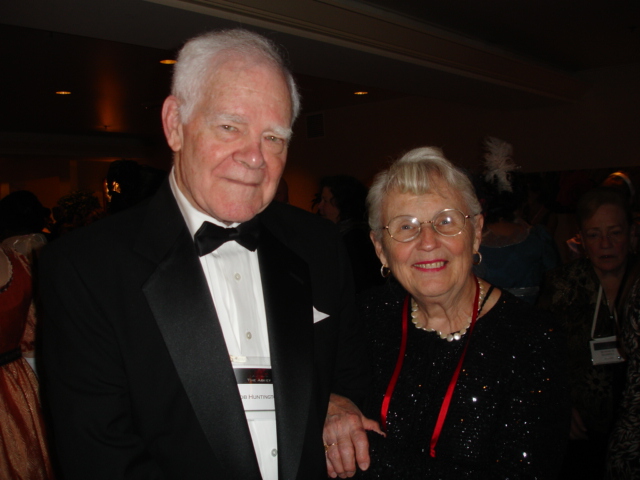
Ceil and Bob HuntingtonLorraine and William Hanaway
Carol Moss - JASNA webmaster!Laurel Ann and her roomie!Portland at night...
Portland AGM – Day Two ~ I first refer to Laurel Ann’s post at Austenprosefor her take on Day 2 – we did a lot together, but also tried to attend different break-out sessions – so here is a quick summary of my day two: I should start this by saying something about my love of Northanger Abbey – it took me few readings, over a few years, but now I count it as one of my favorites, Catherine an engaging heroine and Henry quite to-die-for and Austen more on her game than she is often given credit for – you can read this former post about my thoughts on NA, rather than repeat all that – but just wanted to emphasize how much I was looking forward to this AGM and it most certainly exceeded my expectations!
I was completely bummed that I had to miss the Team Tilney offering headed by Maggie “‘Da Man” Sulllivan and thankfully Laurel Ann shared the happenings with me – I had to go off to a THREE hour [yikes!] regional coordinator training session, which was great – some new people, some old friends, some great new ideas – Claire Bellanti, VP of Regions gave an inspiring meeting – and we all left with plans for new programs and ways to connect with each other in our varying attempts to bring Jane Austen into the lives of the folks in our respective regions. Claire had us all introduce the person next to us and we each had to share what book, other than of course any Austen, we would want with us if stranded on a desert island – interesting responses [perhaps a future post]!
After a quick lunch with Laurel Ann, we headed into the official AGM opening, hearing President Marsha Huff on her love of Northanger Abbey; theJAS Secretary Maureen Stiller who spoke of the loss this year of two great Austen scholars Elizabeth Jenkins and Brian Southam; and Steve Lawrence from Chawton House Libraryand Joan Ray thanking members for their generosity to the NAFCHL [North American Friends of Chawton House Library] –
and then on to the Plenary speaker Stephanie Barron, noted author of the Jane Austen mysteries, on “Suspicious Characters, Red Herrings, and Unreliable Detectives: Elements of Mystery in Jane Austen’s Northanger Abbey” – a delightful talk on the mystery elements in Austen, a crime in every novel, the heroine as solver, the detectives and pseudo-detectives, and the final restoration of order. Barron quotes W. H. Auden and his three requirements of a mystery novel, all present in Austen’s works: a closed society; a state of innocence with the “crime” committed by a fallen member of the society; and the societal ritual that the criminal has knowledge of in order to commit the crime, but is overcome by one of superior knowledge who restores order [thankfully!] – Barron then applies this pattern to Northanger Abbey – the investigators, the clues, the red herrings – Henry as the consummate detective, Catherine as ignoring the clues, Isabella the dropper of clues, John Thorpe as the red herring, General Tilney as the fallen one – with Henry finally restoring order, Catherine all the while gaining understanding of the male world, “penetrating the veil” as in all good gothic novels. Barron ended her talk with a comment on the Kathryn Sutherland kerfuffle about one’s editors [you can read more about it here], a reference to her short story to be part of Laurel Ann’s Jane Austen short story anthology Jane Made Me Do It [we all whooped! Laurel Ann swooned!], and answered some questions on her latest book Jane Austen and the Madness of Lord Byron – she spoke about following Austen’s chronological real life in the writing of her fictional mystery series, and oh! what will happen in 1817. All in all quite a wonderful introduction to this year’s AGM!
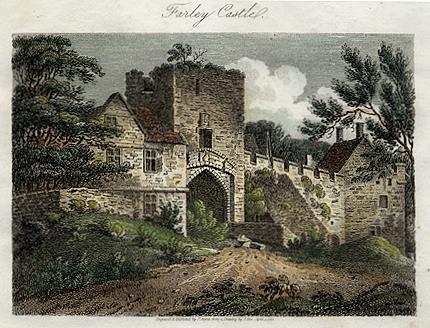
Then off to the first of many break-out sessions – and what a task to choose! – each session offering such variety and depth – the choice so difficult – I decided to do at least one on the gothic literary features of NA, one on fashion and all that muslin, and of course, something on Henry Tilney. So my first was to hear the ever interesting Janine Barchas on “The Real Bluebeard of Bath: A Historical Model for Northanger Abbey” a brilliant tour through the nightmarish history of the Farley-Hungerford Castle, within driving distance form Bath, and a place that Austen would likely have visited or known about in her time in Bath. Professor Barchas shared the words in a contemporary guidebook, Richard Warner’s Excursions from Bath [1801], a book known to have been in George Austen’s library and containing Jane’s marginalia – and here we have some real-life gothic tales about what went on in Farley Castle and may have served as Austen’s inspiration for her own Abbey story, truth of course being far more bizarre than fiction!
Then off to see Stephanie Eddleman on “Henry Tilney: Austen’s Feminized Hero?”– One of the things that can get my dander up in a discussion about NA is talk that Henry is too feminine to be a true hero, or too condescending to be an equal lover to Catherine, or too distant as a character to engage the reader – so I was hoping that Prof. Eddleman would give me much needed ammunition! – and she did indeed: Henry as the one hero who stands apart – he is her only witty hero; he is feminized but not feminine, and unlike Austen’s other feminized male characters [Frank Churchill, Robert Ferrars], Austen is not critical of Henry. I most appreciated Eddleman’s answer to Marvin Mudrick’s contention that Henry is a detached, disengaged character – she feels that Henry develops intimacy through his intelligence and wit, always encouraging Catherine toward her own independent thinking. I hope this talk will be in Persuasions – it gives much needed support for Henry as True & Worthy Austen Hero.
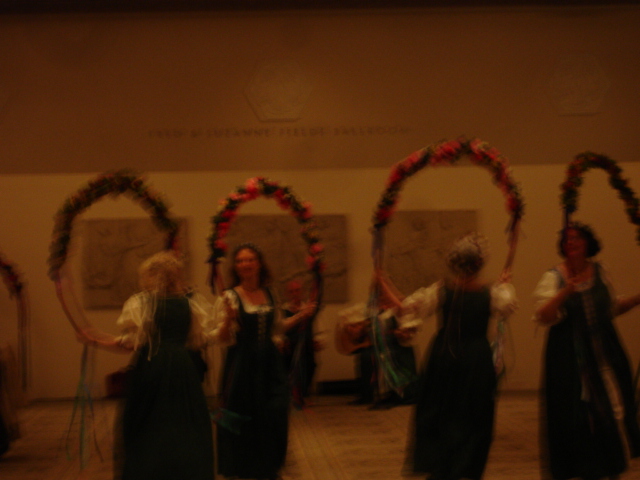
With all these great thoughts swimming around in my head, off we ran to the Portland Art Museum for the General Reception with the Wild Rose Garland Dancers – we arrived slightly behind schedule and found long lines for food and drink – Laurel Ann off for food, I did drinks – the long line frustration only lessened by a gentleman who told me all about his breakout session by James Nagle on “Dismemberment in the Library with the Quill Pen” – all about Regency succession rules, primogeniture, entails, etc. – Laurel Ann also went to this, so between the two of them I felt as though I had not missed this obviously interesting and entertaining talk – so this made the line move – we ate and drank and stood for the dancers as there was not a seat in sight – the dancers quite lovely and great fun to watch – here are a few pictures [with apologies for the dark and motion]:
Wild Rose Garland Dancers
the woman who would not sit downThe Dancers and the Players“]Sneakers- for my son
Player Gerhardt Quast on his Bodhron
[with thanks for letting me take a picture of his sneakers for my son!]
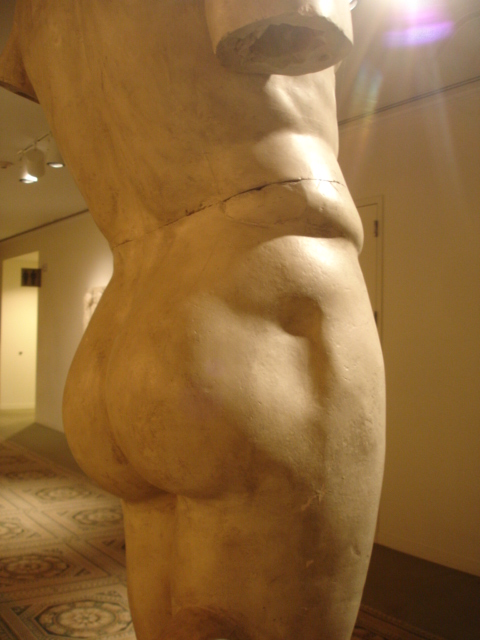
Next to me, however, was a woman who said she was sorely distracted by the distant statue of a rather large naked man [rear view only] – pictures duly taken, much laughter around and we were lost in the giggles for the rest of the evening [too much wine perhaps and not enough food?] – I see that Laurel Ann posted on this and the woman left a comment, so we are glad to have found her – and send you thanks Brenda for making our evening! – not that the dancers were not fabulous – we were just giddy at this point and who could resist!
I regret not taking more photos of the museum offerings – I see that Diana Birchall has several on her blog – so I send you over there for a peak to Light Bright and Sparkling. And you can view the Museum website as well.
And then the evening not nearly over – back to the hotel for the author book signings and to hear Jeff Nigro’s talk on “Mystery Meets Muslin: Regency Gothic Dress in Art, Fashion and the Theatre.” Jeff is the new RC for the Chicago Region and had spoken at that AGM two years ago on Art – so here again, another interesting visual treat about art and fashion and the literary and theatrical world of Austen’s time – I am not sure I will ever look at the art of the period the same ever again, or at least trust what I am looking at! – I am not even sure I can understand my notes! – so much information in this talk! – the mixing and matching of styles in the historical and contemporary works of art, with an emphasis on the “Gothick Picturesque”, the eclectic Regency gothic – Nigro shows that Austen’s Northanger Abbey is itself an eclectic mix, an overlapping of genres, as encompassed in both the Thomson and Brock illustrations. This was such a visual tour, one must see it to appreciate it, and not well described without the visual piece to accompany it – I would dearly love to get Jeff to visit Vermont and share his love of the arts with us…
So Day Two –who knew that just sitting around and absorbing all things Austen could be so invigorating and exhausting! I will add this – hanging out with Laurel Ann had many perks! – the book she is editing involves a number of great Austenesque authors who have each contributed a story to the anthology [see Austenprose for details] – but while I have been attending AGMs for a number of years and was happy to introduce Laurel Ann to a number of JASNA people [and as soon as they understood she is the force behind Austenprose they all nearly genuflected!] – but her contacts with her authors was a treat for me to be introduced and spend some time with them as well – I have a few pictures of them and append them here with links to their sites – great writers all who embrace Austen in their own imaginative ways – I look forward to Laurel Ann’s book publication [alas! not until next October – just in time for the Fort Worth AGM!] – so thank you Laurel Ann for this – great fun all around!
Syrie James, Laurel Ann Nattress, and Cindy Jones
Syrie James and her husband Bill were a delight to meet – she costumed every day and he for the ball [will save the elaborate ball dress for tomorrow!] – Syrie has authored The Lost Memoirs of Jane Austen, The Secret Diaries of Charlotte Bronte [we bonded on a mutual love of Jane Eyre], and Dracula, My Love [on my TBR pile -I hear it is great!] Visit her website here.
Cindy Jones has a new book coming out [March 29, 2011] My Jane Austen Summer: A Season at Mansfield Park – we had a great chat and I look forward to reading her book – please visit her blog at First Draft to learn more about her and her forthcoming book. Cindy is also blogging at the new Austen Author’s blog.
Marsha Huff, Laurel Ann Nattress, Laurie Viera Rigler
Marsha Huff is, of course, JASNA President – this is her last AGM as head of the troops, and she has now passed on the torch to Iris Lutz from the Tucson Region – it has been a wonderful four years with Marsha and we will miss her – but I don’t think she will wander very far from the activities! In this picture, she has just given Laurel Ann her JASNA Life Member pin! – so congrats to Laurel Ann on this!
Laurie Viera Rigler needs no introduction, but you can view her website here and her blog here – always a sheer pleasure to spend time with Laurie – but alas! no gossip on her next book – we must content ourselves for now with her “Sex and the Austen Girl” creations [such a punishment…]
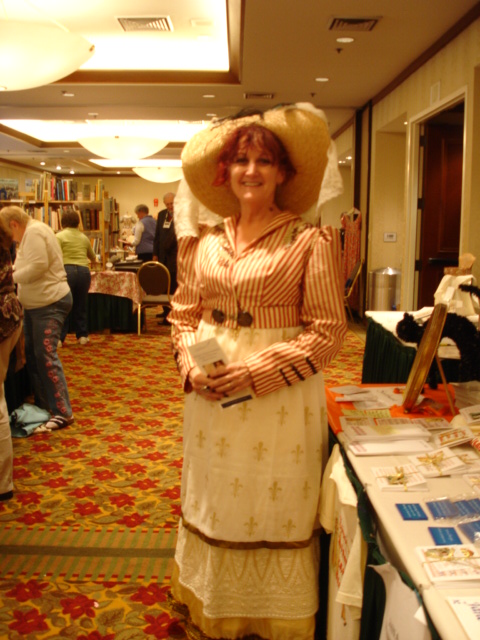
And I will close with another fashionista picture of Rebecca Morrison-Peck, one of the Emporium vendors – you can visit her shop at Etsy here: http://www.etsy.com/shop/thethatchedcottage, where you will find all manner of Regency fashion pieces. I was quite disappointed to try on two lovely spencers – one too large, the other too small – so will wait for another day to adorn myself – I purchased a Regency dress pattern three years ago , and that is as far as I have gotten – my Singer retains its dust and I think I should just give in and buy something from one of these far more talented mantuamakers!
Rebecca Morrison-Peck - The Thatched Cottage
Vic, who we sorely missed and hope one of these days to meet at an AGM, has posted links on her Jane Austen Today blog to several of the AGM posts already out there – so check out the thoughts and pictures of everyone else! … and finally,
Stay-tuned for tomorrow, Day Three and the Ball fashions! – I think this was the most costumed AGM yet!
Well, I have been immersed in the long 18th century these past several days [and will shortly post on the fabulous AGM in Portland in the next few days] – but while there, the October 28 Sotheby’s auction that I posted about last month, The Library of an English Bibliophile Part I, took place and here are the results
and the winner? Pride and Prejudice at £139,250! – whatever would Jane say?!
LOT 1 [AUSTEN, JANE.]
SENSE AND SENSIBILITY: A NOVEL… BY A LADY. LONDON: PRINTED FOR THE AUTHOR BY C. ROWORTH AND PUBLISHED BY T. EGERTON, 1811
40,000—60,000 GBP Lot Sold. Hammer Price with Buyer’s Premium: 49,250 GBPLOT 2 [AUSTEN, JANE.]
PRIDE AND PREJUDICE: A NOVEL. LONDON: G. SIDNEY FOR T. EGERTON, 1813
75,000—100,000 GBP Lot Sold. Hammer Price with Buyer’s Premium: 139,250 GBP
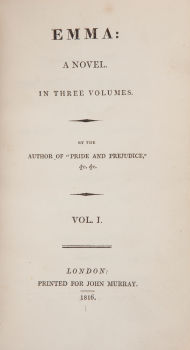
LOT 3 [AUSTEN, JANE.]
EMMA: A NOVEL. LONDON: C. ROWORTH FOR JOHN MURRAY, 1816
20,000—30,000 GBP Lot Sold. Hammer Price with Buyer’s Premium: 30,000 GBP
LOT 4 [AUSTEN, JANE.]
MANSFIELD PARK: A NOVEL. LONDON: FOR J. MURRAY, 1816
1,500—2,000 GBP Lot Sold. Hammer Price with Buyer’s Premium: 1,875 GBP
LOT 5 [AUSTEN, JANE.]
NORTHANGER ABBEY: AND PERSUASION…WITH A BIOGRAPHICAL NOTICE OF THE AUTHOR. LONDON: JOHN MURRAY, 1818
20,000—30,000 GBP Lot Sold. Hammer Price with Buyer’s Premium: 43,250 GBP
Further reading and other results in this auction at Sotheby’s website
There is much that we do not know about Jane Austen, and the much that we do “know” has been pieced together from letters and family remembrances and historical contexts. But one thing we know for sure is that Austen was familiar with ALL the carriages of her day. This is best illustrated by her Juvenilia piece “The Memoirs of Mr. Clifford: an Unfinished Tale” [MW 43], written between 1787-90, when Austen was 12 – 15 years old: this is what she says:
Mr Clifford lived at Bath; and having never seen London, set off one Monday morning determined to feast his eyes with a sight of that great Metropolis. He travelled in his Coach & Four, for he was a very rich young Man & kept a great many Carriages of which I do not recollect half. I can only remember that he had a Coach, a Chariot, a Chaise, a Landau, a Landaulet, a Phaeton, a Gig, a Whiskey, an Italian Chair, a Buggy, a Curricle & a wheelbarrow. He had likewise an amazing fine stud of Horses. To my knowledge he had six Greys, 4 Bays, eight Blacks & a poney.
[what! no barouche!!]
Austen used carriages in her novels as a way to indicate income and social status but also as a way to delineate character – for example, we know most everything about John Thorpe in Northanger Abbey by just listening to the way he describes his horse and carriage! [Thorpe has been called the most horse-obsessed character in all of literature!]; we know that Willoughby cannot afford the carriage and horses that he has, that he is a fast driver, and that his driving a large chaise with four horses to visit Marianne when he thinks she is dying show how much he wants to get there and quickly, at any cost [but of course he is now married to Miss Gray, so cost does not matter to him…].
Coaching Inns:
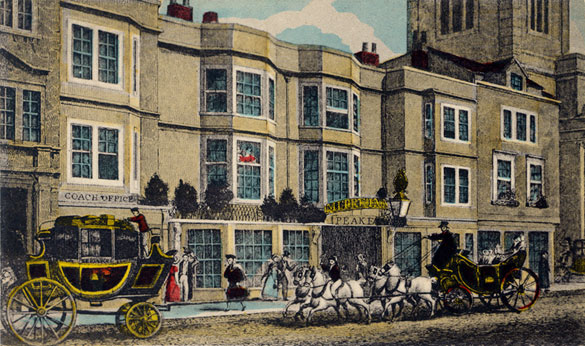
Austen would have also known the Coaching Inns of her day – she would have stayed in them during her own numerous travels. But in Sense and Sensibility there are only two mentions: Edward staying at an Inn when he leaves London after he is disinherited, and Robert and Lucy Ferrars at the New London Inn in Exeter following their marriage. But all the characters would have stayed at Inns for any of the longer trips, as was explained in the previous post.
Carriages:
There are numerous specifically noted carriages in S&S. “Carriage” is a general term: there were many variations in nomenclature and design, and big discrepancies even among the same “named” vehicle. There were differences in “construction, function, size, speed and appearance.” [Rogers] And there was a full class-system of horse-drawn vehicles; the wealthy often had unique designs made to order.
Some understanding of the parts of a carriage helps to identify a particular type: see this link at The Georgian Index for a glossary of carriage terms, as well as this diagram:
So, just a few carriage part terms:
1. C-Springs: a curved spring of C-shape, made up of several overlapping plates or leaves. They where introduced in the late 18th century (shortly after the S-Spring) and replaced the primitive wooden pillar attached to the axle, from which braces extended to the coach body.
2. Elliptical spring: Carriage spring made up of two sets of overlapping steel plates or leaves bolted together in elliptical or semi-elliptical form. It was invented by Obadiah Elliot in England (1804) and made the ride much smoother and the carriages more stable.
3. Lights: called “moons” [as per Chapman]: for dress carriages: the simplest were wax candles in tin tubes in a circular casing; for traveling coaches – lamps with oil in square casing [Adams]
In the country, social engagements were dependent upon the moon, traveling at night unsafe: for example in S&S, Sir John Middleton has asked other neighbors to join their party, but “it was moonlight and everybody was full of engagements.”
A few definitions about the people of the horse and carriage era:
1. Postilion or post boy: a person who rides the leading nearside horse of a team or pair drawing a coach or carriage, when there is no coachman
2. Groom: a male servant employed to care for horses; at times accompanying an owner’s carriage
3. Ostler: a groom or stable boy employed at an Inn to take care of guest’s horses
4. Tiger: a boy or small man employed as a groom on the back of a curricle or other small carriage. Name derived from the yellow and black striped waist coat worm by the groom [OED: A smartly-liveried boy acting as groom or footman; formerly often provided with standing-room on a small platform behind the carriage, and a strap to hold on by; less strictly, an outdoor boy-servant. obs.slang. ]
5. Livery: historical- distinctive dress or uniform worn by an official, retainer, or servant (and given to him or her by the employer) [term from c1290 in Old French] – a footman’s livery of two suits would cost about £20, as much as his year’s wages
********************
And now to the carriages ~ I will post about each type and how and where they appear in Austen’s works over the next several days:
FOUR WHEELED VEHICLES:
1. Long Wagon:
-similar to the American covered wagon
-carried goods and passengers – did “the practical work of the nation” with 6-8 draft horses
-not specifically mentioned in Austen, except off stage
2. Carts
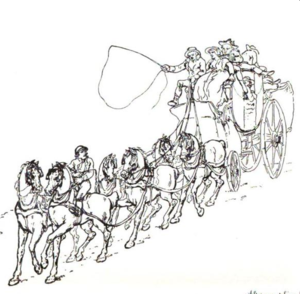
3. the Coach: “Kings of the Road” – called the most dignified of moving objects
• a large, enclosed 4-wheeled carriage, a fixed head, doors and windows
• pulled by at least four horses, for long-distance travel, traveled @ 7 miles / hour
• 4-6 passengers, in two seats facing each other; also passengers on top
• C-springs helped as shock absorbers
• public use OR persons of wealth or high rank
[the term “hackney coach” is what we would call a modern day taxi, and were most often cast-off coaches from the original owners]
I am on the road, so not able to connect to all my Austen “feeds” on a daily basis, so I was grateful to hear from Janeite Marti who sent me the information on this latest kerfuffle in Austenland – it seems that Professor Kathryn Sutherland has, in her releasing the latest digital editions of Austen’s fiction manuscripts [see the link here Jane Austen Fiction Manuscripts], made comments on Austen’s spelling and punctutaion and the need for a proper editor to clean everything up for publication – how the press has picked up on this in a world-class endeavor to bring Austen down a peg or two, tossing her from her very high literary pedestal! Vic at Jane Austen’s World has addressed the issue most adequately, so I send you there to read her near perfect defense of “Dear Jane.”
I will add this – we have long known that Austen was no Marian Grammarian – her spelling WAS appalling [thankfully spelling is not a requirement for imaginative thinking, brilliant characterization and comic timing] – and we do know, if you are at all conversant with her letters, that she worked diligently with her publishers [and likely an editor as well! alas!] correcting proofs of her novels. And those of us who have seen any of her working manuscripts, or indeed have read Sanditon or The Watsons in their unpunctuated, unparagraphed state have also long known how Austen wrote – we should also take into account her need to conserve paper – her letters attest to this – the cross-writing, the writing on all available edges – but these mentions of her unruly notetaking, scribbling, lack of paragraph formation and quotation marks and obvious need of an editor, is not all that Sutherland had to say, and the media emphasis on this is unfair to both her and Austen. One should read further:
Still more interesting to her, however, is the authorial voice one hears in the manuscripts. She calls it “a more innovative, more experimental voice” than Austen gets credit for. “By not working with the grammatical form, she’s actually coming much closer to writing real conversation” than in the printed versions where “she’s pulled back into a more conventional form,” the scholar said. “It’s a voice you’re perhaps not hearing again until the early 20th century.”
Ms. Sutherland thinks the digital edition will give a push to “beginning a new kind of work on Jane Austen, which is how she actually wrote.”
So let’s embrace this gift of seeing Austen at work and instead of quibbling about commas and quotation marks that make it look like some male editor made the Austen we all admire, do as Sutherland suggests and take Austen’s works to yet another level… what an opportunity we have!
The November/December 2010 edition of Jane Austen’s Regency World is now on sale:
In the new issue:
*ALL I WANT FOR CHRISTMAS: seasonal gift suggestions for the Austen fan in your life – or hints to drop your family and friends if you are an Austen fan!
*POWER OF ATTRACTIONS: what gives some of Jane’s characters sex appeal
*WHY I’M BANISHING JANE FROM MY BOOKSHELF: the reader who has fallen out of love with Austen
*THANKS FOR ALL THE FISH: Amy Patterson, of Jane Austen Books, finds similarities in the writings of Douglas Adam and Jane Austen
*NOVEMBER IN THE NOVELS: a busy time of year in Jane’s writing
*TOM AND JERRY: No, not the cartoon; a sportswriter’s fiction from the 1820s
*ON THE COVER: Royal Crescent Hotel, Bath, one of the grandest buildings in the city. Sharon Love, the general manager, tells us about “My Jane Austen”
Plus: All the latest news from the world of Jane Austen, as well as letters, book reviews, quiz, competition and news from JAS and JASNA
One of my favorite letters in the collection Jane Austen’s Letters, ed. by Deirdre Le Faye (Oxford, 1995) is Letter No. 122 (A)(D), 21 October 1815. This is a draft of a letter from Henry Austen to John Murray on his sister’s behalf and it gives us the rare direct glimpse into the wit of Henry Austen. Jane Austen is in Town and working on negotiations with John Murray for the publication of Emma. This is the visit of her famous meeting with the Prince Regent’s Librarian James Stanier Clarke and his request for Austen to dedicate her next work to the Regent. The amusing correspondence between Austen and Clarke follow this letter, as well as Austen’s own letters to Murray, written directly to the publisher due to Henry’s grave illness and his inability to correspond. These, plus her few letters to Cassandra during this time, are strong evidence of Austen’s direct involvement and concerns in the negotiations and publication of her work – all these letters make great reading! But today, let’s just look at Henry’s letter:
?Friday 20 / Saturday 21 October 1815
[A Letter to Mr. Murray which Henry dictated a few days after his Illness began, & just before the severe Relapse which threw him into such Danger. – ]
Dear Sir
Severe illness has confined me to my Bed ever since I received Yours of ye 15th – I cannot yet hold a pen, & employ an Amuensis [sic]. – The Politeness & Perspicuity of your Letter equally claim my earliest Exertion. – Your official opinion of the Merits of Emma, is very valuable & satisfactory. – Though I venture to differ occasionally from your Critique, yet I assure you the Quantum of your commendation rather exceeds than falls short of the Author’s expectation & my own. – The Terms you offer are so very inferior to what we had expected, that I am apprehensive of having made some great Error in my Arithmetical Calculation. – On the subject of the expense & profit of publishing, you must be much better informed that I am; – but Documents in my possession appear to prove that the Sum offered by you, for the Copyright of Sense & Sensibility, Mansfield Park & Emma, is not equal to the Money which my Sister has actually cleared by one very moderate Edition of Mansfield Park –(You Yourself expressed astonishment that so small an Edit. of such a work should have been sent into the World) & a still smaller one of Sense & Sensibility…
*******************************
Such a Brother was he! – a good businessman and witty in the process! an ‘error in my Arithmetical Calculation’ indeed!
Henry’s very serious illness prompted Austen to call all her family members to his bedside, and it was not until a few weeks later that Austen herself takes on the writing of letters to Murray to complete the Emma negotiations – she writes requesting him to call on her in Hans Place because “a short conversation may perhaps do more than much Writing.” [Ltr. 124, Nov. 3, 1815; To John Murray]
[Henry’s Draft letter in Austen’s hand is in the Bodleian Library; a facsimile is in Modert, F-361 and F-362]

























 Jane Austen in Vermont