Jane Austen · Regency England

London Trekking

Have just returned from a week in London – hence the blogging silence – will post more pictures and some thoughts, but to start here are a few.  I met up for a delightful tea and afternoon of sight-seeing with Tony Grant, of the blog London Calling [alas! he just lately removed it from the blogsphere] – Tony now writes regularly for Vic at Jane Austen’s World, where you can see his pictures and posts on Austen’s England [see his latest on The Library of an 18th-century Gentleman and also today’s post at Jane Austen Today on Brighton Pier.]

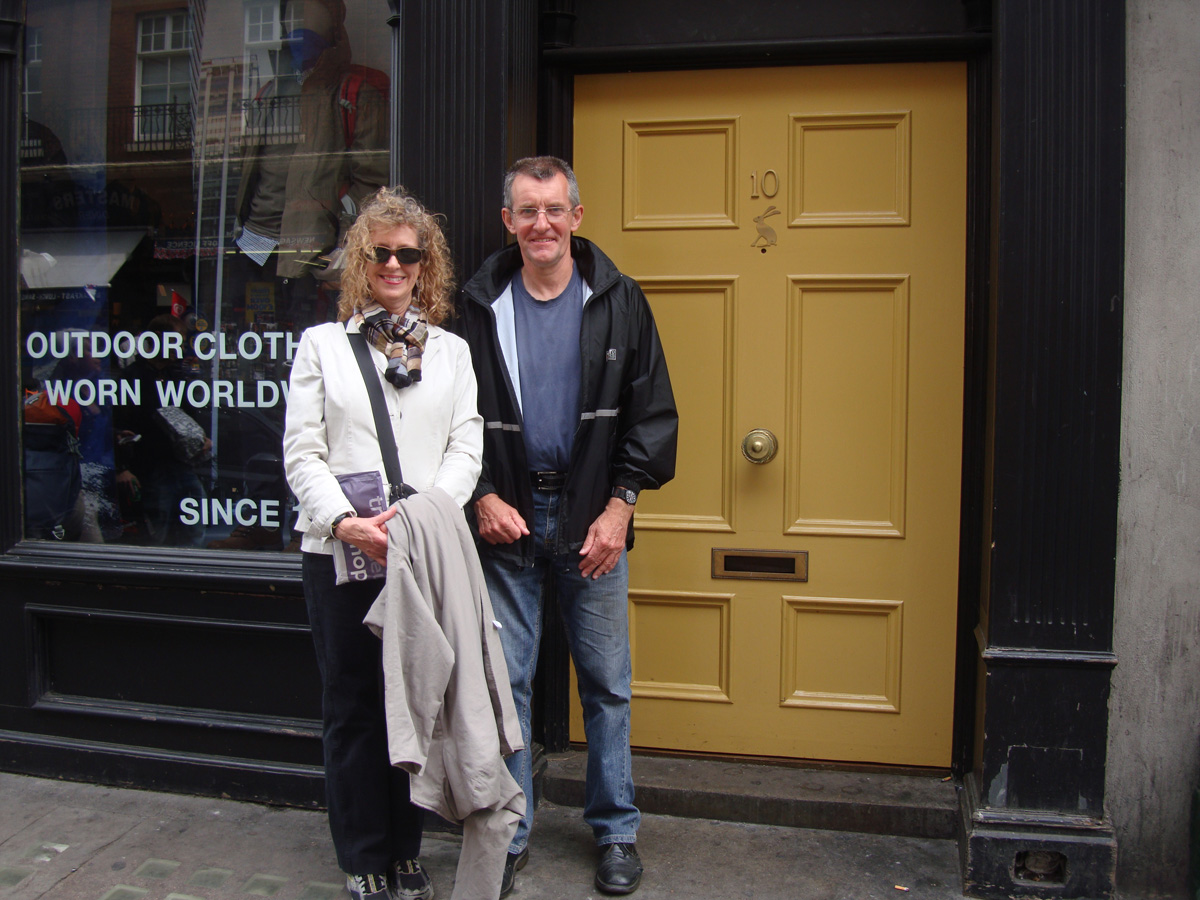
As I did the unbelievable, mind-boggling error of leaving my camera in the hotel,  I have only this one photo of Tony and I [taken by an obliging passer-by on Tony’s camera] to prove that we actually met up!  

Here we are in front of Henry Austen’s home/office at 10 Henrietta Street where Jane stayed!

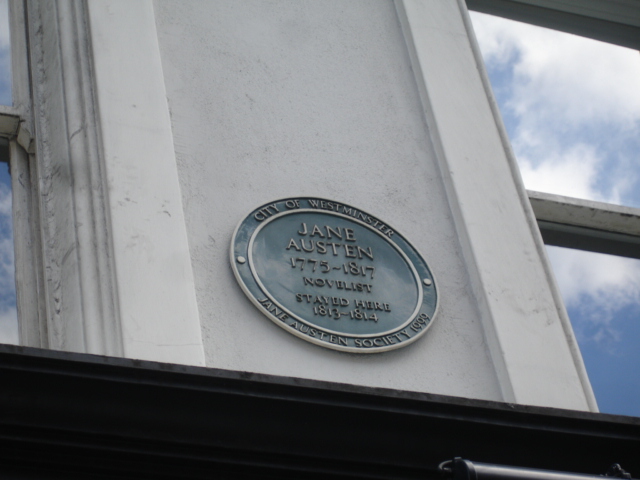
I went back a few days later to get a photograph of the plaque on the building:

Many thanks to Tony for a lovely day of walking around London – I find that it was all the more satisfying because I DID forget my camera – one ceases to look at everything from the inside of that little box, framing all in view for just the right shot – so everything seen remains all the more etched in my memory.

More to come – museums, plays, walking, walking, walking in search of Austen in Regency London – and in perfect sunshine all week!  Stay tuned!

Westminster Abbey
Copyright @2011 by Deb Barnum, of Jane Austen in Vermont
Jane Austen · JASNA-Vermont events · News · Regency England

Join Us! ~ ‘Jane Austen’s London in Fact & Fiction’

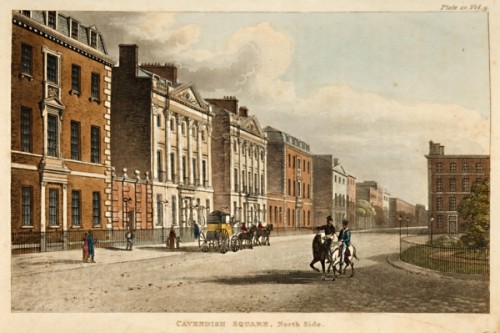
Cavendish Square

You are Cordially Invited to JASNA-Vermont’s March Meeting 

~Jane Austen’s London in Fact & Fiction ~ 

with 
  Suzanne Boden* & Deborah Barnum** 

Jane Austen and London! ~ Why did she go & How did she get there? ~ Where did she stay & What did she do? ~ Was it a ‘Scene of Dissipation & Vice’ or a place of lively ‘Amusement’ filled with Shopping, the Theatre, Art Galleries & Menageries? ~ And her fiction? ~ How does Mr. Darcy know where to find Lydia and Wickham? And Why does nearly everyone in Sense & Sensibility go to Town? To find out all this  & more absolutely essential Austen biographical & geographical trivia, please… 

Join Us for a Visual Tour of Regency London!

*****

Sunday, 27 March 2011, 2 – 4 p.m. 

 Champlain College, Hauke Conference Center,
375 Maple St Burlington VT

Free & Open to the Public
Light refreshments served

For more information:   JASNAVermont [at] gmail [dot] com  Please visit our blog at: http://JaneAustenInVermont.wordpress.com

************************************ 

Suzanne & Deb will share their mutual love of London! ~ *Suzanne Boden is the well-traveled proprietress of The Governor’s House in Hyde Park, where she regularly holds Jane Austen Weekends:  http://www.onehundredmain.com/ ; **Deb Barnum is the owner of Bygone Books, a shop of fine used & collectible books, the Regional Coordinator for the Vermont Region of JASNA,  author of the JASNA-Vermont blog, and compiler of the annual Jane Austen Bibliography.   

Upcoming:  June 5: A Lecture & Organ Recital on ‘The Musical World of Jane Austen’ with Professor William Tortolano.  At Vermont College of Fine Arts, Montpelier.  See blog for details.

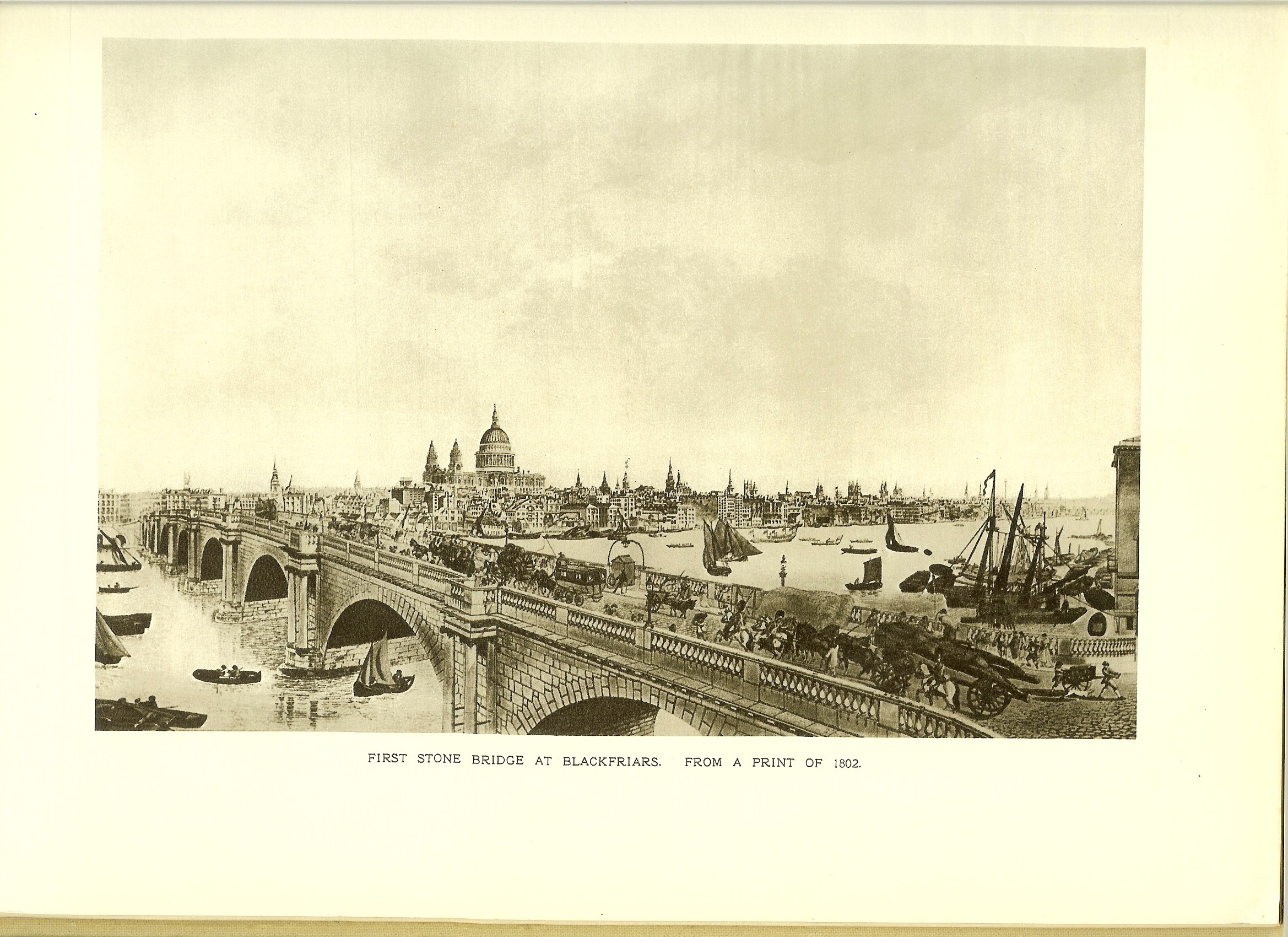
[Image:  Blackfriars Bridge, 1802.  The City of London.  London: The Times, circa 1928, facing p. 192]

Copyright @2011, by Deb Barnum, at Jane Austen in Vermont
Jane Austen · JASNA · JASNA-Vermont events · Regency England · Schedule of Events

JASNA-Vermont Event ~ March 27, 2011 ~ A Visual Tour of Regency London!

Cavendish Square


You are Cordially Invited to JASNA-Vermont’s March Meeting 

~Jane Austen’s London in Fact & Fiction ~ 

with 
  Suzanne Boden* & Deborah Barnum** 

Jane Austen and London! ~ Why did she go & How did she get there? ~ Where did she stay & What did she do? ~ Was it a ‘Scene of Dissipation & Vice’ or a place of lively ‘Amusement’ filled with Shopping, the Theatre, Art Galleries & Menageries? ~ And her fiction? ~ How does Mr. Darcy know where to find Lydia and Wickham? And Why does nearly everyone in Sense & Sensibility go to Town? To find out all this  & more absolutely essential Austen biographical & geographical trivia, please 

Join Us for a Visual Tour of Regency London!

*****

Sunday, 27 March 2011, 2 – 4 p.m. 

 Champlain College, Hauke Conference Center,
375 Maple St Burlington VT

Free & Open to the Public
Light refreshments served

For more information:   JASNAVermont [at] gmail [dot] com  Please visit our blog at: http://JaneAustenInVermont.wordpress.com

************************************ 

Suzanne & Deb will share their mutual love of London! ~ *Suzanne Boden is the well-traveled proprietress of The Governor’s House in Hyde Park, where she regularly holds Jane Austen Weekends:  http://www.onehundredmain.com/ ; **Deb Barnum is the owner of Bygone Books, a shop of fine used & collectible books, the Regional Coordinator for the Vermont Region of JASNA,  author of the JASNA-Vermont blog, and compiler of the annual Jane Austen Bibliography.   

Upcoming:  June 5: A Lecture & Organ Recital on ‘The Musical World of Jane Austen’ with Professor William Tortolano.  At Vermont College of Fine Arts, Montpelier.  See blog for details.

[Image:  Blackfriars Bridge, 1802.  The City of London.  London: The Times, circa 1928, facing p. 192]

Copyright @2011, by Deb Barnum, at Jane Austen in Vermont

Author Interviews · Book reviews · Books · Jane Austen · Jane Austen Popular Culture · Regency England

Interview: Part I ~ Walking around Regency London with Louise Allen

NOTE:  Book giveaway! ~ see the end of this post for details!

 Please welcome author Louise Allen today as she answers questions about her new book on Regency London.  Louise is a very successful writer of historical Regency romances, over thirty-five titles to date!  Her interest in all things Regency is fed by constant research into the period, as well as the development of a fine collection of prints and ephemera from the era – all this to help in her writing. In December 2010 she released her first non-fiction work titled Walks Through Regency London [available direct from her at louiseallen [dot] regency [at] tiscali [dot] co [dot] uk


JAIV:  Thank you Louise for joining us here in Vermont today! I was so pleased to get your new book on Regency London hot off the press! – I ordered two copies and gave one to another London-obsessed friend and she is most enjoying your book!…we only wish we could both be in London together and exploring Town with your book in hand, rather than this armchair traveler thing! – hopefully, sometime soon…we’re working on it!

JAIVSo first, tell us something about yourself.

LA:  Thank you very much for inviting me to join you – it is great to be in Vermont, even if only in cyberspace! I live in the East of England with my husband and we are about to move even further east, to a cottage on the North Norfolk coast. I was first published back in 1985 and for years I wrote alongside my full-time job as a property manager, but for the last three years I’ve been writing full-time and I love it.

JAIV:  When did you first discover your love of the Regency period? Why this time and place?

LA:  I think I first became aware of it when reading Georgette Heyer as a teenager. I’ve always been an historian – I studied landscape history, historical geography and archaeology at university – but it took me a while to settle on the “long” Regency as a period to write in. My first book was set during the English Civil War of the 17thc but my editor encouraged me to look at the Regency and I fell in love with it. I think it is because it occupies a transitional place between the agricultural and aristocratic world of the 18thc and the rapid technological change and urbanization of the Victorian era. Boundaries are always interesting and complex and it is also sufficiently different and yet recognizable, which makes it fascinating to write about. And I’m English, so English history felt right.

JAIV:  Did you read Jane Austen as well as Georgette Heyer? – do you re-read them? Which are your favorite titles, if it is possible to choose?

LA:  Yes, to both authors and yes to re-reading. Austen – I love Pride & Prejudice, but I find Sense & Sensibility more interesting. I was at Jane Austen’s house at Chawton last year and it was very moving to walk in her garden and to see her tiny writing table. Heyer favourites? The Grand Sophy and also The Toll Gate, which isn’t everyone’s choice, but I’m tall, so I identify with the heroine!

JAIV: You obviously use London and the London social scene in your fiction, and the need to be accurate has led you to amass a great deal of research through the years – hence your “Walks” book – what first prompted you to pull all this together and publish it?

LA:  My husband and I love walking, and we love London, so it was no hardship to start exploring when I wanted to check details. Then we got hooked and started exploring specific areas – when I looked at my notes and our photos I realized that I had the makings of a book.
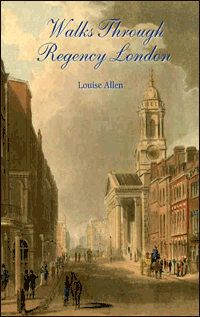
JAIV:  You cite the 1807 The Picture of London guidebook as your main source. What other books did you use? – there are so many works on London – which are your favorite and why?

LA:  I use the 1807 guide because it is fun to take it for a walk where it must once have gone with its Regency owner – it is the real thing, much used and slightly battered. We also take the invaluable A-Z of Regency London published by the London Topographical Society. Their historical A-Zs are a brilliant resource. When I checked my shelves just now I found I have 55 reference books on London, so it is a problem to pick out just a few, but I would say The London Encyclopedia (published by Macmillan) is an essential. Peter Ackroyd’s London: The Biography is full of fascinating, unusual and often downright weird information and Dan Cruickshank’s book on the sensual life of London The Secret History of Georgian London is about so much more than sex.

JAIV:  What are your favorite haunts in London, for both Regency times and the present?

LA:  The St James’s area is the best preserved Georgian/Regency quarter. Soho is endlessly fascinating – so many layers of history. The City, although it has been leveled by the great fire and then again by the Blitz still preserves its medieval street patterns and modern office blocks must contort themselves to fit the shape of some ancient workhouse or monastery cloister. You can even see the curved walls of Newgate Prison fossilized in the shape of an ultra modern building. But it is hard to find a part of London that isn’t interesting if you are prepared to be very nosy!

JAIV:  The book is fact-filled and anecdotal, and culled from so much available information – how did you decide what to include and what not to include?

LA:  It was a nightmare! I had enough material for twenty walks, but I tried to chose ones that gave a variety of experiences, which were all about 2 miles long and which could be split up if walkers wanted to have a shorter route or spend more time in a museum.

JAIV:  Did you discover anything surprising in your research and exploration? Something you did not already know?

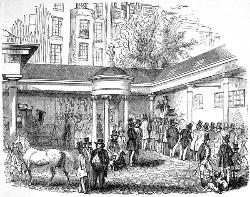
LA:  It wasn’t so much new facts that I found but places which gave me a real frisson of excitement: the 1820s operating theatre where you can see the marks of the surgeons’ saws on the table; the last galleried coaching inn left in London; the great scales in Berry Bros & Rudd where Byron used to weigh himself; having a drink in Tom Cribb’s own pub and exploring the back alleys behind Almack’s which were once filed with high-class brothels and gambling dens. Perhaps the most unexpected discovery was in a Chinese supermarket in Soho – walk past stacks of dried herbs and fish, bags of rice and look up and realize you are in a very old house indeed – and in the back is still the sweeping 18thc staircase. This is the Turk’s Head coffee-house and Dr Johnson and Joshua Reynolds were just two of the great men who  socialized here.
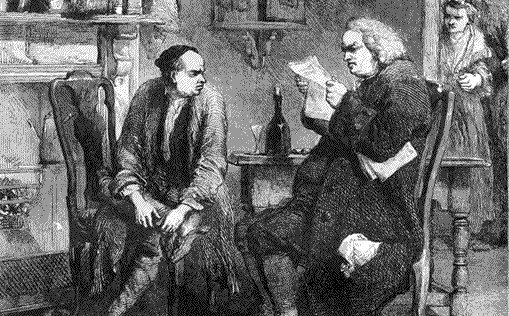
[Image of Samuel Johnson: Johnsonese.com]

JAIV:  The illustrations in your book are from your own collection. What other ephemera from the era do you look for? When did you start becoming a serious collector? – and did your writing come first or vice versa?

LA:  The writing came first then the more I wanted to know about the period, the more I would look for items from it. I collect fashion prints 1790-1820, prints of London from Ackermann’s Repository, coaching and sporting prints, bills and invoices, playbills and anything else that I can get my hands on. I started buying fashion prints when I stubbed my toe on a box of over thirty, all framed, under the table at an auction. I got them for a song and as the porter staggered out to the car with them he said, ‘Bloody hell, madam, you don’t half buy in bulk!’ He didn’t know how true it was, I’m afraid – I’ve got about 1,000 prints now.
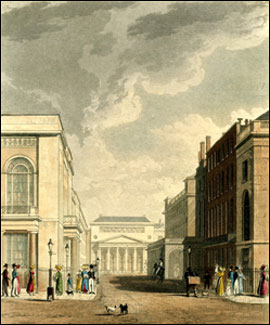
[Charles Street]

JAIV:  Where are your favorite haunts to find items? How do you categorize and store them?

LA:  On-line and live auctions, antique fairs and antique shops are all good places to search, but auctions are the most productive. I store them in archival-quality binders on acid free paper, or have them framed by a specialist framer using acid-free mounts. I arrange the fashion prints by date, the London prints by street and everything else by subject.

JAIV:  You bring the Regency so to life! – better to have this guide while actually walking around London – but even so this journey of readinghas been delightful… Which of your walks is your favorite? – what is your favorite part of London?

LA:  Thank you! I enjoy them all – it depends on my mood. If I am feeling like high society and shopping, Mayfair and St James’s are best. Hyde Park is great for a good walk, Soho is vibrant and slightly edgy and the City surprisingly dark and sinister.

JAIV:  The process of writing fiction and non-fiction is quite different – explain the process for writing this Walks book.

LA:  I was very conscious the whole time that I had to make this crystal-clear for people to follow. It would have more than doubled the cost if I’d included maps, so users needed to be able to do without, or use it in conjunction with an ordinary pocket map. Then, once I had plotted each walk out on a modern map it was a question of picking out the relevant points of interest or short snippets of interesting information and weaving them in with the directions – and then re-walking to check every turning and fact.

JAIV:  Do you have another non-fiction Regency-era book in the works?

LA:  We are tracing the original route of the Great North Road, the main coaching route between Edinburgh and London – but not on foot! This is great fun and needs a lot of detective work and old maps. I see this one as possibly being a Kindle book rather than a print one.

JAIV:  Thank you Louise for joining us today for Part I of this interview! Louise is happy to answer any of your questions, so please ask away!

Stay tuned: Part II  tomorrow where I continue this interview with Louise on her Regency Romances and her thoughts on writing; followed by Part III, a book review of Walks Through Regency London

You can visit Louise’s website here and find her on Twitter @LouiseRegency

If you would like to order the Regency Walks book, you can do so directly from her website – I can attest to the book being mailed right away, arriving safe and sound and very quickly!

Thank you again Louise for joining us today – looking forward to continuing our discussion  tomorrow!

Book Giveaway:  Please enter the drawing for a copy of Walks Through Regency London, compliments of ‘Jane Austen in Vermont’, by asking Louise a question or commenting on any of the three posts about this book.  Drawing will take place next Wednesday 2 March 2011; comments accepted through 11 p.m. EST March 1st.  [Delivery worldwide.]

[All images excepting Dr. J from Louise Allen’s website]

Copyright @2011, Deb Barnum, at Jane Austen in Vermont.
Jane Austen · Regency England · Social Life & Customs

Follow Friday ~ Number One London

 “When a man is tired of London, he is tired of life; for there is in London all that life can afford.”
-from Boswell’s Life of Johnson


Obsessed with London? – you can get a daily fix from the comfort of your own computer screen by visiting the blog Number One London – at http://onelondonone.blogspot.com  –  poor substitute I know for the real thing, but the best one can do most days… and blog creators Kristine Hughes and Victoria Hinshaw do their very best to make it an enjoyable visit:

Welcome . . . You’ve arrived at Number One London, an address for those with an interest in England past and present and a passion for daily life during the Georgian, Regency and Victorian eras. Share with us your book finds, favorite films and websites, on dits regarding your research pursuits, travel adventures across the pond and historic treasures. If you spend an inordinate amount of time reading, researching and pondering past and present England, then you’ve found a place to share information and make the aquaintance of others who feel at home at Number One London. *

Number One, London was the home of the Duke of Wellington – and a perfect place to start your immersion in London’s past and present… todays’ post is about Benedict Cumberbatch, the latest Sherlock Holmes on Masterpeice Mystery; the site is filled with all manner of goodies, like the weather since 1500, and all you ever wanted to know about William and Kate, and as Ms. Hinshaw was at the JASNA AGM, you can follow her summary of the happenings… [she spoke with Kim Wilson on “About Those Abbeys: A Trip Through History, Literature and the Picturesque” which I unfortunately missed..]

Enjoy your cyberspace trek to London!

[* From the blog Number One London]

Fashion & Costume · Jane Austen · Regency England · Social Life & Customs

Follow Friday ~ The Regency Encyclopedia

I have posted about this very rich resource before, but doing so again as much had been added: The Regency Encyclopedia.  I met up with the creator, Sue, at the Portland JASNA AGM, and we talked about some of the new items – maps, authors, and various bells and whistles. This is a password protected site, but Sue gave me permission to again provide the logins [case-sensitive]:

User ID – JAScholar
PW – Academia

I suggest you first look at the 18-page User’s Guide [no worries – it is largely visual with big print!] – to get a sense of how the database works.  Then scan the various categories; and always check the “What’s New” tab to see what has been added – it is constantly being updated and Sue asks for suggestions of good resources that she can add.  Here are the categories to give you an idea of what is included – all are keyword searchable:

  • Map Gallery that includes a Time & Distances option – this all based on John Cary’s New Itinerary (1819)
  • London: many maps, a tour, and shopping locations!
  • Georgian Names index
  • Fashion Print Gallery
  • Novel Calendars w/ Chapman’s Lists of Characters
  • Source list of work catalogued [my only criticism: this is a great bibliography of Regency resources but it is listed A-Z by first name, not the most helpful access point]
  • Online resource links [a select list]

A perfect weekend project – this database need some time spent with it to find all that is hidden behind its main menu page!

Austen Literary History & Criticism · Jane Austen · Regency England · Social Life & Customs

Thoughts on Travel in ‘Sense and Sensibility’ ~ Part II

Part II.  A Study of Character’s Movement in Sense and Sensibility

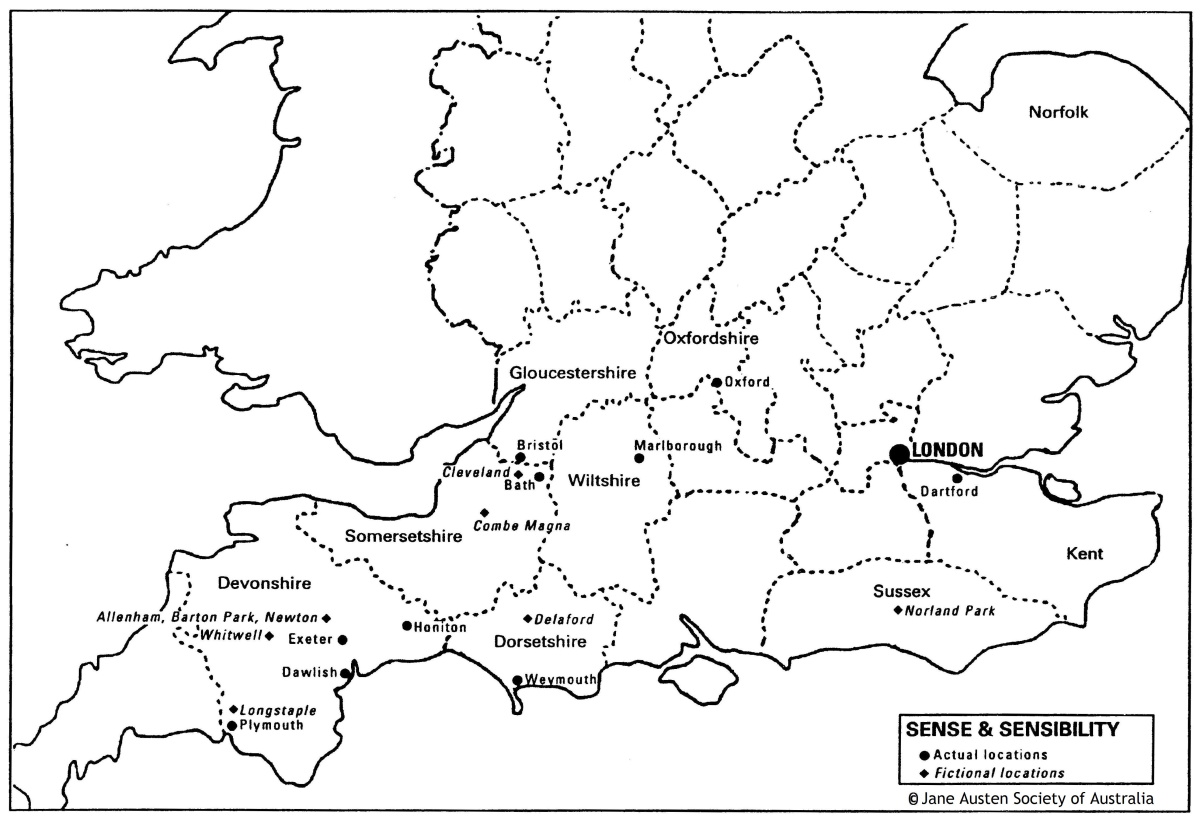
Fig. 1. Sense & Sensibility map

A startling fact! – there are 49 mentions of movement and 46 mentions of carriages [to include a few referring to travel by horseback] – and people say that nothing happens in Jane Austen!  That is a great deal of  traveling in what I have just described in the previous post as a not easy or inexpensive world to travel in!

To begin, let’s place the characters where they live and their income if known:

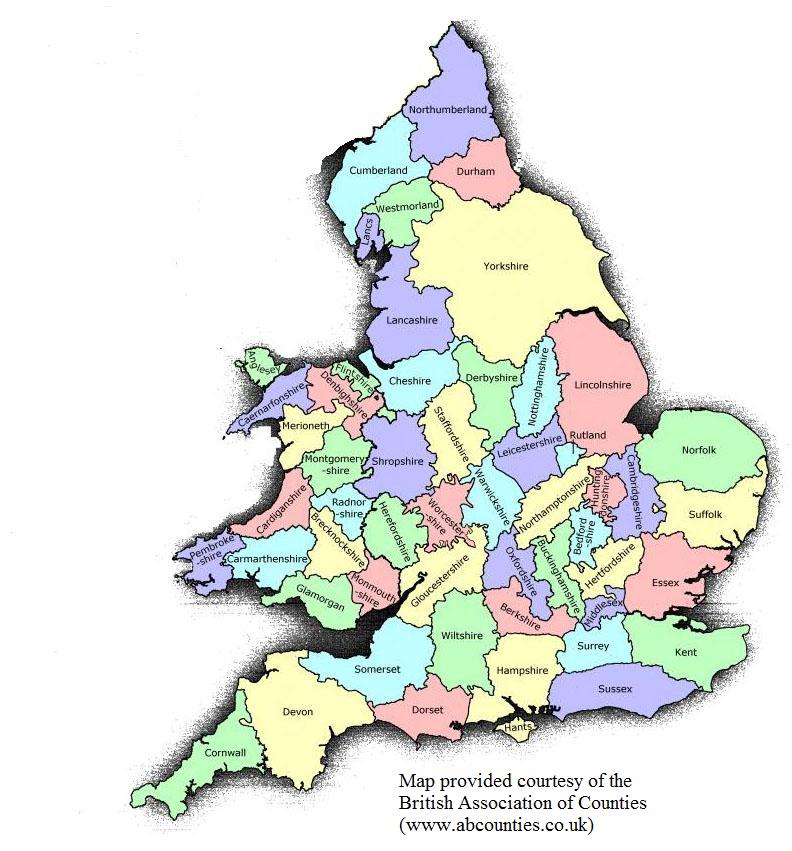
A.  Where the characters live:  see the map of England’s Counties below, and the map of places, both real and fictional above

  • Counties = Sussex, Somerset, Dorset, Devon
  • London [“Town” = London], largely Mayfair


The Dashwoods:

  • Henry Dashwood – Norland, Sussex
  • Mrs. Henry Dashwood – Norland, moves to Barton Cottage, Devonshire – £7000 = £350 / yr
  • Mrs. Dashwood’s mother – Stanhill [Sussex]
  • John and Fanny Dashwood –  Norland, Sussex; Harley St, London [renting?]; purchase East Kingham Farm, near Norland – £5,000 – £6,000 / year
  • Elinor / Marianne / Margaret:  Norland, Sussex, move to Barton Cottage, Devonshire; each have £1000 capital from their uncle = £50 pounds each annual income = £500 total for the four of them  [150 + 350 = £500]
Sussex
Devonshire

Colonel Brandon:  Delaford in Dorset; St. James St, London –  £2000 / year

  • Eliza Williams, his ward – Avignon [Brandon’s sister] – where? – found her in London
  • Brandon’s brother-in-law:  Whitwell,  near Barton
Dorset

The Ferrars:

  • Mrs. Ferrars – Park St, London
  • Edward –  his mother’s house; Pall Mall, London, after leaving home; Oxford; Edward and Elinor after marriage will have £350 / year (though this will increase to £850 with Edward’s inheritance of £10,000 from Mrs. Ferrars, reluctantly given!)
  • Robert – his mother’s house? later London with Lucy Steele
  • Fanny Ferrars Dashwood [see above]
Cavendish Square, London

John Willoughby – Combe Magna, Somerset; Bond St, London –  about £600-700 /yr 

  • Mrs. Smith, Willoughby’s Aunt – Allenham Court, Devonshire
  • Miss Gray, Willoughby’s wife – £50,000 = £2,500 /yr

The Jennings / Middletons / Palmers:

  • Sir John and Lady Mary Middleton [Mrs. Jennings daughter]:  Barton Park, Devonshire; Conduit St, London
  • Mrs. Jennings:  Berkeley St, London,  near Portman Square, otherwise she is visiting her daughters
  • Mr. Thomas Palmer and Charlotte Palmer [Mrs. Jennings’ daughter]: Cleveland, Somerset; Hanover Square, London [renting?]
Hanover Square, London

The Steeles:

  • Lucy and Anne [Nancy] Steele – Bartlett’s Buildings, London
  • Mr. Pratt  [the Steele’s Uncle] –  Longstaple [near Plymouth]


Miss Morton:
 Edward’s intended, London somewhere – £30,000 = £1500/yr 

Fig. 2. England Counties

**************************************

 B.  Movement of characters – a quick summary:

1.  The novel starts out with Mrs. Dashwood and her three daughters moving from Norland Park [Sussex] to Barton Cottage [Devonshire] – their furniture goes by way of the water [i.e. canal system]

 2.  The Elinor and Marianne go to London with Mrs. Jennings [and most everyone else], then return to Cleveland, then back to Barton Cottage, where they await their destiny, both ending up at Delaford.

 3.  Colonel Brandon lives in Delaford, but he is quite often at Barton Park, he goes to London to see his ward, later moves to London with everyone else, and when staying in London, he goes back and forth to Delaford “a few times”, and then later returns home via Cleveland and has to fetch Mrs. Dashwood in the middle of the night back and forth from Cleveland to Barton Cottage, and then finally seems to be at Barton Park / Cottage an awful lot…

Barton Cottage

4.  Edward Ferrars visits Barton Cottage and later we find that he was actually first in Plymouth – he travels a few times back and forth to London to his mother’s, then off to an unnamed Inn somewhere after he is disinherited, then to Oxford, then back to London settling in Pall Mall, and then of course to Barton to visit then marry Elinor, and they move to the parsonage at Delaford and we expect will live happily ever after…

5.  Willoughby lives in London, has his estate home at Combe Magna in Somerset, visits his Aunt in Allenham Court [Devonshire], leaves for London when HE is disinherited; he later visits Cleveland [Somerset] to see the dying Marianne, and then back to London to live with his boring, but wealthy wife

Willoughby

6.  The Middletons live at Barton Park [Devonshire], but travel to London with everyone else…

7.  The Palmers live at Cleveland [Somerset], they visit Barton Park [Devonshire], then back to Cleveland and then to London with everyone else; return to Cleveland and then leave again as Marianne falls ill.

8.  Mrs. Jennings, of course, lives in London but travels all over to visit her children at Barton Park and Cleveland

9.  the Miss Steeles live in Plymouth with their Uncle, visited Exeter and then to Barton Park, then to London where they stay with first the Middletons, then the John Dashwoods, then Lucy with her now husband Robert Ferrars leave London for Dawlish, then return to London to live unhappily ever after, while her abandoned sister has to borrow money from Mrs. Jennings to catch a coach back to Plymouth [in the endless, hopeless search of her Doctor…]

10.  Mrs. Dashwood is taken to Cleveland by Col. Brandon to see Marianne at Cleveland [Somerset]; she is the only character who does not go to London.

11.  As noted above, Everyone but Mrs. Dashwood goes to London, and while there they travel for their daily visiting calls and excursions around Town.

12.  And of course, Mrs. Ferrars stays put, selecting / de-selecting her heir from her comfortable seat in London – BUT the book ends with her visiting Elinor and Edward: ‘She came to inspect the happiness which she was almost ashamed of having authorized.”

Fig. 3. 1812 Cary map England

And how did they travel?? –  stay tuned for Part III:  Carriages in Sense and Sensibility

*****************************************

Sources:  Fig. 1 and 2 maps from the JASNA.org website; Fig. 3 Cary map from Pemberley.com

Jane Austen · News

“Scene of Dissipation & vice”…

I am lately returned from said “Scene of Dissipation & vice” i.e. London, quoting Austen’s letter of August 23, 1796 [Le Faye, Letters, no. 3], telling of her arrival in Town and finding already her “Morals corrupted” – and where I, currently re-reading Mansfield Park, saw a good number of delightful Henry and Mary Crawfords! 

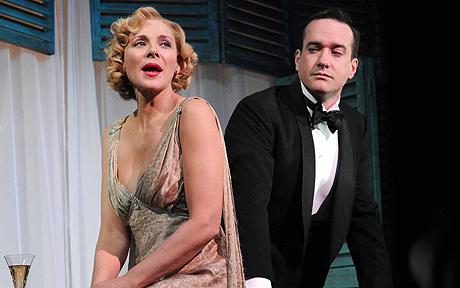
 So much to tell [mostly having nothing to do with Jane Austen, I am afraid to say…] – so mainly here just want to share about one night at the theatre, where we had the privilege of seeing Private Lives, with Kim Cattrall and Matthew MacFadyen of Mr. Darcy fame, and directed by Sir Richard Eyre.  The show was in previews starting February 24, and how lucky my daughter and I were to get tickets for the 26th.  What a treat to sit in the fifth row, dead center and watch them do their magic, passion abounding both of the sexual kind and the throwing things kind! – it seems that every night in Act II the set is nearly demolished during a violent quarrel between the major parties where far more than mere words are flung at each other.

I confess wanting to go to this play largely to see “Mr. Darcy” up close and personal [who looks quite fine in a tuxedo as you can see…] – my daughter more than happy to oblige, and as she is a huge fan of both Mr. Darcy and Sex and the City’s Kim Cattrall, the evening could only be a delight for all.  This production began its life in Bath and will be in London for a ten-week run – and what great fun it is!   Noel Coward’s Private Lives has been revived numerous times, first perfomed in 1930 with Noel Coward and Gertrude Lawrence [and a young Laurence Olivier in the supporting actor role], and most recently in 2001/2 with Lindsay Duncan and Alan Rickman, and as has been universally discussed, there must be a grand spark and chemistry between the leads or one should just get up and leave, the play after all being about the nature of sexual attraction!  And this works very well with  MacFadyen and Cattrall, despite a huge gap in their ages in real time [Ms. Cattrall is 53, MacFadyen a mere 35] – they play the formerly married-to-each-other Amanda and Elyot, who while honeymooning with their new spouses in the south of France discover their hotel rooms share adjoining balconies.  And from there it is all fireworks and love and lust and anger as they abandon their new spouses and perhaps their better selves for a Part II performed largely in a pajama-clad semi-drunken state as they try to figure out what to do with this nearly debilitating passion… watch out if you are in the front row! [An article from yesterday tells of Ms. Cattrall’s bruising her legs on falling into a table after a hefty shove by MacFadyen – can this be our gentlemanly Mr. Darcy??!] – these are two very self-absorbed people you would barely tolerate in real life, but thankfully for the biting wit and constant edge of Mr. Coward’s words, and the acting of all, you have sympathy for this couple in search of themselves [there was a more than audible gasp from the audience when Elyot smacks Amanda, so sympathies only go so far…]

Ms. Cattrall pulls off an English accent far better than I would have expected [one woman I talked to during intermission felt her only misstep was pronouncing a French word incorrectly!] and her comic-timing is perfect, and as expected, her clothing is fabulous – putting the play in its time frame, which perhaps helps us deal with the chauvinistic Elyot.  Act II, as mentioned, finds Amanda and Elyot in their elegant silk pajamas through nearly the end of the play, and lovely pajamas at that!  [with memories of a partially bare-chested Mr. Darcy in the mists..] – MacFadyen and Cattrall also sing quite credibly, and though it appears that Elyot is playing the piano [and I was impressed that MacFadyen has such skills!] – it seems that it was play-acted after all, but I was certainly fooled as was most everyone else!  And I must add that, as he fully displayed in the hilarious Death at a Funeral, MacFadyen’s comic timing is spot-on…

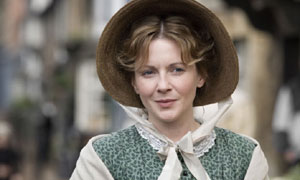
…and for another costume drama aside, Lisa Dillon plays the hapless new spouse of Elyot – poor girl and what a mess she gets herself into with this cad – and certainly a far different role than her part in Cranford  as Mary Smith:


And one other aside that does bring Austen into focus.  The woman next to me and I began  chatting about why we came to see this play –  for me, because I was a fan of MacFadyen’s for his Spooks work and the 2005 P&P – she was astonished as Austen is her favorite writer, etc, etc. – you all know the conversation that follows after that connection is established! – and the “what is your favorite book?’ was answered on her part with an almost embarrassing “Oh! I love most the one few people even like or worse have not even read – Northanger Abbey!” – well, here we were two complete strangers from two different countries, suddenly bonding over Henry Tilney, and only needing to stop talking in order to watch “Mr. Darcy” continue in his play – how bad is that for an evening in London!

Playing at:

Vaudeville Theatre
The Strand, London WC2
February 24 – May 1, 2010

Further reading and reviews:

[Posted by Deb]

Book reviews · Books · Jane Austen · News

Round-Up ~ All Things Austen

This week is mostly about books….!

Jane Odiwe tells of her new book:  a sequel to S&S, Mr. Willoughby Returns: (see her blog for more info)

When Marianne Dashwood weds Colonel Brandon both are aware of the other’s past attachments; Marianne’s grand passion for the charming but ruthless John Willoughby and Brandon’s tragic amour for his lost love Eliza. Three years on Marianne is living with her husband and child at Delaford Park, deeply in love and contented for the most part, although Marianne’s passionate, impulsive and sometimes jealous behaviour is an impediment to her true happiness. News that John Willoughby and his wife have returned to the West Country brings back painful memories for Marianne and with the demise of Mrs Smith of Allenham Court comes the possibility of Mr Willoughby and his wife returning to live near Barton and the surrounding area of Devon and Dorset, a circumstance which triggers a set of increasingly challenging, yet often amusing perplexities for Marianne and the families who live round about.

lost-years-ja-cover

 Alert Janeite Nancy M. has posted about The Lost Years of Jane Austen, by Barbara Ker Wilson [Ulysses Press, Nov. 2008]

“Thanks to her meticulous diaries and frequent letters, Jane Austen’s life is well documented. Except for a mysterious period in her early 20s , when, for unknown reasons, her sister Cassandra burned all of Jane’s personal writings.”

A fantasy of what could have happened in the lost years.
Australia and Wentworth are mentioned [but as Laurel Ann proposes, is the a book written in 1984 titled Jane in Australia ?]


 Peter Ackroyd, author of many a British literary tome – novels and all manner of non-fiction, has a new book,  The Thames: A Biography [Nan Talese, 2008] to follow his London: A Biography of 2000. Published last year in the U.K. under the title Thames: Sacred River, and now available in the US, this is a must for my London collection!  Here is a review from Publisher’s Weekly:


 For a river with such a famous history, England’s Thames measures only 215 miles. Acclaimed novelist and biographer Ackroyd (Hawksmoor; Shakespeare) invites readers on an eclectic, sprawling and delightful cruise of this important waterway. The Thames has been a highway, a frontier and an attack route; it has been a playground and a sewer, a source of water and a source of power, writes Ackroyd. Historians believe the river may have been important for transport and commerce as early as the Neolithic Age. The ancient Egyptian goddess Isis has a long association with the Thames, which was used for baptisms, both pagan and Christian, during the Roman Empire. The British tribes tried to use the Thames as a defense against Julius Caesar’s invasion, and the Normans built the Tower of London and Windsor Castle on the Thames as symbols of military preeminence. The royal waterway carried Anne Boleyn to both her coronation and her beheading, and famously served as inspiration for paintings by Turner and Monet and for Handel’s Water Music, commissioned to associate the German-born George I with a potent source of English power. Elegant and erudite, Ackroyd’s gathering of rich treats does the famed tributary proud. Illus., maps. (Nov. 4)
See this LA Times review 

thames-brit-cover

thames-amer-cover1


stratagem_webcover8


Lavolta Press has published this French book from 1820: 

The Lady’s Stratagem: A Repository of 1820s Directions for the Toilet, Mantua-Making, Stay-Making, Millinery & Etiquette


Edited, translated, and with additional material by Frances Grimble
Publication date: November 3, 2008
755 pages; 98 line drawings, 36 halftones
Glossary, bibliography, and index
ISBN: 978-0-9636517-7-8
Cover price: $75.00

Lavolta Press
20 Meadowbrook Drive
San Francisco, California 94132
415/566-6259
www.lavoltapress.com

and also see this review at PR-Canada.net


heyerfridays-child


 The Books Please blog reviews Georgette Heyer’s Friday’s Child.  [Margeret has created a very thoughtful reading blog and is one you should visit often…] for this, her first Heyer read, she links to the Georgette Heyer Reading Challenge Blog.  I confess to just starting MY first Heyer, Faro’s Daughter, and will post a review soon.


And finally a visit to Austenprose for her November booklist… [some duplicates I fear, but we are always looking for the same thing!]

For those of you interested in textiles, visit R. John Howe’s blog on Textiles and Text  where he reports on the recent textile symposium in Washington DC… many lovely photographs to view!

 And for those of you who are hungry, Regency Reader Blog writes about the typical Regency breakfast; and while you are there, look at the other recent posts on Bath, Tattersall’s, and various historical Regency novels that have been reviewed. 

And finally for a bit of end-of- the-week humor (or maybe not…), take a quick look at the results of the Guardian.co.uk contest on redesigning covers of literary classics for a “dumbed-down” age.  Dickens had the most entries it seems, but as you can see, Jane made the list!

ppflag-cover

bleakhousecover


Happy reading!

Deb

Jane Austen · Regency England · Social Life & Customs

Letter no. 3 ~ “Scene of Dissipation & Vice”

Letter No. 3. 

  • August 23, 1796
  • Jane (in Cork Street, London) to Cassandra (Steventon? not noted)
  • Boston Public Library (since 1966)

There has been a gap of seven months since Letter no. 2 (of January 1796), but Letter 3 finds Jane in London, likely staying at at the home of Benjamin Langlois in Cork Street (see below) and she hurriedly pens a quick letter to Cassandra.  She begins with her oft-quoted

Here I am once more in this Scene of Dissipation & vice, and I begin already to find my Morals corrupted.


and “hoping you are all alive after our melancholy parting.”  She reports on the trip in a Chaise and “without suffering so much from the heat as I had hoped to do.”  She has traveled with her brothers Edward and Frank and “they are both gone out to seek their fortunes; the latter is to return soon & help us to seek ours.  The Former we shall never see again.”

They are off to “Astley’s” to night” [ Astley’s Amphitheatre near Westminster Bridge, an equestrian circus open from Easter through November or so]  See Emma chapters 54 and 55 for references to Astley’s.

Then a reference to Henry driving his then fiance Miss [Mary] Pearson to Rowling, where Jane is headed on Thursday, so her visit to London is a short one [Rowling is in Kent, and the home of the Bridges family; Jane’s brother Edward married Elizabeth Bridges]; and Austen signs off with hopes that Cassandra “pursued your intended avocation with Success.-” not sure what this refers to…will see if mention is made in a subsequent letter.

 An interesting note about this letter is in the viewing of it in Modert’s compilation of facsimiles; one finds Austen’s writing  much larger and sprawling than most of her other letters…. she perhaps had no concerns here about the costs of posting, or wrote it very quickly and just wanted to send it off without thinking of adding more the next day, as she often did…


 One of my great finds at the AGM was this book titled Jane Austen Visits London by Vera Quin.  Ms. Quin was one of the presenters, giving a delightful talk on Austen’s Landscape.  In this book, just published in 2008 by Cappella Archive, Quin takes us through Austen’s letters from London, numbering thirty out of the 160 or so extant letters.  So I will return to this book again and again as I read the letters.  But here I am interested in what she says about this letter and Austen’s stay at Cork Street.  Quin takes us along the street to identify what was there during Austen’s time…and the house she likely stayed in was that of Benjamin Langlois, an MP and Under-Secretary, and a bachelor who lived alone in this small house at 18 Cork Street, but more importantly the Uncle to Tom Lefroy, the subject of Jane’s previous two letters, and this home is where Tom stayed when he was in London.  Ms. Quin references the theory, albeit she adds with no evidence, that Jane stayed here with perhaps the intention of seeing Tom and seeking his Uncle’s approval for a possible engagement… (p. 9)

…but that not forthcoming, Quin continues with her thoughts that Jane would have walked the streets of the surrounding squares and perhaps put her imagination to work…this is where you find Mrs. Ferrars, Mrs. Jennings and her daughters, John and Fanny Dashwood, all of S&S and the Hursts of P&P. (p. 10)  Austen’s later trips to London found her at her brother Henry’s.  All speculation aside, it is an interesting question as to why Jane spent these two days at this house, noted as being too small to house guests comfortably…is there any more thought or research on this?  I know that Joan Ray’s article on Austen and Lefroy makes it clear that Tom would not have been there at this time because his classes were not in session.  And I agree wth Ray that there is no reason to link the comment about her “morals being corrupted” with Lefroy being there… this is just Austen making fun of the prevailing take on London as a place of lose morals….

Further reading: there is no beginning with links to Regency London; I collect books on London and am well-aware that it is a lifetime commitment!  Here are just a few of the good sources out there.  I will refer to more of them as I come upon other Austen letters sent from London.

  • Wikipedia on Philip Astley
  • Ray, Joan Klingel.  “The One-Sided Romance of  Jane Austen and Tom Lefroy” Persuasions Online, vol.28, no. 1 (Winter 2007)
  • There are a number of good books on London at this time, notably Liza Picard’s Dr. Johnson’s London [St. Martins Press, 2000] with its tantalizing sub-title:  “coffee-houses and climbing boys, medicine, toothpaste and gin, poverty and press-gangs, freakshows and female education.”
  • Also Roy Porter, London: A Social History [Penguin, 1996] and Stella Margetson Regency London [Cassell / Praeger, 1971]; and Peter Thorold, The London Rich, the Creation of a Great City, from 1699 to the Present [ St Martin’s, 2000]
  • and there is an excellent collection of essays on Jane Austen in London at the JASA website, which covers a number of topics on life in London during the Regency.
  • Regency London Tour at Sara Freeze’s Romancing the Regency page.