Books · Jane Austen Circle · Regency England · Social Life & Customs

Book thoughts ~ ‘Thomas Rowlandson: Pleasures and Pursuits in Georgian England’

On my TBO* list:  with a release date of January 16, 2011 [as per Amazon; publisher release date is February 2011]

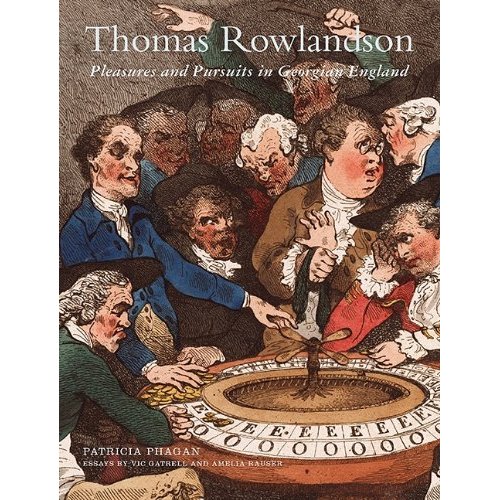
Thomas Rowlandson: Pleasures and Pursuits in Georgian England, by Patricia Phagan; essays by Vic Gatrell and Amelia Rauser.  Published by D Giles LTD in association with the Frances Lehman Loeb Art Center, Vassar College, Poughkeepsie, NY, 2011.

This illustrated volume which presents 72 watercolors, drawings, prints and illustrated books to reassess the legacy of this renowned 18th-century satirist. Accompanies the first major exhibition of Rowlandson’s work in North America for twenty years, showing at the Mary and Leigh Block Museum of Art, Northwestern University, Evanston, Illinois, Jan 14, 2011 – March 13, 2011 and the Frances Lehman Loeb Art Center, Vassar College, Poughkeepsie, April 8, 2011 – June 11, 2011 [Click here for information on the exhibit]  

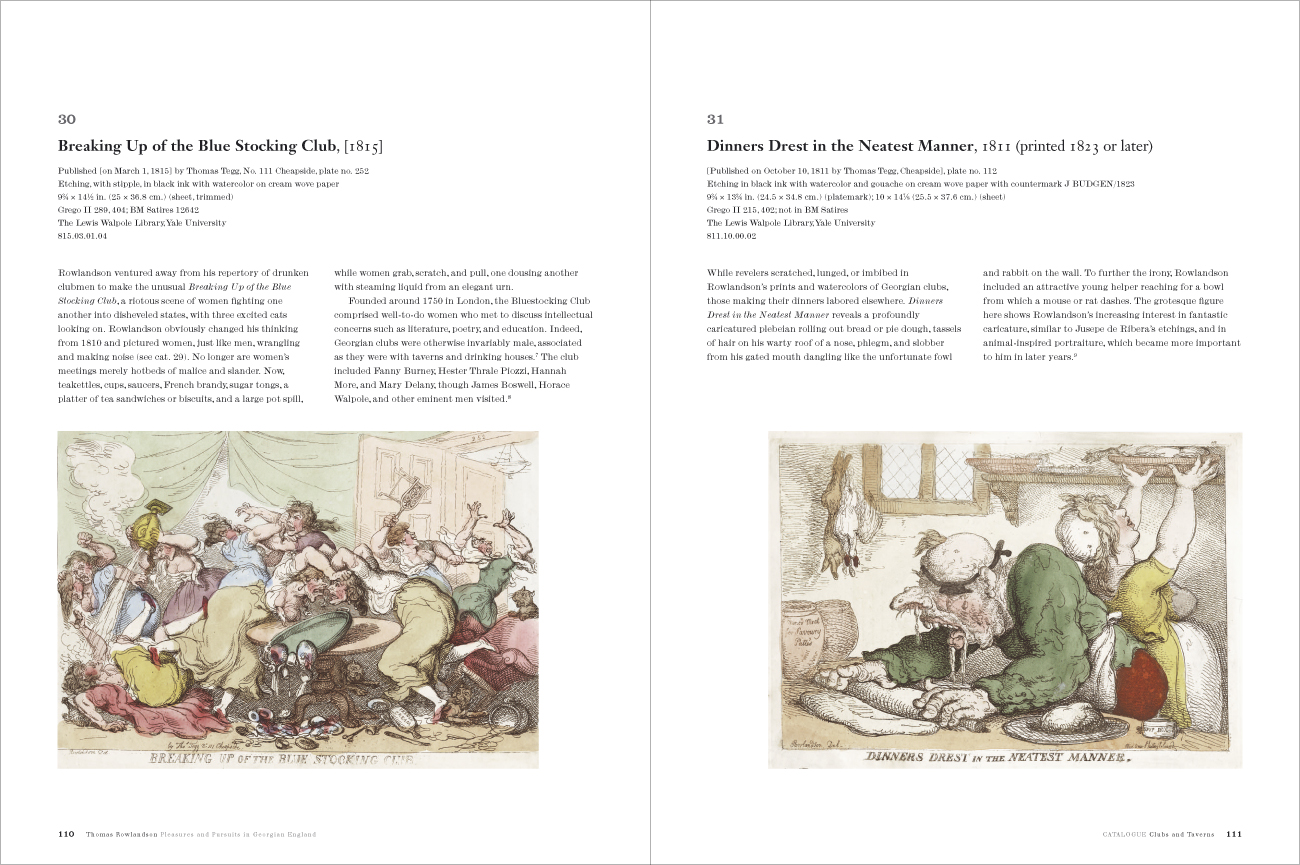
Thomas Rowlandson - Pages 110-11

[Click on to enlarge]

About the authors: 

Patricia Phagan is Philip and Lynn Straus Curator of Prints and Drawings at the Frances Lehman Loeb Art Center and the co-author of ‘The American Scene and the South: Paintings and Works on Paper, 1930-1946’ (1996) and ‘Images of Women in Seventeenth-Century Dutch Art: Domesticity and the Representation of the Peasant’ (1996).

Vic Gatrell is Life Fellow of Gonville and Caius College, Cambridge, and the author of ‘City of Laughter: Sex and Satire in Eighteenth-Century London’ (2006) [fabulous book!] and ‘The Hanging Tree: Execution and the English People 1770-1868‘ (1994).

Amelia Rauser is Associate Professor of Art History at Franklin and Marshall College, Lancaster, Pennsylvania, and author of ‘Caricature Unmasked: Irony, Authenticity and Individualism in Eighteenth-Century English Prints’ (2008). [from Amazon]

 See the publisher’s website at:  D Giles LTD; and Amazon.com   

            ISBN-10: 1904832784
            ISBN-13: 978-1904832782

*To Be Ordered

Copyright @ 2011, Deb Barnum, Jane Austen in Vermont

Austen Literary History & Criticism · Book reviews · Books · Collecting Jane Austen · Jane Austen · Literature · Regency England · Social Life & Customs

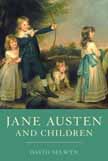
Book Review ~ “Jane Austen and Children” by David Selwyn

To be at the beginning of life, one must start at the end of the novel.  For although Jane Austen concludes her books with the marriage of the hero and heroine to which the whole thrust of the narrative has been leading, and the reader rejoices in the perfect happiness of the union, in reality the best is yet to come: they will have children – procreation  being not only the natural and desirable end of marriage, but also an economic and dynastic necessity.  And those children will have their own stories…What will become of the Darcy children?…”  (Ch. 1, Confinement, p. 5)

And thus does David Selwyn begin his treatise on Jane Austen and Children (Continuum, 2010), a most enjoyable journey through the world of childhood and parenting and education and growing-up in the life of Jane Austen, and the lives of her fictional characters.  If you are perhaps one of those people who think that Jane Austen does not like children, an idea certainly fed buy such comments about women “breeding again” or the child-generated “dirt and noise” or “the two parties of Children is the cheif Evil” [Ltr. 92], or the proper child-rearing “Method has been wanting” [Ltr. 86], etc. – you need to read this book!

Selwyn takes his reader essentially through the nine ages of man [with apologies to Shakespeare] beginning with confinement and birth, through infancy, childhood, parenting, sibling relations, reading and education, and finally maturity, as Selwyn says, the “end of the novel” when the Hero and Heroine come together, after all manner of trial and tribulation, to begin their own family.

We are given a general survey of the shift in the attitudes toward children, that late eighteenth – early nineteenth century view that fell between viewing children as not just “little adults” to the Victorian view of “seen but not heard”, following Locke and Rousseau and believing children to be natural innocents.  In each chapter Selwyn seamlessly weaves pieces of Austen’s life as gleaned from her letters and scenes from all her writings – and it is masterly done, all with a historical perspective.  We see Jane as a child, as a madly composing adolescent, a loving and humorous Aunt imaginatively interacting with her nieces and nephews, and as an accomplished writer whose fictional children are far more worthy of our notice than we have previously supposed: the frolicsome Walter hanging on Anne’s neck in Persuasion; the spoiled Middletons; the noisy and undisciplined Musgroves; the grateful and engaging Charles Blake in The Watsons; the John Knightley brood in the air courtesy of their Uncle George; the dynamics of the five Bennet sisters; Henry Dashwood the center of attention for the manipulative Steele sisters; the reality-based scenes of Betsy and Susan Price at Portsmouth; and finally Fanny Price, Austen’s only heroine we see grow up from childhood, having an elegant come-out, finding true-live and ends “needing a larger home.”

In all her works, Austen uses children as “a resource for her narrative strategies” (p. 4), be that comedy, a plot device to further the action, or a means of revealing attitudes and responses of the adults around them (p. 3).  Austen’s children are easy to miss – they won’t be after reading this book – here they are brought to life, given character and meaning, and you will see what Selwyn terms “Austen’s satirical delight in children behaving in character” (p. 73)

If Austen’s fiction seems to gloss over the reality of childbirth [the exception is Sense and Sensibility’s two Elizas], her letters tell the tale of its dangers [Austen lost three sisters-in-law to death in childbirth], and Selwyn links all to the social structure of the day, the nursing of babies and swaddling practices, to child rearing theories and moralizing tracts, and governesses and Austen’s ambivalence toward them. We visit boarding schools along with Jane and her characters and we hear the voices of a number of contemporary diarists (Agnes Porter, Sophia Baker, Susan Sibbald, Elizabeth Ham and Sarah Pennington).  There is a lovely in-depth chapter on the reading materials written especially for children and Austen’s first-hand knowledge of these titles.  The discussion on sisters and brothers, those so important in Austen’s own life, and those in her fiction, for example, characters with confidants (Lizzy and Jane, Elinor and Marianne), those isolated (Fanny, Anne Elliot, Emma Watson, Mary Bennet), and those with younger sisters (Margaret Dashwood and Susan Price).  As part of the growing-up process, Selwyn uncovers much on “coming-out” as Austen herself writes of in her “Collection of Letters” [available online here] – with the emphasis here on Fanny as the only heroine to have a detailed “coming-out” party.

The chapter on “Parents” starts with the premise that “in Jane Austen’s novels the parents best suited to bringing up children are dead” (p.95) and Selwyn takes us from the historical view of parenting, through Dr. Johnson’s “Cruelty of Parental Tyranny” [shadows of Northanger Abbey] to a full discussion of the marriage debate in the 18th-century – that between the worldly concerns of wealth vs. choice of partner based on emotional love as personified in Sir Thomas and Fanny Price respectively.  Excerpts are included from James Austen’s very humorous Loiterer piece   “The Absurdity of Marrying from Affection.” (p. 207) and Dr. John Gregory’s A Father’s Legacy to his Daughters (1774) [viewable at Google Books here] , and the Edgeworth’s Practical Education (1798) [Vol. III at Google Books here].  One finds that in reading all of Austen’s letters and all the works you can indeed discover a complete instruction manual for good parenting!

Jane Austen and Children appropriately ends with Selwyn’s speculation on what sort of parents her Heroes and Heroines will be, all of course based on the subtle and not-so-subtle clues that Austen has given us throughout each work – conjecturing on this is perhaps why we have so many sequels with little Darcys, Brandons, Bertrams, Knightleys, Tilneys, and Ferrars running about!

Just as in his Jane Austen and Leisure, where Selwyn analyzes the various intellectual, domestic and social pursuits of the gentry as evidenced in Austen’s world and her works, he here gives us an accessible and delightful treatise on Austen’s children, culling from her works the many quotes and references related to children and linking all to the historical context of the place of children in the long eighteenth century.  The book has extensive notes, a fine bibliography of sources on child-rearing, contemporary primary materials, children’s literature, and literary history, and several black and white illustrations.  (I did note that there are a few mixed up footnotes in chapter 3, hopefully to be corrected in the next printing).  What will this book give you? – you will never again miss the importance of Austen’s many children, peaking from behind the page, there for a set purpose to show you what great parents the Gardners are, or just to make certain you see how very selfish the John Dashwoods and the Miss Steeles are, or to see the generosity of an Emma Watson in her rescue of Charles Blake, or to feel the lack for the poor Musgrove boys having Mary for a mother, the playfulness of an otherwise conservative Mr. Knightley, and the unnerving near touch of Captain Wentworth as he relieves Anne of her burden –  thank you David Selwyn for bringing all these children to life for Austen’s many readers – you have given us all a gift!

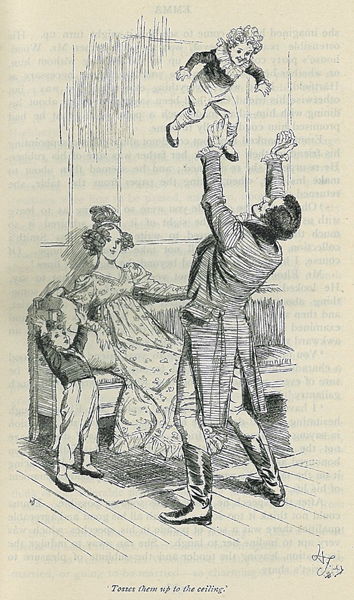
Emma – ‘Tosses them up to the ceiling’
[by Hugh Thomson, print at Solitary Elegance]

 __________________

Jane Austen and Children
Continuum, 2010
ISBN:  978-1847-250414

David Selwyn is a teacher at the Bristol School in Bristol, UK.  He has been involved with the Jane Austen Society [UK] for a number of years, has been the Chairman since 2008,  the editor of the JAS Report since 2001, and has written and edited several works on Austen.  He very graciously agreed to an “interview” about this latest work that you can find by clicking here.  See also the post on the various illustrations of Austen’s children by the Brocks and Hugh Thomson.  And finally, I append below a select bibliography of Selwyn’s writings on Jane Austen and her family.

 Select Bibliography:  

  1. Lane, Maggie, and David Selwyn, eds.  Jane Austen: A Celebration.  Manchester: Fyfield, 2000. 
  2. Selwyn, David, ed.  The Complete Poems of James Austen, Jane Austen’s Eldest Brother. Chawton: Jane Austen Society, 2003. 
  3. _____. “Consumer Goods.” Jane Austen in Context. Ed. Janet Todd. Cambridge Ed. of the Works of Jane Austen. New York: Cambridge UP, 2005. 215-24. 
  4. _____, ed.  Fugitive Pieces: Trifles Light as Air: The Poems of James Edward Austen-Leigh.  Winchester: Jane Austen Society, 2006. 
  5. _____. “A Funeral at Bray, 1876.” Jane Austen Society, Collected Reports V (1998): 480-86. 
  6. _____. “Games and Play in Jane Austen’s Literary Structures.” Persuasions 23: 15-28 
  7. _____. “Incidental closures in Mansfield Park.”  [Conference on “Jane Austen and Endings”, University of London, 17 November 2007] – unpublished paper. 
  8. _____. “James Austen – Artist.” Jane Austen Society Report 1998. 157-63. 
  9. _____.  Jane Austen and Leisure.  London: Hambledon Continuum, 1999. 
  10. _____, ed.  Jane Austen: Collected poems and Verse of the Austen Family.  Manchester:  Carcanet / Jane Austen Society, 1996. 
  11. _____, ed.  Jane Austen Society Report, 2001 – present. 
  12. ­_____. “Poetry.” Jane Austen in Context. Ed. Janet Todd. Cambridge Ed. of the Works of Jane Austen. New York: Cambridge UP, 2005. 59-67. 
  13. _____. “Shades of the Austens’ Friends.” Jane Austen Society Collected Reports V (2002): 134. 
  14. _____. “Some Sermons of Mr Austen.” Jane Austen Society Collected Reports V (2001): 37-38. 
Austen Literary History & Criticism · Book reviews · Collecting Jane Austen · Jane Austen · Regency England

Author Interview ~ David Selwyn on ‘Jane Austen and Children’

David Selwyn had graciously offered to answer my questions about his newest book, Jane Austen and Children (Continuum, 2010).  David is the current Chairman of the Jane Austen Society, editor of the Annual JAS Report since 2001,  and author of numerous works and articles on Austen.  His previous Jane Austen and Leisure (Hambledon Continuum, 1999)) is a must-read treasure trove of social and domestic activities that Austen engaged in and referred to in her novels. His current work is another must-read that weaves the historical, the factual and the fictional world of Austen and her works, all relating to children.  I will post a review of the book in a few days [after the 16th Birthday celebration] –  but I will say now that I most highly recommend this book, and suggest that you add this to your holiday “want” list and hope it may be found under your tree on Christmas morn…!

 Welcome David! 

JAIV:  I think when reading the novels, it is so very easy to overlook the number of children and how Austen’s presents them – but after reading your book one sees indeed how many children there are in her works and their importance to the narrative – is this what prompted you to write the book? the fact that too many people really do not see?

DS:      Yes, and I was struck by the fact that nobody had written on the subject, nor as far as I knew lectured on it. 

JAIV:  Jane Austen is often said to have not been particularly fond of children – was this another main reason in writing your book? – to show that as not the case? – 

DS:      As regards the novels, it always seemed to be assumed that her world was essentially an adult one (which I suppose largely it is) and the crucial role that children play in her exploration of it had been missed. As regards her own feelings about children, nobody who reads the letters can be in any doubt as to her fondness for her nephews and nieces.

JAIV:  Did anything surprise you in your research? 

DS:      How sensible she was about the bringing up of children – but then, I suppose one ought never to be surprised by JA’s wisdom on any matter!

JAIV:  And such extensive research! – the references in her letters, other family reminiscences, all the novels and minor works, and the historical context of child rearing in the long 18th century! – how long have you been working on this? 

DS:      For some years, but the editing of JEAL’s poems (Fugitive Pieces) intervened.

JAIV:  And this book presents such a seamless weaving of this real life, historical and fictional contexts – what are your working habits, writing process to achieve this?

DS:      I re-read the novels, minor works and letters, making notes of anything relevant in notebooks (one for each text) and highlight the notes in different colours according to theme. I did this for Jane Austen and Leisure and found that it worked. You’ll notice that at this stage I don’t use a computer. I also do a lot of background reading in social history, biography etc, and make notes on those books too of course.

JAIV:  You say that Jane Austen “makes use of her children to reveal aspects of her adult characters” – what is your favorite example of this?

DS:      It is difficult to choose, because each time she does it it is so wholly convincing. Annamaria Middleton and the naughty little Musgrove boy are the funniest, and the latter creates the most delicately balanced mood of comedy and emotion in any scene with children in it; but I love the little Gardiners, whose charming behaviour shows just how children should be brought up.

JAIV:  And then secondly, that Austen uses children as a means of advancing the plot – what is the best example of this?

DS:      It would certainly have been Charles Blake in ‘The Watsons’ had JA finished the novel.

JAIV:  There is much on Mansfield Park, perhaps because unlike the other heroines [other than the quick summary of Catherine Morland’s childhood], Fanny is presented to us as a child – but you seem to write most fondly of this novel, indeed, you end your book with thoughts on Fanny and Edmund making the best parents.  Is Mansfield Park your favorite among the novels? Or is this an unfair question! [who can ever choose!]

DS:      As you say, an impossible question. Yes, I do admire MP very much (and think that Fanny is often under-rated: she knows exactly what she wants and in the end gets it); but ultimately my favourite is Emma, partly because it is surely the subtlest and cleverest novel before Henry James, and partly because I think Miss Bates is, as well as being very funny, one of the most moving examples of human goodness in any literary work – JA touches us profoundly with the portrayal of a single woman who centres all the energy of a loving heart on her mother and niece (which is why the scene at Box Hill is so truly climactic – Emma’s thoughtless crushing of such a good heart is appalling, as she herself soon realises). By the way, another thing about Miss Bates: how brilliant of JA to be able to create such a wholly imagined voice that another character (Emma) can mimic it – flannel petticoats etc. 

JAIV:  It has always “troubled” me that Jane is the only child in this Austen family with only one given name – you speak of her having two godmothers both named “Jane” – do you think this is the reason? or do you have other thoughts? 

DS:      But she wasn’t: James, George and Edward had no second names, and nor did their parents. It may well be that the habit of giving two Christian names was becoming more fashionable during this period. 

JAIV:  One of the most famous child-based scenes in Austen is in Persuasion when Captain Wentworth helps Anne by the swift removal of her troublesome nephew – why is this scene so important to the plot? 

DS:      It brings Anne and Captain Wentworth intimately close for the first time in the novel – though JA is delicate enough to depict that intimacy with the child’s hands preventing direct physical contact between them.

JAIV:  Where much of The Watsons can be seen to appear in her other works, the most marvelous piece, when Emma Watson engages young Charles Blake in the dance, is nowhere to be found anywhere else [though it has been said that Mr. Knightley’s dancing with Harriet Smith is Austen’s reworking of this scene].  Do you think Austen could have placed this somewhere in her surviving novels? 

DS:     No, I don’t think she was ever to give a child quite such individual prominence again. 

JAIV:  You start your chapter on “Parents”: “In Jane Austen’s novels the parents best suited to bringing up children are dead.”  Who of the living parents do you think are the most effective? Who the least?  

DS:      The Gardiners are far and away the best. Sir Walter Elliot (though not of course the late Lady Elliot) is a disgrace to the Baronetage in which he takes such pride!

JAIV:  You so obviously love Jane Austen!  – when did this begin for you? 

DS:      In  picking up a stray copy of Emma when I was at home ill once, when I was a (music) student. But I was also thrilled to see a real live JA MS which used to be on display in the Pump Room at Bath (it is now safely tucked away in the offices of Bath City Council); it was the ‘headache’ poem, and it was hung in a hinged frame enabling you to see the reverse, on which there was one of the versions of the ‘Gill-Gell’ verse. I remember noting in the Minor Works volume that Chapman (re-edited by Brian Southam) said that he did not know where that particular version of the Gill’ Gell poem was, and I gleefully thought to myself, ‘I do – it’s in Bath!’ I seem to remember writing to OUP, but I didn’t get a reply.

JAIV:  You say that “it is highly unlikely that Jane Austen ever read a word of Mary Wollstonecraft (though she did read the novels of her radical husband, William Godwin)” – how are you so sure she did not read Wollstonecraft, and how so sure she did read Godwin? 

DS:      This is, I concede, speculation. JA refers to Godwin in a letter and Deirdre Le Faye suggests that she ‘was probably acquainted with Caleb Williams’; I am not sure she didn’t read Hannah More, but I think it unlikely.

JAIV:  One of the many things I took from your book in its focus, its seeing all through the lens of childhood, was a pattern of new themes emerging in all the novels – for instance, the theme in Emma of unconditional love, the love parents have for children, but in Emma, this love that Emma has for her father, Miss Bates for her mother and Jane Fairfax, Mr. Knightley for Emma – i.e. as you say “the unconditional love for people who may, consciously or unconsciously, require sacrifices to be made for them.” [p.111]. What are some other themes that became clearer for you since approaching the novels from this viewpoint? 

DS:      Not so much themes as procedures, and in particular the technique of introducing children not really for their own sake but as a contrivance for some aspect of plot or characterisation – and in the process, being JA, to bring them wonderfully to life.

JAIV:  One could read your book, re-read all of Austen, and get a very lucid and valuable instruction manual for good parenting! – did you have this perception yourself before reading and studying the books through this lens? 

DS:      No, it had never occurred to me that JA could be seen in such a light until I looked closely and specifically at what she says about children and parents.

JAIV:  Your book on Jane Austen and Leisure also offered a very valuable (and very enjoyable!) contribution to an understanding of Austen in the context of social history, her reading, her novels and her life and letters – again in many instances taking a few well-placed words in Austen and giving them such meaning.  What is up next for you?? 

DS:      I hope to do some more editing for a JA Society book. What a pity that JEAL’s sister Caroline destroyed the MSS of her poems; I should like to have brought those out.    

********************

Thank you so much David for answering all my questions!  Stay tuned for my review and a select bibliography on David Selwyn’s other Austen-related works. 

 [Getty Images.com]
Fashion & Costume · Jane Austen · Regency England · Social Life & Customs

Follow Friday ~ The Regency Encyclopedia

I have posted about this very rich resource before, but doing so again as much had been added: The Regency Encyclopedia.  I met up with the creator, Sue, at the Portland JASNA AGM, and we talked about some of the new items – maps, authors, and various bells and whistles. This is a password protected site, but Sue gave me permission to again provide the logins [case-sensitive]:

User ID – JAScholar
PW – Academia

I suggest you first look at the 18-page User’s Guide [no worries – it is largely visual with big print!] – to get a sense of how the database works.  Then scan the various categories; and always check the “What’s New” tab to see what has been added – it is constantly being updated and Sue asks for suggestions of good resources that she can add.  Here are the categories to give you an idea of what is included – all are keyword searchable:

  • Map Gallery that includes a Time & Distances option – this all based on John Cary’s New Itinerary (1819)
  • London: many maps, a tour, and shopping locations!
  • Georgian Names index
  • Fashion Print Gallery
  • Novel Calendars w/ Chapman’s Lists of Characters
  • Source list of work catalogued [my only criticism: this is a great bibliography of Regency resources but it is listed A-Z by first name, not the most helpful access point]
  • Online resource links [a select list]

A perfect weekend project – this database need some time spent with it to find all that is hidden behind its main menu page!

Austen Literary History & Criticism · Jane Austen · Regency England · Social Life & Customs

Thoughts on Travel in ‘Sense and Sensibility’ ~ Part II

Part II.  A Study of Character’s Movement in Sense and Sensibility

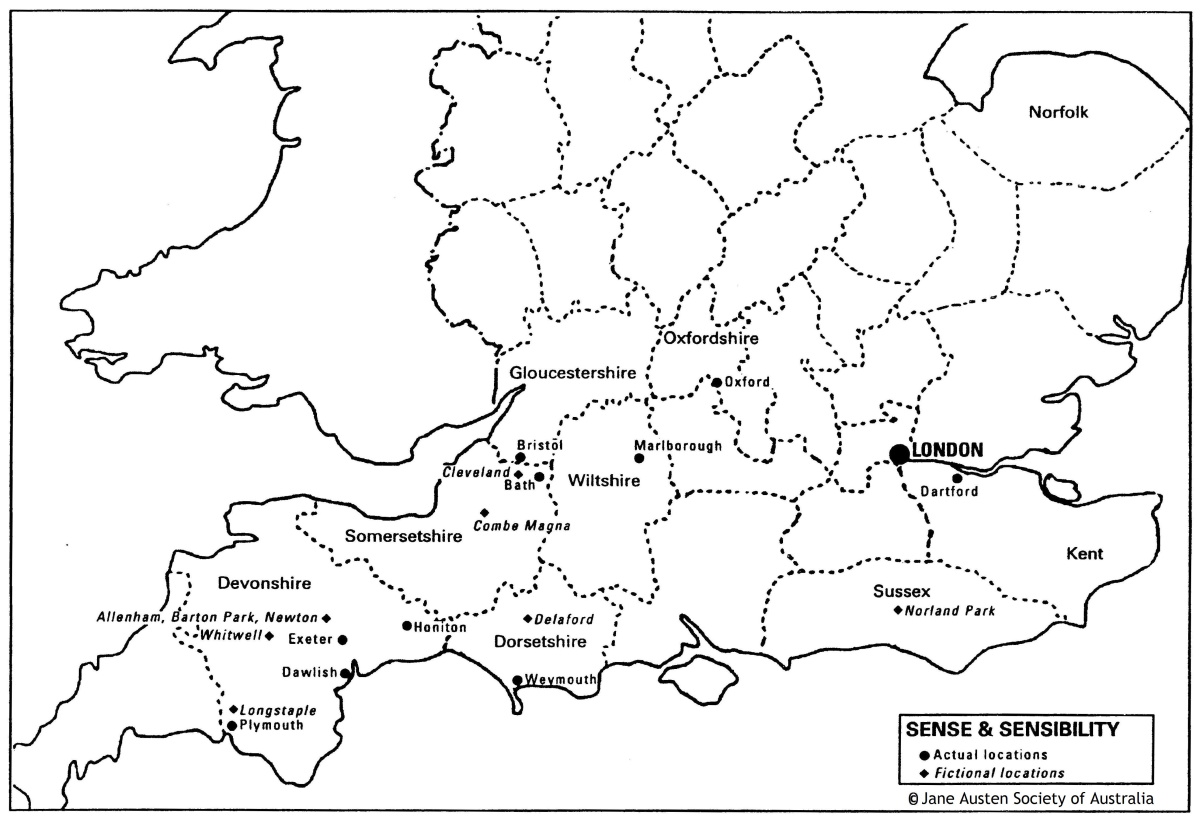
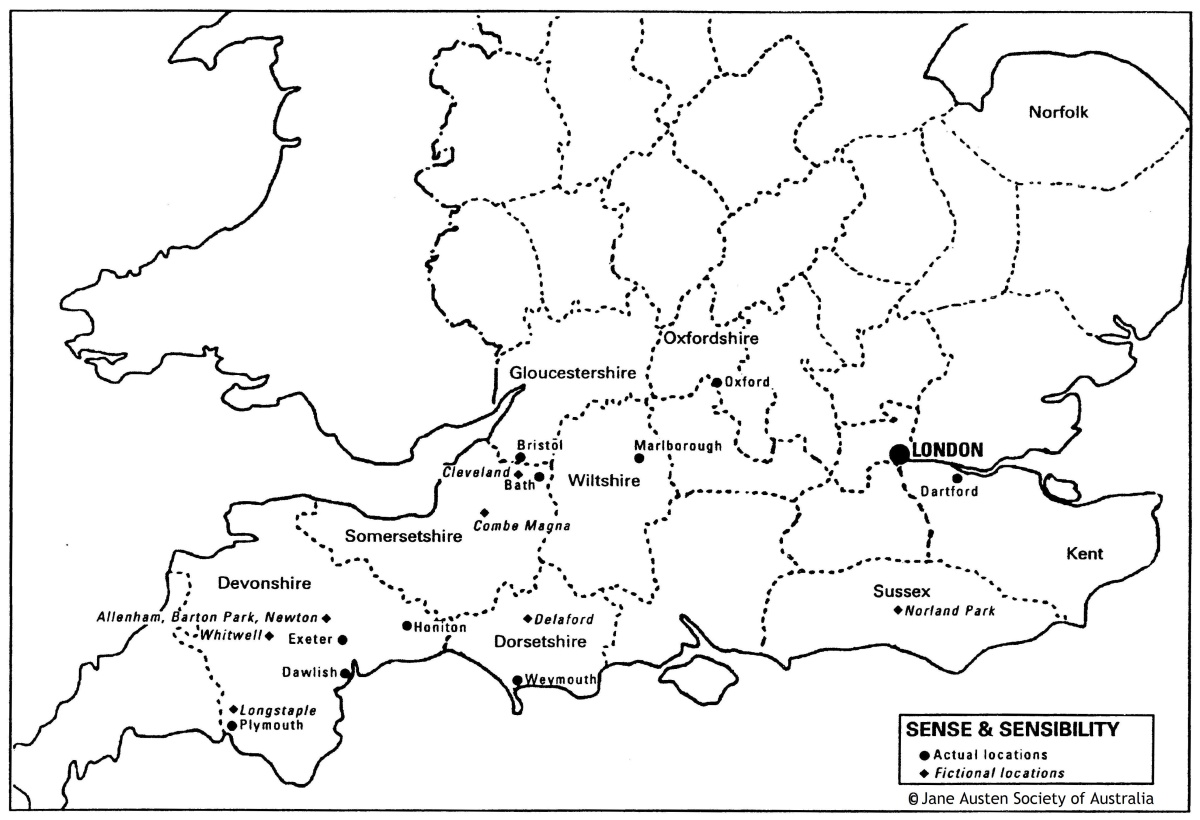
Fig. 1. Sense & Sensibility map

A startling fact! – there are 49 mentions of movement and 46 mentions of carriages [to include a few referring to travel by horseback] – and people say that nothing happens in Jane Austen!  That is a great deal of  traveling in what I have just described in the previous post as a not easy or inexpensive world to travel in!

To begin, let’s place the characters where they live and their income if known:

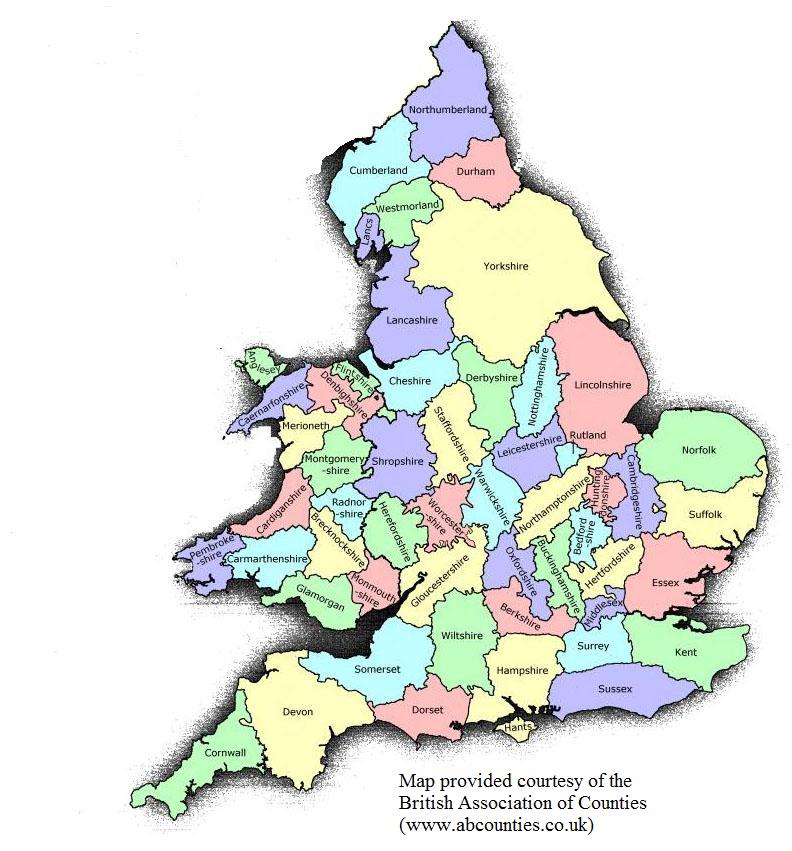
A.  Where the characters live:  see the map of England’s Counties below, and the map of places, both real and fictional above

  • Counties = Sussex, Somerset, Dorset, Devon
  • London [“Town” = London], largely Mayfair


The Dashwoods:

  • Henry Dashwood – Norland, Sussex
  • Mrs. Henry Dashwood – Norland, moves to Barton Cottage, Devonshire – £7000 = £350 / yr
  • Mrs. Dashwood’s mother – Stanhill [Sussex]
  • John and Fanny Dashwood –  Norland, Sussex; Harley St, London [renting?]; purchase East Kingham Farm, near Norland – £5,000 – £6,000 / year
  • Elinor / Marianne / Margaret:  Norland, Sussex, move to Barton Cottage, Devonshire; each have £1000 capital from their uncle = £50 pounds each annual income = £500 total for the four of them  [150 + 350 = £500]
Sussex
Devonshire

Colonel Brandon:  Delaford in Dorset; St. James St, London –  £2000 / year

  • Eliza Williams, his ward – Avignon [Brandon’s sister] – where? – found her in London
  • Brandon’s brother-in-law:  Whitwell,  near Barton
Dorset

The Ferrars:

  • Mrs. Ferrars – Park St, London
  • Edward –  his mother’s house; Pall Mall, London, after leaving home; Oxford; Edward and Elinor after marriage will have £350 / year (though this will increase to £850 with Edward’s inheritance of £10,000 from Mrs. Ferrars, reluctantly given!)
  • Robert – his mother’s house? later London with Lucy Steele
  • Fanny Ferrars Dashwood [see above]
Cavendish Square, London

John Willoughby – Combe Magna, Somerset; Bond St, London –  about £600-700 /yr 

  • Mrs. Smith, Willoughby’s Aunt – Allenham Court, Devonshire
  • Miss Gray, Willoughby’s wife – £50,000 = £2,500 /yr

The Jennings / Middletons / Palmers:

  • Sir John and Lady Mary Middleton [Mrs. Jennings daughter]:  Barton Park, Devonshire; Conduit St, London
  • Mrs. Jennings:  Berkeley St, London,  near Portman Square, otherwise she is visiting her daughters
  • Mr. Thomas Palmer and Charlotte Palmer [Mrs. Jennings’ daughter]: Cleveland, Somerset; Hanover Square, London [renting?]
Hanover Square, London

The Steeles:

  • Lucy and Anne [Nancy] Steele – Bartlett’s Buildings, London
  • Mr. Pratt  [the Steele’s Uncle] –  Longstaple [near Plymouth]


Miss Morton:
 Edward’s intended, London somewhere – £30,000 = £1500/yr 

Fig. 2. England Counties

**************************************

 B.  Movement of characters – a quick summary:

1.  The novel starts out with Mrs. Dashwood and her three daughters moving from Norland Park [Sussex] to Barton Cottage [Devonshire] – their furniture goes by way of the water [i.e. canal system]

 2.  The Elinor and Marianne go to London with Mrs. Jennings [and most everyone else], then return to Cleveland, then back to Barton Cottage, where they await their destiny, both ending up at Delaford.

 3.  Colonel Brandon lives in Delaford, but he is quite often at Barton Park, he goes to London to see his ward, later moves to London with everyone else, and when staying in London, he goes back and forth to Delaford “a few times”, and then later returns home via Cleveland and has to fetch Mrs. Dashwood in the middle of the night back and forth from Cleveland to Barton Cottage, and then finally seems to be at Barton Park / Cottage an awful lot…

Barton Cottage

4.  Edward Ferrars visits Barton Cottage and later we find that he was actually first in Plymouth – he travels a few times back and forth to London to his mother’s, then off to an unnamed Inn somewhere after he is disinherited, then to Oxford, then back to London settling in Pall Mall, and then of course to Barton to visit then marry Elinor, and they move to the parsonage at Delaford and we expect will live happily ever after…

5.  Willoughby lives in London, has his estate home at Combe Magna in Somerset, visits his Aunt in Allenham Court [Devonshire], leaves for London when HE is disinherited; he later visits Cleveland [Somerset] to see the dying Marianne, and then back to London to live with his boring, but wealthy wife

Willoughby

6.  The Middletons live at Barton Park [Devonshire], but travel to London with everyone else…

7.  The Palmers live at Cleveland [Somerset], they visit Barton Park [Devonshire], then back to Cleveland and then to London with everyone else; return to Cleveland and then leave again as Marianne falls ill.

8.  Mrs. Jennings, of course, lives in London but travels all over to visit her children at Barton Park and Cleveland

9.  the Miss Steeles live in Plymouth with their Uncle, visited Exeter and then to Barton Park, then to London where they stay with first the Middletons, then the John Dashwoods, then Lucy with her now husband Robert Ferrars leave London for Dawlish, then return to London to live unhappily ever after, while her abandoned sister has to borrow money from Mrs. Jennings to catch a coach back to Plymouth [in the endless, hopeless search of her Doctor…]

10.  Mrs. Dashwood is taken to Cleveland by Col. Brandon to see Marianne at Cleveland [Somerset]; she is the only character who does not go to London.

11.  As noted above, Everyone but Mrs. Dashwood goes to London, and while there they travel for their daily visiting calls and excursions around Town.

12.  And of course, Mrs. Ferrars stays put, selecting / de-selecting her heir from her comfortable seat in London – BUT the book ends with her visiting Elinor and Edward: ‘She came to inspect the happiness which she was almost ashamed of having authorized.”

Fig. 3. 1812 Cary map England

And how did they travel?? –  stay tuned for Part III:  Carriages in Sense and Sensibility

*****************************************

Sources:  Fig. 1 and 2 maps from the JASNA.org website; Fig. 3 Cary map from Pemberley.com

Austen Literary History & Criticism · Book reviews · Books · Collecting Jane Austen · Jane Austen · Literature · Publishing History · Regency England

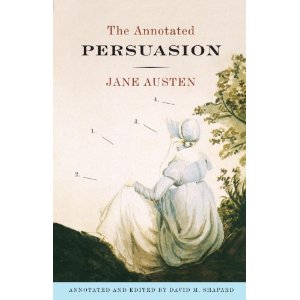
Book Review ~ ‘The Annotated Persuasion’

Last week I ran into Barnes & Noble to pick up the latest annotated Pride and Prejudice, edited by Patricia Meyer Spacks, and since then I have been “gadding about” as Austen would say – so no time to really give it a complete read and review; but in another trek yesterday into yet another Barnes & Noble [no worries, I also have haunted the local USED booksellers!], my husband stumbled upon the just published [as in October 5, 2010]  The Annotated Persuasion, annotated and edited by David M. Shapard [New York: Anchor Books, 2010; paperbound; ISBN:  978-0-307-39078-3] – and I have discovered a veritable feast! 

Shapard is known for his annotated edition of Pride and Prejudice [which I have but it is not in hand, as I am in “gadding about” mode as mentioned above…] – so I cannot compare this book to that edition [his annotated Sense & Sensibility is to be, I believe, published in April 2011] – though I have found that work quite useful as a reliable reference source – it was first published in hardcover followed by a paperback edition; this Persuasion is only in paperback… it is also a smaller format, likely because the novel is so much shorter, but this renders the many illustrations quite small – but I quibble about these few drawbacks …. publishers decisions do not always make the most sense… 

I first look for the extras:  

An Introduction which gives a brief history of the publishing of Persuasion, and the differences in this final novel from Austen’s other works

A Chronology of the novel [will compare this to Ellen Moody’s calendar 

Maps of sites that relate to the characters and storyline: the world, England, Somerset, Lyme, and two of Bath 

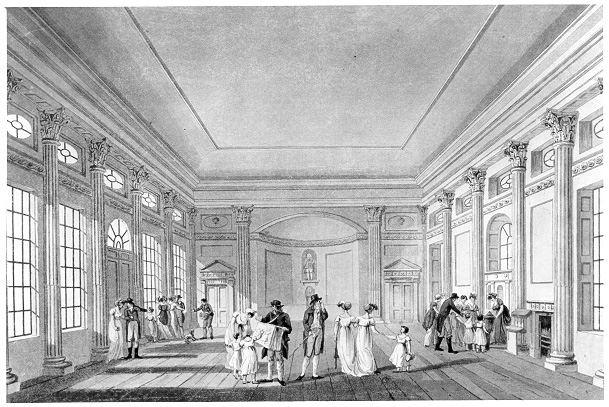
A good number of b/w Illustrations – there is unfortunately no listing of these; the source is indicated under each picture, but a listing would have served as an index to the subjects, which cover all manner of Regency life:  architecture such as that in Bath with interior and exterior scenes of the Assembly Rooms; various carriages; fashion; furniture; Naval life; the Cobb in Lyme Regis; etc.  – many of these illustrations will be familiar to most readers with a modicum of knowledge about the period – and color would have been nice – but the point here of these illustrations is to serve as a starting reference for further research, and it is an added plus to have any of these included. 

Bibliography:  this also serves as a starting point – it is in no way a complete listing of sources, but likely those sources that Shapard relied on for his research.  How complete can a bibliography of Austen be without mention of Claire Tomalin’s biography under that category, or Claudia L. Johnson’s Jane Austen: Women, Politics and the Novel or Kaplan’s Jane Austen Among Women nowhere to be found – but as Shapard is an historian, it is that strength that resides in this bibliography, again a great starting point for further study – it is organized by broad subjects:  language; cultural and literary background; marriage and the family; position of women; children; housekeeping and servants; entails and estates and the landed gentry; rural and urban life; the military; medicine; the law; education; books, media, libraries; writing; postal service; transportation; theater [but no mention of the two works Jane Austen and the Theatre – two works with the same title and both quite comprehensive]; music and dance; sports; weather; the seaside resorts; houses and gardens; fashion; food; etiquette and female conduct books; and others – again, a good select listing of resources on various topics.   

The Literary commentary and annotations:  Shapard begins with the caveat that “the comments on the techniques and themes of the novel represent the personal views and interpretations of the editor…such views have been carefully considered, but inevitably they will still provoke disagreement among some readers “ [xi] – which Shapard encourages…; these annotations include such literary commentary, historical context, and definitions of words in context if they had a different meaning in Austen’s time, some repeated when necessary or cross-references provided.  

The book is arranged with the original text on the verso, the annotations and illustrations on the recto – the annotations are extensive as the following few very random examples show: 

  1. Persuasion starts with the full description of Sir Walter Elliot’s obsession with both his own personal charms and his listing in the baronetage – Shapard here provides information on that book and others of the time and the definition of “baronet” and how Sir Walter acquired his own status…
  2. Gout is fully described on pages 311 and 315, when Anne learns that the Crofts are removing to Bath dues to the Admiral’s “gouty” condition.
  3. “replaced” – [p. 103] – “they suspected great injury, but knew not where; but now the collar-bone was soon replaced”   – the annotation explains that the word “replaced” had the meaning in Austen’s time of “to be put back in its original position” rather than “to take the place of” – there is also a description of anatomical knowledge as understood at the time.
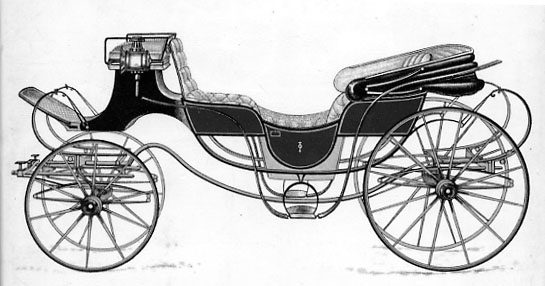
  4. Carriages get much attention whenever they are mentioned in the text – so we have descriptions and illustrations of barouches and chaise and fours, and chairs and of course Anne’s pretty little “landaulette” [p. 483]                                                                         
         

    a barouche


  5. Money and wealth – Wentworth’s income explained [p. 145]
  6. Servants:  various duties outlined [p.  87]
  7. Street names, shops, locations explained throughout; e.g. The Cobb; Tattersall’s [a mention on p. 14 with an illustration]; Milsom Street; Westgate Buildings;…etc…
  8. The Clergy in Austen’s time
  9. Austen’s language as delineating character:  as in the following: “Lady Russell had only to listen composedly, and wish them happy; but internally her heart reveled in angry pleasure, in pleased contempt” [p. 232] – and the annotation reads:  “Her reveling in such emotions indicates her moral inferiority to Anne, who never derives pleasure from anger or contempt.” [p. 233]
  10. Social rules and strictures:  some examples – Sunday traveling [p. 305]; shaking of hands between men and women [p. 427]; not using first names, even those of friends such as Anne and Mrs. Smith

 A look at a few key scenes will also illustrate Shapard’s invaluable commentary: 

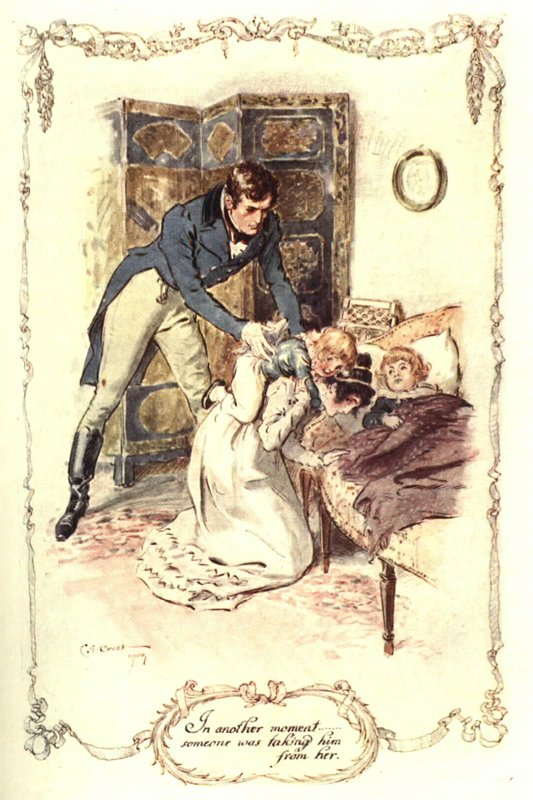
  1. Wentworth removing young Walter Musgrove from around Anne’s neck [pp. 152-5]:  Shapard emphasizes the importance of this scene in displaying both Anne’s and Wentworth’s feelings – he quotes William Dean Howell’s how “this simple, this homely scene, is very pretty, and is very like things that happen in life, where there is reason to think that love is oftener shown in quality than quantity, and does its effect as perfectly in the little as in the great events. [from Heroines of Fiction].  Shapard also suggests that Wentworth’s reluctance to converse with Anne about what has just happened is as much due to his efforts to remain aloof as it is to a “simple dislike of thanks,” [p. 155], as is true of Mr. Knightley in Emma. 
                                                                                                        

    Brock illus - from Molland's


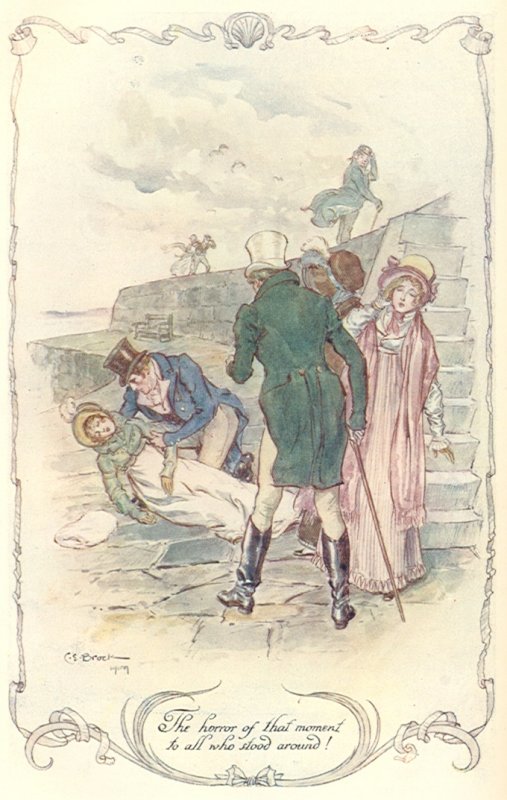
  2. Louisa’s fall in Lyme Regis [p. 210-15]:  Shapard describes the Cobb, the steps that were the scene of The Fall, comments on the feelings of Anne and Wentworth, the strength of the former and the uncharacteristic weakness of the latter; Anne’s carrying the “salts” [have you ever wondered why Anne IS carrying smelling salts and conveniently has them in her possession? – “here are salts – take them, take them.” [p. 210]]; the calling for the surgeon and the differences between he and an apothecary; the comic relief of “the sight of a dead young lady, nay, two dead young ladies, for it proved twice as fine as the first report.” [p. 213-4] 
    "The horror of the moment" - from Molland's


  3. and of course, The Letter! [p. 452] – Shapard so rightly states that “Wentworth’s passionate language contrasts him with other Jane Austen heroes, who are often much cooler and more rational.  It also fits with the more intense emotional tone of this novel … the letter itself is arguably the moment of highest emotion in her works…” [p. 453]  – and we are given a picture of a writing table of the time [p. 457] – there is also extensive commentary on the conversation between Capt. Harville and Anne. 

As referred to above, there are disappointments in this work – I would most wish for an index to the annotations – these could be just general subject areas, such as similar divisions as in the bibliography – so for instance – all annotations which discuss medicine could be cited, or any references to carriages, or fashion, or Bath locations, the Navy, or examples of Free Indirect Discourse, the literary allusions such as Byron’s The Corsair and Matthew Prior’s poem “Henry and Emma”, etc.  As it is, one needs to read through the entire work to find the references, and as Shapard wishes for this to be a work for reference purposes, this addition of an index would seem to be a necessity.  A index of Characters would have also been a helpful addition – one must reach for their Chapman for this information; and finally there is also no “note on the text”, important information in any such reference source – the bibliography lists Chapman’s 1933 edition, Spacks’s Norton critical edition [1995]; and the latest Cambridge edition edited by Janet Todd and Antje Blank [2006] – but I would have liked to see from whence he took the exact text…

That all said – this is a delightful and fact-filled addition to your Austen Library – and if you are already fairly well-versed in the Regency period and Austen criticism, this will serve as a copy of Persuasion where much of this information is at your fingertips; if you are just starting your adventure in reading Austen, this will be a great introduction to the very rich world of her writings, her world, and her literary themes – what more can we ask for!  [other than a hardcover with an index!]

 4 full inkwells out of 5

[please note that the illustrations are meant to illustrate this post and are not illustrations in the work being reviewed] 

Austen Literary History & Criticism · Jane Austen · Regency England · Social Life & Customs

Thoughts on Travel in ‘Sense and Sensibility’

Sense & Sensibility is about so many things, but there is an emphasis on income, inheritance and money, and how the world of the late 18th, early 19th century figured in the lives of Austen’s characters, especially the women in her novels.  But one of the things one notices after a number of readings is the amount of movement in this novel – the constant  comings and goings of the characters, with their visiting, travels to London, moving from one end of England to the other.  On first reading, you might almost miss the extent of this movement, after all, nothing really ever happens in Austen, isn’t that what we always hear?!  But take a look at the map on the JASNA.org site for Sense and Sensibility and you will see what I mean. And if you know anything about travel in late 18th – early 19th century England, you will be know how arduous such travel was.  I am going to chart the movement of characters in the novel and the means whereby they moved from place to place, or as Mrs. Jennings so aptly asks of the Misses Steele:  “How did you travel?”  

Austen knew first-hand the travel issues of her day [read her letters!] – and she was very knowledgable and consistent in writing about it in her novels – often not necessarily specific but there are clues all around!   But alas!, there is so much to discuss about travel: carriages and their parts; the history of the postal system; the history of coaching and the turnpike system; the economics of the time – taxation, income and inheritance – all these; but I will in the next several posts offer a brief outline of the travel in Regency England, its difficulty and costs with a few thoughts on economics; then a discussion of movement in S&S; the types of carriages in use in Regency England and those used by Austen’s characters; and finally a few words on the London of S&S – it has the most mention of any of her novels, and interesting to see where each character was housed in Town.  And at the end of this series of posts, I will provide a bibliography and further reading references.
 

 Part I:  Travel in Regency England  

[English Counties: Map from JASNA.org]

  • -The difficulty of travel due to the condition of the roads – each parish was responsible for its own roads but they were largely dirty and muddy, and dangerous
  • -most people traveled by foot:  certainly true of the lower classes, but recall Mrs. Dashwood: 

 …his [Mr. Middleton’s ] repeated assurances of his carriage being always at their service, the independence of Mrs. Dashwood’s spirit overcame the wish of society for her children; and she was resolute in declining to visit any family beyond the distance of a walk.  

  •   -traveling in vehicles in the daytime or only in the nights with bright moonlight, little travel in winter, no travel on Sunday
  • -improper for women to travel alone [if you read Austen’s letters, you will see that she was completely dependent upon her brothers to visit anyone or travel any distance; and how outrageous that Northanger Abbey’s Catherine Morland was put on that coach all alone!]
  • -for overnights at coaching inns, travelers often brought their own linens or silverware…
  • -travel vehicles were uncomfortable and dangerous due to the road conditions and highwaymen
  • -despite all this, the late 18th-century saw a great improvement in the roads, and one could travel great distances more quickly [and if they had the money!].   Paterson’s British Itinerary, a travel guide had 17 editions between 1785-1832 – it outlined the roads used by the stage and mail coaches, the tolls, the bridges, etc.   

[Image from Georgianindex.net]

A quick review of travel times [varies depending upon vehicles]:  

  • – Mr. Darcy:  8 miles/hr –  recall his famous line to Elizabeth:  ‘what is 50 miles of good road? little more than half a day’s journey’
  • -the Stage Coach [and General Tilney]:  7 miles /hr
  • -average travel time:  4-6 miles / hr
  • -100 miles = 2 days of travel [and remember, no travel on Sunday]
  • -in 1800, London to Edinburgh took 60 hrs; London to Norwich, 19 hrs 

The estimated mileages in Sense and Sensibility: [this is in todays distances] 

  • London to Bristol = @ 106 miles
  • London to Bath = @ 97 miles
  • London to Exeter = @ 157 miles
  • London to Plymouth = @ 192 ,iles
  • Exeter to Honiton = @ 16 miles
  • Honiton to Weymouth = @ 35 miles

[Map of S&S: from JASNA.org]

Cost of living ~ some basic facts: 

The economy in Britain during this time was very unstable – hard to effectively calculate the meaning of what the cost of living was in the early 19th century and to compare it with ours today; also some items cost more in Austen’s times than they do today, some less.

One 1988 article calculated that one pound in 1811 = $33., so Darcy’s income of 10,000 = $330,000.  The following month another article said that to compare 1810 with 1990, one should multiply today’s average per capita income by 300 [in 1990 this was $20,894.] = $6,300,000. would be Darcy’s income in today’s language.  Another article:  the pound in 1800 = $100. , so Darcy’s 10,000 = 1 million! – to be honest I just got dizzy with this whole thing!  [There are various websites where you can play around calculating these amounts, such as Measuring Worth, and the National Archives Currency Converter]

And remember that Austen often tells you exactly what someone is worth – this was common knowledge at the time and was not considered rude to talk about it.  But when there is a reference to money, for the men, she is referring to their annual income [Darcy 10,000; Bingley 5,000; Brandon 2,000; etc], but when referring to a woman, the reference is to her total assets, i.e. this money would be invested at 5% and she would earn the income from that each year, so Miss Gray’s 50,000 [Austen’s richest woman] is not her income, but rather the income from that, so £2,500 / year to live on.  [note that this is not always consistent, but is largely a general rule in Austen]

 So rather than trying to figure out what something would be worth today, it is better to look at the cost of living, i.e. what things cost in Austen’s time,  so to gain some perspective, keep the following in mind:

  • the world that Jane Austen writes about and the world we see visually in the film adaptations portrays a very small minority of the population, the “Polite World”, the upper 10,000; Austen might give various clues in each novel to that other world, but it is easy to forget it when reading about the romance and balls and carriages and fashion, etc.   
  • Edward Copeland, an Austen scholar who has written much on the economics of Austen’s world, and says she was “meticulous” in presenting these economic truths, states that this economic world in S&S is presented in terms of the power that money brings with it, and the frightening aspect of this for the women in the novel, where it seems that the “wicked, foolish and selfish” are rewarded.  
  • in 1799, in order to support and pay for the war with France, the British Government imposed a tax of 2s / pound on all income over £200; there were also taxes on windows, on malt, sugar, tea, coffee [considered a luxury tax], etc… 

Some hard economic facts ~ in a world where the lowest “respectable” income would be about £50 / year: 

  • a common laborour:  £25 / year – this to maintain himself, his wife, and 6 children in food, lodgings, clothes and fuel 
  • governess:  £25 / year 
  • curate w/ house and garden:  £40 / year  
  • average gentleman = £150 /yr
  • for a gentleman in 1825 with an income of £250 – for himself, his wife, three children and a maidservant, food cost a little over £2.5 / wk = £135 /yr.
  • £370 /yr – will support 2 servants 
  • £500 /yr – will support two servants, a boy, an occasional gardener  [Mrs. Dashwood and three daughters] 
  • Edward & Elinor when married will have £850  [after his mother gives him money – they would have married with only 350 – see Copeland in Cambridge Companion.]
  • £800 – 1200 will support a carriage  [hence Willoughby is living way beyond his means, as we shall see…]
  • £5000+ – the minimal income needed to partake of the “London Season” – [The John Dashwoods, etc] – renting and running the household, elegant parties, stabling horses, clothing, etc.

So if Austen doesn’t tell us directly about a character’s income, you can figure it out by inference:  London? any carriage? how many servants? 

 Costs of travel:  [estimates for 1800] 

  • Stage Coach:  2-3 pence / mile = 1.25 pounds from London to Bath / half-price if up top / outside [but remember the average income was about £30 / year 
  • Hired post-chaise =  estimate about £1 / mile [i.e @1 shilling / horse / mile, to include the postillion] 

Costs of Horses: for hunting, racing, riding, pleasure drives

  • -expensive to buy and maintain:  cost = 100 pounds; annual maintenance 120 pounds to stable in London
  • -costs of the carriages [discuss later] – but there were also taxes on private carriages and horses; toll roads
  •  -for perspective:  in 1801, 8 million population in England; in 1814, there were 69,200 taxed carriages [i.e. less than 1 / 100]:  23,400 four wheeled; 27,300 two-wheeled; 18,500 “tax-carts” [basic springless vehicles] [quoting All Things Austen]

 The economic realities in S&S ~ remember that Mrs. Dashwood could not keep a horse or a carriage after the loss of their inheritance:  

1.  Narrator on the Henry Dashwoods: 

…the horses that were left her by her husband had been sold soon after his death, and an opportunity now offering of disposing of her carriage, she agreed to sell that likewise at the earnest advice of her eldest daughter.  [and she had 500 pounds a year!]

 2.  Narrator on Willoughby’s gift of a horse to Marianne [his irresponsibility – the realities of owning a horse]:  

 …Willoughby had given her a horse, one that he had bred himself on his estate in Somersetshire, and which was exactly calculated to carry a woman.  Without considering that it was not in her mother’s plan to keep any horse, that if she were to alter her resolution in favour of this gift, she must buy another for a servant, and keep a servant to ride it, and after all, build a stable to receive them…

 3.  Marianne on a competence:  she wants 2000 pounds a year: 

I am sure I am not extravagant in my demands. A proper establishment of servants, a carriage, perhaps two, and hunters, cannot be supported on less.   [the irony being that that is exactly the income of Colonel Brandon!]  – and of course, Elinor responds:

TWO thousand a year! ONE is my wealth!

4.  Fanny Dashwood in the infamous scene talking down the inheritance: 

Their housekeeping will be nothing at all.  They will have no carriage, no horses, and hardly any servants; they will keep no company, and can have no expenses of any kind!

 And on that happy note, I will pause ~ next up:  what is the income of the characters in S&S, where do they live, and to where do they travel in this novel of many travels?


[Posted by Deb]

Austen Literary History & Criticism · Books · Jane Austen · News · Uncategorized

New issue! ~ ‘Jane Austen’s Regency World Magazine’

News from the Editor of  Jane Austen’s Regency World magazine: the September/October 2010 issue is published this week:  


Featured on the cover is a scene from The Secret Diary of Anne Lister, the BBC’s new drama about a Georgian heiress who follows an unconventional path in life and love.

Highlights of the new issue of the magazine include: 

  • The Latin touch: how Jane’s fame is spreading in Brazil 
  • A very secret diary: the heiress Anne Lister’s love for a woman has been turned into a film 
  • A Cornish exile: Maggie Lane explores the life and times of Charles Austen, Jane’s seafaring brother 
  • Jane’s best jest: Paul Bethel compares Emma with Mansfield Park 
  • Required reading: Sue Wilkes explains how no Georgian gentleman could afford to miss 
  • Enter stage right: Jane Austen would have known the old Theatre Royal in Bath 
  • My Jane Austen, Marsha Huff: The outgoing president of JASNA shares her love of Jane Austen

Full details of Jane Austen’s Regency World Magazine, which is published every two months, are available on our website http://www.janeaustenmagazine.co.uk/

******

 Jane Austen’s Regency World Magazine is also delighted to announce that it will be at the following events:

  •  Bath Jane Austen Festival, country fayre at the Guildhall, Bath, on Saturday, September 19
  •  JASNA AGM, Regency Emporium, in Portland, Oregon, October 28-30

Readers are invited to visit our stand and say hello!

[Posted by Deb, who will write more on this when it shows up in her mailbox…]

Books · Jane Austen · Jane Austen Circle · Regency England · Social Life & Customs

In My Mailbox…

The most recent issue of Jane Austen’s Regency World [March / April 2010, Issue 44], this issue titled “Jane Austen’s Musical World,” brought a delightful surprise – a free cd containing the six works by composers who were working in Bath in the late 18th century [see a list of the selections below], as well as  several articles on the music of Austen’s time:

~ the guest essay by Franz Joseph Hayden describing his visit to Bath in 1794

~ Maggie Lane on Jane Austen, Music Lover? where Ms. Lane posits that “Jane’s attitude toward music seems to have been occasionally hostile, often ambivalent, and only rarely enthusiastic.”

~ David Owen Norris on What was on Jane’s Ipod? on newly discovered music within the Austen family, suggesting that Eliza de Feuillide was an even more considerable pianist than previously thought, as well as the discovery of a hand-written piece possibly composed by Austen herself!

~ Patrick Wood on Thomas Linley, Mozart’s boyhood rival [and subject of one of Gainsborough’s famous paintings]

~ Mike Parker, Tidings of My Harp, “argues that Jane Austen uses the harp in her novels to identify privileged and spoilt women, while knowing little of the mechanics of the instrument herself.”  [think Mary Crawford, the Musgrove sisters and Georgiana Darcy]

~ our very own JASNA-Vermont ‘s Kelly McDonald in A Golden Time, tells of the diaries of Emma Austen-Leigh, wife of Austen’s nephew James Edward Austen-Leigh, which provide valuable insight into London’s music scene during the Regency – here focusing on the Knyvett family of musicians. 

~ Gillian Dooley considers the question of taste in Sense & Sensibility in Matters of Taste and its relationship to moral worth.

~ an interview with Austen scholar Richard Jenkyns – who enlightens us with admitting a special affection for Mansfield Park, thinking the latest BBC adaptation of MP “wins the competition for the worst ever adaptation of any classic novel by a mile”, and wanting most to be like Henry Tilney [but would like to marry Lizzy Bennet]!  [and I add that Jenkyns book A Fine Brush on Ivory: an Appreciation of Jane Austen (2004) is a wonderful read…]

~ articles from JASNA’s Carol Adams on the score for the 1995 P&P; JASA’s Ann Bates on their one-day symposium on Jane and Occupations; reviews of cds, letters, news from 1802, and as always, a great number of fabulous illustrations…

The enclosed cd contains works by:

  • Thomas Linley the Elder : Cantata: Awake my lyre and Invocation: Fly to my aid, O mighty love
  • Henry HarringtonEnchanting Harmonist
  • Thomas Linley the YoungerTo heal the wound a bee had made
  • William Jackson after Thomas ArneWhere the bee sucks
  • William HerschelSonata in D

Subscribe and enjoy!  Jane Austen’s Regency World Magazine

[Posted by Deb]

Book reviews · Fashion & Costume · Jane Austen · Regency England · Social Life & Customs

Book Review ~ Jane Austen’s Sewing Box

book cover jane austens sewing boxJane Austen’s Sewing Box: Craft Projects & Stories from Jane Austen’s Novels. 
by Jennifer Forest.  Murdoch Books Australia, 2009 

ISBN:  9781741963748, paperback, 224 pages.


 This is a lovely, sumptuous book.  When it first arrived, I did a quick skim – it is filled with photographs, decorated papers, fashion plates, quotes from Austen, and a good number of handiwork projects – hmmm, I thought, maybe one of those books that just looks nice but is of little substance – a coffee table [albeit a small one] book you look at once and then relegate it to collect dust in the “parlor” –  But on further study I found within these 224 pages a wealth of information – a brief but amazingly thorough introductory commentary on Regency historic and social life, the world of “women’s work” in Austen’s time, and the references to Austen’s many mentions of these real-life activities in her novels and letters.

 Ms. Forest has a background in history and cultural heritage, and combining this knowledge, her love of Austen and a “passion for fabric arts and crafts,” she has given us a treasure of a book.  With a starting point of finding Austen’s references to handi- and fancy work, Forest puts these quotes in their historical context, explains the meaning and use of the piece, and then provides instructions for each project – each of varying skill level, each a different task – there is knitting, sewing, embroidery, netting, paperwork, glasswork, and canvas-work, a total of eighteen different projects – from a letter case, linen cravat, fur tippet, to a pin cushion, reticule, bonnet and muslin cap – all mentioned by Jane Austen, and here lovingly replicated, with photographs of Regency era decorative arts and Ackermann’s fashion plates interspersed throughout. 

Best to show an example, so I will choose the huswife [page 100ff]  [ “the huswife was a small fabric case with pockets to hold all those tools for sewing and needlework – scissors, tape measure, thread, pins, and pin cushion”( page 104)]: 

This is a sewing task for beginners, with two pages of photographs of the finished piece, a short history of the huswife and its uses, a quote [all the quotes are written in script] from Emma where Austen uses the term [there is also a second quote from Sense & Sensibility spoken by Anne Steele] – here Miss Bates has misplaced a letter from Jane Fairfax that she later reads to Emma:

 “Thank you. You are so kind!” replied the happily deceived aunt, while eagerly hunting for the letter. “Oh here it is.  I was sure it could not be far off, but I had put my huswife on it, you see, and without being aware, and so it was hid.”  [page 104, quoting Emma]

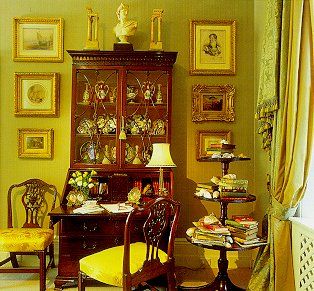
 This is followed by a full page of blue decorated paper with a part of the quote, a full page fashion plate from Ackermann’s, and a full page of an art reproduction depicting a woman at her fancy work, then a full page photograph of a detail from a piece of Regency furniture [all photographs are from the Johnston Collection *], and then three pages of project instructions with black and white drawings, and a final photograph of a furniture detail.  This format and sequence is followed for each of the eighteen projects, ending with a list of suppliers, references and an index.

johnston collection desk
from The Johnston Collection


All these Austen quotes, taken out of context, are quite a wonderful discovery! – they can so easily be passed over in the reading – what indeed IS a huswife? or a tippet? [“Jane, dear Jane, where are you? here is your tippet.  Mrs. Weston begs you to put on your tippet.”]  Or a transparency? [“and its greatest elegancies and ornaments were a faded footstool of Julia’s work, too ill done for the drawing room, three transparencies, made in a rage for transparencies…”] or a reticule? [“…a letter which she [Mrs. Elton] had apparently been reading aloud to Miss Fairfax, and return it into the purple and gold reticule by her side.”]  or “netting” for that matter [“They all paint tables, cover screens and net purses” says Charles Bingley]; and then of course Lady Bertram’s carpet-work and “yards of fringe!” 

This book opened up a whole new awareness of Austen’s writing in the NOW – her knowing what her readers would glean from these almost off-hand references [as in Mrs. Elton’s purple and gold reticule, “expensive colours that Austen possibly chose to sketch her character’s pretensions to grandeur, associated as they were with royalty and luxury.” [page 182] – and as always one is awed by Austen’s use of such fine details to delineate character.

fashion plate yellow dress
from Costumes.org

 The book is by no means comprehensive on the subject – but there are so many tidbits of Regency social life and customs, coupled with Austen’s words – I found in the reading an “oasis of calm”, a slowing down, a return to a time of sewing for the poor, or making your brother’s shirts (done in private), and your embroidery and fancy work and painting put on public display to show yourself as “an accomplished woman” [a la Mr. Darcy] – and the exquisite paper and decoration, the furniture details, and the fashion illustrations all combine to create this time-warp, invoking the Regency era and “its enthusiastic appreciation of design in all forms – dress, architecture, interiors, furniture, wallpaper and fabric” [page 17] – the whole sphere is beautifully presented in these pages and makes this a wonderful addition to your Jane Austen collection and a great starting point for your creative endeavors! 

5 full inkwells [out of 5]

* The Johnston Collection is “a Fine and Decorative Arts Museum, Gallery and Reference Library in East Melbourne, Australia.  It is no ordinary museum with roped off exhibits, but presents an astonishing and diverse collection arranged in the English Country House Style.”  Visit their website for the history, gallery exhibits, and a sampling of the treasures in the collection.

Posted by Deb