Jane Austen · London · Regency England · Social Life & Customs

In Search of Austen in London ~ The Geffrye Museum

One of the best places to visit in London if you have any interest in English domestic life is the Geffrye Museum – this has been on my ‘to-visit’ list for several years and I just haven’t made it there on previous trips to London – so when I met up with Tony Grant  and he said said his favorite museum is the Geffrye – well, done deal, off we went! 
As mentioned above, I did not have my camera, and we got there late, spent too much time chatting over tea, and the place closed down before I could finish the tour on contemporary life and go to the shop – so I cannot offer much more than a link to their fabulous website, where you can take any number of virtual tours through the various rooms, and begin to imagine Jane Austen in her own time and place! 

From their website:

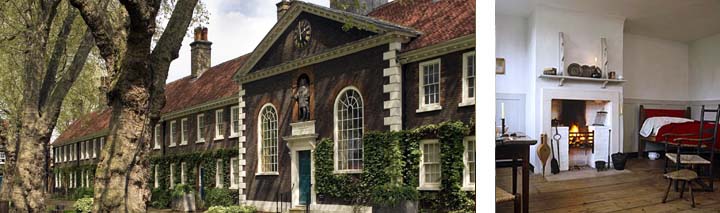
The Geffrye Museum depicts the quintessential style of English middle-class living rooms. Its collections of furniture, textiles, paintings and decorative arts are displayed in a series of period rooms from 1600 to the present day.

The displays lead the visitor on a walk through time, from the 17th century with oak furniture and panelling, past the refined splendour of the Georgian period and the high style of the Victorians, to 20th century modernity as seen in a 1930s flat, a mid-century room in ‘contemporary style’ and a late-20th century living space in a converted warehouse.

The museum is set in elegant 18th century almshouses with a contemporary wing surrounded by attractive gardens, which include an award-winning walled herb garden and a series of period gardens.

A parlour in 1790 – photography John Hammond

The use of the parlour remained much the same as earlier in the century; it was the room where the family would have gathered, received guests and taken meals. However, the way it was decorated and furnished had changed considerably.

In diaries, journals and letters of the time people often referred to rooms and furnishings that they liked as ‘neat’, which meant bright and stylish as well as clean and tidy. This taste required lighter colours and more delicate decoration. Wallpapered walls were particularly useful for achieving this effect, replacing heavily moulded panelling.  

In the museum’s room the wallpaper is a modern replica copied from a fragment dating to around 1780. The plaster frieze is copied from a house in Cross Street, Islington. Interest in classical design and decoration was increasingly widespread towards the end of the century.

***************************

When you first walk in, you are faced with a series of chairs depicting each era – a wondeful way to see the changes in that most essential piece of furniture – the lofty chair.  And then you begin your tour through the period rooms, starting with a Hall of 1630.  Each room is arranged to look as though someone just got up and left – letters half written, chairs a bit askew, cards spread out.  Tony is a teacher and he said he loves bringing young people to this very hands-on museum – he would focus on a particular item or habit – for example, light – and have his students really think about how our use of and access to different kinds of light has changed through the years.  It is a marvelous way of really putting yourself in each room and seeing how one would have to function in that context.

A drawing room in 1830 – photography Chris Ridley

The Almshouse was not open when I visited, so here again from their website:
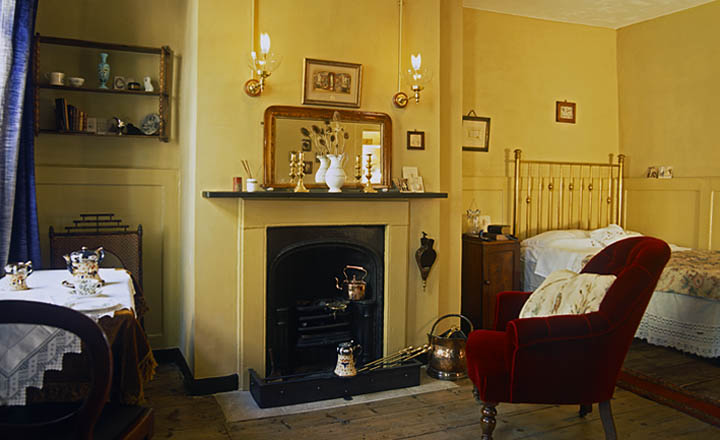
An almshouse room in 1880 – photography Morley von Sternberg

The 1880s room, situated on the upper floor, shows how a former governess living in the Geffrye almshouses during the 1880s may have furnished it.

The interior exemplifies the principle of genteel poverty. Within this context, the objects on display reflect many of the principal themes related to daily life during the nineteenth century, such as scientific and technological developments, moral and social trends, travel, and educational and artistic accomplishments.

*****************************
The Museum also houses elegant gardens from the 17th to 20th centuries; here is one from the 18th c – you can visit the website for lists of key plants:

18th century period garden – photography Jayne Lloyd 

A lovely visit, despite my lack of camera! –  and again my hearty thanks to Tony Grant for taking me there!

All the images posted here are from the website, where you can visit all the rooms, take virtual tours, shop*, and discover this magical world of the English home. 

*the shop has many books, such as The History of the Geffrye Almshouses, by Kathy Haslam. 
or gifts:

You can also visit them on Facebook here, where you can like them!
Copyright @2011 by Deb Barnum, of Jane Austen in Vermont
Jane Austen · Regency England

London Trekking

Have just returned from a week in London – hence the blogging silence – will post more pictures and some thoughts, but to start here are a few.  I met up for a delightful tea and afternoon of sight-seeing with Tony Grant, of the blog London Calling [alas! he just lately removed it from the blogsphere] – Tony now writes regularly for Vic at Jane Austen’s World, where you can see his pictures and posts on Austen’s England [see his latest on The Library of an 18th-century Gentleman and also today’s post at Jane Austen Today on Brighton Pier.]

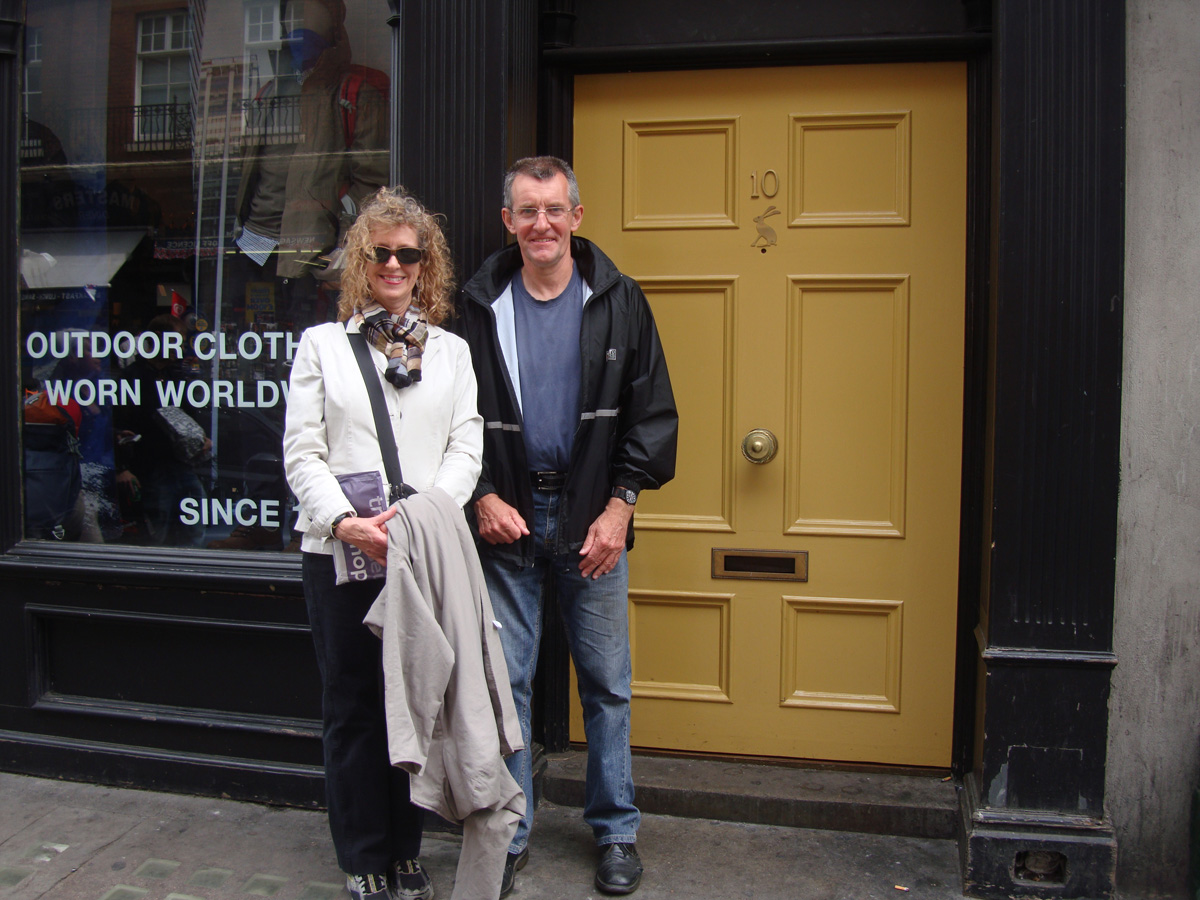
As I did the unbelievable, mind-boggling error of leaving my camera in the hotel,  I have only this one photo of Tony and I [taken by an obliging passer-by on Tony’s camera] to prove that we actually met up!  

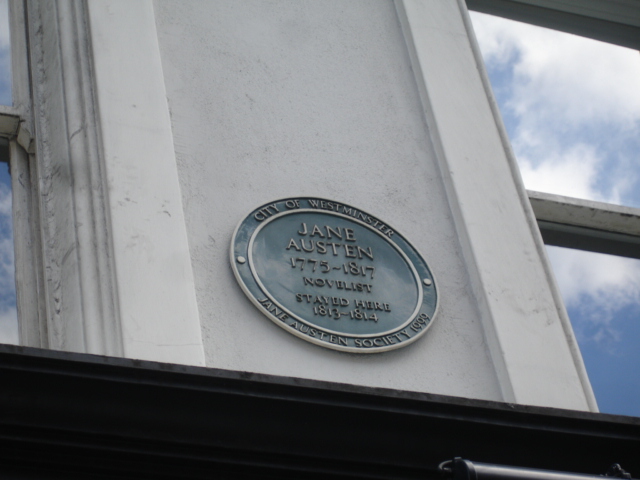
Here we are in front of Henry Austen’s home/office at 10 Henrietta Street where Jane stayed!

I went back a few days later to get a photograph of the plaque on the building:

Many thanks to Tony for a lovely day of walking around London – I find that it was all the more satisfying because I DID forget my camera – one ceases to look at everything from the inside of that little box, framing all in view for just the right shot – so everything seen remains all the more etched in my memory.

More to come – museums, plays, walking, walking, walking in search of Austen in Regency London – and in perfect sunshine all week!  Stay tuned!

Westminster Abbey
Copyright @2011 by Deb Barnum, of Jane Austen in Vermont
Jane Austen · JASNA · JASNA-Vermont events · News · Schedule of Events

JASNA 2011 AGM – Registration Now Open!

Registration for the 2011 AGM in Fort Worth Texas is now open.  You must be a member of JASNA to participate, so what better time to join than now, when you can head off into the sunset with all new thoughts about Sense and Sensibility  [and perhaps a Col. Brandon by your side!] – check out all the events at the AGM website here as JASNA celebrates the 200th anniversary of Austen’s first published novel:

http://jasna.org/agms/fortworth/index.html

The registration form is here: http://jasna.org/agms/fortworth/registration.html [scroll to bottom of page and click on the blue button]

Giddyup!

[Image: FineArtAmerica.com]

Note our next JASNA-Vermont event on June 5:  The Musical World of Jane Austen, an organ recital with Dr. William Tortolano: information is here

Copyright @2011 by Deb Barnum of Jane Austen in Vermont
Austen Literary History & Criticism · Books · Jane Austen · Regency England · Social Life & Customs

Susannah Fullerton on Jane Austen and Crime ~ An Audio Lesson

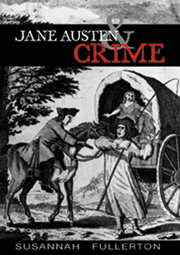
The ABC Sydney, Australian Broadcasting Corporation, has posted online its weekly “Self-Improvement Wednesday.”  This week’s lesson is an 11 minute chat on “Jane Austen’s  Crime” with Susannah Fullerton, the JASA President and author of the fabulous Jane Austen & Crime.

You can listen to the audio and then take the quiz to test your retention skills here:  http://www.abc.net.au/local/audio/2011/05/04/3207499.htm?site=sydney

Enjoy this very quick and entertaining run through all the possible crimes in Georgian England as seen in Austen’s writings:  adultery and crim con, dueling, prostitution, murder, elopement, rape, theft, smuggling, gaming, and the various punishments.  Better yet, read the book! [you can read my review here.]

Copyright @2011 by Deb Barnum, of Jane Austen in Vermont
Austen Literary History & Criticism · Jane Austen · Jane Austen Popular Culture · News · Regency England · Social Life & Customs

Coming Soon to Your Mailbox! ~ Jane Austen’s Regency World Magazine Issue 51

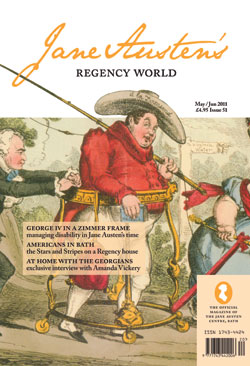
The May/June 2011 issue [ Number 51] of Jane Austen’s Regency World magazine is now on sale and has been mailed to subscribers.

In the new issue: 

  • Americans in Bath ~ Celebrating 50 years of the American Museum in Britain
  •  Battle Wounds and Bedlam ~ Living with illness in Georgian times 
  •  Loitering with James ~ Maggie Lane asks if Jane Austen helped her brother with his periodical, The Loiterer
  •  Amanda Vickery Interview ~ Meet the academic who has brought the Georgians to life on TV
  •  Correspondence Culture ~ Kelly M McDonald* on the art of letter writing
  •  Our Chawton Home ~ Louise West on her plans for Jane Austen’s House Museum
  •  Fantastic Ferens ~ The Canaletto on display in the Ferens Gallery, Hull

Plus: All the latest news from the world of Jane Austen, as well as Letters, Book Reviews, the always difficult Quiz, a Competition,  and Jottings from JAS and JASNA.

For further information, and to subscribe, visit: www.janeaustenmagazine.co.uk

*We are very pleased to see that our very own JASNA-Vermont member Kelly McDonald has another article in JARW – congratulations Kelly! You can follow Kelly on her blog Two Teens in the Time of Austen.

Copyright @2011 by Deb Barnum, of Jane Austen in Vermont
Austen Literary History & Criticism · Books · Collecting Jane Austen · Jane Austen · Literature · News

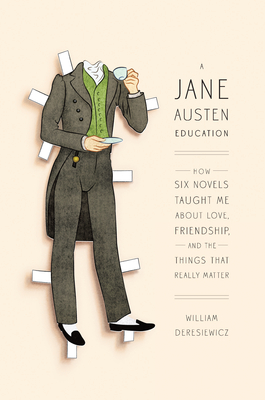
Your Austen Library ~ ‘A Jane Austen Education’


In A Jane Austen Education, Austen scholar William Deresiewicz turns to the author’s novels to reveal the remarkable life lessons hidden within. With humor and candor, Deresiewicz employs his own experiences to demonstrate the enduring power of Austen’s teachings. Progressing from his days as an immature student to a happily married man, Deresiewicz’s A Jane Austen Education is the story of one man’s discovery of the world outside himself.

A self-styled intellectual rebel dedicated to writers such as James Joyce and Joseph Conrad, Deresiewicz never thought Austen’s novels would have anything to offer him. But when he was assigned to read Emma as a graduate student at Columbia, something extraordinary happened. Austen’s devotion to the everyday, and her belief in the value of ordinary lives, ignited something in Deresiewicz. He began viewing the world through Austen’s eyes and treating those around him as generously as Austen treated her characters. Along the way, Deresiewicz was amazed to discover that the people in his life developed the depth and richness of literary characters-that his own life had suddenly acquired all the fascination of a novel. His real education had finally begun.

Weaving his own story-and Austen’s-around the ones her novels tell, Deresiewicz shows how her books are both about education and themselves an education. Her heroines learn about friendship and feeling, staying young and being good, and, of course, love. As they grow up, they learn lessons that are imparted to Austen’s reader, who learns and grows by their sides.

A Jane Austen Education is a testament to the transformative power of literature, a celebration of Austen’s mastery, and a joy to read. Whether for a newcomer to Austen or a lifelong devotee, Deresiewicz brings fresh insights to the novelist and her beloved works. Ultimately, Austen’s world becomes indelibly entwined with our own, showing the relevance of her message and the triumph of her vision.

A Jane Austen Education: How Six Novels Taught Me About Love, Friendship, and the Things That Really Matter

ISBN 9781594202889
272 pages
Release date: 28 Apr 2011
The Penguin Press:  available in hardover for $25.95;  ebook / adobe reader for $12.99

About the author:   

William Deresiewicz was an associate professor of English at Yale University until 2008 and is a widely published literary critic who writes for a popular audience. His reviews and criticism regularly appear in The New Republic, The Nation, The American Scholar, the London Review of Books, and The New York Times. In 2008 he was nominated for a National Magazine Award for reviews and criticism.

Text From the  publisher’s website:  Penguin Press

Deresiewicz also authored Jane Austen and the Romantic Poets  (Columbia UP, 2005)

He will be conducting a blog tour as follows:  info from TLC Book Tours]

Copyright @2011 by Deb Barnum, at Jane Austen in Vermont
Jane Austen · News · Social Life & Customs

Happy Easter!

[Vintage Postcard from my collection]

Hope your day is filled with Love, Jane Austen, and Chocolate!

Copyright @2011, by Deb Barnum of Jane Austen  in Vermont
Fashion & Costume · Jane Austen · News · Regency England · Social Life & Customs

Follow Friday [a day early!] ~ Regency Dances.org

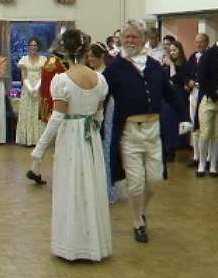
Regency Dancing was how young ladies and young gentlemen met and courted, and the dance floor was often the only place they could talk without being overheard by their chaperones. As was to be expected, the dancing was lively and flirtateous. The dancing needs to be accurate and elegant, but always remember that it is also about love and young people having fun.

A lovely email from a Gentleman in England alerted me to this new website on Regency Dances [ http://RegencyDances.org ]. 

From his email:

Launched in January, the site is a free learning resource for Regency Dances. As well as providing dance notations, the dances are shown as animations.  This combination of watching the animation while following the notation has been found to be an excellent way of quickly understanding the structure of a dance.  The dances are taken from original 18th -19th century sources and written into modern notation by experienced dancers under the watchful eye of a recognised international expert. 

Two or three new dances are added each week.  To keep informed you can “follow” them on Twitter at http://twitter.com/RegencyDances

The objective of http://RegencyDances.org is to create an international shared website resource independent of any specific dance group for (a) sharing genuine Regency dances of known provenance, (b) sharing news of upcoming Regency balls, and (c) sharing information about other Regency groups. 

The site includes a history of the dances, the various dance steps presented in animations, lists of dances and music sources, plans on how to organize a Regency party, a listing of various societies and upcoming events, and a very informative section on “What to Wear” which includes the details of the era fashions and how to locate or make your very own costume.

Please visit the site if you have any interest in the dance of Jane Austen’s period – new information is being constantly added, and the site editors are “looking for sources of recorded music that we may use, videos of single dances to be selected as examples of ‘good practice’ and a few more editors.”

If you are a member of a Regency dance group, certainly add your name and events to their growing list.

[Image: Regency Dances website]

Copyright @2011 by Deb Barnum of Jane Austen in Vermont.
Fashion & Costume · Jane Austen · Regency England · Social Life & Customs

Royal School of Needlework

I happened to catch this on CBS’s Sunday Morning while trekking on my tredmill – a very nice piece on the Royal School of Needlework, located in the Hampton Court Palace:

The RSN is the international centre for teaching, practicing and promoting hand embroidery across a wide range of techniques.

We offer hand embroidery courses for all levels; conservation and restoration of historic needlework or creation of new embroideries in our Studio; tours to see some of our needlework Collection and more. [you can schedule private tours to see pieces in the collection that are not viewable to the general public]

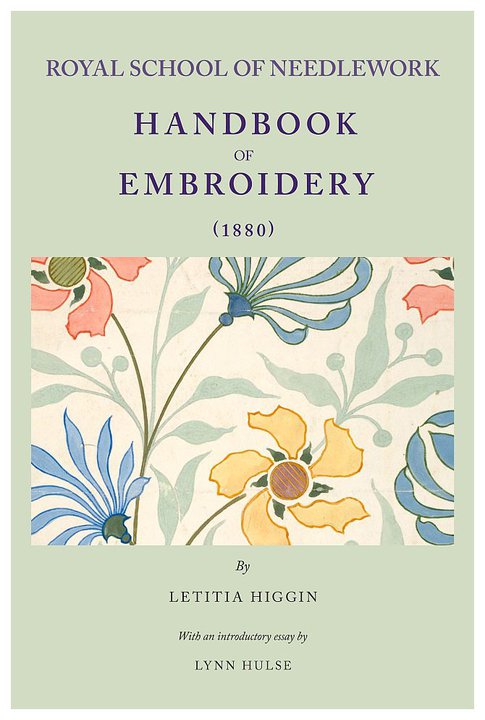
There are various books offered in the shop – here are two examples:


You can order the whitework sampler kit celebrating the upcoming royal wedding of William and Kate for £30:

You can view the CBS video here:

http://www.cbsnews.com/video/watch/?id=7363014n

[Hampton Court Palace:  image from Evan Evans Tours]

Embroidery images from the RSN website; you can join their Facebook page here:  http://www.facebook.com/pages/Royal-School-of-Needlework/185840784788771

Copyright @2011 by Deb Barnum at Jane Austen in Vermont
Jane Austen · News · Regency England · Social Life & Customs

Regency England at the Huntington Library

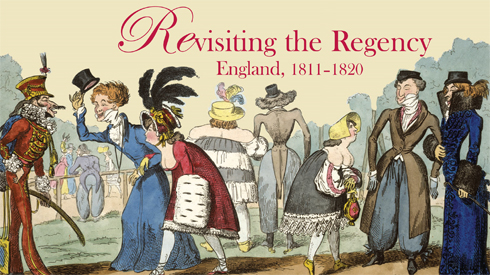
The Huntington Library is hosting an exhibit “Revisiting the Regency: England, 1811-1820” from April 23 – August 1, 2011:

A new exhibition takes a closer look at a glittering yet turbulent era.  In October of 1810, England’s King George III slipped into that final madness from which only death would release him, nearly a decade later. The following February, Parliament authorized the king’s estranged and profligate eldest son, the Prince of Wales (the future George IV), to rule in his place as regent. Extravagant, emotional, controversial, and self-indulgent, the prince regent lent his name and many of his characteristics to a glittering era. 

In commemoration of the 200th anniversary of this extraordinary decade, The Huntington presents an exhibition titled “Revisiting the Regency: England, 1811–1820.” Opening April 23 in the West Hall of the Library and continuing through Aug. 1, the exhibition draws on The Huntington’s extensive holdings of rare books, manuscripts, prints, and drawings documenting this historic era.

The term “Regency England” usually evokes Jane Austen’s world of graceful country-house living and decorous village society, the elegance of London’s fashionable elite, or the licentious activities of the prince and his aristocratic Carlton House set. Ladies followed the latest fashions in La Belle Assemblée while gentlemen copied Beau Brummell’s severe elegance. Readers found new works by a generation of England’s greatest poets and novelists: Austen, Lord Byron, John Keats, Samuel Taylor Coleridge, and Sir Walter Scott. Londoners enjoyed a rich theatrical and musical life, watching Edmund Kean’s premiere in Richard III or hearing the first English production of Mozart’s Don Giovanni. Art lovers followed the latest exhibits at the Royal Academy. Under the prince’s patronage, architect John Nash created the fantasy Royal Pavilion at Brighton and remade London’s West End with the new developments of Regent’s Park and Regent Street.

Yet underneath this ordered upper-class surface lay a far more complex and turbulent world: more than a century of intermittent war with France ended at Waterloo, but peace revealed wrenching poverty, social unrest, the strains of rapid industrialization, and growing calls for political reform. The first railroads, gas lighting, and other advances in technology altered the landscape of everyday life.

This rich cavalcade of people and events provided irresistible targets for a brilliant generation of visual satirists. The witty, savage, and iconic images of George Cruikshank and his fellow caricaturists, well represented in the exhibition, capture all the vagaries of an extraordinary decade in English arts, letters, science, and society.

[Text and images from the Huntington Library website]

Copyright @2011, by Deb Barnum of Jane Austen in Vermont