Author Interviews · Book reviews · Books · Jane Austen · Jane Austen Popular Culture · London · Rare Books · Regency England

Part I ~ The Perfect Visit ~ Interview with Stuart Bennett, Wherein We Meet Jane Austen and Shakespeare … and Enter to Win the Book Giveaway!

The Perfect Visit (Longbourn Press, 2011) is, no way to say it otherwise, a perfect treat – who of us would not want to spend a few days [or pull an all-nighter!] in the company of a time-travelling couple who are each in turn lovers of books, Jane Austen, Shakespeare, and just possibly each other? –

Today I welcome the author Stuart Bennett for a blog interview where we talk about how a rare bookseller became a writer of a first novel that brings to life both Jane Austen and Shakespeare, takes us on a whirlwind tour of their times, regales us with book history as we trek about the bookstalls of London and Bath, and all this in a mere 342 pages, a book sure to take a prime spot on your bookshelf.  So join us today for Part I of the interview, stay tuned for Part II this weekend, and enter the Book Giveaway by commenting or asking a question on either post before 11:59 pm 15 April 2012. Winner will be announced on Monday April 16, 2012 (worldwide eligibility).

************************

Welcome Stuart!  Thank you so much for joining us here at Jane Austen in Vermont. I have known of you for a good number of years as a rare bookseller and for a time president of the ABAA [Antiquarian Booksellers’ Association of America] – needless to say when I discovered you had recently published this book on Jane Austen [the title even comes from Emma: “It was a delightful visit; – perfect in being much too short.” [Vol. I, Ch. XIII]] – I saw my two worlds colliding in the most marvelous of cosmic alignments! I was so greedy to begin, I immediately downloaded it on my kindle, my hardcopy order far too slow to arrive, and was happily transported to the various times in your tale. So lets talk a bit about your background as a rare bookseller, your love of Jane Austen and Shakespeare [and how you dared to put both in the same tale!], the history of books, the time-travel bits, the woman-issue, and of course, just the sheer pleasure of a really nice romance…

*****************************

Talking about the story:

JAIV: To start, please explain the premise of your tale – a time-travel, book-loving love story that you say was first titled “A Bibliographical Romance” – so tell us about “The Project,” or at least a quick synopsis without giving too much away!

SB:  It starts as the tale of two bibliophiles planning to go back in time to rescue lost books and manuscripts. Vanessa decides on Regency England; Ned goes to Shakespeare’s. But they both have their own agendas as well.  Vanessa wants to rewrite history. And Ned wants to meet the Bard himself. 

Vanessa falls foul of the law, transported from Jane Austen’s genteel world to the dark underbelly of a Regency prison. 1607 London shows an equally black side to Ned when he antagonises one of Shakespeare’s rivals, escaping with his life only to find that an accident of time takes him only halfway home.

Talking about Jane Austen: 

“It was a delightful visit; – perfect, in being too short.” [Emma, vol. 1, ch. 13]

JAIV:  I know of your background as an antiquarian bookseller and former ABAA president – you have spent most of your life in books published before 1850.  So why Jane Austen for you? And why Shakespeare? Why not Frances Burney or Chaucer? Is it their times or their works, their continuing popularity today? 

SB:  Jane Austen and Shakespeare are central to my book because I love them.  A bookseller writing a “bibliographical romance” is committing a self-indulgent act – the more so with the presence of time-travel – and these two authors are part of it.  Frances Burney is intriguing, but I confess that had Jane Austen never written (could I have written any kind of  Perfect Visit without J.A.? – I doubt it) I might have been more tempted by Maria Edgeworth as a character.  Or maybe Hester Lynch Piozzi.  Chaucer and his world needs a true mediaevalist: I don’t have the knowledge of or empathy to go there.

JAIV:  You say in your postscript: “It is a presumption of a very high order to bring both Jane Austen and William Shakespeare into a single work of fiction, let alone a first novel … of the two, somehow Jane Austen intimidates me more, even though Shakespeare is perhaps the greater genius.” Explain your thoughts on the intimidating Miss Austen!

SB:  Wonderful question.  What is it that’s so intimidating?  I think it may be that, compared to Shakespeare, we really know quite a bit about Jane Austen’s life, notwithstanding the wholesale destruction of her letters by her sister and niece.  And what we know seems domesticated and uneventful. 

So how and why did she become, as I see her, the greatest novelist ever to write in English?  One could ask a similar question about Shakespeare and his plays: how did the grammar-school boy from provincial Stratford manage those.  And of course the fact that we know so little about Shakespeare’s life allows those in Shakespeare-denial (Oxfordians and similar snobs) scope for their own inventions. What we have of Jane Austen’s personal history is secure. 

As a novelist it’s a relief to have no sense of what Shakespeare was like as a man, let alone as a conversationalist.  I could invent quite freely.  The real Jane Austen, on the other hand, survives in family memoirs and letters, and I considered it my job to try to be true to her.  All I felt confident about at the time went into The Perfect Visit , but she haunts me still, and features much more largely in one of the two sequels/prequels to P.V. which are complete in first drafts but still have a long way to go.

JAIV:  How and when did you first discover Jane Austen? – as a reader or a collector or as a bookseller?  Or was your name [despite that extra “t”!] the impetus behind reading and writing about Jane Austen?! 

SB:  No to the last – I didn’t know there was a character in Jane Austen with my name mis-spelled until I was in my early twenties.  J.A. wasn’t quite the household name she’s become in the last thirty years, and I think I was lucky in being no younger than twenty-one, at university in England, when first introduced to the novels via Emma.  I couldn’t put it down.  

(I should add, however, that I take comfort in the fact that my spelling of “Bennett” is the same as the street in Bath.  Perhaps J.A. – or so I like to think – was recollecting the street as a good character name and simply forgot the last “t”.)

JAIV:  I don’t like to ask this question because who can ever work through such a dilemma, but I always do because the answers are so enlightening – but first I would ask if Persuasion is your favorite Austen novel? – it figures prominently in your story: Ned’s reading Persuasion; he and Vanessa are in Bath and literally take a Persuasion tour [which was great fun!]; and their romance has echoes of the Anne / Wentworth story.  ….

SB:  Your question – I’m sure this won’t surprise you – contains its own answer.  All the elements you describe in my book derive from my love of Persuasion. which seems to me to express most clearly Jane Austen’s own longings and losses, as the most autobiographical of all her novels.

JAIV:  A lovely answer! Persuasion is my own favorite, and it is wonderful how you weave Anne Elliot’s tale into your own. 

Is it every antiquarian bookseller‘s dream to actually visit the time of their literary hero[es]? To meet them as Vanessa meets Jane Austen and Ned William Shakespeare – is this your own vicarious dream? And has this time-travel story been in your head for the longest time?  I know you have written non-fiction works on book collecting, but have you written other yet-unpublished novels or fictional pieces?

 SB:  I think I may have answered the salient points of this great question in the course of dealing with other questions, but I would add this:  The most successful antiquarian booksellers I know don’t spend time dreaming about time-travel.  Instead they get to the auctions and flea-markets I didn’t know existed, woo wealthy collectors, and have healthier bottom lines. 

JAIV:  Yes! That bottom line does get in the way of day-dreaming and novel-writing, doesn’t it?! Jane Austen’s very own problem as well! 

 We find, along with your heroine, that we are soon to be in Jane Austen’s presence: 

“The first response to Vanessa’s knock was a rustle of papers, receding footsteps, and the creak of an interior door.” [p.5] 

– and we know we are in Jane Austen’s house in Chawton! … and we are there almost holding our breath as Vanessa first meets her, describes her – how difficult was she to create on your page, knowing readers all have their very own Jane Austen in their head?

Chawton Cottage

SB:  I did my very best to describe the physical J.A., and also Martha Lloyd, that emerge from contemporary accounts.  As to that first conversation, as well as later ones, the Jane Austen I hear is graceful, a little shy, with a ready wit and even sarcasm, but fundamentally kind.  Can any J.A. aficionado really demur to that?

JAIV:   Your heroine Vanessa Horwood is what Mr. Darcy would call an “accomplished woman” – even your Jane Austen character says “I have, it seems, in one young woman a literary critic, a musician, a financier, and an apothecary.”  [p. 7]. Is it fair to ask a male writer with a female protagonist, for a good part of the book at least – are you a little bit in love with your Vanessa?

SB:  All’s fair, and of course I am.  But I was also a little taken aback when many who know me best said that my Vanessa reminds them of me, and not always my most lovable side.

JAIV:  Aah – you have created your own better half it seems! 

 The description of clothing is very exact! – may I ask if you tend toward Henry Tilney in “understand[ing] your muslins, sir”?

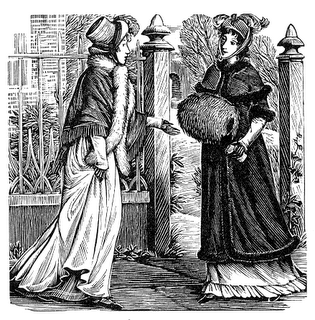
Morning Dress @1819, R. Ackermann [wikicommons]

SB:  I hope so.  But Ackermann’s Repository and other contemporary sources are a great help too, not to mention the modern books by the Cunningtons, e.g. Handbook of English Costume in the Nineteenth Century

JAIV:    As you mention above, these times had heavy realities that Austen kept in the background for the more astute reader to find – but they are there – your heroine is jailed for forgery and will likely hang or will be transported – so this part of your story tells this darker side, the underbelly of Regency life, especially for women.  What was prison like and what resources did you use to make this seem so real? 
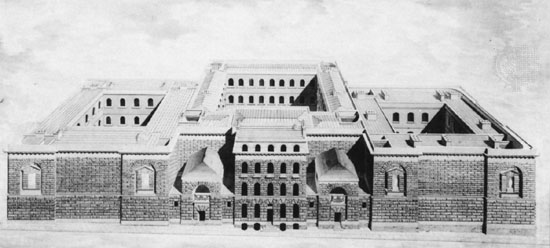
Newgate Prison - eb.com

SB:  I’ve read, and also bought and sold, so many accounts of English malefactors and their punishments in Regency and earlier times that I can’t really cite many of the sources that contributed to my sense of what a prison must have been like at that time.  Did I get it right?  Perhaps partly so, but I suspect the reality of most female penitentiaries was worse than I describe.  

Two essential sources for the Regency period are those to which Elizabeth Fry (who makes an appearance in The Perfect Visit) contributed: Notes on a Visit to some of the Prisons in Scotland and the North of England with Elizabeth Fry (this was published by Elizabeth Fry’s brother Joseph John Gurney) and Observations, on the Visiting, Superintendence and Government of Female Prisoners.


Elizabeth Fry, by Charles Robert Leslie - wp

 
Talking about Time-Travel:

 “Thus the whirligig of time brings in his revenges.” [Twelfth Night, Act V, Sc. 1] – [p. 113]

JAIV:  This is a time-travel book: and filled with “Rules of Time –Travel” – are these of your own creation for this story or from other sources? A few of the “rules” for example: 

  • -you cannot kill anyone
  • -cannot play modern music [in this case Vanessa playing Rachmaninoff if anyone is present]
  • -only organic clothing and material will pass through the time portal, so books, coins of the times, etc. will go, but no illuminated manuscripts
  • – the loss of the language of our 21st century life
  • -can only go the past, no travel into the future

SB:  As a child I watched, and was haunted by an episode of The Twilight Zone in which (as I recall from my single viewing close to fifty years ago) a criminal transports to the past, remains a criminal, and murders his own grandfather. 

Was it in the Wild West?  I’m not sure.  But what I remember is the image at episode’s end where the onscreen modern criminal dissolves saying something like “If I’ve just killed my grandfather, then how” [more dissolve] “can I” [almost gone] “exist?”  That was the origin of the first rule.  The others I developed as I sought consistency

JAIV:  Yikes! I remember that Twilight Zone episode! [also quite a faded memory!]. My other favorite was the 2-part Star Trek tale when Captain Kirk goes back in time and falls in love with Joan Collins – her character dies in “real life” and he must watch this and not step in to help so as not to completely alter the socio-political history of the future – I think I’ve seen that show 10 times! And it breaks my heart every time… 

So, I must assume you are a fan of time-travel literature? Your favorite? 

SB: As a kid I loved Robert A. Heinlein’s Door into Summer.  And Ray Bradbury wrote perhaps the greatest of all time-travel short stories, “A Sound of Thunder,” from which “the butterfly effect” has become a scientific term of art.  Alison Uttley’s Traveller in Time is a children’s book that transcends the genre (but then so do many of the best children’s books).  More recently I sobbed my way through The Time Traveler’s Wife (too bad about the movie though).

JAIV:  I haven’t watched the movie because I heard it was so dreadful – and yes, the book was sob-city-central! 

Shakespeare’s time reads like a gazetteer of London as Ned tours around looking for booksellers and all things Shakespeare, with detailed street names and historical sites and bookseller stalls – You must be familiar with London, so I must ask what is your favorite book on London? And London during the Elizabethan period?  The Regency period? And your favorite London haunt? [other than perhaps the British Library?!]
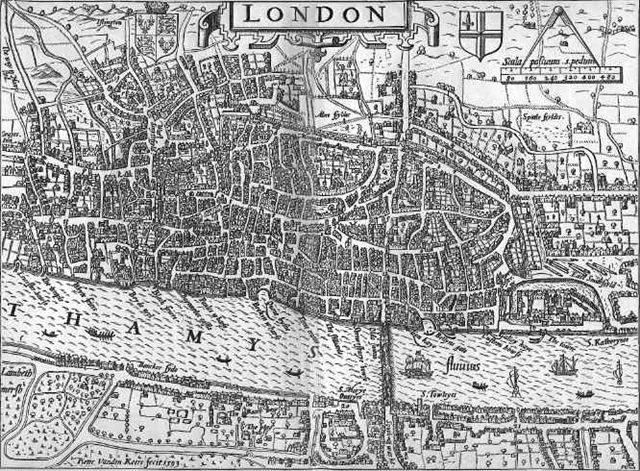
[Map of London 1593 – Internet Shakespeare Editions]

SB:  Oh dear, I didn’t want to sound like a gazetteer.  I lived more than ten years in London, and three in Bath, so much of what I wrote was from recollection.  Then I went back, retracing my characters’ steps with period maps and other clues to get the street names right, and to remove bridges and buildings that weren’t there at the times I was writing about.  I consulted all kinds of odd books, especially Regency ones, that I’d put aside during the course of my bookselling.  Pierce Egan’s Walks through Bath (1819) is a good example, and a useful one too.  For a modern book on London in Shakespeare’s time, the Oxford compendium Shakespeare’s England, first published in 1916, is still (I think) as good as it gets

JAIV:   On no! I meant that your book reading in parts like a gazetteer was a GOOD thing! I love the old London maps and had great fun following Ned around! 

The topic of carriages interests me very much, and the question of calculating distances and times is a difficult one: you say a coach traveling to London from Winchester in 1817 [50 miles] took 7 hours.  What sources did you use for those calculations?

SB:  Contemporary travel guides are not easy to come by, and sometimes even give conflicting information, but quite a few of the Regency and later guides to London have appendices of travel times.  I did the best I could with several of these.

JAIV:   I love the little bit about Fanny Dickens, Charles’s oldest sister, though you do say you muddled the dates a bit  – why Fanny and not other characters from the London or Bath of the time?

SB:  My brain accumulates trivia, and from somewhere or other I knew Fanny Dickens was a talented pianist.  That scene in Perfect Visit (I love it too – thank you) unexpectedly wrote itself one afternoon in the London Library where I was supposed to be doing other things.  I couldn’t let go of that scene, even when I found out I’d muddled the dates.  But with Fanny, Jane Austen, Elizabeth Fry, John Payne Collier, et al., already in the Regency parts of the novel, I felt that cluttering it up with even more celebrities would be too much of a good thing. 

JAIV:  Your Part III and IV are set in September 1833 [I will not ruin the plot and tell anyone the how and why!] – so without giving too much away, why this date? 

SB:  Touché!  September 1833 imposed itself on an early draft of the novel when I was trying to figure out a way to get Ned to the early 19th century.  My justification seemed compelling at the time, and then, quite suddenly, didn’t much matter at all.  But I’d gone to a lot of trouble getting the topography and costume of 1833 London as close to right as I could, so I kept Ned there.  I could invoke other reasons too, but I agree they would spoil the plot.

***************************** 

Thank you Stuart! – we will continue our conversation this weekend – Gentle Readers, please ask any question you might have for Stuart or leave a comment on either this post or the Part II post, and you will be entered into the random drawing for a copy of The Perfect Visit. Please do so by 11:59 pm, April 15, 2012.

Stuart Bennett was an auctioneer at Christie’s in London before starting his own rare book business. He is the author of the Christie’s Collectors Guide How to Buy Photographs (1987), Trade Binding in the British Isles (2004) which the London Times Literary Supplement called “a bold and welcome step forward” in the history of bookbinding, and many publications on early photography, auctions and auctioneers, and rare books. He currently lives and works near Boston, Massachusetts.

The Perfect Visit, by Stuart Bennett
Longbourn Press, 2011
ISBN: 9780615542706

For more information:

Copyright @2012 Jane Austen in Vermont
Collecting Jane Austen · Jane Austen · Jane Austen Popular Culture · Regency England · Social Life & Customs

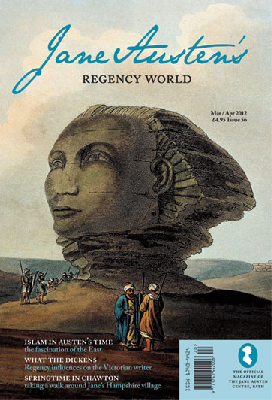
Hot off the Presses! ~ Jane Austen’s Regency World No. 56

Coming soon to your mailbox!

In the new issue (No. 56, March / April 2012): 

  • Archaeologists excavate the site of Steventon rectory
  • Romance of the East: how Regency travellers were fascinated by Islam and the Orient
  •  Best-selling novelist Karen Doornebos asks why grown men swoon over Mr Darcy
  •  How Charles Dickens, the bicentenary of whose birth is celebrated this year, was influenced by Jane Austen’s contemporaries
  •  Maggie Lane explores Frances Burney’s experiences at the Royal Court
  •  Jane Austen’s nieces in Ireland- the amazing true story of May, Lou and Cass
  • Finding the fools in Northanger Abbey *
  • Plus the latest Jane Austen news, readers’ letters, book reviews and news from Jane Austen societies around the world

[*John Thorpe anyone?]

Subscription information is available at www.janeaustenmagazine.co.uk

Jane Austen’s Regency World magazine is the only full-colour glossy magazine dedicated to Jane Austen and the Georgian and Regency times. It is published six times a year in Bath, England, and mailed worldwide by subscription. Copies are also sold via Jane Austen’s House Museum, Chawton; the Jane Austen Centre, Bath; and Jane Austen Books in the US.

[Text and image from JARW]

Copyright @2012 Jane Austen in Vermont
Great Britain - History · Jane Austen · Regency England

Jane Austen in Kent ~ Or, How a Set of Pimpernel Coasters Set Me on a Journey…

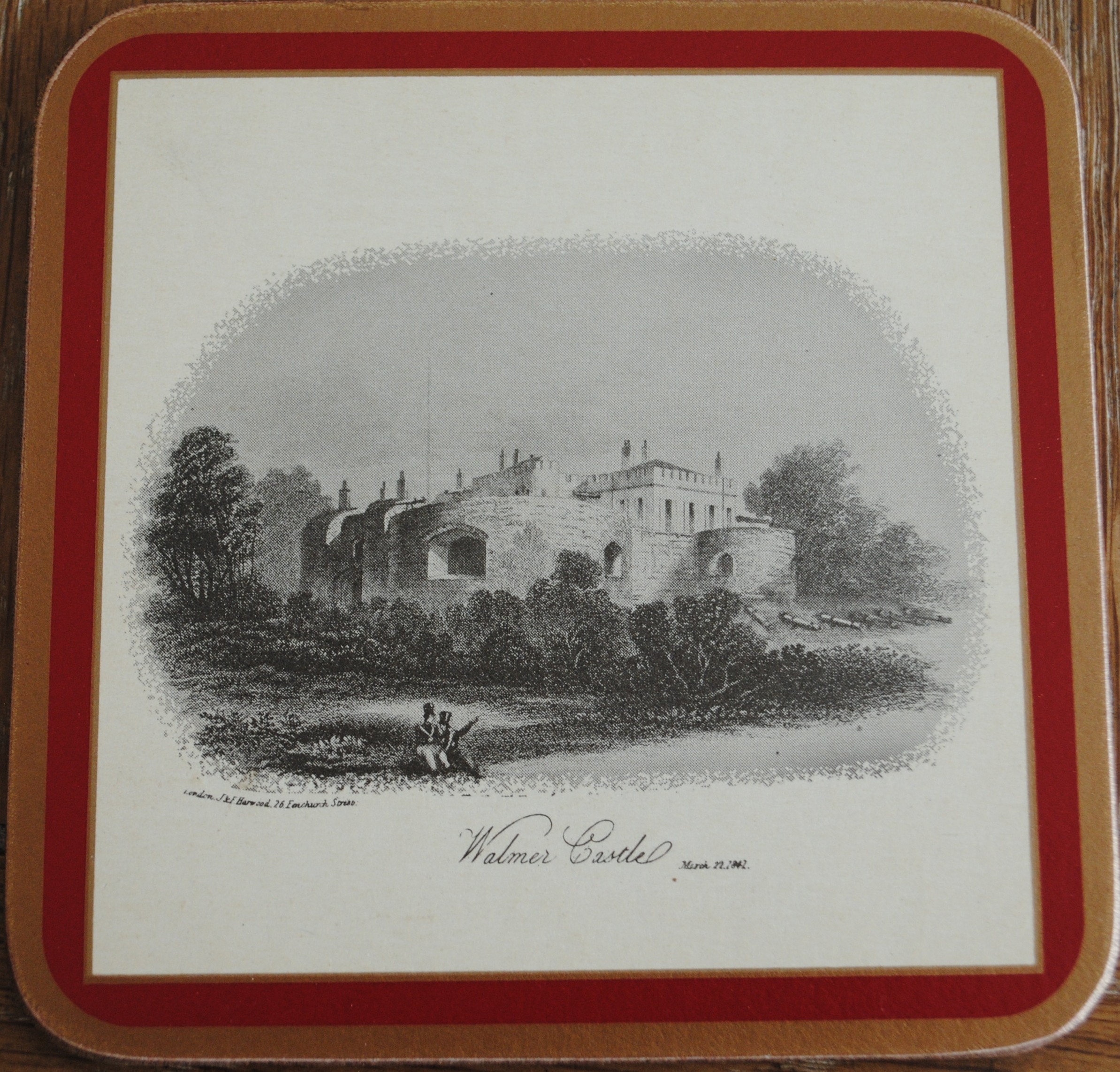
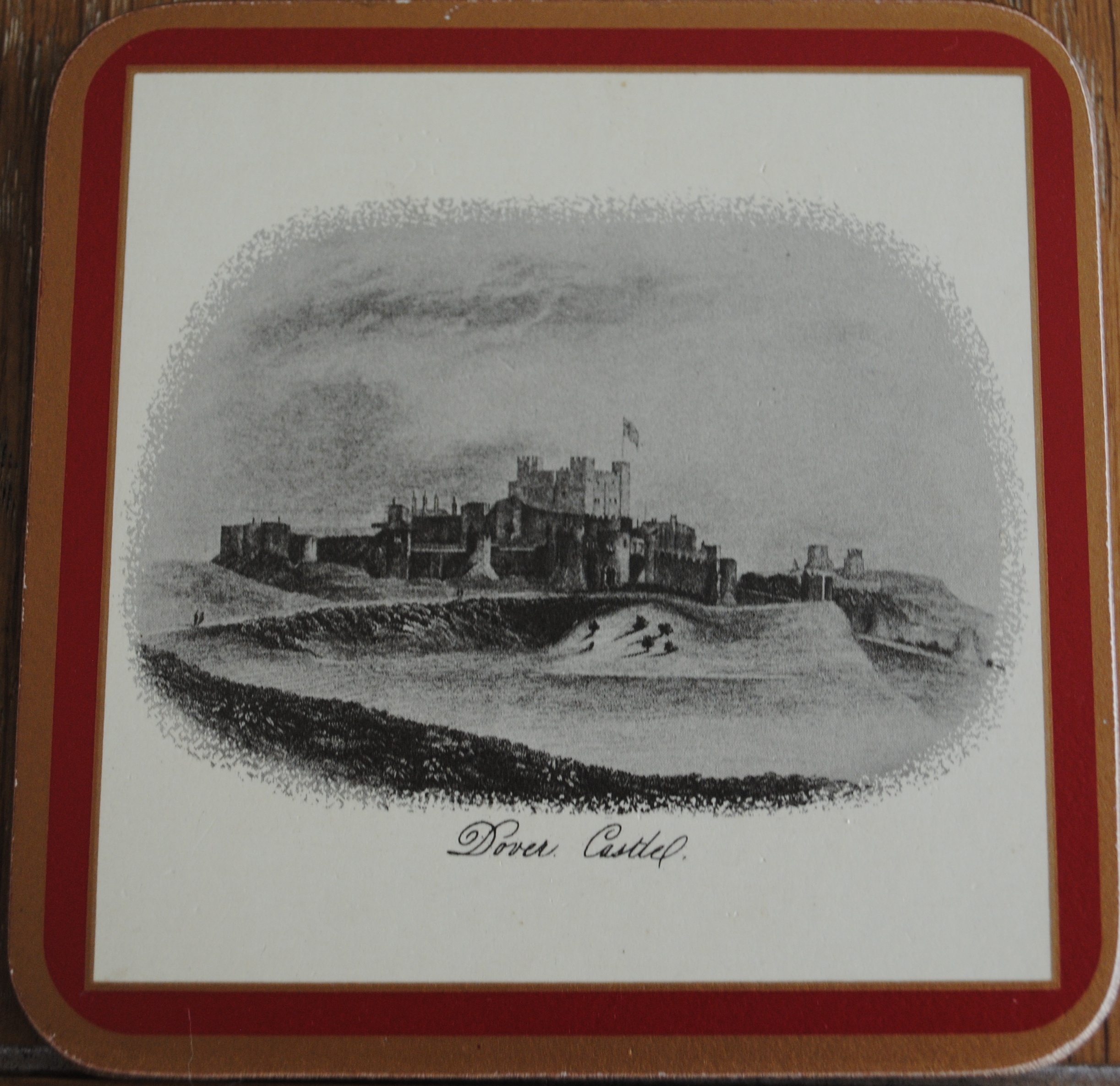
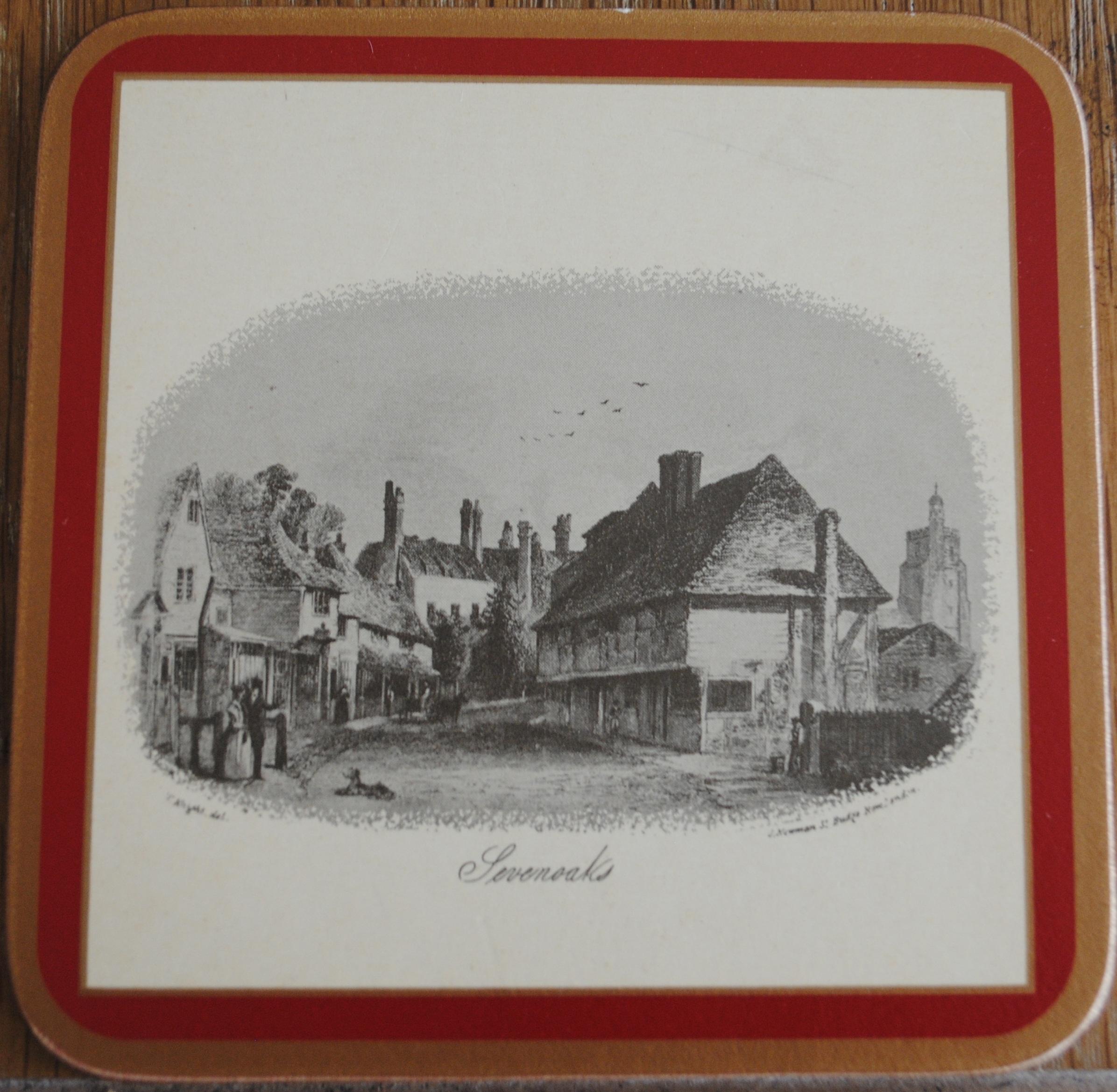
Browsing around an antique shop last week, I spotted a boxed set of six Pimpernel coasters, each coaster’s image an engraving of a British Heritage site in Kent, and all bordered by red and gold bands.

Pimpernel Coasters - British Heritage, Kent

Not sure how old these are – the box is plain white with an image on the front, but they were $3.00 in unused condition, and who could resist them? – all places that Jane Austen may have visited on her many trips to Kent [alas! my book Jane Austen in Kent by David Waldron Smithers is not in hand – I am lost!]

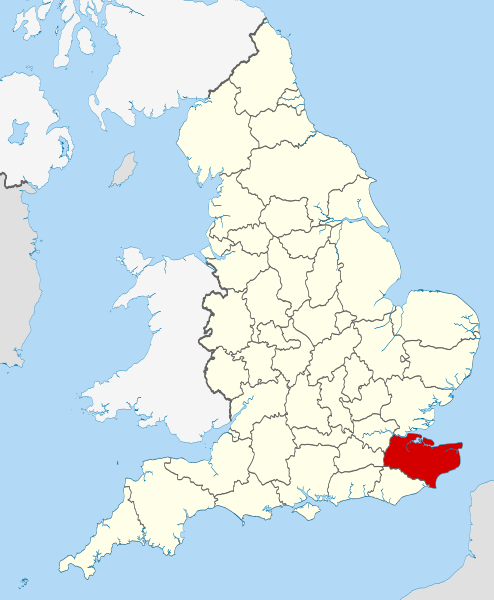
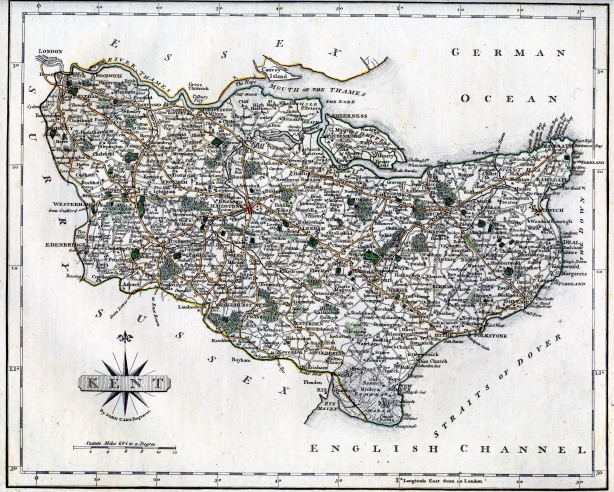
I have been to England many times, but have not seen the Jane Austen sites in Kent, so let’s take a short tour through these six coastered” sites, wondering if Austen visited any of them, beginning with, where IS Kent anyway?

Map of Kent’s location in England – wikipedia

and here a map of Kent, from Julie Wakefield’s Jane Austen Gazetteer
**********************

We do know that Jane Austen visited Kent many times, traveling through to her brother Edward Austen-Knight’s home at Godmersham Park, and staying in various coaching inns along the way:

 Godmersham Park – image from Frontispiece.co.uk

 and to Goodnestone Park, the home of the Bridges family and Jane Austen’s sister-in-law Elizabeth Bridges [when Austen’s brother Edward and Elizabeth first married, they lived in Rowling, a house on the Goodnestone estate.

Goodnestone Park (wikipedia)

Austen may have indeed visited each of these places on my now treasured coasters. We have only her letters to tell us for sure and I depend upon the homework already done by Deirdre Le Faye in her indexes to those letters [4th ed., Oxford, 2011], and by Julie Wakefield at the aforementioned sister site to Austenonly,  A Jane Austen Gazetteer, where Kentish sites are cross-referenced to the letters.
So here are the six places on the coasters – a perfect journey through Kent, with a little bit of history thrown in, and perhaps following in Jane Austen’s footsteps! 
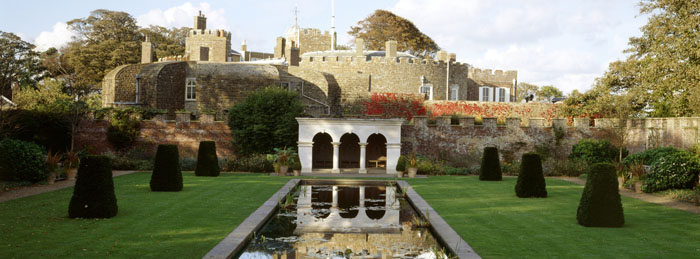
1. Walmer Castle, Kingsdown Road, Deal, Kent

Built during the reign of King Henry VIII, Walmer Castle is one of the most fascinating visitor attractions in the South East. Originally designed as part of a chain of coastal artillery defences it evolved into the official residence of the Lord Warden of the Cinque Ports. The Duke of Wellington held the post for 23 years and enjoyed his time spent at the castle and in recent years Her Majesty Queen Elizabeth the Queen Mother made regular visits to the castle.

The armchair in which Wellington died and an original pair of  ‘Wellington boots’ along with some of the rooms used by the Queen Mother are among the highlights. And with the magnificent gardens, a woodland walk and some excellent bird spotting there’s something for everyone to enjoy. There is also a pleasant cycle path along the beach front to nearby Deal Castle.

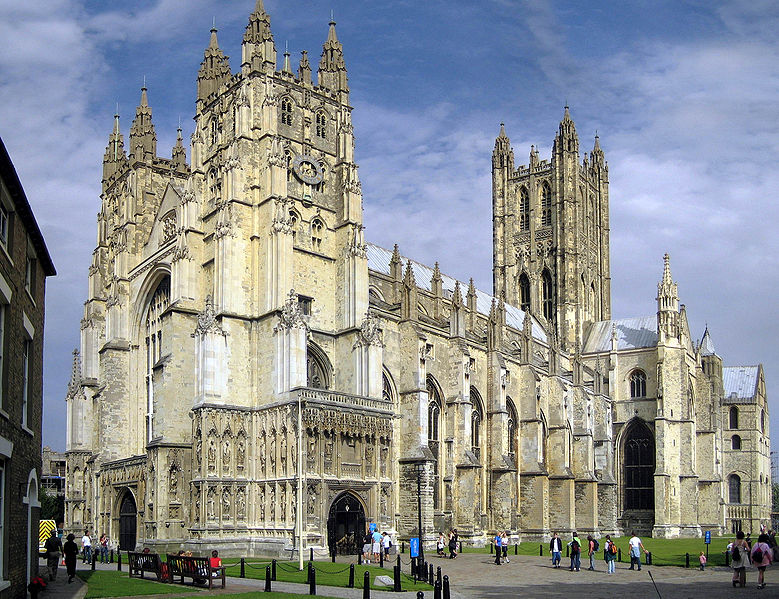
2. Canterbury Cathedral, Kent

St Augustine, the first Archbishop of Canterbury, arrived on the coast of Kent as a missionary to England in 597 AD. He came from Rome, sent by Pope Gregory the Great. It is said that Gregory had been struck by the beauty of Anglo slaves he saw for sale in the city market and dispatched Augustine and some monks to convert them to Christianity.

Augustine was given a church at Canterbury (St Martin’s, after St Martin of Tours, still standing today) by the local King, Ethelbert whose Queen, Bertha, a French Princess,, was already a Christian. This building had been a place of worship during the Roman occupation of Britain and is the oldest church in England still in use. (from the Cathedral website) 

Canterbury Cathedral - wikipedia

3.  Rochester Castle,  Ken 

“It wanted five minutes of twelve when we left Sittingbourne, from whence we had a famous pair of horses, which took us to Rochester in an hour and a quarter; the postboy seemed determined to show my mother that Kentish drivers were not always tedious, and really drove as fast as Cax.”

Austen’s letter No. 9 of 24 Oct. 1798. Letters p. 14.

Rochester Castle stands on the east bank of the River Medway in Rochester, Kent, England. The 12th-century keep or stone tower, which is the castle’s most prominent feature, is one of the best preserved in England or France. Located along the River Medway and Watling Street, Rochester was a strategically important royal castle. During the medieval period it helped protect England’s south-east coast from invasion. The first castle at Rochester was founded in the aftermath of the Norman Conquest. It was given to Bishop Odo by his half-brother, William the Conqueror. During the Rebellion of 1088 over the succession to the English throne, Odo supported Robert Curthose, the Conqueror’s eldest son, against William Rufus. It was during this conflict that the castle first saw military action; the city and castle were besieged after Odo made Rochester a headquarters for the rebellion. After the garrison capitulated, this first castle was abandoned. [wikipedia]

Rochester Castle – English Heritage

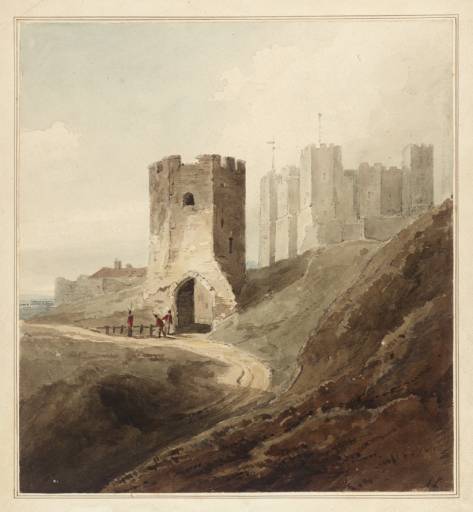
4. Dover Castle, Castle Hill, Dover, Kent

Commanding the shortest sea crossing between England and the continent, Dover Castle has a long and immensely eventful history. Many centuries before King Henry II began the great stone castle here in the 1160s, its spectacular site atop the famous ‘White Cliffs’ was an Iron Age hill fort, and it still houses a Roman lighthouse, one of the best-preserved in Europe. The Anglo-Saxon church beside it was once probably part of a Saxon fortified settlement: very soon after his victory at Hastings in 1066, this was converted by William the Conqueror into a Norman earthwork and timber-stockaded castle.

From then on Dover Castle was garrisoned uninterruptedly until 1958, a continuous nine-century span equalled only by the Tower of London and Windsor Castle. The stronghold hosted royal visits by Henry VIII, Elizabeth I and Charles I’s Queen Henrietta Maria: and from 1740 until 1945, its defences were successively updated in response to every European war involving Britain. [from English Heritage]

Dover Castle, by Amelia Long (Lady Farnborough) 1772-1837, No date, prior to 1837
Source: Tiny image at the Tate Gallery


5.  Sevenoaks, Kent.

Francis Austen, a great-uncle of Jane’s, was a solicitor in Sevenoaks.  Austen sends a letter to her cousin Philadelphia Walter in Seal, an area of Sevenoaks [Ltr. 8]. 

Sevenoaks is a commuter town situated on the London fringe of west Kent, England, some 20 miles (31.2 km) south-east of Charing Cross, on one of the principal commuter rail lines from the capital. The town gives its name to the Sevenoaks district, of which it is the principal town, followed by Swanley and Edenbridge.

The presence of Knole House, a large mansion, led to the earlier settlement becoming a village and in the 13th century a market was established. Sevenoaks became part of the modern communications network when one of the earlier turnpikes was opened in the 18th century; the railway was relatively late in reaching it. [wikipedia]

Knole House image:  Morris’s Seats of Noblemen and Gentlemen (1880) – wikipedia

High Street in Chiddingstone, a village in the Sevenoaks area, [and where James Stanier Clarke visits when he is writing to Jane Austen in Letters 125(A) and 132(A)], has been described as “the most perfect surviving example of a Tudor village in the county.”
Sevenoaks High Street: image from Grosvenor Prints

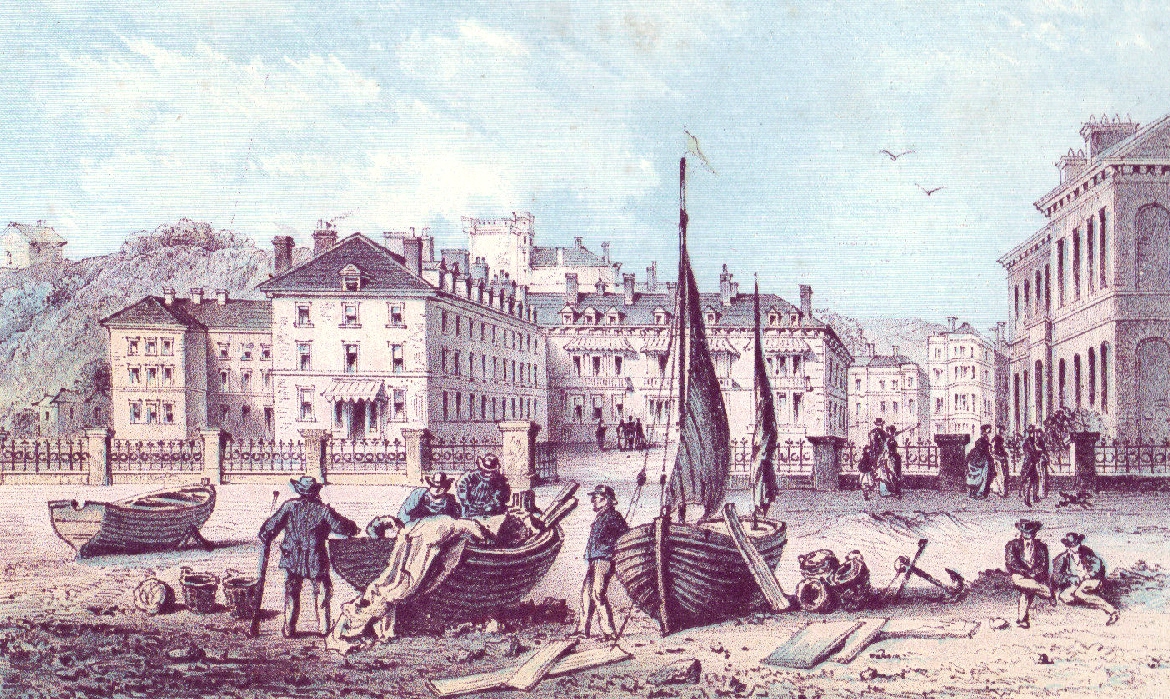
6.  Folkstone Harbour & Pavillion, Kent

A Norman knight held a Barony of Folkestone, by which time the settlement had become a fishing village. That led to its entry as a part of the Cinque Ports in the thirteenth century and with that the privilege of being a wealthy trading port. At the start of the Tudor period it had become a town in its own right. Wars with France meant that defences had to be built here and soon plans for a Folkestone Harbour began. Folkestone, like most settlements on the south coast, became involved in smuggling during the eighteenth century. At the beginning of the 1800s a harbour was developed, but it was the coming of the railways in 1843 that would have the bigger impact.

 Until the 19th century Folkestone remained a small fishing community with a seafront that was continually battered by storms and encroaching shingle that made it hard to land boats. In 1807 an Act of Parliament was passed to build a pier and harbour which was built by Thomas Telford in 1809. By 1820 a harbour area of 14 acres (5.7 hectares) had been enclosed. Folkstone’s trade and population grew slightly but development was still hampered by sand and silt from the Pent Stream. The Folkestone Harbour Company invested heavily in removing the silt but with little success. In 1842 the company became bankrupt and the Government put the derelict harbour up for sale. It was bought by the South Eastern Railway Company (SER), which was then building the London to Dover railway line. George Turnbull was responsible in 1844 for building the Horn pier. Dredging the harbour, and the construction of a rail route down to it, began almost immediately, and the town soon became the SER’s principal packet station for the Continental traffic to Boulogne.

Image and text from Folkestone History.org

****************************

So thank you for joining me on my journey through Kent – I should like to write more on this, once I have my proper research tools in hand – especially about the coaching inns that Austen stayed in her travels – so stay tuned please! And if any of you have any Kentish tales to share, especially those involving Jane Austen, please do!
And with hearty thanks to Julie at Austenonly for her references and map and to Deirdre Le Faye for her invaluable indexes!

Copyright @2012 Jane Austen in Vermont
Collecting Jane Austen · Jane Austen · Jane Austen Popular Culture · Regency England · Social Life & Customs

Day 4: All I want for Christmas ~ Anything Jane Austen!

Day 4: Thursday 22 December 2011

For Your Enjoyment

A plug for the Jane Austen’s Regency World Magazine – if you don’t already subscribe, time to treat yourself by asking for it for Christmas; or a perfect gift for your best Jane Austen fan friend…

The next issue, Jan/Feb 2012, Issue 55 will be on sale January 1, 2012!


Contents:

  • An interview with P. D. James [on the cover] ~ on her love of Austen and her new book Death Comes to Pemberley
  • Regency Childbirth ~ Pregnancy horrors in Georgian times
  • Let it Snow, Let it Snow ~ exploring the winter weather in Jane’s novels
  • Letter to Cassandra ~ the joy of seeing Austen’s handwriting
  • Austen’s Contemporaries ~ the ‘other’ Jane ~ Jane Porter, and her sister Anna Maria

And of course all the regular columns from JAS, JASNA, the topical news from contemporary papers, the quiz, and so much more – even the advertisements are interesting!

You can visit the magazine’s website here.

You can subscribe online here: 
http://www.janeaustenmagazine.co.uk/subscriptions.html

  • from outside the UK: £29.70 plus £9.00 postage [@ $60.74 total]
  • from inside the UK: £29.70 plus £3.30 postage

…and worth every penny!

Copyright @2011 Jane Austen in Vermont
Books · Domestic Arts · Jane Austen · Regency England · Social Life & Customs

All I Want for Christmas ~ Anything Jane Austen! ~ Day II: For Your Bookshelf

All I Want for Christmas, Day II

For Your Bookshelf

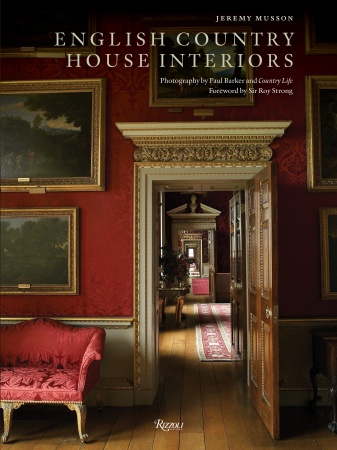
English Country House Interiors, by Jeremy Musson.  Foreword by Sir Roy Strong; Photography by Paul Barker. New York: Rizzoli, 2011.

ISBN: 978-0-8478-3569-0
$60. [though Amazon has it for $38., much as I hate to say that…]

This book I should very much like to add to my collection on English architecture and stately homes [loud hint to my family…] – I discovered this at the UVM Library and have brought it home to peruse – extensive commentary and lovely photographs of the interior details of the fourteen houses included – here is the blurb from the publisher, Rizzoli

A highly detailed look at the English country house interior, offering unprecedented access toEngland’s finest rooms. In this splendid book, renowned historian Jeremy Musson explores the interiors and decoration of the great country houses ofEngland, offering a brilliantly detailed presentation of the epitome of style in each period of the country house, including the great Jacobean manor house, the Georgian mansion, and the Gothic Revival castle. For the first time, houses known worldwide for their exquisite architecture and decoration–includingWilton, Chatsworth, and Castle Howard–are seen in unprecedented detail. With intimate views of fabric, gilding, carving, and furnishings, the book will be a source of inspiration to interior designers, architects, and home owners, and a must-have for anglophiles and historic house enthusiasts. 

The fourteen houses included represent the key periods in the history of English country house decoration and cover the major interior fashions and styles. Stunning new color photographs by Paul Barker-who was given unparalleled access to the houses-offer readers new insights into the enduring English country house style. Supplementing these are unique black-and-white images from the archive of the esteemed Country Life magazine. 

Among the aspects of these that the book covers are: paneling, textile hangings (silks to cut velvet), mural painting, plasterwork, stone carving, gilding, curtains, pelmets, heraldic decoration, classical imagery, early upholstered furniture, furniture designed by Thomas Chippendale, carved chimney-pieces, lass, use of sculpture, tapestry, carpets, picture hanging, collecting of art and antiques, impact of Grand Tour taste, silver, use of marble, different woods, the importance of mirror glass, boulle work, English Baroque style, Palladian style, neo-Classical style, rooms designed by Robert Adam, Regency, Gothic Revival taste, Baronial style, French 18th century style, and room types such as staircases, libraries, dining rooms, parlors, bedrooms, picture galleries, entrance halls and sculpture galleries. 

The range is from the early 17th century to present day, drawn from the authenticated interiors of fourteen great country houses, almost all still in private hands and occupied as private residences still today. The book shows work by twentieth-century designers who have helped evolve the country house look, including Nancy Lancaster, David Hicks, Colefax & Fowler, and David Mlinaric.

The Table of Contents:  I’ve added some exterior shots and links for several of the houses – you will have to buy the book for the sumptuous interior adventure! 

1.   Hatfield House: The Courtly Jacobean Interior 

2.   Wilton House: The Courtly Caroline Interior 

Wilton House

3.   Broughton House: The Taste for France 

4.   Chatsworth: The English Baroque Interior 

5.   Castle Howard: The Imagination of Vanbrugh 

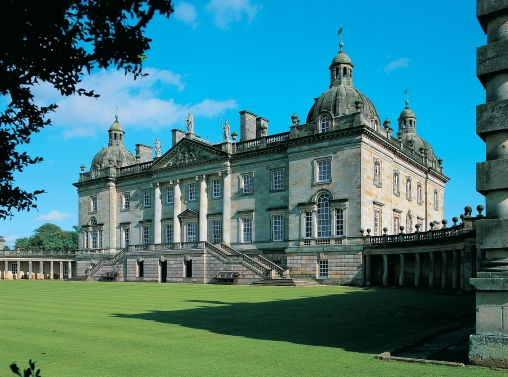
6.    Houghton Hall: The Palladian Interior I 

Houghton Hall

 7.    Holkham Hall: The Palladian Interior II 

8.    Harewood House: The Genius of Robert Adam I

Harewood House

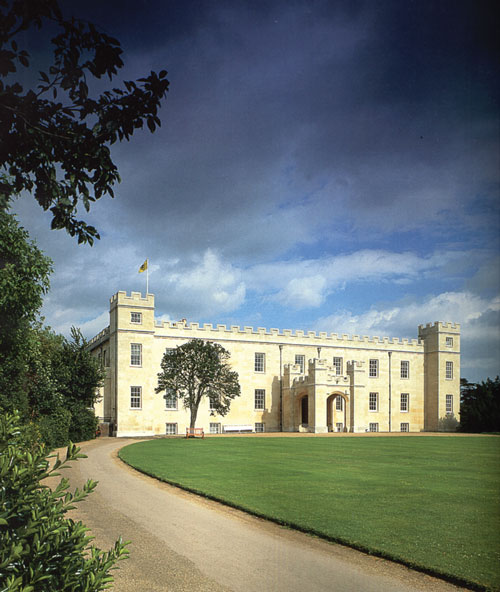
9.    Syon House: The Genius of Robert Adam II

Syon House

 10.  Goodwood House: The Regency Revolution in Taste 

11.  Regency Reinvention: Some Houses Revisited 

12.  Arundel Castle: The Gothic Revival Interior 

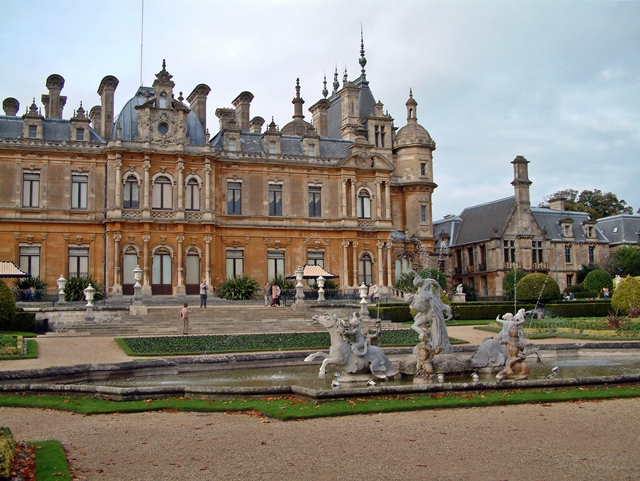
13.  Waddesdon Manor: The Inspiration of the Chateau 

Waddesdon Manor

14.   Berkeley Castle: The Castle of Taste 

15.  Parham House: The Cult of the Manor House

Parham House

 16.  Living Interiors: The English Country House Interior Today

***********************

 Not included is the house used in Downton Abbey, seen here, and certainly on everyone’s mind as we approach Season 2!:

Highclere Castle

 And if you want another book to add to your collection that belongs on your shelf next to the above, you should add this to your list – hopefully Santa is listening, watching, and making his own list, and you have not been naughty but have only been nice the whole year long …

 The English Country House: From the Archives of Country Life

Written by Mary Miers, Contribution by Jeremy Musson, Tim Richardson, Tim Knox and Marcus Binney. New York: Rizzoli, 2009.
ISBN: 978-0-8478-3057-2 , $85.  

And here is one interior bit to whet your appetite all the more:

[Syon House – detail of the ceiling of the Red Drawing Room, p. 148]

What are your favorite English architecture / interior decoration books – ones you have or ones you want?

Copyright @2011 Jane Austen in Vermont 
Books · Jane Austen · JASNA · Literature · London · Museum Exhibitions · Regency England · Social Life & Customs

The Penny Post Weekly Review ~ All Things Jane Austen!

The Penny Post Weekly Review

December 12, 2011

News /Gossip

Author Lev Raphael on “Thank you Jane Austen”

A website I just stumbled upon [yet not new!] Why Jane Austen.com : A Truth Universally Acknowledged.

JASNA ~  National & Regional News

A new blog:  a gentleman [we shall call him Janeite Kirk] who belongs to not just one but TWO Boston Jane Austen Reading Groups came to our JASNA-Vermont tea this past week and he told me their blog with some fine pictures and many links to “All Things Jane Austen”:
Austen in Boston: A Jane Austen Reading Group
They also have a facebook page here: https://www.facebook.com/pages/Austen-In-Boston-A-Jane-Austen-Book-Club/213374625342080?sk=wall

JASNA Eastern PA is having a Jane Austen Day celebration on April 28, 2012.  You can read all about it on their website, where you will find a link to their youtube videos: http://www.jasnaeastpa.org/jaday.html – they also have a facebook page: www.facebook.com/jasnaeaspa, and a youtube channel: http://www.youtube.com/jasnaeastpa

Vermont News 

[Image from: Cactus Creek Daily]

Hooked in the Mountains – Stuck in Vermont, and you can visit the website of the Green Mountain Rug Hooking Guild here: http://www.gmrhg.org/ 

The Shelburne Museum has posted information on the use of LED lights to illuminate your collections: http://shelburnemuseum.blogspot.com/2011/11/looking-into-light.html

The Circulating Library 

The British Library has made available its British Newspaper Archive
Just type in “Jane Austen” and you will be kept busy for hours!

And read this review of the archive at The Digital Victorianist: http://www.digitalvictorianist.com/2011/12/the-british-newspaper-archive-2/ 

And for other newspaper archives, see this link at the Library of Congress to their Newspaper Resource List and also Newspaper Archives on the Web  

  • Books I am Looking Forward to… 

From the National Portrait Gallery:
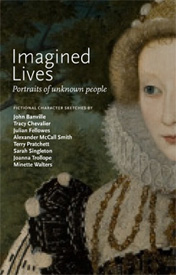
Imagined Lives: Portraits of Unknown People

Eight internationally acclaimed authors have invented imaginary biographies and character sketches based on fourteen unidentified portraits. Who are these men and women, why were they painted, and why do they now find themselves in the Collection of the National Portrait Gallery? With fictional letters, diaries, mini-biographies and memoirs, Imagined Lives creates vivid stories about these unknown sitters from the sixteenth and seventeenth centuries.

For your iphone, ipad and such: Ebook Treasures: We already know that Austen’s History of England is available from the British Library, but look at this, a 14th Century Cookbook:

“The Forme of Cury is the oldest surviving cookbook in the world, dating from the late 14th century. Originally made by the cooks of the court of Richard II, very few copies survive, and this one, from the John Rylands Library in Manchester, is probably the best and earliest. Written in Middle English, the script can be hard to interpret, and some of the recipes unfamiliar. The book gives an incredible insight into medieval kitchens, as well as medieval life itself.  The book contains one hundred and ninety-four recipes which reveal the amazing variety and elaboration of the dishes available to the elite, including stews, roast dishes, jellies, tarts and custards. Among the recipes are ‘Chyckens in gravey’, ‘Blank manger’ (a white savory stew, from which the word ‘blancmange’ derives),‘Furmente with porpays’ (porpoise in wheat porridge), and ‘Crypses’ (fried pastries). 

The manuscript is still in a very worn, and possibly original, binding and it may well have been used as a practical cookery book in an aristocratic or royal kitchen. However, unlike modern recipe books, the Forme of Cury doesn’t give exact quantities or cooking times, so a lot is left to the skill and imagination of the cook. 

This iBook contains the complete manuscript along with transcriptions from the Middle English. iTunes £3.99 ” [from the website]___________________________________

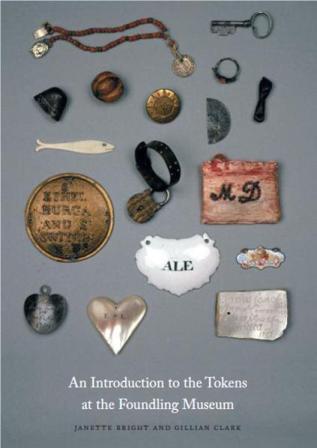
 An Introduction to the Tokens at the Foundling Museum, by Janette Bright & Gillian Clark. Price:   £5.00

[with thanks to the Two Nerdy History Girls for the heads-up]

Michael Dirda of the Washington Post reviews Death Comes to Pemberley – this is on the top of my TBR pile… 

For those non-vegetarians out there with an interest in the Meat of London, here is a tasty read [and perhaps an unsettling one?]: 

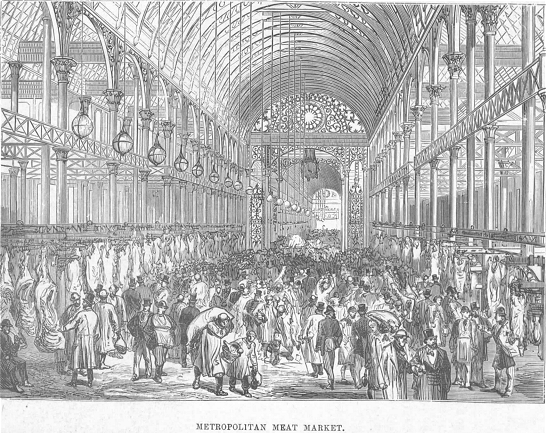
Meat, Commerce and the City: The London Food Market, 1800–1855 by Robyn Metcalfe –  all you ever wanted to know about the Smithfield Meat Market, due out in March 2012 from Pickering & Chatto.
[image from Victorian London.org]

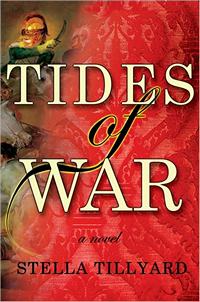
Tides of War, by Stella Tillyard  

An epic novel about love and war, set in Regency England and Spain during the Peninsular War (1812-15), by the acclaimed historian and bestselling author of “Aristocrats.” Tides of War opens in England with the recently married, charmingly unconventional Harriet preparing to say goodbye to her husband, James, as he leaves to join the Duke of Wellington’s troops in Spain….

And read a review at http://www.independent.co.uk/arts-entertainment/books/reviews/tides-of-war-by-stella-tillyard-2292233.html

A book about the plague, Ralph Tailor’s Summer by Keith Wrightson – visit the publisher Yale Books where you can read a fascinating extract from the preface.

And it is always a good habit to check out the newest titles at GirlebooksThe Female Quixote, by Charlotte Lennox.

Robert Adam - Wikipedia

If architecture is your passion, here is a new work, also published by Pickering & Chatto:  Robert and James Adam, Architects of the Age of Enlightenment, by Ariyuki Kondo, available now… 

  • Articles of Interest 

Lynda A. Hall. “A View from Confinement: Persuasion’s Resourceful Mrs. Smith.” Nineteenth-Century Gender Studies 7.3 (Winter 2011).

And John Mullan with another of  his “Ten Best” at The Guardian– Austen makes the list yet again! 
http://www.guardian.co.uk/books/2011/dec/09/ten-best-governesses-john-mullan

 
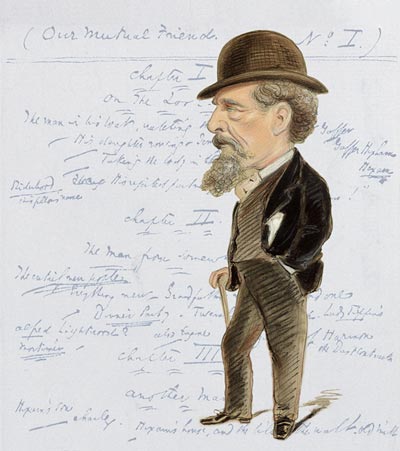
Charles Dickens ~ his 200th birthday!

Charles Dickens

Charles Dickens is getting a good number of  exhibitions all over in celebration of his 200th birthday: you can check the various happenings at the Dickens 2012 website.  

Here are a few of the current offerings: 

*Dickens Christmas Tour at National Gallery: http://www.npg.org.uk/whatson/event-root/december-2011/a-dickens-christmas-tour.php

*Dickens at the British Library: A Hankering after Ghosts: Charles Dickens and the Supernatural, British Library,London, until March 4 2012

Info at: http://www.bl.uk/whatson/exhibitions/cdickens/index.html

And here: http://www.culture24.org.uk/history%20&%20heritage/literature%20&%20music/art370174

Dickens and London at the Museum of London:

Bleak House 1st ed. - Museum of London

http://www.visitlondon.com/events/detail/21973327-dickens-and-london-at-the-museum-of-london

*There is also the Dickens Exhibition at The Morgan Library.  Here is the online component you can visit without leaving home: you can view 20 pages of A Christmas Carol and read a letter penned by Dickens…

Dickens - Morgan Library

*Penelope Wilton reading Claire Tomalin’s Dickens biography at the BBC:  http://www.bbc.co.uk/programmes/b017v88v
[with thanks to Tony G.!]

 Museum Musings ~ Exhibition Trekking 

Yale Exhibition - Adapting the Eye

Yale Centre for British Art: Adapting the Eye: An Archive of the British in India, 1770–1830 [October 11, 2011–December 31, 2011] 

 Organized to complement the Center’s major exhibition on Johan Zoffany, who spent six productive years in India, Adapting the Eye explores the complex and multifaceted networks of British and Indian professional and amateur artists, patrons, and scholars in British India in the later eighteenth and early nineteenth centuries, and their drive to create and organize knowledge for both aesthetic and political purposes. Selected from the Center’s rich holdings, the exhibition includes a diverse range of objects from both high art and popular culture, including albums, scrapbooks, prints, paintings, miniatures, and sculpture, demonstrating how collecting practices and artistic patronage in India during that period constituted a complex intersection of culture and power.

Auction News 

At auction this coming week:  Bonham’s Fine Books and manuscripts, December 15, 2011:

 Lot No: 5159  WALKER, MRS. ALEXANDER. Female Beauty, as Preserved and Improved by Regimen, Cleanliness and Dress. London: Thomas Hurst, 1837.

8vo (183 x 107mm). With 11 lithographed illustrations, 10 hand-colored, each with hand-colored overlay, showing how physical characteristics (thick waist, broad jaws, short limbs, etc.) can be camouflaged in order to enhance one’s appearance. Later morocco by Sangorski & Sutcliffe, spine gilt, a.e.g. Custom slipcase. Some staining to spine, minor foxing throughout, offset from plates.  Estimate: US$500 – 700. 

And more of Mr. Dickens! Lot No: 5177: DICKENS, CHARLES. 1812-1870.

A Christmas Carol. In Prose. Being a Ghost Story of Christmas. London: Chapman & Hall, 1843.

8vo. [viii], 166, [2] ad pp. Hand-colored engraved frontispiece and 3 hand-colored plates. Original cloth blindstamped and gilt, a.e.g. Custom morocco pull-off case by Scroll Club Bindery. Pp 64-70 lightly foxed, binding slightly cocked and faded.

Provenance: Jerome Kern (morocco book label); Frank Brewer Bemis [1861-1935],Bostoncollector, whose collection was dispersed by Rosenbach and Goodspeed (bookplate). 

FIRST EDITION, THE KERN-BEMIS COPY. Second issue of the text, with “Stave One” on page [1], title page in red and blue dated 1843, and yellow endpapers, but first state of the binding (the closest interval between blindstamped border and gilt holly wreath being 14-15 mm not 12 mm, and the upper left serif of D intact). Todd calls this binding point a “desideratum … encompassing all the others,” and of greater importance in priority than the textual points (The Book Collector, 1961, pp 449-454). Eckel, p 116; Sadleir 684.  Estimate: US$4,000 – 6,000.

 Lot No: 5284 : GEORGE III. 1738-1820.

Document Signed (“George R.”), 1 p (with conjoined docketed blank), folio, St. James’s, May 25, 1781, being a pay warrant for General Henry Seymour Conway for the Royal Horse Guards for the year 1779, additionally signed by CHARLES JENKINSON, Earl of Liverpool, toned, tape stains at upper and lower right corners, small chips at edges, matted and framed.

Provenance: with Thomas F. Madigan,New Yorkautograph dealer (signed letter of authenticity, October 26, 1935). Estimate: US$800 – 1,200.

 Prices Realized at Auction: 

Mr. Dickens yet again!: A complete set in fine bindings of the first editions of Charles Dickens’s Christmas Books. Five volumes, uniformly bound, London, 1843-1848. Includes A Christmas Carol. Sold for $6,480. [Swann]

***********************

Dance Card for the Union Ball in Honor of the Inauguration of Abraham Lincoln, $3,840 at Swann Galleries of New York on December 1.

A dance card issued to the guests atLincoln’s inaugural ball in 1861. Courtesy of Swann Galleries.These cards, with die-cut decorative border and a ribbon through one corner, were issued to guests at the inauguration ball inWashington,D.C.on March 4, 1861. On the second of the four pages are listed the twenty-three planned dances that will take place to the music provided by L. F. Weber’s band, while on the third is space to write in one’s partner for each dance. On the rear panel are printed the names of Lincoln and his vice president, Hannibal Hamlin, around an illustration of a bald eagle, captioned “The Constitution.”  [Invitations to the ball appear from time to time and sell for upwards of $8,000, but Swann could find no previous record of a dance card at auction.]

From the ever-interesting Booktryst website:

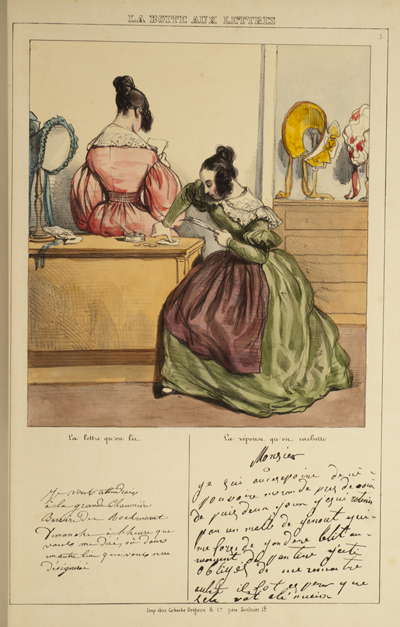
$7,500. for two albums by Paul Garvani: La Boite aux Lettres [the mailbox] [c1839] at Booktryst: 


Had to share this lovely illustration!

********************* 

If you have not been following Austenonly’s posts on antique clothing at auction, take a look here: http://austenonly.com/2011/11/24/auctions-of-georgian-and-antique-clothing-kerry-taylor-auctions/ 

London sitings:

*Tony Grant at his London Calling blog on “Tea, just like Jane – Twinings”

*A tour of Dr. Johnson’s Londonhttp://yalebooks.wordpress.com/2011/11/28/what-dr-johnson-knew-julie-flavell-takes-us-on-a-tour-of-georgian-londons-fleet-street/

Reason enough to go to London in May [like one needs a reason…]:  
The Chelsea Flower Show

 Regency Life and Customs 

  • History 

*While searching in the eBritish Library Journal, I came upon this article on “‘Most Secret and Confidential’: The Pressed Copy Nelson Letters at the British Library” by Colin White  – with images [notice Nelson’s writing desk]:
http://www.bl.uk/eblj/2007articles/pdf/ebljarticle12007.pdf

also this article on political poetry of the late Georgian period – all poems about William Pitt: http://www.bl.uk/eblj/2004articles/pdf/article5.pdf 

and this on Peter Pindar: ttp://www.bl.uk/eblj/2002articles/pdf/article4.pdf

*A blog by the author Sarah J. Waldock: Renaissance and Regency Rummage Repository, where you can find a number of posts about Nelson and the Royal Navy, and other historical goodies…. You can follow her on Twitter as well here: http://twitter.com/#!/SarahJWaldock

  • Cookery:  [via Austenonly, so thank you Julie for these delicious links!] 

Food History Jottings: http://foodhistorjottings.blogspot.com/  the new blog of Ivan Day – and his website on the history of food: http://www.historicfood.com/ 

  • Fashion  [with more thanks to Julie at Austenonly!] 

*Australian Dress register http://www.australiandressregister.org/ 

*New fashion blog: http://serenadyer.blogspot.com/


Shopping
 

If you are into hair collecting [a little late for our Regency tastes, but what good Victorianist is not into hair…], here is a short essay on the topic at Paul Fraser Collectibles.

And then you might like to add this to your collection: Lord Nelson’s hair for £49.95, or Napoleon, and the Duke of Wellingon, all the same price – also Dickens and Steinbeck and Paul McCartney, etc – but alas! – no Jane Austen!  

 – you can view them all here: http://www.paulfrasercollectibles.com/famous-hair/ 
Did I mention that the hair is only 1/16th of an inch?


For Fun
 

This from How to be a Retronaut, always a fun place to visit : Harry Hill’s Take on Tate  

Harry Hill's Take on Tate

You can purchase the book of postcards here: http://www.tate.org.uk/shop/do/Postcards/Harry-Hill-Postcard-Book/product/46302

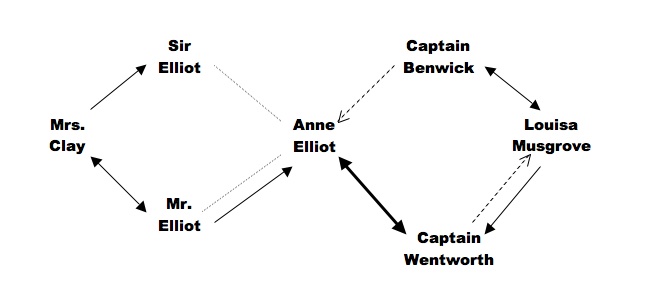
And this is way too much fun to look at – The Love Diagrams of Jane Austen at Diana Peterfreund’s website: [visit her site for diagrams of the other novels]

 And finally, this is all over the airwaves, and we will have to wait until December 16th for it all to be unveiled, but visit the website of The Austen Games.com to whet your appetite and ponder.…  

**And, see you all on the 16th for the
Jane Austen Birthday Soiree!**

 Copyright @2011 Jane Austen in Vermont
Books · Fashion & Costume · Jane Austen · Jane Austen Popular Culture · JASNA · Literature · London · Museum Exhibitions · Regency England

The Penny Post Weekly Review ~ All Things Jane Austen!

The Penny Post Weekly Review

 November 20, 2011

 News & Gossip 

*Lindsay Ashford on her new book The Mysterious Death of Miss Austen – and how Austen perhaps died from arsenic poisoning, whether intentional or not – has created quite the kerfuffle on the airwaves. Miss Ashford has written a fictional account of what might have happened [and it certainly reveals a good number of Austen family secrets! – all fiction of course…or is it?]

The Daily Mail: http://www.dailymail.co.uk/femail/article-2060743/Im-convinced-Jane-Austen-poisoned-arsenic-A-startling-revelation-Britains-leading-novelists.html

and The Guardian: http://www.guardian.co.uk/books/2011/nov/14/jane-austen-arsenic-poisoning

 [I had the pleasure of meeting Ms. Ashford at the Fort Worth AGM – I’ve also read the book! – more on this in a future post I hope… has anyone else read it? – it deserves some conversation!]

*Those who have been following Downton Abbey [and who in their right costume-drama mind is not] will be pleased to know that the series has been granted a third season! – meanwhile we on this side of the pond “patiently” wait until January for Series 2, now finished in the UK – watch your PBS station for details on the re-running of Season 1 prior to the new shows – [do I dare admit that at our WWW (Wild Women Weekend) we watched the entire first season straight through [well, parts 5 and 6 on the Sunday morning – is there anything better than sharing this show with your very own group of fabulous wild women?!] 

Anyway, here is an interview with Dan Stevens – the hero of the piece, soon to be a soldier in WWI who returns home injured – however will Mary fit into this lifestyle change?? http://www.huffingtonpost.co.uk/2011/11/04/downton-abbey-dan-stevens-interview_n_1075617.html?just_reloaded=1

 
JASNA and JASNA-Vermont News

The JASNA website has added its annual link to Austen-related gifts from various JASNA Regions here: http://jasna.org/merchandise/index.html – a great place to start your holiday shopping, even for those not so Austen-crazed – what a better time than this to convert a few friends…

The JASNA-Vermont Annual Birthday Tea is next Sunday December 4, 2011 – please send in your reservation form if you are planning on attending! – https://janeausteninvermont.wordpress.com/2011/11/06/jasna-vermont-event-annual-jane-austen-birthday-tea/

This at the JASNA South Carolina Region:  I went – wonderful time – will report the full details this week…http://www.charlestoncitypaper.com/charleston/vince-lannie/Event?oid=3642559
 

The Circulating Library 

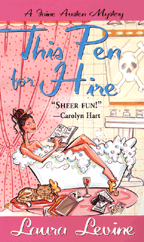
*Has anyone read any of these books? Are they any good? – the Jaine Austen mysteries by Laura Levine: http://www.lauralevinemysteries.com/index.html

Humor is the key ingredient in this slick debut by television comedy writer Levine. Freelancer Jaine Austen (her mother loved the classics but couldn’t spell) makes a living writing love letters, personal ads and industrial brochures, but she never expected her work to involve her in murder.

Titles in the series: 

  • Pampered to Death 
  • Death of a Trophy Wife
  • Killer Cruise 
  • Killing Bridezilla 
  • Death by Pantyhose 
  • The PMS Murder 
  • Shoes to Die For 
  • Killer Blonde 
  • Last Writes 
  • This Pen for Hire

*For the Sense and Sensibility bicentenary – an article in Fine Books & Collections:
http://www.finebooksmagazine.com/fine_books_blog/2011/10/by-a-lady.phtml

FB&C asks: Have any FB&C readers attempted to collect all known editions and translations of Austen’s debut title?  Does anyone know of any individual or institution that may have made such an attempt…?

* a great resource: “Fiction in the Hampshire Chronicle 1772-1820” on the Chawton House Library website:
http://www.chawton.org/library/chronicle.html

 
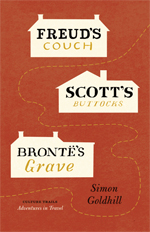
* A new book with a great title:  Freud’s Couch, Scott’s Buttocks, Bronte’s Grave by Simon Goldhill.  There are chapters on traveling to the homes and haunts of Shakespeare, Bronte, Wordsworth, Scott, and Freud, but alas! no Austen – what was Mr. Goldhill thinking?!: http://press.uchicago.edu/ucp/books/book/chicago/F/bo10997683.html

And the press release:  http://press.uchicago.edu/news/2011/November/1111goldhillprs.html 
[with thanks to Joe T.!] 

*Do you like Sherlock Holmes? – there is some good stuff at Victoria Magazine

http://www.victorianamagazine.com/archives/12989 and http://www.victorianamagazine.com/archives/12964 

And while we are on Mr. Holmes, visit the website for the Sherlock Holmes Society of London:
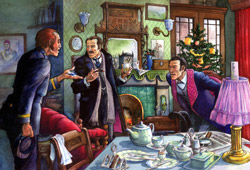
http://www.sherlock-holmes.org.uk/ – where you can order your Christmas cards for 2011 complete with Holmes and Watson in the “Blue Carbuncle”…

And you can get on your Kindle with the touch of your keyboard, a new Holmes-inspired book: Barefoot on Baker Street by Charlotte Anne Walter:
http://www.amazon.com/Barefoot-Street-Sherlock-Holmes-ebook/dp/B005CD789G/ref=sr_1_2?ie=UTF8&qid=1317030802&sr=8-2

 This all in preparation for the second installment in the Holmes / Watson – Downey / Law due out it is said on of all days, December 16th! Would Jane Austen like Sherlock Holmes?? what do you think??

 
Websites and Blogs worth a look 

*Harvard University has set up a page Jane Austen: Online Resources http://www.hup.harvard.edu/features/austen/austen-resources.html

Harvard recently published the annotated editions of Pride and Prejudice and PersuasionEmma, NA, MP, and S&S are forthcoming.  Note that our esteemed Austenblog and Jane Austen’s World blog are both included in the resource list! Congratulations to Mags and Vic!

*One can never have enough of London, as Samuel Johnson so wisely opined – so here is yet another site to visit to satisfy your London wanderlust: the online exhibition Glimpses of London’s Past at the University of Otago: http://www.library.otago.ac.nz/exhibitions/london/index.html

Norden map of London 1593

[via Vic at Jane Austen’s World]

*Another Jane Austen blog to spend your spare minutes visiting: Vicariously Jane Austen at  http://vicariouslyjaneausten.com/ 

*An oldie but worth a listen:  Claire Tomalin on Jane Austen at TTBOOK.org:
http://ttbook.org/book/claire-tomalin-jane-austen
[TTBOOOK = To the Best of Our Knowledge – check out the various interview podcasts…]

*Old Print Giclees – reproducing prints of all sorts – here is a Gibson print – you can own your own [and very affordable], either on paper or canvas in any size – check out the website for other print selections on various subjects:  http://old-print-giclees.com/?wpsc_product_category=gibsonbook

"She Finds Some Consolation in her Mirror"

Museum Musings – Exhibition Trekking 

*The V&A:  Number 11 Henrietta Street – follow this audio and transcript for a tour through the house next door to Henry Austen’s No. 10: http://www.vam.ac.uk/content/articles/a/the-henrietta-street-room/ a tad larger than this image!

*The First Ladies Exhibit at the Museum of American History, opened November 19, 2011 http://americanhistory.si.edu/exhibitions/exhibition.cfm?key=38&exkey=1674&utm_source=Monthly+newsletter+subscribers&utm_campaign=50a804aaae-oct2011monthlynews&utm_medium=email

 The First Ladies explores the unofficial but important position of first lady and the ways that different women have shaped the role to make their own contributions to the presidential administrations and the nation. The exhibition features more than two dozen gowns from the Smithsonian’s almost 100-year old First Ladies Collection, including those worn by Frances Cleveland, Lou Hoover, Jacqueline Kennedy, Laura Bush, and Michelle Obama. A section titled “Changing Times, Changing First Ladies” highlights the roles played by Dolley Madison, Mary Lincoln, Edith Roosevelt, and Lady Bird Johnson and their contributions to their husband’s administrations. The First Ladies encourages visitors to consider the changing role played by the first lady and American women over the past 200 years.

*Robert Burns at the Morgan: http://www.themorgan.org/exhibitions/exhibition.asp?id=55

Burns - Auld Lang Syne

 
Regency Life 

*Fashion: video of Regency fashions as worn by Jane Austen, courtesy of the Yorkshire Post from an exhibit at Fairfax House that runs through December 31st:  http://www.yorkshirepost.co.uk/news/at-a-glance/main-section/video_autumn_fashions_as_worn_by_jane_austen_1_3702171

*Music: a reminder about the Jane Austen Music Transcripts by Gillian Dooley: http://dspace.flinders.edu.au/jspui/handle/2328/15193

 – and see this Regency Musical Timeline blog: http://regencymusicaltimeline.blogspot.com/search?updated-max=2007-05-16T10%3A42%3A00-07%3A00&max-results=7 – no longer updated it seems, but a few good posts there worth looking at…
 

Shopping 

*Begin your holiday gift giving by sending all your friends this Jacquie Lawson Advent Calendar – London again!  http://www.jacquielawson.com/advent/london [click this link not the picture for the demo]


And for Fun! 

*Buy your own London Taxi! from London Taxi Exports – see the story at Mary Ellen Foley’s Anglo-American blog: http://mefoley.wordpress.com/2011/11/08/drive-your-own-london-taxi/

*And finally, How Shakespearean are you?  – visit the Oxford Words blog to find out:
http://blog.oxforddictionaries.com/2011/08/how-shakespearean-are-you/  

So, I couldn’t resist typing in: 

It is a truth universally acknowledged that a single man in possession of a good fortune, must be in want of a wife.

Result??

Your English is 96 percent Shakespearean.

You ARE William Shakespeare!

No surprise there!

Copyright @2011 Deb Barnum of Jane Austen in Vermont 
Domestic Arts · Fashion & Costume · Jane Austen · Jane Austen Popular Culture · Regency England · Social Life & Customs

Guest Post ~ Jane Austen Knits

Gentle Readers! ~ I welcome today Janeite Lynne, a JASNA-Vermont member and occasional contributor to this site, as she writes on Jane Austen and knitting!

***********************

Jane Knits


They were entering the hall. Mr. Knightley’s eyes had preceded Miss Bates’s in a glance at Jane. From Frank Churchill’s face, where he thought he saw confusion suppressed or laughed away, he had involuntarily turned to hers; but she was indeed behind, and too busy with her shawl. [Emma]

                                                                                                         *********************                                                                                                                               

              Have you ever wanted to create the kind of shawl that Jane Fairfax might have hid behind or slippers that would have kept Elizabeth Bennet’s feet warm?  If your answer to this question is yes!, then, like me, you may be both a Janeite and a knitter.  I imagined that people with these two interests would be a very small subset of the larger groups, but this month Interweave Knits made me think I was wrong.  They have released a special edition of their magazine: Jane Austen Knits.


The patterns in the edition are organized around places: country, manor, garden, and town. There are over thirty patterns including:  shawls, shrugs, scarves, handwarmers, slippers, reticules,  Mr. Knightley’s Vest, and, of course, a tea cozy.  If you are a lace knitter, you will be in heaven.  Lace abounds!

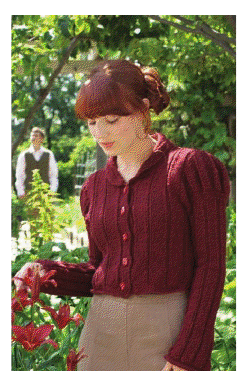
Lydia Military Spencer

Jane Austen Knits goes beyond the patterns, though.  There are articles about knitting during Austen’s time; both Mrs. Austen and Cassandra knit.  People speculate that Austen herself probably knit, but there is no concrete evidence for this.  We know that she did needlework.  But knitting may have been one of the household chores that the family sheltered her from so that she could write.  There are other articles in the special edition on regency fashion, muslin, a timeline of her life and the historical events that happened during her lifetime, and even suggestions for Austen-inspired movies and auidobooks to watch or listen to while you are knitting.

Knitting during the Regency Period was a utilitarian activity, and therefore was a job for those without money.  Mrs. Bates in Emma, Mrs. Smith in Persuasion, and Mrs. Jennings in Sense and Sensibility all mention projects or engage in knitting.  Of course, Mrs. Jennings would be undaunted by fashionable society’s prejudices and continue to knit even when she was wealthy.  Still, I like to imagine that knitting not only served a necessary household function for the other characters but also gave them solace and satisfaction.  As Mrs. Smith says about Nurse Rooke: “As soon as I could use my hands, she taught me to knit, which has been a great amusement.”  I couldn’t agree with her more.

Pemberley slippers

[Images: from the Interweave website]

******************************** 

More information at the Interweave website where you can order this special issue for $14.99. http://www.interweavestore.com/Knitting/Magazines/Jane-Austen-Knits-2011.html

Thank you Lynne for sharing this! – makes me want to dig out my old knitting needles and get to work! 

Miss Bennet's beaded bag
Copyright @2011 by Lynne H, of Jane Austen in Vermont
Books · Fashion & Costume · Jane Austen · JASNA · Literature · Museum Exhibitions · News · Regency England · Social Life & Customs

The Penny Post Weekly Review ~ All Things Jane Austen!

The Penny Post Weekly Review

  October 30, 2011

News / Gossip: JASNA

For those who did not go to the AGM [and for those who did because the sound was flawed] – here is the video previewing the upcoming AGM in New York City next October [via Kerri]: http://jasna.org/agms/newyork/video/

You can follow the 2012 AGM plans here: http://jasna.org/agms/newyork/index.html

[how easily we forget our cowboys and barbecued spare ribs! – how fickle we are!]

And even further into the future – here is the JASNA AGM 2014 on Facebook: “Mansfield Park in Montreal” [Fanny supporters unite!] – http://www.facebook.com/pages/JASNA-AGM2014/230649860329213?sk=wall

A review of the play S&S in Fort Worth: spoiler alert! Gender bias! http://www.dfw.com/2011/10/18/525176/youll-like-sense-and-sensibility.html


The Circulating Library

“The Making of a Homemaker” – a Smithsonian Institution online exhibition about the domestic guidebooks written for the 19th century American housewife: many images

http://www.sil.si.edu/ondisplay/making-homemaker/intro.htm

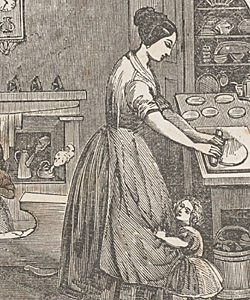
Image: Mrs. Lydia Green Abell. The Skillful Housewife’s Book: or Complete Guide to Domestic Cookery, Taste, Comfort and Economy. New York: R. T. Young, 1853.

  • Articles of Interest

Gemmill, Katie. “Jane Austen as Editor: Letters on Fiction and the Cancelled Chapters of Persuasion.”   ECF 24.1 (2011): 105-122

“Seen but Not heard: Servants in Jane Austen’s England”  by Judith Terry:
http://www.jasna.org/persuasions/printed/number10/terry.htm
[via Christy S.]

  •  Books I am Looking Forward to…

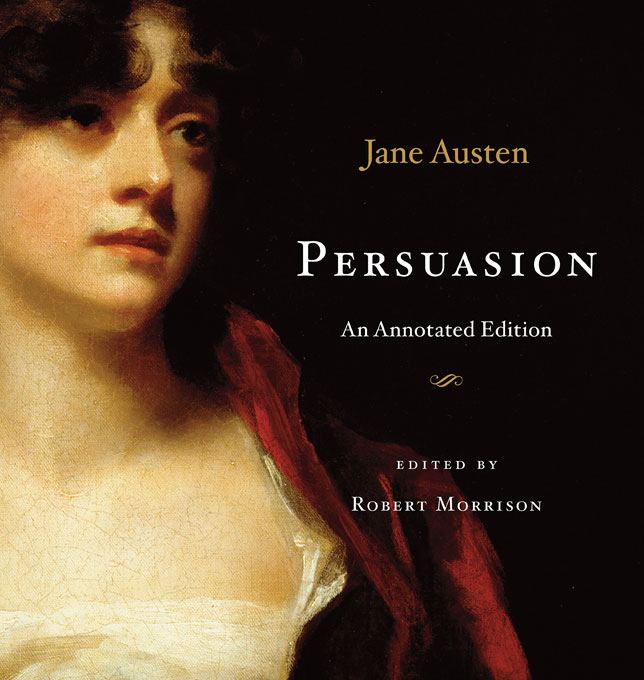
Persuasion, An Annotated Edition, edited by Robert Morrison [in the same series as the Annotated Pride and Prejudice edited by Patricia Myers Spacks] – http://www.hup.harvard.edu/catalog.php?recid=31301

The Jennifer Kloester biography of Georgette Heyer:  a not so glowing review in The Guardian: http://www.guardian.co.uk/books/2011/oct/06/georgette-heyer-biography-review-kloester

I think I might weigh in after reading it myself – I thoroughly enjoyed the Hodge biography…

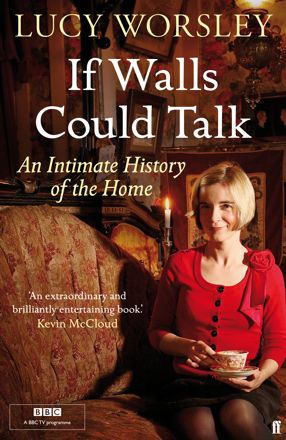
If you have read Bill Bryson’s At Home and Amanda Vickery’s Behind Closed Doors [and etc. regarding her titles] – and need another fix for your domestic matters obsessions, here is a must-have: If Walls Could Talk by Lucy Worsley [image US and UK cover: note that it is not available in the US until 2/2012 and has a different cover] – Ms. Worsley recently aired her Elegance and Decadence, The Age of the Regency on BBC4, also not available here until when ?? [though it is available for streaming, on youtube, etc.]  [makes one want to abandon the colonies for good and head to the mothership?]

You can follow Lucy Worsley’s blog here: http://www.lucyworsley.com/home.html where there is a link for the book…

US cover
UK cover

If you like to buy Jane Austen’s six novels in various forms by cover, editor, etc, here is a new take on cover art:

http://www.africandigitalart.com/2011/10/jane-austen-remixed-thandiwe-tshabalala/

A review by Claire Harman [of Jane’s Fame fame] of P.D. James’s Death Comes to Pemberley here: http://www.thisislondon.co.uk/lifestyle/book/article-24002867-death-comes-to-pemberley—review.do?mid=513438

  • On my bedside table

Claire Tomalin’s Dickens: http://www.penguin.co.uk/nf/Book/BookDisplay/0,,9780670917679,00.html

And speaking of Dickens, a reminder about the exhibition at the Morgan Library and Museum: http://www.themorgan.org/exhibitions/exhibition.asp?id=48

Websites and Blogs worth a look:

I’ve looked at this before, but a friend [thanks Joe!] reminded me to give it another look:  Jane Austen’s family on Ancestry.com

http://wc.rootsweb.ancestry.com/~janeausten

“A Dude Reads Jane Austen” at the Gone Reading blog: http://gonereading.com/site/2011/10/20/a-dude-reads-jane-austen-volume-2/

And visit the Gone Reading blog to find out about their reading foundation – have a look and give if you can!

A group blog by British historical fiction authors: English History Authors http://www.englishhistoryauthors.blogspot.com/

“Britain leaves us awed by ancient castles, ruins and museums. History pours out a legacy of battles, a developing monarchy, a structured class system, court-inspired behaviors and fashions, artwork and writings that have created an international hoard of Anglophiles. From among them have come forth those who feel that they must fuel the fire. Welcome to the happy home of English Period Authors. We have come together to share, inspire and celebrate and to reach out to our cherished readers.”

“What links Jane Austen, John Nash, Humphry Repton and Blaise Hamlet?” at the Georgian Gentleman blog:

Blaise Castle – Humphry Repton

http://georgiangentleman.posterous.com/blaise-hamlets-homes-fit-for-the-elderly
[via Two Nerdy History Girls]

Thrifty Jane blog – interviews with various Austen characters, esp the “thrifty” sort! [i.e. Mrs. Norris, Lucy Steele, Lady C, etc…] http://thriftyjane.wordpress.com/

Jane Austen Confessions: http://austenconfessions.tumblr.com/

Recipes from Colonial Williamsburg: http://recipes.history.org/

A reminder of this site, Bath In Time: http://www.bathintime.co.uk/

[image: Inside the Assembly Rooms, 1805]

A post on Ackermann’s many prints, reproduced on this blog: [via Jane Austen’s World blog]:

Ackermann’s Library 1813

http://ekduncan.blogspot.com/2011/10/regency-england-interior-views.html?mid=50

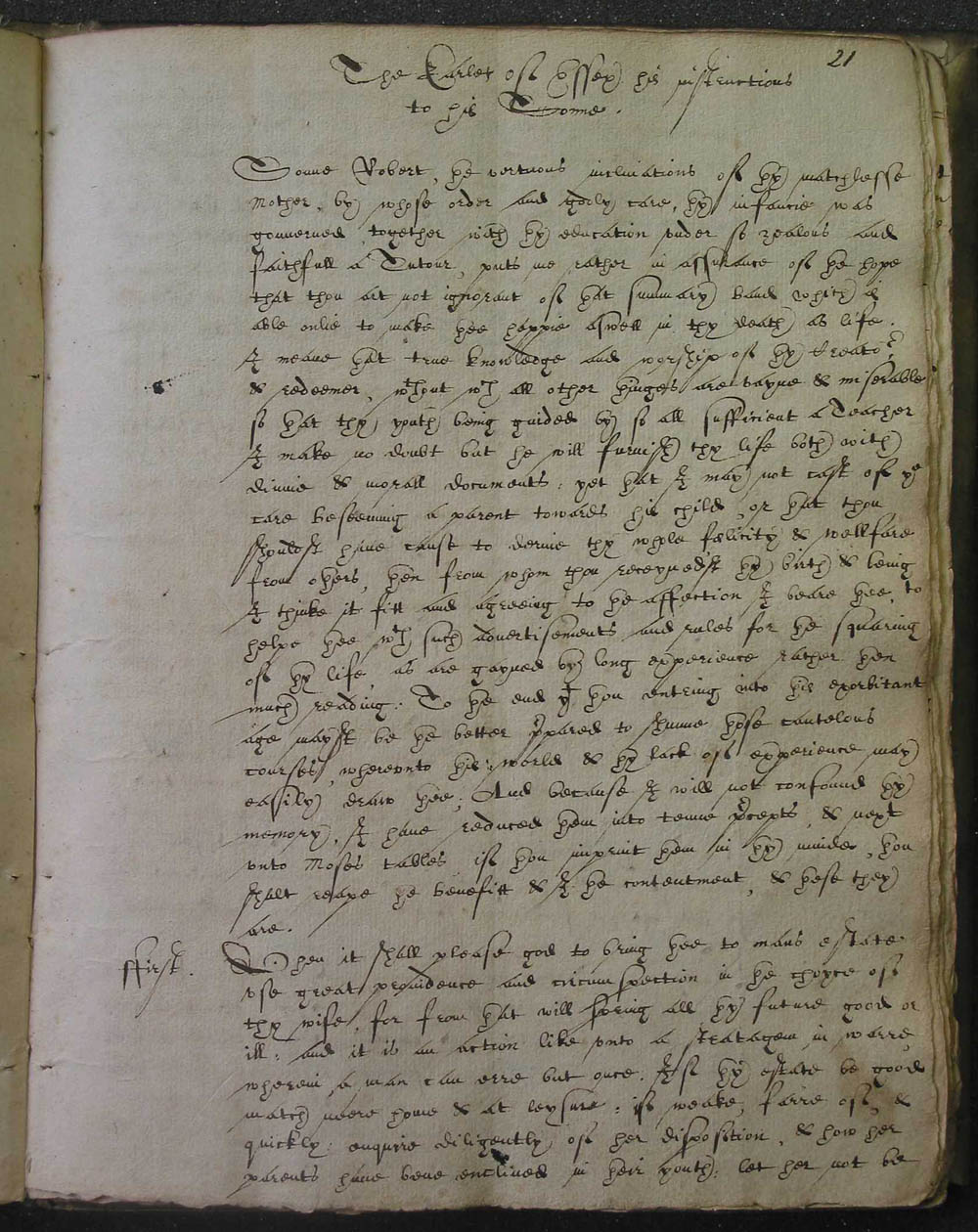
Any interest in English Handwriting?? – here is an amazing online course for free – makes me want to dig out my old calligraphy pens and settle in for a winter class!:

http://www.english.cam.ac.uk/ceres/ehoc/

‘The Earle of Essex his instructions to his sonne’

and here is more handwriting information:
http://paleo.anglo-norman.org/empfram.html

A post by Simon Beattie on the man who tried to kill King George III in 1800: http://www.simonbeattie.kattare.com/blog/?p=57


Museum Musings – Exhibition Trekking:

I’ve posted on this before and now the exhibition is open:

Dorothy Jordan – NPG

http://www.npg.org.uk/whatson/the-firstactresses/first_actresses_exhibition.php

[and while there, don’t forget to sign up for the Fortnum & Mason luxury hamper giveaway! – http://www.npg.org.uk/whatson/the-first-actresses/competition.php

And visit Austenonly for a review of the accompanying book:

http://austenonly.com/2011/10/19/book-review-of-the-first-actresses-nell-gwyn-to-sarah-siddons-by-gill-perry-with-joseph-roach-and-shearer-west/

The Charleston Museum (in South Carolina) will be offering a documentary film series on quilts: http://www.charlestonmuseum.org/event.asp?ID=444 [be sure to watch the video at this link]

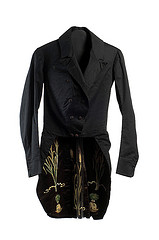
And also visit the upcoming exhibit Coat Check: [image] Nov. 12, 2011 – March 4, 2012 http://www.charlestonmuseum.org/exhibits-coatcheck

Coat c1830

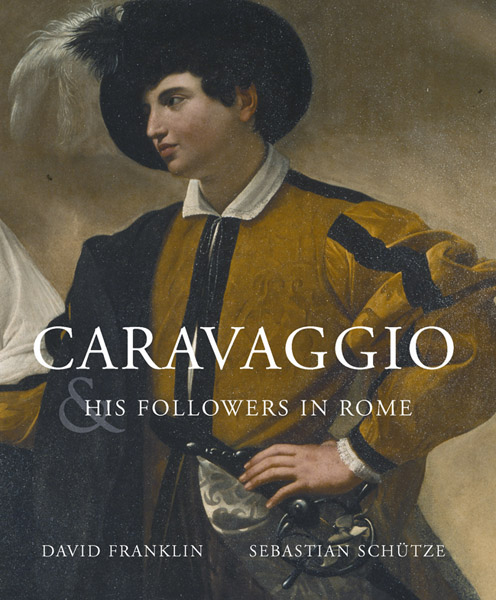
Caravaggio and His Followers in Rome:   this exhibit was at the Kimball Art Museum in Fort Worth, but I was unfortunately unable to go – Laurel Ann at Austenprose did see it on the Sunday as she was leaving later than me – she said I must buy the book, so here you go, another lovely art book to peruse: http://yalepress.yale.edu/yupbooks/book.asp?isbn=9780300170726

Exhibit info here:
https://www.kimbellart.org/Exhibitions/Exhibition-Details.aspx?eid=74

and here at the National Gallery of Canada:
http://www.gallery.ca/caravaggio/en/index.htm

Winterthur Museum:
“With Cunning Needle: Four Centuries of Embroidery”

http://www.winterthur.org/?p=901

and the upcoming conference: http://www.winterthur.org/?p=892
[via Two Nerdy History Girls]


Continuing Education:

Check out this Colorado Romance Writers, Inc. Online Workshop Series
class for NOVEMBER 2011!

Writing Between the Sexes (Using gender differences to
create believable characters)

Instructor: Leigh Michaels http://www.leighmichaels.com/
Date: October 31 – November 25, 2011

DESCRIPTION: Have you ever read a mystery where the heroine sounds like
an oversexed gangster? Or a romance where the hero sounds more like a
girlfriend than a man? Chances are, the oversexed heroine was created by
a male author; the tender, emotional hero by a woman. Men and women
think, act, and talk differently – which causes problems for writers
who are trying to create characters of the opposite sex. Learn about the
most common gender differences, and use them to create believable
characters of the opposite sex. (And along the way, you may get some
great ideas about how to deal with your husband, boyfriend, boss, big
brother, or other assorted males — or for the first time, understand
what’s really going on inside the head of your wife, girlfriend, mom…)

Fee: $20 CRW Members; $25 Non-CRW Members. FMI about the workshops or
speakers, or to register: http://crw-rwa.ning.com

Shopping

The Jane Austen Centre is beginning its holiday shopping marketing:  here are some  ideas from the “Pemberley Collection”: http://www.janeaustengiftshop.co.uk/images/2611.html

“The popular colours of Regency England” 

Sage and other variants were very fashionable during the Regency period as a green dye that did not fade or darken was invented. However, it was literaly the colour to die for – the pigment contained a poisonous copper arsenic compound! 

Plum is a much nicer word than ‘Puce’, which was popular in the Regency period. The purplish pink shade was named after the French word for ‘Flea’ as it resembled the shade of the blood sucking insect after a meal. Yuck! 

Teal and shades of blue were also in demand. In Jane Austen’s time dyes were expensive, pigments made of natural substances and the resulting hues rather muted compared to our modern artificial dyes, hence this lovely soft shade of teal would have been considered as being quite bright!

[from the Jane Austen Centre website]

[sage, plum and teal being my favorite colors – I knew I was born in the wrong century!]

For Fun

A joke on twitter – Victorian London:

“Why are a chimney sweep and a bugler good partners at cards?

One can follow soot, the other can trumpet.” joke, 1884

This just strikes my funny bone: “The Invisible Mother” at How to be a Retronaut:

And finally, absolutely nothing to do with Jane Austen or the 18th or the 19th century:

Swim caps from the 50s – thankfully we have come a long way baby…: [via How to Be  a Retronaut]   http://www.youtube.com/watch?v=FtZJMlOu0Sw

Copyright @2011 by Deb Barnum of Jane Austen in Vermont
Austen Literary History & Criticism · Books · Jane Austen · Jane Austen Popular Culture · Jane Austen Societies · JASNA · Literature · London · Regency England · Women Writers

My Book Stash from the JASNA AGM

One cannot resist the Emporium at the JASNA AGM – and this year in Fort Worth was more fun than ever – tables filled with goodies from the various Regions, and a whole room filled with local vendors from Texas.  But I first always head to the book stalls – a bad and expensive habit – and this year I was not disappointed. Happy to see again, Traveler’s Tales from Canada [sorry, no website!], and Jane Austen Books, and though I had to think of weight and limit some purchases, this year I wisely bought what I wanted to and shipped them home – they came today [love the UPS man, don’t you?!] 

So here is my book list: some are titles I have had on my list for a while, others are what I call the “browser’s banquet” – those things you either didn’t know about or wanted to see and touch before buying – and finally those things I am ashamed to say should have been in my Austen Library years ago, but never made it there for some reason or other …  so here goes, with short annotations, in no particular order… 

Austen, Jane.  Volume the Second. Ed. Brian Southam. Oxford: 1963. – I’ve had vol. 1 and 3 for a good long time, so very happy to find this… 


Quin, Vera. In Paris with Jane Austen.  Cappella Archive, 2011. Her Jane Austen Visits London is terrific, so why not Paris…! 

Hurst, Jane. Jane Austen and Chawton. The Author / JAS, 2009.  Had to add this to my JAS collection… 

Such Things as Please my Own Appetite: Food and Drink in Jane Austen’s Time. JASNA-Washington DC, n.d.  40p.  A great compilation of essays, both contemporary and historical.   

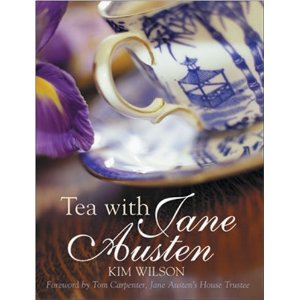
Wilson, Kim. Tea with Jane Austen. London: Frances Lincoln, 2011.  The new edition with color illustrations – I saw this in London in May and didn’t pick it up [that old weight problem…] – saw Ms. Wilson [we played Whist together!] but did not get it signed … oh well… lovely book – everyone who loves tea and Jane should have this, both editions really…    

_____. Flowers and Shrubs for Georgian and Regency Gardens, including a catalogue of Kitchen-garden Plants. The Author, 2011. 20 p.  A great list for the gardener in me… 

Noblesse Oblige: An Enquiry into the Identifiable Characteristics of the English Aristocracy. By Alan Ross, Nancy Mitford, Evelyn Waugh, et al. London: Hamish Hamilton, 1956. A must-have for your British collection, with requisite British “humour.” 

Kemble, Frances Anne.  Journal of a Residence on a Georgian Plantation in 1838-1839.  Athens: U of Georgia P, 1984, c1961. [originally published in 1863] – Kemble’s views on slavery in Georgia– compelling stuff I have long wanted to read…

Monaghan, David, ed. Emma: Contemporary Critical Essays. Macmillan, 1992. Didn’t have this one – now I do… 

Wright, Lawrence. Clean & Decent: The Fascinating History of the Bathroom and the Water-Closet. Penguin, 2000, c1960.  What every person with an interest in the most basic domestic matters should read… and the cover is really cool…

Vulliamy, C. E. English Letter Writers. London: Collins, 1945.  Part of the Britain in Pictures series, which I collect… 

Lefroy, Helen, and Gavin Turner, ed. The Letters of Mrs. Lefroy: Jane Austen’s Beloved Friend. Winchester, JAS, 2007.  why not?  more letters from Jane’s circle…

Adams, Jennifer. Little Miss Austen: Pride and Prejudice. Layton: Gibbs Smith, 2011. Because you have to have this if you collect everything to do with P&P

Ashford, Lindsay. The Mysterious Death of Miss Austen. Dinas Powys,Wales: Honno, 2011.  Ms. Ashford gave a most interesting talk at the AGM – brought this on the plane – almost done and will report on it soon! 

Piggott, Patrick. The Innocent Diversion: Music in the Life and Writings of Jane Austen. Moonrise, 2011, c1979.  A must-have, now reprinted… 

Barron, Stephanie. Jane and the Canterbury Tale. New York: Bantam, 2011. Because this is her latest – Ms. Barron was there, but alas! I did not get this signed either… I have heard it is great…

Southam, Brian. Jane Austen and the Navy. 2nd ed, rev. National Maritime Museum, 2005, c2000. Because I am shamed at not having read this – on my TBR pile, on top… 

Rubino, Jane, and Caitlen Rubino-Bradway. Lady Vernon and Her Daughter. New York: Crown, 2009.  Who cannot want more of Lady Susan?

Rees, Joan. Jane Austen: Woman and Writer. New York: St. Martin’s, 1976.  A biography I do not have – has an emphasis on the juvenilia and letters… 

McMullen, Lorraine. An Odd Attempt in a Woman: The Literary Life of Frances Brooke. Vancouver: U of British Columbia P, 1983.  I recently read The Excursion and wanted to know more about this author who Jane Austen read… 

Spacks, Patricia Meyer. Gossip. New York: Knopf, 1985.  Should have been on my shelf years ago – imagine Emma without “gossip”! 

A few finds on London, because one can never have enough:

Colby, Reginald. Mayfair: A Town within London. New York: Barnes, 1966. 

Hobhouse, Hermione. A History of Regent Street. London: MacDonald and Jane’s, 1975. 

Shepherd, Thomas, and James Elmes. London in the Nineteenth Century. New York: Mayflower, 1978. A reprint edition [originally published in 1827] but happy to finally have this… excellent pictures…

and of course this from my roomie – Jane Austen Made me Do It, by Laurel Ann Nattress – now signed and all! – not to mention a delightful read…

Oh dear, no space, no time…

Copyright @2011 Deb Barnum, of Jane Austen in Vermont