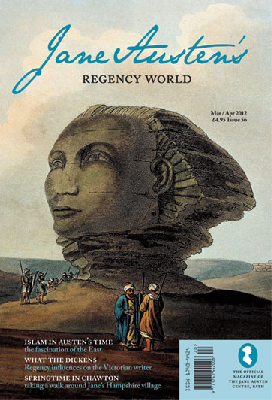
Jane Austen’s Regency World magazine is the only full-colour glossy magazine dedicated to Jane Austen and the Georgian and Regency times. It is published six times a year in Bath, England, and mailed worldwide by subscription. Copies are also sold via Jane Austen’s House Museum, Chawton; the Jane Austen Centre, Bath; and Jane Austen Books in the US.
A plug for the Jane Austen’s Regency World Magazine – if you don’t already subscribe, time to treat yourself by asking for it for Christmas; or a perfect gift for your best Jane Austen fan friend…
The next issue, Jan/Feb 2012, Issue 55 will be on sale January 1, 2012!
Contents:
An interview with P. D. James [on the cover] ~ on her love of Austen and her new book Death Comes to Pemberley
Regency Childbirth ~ Pregnancy horrors in Georgian times
Let it Snow, Let it Snow ~ exploring the winter weather in Jane’s novels
Letter to Cassandra ~ the joy of seeing Austen’s handwriting
Austen’s Contemporaries ~ the ‘other’ Jane ~ Jane Porter, and her sister Anna Maria
And of course all the regular columns from JAS, JASNA, the topical news from contemporary papers, the quiz, and so much more – even the advertisements are interesting!
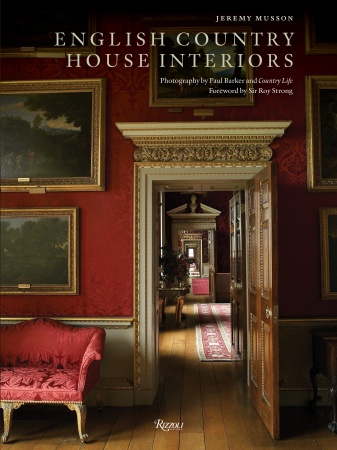
English Country House Interiors, by Jeremy Musson. Foreword by Sir Roy Strong; Photography by Paul Barker. New York: Rizzoli, 2011.
ISBN: 978-0-8478-3569-0
$60. [though Amazon has it for $38., much as I hate to say that…]
This book I should very much like to add to my collection on English architecture and stately homes [loud hint to my family…] – I discovered this at the UVM Library and have brought it home to peruse – extensive commentary and lovely photographs of the interior details of the fourteen houses included – here is the blurb from the publisher, Rizzoli:
A highly detailed look at the English country house interior, offering unprecedented access toEngland’s finest rooms. In this splendid book, renowned historian Jeremy Musson explores the interiors and decoration of the great country houses ofEngland, offering a brilliantly detailed presentation of the epitome of style in each period of the country house, including the great Jacobean manor house, the Georgian mansion, and the Gothic Revival castle. For the first time, houses known worldwide for their exquisite architecture and decoration–includingWilton, Chatsworth, and Castle Howard–are seen in unprecedented detail. With intimate views of fabric, gilding, carving, and furnishings, the book will be a source of inspiration to interior designers, architects, and home owners, and a must-have for anglophiles and historic house enthusiasts.
The fourteen houses included represent the key periods in the history of English country house decoration and cover the major interior fashions and styles. Stunning new color photographs by Paul Barker-who was given unparalleled access to the houses-offer readers new insights into the enduring English country house style. Supplementing these are unique black-and-white images from the archive of the esteemed Country Life magazine.
Among the aspects of these that the book covers are: paneling, textile hangings (silks to cut velvet), mural painting, plasterwork, stone carving, gilding, curtains, pelmets, heraldic decoration, classical imagery, early upholstered furniture, furniture designed by Thomas Chippendale, carved chimney-pieces, lass, use of sculpture, tapestry, carpets, picture hanging, collecting of art and antiques, impact of Grand Tour taste, silver, use of marble, different woods, the importance of mirror glass, boulle work, English Baroque style, Palladian style, neo-Classical style, rooms designed by Robert Adam, Regency, Gothic Revival taste, Baronial style, French 18th century style, and room types such as staircases, libraries, dining rooms, parlors, bedrooms, picture galleries, entrance halls and sculpture galleries.
The range is from the early 17th century to present day, drawn from the authenticated interiors of fourteen great country houses, almost all still in private hands and occupied as private residences still today. The book shows work by twentieth-century designers who have helped evolve the country house look, including Nancy Lancaster, David Hicks, Colefax & Fowler, and David Mlinaric.
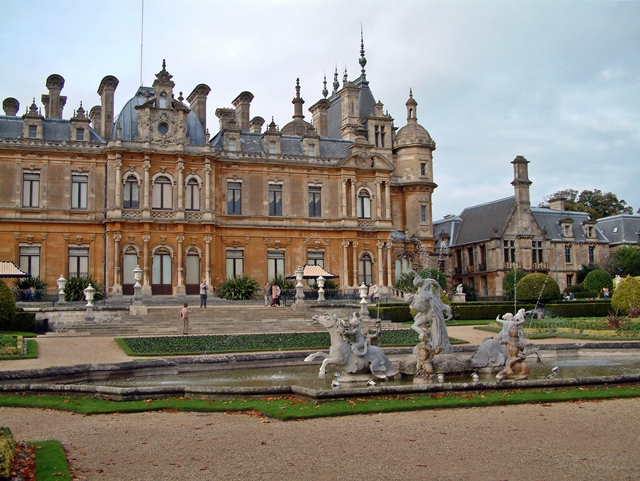
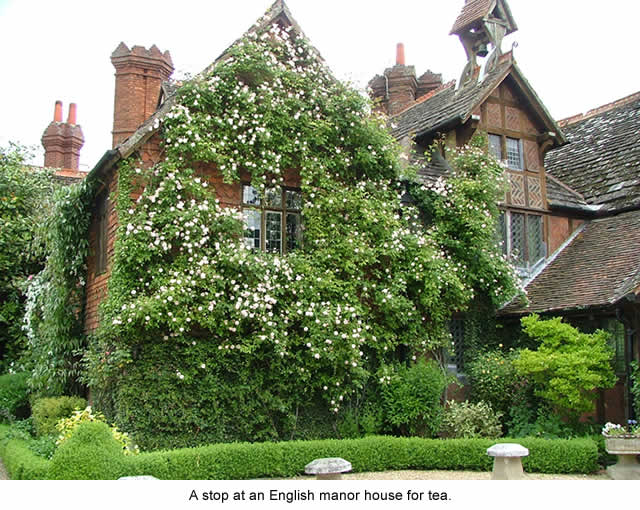
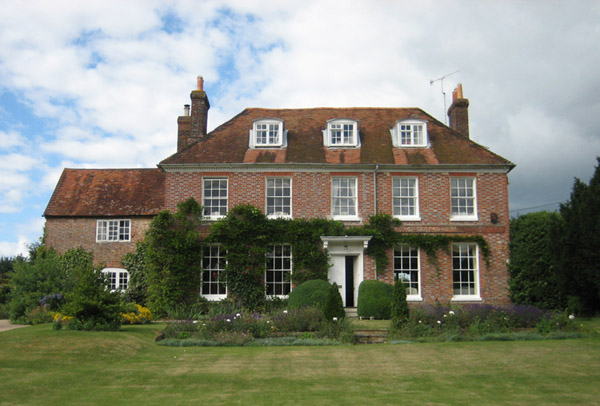
The Table of Contents: I’ve added some exterior shots and links for several of the houses – you will have to buy the book for the sumptuous interior adventure!
16. Living Interiors: The English Country House Interior Today
***********************
Not included is the house used in Downton Abbey, seen here, and certainly on everyone’s mind as we approach Season 2!:
Highclere Castle
And if you want another book to add to your collection that belongs on your shelf next to the above, you should add this to your list – hopefully Santa is listening, watching, and making his own list, and you have not been naughty but have only been nice the whole year long …
The English Country House: From the Archives of Country Life
Written by Mary Miers, Contribution by Jeremy Musson, Tim Richardson, Tim Knox and Marcus Binney. New York: Rizzoli, 2009.
ISBN: 978-0-8478-3057-2 , $85.
And here is one interior bit to whet your appetite all the more:
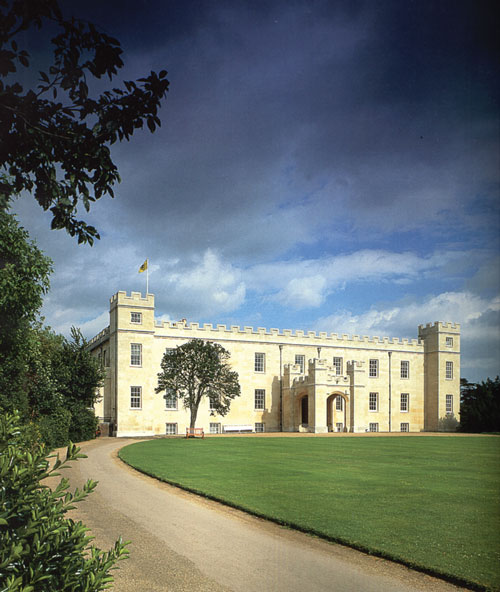
[Syon House – detail of the ceiling of the Red Drawing Room, p. 148]
What are your favorite English architecture / interior decoration books – ones you have or ones you want?
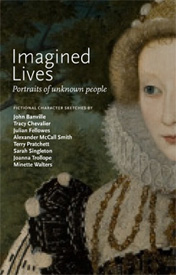
Eight internationally acclaimed authors have invented imaginary biographies and character sketches based on fourteen unidentified portraits. Who are these men and women, why were they painted, and why do they now find themselves in the Collection of the National Portrait Gallery? With fictional letters, diaries, mini-biographies and memoirs, Imagined Lives creates vivid stories about these unknown sitters from the sixteenth and seventeenth centuries.
For your iphone, ipad and such: Ebook Treasures: We already know that Austen’s History of England is available from the British Library, but look at this, a 14th Century Cookbook:
“The Forme of Cury is the oldest surviving cookbook in the world, dating from the late 14th century. Originally made by the cooks of the court of Richard II, very few copies survive, and this one, from the John Rylands Library in Manchester, is probably the best and earliest. Written in Middle English, the script can be hard to interpret, and some of the recipes unfamiliar. The book gives an incredible insight into medieval kitchens, as well as medieval life itself. The book contains one hundred and ninety-four recipes which reveal the amazing variety and elaboration of the dishes available to the elite, including stews, roast dishes, jellies, tarts and custards. Among the recipes are ‘Chyckens in gravey’, ‘Blank manger’ (a white savory stew, from which the word ‘blancmange’ derives),‘Furmente with porpays’ (porpoise in wheat porridge), and ‘Crypses’ (fried pastries).
The manuscript is still in a very worn, and possibly original, binding and it may well have been used as a practical cookery book in an aristocratic or royal kitchen. However, unlike modern recipe books, the Forme of Cury doesn’t give exact quantities or cooking times, so a lot is left to the skill and imagination of the cook.
This iBook contains the complete manuscript along with transcriptions from the Middle English. iTunes £3.99 ” [from the website]___________________________________
Michael Dirda of the Washington Post reviews Death Comes to Pemberley – this is on the top of my TBR pile…
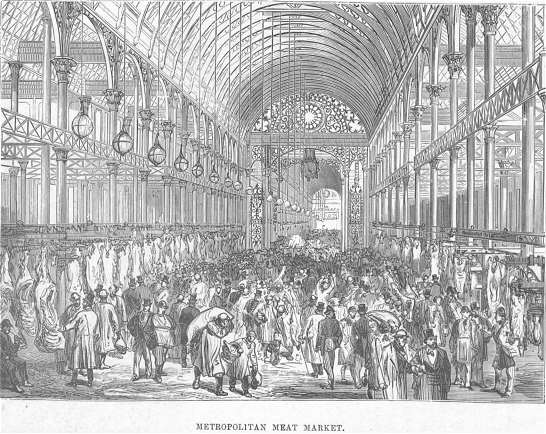
For those non-vegetarians out there with an interest in the Meat of London, here is a tasty read [and perhaps an unsettling one?]:
Meat, Commerce and the City: The London Food Market, 1800–1855 by Robyn Metcalfe – all you ever wanted to know about the Smithfield Meat Market, due out in March 2012 from Pickering & Chatto.
[image from Victorian London.org]
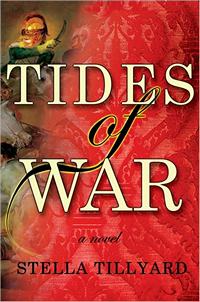
Tides of War, by Stella Tillyard
An epic novel about love and war, set in Regency England and Spain during the Peninsular War (1812-15), by the acclaimed historian and bestselling author of “Aristocrats.” Tides of War opens in England with the recently married, charmingly unconventional Harriet preparing to say goodbye to her husband, James, as he leaves to join the Duke of Wellington’s troops in Spain….
A book about the plague, Ralph Tailor’s Summer by Keith Wrightson – visit the publisher Yale Books where you can read a fascinating extract from the preface.
Charles Dickens is getting a good number of exhibitions all over in celebration of his 200th birthday: you can check the various happenings at the Dickens 2012 website.
*There is also the Dickens Exhibition at The Morgan Library. Here is the online component you can visit without leaving home: you can view 20 pages of A Christmas Carol and read a letter penned by Dickens…
Organized to complement the Center’s major exhibition on Johan Zoffany, who spent six productive years in India, Adapting the Eye explores the complex and multifaceted networks of British and Indian professional and amateur artists, patrons, and scholars in British India in the later eighteenth and early nineteenth centuries, and their drive to create and organize knowledge for both aesthetic and political purposes. Selected from the Center’s rich holdings, the exhibition includes a diverse range of objects from both high art and popular culture, including albums, scrapbooks, prints, paintings, miniatures, and sculpture, demonstrating how collecting practices and artistic patronage in India during that period constituted a complex intersection of culture and power.
Auction News
At auction this coming week: Bonham’s Fine Books and manuscripts, December 15, 2011:
Lot No: 5159WALKER, MRS. ALEXANDER.Female Beauty, as Preserved and Improved by Regimen, Cleanliness and Dress. London: Thomas Hurst, 1837.
8vo (183 x 107mm). With 11 lithographed illustrations, 10 hand-colored, each with hand-colored overlay, showing how physical characteristics (thick waist, broad jaws, short limbs, etc.) can be camouflaged in order to enhance one’s appearance. Later morocco by Sangorski & Sutcliffe, spine gilt, a.e.g. Custom slipcase. Some staining to spine, minor foxing throughout, offset from plates. Estimate: US$500 – 700.
And more of Mr. Dickens! Lot No: 5177: DICKENS, CHARLES. 1812-1870.
A Christmas Carol. In Prose. Being a Ghost Story of Christmas. London: Chapman & Hall, 1843.
8vo. [viii], 166, [2] ad pp. Hand-colored engraved frontispiece and 3 hand-colored plates. Original cloth blindstamped and gilt, a.e.g. Custom morocco pull-off case by Scroll Club Bindery. Pp 64-70 lightly foxed, binding slightly cocked and faded.
Provenance: Jerome Kern (morocco book label); Frank Brewer Bemis [1861-1935],Bostoncollector, whose collection was dispersed by Rosenbach and Goodspeed (bookplate).
FIRST EDITION, THE KERN-BEMIS COPY. Second issue of the text, with “Stave One” on page [1], title page in red and blue dated 1843, and yellow endpapers, but first state of the binding (the closest interval between blindstamped border and gilt holly wreath being 14-15 mm not 12 mm, and the upper left serif of D intact). Todd calls this binding point a “desideratum … encompassing all the others,” and of greater importance in priority than the textual points (The Book Collector, 1961, pp 449-454). Eckel, p 116; Sadleir 684. Estimate: US$4,000 – 6,000.
Lot No: 5284 : GEORGE III. 1738-1820.
Document Signed (“George R.”), 1 p (with conjoined docketed blank), folio, St. James’s, May 25, 1781, being a pay warrant for General Henry Seymour Conway for the Royal Horse Guards for the year 1779, additionally signed by CHARLES JENKINSON, Earl of Liverpool, toned, tape stains at upper and lower right corners, small chips at edges, matted and framed.
Provenance: with Thomas F. Madigan,New Yorkautograph dealer (signed letter of authenticity, October 26, 1935). Estimate: US$800 – 1,200.
Prices Realized at Auction:
Mr. Dickens yet again!: A complete set in fine bindings of the first editions of Charles Dickens’s Christmas Books. Five volumes, uniformly bound, London, 1843-1848. Includes A Christmas Carol. Sold for $6,480. [Swann]
***********************
Dance Card for the Union Ball in Honor of the Inauguration of Abraham Lincoln, $3,840 at Swann Galleries of New York on December 1.
A dance card issued to the guests atLincoln’s inaugural ball in 1861. Courtesy of Swann Galleries.These cards, with die-cut decorative border and a ribbon through one corner, were issued to guests at the inauguration ball inWashington,D.C.on March 4, 1861. On the second of the four pages are listed the twenty-three planned dances that will take place to the music provided by L. F. Weber’s band, while on the third is space to write in one’s partner for each dance. On the rear panel are printed the names of Lincoln and his vice president, Hannibal Hamlin, around an illustration of a bald eagle, captioned “The Constitution.” [Invitations to the ball appear from time to time and sell for upwards of $8,000, but Swann could find no previous record of a dance card at auction.]
If you are into hair collecting [a little late for our Regency tastes, but what good Victorianist is not into hair…], here is a short essay on the topic at Paul Fraser Collectibles.
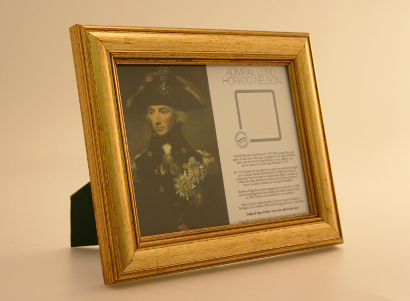
And then you might like to add this to your collection: Lord Nelson’s hair for £49.95, or Napoleon, and the Duke of Wellingon, all the same price – also Dickens and Steinbeck and Paul McCartney, etc – but alas! – no Jane Austen!
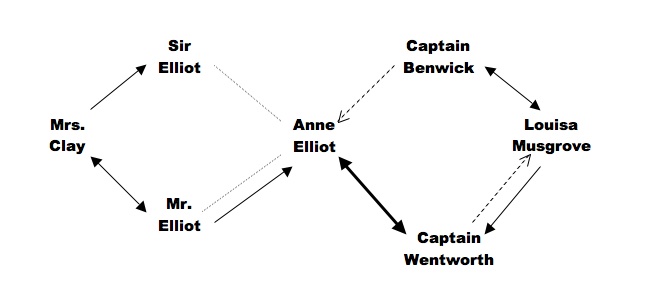
And this is way too much fun to look at – The Love Diagrams of Jane Austenat Diana Peterfreund’s website: [visit her site for diagrams of the other novels]
And finally, this is all over the airwaves, and we will have to wait until December 16th for it all to be unveiled, but visit the website of The Austen Games.com to whet your appetite and ponder.…
Gentle Readers! ~ I welcome today Janeite Lynne, a JASNA-Vermont member and occasional contributor to this site, as she writes on Jane Austen and knitting!
***********************
Jane Knits
They were entering the hall. Mr. Knightley’s eyes had preceded Miss Bates’s in a glance at Jane. From Frank Churchill’s face, where he thought he saw confusion suppressed or laughed away, he had involuntarily turned to hers; but she was indeed behind, and too busy with her shawl. [Emma]
*********************
Have you ever wanted to create the kind of shawl that Jane Fairfax might have hid behind or slippers that would have kept Elizabeth Bennet’s feet warm? If your answer to this question is yes!, then, like me, you may be both a Janeite and a knitter. I imagined that people with these two interests would be a very small subset of the larger groups, but this month Interweave Knits made me think I was wrong. They have released a special edition of their magazine: Jane Austen Knits.
The patterns in the edition are organized around places: country, manor, garden, and town. There are over thirty patterns including: shawls, shrugs, scarves, handwarmers, slippers, reticules, Mr. Knightley’s Vest, and, of course, a tea cozy. If you are a lace knitter, you will be in heaven. Lace abounds!
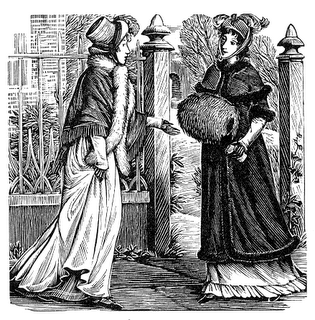
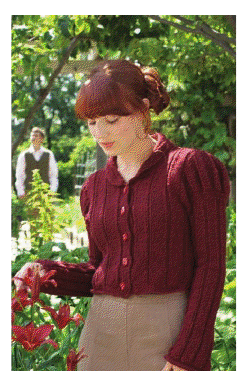
Lydia Military Spencer
Jane Austen Knits goes beyond the patterns, though. There are articles about knitting during Austen’s time; both Mrs. Austen and Cassandra knit. People speculate that Austen herself probably knit, but there is no concrete evidence for this. We know that she did needlework. But knitting may have been one of the household chores that the family sheltered her from so that she could write. There are other articles in the special edition on regency fashion, muslin, a timeline of her life and the historical events that happened during her lifetime, and even suggestions for Austen-inspired movies and auidobooks to watch or listen to while you are knitting.
Knitting during the Regency Period was a utilitarian activity, and therefore was a job for those without money. Mrs. Bates in Emma, Mrs. Smith in Persuasion, and Mrs. Jennings in Sense and Sensibility all mention projects or engage in knitting. Of course, Mrs. Jennings would be undaunted by fashionable society’s prejudices and continue to knit even when she was wealthy. Still, I like to imagine that knitting not only served a necessary household function for the other characters but also gave them solace and satisfaction. As Mrs. Smith says about Nurse Rooke: “As soon as I could use my hands, she taught me to knit, which has been a great amusement.” I couldn’t agree with her more.
For those who did not go to the AGM [and for those who did because the sound was flawed] – here is the video previewing the upcoming AGM in New York City next October [via Kerri]: http://jasna.org/agms/newyork/video/
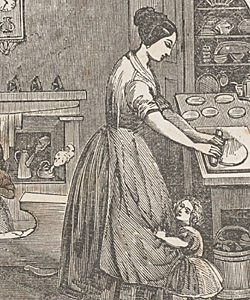
“The Making of a Homemaker” – a Smithsonian Institution online exhibition about the domestic guidebooks written for the 19th century American housewife: many images
Image: Mrs. Lydia Green Abell. The Skillful Housewife’s Book: or Complete Guide to Domestic Cookery, Taste, Comfort and Economy. New York: R. T. Young, 1853.
Articles of Interest
Gemmill, Katie. “Jane Austen as Editor: Letters on Fiction and the Cancelled Chapters of Persuasion.” ECF 24.1 (2011): 105-122
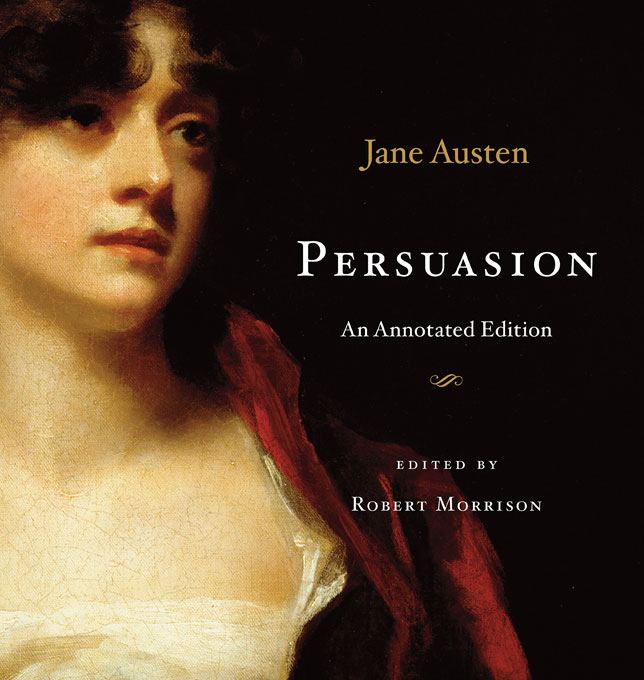
Persuasion, An Annotated Edition, edited by Robert Morrison [in the same series as the Annotated Pride and Prejudice edited by Patricia Myers Spacks] – http://www.hup.harvard.edu/catalog.php?recid=31301
I think I might weigh in after reading it myself – I thoroughly enjoyed the Hodge biography…
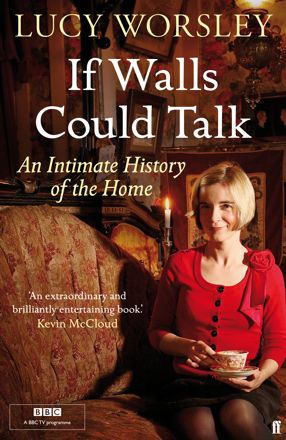
If you have read Bill Bryson’s At Home and Amanda Vickery’s Behind Closed Doors [and etc. regarding her titles] – and need another fix for your domestic matters obsessions, here is a must-have: If Walls Could Talk by Lucy Worsley [image US and UK cover: note that it is not available in the US until 2/2012 and has a different cover] – Ms. Worsley recently aired her Elegance and Decadence, The Age of the Regency on BBC4, also not available here until when ?? [though it is available for streaming, on youtube, etc.] [makes one want to abandon the colonies for good and head to the mothership?]
“Britain leaves us awed by ancient castles, ruins and museums. History pours out a legacy of battles, a developing monarchy, a structured class system, court-inspired behaviors and fashions, artwork and writings that have created an international hoard of Anglophiles. From among them have come forth those who feel that they must fuel the fire. Welcome to the happy home of English Period Authors. We have come together to share, inspire and celebrate and to reach out to our cherished readers.”
“What links Jane Austen, John Nash, Humphry Repton and Blaise Hamlet?” at the Georgian Gentleman blog:
Thrifty Jane blog – interviews with various Austen characters, esp the “thrifty” sort! [i.e. Mrs. Norris, Lucy Steele, Lady C, etc…] http://thriftyjane.wordpress.com/
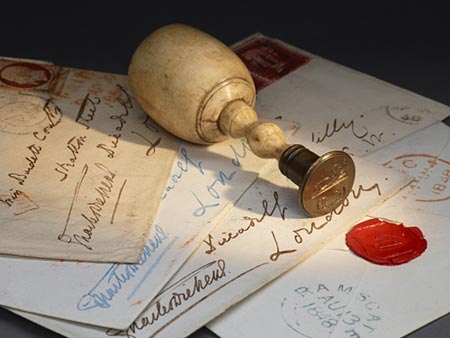
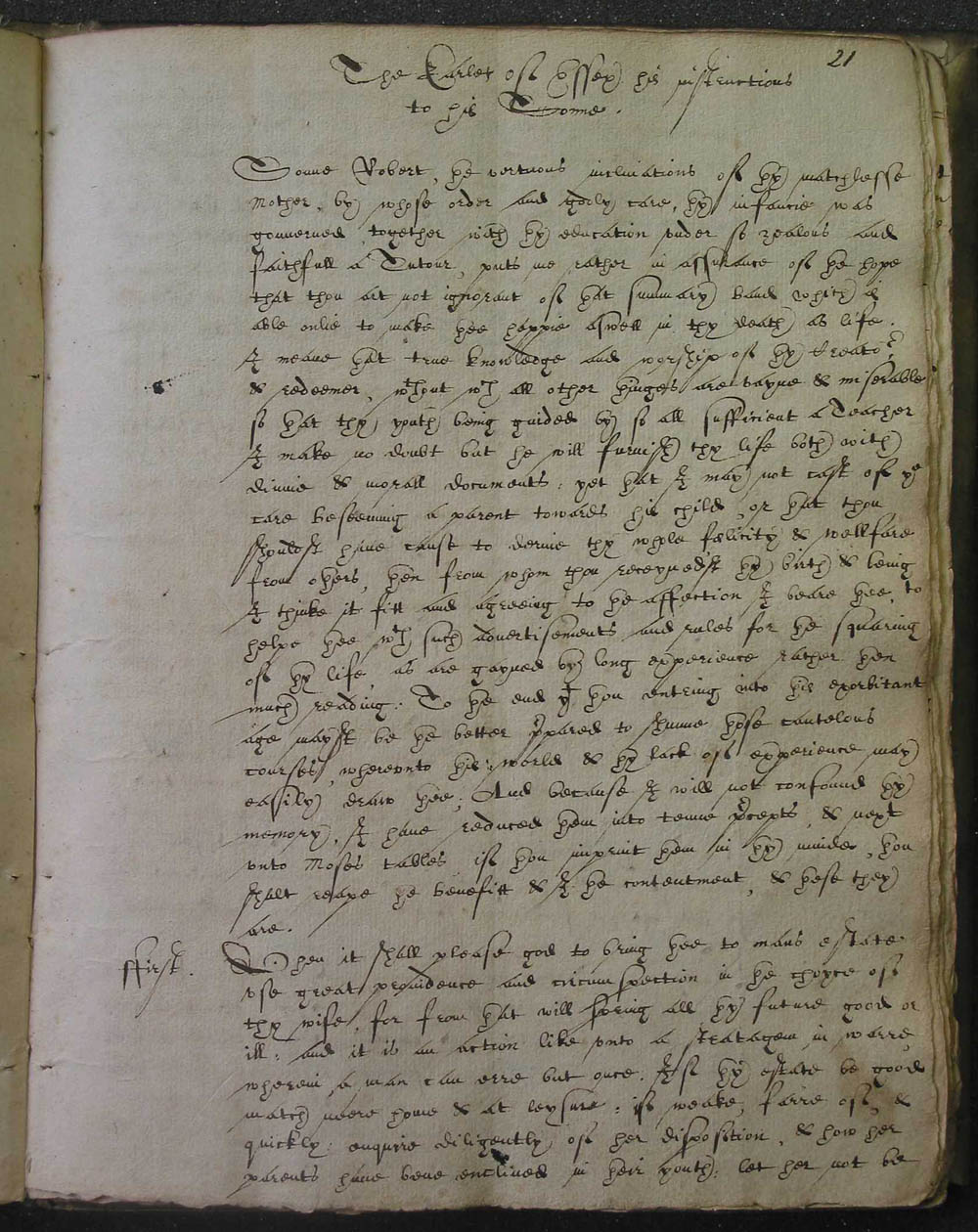
Any interest in English Handwriting?? – here is an amazing online course for free – makes me want to dig out my old calligraphy pens and settle in for a winter class!:
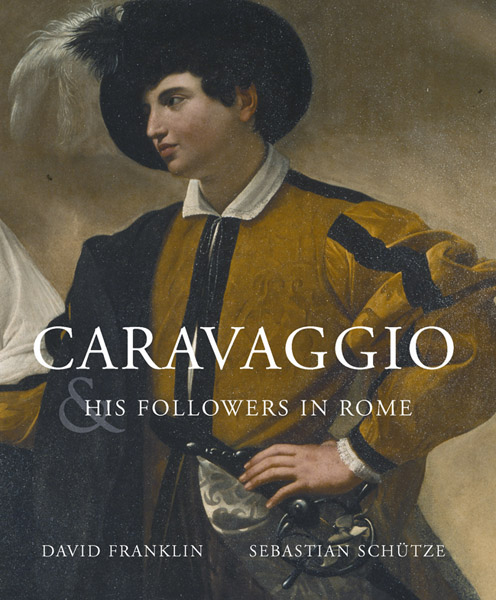
Caravaggio and His Followers in Rome: this exhibit was at the Kimball Art Museum in Fort Worth, but I was unfortunately unable to go – Laurel Ann at Austenprose did see it on the Sunday as she was leaving later than me – she said I must buy the book, so here you go, another lovely art book to peruse: http://yalepress.yale.edu/yupbooks/book.asp?isbn=9780300170726
DESCRIPTION: Have you ever read a mystery where the heroine sounds like
an oversexed gangster? Or a romance where the hero sounds more like a
girlfriend than a man? Chances are, the oversexed heroine was created by
a male author; the tender, emotional hero by a woman. Men and women
think, act, and talk differently – which causes problems for writers
who are trying to create characters of the opposite sex. Learn about the
most common gender differences, and use them to create believable
characters of the opposite sex. (And along the way, you may get some
great ideas about how to deal with your husband, boyfriend, boss, big
brother, or other assorted males — or for the first time, understand
what’s really going on inside the head of your wife, girlfriend, mom…)
Fee: $20 CRW Members; $25 Non-CRW Members. FMI about the workshops or
speakers, or to register: http://crw-rwa.ning.com
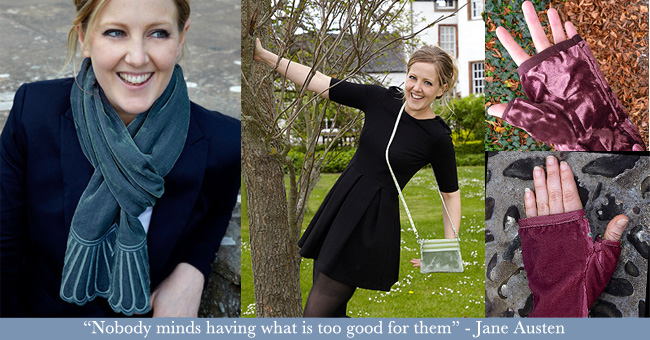
Sage and other variants were very fashionable during the Regency period as a green dye that did not fade or darken was invented. However, it was literaly the colour to die for – the pigment contained a poisonous copper arsenic compound!
Plum is a much nicer word than ‘Puce’, which was popular in the Regency period. The purplish pink shade was named after the French word for ‘Flea’ as it resembled the shade of the blood sucking insect after a meal. Yuck!
Teal and shades of blue were also in demand. In Jane Austen’s time dyes were expensive, pigments made of natural substances and the resulting hues rather muted compared to our modern artificial dyes, hence this lovely soft shade of teal would have been considered as being quite bright!
[from the Jane Austen Centre website]
[sage, plum and teal being my favorite colors – I knew I was born in the wrong century!]
For Fun
A joke on twitter – Victorian London:
“Why are a chimney sweep and a bugler good partners at cards?
One can follow soot, the other can trumpet.” joke, 1884
Watch your mailbox, or subscribe now to get this Sense and Sensibility filled issue!
•Andrew Davies reveals to the JASNA conference how he ‘sexed-up’ Pride & Prejudice
[I heard Davies at the Fort Worth AGM – a hoot of a talk with many pictures from the movies – will report on this in full when I post my AGM reports – so stay tuned!]
•A new series of Garrow’s Law, the Georgian courtroom drama, hits the TV screens
•The Night Before Christmas: seasonal writing from 1800s America
•Stunning pictures from the Jane Austen Festival in Bath
•Do the men in Sense & Sensibility disappoint, asks Maggie Lane
•Take a new look at the events that led to the start of the Regency
•The moving history of the Sunday school movement
•Plus all the latest news from the Jane Austen world as well as reports from JAS and JASNA, our popular quiz, competition and readers’ letters!
Subscribe today to Jane Austen’s Regency World, the full-colour, must-read, glossy magazine for fans of the world’s favourite author – delivered to your doorstep every two months direct from Bath, England.
You are Cordially Invited to JASNA-Vermont’s September Gathering
with
JASNA President Iris Lutz
“‛…in proportion to their family and income’: Houses in
Jane Austen’s Life and Fiction” *
*An illustrated lecture featuring the houses in Jane Austen’s real and imagined worlds ~ we will be visiting Chawton, Bath, Winchester, and Kent, pairing pictures of real houses with descriptions in the novels of Austen’s various cottages, manors, and estates ~ Barton Cottage, Longbourn, Mansfield Park, Sotherton, and of course Pemberley!
**********
Sunday, September 25, 2011 2 ~ 4 pm
An event of the Burlington Book Festival
~ Sponsored by Bygone Books ~
Hosted by: Champlain College,
Hauke Conference Center ~
375 Maple St Burlington VT
Chloe Parker was born two centuries too late. A thirty-nine-year-old divorced mother, she runs her own antique letterpress business, is a lifelong member of the Jane Austen Society, and gushes over everything Regency. But her business is failing, threatening her daughter’s future. What’s a lady to do? Why, audition for a Jane Austen-inspired TV show set in England, of course.
What Chloe thinks is a documentary turns out to be a reality dating show set in 1812. Eight women are competing to snare Mr. Wrightman, the heir to a gorgeous estate—and a one-hundred-thousand-dollar prize. So Chloe tosses her bonnet into the ring, hoping to transform from stressed-out Midwestern mom to genteel American heiress and win the money.
With no cell phones, indoor plumbing, or deodorant to be found, she must tighten her corset and flash some ankle to beat out women younger, more cutthroat, and less clumsy than herself. But the witty and dashing Mr. Wrightman proves to be a prize worth winning, even if it means the gloves are off…
[from the author’s website and publisher’s release]
I often have trouble with sequels, and there are so many lately that my head spins just looking at the booklist! – I do marvel at the originality of all these writers wanting to re-tell in some fashion all that Jane Austen left unsaid, but in all honesty I want Austen’s characters left alone, to be returned to in their original state with a good solid re-read when I choose [though I am also of the school that says ‘no criticizing if you haven’t read the book’…!]. I find more to my taste the Austen-inspired fiction the likes of “Lost in Austen”, where the plot offers new characters, fresh dialogue, and inspired plots, where you are taken into Jane Austen’s world, either as a 21st century soul trying to adapt to what we think we know of the Regency Period and on that endless search for a character like Mr. Darcy, or Henry Tilney or Captain Wentworth (sigh…) – or perhaps a Willoughby if you are so inclined! – or where we are taken into her world where we meet a fictional Jane herself, as in Stephanie Barron’s creative mysteries. Confessions of a Jane Austen Addict and Bridget Jones Diary, Austenland and The Man Who Loved Jane Austen are all of this genre, and thankfully, all leave the original works quite at peace.
The problem is that these too all start to look alike – the klutzy independent Heroine with “life issues” somehow transported into the early 1800s and found struggling against the social (and fashion!) restrictions of the times. Definitely Not Mr. Darcy is the latest entrant in this genre: I quote Publisher’s Weekly:
Doornebos gives the historical romance a hilarious update in this delightful debut… The amusing secondary characters, sidesplitting faux pas, and fiery romance will make Doornebos an instant hit with readers.
And from Romantic Times:
Doornsbos brings readers a fresh take on Jane Austen’s world. Mixing reality television with Regency-style romance, this tale combines a fun plot with witty dialogue, charming characters and a strong-willed heroine. It will leave you laughing in delight and reluctant to put it down until the last page is read.
And “fresh take” though it is, one can’t help feeling “I’ve been here before.” Ms. Doornebos states herself in the acknowledgments that she was mostly done with her writing before she even knew about the reality show “Regency House Party.” And far too many of the characters do seem clichéd: the handsome Lord and Hero; his almost-but-not-quite dorky brother; the glamorous but really nasty American-bashing contestant; the side players with their own back stories that continually confuse the Heroine as to the truth vs. the play script; the borderline cruelty of the producer; and the Heroine, the all-American with a messy life who just needs to win the money (and a Lord on the side would be nice…), caught between this reality and her need for True Love. Sound familiar??
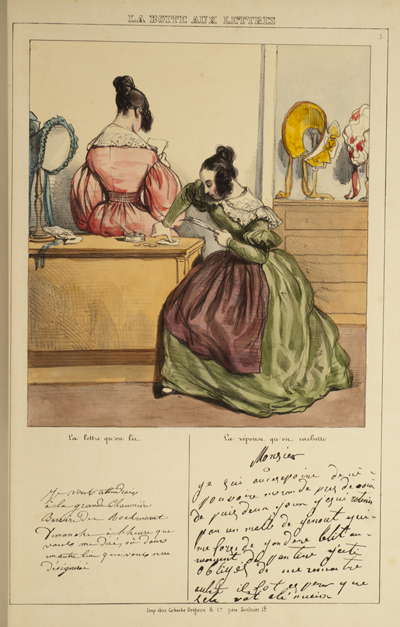
Well, that’s ok – even Georgette Heyer rewrote her own formula fiction over and over again and alas! it is summer, and what better way to spend such a summer’s day than laying about with a quick read that has an engaging plot with a few twists, a Heroine you do root for as she falls into one mishap after another (she is often very wet and suffers various fainting fits!), and that irresistible Regency setting! And you will laugh out loud – the Cook, the Chaperone, the Maid, and a Footman or two who instruct and keep our Heroine in strict social compliance round out the story – you will learn the “language of the fan”, various fashion secrets, letter-writing etiquette (though this one glaring error: the constant reference to “envelopes” – yikes!) – the hated needlework assignments, side-saddle riding, a few archery lessons, the rules of dining and enough about Regency era food to turn any committed carnivore into a vegetarian, and several opportunities for dancing (the waltz!).
Can’t tell more – would ruin your fun – just go and get yourself “lost in Austen” for a few hours and discover just how Doornebos fashions her Darcy for this latest Austen-obsessed Heroine. You won’t be disappointed!
4 out of 5 Full Inkwells
Definitely Not Mr. Darcy, by Karen Doornebos
New York: Berkley, 2011
Release date: September 6, 2011
ISBN: 978-0-425-24382-4
[I append here the post I wrote last year on this day]
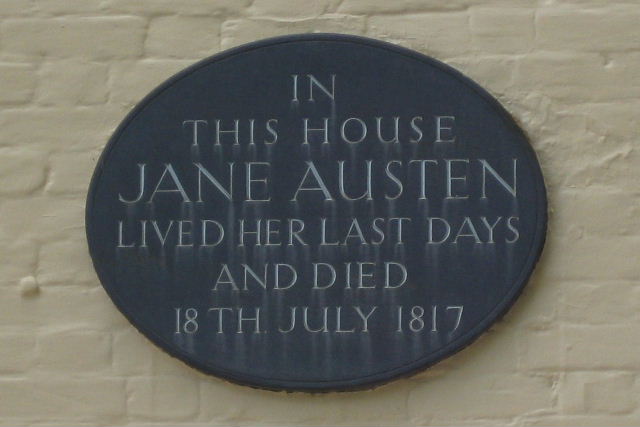
July 18, 1817. Just a short commemoration on this sad day…
No one said it better than her sister Cassandra who wrote
I have lost a treasure, such a Sister, such a friend as never can have been surpassed,- She was the sun of my life, the gilder of every pleasure, the soother of every sorrow, I had not a thought concealed from her, & it is as if I had lost a part of myself…”
(Letters, ed. by Deidre Le Faye [3rd ed, 1997], From Cassandra to Fanny Knight, 20 July 1817, p. 343; full text of this letter is at the Republic of Pemberley)
There has been much written on Austen’s lingering illness and death; see the article by Sir Zachary Cope published in the British Medical Journal of July 18, 1964, in which he first proposes that Austen suffered from Addison’s disease. And see also Claire Tomalin’s biography Jane Austen: A life, “Appendix I, “A Note on Jane Austen’s Last Illness” where she suggests that Austen’s symptoms align more with a lymphoma such as Hodgkin’s disease.
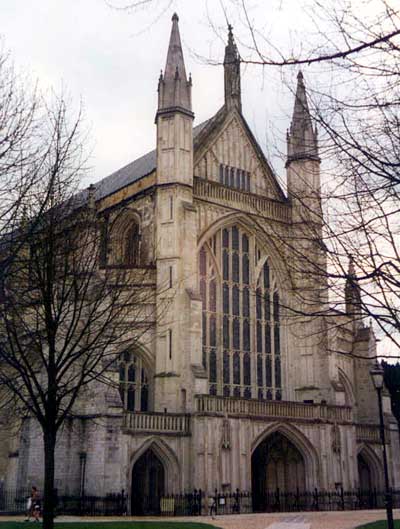
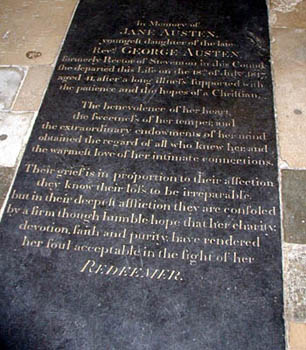
….where no mention is made of her writing life on her grave:
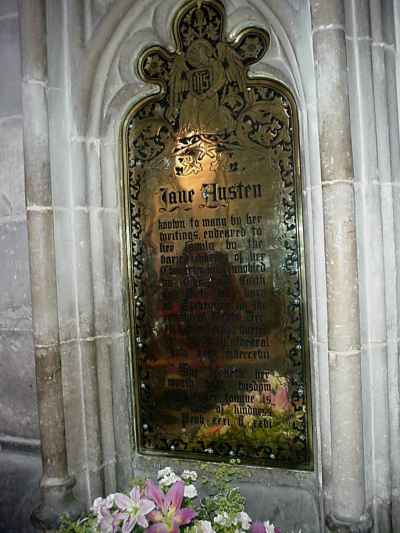
It was not until after 1870 that a brass memorial tablet was placed by her nephew James Edward Austen-Leigh on the north wall of the nave, near her grave:
It tells the visitor that:
Jane Austen
[in part] Known to many by her writings,
endeared to her family
by the varied charms of her characters
and ennobled by her Christian faith and piety
was born at Steventon in the County of Hants.
December 16 1775
and buried in the Cathedral
July 18 1817.
“She openeth her mouth with wisdom
and in her tongue is the law of kindness.”
The Obituaries:
David Gilson writes in his article “Obituaries” that there are eleven known published newspaper and periodical obituary notices of Jane Austen: here are a few of them:
Hampshire Chronicle and Courier (vol. 44, no. 2254, July 21, 1817, p.4): “Winchester, Saturday, July 19th: Died yesterday, in College-street, Miss Jane Austen, youngest daughter of the late Rev. George Austen formerly Rector of Steventon, in this county.”
Hampshire Telegraph and Sussex Chronicle (vol. 18, no. 928, p. 4)…”On Friday last died, Miss Austen, late of Chawton, in this County.”
Courier (July 22, 1817, no. 7744, p. 4), makes the first published admission of Jane Austen’s authorship of the four novels then published: “On the 18th inst. at Winchester, Miss Jane Austen, youngest daughter of the late Rev. George Austen, Rector of Steventon, in Hampshire, and the Authoress of Emma, Mansfield Park, Pride and Prejudice, and Sense and Sensibility. Her manners were most gentle; her affections ardent; her candor was not to be surpassed, and she lived and died as became a humble Christian.” [A manuscript copy of this notice in Cassandra Austen’s hand exists, as described by B.C. Southam]
The Hampshire Telegraph and Sussex Chronicle published a second notice in its next issue (July 28, 1817, p. 4) to include Austen’s writings.
There are seven other notices extant, stating the same as the above in varying degrees. The last notice to appear, in the New Monthly Magazine (vol. 8, no. 44, September 1, 1817, p. 173) wrongly gives her father’s name as “Jas” (for James), but describes her as “the ingenious authoress” of the four novels…
[from Gilson’s article “Obituaries”, THE JANE AUSTEN COMPANION [Macmillan 1986], p. 320-1]





























 Jane Austen in Vermont