Book reviews · Regency England

Book Review ~ ‘Bath Tangle’ by Georgette Heyer

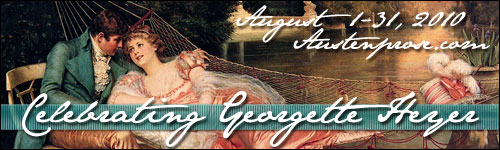
Here is the review of Georgette Heyer’s Bath Tangle that I wrote for the “Georgette Heyer Celebration” at Austenprose:

I first encountered Georgette Heyer’s Bath Tangle via audio and I was enchanted – the head-strong Hero and Heroine, not always likeable, at odds with each other from page one – so I was delighted to read the book when Laurel Ann asked me to do this review – another Heyer, another cast of characters, and an abundance of Regency settings to savor!

Serena Carlow, 25, a titian-haired beauty, strong-willed, headstrong, accomplished*, daring and tempestuous, certainly anything but “serene”, has suddenly lost her father, the Earl of Spenborough.  He leaves a twenty-two year old wife, no male heir with his estate passing to a cousin, and a will that provides for Serena’s fortune to be under the trusteeship of the Marquis of Rotherham.  Fanny, now the widowed Lady Spenborough, a young girl, barely out of the schoolroom when she was pledged to the 47 year-old Earl against her will, is well-named – Austen’s Fanny Price looms over this character.  Though of a shy, retiring disposition and propriety-bound, she and Serena, so very different, have forged a true friendship – they move together to the Dower House, leaving the cousin and wife, a la the John Dashwoods in Sense & Sensibility, to take over the Earl’s entire estate. Serena is left with an allowance, her fortune of 10,000 pounds a year to be passed to her only upon her marriage to a man approved by Rotherham …which of course sends Serena “up into the boughs.”

Major back story, as in Persuasion:  Serena and Rotherham were betrothed three years before, her father’s wish, but Serena crying-off shortly before the ceremony because “they did not suit”.  Rotherham is after all a harsh and arrogant fellow, with an “imperious and tyrannical disposition”, “high in the instep”, barely even handsome [but he has great hands! and those powerful shoulders!] – they do their “dagger-drawing” from page one and while they may not think they suit, we know quite differently, that they are meant for each other, everyone else paling in comparison…..[Shakespeare’s Taming of the Shrew comes to mind!]

Fanny and Serena decamp to Bath for a change of scene during their mourning period – and so enters Major Hector Kirkby, Serena’s “first and only true love” from six years before – and she, Hector’s “goddess”, his dream become real when they once again meet.  Hector is fine and handsome, but a tad frightened of Serena’s strong personality of “funning humours and openness of temper”. They set all the tongues of Bath wagging, embark on a secret engagement [due to mourning etiquette], Rotherham is consulted and approves, then announces his own engagement to the not-yet 18 year old Emily, and suddenly, Everyone Ends Up In Bath: Mothers in the marriage mart; Aunts critical of Serena’s behaviors; Rotherham’s family demanding attention and money; Hector’s dream; Serena feeling 19 again; the fortune-seeking Lalehams, pushing Emily into the arms of the Marquis; and Mrs. Floore, Emily’s grandmother, one very lively jump-off-the-page character, “of little height and astonishing girth”, vulgar and socially stigmatized, with an outrageous sense of fashion; and Rotherham, the jilted lover, who says of Serena “she would have been well-enough if she ever broke to bridle”, he is“blue-devilled” and angry, bordering on the cruel throughout most of the book…

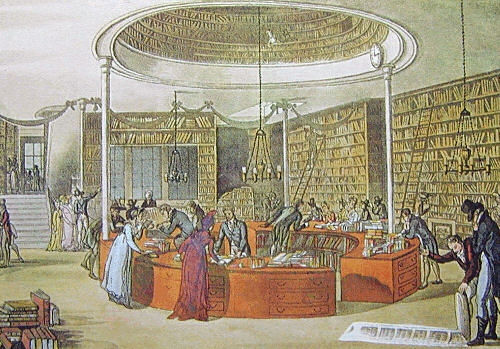
Heyer gives us what we love her for: the witty dialogue; the fashions described; the list of cant terms [ramshackle, clodpole, “the dismals” feather-headed, ninny-hammer, on-dits, bird-witted, toad-eating, etc]; the Hero and Heroine throwing all the barbs known – abominable, wretch, odious, detestable, termagant, etc.]; and Bath in all its glory – the Libraries, Assemblies, name-dropping of real residents [Madame D’Arblay, Mrs. Piozzi, the scandalous Caroline Lamb and her Glenarvon];  the political arena of the time [Rotherham is in Parliament] – all the many details that make this visit to the Bath of Regency England so very real, so very engaging, and with that Heyeresque rollicking Romance, a courtship novel with its Many Tangles to help turn the pages – Delightful!

[*Note:  Jude Morgan’s An Accomplished Woman [St. Martin’s, 2009] literally duplicates this Heyer formula and does so quite well – I recommend it!]

[Posted by Deb]

Fashion & Costume · Jane Austen · Movies · Social Life & Customs

Follow Friday ~ Fashion Exhibit at ‘Austenonly’

Well, this should be a “Follow Friday” but it’s already Saturday, so hopefully no one notices….

Please visit Austenonly for this ‘absolutely fabulous’ post:  Austen Attired: Marvellous Costume Exhibit at the Magnificent Peckover House where Julie shares pictures of the  costumes from various Austen TV and film adaptations currently on exhibit at the Peckover House in Wisbech.  For those of us unable to visit, we can be most grateful to Julie for this birdseye view of the many costumes, and to the National Trust for giving her permission to take the pictures.  A catalogue of the exhibition would be most welcome!

[wedding attire of Marianne and Colonel Brandon in S&S]

from the Austenonly website:  visit to see close-up details of these and many more fashions on display.

Books · Jane Austen · News

Jane Austen’s Steventon ~ a New Guide & a Website

Three manors? A deserted village? A lost rectory where Jane Austen spent most of her short life? And not 5 miles outside Basingstoke! There’s a new little book by Richard Tanner. Copiously illustrated, it takes the reader round the village from manor and church, past the rectory site where Jane wrote the first 3 of her 6 great novels, through today’s village and back to the start.

[text and image from the website]

There’s a new website in town! – all about Jane Austen’s Steventon.  Richard Tanner, the author of the site also offers a guide for purchase for £5.99.  Here is the link:  Steventon:  Jane Austen’s Birthplace.  Mr. Tanner gives talks and tours which include Tea in North Waltham!  Visit the site for information, a picture gallery, and an order form.

[I have yet to write my final post on the Steventon Rectory, so be on the watch… will now have to order this book and do more homework!]

[Posted by Deb]

Book reviews · Jane Austen · Regency England · Women Writers

Book Review ~ ‘The Quiet Gentleman’ at Austenprose

As mentioned in a previous post, Laurel Ann at Austenprose has been celebrating Georgette Heyer through the month of August, with various guest reviews of the novels and interviews with Heyer experts.  Laurel Ann had asked me to write a review of The Quiet Gentleman, which is posted today, and Bath Tangle which will be posted August 20th. 

Reading Georgette Heyer is a new experience for me, and the immersion has been quite enjoyable – I most like stumbling upon her Austen echoes, and they are there in her characters, her settings, her plots – Heyer greatly admired Austen amd read and re-read her through the years.  I don’t agree with those who think that Heyer is another Austen [here is a short article on the topic], but it is a lesson in influence to read Heyer’s romances [and her mysteries aren’t half-bad either!], and see where Austen touches her.

You can read the review of ‘The Quiet Gentleman’ here  at Austenprose – please visit and comment; I’ll post the full text here next week.

Jane Austen · Literature · Schedule of Events · Social Life & Customs

A Jane Austen Weekend ~ Spectacular!

“My idea of good company, is the company of clever, well-informed people, who have a great deal of conversation; that is what I call good company.”
[Jane Austen, Persuasion]

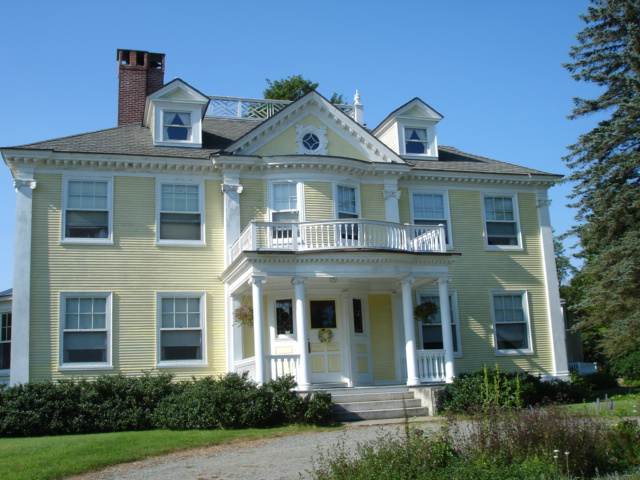
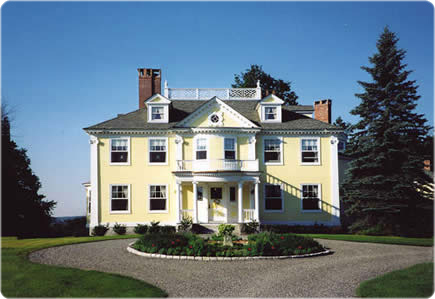
Well, just another summer weekend, lounging around in a lovely old Inn – a Victorian reproduction of a Georgian style house – in a sleepy Vermont town surrounded by mountains; being waited on by the Inn’s owner and most excellent cook for lavish breakfasts, a full Afternoon Tea, and a dinner reminiscent of the repast at the Netherfield Ball [lacking ‘white soup’ of course but that is saved for winter gatherings!]; and all this with lively discussions of Jane Austen and Sense & Sensibility late into the evening – Absolutely Perfect!

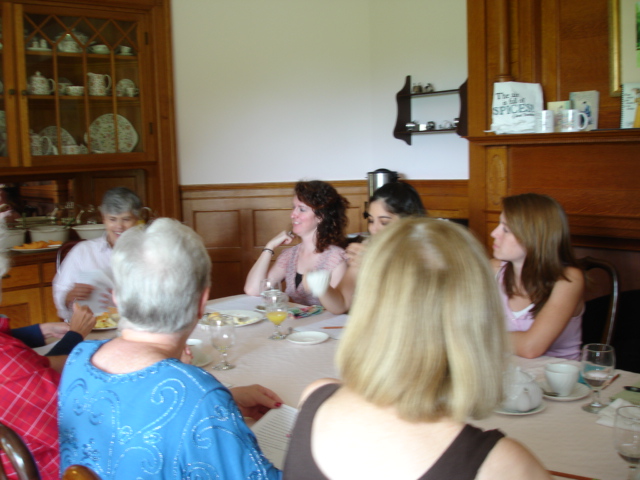
The Governor’s House in Hyde Park Vermont has been hosting these Jane Austen Weekends for the past few years – I have been to a few of the evening events and have stayed for those weekends where I was speaking – each event is made more special by the participants, people from all over who have found their way, for their very different reasons, to mingle with complete strangers and talk about Jane.  This past weekend brought a full house of fourteen people [sixteen to include Suzanne and me…] –

 *A mother celebrating her 50th birthday, her only wish for her two daughters [one still in high school, the other in college] and her two sisters to share in her love of Austen – none of them [except the Mom!] Austen readers in the least.  After being subjected to a nine-hour car ride listening to a BBC audio of S&S ALL the way, they arrived bleary-eyed and just FULL of S&S, and now I can safely say, all ready to go home to read the book! [love these convert stories!] – they win the “We’ll do anything to keep peace in the family [and this S&S thing isn’t so bad after all]” Award!

**********************************

*A couple from Minnesota [the husband one of the best sports I have yet to encounter!]  – he created a complete notebook of his wife’s ‘Jane Austen Collection’ – a bibliography of all her books, resources on the Regency period and Austen’s life, and a collection of all the emails received on their Minneapolis Region events – what a gift, a surprise no less! – and he actually really seems to be quite taken with Jane himself – though not so far as appearing in a superfine waistcoat [nor flannel for that matter!], pantaloons and hessians! – hopefully next time! – and his wife, a joy to see another so taken with Austen, re-discovering her, as so many do after the kids have left the house and there is time to reflect and savor – and she is enjoying all the recent sequels [with perhaps the exception of P&P and Zombies, a gift to her, that like me, she cannot quite get beyond that first page!] – they win the “Couples who read Austen together have a finer understanding of Love” Award!

********************************

*Another family, “dragged” away for the weekend by the elder Austen-loving daughter, good sports all – her Mother, her Aunt, and her younger sister – all cramming the reading of S&S into their busy lives over the past month [we did discover that those who were still cramming their S&S the night before the quiz, fared far better than those of us who actually have read the thing ten times!] – the Aunt came from a distance so a family reunion of sorts – they win the “Now will you finally believe me when I keep saying how wonderful Austen is” Award! [I think they believe her now…] – AND First Prize in the “Love to dress up in Regency” Award!

***************************** 

[two Austen-quoting friends with Suzanne pouring Tea]

*Two young women who love Austen, can recite most lines from the books AND movies on command [my son can do this with Caddyshack – and my goodness, how much more enjoyable to hear the quotes from Austen!], brought along the sister of one of them whose husband dropped them all off so he could mountain bike Vermont for a few days – they did their knitting and needlepoint and completed the very difficult Jane Austen puzzle in no time at all – [[but alas! the Regency dress made by hand by one of the sisters was not quite finished – she promises to wear it next time!] – they win the “We LOVE Jane Austen and want to shout it to the whole world” Award!

********************************

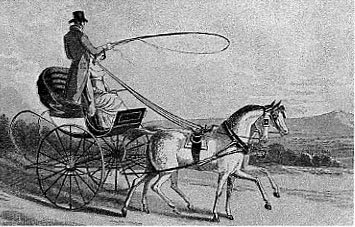
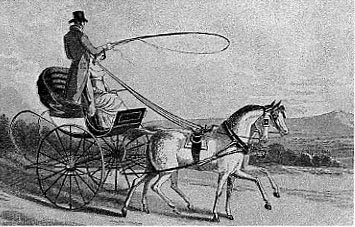
And the conversation? – Suzanne talked about the “lay of the land” during this Regency period – the government, town and village life, domestic life, AND the proper serving of Tea; I spoke on traveling in S&S – the economics, the distances, and the carriages of each of the characters [Willoughby and his curricle getting far too much attention] – and much discussion on who is “sense” and who is “sensibility” and what does “sensibility” mean anyway, and how does the first sentence compare to the opening line of Pride & Prejudice, and a most gruelling but laughter-inducing quiz with fabulous prizes, and of course the MOVIES – so many different opinions on each of the adaptations – Hugh Grant is to die-for to Hugh Grant is a wimp; Colonel Brandon is way cool in his waistcoat to Marianne is quite right to be disgusted with his aches and pains; Mr. Palmer we all agreed is the best of the comic characters, his wife a silly fool and more the pity for him [and Hugh Laurie got well-deserved high marks] – and though it was an S&S weekend, Colin Firth, a.k.a. Mr. Darcy was never far from the table conversation [as is quite proper] and the 2005 rendition causing quite the heated talk – endless chat, not one thought really completed, but certainly all agreeing that a more delightful weekend would be hard to come by!

On a personal note, one always finds at these gatherings how very small the world is – one group from a small town in New Jersey “I would never have heard of” which turned out to be where my college roommate grew up and I had visited it a number of times; and the mother of the other mother-daughter group was in the Army at the same place and same time that my husband and I were in the early 1970s – we were nearly neighbors!

And of course, great kudos and a hearty thank you to Suzanne who runs these weekends so beautifully, bringing so many people from all parts of the country together – new friends found in this resplendent world of Jane Austen – a step back from the 21st century for a few short days that energizes and soothes at the same time  – Jane would approve, I have no doubt  – she was there, after all…

… the Austen-era feeling certainly was helped along with a
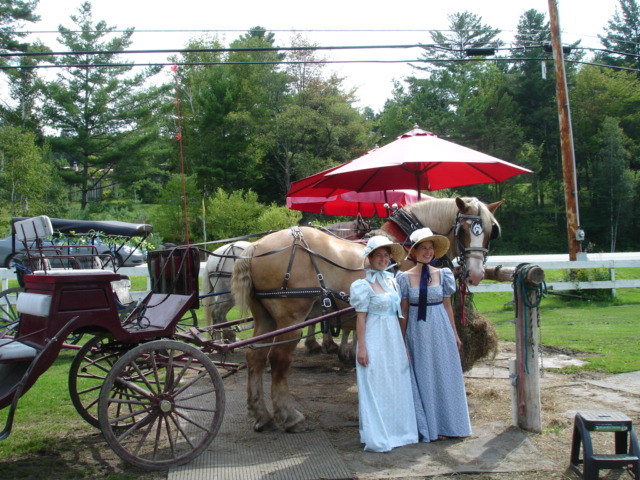
leisurely morning carriage ride through the Stowe Vermont woods…

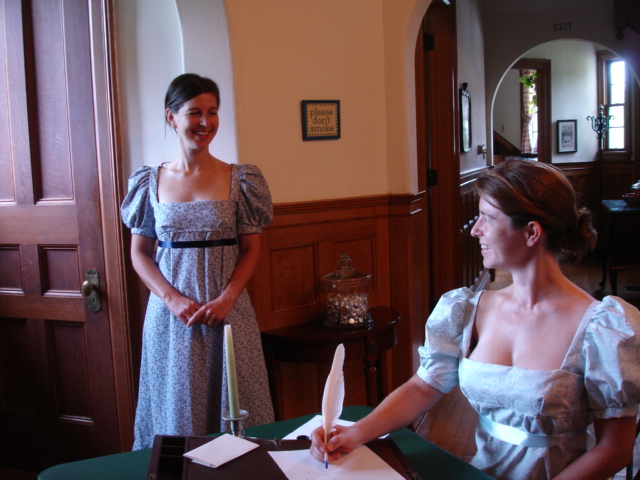
… and letter-writing exercises with quills
[but alas! no Darcy to mend our pens] …

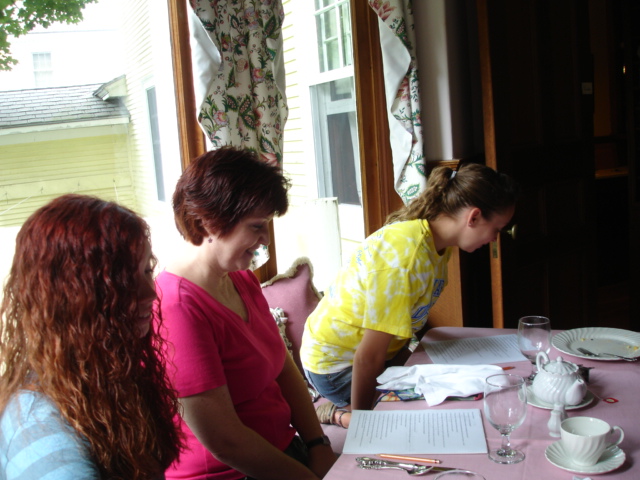
…and mulling over that very difficult quiz!

… and reading up on carriages, bonnets in hand awaiting an outing …

**********************************

Next up:  

series 3: Sense and Sensibility
Friday evening talk: Making Sense of the Regency World

Friday – Sunday, September 10 – 12, 2010
Friday – Sunday, January 7 – 9, 2011

Click here for more details and here for the Governor’s House website

[Posted by Deb] 

Book reviews · Literature

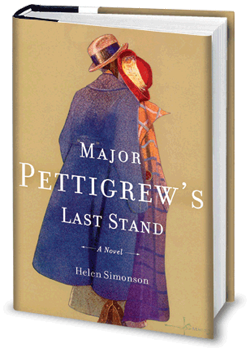
Book Review ~ ‘Major Pettigrew’s Last Stand’

Inquiring Readers:  I welcome guest blogger Janeite Lynne, a JASNA-Vermont member, who has penned a review of Helen Simonson’s Major Pettigrew’s Last Stand.  Thank you Lynne for sharing your thoughts about this book that everyone I know has been touting very loudly!

When I first began reading Major Pettigrew’s Last Stand by Helen Simonson, I wasn’t sure that I wanted to spend a whole book with Major Pettigrew, a widower and retired military man living in Somerset, England.  He seemed like a mix of Jane Austen’s minor characters—a stuffy member of the local gentry focused on his position and his guns.  But Simonson deftly lets the Major develop and come to life in the first half of the book, and I became engrossed in his story. 

The Major, (please don’t refer to him as Mr. or Ernest), is the center of the book and the reason to read it.  He is an opinionated man.

 On women drivers:  “He didn’t like being driven by a woman.  He hated their cautious creeping about at intersections, and their heavy-handed indifference to the nuances of gear changing, and their complete ignorance of the rearview mirror.”

 On Americans: Americans seemed to enjoy the sport of publicly humiliating one another.  The occasional American sitcoms that came on TV were filled with childish fat men poking fun at others, all rolled eyeballs and metallic taped laughter.”

 On the golf club: “It was a source of annoyance to the Major that what had once been a very refined black tie dance, with simple steak menu and a good band, had been turned into a series of increasingly elaborate theme evenings.” 

                                                              And…

“…it freed them from the sullen charms of waitresses who, culled from the pool of unmotivated young women being spat out by the local school, specialized in a mood of suppressed rage.  Many seemed to suffer from some disease of holes in the face and it had taken the Major some time to work out that the club rules required young women to remove all jewelry and that the holes were piercings bereft of decorations.”

As Major Pettigrew’s Last Stand opens, the Major has just learned that his only brother, Bertie, is dead.  It is through his reaction to his brother’s death, as well as his growing relationship with Mrs. Ali, a local shop keeper, that Simonson shows us Major Pettigrew as a whole person.  As he struggles with the changes in his life, his opinions become less strident and more blurred by the human relationships that he allows himself to experience. 

 Later in the novel, Mrs. Ali must make a decision to mail a letter that will likely change her life.  Major Pettigrew watches her at the postbox. 

“He never imagined so clearly the consequences of mailing a letter—the impossibility of retrieving it from the iron mouth of the box…It suddenly seemed horrible that one’s words could not be taken back, one’s thoughts allowed none of the remediation of speaking face to face.” 

Major Pettigrew’s Last Stand, for me, came down to the importance of risking the face to face relationships of life.  There are many other plot elements in the book.  There are issues of prejudice, land development, and prickly relationships between parents and children.  Simonson competently explores each of these, but her writing is at its best when she is drawing the Major and his re-entry into his emotional life.  When the book ended, I had come full circle.  I was happy in Major Pettigrew’s company, and I wanted to know what he would do next.

**********************************

Helen Simonson
Major Pettigrew’s Last Stand
Random House, 2010
ISBN:  978-1400068937

[Posted by Janiete Lynne]

Austen Literary History & Criticism · Books · Jane Austen · News · Regency England · Schedule of Events · Social Life & Customs

A Jane Austen Weekend in Vermont!

The Governor’s House in Hyde Park will be hosting another Jane Austen event this coming weekend August 13 -15, 2010  ~ topic is Sense and Sensibility.

 Jane Austen Weekend: Sense & Sensibility
The Governor’s House in Hyde Park
Friday to Sunday, August 13-15, 2010

http://www.OneHundredMain.com/jane_austen.html
802-888-6888, tollfree 866-800-6888 or info@OneHundredMain.com

 Reservations are required! 

A leisurely weekend of literary-inspired diversions has something for every Jane Austen devoteé. Slip quietly back into Regency England in a beautiful old mansion. Take afternoon tea. Listen to Mozart. Bring your needlework. Share your thoughts at a discussion of Sense & Sensibility and how the movies stand up to the book.  Attend the talk entitled ~ “Making Sense of Jane Austen’s World” * ~  Test your knowledge of Sense & Sensibility and the Regency period and possibly take home a prize. Take a carriage ride. For the gentleman there are riding and fly fishing as well as lots of more modern diversions if a whole weekend of Jane is not his cup of tea. Join every activity or simply indulge yourself quietly all weekend watching the movies. Dress in whichever century suits you. It’s not Bath, but it is Hyde Park and you’ll love Vermont circa 1800. 

  **************************

* “Making Sense of Jane Austen’s World” – Inn owner Suzanne Boden will be talking on the architecture, furnishings and other decorative arts of the Regency Period; Deb Barnum of JASNA-Vermont [yours truly] will be talking about travel in the late 18th and early 19th century – the horse and carriage era – and how Austen’s characters travelled in Sense & Sensibility – [and there is a lot of moving about in this book!]

*Or come for just an afternoon or evening and choose from these activities:

  • Informal Talk with Coffee and Dessert, Friday, 8:00 p.m., $14.00
  • Afternoon Tea, Saturday, 3:00 p.m., $20.00
  •  Book Discussion and Dinner, Saturday, 7:00 p.m., $35.00
  •  Jane Austen Quiz and Sunday Brunch, Sunday, 11:30 a.m., $15.00
  • All four activities: $75.00

The Governor’s House in Hyde Park
100 Main St
Hyde Park, VT 05655
http://www.OneHundredMain.com/jane_austen.html
802-888-6888, tollfree 866-800-6888 or info@OneHundredMain.com

**If you cannot make this weekend, make a note on your calendars of the  following dates as well:

series 3: Sense and Sensibility
Friday evening talk: Making Sense of the Regency World

Friday – Sunday, September 10 – 12, 2010
Friday – Sunday, January 7 – 9, 2011

******************************

and for your 2011 calendar:

series 4: Persuasion
Friday evening talk: Captain Wentworth’s Royal Navy
Friday – Sunday, January, 28 – 30, 2011
[other dates TBA]

Austen Literary History & Criticism · Book reviews · Books · Collecting Jane Austen · Jane Austen · Publishing History

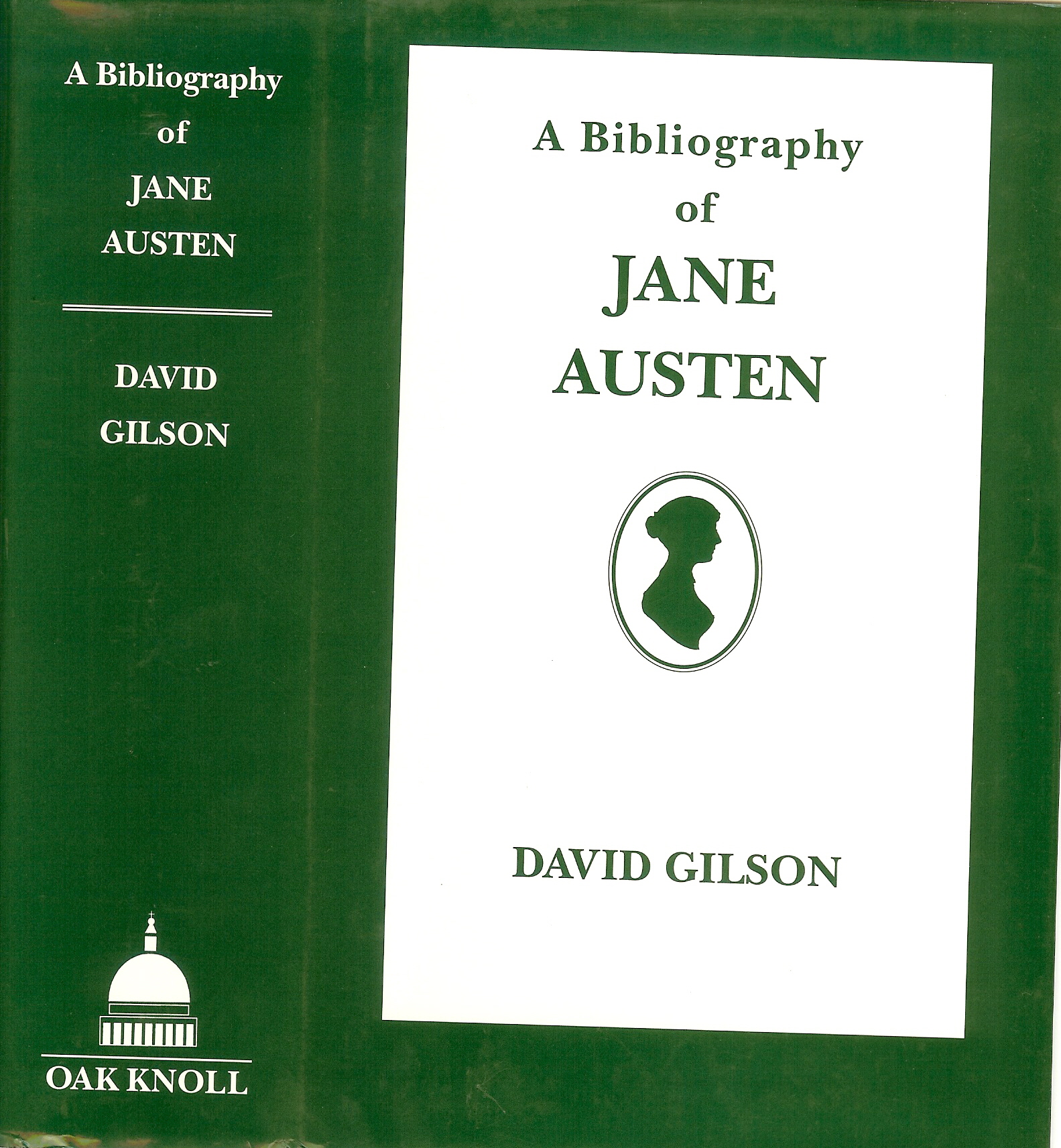
Your Jane Austen Library ~ Gilson’s Bibliography ~ a Review

Gilson, David.  A Bibliography of Jane AustenNew Introduction and Corrections by the Author.  Winchester: St. Paul’s Bibliographies  / New Castle, Delaware: Oak Knoll Press, 1997.

***********************

 I am often asked what I would consider the most important book to add to ones own “Jane Austen Library.”  Primary sources of course, the Chapman Oxford set of all the novels, minor works, juvenilia, etc – these volumes remain the source for citation in any scholarly work.  The new Cambridge edition would be lovely, but presently beyond my pocketbook, so the local University Library suffices for this ;  though I do wonder when this edition of the works will supplant the Chapman for citation purposes – shall start saving now…

But after that, what?   I would choose and most highly recommend David Gilson’s Bibliography of Jane Austen.  Originally published in 1982, Gilson had set out to revise and update the Sir Geoffrey Keynes’ 1929 Nonesuch Press Austen bibliography, after discovering the lack of information in the Keynes relating to the early American editions of Austen’s works.  Gilson wrote about these and other discoveries of the various early translations in his articles for The Book Collector.  At Keynes’ suggestion, Gilson began a second edition but found it best to present a whole new work based on Keynes but with much additional information and to include the work of Chapman in his 1955 Austen bibliography.  The 1997 edition is not a revision of the 1982 work but does include a new introduction, corrections, some additions, and a brief bibliographic essay on material published since 1978It is less physically attractive and lacks the frontispiece illustrations of the 1st edition, but I consider this very comprehensive work [at 877 pages!] the starting point for all Austen research. Gilson writes a very informative essay prefacing each of the twelve chapters, includes a chronological listing of editions and reprints and an exhaustive index that links back to all the entries.

I offer here a brief capsule of each of these chapters:  

A.  The Original Editions:  Gilson follows the principles set down by Philip Gaskell in his New Introduction to Bibliography [1972] and the entry for each original edition is exhaustive: full bibliographical details of the physical book [title; collation; contents; technical notes on the paper, printing, headlines, chapter headings and endings, binding; etc]; its publishing history; reviews and contemporary comments; later publishing history; auction records [fascinating!]; listing of copies examined; and other copies known to exist. [I LOVE this stuff!] 

B.  First American Editions:  as Austen mentions nothing about foreign editions of her work, Gilson assumes she knew nothing about the Emma that was published by Matthew Carey in 1816, a very rare edition, and unknown of by the earlier bibliographers – [Gilson B1].  Gilson again gives full bibliographical data as for the original editions, noting the textual variations in punctuation and spelling. 

C. Translations:  as Gilson states, despite that “JA’s opinion of the French seems not to have been high [citing her letter of Sept  8, 1816]…the French first paid her the compliment of translating her novels in 1813 and 1815.” [Gilson, p. 135]  Same full bibliographic details here for the various translations. 

D.  Editions Published by Richard Bentley:  no reissue of Austen’s novels is known after 1818 until 1832 when Richard Bentley decided to include them in his series of Standard Novels [quoting Chapman].  The copyrights had been sold to him by Cassandra for £210 and the P&P copyright was purchased from Egerton for £40.  [Gilson, p. 211]  Covers all the Bentley editions through 1882, with bibliographical details. 

E.  Later Editions and Selections:  lists “as far as it has been practicable” all other later editions of the novels from the 1830s onwards, with cursory bibliographical details and a focus on the statistical details for these editions, excepting the “textually significant edition edited by Chapman (E150)” [Gilson, p. 238] – there are 425 entries in this section. 

F.  Minor Works:  great literary history here! – with complete bibliographical details for Lady Susan, The Watsons, Charades, Love & Freindship, Sanditon, “Plan of a Novel”, Persuasion chapters, Prayers, the Juvenilia, etc. 

G.  Letters:  Brabourne, Bodley Head, Chapman editions, Le Faye coming later [the new 3rd edition, in 1995] 

H.  Dramatisations:  Gilson states that in 1929 Keynes could only find three dramatic adaptations, but fifty are listed here, and only those that are published works, and surprise of surprises, P&P being the most popular. [Gilson, p. 405]

J.  Continuations and Completions  [no “I” so not skipping anything]:  Gilson lists 14, adds a good number in his 1997 update, but since then the world has been inundated with all manner of sequels, prequels, and mash-ups –  this chapter is a good starting point for some of the less known early sequels that have gotten lost in the back room library stacks – some are quite good [Brinton and Bonavia-Hunt for example]

K.  Books Owned by Jane Austen:  there is much evidence of what Austen actually read – in Chapman’s indexes and other studies on literary influences on her – but as Gilson states, “the actual copies prove more elusive” [p. 431], so these twenty entries listed are noted in some way to have been subscribed to by her or inscribed in some way – the essay here is very informative and great to learn of the provenance of some of these titles Austen owned and read.  [Note:  I have set up a page in the Bibliography section on this blog titled Jane Austen’s Reading ~ a Bibliography –  a list of all the books that Austen owned or is known to have read, compiled from various sources – it makes a great reading list! – (it is still a work in progress…)]

L. Miscellaneous:  the ever-needed catch-all and quite a little find, as Gilson says “unclassifiable miscellanea (with yet a curious fascination of their own!) [p. 449] – for example an Elizabeth Goudge short story “Escape for Jane”, a romanticized re-telling of the Harris Bigg-Wither episode (L24), a number of works adapted for children, and a few works on the Leigh-Perrot trial.

M.  Biography and Criticism:  everything from 1813 on, to include books, journal articles, reviews, etc, chronologically arranged and annotated [though not consistently], 1814 items in total, with a bibliographical essay in the updated version to touch on recent resources, ALL examined by Gilson personally.  No words here to adequately explain this section – just an amazing piece of scholarship –

Appendix:  ca chronological listing of all editions, reprints and and adaptations of JA’s works recorded in the bibliography

Index:  pp. 753-877 – exhaustive!

… but here of course is where any printed book falls short – before it hits the stands, it is outdated. Recent efforts to keep Austen bibliography current have been largely produced by Barry Roth in his three works:

  • Roth, Barry and Joel Clyde Weinsheimer.  An Annotated Bibliography of Jane Austen Studies, 1952-1972.  Charlottesville, VA: University Press of Virginia, 1973.
  • Roth, Barry. An Annotated Bibliography of Jane Austen Studies, 1973-1983.  Charlottesville, VA: University Press of Virginia, 1985.
  • __________.  An Annotated Bibliography of Jane Austen Studies, 1984-1994.  Ohio University Press, 1996.
  • __________ .  bibliographies  in Persuasions and Persuasions On-Line published annually by the Jane Austen Society of North America [JASNA]: each annual issue has a bibliography titled “Jane Austen Works and Studies” [and later the  “Jane Austen Bibliography”] and is available online since the 1999 bibliography appeared in the 2001 Persuasions On-Line. [Note that the bibliographies in the earlier issues of Persuasions were compiled by Patricia Latkin, and later by Latkin and Roth together, then just by Professor Roth.]

And now the Internet with such immediate access to journals and books, tons of bibliographies, etc. has made all of us capable of being completely on top of everything every minute of the day – but for me, there is nothing quite like going to my Gilson to get back to those earlier days of bibliography, when a scholar such as he lovingly handled each work and made the effort to describe with such fullness each edition so it may become present before you [because you certainly cannot afford them!] and thus we are brought a little bit closer to the Austen we all love and admire – indeed, we can feel as excited as she did upon receipt of her own first copy of Pride & Prejudice as she exclaimed to Cassandra I want to tell you that I have got my own darling Child from London “ [Le Faye, Letter 79, p. 201]

If you don’t have this book, get it – it makes for fascinating reading! [I confess to being a librarian and I know we are all a little bit weird about this bibliography and classification thing, but this book will give you much to ponder, trust me…]

Further Reading:

  • Chapman, R.W.  Jane Austen:  A Critical Bibliography. 2nd ed.  London: Oxford University Press, 1969.
  • Keynes, Geoffrey.  Jane Austen:  A Bibliography.  NY:  Burt Franklin, 1968 [originally published in London, 1929]
  • The Roth bibliographies noted above 

A few other sources, mostly Gilson, though not a complete list:

  • Gilson, David.  “Auction Sales,” in A Jane Austen Companion, ed. J. David Grey.  NY:  Macmillan, 1986.  See also his “Editions and Publishing History,” “Obituaries, “ and “Verses” in this same volume.
  • ____________. “Books and Their Owners: Some Early American Editions of Jane Austen.” Book Collector 48 (1999): 238-41.
  • ___________. “The Early American Editions of Jane Austen.”  The Book Collector 18 (1969): 340-52.
  • ___________. “Henry Austen’s ‘Memoir of Miss Austen,” Persuasions 19 (1997):12-19.
  • ___________. “Later Publishing History with Illustrations” in Jane Austen in Context, ed. Janet Todd. The Cambridge Edition of the Works of Jane Austen, Cambridge University Press, 2005.      
  • ____________.  Putting Jane Austen in Order.  Persuasions 17 (1995):12-15
  • ____________.  “Serial Publication of Jane Austen in French,” The Book Collector 23 (1974): 547-50.
  • Latkin, Patricia.  “Looking for Jane in All the Wrong Places: Collecting Books in Gilson’s Category J.”   Persuasions 15 (1993):  63-68.       

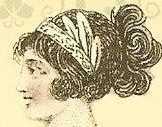
[Image from Ackermann’s via hibiscus-sinensis.com]

* I will be posting occasional reviews of books recommended “For Your Austen Library” – these will be listed on the bibliography page so titled.  You can also visit the the other Bibliography pages for more reading recommendations.

[Posted by Deb]

Jane Austen · Regency England · Social Life & Customs

So What the Heck are ‘Holland Covers’, anyway??

One of my most favorite scenes in a movie is the opening of the 1995 Persuasion  and the slow-motion laying on of the “holland covers” to protect all the Kellynch furniture as the Elliots retrench to Bath.  One can read just about any book of historical fiction and see this term used to refer to furniture coverings:  “shrouded in holland covers” or some such reference [just google ”holland covers” and you will see what I mean – even Balzac used the term!]  It is such a common reference in today’s historical fiction writings, and one reads along, knowing what it means, but where does the term come from? and most important of all, did Jane Austen ever use the term? 

 I have a book titled Regency Furniture, by Clifford Musgrave [any relation to The Watson’s Tom?], and there is much on Henry Holland, and I recall when I first bought this book that I thought perhaps this is where the term originated – Holland designed furniture, so coverings for said furniture could be called ‘holland covers’ – no?  Holland was the architect appointed by the Prince Regent [then the Prince of Wales] to rebuild and refurbish Carlton House, the Prince’s London establishment since 1783.  Carlton House was subjected to an endless series of alterations to the building and the furnishings for the next forty years, all to end in demolition in 1827.  But Mr. Holland is a topic for another post [he was the pupil and assistant of the landscape architect ‘Capability’ Brown and married his daughter Bridget, designed the PR’s Marine Pavilion in Brighton, laid out parts of the development of the fashionable Knightsbridge and Chelsea areas of London [including Sloane Square where Austen’s brother Henry lived] – so he will make a most interesting topic in his own right…] – but indeed he has nothing to do with ‘holland covers’ ….  But it is this thought that got me to wonder at its meaning…

Now,  if you search “Holland covers” on the ever-reliable, all-knowing, all-seeing internet, barely anything comes up, and certainly not an image in sight –  to whit: 

*There is a link to a description of the above-mentioned Persuasion

At the begining, we see Anne Elliot (Sally Hawkins) going through the rooms of her home, Kellynch Hall, as harried servants are trying to pack up, and placing holland covers on the furniture. She is marking items on lists and trying to direct the servants.

*A link to an online Google book  from 1909, Mrs. Wilfrid Ward’s Great Possessions, with chapter 33 titled “Brown Holland Covers”  [the full text is here in the event you cannot resist the whole book…]

*And Edith Nesbit makes mention of them here in her The Enchanted Castle.  

*There is a short advertisement in an 1856 edition of Punch, that is quite funny: 

 A MAD WAG’S ADVERTISEMENT.

 We beg leave to call the attention of ProFessor Owen to the very contradictory animal referred to in an extraordinary advertisement, relating to a Bath chair, which we are told “may be drawn by either a man or pony, painted maroon, lined with drab cloth and holland covers.” We can understand the possibility of painting either a man or a pony “maroon,” though we shonld question the good taste or the utility of applying such a mode of external decoration to either animal ; but that either of t them should be “lined with drab cloth and holland covers ” is a phenomenon we at once pro! nounce incredible. It is true that a man’s stomach has a coat, and so we presume has a pony’s, which may account in some degree for the very whimsical notion of a man or pony ” lined with cloth ;” and we hâve a faint glimmering of an idea suggestive of ” holland covers ” arising out of the tendency of an inveterate gin drinker to cover his inside with Hollands. Nevertheless, the advertisement is so odd, that if the advertiser were to take it into his head to poison half his relations, make away with himself, or steal a pound of pork sausages, we 1 dare say that no intelligent British jury would find any difficulty in pronouncing him ” Not Guilty,” on the ground of insanity.

*And from a book on Textiles in America, describing the proper way to make slipcovers, where we are told that these covers are removed for company, but that Holland, though the most durable, looks cold and chintz is thus much preferred…

*And a 1919 article in The Independent on “Summer Clothes for the House”.

[This dates me terribly I’m afraid to say, but my grandmother and mother always covered every piece of upholstered furniture in the summer with beautifully made slipcovers, holland covers being their precursor – they also rolled up all the rugs and put down lighter summer carpets and changed all the curtains to summer sheers and changed all the bedlinens [well, I still do that] and washed down all the walls – yikes!]

Now as for Austen:  I find no mention in the novels; indeed, the only reference comes up in a short tale found in the RoP’s “Bits of Ivory” section called The Key:   

He looked around at the furniture which has not seen any use for over five years, it was draped with Holland covers to keep off the dust–even though Mrs. Reynolds, being a conscientious housekeeper, regularly cleaned and dusted the room. Darcy was unaware that she often thought what a pity it was that the Master’s suite was not being used.

I can find no references in the letters, and wonder about the Juvenilia, where one would think Austen would have her heroines fainting on sofas that might be so covered…

So for me, back to the books:  A Dictionary of Costume and Fashion by Mary Brooks Picken [Dover, 1999] says the following under “Holland”: 

Closely woven linen fabric originally made in Holland.  The first Hollands were made of this fabric [i.e. a form-fitting foundation made by big establishments for special customers and used as a size guide in cutting and draping to save fittings] – a linen or fine cotton in plain weave, sized and often glazed [p. 175];

and under “Linens”:  firm, course, plain-woven, linen, unbleached or partly bleached, glazed and unglazed; originally from Holland.  Used for aprons, furniture covers, window shades, dress-form covers, etc. [p. 213]

And in Inside the Victorian Home: A Portrait of Domestic life in Victorian England, by Judith Flanders [Norton, 2004]:  

As the second half of the century progressed, hygiene became the overriding concern.  Mrs. Panton, still distressed about bedroom carpets, remembered a carpet that had spent twenty years on the dining room floor, “covered in Holland in the summer,” and preserved from winter wear by the most appallingly frightful printed red and green ‘felt square’ I ever saw.” [with a note:  Holland was a hard-wearing linen fabric, usually left undyed.  It was much used in middle- and upper-class households to cover and protect delicate fabrics and furniture.”  [p.  43] 

[quoting Mrs. Jane Ellen Panton, 1848-1923, author of many books on home decorations and home economics, her From Kitchen to Garret, published in eleven editions in ten years!]

And now I see that searching ‘holland linen’ and ‘holland cloth’ is more productive: 

*Here being the whole history of Dutch linen at A Fabric Collector’s Diary

*And at ehow.com, a definition and a picture of plain old linen: 

Holland linen is a plain-woven linen fabric that is treated with oil and starch, making it opaque and hard for the sunlight to penetrate. This quality makes it well-suited for use in making window shades and lampshades.


*And even at British History Online, we find history of the import of holland linen:   

Holland and its neighbours were major producers of LINEN of all grades, the finest of which was usually designated simply as HOLLAND or HOLLAND CLOTH. It was much used for making the highest quality of NAPERY and BED LINEN above those made of DIAPER, HUCKABACK, FLAXEN CLOTH, HEMPEN CLOTH and TOW.

OED earliest date of use: 1617

Found described as PLAIN

[From: ‘Hobnail – Holliwortle’, Dictionary of Traded Goods and Commodities, 1550-1820 (2007)]

*And on this side of the pond at the MFA in Boston – their CAMEO site on materials: 

Material Name: holland cloth : 

Originally, the name for any fine, plain-weave, linen cloth manufactured in the Netherlands. Holland cloth now refers to a plain-weave cotton or linen fabric made opaque by fillers, sizing, and/or glazing. It is typically sized with starch, then glazed with a filled oil. Holland cloth is used for window shades, lamp shades, bookbinding, upholstery, labels, and gummed tapes.

 And so it goes – this search, much like my previous short post on the Steventon Rectory that started from a real estate ad and resulted in two posts and is still to be updated with new and amazing information – has just opened a huge can of worms – I just want to find an IMAGE of a piece of furniture in “holland covers” – if anyone has such, and there MUST be one out there somewhere, please email me the link – I will be forever grateful, and can thus bring this post to a close… and lacking holland covers, I am having this awful feeling of the need to vacuum and dust…

Austen Literary History & Criticism · Jane Austen · Literature

Andrew Lang’s ‘Letter to [a dead] Jane Austen’

Andrew Lang’s Letters to Dead Authors  [NY:  Scribner’s, 1889, c1886] is one of my favorite little books [because I like and collect little books, love Andrew Lang, as in Fairy Book fame, and love the title – my book is a very dark green with gilt lettering, has a Greek myth book-plate and a few notes from a previous owner penned in a beautiful calligraphic hand].

Lang (1844-1912) was one of the most prolific and versatile writers of his day – a poet, essayist, reviewer, biographer, bibliographer, historian, translator, editor, and anthropologist [1] – known mostly today for his Homeric scholarship, and his series of lovely Fairy Books [the first in 1889 was The Blue Fairy Book, followed by eleven others[2] which did much to revive interest in fairy tales.
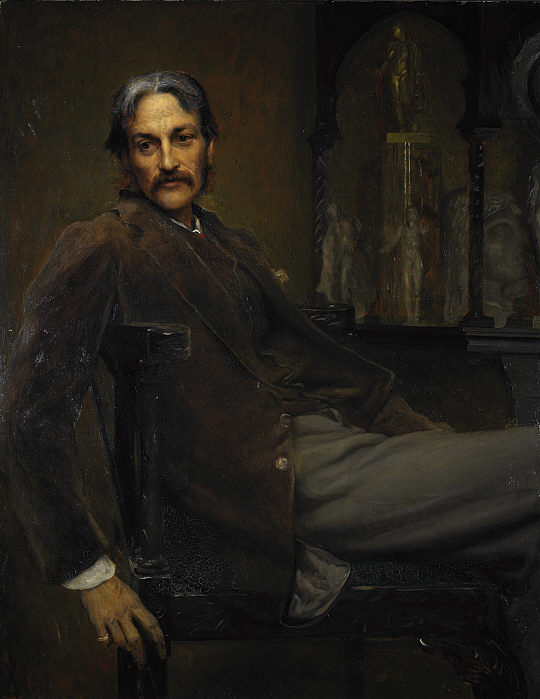
[Andrew Lang, 1855 portrait by Sir William Blake Richmond,
Scottish National Gallery, from adelaide.edu]

 But I bought this book many years ago because of chapter VIII, “To Jane Austen”, though the other essays are certainly deserving of a read: 

Contents:  Preface

  1. To W. M. Thackeray
  2. To Charles Dickens
  3. To Pierre De Ronsard
  4. To Herodotus
  5. To Mr. Alexander Pope
  6. To Lucian of Samosata
  7. To Maitre Francoys Rabelais
  8. To Jane Austen
  9. To Master Isaak Walton
  10. To M. Chapelain
  11. To Sir John Manndeville
  12. To Alexandre Dumas
  13. To Theocritus
  14. To Edgar Allan Poe
  15. To Sir Walter Scott, Bart.
  16. To Eusebius of Caesarea
  17. To Percy Bysshe Shelley
  18. To Monsieur De Molie’re, Valet De Chambre du Roi
  19. To Robert Burns
  20. To Lord Byron 
  21. To Omar Khayya’m
  22. To Q. Horatius Flaccus

*********************************
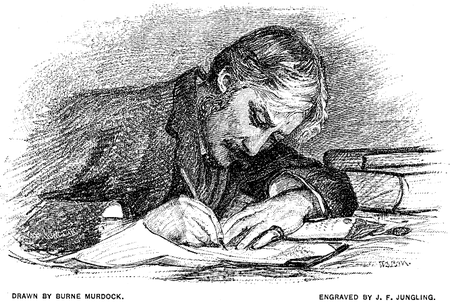
[‘Lang at Work’ from Wikisource]

You will note, of course, that Austen is the only female in the group and thus shows her status among the literary elite in 1886, the essay first appearing in the St. James Gazette.  Lang remarks in his preface the “it is, perhaps, superfluous to add that some of the Letters are written to suit the Correspondent than to express the writer’s own taste or opinions.” [p. vi].  I append here the full text, as it is available in numerous online versions.  Lang offers a humorous critique of Austen’s critics, as Brian Southam suggests, Lang’s own comments voicing those of Anne Thackeray and reiterating the ”cloying tradition” of Austen criticism.[3]  So whatever Lang’s intent, I think his words still stand today to those who think that “nothing happens in Austen” – his thoughts on Lydia or Kitty as heroines is one of the many chuckles in these few short paragraphs – 

With Lydia for a heroine you might have gone far; and, had you
devoted three volumes, and the chief of your time, to the passions of Kitty, you might have held your own, even now, in the circulating library. How Lyddy, perched on a corner of the roof, first beheld her Wickham; how, on her challenge, he climbed up by a ladder to her side; how they kissed, caressed, swung on gates together, met at odd seasons, in strange places, and finally eloped: all this might have been put in the mouth of a jealous elder sister, say Elizabeth, and you would not have been less popular than several favourites of our time.  [p. 79]

 **********************

So, read this, it is not that long, and comment if you will, please!

 VIII.  To Jane Austen

Madame,–If to the enjoyments of your present state be lacking a view of the
minor infirmities or foibles of men, I cannot but think (were the thought
permitted) that your pleasures are yet incomplete. Moreover, it is certain
that a woman of parts who has once meddled with literature will never wholly lose her love for the discussion of that delicious topic, nor cease to relish what (in the cant of our new age) is styled ‘literary shop.’ For these reasons I attempt to convey to you some inkling of the present state of that agreeable art which you, madam, raised to its highest pitch of perfection.

As to your own works (immortal, as I believe), I have but little that is
wholly cheering to tell one who, among women of letters, was almost alone in her freedom from a lettered vanity. You are not a very popular author: your volumes are not found in gaudy covers on every bookstall; or, if found, are not perused with avidity by the Emmas and Catherines of our generation. ‘Tis not long since a blow was dealt (in the estimation of the unreasoning) at your character as an author by the publication of your familiar letters. The editor of these epistles, unfortunately, did not always take your witticisms, and he added others which were too unmistakably his own. While the injudicious were disap-pointed by the absence of your exquisite style and humour, the wiser sort were the more convinced of your wisdom. In your letters (knowing your correspondents) you gave but the small personal talk of the hour, for them sufficient; for your books you reserved matter and expression which are imperishable. Your admirers, if not very numerous, include all persons of taste, who, in your favour, are apt somewhat to abate the rule, or shake off the habit, which commonly confines them to but temperate laudation.

‘T is the fault of all art to seem antiquated and faded in the eyes of the
succeeding generation. The manners of your age were not the manners of to-day, and young gentlemen and ladies who think Scott ‘slow,’ think Miss Austen ‘prim’ and ‘dreary.’ Yet, even could you return among us, I scarcely believe that, speaking the language of the hour, as you might, and versed in its habits, you would win the general admiration. For how tame, madam, are your characters, especially your favourite heroines! how limited the life which you knew and described! how narrow the range of your incidents! how correct your grammar!

As heroines, for example, you chose ladies like Emma, and Elizabeth, and
Catherine: women remarkable neither for the brilliance nor for the degradation of their birth; women wrapped up in their own and the parish’s concerns, ignorant of evil, as it seems, and unacquainted with vain yearnings and interesting doubts. Who can engage his fancy with their match-makings and the conduct of their affections, when so many daring and dazzling heroines approach and solicit his regard?

Here are princesses dressed in white velvet stamped witla golden fleurs-de-lys –ladies with hearts of icc and lips of fire, who count their roubles by the
million, their lovers by the score, and even their husbands, very often, in
figures of some arithmetical importance. With these are the immaculate
daughters of itinerant italian musicians, maids whose souls are unsoiled
amidst the contaminations of our streets, and whose acquaintance with the art of Phidias and Praxiteles, of Daedalus and Scopas, is the more admirable,
because entirely derived from loving study of the inexpensive collections
vended by the plaster-of-Paris man round the corner. When such heroines are wooed by the nephews of Dukes, where are your Emmas and Elizabeths? Your volumes neither excite nor satisfy the curiosities provoked by that modern and scientific fiction, which is greatly admired, I learn, in the United States, as well as in France and at home.

You erred, it cannot be denied, with your eyes open. Knowing Lydia and Kitty so intimately as you did, why did you make of them almost insignificant characters? With Lydia for a heroine you might have gone far; and, had you devoted three volumes, and the chief of your time, to the passions of Kitty, you might have held your own, even now, in the circulating library. How Lyddy, perched on a corner of the roof, first beheld her Wickham; how, on her challenge, he climbed up by a ladder to her side; how they kissed, caressed, swung on gates together, met at odd seasons, in strange places, and finally eloped: all this might have been put in the mouth of a jealous elder sister, say Elizabeth, and you would not have been less popular than several favourites of our time. Had you cast the whole narrative into the present tense, and lingered lovingly over the thickness of Mary’s legs and the softness of Kitty’s cheeks, and the blonde fluffiness of Wickham’s whiskers, you would have left a romance still dear to young ladies.

Or again, you might entrance your students still, had you concentrated your attention on Mrs. Rushworth, who eloped with Henrv Crawford. These should have been the chief figures of ‘Mansfield Park.’ But you timidly decline to tackle Passion. ‘Let other pens,’ you write, ‘dwell on guilt and misery. I quit such odious subjects as soon as I can.’ Ah, _there_ is the secret of your failure! Need I add that the vulgarity and narrowness of the social circles you describe impair your popularity? I scarce remember more than one lady of title, and but very few lords (and these unessential) in all your tales. Now, when we all wish to be in society, we demand plenty of titles in our novels, at any rate, and we get lords (and very queer lords) even from Republican authors, born in a country which in your time was not renowned for its literature. I have heard a critic remark, with a decided air of fashion, on the brevity of the notice which your characters give each other when they offer invitations to dinner. ‘An invitation to dinner next day was despatched,’ and this demonstrates that your acquaintance ‘went out’ very little, and had but few engagements. How vulgar, too, is one of your heroines, who bids Mr. Darcy ‘keep his breath to cool his porridge.’ I blush for Elizabeth! It were superfluous to add that your characters are debased by being invariably mere members of the Church of England as by law established. The Dissenting enthusiast, the open soul that glides from Esoteric Buddhism to the Salvation Army, and from the Higher Pantheism to the Higher Paganism, we look for in vain among your studies of character. Nay, the very words I employ are of unknown sound to you; so how can you help us in the stress of the soul’s travailings?

You may say that the soul’s travailings are no affair of yours; proving
thereby that you have indeed but a lowly conception of the duty of the
novelist. I only remember one reference, in all your works, to that
controversy which occupies the chief of our attention–the great controversy on Creation or Evolution. Your Jane Bennet cries: ‘I have no idea of there being so much Design in the world as some persons imagine.’ Nor do you touch on our mighty social question, the Land Laws, save when Mrs. Bennet appears as a Land Reformer, and rails bitterly against the cruelty ‘of settling an estate away from a family of five daughters, in favour of a man whom nobody cared anything about.’ There, madam, in that cruelly unjust performance, what a text you had for a _Tendenz-Roman_. Nay, you can allow Kitty to report that a Private had been flogged, without introducing a chapter on Flogging in the Army. But you formally declined to stretch your matter out, here and there, with solemn specious nonsense about something unconnected with the story.’ No ‘padding’ for Miss Austen! In fact, madam, as you were born before Analysis came in, or Passion, or Realism, or Naturalism, or Irreverence, or Religious Open-mindedness, you really cannot hope to rival your literary sisters in the minds of a perplexed generation. Your heroines are not passionate, we do not see their red wet cheeks, and tresses dishevelled in the manner of our frank young Maenads. What says your best successor, a lady who adcIs fresh lustre to a name that in fiction equals yours? She says of Miss Austen: ‘Her heroines have a stamp of their own. They have a _certain_gentle_self-respect_and__humour_and_hardness_of_heart_… Love with them does not mean a passion as much as an interest, deep and silent.’ I think one prefers them so, and that Englishwomen should be more like Anne Elliot than Maggie Tulliver. ‘All the privilege I claim for my own sex is that of loving longest when existence or when hope is gone,’ said Anne; perhaps she insisted on a monopoly that neither sex has all to itself. Ah, madam, what a relief it is to come back to your witty volumes, and forget the follies of to-day in those of Mr. Collins and of Mrs. Bennet! How fine, nay, how noble is your art in its delicate reserve, never insisting, never forcing the note, never pushing the sketch into the caricature! You worked without thinking of it, in the spirit of Greece. on a labour happily limited, and exquisitely organised. ‘Dear books,’ we say, with Miss Thackeray–‘dear books, bright, sparkling with wit and animation, in which the homely heroines charm, the dull hours fly, and the very bores are enchanting.’

 *************************

[Text from ReadPrint.com; etexts also available on Mollands, Google Books, Literature Network, etc.]

______________________________________________________________________

 1. Drabble, Margaret, ed.  The Oxford Companion to English Literature. Oxford, 1985, p. 548.

 2. the Fairy Books Series:  see  MythFoklore.net for contents and various etext versions [though there is nothing like holding these books!]
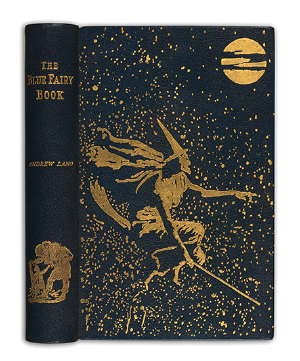
  • Blue Fairy Book (1889)
  • Red Fairy Book (1890)
  • Green Fairy Book (1892)
  • Yellow Fairy Book (1894)
  • Pink Fairy Book (1897)
  • Grey Fairy Book (1900)
  • Violet Fairy Book (1901)
  • Crimson Fairy Book (1903)
  • Brown Fairy Book (1904)
  • Orange Fairy Book (1906)
  • Olive Fairy Book (1907)
  • Lilac Fairy Book (1910)

3.  Southam, Brian.  Jane Austen: The Critical Heritage, 1870-1940.  Routledge,1996; Introduction, p.25.

*************************

Further Reading: