Jane Austen · Literature · Regency England

The Mystery of Clare Darcy

For the past year I have been interspersing my regular reading with a taste of Georgette Heyer – a delightful romp through her Regency romances – not quite done yet [gad! There are so Many! – not to mention the Mysteries and the Historicals…], and I fear as I look back that I am getting them all confused – I must learn to take better notes! – But I have taken a break for a bit, and in looking around for other such books to get my “Regency fix” [or is it the “romance”?!], I have discovered Clare Darcy – or at least discovered her books, as there seems to be cloak of complete mystery about the author.  Even the know-it-all Internet brings up little evidence:

1.  A Wikipedia entry  that only lists her books and repeats the biography given on all the novels:  “an American novelist from Ohio” 

2.  The Books Themselves:  “…her recent Regency tales have all been acclaimed as the truest successors to those of Georgette Heyer.  It is hard not to believe that Miss Darcy was born and raised in the best Society of that day – rather than in the Ohio of our own time.”   All copyright notices state either the publisher “Walker and Company” or “Clare Darcy”

3.  Rave Reviews:  “The latest addition to the author’s piquant, literate romances of life among the ton in Regency England celebrates one of Darcy’s spunkiest heroines yet” [Publisher’s Weekly on Eugenia] and “An enchanting Regency novel…which makes one rejoice in finding what could have been taken for a new Georgette Heyer novel”  [Library Journal on Victoire]

4.  A Blog Post by the Regency author Lesley-Anne McLeod  dated September 16, 2008: Ms. McLeod raises the same questions I have: Who was she?  Where is she?  Was she a “she” or a “he”?  Is Clare Darcy a penname? [it must be!], Did she write other books?  she is obviously versed in Heyer, but original and knowledgeable enough to put the reader into a living, breathing Regency world.  Ms. McLeod asks for any information, and a reader commented: “I would like to point out in the front of my book it states that ‘this is the last of the novels discovered after Clare Darcy’s death’.  It was first published in 1982.” – this last title is Caroline and Julia.  [I have the Signet paperback and it makes no such mention, so this must be in the hardcover edition; but the author note in my copy says “Miss Darcy was very much at home in her special world, Regency England” and the previous books note that “she is very much at home…” [well, at least that answers ‘where she is’]

 [and BTW, on another post, Lesley Ann lists her top dozen Regency reads:  Clare Darcy’s Lydia sits in great company at number 11; Persuasion is 6, but the list is in no particular order]

 5.  At Good Ton there is a list of all her works with character names and short summaries

6.  There are two reviews at An Evening at Almack’s:  one of Lydia and one of Victoire

7.  And finally at Fantastic Fiction, there is a list of titles with several images of book covers, but nothing else

 So, scanty information!  I’ll share some thoughts and pen a few “rapid reviews” over my next few posts [don’t want to give too much away!] – I begin with the titles of her fourteen published works [thankfully, more manageable than Heyer!] – all published by Walker, and in paperback by Signet, other various reprints, no longer in print but readily available from used booksellers.  You can also search Amazon and read a few customer reviews.

 Here’s the list: 

  • Georgina [1971]
  • Cecily: Or a Young Lady of Quality [1972)]
  • Lydia: Or Love in Town [1973]
  • Victoire [1974]
  • Lady Pamela [1975]
  • Allegra [1976]
  • Elyza [1976]
  • Regina [1976]
  • Cressida [1977]
  • Eugenia [1977]
  • Gwendolen [1979]
  • Rolande [1979]
  • Letty [1980]
  • Caroline and Julia [1982]

******************************* 


So far I have read eight of the fourteen in my continuing efforts to flunk my regular bookgroup – and now, as with my Heyer immersion, I am getting all the plot lines confused, relying on notes to keep them fresh in my mind, and now taking a much needed break [not to mention that I am increasingly frustrated with my husband for not wanting to dress in superfine blue waistcoats and a cravat in the Mathematical style, his “dark locks”  in the Stanhope Crop, and must desist in those efforts for family harmony…]

I cannot compare Darcy to Heyer – she falls short; everyone does, just as anyone trying to imitate Jane Austen, fails miserably despite best efforts.  Heyer is incomparable in plot, characterization, and laugh-out-loud humor – I first read Faro’s Daughter and at every turn of the page I yelled at myself for not Reading Her Before Now –  so I will not compare them – read Clare Darcy for herself – here too we find great plots, characters [some that jump off the page], sparkling dialogue, and almost as much humor as Heyer – there is at least one classic scene in each novel that sends you into peels, and any of the books will certainly cure you of a “fit of the dismals”!   

Some Regency Romance conventions:

 The Romance Writers of America site defines the “Romance Genre” thusly – it must comprise these two elements:   

A Central Love Story: The main plot centers around two individuals falling in love and struggling to make the relationship work. A writer can include as many subplots as he/she wants as long as the love story is the main focus of the novel. 

An Emotionally-Satisfying and Optimistic Ending: In a romance, the lovers who risk and struggle for each other and their relationship are rewarded with emotional justice and unconditional love.

 A “Regency Romance” must have these and be set for the most part in Regency England.  And what else? – these seem to be the recurring conventions , what shows up in each tale, what we expect from page one to the end [I confess to NOT being a reader of romances, so bear with me as I try to piece all this together]

1.  The Regency World of Town and Country

real settings in England, either in London and during the London Season, or in a Country house; Ireland figures here and there, and one heroine is AMERICAN from New Orleans [and thus fashioned appropriately in all the latest French fashions]; Waterloo is also prominent:  we see settings such as Vauxhall Gardens; the Covent Garden Theatres, complete with the acting greats Kean, Kemble, Siddons; the boxing saloons and gambling houses; Almack’s and its Patronesses; circulating libraries; Tattersalls and horses [“ a bang-up set of blood and bones”] and carriages [chaises and hackney coaches and fast-driven curricles and gigs] and coaching inns for traveling escapades, complete with races, mishaps and crashes; Restorative Pork Jelly makes an appearance, as does even the Prince Regent himself.

 2.  A world of Regency fashion:– where male and female dress is described in full, vivid, colorful detail, ones attention to their dress delineating their character – there is indeed an abundance of the color “puce” – the “why” of this I will persue further… 

3.  Regency language:  Miss Darcy either kept lengthy notes while reading her Heyer or she had her own “Regency Lexicon” close by – each novel is replete with Regency cant, adding to the authenticity and the humor: you can read my post on Frederica  where all I do is compile a list of Heyer’s terms –  so here I list some of Darcy’s, in no particular order [and laughing at my frustrated spell-checker’s efforts!] – you can refer to the online Regency Lexicon if you need a definition!:   

outside of enough; flummery; fustian; fall into the ropes; rake-shame; faradiddle; light-skirts; roundaboutations [my very favorite!]; Banbury Tales and Cheltenham Tragedies; bumblebroth; miff-maff; flying up into the boughs; cloth-headed; moonlings; Top of the Trees, Lady of Quality; the ton; shatter-brained; bird-witted; gudgeon; on dits and tattle-boxes; put-downs and cuts and quizzing glasses;  those requisite vapours and dismals; don’t like it above half; rag-mannered; the high fidgets; cutting a wheedle; coming to cuffs; etc.  – you get the idea – we are in Heyeresque territory here…and feel quite at home.

4.  The Heroine:  she will be independent, feisty and high-spirited; a Lady of Quality but unconventional in her behaviors, setting the tattle-boxes wagging their tongues and the Hero intrigued; sometimes wealthy in her own right, but usually in need of some assistance, either for herself or a family member and thus searching for work, rank, money, an introduction into Society, etc; always beautiful, not always a “traditional” beauty, but can be dark, or titian / chestnut or blond; usually tall and slim, but can be petite [Elyza]; will have numerous gentleman sitting at her feet, interested in all manner of coupling arrangements; knows all the dances, even the WALTZ; adept at male-dominated activities as riding, hunting, fishing, carriage driving; seems to be most adept at getting into scrapes – enter the Hero; always calls the Hero “abominable” or “wretch” and is always “crossing swords” with him [that’s how we know he is The Hero… or as Lady St. Abbs says in Lady Pamela:

You mark my words… when a woman comes to dagger-drawin’ with a man every time she meets him, there’s mischief in it! [p.126]

5.  The Hero:  usually wealthy, either by birthright or inheritance from a distant relative; always has some grand name like Lord Dalven, or Sir Derek Herington, Lord Wrexam, Viscount Northover, Cleve Redmayne [Cleve??!], the Marquis of Tarn, or Robert Ranleigh; he will be handsome but not perfectly so [compare to Lord Harlbury in Lydia, first name “Shafto”, reason enough to rule him out as Hero, but he is also “a very worthy young man – and the most beautiful creature I have ever set eyes on – and an earl – and fabulously rich-“ – but alas! NOT our Hero]; OUR Hero is handsome but this is usually coupled with a sardonic, cynical look, a darkening brow; mostly dark locks, occasionally fair, with grey or black eyes; dressed like a dandy in the fashion of the moment, but detached enough from his own appearance to be attractive not foppish, with only the occasional grab for his snuff box – he wears a well-fitting superfine blue coat, starched neckcloths, he is ALWAYS broad-shouldered and powerfully built; he calls the heroine all sorts of charming endearments:  my girl, a chit, a vixen, hoyden, infant, brat [these can grate on my 21st century feminist leanings, but I shake it off in an effort to get into the spirit of it all…]; he is calm and rational and in control in the face of any hysteria, tribulation or catastrophe, his behavior bordering on the arrogant [those feminist sensibilities having trouble yet again…]; often languid with a “drawl” in speaking; a sense of humor, but has a “dangerous look” when pushed to the limit; is an accomplished boxer and knocks adversaries to the ground in one blow; and of course is an experienced whip.  In short, the perfect man for us all… except for that horrible gossip-feeding reputation as… a Rake…


6.  Other Characters:  often a sibling of the heroine in need of Help, can be a bit “bird-witted”; the Other Men, hanging about the Heroine, often Mama’s boys, dandies, or wimps; those gossipy Matrons of the ton, and the Mothers with marriageable daughters a la Lady Catherine de Bourgh; a coterie of landladies, butlers, cooks, maids, grooms and tigers, each with their own personality that propel the plot, add the humor, and give the main characters someone to sound off to, play off of…

7.  Like in Heyer, everything is revealed in the Eyes of the Hero – the gleam; the odd light; the intense warmth; the laughing eyes; the eyes that are alight; the hard grey eyes strangely softening… etc…

 8.  The Consummate Ending: the thickened voice of the hero; the melting heroine weak in the knees suddenly unable to look The Hero in the face; the “ruthless” nearly crushing embraces; the “violent” kisses… I could go on but won’t – you must read each ending…

 9. And Austen? – well of course, all these Heroes are made of Darcy’s [as in Fitzwilliam] cloth, so Austen is everywhere really – but in Lady Pamela there is this wonderful reference to Sir Charles Grandison by The Hero: 

In love with him! No, no – you mean you made up your mind to have him when you were a schoolroom chit and hadn’t any more idea of what you wanted in a man than what you read in novels.  And I must say Babcoke [another name to surely alert us to his I-am-not-the-hero status] could do Sir Charles Grandison very well if he had the least idea of what it was all about and didn’t fall asleep in the middle of it.  [p. 120]

Aah! The Hero has actually READ Sir Charles Grandison! 

And like Austen in her Letters where she freely used Capital Letters, there is a penchant in Lady Pamela for the same: it adds to the humor in the dialogue, such as “I will Get to the Bottom of This”.

A quick summary – but lest you think that all the stories are the same, be not afraid of treading into Clare Darcy’s land – each story, like most romance novels, begins on page one and by page two you have figured out who is the Heroine and who will be Her Hero, and I suppose you could turn to the last few pages and get into all the Ending Embraces and Kisses and call it a day – but don’t do that – each story brings unique characters, fun plot lines, all that Regency chatter, the lovely fashions described, the Heroine’s adventures amidst the Society constraints on her Behavior, the Hero’s awakening to being a “marrying man” after all, and the Heroine realizing that she really has had a passion for this “abominable wretch” quite from the start – we knew it all along, but don’t pass up the ride… 

Join me for several reviews, spaced over the next few days…. 

[Posted by Deb]
Jane Austen · News

Pride & Prejudice in Utah

News Alert from Utah:  from Utah Public Radio

Jane Austen’s Pride and Prejudice has become part of the canon of Western literature, and it has a huge fan following. Why does this story still speak to us today, in both the original novel form and its many adaptations? We’ll explore the subject with four guests: two who are BYU professors and two who are integrally involved with its production at this year’s Shakespearean festival. 

 You can listen here:  Classical 89: Thinking Aloud  [click on the P&P link for June 28, 2010] 

The Utah Shakespearean Festival is staging Pride & Prejudice through August 28th, with various Austen-related events during the “Jane Austen Week” of July 19-24.  [and the JASNA Utah Region is very much involved.]

With thanks to Janeite Sylvia for this information [her son is the director!]

[Posted by Deb]

Austen Literary History & Criticism · Books · Jane Austen · Literature · Publishing History

Jane Austen’s ‘Own Darling Child’

Laurel Ann at her Austenprose blog is currently posting a month-long group read through Pride & Prejudice – do visit and join in the discussion! – she is as always an insightful reader and discussion leader, and what better way to spend the first month of summer musing on P&P and the finer points of Austen’s magic!
 
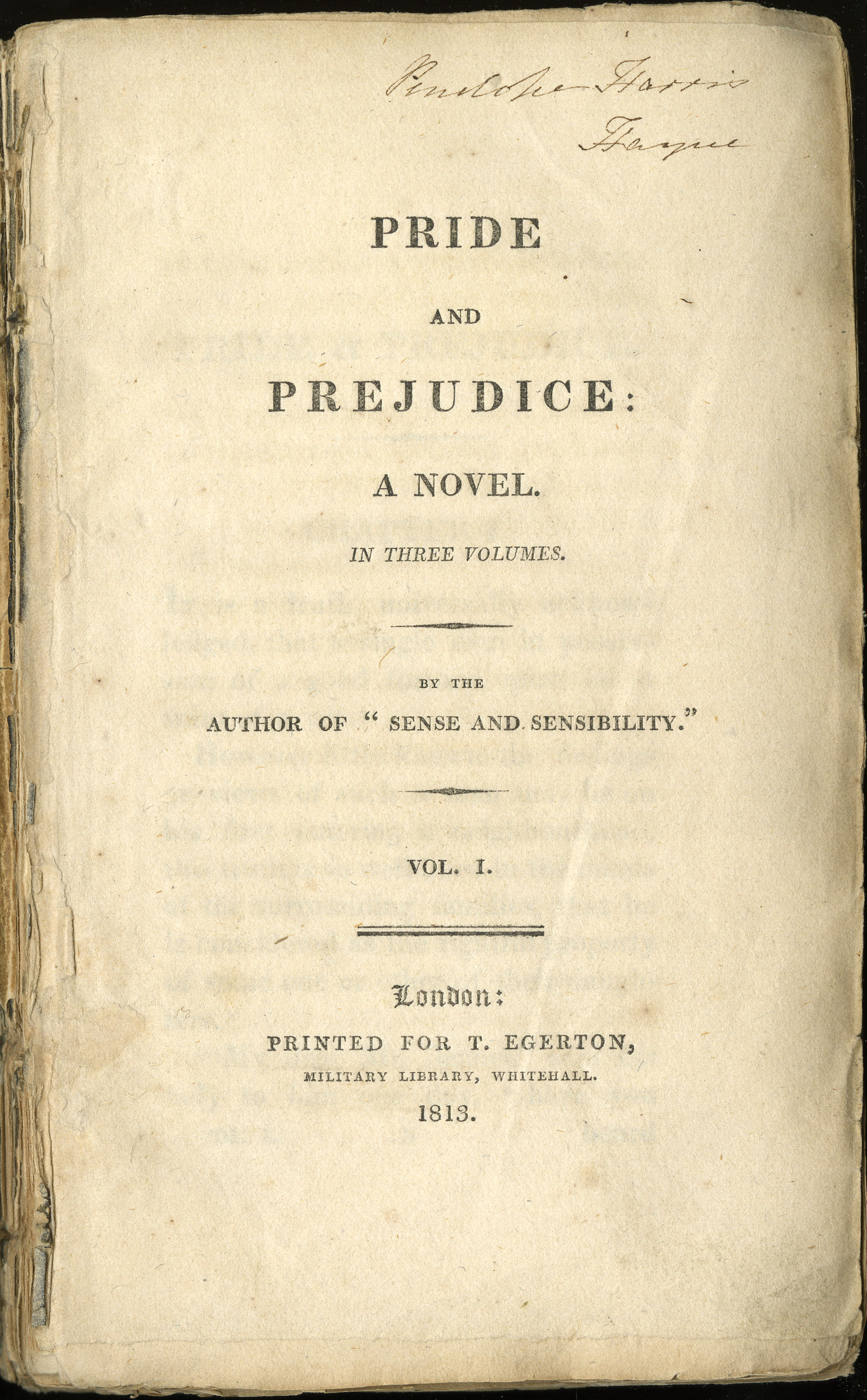
The publishing history of P&P, Austen’s most popular book, then and now, is an interesting study in the book trade of early 19th century England.  First completed in 1797 [and called First Impressions] and rejected by the publisher her father took the manuscript to, Austen reworked P&P and submitted it to Thomas Egerton, the publishing house of her Sense & Sensibility, in 1812 [published January 28, 1813].   She sold the copyright outright for £110, and did not incur other expenses in its publication, as in the three other works published in her lifetime [see links below for more information.]  How we would love to know her thoughts on this road to publication! – how we would love to have her letters written while in the process of the writing to give us some idea of her imagination at work [where WAS the model for Pemberley?  was Mr. Darcy someone REAL?  was Elizabeth Bennet her alter ego? was MR COLLINS drawn from life?], or to have the letters to her brother Henry and his to Egerton – but alas! we have nothing, just a few comments scattered among the surviving letters. 
 
Austen does not give us much in her letters as to her writing practices or narrative theory [and thus such a disappointment when they were first published, criticized for their “mundaneness,” their focus on domestic nothings and neighborhood gossip!] – but if you dig for diamonds you will find them, and these scattered mentions are certainly diamonds – it is the feeling of having her right over your shoulder when you read that she is “disgusted” with the way her mother is reading her book aloud, or that she REALLY likes this earning money for her labors, or being miffed [but also full of pride!] with Henry for telling her Secret to one and all – we see Jane Austen here in her own words – the funny, ironic, brilliant Jane Austen – never enough, but this is as good as it is going to get. 
 
So in this post I offer all the references she makes to Pride & Prejudice, her “own darling Child” – read them and enjoy!
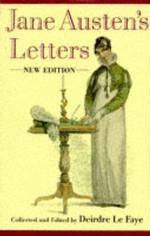
[NOTE:  page references are to Deirdre Le Faye, ed., Jane Austen’s Letters, 3rd ed., Oxford, 1997;  all abbreviations and spelling errors are retained]
 
Letter 17. January 8-9, 1799 to Cassandra, from Steventon
 
I do wonder at your wanting to read first impressions again, so seldom as you have gone through it, & that so long ago. [page 35]
 
[Le Faye notes that this is the first surviving mention of Austen’s literary work, this prototype of P&P having been finished in August 1797; Note, p. 366]
 
Letter 21. June 11, 1799,  To Cassandra, from Bath
 
I would not let Martha read First Impressions again upon any account, & I am very glad that I did not leave it in your power. – She is very cunning, but I see through her design; – she means to publish it from Memory, & one more perusal must enable her to do it.  [p.44]
 
Letter 77.  November 29-30, 1812, to Martha Lloyd from Chawton
 
P.& P. is sold. – Egerton gives £110 for it. – I would rather have had £150, but we could not both be pleased, & I am not at all surprised that he should not chuse to hazard so much. – It’s being sold will I hope be a great saving of Trouble to Henry, & therefore must be welcome to me. – The Money is to be paid at the end of the twelvemonth. [p. 197]
 
 
Letter 79.  January 29, 1813, to Cassandra from Chawton    
 
I want to tell you that I have got my own darling Child from London; – on Wednesday I received one Copy, sent down by Falknor, with three lines from Henry to say that he had given another to Charles & sent a 3d by the Coach to Godmersham; just the two Sets which I was least eager for the disposal of.  I wrote to him immediately to beg for my own two other Sets, unless he would take the trouble of forwarding them at once to Steventon & Portsmouth – not having any idea of his leaving Town before today; – by your account however he was gone before my Letter was written.  The only evil is the delay, nothing more can be done till his return.  Tell James & Mary so, with my Love. – For your sake I am as well pleased that it shd be so, as it might be unpleasant to you to be in the Neighborhood at the first burst of the business. – The Advertisement is in our paper to day [the Morning Chronicle of January 28, 1813]. – 18s – He shall ask £1-1- for my two next, & £1-8 – for my stupidest of all. I shall write to Frank, that he may not feel himself neglected.  Miss Benn dined with us on the very day of the Books coming, & in the eveng we set fairly at it & read half the 1st vol. to her – prefacing that having intelligence from Henry that such a work wd soon appear we had desired him to send it whenever it came out – & I beleive it passed with her unsuspected. – She was amused, poor soul! that she cd not help you know, with two such people to lead the way [JA and her mother]; but she really does seem to admire Elizabeth.  I must confess that I think her as delightful a creature as ever appeared in print, & how I shall be able to tolerate those who do not like her at least, I do not know. – There are a few Typical errors – & a “said he” or a “said she” would sometimes make the Dialogue more immediately clear – but “I do not write for such dull Elves” “As have not a great deal of Ingenuity themselves.”  [from Scott’s Marmion] – The 2d vol. is shorter than I cd wish – but the difference is not so much in reality as in look, there being a a larger proportion of Narrative in that part.  I have lopt & cropt so successfully however that I imagine it must be rather shorter than S. & S. altogether. – Now I will try to write of something else; – it shall be a complete change of subject – Ordination. [p. 201-2]


Letter 80.  February 4, 1813, to Cassandra from Chawton
 
Your letter was truely welcome & I am much obliged to you all for your praise; it came at a right time, for I had had some fits of disgust. – our 2d evening’s reading to Miss Benn had not pleased me so well, but I beleive something must be attributed to my Mother’s too rapid way of getting on – & tho’ she perfectly understands the Characters herself, she cannot speak as they ought. – upon the whole however I am quite vain enough & well satisfied enough. – The work is rather too light & bright & sparkling; – it wants shade; – it wants to be stretched out here & there with a long Chapter – of sense if it could be had, if not of solemn specious nonsense – about something unconnected with the story; an Essay on Writing, a critique on Walter Scott, or a history of Buonaparte – or anything that would form a contrast & bring the reader with increased delight to the playfulness & Epigrammatism of the general stile. –  I doubt your quite agreeing with me here – I know your starched Notions. – The caution observed at Steventon with regard to the possession of the book is an agreable surprise to me, & I heartily wish it may be the means of saving you from everything unpleasant; – but you must be prepared for the Neighbourhood being perhaps already informed of there being such a Work in the World, & in the Chawton World! Dummer will do that you know. – It was spoken of here one morng when Mrs. D. [Digweed] called with Miss Benn. – The greatest blunder in the Printing that I have met with is in Page 220 – Vol.3 where two speeches are made into one. – There might as well have been no suppers at Longbourn, but I suppose it was the remains of Mrs. Bennet’s old Meryton habits. [p. 203]
Mrs. George Austen
 
I had a letter from Henry yesterday, written on Sunday from Oxford; mine had been forwarded to him… he says that copies were sent to S. [Steventon] & P. [Portsmouth] at the same time as the others. [p. 204]
 
 
Letter 81.  February 9, 1813, to Cassandra from Chawton
 
I am exceedingly pleased that you say what you do, after having gone thro the whole work – & Fanny’s praise is very gratifying; – my hopes were tolerably strong for her, but nothing like a certainty.  Her liking Darcy & Elizabeth is enough.  She might hate all the others, if she would. I have her opinion under her own hand this morning, but your transcript of it which I read first, was not & is not the less acceptable. – To me, it is of course all praise – but the more exact truth which she sends you is good enough. [p. 205]
 
Yes, I beleive I shall tell Anna – & if you see her, & donot dislike the commission, you may tell her for me.  You know I meant to do it as handsomely as I could.  But she will probably not return in time [p. 205, referring to telling her niece Anna that she is the author of S&S and P&P, note p. 414]
 
…- there is still work for one evening more. [p. 206, to finish reading P&P aloud, note p. 414]
 
 
Letter 85.  May 24, 1813, to Cassandra from London
 
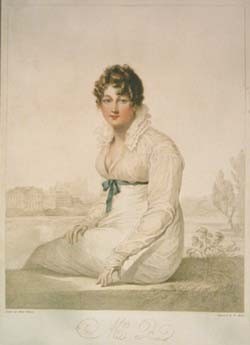
…Henry & I went to the Exhibition in Spring Gardens.  It is not thought a good collection, but I was very well pleased – particularly [pray tell Fanny] with a small portrait of Mrs. Bingley, excessively like her.  I was in hopes of seeing one of her Sister, but there was no Mrs. Darcy; – perhaps however, I may find her in the Great Exhibition which we shall go to, if we have time; – I have no chance of her in the collection of Sir Joshua Reynolds’s Paintings which now is shewing in Pall Mall & which we are also to visit. – Mrs. Bingley is exactly herself, size, shaped face, features and sweetness; there never was a greater likeness.  She is dressed in a white gown, with green ornaments, which convinces me of what I have always supposed, that green was a favourite colour with her.  I dare say Mrs. D. will be in Yellow. [p. 212] 
 
 [Portrait of a Lady, by J.F.M. Huet-Villiers]
a.k.a. Mrs. Bingley
 
 
I am very much obliged to Fanny for her Letter; – it made me laugh heartily; but I cannot pretend to answer it.  Even had I more time, I should not feel at all sure of the sort of Letter that Miss D. would write… [p. 213, referring to a letter from Fanny written to and expecting a response from Georgiana Darcy – Note p. 417]
 
We have been to both the Exhibition & Sir J. Reynolds’, – and I am disappointed, for there was nothing like Mrs. D. at either. – I can only imagine that Mr. D. prizes any Picture of her too much to like it should be exposed to the public eye. – I can imagine he wd have that sort [of, omitted] feeling – that mixture of Love, Pride & Delicacy. [p. 213]
 
 Letter 86.  July 3-6, 1813, to Francis Austen from Chawton
 
You will be glad to hear that every Copy of S.&S. is sold & that it has brought me £140 – besides the Copyright, if that shd ever be of any value. – I have now therefore written myself into £250. – which only makes me long for more. – I have something on hand – which I hope on the credit of P. & P. will sell well, tho’ not half so entertaining… [referring to Mansfield Park] [p. 217]
 
 Letter 87.  September 15-16, 1813, to Cassandra from London
 
Lady Robert [Kerr, nee Mary Gilbert] delighted with P. & P – and really was so I understand before she knew who wrote it – for, of course, she knows now. – He [Henry] told her with as much satisfaction as if it were my wish.  He did not tell me this, but he told Fanny.  And Mr. Hastings – I am quite delighted with what such a Man writes about it. – Henry sent him the Books after his return from Daylesford – but you will hear the Letter too.  // Let me be rational & return to my two full stops. [p. 218]
 
I long to have you hear Mr. H’s [Warren Hastings] opinion of P&P.  His admiring of Elizabeth so much is particularly welcome to me. [p. 221]
 
 
Letter 89.  September 23-24, 1813, to Cassandra from Godmersham Park
 
Poor Dr. Isham is obliged to admire P.&P. – & to send me word that he is sure he shall not like Mde. Darblay’s new Novel half so well. – Mrs. C. [Cooke] invented it all of course. [referring to Frances Burney’s The Wanderer, published in 1814] [p. 227]
 
 
Letter 90.  September 25, 1813, to Francis Austen from Godmerhsam Park  
 
I thank you very warmly for your kind consent to my application & the kind hint that followed it. [asking Frank if she can use the names of his old ships in her her current work, MP] – but the truth is that the Secret has spread so far as to be scarcely the Shadow of a secret now – & that I beleive whenever the 3d appears I shall not even attempt to tell Lies about it. – I shall rather try to make all the Money than all the Mystery I can of it. – People shall pay for their knowledge if I can make them. – Henry heard P. & P. warmly praised in Scotland, by Lady Robt Kerr & another Lady; – and what does he do in the warmth of his Brotherly vanity & Love, but immediately tell them who wrote it! – A Thing once set going in that way – one knows how it spreads! – and he, dear Creature, has set is going so much more than once.  I know it is done from affection & partiality – but at the same time, let me here again express to you & Mary my sense of the superior kindness which you have shewn on the occasion, in doing what I wished. – I am trying to harden myself. – After all, what a trifle it is in all its Bearings, to the really important points of one’s existence even in the World!  [p. 231]
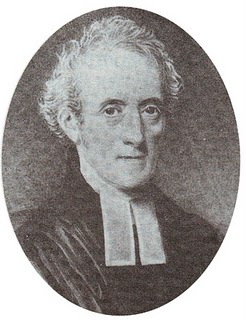
Henry Austen
 
There is to be a 2d Edition of S.&S. Egerton advises it. [p. 232, referring to her publisher]
 
 
Letter 104.  August 10-18, 1814, to Anna Austen from Chawton
 
Now we have finished the 2d book – or rather the 5th – I do think you had better omit Lady Helena’s postscript; to those who are acquainted with P.&P it will seem an Imitation. [p. 268, referring to Anna’s manuscript sent to JA for advice]
 
  
Letter 128.  November 26, 1815, to Cassandra from London
 
Mr. H is reading Mansfield Park for the first time & prefers it to P&P. [p. 301, referring to Mr. Haden, London surgeon, who brought good Manners & clever conversation]
 
  
Letter 132(Draft).  December 11, 1815, to James Stanier Clarke from London
 
My greatest anxiety at present is that this 4th work [Emma] shd not disgrace what was good in the others.  But on this point I will do myself the justice to declare that whatever may be my wishes for its’ success, I am very strongly haunted by the idea that to those readers who have preferred P&P. it will appear inferior in Wit, & to those who preferred MP. very inferior in good sense… [p. 306]
 
 
Letter 134(A).  December 27, 1815, from the Countess of Morley to JA at Chawton
 
I am most anxiously waiting for an introduction to Emma…. I am already become quite intimate in the Woodhouse family, & feel that they will not amuse & interest me less than the Bennetts [sic], Bertrams, Norriss & all their admirable predecessors – I can give them no higher praise- [p. 308]
 
************************************
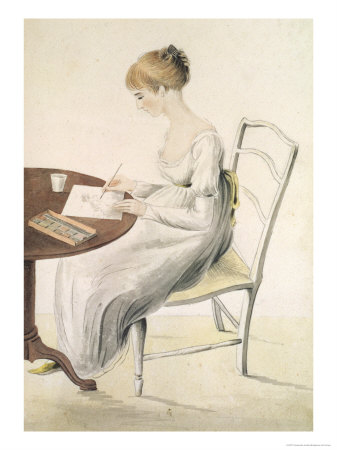
 [a letter-writing Fanny Austen-Knight by Cassandra]
Ah! indeed! – no higher praise…
 
 
Further reading:

[Posted by Deb]

Jane Austen · News

Web Round-up ~ All Things Austen!

Just to share several sites / posts recently discovered / re-discovered:

Tony Grant at his London Calling blog has written another two posts on Jane Austen:  Jane Austen and the Vicars and The Cobb and the Undercliff at Lyme Regis, complete with great photographs and Tony’s commentary.  [Visit his blog and search “Jane Austen” for his other photographic treks to Austen sites.] 

Mr. Grant has recently joined the Jane Austen Today blog as a weekly columnist – he has written on Jane Austen being fit and the recent post on Jane Austen’s World Cup football team [and thankfully we tied with the UK in the first game, though they may have won if they had had Mr. Darcy as the “goalscorer supreme’!]

Tony also alerted me to the website Geograph Britain and Ireland – a collection of photographs that represent every square kilometer of the UK.  You can search any town relating to Jane Austen and find numerous current depictions of the area:  Steventon, Lyme Regis, London, Bath, Chawton, etc… [Tony has contributed a number of his photographs as well…]

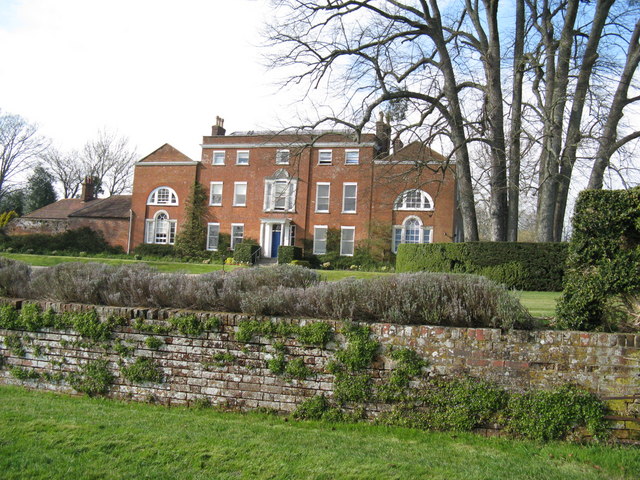
Worting House in Hampshire

[see below for the Austen connection*] 

Janeite Marti sent me this link to the Two Nerdy History Girls  post on the history of chocolate – there is a link to a video from American Heritage Chocolate on how chocolate was made in Colonial Williamsburg… YUM! –  subscribe to the “two nerdy girls” [both historical fiction writers] blog for other great articles…

Here is a great blog idea – “letters written to fictional characters by actual people” – visit the blog at Letters with Character – visit here for two Austen-related letters:  one to Elizabeth and one to Mr. Darcy. [what would YOU write to an Austen character?? ]

When Masterpiece Theatre produced and aired the Jane Austen programs two years ago, they also created “The Complete Guide to Teaching Jane Austen” which is available in a 24-page pdf file on their website – a wonderful resource for viewing and discussing all the films, not just the 2008 versions.  Print it out and settle in for another marathon film adventure!

This guide offers ideas and tips on how to teach the works of Jane Austen, using film as another avenue into her world. The guide has been organized so it can easily be adapted for various needs. Sections that explore universal themes—Novel to Film, the Art of Adaptation, Self-Discovery, Society and the Self, Satire and Irony—provide questions and activities that can be used for any of Austen’s works. Before and After Viewing questions have been provided for each film so you can thoroughly explore whatever title you choose to teach. Other features include an essay about Austen’s continued popularity, biographical information, and an exploration of the role of biography in an author’s work.

[from the PBS / Masterpiece Theatre website]

The Dolphin Hotel in Southampton where Jane Austen danced away in the “Assembly Room” has been refurbished as the Mercure Southampton Centre.  There is a “Jane Austen function room” suitable for weddings, etc., if you would like to celebrate in the same space Austen did on her 18th birthday in 1793.  Austen lived in Southampton from 1805-1809 prior to her move to Chawton in 1809.

Robert Rodi at the Bitch in a Bonnet blog that I alerted you all to awhile back, has finished his summing up of Pride & Prejudice – lovely final words, worthy of a repeat:

Every time I read Pride and Prejudice, I laugh.  It’s the laughter of philosophy; the clear, cold laughter of those who reside in the abyss but are untouched by its sweat-soaked, writhing tumult.  We laugh, because Austen lifts us above the fray and nimbly escorts us to a farther shore, where there are kindred spirits waiting.  We can’t stay there long; but we can return whenever we like…again, and again, and again, and again. 

…makes you want to run right to your bookshelf and begin it all again, doesn’t it?

And speaking of P&P, Laurel Ann at Austenprose starts her month-long reading [no mash-ups, zombies, vampires, slashing heroines for Laurel Ann – yea!! – back to the real thing for her, thank goodness…] – it all starts on June 16th, so begin your reading of chapters 1-7 NOW and join in the analysis and discussion…

Visit Gillray’s Printshop of Historical Absurdities of the 18th and 19th centuries – there are many of them, so an endless treasure chest of information…

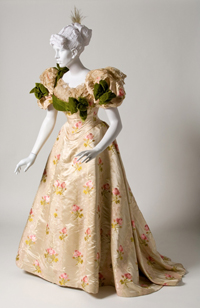
And finally, for the fashion-conscious, the Bruce Museum in Greenwich Connecticut has a new exhibit on The Dressmaker’s Art:

The Bruce Museum’s major summer exhibition, The Dressmaker’s Art: Highlights from the Bruce Museum’s Costume Collection, organized by guest curator Adrienne Saint-Pierre, features twenty-four elegant gowns and dresses along with displays of lavishly embellished accessories and underpinnings such as taffeta and lace petticoats, primarily taken from the collection of the Bruce Museum in Greenwich, Connecticut. Additional items are on loan from the Fairfield Museum and History Center.

[Ball gown, c1895, Worth, Paris]

The earliest gown is from 1820 and the exhibit displays fashions through the early 20th century – visit the Museum’s website for more information – a delight to have this exhibit here in New England!

*Jane Austen and Worting House:  A visit by Jane Austen, probably one of many unrecorded, paid on the evening of Thursday December 20 1798 and mentioned by her in a letter dated December 24 to her sister Cassandra. In it she described a ball of the Basingstoke Assembly for which the authoress to be, then in her dancing days, was staying at Manydown with her friend Catherine Bigg – one of Squire Bigg-Wither’s seven daughters.  She wrote:

I spent my time very quietly and pleasantly with Catherine. Miss Blachford is agreeable enough. I do not want People to be very agreeable as it saves me the trouble of liking them a great deal.- I found only Catherine and her when I got to Manydown on Thursday. We dined together and went together to Worting to seek the protection of Mrs Clarke with whom Lady Mildmay, her eldest son, and a Mr and Mrs Hoare………. Our ball was very thin, but by no means unpleasant………There were 31 People and only 11 Ladies out of the Number, and but five single women in the room….There were twenty dances, and I danced them all, and without any fatigue………My black cap was openly admired by Mrs Lefroy, and I secretly imagine by everybody else in the room.

[Letter 15, December 24-26, 1798, Jane Austen’s Letters, ed. Deirdre Le Faye, quoting the Bigg-Wither – Worting  House website]

[Posted by Deb]

Jane Austen · Jane Austen Circle · News · Social Life & Customs

Jane Austen’s Ipod ~ you can listen!

Three days left to listen to the BBC Radio 4 program of Jane Austen’s Ipod [first heard in January and now repeated] – here’s the link:

BBC Radio 4 Programme  – Jane Austen’s Ipod

A rare insight into the family life of Jane Austen through her favourite songs. She collected songs all her life, but many of them have only just come to light, in manuscripts inherited by one of her descendants. Jazz singer Gwyneth Herbert performs some of these songs.

Professor Richard Jenkyns inherited a pile of music manuscripts which are only just being looked at by the Austen scholars. He shows us what he found: some have been laboriously copied out by Jane herself – among the music manuscripts in Jane’s handwriting is a piano piece which he believes she composed.

David Owen Norris brings him together with scholars Deirdre Le Faye and Samantha Carrasco at Jane Austen’s house in Chawton, Hampshire. Together they cast a new light on one of our best-loved and most enigmatic writers.

Some of the songs included are:

  • A romantic song by Robert Burns, to which she changed the words, so that the final words referred to herself -“the charms of your Jane.”
  • A tragic French song, “Les Hirondelles”, which ends with imprisonment and death. Jane’s sister in law Eliza had lived in France, and her first husband was guillotined in the Terror.
  • “The Ploughboy” – a popular song of the time, witty, and with a politically subversive message about corrupt politicians who are only interested in money, and manage to buy their way into power.
  • “Goosey Goosey Gander” – Jane had a lot of nursery rhymes, and was constantly surrounded by boisterous nephews and nieces.

Producer: Elizabeth Burke
A Loftus production for BBC Radio 4.

[Image and text from the BBC site]

[Posted by Deb, with thanks to Janeite Kerri]

…AND if you happen to be around the University of Southampton on June 30th, don’t miss this Jane Austen program at Turner Sims:

Calling all Jane Austen enthusiasts!

Discover the music that influenced Jane Austen whilst writing her classic novels, as pianist David Owen Norris explores the nine newly-discovered volumes of the Austen family music collection. Entertaining Miss Austen is on Wednesday 30 June at 8pm.

David Owen Norris is Professor of Musical Performance at the University of Southampton, an Honorary Fellow of Keble College, Oxford, an Educational Fellow of the Worshipful Company of Musicians, and an authority and leading performer on early pianos and rare piano concertos. Joined by soprano Amanda Pitt, David sheds unique light on the musical loves of Jane Austen and her family.

This fascinating recital includes favourite airs and dances – and the only piece of music actually mentioned in Jane’s novels; Kiallmark’s ‘Robin Adair’, which is performed expertly by Jane Fairfax in Emma.

Tickets are £10 and free to Friends of Turner Sims.

[from the Turner Sims website]


Jane Austen · News · Schedule of Events · Social Life & Customs

Gala Event ~ Burlington Country Dancers ~ & You are Invited!

YOU’RE INVITED TO WATCH JANE AUSTEN’S FAVORITE PASTIME …


YOU’VE READ ABOUT ENGLISH COUNTRY DANCING
IN AUSTEN’S NOVELS ~ 
YOU’VE SEEN IT IN FILMS LIKE  “PRIDE & PREJUDICE”~
NOW YOU CAN SIT ON STAGE TO LISTEN TO THE BEAUTIFUL LIVE MUSIC,
WATCH THE COSTUMED DANCERS
(MANY DRESSED IN AUSTEN-ERA GARB),
AND, IF YOU LIKE, INDULGE IN TASTY REFRESHMENTS AT THE BREAK

ACROSS THE LAKE
An English Country Dance Gala
on the Vermont side of Lake Champlain

SATURDAY, JUNE 12, 2010
8 p.m. to 11 p.m.

Elley-Long Music Center
223 Ethan Allen Ave.
Colchester, VT
(in Fort Ethan Allen, off Route 15) 

Prompting by Orly Krasner
Music by Earl Gaddis ~ violin
Mary Lea ~ violin & viola
Jacqueline Schwab ~ piano
Wayne Hankin ~ woodwinds & more

SPECTATOR’S PRICE, AT THE DOOR:
$10 with sumptuous refreshments at break, $5 without


Website: www.burlingtoncountrydancers.org  
just click on Across the Lake for all the details!

[Image from the Hamilton English Dancers  website]

[From Janeite Val]

Books · Jane Austen · Literature · News · Publishing History · Rare Books

Sold to the Highest Bidder! ~ Austen on the Block…

The set of Jane Austen’s novels published by Bentley in 1833 and up for auction at Bonham’s sale today [June 8, 2010] has come under the gavel and has sold for £3,360  [= @ $4827.] [the estimate was for  £2000 – £3000 ]

Here are the details:

AUSTEN, Jane. Works, Bentley’s Standard Novel edition, 6 vol. in 5, 5 engraved frontispieces and additional titles, some light spotting to first and final few leaves, small corner tear to printed title “Pride and Prejudice”, without half-titles, ownership inscription of Eularia E. Burnaby (1856) on printed titles, bookplate of Henry Vincent, bookseller’s label of H.M. Gilbert, Southampton, uniform contemporary half calf, red and dark green morocco labels, extremities lightly rubbed [Gilson D1-D5], 8vo, R. Bentley, 1833

 Sold for £3,360 inclusive of Buyer’s Premium 

Footnote:

“No English reissue of JA’s novels is known after 1818 until in 1832 Richard Bentley decided to include them in his series of Standard Novels” (Gilson, p.211). See illustration on preceding page.

  • See the Bonham’s site here for details and other auction items in this ‘Printed Books, Maps and Manuscripts’ auction [Sale No. 17809]
  • See Laurel Ann’s post analyzing this set [along with her super sleuthing as to the provenance!] at Austenprose

Someone has gone home very happy today!  [and hopefully this has gone to either a fine institution or a fine home with an Austen-loving owner…] 

[Posted by Deb]

Jane Austen

Steventon Parsonage redux

When I wrote the previous post on the Steventon Parsonage, I looked in vain for a copy of a pamphlet I have [or was sure I had!] titled Steventon and the Austens:  Jane Austen bi-centenary 1775-1975, written by Keith Irons.  This is the souvenir booklet and programme for the July 18- July 27, 1975 Jane Austen celebration in Steventon.  Well, I could not find it, and thus did not have much data on the new Rectory that was built by Edward Knight for his son William Knight, the rector who took over the curacy from Henry Austen in 1823, or the Manor House referred to in various sources. – but as always one finds things when not actually looking for the particular item madly searched for a week ago – and so here it is, on my reading table, and has been there for a bit, out of place, but now happily found…

So I can give more information on the new Rectory that was built in 1826 after the demolition of Austen’s own home, and the subject of the auction sale in the news article found in my book.  But as you will see, I am more confused than ever! I quote from this pamphlet directly:

Edward Knight remained in possession of the estate until 1855 [Edward Knight died in 1852] when he sold it to the second Duke of Wellington, who in turn sold it in 1877 to a Mr. Henry Harris.  Mr. Harris, a man of considerable wealth, farmed the estate himself and built a substantial new manor house of red brick with cottages surrounding it, and a new farm house and outbuildings now known as Home Farm.  Before this the estate had been farmed by the Digweed family who had been tenants and had lived at the old manor house for nearly 100 years.  The estate remained in the possession of the Harris family until 1910 when it was sold to Mr. Robert Mills.  In 1932 the brick manor house was damaged by fire with the residential quarters being completely gutted.  The then owner, Mr. Onslow Fane, decided to add a new wing to the old Tudor manor rather than to rebuild the Victorian one.  [This old Tudor manor was called Steventon Manor House, and the Digweeds lived here  – Edward Knight owned it as it was part of the estate…David Cecil has a picture of this house in his Portrait of Jane Austen, but it is also misnamed as the Chawton Great House (p.159)…] 

He [Mr. Fane] lived in it briefly before the house was requisitioned by military authorities during the war, but it was never reoccupied afterwards which contributed largely to its decay, leading to its eventual demolition [in 1970].  The servant’s wing of the Victorian manor, undamaged by the fire in 1932, still stands, but it is now used only as a machinery store and barn; although it will have one brief period of glory again when it serves as a threatre during the Jane Austen bi-centenary celebrations.  [Irons, Steventon and the Austens, 1975]

 Irons says the new rectory that Edward Knight built in 1826 was on the other side of the valley on an elevated site, so this is the reference as in the previous post that is the house for sale last October.  There is mention also of the cottages that “straddled the lane toward the village” and home to Mrs. Littlewort, Jane Austen’s Nanny and mentioned in her letters.  Anna LeFroy also sketched these cottages, but they, according to Irons “disappeared in the mid 1820s, demolished for spoiling the view from the new Rectory, it would seem.”  

 I also quote here Constance Hill’s description of Steventon, the Rectory and the Manor House, in her book Jane Austen, Her homes and Friends [London 1904] – [and also titled Jane Austen: her Houses and Haunts] – the full-text of the 1923 edition is available online at A Celebration of Women Writers – read this book if you can – it is a delightful account of traveling to various Austen sites, coupled with references to Austen’s letters and works:  here is a portion of the Steventon chapters, complete with drawings: 

Leaving the park, the road turns abruptly to the right, and we find ourselves entering the sunny village of Steventon, which lies in a gentle hollow. We alight from our chaise and walk between the gardens of pretty cottages that border the road. These cottages, it seems, form the village, and passing them we proceed along Steventon Lane. A knoll, on the left, is surmounted by the new rectory, and on the right, green fields and woods cover a hillside, on the top of which, we are told, we shall find the church. Presently we reach a meadow at the foot of the hill and notice that the ground slopes up to a grassy terrace. This is the place! We cannot mistake it. This is the site of the old parsonage-house where Jane Austen was born! For her nephew tells us that “along the upper or southern side of the garden ran a terrace of the finest turf.” There is the very terrace described! We know that the house stood between it and the lane, but what is the exact site? Can no one tell us? May there not be some person yet living who remembers the parsonage pulled down in 1826?

Inspired by this idea, we hurry back to the cottages and speculate upon each open door as to what might be gained from its dark interior. At last we see an old man leaning on his garden-gate.

“Can you tell us,” we anxiously inquire, “where the old parsonage stood in which the Austen family lived long ago?”

“Ay, that I can,” he exclaims: “maybe you’ve seen the field at the corner where the church lane cooms out o’ Steventon Lane? Well, if you saw that, did you notice a pump in the middle o’ the field?”

“Yes, yes!”

“Well, that pump stood i’ the washhouse at the back o’ the parsonage. There’s a well under the pump. The Austens got their water from that well. I was a little ‘un when the old house was pulled down, but I well recollect seeing all the bricks and rubbish lyin’ about on the ground.”

“The house faced the road, did it not?” we ask.

“Yes; and the gates o’ the drive were at the corner o’ the field, between the church lane and Steventon Lane. I remember when you could make out the line o’ the drive quite well, ’cause the grass grew poor and thin where the gravel had been.”

Presently we learn that our informant’s grandfather, whose name was Littlewart, was coachman to Mr. James Austen, Jane’s eldest brother.

” I used to hear a deal about the Austens when I was a lad,” continued our friend. “from my mother, for she was a god-daughter o’ Miss Jane’s. People tell me now that Miss Jane wrote some fine stories, and I’ve just seen her name in a newspaper. I’ll go and fetch the paper for you to see.” And the old man hurries into his cottage.

Whilst he is away I refer to a volume of Jane Austen’s Letters which I carry under my arm [don’t we all do this!], to see if, by chance, the name of Littlewart occurs in any of them. Yes! here it is in one dated November 1798. Jane is writing from Steventon to a sister-in-law, and after telling her that “their family affairs are somewhat deranged” owing to illness among the servants, she goes on to say “You and Edward will be amused, I think, when you know that Nanny Littlewart dresses my hair.” It was evidently this Nanny Littlewart’s daughter that was godchild to Jane Austen. So we have been actually talking to the son of her god-daughter!

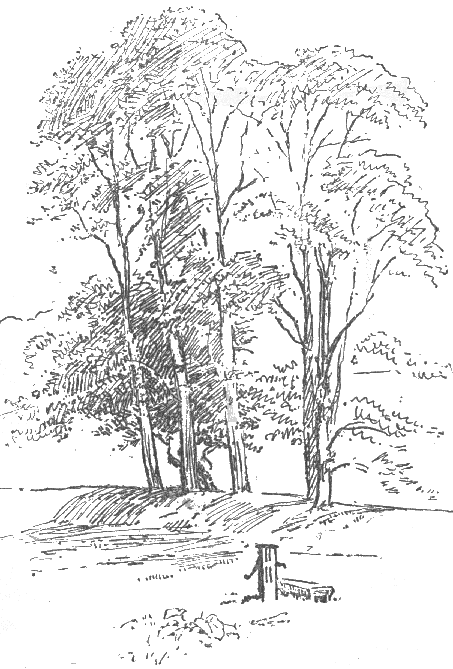
After showing proper appreciation of the newspaper paragraph, we return to the meadow where the parsonage stood. My companion sits down on a bank to sketch the terrace and the pump, for the pump, barely noticed before, has become interesting now as the only visible relic of the Austens’ home.  Meanwhile I wander over the field endeavouring to

“Summon from the shadowy past
The forms that once have been.”

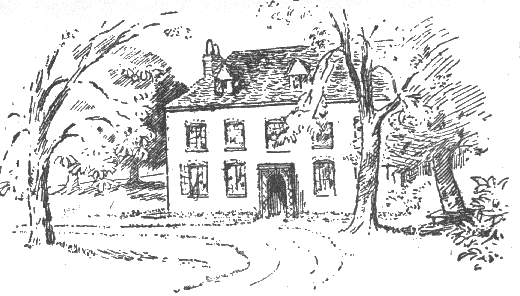
I can now picture to myself the exact spot where the parsonage stood, and can fancy the carriage drive approaching it “between turf and trees” from the gates at the corner of the two lanes. I can even fancy the house itself, being familiar with two old pencil views of it taken by members of the Austen family. These show that the front had a latticed porch, and that the back

                    STEVENTON PARSONAGE (FRONT VIEW)

had two projecting wings and looked on to the garden which sloped up to the terrace “walk.” In both sketches fine trees are introduced, and as I saunter about I notice some great flat stumps of elm-trees in the grass. The sight of these brings to mind a letter of Jane’s, written in November 1800, in which she says: “We have had a dreadful storm of wind in the fore part of this day, which has done a great deal of mischief among our trees. I was sitting alone in the dining-room  when an odd kind of crash startled me; in a moment afterwards it was repeated. I then went to the window, which I reached just in time to see the last of our two highly-valued elms descend into the Sweep!!!! The other, which had fallen, I suppose, in the first crash, and which was the nearest to the pond, taking a more easterly direction, sank among our screen of chestnuts and firs, knocking down one spruce fir, beating off the head of another, and stripping the two corner chestnuts of several branches in its fall. This is not all. One large elm, out of the two on the left-hand side as you enter what I call the elm walk, was likewise blown down; the maple bearing the weathercock was broke in two, and what I regret more than all the rest is, that all the three elms which grew in Hall’s meadow, and gave such ornament to it, are gone; two were blown down, and the other so much injured that it cannot stand. I am happy to add,” she continues, “that no greater evil than the loss of trees has been the consequence of the storm in this place, or in our immediate neighbourhood. We grieve therefore in some comfort.”[1]

The “elm walk” alluded to, which is sometimes called the “wood walk” in the “Letters,” extended from the terrace westward and led to a rustic shrubbery. The shrubbery has disappeared, but there are groups of trees on the slope of the terrace that may have shaded the “walk.” One group is especially beautiful. It consists of tall sycamores with their pale grey stems and dark green foliage, among which an old thorn has entwined its branches. We read in one of the “Letters” from Steventon: “The bank along the elm walk is sloped down for the reception of thorns and lilacs.”

Perhaps these features of her home may have been in the author’s mind when she described “Cleveland” in “Sense and Sensibility.” “It had no park, but the pleasure grounds were tolerably extensive . . . . It had its open shrubbery and closer wood walk . . . . The house itself was under the guardianship of the fir, the mountain ash, and the acacia.”

The ground between the house and the terrace “was occupied by one of those old-fashioned gardens in which vegetables and flowers are combined, flanked and protected on the east by one of the thatched mud walls common in that country, and overshadowed by fine elms.”[1] I look on the sloping grass “where once this garden smiled,” and fancy I see fruit-trees and flowers and that I even catch a glimpse of two girlish forms moving among them – those of Jane Austen and her sister Cassandra; that only sister so dear to the heart of Jane, of whom she spoke, “even in the maturity of her powers, as of one wiser and better than herself.”

We are told that a path called the “Church walk” started from the eastern end of the terrace and ascended the steep hill behind the parsonage to the church. It ran between “hedgerows under whose shelter the earliest primroses, anemones, and wild hyacinths were to be found.” Let us cross the meadow, gentle reader, where the path ran which the Austens must have trod each Sunday morning as they walked to church. Leaving the meadow, we enter a small wood, and, on emerging from this wood, find ourselves on high tableland. There above us stands the church, a modest edifice of sober grey, seen through a screen of great arching elms and sycamores. Behind us stretches a fertile valley fading into a blue distance. The only sounds that meet the ear on this still September day are the twittering of birds and the distant bleating of sheep. How often must Jane Austen have listened to these sounds as she passed on her way to church!

We follow a path which crosses the churchyard beneath the boughs of an ancient yew-tree, and enter the small silent church. Our attention is caught at once by the squire’s pew on the right of the chancel arch. Square and big and towering above the modern benches it stands – solid oak below, but with elegant open tracery above through which the occupants could see and be seen. In the Austens’ time a family named Digweed rented the Manor of Steventon. Its owner was Mr. Thomas Knight, a distant relative of the Rev. George Austen, but the Digweeds held the property for more than a hundred years.

After examining, with great interest, many tablets to Austens and Digweeds, we quit the dark church and step into the sunshine once more; and, passing through a wicket gate, find ourselves upon a wide spreading lawn adorned with great sycamores. Beyond the trees rises a stately mansion of early Tudor date, with its stone porch, its heavy mullioned windows, and its great chimney-stacks all wreathed with ivy – the old Manor House of Steventon.

The house is no longer inhabited, for the present owner, we learn, has migrated to a new mansion erected hard by, but the old building itself has suffered no alteration, as far as its outward walls are concerned, since the Digweeds lived there, when there was much intercourse between the squire’s and the rector’s families.

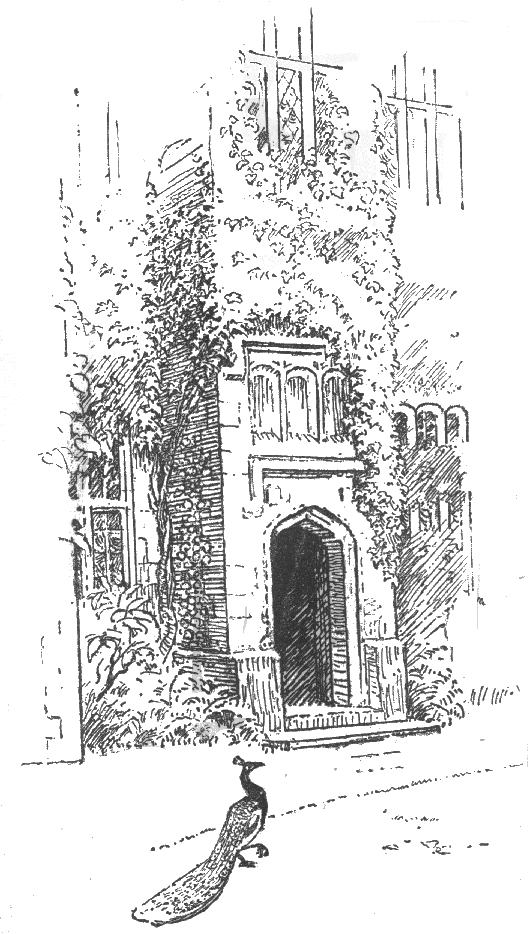
We sit down upon a grassy bank under the shade of tall limes and, looking to the right of the old grey building, we can see the corner of a gay flower garden, whose red and white dahlias and yellow sunflowers rise above a high box hedge. To our left is a bowling-green, across which the shadows of great trees are sweeping. Whilst my companion sketches the porch of the Manor House


THE OLD MANOR HOUSE

I turn over the leaves of Jane Austen’s “Letters” and my eye falls upon these playful remarks, written in November 1800 to her sister Cassandra: “The three Digweeds all came on Tuesday, and we played a pool at commerce. James Digweed left Hampshire to-day. I think he must be in love with you, from his anxiety to have you go to the Faversham balls, and likewise from his supposing that the two elms fell from their grief at your absence. Was not it a gallant idea? It never occurred to me before, but I daresay it was so.”

We are told that “Mr. Austen used to join Mr. Digweed in buying twenty or thirty sheep, and that all might be fair it was their custom to open the pen, and the first half of the sheep which ran out were counted as belonging to the rector. Going down to the fold on one occasion after this process had been gone through, Mr. Austen remarked one sheep among his lot larger and finer than the rest. ‘Well, John,’ he observed to John Bond (his factotum), ‘I think we have had the best of the luck with Mr. Digweed to-day, in getting that sheep.’ ‘Maybe not so much in the luck as you think, sir,’ responded the faithful John, ‘I see’d her the moment I come in and set eyes on the sheep, so when we opened the pen I just giv’d her a “huck” with my stick, and out a’ run.'”[1]

When evening approaches we leave the old manor house and its smooth lawns under the glowing light of the setting sun and descend the hill to Steventon Lane. There our chaise awaits us and we make our way, not back to Deane, but on to Popham Lane, the main road between Basingstoke and Micheldever, and establish ourselves at an old posting inn, called the Wheatsheaf, which we find will be within reach of many a place visited by Jane Austen as well as of Steventon.
[Hill, Jane Austen: Her Homes and her Friends, pp. 6-22]

**********************************

So one does need another trek to Steventon to place all these buildings in context – those still standing [what of the building used as the theatre in 1975?] and those now lost, but on the glebe maps to view. 

So a rather useless update here with just a little bit more information, a few more names, a few more buildings, a few lost buildings, and more questions…  anyone living in or near Steventon that sees this, please, please help me to fill in the gaps!

[Posted by Deb] 

JASNA-Vermont events

JASNA-Vermont Outing ~ Weather Update

Well, the weather gods have not been with us [as for many of our gatherings!] – if only Friday had been Sunday, we would have had a glorious afternoon! –  so I am making the decision to have our Box Hill Picnic event inside at the college instead of in my garden – we are talking not only rain, thunderstorms and wind, but 58 degrees!, so methinks that even Frank Churchill, so easily put in a foul mood over too HOT a day, might find himself in a an even fouler mood over a bit of rain, wind and cold…and that will not do…  [and not to mention Mr. Woodhouse and what the thought of this weather might do to him…]

So we will be gathering in the Hauke Board Room – full information in the email sent to all attendees… please email me if you have questions – and remember to bring your copy of Emma with you as we celebrate at our very own Box Hill outing…

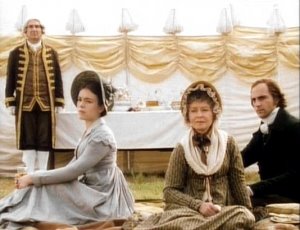
…though sadly lacking Mr. Knightley… [Mark Strong above in the Kate Beckinsdale Emma]

Click here for the previous post on our event:  “Austen / Adams: Journeys with Jane & Abigail.”

[Posted by Deb]

Jane Austen · News · Publishing History

Sold! On the Block: Brock’s Illustrations for ‘Persuasion’

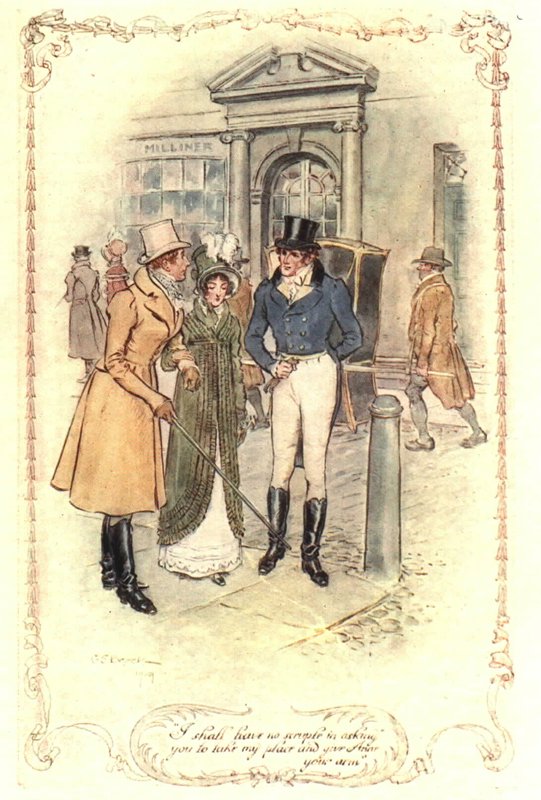
Sold at Christie’s London on June 2nd:  14 of C.E. Brock’s illustrations for Persuasion [plus J.M. Dent’s file copy of the 1909 edition of the novel!]


“I shall have no scruple in asking you to take my place, and give Anne your arm” ~ Volume II, Chapter XI (23)  [illustration from Molland’s]

Lot Description

BROCK, Charles Edmund, R.I. (1870-1938). A series of fine ink and watercolour drawings for Jane Austen’s Persuasion, 1909.

14 pen and ink and watercolour drawings including one for the title-page (most c.280 x 180mm) on paper (390 x 270mm), and later mounted on card. Provenance: J.M. Dent and Co. (sold, part lot 769, 19 June 1987, £33,000).

14 ORIGINAL DRAWINGS FOR AUSTEN’S PERSUASION published by J.M. Dent and Co. in 1909. Together with J.M. Dent and Co.’s stamped file copy, in the original cloth, of a 1909 edition of Persuasion in which the drawings were published. (15)

Estimate:   £7,000 – £9,000  ($10,108 – $12,996)   

Price Realized:   £10,000 ($14,710) [Price includes buyer’s premium]

Sale Information:  Christie’s Sale 7854 ,Valuable Manuscripts and Printed Books , 2 June 2010 , London, King Street

Click here for further information.

There are 23 illustrations + the title page in this edition of Persuasion, so this is not a complete lot – but still I would have been happy to add all this to my Austen collection! 

Further Reading:

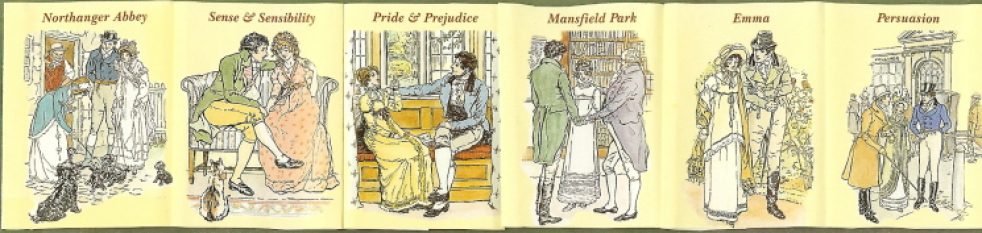
*Visit Molland’s to view all of Brock’s illustrations: [these links are under “e-texts”]

Illustrations for Sense and Sensibility
Illustrations for Pride and Prejudice
Illustrations for Mansfield Park
Illustrations for Emma
Illustrations for Northanger Abbey
Illustrations for Persuasion

*Visit Pemberley.com for more information on C.E. Brock.
*Keiko Parker’s
“Illustrating Jane Austen” in Persuasions 11 (1985)
*
Jane Austen’s World Blog on the Brock brothers


[Posted by Deb]